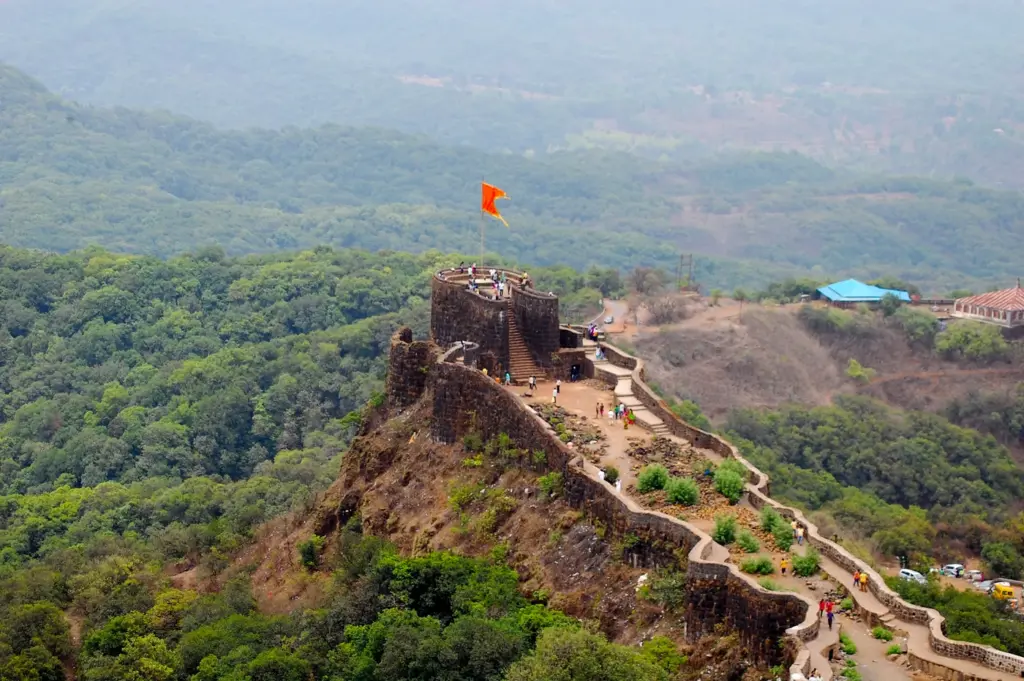
Pratapgad Fort is a hill fort in Satara district of Maharashtra, about 21 km from Mahabaleshwar on the road down to Mahad, built in 1656 on the orders of Shivaji. It’s remembered for one afternoon: on 10 November 1659, on the slope below this fort, Shivaji met the Bijapur general Afzal Khan, and the meeting ended with Afzal Khan dead and his army scattered through the forest. Since 11 July 2025 the fort has also been one of the twelve components of the Maratha Military Landscapes of India, a UNESCO World Heritage Site.
Most people carry Pratapgad as a single film scene, a giant general locked in a fatal embrace with a steel claw hidden in the other man’s hand. The fort came first, three years before that scene. The killing happened below the walls, not inside them. And the weapon everyone remembers is the one detail the old sources don’t agree on, which is why a claw loaned from London in 2024 went on display with a disclaimer beside it.
Where Pratapgad is and what it is known for
Pratapgad sits on a spur of the Mahabaleshwar hills in the Western Ghats, 3,543 feet above sea level, commanding the road between the villages of Par and Kineshwar. On the west and north the hill falls away in cliffs toward the Konkan. On the east and south the slopes are gentler and were thickly wooded, and that forest is why the 2025 nomination classes Pratapgad, alone among its twelve forts, as a hill-forest fort.
| Fact | Detail |
|---|---|
| Location | Satara district, Maharashtra; about 21 km from Mahabaleshwar on the Mahad road |
| Built by | Shivaji; construction carried out by Moropant Trimbak Pingle |
| Built in | 1656 |
| Type | Hill-forest fort in two tiers (upper and lower fort), 3,543 feet above sea level |
| Defining event | Shivaji’s meeting with Afzal Khan of Bijapur on the slope below the fort, 10 November 1659 |
| Later holders | Maratha kingdom and Peshwa-era garrison; surrendered to the British in 1818 |
| Protection status | State protected by the Directorate of Archaeology and Museums, Government of Maharashtra |
| UNESCO status | Inscribed 2025 as component 1739-007 of the Maratha Military Landscapes of India |
| Known for | The Afzal Khan encounter, the Bhavani temple and Afzal Khan’s tomb below the fort |
Why Shivaji built Pratapgad in 1656
The short answer is Javli. In 1656 Chhatrapati Shivaji Maharaj took the Javli valley from the More family, after a campaign that ended with the killing of its chief, Yeshwantrao More. The Mores’ lands held the forested passes between the Deccan and the Konkan, and holding a valley isn’t the same as holding the roads through it. So Shivaji picked a high rock near the source of the Krishna and ordered a fort built on it.
The Satara gazetteer, following Grant Duff, gives the purpose in plain terms. The new fort secured Shivaji’s access to his lands on the banks of the Nira and the Koyna, and it strengthened the defenses of the Par pass, the road that climbs from Mahad in the Konkan toward Wai and Mahabaleshwar. A fort above a pass works like a gate above a staircase. It doesn’t need to win a battle in the open; it only needs to make the climb too costly for anyone it doesn’t want on the stairs.
The work went to Moropant Trimbak Pingle (the gazetteers also write Moro Trimal Pingle), whom the Satara gazetteer calls “the famous Brahman minister”. He had shortly before been given command of Purandar, and the gazetteer says the way he raised Pratapgad confirmed Shivaji’s good opinion of him. The name is simple enough: gad is Marathi for fort.
What happened below Pratapgad on 10 November 1659
The direct answer: a truce meeting between Shivaji and Afzal Khan, held in a tent on the slope below the fort, ended with Afzal Khan killed and his army routed by Maratha troops waiting in the forest. The outline isn’t in dispute. The details are, and the details are where the exam and the public argument both live.
The background explains the stakes. By 1659 the court of Bijapur wanted Shivaji subdued, and Afzal Khan, who had governed the Wai district for Bijapur from 1649 and knew this country well, volunteered to lead the expedition. Estimates of his army run from about 10,000 horse in Jadunath Sarkar’s account to 20,000 men in Encyclopaedia Britannica. His army marched in September 1659 by way of Pandharpur toward Wai, and Shivaji withdrew to Pratapgad and sent messages of submission.
That choice of ground was the plan. In Britannica’s words, Shivaji enticed the force deep into difficult mountain terrain, and the Satara gazetteer notes that the Bijapur troops reached Javli only with great labor.
The record historians agree on
Strip away the retellings and a solid core remains, supported by the Satara gazetteer, Britannica and the Victoria and Albert Museum’s own catalog entry:
- The meeting was a negotiated truce, held in a decorated tent about halfway up the ascent to the fort.
- Both men came armed, and Shivaji wore mail under his clothes and a steel cap under his turban.
- Afzal Khan was killed at the meeting.
- At a signal from the fort, troops under Netaji Palkar and Moropant, posted in the forest in advance, fell on the Bijapur army and routed it.
- Shivaji came away with the army’s horses and guns, and Britannica’s verdict is that overnight he had become a formidable warlord.
The consequence matters more than the scene. Within a few years the Mughal emperor Aurangzeb was sending his own viceroy against Shivaji, which tells you how much 1659 had changed the scale of the contest.
Where the accounts divide
The live question is who struck first. Grant Duff, the East India Company officer who wrote his History of the Mahrattas in 1826 after serving as Resident at Satara, told it as the murder of an invited guest: Shivaji struck during the embrace. The old Maratha chronicles, including Sabhasad’s bakhar of 1697, say Afzal Khan struck first. The Satara gazetteer’s retelling has him pin Shivaji’s neck under his arm and drive a dagger that scraped off the hidden mail.
Jadunath Sarkar settled the question as far as the evidence allows. He set the chronicles beside an English factory letter from Rajapur dated 10 December 1659, written a month after the meeting by men with no stake in the quarrel, which says Bijapur had instructed Afzal Khan to secure Shivaji by “pretending friendship”. Sarkar concluded that Afzal Khan meant treachery and that Shivaji, knowing it, came prepared.
Here’s why Sarkar’s verdict carries weight. He was no apologist. In the same book he called the taking of Javli three years earlier “deliberate murder and organized treachery” on Shivaji’s part, and he pointed out that the old chroniclers who blamed Afzal Khan were the same men who freely charged Shivaji with murder elsewhere. A historian who condemns one killing and clears another on evidence is doing history, not hagiography.
The wagh nakh question
A wagh nakh, literally “tiger claw”, is a steel weapon of curved blades on a bar with rings for two fingers, small enough to hide in a half-closed hand. The story that Shivaji used one comes from Sabhasad, and Grant Duff repeated it. The Satara gazetteer notes that the Shiva Bharat, a poem written in Shivaji’s lifetime, doesn’t support the claw story, and the gazetteer’s own narrative has Shivaji strike with a bichwa, a curved dagger, and then the sword. Sarkar, for his part, distrusted the Shiva Bharat as romance. So the weapon is the least certain part of a well-attested event, and it’s also the part that ended up in a museum case.
Pratapgad after 1659: temple, prison and surrender
In the rains of 1661, unable to make the journey to the goddess’s great shrine at Tuljapur, Shivaji dedicated a temple to Bhavani on Pratapgad. The temple stands on the eastern side of the lower fort: a hall rebuilt in modern times and a stone shrine with a black stone image of the goddess. A lead covering on the roof was added by Raja Pratapsinh of Satara, who ruled from 1818 to 1839.
The fort’s later career tracks the arc of the Maratha Empire from Shivaji’s kingdom to the Peshwa’s court at Pune. In 1778 the Poona minister Sakharam Bapu was confined here by his rival Nana Phadnavis and moved from fort to fort until he died at Raigad. In 1796 Nana himself, escaping the intrigues around Daulatrao Shinde, threw a strong garrison into Pratapgad on his way to the Konkan.
The end was quiet. In the war of 1818 Pratapgad surrendered to the British by private negotiation, even though the gazetteer records it as an important stronghold with a large garrison. A fort that had been built to shut a pass was handed over without a siege, which says more about the collapse of Peshwa authority that year than about the walls.
How Pratapgad’s defenses work, from an attacker’s side
Pratapgad is two forts stacked on one hill, and the 1842 British inspection report quoted in the Satara gazetteer lets you walk it the way an attacker would have had to. The two parts are:
- The upper fort, on the crest, about 200 yards by 200, with permanent residences and a temple of Mahadev.
- The lower fort, about 350 yards by 120, wrapped around the east and south of the hill below it, holding the Bhavani temple.
Start with the direction you can’t use. The west and north faces are cliffs with a near-vertical drop of seven or eight hundred feet in places. No one assaults those. On the south, the towers and bastions rise thirty to forty feet above a scarp, a face of bare rock cut or left nearly vertical at the foot of the wall, that is almost as high again.
That leaves the east, and the east is where the builders set their trap. The one approach that wasn’t strongly guarded crossed easy ground, fit for a mortar battery, and led toward a tower at the end of an outwork, a defensive wall thrown out beyond the main line to control the ground in front of it. This is the tower that carries Afzal Khan’s name. The gazetteer says the outwork was said to have been added by Shivaji after 1659, and local tradition holds that Afzal Khan’s head is buried beneath it.
Now climb. From the tower, the path runs up a steep rugged track along the south side of the outwork, and the outwork’s walls overlook it the whole way. Every step up is taken with your flank exposed to defenders firing down. At the top the entrance squeezes between two strong towers with a gap of no more than four feet, closed by a double gate. Four feet is two men abreast at most, so however large the attacking column, only its front rank can ever fight.
Pause on that. The walls themselves weren’t impressive: the 1842 report found the parapet slight and the rampart only three feet broad. The strength lay in geometry. Cliffs close two sides and forest slows the third. The fourth is turned into a narrow, overlooked gallery.
The same report flags the weak point too. Between the lower and upper forts there were two entrances, and the one at the north-east corner was a mere opening between two towers, very weak but for the precipice outside. The builders leaned on the hill wherever they could, and here the hill was all there was.
Pratapgad today: UNESCO, protection and the disputes
Pratapgad was inscribed on the World Heritage List on 11 July 2025, at the 47th session of the World Heritage Committee in Paris, as one of the twelve forts of the Maratha Military Landscapes of India, India’s 44th World Heritage property. The UNESCO listing treats the twelve as a single serial property, and Pratapgad is component 1739-007, covering 79.3 hectares with a buffer zone of 12,789.51 hectares. The site’s current-affairs note on the inscription covers the full set, and it sits alongside the rest of India’s list in the UNESCO World Heritage Sites in India guide.
The property was inscribed under two criteria. In plain words:
- Criterion (iv) recognizes the forts as an outstanding example of a type of building ensemble, here Maratha fortification fitted to very different ground, from Sahyadri hilltops to islands off the Konkan.
- Criterion (vi) recognizes a direct association with events and living traditions of outstanding universal significance.
Pratapgad is one of the four components that the Archaeological Survey of India does not look after. It’s protected by the state’s Directorate of Archaeology and Museums, which looks after three other forts in the listing, while the remaining eight are ASI monuments.
Memory has been built onto the hill as well. A bronze equestrian statue of Shivaji, 17 feet high on a 20-foot base, was inaugurated by Prime Minister Jawaharlal Nehru on 30 November 1957, the same year a road was taken up to the main gate. Below the fort, to the south-east of the tower that carries his name, stands the dargah of Afzal Khan, where an annual urs has been held.
That tomb became a legal matter. On 10 November 2022, the 363rd anniversary of the encounter, the Satara district administration demolished unauthorized structures and encroachments around it, acting on a removal order the Bombay High Court had passed in 2007. The next day the Supreme Court asked the Satara Collector and the Deputy Conservator of Forests to file reports, after the state told the court the drive was already over.
The wagh nakh returned as a museum loan. The Victoria and Albert Museum in London agreed to lend its steel tiger claws to Maharashtra for three years, and they went on display from 19 July 2024 at the Chhatrapati Shivaji Maharaj Museum in Satara, with later venues planned in other cities. Within a week the museum had put up a board saying it’s not possible to verify that the object is the one Shivaji used, and historian Indrajit Sawant had been arguing the same.
The museum’s own record explains the doubt, and it’s a fine lesson in provenance. The claws belonged to James Grant Duff, Resident at Satara from 1818. Their fitted case was made only after he returned to Scotland in 1823, and its inscription calls Afzal Khan “the Moghul General”, though he served Bijapur. Other claws with the same claimed provenance were recorded in the Satara royal collection long after Grant Duff left, and the Satara gazetteer notes that Raja Pratapsinh gave a set to Elphinstone in 1827. A label is not a history.
How to study Pratapgad for exams
Pratapgad sits at three points in the syllabus, and a question can enter from any of them:
- Medieval history, through the rise of Shivaji and the Maratha-Bijapur conflict.
- Art and culture, through the 2025 World Heritage list and Maratha fort typology.
- Historiography, because the Afzal Khan debate is a clean example of weighing chronicles against contemporary documents.
The history angle is asked in exactly this shape. History Optional 2026 Paper I set the question “Trace the trajectory of Maratha polity from Shivaji to Peshwa Balaji Baji Rao. What was the impact of the Third Battle of Panipat (1761) on the Maratha State? Analyze.” Pratapgad compresses the first half of that arc onto one hill, from a fort Shivaji raised in 1656 to a state prison of the Peshwa’s ministers in 1778.
History Optional 2024 Paper I came at it from the military side: “How did the Maratha guerrilla warfare tactics contribute to their military successes against larger and more established armies?” The 1659 campaign is the model example, a larger Bijapur army drawn into the Javli forest and routed by troops posted there in advance.
On the Prelims side, 94 of the 1,403 questions from 2013 to 2026 in our Prelims question bank are tagged art and culture, about one in fifteen, and typology and protection details like those in the table below are what the options get built from.
The facts worth carrying into revision:
- Built in 1656 for Shivaji by Moropant Trimbak Pingle, after the conquest of Javli, to guard the Par pass.
- The Afzal Khan meeting was on 10 November 1659, in a tent below the fort, not inside it.
- The Bhavani temple was dedicated in 1661, as a substitute for the journey to Tuljapur.
- The 2025 nomination calls it the only hill-forest fort among the twelve components.
- It is state protected, not an ASI monument, and it is UNESCO component 1739-007.
- The Rajapur factory letter of 10 December 1659 is the contemporary document behind Sarkar’s verdict.
The common confusions are easy to keep apart once you name them. The spelling wobbles between Pratapgad and Pratapgarh; even the 2025 PIB release uses both. The fort predates the encounter by three years, so any option calling it a victory memorial is wrong. And Afzal Khan was a Bijapur general, not a Mughal one, whatever the London case says.
It also helps to see Pratapgad beside its siblings in the 2025 listing, since options often mix up typology and protection. For contrast outside the Maratha system, Daulatabad Fort shows a very different answer to the same problem: a citadel whose builders cut its hill into a sheer face instead of borrowing a forest.
| Fort | Terrain type in the 2025 nomination | Protected by | One anchor fact |
|---|---|---|---|
| Pratapgad | Hill-forest fort | State Directorate of Archaeology and Museums | Afzal Khan encounter, 1659 |
| Raigad | Hill fort | ASI | Shivaji’s capital; enthroned there in 1674 |
| Lohagad | Hill fort | ASI | Taken 1648, ceded 1665, retaken 1670 |
| Panhala | Hill-plateau fort | ASI | Where Bijapur besieged Shivaji and he escaped |
| Sindhudurg | Island fort | ASI | One of three island forts in the listing |
Pratapgad rewards the aspirant who treats it as evidence rather than spectacle. The fort teaches how terrain did the work of walls, and the encounter teaches how to hold an agreed record apart from a disputed detail. Carry both habits into any heritage question and the answer writes itself with more authority than any retelling of the embrace.
Frequently Asked Questions
Who built Pratapgad Fort?
Pratapgad Fort was built in 1656 on the orders of Chhatrapati Shivaji Maharaj. The construction was carried out by Moropant Trimbak Pingle, whom the gazetteers also call Moro Trimal Pingle. Shivaji wanted it to guard the Par pass and his newly won Javli valley.
Where is Pratapgad Fort located?
Pratapgad Fort is in Satara district of Maharashtra, about 21 km from Mahabaleshwar on the road to Mahad. It stands on a spur of the Mahabaleshwar hills in the Western Ghats, 3,543 feet above sea level. Its cliffs face the Konkan to the west.
What happened at Pratapgad in 1659?
On 10 November 1659 Shivaji met Afzal Khan, a general of the Bijapur sultanate, at a truce meeting in a tent below the fort. Afzal Khan was killed at the meeting and Maratha troops hidden in the forest then routed his army. The event turned Shivaji from a local rebel into a major power in the Deccan.
Did Shivaji use a wagh nakh to kill Afzal Khan?
The old Maratha chronicle of Sabhasad says he did, and Grant Duff repeated the story in 1826. The Satara gazetteer notes that the Shiva Bharat, a poem from Shivaji’s lifetime, doesn’t support the claw story, and its own account has Shivaji use a curved dagger and a sword. Historians agree on the killing itself, but the exact weapon remains the least certain detail.
Is Pratapgad Fort a UNESCO World Heritage Site?
Yes. Pratapgad was inscribed on 11 July 2025 as one of the twelve components of the Maratha Military Landscapes of India, under criteria (iv) and (vi). Its component number on the UNESCO list is 1739-007.
Is Afzal Khan’s tomb at Pratapgad?
Yes, the dargah of Afzal Khan stands below the fort, to the south-east of the tower named after him. On 10 November 2022 the Satara administration removed unauthorized structures around the tomb under a 2007 Bombay High Court order. The Supreme Court then sought reports from the district authorities.
Which temple is inside Pratapgad Fort?
The best known is the Bhavani temple in the lower fort, which Shivaji dedicated in 1661 when he couldn’t travel to the Tuljapur shrine. The upper fort also has a temple of Mahadev. The Bhavani temple’s lead roof covering was added by Raja Pratapsinh of Satara.
Who protects Pratapgad Fort, the ASI or the state?
Pratapgad is protected by the Directorate of Archaeology and Museums of the Government of Maharashtra, not by the Archaeological Survey of India. It is one of four state-protected forts among the twelve components of the 2025 World Heritage listing.
Practice Questions
Prelims
1. Consider the following statements about Pratapgad Fort:
1. It was built after the death of Afzal Khan to commemorate Shivaji’s victory.
2. Its construction is credited to Moropant Trimbak Pingle.
Which of the statements given above is/are correct?
- (a) 1 only
- (b) 2 only
- (c) Both 1 and 2
- (d) Neither 1 nor 2
Answer: (b) Pratapgad was built in 1656, three years before the 1659 encounter, by Moropant Trimbak Pingle.
2. In the 2025 nomination of the Maratha Military Landscapes of India, Pratapgad is classified as a:
- (a) Hill-plateau fort
- (b) Coastal fort
- (c) Hill-forest fort
- (d) Island fort
Answer: (c) Pratapgad is the only component classed as a hill-forest fort; Panhala is the hill-plateau fort.
3. Consider the following statements about the Maratha Military Landscapes of India:
1. The property was inscribed under criteria (iv) and (vi).
2. All twelve components lie in Maharashtra.
3. Pratapgad is protected by the Archaeological Survey of India.
Which of the statements given above is/are correct?
- (a) 1 only
- (b) 1 and 2 only
- (c) 2 and 3 only
- (d) 1, 2 and 3
Answer: (a) Gingee Fort is in Tamil Nadu, and Pratapgad is protected by Maharashtra’s Directorate of Archaeology and Museums.
4. The contemporary English factory letter that Jadunath Sarkar used to judge the Afzal Khan episode was written at:
- (a) Surat
- (b) Rajapur
- (c) Bombay
- (d) Madras
Answer: (b) The Rajapur letter of 10 December 1659 says Afzal Khan was told to secure Shivaji by pretending friendship.
5. Consider the following pairs:
1. Pratapgad : Satara district
2. Bhavani temple at Pratapgad : dedicated in 1661
3. Afzal Khan : general of the Mughal Empire
Which of the pairs given above is/are correctly matched?
- (a) 1 only
- (b) 1 and 2 only
- (c) 2 and 3 only
- (d) 1, 2 and 3
Answer: (b) Afzal Khan served the Adil Shahi sultanate of Bijapur, not the Mughals.
Mains
- “Pratapgad relied on terrain more than on the thickness of its walls.” Discuss with reference to the layout and approaches of the fort. (10 marks, 150 words)
- Evaluate the sources for the killing of Afzal Khan in 1659. What does the debate teach about weighing later chronicles against contemporary documents? (15 marks, 250 words)
- “A museum label is not a history.” Examine this statement with reference to the wagh nakh loaned to Maharashtra in 2024. (10 marks, 150 words)
- The 2025 inscription of the Maratha Military Landscapes of India treated terrain itself as heritage. Discuss the significance of serial nominations, using Pratapgad as an example. (15 marks, 250 words)
- Safeguarding the Indian art heritage is the need of the moment. Discuss. (10 marks, 150 words) Previous year: Mains 2018, GS Paper I.
Tell Google you want more of this.
Add Anantam IAS as a preferred sourceOne tap, and this site shows up more often in your own Top Stories, AI Overviews and AI Mode. Remove it any time.