
In June 2025, the Kerala Forest Minister wrote yet again to the Ministry of Environment, Forest and Climate Change asking the Centre to declare wild pigs as vermin for at least six months across the state. The request arrived after years of mounting farmer complaints, repeated crop losses across plantation belts, and a small but politically charged tally of human casualties in encounter incidents. It also arrived against a backdrop of legal complexity. The wild boar is a Schedule III species under the Wildlife Protection Act, 1972, which means it cannot simply be hunted. To allow culling for a defined period, in a defined area, the species has to be declared vermin.
That mechanism, set out in Section 62 of the Wildlife Protection Act, is the focus of this guide. The vermin declaration is one of the more contested instruments in Indian wildlife law. It sits at the intersection of agrarian distress, biodiversity policy, and federal coordination between state forest departments and the Centre. It has been invoked sparingly. When it is invoked, it triggers public debate that draws in farmers, ecologists, and animal-welfare litigators in roughly equal measure.
For UPSC, the topic surfaces in prelims through provisions of the Wildlife Protection Act and in mains as part of the broader human-wildlife conflict question. This guide walks through the legal grounds, the seven-step procedure, the institutional roles, the recent Indian cases, and the way forward.
Quick Facts
- Governing law: Wildlife (Protection) Act, 1972
- Section: 62 (declaration of vermin)
- Notifying authority: Central Government (MoEFCC)
- Proposal originator: State or Union Territory Government
- Scientific assessor: Wildlife Institute of India and State Forest Department
- Legal effect: Species temporarily moved to Schedule V (vermin)
- Duration: Specified period in the gazette notification, area-bounded
- Excluded: Species in Schedule I and Part II of Schedule II
- Common candidates: Wild boar, nilgai, rhesus macaque, wild elephant (rejected)
- Recent active states: Kerala, Bihar, Uttarakhand, Himachal Pradesh
- Ground for declaration: Crop damage, livestock threat, human safety, public health, livelihood conflict
- Post-notification action: State carries out controlled culling
- Status expiry: Automatic at end of notified period
What Is Vermin under the Wildlife Protection Act
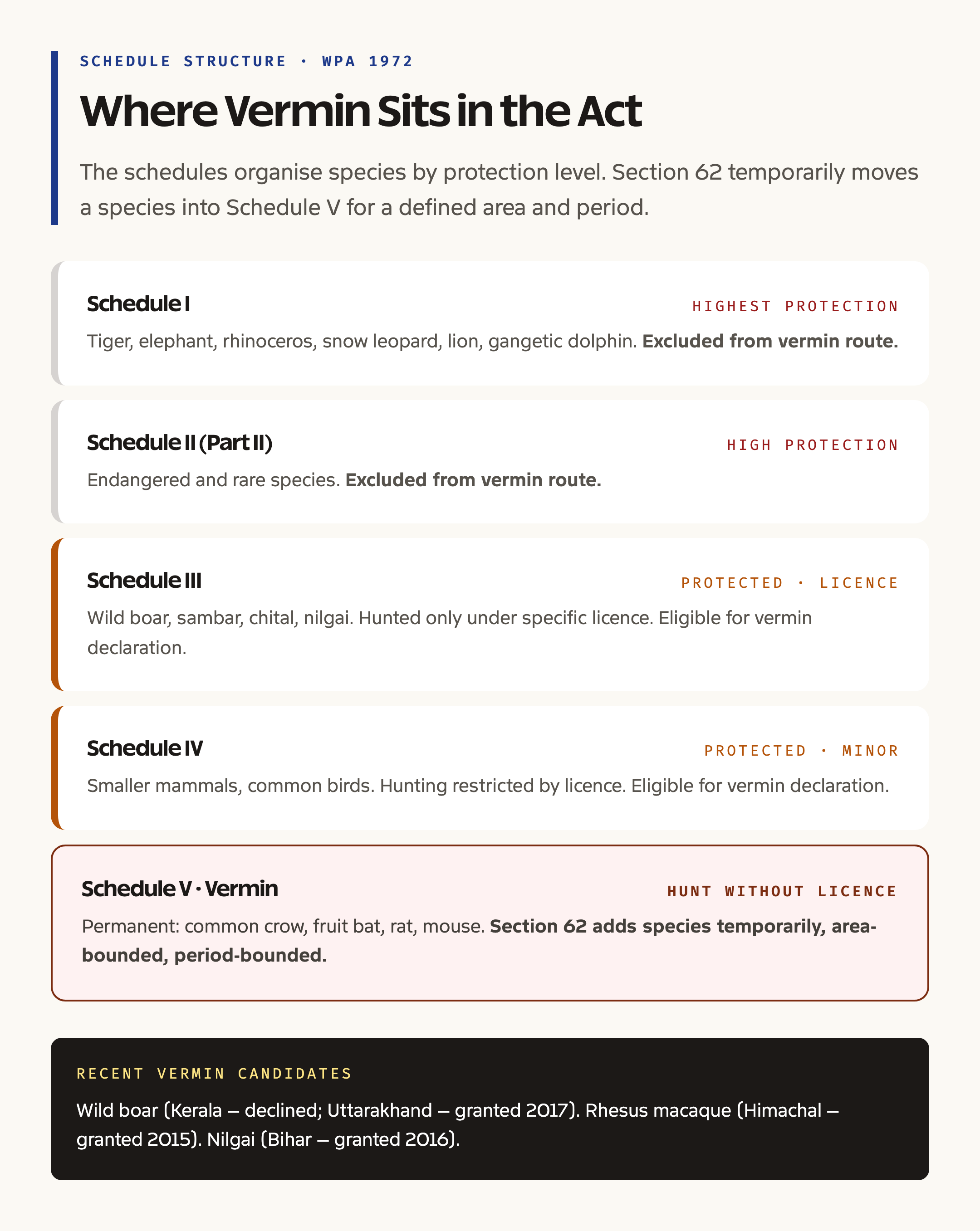
The Wildlife Protection Act, 1972, organises species into schedules based on the degree of legal protection. Schedule I and Part II of Schedule II carry the highest protection. Schedule III and Schedule IV cover species that may be hunted only under specific licences and conditions. Schedule V is the vermin schedule. It traditionally lists a small number of species, including the common crow, the fruit bat, the rat, and the mouse, that may be hunted without licence and at any time. After the 2022 amendment, the schedules were rationalised but Section 62 remains the operative provision.
A vermin declaration under Section 62 temporarily moves a species into the Schedule V status for a defined area and a defined period. The species does not lose its core protection elsewhere. Once the notified period ends, the protected status returns automatically, with no further notification required. The mechanism is therefore narrowly tailored: it does not de-list a species from the Act’s protection schedules, it only carves out a localised exception.
The legal premise of vermin declaration is that wildlife protection is not absolute. When a species’s population in a particular area, in interaction with human land use, threatens crops, livestock, public health, or human life, the State has the constitutional and statutory authority to manage that population through controlled action. The vermin route is one of three culling pathways available to a state government. The other two are individual hunting permits under Section 11 (for problem animals declared dangerous) and broader management plans under approved zoning frameworks.
Background and Historical Context
Section 62 has been in the Wildlife Protection Act since the original 1972 enactment, but its use has fluctuated with political and ecological pressure. Through the 1970s and 1980s, vermin declarations were rare and uncontroversial, focused on rodents and small species in agricultural belts. The shift came in the 2010s as crop damage from larger species rose to political prominence in several states.
The first major modern invocation came in 2015, when the Centre declared the rhesus macaque as vermin in Himachal Pradesh for a one-year period in select districts. The declaration was contentious. Animal-welfare groups argued that the population estimates underpinning the proposal were unreliable. The state cited mounting crop losses in apple orchards. The macaque vermin notification was renewed once and then allowed to lapse.
In the same period, similar declarations covered wild boar in Uttarakhand, the nilgai in parts of Bihar, and the rhesus macaque in Delhi for a brief window. Each declaration triggered litigation, parliamentary questions, and public debate. By the late 2010s, the Centre had become more circumspect, and several state proposals were either pending review or had been returned to the state for additional data.
The 2022 amendment to the Wildlife Protection Act restructured the schedules and brought the Act into closer alignment with CITES, but it did not alter the core architecture of Section 62. The procedure remained as it had been since 1972, although the standard of evidence expected by MoEFCC has informally tightened. State proposals are now expected to carry detailed population estimates, crop-damage data, and a clear case for why non-lethal management has failed.
Grounds for Declaration
The Act does not enumerate the grounds in a closed list, but four broad categories have crystallised through practice. Significant crop damage is the most frequent ground. A state must show systematic loss across a contiguous agricultural area, supported by panchayat records, agricultural department surveys, or insurance claims. The threshold is not statutory. It is a question of administrative judgment.
Threat to livestock is the second ground. This applies most often to predator species in pastoral or peri-urban contexts, although such species are typically Schedule I and therefore excluded from the vermin route. Threat to human life or safety is the third ground, used in cases where a species causes repeated injury or death to people, particularly in tribal or rural belts where avoidance is difficult.
Serious public health concerns, the fourth ground, applies when a species acts as a disease reservoir or vector. The classic case is the fruit bat in zoonotic-disease outbreaks, although fruit bats are already in Schedule V. Conflict impacting local livelihoods is sometimes treated as a fifth ground, particularly in plantation belts where crop damage cuts into household income at scale.
The four grounds are not mutually exclusive. Most state proposals invoke two or more, building a cumulative case for the declaration. The MoEFCC review weighs the grounds against the conservation status of the species, the availability of non-lethal alternatives, and the precedent value of the decision.
The Seven-Step Procedure
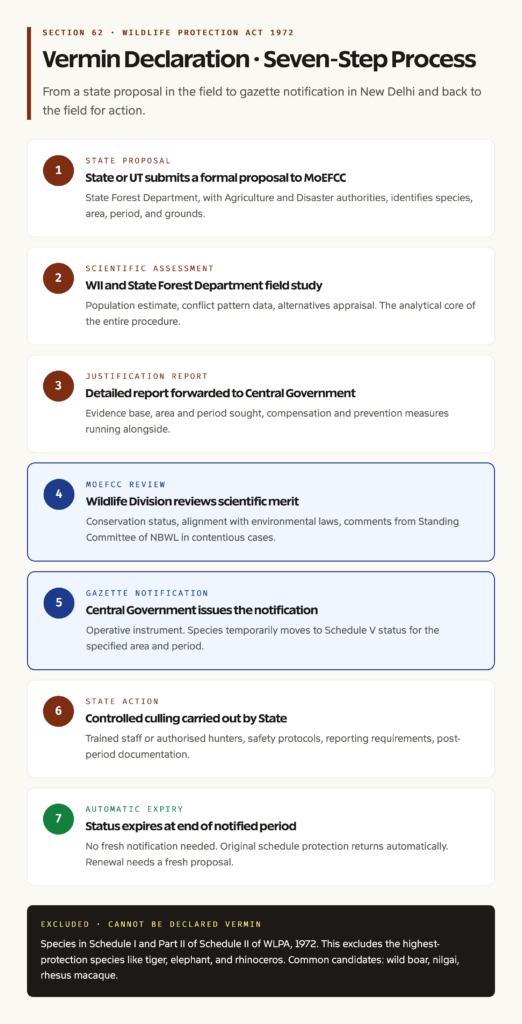
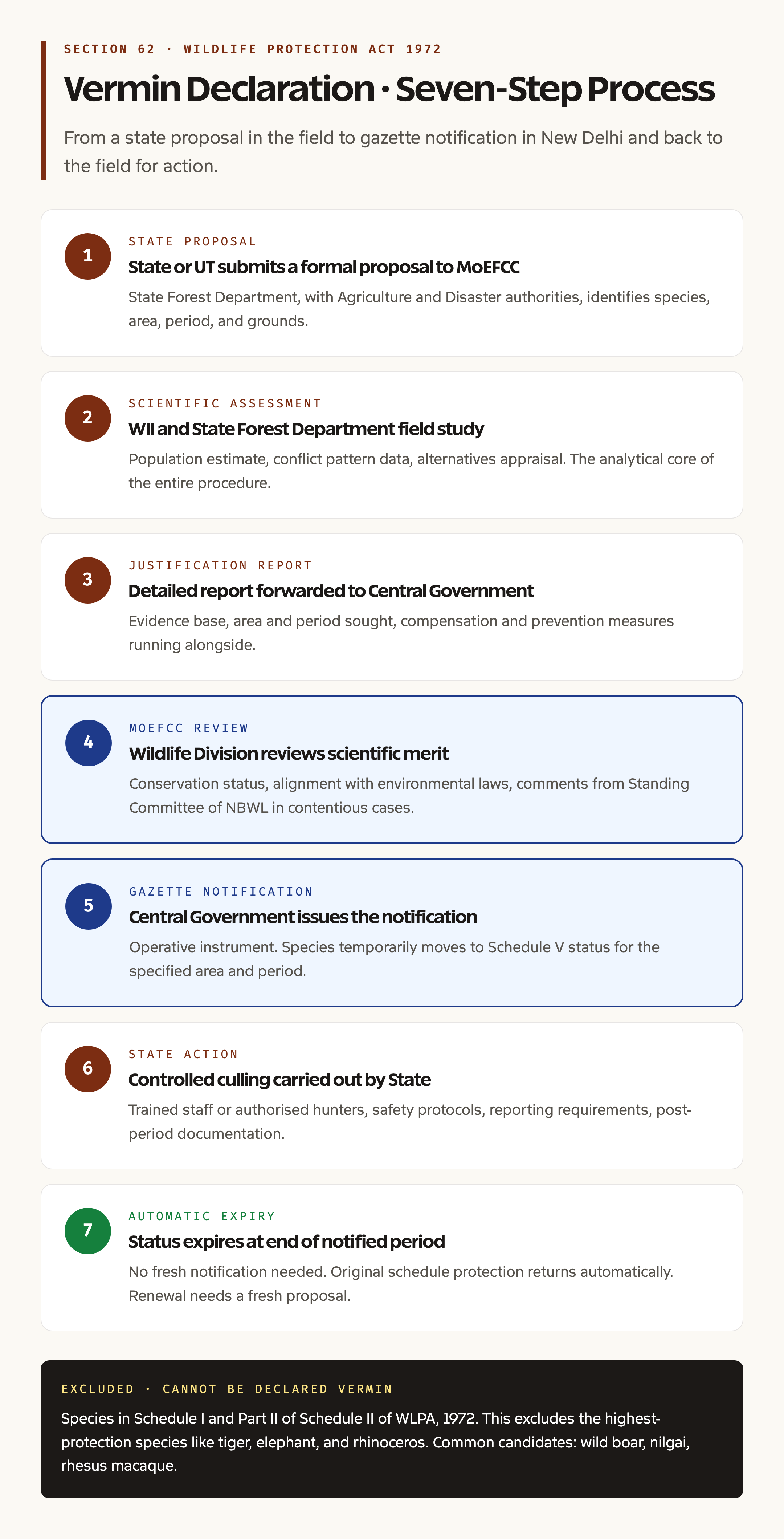
The vermin declaration process under Section 62 is structured as a seven-step procedure that runs from a state proposal to gazette notification and post-period expiry.
Step 1 — State Proposal. The concerned State or Union Territory government submits a formal proposal to the MoEFCC. The proposal originates with the State Forest Department in coordination with the State Agriculture Department and the State Disaster Management Authority. It identifies the species, the area, the proposed duration, and the grounds.
Step 2 — Scientific Assessment. The Wildlife Institute of India and the State Forest Department jointly assess the population, the conflict pattern, and the available alternatives. The assessment includes camera-trap data, line-transect surveys, agricultural-loss tallies, and public-grievance data. This step is the analytical core of the procedure.
Step 3 — Justification Report. Based on the assessment, the State forwards a detailed justification report to the Central Government. The report sets out the case for declaration, the evidence base, the area and period sought, and the compensatory measures that the State proposes to run alongside.
Step 4 — MoEFCC Review. The Centre reviews the proposal through the Wildlife Division of the MoEFCC. The review considers the scientific merit, the conservation status of the species, alignment with the environmental laws in India framework, and any comments from independent experts. The Standing Committee of the National Board for Wildlife may be consulted in contentious cases.
Step 5 — Gazette Notification. If the Centre is satisfied, it issues a Gazette Notification declaring the species as vermin for the specified area and period. The notification is the operative instrument. Until it is published, the species retains its existing schedule status.
Step 6 — State Action. Post-notification, the State Government carries out the management action. This typically involves controlled culling by trained staff or authorised hunters, with safety protocols and reporting requirements. The State must also document outcomes for the Centre’s post-period review.
Step 7 — Automatic Expiry. Once the notified period ends, the vermin status automatically expires. No fresh notification is required to restore the protected status. If the State seeks to extend the declaration, a fresh proposal must be submitted, with updated evidence.
Why It Matters
The vermin declaration matters at three levels. Legally, it is the principal mechanism by which Indian wildlife law accommodates the reality of human-wildlife conflict. Without Section 62, a State would have no instrument to authorise lethal management of a Schedule III species at population scale, even where conflict is acute.
Politically, the declaration has become a flashpoint between farmer constituencies, animal-welfare advocates, and conservation groups. State governments find themselves caught between agrarian voters demanding action and central authorities cautious about precedent. The political economy of the declaration is, therefore, not just a wildlife issue but a federal coordination issue.
Ecologically, the declaration carries real consequences for population dynamics. A species under sustained vermin status across multiple seasons can see local population reduction, shifts in age structure, and downstream effects on competing species. The Wildlife Institute of India has called for systematic post-action monitoring, although such monitoring is uneven across states.
Detailed Analysis: Recent Indian Cases
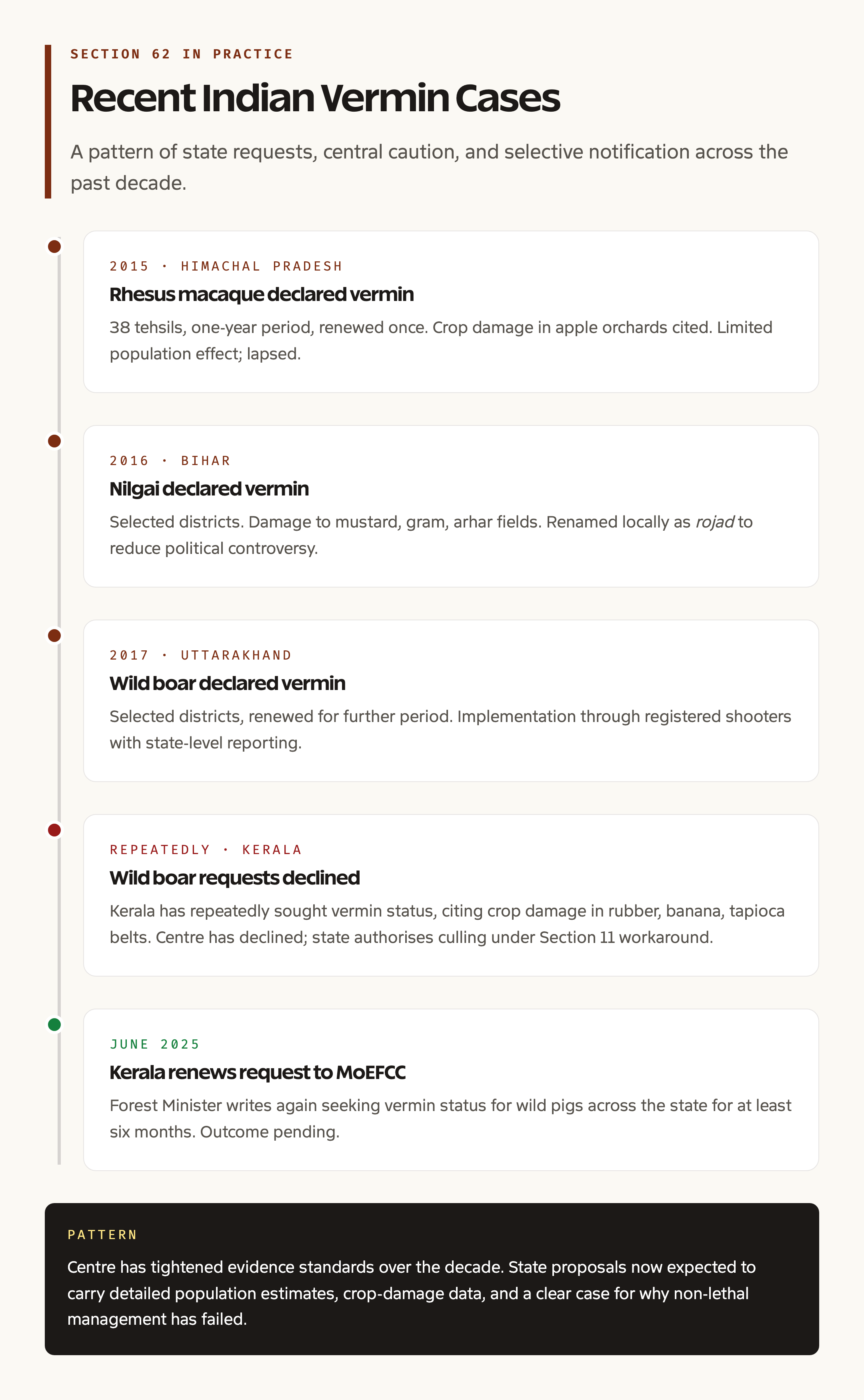
The wild boar question in Kerala is the most prominent recent case. The state has repeatedly sought vermin status, citing crop damage across rubber, banana, and tapioca belts. The Centre has declined the request multiple times, reasoning that the State has wider statutory options under Section 11 for problem-animal management. Kerala has responded by empowering local self-government bodies to authorise culling under modified Section 11 procedures, a workaround that has itself attracted litigation.
The rhesus macaque in Himachal Pradesh was declared vermin for a one-year period in 2015 across 38 tehsils, then extended once. The declaration was let to lapse without further extension. Studies suggested limited population reduction, in part because the macaque is highly mobile and the declaration covered only a fraction of its range.
The nilgai vermin notification in Bihar in 2016 covered selected districts for crop-protection purposes. The state cited damage in mustard, gram, and arhar fields. The declaration prompted political controversy, particularly over the use of the term gai in the species’s common name. Bihar later renamed the species rojad in vernacular usage, and the cull proceeded for the notified period.
The wild boar declaration in Uttarakhand covered selected districts in 2017 and was renewed for a further period. Implementation relied on registered shooters, with state-level reporting on numbers and locations.
Comparative Perspective
India’s vermin declaration mechanism is unusual in being centralised. Most countries with comparable wildlife laws, including the United Kingdom, Australia, and South Africa, devolve such declarations to provincial or state authorities. The United Kingdom’s General Licences under the Wildlife and Countryside Act, 1981, allow lethal control of a defined list of birds without a specific notification, on conditions of necessity and proportionality. Australia’s state-level pest-animal declarations operate similarly, with stronger emphasis on integrated management plans.
The Indian approach reflects the constitutional position of wildlife on the Concurrent List, with the Centre retaining policy primacy. It also reflects historical caution. India has a stronger animal-welfare jurisprudence than most peer countries, anchored in Article 51A(g) of the Constitution and reinforced through Supreme Court rulings, including the Animal Welfare Board of India v Nagaraja (2014) judgment.
Challenges and Issues
The vermin route faces several structural challenges. Data quality is the first. State proposals often rely on patchy crop-damage tallies, anecdotal incident reports, and population estimates of variable rigour. The MoEFCC review process is therefore tasked with adjudicating evidence that is itself contested.
Federal friction is the second challenge. State governments view repeated central rejections as bureaucratic obstruction. Central authorities view weak state evidence as cause for caution. This tension has, in cases like Kerala, pushed states to seek workarounds under Section 11 that risk legal exposure.
Animal-welfare litigation is the third challenge. Several vermin declarations have been challenged in High Courts and the Supreme Court, with mixed outcomes. The litigation has not overturned the architecture of Section 62 but has pushed both Centre and State towards more transparent, evidence-based procedures.
Compensation and prevention sit alongside lethal management as ongoing policy questions. Several states run crop-damage compensation schemes, electric fencing programmes, and community-based deterrence projects. Their effectiveness is patchy, and a robust evaluation framework is missing. The vermin declaration is therefore frequently invoked as a fallback rather than a managed first option.
Prelims Pointers
- Statute: Wildlife (Protection) Act, 1972, Section 62.
- Notifying authority: Central Government via MoEFCC.
- Excluded species: Schedule I and Part II of Schedule II.
- Effect: Temporary placement in Schedule V status (vermin).
- Duration: Specified period, area-bounded, automatic expiry.
- Scientific assessor: Wildlife Institute of India.
- Steps: State proposal → assessment → justification → MoEFCC review → gazette → state action → expiry.
- Common species: Wild boar, nilgai, rhesus macaque.
- Recent cases: Kerala wild boar (proposed), Himachal macaque (2015), Bihar nilgai (2016), Uttarakhand wild boar (2017).
- Workaround used: Section 11 problem-animal authorisation.
- Constitutional position: Wildlife is on the Concurrent List.
- Linked frameworks: NTCA, BNHS, Wildlife Crime Control Bureau.
Probable Mains Questions
- Critically examine the vermin declaration mechanism under Section 62 of the Wildlife Protection Act, 1972, in the context of human-wildlife conflict in India. (250 words)
- The repeated request from Kerala for vermin status for wild boar reflects deeper failures of human-wildlife coexistence policy. Discuss. (250 words)
- Compare the vermin declaration procedure in India with pest-control authorisation frameworks in selected federal democracies. (150 words)
Way Forward
The vermin declaration framework needs reform on several fronts. Standardised evidence protocols would reduce the friction between Centre and State. The Wildlife Institute of India should publish a binding methodology for population assessment, crop-damage quantification, and conflict pattern analysis. State proposals that follow the protocol should benefit from a faster review track.
Time-bound MoEFCC review would address the perception of central inaction. A statutory or administrative deadline for the review, with transparent reasons for rejection, would strengthen federal coordination. Integrated management plans combining lethal and non-lethal interventions should accompany every declaration. Vermin status alone, without compensation, fencing, and community engagement, has limited long-term effect.
Post-action monitoring must become standard. Every notified declaration should carry a monitoring plan, with population data, off-take records, and ecological impact assessments. The Wildlife Institute of India is best placed to coordinate this, drawing on the expanded research base of the tiger reserves in India network and the biosphere reserves in India framework.
Public communication is the final piece. The vermin declaration is a technical instrument that gets translated into political slogans on both sides. Clearer Centre-State communication on the basis, the limits, and the safeguards of each declaration would lower the temperature of public debate and ground policy in evidence rather than rhetoric.
Frequently Asked Questions
What does vermin status mean under the Wildlife Protection Act, 1972?
Vermin status, granted under Section 62, temporarily moves a species into the Schedule V protection level for a defined area and period. Within that area and period, the species may be hunted without the usual licence requirements. Outside the notified area or after the period ends, the species’s regular protected status returns automatically.
Which species can be declared vermin under Section 62?
Any species not listed in Schedule I or Part II of Schedule II of the Act may be declared vermin. This excludes the highest-protection species like the tiger, elephant, and rhinoceros. Common candidates include the wild boar, the nilgai, and the rhesus macaque, each of which sits in lower schedules.
Who initiates the vermin declaration process?
The concerned State or Union Territory government initiates the process by submitting a formal proposal to the Ministry of Environment, Forest and Climate Change. The State Forest Department is the operating agency, working in coordination with agriculture and disaster management authorities.
What is the role of the Wildlife Institute of India in this process?
The Wildlife Institute of India is the principal scientific assessor. It conducts or reviews the population assessment, the conflict-pattern analysis, and the alternatives appraisal. Its assessment forms the analytical core of the State’s justification report and the Centre’s review.
Can a vermin declaration be challenged in court?
Yes. Several declarations have been challenged in High Courts and the Supreme Court by animal-welfare groups and individual petitioners. The courts have not overturned the architecture of Section 62 but have insisted on transparent, evidence-based procedures and have struck down notifications where the evidence base was inadequate.
How long does a vermin notification last?
A vermin notification lasts for the period specified in the gazette notification. The period is finite. Once it ends, the vermin status expires automatically, with no further notification required. A State seeking to continue the declaration must submit a fresh proposal with updated evidence.
Why has Kerala’s wild boar vermin proposal been repeatedly declined?
The Centre has declined Kerala’s repeated wild boar proposals on grounds including the availability of alternative pathways under Section 11, concerns about precedent, and questions about the population evidence. Kerala has responded by authorising culling at the local self-government level under modified Section 11 procedures.
What is the difference between vermin declaration and Section 11 problem-animal authorisation?
Vermin declaration under Section 62 is a population-level instrument issued by the Centre for a species in a defined area for a defined period. Section 11 authorisation is an individual or local instrument issued by the Chief Wildlife Warden for a specific problem animal, typically in response to immediate threat to human life or property.
Has the 2022 amendment to the Wildlife Protection Act changed the vermin process?
The 2022 amendment restructured the schedules of the Act and brought it into closer alignment with the international CITES framework, but it did not alter the core architecture of Section 62. The procedure remains as set out in the original 1972 enactment, although administrative expectations on evidence have informally tightened.
What happens if a state government carries out culling without a vermin notification?
Culling without statutory authorisation is illegal under the Act. State officials and shooters can face prosecution. States therefore route lethal management either through Section 62 vermin notifications or through Section 11 problem-animal authorisations, both of which require formal procedures and documentation.
Tell Google you want more of this.
Add Anantam IAS as a preferred sourceOne tap, and this site shows up more often in your own Top Stories, AI Overviews and AI Mode. Remove it any time.





