The Wildlife Protection Act of 1972 sits at the centre of every conversation about conservation, hunting, and the sharp tension between rural livelihoods and animal protection in India. The latest flashpoint is the Kerala government’s repeated demand to relax the Act so that the wild boar, a Schedule II animal that has been damaging crops and occasionally injuring people, can be declared a vermin and culled at scale. The case is more than a state-level grievance. It tests the architecture of the Act, the meaning of the now-abolished Schedule V, the role of Section 62, and the way India balances protection of fauna with the costs that fauna sometimes impose on cultivators near forests.
For UPSC the topic offers material for both prelims and mains. Prelims questions on the Wildlife Protection Act now need command over the post-2022 schedule structure, the powers of the Centre to notify vermin, the difference between a Wildlife Sanctuary and a Conservation Reserve, and the species protected at each level. Mains questions on human-wildlife conflict, federalism in environmental governance, and the rights of forest-dwelling communities all return repeatedly to the WLPA. The 2022 amendment, which restructured the schedules and added a new chapter on international trade, has reset much of what older study material covered, so a contemporary read is essential.
This guide walks through the architecture of the Wildlife Protection Act, the precise meaning of vermin under Indian law, the procedure under Section 62, the ground reality of the wild boar problem, and the tools available to states that face large-scale crop damage.
Quick Facts at a Glance
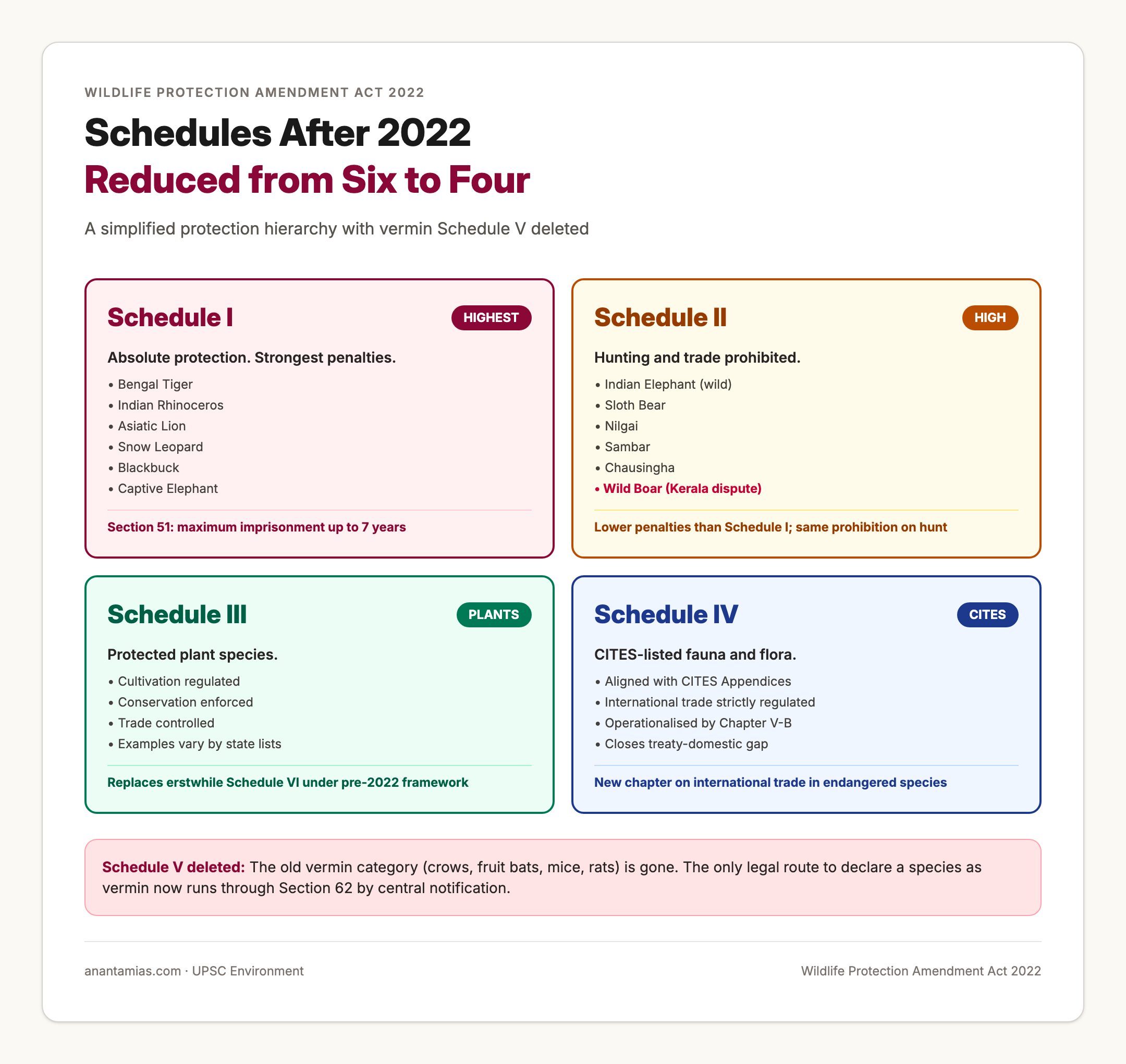
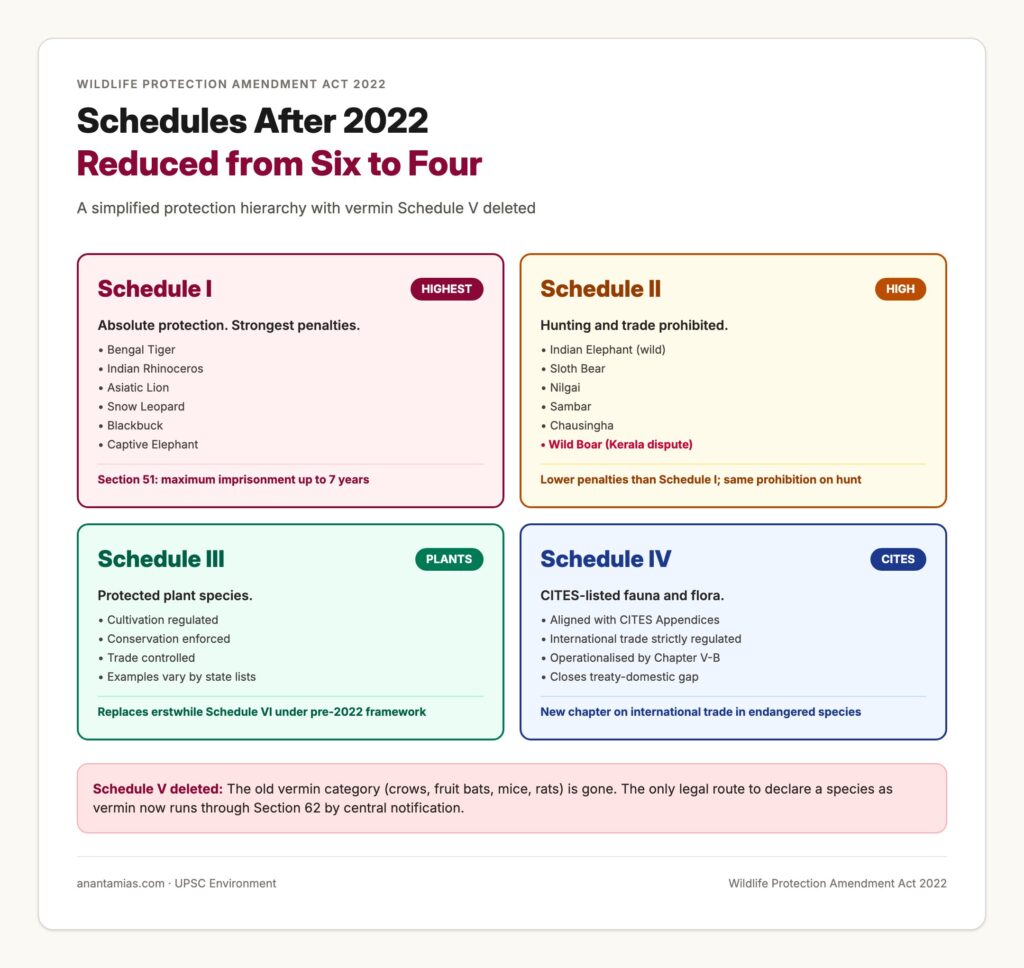
The Wildlife Protection Act 1972 is the umbrella legislation for wildlife conservation in India and applies to the whole country. After the Wildlife Protection Amendment Act 2022, the schedules have been reduced from six to four. Schedule V, the old vermin category, has been deleted, and the only path to declare a species as vermin now runs through Section 62 by way of central notification. Schedule I provides the highest level of protection, with species such as the Bengal Tiger, Indian Rhino, Asiatic Lion, Snow Leopard, and Blackbuck. Schedule II covers high-protection species such as the Indian Elephant, Sloth Bear, Nilgai, Sambar, and the Wild Boar. Schedule III lists protected plants. Schedule IV maps to species listed under the appendices of the Convention on International Trade in Endangered Species, or CITES. The 2022 amendment introduced Chapter V-B to regulate international trade in endangered species and empowered the Centre to control invasive alien species. India is a party to CITES, the Convention on Biological Diversity, and the Convention on Migratory Species, all of which feed into how the WLPA is applied.
What the Wildlife Protection Act Is
The Wildlife Protection Act, enacted in 1972, is the principal legal instrument for the protection of wild animals, birds, and plants in India. It defines the categories of protected areas, lists the species that enjoy protection, sets out hunting prohibitions, regulates trade in wildlife and wildlife articles, and creates the institutional machinery that enforces the law. The Act is administered by the Ministry of Environment, Forest and Climate Change at the centre and by the Chief Wildlife Warden in each state. It is supplemented by rules and notifications under the Environment Protection Act 1986 for matters such as Eco-Sensitive Zones around protected areas. The deeper context is provided in the article on the Wildlife Protection Amendment Act 2022.
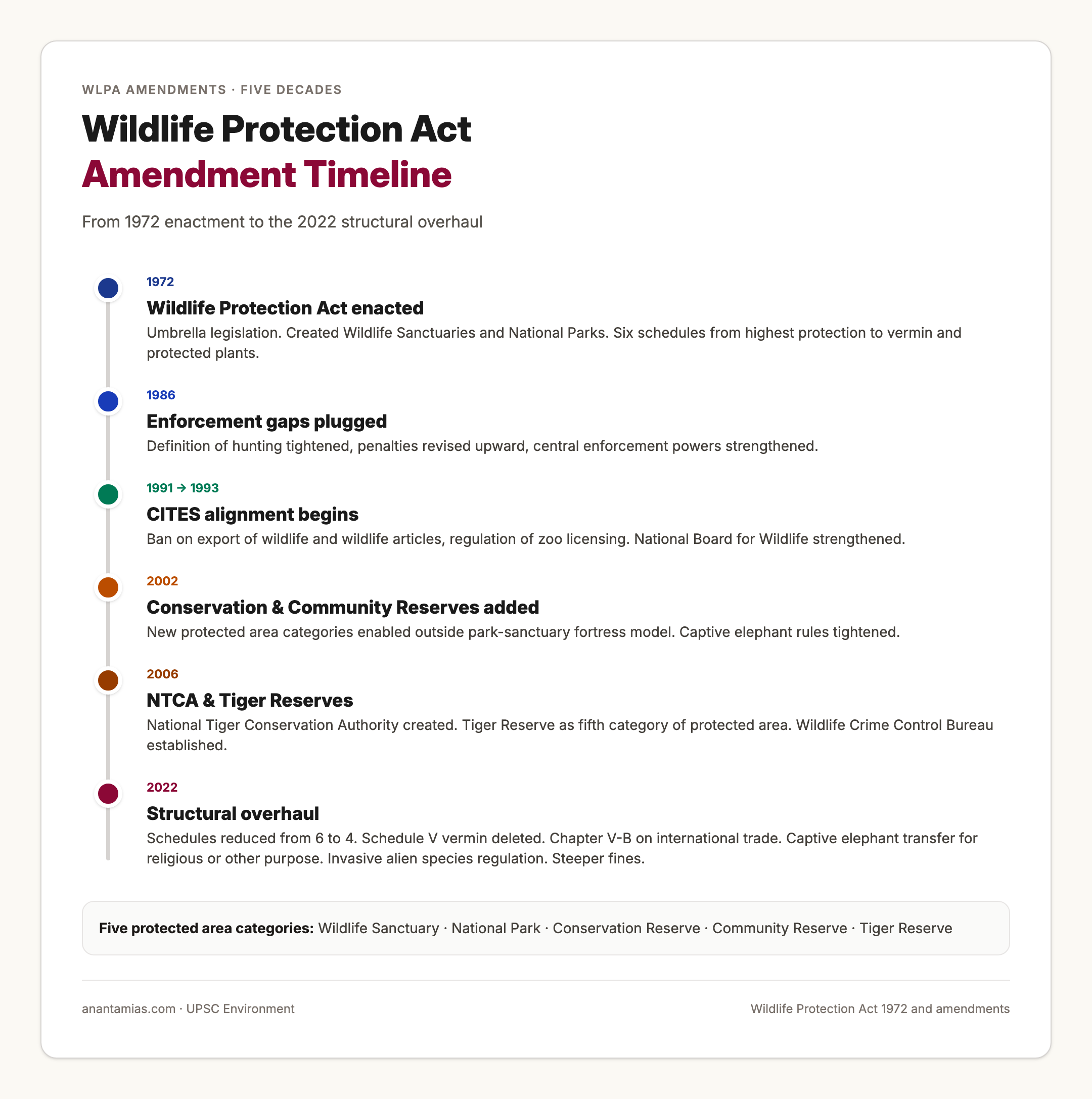
The Act recognises five categories of protected areas. Wildlife Sanctuaries and National Parks are the original two from 1972; Conservation Reserves and Community Reserves were introduced by the 2002 amendment to create more flexible protection in landscapes that fall outside parks and sanctuaries. Tiger Reserves were added by the 2006 amendment, which also created the National Tiger Conservation Authority. Eco-Sensitive Zones around parks and sanctuaries are regulated under the environment impact assessment framework but linked into the WLPA enforcement chain.
Background and Historical Context
Independent India inherited a colonial hunting culture and an inadequate patchwork of provincial laws when it began drafting the Wildlife Protection Act. The trigger was the alarming decline in tiger numbers reported in the late 1960s and the international embarrassment of being a country that had once exported live tigers and tiger skins as game trophies. The Act of 1972 created a unified national framework for the first time, banned hunting of listed species, and built the protected area system on a statutory footing.
Multiple amendments since then have responded to specific challenges. The 1986 amendment plugged enforcement gaps. The 1991 amendment tightened trade regulation in keeping with CITES obligations. The 2002 amendment introduced Conservation Reserves and Community Reserves and brought captive elephants under tighter regulation. The 2006 amendment created the National Tiger Conservation Authority and the Wildlife Crime Control Bureau. The 2022 amendment, by far the most structural recent change, reduced the six earlier schedules to four, deleted the Schedule V vermin category, added Chapter V-B on international trade in endangered species, allowed the transfer of captive elephants for religious or any other purpose under conditions, and substantially raised fines.
Schedules of the Wildlife Protection Act after the 2022 Amendment
| Schedule | Protection Level | Description | Examples |
|---|---|---|---|
| Schedule I | Highest Protection | Absolute protection; offences attract the strongest penalties | Bengal Tiger, Indian Rhino, Asiatic Lion, Snow Leopard, Blackbuck |
| Schedule II | High Protection | Hunting and trade prohibited; penalties lower than Schedule I | Indian Elephant, Sloth Bear, Nilgai, Sambar, Chausingha, Wild Boar |
| Schedule III | Protected Plants | Regulates cultivation, conservation, and trade of listed plants | Plants protected under WPA, examples vary by state lists |
| Schedule IV | CITES-based Protection | Species listed under CITES Appendices; trade strictly regulated | All CITES-listed fauna and flora included |
Compared with the pre-2022 structure the most consequential change is the deletion of Schedule V, which used to list vermin species such as common crows, fruit bats, mice, and rats. With Schedule V gone, the only legal route for states to deal with a problematic species at scale is to ask the Centre to notify the species as vermin under Section 62 in a defined area for a defined time.
Vermin and the Wild Boar Question
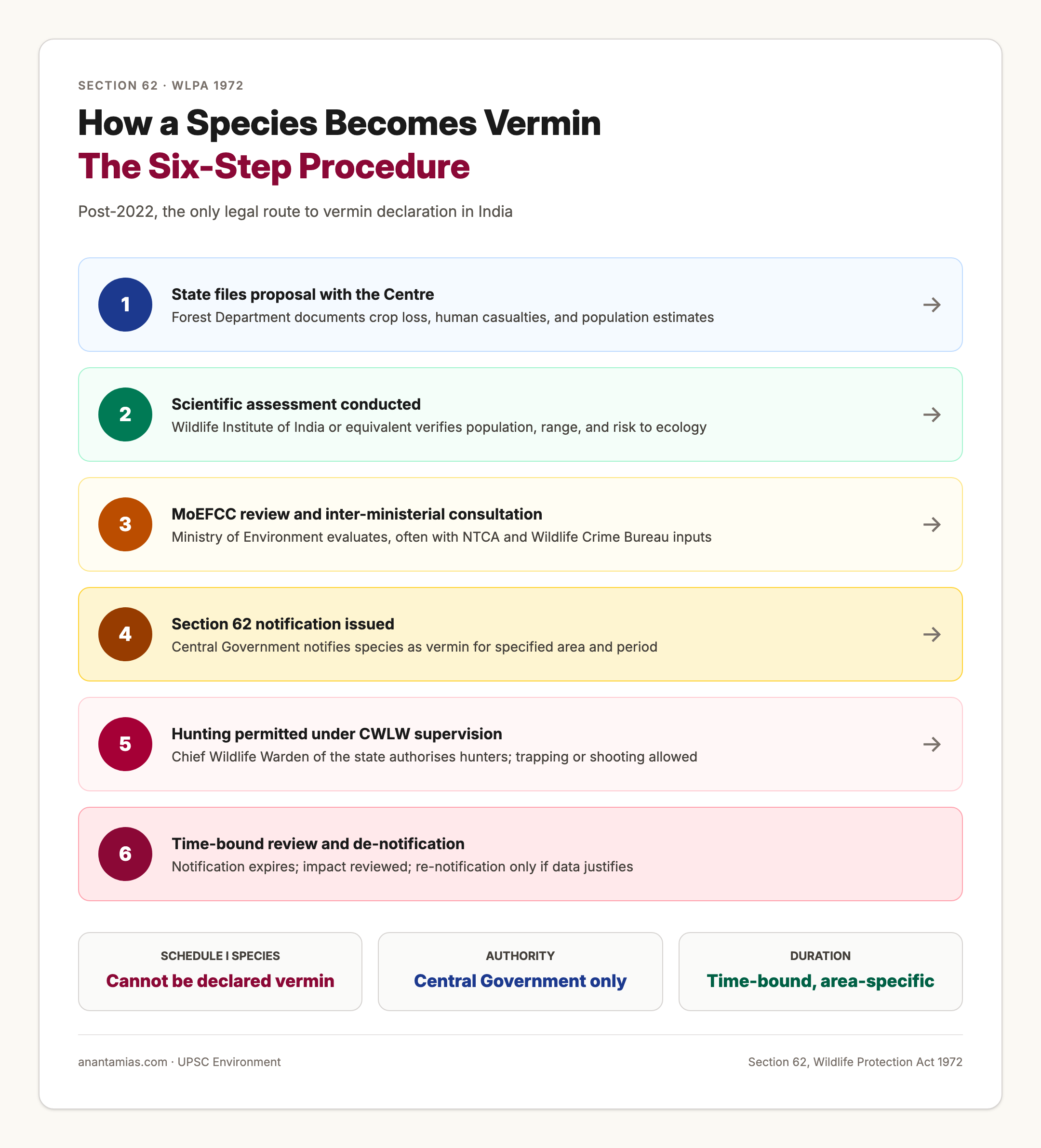
A vermin under the Wildlife Protection Act is any wild animal that the Central Government, by notification, declares to be vermin for a specified area and for a specified period. Once notified, a species effectively loses the protection of its schedule for that area and time, and may be hunted by anyone with the permission of the Chief Wildlife Warden. The procedure for vermin declaration is detailed in the standalone article on the procedure to declare a species as vermin under WLPA 1972.
Kerala’s request relates to the wild boar, currently a Schedule II species. Wild boars cause heavy crop damage in plantations and small farms in the foothills of the Western Ghats and in pockets of north Kerala. Farmer associations have mounted political pressure for years, demanding that the boar be declared a vermin so that trapping and shooting can be carried out at scale without case-by-case clearance from the Chief Wildlife Warden.
Kerala has previously sought a state-wide vermin declaration, and the Centre has so far stopped short of granting one, citing the 2022 deletion of Schedule V and the need for a more careful, time-bound, area-specific approach under Section 62. The state government has therefore had to use a workaround: empowering Chief Forest Officers and panchayats to authorise hunting of crop-raiding boars on a case-by-case basis. The compromise satisfies neither side fully. Conservationists fear that loose authorisations will be misused, and farmers complain that the process is too slow.
Why It Matters
The vermin debate is not just about wild boars. It is the test bed for how India will resolve the larger conflict between conservation and rural livelihoods as forest cover stabilises and species expand into farm landscapes. Nilgai in north India, leopards across Maharashtra, elephants in Odisha and Jharkhand, and macaques in Himachal all generate similar pressure. The sturdier the procedure for vermin declaration, the better the system can absorb such pressure without falling back to the blunt logic of mass culling. The article on human wildlife conflict explores the scale of the problem.
The vermin question is also a federalism question. States bear the political cost of crop damage and human casualties; the Centre holds the legal pen on schedule status and vermin notification. The 2022 amendment did not give states an independent power to declare vermin, leaving Kerala and other states dependent on central decisions. A reform that aligned authority with accountability has been long argued for and is likely to return to the policy table.
Detailed Analysis of the 2022 Amendment
The Wildlife Protection Amendment Act 2022 made five substantive changes that aspirants must remember. First, the schedules were reduced from six to four, simplifying the framework and dropping Schedule V vermin and Schedule VI plants. Second, a new Chapter V-B was introduced to operationalise India’s CITES obligations, regulating the import and export of species listed in CITES appendices. Third, a new provision allowed the transfer or transport of a captive elephant for religious or any other purpose by a person holding a valid certificate of ownership, subject to conditions and surveillance. Fourth, the Central Government was empowered to regulate or prohibit the import, possession, trade, or proliferation of invasive alien species. Fifth, fines for violations were significantly increased to raise deterrence.
The captive elephant clause attracted criticism from animal welfare organisations who feared misuse for commercial transfer disguised as religious purpose. The CITES alignment, on the other hand, was widely welcomed because it closed a long-standing gap between domestic law and India’s international commitments.
Comparative Note: Schedules Before and After
The previous six-schedule structure listed Schedule I animals with absolute protection, Schedule II Part 1 with high protection, Schedule II Part 2 with somewhat lower penalties, Schedule III with low protection, Schedule IV with even lower protection, Schedule V as vermin, and Schedule VI as protected plants. Aspirants must update their mental map. The unified Schedule I now includes most strictly protected species; the unified Schedule II covers high-protection species; Schedule III now contains protected plants; Schedule IV maps to CITES.
Challenges and Implementation Gaps
The Act has been ahead of its enforcement capacity for decades. Forest department staffing in many states is short of sanctioned strength, training in modern wildlife crime investigation is uneven, and prosecution conviction rates are low. The Wildlife Crime Control Bureau and the Central Bureau of Investigation handle organised cases but cannot scale to every minor violation. Conflict species management requires coordination between the forest department, the agriculture department, and panchayats; the inter-departmental friction is legendary in many states. Compensation for crop damage and human casualty exists but is delayed and undervalued in real terms.
International trade enforcement under the new Chapter V-B will need customs cooperation and CITES-trained officers at major airports and ports. The captive elephant pathway will need a tight central register and an audit chain. Without these, the amendment will not deliver in practice what it promises on paper.
Prelims Pointers
The Wildlife Protection Act 1972 applies to the whole of India. Schedules after the 2022 amendment are four. Schedule V, the old vermin schedule, has been deleted. Section 62 empowers the Centre to declare any wild animal other than those in Schedule I to be vermin for a specified area and time. Conservation Reserves and Community Reserves were created by the 2002 amendment. Tiger Reserves and the NTCA were established by the 2006 amendment. The Asiatic Lion is in Schedule I. The Wild Boar is in Schedule II. Plants are now in Schedule III. CITES species are in Schedule IV. Captive elephants are protected as Schedule I species but the 2022 amendment created an exception for transfer for religious or any other purpose under conditions. The Chief Wildlife Warden of the state is the central operational authority for licences, permits, and prosecutions, but in a Community Reserve the management is by a Community Reserve Management Committee.
Mains Practice Questions
GS-III: Discuss the procedure to declare a species as vermin under the Wildlife Protection Act 1972 and critically examine the Kerala government’s demand to declare wild boars as vermin. (250 words)
GS-III: Evaluate the Wildlife Protection Amendment Act 2022 with respect to schedule restructuring, CITES alignment, and captive elephant provisions. Have these reforms balanced conservation with practical concerns? (250 words)
GS-II: Examine federal tensions between the Centre and states in wildlife governance with reference to vermin notifications, Eco-Sensitive Zones, and Tiger Reserves. (250 words)
GS-III: Human-wildlife conflict in India is increasingly an agrarian distress issue. Discuss legal and policy options under the Wildlife Protection Act 1972 to manage this conflict without compromising conservation. (250 words)
Way Forward
A reform agenda for the Wildlife Protection Act should focus on five fronts. The first is faster, time-bound, geographically narrow vermin notifications under Section 62 with built-in scientific reviews and sunset clauses. The second is restoration of partial state authority over a defined and limited list of high-conflict species, subject to central oversight, so that political accountability and legal authority sit closer together. The third is investment in compensation systems with rapid disbursement, transparent assessment, and parity with market value. The fourth is strict implementation of Chapter V-B for international trade, supported by enforcement capacity at airports and ports. The fifth is integration of wildlife management with the forest rights act 2006 and panchayat-level institutions so that local communities are partners and not bystanders. Done well, the Act can serve both the species it protects and the people who share landscapes with them.
Frequently Asked Questions
What is the Wildlife Protection Act 1972?
The Wildlife Protection Act 1972 is the umbrella legislation that protects wild animals, birds, and plants in India. It defines protected areas, lists species in schedules, prohibits hunting of listed species, and regulates wildlife trade.
How many schedules does the Wildlife Protection Act now have?
After the 2022 amendment, the Act has four schedules. Schedule I covers species with the highest protection, Schedule II high protection, Schedule III protected plants, and Schedule IV species listed under CITES.
What is a vermin under the Wildlife Protection Act?
A vermin is a wild animal that the Central Government has declared by notification under Section 62 to be vermin for a specified area and a specified period. During the notification period, the species effectively loses the protection of its schedule for that area and may be hunted with permission.
Why does Kerala want to declare wild boars as vermin?
Kerala has been facing widespread crop damage and human injury caused by wild boars in plantation belts and the foothills of the Western Ghats. Farmer pressure has pushed the state to seek a statewide vermin declaration so that boars can be hunted without case-by-case clearance.
Has the Centre declared wild boars as vermin in Kerala?
The Centre has not granted a statewide vermin declaration for the wild boar in Kerala under the new framework. Following the deletion of Schedule V, the Centre prefers narrow, time-bound notifications. Kerala has had to use case-by-case authorisations to manage the problem.
What was Schedule V of the Wildlife Protection Act?
Schedule V was the old vermin category that listed species such as common crows, fruit bats, mice, and rats. The Wildlife Protection Amendment Act 2022 deleted Schedule V, making Section 62 the only legal route to declare a species as vermin.
What changed in the 2022 amendment of the Act?
The 2022 amendment reduced the schedules from six to four, deleted Schedule V, introduced Chapter V-B on international trade in endangered species, allowed transfer of captive elephants for religious or other purposes, empowered the Centre to control invasive alien species, and significantly raised fines.
What is the difference between a Wildlife Sanctuary and a National Park?
A Wildlife Sanctuary may permit limited human activity such as grazing under specified conditions, whereas a National Park is more strictly protected with no human activity allowed except as authorised by the Chief Wildlife Warden. Both are notified under the Wildlife Protection Act.
Are captive elephants protected under the Act?
Captive elephants enjoy Schedule I protection. The 2022 amendment created an exception that allows transfer or transport of a captive elephant for religious or any other purpose by a person holding a valid certificate of ownership and subject to conditions specified by the Centre.
Who has authority to enforce the Wildlife Protection Act?
At the central level the Ministry of Environment, Forest and Climate Change, the National Tiger Conservation Authority, and the Wildlife Crime Control Bureau are the key bodies. At the state level the Chief Wildlife Warden, Forest Department officials, and the police enforce the Act.
Tell Google you want more of this.
Add Anantam IAS as a preferred sourceOne tap, and this site shows up more often in your own Top Stories, AI Overviews and AI Mode. Remove it any time.