Sant Tukaram was a Marathi poet-saint of the Varkari tradition who lived at Dehu, a village on the Indrayani river near Pune, and died in 1649 or 1650. His abhangs, short devotional songs to Vithoba of Pandharpur, are still sung on the yearly walk to Pandharpur, and Britannica says he is often considered the greatest writer in Marathi. He matters because he carried the Bhakti movement’s case against caste pride into the plain Marathi of a village trader, and learned men in his own district treated that as a provocation.
Most readers meet Tukaram through films and calendar art, and the stories arrive with him. The notebooks that floated back up from the Indrayani are tradition. So is his bodily ascent to heaven, and so is his meeting with Shivaji. The record is thinner and more useful: a Kunbi trader’s son who went bankrupt in the famine of 1629-30 and watched his first wife die of hunger. This note keeps record and legend apart.
Who Was Sant Tukaram?
Sant Tukaram, also remembered as Tukoba and as Tukaram Maharaj, was a householder and trader of Dehu whom the Varkari tradition places at the top of its line of poet-saints. The table gives the core facts, and where the sources disagree, the row says so.
| Fact | Detail |
|---|---|
| Born | 1608 by the traditional date from Mahipati; Dehu and Pandharpur genealogies give 1598, and older scholars argued for dates as early as 1568 |
| Died | 1649 or 1650; scholars have proposed dates from 1648 to 1652 |
| Birthplace | Dehu, on the south bank of the Indrayani near Pune |
| Caste and trade | Shudra Kunbi by caste; a trading family that held the hereditary office of village mahajan |
| Tradition | Varkari Panth, the ‘Pilgrims’ Path’, devoted to Vithoba (Vitthala) of Pandharpur |
| Verse form | Abhang: four short lines of three to eight syllables each |
| Major work | The Tukaram Gatha; printed editions hold roughly 4,100 to 4,650 abhangs |
| Guru | Babaji, met in a dream, who gave him the mantra ‘Rama Krishna Hari’ |
| Main early biographer | Mahipati, writing in 1774, about 125 years after Tukaram’s death |
How a Dehu Trader Became a Varkari Poet
Tukaram’s life turns on one disaster: a famine that bankrupted him and killed his first wife. The years below follow the chronology J. Nelson Fraser and J. F. Edwards built in 1922 from Mahipati and from Tukaram’s own autobiographical poems, so they’re close estimates, not recorded dates.
The Mahajan’s Son
Tukaram’s family were Kunbis, a peasant caste ranked as Shudra, but they lived by trade. Dilip Chitre, who translated him in Says Tuka (1991), notes that his father Bolhoba held the hereditary office of village mahajan, the trader-headman appointed to supervise certain traders and collect revenue from them. The family kept written accounts, which is why a Kunbi boy at Dehu grew up literate. Britannica calls him simply a shopkeeper’s son.
His father handed him the business in 1621, when he was about 13, and within two years he had married twice, first Rakhmabai and then Jijabai, also called Avali. His parents died in 1625. Before he turned 21, Chitre notes, Tukaram had buried most of the people closest to him.
The Famine of 1629-30
Fraser and Edwards date his bankruptcy to 1629, the year a famine began, and put its worst in 1630, when Rakhmabai died of hunger and his eldest son died too. Tukaram withdrew to Bhambanath Hill. In 1631 he rebuilt the temple at Dehu and began attending kirtans, devotional singing led by one performer with the crowd taking up the refrain. Between 1632 and 1635 came the call to poetry and his initiation: in a dream a wandering devotee named Babaji gave him the mantra ‘Rama Krishna Hari’, three names of Vishnu.
Learning From the Older Saints
Before he sang his own verses, he learned other people’s. Mahipati says he sat on Bhandara Hill, west of Dehu, memorizing the older saints, and Fraser and Edwards trace four names through his poems:
- Dnyaneshwar, the thirteenth-century author of the Jnaneshvari;
- Namdev, the fourteenth-century tailor’s son of the Varkari path;
- Kabir, who lived more than a century and a quarter before him;
- Eknath of Paithan, who died in 1599.
Opposition came from men with standing, and Bahinabai’s memoir partly confirms Mahipati’s account of it. An ascetic named Mumbaji, settled at Dehu, “despised him as being a Sudra by caste and a grocer by vocation”, in Fraser and Edwards’ retelling. Rameshwar Bhatt of Wagholi, a Brahmin scholar, complained against him to the court, then repented and became a leading disciple. Bahinabai (1628-1700), another disciple, was turned out of Mumbaji’s house for going to Tukaram’s kirtans.
What Did Tukaram Teach?
Tukaram taught that singing and repeating God’s name, in company, is open to everyone and counts for more than birth or learning. He said it as an ordinary householder, often sharply, and he aimed the sharpness at religious professionals as much as at himself.
Four ideas carry most of his verse, each with a Marathi term worth knowing:
- Naam, the Name. Repeating God’s name is the whole practice, which is why his guru’s gift was a mantra, not a ritual.
- Kirtan as shared devotion. His abhangs lived in the kirtan, sung before a village crowd rather than read in private.
- Against caste pride. A line quoted by the Prime Minister at Dehu in 2022, ‘unch nich kahi nene bhagavant’, says God knows nothing of high and low.
- Service as the test of a saint. ‘Je ka ranjale ganjale, tyasi mhane jo apule, tochi sadhu olakhava, deva tethechi janava’: the one who calls the afflicted and oppressed his own is the true sadhu, and God is found right there.
His anger is part of the teaching. In J. Murray Mitchell’s 1882 translation, reprinted by Fraser and Edwards, one abhang ends on the man who sings God’s praise loudly while his soul clings to money, and Tukaram’s verdict is that someone should slap his face.
His criticism of caste also had limits. When his daughters came of age, Mahipati says, Tukaram married them to three boys of his own caste he found playing in the road. His poems attack the pride of caste and the learned monopoly over religion; they don’t ask for caste to be dismantled as a social order. That places him with the Bhakti saints generally, whose reform worked on devotion first and on society second.
What Is a Tukaram Abhang?
The abhang is the Varkari poets’ own verse form, short and built for singing. Britannica glosses the word as ‘unbroken’. Chitre describes four lines of three to eight syllables each, a meter native to spoken Marathi and the favorite of Varkari poets since the thirteenth century. Each poem carries the signature ‘Tuka mhane’, meaning ‘Tuka says’, which Chitre calls the door into the poem’s deeper structure.
The Gatha Was Printed Late
The Tukaram Gatha is the collected body of his abhangs, and no complete copy in his hand survives. The Dehu family keeps a manuscript of about 250 poems that his descendants hold to be his own writing, and Fraser and Edwards reproduced a page from the manuscript of Santaji Teli Jaganade, an associate remembered for recording his work. Everything else reached print through copies of copies.
The printed counts disagree, and that teaches more than any single number. Fraser and Edwards tabulated the Marathi editions of 1867 to 1913: most hold about 4,100 to 4,650 abhangs, and one 1889 edition swelled to 8,441. The 1869 Indu Prakash edition in Bombay counted 4,621, while Chitre treats the government-backed Indu Prakash printing of 1873, with 4,607, as the standard text. Britannica’s round ‘over 4,000’ is the figure to carry.
There’s a harder problem. The Indu Prakash editors admitted that some of their manuscripts had been ‘corrected’ and ‘further corrected’ after more than two centuries in devotional hands. The core of the Gatha is Tukaram’s; any single abhang may not be.
The Indrayani Notebooks Are a Tradition
The most famous story about the Gatha is a miracle and should be told as one. Tukaram was made to sink his notebooks in the Indrayani; he fasted for 13 days, and they rose undamaged. Mahipati’s line of the story ties the pressure to Rameshwar Bhatt, while Chitre speaks only of mocking detractors. The Shila Mandir at Dehu enshrines a rock on which, tradition says, he spent 13 days in penance.
Read as history, the story records pressure. Someone with standing thought a Shudra’s notebooks were worth drowning, and that hostility is attested in more than one account. The recovery belongs to faith.
Where Does Tukaram Stand Among the Varkari Saints?
Tukaram is the last of the four great Varkari poets, and the tradition names him its crowning stone. A verse attributed to Bahinabai, quoted by Chitre and recalled by the Prime Minister at Dehu in 2022, pictures the Varkari path as a temple:
- Jnanadev laid its foundation;
- Namdev built its walls;
- Eknath gave it a central pillar;
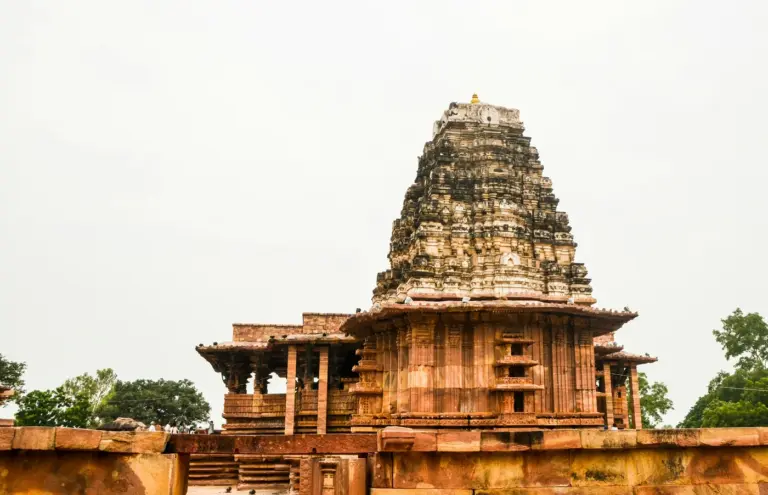
- Tukaram became its spire, the kalas, the pot-shaped finial on top.
The Varkari Panth, Britannica’s ‘Pilgrims’ Path’, is the devotional community of Vithoba, also called Vitthala or Panduranga, a form of Vishnu worshipped with his consort Rukmini at Pandharpur on the Bhima, about 55 km west of Solapur. Its main temple dates to the twelfth-century Yadavas of Devagiri. Britannica names Namdev its foremost exponent and says the tradition he inspired ran four centuries before culminating in Tukaram. It also credits the Panth with freedom from caste restrictions in worship.
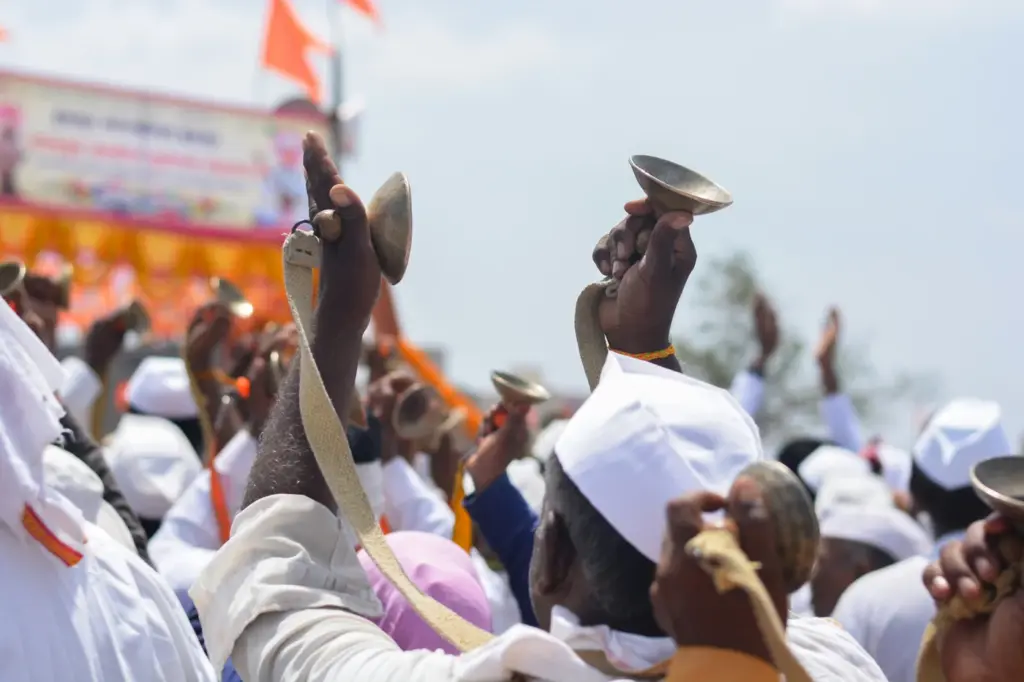
Each year pilgrim companies walk to Pandharpur for the Ashadhi festival, each carrying a palkhi (palanquin) with the paduka, the footprints, of its saint. Their refrain, as Fraser and Edwards recorded it, was ‘Dnyanoba, Tukoba’: the first saint and the last in one breath.
| Saint | Dates | Place | Background | Main work | Remember him for |
|---|---|---|---|---|---|
| Jnaneshwar (Jnanadeva) | 1275 to 1296 | Alandi | Family treated as outcaste after returning from renunciation | Jnaneshvari (Bhavarthadipika), a Marathi verse commentary on the Bhagavad Gita | Called the father of Marathi poetry; the foundation of the canon |
| Namdev | c. 1270 to 1350 | Born at Narasi, died at Pandharpur | Tailor’s son, of low caste | Abhangs; verses in the Adi Granth of the Sikhs | Foremost exponent of the Varkari Panth, popular in Punjab too |
| Eknath | 1544 to 1599 (Britannica) | Paithan on the Godavari | Deshastha Brahmin who clashed with orthodox Brahmins over caste | Restored text of the Jnaneshvari; a Marathi Ramayana | The line ‘the dog and God are identical’ |
| Tukaram | c. 1608 to 1649 or 1650 | Dehu on the Indrayani | Shudra Kunbi from a trading family | Abhangs collected in the Tukaram Gatha | The kalas: the plainest and most personal voice of the four |
Two patterns sit in that table. Jnaneshwar and Eknath came from Brahmin families and wrote learned Marathi versions of Sanskrit texts; Namdev and Tukaram came from working castes and are remembered for abhangs. Within the wider Bhakti movement, the Varkaris stand out as a pilgrimage community whose saints came from Brahmin and working-caste homes alike.
What Historians Dispute About Tukaram
Almost every famous fact about Tukaram has a softer twin in the sources. Three disputes do most of the work.
His Dates
Fraser and Edwards laid out the birth-year problem in 1922 and called certainty impossible. Their candidates:
- 1608, the traditional date from Mahipati, which Britannica follows;
- 1598, from the family genealogies at Dehu and Pandharpur;
- 1588, held by Janardan Ramchandra;
- 1577, held by other authorities;
- 1568, argued by the historian Rajwade from an old genealogy found near Wai.
Chitre gives 1609. For his death, Britannica keeps the traditional 1649 while Chitre gives 1650, and scholars’ dates run from 1648 to 1652. The honest short form is c. 1608 to 1649 or 1650.
How His Life Ended
The Varkari account is an ascension: Mahipati describes chariots in the sky carrying Tukaram to Vaikuntha, Vishnu’s heaven. An inscription at the Dehu shrine says he ascended to Vaikuntha from that spot, and in 1920 the shrine drew 20,000 to 40,000 people every Phalguna.
Two other readings sit beside it. Britannica records the belief that he threw himself into a river and drowned, and Fraser and Edwards noticed that the shrine faces the deepest pool of the Indrayani. Chitre reads the farewell poems as a man saying goodbye to his friends and leaving Dehu for good. The ascension is faith and the drowning an inference; the departure is a reading of poems, and none of the three is a record.
Did Tukaram Meet Shivaji?
Tradition says yes; the record can’t confirm it. In Mahipati’s story, Shivaji sends a horse with a torch and umbrella to fetch Tukaram, who replies in abhangs declining. Shivaji then comes himself with gold, and Tukaram tells him to wear only the tulsi garland and call himself Vithoba’s servant. Fraser and Edwards found scholars split and called it impossible to pronounce definitely either way.
Chronology is the difficulty. Jadunath Sarkar put Shivaji’s birth in February 1630, against an older date of 1627, so Shivaji was about 20 when Tukaram died and, as Chitre notes, the Maratha kingdom did not yet exist. The saint conventionally paired with Shivaji as his spiritual adviser is Ramdas.
Behind the meeting sits a bigger claim: that the saints prepared Maharashtra for the Maratha state. A passage printed in Fraser and Edwards’ study calls Dnyaneshwar “the progenitor of Maratha nationality, which culminated in the great Sivaji’s Maratha Empire”. Treat that as interpretation. The saints gave Marathi speakers a shared devotional language across caste lines, but the evidence that this produced a state is thin.
Sant Tukaram Today
Tukaram’s presence today is a living pilgrimage and a cluster of shrines at Dehu run by the Sant Tukaram Maharaj Sansthan. Its office-bearers in 2026 came from the More family, and Chitre names a More of Dehu as Tukaram’s oldest direct descendant. Two dated developments matter:
- Shila Mandir, 14 June 2022. Prime Minister Narendra Modi inaugurated a temple at Dehu around the rock where, tradition says, Tukaram spent 13 days in penance. The Prime Minister’s address at Dehu also recalled the foundation laid for four-lane palkhi highways, with the Sant Tukaram Maharaj Palkhi Marg to be built in three phases.
- The 2026 palkhi. The Sansthan’s schedule, reported by Sakal on 4 June 2026, sent the palkhi out of Dehu on 7 July 2026, due at Pandharpur on 24 July, and reports counted it as the procession’s 341st year.
The same speech shows how public life now reads him. It set ‘unch nich kahi nene bhagavant’ beside the promise of schemes without discrimination, and it read ‘je ka ranjale ganjale’ as a charter for Antyodaya, welfare for the person in the last row. A saint claimed by so many camps belongs to none, and his lines are best quoted for what they say. The palkhi says more about his reach than any speech: a procession in its 341st year, walked by ordinary Varkaris singing a Kunbi trader’s verses.
How to Study Sant Tukaram for Exams
Sant Tukaram sits in two places in the syllabus: General Studies Paper I, under Indian culture and the Bhakti movement, and History optional Paper I, under medieval religious movements. Maharashtra’s state service exam goes deeper into the Varkari saints, and the MPSC guide covers that syllabus.
Questions rarely name him. They ask about Bhakti literature and how far the saints changed society, and a precise Tukaram paragraph is evidence inside those answers. Mains 2014 GS Paper I asked candidates to comment on this: “Sufis and medieval mystic saints failed to modify either the religious ideas and practices or the outward structure of Hindu/Muslim societies to any appreciable extent. Comment.“
Tukaram fits both sides of that answer. His daughters’ marriages within his caste support the claim, and a Kunbi grocer becoming the kalas of the Varkari canon cuts against it. The History optional has set the theme directly: Paper I in 2014 asked candidates to “Evaluate the contribution of Vaishnava saints to the growth of medieval Bhakti literature”, and Paper I in 2017 asked them to discuss whether “Bhakti and Sufi movements served the same social purpose.”
In Prelims, Art and Culture accounts for 94 of the 1,403 questions in the Prelims question bank from 2013 to 2026, and History for 184. A saint-to-work or saint-to-place pairing is the likeliest shape for a Tukaram item, so the four-saint table above is worth memorizing.
The revision facts worth fixing:
- Dehu, on the Indrayani near Pune; c. 1608 to 1649 or 1650, with the birth year argued as early as 1568.
- A Shudra Kunbi by caste and a trader by occupation; his father held the office of village mahajan.
- The famine of 1629-30 bankrupted him and killed his first wife, Rakhmabai.
- Guru Babaji, met in a dream, who gave the mantra ‘Rama Krishna Hari’.
- The abhang: four short lines signed ‘Tuka mhane’; the Gatha holds over 4,000 of them.
- Varkari Panth of Vithoba at Pandharpur; the Dehu palkhi walks there for the Ashadhi festival.
- Bahinabai’s temple image: Jnanadev the foundation, Tukaram the kalas.
Four confusions cost marks, and each has a clean separator:
- Namdev, not Tukaram, has verses in the Adi Granth of the Sikhs.
- The Jnaneshvari is Jnaneshwar’s commentary on the Gita and Eknath restored its text; Tukaram’s work is abhangs, not commentary.
- Ramdas, not Tukaram, is the saint conventionally called Shivaji’s spiritual adviser; the Tukaram-Shivaji meeting is tradition.
- Eknath died in 1599, so Tukaram learned from his verses, not from the man.
For the Bhakti and Sufi comparison, read this with the note on the Sufi movement; for Ethics case material, the note on Bhakti and Sufi ethics uses the same saints. Marathi literature optional candidates read him in the original, and the Marathi literature optional guide lists annotated editions of Jnaneshwar and Tukaram among the texts worth owning.
Tukaram is small in the syllabus and large inside an answer, because he turns the Bhakti argument into a named man with a dated famine behind him. His own line, quoted at Dehu in 2022, is advice for the whole preparation: ‘asadhya te sadhya karita sayas, karan abhyas, Tuka mhane’, the impossible becomes possible with effort, and the reason is practice. A candidate who can place him precisely, dates hedged and legends labeled, is showing the examiner the exact habit these questions reward.
Frequently Asked Questions
Who was Sant Tukaram?
Sant Tukaram was a seventeenth-century Marathi poet-saint of the Varkari tradition from Dehu near Pune. He composed abhangs, short devotional songs to Vithoba of Pandharpur, which are collected in the Tukaram Gatha. His traditional dates are 1608 to 1649 or 1650.
When was Sant Tukaram born?
The traditional date, followed by Britannica, is 1608, taken from the biographer Mahipati. Family genealogies at Dehu and Pandharpur give 1598, and other scholars have argued for dates as early as 1568, so the year is genuinely disputed. Most accounts place his death in 1649 or 1650.
What is a Tukaram abhang?
An abhang is a short Marathi devotional poem of four lines, each of three to eight syllables, sung in kirtan and on pilgrimage. Britannica glosses the word as ‘unbroken’. Each of Tukaram’s abhangs carries his signature, ‘Tuka mhane’, meaning ‘Tuka says’.
What is the Tukaram Gatha?
The Tukaram Gatha is the collected body of his abhangs. Printed editions from 1867 onward hold roughly 4,100 to 4,650 poems, and the Indu Prakash printing of 1873, made under Bombay government patronage, is treated as the standard text. Because the manuscripts were copied and corrected for two centuries before print, scholars read individual poems with some caution.
Is the story of Tukaram’s notebooks in the Indrayani true?
It is a tradition, not a documented event. The story says he was made to sink his notebooks in the Indrayani and that they resurfaced undamaged after he fasted for 13 days. What it does reflect is the real hostility some men of standing showed a Shudra poet.
Did Sant Tukaram meet Shivaji?
The meeting is a story told by the eighteenth-century biographer Mahipati, and scholars have not been able to confirm it. Shivaji was only about 20 when Tukaram died, and the Maratha kingdom did not yet exist. The saint usually named as Shivaji’s spiritual adviser is Ramdas.
How did Sant Tukaram die?
Nobody knows for certain. Varkaris believe he ascended bodily to Vaikuntha, Vishnu’s heaven, from Dehu, while Britannica records a belief that he drowned in a river. The translator Dilip Chitre reads his farewell poems as a departure from the village, and none of these accounts is a documented record.
What is the Sant Tukaram palkhi?
It is the palanquin procession that carries Tukaram’s paduka, his symbolic footprints, from Dehu to Pandharpur for the Ashadhi festival of Vithoba. Varkaris walk with it singing the saints’ abhangs. The 2026 procession was scheduled to leave Dehu on 7 July 2026 and was counted as the 341st.
Practice Questions
Prelims
1. Consider the following statements about Sant Tukaram: 1. He was born into a Brahmin family of Paithan. 2. His father held the hereditary office of village mahajan at Dehu. 3. He composed his devotional poetry mainly in the abhang form. Which of the statements given above is/are correct?
- (a) 1 and 2 only
- (b) 2 and 3 only
- (c) 1 and 3 only
- (d) 1, 2 and 3
Answer: (b) Tukaram was a Shudra Kunbi of Dehu; the Brahmin saint of Paithan was Eknath.
2. Which one of the following Marathi saints has verses included in the Adi Granth of the Sikhs?
- (a) Tukaram
- (b) Eknath
- (c) Namdev
- (d) Jnaneshwar
Answer: (c) Some of Namdev’s verses are included in the Adi Granth, the Sikh scripture.
3. Consider the following statements: 1. The Jnaneshvari is a Marathi verse commentary on the Bhagavad Gita. 2. Eknath prepared a restored edition of the Jnaneshvari. Which of the statements given above is/are correct?
- (a) 1 only
- (b) 2 only
- (c) Both 1 and 2
- (d) Neither 1 nor 2
Answer: (c) Jnanadeva composed the Jnaneshvari in the late thirteenth century, and Eknath restored its corrupted text in the sixteenth.
4. Consider the following pairs of saint and place: 1. Tukaram and Dehu 2. Jnaneshwar and Alandi 3. Eknath and Pandharpur. Which of the pairs given above is/are correctly matched?
- (a) 1 only
- (b) 1 and 2 only
- (c) 2 and 3 only
- (d) 1, 2 and 3
Answer: (b) Eknath is associated with Paithan on the Godavari, not Pandharpur.
5. Consider the following statements about the Tukaram Gatha: 1. A complete manuscript of the Gatha in Tukaram’s own hand survives at Dehu. 2. Printed editions of the Gatha differ in the number of abhangs they contain. Which of the statements given above is/are correct?
- (a) 1 only
- (b) 2 only
- (c) Both 1 and 2
- (d) Neither 1 nor 2
Answer: (b) The Dehu manuscript holds only about 250 poems, and printed editions from 1867 to 1913 range from about 4,100 to over 4,600, with one outlier.
Mains
- Evaluate the nature of the Bhakti literature and its contribution to Indian culture. (10 marks, 150 words) Previous year: Mains 2021, GS Paper I.
- “Sant Tukaram’s poetry attacked the pride of caste but did not challenge caste as a social order.” Examine this statement with reference to his life and abhangs. (15 marks, 250 words)
- How did the Varkari tradition make religious devotion accessible to people outside the Brahmanical order in medieval Maharashtra? Illustrate with reference to Namdev and Tukaram. (15 marks, 250 words)
- Distinguish between what the historical record supports and what tradition holds about Sant Tukaram’s life. Why does the distinction matter to a historian? (10 marks, 150 words)
- “The saints of Maharashtra prepared the ground for the rise of Maratha power.” Critically examine this view. (15 marks, 250 words)
Tell Google you want more of this.
Add Anantam IAS as a preferred sourceOne tap, and this site shows up more often in your own Top Stories, AI Overviews and AI Mode. Remove it any time.