
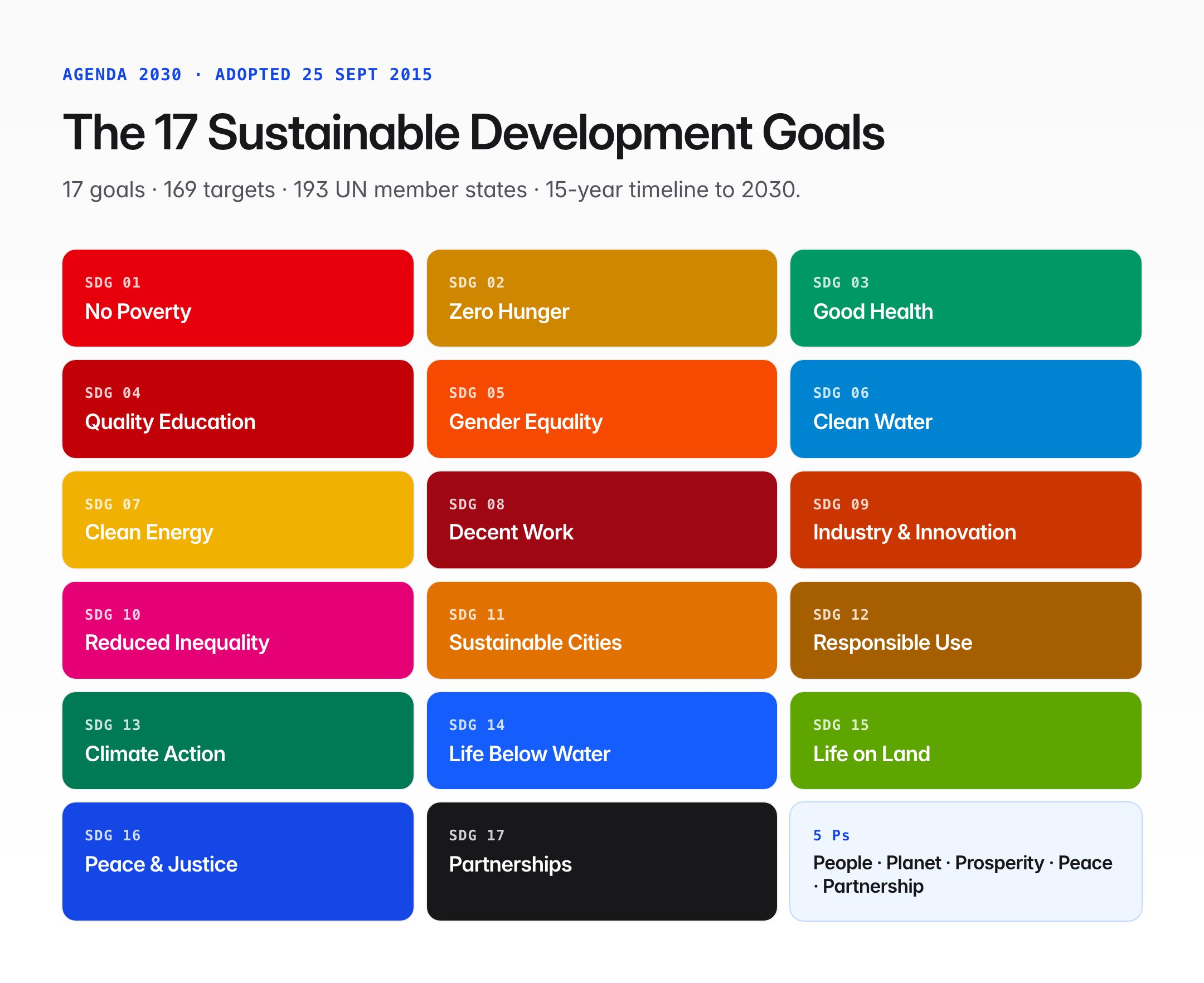
The Sustainable Development Goals (SDGs), also called the Global Goals, are a set of 17 interlinked goals and 169 targets adopted by all 193 UN member states in September 2015 as the core of the 2030 Agenda for Sustainable Development. The SDG Goals succeeded the Millennium Development Goals (MDGs, 2000-2015) and came into force on 1 January 2016, committing every signatory – including India – to end poverty, protect the planet and ensure peace and prosperity by 2030. They are the most ambitious global development compact ever signed and recur heavily in UPSC Prelims, Mains GS-2 and GS-3.
Origin and Adoption
| Milestone | Year | Significance |
|---|---|---|
| Rio Earth Summit | 1992 | Agenda 21, sustainable development concept |
| Millennium Summit | 2000 | Millennium Development Goals (8 MDGs) |
| Rio+20 | 2012 | Mandate to create SDGs |
| Open Working Group | 2013-14 | Drafted the 17 goals |
| UN Sustainable Development Summit | 25-27 September 2015 | Agenda 2030 adopted by 193 countries in New York |
| Implementation begins | 1 January 2016 | 15-year timeline to 2030 |
| Mid-term review | 2023 | SDG Summit noted severely off-track progress |
Agenda 2030 rests on five Ps – People, Planet, Prosperity, Peace and Partnership – and is supported by the Addis Ababa Action Agenda for financing.
The 17 Sustainable Development Goals
| Goal | Title | Focus Area |
|---|---|---|
| SDG 1 | No Poverty | End poverty in all forms |
| SDG 2 | Zero Hunger | Food security, nutrition, sustainable agriculture |
| SDG 3 | Good Health and Well-being | UHC, maternal and child health |
| SDG 4 | Quality Education | Inclusive, equitable, lifelong learning |
| SDG 5 | Gender Equality | Empower women and girls |
| SDG 6 | Clean Water and Sanitation | Water availability and WASH |
| SDG 7 | Affordable and Clean Energy | Access and renewables |
| SDG 8 | Decent Work and Economic Growth | Full employment, productivity |
| SDG 9 | Industry, Innovation, Infrastructure | Resilient infrastructure, industrialisation |
| SDG 10 | Reduced Inequalities | Within and among countries |
| SDG 11 | Sustainable Cities and Communities | Safe, resilient urbanisation |
| SDG 12 | Responsible Consumption and Production | Sustainable lifestyles |
| SDG 13 | Climate Action | Combat climate change and impacts |
| SDG 14 | Life Below Water | Oceans, seas, marine resources |
| SDG 15 | Life on Land | Ecosystems, forests, biodiversity |
| SDG 16 | Peace, Justice, Strong Institutions | Rule of law, accountable institutions |
| SDG 17 | Partnerships for the Goals | Global partnership and means of implementation |
Remember the mnemonic in three layers:
- Social (1-6): Poverty, Hunger, Health, Education, Gender, Water
- Economic (7-11): Energy, Work, Infrastructure, Inequality, Cities
- Environmental + Enabler (12-17): Consumption, Climate, Oceans, Land, Peace, Partnerships
SDGs vs MDGs: Key Differences
| Feature | MDGs (2000-2015) | SDGs (2016-2030) |
|---|---|---|
| Number | 8 goals, 21 targets | 17 goals, 169 targets |
| Coverage | Developing countries | All 193 UN members |
| Drafting | Top-down (UN secretariat) | Bottom-up, consultative |
| Focus | Social development | Social + economic + environmental |
| Finance | Aid-dependent | Domestic + international, private sector |
| Environment | Weak coverage | Climate, oceans, land, consumption all explicit |
| Peace | Absent | SDG 16 |
India and the SDGs
India, home to about one-sixth of humanity, is central to global SDG achievement. The nodal agency for SDG implementation and monitoring is NITI Aayog.
NITI Aayog SDG India Index
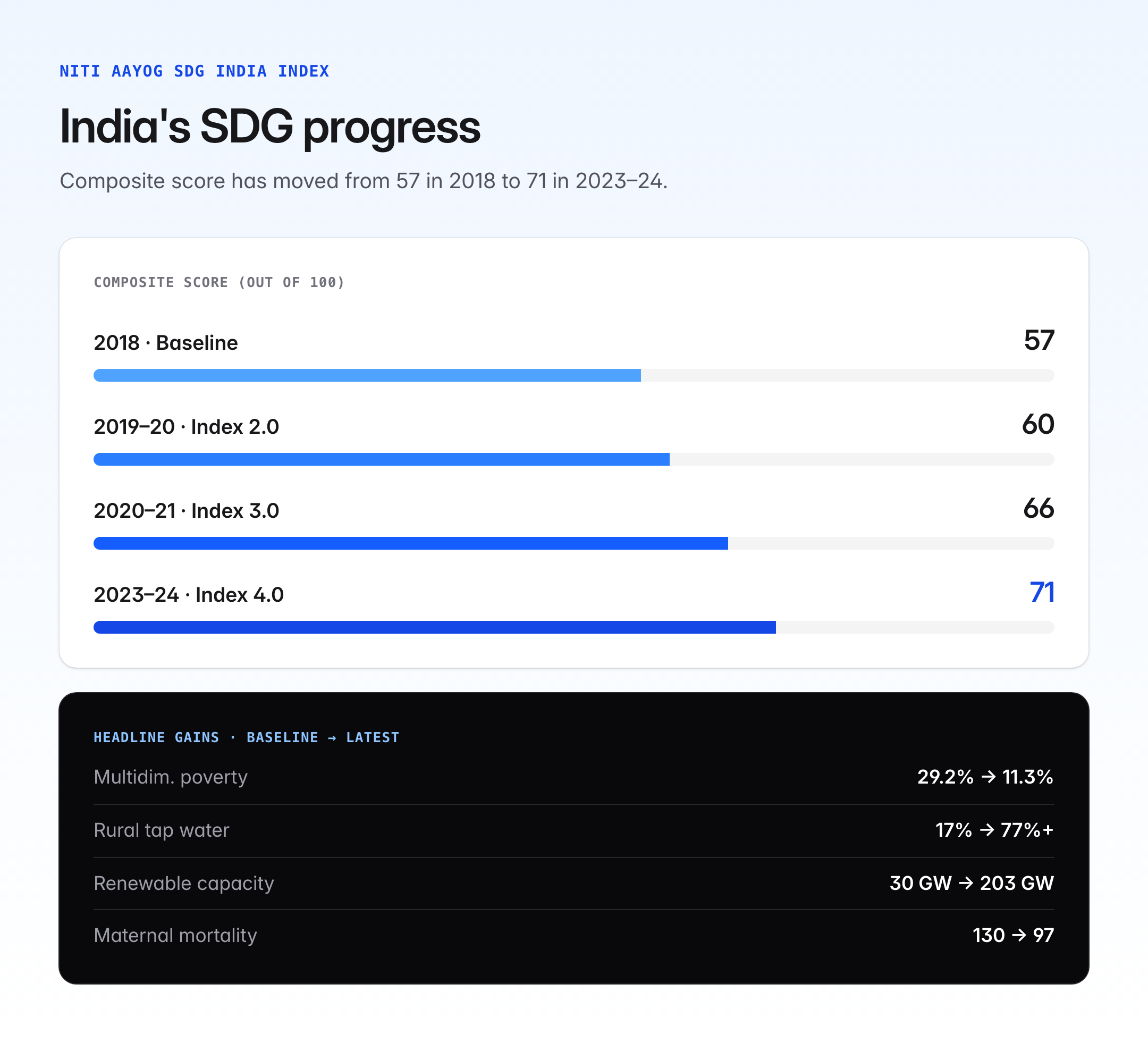
NITI Aayog, in partnership with the UN in India, launched the SDG India Index in 2018 to monitor state and UT performance across SDG targets.
| Edition | Year | National Composite Score (out of 100) |
|---|---|---|
| Baseline Report | 2018 | 57 |
| SDG India Index 2.0 | 2019-20 | 60 |
| SDG India Index 3.0 | 2020-21 | 66 |
| SDG India Index 4.0 | 2023-24 | 71 |
The Index places states in four categories:
- Aspirant (0-49)
- Performer (50-64)
- Front Runner (65-99)
- Achiever (100)
Kerala, Tamil Nadu, Himachal Pradesh, Goa and Karnataka have consistently been top performers, while Bihar, Jharkhand and several North-Eastern states figure lower. The Index is built on around 113 national indicators.
Complementary tools include the North-Eastern Region (NER) SDG Index and the SDG Urban Index (for cities).
Key Schemes Mapped to SDGs
India implements its SDG commitments primarily through existing national flagship programmes.
| SDG | Indian Flagship Programmes |
|---|---|
| SDG 1 | MGNREGA, PM-Garib Kalyan Yojana, Jan Dhan |
| SDG 2 | National Food Security Act, PM-Poshan, PM Garib Kalyan Anna Yojana |
| SDG 3 | Ayushman Bharat PMJAY, Mission Indradhanush, National Health Mission |
| SDG 4 | Samagra Shiksha, NEP 2020, PM SHRI, Beti Bachao Beti Padhao |
| SDG 5 | Mission Shakti, Ujjwala, One Stop Centres |
| SDG 6 | Jal Jeevan Mission, Swachh Bharat Mission |
| SDG 7 | Saubhagya, PM Kusum, Ujjwala |
| SDG 8 | Skill India, PM MUDRA, Startup India |
| SDG 9 | PM Gati Shakti, Bharatmala, Sagarmala |
| SDG 11 | Smart Cities Mission, AMRUT, PMAY-U |
| SDG 13 | Panchamrit pledges at COP26, National Action Plan on Climate Change |
| SDG 15 | CAMPA, Green India Mission, Nagar Van Yojana |
India's Progress: Selected Indicators
| Indicator | Baseline | Latest |
|---|---|---|
| Multidimensional poverty headcount | 29.17 percent (2013-14) | 11.28 percent (2022-23) |
| Maternal Mortality Ratio (per lakh live births) | 130 (2014-16) | 97 (2018-20) |
| Access to electricity | 76 percent (2014) | Near universal (2024) |
| Rural households with tap water | 17 percent (2019) | Over 77 percent (2024) |
| Renewable energy installed | 30 GW (2014) | 203 GW (2024) |
| Forest and tree cover | 24.16 percent (2013) | 25.17 percent (2023) |
Poverty reduction (SDG 1), access to electricity (SDG 7) and tap water coverage (SDG 6) are widely cited success stories. However, malnutrition, learning outcomes (ASER reports), gender workforce participation, air quality and ecosystem protection remain problem areas.
Voluntary National Review (VNR)
Under Agenda 2030, each country periodically presents a Voluntary National Review to the UN High-Level Political Forum (HLPF). India has presented VNRs in 2017 and 2020, and will present again before 2030.
Key Goals for UPSC Focus
| Goal | High-probability themes |
|---|---|
| SDG 1 (Poverty) | Multidimensional Poverty Index (NITI Aayog and OECD-UNDP), MGNREGA |
| SDG 2 (Hunger) | National Family Health Survey malnutrition data, PM-Poshan |
| SDG 4 (Education) | NEP 2020, PISA, ASER, learning poverty |
| SDG 5 (Gender) | Sex ratio, female LFPR, political representation |
| SDG 6 (Water) | Jal Jeevan Mission, Composite Water Management Index |
| SDG 13 (Climate) | Panchamrit, NDCs, Net-Zero by 2070 |
| SDG 16 (Institutions) | Rule of Law Index, judicial pendency, RTI |
Global Challenges
- COVID-19 reversed years of SDG progress, pushing 70-100 million people into extreme poverty
- War in Ukraine and Gaza disrupted food and energy markets
- Climate finance gap – developed countries have missed the promised 100 billion dollars per year
- Data deficits – over 30 percent of SDG indicators still lack regular data globally
- Ambition gap – the UN's 2024 SDG Report found only 17 percent of targets are on track
The SDG Stimulus proposed by the UN Secretary-General seeks 500 billion dollars annually to accelerate implementation.
India's Concerns and Leadership
India has sought to reshape SDG discourse through:
- LiFE (Lifestyle for Environment) campaign at COP26, aligning with SDG 12
- International Solar Alliance (ISA) and Coalition for Disaster Resilient Infrastructure (CDRI)
- G20 New Delhi Declaration 2023 reaffirming Agenda 2030
- Global South solidarity at the Voice of the Global South Summits
UPSC Relevance
Prelims: Expect direct questions on the number of goals (17), targets (169), year of adoption (2015), host city (New York), nodal Indian agency (NITI Aayog), ranking states in the SDG India Index, and the three pillars (social, economic, environmental).
Mains GS-2 (Governance, International Relations): Themes include role of NITI Aayog, Centre-state cooperation in SDG implementation, UN’s role, development partnerships with the Global South, and India’s VNR reports. Always connect SDGs to cooperative federalism and data-driven governance.
Mains GS-3 (Economy, Environment): Use SDGs to frame answers on poverty alleviation, inclusive growth, renewable energy transition, agriculture sustainability, climate finance, and biodiversity conservation. Relate SDGs 13-15 to India’s Panchamrit commitments and net-zero pledge.
GS-4 (Ethics): The SDGs enshrine intergenerational equity, global citizenship, and the principle of leaving no one behind, which can be quoted in ethics answers on development and governance.
Memorise the 17 goals by title, the five Ps, India's composite score, and at least three SDG-linked flagship schemes per goal to handle any SDG-themed question with confidence.
Tell Google you want more of this.
Add Anantam IAS as a preferred sourceOne tap, and this site shows up more often in your own Top Stories, AI Overviews and AI Mode. Remove it any time.