Most people can point to the Suez Canal on a map and recite the sentence: it joins the Mediterranean to the Red Sea and saves ships the trip around Africa. That’s true, and it explains almost nothing. It doesn’t explain why one container ship parked sideways for six days froze roughly $9.6 billion of trade a day, or why a ditch in Egypt nearly triggered a great-power war in 1956.
Start from the fact everything hangs on. The Suez isn’t a strait. It’s a trench that people dug. So somebody owns it, somebody can close it, and there’s no way around it except the very long way. Every headline the canal has ever generated comes out of that one sentence.
What the Suez Canal actually is, and why “strait” is the wrong word
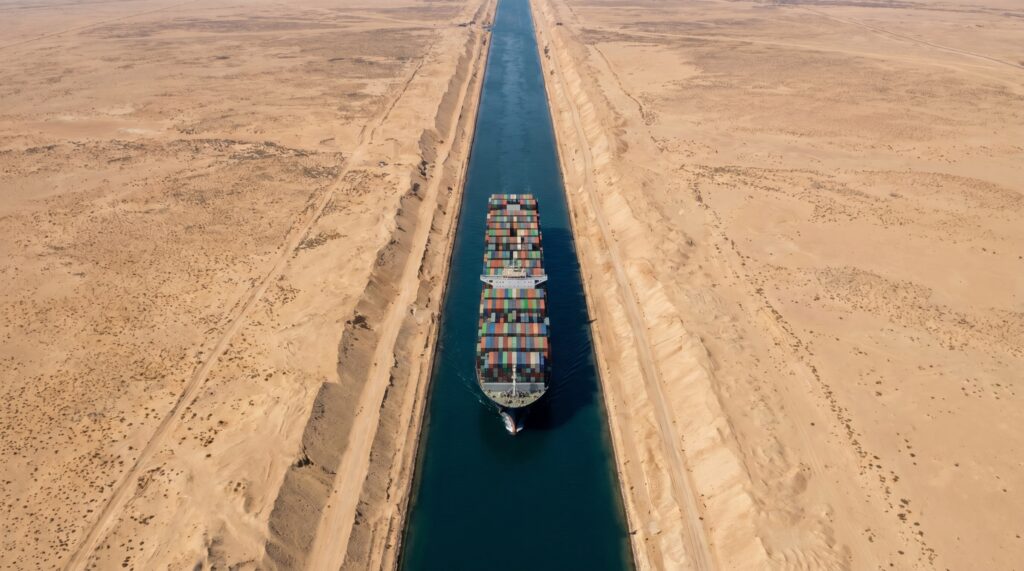
The Suez Canal is an artificial sea-level waterway about 193 km long, cut across the Isthmus of Suez in Egypt, running from Port Said on the Mediterranean south to the city of Suez on the Gulf of Suez, which opens into the Red Sea. It has no locks. It carries around 12% of world trade by volume and close to 30% of global container traffic.
Here’s the distinction that does the work. A strait is a natural gap between two land masses, made by the sea. Malacca, Hormuz, Gibraltar: nobody built those. A canal is a trench cut through land where there was no gap at all. The Suez sliced through the Isthmus of Suez, the 125 km neck of desert that used to join Africa to Asia, turning Africa into an island and leaving the Sinai Peninsula as the only piece of Egypt in Asia.
That isn’t pedantry. A crowded strait still passes ships. When the Suez closes, it closes, and it has twice, once for months and once for eight years. Against Hormuz and the other major straits it’s the same chokepoint logic with a very different vulnerability underneath.
| Attribute | Detail |
|---|---|
| Type | Artificial sea-level canal, no locks |
| Location | Isthmus of Suez, Egypt; separates Africa from Asia |
| Connects | Mediterranean Sea (Port Said) to the Red Sea, via the Gulf of Suez |
| Length | About 193 km including approach channels |
| Opened | 17 November 1869 |
| Built by | Suez Canal Company, under Ferdinand de Lesseps; digging began 1859 |
| Owner and operator | Suez Canal Authority, Egypt, since 1956 |
| Legal basis | Constantinople Convention, 1888: free passage in peace and war |
| Major closures | 1956 to 1957 (Suez Crisis); 1967 to 1975 (Arab-Israeli wars) |
| Widening | New Suez Canal: 35 km parallel channel plus 37 km deepened, opened 6 August 2015 |
| Peak toll revenue | $10.25 billion in 2023; about $4 billion in 2024 |
Why the shortcut is worth billions a day
Because the alternative is sailing around the Cape of Good Hope, and that detour costs roughly 6,000 km and about ten extra days each way.
Let me show you with one voyage. A container ship from Singapore to Rotterdam covers about 8,300 nautical miles through the Suez. Around the Cape it’s about 11,700. Those 3,400 extra nautical miles mean roughly nine extra days each direction and close to $1 million in extra fuel. And a ship at sea isn’t earning, it’s burning. Multiply by a fleet, then a year, and a toll in the hundreds of thousands per transit starts to look cheap.
Scale it up. About 26,000 ships transited in 2023, and Egypt collected a record $10.25 billion in tolls, one of its top foreign-exchange earners alongside remittances and tourism. Then Red Sea attacks cut 2024 traffic to roughly half and revenue to about $4 billion, a hole President Sisi put at $7 billion. A trench 193 km long swings several percent of a country’s economy, depending on what a militia 2,000 km down the coast decides to do.
Why the Suez has no locks, and the Panama Canal does
Because the Mediterranean and the Red Sea sit at effectively the same level, and the desert between them is nearly flat. Panama needs locks because Panama has to climb a hill.
A lock is a water lift, a chamber that floods or drains to carry a ship between two stretches of water at different heights. You need one when the route goes uphill. The Suez never rises above about 15 metres, at the El Gisr ridge, and the engineers cut through it. The Bitter Lakes absorb what difference there is in tidal range, so seawater just fills the trench and finds its own level.
Hold that against the Panama Canal, because the contrast is the whole lesson. Panama crosses the continental divide, so ships must be lifted 26 metres to Gatun Lake and lowered the other side. Each lockage spends roughly 200 million litres of fresh water, drawn from a lake that depends on rain, which is why the 2023-24 drought forced Panama to cut daily transits from 36 to 22. A canal in one of the wettest countries on Earth ran out of water. The Suez spends none at all.
Now the objection you should be forming: if the seas are level, didn’t anyone notice earlier? They did, and they got it wrong. Napoleon’s chief surveyor Jacques-Marie Le Père reported in 1799 that the Red Sea stood about 10 metres higher than the Mediterranean. If true, the canal needed locks and the cost looked ruinous. The error went unchallenged for forty years, until Linant de Bellefonds re-surveyed in the 1840s and found the seas level. The Suez exists because one man rechecked a number everybody had already agreed on.
From de Lesseps to Nasser: how a French company’s ditch became Egypt’s asset
The canal opened on 17 November 1869, built by a French company on an Egyptian concession, and Egypt didn’t control it for another 87 years. Hold the order, because the order is where careless answers fall apart.
- 1854: Ferdinand de Lesseps secured a concession from Said Pasha. Digging ran from 1859 for ten years on corvée labour, meaning conscripted Egyptian peasants. Deaths are usually put in the tens of thousands, mostly cholera. Nobody can give a firm figure, and that’s the point: the records weren’t kept for the people doing the digging.
- 1875: Khedive Ismail, out of money, sold Egypt’s 44% stake to Britain. Disraeli bought it for £4 million, borrowed from Rothschild over a weekend. Britain occupied Egypt outright in 1882, to hold what it called the road to India.
- 1888: the Constantinople Convention declared the canal open to vessels of every nation, in peace and war. It’s still the legal foundation today.
- 26 July 1956: after Washington and London pulled financing for the Aswan High Dam, Gamal Abdel Nasser nationalised the Suez Canal Company and said the tolls would build the dam instead.
What followed, the Suez Crisis, gets taught badly. Israel invaded Sinai on 29 October 1956; Britain and France landed at Port Said on 5 November, claiming to separate the combatants. Militarily it worked. Politically it collapsed inside a week, once Eisenhower made clear Washington would let the pound fall. All three withdrew, and the UN Emergency Force, the first UN peacekeeping deployment, went in instead.
The usual takeaway is “Nasser won.” The sharper reading is that 1956 is when Britain and France discovered they could no longer act as first-rank powers without American permission. The canal was the object; the transfer of authority was the event, which is why this belongs in your notes on the Cold War as much as in a geography chapter.
Then the closures: months during the crisis, reopening in April 1957, then eight years after the Six-Day War of 1967, until 5 June 1975. Fourteen ships sat trapped in the Great Bitter Lake that whole time, hulls yellowing under desert dust. Sailors called them the Yellow Fleet. In 2015 Egypt dug a 35 km parallel channel to speed the convoys, but only about 72 km of the 193 got the treatment.
The Ever Given, and what six days exposed
On 23 March 2021, the Ever Given, a 400-metre container ship, was pushed off course in a sandstorm and wedged diagonally across the channel. She was refloated on 29 March. In six days she did more damage to global logistics than most wars manage.
Around 400 ships queued at both ends. Lloyd’s List valued the goods held up at roughly $9.6 billion a day. The Suez Canal Authority impounded the vessel and claimed $916 million; the owners settled for an undisclosed sum reported at about half, and the ship sailed on 7 July 2021.
The real lesson isn’t the salvage, it’s what the delay did downstream. Just-in-time inventory, the system that made manufacturing cheap for thirty years, works by holding almost no stock. A firm sitting on six weeks of parts shrugs at a six-day delay. A firm sitting on four days stops its line. European car plants felt it for weeks. The canal didn’t break. The assumption that the canal never breaks broke.
And there was no plan B, nothing but a sailing plan obsolete since 1869. That’s what a chokepoint means, and the Ever Given taught it better than any comparison of the world’s straits could.
What the canal means for India
Roughly 80% of India’s merchandise trade with Europe moves through the Suez, along with much of its trade with North Africa and the US East Coast. India’s goods trade with the European Union alone ran to about $135 billion in 2023-24, and estimates for total Indian trade routed through the Red Sea reach around $200 billion a year.
Make it concrete. A container from Nhava Sheva to Rotterdam covers about 6,400 nautical miles through the Suez, against close to 10,700 around the Cape. When Houthi attacks pushed carriers around Africa from December 2023, Indian exporters watched transit times to Europe stretch by 14 to 20 days and spot freight rates on some lanes multiply three to four times. Basmati, tea, marine products and readymade garments took it worst, because in those trades freight is a large slice of the landed price and the margin can’t absorb it. If you’re revising India’s external trade policy, this is the physical layer under the paperwork.
India’s response was naval and deliberately independent. It stayed out of the US-led Operation Prosperity Guardian and the EU’s Operation Aspides, surging about 10 warships into the Arabian Sea and the Gulf of Aden under its own tasking instead. That’s Indian Ocean diplomacy in one move: escort the ships that matter to you, answer distress calls from anyone, and don’t enlist in someone else’s war to do it.
The pressures the canal is under now
The Suez faces a security problem it can’t solve and a competition problem it can only partly solve.
The security problem is at the far end. The southern approach runs down the Red Sea and out through the Bab-el-Mandeb, a strait about 29 km wide between Yemen and Djibouti. Since November 2023, Houthi forces have attacked shipping there, and Suez transits fell by more than half while Cape roundings roughly doubled. Notice the asymmetry. Egypt can dredge its canal, widen it and discount its tolls. Egypt cannot police a strait 2,000 km away inside somebody else’s war. A chokepoint is only as usable as its worst approach.
The competition is real but smaller than the headlines suggest.
- The Cape of Good Hope is always available, always longer, and stickier than it looks. Once carriers rebuild schedules around it, some stay.
- The Northern Sea Route along Russia’s Arctic coast cuts Yokohama to Rotterdam by roughly 40%, but it’s open a few months a year, needs ice-class hulls, and runs at one government’s discretion. Growing, not a substitute.
- IMEC, announced at the G20 in New Delhi in September 2023, moves cargo by ship to the UAE, by rail to Haifa, then by ship to Europe. It’s built for high-value, time-sensitive freight, not bulk, and it needs a regional peace that doesn’t exist. It complements the Suez rather than replacing it.
- The Israeli Ben Gurion Canal that circulates online isn’t a project: no funding, no survey, no state behind it. Don’t write it into an answer as a live alternative.
How to study the Suez Canal
Build it as one chain, not a list, because a chain survives revision. Dug, not natural, so it’s owned and closable; the ground is flat and at sea level, so it needs no locks; it saves about 6,000 km to Europe, so it carries roughly 12% of world trade; that concentration makes it a chokepoint, so one grounding or one militia can price it; and that fragility drives every rival corridor on the map, including India’s ports and shipping strategy.
Four traps, because this is where good answers lose marks.
1. The canal doesn’t reach the Indian Ocean directly. It opens into the Gulf of Suez, then the Red Sea, then Bab-el-Mandeb, then the Gulf of Aden, then the Arabian Sea. Naming that sequence shows you know where the fragility sits. 2. Don’t merge the Suez Crisis with the long closure. The 1956 closure lasted months. The eight-year shutdown was 1967 to 1975, after a different war. 3. Britain didn’t build the canal. A French company did, under an Egyptian concession. Britain bought a shareholding six years after it opened. 4. On the no-locks question, “because it’s flat” is half an answer. Say sea-level canal, a ridge of about 15 m at most, and the Bitter Lakes buffering two seas at near-identical levels.
Then pair it against contrasts: Panama for locks, fresh water and ownership; Hormuz and Malacca for dug versus natural; the Cape for the economics of distance. A fact standing next to a contrast turns into a concept.
Frequently Asked Questions
Where is the Suez Canal and what does it connect?
It runs across the Isthmus of Suez in Egypt, from Port Said on the Mediterranean south to the city of Suez on the Gulf of Suez, which opens into the Red Sea. It’s about 193 km long and leaves Sinai as Egypt’s only Asian territory.
Why does the Suez Canal have no locks?
Because the Mediterranean and the Red Sea sit at effectively the same level and the route crosses flat desert that never rises much above 15 metres, so seawater simply fills the trench. Panama needs locks because ships there must be lifted 26 metres to Gatun Lake.
How much time does the Suez Canal save?
Roughly ten days each way on the Asia to Europe run, and about 40% of the distance. Singapore to Rotterdam is about 8,300 nautical miles via Suez against about 11,700 around the Cape, which also costs close to $1 million more in fuel.
Who owns the Suez Canal?
Egypt, through the state-owned Suez Canal Authority, since Nasser nationalised the French-controlled Suez Canal Company on 26 July 1956. The 1888 Constantinople Convention still obliges Egypt to keep it open to ships of all nations, in peace and war.
How long was the Suez Canal closed?
Twice. For a few months during the 1956 crisis, reopening in April 1957. Then for eight years, from the Six-Day War of 1967 until 5 June 1975, during which fourteen ships known as the Yellow Fleet sat trapped in the Great Bitter Lake.
What happened with the Ever Given in 2021?
The 400-metre container ship grounded across the canal on 23 March 2021 during a sandstorm and blocked it until 29 March. About 400 ships queued, and Lloyd’s List estimated roughly $9.6 billion of trade a day was held up.
Why does the Suez Canal matter to India?
About 80% of India’s merchandise trade with Europe moves through it, and India’s goods trade with the EU alone was around $135 billion in 2023-24. When Red Sea attacks forced ships around Africa, exporters faced 14 to 20 extra days and freight rates that tripled on some lanes.
Practice Questions
1. The Suez Canal is best described as:
a) A natural strait between Africa and Asia
b) An artificial sea-level canal with no locks
c) A lock-based canal crossing a highland divide
d) A tidal inlet of the Mediterranean Sea
Answer: b
2. The Suez Canal requires no locks primarily because:
a) The Red Sea lies well above the Mediterranean
b) Its convoy system regulates water levels
c) The two seas are at nearly the same level and the route crosses low, flat terrain
d) The Bitter Lakes act as a natural lock chamber
Answer: c
3. The Constantinople Convention of 1888 is significant because it:
a) Transferred ownership of the canal to Britain
b) Guaranteed free passage to vessels of all nations in peace and war
c) Fixed the toll rates charged by the Suez Canal Company
d) Created the Suez Canal Authority
Answer: b
4. The Suez Canal remained closed for the longest continuous period following the:
a) Nationalisation of the canal in 1956
b) Anglo-French landings at Port Said
c) Six-Day War of 1967
d) Grounding of the Ever Given in 2021
Answer: c
5. A ship sailing from the Suez Canal towards the Arabian Sea passes through them in the order:
a) Gulf of Aden, Red Sea, Bab-el-Mandeb, Gulf of Suez
b) Gulf of Suez, Red Sea, Bab-el-Mandeb, Gulf of Aden
c) Red Sea, Gulf of Suez, Gulf of Aden, Bab-el-Mandeb
d) Bab-el-Mandeb, Gulf of Suez, Red Sea, Gulf of Aden
Answer: b
Mains-style questions
1. “A canal is a political object in a way a strait can never be.” Examine this with reference to the Suez Canal between 1869 and 1975. 2. Compare the Suez and Panama canals in design, water requirements and vulnerability, and explain why the differences matter for global shipping. 3. Assess the significance of the Suez Canal for India’s external trade, and evaluate India’s response to the disruption of Red Sea shipping. 4. The grounding of a single vessel in 2021 halted a significant share of world trade. Discuss what this reveals about supply chains and the idea of a maritime chokepoint. 5. Examine whether alternative routes and corridors can meaningfully reduce global dependence on the Suez Canal.
The Suez is the clearest case you’ll find of geography being made rather than found. Somebody looked at 125 km of desert, rechecked a survey everyone had accepted, and cut Africa loose from Asia. That one act of construction created the efficiency, the ownership, the crisis of 1956, the eight-year closure, the six days in 2021, and the whole nervous architecture of alternative corridors now being drawn across the map. Learn the chain, keep the causes in order, and you’ll explain in five sentences what most people can only recite in one.
Tell Google you want more of this.
Add Anantam IAS as a preferred sourceOne tap, and this site shows up more often in your own Top Stories, AI Overviews and AI Mode. Remove it any time.