
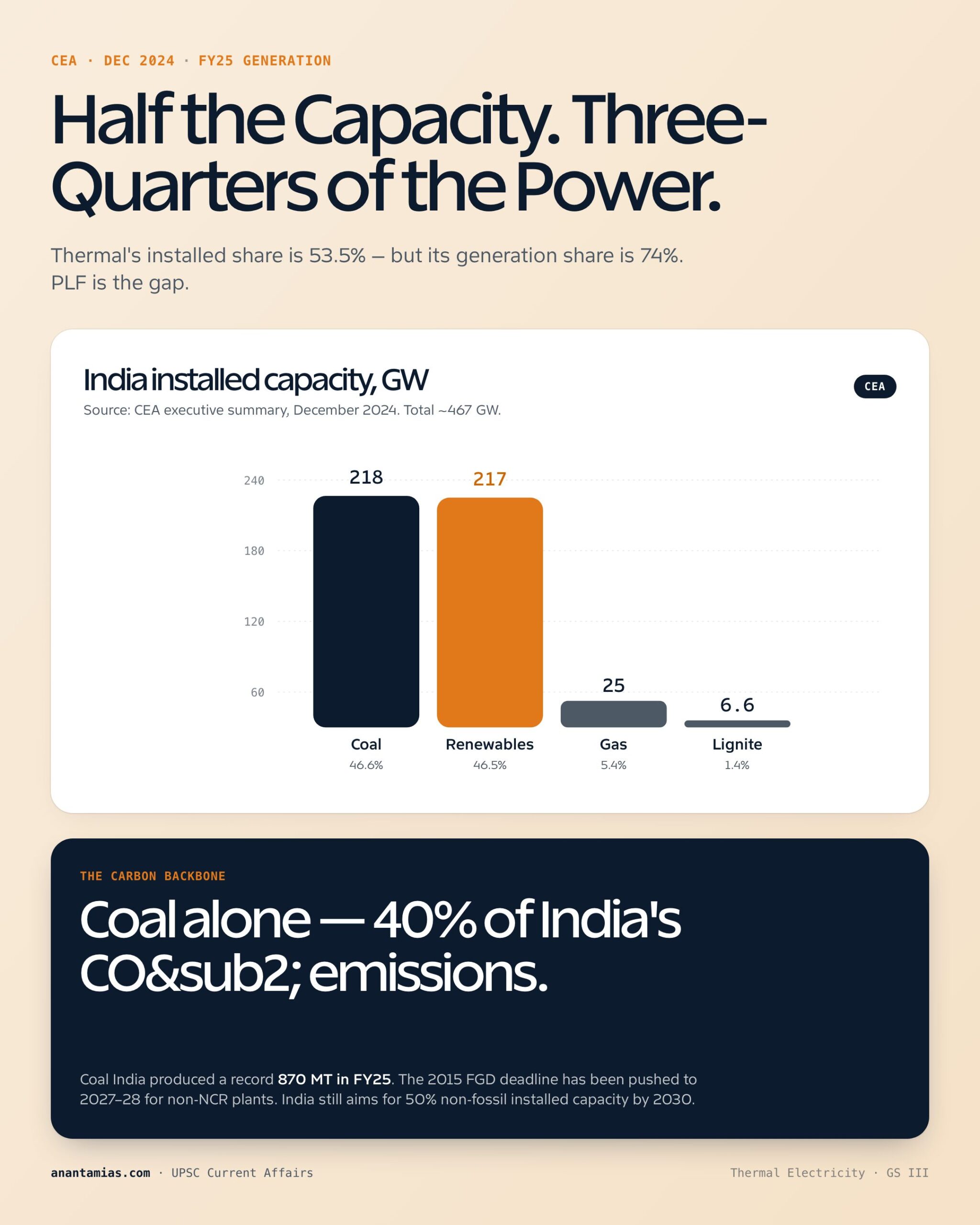
In fiscal year 2024-25, India generated roughly 1,824 billion units (BU) of electricity — and 74% of it came from thermal power plants, primarily coal. Despite the world's fastest renewable build-out, the headline number tells the harder truth: India still adds new coal capacity faster than it retires old plants. As of December 2024, India's installed thermal capacity stood at 243 GW out of 467 GW total installed capacity.
Thermal electricity is therefore both India's base-load workhorse and its largest single contributor to greenhouse-gas emissions and air pollution. Coal-fired electricity alone accounts for roughly 40% of India's CO2 emissions.
For UPSC, thermal electricity sits squarely at the cross-roads of energy security, environmental governance, climate diplomacy and economic development. This guide explains what thermal electricity is, how it is produced, what determines plant location, India's policy framework, the 2015 emission norms saga, the FGD deadline controversy, and the trajectory of the coal-to-clean transition.
What is Thermal Electricity?
Thermal electricity is power generated by converting heat energy into electrical energy. The thermodynamic principle is the Rankine cycle:
- Fuel is burned in a boiler.
- Heat converts water into high-pressure, high-temperature steam.
- Steam drives a turbine.
- The turbine spins a generator, producing electricity.
- Steam is condensed and recycled.
Fuels Used
- Coal — anthracite, bituminous, sub-bituminous, lignite. India primarily uses bituminous and lignite.
- Natural gas — combined-cycle gas turbines (CCGT).
- Petroleum products — diesel, fuel oil (small share).
- Biomass and Refuse-Derived Fuel (RDF) — emerging.
- Nuclear is technically thermal but is treated separately in Indian classification.
Plant Configurations
| Type | Steam Conditions | Efficiency | Indian Status |
|---|---|---|---|
| Subcritical | < 22.1 MPa, < 374°C | ~33% | Older, being phased out |
| Supercritical | 22.1–25 MPa, ~600°C | ~38% | Standard for new plants since 2010s |
| Ultra-supercritical (USC) | > 25 MPa, > 600°C | ~42% | E.g., NTPC Khargone, Telangana Super Thermal |
| Advanced USC (AUSC) | > 30 MPa, > 700°C | ~46% | Under R&D — BHEL-IGCAR-NTPC |
Combined-Cycle Gas Turbines (CCGT)
Use both gas turbines and steam turbines from waste heat. Efficiency up to 60%, but India's gas-based plants run at <25% Plant Load Factor (PLF) due to costly and unavailable domestic gas.
Factors Determining Location of Thermal Power Plants
Thermal plants are sited based on a balance of fuel supply, water, market and environmental factors.
Fuel Supply
- Pithead plants (near coal mines): Ramagundam, Talcher, Vindhyachal, Singrauli, Korba.
- Linkage-based plants (rail-fed): Tanda, Dadri, North Karanpura.
- Coastal/imported coal plants: Mundra, Krishnapatnam, Sasan UMPP.
- Reduces transportation costs of low-calorific Indian coal (typically 3,500-4,000 kcal/kg).
Water Supply
Thermal plants need 2-3 m³/MWh for cooling. Sources: rivers, lakes, estuaries, sea.
- River-based: Ganga, Mahanadi, Godavari basins.
- Coastal: Tamil Nadu, Andhra, Gujarat coasts.
- Cooling tower technology with closed-loop systems is now standard.
- Air-cooled condensers (ACC) reduce water demand by 90% but cost more.
Market Proximity
- Reduces transmission losses (currently ~17-20% AT&C losses for distribution).
- Industrial belts (NCR, MMR, Kolkata-Asansol) host significant thermal capacity.
Transport Connectivity
- Rail link to coal mines is essential.
- Coastal plants depend on port infrastructure.
Land Availability
- A 1,000 MW plant needs 350-450 acres for plant + ash pond + colony.
Economic and Political Stability
- Fuel supply agreements (FSA), Power Purchase Agreements (PPA), regulatory certainty critical for >20-year project lifecycles.
- Many private-sector plants (Reliance, Adani, Tata) are sensitive to coal pricing and tariff disputes.
Environmental Constraints
- MoEFCC environmental clearance.
- CRZ regulations for coastal plants.
- Distance from protected areas, urban habitations.
India's Thermal Capacity Profile
| Source | Installed Capacity (Dec 2024) | Share |
|---|---|---|
| Coal | ~218 GW | 46.6% |
| Lignite | 6.6 GW | 1.4% |
| Gas | 25 GW | 5.4% |
| Diesel | 0.6 GW | 0.1% |
| Total Thermal | ~250 GW | 53.5% |
| Renewables (incl. large hydro) | ~217 GW | 46.5% |
| Total | ~467 GW | 100% |
Source: CEA executive summary, December 2024.
But generation share of thermal is much higher (74%) because of high PLF (~70%) versus solar (~20%) and wind (~25%).
Major Thermal Producers
- NTPC — public sector behemoth, ~75 GW (largest in India).
- State GENCOs — Mahagenco, UPRVUNL, Tangedco, NLC India.
- Private — Adani Power, Tata Power, JSW, Reliance, Vedanta.
Environmental Impact

Thermal electricity, especially coal-based, is India's largest stationary source of pollution.
Greenhouse Gas Emissions
- A coal plant emits ~0.95 kg CO2 per kWh.
- Coal-fired electricity contributes ~40% of India's CO2 emissions.
- India's per capita emissions (~2 tonnes CO2/year) are still well below the global average (~4.7), but absolute emissions are the third-highest globally.
Air Pollutants
- SO2 — coal contains 0.3–0.5% sulphur; without FGD, emissions are massive.
- NOx — high-temperature combustion.
- PM (Fly ash, soot) — even with ESPs, fugitive ash escapes.
- Mercury — neurotoxin; deposited downwind.
- Heavy metals — As, Cd, Pb in fly ash.
Water Pollution
- Thermal pollution — warm water discharge harms aquatic life.
- Fly ash leachate contaminates groundwater.
- Major fly ash pond breaches — Singrauli (2019), Reliance Sasan (2017), Vedanta Jharsuguda (2020) — devastated villages and farmlands.
Land Use
- Fly ash generation — over 270 million tonnes annually.
- Utilisation — ~80%, but storage of un-utilised ash poses risk.
- Mining footprint — coal-mining areas (Singrauli, Korba, Dhanbad) are among India's most polluted.
Health Impact
- Lancet Commission: coal plants contribute to >100,000 premature deaths/year in India.
- Centre for Science and Environment (CSE): respiratory disease rates 2-3x higher in coal belts.
Policy Framework
Electricity Act, 2003
The principal statute governing generation, transmission, distribution.
Environment (Protection) Act, 1986
Provides MoEFCC the authority to set emission norms.
2015 Emission Norms (and the FGD Saga)
- December 2015 notification by MoEFCC set first-ever SO2, NOx, PM and mercury standards for thermal plants.
- Required all coal plants to install Flue-Gas Desulphurisation (FGD) units within 2 years (2017).
- Original deadline: 2017 → extended to 2022 → again to 2024–26 in phased manner → in 2024, MoEFCC announced further phase-wise relaxations to 2027–28 for plants outside critically polluted areas, citing technical and financial constraints.
- As of late 2024, only ~10% of coal capacity has commissioned FGD; tenders cover ~60%.
Perform, Achieve and Trade (PAT) Scheme
Under National Mission for Enhanced Energy Efficiency (BEE). Thermal plants are designated consumers; energy intensity targets enforced through ESCerts.
Renewable Purchase Obligations (RPO)
DISCOMs must buy a fixed percentage of power from renewables, indirectly capping thermal demand.
Phasing Out Subcritical Plants
- Old plants (<25 years, <210 MW) being retired in phases.
- NTPC retired its 740 MW Badarpur plant (2018) — Delhi's largest single source closed.
NDC and Climate Commitments (Paris Agreement, 2015 → updated 2022)
- 50% non-fossil installed capacity by 2030 (originally 40%).
- Reduce emissions intensity of GDP by 45% from 2005 levels by 2030.
- Net-Zero by 2070 (Glasgow COP26).
National Electricity Plan 2022–32
Projects coal capacity to grow to 283 GW by 2030, even as renewables overtake. No new "all-coal" greenfield project after 2022; only completion of existing pipeline.
Carbon Credit Trading Scheme (CCTS), 2023
India's domestic carbon market — phased rollout 2024-26; thermal plants are obligated entities.
Coal India Reforms
- Commercial coal mining opened in 2020.
- Coal Block Allocation Reforms under Mines and Minerals (Development and Regulation) Amendment Act, 2021.
Recent Developments (2024–26)
- India's installed thermal capacity crossed 250 GW in December 2024 — a record.
- MoEFCC FGD deadline (Dec 2024) further relaxed to December 2027–28 for non-NCR plants; CSE and environmental groups opposed.
- NTPC's first AUSC project at NTPC Sipat is in advanced design — first of its kind in India.
- Coal India FY24-25 production crossed 870 MT — a record; demand-driven by extreme summer and pre-monsoon load.
- CEA's Resource Adequacy Plan (2024) flags thermal will remain critical till 2032 for grid balancing.
- Solar + Storage parity — battery storage tariffs at Rs 4.0/kWh in 2024 auctions, approaching coal levelised cost.
- Pumped Storage Projects (PSPs) — 30 GW pipeline approved by Cabinet (Aug 2024) to back up renewables.
- Just Transition Framework — NITI Aayog draft circulated 2024 for coal-belt states (Jharkhand, Chhattisgarh, Odisha, MP).
- Carbon market notification — CCTS launched compliance trading from 2025.
- CBAM impact — EU's Carbon Border Adjustment Mechanism (transitional 2023-25, full from 2026) will price India's thermal-heavy electricity for steel and aluminium exports.
- India's 50% non-fossil target likely to be achieved by 2026, four years ahead of the 2030 NDC commitment, per CEA dashboards.
Way Forward
- No new coal greenfield projects — limit additions to under-construction pipeline only.
- Mandatory FGD without further extensions — at minimum for plants in critically polluted areas.
- Retire subcritical plants (>25 years) on schedule.
- Repurpose old thermal plants as battery storage or pumped hydro hubs.
- Just Transition Plans for coal-dependent districts and workers.
- Accelerate AUSC and Carbon Capture R&D for unavoidable coal use.
- Scale up battery storage and PSPs to enable round-the-clock renewables.
- Domestic carbon market enforcement with rising stringency.
- Demand-side management — energy efficiency, time-of-day tariffs.
- Strengthen DISCOMs financial health to reduce reliance on cheap thermal PPA renegotiations.
- Mandate coal-pithead plants only, blocking long-haul coal logistics.
Mains Hook
"India's energy transition is being shaped by two opposing trends — record thermal additions and record renewable additions. Discuss the policy challenges of managing this dual reality." — GS III
"The repeated extension of FGD deadlines for thermal power plants undermines India's air-quality and climate commitments. Critically examine." — GS III
Prelims Pointers
- Thermal electricity uses the Rankine cycle.
- Supercritical: > 22.1 MPa, ~600°C.
- Ultra-supercritical: > 25 MPa, > 600°C.
- Advanced ultra-supercritical (AUSC): > 30 MPa, > 700°C.
- CCGT efficiency: up to 60%.
- India's installed thermal capacity (Dec 2024): ~250 GW (~53.5% of 467 GW).
- Coal share of installed capacity: ~46.6% (~218 GW).
- NTPC is India's largest thermal producer, ~75 GW.
- 2015 MoEFCC norms mandated FGD; deadline extended multiple times to 2027-28.
- Coal contributes ~40% of India's CO2 emissions.
- NDC 2030 updated targets: 50% non-fossil installed capacity, 45% emission intensity reduction.
- Net-Zero target: 2070 (Glasgow COP26).
- Pithead plants: Singrauli, Vindhyachal, Korba, Talcher, Ramagundam.
- PAT scheme under BEE; uses ESCerts.
- Carbon Credit Trading Scheme (CCTS) notified 2023; rollout 2024-26.
- Fly ash generation: ~270 MT/year; utilisation ~80%.
Conclusion
Thermal electricity is the bridge that India must cross — and ultimately leave behind. The country cannot afford to dismantle coal too fast (energy security, jobs, grid stability) or too slow (air pollution, climate commitments, CBAM costs). The right path is a managed transition: enforce FGD norms now, retire old subcritical plants on schedule, double down on storage and renewables, and prepare coal-belt districts for a post-coal economy. Done well, India can meet its NDC targets without leaving 13 million coal-economy livelihoods in the dust.
Tell Google you want more of this.
Add Anantam IAS as a preferred sourceOne tap, and this site shows up more often in your own Top Stories, AI Overviews and AI Mode. Remove it any time.