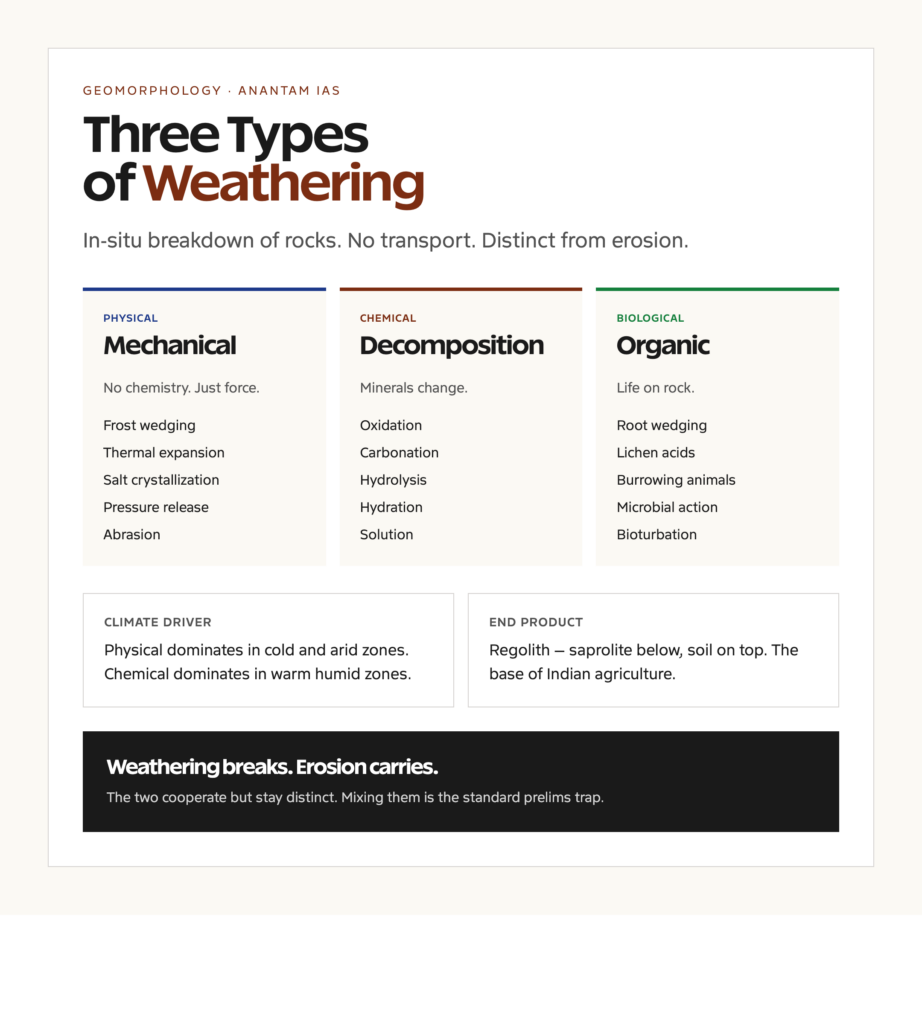
Types of weathering form the foundation of geomorphology, the study of how the earth’s surface gets shaped over time. Weathering is the in-situ breakdown of rocks and minerals at or near the earth’s surface, distinct from erosion, which is the transport of the broken material to somewhere else. The two processes work together, but they are not the same thing, and the distinction is one of the most reliable trip-wires in a UPSC prelims paper.
There are three broad types of weathering, and most introductory texts agree on the categories. Physical, also called mechanical, weathering breaks rocks apart without changing their chemical composition. Chemical weathering alters the mineral composition through reactions with water, oxygen, carbon dioxide, and acids. Biological weathering, sometimes called biotic or organic weathering, is the action of living organisms on rocks and is partly physical and partly chemical in mechanism. In real landscapes the three operate together, with one or the other dominating depending on climate, lithology, and time.
This piece walks through each type of weathering with its sub-processes, the India-specific examples that examiners reach for first, the link between weathering and soil formation, the role of climate and lithology, and the practical implications for landslide risk, slope stability, and infrastructure planning. The framing is pitched for UPSC GS Paper 1 physical geography with side-glances at GS Paper 3 disaster management.
Quick Facts at a Glance
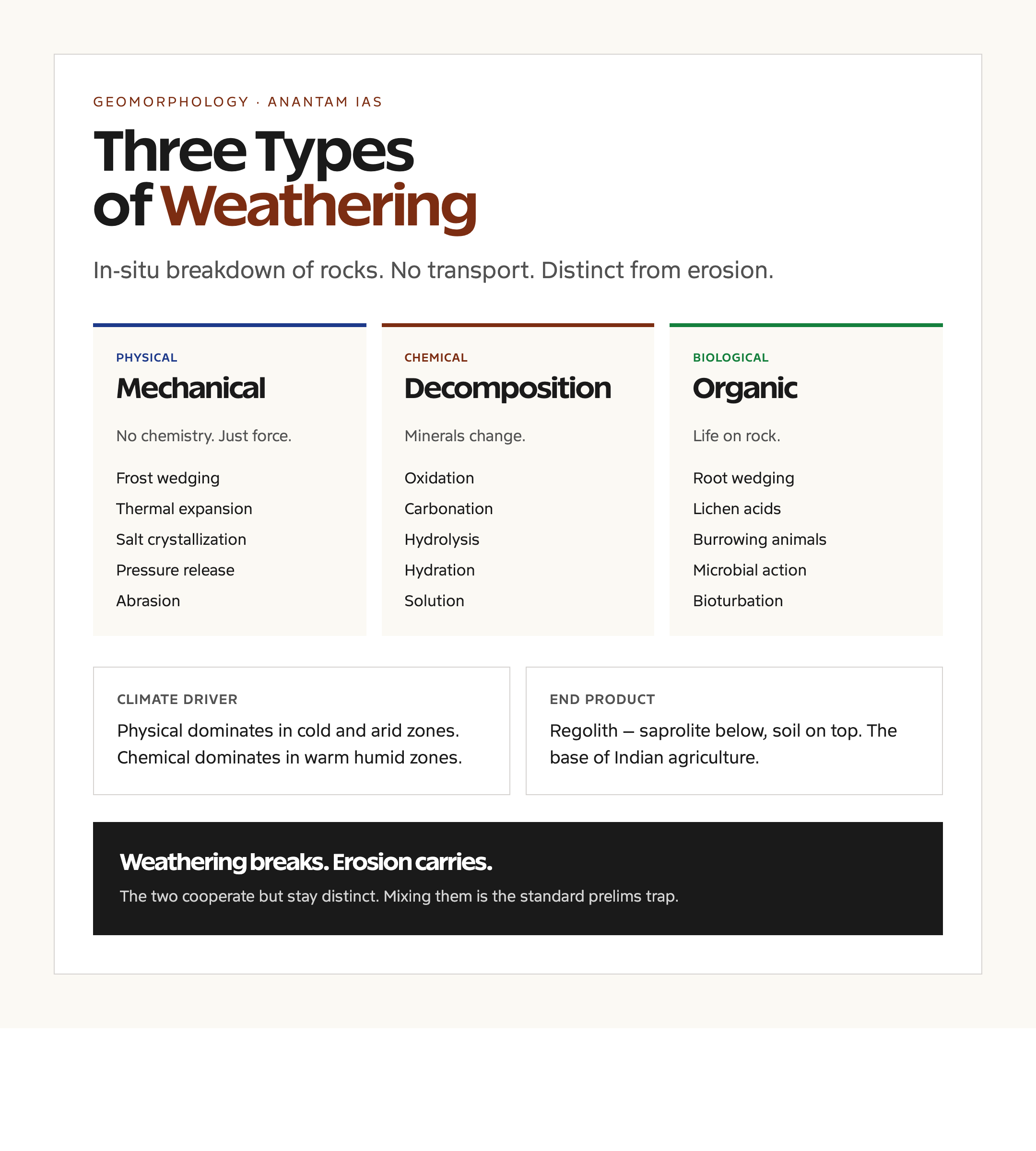
- Weathering definition: In-situ breakdown of rocks and minerals at the earth’s surface, without transport
- Three main types: Physical (mechanical), chemical, biological
- Physical sub-processes: Frost wedging, thermal expansion, salt crystallization, pressure release, abrasion
- Chemical sub-processes: Oxidation, carbonation, hydrolysis, hydration, solution
- Biological sub-processes: Root wedging, lichen and moss action, burrowing animals, organic acid release
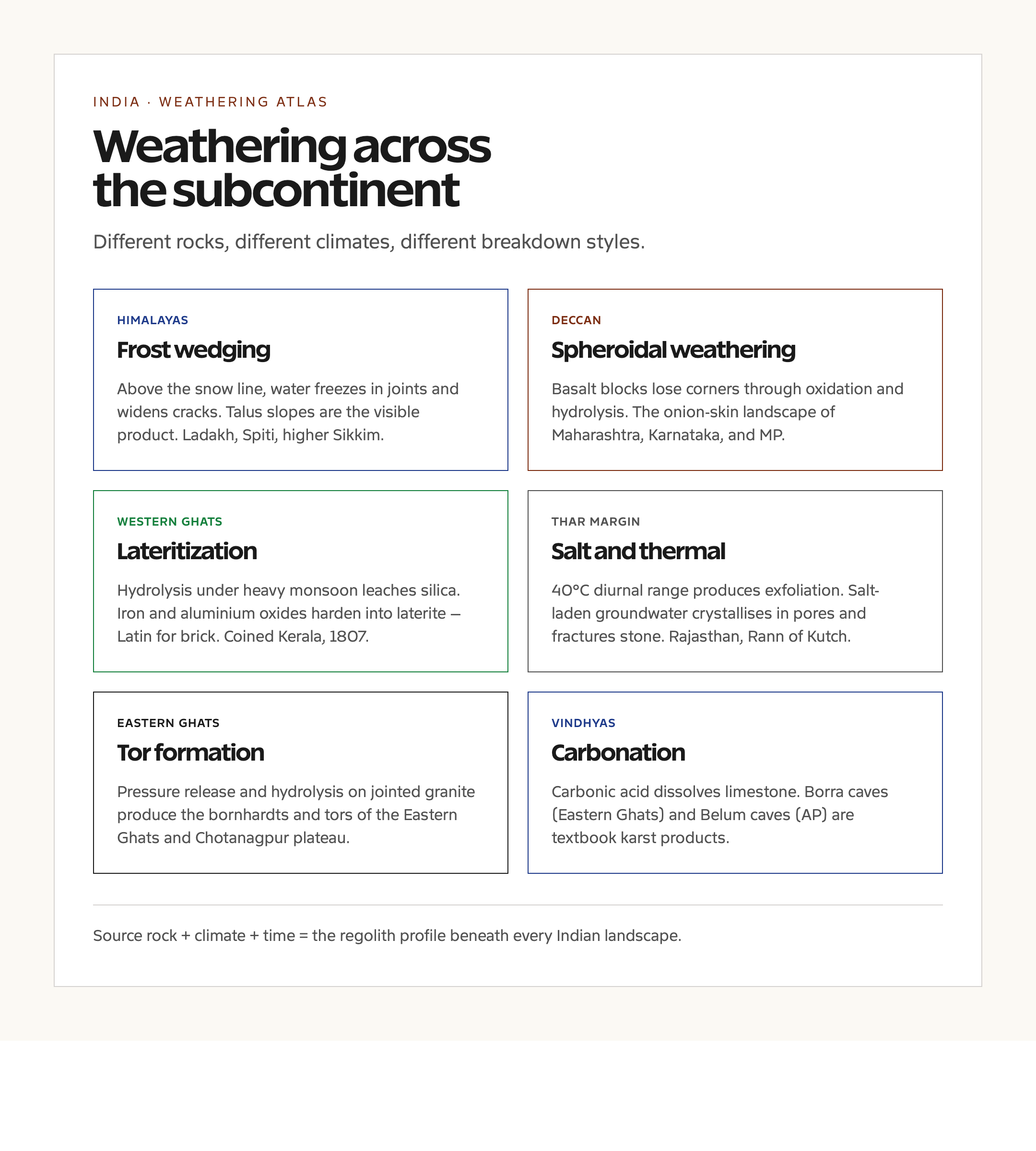
- Key India examples: Himalayan frost weathering, Deccan basalt spheroidal weathering, Western Ghats lateritization, Thar salt weathering, Eastern Ghats granite tor formation
- Climate dependence: Physical weathering dominates in arid and cold regions, chemical weathering dominates in warm and humid regions
- Time scale: Weathering operates over centuries to millions of years; rates vary from millimetres per millennium to centimetres per year
- End product: Regolith, the layer of weathered material that includes soil and saprolite
What Weathering Actually Is
Weathering is the slow disintegration and decomposition of rocks at the earth’s surface, driven by atmospheric agents and biological activity. The crucial word is in-situ. The rock is broken apart where it sits. The minute the broken material is carried away by water, wind, ice, or gravity, the process is no longer weathering, it is erosion. Weathering produces the material that erosion can then transport.
The agents of weathering are temperature changes, water in liquid and frozen forms, atmospheric gases including oxygen and carbon dioxide, dilute acids in rainwater and groundwater, and the metabolism of organisms from bacteria and lichens to trees and burrowing mammals. Each agent acts on rocks in different ways. The granite of the Eastern Ghats weathers differently from the basalt of the Deccan, which weathers differently from the limestone of the Vindhyas, which weathers differently from the sandstone of the Thar margin.
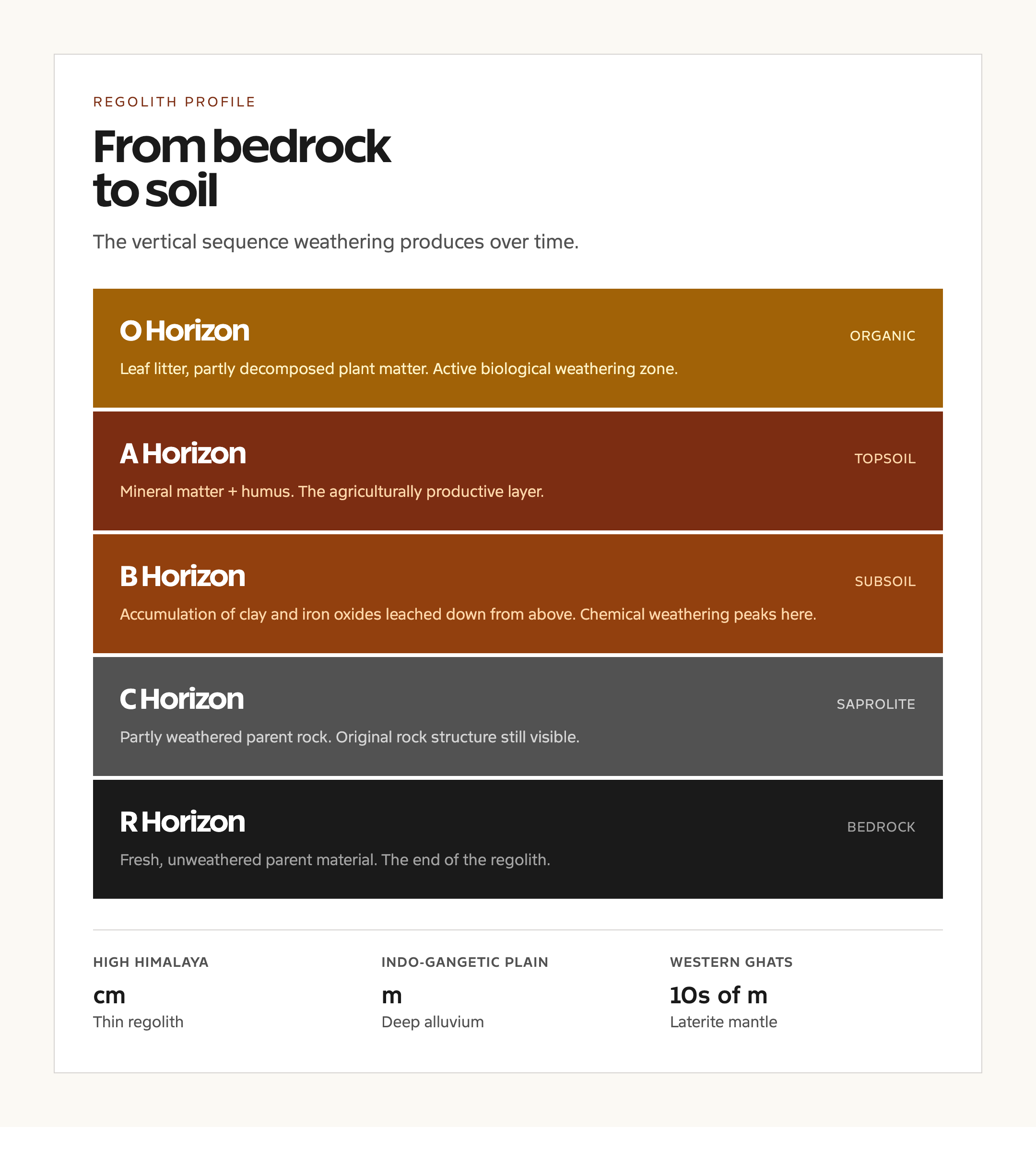
The product of weathering is the regolith, the loose layer of weathered material that overlies fresh bedrock. The regolith includes saprolite, the partly weathered bedrock that still retains some original rock structure, and the soil at the top, where biological activity has reorganized the weathered material into horizons. The regolith profile across the Indian subcontinent varies in thickness from a few centimetres in the high Himalaya to several tens of metres in the Western Ghats laterite belts.
Background and Historical Context
The systematic study of weathering as a geological process took shape in the nineteenth century. James Hutton’s Theory of the Earth in 1788 placed slow surface processes at the centre of geological reasoning. Charles Lyell’s Principles of Geology in 1830 extended the framework with detailed observations of present-day weathering rates. The German chemist Robert Bunsen and the Swiss geologist Albert Heim made early measurements of chemical weathering rates in the mid-nineteenth century. The Russian soil scientist Vasily Dokuchaev established the climate-vegetation-soil link in the 1880s and provided the framework that linked weathering, climate, and soil formation.
The Indian context has its own substantial scientific record. The Geological Survey of India was founded in 1851, the third-oldest national geological survey in the world, and produced systematic geological mapping that documented weathering profiles across the country. T.R. Holland’s 1908 work on the Indian peninsula identified the laterite weathering of the Western Ghats as a distinctive Indian feature, and the term laterite itself, from Latin later for brick, was coined by Francis Buchanan-Hamilton in Kerala in 1807. The Wadia Institute of Himalayan Geology and the National Institute of Hydrology have since produced detailed studies of Himalayan weathering and its links to landslide and flood risk.
The mid-twentieth century work of Bruce Birkeland and Sheldon Judson at Stanford established quantitative weathering-rate measurements using soil chronosequences. The current understanding of weathering rates, expressed in tonnes per square kilometre per year or in millimetres of surface lowering per millennium, draws on field measurements, laboratory dissolution experiments, and cosmogenic nuclide dating that emerged from the 1990s onward.
Physical Weathering in Detail
Physical or mechanical weathering breaks rocks apart without altering their chemistry. The five main sub-processes are frost wedging, thermal expansion, salt crystallization, pressure release, and abrasion.
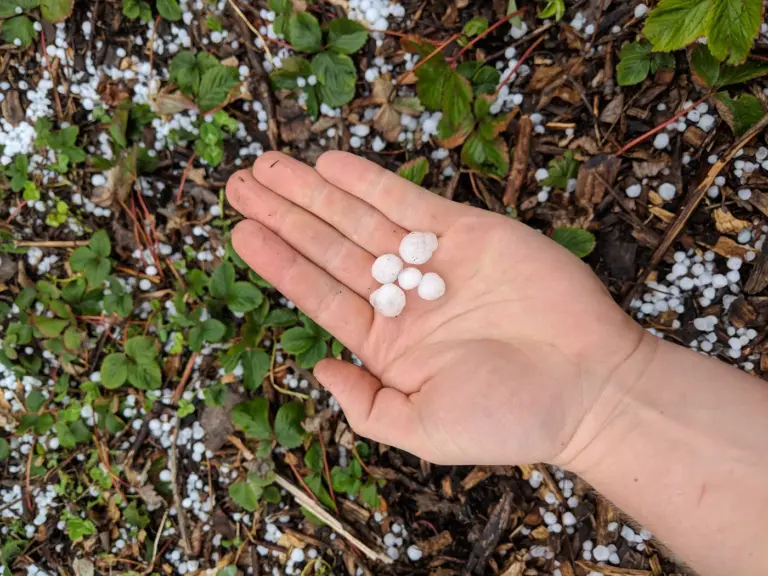
Frost wedging, also called freeze-thaw weathering, is the dominant physical process in cold regions including the Himalayas and the higher Western Ghats. Water seeps into cracks in rocks, freezes, and expands by about nine percent as it forms ice. The expansion exerts pressure on the surrounding rock, widening the crack. Repeated freeze-thaw cycles eventually split the rock apart. The Himalayan region from Ladakh through Spiti to Sikkim sees intense frost weathering above the snow line. The talus slopes, the piles of angular rock fragments at the base of cliffs, are the visible product.
Thermal expansion, also called insolation weathering, is the daily heating and cooling of rock surfaces. In arid regions including the Thar Desert, daytime temperatures can exceed 45 degrees Celsius and nighttime temperatures can drop near zero, producing a diurnal temperature range of forty degrees or more. The differential expansion and contraction of the outer rock layer relative to the cooler interior generates stress and eventually produces exfoliation, the peeling away of curved shells from rock surfaces. The granite domes of southern Karnataka and Tamil Nadu show classic exfoliation.
Salt crystallization is significant in coastal and arid environments. Salt-laden groundwater is drawn into rock by capillary action, then evaporates and leaves salt crystals behind. The crystals grow inside pore spaces and exert pressure that fractures the rock. The Thar margin, the Rann of Kutch, and the salt-pan areas of Tamil Nadu show extensive salt weathering of building stone.
Pressure release, also called unloading or sheeting, occurs when overlying rock is removed by erosion. The exposed rock expands upward and develops sheet joints parallel to the surface. The granite tors of the Eastern Ghats and the bornhardts of the Chhotanagpur plateau owe their characteristic shapes to pressure-release weathering.
Abrasion is the mechanical wearing of rock surfaces by transported material. Wind-blown sand abrades the windward face of rocks in the Thar. Glacial abrasion produces the striated bedrock surfaces of the high Himalaya. River abrasion produces the smoothed boulders of mountain streams.
Chemical Weathering in Detail
Chemical weathering changes the mineral composition of rocks. The five main reactions are oxidation, carbonation, hydrolysis, hydration, and solution.
Oxidation is the reaction of oxygen with iron-bearing minerals. The most common visible product is the rust-red staining of rocks containing pyrite, magnetite, or other iron compounds. The Deccan basalts, rich in iron-bearing pyroxenes and olivine, weather to red and yellow-brown surfaces through oxidation. The bright red soils of central Maharashtra and parts of Telangana owe their colour to extensive oxidation.
Carbonation is the reaction of dissolved carbon dioxide with calcium carbonate. Rainwater absorbs atmospheric CO2 to form weak carbonic acid, which dissolves limestone and dolomite. The Kaimur sandstone and Vindhyan limestone show carbonation features. The Borra caves in the Eastern Ghats and the Belum caves in Andhra Pradesh are products of long-term carbonation of limestone, the same process that produces karst landscapes elsewhere in the world.
Hydrolysis is the reaction of water with silicate minerals, especially feldspars. The water molecules react with the feldspar to form clay minerals such as kaolinite, releasing dissolved silica and potassium or sodium ions. Hydrolysis is the dominant chemical weathering process in the humid tropics, including most of peninsular India during the monsoon. The granite of the Eastern Ghats and the gneiss of the Aravallis show extensive hydrolysis-driven weathering.
Hydration is the incorporation of water molecules into a mineral’s crystal structure. Anhydrite hydrates to gypsum with a volume increase of about sixty percent, producing internal stress that fractures rock. Iron oxide hematite hydrates to limonite. Hydration is also a key step in the formation of clay minerals from feldspars.
Solution is the direct dissolution of soluble minerals in water. Halite, gypsum, and calcite are the most readily soluble. Solution is the main process in salt and karst landscapes. The salt pillars and gypsum karst of the Rann of Kutch margin are examples.
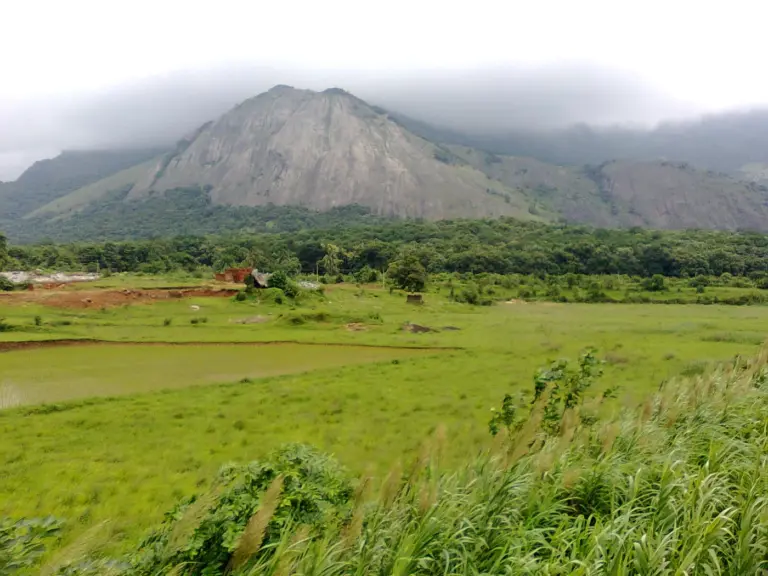
The Western Ghats laterite belt is the showcase example of chemical weathering at scale in India. Extended hydrolysis under heavy monsoon rainfall leaches silica and alkalis from the parent rock, leaving behind iron and aluminium oxides that harden on exposure to form the brick-like laterite for which the process is named.
Biological Weathering in Detail
Biological weathering combines physical and chemical mechanisms driven by living organisms. Plant roots, especially of trees, exert mechanical force as they grow into rock cracks and progressively widen them. Tree roots can split granite boulders along pre-existing joints. The peepal and banyan trees of the Indian plains often establish on temple walls and old monuments and break them apart by root wedging.
Lichens are the slow but persistent chemical weathering agents at the earth’s surface. They secrete oxalic acid and other organic acids that dissolve silicate minerals at the rock-lichen interface. The colour of lichen-encrusted rock surfaces in the Western Ghats and Himalayas is a visible marker of biological weathering.
Burrowing animals from earthworms to rodents physically rearrange the regolith. Earthworms ingest and excrete soil at rates that have been measured at several tonnes per hectare per year in India’s humid tropical soils, producing what Charles Darwin called vegetable mould. The aeration and mixing improve chemical weathering by increasing the surface area exposed to water and atmospheric gases.
Microbial weathering is the least visible but possibly the most extensive form. Sulphur-oxidizing bacteria, iron-reducing bacteria, and various chemoautotrophs accelerate mineral dissolution in soils and aquifers. The role of microbial communities in weathering is an active area of research at the Indian Institute of Science and the Wadia Institute.
Why It Matters
Weathering matters for three reasons. The first is soil formation. Indian agriculture rests on weathering processes that have produced the alluvial soils of the Indo-Gangetic plain, the black cotton soil of the Deccan from basalt weathering, the red and lateritic soils of peninsular India, and the mountain soils of the Himalayas. The fertility, texture, and water-holding capacity of each soil type traces back to specific weathering pathways.
The second is hazard. Deep weathering profiles, especially in the Western Ghats and the Himalayas, become unstable when saturated by monsoon rainfall. Landslides in Uttarakhand, Himachal Pradesh, and Kerala are concentrated where chemical weathering has produced thick clay-rich regoliths on steep slopes. The 2018 Kerala floods, the 2023 Joshimath subsidence, and the 2024 Wayanad landslides all involved weathering-prepared slope failures. The National Institute of Disaster Management and the Geological Survey of India have called for systematic weathering-profile mapping as part of landslide-hazard zonation.
The third is infrastructure. Tunnels, dams, and bridge foundations in the Himalayas pass through weathered rock zones that behave very differently from fresh bedrock. The collapse of tunnel sections during the Char Dham road construction in 2021 and earlier setbacks at the Tehri dam highlighted the need for detailed weathering surveys in route alignment. The Border Roads Organisation now requires weathering-grade classification along all strategic highway projects in mountainous terrain.
Prelims Pointers
- Weathering is in-situ breakdown of rocks, distinct from erosion which involves transport
- Three types: physical (mechanical), chemical, biological
- Frost wedging, thermal expansion, salt crystallization, pressure release, abrasion are physical processes
- Oxidation, carbonation, hydrolysis, hydration, solution are chemical processes
- Physical weathering dominates in arid and cold climates; chemical in warm humid climates
- The Western Ghats laterite belt is the showcase case of large-scale hydrolysis and oxidation
- Deccan basalt weathering produces the black cotton soil of Maharashtra and Madhya Pradesh
- The term laterite was coined by Francis Buchanan-Hamilton in 1807 in Kerala
- Spheroidal weathering produces the rounded boulders typical of jointed granite and basalt
- Regolith is the layer of weathered material; saprolite is the partly weathered subsurface zone
- Geological Survey of India was founded in 1851, the third-oldest national geological survey
- The Borra and Belum caves are products of long-term carbonation of limestone
Mains Practice Questions
- Distinguish between physical, chemical, and biological weathering with suitable Indian examples. (GS Paper 1, 150 words)
- The Western Ghats laterite belt is the largest single landscape produced by chemical weathering in India. Discuss the processes involved and the implications for soil, water, and slope stability. (GS Paper 1, 250 words)
- The 2023 Joshimath subsidence and the 2024 Wayanad landslides highlight the role of weathered regoliths in modern disaster risk. Critically examine the case for systematic weathering-profile mapping as part of national hazard zonation. (GS Paper 3, 250 words)
- Compare the weathering regimes of the Thar Desert, the Deccan plateau, and the Himalayan belt, and discuss the implications for soil formation and land use. (GS Paper 1, 250 words)
Way Forward
The first practical step is systematic weathering-profile mapping in landslide-prone regions. The Geological Survey of India has the technical capacity, the National Disaster Management Authority has the institutional mandate, and the National Remote Sensing Centre has the data backbone for combined satellite, geophysical, and field-based regolith characterization. A national weathering atlas, district by district, would feed directly into the disaster-risk and slope-stability framework.
The second is to make weathering data routinely available for infrastructure design. The Bureau of Indian Standards code on soil mechanics already references weathering grade in shallow foundation design, but the practical use is inconsistent. Strategic infrastructure in the Himalayas, the Western Ghats, and the Northeast needs weathering-grade specification as a default rather than an exception. Useful related references include the greater one-horned rhinoceros habitat in alluvial floodplain soils derived from Himalayan weathering, the Indian Ocean tsunami of 2004 for the role of coastal weathering in shoreline vulnerability, and the Kudankulam Nuclear Power Plant site selection which involved detailed weathering-grade assessment of the Tamil Nadu coastal granite.
Frequently Asked Questions
What is weathering and how is it different from erosion?
Weathering is the in-situ breakdown of rocks and minerals at the earth’s surface, without transport. Erosion is the removal and transport of the broken material by water, wind, ice, or gravity. Weathering supplies the material that erosion then carries away. The two work together but operate through different mechanisms and produce different outcomes.
What are the three main types of weathering?
Physical or mechanical weathering breaks rocks apart without changing their chemistry. Chemical weathering alters the mineral composition through reactions with water, oxygen, carbon dioxide, and acids. Biological weathering is the action of living organisms on rocks, combining mechanical and chemical mechanisms. In real landscapes all three operate together, with one or the other dominating depending on climate and lithology.
What is frost wedging and where is it most active in India?
Frost wedging is the splitting of rocks by repeated freezing and thawing of water inside cracks. Water expands by about nine percent as it freezes, exerting pressure on the surrounding rock. Frost wedging is the dominant physical process in the Himalayas above the snow line, including Ladakh, Spiti, Lahaul, and the higher reaches of Sikkim and Arunachal Pradesh.
What is the difference between hydrolysis and hydration?
Hydrolysis is a chemical reaction in which water reacts with silicate minerals to form new clay minerals, releasing dissolved silica and alkali ions. Hydration is the simple incorporation of water molecules into the crystal structure of a mineral without breaking the chemical bonds. Hydrolysis produces new minerals; hydration changes a mineral’s volume and properties.
How does laterite form in the Western Ghats?
Laterite forms through extended chemical weathering of parent rock under heavy monsoon rainfall and warm temperatures. Hydrolysis and oxidation leach silica and alkalis from the rock, leaving behind iron and aluminium oxides that harden on exposure. The Western Ghats belt from Maharashtra through Kerala contains the largest contiguous laterite landscape in India.
Why is the Deccan basalt landscape associated with spheroidal weathering?
Spheroidal weathering occurs because chemical weathering attacks rock most aggressively at corners and edges, where the surface-to-volume ratio is highest. Over time, the rectangular blocks formed by joints in the basalt become rounded, producing the characteristic onion-skin or core-stone landscape. The Deccan basalts of Maharashtra, Karnataka, and Madhya Pradesh are textbook examples.
What is the role of biological weathering?
Biological weathering combines mechanical and chemical mechanisms driven by living organisms. Tree roots split rocks by wedging into cracks, lichens secrete acids that dissolve silicates, burrowing animals rearrange the regolith and improve aeration, and microbes accelerate mineral dissolution. The combined effect is significant but slow, and is most visible in long-undisturbed surfaces.
How does climate influence the type of weathering that dominates?
Cold and dry climates favour physical weathering, particularly frost wedging and thermal expansion. Warm and humid climates favour chemical weathering, particularly hydrolysis and oxidation. Arid hot climates favour salt crystallization and exfoliation. Polar climates favour glacial abrasion and frost shattering. India spans all these regimes within its borders.
What is regolith and why does it matter?
Regolith is the layer of weathered material that overlies fresh bedrock. It includes soil at the top and saprolite, the partly weathered bedrock, below. Regolith thickness varies from a few centimetres in the high Himalaya to tens of metres in the Western Ghats laterite belt. Regolith holds the soil, the groundwater, and the slope-stability conditions that matter most for agriculture, water, and disaster risk.
Why does weathering matter for infrastructure projects in the Himalayas?
Himalayan weathering produces thick clay-rich regoliths on steep slopes that become unstable when saturated by monsoon rainfall. Tunnels, dams, and roads have to pass through these zones with appropriate engineering design. The Char Dham road, the Tehri dam, and several Border Roads Organisation highway projects have required detailed weathering-grade classification to avoid construction-stage and operational-stage failures.
Tell Google you want more of this.
Add Anantam IAS as a preferred sourceOne tap, and this site shows up more often in your own Top Stories, AI Overviews and AI Mode. Remove it any time.