The Veerabhadra Temple at Lepakshi is famous for a party trick: a stone pillar that hangs slightly off the ground, so guides slide a sheet of paper or a strip of cloth clean underneath it. That single image is what most people carry away, and it does the temple a disservice. Strip away the pillar for a moment and Lepakshi is still one of the most complete pieces of sixteenth-century Vijayanagara art anywhere in India, with a ceiling of painted murals, a monolithic bull the size of a room, and a serpent coiled over a linga cut from one boulder. The hanging pillar is the hook. The reason to actually know this temple is that it is a rare, near-intact snapshot of the last great phase of Vijayanagara building, made just before that world was destroyed.
What and where the temple is
The short answer: Lepakshi is a sixteenth-century Hindu temple in Andhra Pradesh, dedicated to Veerabhadra, built at the height of the Vijayanagara Empire. It sits in the village of Lepakshi in the Anantapur region of Andhra Pradesh, now part of Sri Sathya Sai district, close to the Karnataka border and a short drive from Bengaluru.
The presiding deity, Veerabhadra, is a fierce, warrior form of Shiva. In the myth, Shiva created Veerabhadra out of his own rage after his consort Sati immolated herself at her father Daksha’s sacrifice, and Veerabhadra stormed in to destroy the yagna. So this is not a gentle, benedictory Shiva temple. It is dedicated to Shiva in his most terrifying aspect, which is why the largest painting inside shows a towering, weapon-bearing figure rather than a serene god.
The temple was built around the 1530s CE, commonly dated to about 1538, during the reign of Achyuta Deva Raya, the Vijayanagara emperor who succeeded the famous Krishnadevaraya. Its patrons were two brothers, Virupanna and Viranna, local governors and treasury officials under the empire. To place it in time: this is roughly a generation before the empire’s catastrophic defeat, so Lepakshi is late-imperial Vijayanagara art, confident and mature, built by a state that did not yet know its clock was running out. If you have studied the Vijayanagara Empire as a political story, this temple is what its wealth looked like on the ground.
Built on a tortoise: the Kurma Saila plan
Here is a detail that turns a bland site note into something you remember. The temple is built on and into a low granite hill shaped like a tortoise, called Kurma Saila or Kurma Sailam. The rock itself is part of the design; walls and shrines grow straight out of the living granite rather than sitting on a levelled platform.
That matters for two reasons. First, it explains the whole engineering personality of the place, because a temple carved partly from bedrock behaves differently from one assembled on flat ground, and the famous hanging pillar is best understood as a builder’s game played on exactly this kind of rock-anchored structure. Second, the tortoise is not accidental symbolism. In Hindu cosmology the tortoise, Kurma, is a form of Vishnu that supports the world, so a Shiva temple raised on a tortoise-shaped rock is a quiet statement about the stability and cosmic weight of the shrine. The layout unfolds in the standard South Indian sequence you will recognise from any study of Dravidian temple architecture: an outer assembly and dance hall, an inner hall, and the sanctum, with the whole enclosed by a pillared court.
The hanging pillar, explained without the mysticism
The single most asked question about Lepakshi is whether the hanging pillar is real, and the honest answer is yes, but it is engineering, not magic. In the large pillared hall, the natya mandapa, there are around 70 carved granite pillars. One of them does not rest fully on the floor. There is a narrow gap at its base, and visitors routinely pass a thin cloth, a sheet of paper, or a stick under it from one side to the other.
The usual explanation is that the pillar is essentially suspended from above, its load carried through the beam and ceiling structure it is locked into rather than pressed down onto the ground, so the base clears the floor by a sliver. It is a deliberate demonstration of the builders’ command over stress and balance, the kind of showpiece a confident guild builds to prove it can. There is a well-worn story that during the colonial period a British engineer tried to dislodge the pillar to work out the secret and shifted it a little, disturbing the arrangement of the ceiling frescoes above it, after which it was left alone. Whether every detail of that anecdote is exact, the point for a student is the right one: treat the hanging pillar as evidence of extraordinary structural skill, not as a miracle, and you will describe it correctly.
The ceiling: Vijayanagara mural painting at its peak
Look up, and Lepakshi delivers what almost no other Vijayanagara temple can. The ceilings of the halls are covered in fresco murals, painted in rich natural, vegetable and mineral dyes, and they are among the best preserved examples of the Vijayanagara school of painting anywhere. This is genuinely rare, because paint is fragile and most medieval Indian temple murals are gone. Lepakshi still has its ceiling.
The murals are painted in strong outlines and flat, warm colours, ochres, reds, blacks, and earthy greens, with rows of figures shown mostly in profile, wearing the elaborate costumes, textiles, and headgear of the sixteenth-century Vijayanagara court. The subjects run through Shaiva legends and epic scenes: episodes from the life of Shiva, the marriage of Shiva and Parvati, scenes from the Mahabharata and Ramayana, and a long procession panel showing the patrons Virupanna and his family approaching the deity. The centrepiece is the ceiling of the assembly hall, which carries a colossal image of Veerabhadra, often described as one of the largest single-figure murals in India, several metres across. For anyone who has only met Indian temple art as carved stone, this painted dimension is a revelation, and it is why art historians rate Lepakshi so highly.
The monolithic Nandi and the Nagalinga
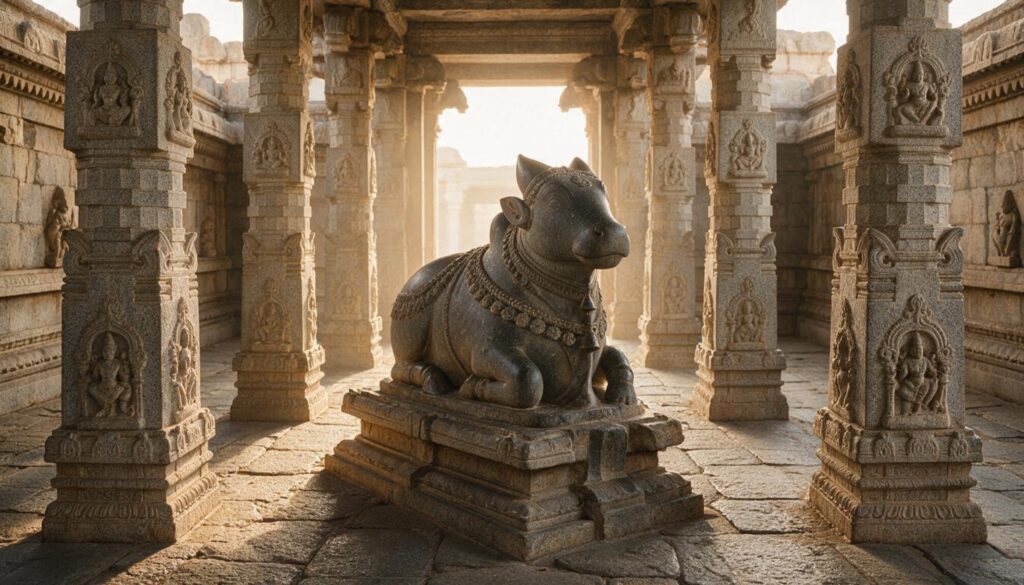
A little way from the temple, beside the approach road, sits the Nandi, Shiva’s bull mount, carved from a single block of granite. It is huge, roughly 4.5 metres tall and about 8 metres long, and it is regularly cited as one of the largest monolithic Nandi sculptures in India. What lifts it above mere size is the finish, because the sculptors carved a fully ornamented bull, complete with bells, garlands, and harness detail, out of one boulder, and set it facing back toward the temple.
Inside the complex is its companion piece, the Nagalinga, a giant seven-hooded serpent, or Naga, rising up and coiling protectively over a Shiva linga, again carved from a single stone. Local tradition says it was cut in a remarkably short time by the sculptors while they waited for a meal to be prepared, which is folklore, but it does capture the astonishing speed and command these craftsmen had. The Nandi and the Nagalinga are usually understood as a linked pair placed so the bull gazes across at the serpent-guarded linga. Together they show Vijayanagara monolithic carving at full stretch, the same ambition that produced the great stone monuments at Hampi.
The unfinished hall and the legend of the blinded eyes
The most human part of Lepakshi is the thing that was never finished. There is an incomplete Kalyana Mandapa, a marriage hall meant to celebrate the divine wedding of Shiva and Parvati, its pillars richly carved with gods, sages, and musicians, but left abruptly incomplete, the sculpture trailing off as if the workers downed tools mid-strike.
The temple’s own name is wrapped in two legends that are worth knowing because they turn up constantly, even though they are traditional stories rather than documented history. The first is a Ramayana connection: the wounded bird Jatayu, struck down by Ravana while trying to rescue Sita, is said to have fallen here, and when Rama came upon the dying bird he said “Le Pakshi,” Telugu for “rise, O bird,” which is offered as the origin of the name Lepakshi. The second explains the unfinished hall. In this tale the builder Virupanna, treasurer under Achyuta Deva Raya, spent lavishly from the royal treasury to complete the temple while the king was away, was accused of misusing state funds, and was sentenced to be blinded. On hearing the order he blinded himself, dashing his own eyes against the temple wall, where two dark stain marks near the Kalyana Mandapa are pointed out to this day. In this reading Lepakshi comes from “Lepa-akshi,” roughly “the village of the blinded eye,” and the hall stayed unfinished because its patron was gone. Present these as the temple’s living legends, not as settled fact, and you strike the right note.
The rest of the sculptural programme
The famous features get all the attention, but Lepakshi rewards the visitor who keeps looking, and a couple of lesser-known works are worth carrying into an answer because they show the range of the site. Carved on the pillars of the main hall is a remarkable series of figures shown in dance postures, musicians and celestial dancers frozen mid-movement, which scholars read as one of the richer sculptural records of classical South Indian dance. These are not idle decoration; they are a stone catalogue of poses and instruments from a courtly performing tradition, the sort of source that lets art historians reconstruct how sixteenth-century temple dance and music actually looked.
There is also a large image of Ganesha carved against the natural rock, a huge sculpture of Hanuman, and, out in the open near the temple, a much-photographed footprint set into the granite that stays perpetually moist and is venerated as the footprint of Sita or of the goddess. Rationalists point to a hidden seep in the rock; devotees see the divine. Either way it is a good example of how a temple’s meaning is built from layered story as much as from carved stone, the same lesson the Jatayu and Virupanna legends teach.
Two things tie the whole programme together. First, the material discipline: almost everything here is granite, an unforgiving stone to carve, yet the sculptors handled it as if it were soft, from the lace-fine pillar reliefs to the massive single-block Nandi. Second, the completeness. Most Vijayanagara sites reach us as fragments, so a temple that still has its murals, its monoliths, its dance panels, and even its legends attached is unusually whole. That wholeness is precisely what makes Lepakshi such a good teaching site, because you can see an entire sixteenth-century religious complex working as one, rather than guessing at it from ruins.
How Lepakshi fits the Vijayanagara story
To use Lepakshi well in an answer, place it inside the arc of the empire rather than treating it as a stray marvel. Vijayanagara temple building matured at the capital, Hampi, in structures like the great Virupaksha temple at Hampi, with their towering gateway pyramids, ornate pillared halls, rearing horse and yali pillars, and separate marriage and swing pavilions. Lepakshi is a provincial masterpiece in exactly that idiom, built a little later and, crucially, with its paintings intact.
That last point is why the temple matters so much. In 1565 CE, at the Battle of Talikota, a coalition of Deccan sultanates crushed the Vijayanagara army, and the capital Hampi was sacked and largely abandoned. Much of what the empire built at the centre survives only as roofless stone. Lepakshi, off in a village to the south-east, escaped that destruction, which is a large part of why its fragile ceiling murals lasted while Hampi’s did not. So the temple is not only beautiful, it is a survivor, a window into the colour and painted decoration that the ruined capital has lost. Set it beside the Vijayanagara Empire’s political timeline and it stops being a curiosity and becomes evidence.
| Feature at Lepakshi | What to remember |
|---|---|
| Deity | Veerabhadra, fierce warrior form of Shiva |
| Period and dynasty | c. 1530s CE, Vijayanagara Empire, under Achyuta Deva Raya |
| Patrons | Brothers Virupanna and Viranna |
| Built on | Kurma Saila, a tortoise-shaped granite hill |
| Signature features | Hanging pillar, ceiling murals, monolithic Nandi, Nagalinga |
| Location | Lepakshi, Anantapur region (Sri Sathya Sai district), Andhra Pradesh |
How to study Lepakshi for exams
Do not memorize Lepakshi as a bundle of trivia. Attach each headline feature to a larger idea so it earns its place in an answer.
Start with the anchor sentence: Lepakshi is a sixteenth-century Vijayanagara temple to Veerabhadra in Andhra Pradesh, famous for its hanging pillar, its ceiling murals, and its giant monolithic Nandi. If you can say that cleanly, you have the core. Then attach the “why it matters” line: because Hampi was destroyed in 1565, Lepakshi is one of the best surviving showcases of Vijayanagara painting, which no ruined stone temple at the capital can give you. That single contrast is worth more than a dozen loose facts.
Keep four features ready with a one-line significance each: the hanging pillar as evidence of structural mastery, the ceiling frescoes as the finest surviving Vijayanagara murals, the monolithic Nandi and Nagalinga as peaks of single-stone carving, and the unfinished Kalyana Mandapa with the Virupanna legend as the temple’s human story. Distinguish clearly between fact and folklore; the dating and dynasty are history, the Jatayu and blinding stories are tradition. That discipline is exactly what separates a serious answer from a coaching handout.
Finally, cross-file it. Group Lepakshi with Hampi under Vijayanagara art, then contrast it upward with the Nagara world of the Khajuraho temples and the Dravida grandeur of the Brihadisvara temple at Thanjavur, and sideways with the Hoysala temples that preceded Vijayanagara in the same region. Slot it into the standard temple architecture in India scheme so you can locate it instantly under pressure. Once it sits in that web, Lepakshi is not one more temple to cram. It is the painted, surviving face of an empire you already know.
Frequently Asked Questions
Where is the Veerabhadra Temple at Lepakshi?
In the village of Lepakshi in the Anantapur region of Andhra Pradesh, now part of Sri Sathya Sai district, near the Karnataka border and within easy reach of Bengaluru.
Who built the Lepakshi temple and when?
It was built around the 1530s CE, commonly dated to about 1538, during the Vijayanagara Empire under Achyuta Deva Raya. Its patrons were the brothers Virupanna and Viranna, treasury officials of the empire.
How does the hanging pillar of Lepakshi work?
One of the roughly 70 granite pillars in the main hall does not rest fully on the floor, so a thin cloth or sheet of paper can be passed under its base. It is understood as a feat of engineering in which the pillar’s load is carried through the ceiling and beams above rather than pressed onto the ground, not a supernatural phenomenon.
Why is the Lepakshi temple important for art history?
Its ceilings carry some of the best preserved Vijayanagara-era murals in India, painted in natural dyes, including a giant image of Veerabhadra. Because the Vijayanagara capital at Hampi was destroyed in 1565, Lepakshi is one of the finest surviving windows into Vijayanagara painting.
What is special about the Lepakshi Nandi?
It is a colossal Nandi bull, about 4.5 metres tall and roughly 8 metres long, carved from a single block of granite, and is regarded as one of the largest monolithic Nandi sculptures in India. It faces the temple from a short distance away.
What is the legend behind the name Lepakshi?
Two traditions exist. In one, Rama told the dying bird Jatayu “Le Pakshi” (rise, O bird) at this spot, from the Ramayana. In the other, the builder Virupanna blinded himself here after being accused of misusing royal funds, giving “Lepa-akshi,” the village of the blinded eye. Both are legends rather than documented history.
Is the Lepakshi temple linked to the Ramayana?
Only through the Jatayu legend, in which the bird is said to have fallen here after being wounded by Ravana. This is a devotional tradition, not a historical record, though it is central to the temple’s identity and name.
Practice Questions
1. The Veerabhadra Temple at Lepakshi was built during which empire?
a) Chola Empire
b) Hoysala Empire
c) Vijayanagara Empire
d) Kakatiya Empire
Answer: c) Vijayanagara Empire
2. The presiding deity of the Lepakshi temple, Veerabhadra, is a form of:
a) Vishnu
b) Shiva
c) Brahma
d) Kartikeya
Answer: b) Shiva
3. The Lepakshi temple is built on a granite hill shaped like which animal, giving it the name Kurma Saila?
a) Elephant
b) Lion
c) Tortoise
d) Serpent
Answer: c) Tortoise
4. Which of the following is a distinctive feature of the Lepakshi temple?
a) A hanging pillar that clears the floor
b) The tallest temple tower in India
c) A stepwell shaped like a lotus
d) A rock-cut cave sanctuary
Answer: a) A hanging pillar that clears the floor
5. Why are the Lepakshi ceiling paintings historically valuable?
a) They are the oldest cave paintings in India
b) They are among the best surviving Vijayanagara murals, while Hampi’s were largely lost
c) They were painted by a colonial-era British artist
d) They depict only Buddhist themes
Answer: b) They are among the best surviving Vijayanagara murals, while Hampi’s were largely lost
Mains-style questions
- “Lepakshi is a provincial masterpiece of Vijayanagara art that survives where the capital’s monuments did not.” Discuss with reference to its architecture and paintings.
- Examine the significance of the ceiling murals at the Veerabhadra Temple, Lepakshi, for the study of Vijayanagara-period painting.
- Distinguish between the historical and the legendary elements associated with the Lepakshi temple, and comment on why both matter to how heritage sites are understood.
- Analyse how the Lepakshi temple reflects the wealth, artistic maturity, and religious priorities of the Vijayanagara Empire in the early sixteenth century.
- “The hanging pillar of Lepakshi is better read as engineering than as miracle.” Comment, using the temple to illustrate the technical skill of Vijayanagara builders.
Lepakshi rewards the reader who refuses to stop at the trick pillar. Take it as the surviving, painted face of Vijayanagara, a temple carved into a tortoise-shaped rock, roofed with the empire’s colours, and guarded by a bull cut from a single stone, and you have far more than a curiosity. You have a piece of hard evidence for what the empire could do at its height, made all the more precious because so little else from that world came through intact. Learn it beside Hampi and the 1565 catastrophe, keep the fact-versus-legend line sharp, and Lepakshi becomes one of the most vivid and usable entries in the whole art and culture syllabus.
Tell Google you want more of this.
Add Anantam IAS as a preferred sourceOne tap, and this site shows up more often in your own Top Stories, AI Overviews and AI Mode. Remove it any time.