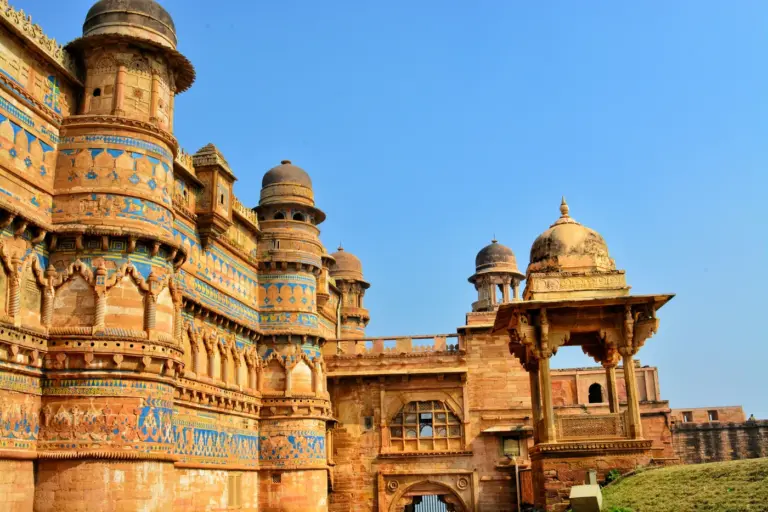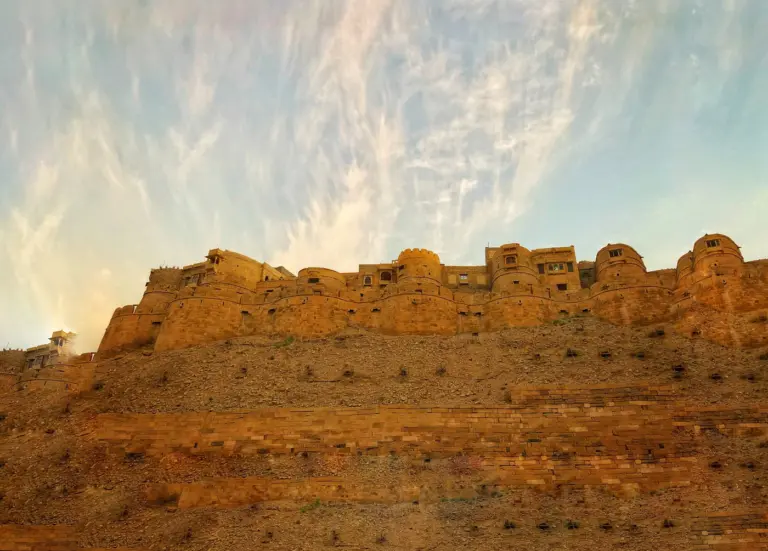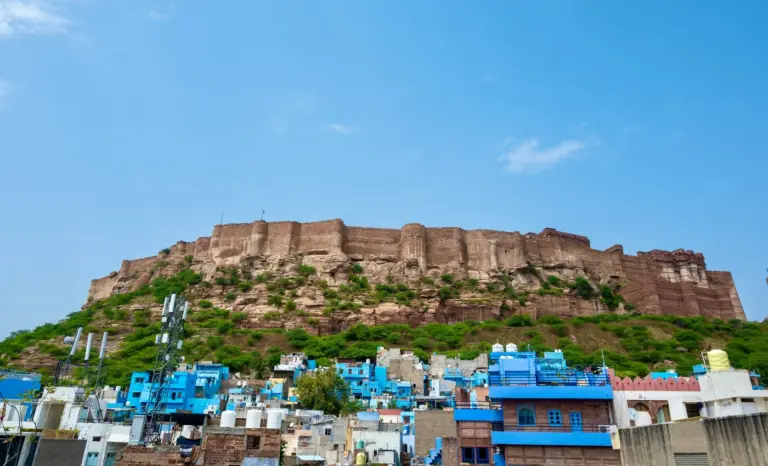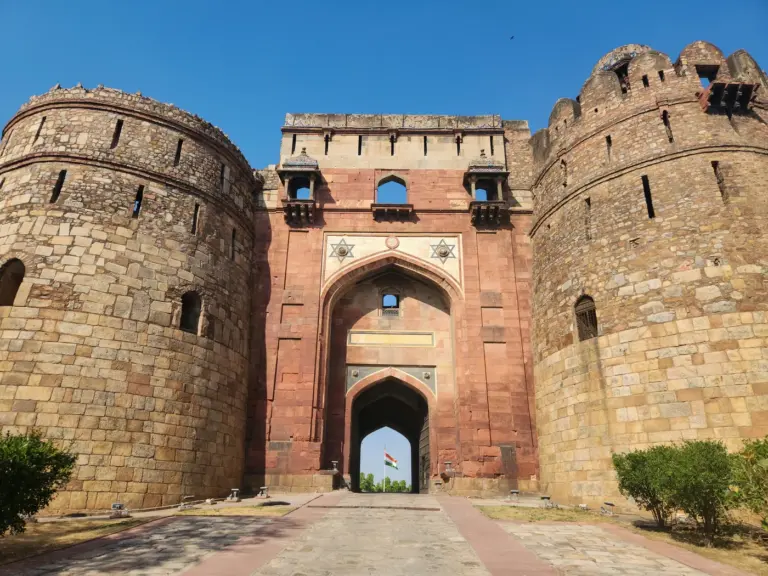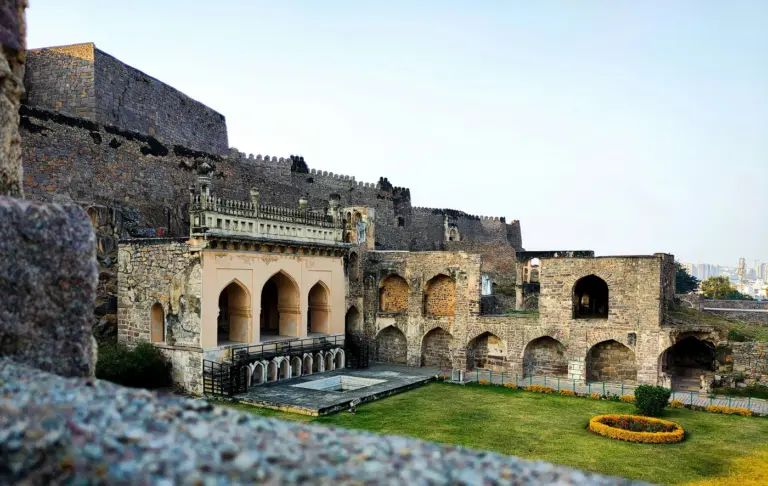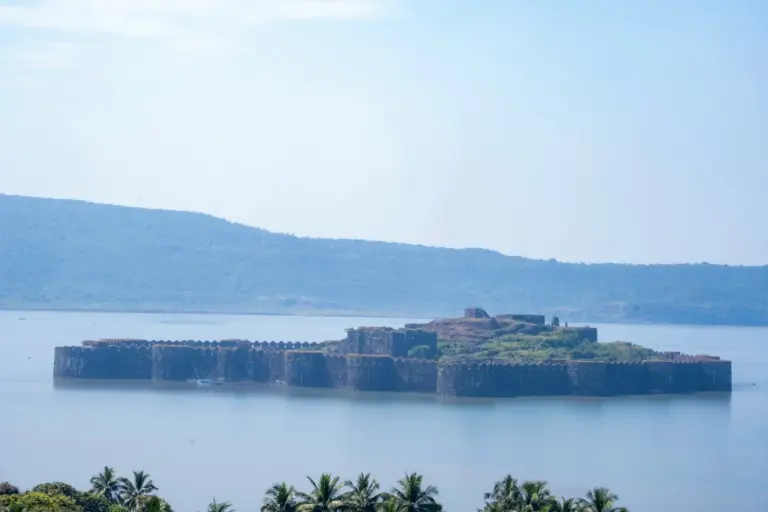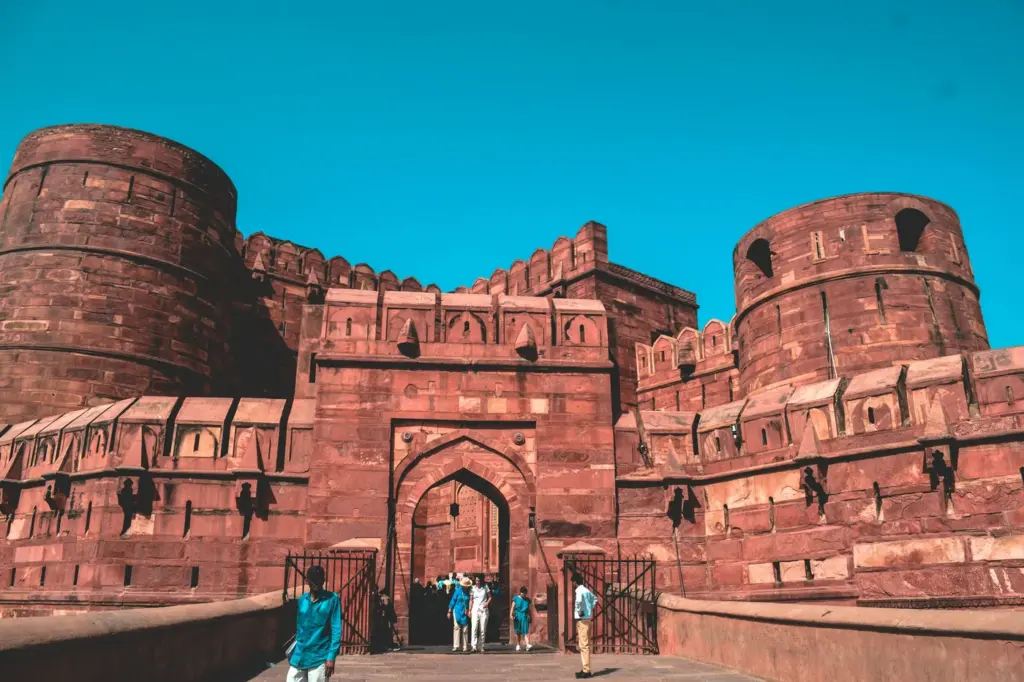
Agra Fort is the walled Mughal citadel on the Yamuna in Agra, Uttar Pradesh, near the gardens of the Taj Mahal. Akbar had it rebuilt in red sandstone between 1565 and 1573 on the site of an older fort, and his grandson Shah Jahan later replaced much of the interior with white marble palaces. UNESCO inscribed it as a World Heritage Site in 1983, and it’s where Shah Jahan spent his last 8 years as the prisoner of his son Aurangzeb.
Most readers carry one wrong picture of this fort, and the name causes it. Agra Fort and Delhi’s Red Fort are both called Lal Qila and both are red sandstone Mughal forts on the Yamuna, so the two blur into one monument. They aren’t the same fort. Agra’s is Akbar’s, begun in 1565 and refitted by Shah Jahan; Delhi’s is Shah Jahan’s own, begun in 1639 for his new capital. A second, smaller mix-up rides on the first: Shivaji’s escape of 1666 happened in Agra, but not from inside this fort.
What Agra Fort is and who built it
The short answer: a Mughal palace-city inside a ring of red sandstone walls, raised by Akbar on an older site and finished in marble by Shah Jahan. UNESCO’s own description calls it the Red Fort of Agra and says its enclosure walls, about 2.5 km long, hold the imperial city of the Mughal rulers.
| Fact | Detail |
|---|---|
| Location | Agra, Uttar Pradesh, on the Yamuna, near the gardens of the Taj Mahal |
| Earlier fort on the site | Badalgarh; Sikandar Lodi had already made Agra his capital |
| Rebuilt by | Akbar, 1565 to 1573, in red sandstone |
| Major later builder | Shah Jahan: white marble palaces and three marble mosques |
| Walls | About 2.5 km long (UNESCO); fortification wall 21.4 m high (ASI); moat 9 m wide and 10 m deep (Uttar Pradesh government) |
| Type | Riverside land fort enclosing a palace-city, on a crescent-shaped plan |
| Protection | Centrally protected by the ASI; part of the fort is still used by the Indian Army |
| UNESCO status | Inscribed in 1983 at the 7th session (Florence), criterion (iii) |
| Known for | The Jahangiri Mahal, Khas Mahal and Diwan-i-Khas; Shah Jahan’s confinement, 1658 to 1666 |
One number in that table gets misquoted. UNESCO’s 2.5 km is the length of the fort’s enclosure walls, not the distance from the fort to the Taj Mahal, though it’s sometimes repeated online as the second. Keep it attached to the walls.
What stood at Agra before Akbar
Akbar didn’t start on an empty riverbank. The ASI records that he built on the remains of an older site known as Badalgarh, and the Uttar Pradesh government’s page on the fort notes that Abul Fazl, Akbar’s court historian, mentions an old fort at Agra from before the Mughals. Who first built it isn’t settled, and a careful answer leaves it that way.
What is clear is Agra’s rise under the Lodis. The ASI credits Sikandar Lodi as the first sultan of Delhi to move his capital to Agra, which made the city the seat of the Lodi dynasty. It was still the Lodi capital when Ibrahim Lodi lost the First Battle of Panipat to Babur in 1526, a turning point covered in the note on the battles of Panipat.
Then the fort changed hands with the empire itself. The Mughals took Agra after Panipat. Humayun lost northern India to Sher Shah Suri in 1540 and, by Britannica’s account, recovered Delhi and Agra only in July 1555, about six months before his death. So when Akbar came to the throne in 1556, the fort he inherited had already served three regimes.
How Akbar rebuilt the fort, and how long it took
Akbar ordered the rebuilding in 1565. The ASI gives the scale: about 4,000 builders worked on it every day, and the fort was finished in 8 years, in 1573. The new work was in red sandstone, and the fortification wall rose to 21.4 m. What Akbar built was less a castle than a palace-city inside walls, which is how UNESCO still describes it.
Very little of Akbar’s interior survives, and that surprises most people. Shah Jahan later replaced most of it with marble, and the Uttar Pradesh government’s fort page names the Akbar-period structures that are still standing:
- the Delhi Gate
- the Amar Singh Gate, today the only entrance for visitors
- the Akbari Mahal
- the Jahangiri Mahal
The Jahangiri Mahal is the name that trips people up. It carries the name of Akbar’s son Jahangir, but it belongs to Akbar’s building campaign, and UNESCO’s Japanese-language summary also places it in Akbar’s time. It’s the clearest surviving piece of the fort’s red sandstone phase, and it’s the building to cite when a question asks what Akbar’s Agra looked like before the marble arrived.
What Shah Jahan changed, and why the fort turned white
The fort you walk through today is largely Shah Jahan’s. The ASI says he raised white marble palaces inside Akbar’s walls and built three white marble mosques:
- the Moti Masjid, the Pearl Mosque
- the Nagina Masjid
- the Mina Masjid
UNESCO’s description names the Khas Mahal, built by Shah Jahan as his private palace, and the Diwan-i-Khas, the hall of private audience where the emperor received nobles and envoys away from the crowd. The hall of public audience, the Diwan-i-Am, is described on the Uttar Pradesh page as erected by Shah Jahan in 1628, the year he came to the throne. The page hedges that date with “said to be”, and an answer should hedge it too.
Why marble? Shah Jahan’s taste ran to white marble inlaid with colored stone, from the palaces here to the Taj Mahal nearby, and he refitted the riverside apartments to match. For your answers, the point is that the fort records two phases of Mughal architecture in one enclosure: Akbar’s sandstone strength and Shah Jahan’s marble refinement.
Then Shah Jahan left. In 1638 he moved the capital from Agra to Delhi and laid the foundations of Shahjahanabad, and the Red Fort there was begun in 1639 and completed nine years later, by the ASI’s account. Agra stayed a great imperial city, but it was no longer the seat of the court.
Shah Jahan’s captivity and Shivaji’s visit
The fort’s most human chapter came after Shah Jahan fell ill and his sons fought over the succession. Aurangzeb won, and the ASI’s summary is blunt: he imprisoned his father in the fort for 8 years, until Shah Jahan died in 1666.
Tradition places those years in the Musamman Burj, the octagonal marble tower on the river side of the fort (musamman means eight-sided), with a view of the Taj Mahal. The confinement is on record; the tower as the exact place comes from tradition, and it should be labeled that way in an answer.
Shivaji’s visit falls in the same year. Under the terms he accepted after Jai Singh’s campaign against him, Shivaji came to Aurangzeb’s court at Agra in 1666 to be received as a Mughal vassal. A historian cited in 2025 reporting dates the audience to 12 May 1666 and places it in the fort’s Diwan-i-Khas. He felt slighted and protested, and he was put under house arrest. On 17 August 1666, by Britannica’s date, he and his son had themselves carried past the guards in baskets of sweets.
Here is the correction that matters. The house where Shivaji was held was in the city, not inside the fort. Tradition identifies it with Kothi Meena Bazaar, and in March 2025 the Maharashtra government issued a resolution to acquire that land for a memorial, with the state tourism corporation as the nodal agency. So Shivaji belongs in the Agra Fort story as a visitor to its court, not as a prisoner in its towers.
Agra Fort after the Mughals, and in 1857
In the 18th century the fort followed the fortunes of Agra. Britannica’s history of the city has it passing through Jat and Maratha hands, among others, before the British took it in 1803 in the Second Anglo-Maratha War. The Treaty of Surji-Arjungaon, signed on 30 December 1803, confirmed Agra to the East India Company. The Maratha side of that story is in the note on the Maratha Empire.
In 1857 the fort became a refuge. When the revolt reached Agra, the British garrison and the Christian population of the city took shelter inside its walls. According to the Dictionary of National Biography, John Russell Colvin, the Lieutenant-Governor of the North-Western Provinces, fell ill just before the move into the fort; he died on 9 September 1857 and was buried inside the fort the next morning. The wider rising is covered in the note on the Revolt of 1857.
The Mughal palace-city didn’t come through these centuries intact. UNESCO’s Japanese-language summary notes that the fort’s splendor faded after the court moved to Delhi, worn down by later revolts and the stationing of British troops.
How Agra Fort’s defenses work: an attacker’s route in
Walk the fort in the order an attacker would have met it and the design explains itself. Each layer was meant to slow an attacker down or turn him into a target.
The moat. The Uttar Pradesh government’s page describes a moat 9 m wide and 10 m deep around the outer wall. An army had to fill it or bridge it under fire before it could touch stone.
The walls. The fort is ringed by double castellated ramparts of red sandstone, with bastions at regular intervals. Castellated means topped with battlements: solid blocks called merlons alternating with gaps for firing. A bastion is a tower pushed out from the line of the wall, so that defenders on it can shoot along the face of the wall at anyone trying to climb it. The ASI gives the fortification wall as 21.4 m high, and the Uttar Pradesh page describes an inner wall of 22 m behind it.
The gate. The same page describes the route through the Amar Singh Gate as dog-legged. That bend is the core of Mughal gate design. An attacking column, or an elephant sent to batter the doors, can’t build up speed on a path that turns, and while it turns it shows its flank to the walls above. The ASI notes four gates in all, one on each side of the fort, and both the Delhi Gate and the Amar Singh Gate survive from Akbar’s time.
The palaces. Past the gates the plan changes character. The fort is crescent-shaped, flattened on the east with a long, nearly straight wall facing the river, and the Uttar Pradesh page notes that the course of the river set the layout. The imperial apartments were built along that river front, which is why their balconies look out over the water rather than toward the city.
The buildings worth being able to name
A handful of names carry most of the marks. Learn each with its builder or its use:
- Jahangiri Mahal: the red sandstone palace of Akbar’s time, despite the name.
- Khas Mahal: Shah Jahan’s white marble private palace.
- Musamman Burj: the octagonal marble tower on the river wall, tied by tradition to Shah Jahan’s last years.
- Diwan-i-Khas: the hall of private audience.
- Diwan-i-Am: the hall of public audience, attributed to Shah Jahan with a date of 1628 that the sources hedge.
- Moti Masjid: Shah Jahan’s white marble Pearl Mosque, not to be confused with the Moti Masjid that Aurangzeb added to Delhi’s Red Fort.
One more term belongs in this vocabulary. A jharokha is a projecting balcony window from which a Mughal emperor showed himself to his subjects, and the ritual of appearing at one, jharokha darshan, shaped how Mughal palaces faced their public.
Agra Fort today: UNESCO status, the Army and access
Agra Fort was inscribed on the World Heritage List in 1983, at the 7th session of the World Heritage Committee in Florence, under a single criterion, (iii). In plain words, criterion (iii) recognizes a place that is exceptional evidence of a cultural tradition or a civilization; here, the court culture of the Mughal emperors. The listing is on the UNESCO World Heritage Centre site, and the fort sits in the wider roundup of UNESCO World Heritage Sites in India.
The fort is centrally protected by the ASI. It is also partly a working military site. The official Agra tourism site notes that part of the fort is still used by the Indian Army and closed to the public, and that visitors can enter only through the Amar Singh Gate. That’s why the public sees only part of the fort.
UNESCO’s record also lists state-of-conservation reports on the fort in eight different years between 1997 and 2013, which means the Committee has returned to its condition more than once.
How to study Agra Fort for exams
Agra Fort touches three parts of the syllabus:
- Medieval history: the Lodi move to Agra; the Mughal capital under Akbar and Shah Jahan; Aurangzeb’s war of succession.
- Art and culture: the shift from Akbar’s red sandstone to Shah Jahan’s marble.
- Heritage lists: one of India’s first World Heritage inscriptions, in 1983.
The optional paper has tested exactly this ground. History Optional 2023 Paper I set “Mughal architecture was syncretic in character. Comment.” and, in the same paper, “Discuss the nature of the Mughal State under Akbar.” Agra Fort serves the first directly, since its two building phases show Mughal design changing between Akbar and Shah Jahan, and it gives the second a concrete setting.
These are the facts to revise:
- Badalgarh was the older fort on the site; Sikandar Lodi made Agra the capital.
- Akbar rebuilt it in red sandstone, 1565 to 1573, with about 4,000 builders a day.
- The Jahangiri Mahal belongs to Akbar’s phase, whatever its name.
- Shah Jahan added the marble palaces and three marble mosques, the Moti Masjid among them.
- Aurangzeb confined Shah Jahan here from 1658 until his death in 1666.
- UNESCO: inscribed 1983, criterion (iii), enclosure walls about 2.5 km.
- Part of the fort is still with the Indian Army; visitors enter by the Amar Singh Gate.
The big confusion is with Delhi’s Red Fort. Keep them apart point by point:
| Point | Agra Fort | Red Fort, Delhi |
|---|---|---|
| Main builder | Akbar, 1565 to 1573; refitted by Shah Jahan | Shah Jahan, begun 1639, completed 1648 |
| Capital it served | Agra, before 1638 | Shahjahanabad, from 1638 |
| Moti Masjid | Built by Shah Jahan | Added later by Aurangzeb |
| In 1857 | A refuge for the British garrison | The rebels’ center, later the site of Bahadur Shah Zafar’s trial |
| UNESCO | 1983, criterion (iii) | 2007, as the Red Fort Complex with Salimgarh, criteria (ii), (iii) and (vi) |
Two smaller confusions are worth a line each:
- Shivaji and the fort. He was received at the court in Agra and held in the city; his escape wasn’t from the fort.
- The 2.5 km figure. It’s the length of the walls, not the distance to the Taj Mahal.
Agra Fort is the one monument where you can watch Mughal architecture change its mind, from Akbar’s red stone to Shah Jahan’s marble, inside the same walls. Learn it as two builders and one prisoner and it will stop blurring into the Red Fort. The comparison between the two forts then becomes one of the most reliable answers you can write on Mughal architecture.
Frequently Asked Questions
Who built Agra Fort?
Akbar rebuilt Agra Fort in red sandstone between 1565 and 1573 on the site of an older fort called Badalgarh. His grandson Shah Jahan later replaced much of the interior with white marble palaces and mosques, so the fort you see is the work of both.
How long did it take to build Agra Fort?
The ASI records that Akbar’s rebuilding took 8 years, from 1565 to 1573, with about 4,000 builders working daily. Shah Jahan’s marble additions came later, in the years before he moved the capital to Delhi in 1638.
Is Agra Fort the same as the Red Fort?
No. Agra Fort, which UNESCO calls the Red Fort of Agra, was rebuilt by Akbar from 1565. The Red Fort in Delhi was built by Shah Jahan between 1639 and 1648 for his new capital, Shahjahanabad, and was inscribed separately by UNESCO in 2007.
Is Agra Fort a UNESCO World Heritage Site?
Yes. UNESCO inscribed Agra Fort in 1983 under criterion (iii), at the World Heritage Committee’s 7th session in Florence. It was among India’s first World Heritage inscriptions.
Where was Shah Jahan imprisoned?
Aurangzeb confined his father Shah Jahan in Agra Fort for 8 years, until Shah Jahan’s death in 1666. Tradition places his last years in the Musamman Burj, an octagonal marble tower on the river side with a view of the Taj Mahal.
Did Shivaji escape from Agra Fort?
Not from inside it. Shivaji attended Aurangzeb’s court at Agra in May 1666 and was then held under house arrest in the city, at a site tradition identifies with Kothi Meena Bazaar. He escaped on 17 August 1666, hidden in baskets of sweets.
Can visitors see the whole of Agra Fort?
No. Part of the fort is still used by the Indian Army and is closed to the public. Visitors enter only through the Amar Singh Gate and can see the palaces, halls and mosques in the open section.
Practice Questions
Prelims
1. Consider the following statements about Agra Fort:
1. Akbar rebuilt it in red sandstone between 1565 and 1573.
2. The Jahangiri Mahal inside it was built during Jahangir’s reign.
3. Shah Jahan built the Moti Masjid inside it.
Which of the statements given above is/are correct?
- (a) 1 and 2 only
- (b) 1 and 3 only
- (c) 2 and 3 only
- (d) 1, 2 and 3
Answer: (b) The Jahangiri Mahal belongs to Akbar’s building phase despite its name.
2. Agra Fort was inscribed on the UNESCO World Heritage List in which year?
- (a) 1983
- (b) 1986
- (c) 1993
- (d) 2007
Answer: (a) Agra Fort was inscribed in 1983; 2007 is the year of the Red Fort Complex in Delhi.
3. Consider the following statements:
1. Sikandar Lodi was the first sultan of Delhi to move his capital to Agra.
2. Humayun recovered Agra from the Sur rulers in 1555.
Which of the statements given above is/are correct?
- (a) 1 only
- (b) 2 only
- (c) Both 1 and 2
- (d) Neither 1 nor 2
Answer: (c) The ASI credits Sikandar Lodi with the move, and Humayun recovered Delhi and Agra in July 1555.
4. Which one of the following pairs is correctly matched?
- (a) Moti Masjid, Red Fort Delhi: Shah Jahan
- (b) Moti Masjid, Agra Fort: Shah Jahan
- (c) Jahangiri Mahal, Agra Fort: Aurangzeb
- (d) Diwan-i-Am, Agra Fort: Babur
Answer: (b) Shah Jahan built Agra’s Moti Masjid, while the Moti Masjid in Delhi’s Red Fort was added by Aurangzeb.
5. During the revolt of 1857, Agra Fort served as:
- (a) the headquarters of the rebel government
- (b) a refuge for the British garrison and the Christian population of Agra
- (c) the site of Bahadur Shah Zafar’s trial
- (d) the seat of a Maratha governor
Answer: (b) The garrison and the Christian population took refuge in the fort, and Lieutenant-Governor Colvin was buried inside it.
Mains
- Agra Fort records two phases of Mughal architecture within one enclosure. Discuss with reference to the buildings of Akbar and Shah Jahan. (15 marks, 250 words)
- Compare Agra Fort and the Red Fort in Delhi as expressions of Mughal imperial power. (15 marks, 250 words)
- Examine the defensive design of Agra Fort and how its layout responds to the Yamuna. (10 marks, 150 words)
- Examine the main aspects of Akbar’s religious syncretism. (10 marks, 150 words) Previous year: Mains 2025, GS Paper I.
- Discuss the challenges of conserving a World Heritage fort that is partly in active military use. (15 marks, 250 words)
Tell Google you want more of this.
Add Anantam IAS as a preferred sourceOne tap, and this site shows up more often in your own Top Stories, AI Overviews and AI Mode. Remove it any time.