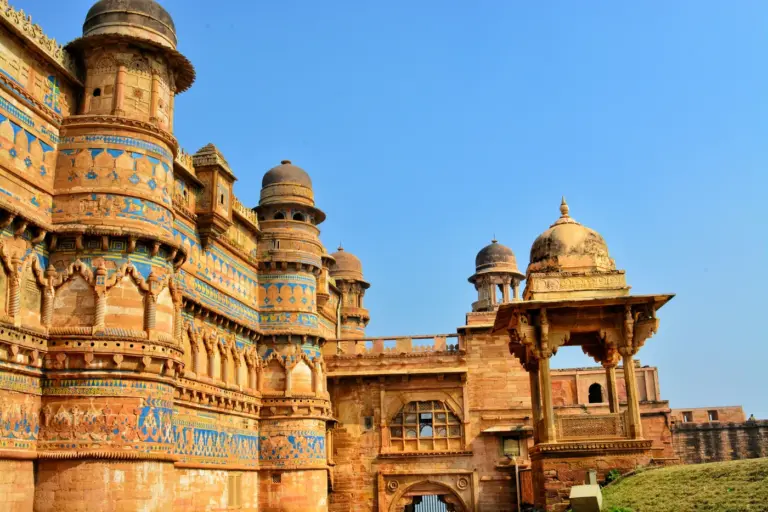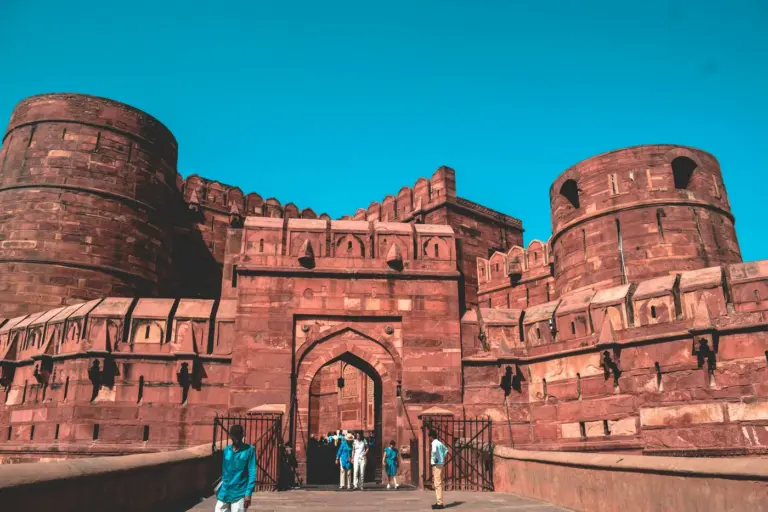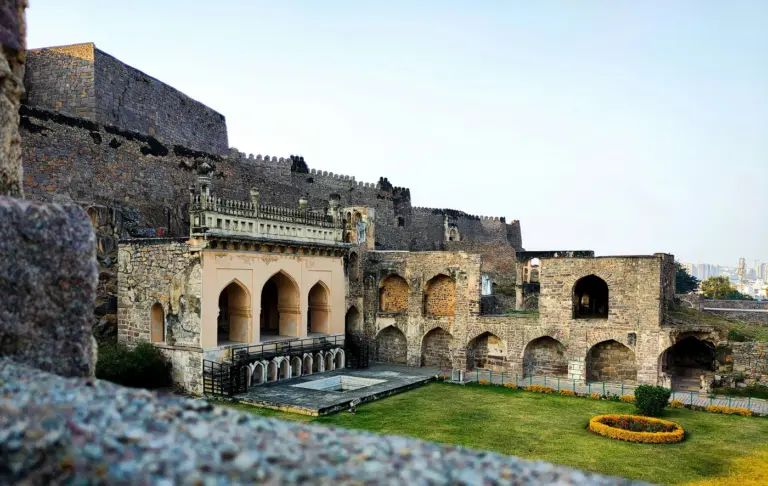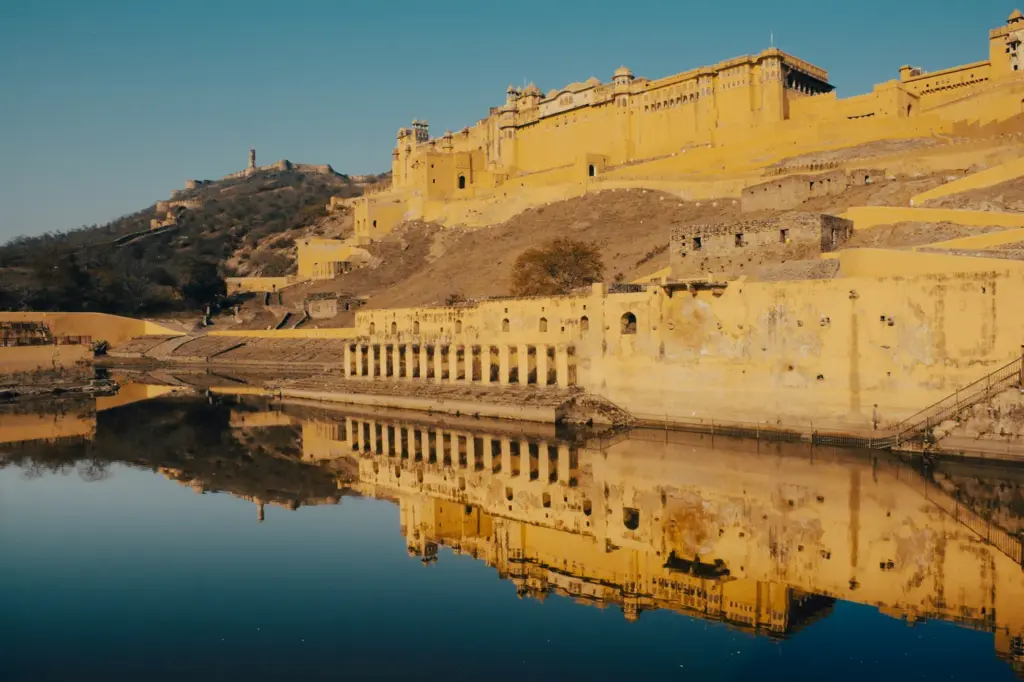
Amer Fort is the hill palace of the Kachwaha Rajputs at Amer, about 11 km from Jaipur, and the palace that stands today was begun by Raja Man Singh I in 1592 and enlarged by Mirza Raja Jai Singh I in the 17th century. It served as the Kachwaha capital until Sawai Jai Singh II founded Jaipur in 1727. The fort is known for its courtyard palaces, above all the Sheesh Mahal, and for a style that joins Rajput planning to Mughal forms.
Two confusions travel with Amer. The first is the name: Amer and Amber are the same place, and both spellings are in official use. The second matters more. Akbar’s Kachwaha queen from this house is almost always called “Jodha Bai”, a name that historians say doesn’t belong to her. Settle both and Amer becomes the clearest case study you have of how the Rajput-Mughal alliance showed up in stone.
Where Amer Fort is and who built it
Amer Fort, also called Amber Fort or Amer Palace, stands on a hill above Maota Lake at Amer, a former town that Britannica now counts as part of the Jaipur urban area. The Kachwahas made Amer their capital in the 12th century, according to Britannica, and the palace you see was built from the 1590s onward by two rulers who served the Mughals, Man Singh I and Mirza Raja Jai Singh I.
| Fact | Detail |
|---|---|
| Location | Amer, about 11 km from Jaipur, Rajasthan, on a hill above Maota Lake |
| Built by | Raja Man Singh I, from 1592 (Rajasthan Tourism); Britannica gives about 1600 |
| Main period | Late 16th to early 18th century; 17th-century additions by Mirza Raja Jai Singh I |
| Rulers | Kachwaha Rajputs, capital at Amer from the 12th century until the move to Jaipur |
| Type | Hill palace-fortress, linked by underground passages to Jaigarh Fort above it |
| Protection status | State Protected Monument of Rajasthan since 1968, with a 50 m buffer notification |
| UNESCO status | Inscribed in 2013 as part of the Hill Forts of Rajasthan, criteria (ii) and (iii) |
| Known for | Sheesh Mahal, Sukh Niwas and Diwan-i-Aam; the Rajput-Mughal court style |
Who the Kachwahas were, and why Amer mattered
The Kachwahas were the Rajput house that ruled from Amer for about six centuries. Britannica says Amer became the Kachwaha capital in the 12th century and remained a political center for 600 years, until the court moved to Jaipur. Rajasthan Tourism adds that the first stronghold here was a small structure the Rajputs won from the Meena tribes, and that 28 Kachwaha kings lived at Amer before the capital moved.
The site helps explain how Amer held on for so long. Britannica describes Amer as entirely surrounded by hills and standing at the foot of a rocky gorge. A capital tucked into a gorge is hard to surprise, and the ridge above it could carry a separate citadel, which is the role Jaigarh Fort later filled.
Amer or Amber: a quick spelling note
Both spellings are right, and they name one place. Britannica derives the name from Ambarisha, a king of Ayodhya: the full form Ambarikhanera was shortened to Ambiner and then Amber. Britannica adds that the official name is Amer, and Rajasthan Tourism writes it as “Amber (pronounced Amer)”. UNESCO’s listing, meanwhile, uses Amber Fort and Amber Palace. So when a question says Amber and your notes say Amer, you’re looking at one fort, not two.
How the 1562 alliance with Akbar changed Amer
The alliance began with a marriage. In 1562, Britannica records, Raja Bihari Mal of Amber, also called Bharmal, faced a succession dispute and offered his daughter in marriage to Akbar. Bihari Mal acknowledged Akbar’s suzerainty, and his sons prospered in Mughal service.
Britannica’s account of Akbar’s reign says he then followed the same feudal policy toward the other Rajput chiefs. They could hold their ancestral territories provided that they:
- acknowledged Akbar as emperor
- paid tribute
- supplied troops when required
- concluded a marriage alliance with him
The Kachwahas got the best of that bargain. The emperor’s service was opened to Rajput chiefs and their sons, and Britannica notes that Rajput princes attained the highest ranks, as generals and as provincial governors, within the graded ranks of the mansabdari system. Amer’s own Man Singh became one of the empire’s leading commanders, and Britannica’s entries on him record three roles:
- commander of the Mughal army at Haldighati in 1576, against Maharana Pratap
- governor of Bihar, when he annexed Orissa for the empire
- governor of Bengal, when he chose Rajmahal as the provincial capital in 1595-96
That’s the context for Mewar’s story. Amer allied in 1562, while Mewar lost Chittorgarh to Akbar in 1568 and fought on. Britannica notes that the fall of Chitor pushed other Rajput rajas to accept Akbar as emperor in 1570, even though Mewar did not submit. The two houses are the two halves of Akbar’s Rajput policy, and a good answer uses both.
Harkha, Mariam-uz-Zamani and the Jodha Bai confusion
Here’s where most answers slip. The bride of 1562 is usually called Jodha Bai, the name that films and television have made familiar. The historian Parvati Sharma, in her biography Akbar of Hindustan, gives her name as Harkha and notes that she is often misidentified as Jodha Bai. Sharma also places the wedding at Sambhar, where Bihari Mal arranged it on Akbar’s return journey.
Her title is the name the record uses. The Agra district administration’s page on her tomb near Sikandra calls her Mariam-uz-Zamani, “the Rajput empress of Akbar and mother of Jahangir”, and gives “Jodha Bai” only in quotation marks. Her son was Jahangir, so the Kachwaha alliance put a grandson of Bihari Mal on the Mughal throne.
Why does the wrong name stick? “Jodha” sounds like Jodhpur, the seat of the Rathore house, while the bride of 1562 was a Kachwaha princess of Amer. The label doesn’t even fit her family. In an answer, write “the daughter of Bihari Mal (Bharmal), known by her title Mariam-uz-Zamani, mother of Jahangir” and you’re on solid ground.
What Man Singh I built, and what Mirza Raja Jai Singh I added
The palace went up in two main phases. Rajasthan Tourism and the Incredible India portal both say Raja Man Singh I began construction in 1592; Britannica puts the start at about 1600, so “from the 1590s” is the safe phrasing. Rajasthan Tourism says the palace was completed by Mirza Raja Jai Singh.
UNESCO is precise about why the second phase matters. Its statement says Amber represents a key 17th-century phase in the development of a common Rajput-Mughal court style, embodied in the buildings and gardens that Mirza Raja Jai Singh I added. That’s the sentence to quote in any answer on Rajput architecture, because it ties a named ruler to a dated idea.
Money and manpower explain the timing. Man Singh spent his career in imperial service, and a commander who governed Bihar and Bengal could fund building on a scale a small Rajput court could not manage alone. That’s an inference, but it’s why the alliance and the palace belong in the same answer. His family built in the town below as well: Rajasthan Tourism says the Jagat Shiromani temple at Amer was built around 1599-1608 by Queen Kanakwati, Man Singh I’s wife, in memory of their son Jagat Singh.
The result reads like a Rajput palace that has studied Mughal architecture. Britannica calls its architecture Mughal-influenced, and its progression from a public audience hall to private apartments around a garden will look familiar to anyone who has read about the Red Fort in Delhi.
Why the capital moved to Jaipur in 1727
The Kachwahas left Amer because the town had outgrown its gorge. Rajasthan Tourism says Sawai Jai Singh II founded Jaipur in 1727 and shifted his capital from Amber because of a rapidly growing population and increasing water scarcity. The architect Vidyadhar Bhattacharya laid out the new city on the principles of Vastu Shastra.
Britannica also dates Jaipur’s founding to 1727, though its entry on Amer says the royal residence moved in 1728. A city can be founded one year and occupied the next, so the two dates don’t contradict each other; use 1727 for the founding of Jaipur.
The move is like a family leaving an old house in the hills for a planned colony on the plain: the old house isn’t abandoned, it just stops being where the family lives. The comparison breaks on one point. Amer wasn’t left undefended. Rajasthan Tourism credits Sawai Jai Singh II with building Jaigarh Fort on the ridge above it in the early 18th century, and the Incredible India portal describes underground tunnels linking the palace to Jaigarh. Jai Singh II is also the ruler behind Jaipur’s Jantar Mantar, which Rajasthan Tourism calls the largest of the five observatories he built.
Walking through Amer Fort, courtyard by courtyard
Amer is a palace that happens to be fortified, and its plan is a sequence of courtyards, each more private than the last. The Incredible India portal divides it into four main sections, each with its own courtyard. Here’s the order in which a visitor, or an intruder, meets them:
- Suraj Pol, the Sun Gate and main entrance, reached by the climb from below.
- Jaleb Chowk, the great first courtyard, which the Incredible India portal describes as the army’s parade ground, where soldiers displayed the spoils of victory to the public.
- The Diwan-i-Aam, the hall of public audience, where the ruler heard his subjects. It’s a hypostyle hall, one whose roof rests on rows of columns, the hall type Britannica singles out in the palace.
- The private court, with the Sheesh Mahal, the Sukh Niwas, the Jas Mandir and the royal garden.
- The zenana (the women’s quarters) and the palace of Man Singh I from the first building phase.
As a defense, Amer relies on its setting more than on its gates. The palace rises over Maota Lake and the approach climbs to Suraj Pol. Above it all, Jaigarh holds the ridge. An attacker who reached Jaleb Chowk was inside a walled courtyard overlooked by the palace, with the private courts and the higher citadel still to take.
Two rooms carry most questions. The Sheesh Mahal, the palace of mirrors, has walls and ceilings set with thousands of small mirrors, according to the Incredible India portal. The Sukh Niwas works on a different idea: the portal describes its sandalwood door and the water piped through the hall to cool it, which it compares to air conditioning. One room plays with light and the other with water, and between them they show a court that could afford both.
On materials the tourism sources disagree. Rajasthan Tourism describes red sandstone and white marble, while the Incredible India portal speaks of pale yellow and pink sandstone, so describe it simply as a sandstone and marble palace.
Amer Fort today: UNESCO, state protection and the plaster question
Amer has been on the World Heritage List since 2013, when the World Heritage Committee, at its 37th session in Phnom Penh in June that year, inscribed it as one of six components of the serial property Hill Forts of Rajasthan. A serial property is a single listing made of separate sites that make full sense only together. The six components are:
- Chittorgarh, the old capital of Mewar
- Kumbhalgarh, Rana Kumbha’s 15th-century citadel in Rajsamand district
- Ranthambore, the forest fort in Sawai Madhopur district, whose surroundings form Ranthambore National Park
- Gagron, the river-protected fort in Jhalawar district
- Amber (Amer), near Jaipur
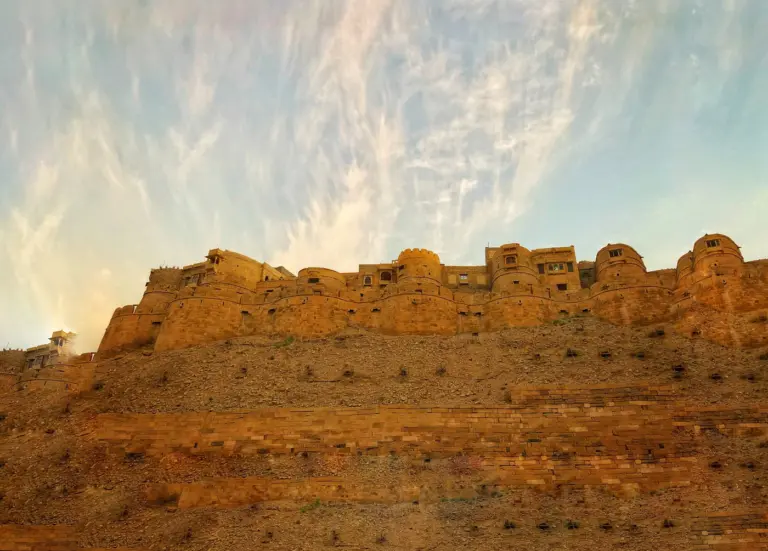
- Jaisalmer, the desert fort
The listing rests on two criteria. Criterion (ii) recognizes an interchange of ideas: Rajput fort planning and art that borrowed from Sultanate and Mughal building and later influenced styles such as Maratha architecture. Criterion (iii) treats the six as an exceptional testimony to the cultural traditions of the ruling Rajput clans. Amer’s place in the series is the court style of Mirza Raja Jai Singh I, which is criterion (ii) in its clearest form.
The protection status is where Amer differs from its Mewar siblings. Chittorgarh and Kumbhalgarh are Monuments of National Importance under the ASI, but Amber is a State Protected Monument of Rajasthan, listed in 1968 under the Rajasthan Monuments, Archaeological Sites and Antiquities Act, 1961. UNESCO notes that the act bars any work on a protected monument, even by its owner, without state permission, and that an extra notification protects a 50 m buffer around the palace. The Amber Development and Management Authority, notified on 14 October 2011, is the body that carries out the decisions of the State Level Apex Advisory Committee for all six forts.
The concern UNESCO recorded at Amer is about restoration itself. Its statement notes that the original exterior plaster at Amber and Gagron has been replaced, causing a loss of historic material and patina, the surface that age gives to old material. That’s a useful Mains example because the damage came from repair, not neglect. A monument can look better and become less authentic at the same time.
How to study Amer Fort for exams
Amer turns up in three parts of the syllabus:
- Medieval history: Akbar’s Rajput policy, the Kachwaha alliance of 1562 and Man Singh’s career in the Mughal Empire.
- Art and culture: the Rajput-Mughal court style and the courtyard plan of a Rajput palace.
- Heritage lists: one of six components of the Hill Forts of Rajasthan, alongside the other UNESCO World Heritage Sites in India.
Questions on Amer usually arrive through heritage and architecture. Mains 2018 GS Paper I asked: “Safeguarding the Indian art heritage is the need of the moment. Discuss.” Amer’s replaced exterior plaster gives that answer a concrete case of repair doing harm. History Optional 2025 Paper I pushed further: “Define the rise of distinct provincial architectural styles under the Mughal Empire in light of structural diversity, cultural interaction and the nature of provincial power dynamics.” Amer, with its Rajput-Mughal court style, is the Rajput example that question needs. For Prelims, 94 of the 1,403 questions from 2013 to 2026 in the Anantam IAS Prelims bank are tagged Art and Culture.
Revise these facts until you can write them without looking:
- Kachwaha capital from the 12th century (Britannica) until Jaipur was founded in 1727.
- Palace begun by Man Singh I in 1592 (Rajasthan Tourism); Britannica says about 1600.
- 17th-century additions by Mirza Raja Jai Singh I, the phase UNESCO singles out.
- 1562: Bihari Mal (Bharmal) allies with Akbar; his daughter, Mariam-uz-Zamani, becomes the mother of Jahangir.
- Courtyard order: Suraj Pol, Jaleb Chowk, Diwan-i-Aam, then the private court of the Sheesh Mahal and Sukh Niwas.
- Linked by tunnels to Jaigarh Fort on the ridge above.
- State Protected Monument since 1968; UNESCO 2013, criteria (ii) and (iii).
The confusions that cost marks each have a fix:
- Amer is Amber. One place, two spellings; UNESCO uses Amber and the official name is Amer.
- Three rulers, three centuries. Man Singh I began the palace in the late 16th century, Mirza Raja Jai Singh I added the Mughal-style court in the 17th and Sawai Jai Singh II founded Jaipur in the 18th.
- Harkha is not Jodha. The 1562 bride was a Kachwaha princess of Amer; “Jodha” points to Jodhpur.
- Amer is not the Jaipur listing. Jaipur’s Jantar Mantar is a separate World Heritage Site; Amer belongs to the Hill Forts series.
Set against its Mewar siblings, Amer tells the other half of the story:
| Fort | Ruling house | Relationship with the Mughals | What UNESCO singles out |
|---|---|---|---|
| Amer (Amber) | Kachwahas | Allied with Akbar from 1562 | 17th-century Rajput-Mughal court style |
| Chittorgarh | Sisodias of Mewar | Besieged and taken by Akbar in 1567-68 | Former Sisodia capital; three famous sieges |
| Kumbhalgarh | Sisodias of Mewar | Breached once by Mughal and Amber forces | Single building campaign by the architect Mandan |
Amer is the fort that explains the alliance, just as Chittorgarh explains the resistance. Learn its three rulers in order and keep the 1562 bride’s name straight. Then use the palace itself as evidence, because that’s what turns a heritage answer into a history answer.
Frequently Asked Questions
Who built Amer Fort?
Raja Man Singh I began the present palace at Amer in 1592, according to Rajasthan Tourism and the Incredible India portal, though Britannica puts the start at about 1600. Mirza Raja Jai Singh I added major buildings and gardens in the 17th century. Both were Kachwaha rulers who served the Mughals.
Is it Amer Fort or Amber Fort?
Both names refer to the same fort. Britannica says the name comes from Ambarisha, a king of Ayodhya, and that the long form Ambarikhanera was shortened to Ambiner and Amber, while the official name is Amer. UNESCO’s listing uses Amber.
Is Amer Fort a UNESCO World Heritage Site?
Yes. Amer was inscribed in 2013, at the 37th session of the World Heritage Committee in Phnom Penh, as one of six components of the Hill Forts of Rajasthan under criteria (ii) and (iii). UNESCO values it as a key 17th-century phase of the common Rajput-Mughal court style.
Why did the Kachwahas move their capital from Amer to Jaipur?
Rajasthan Tourism says Sawai Jai Singh II founded Jaipur in 1727 and moved the capital because Amer’s population was growing fast and water was becoming scarce. Britannica dates the move of the royal residence to 1728. The new city was laid out by the architect Vidyadhar Bhattacharya.
Was Jodha Bai Akbar’s wife from Amer?
Akbar’s Kachwaha wife from Amer was the daughter of Raja Bihari Mal, also called Bharmal, and she married him in 1562. The historian Parvati Sharma gives her name as Harkha and says she is often misidentified as Jodha Bai. She is known by her title Mariam-uz-Zamani and was the mother of Jahangir.
What is the Sheesh Mahal at Amer Fort?
The Sheesh Mahal, or palace of mirrors, is a hall in the private palace court whose walls and ceilings are set with thousands of small mirrors. It lies beyond the public audience hall, in the part of the palace reserved for the ruler and his household.
How is Amer Fort connected to Jaigarh Fort?
Jaigarh Fort stands on the ridge above Amer, and the Incredible India portal says underground tunnels link the two. Rajasthan Tourism credits Jaigarh to Sawai Jai Singh II in the early 18th century.
Is Amer Fort protected by the ASI?
No. Unlike Chittorgarh and Kumbhalgarh, which the ASI protects as Monuments of National Importance, Amer is a State Protected Monument of Rajasthan, listed in 1968 under the state’s 1961 monuments act. The Amber Development and Management Authority carries out its management.
Practice Questions
Prelims
1. Consider the following statements about Amer Fort: 1. It is protected by the ASI as a Monument of National Importance. 2. It is a component of the Hill Forts of Rajasthan World Heritage property. Which of the statements given above is/are correct?
- (a) 1 only
- (b) 2 only
- (c) Both 1 and 2
- (d) Neither 1 nor 2
Answer: (b) Amer is a State Protected Monument of Rajasthan (listed in 1968), not a centrally protected monument, and it was inscribed with the Hill Forts of Rajasthan in 2013.
2. Consider the following statements: 1. Raja Bihari Mal of Amber offered his daughter in marriage to Akbar in 1562. 2. Historians give the personal name of this queen as Jodha Bai. 3. She was the mother of Jahangir. Which of the statements given above is/are correct?
- (a) 1 and 2 only
- (b) 1 and 3 only
- (c) 2 and 3 only
- (d) 1, 2 and 3
Answer: (b) The historian Parvati Sharma gives her name as Harkha; she is known by the title Mariam-uz-Zamani, and Jodha Bai is a misidentification.
3. Who founded Jaipur in 1727 and moved the Kachwaha capital there from Amer?
- (a) Raja Man Singh I
- (b) Mirza Raja Jai Singh I
- (c) Sawai Jai Singh II
- (d) Raja Bihari Mal
Answer: (c) Rajasthan Tourism and Britannica both date the founding of Jaipur by Sawai Jai Singh II to 1727.
4. According to UNESCO, Amber represents a key phase in the development of a common Rajput-Mughal court style, embodied in additions made by:
- (a) Raja Man Singh I
- (b) Mirza Raja Jai Singh I
- (c) Sawai Jai Singh II
- (d) Raja Bihari Mal
Answer: (b) UNESCO’s statement credits the 17th-century buildings and gardens of Mirza Raja Jai Singh I.
5. The Sukh Niwas at Amer Fort is best known for:
- (a) walls and ceilings set with small mirrors
- (b) water channels that cooled the hall
- (c) a cannon foundry
- (d) a stepwell for the garrison
Answer: (b) The Incredible India portal describes the water piped through the Sukh Niwas to cool it; the mirrors belong to the Sheesh Mahal.
Mains
- “Amer Fort is the architecture of an alliance.” Examine this statement with reference to the Kachwaha-Mughal relationship. (15 marks, 250 words)
- Examine the main aspects of Akbar’s religious syncretism. (10 marks, 150 words) Previous year: Mains 2025, GS Paper I.
- Why did Sawai Jai Singh II move his capital from Amer to Jaipur? What does the move reveal about changing ideas of the city in 18th-century Rajputana? (15 marks, 250 words)
- Popular culture often overwrites the historical record. Illustrate with the case of Jodha Bai and explain how historians establish identity from chronicles and other records. (10 marks, 150 words)
- Restoration can damage authenticity. Discuss with reference to the replacement of original exterior plaster at forts such as Amber and Gagron. (10 marks, 150 words)
Tell Google you want more of this.
Add Anantam IAS as a preferred sourceOne tap, and this site shows up more often in your own Top Stories, AI Overviews and AI Mode. Remove it any time.