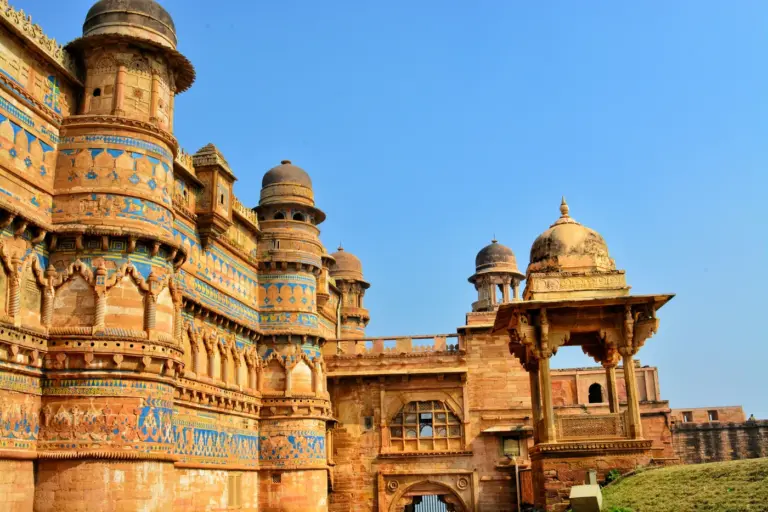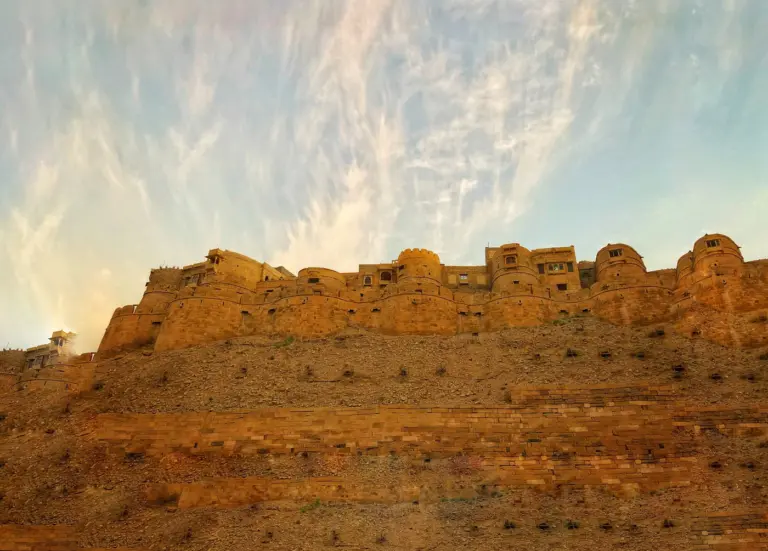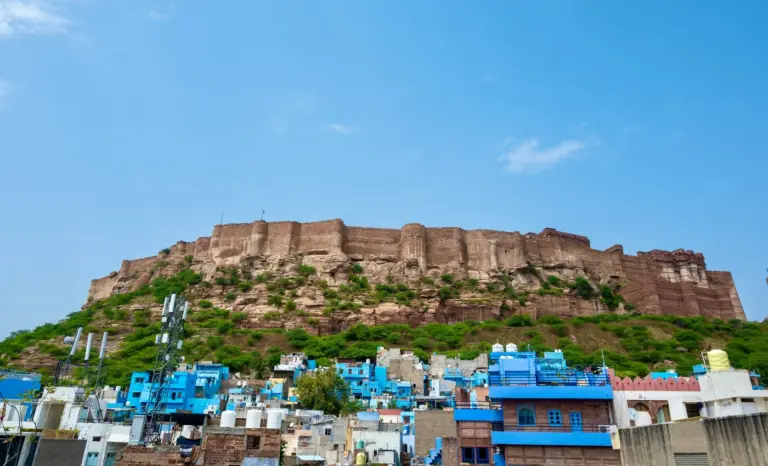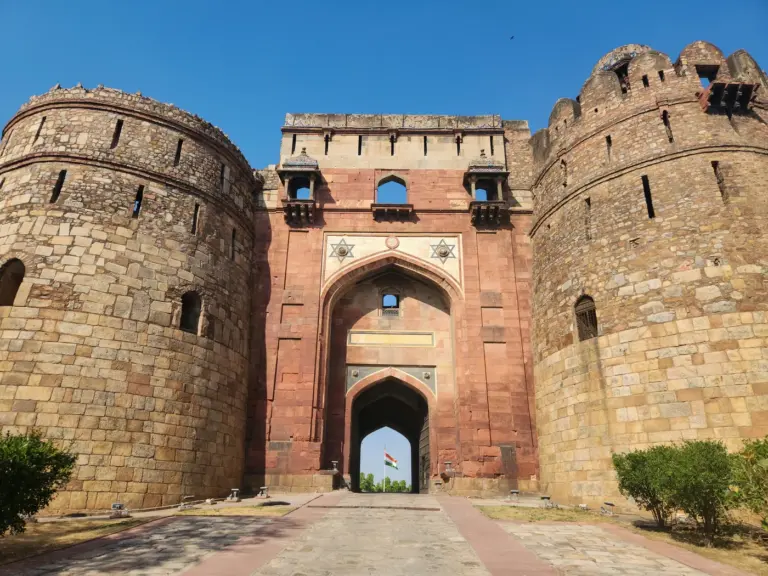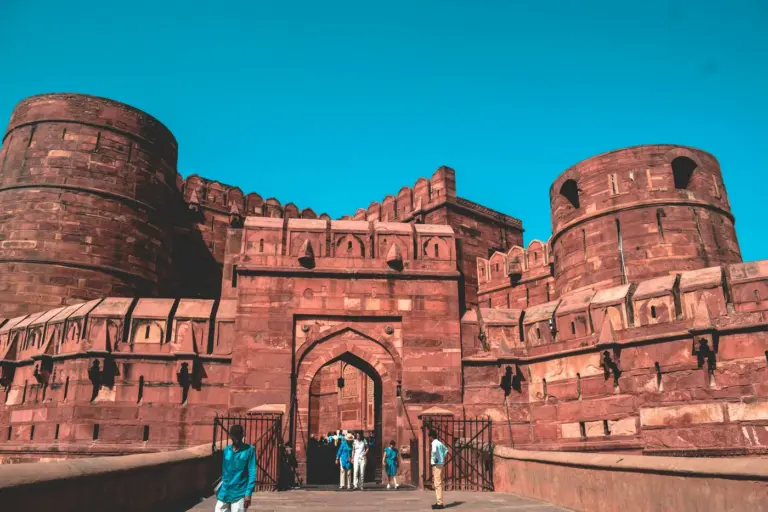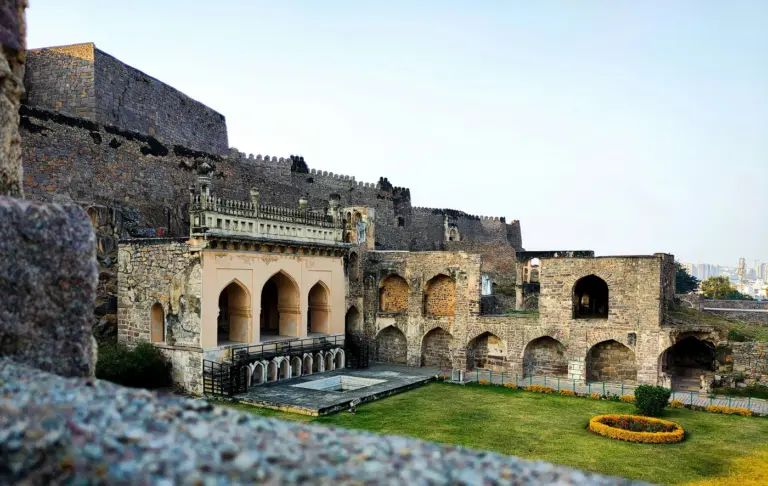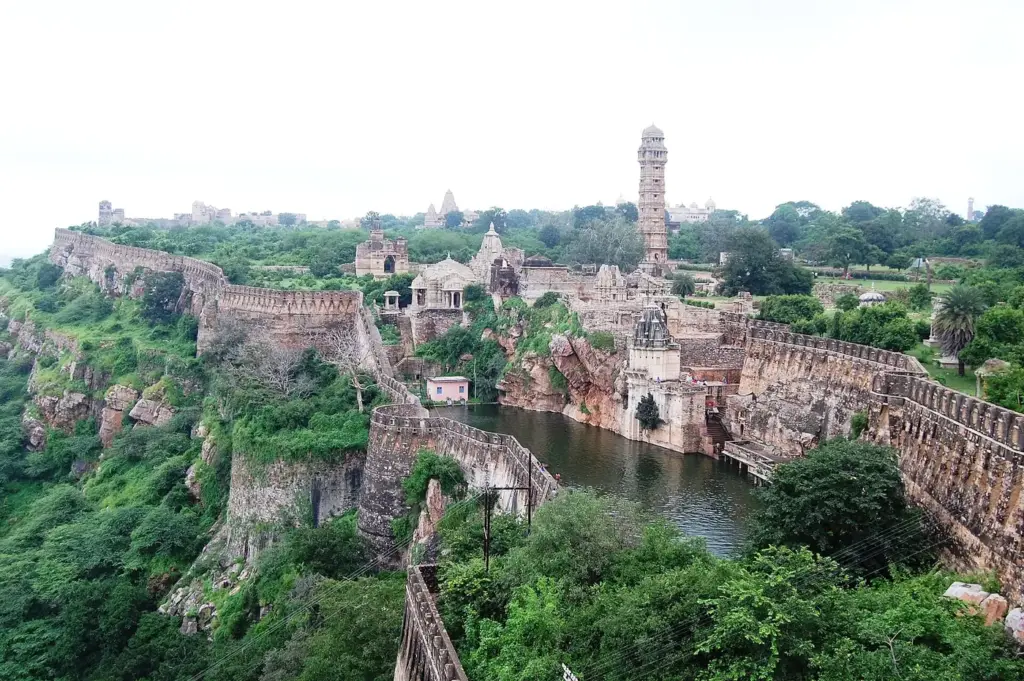
Chittorgarh fort is the one Rajput fort almost every aspirant can name and very few can place properly in time. It stands on an isolated plateau in southern Rajasthan, served as the capital of Mewar from the 8th to the 16th century, faced three famous sieges and has been part of the Hill Forts of Rajasthan World Heritage Site since 2013. The trouble is that its story usually reaches us already mixed: a Khalji siege, a queen from a Sufi poem, two towers built centuries apart and jauhars retold so often that the record and the legend blur.
I want to keep the record and the tradition in separate columns here, because that separation is exactly what a good answer on Chittorgarh needs. The legends below are named as legends and traced back to where they begin.
Where Chittorgarh Fort Stands and How It Began
Chittorgarh fort sits on a rocky plateau above the town of Chittorgarh, on a tributary of the Banas about 100 km northeast of Udaipur. The six Hill Forts of Rajasthan occupy rocky outcrops of the Aravalli range and the western desert, and among them Chittorgarh holds the widest range of early buildings, from the 8th to the 16th century.
Three of the other five forts in that listing have notes of their own on this site: Kumbhalgarh, Amer and Jaisalmer.
The town was once called Chitrakut, a name tradition links to a chieftain called Chitrang or Chitrangad, who is said to have raised the first stronghold here in the 7th century. The earliest datable rulers, though, come from stone rather than story:
- An inscription dated V.E. 770, which is 713 CE, names four rulers of the Mori or Maurya line: Maheshvar, Bhim, Bhoj and Man.
- These Mori rulers were a local 8th-century line, not the Mauryan empire of Chandragupta and Ashoka, a favorite trap in objective questions.
- The ASI records that Bappa Rawal took the fort next, and that the imperial Pratiharas held it soon after.
- The ASI credits the Pratiharas with the Sun temple of the 7th-8th century, now worshipped as the Kalika Mata temple, and dates the origins of the Kumbha Shyam and Kukadeshwar temples to the 9th century.
From the Guhilas to the Sisodias
The fort became the seat of Mewar’s kings in the 13th and early 14th centuries under the Guhila dynasty, and the Sisodias, a branch of the same house, took control in 1336 and kept Chittor as their capital. The table below holds the whole sequence in one place.
| Period | Rulers or actors | What happened at Chittor |
|---|---|---|
| 7th-8th century | Chitrangad (tradition), then the Mori line | First stronghold; inscription of 713 CE |
| 8th-10th century | Bappa Rawal, then the Pratiharas | Temple building, including the Sun temple |
| 13th-early 14th century | Guhila dynasty | Fort expanded as Mewar’s capital; first surviving walls |
| 1303 | Alauddin Khalji | First great siege |
| From 1336 | Sisodias | Sisodias take the fort and rule from it |
| 1433-1468 | Rana Kumbha | Vijay Stambh (1440-1448), Kumbha Mahal, planned defenses |
| 1534-35 | Bahadur Shah of Gujarat | Second siege |
| 1567-68 | Akbar | Third siege; capital moves to Udaipur |
| 1818 | Sisodias and the East India Company | Subsidiary alliance; restoration work begins |
| 1956 | Government of India | Declared a Monument of National Importance |
| 2013 | UNESCO | Inscribed with the Hill Forts of Rajasthan |
The Three Sieges of Chittorgarh
Chittorgarh was besieged three times by powers from outside Mewar: by Alauddin Khalji of Delhi in 1303, by Bahadur Shah of Gujarat in 1534-35 and by the Mughal emperor Akbar in 1567-68. In the account most histories give, the defenders rode out to die each time and the women of the fort chose jauhar, collective self-immolation, rather than capture.
UNESCO’s listing calls Chittorgarh “strongly associated with Rajput history and folk lore”, and the sieges are where that association comes from.
| Siege | Attacker | Context | Outcome |
|---|---|---|---|
| 1303 | Alauddin Khalji, Sultan of Delhi | His army had already sacked Ranthambore in 1301 | Fort taken; described by the court poet Amir Khusrau, who was present |
| 1534-35 | Bahadur Shah, Sultan of Gujarat | Mewar weakened in the years after Rana Sanga | Fort taken by Gujarat |
| 1567-68 | Akbar, Mughal emperor | Mughal drive to bring Mewar under control | Fort taken in 1568; Mewar’s capital shifts to Udaipur |
Two names from these sieges need care:
- 1303: Amir Khusrau, the eyewitness, never names the ruler of Chittor. Later sources, including the historian Ferishta and the genealogy in Mewar’s own inscriptions, call him Rawal Ratan Singh (Ratnasimha).
- 1535: Rajput bardic tradition, preserved in Tod’s Annals, says Rani Karnavati, mother of the infant Udai Singh, led the women into the jauhar after sending Humayun a rakhi for help. M. S. Commissariat’s History of Gujarat records the story but notes that Muslim chroniclers show Humayun staying neutral, so treat the rakhi as tradition rather than record.
The second siege belongs to the story of Rana Sanga and his defeat at Khanwa, which left Mewar exposed to its western neighbor. The third belongs to the reign of Akbar, and the loss of Chittor in 1568 is the backdrop to Maharana Pratap‘s long resistance to the Mughals.
Two of the last buildings raised before the Sisodias lost the fort are the havelis of Jaimal and Patta, the commanders remembered for its final defense. The fort did come back to the Sisodias later, but on terms. A treaty with Jahangir returned Chittorgarh to them while forbidding repairs or new construction, which is one reason so much of the fort still reads as a place that stopped growing when it stopped being a capital.
Padmini: What the Record Says and What Tradition Adds
No contemporary source mentions a queen named Padmini, or says that Alauddin Khalji attacked Chittor because of her. The story first appears in Malik Muhammad Jayasi’s Padmavat, a Sufi romance composed in Awadh around 1540, more than two centuries after the siege.
Most of us met Chittor through that version first, so it helps to see where each layer comes from.
The Contemporary Record
The closest witness to 1303 is Amir Khusrau, the Delhi court poet who was present during the campaign.
- Khusrau’s Khazain-ul-Futuh is a direct contemporary Persian narrative of the invasion of Chittor, and it makes no mention of Padmini as a factor.
- The campaign fits a wider pattern. Khalji’s forces had sacked Ranthambore two years earlier, in 1301, which reads as imperial expansion into Rajputana rather than a personal pursuit.
- The Khilji dynasty note covers that wider expansion.
How the Legend Grew
Padmini’s story was written down, then rewritten, over almost three centuries. Each version served its own audience.
- Around 1540: Jayasi’s Padmavat, an allegorical romance from the Sufi tradition in Awadh, where Padmini first appears.
- 1589: Hemratan’s Gora Badal Chaupai retells the story in a Rajput setting.
- 1660: Mohta Nainsi’s Khyat carries it into the chronicles of Marwar.
- 1829: James Tod’s Annals and Antiquities of Rajasthan gives the legend its most confident form and presents it as history to a colonial readership.
The historian Ramya Sreenivasan’s The Many Lives of a Rajput Queen (2007) traces how regional elites, caste groups, monastic communities, colonial administrators and nationalist writers each refashioned Padmini for their own ends between the 16th and early 20th centuries.
Even the building sold as her palace is late. The Padmini Palace that visitors photograph, overlooking a large reservoir with a pleasure pavilion in the middle, was reconstructed in the early 19th century.
So the sensible position has two halves. Padmini is real as cultural memory, and that memory has shaped how Rajasthan understands itself for five centuries. She is not evidence for why the 1303 siege happened, and an answer that treats her as the cause of the war loses the marks it was trying to earn.
Architecture: A Fortified Town, Not Just a Fort
Chittorgarh fort is best read as a fortified town. A single 305-hectare enclosure holds walls, gates, palaces, temples, memorial towers, tanks and a neighborhood that people still live in, and UNESCO’s advisory body described the six Rajput hill forts as “in effect fortified towns”.
Its walls run for roughly 13 km, and the advisory body called the defenses one of the finest Hindu defense systems to survive in any degree of completeness.
Walls and the Seven Gates
The first surviving walls date to the 13th century, and their present planning reflects the ideas of Rana Kumbha and his artisan Mandan, who set out guidelines for Rajput fortification. A pol is simply a gate, and the road up passes through seven of them, some flanked by hexagonal or octagonal towers:
- Paidal Pol
- Bhairon Pol
- Hanuman Pol
- Ganesh Pol
- Jorla Pol
- Laxman Pol
- Ram Pol, the final and main gate
A climb through seven gates is a defense in itself, because an attacking column has to slow down and regroup at every one.
Palaces
The palace complex sits on the highest and most secure ground in the west of the fort. It grew in layers over five centuries:
- Rana Kumbha Mahal: built in the 15th century and enlarged several times.
- Mira Bai’s palace: a three-storey palace of the Bhakti poet-saint Mira Bai (1498-1546), now part of the Kumbha Mahal complex.
- Ratan Singh Palace: built in 1528-31.
- Padmini Palace: reconstructed in the early 19th century.
- Fateh Prakash Palace: built between 1885 and 1930 in a Mewar-British style.
Temples
Most temples on the hill are Hindu, but the Jain presence is old and visible. The dates below follow the advisory body’s evaluation.
- Kalikamata temple, 8th century
- Kshemankari temple, 825-850
- Kumbha Shyam temple, 1448 in its present form
- Adbhutnath temple, 15th-16th century
- Shringar Chauri, a Jain temple of 1448
- Sat Bis Devri, a Jain temple complex of the mid-15th century
Kirti Stambh and Vijay Stambh
The two towers are the most photographed things at Chittorgarh and the most confused in revision. The Kirti Stambh, or Tower of Fame, is the older and smaller one, a Jain memorial. The Vijay Stambh, or Tower of Victory, is the taller one that Rana Kumbha raised in the 15th century to commemorate his victory over Sultan Mahmud Khalji of Malwa.
| Feature | Kirti Stambh | Vijay Stambh |
|---|---|---|
| Meaning | Tower of Fame | Tower of Victory |
| Date | 12th century (Britannica) to 13th-14th century (ICOMOS) | 1440-1448 |
| Height | About 24 m | About 37 m |
| Association | Jain community of the fort | Rana Kumbha’s victory over Mahmud Khalji of Malwa |
| Revision cue | The older of the two | The taller of the two |
Remember one more trap. The Vijay Stambh at Chittor has nothing to do with the Vijay Stambh at Bhima Koregaon, an obelisk marking an 1818 battle, and victory towers turn up elsewhere too, the Qutub Minar being the obvious one. Questions sometimes rely on the shared name.
Water Harvesting
Water decided whether a hill fort could survive a long siege, and Chittorgarh was built around it. At the time of inscription, the fort had:
- 85 historic water structures, of which 20 were still working
- Three water tanks dating from the 7th century
- A municipal ward of about 3,000 residents near Ratan Singh Tank, inside the walls
UNESCO counts these water systems, many still in use, as part of what makes the six hill forts outstanding.
Chittorgarh Fort at a Glance
These are the facts worth writing on a revision card.
| Item | Detail |
|---|---|
| Location | Chittorgarh district, southern Rajasthan, on a tributary of the Banas |
| Former name | Chitrakut |
| Capital of | Mewar, 8th to 16th century |
| Ruling lines | Mori, Guhilas, Sisodias (from 1336) |
| Chief builder | Rana Kumbha (1433-1468) |
| Area | 305 ha, with a buffer zone of 440 ha |
| Gates | Seven, ending at Ram Pol |
| Sieges | 1303, 1534-35, 1567-68 |
| Towers | Kirti Stambh (about 24 m), Vijay Stambh (about 37 m, 1440-1448) |
| Water structures | 85, of which 20 functioning at inscription |
| National protection | Monument of National Importance since 1956 |
| World Heritage | Hill Forts of Rajasthan, 2013, criteria (ii) and (iii) |
The Hill Forts of Rajasthan Listing
Chittorgarh fort is one of six components of the Hill Forts of Rajasthan, which UNESCO added to the World Heritage List in 2013 under criteria (ii) and (iii). The listing treats the six as a series: each shows a different way Rajput builders used terrain, and none has to stand on its own.
| Fort | District | What it adds to the series |
|---|---|---|
| Chittorgarh | Chittorgarh | Former Sisodia capital with the widest range of early buildings |
| Kumbhalgarh | Rajsamand | Built in a single process; design attributed to Mandan |
| Ranthambore | Sawai Madhopur | Forest hill fort; remains of Hammir’s palace |
| Gagron | Jhalawar | River-protected fort controlling trade routes |
| Amber | Jaipur | 17th-century Rajput-Mughal court style |
| Jaisalmer | Jaisalmer | Desert fort with a living township and Jain temples |
Ranthambore also has a second life as a tiger reserve. The two criteria are worth translating:
- Criterion (ii): Rajput builders borrowed from Sultanate and Mughal forms and in turn influenced later styles such as Maratha architecture. The forts show that exchange of ideas.
- Criterion (iii): The forts are an exceptional testimony to the cultural traditions of the ruling Rajput clans and their patronage of religion, arts and literature.
Conservation and Current Issues
Chittorgarh fort is centrally protected, but its setting is under industrial pressure, and UNESCO has kept that question on its agenda since 2013.
The protection framework has three layers:
- The ASI protects the fort as a Monument of National Importance, listed in 1956, and the 2010 amendment to the monuments law adds a 200 m protected zone around such monuments.
- A State Level Apex Advisory Committee, set up on 11 May 2011 and chaired by Rajasthan’s Chief Secretary, steers management of all six forts.
- The Amber Development and Management Authority acts as the implementing body for that committee’s decisions.
The pressures are specific:
- At inscription, the advisory body flagged quarries, cement factories and zinc smelting plants near Chittorgarh for pollution and landscape impact.
- UNESCO’s 2021 review noted a legal challenge before the Supreme Court to the mining and blasting controls set by a 2012 High Court order. India reported that no mining or blasting had occurred around the fort since inscription.
- In Birla Corporation Ltd v Bhanwar Singh (12 January 2024), the Supreme Court ruled that no mining by blasting or explosives may take place within five kilometres of the fort’s compound wall, while manual and mechanical mining could continue, and ordered an expert study of blasting beyond that radius. The case was still before the Court in 2026.
- The Committee asked for Heritage Impact Assessments of major projects inside the property and its buffer zone.
- The 2023 review recorded completed repairs to the Rampuriya Gate and desilting of the fort’s water bodies.
- The listing itself notes structures at Chittorgarh in a state of progressive decay or collapse.
The industrial belt, not tourism, is the issue to watch, and it makes Chittorgarh a clean Mains example of heritage protection pulling against a district’s economy.
How Chittorgarh Is Tested and How to Revise It
Objective questions on Chittorgarh usually test identification and sequence: who built a tower, which forts are in the series, which siege came first. Mains questions go wider.
For Prelims, fix these:
- The six forts of the series, and that Mehrangarh, Junagarh of Bikaner and Taragarh are not among them.
- The three sieges in order: Khalji 1303, Bahadur Shah 1534-35, Akbar 1567-68.
- Kirti Stambh is older; Vijay Stambh is taller and belongs to Rana Kumbha.
- The Mori rulers of the 713 CE inscription are not the imperial Mauryas.
- Padmini first appears in Jayasi’s Padmavat, around 1540.
For Mains, three angles carry the most weight:
- Fortified towns: palaces, markets, temples and water systems inside the walls, not just ramparts.
- Record versus memory: Padmini as a case study in how traditions are made and remade.
- Heritage versus industry: mining, cement and smelting in the fort’s setting, and the legal and UNESCO response.
One line of dates revises the whole fort: 713, 1303, 1336, 1440-48, 1534-35, 1567-68, 1818, 1956, 2013. The UNESCO World Heritage Sites in India note places Chittorgarh fort among the other listed properties.
Final Remarks
Chittorgarh fort rewards the aspirant who can hold two things at once: a documented building history that runs across eight centuries, and a legend that has outlived every siege. Keep the sieges, the towers and the 2013 listing firm, and treat Padmini as a question about memory rather than a fact about 1303.
Once the dates are settled, the water structures and the mining dispute are where an answer starts to stand out. That is all from my side on Chittorgarh. I hope it helps.
Frequently Asked Questions
Who built Chittorgarh fort?
No single ruler built it. Tradition credits a chieftain called Chitrang or Chitrangad with the first stronghold in the 7th century, an inscription of 713 CE names rulers of the local Mori line, and the surviving walls date from the 13th century. Rana Kumbha of Mewar (1433-1468) shaped much of the present plan and built the Vijay Stambh.
When did Chittorgarh fort become a UNESCO World Heritage Site?
It was inscribed in 2013 as one of six components of the Hill Forts of Rajasthan, under criteria (ii) and (iii). The other five are Kumbhalgarh, Ranthambore, Gagron, Amber and Jaisalmer.
How many times was Chittorgarh besieged?
Three famous sieges are recorded: by Alauddin Khalji in 1303, by Bahadur Shah of Gujarat in 1534-35 and by Akbar in 1567-68. After Akbar took the fort in 1568, the capital of Mewar moved to Udaipur.
Who built the Vijay Stambh at Chittorgarh?
Rana Kumbha of Mewar built the Vijay Stambh, or Tower of Victory, between 1440 and 1448 to commemorate his victory over Sultan Mahmud Khalji of Malwa. It stands about 37 m high and is the taller of the two towers in the fort.
What is the difference between the Kirti Stambh and the Vijay Stambh?
The Kirti Stambh, or Tower of Fame, is the older and smaller tower, about 24 m high, and is a Jain memorial dated between the 12th and 14th centuries. The Vijay Stambh, or Tower of Victory, was built by Rana Kumbha in 1440-1448 and is about 37 m high.
Was Rani Padmini a historical figure?
There is no contemporary evidence for her. Amir Khusrau, who was present at the 1303 siege, does not mention her, and her story first appears in Malik Muhammad Jayasi’s Padmavat around 1540. Historians treat her as a powerful cultural memory rather than a documented person.
What is jauhar?
Jauhar was the collective self-immolation of the women of a besieged Rajput fort to avoid capture, usually as the men rode out to fight to the death. Chittorgarh is associated with a jauhar at each of its three great sieges.
Why is Chittorgarh fort called a fortified town?
Its 305-hectare enclosure holds palaces, temples, memorial towers, markets, 85 historic water structures and a residential ward, not just ramparts. UNESCO’s advisory body described the Rajasthan hill forts as fortified towns for this reason.
Practice Questions
Prelims MCQs
Q1. Chittorgarh fort is a component of which UNESCO World Heritage property?
(a) Jantar Mantar, Jaipur
(b) Hill Forts of Rajasthan
(c) Jaipur City, Rajasthan
(d) Keoladeo National Park
Answer: (b) Chittorgarh was inscribed in 2013 as one of the six Hill Forts of Rajasthan.
Q2. Which of the following statements about the two towers at Chittorgarh is correct?
(a) The Vijay Stambh is older than the Kirti Stambh
(b) The Kirti Stambh was built by Rana Kumbha
(c) The Vijay Stambh was built by Rana Kumbha and is the taller of the two
(d) Both towers were built after Akbar’s siege
Answer: (c) Rana Kumbha built the Vijay Stambh (about 37 m) in 1440-1448; the Kirti Stambh (about 24 m) is older.
Q3. The story of Padmini of Chittor first appears in which work?
(a) Khazain-ul-Futuh of Amir Khusrau
(b) Padmavat of Malik Muhammad Jayasi
(c) Annals and Antiquities of Rajasthan by James Tod
(d) Tarikh-i-Firoz Shahi of Ziauddin Barani
Answer: (b) Jayasi’s Padmavat, composed around 1540, is the earliest text with Padmini; Khusrau’s contemporary account does not mention her.
Q4. Arrange the sieges of Chittorgarh in chronological order: 1. Akbar 2. Alauddin Khalji 3. Bahadur Shah of Gujarat
(a) 2-3-1
(b) 3-2-1
(c) 2-1-3
(d) 1-2-3
Answer: (a) Khalji besieged it in 1303, Bahadur Shah in 1534-35 and Akbar in 1567-68.
Q5. Which of the following forts is NOT a component of the Hill Forts of Rajasthan World Heritage Site?
(a) Gagron
(b) Jaisalmer
(c) Mehrangarh
(d) Amber
Answer: (c) The six components are Chittorgarh, Kumbhalgarh, Ranthambore, Gagron, Amber and Jaisalmer.
Mains Questions
- The Hill Forts of Rajasthan were fortified towns rather than mere military outposts. Discuss with reference to Chittorgarh. (15 marks, 250 words)
- Distinguish between historical record and later tradition in the story of Chittorgarh, with reference to the Padmini legend. (10 marks, 150 words)
- How did Rajput architecture at Chittorgarh borrow from and influence neighbouring architectural traditions? (10 marks, 150 words)
- Water-harvesting systems in Rajasthan’s hill forts hold lessons for present-day water security. Examine. (10 marks, 150 words)
- Heritage conservation and industrial development often pull in opposite directions. Examine with reference to Chittorgarh fort. (15 marks, 250 words)
Tell Google you want more of this.
Add Anantam IAS as a preferred sourceOne tap, and this site shows up more often in your own Top Stories, AI Overviews and AI Mode. Remove it any time.