Why in News?
The Union government has told a court that the messaging platform Telegram has “evolved into the new dark web”, arguing that its large channels, anonymity features and weak takedown response make it a conduit for unlawful content. The framing puts a fresh spotlight on Section 69A of the Information Technology Act, 2000, the State’s principal legal tool to block public access to online information.
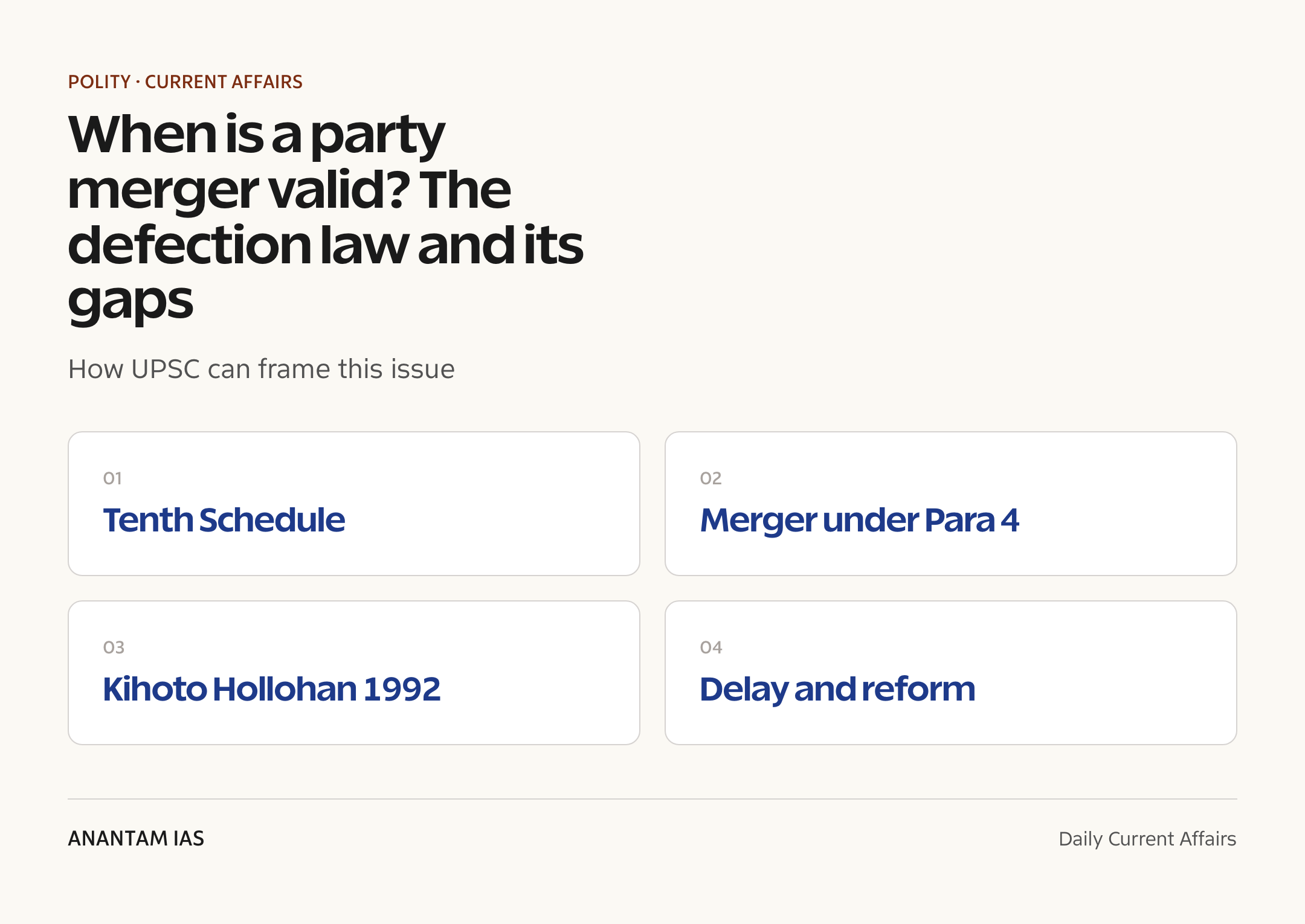
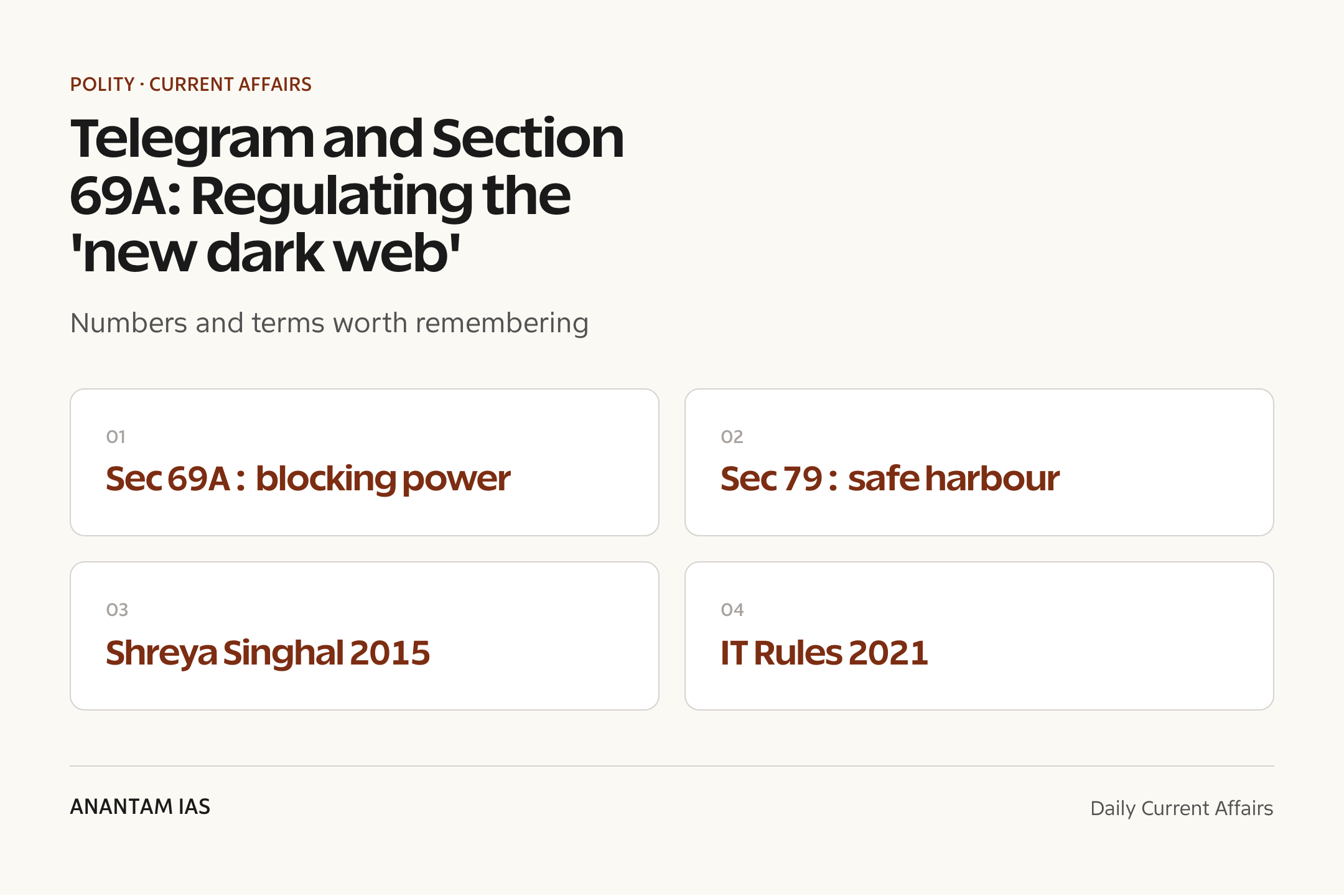
As The Hindu reported, the dispute is less about one app and more about how India regulates powerful intermediaries while honouring free-speech limits. It revives the constitutional architecture from Shreya Singhal v. Union of India (2015), the blocking rules of 2009, the safe-harbour principle under Section 79, and the due-diligence duties imposed by the IT Rules, 2021.
- The Centre characterised Telegram as the “new dark web”, citing encrypted, high-volume channels used for piracy, scams and harmful content.
- The matter foregrounds Section 69A, which empowers the government to direct blocking of information in the interest of sovereignty, security, public order and friendly foreign relations.
- It tests how intermediary liability and safe harbour apply to platforms that host channels reaching lakhs of users.
- Courts and commentators have invoked Shreya Singhal (2015), which upheld 69A but read in procedural safeguards against arbitrary blocking.
- The episode connects to ongoing debates over the IT Rules, 2021 and proposals under the upcoming Digital India Act framework.
The development matters in the context of:
- Relevant to the balance between Article 19(1)(a) free speech and the reasonable restrictions of Article 19(2).
- Relevant to platform governance, traceability of originators, and cyber-security of the information ecosystem.
UPSC Relevance
Prelims Relevance
- Section 69A, IT Act 2000 — power to block public access to information
- Section 79, IT Act — conditional safe harbour for intermediaries
- Section 66A — struck down as unconstitutional in Shreya Singhal (2015)
- Shreya Singhal v. Union of India (2015) — landmark on online free speech
- IT (Procedure and Safeguards for Blocking of Access) Rules, 2009
- IT (Intermediary Guidelines and Digital Media Ethics Code) Rules, 2021
- Definition of an intermediary and a significant social media intermediary
- Article 19(1)(a) and reasonable restrictions under Article 19(2)
- Concept of the dark web versus surface and deep web
- Grievance Appellate Committee (GAC) under the 2021 Rules
Mains Relevance
GS Paper 2
- Government policies and regulation of fundamental rights — free speech online versus content blocking under Section 69A.
- Role of the judiciary: how Shreya Singhal shaped procedural safeguards and proportionality in blocking orders.
- Transparency and accountability in executive blocking powers, including secrecy of blocking orders.
GS Paper 3
- Internal security challenges through communication networks — misuse of encrypted platforms for crime and radicalisation.
- Role of media and social-networking sites in internal-security challenges; basics of cyber security and intermediary due diligence.
Essay
- Liberty and security in the digital age: who guards the gatekeepers of speech?
- Technology is a tool; regulation decides whether it builds or breaks trust.
Background and Context
What Section 69A actually says
Section 69A is the statutory hinge of the entire debate, so its scope matters.
- Inserted by the 2008 amendment to the IT Act, 2000, it lets the Central Government direct any agency or intermediary to block public access to information.
- Permitted grounds mirror parts of Article 19(2): sovereignty and integrity of India, defence, security of the State, friendly relations with foreign states, public order, and preventing incitement to a cognisable offence.
- Non-compliance by an intermediary can attract imprisonment up to seven years plus fine, making the duty to comply legally serious.
- Reasons for blocking must be recorded in writing, but orders are usually kept confidential under the 2009 rules, a recurring transparency concern.
Shreya Singhal and the safeguards
The constitutional benchmark for 69A came from a 2015 verdict that reshaped online speech law.
- In Shreya Singhal v. Union of India (2015), the Supreme Court struck down Section 66A for being vague and overbroad, a chilling effect on speech.
- The Court upheld Section 69A, but read it as narrowly tailored, with reasoned orders and a review committee acting as checks.
- It clarified that intermediaries must act on actual knowledge via a court order or government notification, not on private complaints alone.
- The judgment remains the lodestar for proportionality whenever the State seeks to restrict online content.
Safe harbour under Section 79
Why platforms are usually shielded, and when that shield drops, is central to the Telegram clash.
- Section 79 grants intermediaries conditional immunity from liability for third-party content they host or transmit.
- Protection holds only if the intermediary plays a passive role, follows due diligence, and removes content on receiving a valid court or government order.
- If a platform fails takedown duties or actively abets unlawful content, it can lose safe harbour and face liability.
- The Centre’s “new dark web” framing is effectively an argument that Telegram is not behaving like a neutral, compliant intermediary.
The IT Rules, 2021 layer
A second regulatory layer sets the day-to-day obligations platforms must meet.
- The IT Rules, 2021 impose due-diligence duties, time-bound grievance redressal and a Grievance Appellate Committee for unresolved complaints.
- Significant social media intermediaries must appoint a Chief Compliance Officer, a nodal contact and a resident grievance officer in India.
- For messaging platforms, a contested traceability requirement seeks the first originator of certain messages, raising privacy and encryption questions.
- Compliance gaps, such as a thin India presence, weaken a platform’s claim to safe harbour and invite stricter scrutiny.
Why Telegram draws fire
The platform’s design features explain why regulators single it out.
- Public channels can broadcast to very large audiences, blurring the line between private chat and mass publishing.
- Features like large file sharing, pseudonymity and limited proactive moderation can be exploited for piracy, scams and harmful material.
- The label “new dark web” signals that ordinary, easily accessible apps may now carry risks once associated with hidden networks.
- Globally, Telegram has faced rising legal pressure, including the 2024 detention of its founder in France over moderation failures, raising platform-accountability questions.
The speech-versus-security balance
Every blocking decision sits on a constitutional fault line between two legitimate goods.
- Free expression under Article 19(1)(a) covers the right to receive and share information online, not just to speak.
- Restrictions must satisfy the proportionality test: legitimate aim, suitable means, least-restrictive option and a fair balance.
- Over-broad blocking risks collateral censorship; under-regulation risks crime, fraud and threats to internal security.
- Transparency, reasoned orders and judicial review are the mechanisms that keep the balance legitimate.
Way Forward
Make blocking transparent and reasoned
- Publish anonymised, aggregate data on 69A orders and offer notice to content originators where feasible.
- Strengthen the review committee so each order meets the proportionality standard from Shreya Singhal.
Calibrate platform obligations
- Tie graded duties to a platform’s reach and risk, with faster takedown for clearly illegal content and safeguards for lawful speech.
- Insist on a real India compliance presence and responsive grievance redress before invoking blunt blocking.
Build a modern legal framework
- Move debates toward a clear, rights-respecting successor law (the proposed Digital India Act) that defines intermediary classes and due process.
- Protect encryption and privacy while improving lawful, accountable cooperation on genuine security cases.
Conclusion
The Telegram dispute is a stress test for India’s digital-governance toolkit, not a verdict on one app. Section 69A, safe harbour under Section 79 and the IT Rules, 2021 each carry power and risk, which is why the Shreya Singhal safeguards remain essential.
A durable answer lies in proportionate, transparent regulation: platforms held to genuine accountability, citizens protected from both crime and censorship, and blocking powers exercised under reasoned, reviewable orders rather than rhetoric.
UPSC Practice Questions
Prelims MCQ 1
With reference to Section 69A of the Information Technology Act, 2000, consider the following statements:
- It empowers the Central Government to direct blocking of public access to information on specified grounds.
- The grounds for blocking broadly correspond to the reasonable restrictions under Article 19(2) of the Constitution.
- It was struck down as unconstitutional by the Supreme Court in Shreya Singhal v. Union of India.
How many of the above statements are correct?
(a) Only one (b) Only two (c) All three (d) None
Answer: (b) Only two
Explanation:
Statements 1 and 2 are correct. Section 69A allows the Centre to order blocking on grounds tracking Article 19(2). Statement 3 is wrong: Shreya Singhal (2015) struck down Section 66A but upheld Section 69A.
Prelims MCQ 2
The concept of ‘safe harbour’ for online intermediaries in India is primarily provided by which provision?
(a) Section 66A of the IT Act, 2000 (b) Section 69A of the IT Act, 2000 (c) Section 79 of the IT Act, 2000 (d) Article 19(2) of the Constitution
Answer: (c) Section 79 of the IT Act, 2000
Explanation:
Section 79 grants intermediaries conditional immunity from liability for third-party content, provided they observe due diligence and act on valid court or government orders. Section 66A was struck down; 69A deals with blocking; Article 19(2) sets restriction grounds.
UPSC Mains Questions
- The power to block online content under Section 69A must be balanced against the freedom of speech and expression. Critically examine the safeguards laid down by the judiciary and their adequacy in the present digital ecosystem. (250 words)
- Encrypted messaging platforms pose new challenges to internal security and intermediary regulation in India. Discuss the legal framework governing intermediary liability and suggest a proportionate way forward. (250 words)
Sources: The Hindu and The Hindu (Sci-Tech).
Frequently Asked Questions
What is Section 69A of the IT Act?
Section 69A empowers the Central Government to direct blocking of public access to online information on grounds such as sovereignty, security of the State, public order and friendly foreign relations. Reasons must be recorded in writing, and the framework is detailed in the 2009 blocking rules.
Did Shreya Singhal strike down Section 69A?
No. In Shreya Singhal v. Union of India (2015), the Supreme Court struck down Section 66A for vagueness but upheld Section 69A. It read the blocking power narrowly, requiring reasoned orders and treating procedural safeguards as essential checks on arbitrary censorship.
What is intermediary safe harbour?
Safe harbour, under Section 79 of the IT Act, gives intermediaries conditional immunity from liability for third-party content. The protection applies only if the platform stays passive, follows due diligence, and removes unlawful content after a valid court or government order.
Why did the Centre call Telegram the ‘new dark web’?
The government argued that Telegram’s large public channels, anonymity features and weak takedown response let it host piracy, scams and harmful content at scale. The phrase signals that an easily accessible app can now carry risks once linked mainly to hidden dark-web networks.
What do the IT Rules, 2021 require?
The 2021 Rules impose due-diligence duties, time-bound grievance redressal and a Grievance Appellate Committee. Significant social media intermediaries must appoint India-based compliance officers, and a contested traceability rule seeks the first originator of certain messages.
How is free speech balanced with blocking?
Restrictions on online speech must pass the proportionality test: a legitimate aim, suitable means, the least-restrictive option and a fair balance. Reasoned orders, a review committee and judicial review under Article 19 keep blocking powers within constitutional limits.