Opens in a new tab
Join Anantam IAS Channel on Telegram

Daily Digest · Saturday

20 June 2026 Current Affairs for UPSC

9 current affairs published on Saturday, 20 June 2026

20 June 2026 Current Affairs for UPSC — every Why-in-News article AnantamIAS published on Saturday, 20 June 2026, broken down with Why in News?, the exact GS paper it feeds, sub-topic mapping, MCQ-ready facts and a UPSC-style practice question. 9 articles in total, covering Polity, Economy, Environment, S&T, IR, Geography, History, Society and Internal Security — the same Why-in-News + GS-paper-mapping + practice-question format the Compass uses across every daily digest on the site.

Daily current affairs for UPSC is where new material enters your prep stream. Read this 20 June 2026 digest end-to-end in 25–35 minutes, attempt the practice question at the foot of each article (it's MCQ for some, 10/15-marker for others), then bookmark the entries that fall inside your active revision window. Everything stays cross-linked: tap any subject pill to jump to that subject's hub, or use the table of contents above to skip straight to a specific story.

Use this page three ways. Read sequentially for a one-sitting scan of everything that mattered on 20 June 2026. Download the 20 June 2026 PDF below for offline study or print revision. Or use the June 2026 Current Affairs compilation to see this day in the month's full context. For the previous day's reading, see 19 June 2026 Current Affairs; the next day's is 21 June 2026 Current Affairs.

Why we publish daily current affairs separately from the monthly compilation: daily is learning, monthly is revision. Use the daily page to add fresh material to your notes the day it breaks; come back to the June 2026 compilation 60 days before Prelims when the noise has settled and only the lasting takeaway is worth re-reading.

International Day of Yoga: From ‘One Earth, One Health’ to ‘Yoga for Healthy Ageing’

Open article →Download PDF

Why in News?

As 21 June approaches, India and the world prepare to observe the International Day of Yoga (IDY), the global wellness observance India steered through the United Nations General Assembly in 2014. The Ministry of AYUSH is the nodal coordinator, and the day has become a flagship of India’s cultural diplomacy and soft power.

The 11th IDY (2025) was led by the Prime Minister at Visakhapatnam, Andhra Pradesh, on the theme ‘Yoga for One Earth, One Health’ — framing personal wellbeing as inseparable from planetary health. For the 12th IDY (2026), the Ministry of AYUSH has announced the theme ‘Yoga for Healthy Ageing’, with the main national event planned at Kolkata, shifting focus to longevity, geriatric care and preventive health.

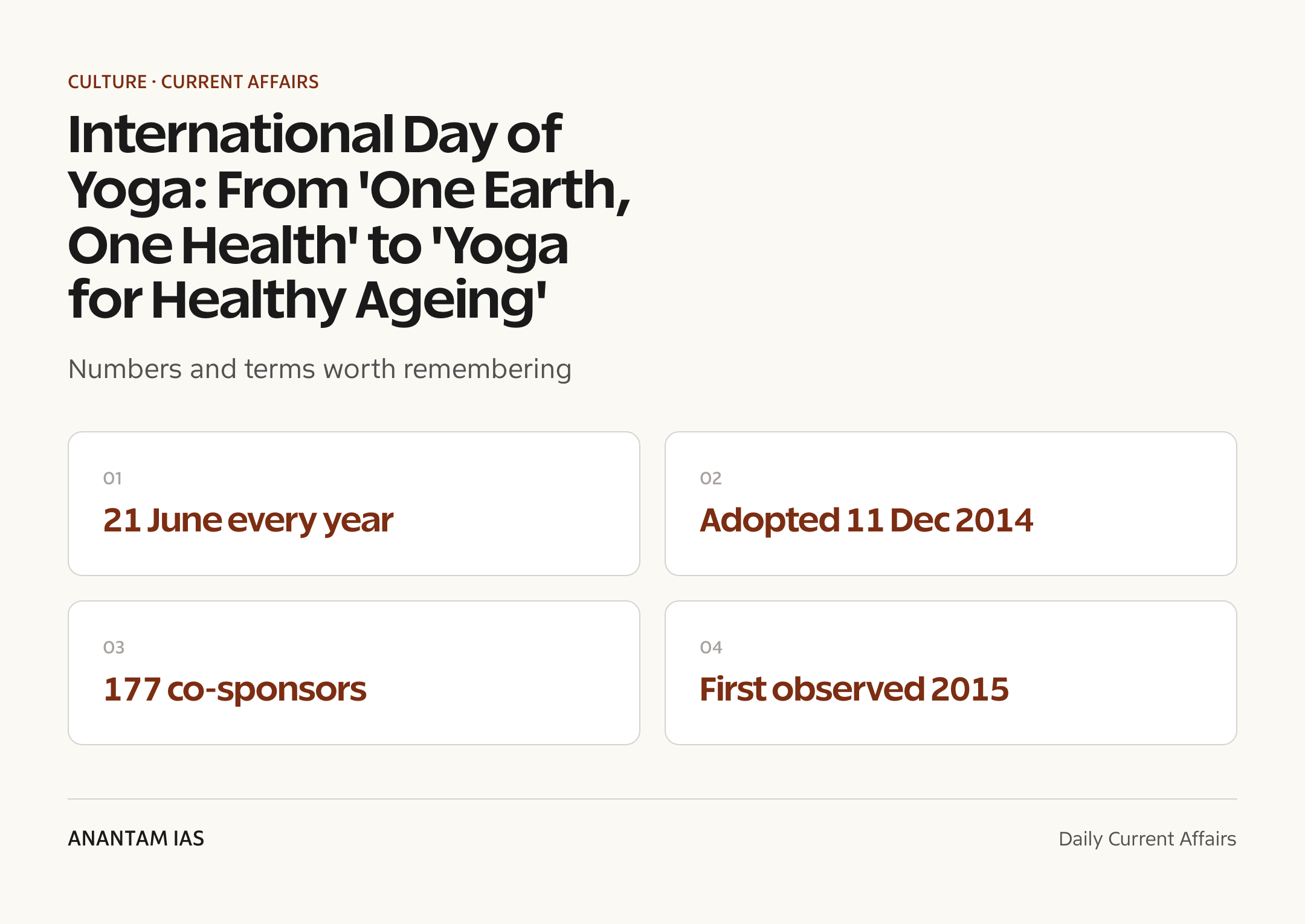
  • IDY is observed every 21 June, the day of the summer solstice (longest day in the Northern Hemisphere).
  • The 11th IDY (2025) theme was ‘Yoga for One Earth, One Health’; the mass event was held at Visakhapatnam.
  • The 12th IDY (2026) theme announced by AYUSH is ‘Yoga for Healthy Ageing’, with celebrations planned at Kolkata.
  • IDY originates in UNGA Resolution A/RES/69/131, adopted on 11 December 2014 with a record 177 co-sponsors; first observed on 21 June 2015.

The development matters in the context of:

  • Yoga is an ancient Indian physical, mental and spiritual practice; ‘yoga’ derives from the Sanskrit root yuj, meaning to join or unite — body, mind and consciousness.
  • IDY anchors India’s soft power abroad, projected through institutions such as the Indian Council for Cultural Relations (ICCR), the Ministry of AYUSH and Indian missions worldwide.

Large group performing yoga asanas together at an outdoor mass session
The International Day of Yoga, observed every 21 June, draws mass participation across India and the world. Photo: Jaspinder Singh (Unsplash)
International Day of Yoga: From 'One Earth, One Health' to 'Yoga for Healthy Ageing' — quick facts

UPSC Relevance

Prelims Relevance

  • International Day of Yoga is observed on 21 June each year, chosen for its link to the summer solstice.
  • It was established by UNGA Resolution A/RES/69/131, adopted on 11 December 2014; the resolution had 177 co-sponsoring countries, a UN record for any resolution.
  • The first IDY was observed on 21 June 2015; the Ministry of AYUSH is the nodal ministry in India.
  • AYUSH stands for Ayurveda, Yoga and Naturopathy, Unani, Siddha and Homoeopathy.
  • Past themes include ‘Yoga for Harmony and Peace’ (2016), ‘Yoga for Health’ (2017), ‘Yoga for Climate Action’ (2019), ‘Yoga for Humanity’ (2022) and ‘Yoga for One Earth, One Health’ (2025).
  • The 12th IDY (2026) theme is ‘Yoga for Healthy Ageing’; the 11th (2025) theme was ‘Yoga for One Earth, One Health’.
  • The Common Yoga Protocol (CYP) is the standardised ~45-minute sequence followed during the mass IDY demonstration.
  • The ‘One Health’ idea links human, animal and environmental health as interdependent, underpinning the 2025 theme.
  • India proposed IDY at the UN during the 69th session of the General Assembly; the proposal was made by the Prime Minister in his September 2014 address.

Mains Relevance

GS Paper 1

  • Yoga as a living element of India’s intangible cultural heritage and its place in the broader tradition of Indian philosophy and indigenous knowledge systems.
  • How a traditional practice is reinterpreted for contemporary concerns — planetary health (2025) and an ageing population (2026).

GS Paper 2

  • IDY as an instrument of India’s soft power and cultural diplomacy, and the role of multilateral platforms (UNGA) and agencies like ICCR in projecting it.
  • Health diplomacy: positioning yoga and AYUSH within global preventive-health and ‘One Health’ agendas alongside WHO frameworks.

Essay

  • Tradition as a resource for modern challenges — wellness, ecological balance and ageing societies.
  • Soft power and the idea of a nation’s influence resting on culture rather than coercion.

Background and Context

Origin: India's UN-led resolution

IDY began as an Indian diplomatic initiative at the United Nations.

  • The Prime Minister proposed the idea at the UN General Assembly in September 2014, suggesting 21 June for its solstice significance.
  • The UNGA adopted Resolution A/RES/69/131 on 11 December 2014, declaring 21 June as the International Day of Yoga.
  • A record 177 countries co-sponsored the resolution, reflecting unusually broad consensus.
  • The first IDY was observed on 21 June 2015, with a mass demonstration on Rajpath, New Delhi.

International Day of Yoga: From 'One Earth, One Health' to 'Yoga for Healthy Ageing' — exam lens

Why 21 June — the solstice symbolism

The date carries cultural and astronomical meaning.

  • 21 June is the summer solstice, the longest day in the Northern Hemisphere.
  • In yogic tradition, the solstice marks the transition to Dakshinayana, considered conducive to spiritual practice.
  • The date links the personal discipline of yoga to natural and cosmic rhythms, reinforcing the body-nature connection.

AYUSH and the delivery machinery

The Ministry of AYUSH coordinates IDY in India and abroad.

  • The Ministry of AYUSH is the nodal ministry; it sets the annual theme and the Common Yoga Protocol.
  • The protocol is a standardised ~45-minute sequence of warm-ups, asanas, pranayama and meditation for synchronised global practice.
  • Indian missions, ICCR and bodies like the Morarji Desai National Institute of Yoga organise events worldwide.
  • Run-up activities such as Yoga Mahotsav and countdown events build participation ahead of 21 June.

Themes across the years

Each edition reframes yoga around a current concern.

  • Early editions stressed harmony, peace and health (2016-2018).
  • Later themes broadened to ‘Yoga for Climate Action’ (2019) and ‘Yoga for Humanity’ (2022).
  • The 11th IDY (2025) used ‘Yoga for One Earth, One Health’ at Visakhapatnam, linking wellbeing to planetary health.
  • The 12th IDY (2026) theme is ‘Yoga for Healthy Ageing’, centred on longevity and geriatric care.

Soft power and cultural diplomacy

IDY is a showcase of India’s civilisational influence.

  • Soft power is the ability to shape preferences through attraction and persuasion rather than force, a concept popularised by Joseph Nye.
  • Yoga lets India project a distinctive cultural identity that resonates across faiths and nations.
  • Mass global participation — sessions at the UN headquarters and across continents — amplifies India’s image as a source of wellness knowledge.
  • It complements other strands of India’s cultural outreach such as Ayurveda, cuisine and classical arts.

'One Health' and the planetary framing

The 2025 theme tied yoga to a wider scientific idea.

  • One Health recognises that human, animal and environmental health are interconnected and interdependent.
  • The framing positions individual wellness as a contribution to the health of the planet, not a private pursuit alone.
  • It aligns yoga with global agendas on preventive health, sustainable lifestyles and ecological balance.
  • The 2026 pivot to healthy ageing extends this into the demographic and public-health challenge of older populations.

Way Forward

Evidence and research

  • Expand clinical and longitudinal research on yoga’s therapeutic benefits, especially for ageing-related conditions, to move from advocacy to evidence.
  • Integrate validated yoga protocols into mainstream and preventive healthcare and geriatric care.

Inclusion and reach

  • Scale accessible formats — Braille yogic texts, adapted practice for persons with disabilities, and tele-yoga for remote areas.
  • Sustain participation beyond 21 June through school curricula, workplace wellness and year-round community programmes.

Diplomacy and standards

  • Deepen partnerships with the WHO and host countries to embed yoga in global health frameworks.
  • Protect the integrity of yoga as heritage while guarding against commercial dilution and misappropriation.

Conclusion

From its origin in a record-backed UN resolution to mass demonstrations on every continent, the International Day of Yoga has become both a public-health movement and a calling card of India’s cultural diplomacy. The shift in themes — from peace and climate to ‘One Earth, One Health’ in 2025 and ‘Yoga for Healthy Ageing’ in 2026 — shows how a centuries-old practice is continually re-read against the questions of the moment.

For India, the challenge is to convert a once-a-year spectacle into durable habits and credible evidence. If yoga is to be more than soft-power theatre, its claims must be tested, its reach made genuinely inclusive, and its delivery sustained the other 364 days of the year.

UPSC Practice Questions

Prelims MCQ 1

With reference to the International Day of Yoga, consider the following statements:

  1. It is observed every year on 21 June, coinciding with the summer solstice.
  2. It was established by a United Nations General Assembly resolution adopted in 2014.
  3. In India, the Ministry of Health and Family Welfare is the nodal ministry for its observance.

How many of the above statements are correct?

(a) Only one (b) Only two (c) All three (d) None

Answer: (b) Only two

Explanation:

Statements 1 and 2 are correct: IDY is on 21 June (summer solstice) and was created by UNGA Resolution A/RES/69/131 adopted on 11 December 2014. Statement 3 is wrong — the nodal ministry is the Ministry of AYUSH, not Health and Family Welfare.

Prelims MCQ 2

The theme of the 12th International Day of Yoga (2026) is:

(a) Yoga for Humanity (b) Yoga for One Earth, One Health (c) Yoga for Healthy Ageing (d) Yoga for Climate Action

Answer: (c) Yoga for Healthy Ageing

Explanation:

The Ministry of AYUSH announced ‘Yoga for Healthy Ageing’ as the 2026 theme. ‘One Earth, One Health’ was the 11th IDY (2025) theme, ‘Yoga for Humanity’ was 2022, and ‘Yoga for Climate Action’ was 2019.

UPSC Mains Questions

  1. International Day of Yoga has emerged as one of India’s most effective instruments of soft power. Examine how cultural assets can be mobilised for diplomacy, using yoga as a case study.
  2. “A traditional practice is most valuable when it answers contemporary questions.” In light of the shift in IDY themes from planetary ‘One Health’ to ‘Healthy Ageing’, discuss the relevance of yoga to India’s public-health priorities.
  3. Trace the origin of the International Day of Yoga at the United Nations and analyse what its near-universal acceptance reveals about India’s standing in multilateral diplomacy.

Sources: Ministry of AYUSH / PMO and Ministry of AYUSH.

Frequently Asked Questions

When is International Day of Yoga observed and why on that date?

It is observed every year on 21 June, the summer solstice and the longest day in the Northern Hemisphere. India proposed the date for its astronomical and yogic significance, marking the transition to Dakshinayana, a period traditionally seen as favourable for spiritual practice and inner discipline.

How did the International Day of Yoga come into being?

India proposed it at the UN General Assembly in September 2014. The UNGA adopted Resolution A/RES/69/131 on 11 December 2014, declaring 21 June as the International Day of Yoga. A record 177 countries co-sponsored the resolution, and the first observance was held on 21 June 2015.

What were the themes of the 11th and 12th editions?

The 11th IDY (2025) carried the theme ‘Yoga for One Earth, One Health’, with the main event at Visakhapatnam. The 12th IDY (2026) theme announced by the Ministry of AYUSH is ‘Yoga for Healthy Ageing’, focusing on longevity, geriatric care and preventive health, with celebrations planned at Kolkata.

Which ministry coordinates the day in India?

The Ministry of AYUSH is the nodal ministry. It sets the annual theme, issues the Common Yoga Protocol used for the synchronised mass session, and coordinates events with Indian missions, the ICCR and institutes such as the Morarji Desai National Institute of Yoga, both within India and abroad.

How does yoga relate to India’s soft power?

Soft power is influence built through attraction rather than coercion. Yoga gives India a distinctive, widely admired cultural offering that crosses national and religious lines. Mass global participation, including sessions at the UN headquarters, projects India as a custodian of wellness knowledge and strengthens its cultural diplomacy.

What is the ‘One Health’ idea behind the 2025 theme?

One Health holds that human, animal and environmental health are interconnected and interdependent. The 2025 theme, ‘Yoga for One Earth, One Health’, used this lens to present individual wellbeing as inseparable from the health of the planet, linking yoga to wider agendas on preventive health and ecological balance.

State of India’s Environment 2026: Seven Planetary Boundaries Breached, Tigers Behaving Differently

Open article →Download PDF

Why in News?

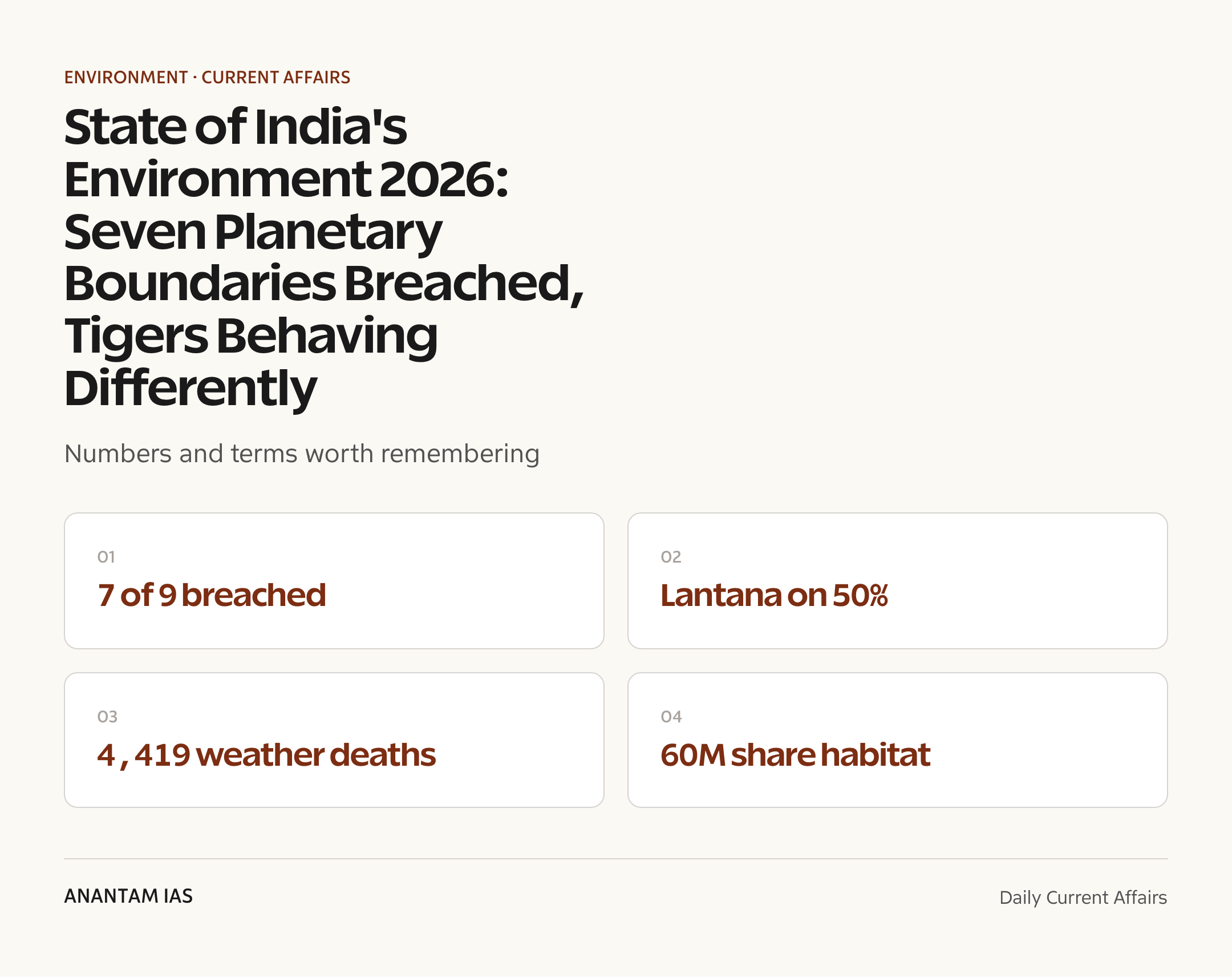
The Centre for Science and Environment (CSE) and its magazine Down To Earth have released the State of India’s Environment (SOE) 2026 report, an annual stocktake published since 1982 and unveiled at the Anil Agarwal Dialogue. The headline finding is stark: seven of the nine planetary boundaries that keep the Earth system stable have now been transgressed, with ocean acidification the latest to cross its safe limit.

The report also documents a behavioural shift in India’s tigers. With reserves saturated and the invasive shrub Lantana camara hollowing out prey-rich habitat, big cats are venturing into shared landscapes, losing their fear of humans, and turning to livestock and, in rare cases, people. It links these wildlife stresses to a wider pattern of extreme weather, flood risk, and ecological breakdown across India in 2025.

  • SOE 2026 by CSE/Down To Earth says 7 of 9 planetary boundaries are breached.
  • Ocean acidification is the newest boundary to be crossed, with ocean acidity up 30-40% since the industrial era.
  • Invasive Lantana camara now occupies nearly 50% of India’s forest and scrubland, fuelling human-tiger conflict.
  • Extreme weather struck on 99% of days in 2025 (Jan 1-Nov 30), killing 4,419 people and hitting 17.41 million hectares of cropland.

The development matters in the context of:

  • The planetary boundaries framework was proposed in 2009 by Johan Rockstrom and colleagues at the Stockholm Resilience Centre to define a “safe operating space” for humanity across nine Earth-system processes.
  • SOE is India’s longest-running independent environment audit; this edition stitches together global Earth-system science with on-the-ground Indian data on weather, forests, and wildlife conflict.
A Bengal tiger walking through dense forest undergrowth in an Indian reserve
Habitat degradation and invasive Lantana are pushing India's tigers into shared landscapes. Photo: Alvesgaspar, CC BY-SA 3.0 (Wikimedia Commons)
State of India's Environment 2026: Seven Planetary Boundaries Breached, Tigers Behaving Differently — quick facts

UPSC Relevance

Prelims Relevance

  • Nine planetary boundaries: climate change, biosphere (genetic and functional) integrity, land-system change, freshwater change, biogeochemical flows (nitrogen and phosphorus), ocean acidification, novel entities, atmospheric aerosol loading, stratospheric ozone depletion.
  • Boundaries currently breached per SOE 2026: climate change, biosphere integrity, land-system change, freshwater, biogeochemical flows, novel entities, ocean acidification.
  • Boundaries still within safe limits: aerosol loading and stratospheric ozone.
  • The framework originated at the Stockholm Resilience Centre (2009), not under any UN treaty.
  • Lantana camara is an invasive alien shrub of the Verbenaceae family, native to tropical America, listed among the world’s worst invasive species.
  • Novel entities as a boundary covers human-made substances such as plastics, synthetic chemicals, and radioactive materials.
  • Project Tiger (1973) and the National Tiger Conservation Authority (NTCA) are the statutory backbone of India’s tiger conservation.
  • Ocean acidification results from oceans absorbing excess atmospheric CO2, lowering seawater pH and harming calcifying marine life.

Mains Relevance

GS Paper 3

  • Conservation success breeding new conflict: how rising tiger numbers, habitat saturation, and invasive species reshape the human-wildlife interface.
  • Translating the global planetary boundaries framework into India’s climate, biodiversity, and disaster-management policy.

Essay

  • Themes on living within ecological limits, the cost of growth without guardrails, and coexistence between people and wildlife.

Background and Context

What the planetary boundaries framework measures

Nine control variables that define a safe operating space for humanity.

  • Devised in 2009 at the Stockholm Resilience Centre, the framework sets quantitative limits for nine Earth-system processes; staying within them keeps the planet in a stable, Holocene-like state.
  • The nine boundaries: climate change, biosphere integrity, land-system change, freshwater change, biogeochemical flows (nitrogen and phosphorus), ocean acidification, novel entities, atmospheric aerosol loading, and stratospheric ozone depletion.
  • Crossing a boundary raises the risk of abrupt, large-scale, possibly irreversible environmental change.
  • It is a scientific assessment tool, not a binding treaty, and is updated as Earth-system science evolves.
State of India's Environment 2026: Seven Planetary Boundaries Breached, Tigers Behaving Differently — exam lens

Seven boundaries breached, ocean acidification the newest

SOE 2026 marks ocean acidification as freshly transgressed.

  • SOE 2026 reports that seven of nine boundaries are now crossed; only aerosol loading and stratospheric ozone remain within safe limits.
  • The newly breached boundary is ocean acidification as oceans absorb excess CO2; surface-ocean acidity has risen by an estimated 30-40% since the industrial era.
  • Acidifying seas weaken corals, shellfish, and plankton, threatening fisheries and the ocean’s role as a carbon sink.
  • The other breached boundaries span climate change, biosphere integrity, land-system change, freshwater, biogeochemical flows, and novel entities (plastics and synthetic chemicals).

Why India's tigers are behaving differently

Saturated reserves and degraded habitat push big cats outward.

  • With tiger numbers rising and reserves at carrying capacity, animals are spilling into unprotected, shared landscapes; nearly 60 million people across 20 states live in areas overlapping tiger territory.
  • Conservation biologist K. Ullas Karanth notes big cats are “losing their fear of humans,” a shift tied to habitat degradation and proximity.
  • Between January and June 2025, at least 43 people were killed near tiger reserves (against 44 in the same months of 2024), with human remains consumed in four attacks.
  • Roughly 40% of tiger territory in these states overlaps zones of dense human settlement, amplifying encounter risk.

Lantana camara: the invasive shrub at the heart of the conflict

An ornamental import now reshapes predator-prey dynamics.

  • Lantana camara, introduced in the 19th century as an ornamental, now occupies nearly 50% of India’s forest and scrubland.
  • It suppresses native grasses and undergrowth that herbivore prey depend on, hollowing out the food base inside many habitats.
  • Dense Lantana thickets create “predator-friendly habitat in prey-poor landscapes” – cover for ambush while restricting prey escape routes, pushing tigers toward easier targets like cattle.
  • A policy paradox follows: livestock-loss compensation sustains cattle-rearing near forests, inadvertently subsidising tiger-human proximity rather than reducing it.

A year of extreme weather and flood risk

2025 saw weather extremes on nearly every day.

  • Extreme weather events occurred on 99% of days between 1 January and 30 November 2025, killing 4,419 people.
  • These events damaged about 17.41 million hectares of cropland, threatening rural incomes and food security.
  • The worst-hit states by extreme-weather days were Himachal Pradesh (267), Kerala (173), and Madhya Pradesh (162).
  • Land-system change, deforestation, and degraded catchments magnify flood risk, linking the boundary crossings directly to disaster-management stress on the ground.

Blind spots in monitoring

Much of India lacks reliable environmental data.

  • Only about 15% of India’s population (~200 million) lives within 10 km of a continuous air-quality monitoring station.
  • The remaining 85% (~1.2 billion people) lack measurable, real-time pollution coverage, weakening evidence-based action.
  • Patchy monitoring of forests, freshwater, and biodiversity makes it harder to detect boundary crossings early and respond.
  • SOE 2026 frames better data and independent audits as preconditions for credible environmental governance.

Way Forward

Treat planetary boundaries as policy guardrails

  • Anchor India’s climate, biodiversity, and water targets to the boundaries that are most stressed – land-system change, freshwater, and biogeochemical flows.
  • Mainstream ocean-acidification monitoring along India’s coasts within the blue-economy and fisheries agenda.

Restore habitat and manage invasives

  • Scale up scientific Lantana camara removal and native-grassland restoration inside and around reserves to rebuild the prey base.
  • Link removal to livelihoods through Lantana-craft and bioenergy uses so eradication is durable.

Redesign human-wildlife coexistence

  • Reform livestock-compensation so it rewards prevention (predator-proof enclosures, herding practices) rather than sustaining cattle near forest edges.
  • Invest in rapid-response teams, early-warning systems, and corridor protection for dispersing tigers.

Close the data gap

  • Expand continuous air, water, and biodiversity monitoring beyond the 15% of the population currently covered.
  • Build a disaster-management calendar of extreme-weather hotspots like Himachal, Kerala, and Madhya Pradesh into state planning.

Conclusion

The State of India’s Environment 2026 reframes a familiar conservation success as a warning. Seven of nine planetary boundaries breached, ocean acidification newly crossed, and tigers behaving differently are not separate stories but symptoms of the same overshoot – an environment pushed past the limits that once kept it stable.

For India, the lesson is that protecting a species or hitting a target is not enough if the surrounding habitat, water, and climate keep degrading. Living within ecological limits, managing invasives like Lantana, and building genuine coexistence are now the test of whether conservation gains can survive the pressures the report documents.

UPSC Practice Questions

Prelims MCQ 1

With reference to the planetary boundaries framework, consider the following statements:

  1. It was developed by the Stockholm Resilience Centre to define a safe operating space for humanity.
  2. Ocean acidification is one of the nine planetary boundaries.
  3. Stratospheric ozone depletion is one of the boundaries that has been transgressed, according to the State of India’s Environment 2026.

How many of the above statements are correct?

(a) Only one (b) Only two (c) All three (d) None

Answer: (b) Only two

Explanation:

Statements 1 and 2 are correct. Statement 3 is wrong: SOE 2026 places stratospheric ozone (with aerosol loading) among the two boundaries still within safe limits, not breached.

Prelims MCQ 2

Consider the following with reference to Lantana camara:

  1. It is an invasive alien shrub native to tropical America.
  2. The State of India’s Environment 2026 links its spread to rising human-tiger conflict.
  3. It is reported to occupy nearly half of India’s forest and scrubland.

How many of the above statements are correct?

(a) Only one (b) Only two (c) All three (d) None

Answer: (c) All three

Explanation:

All three are correct. Lantana camara is a tropical-American invasive that SOE 2026 says occupies nearly 50% of forest and scrubland, suppressing prey habitat and intensifying tiger conflict.

UPSC Mains Questions

  1. “Conservation success can create new ecological conflicts.” Examine this statement in the light of rising human-tiger conflict and the spread of invasive species in India. (250 words)
  2. Discuss the planetary boundaries framework and assess how the State of India’s Environment 2026 findings should shape India’s climate and disaster-management policy. (250 words)

Sources: Centre for Science and Environment (Down To Earth) and Down To Earth.

Frequently Asked Questions

What are planetary boundaries?

Planetary boundaries are nine Earth-system limits defined by the Stockholm Resilience Centre in 2009. Staying within them keeps the planet stable. They cover climate change, biosphere integrity, land-system change, freshwater, biogeochemical flows, ocean acidification, novel entities, aerosol loading, and ozone depletion.

How many planetary boundaries are breached per SOE 2026?

The State of India’s Environment 2026 by CSE reports that seven of the nine planetary boundaries have been transgressed. Only atmospheric aerosol loading and stratospheric ozone depletion remain within safe limits, with ocean acidification the newest boundary to be crossed.

Why are India’s tigers behaving differently?

With reserves saturated and habitat degraded by invasive Lantana, tigers are venturing into shared landscapes and losing their fear of humans. Nearly 60 million people across 20 states share tiger territory, and at least 43 people were killed near reserves in January-June 2025.

How does Lantana camara worsen human-tiger conflict?

Lantana camara, an invasive shrub occupying nearly half of India’s forest and scrubland, suppresses native grasses that prey animals need. It creates dense ambush cover in prey-poor areas, pushing tigers toward cattle and human-dominated zones and intensifying conflict.

What does SOE 2026 say about extreme weather in India?

It records extreme weather on 99% of days between January and November 2025, killing 4,419 people and damaging about 17.41 million hectares of cropland. Himachal Pradesh, Kerala, and Madhya Pradesh saw the most extreme-weather days.

Who releases the State of India’s Environment report?

It is published annually by the Centre for Science and Environment (CSE) and its magazine Down To Earth, an effort running since 1982. The 2026 edition was unveiled at the Anil Agarwal Dialogue.

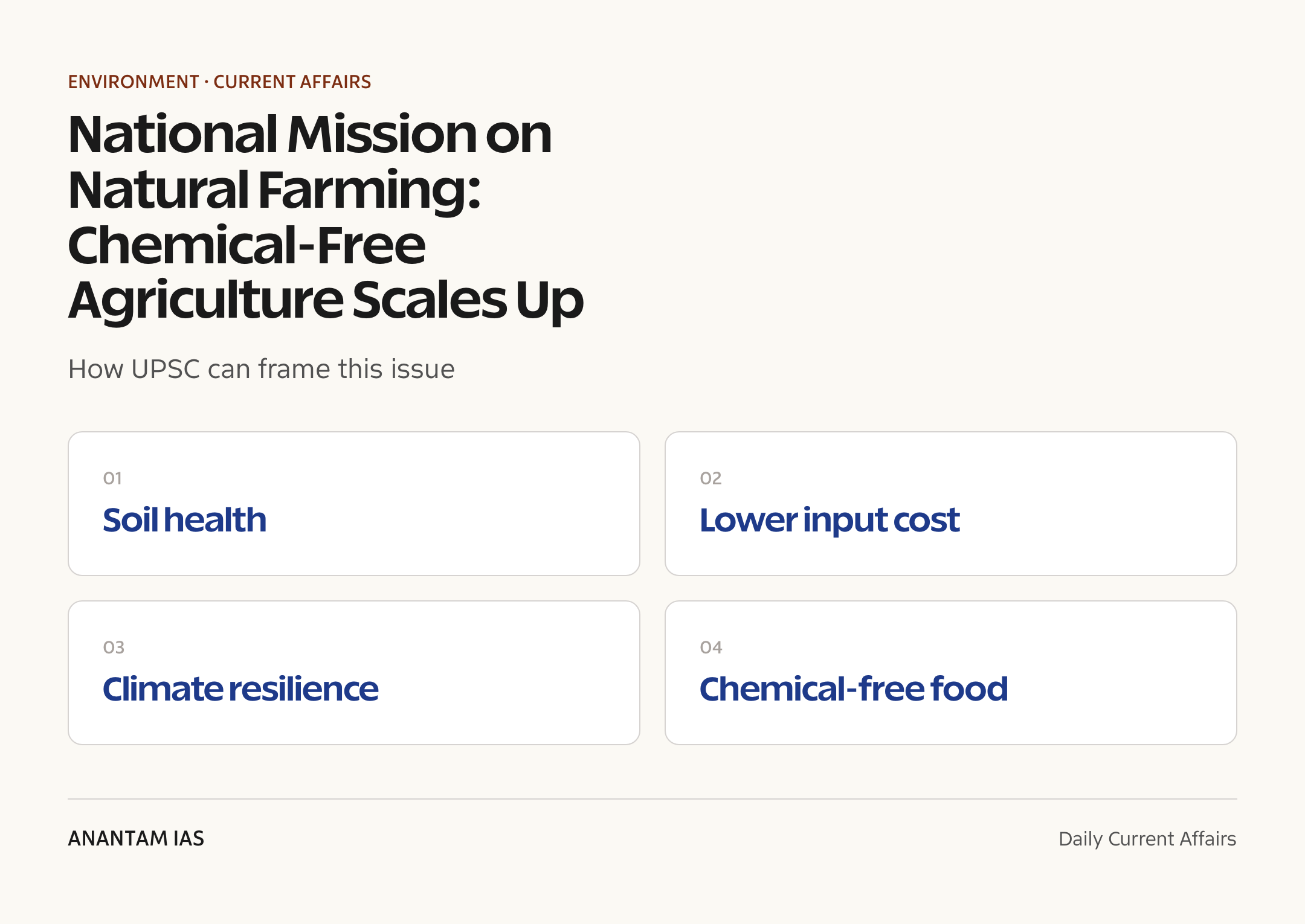
National Mission on Natural Farming: Chemical-Free Agriculture Scales Up

Open article →Download PDF

Why in News?

The National Mission on Natural Farming (NMNF) returns to focus as the Prime Minister’s 20-21 June visit to West Bengal foregrounds rural and agriculture development packages, with chemical-free farming a recurring theme. The Mission, a standalone Centrally Sponsored Scheme launched in November 2024 under the Department of Agriculture & Farmers Welfare, has now scaled past 21 lakh enrolled farmers on its official tracking portal.

NMNF promotes traditional, chemical-free agriculture built on locally available cow-based and bio inputs — branded Bharatiya Prakritik Krishi — through farmer clusters, demonstration farms and a last-mile network of Bio-input Resource Centres (BRCs) and Krishi Sakhis. For UPSC, it sits at the intersection of soil health, input-cost reduction, climate-resilient agriculture and sustainable-livelihood policy.

  • PM’s 20-21 June West Bengal visit spotlights agriculture and rural development, reviving attention on chemical-free farming policy.
  • NMNF’s official portal shows over 21 lakh farmers enrolled and nearly 20,000 clusters activated.
  • Scheme is the first standalone national mission dedicated to natural farming, distinct from earlier BPKP/PKVY sub-components.

The development matters in the context of:

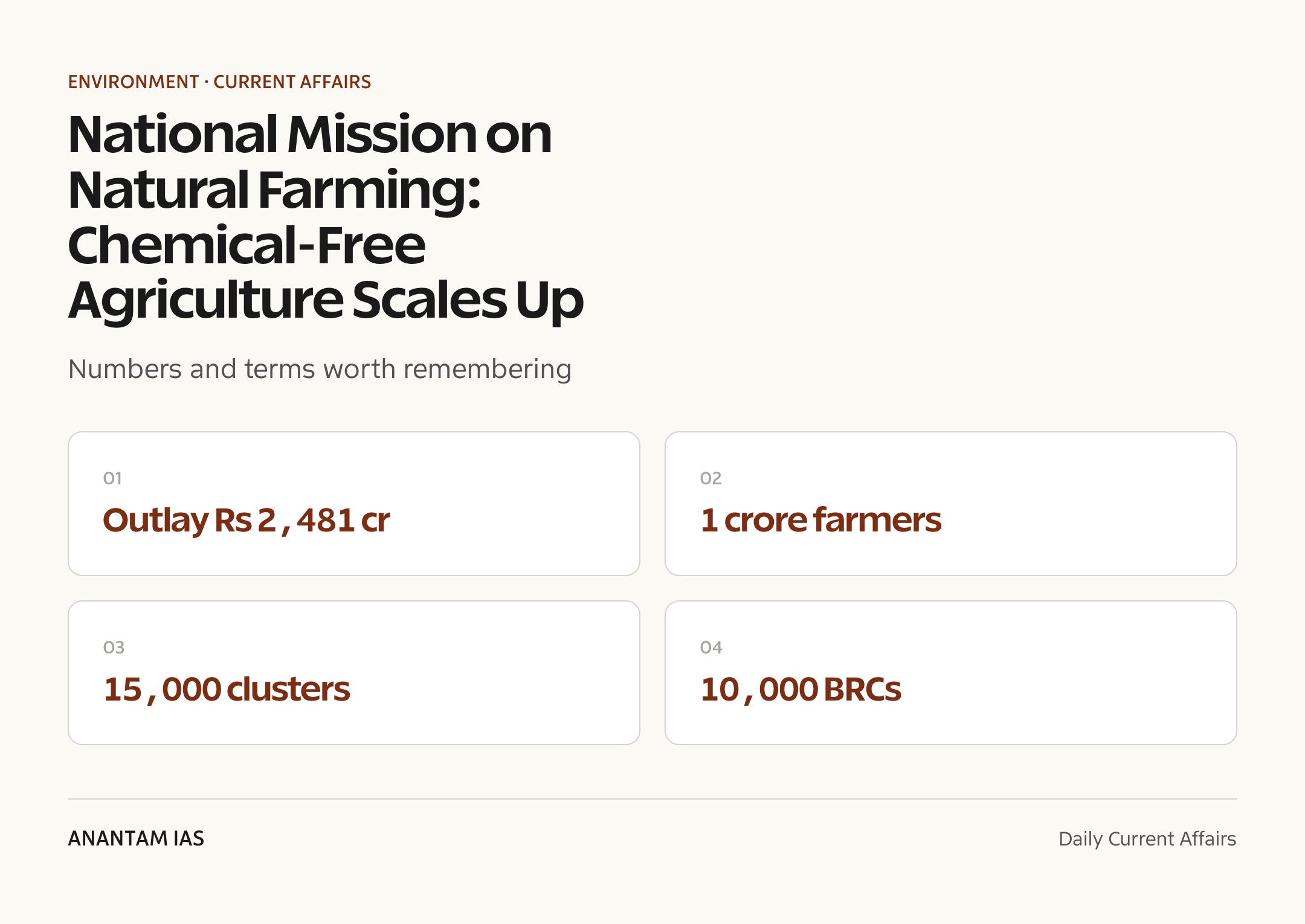
  • Approved by the Union Cabinet with a total outlay of ₹2,481 crore (Centre ₹1,584 cr + States ₹897 cr) up to the 15th Finance Commission cycle.
  • Targets 1 crore farmers across 15,000 clusters covering 7.5 lakh hectares over the mission period.
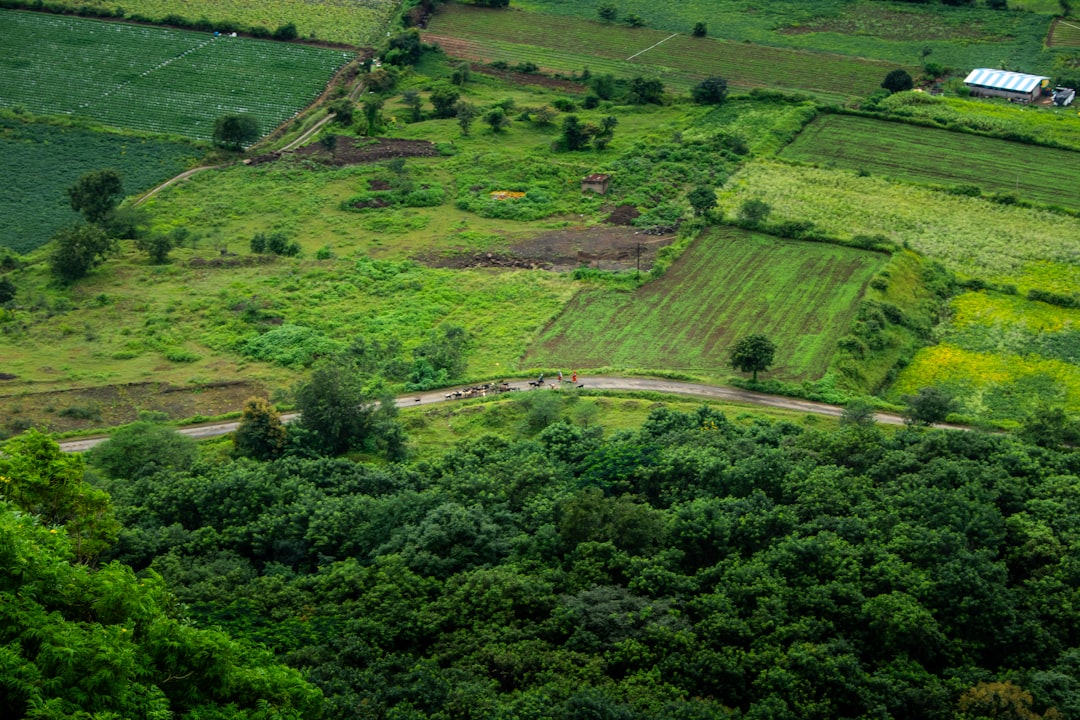
Chemical-free mixed-crop farm field in India under natural farming
Natural farming promotes chemical-free, cluster-based cultivation using local bio-inputs. Photo: Zoshua Colah (Unsplash)
National Mission on Natural Farming: Chemical-Free Agriculture Scales Up — quick facts

UPSC Relevance

Prelims Relevance

  • NMNF is a standalone Centrally Sponsored Scheme (Nov 2024) under the Department of Agriculture & Farmers Welfare, Ministry of Agriculture & Farmers Welfare.
  • Total outlay ₹2,481 crore; Centre share ₹1,584 cr, State share ₹897 cr.
  • Targets: 1 crore farmers, 15,000 clusters, 7.5 lakh hectares.
  • Last-mile delivery via 10,000 Bio-input Resource Centres (BRCs) and trained Krishi Sakhis.
  • Branded inputs come under Bharatiya Prakritik Krishi (BPK); the scheme restructures the earlier BPKP run under PKVY.
  • Natural farming relies on on-farm inputs like Jeevamrit and Beejamrit; it discourages synthetic chemical fertilisers and pesticides.
  • Andhra Pradesh (APCNF) is widely cited as India’s largest community-managed natural-farming programme.
  • ICAR and Krishi Vigyan Kendras (KVKs) provide research and demonstration backing.
  • Natural farming differs from organic farming: it avoids off-farm purchased inputs and emphasises minimal external cost.
  • Soil Health Cards and Krishi Sakhis (a convergence with DAY-NRLM women extension workers) support farmer guidance.

Mains Relevance

GS Paper 3

  • Examine natural farming as a strategy for reducing input costs and improving farm-level resilience while sustaining yields and food security.
  • Assess institutional design of NMNF — cluster approach, BRCs, Krishi Sakhis — and the challenges of scaling chemical-free agriculture nationally.

Essay

  • Sustainability versus productivity: can chemical-free agriculture feed a growing nation without compromising food security?

Background and Context

What the National Mission on Natural Farming is

A dedicated mission to mainstream chemical-free, tradition-rooted farming.

  • Launched in November 2024 as a standalone Centrally Sponsored Scheme under the Department of Agriculture & Farmers Welfare.
  • Promotes natural farming — agriculture using locally available, mostly cow-based and plant-based inputs, with little or no synthetic fertiliser or pesticide.
  • Inputs are branded Bharatiya Prakritik Krishi, drawing on indigenous preparations such as Jeevamrit (microbial culture) and Beejamrit (seed treatment).
  • Core goals: lower input costs, restore soil health, cut chemical residue in food, and build climate resilience.
National Mission on Natural Farming: Chemical-Free Agriculture Scales Up — exam lens

Outlay, targets and architecture

A cluster-based mission with a defined budget and reach.

  • Total outlay ₹2,481 crore up to the 15th Finance Commission period — Centre ₹1,584 crore, States ₹897 crore.
  • Targets 1 crore farmers across 15,000 clusters, covering about 7.5 lakh hectares.
  • Plans roughly 10,000 Bio-input Resource Centres (BRCs) for easy, local access to natural-farming inputs.
  • Deploys trained Krishi Sakhis and Community Resource Persons for farmer hand-holding and last-mile extension.

Rollout so far

Early-stage scaling is visible on the Mission’s tracking portal.

  • Over 21 lakh farmers enrolled and nearly 20,000 clusters activated, per the official NMNF dashboard.
  • Thousands of BRCs already set up, alongside tens of thousands of Community Resource Persons.
  • Supporting infrastructure includes Natural Farming Centres, training institutions and master trainers for capacity building.
  • A digital layer — Krishi Mapper field registration and Soil Health Cards — tracks plots and monitors soil parameters.

From BPKP and PKVY to a standalone mission

NMNF consolidates scattered natural-farming efforts into one programme.

  • Natural farming earlier ran as Bharatiya Prakritik Krishi Paddhati (BPKP), a sub-scheme of the Paramparagat Krishi Vikas Yojana (PKVY).
  • BPKP supported cluster-based adoption but lacked a dedicated national mission structure and scale.
  • NMNF gives natural farming its own budget line, institutional architecture and measurable targets.
  • The term Zero Budget Natural Farming (ZBNF), associated with Subhash Palekar, popularised the input-cost-minimising philosophy that informs the approach.

Andhra Pradesh as the proof-of-concept

A state-led programme offers lessons for national scaling.

  • Andhra Pradesh Community-Managed Natural Farming (APCNF) is widely cited as the largest agroecology programme of its kind.
  • It works through women’s self-help groups and community institutions for peer-to-peer extension.
  • APCNF demonstrates that cluster + community-resource-person models can reach lakhs of farmers.
  • Its experience shapes NMNF’s reliance on Krishi Sakhis and local resource persons.

Why it matters for the economy and ecology

Natural farming links farm incomes with environmental goals.

  • Cutting purchased chemical inputs can lower cultivation costs and reduce farmer debt exposure.
  • Reduced fertiliser use eases pressure on India’s large fertiliser subsidy bill over time.
  • Healthier soils improve water retention and carbon content, supporting climate-resilient agriculture.
  • Chemical-free produce can open premium and export markets if certification and traceability mature.

Concerns and open questions

Scaling chemical-free farming is not without trade-offs.

  • Yield transition risk: a possible dip during the shift from chemical to natural inputs worries farmers.
  • Scientific evidence on yields is mixed, and large-scale, long-term trials are still limited.
  • Input availability — quality bio-inputs and adequate BRCs — must keep pace with enrolment.
  • Market linkage, premium pricing and credible certification remain weak links for adopters.

Way Forward

Strengthen evidence and research

  • Commission long-term, multi-location ICAR/KVK trials comparing yields, costs and soil parameters.
  • Publish transparent data so farmers can weigh transition risk against input savings.

Secure input and extension supply

  • Accelerate quality-assured BRCs so bio-inputs are reliably available within each cluster.
  • Train and incentivise Krishi Sakhis and resource persons for sustained farmer hand-holding.

Build markets and pricing

  • Develop credible certification and traceability for natural-farming produce.
  • Link clusters to premium, institutional and export buyers to reward adopters.

De-risk the transition

  • Offer transition-period support or insurance to cushion any early yield dip.
  • Converge with Soil Health Cards, FPOs and credit so adoption is financially viable.

Conclusion

The National Mission on Natural Farming marks India’s first dedicated, budgeted push to mainstream chemical-free agriculture at scale. With over 21 lakh farmers already enrolled, its cluster model, Bio-input Resource Centres and Krishi Sakhi network are being tested against the realities of input supply, market access and yield assurance.

Its long-term success will hinge on rigorous evidence, dependable bio-input availability and remunerative markets. If natural farming can pair lower input costs with stable yields and healthier soils, it offers a credible bridge between farm incomes and environmental sustainability — a central concern of India’s agricultural policy.

UPSC Practice Questions

Prelims MCQ 1

With reference to the National Mission on Natural Farming (NMNF), consider the following statements:

  1. It is a standalone Centrally Sponsored Scheme launched in 2024.
  2. It is implemented by the Department of Agriculture & Farmers Welfare.
  3. It restructured the earlier Bharatiya Prakritik Krishi Paddhati that ran under the Paramparagat Krishi Vikas Yojana.

How many of the above statements are correct?

(a) Only one (b) Only two (c) All three (d) None

Answer: (c) All three

Explanation:

NMNF (Nov 2024) is a standalone CSS under DA&FW that gives natural farming — earlier run as BPKP under PKVY — its own mission structure and budget.

Prelims MCQ 2

Which of the following best describes ‘Bio-input Resource Centres (BRCs)’ under NMNF?

(a) Centres that supply subsidised chemical fertilisers to farmer clusters (b) Local centres providing easy access to natural-farming bio-inputs (c) Research labs that issue genetically modified seeds (d) Cold-storage hubs for organic produce exports

Answer: (b) Local centres providing easy access to natural-farming bio-inputs

Explanation:

BRCs are last-mile centres (target ~10,000) that make natural-farming bio-inputs locally available to farmers in clusters.

UPSC Mains Questions

  1. Natural farming is increasingly presented as a pathway to sustainable and remunerative agriculture. Examine the rationale, design and challenges of the National Mission on Natural Farming. (GS Paper 3)
  2. Distinguish natural farming from organic farming and discuss whether chemical-free agriculture can be scaled nationally without compromising food security. (GS Paper 3)

Sources: Ministry of Agriculture & Farmers Welfare and The Tribune.

Frequently Asked Questions

What is the National Mission on Natural Farming (NMNF)?

NMNF is a standalone Centrally Sponsored Scheme launched in November 2024 under the Department of Agriculture & Farmers Welfare. It promotes chemical-free, tradition-rooted farming using local, mostly cow-based bio-inputs through farmer clusters, demonstration farms, Bio-input Resource Centres and Krishi Sakhis.

How much funding does NMNF have?

The mission has a total outlay of ₹2,481 crore up to the 15th Finance Commission period, with ₹1,584 crore from the Centre and ₹897 crore from the States. It targets about 1 crore farmers across 15,000 clusters covering roughly 7.5 lakh hectares.

How is natural farming different from organic farming?

Both avoid synthetic chemicals, but natural farming relies on on-farm, locally prepared inputs like Jeevamrit and Beejamrit and minimises purchased external inputs. Organic farming permits certified off-farm organic inputs. So natural farming emphasises very low external cost and self-reliance.

What are Bio-input Resource Centres and Krishi Sakhis?

Bio-input Resource Centres (BRCs) are local hubs — around 10,000 planned — that make natural-farming inputs easily available within clusters. Krishi Sakhis are trained women extension workers and community resource persons who guide farmers, demonstrate practices and provide last-mile hand-holding during the transition.

What is the relationship between NMNF, BPKP and PKVY?

Earlier, natural farming was supported as Bharatiya Prakritik Krishi Paddhati (BPKP), a sub-scheme of the Paramparagat Krishi Vikas Yojana (PKVY). NMNF restructures and elevates this effort into a dedicated standalone national mission with its own budget, targets and institutional architecture.

What are the main challenges to scaling natural farming?

Key challenges include the risk of a yield dip during transition, mixed long-term scientific evidence, ensuring reliable supply of quality bio-inputs and BRCs, and weak market linkages and certification. Addressing these through research, extension, de-risking support and premium markets is central to NMNF’s success.

NFHS-6 and India’s Nutrition Gap: Feeding Practices and Maternal Time Poverty

Open article →Download PDF

Why in News?

A recent editorial in The Hindu, analysing fresh findings from the sixth round of the National Family Health Survey (NFHS-6), argues that India has won the battle on the supply side of maternal and child health but is losing it on the feeding side. Institutional deliveries, antenatal contact and full immunisation are now near-universal, yet the practices that actually build a child’s nutrition in the first two years remain weak.

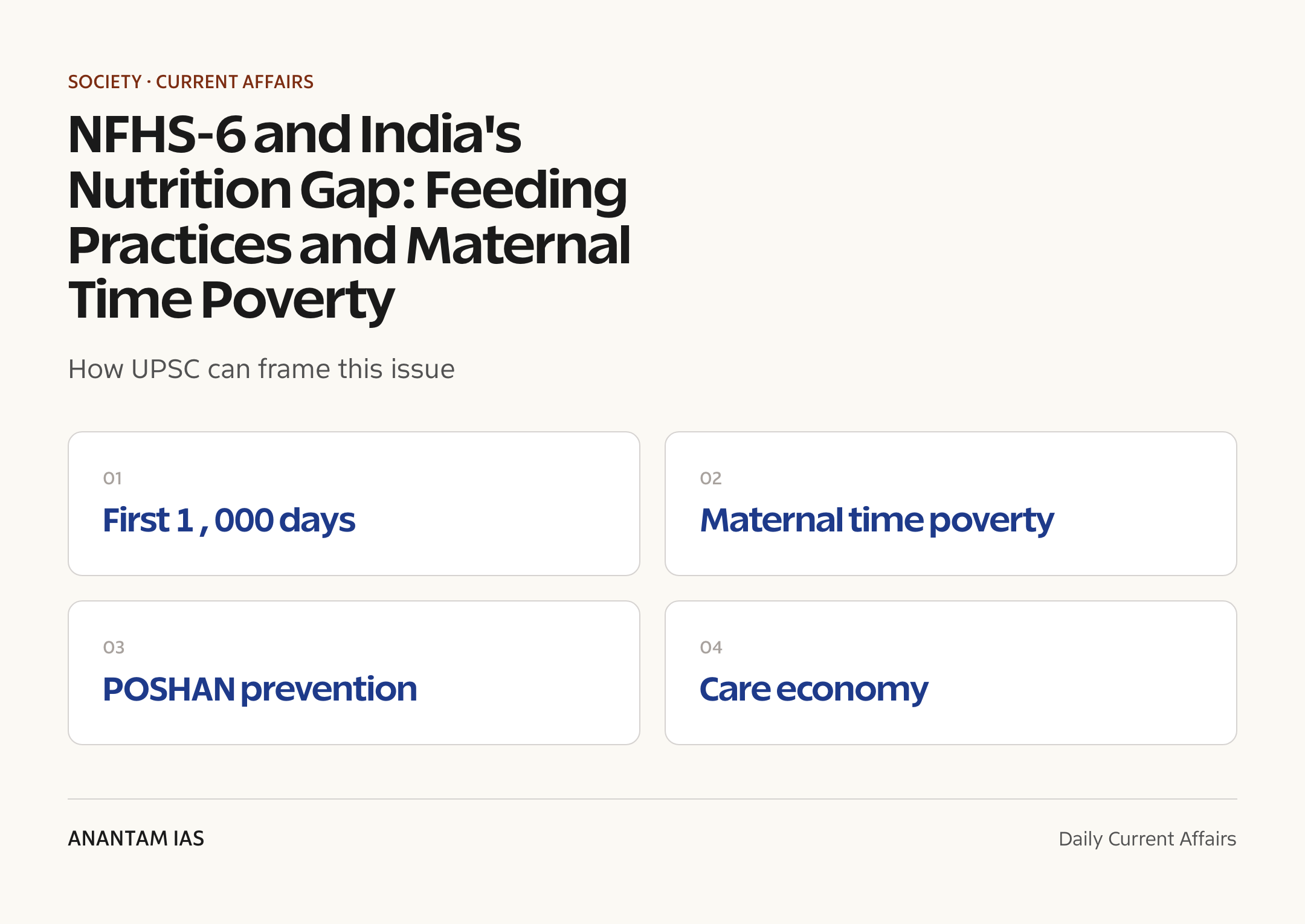
The editorial frames the gap through the lens of maternal time poverty — the idea that mothers, especially those in informal and unpaid work, simply do not have the time, rest or support to feed infants on the schedule that science demands. The data turns nutrition from a purely clinical question into one of gender, care work and welfare delivery, placing it squarely in GS2.

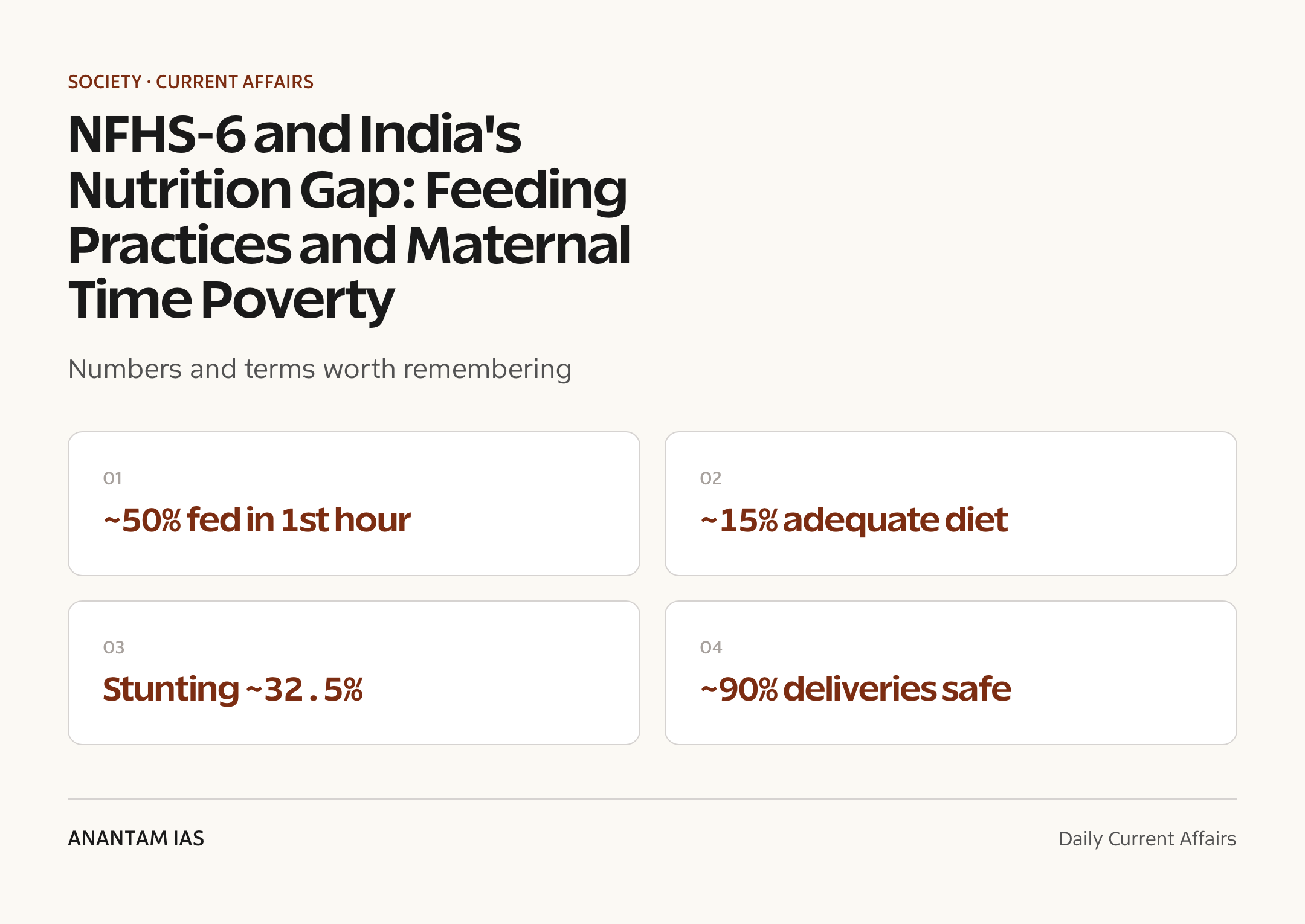
  • NFHS-6 (conducted by IIPS, Mumbai under the Health Ministry) shows near-universal institutional delivery and immunisation but poor infant and young child feeding (IYCF) outcomes.
  • The editorial cited that only about half of newborns are put to the breast within the first hour, and only roughly 15% of children aged 6–23 months get an adequate diet.
  • It attributes much of the feeding deficit to maternal time poverty in informal and unpaid work, not to a lack of clinics or vaccines.
  • Stunting has fallen only modestly (about 35.5% in NFHS-5 to roughly 32.5% in NFHS-6 as cited), signalling a stalled nutrition transition.

The development matters in the context of:

  • The first 1,000 days (conception to age two) is the window when most stunting becomes irreversible, making IYCF the decisive lever.
  • India’s flagship response runs through POSHAN Abhiyaan, Saksham Anganwadi and the ICDS network, which the editorial says still leans toward treatment over prevention.
NFHS-6 and India's Nutrition Gap: Feeding Practices and Maternal Time Poverty — quick facts

UPSC Relevance

Prelims Relevance

  • NFHS is conducted by the International Institute for Population Sciences (IIPS), Mumbai, the nodal agency, under the Ministry of Health and Family Welfare.
  • NFHS is a large-scale, multi-round sample survey giving district- and state-level estimates on health, nutrition, family welfare and population.
  • Key IYCF indicators: early initiation of breastfeeding (within 1 hour of birth) and exclusive breastfeeding for the first 6 months.
  • Minimum Dietary Diversity (MDD), Minimum Meal Frequency (MMF) and Minimum Acceptable Diet (MAD) measure the quality and adequacy of complementary feeding for 6–23-month-olds.
  • Undernutrition is measured as stunting (low height-for-age, chronic), wasting (low weight-for-height, acute) and underweight (low weight-for-age).
  • POSHAN Abhiyaan (2018) is the National Nutrition Mission; Saksham Anganwadi and Poshan 2.0 is its restructured form.
  • ICDS delivers services through Anganwadi centres: supplementary nutrition, immunisation, health check-ups, pre-school education and referral.
  • ‘Time poverty‘ refers to a chronic shortage of discretionary time, here driven by women’s combined paid, informal and unpaid care burden.

Mains Relevance

GS Paper 2

  • Welfare delivery: why near-universal health-service coverage has not translated into nutrition outcomes, and how POSHAN Abhiyaan/ICDS must pivot from rehabilitation to prevention.
  • Government interventions for vulnerable sections (children, mothers) and the gap between scheme inputs and behavioural outcomes.

GS Paper 1

  • Role of women and the gendered care economy: how unpaid care work and informal employment shape child nutrition and women’s well-being.

Essay

  • A society is judged by how it feeds its youngest — nutrition as the meeting point of economic growth, gender equity and the care economy.

Background and Context

What NFHS-6 actually measures

The survey is the backbone of India’s health and nutrition evidence.

  • NFHS is a periodic, large-sample household survey run by IIPS, Mumbai under the Ministry of Health and Family Welfare, with international technical support.
  • It produces representative estimates down to the district level on fertility, mortality, immunisation, anaemia, nutrition and access to services.
  • Because it is repeated in rounds, NFHS lets policymakers track change — NFHS-5 (2019–21) to NFHS-6 — and is the data source most cited for stunting, wasting and IYCF indicators.
NFHS-6 and India's Nutrition Gap: Feeding Practices and Maternal Time Poverty — exam lens

The good news: a strong supply side

On reach and infrastructure, India has genuinely delivered.

  • The editorial cited that roughly 9 in 10 deliveries are now attended by trained personnel and a similar share of children are fully vaccinated.
  • Almost all pregnant women now receive at least one visit from a health worker, reflecting the reach of ASHAs, ANMs and Anganwadi workers.
  • These gains show that mission-mode service delivery works when the intervention is a one-off clinical event — a delivery, a vaccine, a check-up.

The feeding gap that won't close

The crisis is in everyday practice, not access.

  • Despite high institutional delivery, only about half of newborns are breastfed within the first hour — a free, high-impact practice.
  • Timely introduction of solid and semi-solid food around six months reaches only a minority of children, as cited.
  • Crucially, only roughly 15% of 6–23-month-olds receive a minimum acceptable diet — the right mix of frequency and diversity.
  • The result is a stalled stunting decline: better than before, but far too slow to meet national targets. For the wider picture see child malnutrition and stunting in India and the typology of undernutrition, overnutrition and micronutrient deficiency.

Maternal time poverty: the hidden driver

Feeding an infant well is, above all, time-intensive labour.

  • Exclusive breastfeeding and frequent complementary feeding demand a mother’s time, rest and proximity through the day — resources that time-poor women lack.
  • Women in informal, daily-wage and unpaid family work rarely get maternity protection, paid leave or crèche support, forcing an early return to work.
  • The editorial flags that headline ‘women in paid work’ figures mask unpaid care burdens, and that NFHS lacks disaggregated data on the work status of mothers of under-twos.
  • This is a gender-justice problem as much as a health one — explored in women, work and the care economy and social security for informal and gig workers.

Why schemes underperform on prevention

The policy architecture tilts toward treatment, not behaviour change.

  • POSHAN Abhiyaan and ICDS remain strong at rehabilitating severely malnourished children once identified, but weaker at preventing faltering in the first place.
  • Anganwadi centres are well placed for counselling on breastfeeding and complementary feeding, yet are stretched by data-entry and supplementary-food duties.
  • Without time, counselling and family support reaching the mother, supplementary nutrition alone cannot fix what is fundamentally a care-and-feeding-practice deficit.

Way Forward

Make feeding practices the headline metric

  • Shift POSHAN Abhiyaan’s emphasis from treating wasting to preventing it, with early initiation, exclusive breastfeeding and MAD as core targets.
  • Add IYCF counselling at every antenatal and immunisation contact — using the touchpoints India has already universalised.

Tackle time poverty directly

  • Extend maternity protection, paid feeding breaks and crèches to informal and unpaid workers, not just the formal sector.
  • Use Anganwadi-linked day care so mothers can work without sacrificing feeding schedules.

Fix the data gap

  • Collect disaggregated NFHS data on the work status of mothers of 6–23-month-olds to target time-poor households.
  • Track MDD, MMF and MAD at the district level to surface local feeding failures early.

Engage families, not just mothers

  • Run behaviour-change campaigns that bring fathers and grandmothers into feeding and care.
  • Strengthen Anganwadi worker capacity for home-based counselling rather than only food distribution.

Conclusion

NFHS-6 tells a paradoxical story: India has nearly solved the problems that money and infrastructure can solve — safe deliveries, vaccines, antenatal contact — yet the simplest, cheapest acts of feeding an infant well still elude most households. The bottleneck has moved from the clinic to the kitchen and the workplace.

Closing the nutrition gap now means treating it as a question of women’s time and care, not just calories. A POSHAN strategy that protects a mother’s time, counsels her family and measures feeding practices — rather than only weighing children after they falter — is the route from impressive coverage to genuine nourishment.

UPSC Practice Questions

Prelims MCQ 1

With reference to the National Family Health Survey (NFHS), consider the following statements:

  1. It is conducted by the International Institute for Population Sciences, Mumbai, under the Ministry of Health and Family Welfare.
  2. It is a complete enumeration census of all households in India.
  3. It provides estimates on indicators such as stunting, wasting and immunisation coverage.

How many of the above statements are correct?

(a) Only one (b) Only two (c) All three (d) None

Answer: (b) Only two

Explanation:

Statements 1 and 3 are correct. NFHS is a large-scale sample survey, not a complete census, so statement 2 is wrong.

Prelims MCQ 2

The ‘Minimum Acceptable Diet (MAD)’ indicator used to assess infant and young child feeding best combines which of the following?

(a) Birth weight and length-for-age only (b) Minimum dietary diversity and minimum meal frequency (c) Exclusive breastfeeding and immunisation status (d) Anaemia level and Vitamin A supplementation

Answer: (b) Minimum dietary diversity and minimum meal frequency

Explanation:

MAD for breastfed children combines minimum dietary diversity (variety of food groups) with minimum meal frequency (how often the child is fed), capturing both quality and quantity of complementary feeding.

UPSC Mains Questions

  1. Despite near-universal institutional delivery and immunisation, India’s infant and young child feeding outcomes remain poor. Examine the role of ‘maternal time poverty’ in this gap and suggest welfare-delivery reforms. (GS2, 250 words)
  2. “India’s nutrition challenge is increasingly a problem of the care economy rather than of food supply.” Discuss in the light of NFHS-6 findings and the position of women in informal and unpaid work. (GS1, 250 words)

Source: The Hindu (editorial).

Frequently Asked Questions

What is the difference between NFHS-5 and NFHS-6?

Both are rounds of the same National Family Health Survey, run by IIPS, Mumbai under the Health Ministry. NFHS-6 is the latest round and updates indicators like stunting, immunisation and feeding practices first measured in NFHS-5 (2019–21), letting policymakers track how outcomes have changed over time.

What does ‘maternal time poverty’ mean?

It describes the chronic shortage of usable time that mothers face when paid work, informal labour and unpaid care all compete for their day. Because exclusive breastfeeding and frequent complementary feeding are time-intensive, time-poor mothers — especially in informal work — struggle to feed infants on the schedule nutrition requires.

What are early initiation and exclusive breastfeeding?

Early initiation means putting a newborn to the breast within one hour of birth, which provides protective colostrum. Exclusive breastfeeding means feeding only breast milk — no water, formula or food — for the first six months. Both are free, high-impact IYCF practices, yet NFHS data show many infants miss them.

What is a Minimum Acceptable Diet for a child aged 6–23 months?

It is an IYCF benchmark combining minimum dietary diversity (eating from enough food groups) and minimum meal frequency (being fed often enough). A child meeting both is said to receive a minimum acceptable diet. NFHS-6, as cited in the editorial, shows only a small share of 6–23-month-olds clear this bar.

How do POSHAN Abhiyaan and ICDS address child nutrition?

POSHAN Abhiyaan is the National Nutrition Mission; ICDS delivers services through Anganwadi centres — supplementary nutrition, immunisation, check-ups, pre-school education and counselling. The editorial argues they are strong at rehabilitating malnourished children but must shift toward prevention and feeding-practice counselling.

Why has stunting fallen only slowly despite better health services?

Safe deliveries and vaccines are one-off clinical events that mission-mode delivery handles well. Stunting, by contrast, builds up over the first 1,000 days through daily feeding and care, which depend on a mother’s time and family support. Without tackling time poverty and feeding behaviour, coverage gains alone leave stunting high.

AgriStack: India’s Digital Public Infrastructure for Agriculture

Open article →Download PDF

Why in News?

As the Centre prepared to release the 23rd PM-KISAN instalment on 20 June 2026, attention returned to the digital plumbing underneath it: AgriStack, India’s farmer-level Digital Public Infrastructure (DPI) for agriculture, built under the Digital Agriculture Mission approved by the Union Cabinet in September 2024.

AgriStack ties a verified Farmer ID, a geo-referenced land map and a Crop Sown Registry into a single, Aadhaar-linked stack so that scheme benefits flow by data, not by repeated paperwork.

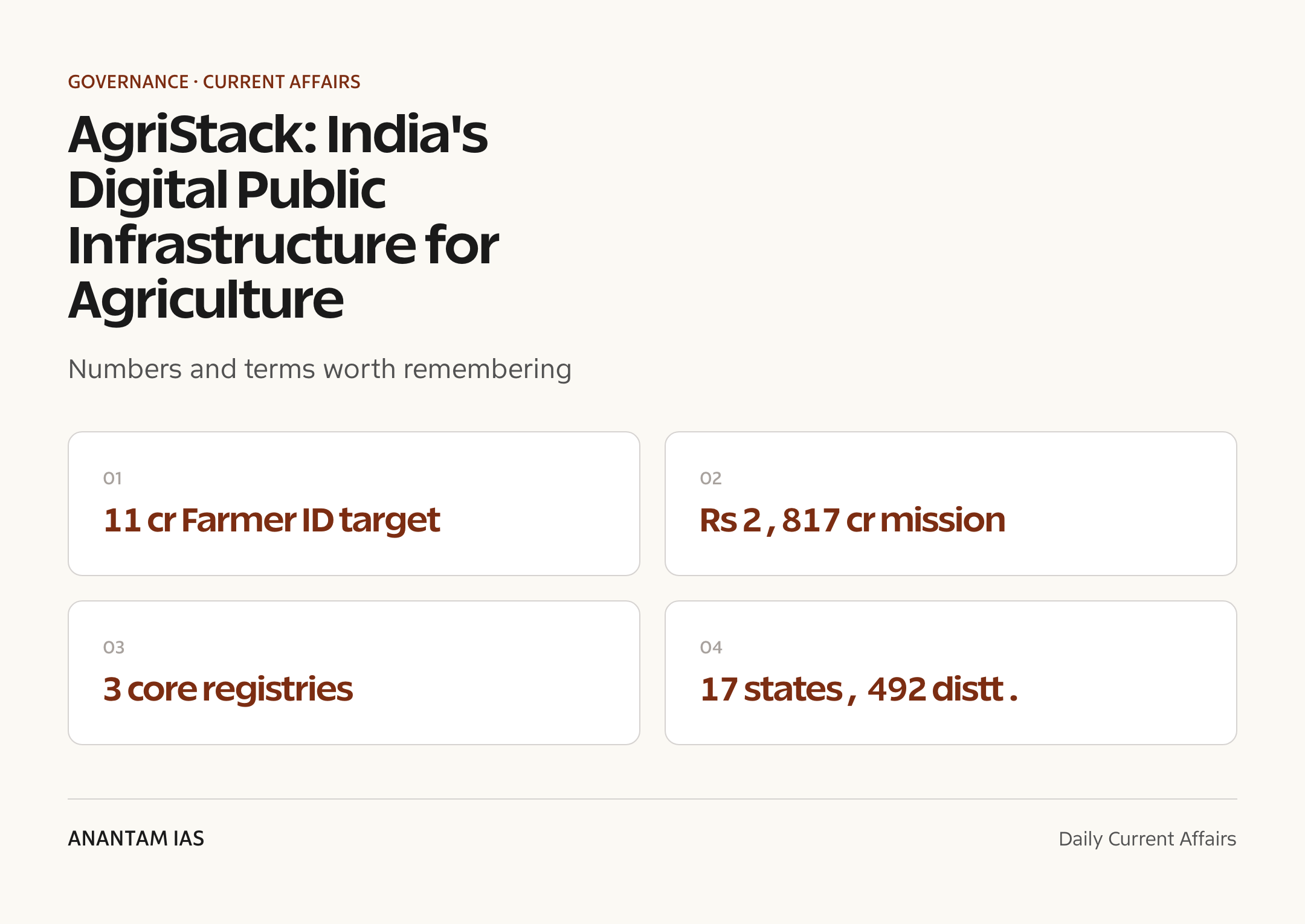
  • The Digital Agriculture Mission carries a total outlay of Rs 2,817 crore, including a central share of Rs 1,940 crore.
  • AgriStack targets 11 crore Farmer IDs phased as 6 crore in FY 2024-25, 3 crore in FY 2025-26 and 2 crore in FY 2026-27.
  • The Digital Crop Survey was piloted across 11 states in 2023-24 and scaled toward 400 districts in FY 2024-25 before nationwide rollout.
  • PIB notes that AgriStack’s core registries already span 17 states, around 492 districts and roughly 4.2 lakh villages at plot level.
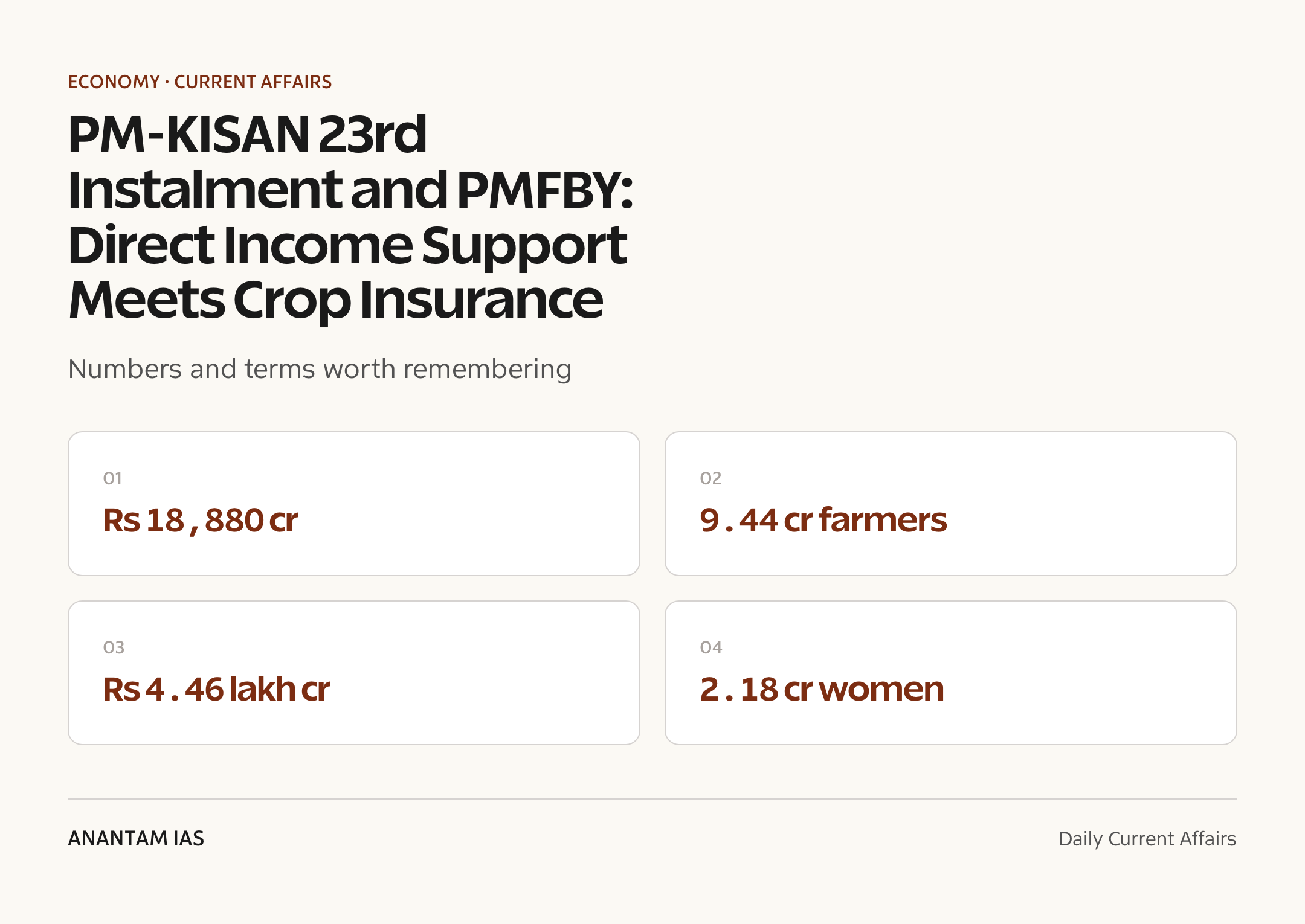
  • DD News reports the 23rd PM-KISAN instalment released about Rs 18,880 crore to nearly 9.44 crore farmers on 20 June 2026.

The development matters in the context of:

  • AgriStack converts agriculture from a paperwork-heavy, exclusion-prone system into a data-driven, presence-less, paperless service layer, mirroring the JAM-Aadhaar logic now applied to farms and crops.
  • A single verified Farmer ID becomes the entry point for PM-KISAN, Kisan Credit Card (KCC), PM Fasal Bima Yojana, MSP procurement and fertiliser subsidy, reducing duplication and leakage.
  • It anchors the syllabus debate on DPI, e-governance, targeted DBT and the privacy-versus-inclusion tension under the DPDP Act, 2023.
AgriStack: India's Digital Public Infrastructure for Agriculture — quick facts

UPSC Relevance

Prelims Relevance

  • AgriStack — a federated DPI of registries, datasets, APIs and IT systems for agriculture
  • Digital Agriculture Mission — outlay Rs 2,817 crore; central share Rs 1,940 crore; approved Sept 2024
  • Three core registries: Farmer Registry, Geo-referenced Village Maps, Crop Sown Registry
  • Farmer ID (Kisan Pehchaan Patra) — Aadhaar-linked unique digital identity
  • Unified Farmer Service Interface (UFSI) — open API gateway for public/private apps
  • Krishi Decision Support System and Soil Profile Mapping — other Mission components
  • Farmer ID target: 11 crore by FY 2026-27 (6cr + 3cr + 2cr phasing)
  • Digital General Crop Estimation Survey (DGCES) / Digital Crop Survey for crop-sown data
  • Nodal ministry: Ministry of Agriculture and Farmers Welfare
  • PM-KISAN — Rs 6,000/year DBT; 23rd instalment Rs 18,880 crore to ~9.44 crore farmers

Mains Relevance

GS Paper 3

  • AgriStack as Digital Public Infrastructure for agriculture: how a Farmer ID and Crop Sown Registry can improve credit, insurance, MSP procurement and subsidy targeting.
  • Use of digital crop surveys and decision-support systems to strengthen yield estimation, agricultural planning and farmer incomes.

GS Paper 2

  • E-governance and welfare delivery: DBT, identity-linked registries, and the inclusion-versus-exclusion risks of mandatory digital IDs for accessing entitlements.

Essay

  • Technology as an enabler of inclusive growth — but only if the last farmer is not left out of the database.
  • Data is the new soil: governing public information infrastructure with trust and consent.

Background and Context

What AgriStack actually is

AgriStack is the agriculture analogue of India Stack — public rails on which services are built.

  • PIB describes it as a federated Digital Public Infrastructure made of registries, datasets, APIs and IT systems, owned by government but open to authorised apps.
  • It is federated: the Centre sets standards and the core schema, while states build and run their own farmer registries on shared rails.
  • The design goal is a single, verified answer to three questions — who farms, on which land parcel, and which crop is sown — refreshed each season.
  • It sits inside the Digital Agriculture Mission (outlay Rs 2,817 crore, central share Rs 1,940 crore) alongside the Krishi Decision Support System and Soil Profile Mapping.
AgriStack: India's Digital Public Infrastructure for Agriculture — exam lens

The three foundational registries

AgriStack rests on three interoperable registries that together give a plot-level picture of Indian farming.

  • Farmer Registry — links a farmer’s demographics, Aadhaar, land records and bank account into one profile, generating the Farmer ID.
  • Geo-referenced Village Maps — digitally maps village land so each parcel can be located and tied to a holder.
  • Crop Sown Registry — records, every season, which crop is grown on which parcel nationwide, fed by the Digital Crop Survey.
  • Because the three registries are interoperable, a benefit can be authorised by matching identity + land + crop rather than by collecting fresh documents each time.

Farmer ID — the trust anchor

The Farmer ID, or Kisan Pehchaan Patra, is the single verifiable key that unlocks the stack.

  • It is an Aadhaar-linked unique digital identity issued under the Ministry of Agriculture and Farmers Welfare.
  • One ID is meant to be the single entry point for PM-KISAN, fertiliser subsidy, PMFBY crop insurance, KCC loans and future schemes.
  • Target is 11 crore Farmer IDs — 6 crore in FY 2024-25, 3 crore in FY 2025-26 and 2 crore in FY 2026-27.
  • Several states have begun making the ID a precondition for fresh PM-KISAN instalments and other entitlements, which is where the inclusion debate sharpens.

The Crop Sown Registry and Digital Crop Survey

Real-time crop data is the part that turns a static ID into a living agricultural information system.

  • The Digital Crop Survey (the digital General Crop Estimation Survey) captures geo-tagged, parcel-level crop data through field enumerators on a mobile app.
  • It was piloted in 11 states in 2023-24 and scaled toward 400 districts in FY 2024-25, moving to nationwide coverage.
  • For the first time, Digital Crop Survey data fed into the 2024-25 Kharif estimates, replacing slower eye-estimation methods.
  • Accurate sown-area data underpins better yield forecasting, MSP procurement planning and crop-loss assessment for insurance claims.

Unified Farmer Service Interface and APIs

The stack becomes useful only when third parties can build on it — that is the role of the open gateway.

  • The Unified Farmer Service Interface (UFSI) is an open API gateway letting authorised public and private apps plug in and exchange data with consent.
  • It cuts integration time and cost, so a bank can verify a farmer for KCC, or an insurer can settle a PMFBY claim, by querying the registries rather than rebuilding them.
  • This mirrors the India Stack / DPI philosophy — open, interoperable, minimalist rails on which an ecosystem of services competes.
  • PIB data places core-registry coverage at roughly 17 states, 492 districts and 4.2 lakh villages at plot level.

Why it matters for delivery

AgriStack is meant to shift agriculture support from exclusion-prone paperwork to data-triggered DBT.

  • A verified Farmer ID can make benefits presence-less and paperless — important for the PM-KISAN Rs 6,000-a-year transfer that just released its 23rd instalment.
  • DD News reports the 23rd instalment moved about Rs 18,880 crore to nearly 9.44 crore farmers on 20 June 2026, a flow that registries are designed to clean and de-duplicate.
  • It can enable pre-approved KCC, automatic crop insurance enrolment and faster claim settlement using crop and land data.
  • Better data also strengthens policy — sowing trends, input demand and disaster response can be read at the parcel level.

Risks and the privacy question

A single farm database is powerful and, for the same reason, sensitive.

  • Exclusion risk: if a Farmer ID becomes mandatory, tenants, sharecroppers and those with messy land records may be locked out of entitlements.
  • Data protection: linking land, Aadhaar, bank and crop data raises consent, purpose-limitation and security concerns under the DPDP Act, 2023.
  • Land-record quality: registries are only as good as the underlying records, which remain incomplete or disputed in many states.
  • Commercial use: critics warn that opening farm data to private agri-tech and lenders needs strong guardrails against surveillance and predatory targeting.

Way Forward

Make inclusion the default

  • Provide assisted, offline-friendly enrolment so tenants and small holders are not excluded, and avoid making the Farmer ID a hard gate before coverage is near-universal.

Hard-wire data protection

  • Operationalise consent, purpose limitation and grievance redress under the DPDP Act, 2023, with clear rules on who can query the registries and why.

Fix the land-record base

  • Pair AgriStack with faster land-record digitisation and dispute resolution so the Farmer Registry reflects real cultivators, not just titleholders.

Build the service ecosystem

  • Use the UFSI to enable pre-approved KCC, automatic PMFBY enrolment and advisory services, while auditing private access for misuse.

Conclusion

AgriStack is India trying to do for farms what India Stack did for payments and identity — turn fragmented, paper-bound records into open, verified, consent-based rails that make schemes like PM-KISAN, KCC and crop insurance flow on data rather than on queues.

The architecture is sound and the early coverage real, but its success will be judged at the margin — whether the tenant farmer with a contested plot gets her instalment as easily as the registered titleholder, and whether the farm database is governed with the privacy safeguards a single, sensitive store of land and crop data demands.

UPSC Practice Questions

Prelims MCQ 1

With reference to AgriStack, consider the following statements:

  1. It is a Digital Public Infrastructure built around three core registries — Farmer, geo-referenced land/village maps and crop sown.
  2. The Farmer ID under AgriStack is an Aadhaar-linked digital identity.
  3. AgriStack is implemented under the Digital Agriculture Mission of the Ministry of Agriculture and Farmers Welfare.

How many of the above statements are correct?

(a) Only one (b) Only two (c) All three (d) None

Answer: (c) All three

Explanation:

AgriStack is a federated DPI built on the Farmer Registry, geo-referenced village maps and the Crop Sown Registry; its Farmer ID is Aadhaar-linked; and it sits under the Digital Agriculture Mission run by the Ministry of Agriculture and Farmers Welfare. All three are correct.

Prelims MCQ 2

Which one of the following components of AgriStack is best described as an open API gateway that lets authorised public and private applications exchange farmer data?

(a) Crop Sown Registry (b) Unified Farmer Service Interface (c) Krishi Decision Support System (d) Soil Profile Mapping

Answer: (b) Unified Farmer Service Interface

Explanation:

The Unified Farmer Service Interface (UFSI) is the open API gateway through which authorised apps plug into AgriStack and exchange data, cutting integration time and cost. The others are data registries or analytical layers, not the interface.

UPSC Mains Questions

  1. AgriStack has been described as Digital Public Infrastructure for Indian agriculture. Examine its architecture and discuss how it can improve the targeting of credit, insurance and subsidy, while addressing the risks of exclusion and data misuse.
  2. Accurate, real-time crop data is central to agricultural planning. Discuss how the Digital Crop Survey and the Crop Sown Registry under AgriStack can strengthen yield estimation, MSP procurement and crop-loss assessment in India.

Sources: PIB, PMO and DD News.

Frequently Asked Questions

What is AgriStack in simple terms?

AgriStack is India’s Digital Public Infrastructure for agriculture — government-owned digital rails made of registries, datasets and open APIs. It links a verified Farmer ID, land maps and a crop-sown registry so that schemes like PM-KISAN, crop insurance and KCC loans can be delivered using data rather than repeated paperwork.

What are the three core registries of AgriStack?

The three foundational registries are the Farmer Registry (who farms, generating the Farmer ID), the geo-referenced village or land maps (on which parcel), and the Crop Sown Registry (which crop is grown each season). Together they give a single, verified, plot-level picture of Indian farming.

What is the Farmer ID and is it linked to Aadhaar?

The Farmer ID, or Kisan Pehchaan Patra, is a unique Aadhaar-linked digital identity for farmers under AgriStack. It bundles demographics, land records and bank details into one profile and is intended to be the single entry point for PM-KISAN, fertiliser subsidy, PMFBY crop insurance and Kisan Credit Card loans.

Which mission and outlay back AgriStack?

AgriStack is built under the Digital Agriculture Mission, approved by the Union Cabinet in September 2024 with a total outlay of Rs 2,817 crore, including a central share of Rs 1,940 crore. The mission also includes the Krishi Decision Support System and Soil Profile Mapping.

How does AgriStack relate to the PM-KISAN instalment?

PM-KISAN transfers Rs 6,000 a year directly to farmers; its 23rd instalment released about Rs 18,880 crore to roughly 9.44 crore farmers on 20 June 2026. AgriStack’s verified Farmer Registry is designed to clean and de-duplicate such beneficiary lists so transfers reach genuine cultivators.

What are the main concerns around AgriStack?

The key worries are exclusion of tenants and farmers with poor land records if the ID becomes mandatory, data-protection and consent issues under the DPDP Act 2023, weak underlying land records, and the risk of private commercial misuse of sensitive farm data without strong guardrails.

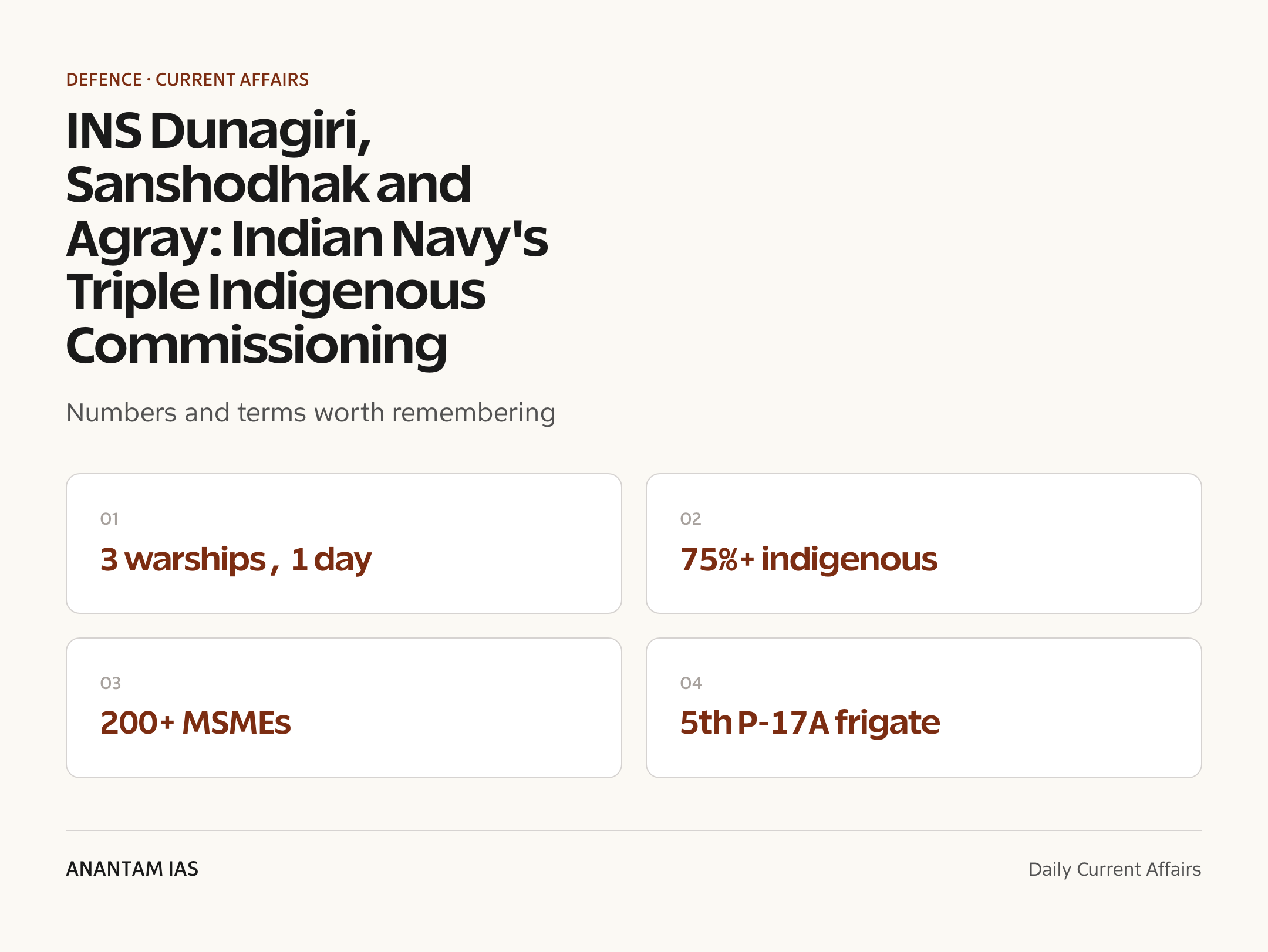
INS Dunagiri, Sanshodhak and Agray: Indian Navy’s Triple Indigenous Commissioning

Open article →Download PDF

Why in News?

The Indian Navy is set to commission three indigenously built warships on the same day at Garden Reach Shipbuilders and Engineers (GRSE) in Kolkata on 21 June 2026 — the stealth frigate INS Dunagiri, the survey vessel Sanshodhak and the anti-submarine warfare craft Agray. A single-day, triple-platform induction is rare in Indian naval history and underscores the maturing capacity of a single shipyard.

All three vessels carry more than 75 per cent indigenous content and drew on the work of over 200 MSMEs, making the event a showcase of Aatmanirbhar Bharat in the defence-manufacturing sector and a marker of India’s deepening shipbuilding self-reliance for the Indian Ocean Region.

  • Three warships commissioned the same day at GRSE Kolkata, a Defence PSU shipyard.
  • INS Dunagiri is the fifth Project 17A (Nilgiri-class) stealth frigate.
  • Sanshodhak is the fourth and last Survey Vessel (Large); Agray is an Arnala-class ASW shallow-water craft.
  • Indigenous content exceeds 75 per cent; over 200 MSMEs involved.
  • Part of a wider surge — the Navy aims to commission 19 ships in 2026.

The development matters in the context of:

  • India is pursuing a blue-water navy able to secure its Indian Ocean Region (IOR) interests against a growing Chinese naval footprint.
  • Domestic warship construction reduces import dependence and builds an indigenous defence-industrial ecosystem.
  • GRSE has compressed build timelines — delivering Dunagiri in 80 months against 93 months for the lead ship of the class.
Indian Navy Project 17A stealth frigate INS Dunagiri at sea
INS Dunagiri, the fifth Project 17A (Nilgiri-class) stealth frigate built by GRSE, Kolkata. Photo: Ministry of Defence, GODL-India (Wikimedia Commons)
INS Dunagiri, Sanshodhak and Agray: Indian Navy's Triple Indigenous Commissioning — quick facts

UPSC Relevance

Prelims Relevance

  • Project 17A (Nilgiri-class) — follow-on to Project 17 Shivalik-class; 7 frigates total, split between GRSE and Mazagon Dock (MDL).
  • INS Dunagiri — fifth P-17A frigate, pennant F36, displacement ~6,670 tonnes, speed ~28 knots.
  • Armament of P-17A: BrahMos supersonic anti-ship missiles, Barak-8 MRSAM, MF-STAR AESA radar, close-in weapon systems.
  • GRSE (Garden Reach Shipbuilders and Engineers) — Kolkata-based Defence PSU shipyard.
  • Sanshodhak — fourth Survey Vessel (Large); sisters Sandhayak, Nirdeshak, Ikshak.
  • Agray — Arnala-class Anti-Submarine Warfare Shallow Water Craft (ASW-SWC).
  • Designer: Indian Navy’s Warship Design Bureau (WDB).
  • Propulsion of P-17A: CODOG (Combined Diesel or Gas) with Integrated Platform Management System.

Mains Relevance

GS Paper 3

  • Indigenisation of defence production and the role of Defence PSUs and MSMEs in achieving Aatmanirbharta.
  • India’s maritime security strategy and naval modernisation in the Indian Ocean Region.

Essay

  • Self-reliance as strategic autonomy — building national capability rather than importing it.

Background and Context

Project 17A and INS Dunagiri

Dunagiri is the latest in India’s flagship stealth-frigate programme.

  • Project 17A (Nilgiri-class) is a series of seven stealth guided-missile frigates, the follow-on to the earlier Project 17 Shivalik-class.
  • The programme is split between GRSE, Kolkata and Mazagon Dock Shipbuilders (MDL), Mumbai; ships are designed by the Navy’s Warship Design Bureau.
  • INS Dunagiri is the fifth ship of the class (pennant F36), with a displacement of about 6,670 tonnes, length ~149 m and a top speed near 28 knots.
  • Stealth features reduce radar, infrared and acoustic signatures, making the vessel harder to detect and target.
  • GRSE delivered Dunagiri in 80 months, an improvement over the 93 months taken for the lead ship, signalling a learning curve in serial production.
INS Dunagiri, Sanshodhak and Agray: Indian Navy's Triple Indigenous Commissioning — exam lens

Weapons, Sensors and Combat Punch

The frigate carries a layered offensive and defensive suite.

  • BrahMos supersonic cruise missiles provide long-range anti-ship and land-attack strike capability.
  • The Barak-8 Medium Range Surface-to-Air Missile (MRSAM) system, co-developed with Israel, gives area air defence.
  • The MF-STAR (EL/M-2248) AESA radar enables simultaneous tracking of multiple aerial and surface threats.
  • Close-in weapon systems and torpedo tubes round out point defence and anti-submarine capability.
  • An Integrated Platform Management System and CODOG propulsion improve survivability and operational efficiency.

Sanshodhak — Survey Vessel (Large)

A specialised platform that maps the seabed for navigation and defence.

  • Sanshodhak is the fourth and final ship of the Survey Vessel (Large) project, after Sandhayak, Nirdeshak and Ikshak.
  • It conducts full-scale coastal and deep-water hydrographic surveys — mapping depth, currents and the seabed.
  • It carries Autonomous Underwater Vehicles (AUVs) and Remotely Operated Vehicles for precise data collection.
  • Survey data supports safe navigation, maritime boundary delineation and naval operational planning, and has civil applications too.

Agray — ASW Shallow Water Craft

A compact hunter built for coastal anti-submarine defence.

  • Agray belongs to the Arnala-class of Anti-Submarine Warfare Shallow Water Craft (ASW-SWC).
  • These craft operate in littoral (near-shore) waters where larger frigates are less effective against small, quiet submarines.
  • Armament includes lightweight torpedoes and indigenous rocket launchers, with shallow-water sonar for detection.
  • They plug a key gap in coastal anti-submarine surveillance and protect harbours, sea lanes and offshore assets.

Indigenisation and the MSME Ecosystem

Self-reliance is measured in supply chains, not just slipways.

  • All three vessels exceed 75 per cent indigenous content by value.
  • Over 200 MSMEs supplied components, sub-systems and services, spreading capability across the industrial base.
  • Warship building has strong forward and backward linkages — steel, electronics, propulsion and software — generating skilled employment.
  • The shift aligns with the Defence Ministry’s positive indigenisation lists and the push to make India a net defence exporter.

Strategic Context — Securing the Indian Ocean Region

Hardware feeds a larger maritime strategy.

  • The Indian Navy seeks a credible blue-water presence across the Indian Ocean Region, a corridor for much of India’s trade and energy.
  • Rapid inductions respond to an expanding Chinese naval and port footprint in the region.
  • India’s role as a net security provider and ‘first responder’ rests on a capable, self-sustaining fleet.
  • The Navy targeting 19 commissionings in 2026 reflects an accelerated force-accretion plan.

Way Forward

Sustain build momentum

  • Hold timelines on remaining Project 17A frigates and avoid cost-and-schedule slippage seen in earlier programmes.
  • Standardise designs and sub-systems across shipyards to capture serial-production efficiencies.

Deepen indigenisation

  • Move beyond hull and platform to indigenous weapons, sensors and propulsion where import dependence persists.
  • Strengthen MSME financing, certification and technology absorption to widen the vendor base.

Match platforms with people and infrastructure

  • Scale up trained crews, maintenance dockyards and logistics to keep new ships at high availability.
  • Invest in underwater domain awareness and networked surveillance to use these platforms effectively.

Conclusion

The single-day commissioning of Dunagiri, Sanshodhak and Agray at GRSE is more than a ceremonial milestone — it signals that an Indian shipyard can deliver a stealth frigate, a survey vessel and an anti-submarine craft in parallel, with most of the value created at home.

For UPSC, the event ties together indigenous defence manufacturing, the MSME ecosystem and India’s maritime security in the Indian Ocean Region. The harder test now is to sustain build tempo, indigenise weapons and sensors, and keep the growing fleet combat-ready.

UPSC Practice Questions

Prelims MCQ 1

With reference to Project 17A frigates, consider the following statements:

  1. They are a follow-on to the Project 17 Shivalik-class frigates.
  2. They are built only by Mazagon Dock Shipbuilders, Mumbai.
  3. INS Dunagiri is one of the ships of this class.

How many of the above statements are correct?

(a) Only one (b) Only two (c) All three (d) None

Answer: (b) Only two

Explanation:

Statements 1 and 3 are correct. Statement 2 is wrong — Project 17A frigates are built by both GRSE, Kolkata and Mazagon Dock Shipbuilders (MDL), Mumbai, not MDL alone.

Prelims MCQ 2

The warships Dunagiri, Sanshodhak and Agray, in the news, are all being commissioned at which shipyard?

(a) Cochin Shipyard Limited (b) Mazagon Dock Shipbuilders, Mumbai (c) Garden Reach Shipbuilders and Engineers, Kolkata (d) Hindustan Shipyard, Visakhapatnam

Answer: (c) Garden Reach Shipbuilders and Engineers, Kolkata

Explanation:

All three indigenous platforms were built by and are being commissioned at GRSE, Kolkata, a Defence PSU shipyard.

UPSC Mains Questions

  1. Indigenisation of warship construction is central to India’s quest for strategic autonomy. Discuss, with reference to recent naval commissionings and the role of Defence PSUs and MSMEs.
  2. Examine India’s naval modernisation imperatives in the Indian Ocean Region. How do platforms such as stealth frigates, survey vessels and anti-submarine craft complement each other in a maritime security strategy?

Sources: Indian Navy / PIB and The Tribune.

Frequently Asked Questions

What is Project 17A?

Project 17A is the Indian Navy’s class of seven Nilgiri-class stealth guided-missile frigates, a more advanced follow-on to the Project 17 Shivalik-class. The ships are built by GRSE in Kolkata and Mazagon Dock in Mumbai, and designed by the Navy’s Warship Design Bureau.

Why is the commissioning of three warships on the same day significant?

Commissioning a stealth frigate, a survey vessel and an anti-submarine craft together at one shipyard is rare in Indian naval history. It demonstrates GRSE’s matured capacity for parallel serial production and accelerates the Navy’s force build-up in the Indian Ocean Region.

What weapons does INS Dunagiri carry?

INS Dunagiri carries BrahMos supersonic anti-ship and land-attack cruise missiles, the Barak-8 Medium Range Surface-to-Air Missile system for area air defence, the MF-STAR AESA radar, close-in weapon systems and anti-submarine torpedoes.

What does a Survey Vessel (Large) like Sanshodhak do?

Sanshodhak conducts coastal and deep-water hydrographic surveys — mapping seabed depth, currents and contours. The data aids safe navigation, maritime boundary work and naval planning. It carries Autonomous Underwater Vehicles and Remotely Operated Vehicles for precise data collection.

How does this event reflect Aatmanirbhar Bharat?

All three vessels have over 75 per cent indigenous content and involved more than 200 MSMEs, spreading defence-manufacturing capability across the domestic industrial base. It cuts import dependence and supports India’s goal of becoming a self-reliant defence producer and exporter.

What is an ASW Shallow Water Craft?

An Anti-Submarine Warfare Shallow Water Craft such as the Arnala-class Agray is a compact vessel built to hunt submarines in near-shore littoral waters where larger frigates are less effective. It uses lightweight torpedoes, rocket launchers and shallow-water sonar.

Supreme Court’s Draft AI-in-Courts Regulations: Disclosure, Limits and Judicial Independence

Open article →Download PDF

Why in News?

The Supreme Court of India‘s AI Committee, chaired by Justice P.S. Narasimha, has released a draft ‘Regulations for Use of Artificial Intelligence in Courts, 2026’, with the public-comment window closing on 20 June 2026. The framework is the first court-wide attempt in India to set guardrails on how judges, registries, lawyers and litigants may use generative and predictive AI inside the justice system.

The draft permits AI for assistive work such as legal research, document summarisation and translation, but draws a hard line at adjudication, sentencing, risk-scoring for bail or recidivism, and surveillance of court participants. A mandatory disclosure rule (Regulation 43) requires parties to declare when filings are AI-assisted, keeping the judge as the final authority on law, facts and justice.

  • Draft titled Regulations for Use of Artificial Intelligence in Courts, 2026; comments invited until 20 June 2026 ([email protected]).
  • Issued by the Supreme Court’s AI Committee under Justice P.S. Narasimha; applies to the Supreme Court, High Courts, subordinate courts, tribunals and adjudicatory commissions.
  • Regulation 20 bars AI-only judicial decisions, sentencing, bail/recidivism risk-scoring, credibility assessment and predictive profiling.
  • Regulation 43 mandates disclosure of AI-assisted documents; courts may demand the tool name and the nature and extent of use.
  • Surveillance of judges, lawyers and litigants, and ‘black-box’ systems affecting legal rights, are prohibited.
  • The framework expressly aligns with the Digital Personal Data Protection (DPDP) Act, 2023.

The development matters in the context of:

  • Indian courts already run AI tools such as SUVAS (translation) and SUPACE (research assistance), but no binding use-policy existed until now.
  • The move follows global concern over AI ‘hallucinations’ producing fabricated case citations in court filings.
  • It sits within the e-Courts Mission Mode Project drive to digitise and modernise the judiciary while protecting due process.
Supreme Court's Draft AI-in-Courts Regulations: Disclosure, Limits and Judicial Independence — quick facts

UPSC Relevance

Prelims Relevance

  • Draft is titled ‘Regulations for Use of Artificial Intelligence in Courts, 2026’; issuing body is the Supreme Court’s AI Committee.
  • Justice P.S. Narasimha chairs the AI Committee that released the draft.
  • Regulation 20 lists prohibited uses; Regulation 43 covers the disclosure mandate.
  • Permitted uses: legal research, document summarisation, transcription, translation, case management, accessibility tools.
  • Barred uses: adjudication, sentencing, bail/recidivism risk-scoring, credibility/profiling, surveillance.
  • The framework aligns with the Digital Personal Data Protection Act, 2023.
  • SUVAS = Supreme Court Vidhik Anuvaad Software (AI translation); SUPACE = Supreme Court Portal for Assistance in Courts Efficiency.
  • Article 50 of the Constitution provides for separation of the judiciary from the executive (a Directive Principle).
  • The e-Courts project is a Mission Mode Project under the National e-Governance Plan.
  • Public-comment deadline for the draft: 20 June 2026.

Mains Relevance

GS Paper 2

  • Examine how AI regulation in courts protects judicial independence and the separation of powers (Article 50).
  • Assess governance challenges of integrating AI into the justice system while preserving due process and access to justice.

GS Paper 3

  • Discuss algorithmic accountability, transparency and the risks of ‘black-box’ AI in public decision-making.

Essay

  • Can machines deliver justice, or only assist those who do?
  • Technology must serve the rule of law, not replace the rule-maker.

Background and Context

What the draft regulations actually do

The framework treats AI as a tool that assists humans, never one that decides for them.

  • Core principle: AI stays strictly subservient to human judgment and judicial authority, functioning only in an assistive capacity.
  • Scope covers the Supreme Court, all High Courts, subordinate courts, tribunals and statutory commissions with adjudicatory functions.
  • Judges remain the final authority on law, facts and justice; AI output cannot substitute reasoned judicial application of mind.
  • Comments were invited until 20 June 2026, signalling a consultative rather than top-down rule-making approach.
Supreme Court's Draft AI-in-Courts Regulations: Disclosure, Limits and Judicial Independence — exam lens

Permitted versus prohibited uses

The draft separates back-office efficiency gains from front-line decision-making.

  • Permitted: legal research and precedent retrieval, document review and summarisation, case management and scheduling, transcription (with human verification), and translation of pleadings and judgments.
  • Prohibited under Regulation 20: AI-only judicial decisions, sentencing, risk assessment for bail/flight risk/recidivism, and credibility assessment of parties or witnesses.
  • Also barred: predictive profiling of litigants or advocates, opaque ‘black-box’ systems affecting legal rights, and surveillance of court participants unless legally authorised.
  • Other assistive uses flagged include chatbots for litigant guidance, accessibility services and fraud or document verification.

The disclosure mandate

Transparency about AI use is the framework’s central safeguard against fabricated content.

  • Regulation 43(3): the AI-assisted character of any document must be disclosed to the court at the time of submission.
  • Regulation 43(4): courts may ask for the tools used and the nature and extent of AI involvement.
  • Those who submit false or fabricated AI-assisted material are held personally liable, deterring ‘hallucinated’ citations.
  • Disclosure preserves the court’s ability to test and verify, rather than banning AI assistance outright.

Existing AI tools in Indian courts

The regulations build on tools the judiciary already uses, without naming them as exceptions.

  • SUVAS (Supreme Court Vidhik Anuvaad Software) translates judgments into regional languages.
  • SUPACE (Supreme Court Portal for Assistance in Courts Efficiency) helps judges process case files and research.
  • Both fit the ‘assistive’ category the draft endorses, while the new bars target decision-making and profiling.
  • The framework gives these ad-hoc deployments a clear, court-wide rule-book for the first time.

Data protection and accountability

AI in courts handles sensitive personal data, so the draft hard-wires safeguards.

  • Personal data cannot be processed for AI training without appropriate approval, aligning with the DPDP Act, 2023.
  • The draft proposes impact assessments, regular audits and an AI incident database before and after deployment.
  • A multi-layered governance structure is envisaged: an apex body at the Supreme Court and AI committees at each High Court.
  • Special protections are extended to women, children, persons with disabilities and marginalised groups against discriminatory outputs.

Why it matters for judicial independence

Outsourcing adjudication to opaque algorithms would quietly erode the separation of powers.

  • Article 50 directs the State to separate the judiciary from the executive; ungoverned AI could let private vendors shape outcomes.
  • Barring risk-scoring and profiling guards against bias being laundered through code, which is hard to challenge on appeal.
  • Mandatory human oversight keeps reasoned judgment, the bedrock of natural justice, with the judge.
  • Clear rules also build public trust that digitisation does not dilute the right to a fair hearing.

Way Forward

Finalise with stakeholder buy-in

  • Incorporate Bar, civil-society and technical feedback before notifying the rules, then phase in across High Courts.
  • Issue model declaration formats so disclosure under Regulation 43 is uniform and easy to comply with.

Build audit and capacity

  • Operationalise the AI incident database and mandate periodic third-party audits of approved tools.
  • Train judges, registry staff and lawyers on safe AI use and on spotting fabricated AI output.

Anchor to data law

  • Align deployment with DPDP Act, 2023 rules on consent, data minimisation and purpose limitation.
  • Insist on explainability standards so no rights-affecting decision rests on a ‘black-box’ system.

Conclusion

India’s draft AI-in-courts regulations strike a careful balance: they welcome AI as a productivity tool for research, translation and case management while ring-fencing the act of judging itself. By mandating disclosure, barring risk-scoring and surveillance, and aligning with the DPDP Act, 2023, the framework keeps reasoned human judgment at the centre of justice.

The real test will be implementation. Robust audits, explainability standards and judicial capacity-building will decide whether the rules genuinely protect judicial independence and due process, or remain aspirational. Done well, India could set a template for AI governance in the justice systems of the developing world.

UPSC Practice Questions

Prelims MCQ 1

With reference to the draft ‘Regulations for Use of Artificial Intelligence in Courts, 2026’, consider the following statements:

  1. They were released by a Supreme Court AI Committee chaired by a sitting judge.
  2. They permit AI to be used for sentencing provided a judge later reviews the outcome.
  3. They mandate disclosure of AI-assisted documents to the court.

How many of the above statements are correct?

(a) Only one (b) Only two (c) All three (d) None

Answer: (b) Only two

Explanation:

Statements 1 and 3 are correct. Statement 2 is wrong: the draft bars AI-only adjudication and sentencing outright under Regulation 20, not merely subject to later review.

Prelims MCQ 2

SUVAS and SUPACE, sometimes seen in the news, are best described as:

(a) Data-protection authorities set up under the DPDP Act, 2023 (b) AI-based tools used in the Indian judiciary for translation and case assistance (c) Tribunals constituted to hear cyber-crime appeals (d) Centrally Sponsored Schemes for legal aid

Answer: (b) AI-based tools used in the Indian judiciary for translation and case assistance

Explanation:

SUVAS (Supreme Court Vidhik Anuvaad Software) translates judgments; SUPACE (Supreme Court Portal for Assistance in Courts Efficiency) assists judges with research and case files.

UPSC Mains Questions

  1. The draft Regulations for Use of AI in Courts, 2026 try to harness artificial intelligence without surrendering judicial decision-making. Discuss how such a framework protects judicial independence and the separation of powers. (250 words)
  2. Algorithmic opacity poses a distinct challenge to accountability in public decision-making. In the context of AI use in courts, examine the safeguards needed to reconcile efficiency with fairness and due process. (250 words)

Sources: Supreme Court of India (AI Committee) and The Federal.

Frequently Asked Questions

What are the Supreme Court’s draft AI-in-courts regulations?

They are the draft ‘Regulations for Use of Artificial Intelligence in Courts, 2026’, released by a Supreme Court AI Committee. They allow AI for assistive tasks like research, summarisation and translation, but bar adjudication, sentencing, risk-scoring and surveillance, while requiring parties to disclose AI-assisted filings. Public comments closed on 20 June 2026.

Which AI uses are prohibited under the draft?

Regulation 20 prohibits AI-only judicial decisions, sentencing, risk assessment for bail, flight risk or recidivism, credibility assessment of parties and witnesses, predictive profiling, opaque ‘black-box’ systems affecting legal rights, and surveillance of judges, lawyers and litigants unless legally authorised.

What does the disclosure mandate require?

Under Regulation 43, anyone filing an AI-assisted document must disclose its AI-assisted character to the court at submission. Courts may ask which tools were used and the nature and extent of that use. Submitting false AI-assisted material attracts personal liability, deterring fabricated or ‘hallucinated’ citations.

How do SUVAS and SUPACE fit in?

SUVAS (Supreme Court Vidhik Anuvaad Software) translates judgments into regional languages, and SUPACE (Supreme Court Portal for Assistance in Courts Efficiency) helps judges with research and case files. Both are assistive tools the draft endorses, while its new bars target decision-making, profiling and surveillance.

How does the draft connect to data protection?

The framework aligns with the Digital Personal Data Protection (DPDP) Act, 2023. It bars processing personal data for AI training without proper approval and proposes impact assessments, audits and an incident database, ensuring sensitive litigant data is handled lawfully and securely.

Why does this matter for judicial independence?

Outsourcing adjudication to opaque algorithms could let private vendors shape outcomes, undermining Article 50’s separation of judiciary and executive. By keeping reasoned human judgment central and barring biased risk-scoring, the rules protect due process, fair hearing and public trust in the courts.

Non-Tariff Barriers: The New Frontier of India’s Trade Strategy

Open article →Download PDF

Why in News?

A June 2026 editorial in The Hindu argued that as conventional tariffs fall across the world, non-tariff barriers (NTBs) have become the decisive force shaping market access, with the editorial noting that such measures now affect close to 90% of global trade even as thousands of new regulatory requirements appear every year.

The piece framed regulatory cooperation and mutual-recognition agreements (MRAs) embedded in recent free-trade agreements as India’s forward-looking lever, pointing to provisions in the India-UAE CEPA and the India-EFTA TEPA as templates for handling the standards-and-conformity frontier rather than the older tariff-cutting playbook.

  • Editorial argues tariffs are no longer the main barrier; regulatory governance is.
  • Cites the claim that NTBs touch nearly 90% of global trade (attributed to the editorial).
  • Flags new instruments like the EU’s Carbon Border Adjustment Mechanism (CBAM) and Deforestation Regulation.
  • Positions MRAs and conformity-assessment cooperation in FTAs as India’s strategic response.

The development matters in the context of:

  • Since the WTO was established in 1995, average global tariff rates have fallen sharply, shifting the trade battleground to standards and regulation.
  • India’s FTA utilisation rate remains notably lower than that of developed economies despite deals with ASEAN, Japan and South Korea.
Non-Tariff Barriers: The New Frontier of India's Trade Strategy — quick facts

UPSC Relevance

Prelims Relevance

  • NTB vs NTM: non-tariff barrier vs the broader, neutral term non-tariff measure (NTM).
  • SPS Agreement: WTO pact on food safety and animal/plant health, must be science-based.
  • TBT Agreement: WTO pact on technical regulations, standards and conformity assessment.
  • CBAM: EU carbon levy on imports based on embedded emissions.
  • MRA: mutual-recognition of standards/test results between trading partners.
  • Rules of origin: criteria deciding a product’s economic nationality for FTA tariff benefits.
  • QCOs and BIS: India’s quality control orders and the national standards body.
  • India-UAE CEPA and India-EFTA TEPA carry regulatory-cooperation clauses.

Mains Relevance

GS Paper 3

  • Effect of non-tariff barriers on India’s export competitiveness and integration into global value chains.
  • Role of standards, conformity assessment and quality infrastructure in trade strategy.

GS Paper 2

  • Economic diplomacy through FTAs: leveraging MRAs and regulatory cooperation for market access.

Essay

  • Walls without tariffs: how rules, standards and carbon borders are redrawing globalisation.

Background and Context

What Non-Tariff Barriers Are

Barriers other than customs duties that restrict or distort trade.

  • Non-tariff barrier (NTB): any measure other than an ordinary tariff that limits imports or exports.
  • Non-tariff measure (NTM): the neutral umbrella term; an NTM becomes an NTB when it acts as disguised protection.
  • Common forms: technical standards, health and safety rules, environmental requirements, certification, packaging and labelling norms, and licensing procedures.
  • Quantitative tools include quotas, import licensing and tariff-rate quotas.
Non-Tariff Barriers: The New Frontier of India's Trade Strategy — exam lens

The WTO Rulebook: SPS and TBT

Two agreements try to separate genuine safeguards from hidden protectionism.

  • SPS Agreement (Sanitary and Phytosanitary Measures): covers food safety and animal and plant health; measures must be science-based and applied only as far as needed.
  • TBT Agreement (Technical Barriers to Trade): covers technical regulations, voluntary standards and conformity assessment across the wider product landscape.
  • Both encourage use of international standards and demand transparency so rules do not become unnecessary trade obstacles.
  • The World Trade Organization, set up in 1995, anchors this discipline as tariffs lose centrality.

The New Generation of Barriers

Climate and technology rules are reshaping access to large markets.

  • CBAM (Carbon Border Adjustment Mechanism): the EU’s levy on carbon embedded in imports like steel, aluminium and cement.
  • The EU Deforestation Regulation conditions market entry on traceable, deforestation-free supply chains.
  • Export controls on semiconductors and advanced computing add a strategic-technology layer of restriction.
  • These measures hit emerging exporters hardest, since compliance and certification costs are steep.

How NTBs Hurt Indian Exporters

Compliance friction, not duties, is the binding constraint.

  • Divergent standards force repeated, costly testing and certification in each destination market.
  • Small exporters lack the quality infrastructure to meet stringent SPS and TBT norms.
  • India’s FTA utilisation rate stays well below that of advanced economies, blunting the gains from signed deals.
  • Rules of origin paperwork can erode the value of preferential tariffs if firms cannot comply.

MRAs and Regulatory Cooperation in India's FTAs

Recent deals shift the focus from duty cuts to mutual recognition.

  • Mutual-recognition agreements (MRAs): partners accept each other’s standards, test results or certifications, cutting duplicate compliance.
  • The India-UAE CEPA carries mutual recognition of standards and acceptance of international testing.
  • The India-EFTA TEPA includes streamlined conformity assessment and legally binding commitments on regulatory cooperation.
  • Conformity assessment: the process of checking that a product meets a standard; recognising it across borders removes a major NTB.

India's Domestic Toolkit

Standards are both a shield and, if overused, a self-imposed barrier.

  • Quality Control Orders (QCOs) mandate compliance with specified standards for listed goods, raising the quality floor.
  • The Bureau of Indian Standards (BIS) sets and certifies national standards under the BIS Act.
  • QCOs protect consumers and curb sub-standard imports, but poorly designed orders can raise input costs for domestic manufacturers.
  • Aligning Indian standards with international benchmarks eases two-way recognition.

Way Forward

Build national quality infrastructure

  • Expand accredited testing labs and certification capacity so exporters meet SPS/TBT norms at home.
  • Support MSMEs with shared compliance facilities and certification subsidies.

Negotiate smarter FTAs

  • Make MRAs and regulatory-cooperation chapters standard features of new trade deals.
  • Push partners toward acceptance of Indian conformity-assessment results.

Align standards internationally

  • Harmonise QCOs with global benchmarks to enable mutual recognition without lowering safety.
  • Engage actively in WTO SPS and TBT committees to flag unjustified barriers.

Prepare for green and tech barriers

  • Develop carbon-accounting and traceability systems ahead of CBAM and deforestation rules.
  • Raise FTA utilisation through exporter awareness and simpler rules-of-origin procedures.

Conclusion

The centre of gravity in trade policy has moved from the customs counter to the standards lab. With duties already low, market access now turns on whether a product clears another country’s safety, technical and environmental rules, which is why the editorial frames non-tariff barriers as the real frontier.

India’s path is twofold: build credible domestic quality infrastructure and bake mutual recognition and regulatory cooperation into every new FTA. Done well, standards become a passport rather than a wall, letting Indian exporters convert signed agreements into actual trade.

UPSC Practice Questions

Prelims MCQ 1

With reference to non-tariff barriers in international trade, consider the following statements:

  1. The WTO Agreement on Sanitary and Phytosanitary Measures deals mainly with food safety and animal and plant health.
  2. The Technical Barriers to Trade Agreement covers technical regulations, standards and conformity assessment.
  3. A mutual-recognition agreement requires both partners to adopt an identical single tariff schedule.

How many of the above statements are correct?

(a) Only one (b) Only two (c) All three (d) None

Answer: (b) Only two

Explanation:

SPS (food safety, plant/animal health) and TBT (technical regulations and conformity assessment) statements are correct. MRAs are about recognising each other’s standards/test results, not about a common tariff schedule, so statement 3 is wrong.

Prelims MCQ 2

The Carbon Border Adjustment Mechanism (CBAM), frequently discussed as a non-tariff barrier, is best described as:

(a) A WTO subsidy permitted for clean-energy exports (b) An EU levy on the carbon embedded in certain imported goods (c) An Indian quality control order issued by BIS (d) A rules-of-origin protocol under the India-UAE CEPA

Answer: (b) An EU levy on the carbon embedded in certain imported goods

Explanation:

CBAM is the European Union’s mechanism that prices the carbon embedded in imports such as steel, aluminium and cement, acting as a climate-linked non-tariff barrier.

UPSC Mains Questions

  1. As tariffs decline globally, non-tariff barriers have become the decisive determinant of market access. Examine their impact on India’s export competitiveness and suggest a strategy to address them.
  2. Mutual-recognition agreements and regulatory cooperation are emerging as the core of new-generation free-trade agreements. Discuss with reference to India’s recent trade deals.

Source: The Hindu (editorial).

Frequently Asked Questions

What is the difference between a non-tariff barrier and a non-tariff measure?

A non-tariff measure (NTM) is any policy other than a tariff that affects trade, such as a standard or licensing rule. It becomes a non-tariff barrier (NTB) when it acts as disguised protection or unjustifiably restricts trade. NTM is the neutral term; NTB carries the negative, trade-distorting sense.

What do the WTO SPS and TBT agreements cover?

The SPS Agreement governs food safety and animal and plant health measures, requiring them to be science-based. The TBT Agreement covers technical regulations, voluntary standards and conformity assessment for the broader range of products. Both aim to allow genuine safeguards while preventing rules from becoming hidden trade barriers.

What is CBAM and why does it worry Indian exporters?

The Carbon Border Adjustment Mechanism is the European Union’s levy on carbon embedded in imports such as steel, aluminium and cement. It raises costs for emission-intensive Indian exports and demands detailed carbon accounting, making it a significant climate-linked non-tariff barrier for India to prepare for.

What is a mutual-recognition agreement (MRA)?

An MRA is an arrangement where two trading partners accept each other’s standards, testing or certifications. It removes duplicate compliance, so a product certified in one country need not be re-tested in the other. India’s recent deals with the UAE and EFTA include such regulatory-cooperation provisions.

What are Quality Control Orders and the role of BIS?

Quality Control Orders (QCOs) make compliance with specified standards mandatory for listed goods, curbing sub-standard imports and protecting consumers. The Bureau of Indian Standards (BIS) sets and certifies these national standards. If poorly designed, QCOs can also raise input costs, so alignment with international benchmarks matters.

Why is India’s FTA utilisation rate important here?

A low FTA utilisation rate means exporters are not fully using the preferential access their trade deals offer, often because of compliance burdens, rules-of-origin paperwork and unfamiliarity. Raising utilisation, alongside mutual recognition and better quality infrastructure, is key to turning signed agreements into real export gains.

PM-KISAN 23rd Instalment and PMFBY: Direct Income Support Meets Crop Insurance

Open article →Download PDF

Why in News?

The Prime Minister released the 23rd instalment of PM-KISAN, transferring about Rs 18,880 crore directly into the bank accounts of roughly 9.44 crore farmers, including some 2.18 crore women farmers. The event was anchored at Tarakeswar, Hooghly district, West Bengal, and the money moved through the Direct Benefit Transfer (DBT) rails with no intermediary handling cash.

Alongside the income transfer, the government renewed its push on the Pradhan Mantri Fasal Bima Yojana (PMFBY) and the allied Restructured Weather Based Crop Insurance Scheme (RWBCIS), with crop-insurance enrolment targeting about 1.10 crore farmers over roughly 30 lakh hectares. PM-KISAN handles steady income; PMFBY handles the shock of a bad harvest, so the two are best read together.

  • 23rd PM-KISAN instalment worth about Rs 18,880 crore released to ~9.44 crore farmers via DBT.
  • Cumulative PM-KISAN disbursal since launch (Feb 2019) has crossed roughly Rs 4.46 lakh crore.
  • Around 2.18 crore women farmers among the beneficiaries in this round.
  • Parallel PMFBY / RWBCIS crop-insurance drive targeting ~1.10 crore farmers and ~30 lakh hectares.
  • Event positioned income support (PM-KISAN) and risk cover (PMFBY) as two halves of farm-safety-net architecture.

The development matters in the context of:

  • PM-KISAN (launched February 2019) is a 100% centrally funded income-support scheme paying eligible landholding farmers Rs 6,000 a year in three equal instalments of Rs 2,000.
  • PMFBY (launched 2016) is the flagship crop-insurance scheme that caps the farmer’s premium and lets governments subsidise the rest, cushioning crop losses from natural calamity, pests and disease.
  • Both run on Aadhaar-seeding and digital databases, making them flagship examples of DBT-led and tech-enabled welfare delivery in agriculture.
PM-KISAN 23rd Instalment and PMFBY: Direct Income Support Meets Crop Insurance — quick facts

UPSC Relevance

Prelims Relevance

  • PM-KISAN: Rs 6,000/year in three Rs 2,000 instalments; launched February 2019; 100% central funding.
  • PM-KISAN is implemented by the Ministry of Agriculture and Farmers Welfare; payments are Aadhaar-seeded and routed through DBT.
  • eKYC is mandatory for PM-KISAN beneficiaries to receive instalments.
  • PM-KISAN exclusion criteria: institutional landholders, income-tax payers, constitutional post-holders, serving/retired officials above certain ranks, and professionals like doctors and lawyers.
  • PMFBY launched in 2016; farmer premium capped at 2% for Kharif, 1.5% for Rabi, and 5% for commercial and horticultural crops.
  • Under PMFBY the balance of the actuarial premium over the farmer’s share is shared by Centre and States as subsidy.
  • PMFBY became voluntary for all farmers (including loanee farmers) from the 2020 Kharif season.
  • Yield is assessed through Crop Cutting Experiments (CCEs), increasingly supported by technology such as YES-TECH (yield estimation) and WINDS (weather data network).
  • RWBCIS is a weather-index-based insurance product run alongside PMFBY.
  • Cumulative PM-KISAN disbursal since 2019 stands at roughly Rs 4.46 lakh crore.

Mains Relevance

GS Paper 3

  • Evaluate how direct income transfer (PM-KISAN) and crop insurance (PMFBY) together build a farm safety net, and where the gaps in coverage and adequacy remain.
  • Examine the role of DBT, Aadhaar seeding and yield-estimation technology in reducing leakage and exclusion errors in agricultural welfare delivery.

Essay

  • Security of the farmer is the foundation of the security of the nation: income stability and risk protection in Indian agriculture.

Background and Context

PM-KISAN: how the income transfer works

A flat, predictable income top-up delivered straight to farmer accounts.

  • Pays Rs 6,000 per year to eligible landholding farmer families in three instalments of Rs 2,000 every four months.
  • 100% funded by the Union government; states only help with verification and beneficiary lists.
  • Money is sent through DBT into Aadhaar-seeded bank accounts, cutting out middlemen and cash handling.
  • eKYC and land-record verification are mandatory, which both clean the database and explain why some eligible farmers miss instalments when their KYC lapses.
PM-KISAN 23rd Instalment and PMFBY: Direct Income Support Meets Crop Insurance — exam lens

Who is left out: PM-KISAN exclusions

The scheme targets small and marginal cultivators, not the well-off.

  • Excludes institutional landholders and families where any member is an income-tax payer.
  • Excludes holders of constitutional posts, sitting and former ministers, MPs, MLAs, mayors and zila parishad chairpersons.
  • Excludes serving and retired government employees above specified ranks and pensioners drawing above Rs 10,000 a month (barring Group D / multi-tasking staff).
  • Excludes professionals like doctors, engineers, lawyers, chartered accountants in active practice.

PMFBY: capping the farmer's premium

The farmer pays a small fixed share; governments absorb the rest.

  • Farmer premium is capped at 2% for Kharif food and oilseed crops, 1.5% for Rabi crops, and 5% for annual commercial and horticultural crops.
  • The gap between this capped rate and the full actuarial premium is paid as subsidy, shared between the Centre and States.
  • Covers losses from natural calamities, pests, diseases, and includes localised risks, prevented sowing and post-harvest losses.
  • Made voluntary for all farmers, including those with crop loans, from the 2020 Kharif season.

Technology in crop insurance

Faster, less disputed loss assessment is the main reform thrust.

  • Yield loss is traditionally measured through Crop Cutting Experiments (CCEs) at the unit-area level.
  • YES-TECH uses remote sensing and satellite data to estimate yields and speed up claim settlement.
  • WINDS builds a dense network of automatic weather stations and rain gauges to feed reliable, granular weather data.
  • The RWBCIS variant settles claims against weather indices (rainfall, temperature) rather than measured yield.

Why income support and insurance go together

One smooths everyday cash flow, the other absorbs the bad year.

  • PM-KISAN gives a predictable income floor that helps farmers buy inputs and meet small expenses without high-cost informal credit.
  • PMFBY converts the uncertain risk of crop failure into a small, affordable, fixed premium.
  • Read together, they target both the chronic low-income problem and the acute shock problem in farming.
  • Both lean on the same digital and Aadhaar-linked rails, so improvements in data quality help both schemes at once.

Persistent challenges

Coverage, accuracy and trust remain the weak links.

  • Exclusion and inclusion errors: genuine tenant farmers and sharecroppers without land records often miss PM-KISAN, while ineligible names sometimes slip in.
  • PM-KISAN’s flat Rs 6,000 is not indexed to inflation, so its real value erodes over time.
  • PMFBY has seen states opting in and out, and complaints about delayed claim settlement and disputed yield data.
  • Weak digitisation of land and tenancy records limits how well both schemes can reach actual cultivators.

Way Forward

Fix the data backbone

  • Accelerate digitisation and updating of land and tenancy records so actual cultivators, not just titleholders, are captured.
  • Tighten eKYC and grievance redress so eligible farmers do not drop off lists for fixable reasons.

Strengthen crop insurance trust

  • Scale YES-TECH and WINDS to make yield and weather assessment faster and less disputed.
  • Enforce time-bound claim settlement with penalties for delay, so farmers see insurance as reliable, not adversarial.

Make support adequate and inclusive

  • Periodically review the PM-KISAN amount against rising input costs and inflation.
  • Design products and outreach for tenant farmers, sharecroppers and women cultivators who are most often left out.

Conclusion

The 23rd PM-KISAN instalment and the parallel PMFBY drive together sketch India’s emerging two-layer farm safety net: a steady income floor delivered through DBT, and a risk cover that converts the dread of a failed harvest into a small, fixed premium. Both run on the same digital and Aadhaar-linked plumbing, which is what makes their reach scalable.

The unfinished agenda is quality, not ambition. Cleaner land and tenancy records, inflation-aware support amounts, faster and trusted insurance payouts, and deliberate inclusion of tenant farmers, sharecroppers and women cultivators will decide whether these schemes protect the farmers who need them most.

UPSC Practice Questions

Prelims MCQ 1

With reference to PM-KISAN and PMFBY, consider the following statements:

  1. PM-KISAN is a 100% centrally funded scheme that pays eligible farmer families Rs 6,000 per year in three instalments.
  2. Under PMFBY, the farmer’s premium for Kharif food crops is capped at 2%.
  3. PMFBY has been made compulsory for all loanee farmers since the 2020 Kharif season.

How many of the above statements are correct?

(a) Only one (b) Only two (c) All three (d) None

Answer: (b) Only two

Explanation:

Statements 1 and 2 are correct. Statement 3 is wrong: PMFBY was made voluntary, not compulsory, for all farmers including loanee farmers from the 2020 Kharif season.

Prelims MCQ 2

Which of the following technology tools is associated with improving yield estimation and weather data under crop insurance in India?

(a) YES-TECH and WINDS (b) UDAN and SVAMITVA (c) BHARATMALA and SAGARMALA (d) GeM and PFMS

Answer: (a) YES-TECH and WINDS

Explanation:

YES-TECH supports satellite-based yield estimation and WINDS builds a weather-station network, both used to speed up and de-dispute PMFBY claim assessment.

UPSC Mains Questions

  1. “Direct income transfer and crop insurance address different problems in Indian agriculture.” In light of PM-KISAN and PMFBY, examine how the two together form a farm safety net and where the gaps remain. (250 words)
  2. Discuss how Direct Benefit Transfer, Aadhaar seeding and yield-estimation technology have reshaped agricultural welfare delivery in India, and identify the risks of exclusion that still persist. (250 words)

Sources: PIB / DD News and DD News.

Frequently Asked Questions

How much does PM-KISAN pay and how often?

PM-KISAN pays eligible landholding farmer families Rs 6,000 per year, released in three equal instalments of Rs 2,000 every four months. It is fully funded by the Union government and credited directly to Aadhaar-seeded bank accounts through Direct Benefit Transfer, with no state cost-sharing on the payout.

What was special about the 23rd PM-KISAN instalment?

The 23rd instalment released about Rs 18,880 crore to roughly 9.44 crore farmers, including around 2.18 crore women farmers, anchored from Tarakeswar in West Bengal. It was paired with a renewed PMFBY crop-insurance push, so income support and risk cover were highlighted together as one farm safety net.

How is the premium fixed under PMFBY?

PMFBY caps the farmer’s premium at 2% for Kharif crops, 1.5% for Rabi crops and 5% for commercial and horticultural crops. The remaining gap up to the full actuarial premium is paid as subsidy, shared between the Centre and the States, which keeps the farmer’s out-of-pocket cost low.

Is PMFBY compulsory for farmers?

No. From the 2020 Kharif season PMFBY was made voluntary for all farmers, including those with crop loans. Earlier, loanee farmers were automatically enrolled, but now every farmer can choose whether to take the cover, which changed enrolment patterns across states.

Who is excluded from PM-KISAN?

Higher-income and institutional categories are excluded: institutional landholders, income-tax payers, holders of constitutional posts, sitting and former legislators and ministers, higher-rank government employees and pensioners above a fixed monthly pension, and practising professionals such as doctors, engineers, lawyers and chartered accountants.

Why are PM-KISAN and PMFBY discussed together?

They tackle two different farm problems. PM-KISAN gives a predictable income floor to smooth everyday spending, while PMFBY absorbs the shock of a failed harvest by turning crop-loss risk into a small fixed premium. Both run on the same digital, Aadhaar-linked rails, so they form complementary layers of one safety net.