Why in News?
The Petroleum Ministry asked States and Union Territories to nominate district nodal officers to help implement household LPG-to-PNG conversion in operational city-gas areas.
- The request came through an August 21 letter to State Chief Secretaries, reported in the 24 August edition of The Hindu.
- Each nominated officer should be associated with the local PNG Coordination Committee and should not be below district supply officer rank.
- District support covers pipeline access, consumer outreach, verification, transition coordination, adoption monitoring and grievance resolution.
- The underlying distribution order was notified in March 2026; the current development concerns implementation, not a newly created national rule.
- A central regulatory direction still depends on district administration because pipelines cross roads, housing societies and other spaces controlled by different local actors.
- The transition is geographically limited: it concerns premises in notified city-gas areas where operational PNG supply and a feasible connection exist.
- Consumer protection matters because notice, technical feasibility and accessible remedies must precede any disruption of an established cooking-fuel service.
UPSC Relevance
Prelims Relevance
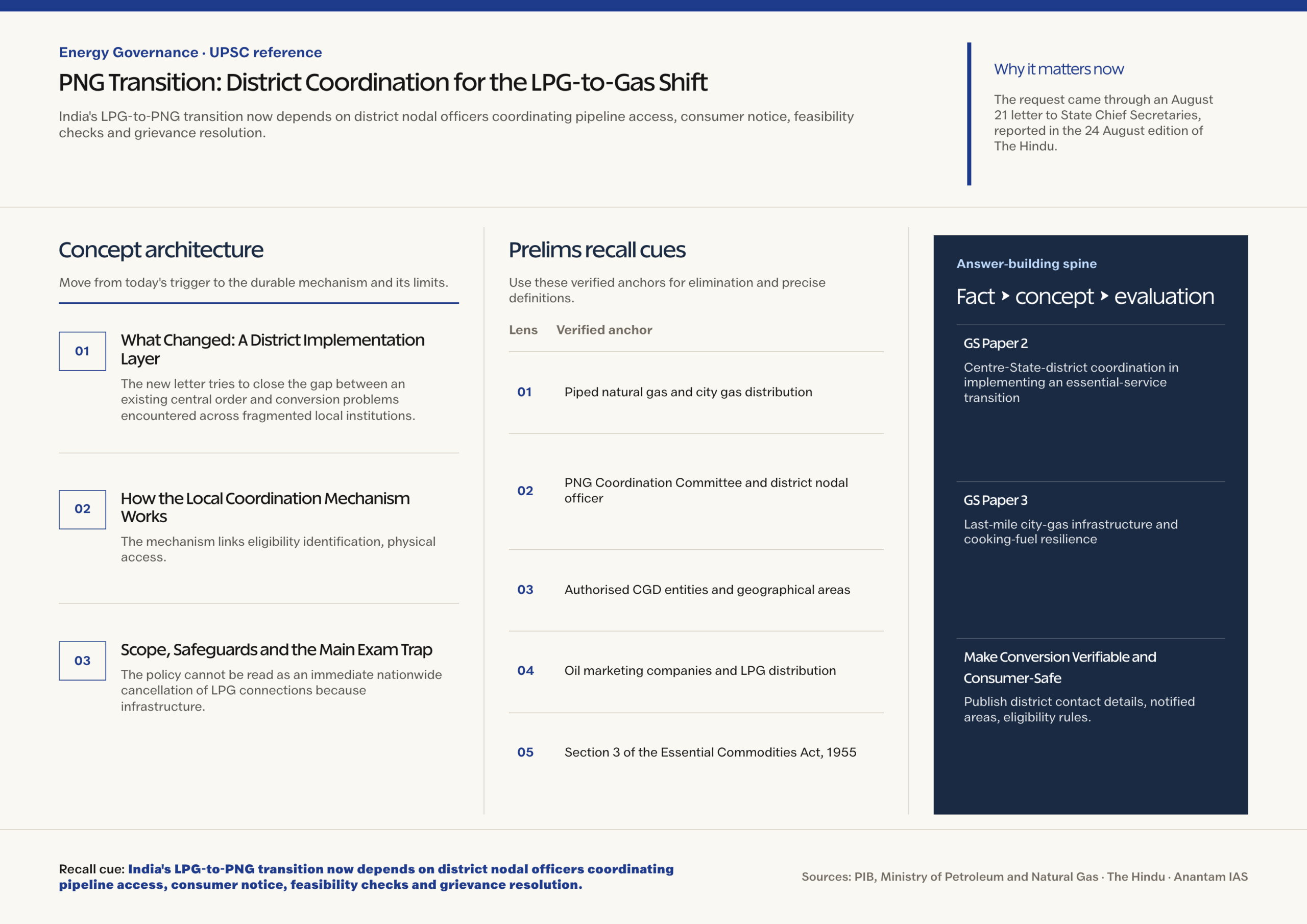
- Piped natural gas and city gas distribution
- PNG Coordination Committee and district nodal officer
- Authorised CGD entities and geographical areas
- Oil marketing companies and LPG distribution
- Section 3 of the Essential Commodities Act, 1955
Mains Relevance
GS Paper 2
- Centre-State-district coordination in implementing an essential-service transition
- Notice, feasibility, grievance redress and administrative accountability
GS Paper 3
- Last-mile city-gas infrastructure and cooking-fuel resilience
- Using existing pipeline investment while managing consumer and distribution costs
Essay
- Infrastructure succeeds when the last administrative mile is designed as carefully as the physical network.
Background and Context
What Changed: A District Implementation Layer
The new letter tries to close the gap between an existing central order and conversion problems encountered across fragmented local institutions, districts and housing complexes.
- Chief Secretaries were asked to nominate one district nodal officer, preferably through the food and civil supplies administration that already regulates LPG distributors.
- The officer joins the local PNG Coordination Committee’s working chain rather than replacing the authorised city-gas entity or oil marketing company within its regulated commercial role.
- CGD entities and public-sector OMCs must coordinate which premises can receive PNG and how the existing LPG relationship will be transitioned.
- District involvement gives the process an authority able to convene agencies, verify field facts and prevent unresolved files from blocking time-bound execution.
- This is a governance change in implementation capacity, not a new announcement that makes PNG universally available across every district.
How the Local Coordination Mechanism Works
The mechanism links eligibility identification, physical access, formal notice and service transition into one auditable sequence instead of treating connection numbers as the only outcome.
- The local committee identifies eligible housing societies and households within an authorised geographical area where pipeline infrastructure can serve them.
- It may issue statutory notices to societies, resident welfare associations and individual consumers, then organise outreach and verification before a connection decision.
- District officials can help obtain right of way or right of use and mediate access to non-public areas needed for safe pipeline installation.
- They also coordinate LPG distributors with CGD entities so one service is not withdrawn before the substitute connection is technically ready and usable.
- Monitoring and grievance handling create an accountable local feedback loop for access refusal, disputed eligibility, metering, restoration, delay or other implementation failures.
Scope, Safeguards and the Main Exam Trap
The policy cannot be read as an immediate nationwide cancellation of LPG connections because infrastructure, building types and household feasibility vary sharply.
- The rule operates where PNG supply is available in a notified area; an unserved village or building outside operational reach is not automatically convertible.
- Physical proximity does not always prove feasibility in practice: internal piping, permissions, safety conditions, metering and building access must support an actual working connection.
- Due notice is a procedural safeguard, but it becomes meaningful only when households can understand the decision, contest errors and reach an effective remedy.
- PNG can reduce cylinder transport and use installed city-gas assets, yet it creates dependence on a fixed network whose reliability and emergency response require district-scale oversight.
- A sound evaluation measures successful, safe connections and resolved grievances, not merely notices issued or LPG records closed on an administrative dashboard.
Way Forward
Make Conversion Verifiable and Consumer-Safe
- Publish district contact details, notified areas, eligibility rules, service timelines and an escalation path in a simple public protocol.
- Require a joint feasibility record from the CGD entity and district officer before any LPG discontinuation process advances for a household.
- Track connection activation, service reliability, grievance disposal and failed installations separately so reported progress reflects usable supply.
- Audit access and safety decisions periodically while preserving alternatives for premises where PNG remains technically unavailable or unreliable.
Conclusion
- The district nodal officer turns the PNG transition into a coordinated and locally accountable service-delivery process linking regulators, gas companies, LPG distributors, housing bodies and households.
- In a Mains answer, pair energy resilience with procedural safeguards: defined scope, verified feasibility, prior notice, continuity of cooking fuel and accessible grievance redress.
UPSC Practice Questions
Prelims MCQ 1
With reference to the LPG-to-PNG transition mechanism, consider the following statements:
- District nodal officers are intended to coordinate with local PNG Coordination Committees.
- The mechanism automatically applies to every household in India, irrespective of pipeline availability.
- Authorised city-gas entities and oil marketing companies have distinct roles in the transition.
How many of the above statements are correct?
(a) Only one (b) Only two (c) All three (d) None
Answer: (b) Only two
Explanation:
Statements 1 and 3 are correct. The mechanism concerns notified city-gas areas where PNG supply and a feasible connection are available; it is not an automatic nationwide conversion.
Prelims MCQ 2
Which function best explains why district administration has been added to the PNG transition mechanism?
(a) Manufacturing all household gas meters (b) Setting international natural-gas prices (c) Coordinating access, verification, consumer transition and grievance resolution among local actors (d) Replacing the Petroleum and Natural Gas Regulatory Board
Answer: (c) Coordinating access, verification, consumer transition and grievance resolution among local actors
Explanation:
District authorities can convene agencies, address right-of-way and housing access, verify local conditions and handle grievances. They do not replace sector regulators or market participants.
UPSC Mains Questions
- Why does India’s LPG-to-PNG transition require a district-level coordination mechanism despite having a central regulatory framework? Examine.
- Energy transitions must protect continuity, choice and due process at the point of service delivery. Discuss with reference to household PNG implementation.
Sources: PIB, Ministry of Petroleum and Natural Gas and The Hindu.
Frequently Asked Questions
What is new in the PNG transition?
The March regulatory framework already existed. The new step asks States and Union Territories to nominate district officers who can coordinate access, verification, service transition and grievances.
Does every LPG household now have to switch to PNG?
No. The mechanism concerns notified city-gas areas where operational PNG supply reaches the premises and a technically feasible connection can be provided after due notice.
What does a PNG Coordination Committee do?
It brings authorised city-gas entities and public-sector oil marketing companies together to identify eligible premises, issue notices, conduct outreach and coordinate the shift from LPG.
Why are district supply officers suited to the role?
They already interact with LPG distributors and have field-level administrative reach, allowing them to coordinate agencies, verify facts, address access barriers and resolve consumer complaints.
What safeguard should precede LPG discontinuation?
Authorities should verify that PNG is operational and technically feasible, provide clear prior notice, preserve cooking-fuel continuity and offer an accessible process to challenge errors or delays.