UPSC CSE 2026 Essay Paper Discussion

Monthly Compilation

January 2026 Current Affairs for UPSC

55 current affairs published in January 2026

January 2026 Current Affairs for UPSC — every Why-in-News article AnantamIAS published in January 2026, mapped to the GS syllabus and packaged for revision. This January 2026 monthly current affairs compilation runs to 55 articles spanning Polity, Economy, Environment, Science & Technology, International Relations, Geography, History, Society and Internal Security — every entry written in the Why-in-News + GS-paper-mapping + UPSC-style practice-question format the Compass uses across every monthly digest on the site.

Each January 2026 entry opens with a Why in News? hook so you know exactly why the story matters for the exam, maps to the precise GS paper and sub-topic, summarises the development in scannable sub-headings, and closes with a UPSC-style practice question plus an FAQ accordion. The structure is deliberately repeatable: the same skeleton across every article in this January 2026 compilation, so revision feels familiar by week two and weak topics surface fast.

Use this January 2026 monthly current affairs page three ways. Read sequentially for a single-sitting scan of everything that mattered in January 2026. Download the January 2026 PDF for offline revision, printing or last-mile cycles before Prelims and Mains. Or filter by GS paper from the Monthly Current Affairs hub to focus on Polity, Economy, IR or Environment in isolation. For day-by-day study, jump to Daily Current Affairs; for the full year, see the 2026 Current Affairs archive. Working backwards? The previous month is December 2025 Current Affairs; the next is February 2026 Current Affairs.

Monthly current affairs for UPSC is the spine of revision — daily reading is for awareness, monthly compilations are what you actually re-read. The January 2026 set below is built for exactly that: open the article, skim the Why-in-News, lock the GS mapping, attempt the practice question, move on. Every piece links to its own per-article PDF if you'd rather collect the high-yield few than the full month.

Pariksha Pe Charcha 2026: Exam Stress, Student Wellbeing and Public Communication graphic 1 for UPSC current affairs

Pariksha Pe Charcha 2026: Exam Stress, Student Wellbeing and Public Communication

Pariksha Pe Charcha 2026 crossed a record registration figure in January, keeping exam stress, student wellbeing and parent-teacher communication in the public-policy conversation. For UPSC, the topic is useful because it connects education policy with mental health, adolescent wellbeing, competitive pressure and the state's use…

Ganga Innovation Meet 2026: Technology, Biodiversity and River Rejuvenation graphic 1 for UPSC current affairs

Ganga Innovation Meet 2026: Technology, Biodiversity and River Rejuvenation

Ganga Innovation Meet 2026 brought together technology, research and river-rejuvenation ideas under the Namami Gange umbrella. The event signalled that river governance is increasingly looking to sensors, biodiversity science, citizen participation and applied innovation. For UPSC, this topic helps students move beyond a static Namami…

India-Germany Joint Statement 2026: Defence, Semiconductors and Green Hydrogen graphic 1 for UPSC current affairs

India-Germany Joint Statement 2026: Defence, Semiconductors and Green Hydrogen

Germany's Chancellor Friedrich Merz visited India in January 2026, and the joint statement that followed was unusually dense. Defence industrial cooperation, semiconductors, critical minerals, telecom, green hydrogen, green ammonia, bioeconomy and skilled migration all appeared in one diplomatic package. For UPSC, this is not a…

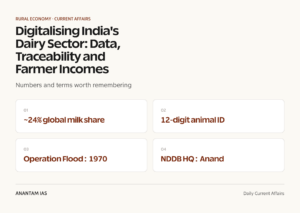
Digitalising India's Dairy Sector: Data, Traceability and Farmer Incomes graphic 1 for UPSC current affairs

Digitalising India’s Dairy Sector: Data, Traceability and Farmer Incomes

Why in News? India's dairy economy is being rewired around digital public infrastructure. The Department of Animal Husbandry and Dairying (DAHD) and the National Dairy Development Board (NDDB) are scaling animal tagging, a unique-ID livestock database and electronic milk-procurement systems to raise productivity, build disease…