Opens in a new tab
Join Anantam IAS Channel on Telegram

Daily Digest · Wednesday

28 October 2026 Current Affairs for UPSC

15 current affairs published on Wednesday, 28 October 2026

28 October 2026 Current Affairs for UPSC — every Why-in-News article AnantamIAS published on Wednesday, 28 October 2026, broken down with Why in News?, the exact GS paper it feeds, sub-topic mapping, MCQ-ready facts and a UPSC-style practice question. 15 articles in total, covering Polity, Economy, Environment, S&T, IR, Geography, History, Society and Internal Security — the same Why-in-News + GS-paper-mapping + practice-question format the Compass uses across every daily digest on the site.

Daily current affairs for UPSC is where new material enters your prep stream. Read this 28 October 2026 digest end-to-end in 25–35 minutes, attempt the practice question at the foot of each article (it's MCQ for some, 10/15-marker for others), then bookmark the entries that fall inside your active revision window. Everything stays cross-linked: tap any subject pill to jump to that subject's hub, or use the table of contents above to skip straight to a specific story.

Use this page three ways. Read sequentially for a one-sitting scan of everything that mattered on 28 October 2026. Download the 28 October 2026 PDF below for offline study or print revision. Or use the October 2026 Current Affairs compilation to see this day in the month's full context. For the previous day's reading, see 27 October 2026 Current Affairs; the next day's is 29 October 2026 Current Affairs.

Why we publish daily current affairs separately from the monthly compilation: daily is learning, monthly is revision. Use the daily page to add fresh material to your notes the day it breaks; come back to the October 2026 compilation 60 days before Prelims when the noise has settled and only the lasting takeaway is worth re-reading.

Himalayan Tourism: Planning Within Carrying Capacity

Open article →Download PDF

Why in News?

Indian Express reported on 28 October 2026 that the Central Empowered Committee recommended carrying-capacity assessments for Himachal tourism hubs; at the previous day’s hearing, the Supreme Court gave the State time to respond.

  • The CEC recommendations cover tourist destinations and supporting infrastructure, including roads, parking and waste management, alongside ecological sensitivity.
  • The committee proposed reviewing environmental-clearance exemptions for certain highway expansions and considering stronger scrutiny of hill-road construction or expansion.
  • Pending assessments, it recommended temporary restrictions where serious congestion or environmental stress exists. These remain committee recommendations, not a final court-imposed visitor quota.
  • Shared infrastructure connects developments that may have received separate permissions: several hotels can depend on the same access road, water supply and waste-disposal arrangements.
  • Planning scale matters. Assessing the entire destination or road corridor can reveal pressures that are difficult to see within an individual building or short project segment.

UPSC Relevance

Prelims Relevance

  • Central Empowered Committee: advises the Supreme Court on environment and forest matters and assists with monitoring compliance.
  • Carrying capacity: the level of activity a destination can sustain within its ecological and service constraints.
  • Cumulative pressure: the combined effect of multiple activities on shared systems.
  • Environmental clearance: a regulatory assessment distinct from an ordinary building permission.
  • Committee recommendation: must be distinguished from a final judicial direction or a notified legal change.

Mains Relevance

GS Paper 3

  • Environmental governance: linking tourism permissions with destination capacity and continuing monitoring.
  • Disaster-risk reduction: considering terrain and infrastructure constraints before approving additional development.

GS Paper 2

  • Institutional coordination: aligning decisions taken by tourism, transport, planning and environmental authorities.

Background and Context

What the Committee Recommended

The reported recommendations seek to connect tourism growth with evidence about what individual destinations and their supporting systems can sustain.

  • According to Indian Express, the CEC examined tourism and multi-storey buildings alongside roads, hydroelectric projects and compensatory afforestation. Its recommendations followed assessment of State information, site visits and review of existing regulatory measures.
  • The committee called for carrying-capacity assessments of major tourist destinations and allied infrastructure. The relevant question extends beyond hotel construction to whether roads, parking and waste management can support the combined activity around them.
  • The report flagged the absence of a published, permission-binding capacity limit for expanding tourism infrastructure. Its proposed change would connect findings about ecological and service constraints with decisions on further accommodation and related development.
  • For hill roads, the committee recommended reviewing clearance exemptions and considering stronger environmental scrutiny. This should not be read as evidence that every recommended change has already become an operative rule governing road projects.
  • The Supreme Court hearing gave Himachal Pradesh time to respond to the recommendations. The reported procedural step does not establish a final judicial ban on tourism, a uniform visitor ceiling or completed implementation by the State.

Why Separate Permissions Can Miss Shared Pressure

A destination can face excessive combined demand even when each development has been examined through its own approval process.

  • Cumulative pressure arises when many developments depend on the same service or environmental system. Checking one hotel in isolation may overlook demand already created by other accommodation, residents and visitors using that shared infrastructure.
  • Carrying capacity is place-specific. Water availability, waste handling, access roads and ecological sensitivity differ between destinations. A limit meaningful for one location cannot simply be copied elsewhere without examining the conditions that support it.
  • Road capacity is only one part of the assessment. More parking or a wider approach road does not by itself resolve pressure on other services; planning must consider the destination as an interconnected system.
  • The CEC also criticised piecemeal forest-diversion proposals for linear road projects, according to the report. Looking at disconnected sections can obscure the combined effects of an entire corridor across terrain and affected ecological areas.
  • This differs from independent structural design checking. A technically reviewed structure addresses specific engineering questions; destination assessment asks whether the wider pattern of development remains compatible with shared service capacity and environmental constraints.

Connecting Capacity Evidence With Permission and Monitoring

An assessment becomes useful when authorities explain how its findings affect development decisions and how changing conditions will be tracked.

  • Permission conditions should reflect the assessment rather than sit in a separate planning document. Authorities would need to explain which constraints affect a proposed development and what must change before additional activity can be supported.
  • Inter-departmental coordination matters because tourism approvals and service provision may rest with different agencies. The principle resembles integrated transport planning: decisions should consider connected facilities rather than treating each administrative boundary as a separate system.
  • Continuing compliance checks whether actual activity remains consistent with permission conditions. Construction approval is a decision at one point in time; later monitoring must examine what was built and how the destination functions in practice.
  • Temporary restrictions were recommended where serious congestion or environmental stress exists while assessments are pending. They should be described as the committee’s proposed precaution, without inventing an already enforced closure or a numerical threshold.
  • Transparent evidence can make decisions reviewable. Publishing the assessment basis, identified constraints and reasons for permission conditions would help residents and businesses understand the decision; this is an implementation approach, not a reported completed outcome.

Way Forward

Make the Assessment Guide Decisions

  • Assess shared systems together and identify the constraints relevant to each destination before assigning additional development capacity.
  • Link responsibilities across tourism, planning, transport and service agencies, with a clear record of how assessment findings affect permissions.
  • Monitor actual conditions after approval and explain any revision of restrictions or permission conditions through updated evidence.

Conclusion

  • Carrying-capacity planning connects the scale of tourism development with the systems that sustain it. Its value lies in assessing combined pressures and making those findings relevant to permissions and continuing oversight.
  • The new CEC recommendations provide a specific planning debate, while the State response and further judicial consideration remain pending in the reported account. Keep proposed safeguards separate from claims that binding limits already operate.

UPSC Practice Questions

Prelims MCQ 1

With reference to carrying-capacity planning for mountain tourism, consider the following statements:

  1. It should consider the combined pressure of developments on shared infrastructure.
  2. A capacity limit determined for one destination can be applied unchanged to all Himalayan towns.
  3. Continuing monitoring can help assess whether actual development remains consistent with permission conditions.

How many of the above statements are correct?

(a) Only one (b) Only two (c) All three (d) None

Answer: (b) Only two

Explanation:

Statements 1 and 3 are correct. Capacity depends on the ecological and service conditions of each destination, so a limit cannot be copied unchanged across all mountain towns.

Prelims MCQ 2

Which example best illustrates the limitation of assessing tourism projects separately?

(a) Several permitted hotels place combined demand on the same limited water and waste services (b) Each hotel is assigned a different postal address (c) A building owner submits a separate application form (d) Two tourism businesses offer different room prices

Answer: (a) Several permitted hotels place combined demand on the same limited water and waste services

Explanation:

Separate approvals may miss cumulative demand on a shared system. Postal addresses, separate forms and room prices do not by themselves demonstrate this environmental planning problem.

UPSC Mains Questions

  1. Explain how carrying-capacity assessment can improve tourism planning in Himalayan destinations. Discuss the importance of linking findings with permissions and monitoring.
  2. Why can project-by-project approval fail to capture cumulative environmental pressures? Examine the role of inter-departmental coordination in addressing this limitation.

Source: Indian Express.

Frequently Asked Questions

What is the new development concerning Himachal tourism?

Indian Express reported that the CEC recommended carrying-capacity assessments and stronger scrutiny of tourism-related development and hill roads. At the 27 October hearing, the Supreme Court gave Himachal Pradesh time to respond.

Does the report establish a court-imposed tourist quota?

No. The reported measures are committee recommendations. The account describes the State being given time to respond, not a final visitor quota, a nationwide tourism ban or completed implementation of every proposed safeguard.

Why does carrying capacity include infrastructure?

Tourism depends on roads, water and waste services as well as ecological conditions. Multiple developments can place combined demand on these shared systems, so evaluating building permissions alone may miss important constraints.

Why is carrying capacity different for each destination?

Terrain, ecological sensitivity and the availability of supporting services vary across locations. A useful assessment must examine local conditions; a numerical limit from another town cannot automatically establish what the destination can sustain.

What is the purpose of continuing compliance monitoring?

Monitoring checks whether actual development and activity remain consistent with permission conditions. It connects the original assessment with later operation, helping authorities identify when approved safeguards are not working as intended.


Heat Exposure: Why Age and Living Conditions Shape Risk

Open article →Download PDF

Why in News?

The Hindu reported on 28 October 2026 that the tenth Lancet Countdown report identified continuing high heatwave exposure among infants and older adults, placing age-specific protection within the climate-health debate.

  • The reported findings identify 2025 as the second-highest year for combined exposure of these vulnerable age groups, following the exceptional exposure recorded in 2024.
  • Person-days measure population exposure over time. They should not be presented as a count of different individuals affected, hospital admissions or deaths.
  • The report authors called for recognition of a global health emergency. Their call is a recommendation, not evidence that WHO has made such a declaration.
  • Health protection depends on who is exposed, how their body responds and whether they can reach cooling, reliable services and timely support.
  • Population averages can hide unequal conditions within a city or district, including differences in housing, outdoor work and access to electricity.

UPSC Relevance

Prelims Relevance

  • Lancet Countdown: an assessment tracking relationships between climate change and health.
  • Person-days: a measure combining the number of exposed people with the duration of their exposure.
  • Physiological vulnerability: susceptibility related to factors such as age and health status.
  • Exposure: contact with hazardous heat conditions, shaped by where people live and work.
  • Heat-health warning: information intended to trigger timely protective action and service preparedness.

Mains Relevance

GS Paper 3

  • Climate adaptation: identifying vulnerable groups and reducing exposure through local planning.
  • Disaster management: connecting warnings with operational responsibilities and essential-service continuity.

GS Paper 2

  • Public health: addressing unequal access to cooling, safe housing and functioning care services.

Background and Context

Reading Exposure Measures Correctly

The reported exposure figures describe the contact between populations and heat over time, rather than directly counting illness or measuring individual clinical risk.

  • Person-days combine people and exposure duration. A person exposed on several days contributes more than once, so an accumulated total cannot be interpreted as the number of unique people who experienced a heatwave.
  • Per-person exposure divides accumulated exposure by the relevant population. It answers a different question from the total: a large population can contribute substantial aggregate exposure without every individual facing the same duration of heat.
  • Measurement units shape interpretation, as the earlier heat-storm measurement note explains. Here the focus is population exposure by age, which should remain distinct from the geographic extent of a hot event.
  • Exposure is not a health outcome. Hospital admissions, illness and deaths require their own evidence. An exposure indicator can identify a protection problem, but it does not establish how many exposed individuals became ill.
  • The reported comparison indicates that exposure remained high despite declining from the preceding exceptional year. A lower annual total does not show that vulnerable groups are adequately protected or that all locations improved equally.

Why the Same Heat Produces Unequal Risk

Age and health affect the body’s response, while living and working conditions influence both exposure and the ability to escape it.

  • Physiological vulnerability depends partly on age and health status. Infants and older adults deserve specific attention, but age alone cannot describe every person’s risk without considering illness, exposure conditions and available support.
  • Heat accumulation occurs when the body gains heat faster than it can lose it. WHO explains that environmental conditions, including humidity and limited air movement, can make cooling more difficult and increase strain on the body.
  • Warm nights extend the period of thermal stress after daytime exposure. Assessing only the afternoon maximum can miss prolonged conditions that reduce recovery opportunities, particularly where homes remain hot and effective cooling is unavailable.
  • Housing and occupation change exposure. Poorly adapted buildings and outdoor manual work can increase contact with hazardous heat, while inadequate income or electricity access can restrict the practical options available for reducing that exposure.
  • Existing health conditions matter. The WHO health assessment describes strain on the heart and kidneys as the body attempts to cool itself; public-health planning should account for these differences rather than rely on age categories alone.

Turning Warnings Into Targeted Protection

A warning becomes protective when it activates practical services for people whose exposure or vulnerability makes delay especially costly.

  • Risk identification should connect vulnerable groups with the places where they spend time, including homes, care facilities and schools. This helps authorities identify where shade, cooling and accessible support are most urgently needed.
  • Early action matters because heat-related health effects can occur rapidly. WHO stresses prompt intervention after alerts; local plans should specify which agency acts, what service it provides and how people can reach that service.
  • Essential-service continuity supports protection during the event. Power failures can disrupt cooling and healthcare, while transport or water problems can deepen exposure; response planning must consider these connected failures rather than only issuing advice.
  • Overlapping hazards need separate evidence. Heatwaves can coincide with air-pollution episodes; pollution monitoring and source analysis illustrate why identifying each hazard helps agencies choose appropriate responses without assuming one measurement explains every health risk.
  • Local evaluation should examine whether protective services were available and reached priority groups. Recording that a warning was issued is insufficient if people lacked usable cooling, reliable transport or access to functioning health facilities.

Way Forward

Assign Action Before the Alert

  • Identify priority groups and facilities using local exposure, health and service-access information, with clear responsibility for contacting or supporting them.
  • Connect warning thresholds with operational tasks, including service readiness and checks on cooling, power, water and transport arrangements.
  • Review access gaps after heat events, using service records and community feedback to improve the next response rather than counting alerts alone.

Conclusion

  • Heat exposure is a starting point for protection, not a complete account of harm. Age, health, housing and service access determine why the same environmental conditions can create different risks across a population.
  • For an answer on climate-health adaptation, connect measurement with delivery: identify exposure accurately, locate vulnerable groups and specify the services that warnings activate. Keep reported exposure trends separate from unverified claims about illness or mortality.

UPSC Practice Questions

Prelims MCQ 1

With reference to heatwave exposure indicators, consider the following statements:

  1. Person-days combine the number of exposed people with exposure duration.
  2. An accumulated person-day total equals the number of unique individuals exposed.
  3. Exposure totals directly establish the number of heat-related hospital admissions.

How many of the above statements are correct?

(a) Only one (b) Only two (c) All three (d) None

Answer: (a) Only one

Explanation:

Only statement 1 is correct. Repeated exposure contributes multiple person-days, while illness and hospital admissions require separate outcome evidence.

Prelims MCQ 2

Which approach best translates a heat-health warning into targeted protection?

(a) Publishing the same message without examining local service access (b) Identifying vulnerable groups and activating accessible protective services (c) Treating every resident as having identical physiological risk (d) Inferring hospital admissions directly from person-day totals

Answer: (b) Identifying vulnerable groups and activating accessible protective services

Explanation:

Targeted protection connects exposure and vulnerability with actual service delivery. A warning alone does not establish that people can obtain cooling, support or healthcare.

UPSC Mains Questions

  1. Explain why age-specific heat exposure indicators must be interpreted alongside housing, occupation and essential-service access. (150 words)
  2. Heat-health warnings require operational public services to protect vulnerable populations. Discuss how local planning can close the gap between alerts and action. (250 words)

Sources: The Hindu and WHO, Heat and Health.

Frequently Asked Questions

What is the new heat-health development?

The Hindu reported findings from the tenth Lancet Countdown assessment on 28 October 2026, highlighting continuing high heatwave exposure among infants and older adults. The note examines the implications for targeted public-health protection.

Does a person-day total count different people?

No. It combines exposed people with exposure duration, so the same person can contribute on several days. It must be distinguished from unique individuals, average exposure per person and measured health outcomes.

Why can heat risk differ among people of the same age?

Health status, occupation, housing and access to cooling or reliable services can differ substantially. Age is an important vulnerability factor, but it does not capture every condition that shapes exposure and protection.

Has WHO declared the emergency requested by the report authors?

The reported statement is a call from the authors for formal recognition of a global health emergency. It should not be described as a completed WHO declaration or a new legal status already in force.

What should a local heat plan assess beyond issuing warnings?

It should identify priority groups, service responsibilities and access barriers, then check whether cooling, essential utilities and health services function during an event. Evaluation should examine delivery as well as communication.

Local Toll Pass: Matching Concessions to Residents and Fee Plazas

Open article →Download PDF

Why in News?

On 27 October 2026, the Road Transport Ministry announced a notified local toll-pass concession for eligible residents near National Highway fee plazas, effective from 1 November.

  • The annual fee is ₹1,500 at plazas outside municipal or local-town limits and ₹3,000 at plazas within those limits; the distinction depends on the plaza’s location.
  • Eligibility covers non-commercial vehicle owners residing within 20 km of the specific plaza and having a valid, functional FASTag.
  • The pass applies to one plaza and cannot be transferred to another; eligible owners may still choose the existing monthly pass.
  • Exclusions cover closed user-fee collection systems and locations where a service road or alternative road is available. The concession is not operational on 28 October.
  • Local travel can involve repeatedly crossing the same toll point for everyday journeys. A resident concession targets this burden without exempting every highway user.
  • Targeting requires several conditions to hold together. Residence alone does not establish entitlement if the vehicle or the toll facility falls outside the rule.

UPSC Relevance

Prelims Relevance

  • National Highways Fee Rules: the concession follows their Fifth Amendment, 2026.
  • Non-commercial vehicle: the specified vehicle category for the local concession.
  • FASTag: a valid and functional tag is required alongside residence eligibility.
  • Plaza-specific validity: the annual pass does not follow the owner across all fee plazas.
  • Closed collection system: an expressly excluded toll arrangement.

Mains Relevance

GS Paper 3

  • Infrastructure finance: balancing user-fee collection with the recurring travel burden on nearby residents.
  • Policy design: evaluating who receives a concession and which journeys remain outside it.

GS Paper 2

  • Administrative fairness: consistent eligibility decisions, clear exclusions and accessible dispute resolution.

Background and Context

Who Qualifies and Where the Pass Works

The local pass joins a resident, an eligible vehicle and one fee plaza within a single concession arrangement.

  • Residence proximity is one eligibility condition: the owner must live within the stated distance of the relevant plaza. It is not a general discount for everyone travelling through the surrounding district.
  • Vehicle eligibility is separate from residence. The release specifies non-commercial vehicles, so a nearby address does not by itself bring a commercial vehicle within the concession or change the vehicle category.
  • FASTag validity adds an operational requirement to the eligibility test. Possessing a pass and maintaining a functioning tag are related but distinct conditions; the announcement does not remove electronic collection requirements.
  • Plaza-specific validity limits the benefit geographically. An eligible resident using another fee plaza cannot assume that the same annual payment covers that crossing, even when both plazas lie on the same highway.
  • Alternative access changes eligibility. The release excludes places with an available service road or alternative road; living nearby does not override that exclusion, which must be considered when a pass request is assessed.

How a Targeted Concession Changes User-Fee Design

A local concession adjusts the treatment of a defined group while retaining the wider system of charging for road use.

  • User-fee relief differs from a complete toll exemption. The eligible owner makes an annual payment for the specified plaza; the policy does not abolish the charge for highway use or waive it nationwide.
  • Annual and monthly options remain available to eligible residents. Choosing between them depends on expected use and applicable charges; the release does not establish that an annual option is best for every household.
  • Plaza location determines which annual fee applies. The municipal or local-town boundary is the relevant classification, rather than the owner’s income, occupation or an assumed difference between richer and poorer vehicle users.
  • Closed collection systems generally connect charges to recorded entry and exit along a controlled road section. Their explicit exclusion prevents a single-plaza concession being mistaken for permission to travel across an entire tolled network.
  • Distribution matters: relief reaches eligible vehicle owners rather than all travellers. Its reach differs from public-bus fare support; an assessment should identify who benefits and who continues bearing transport costs.

Implementation Must Match the Notified Scope

The announcement establishes the policy boundaries; reliable administration must translate those boundaries into consistent decisions at eligible plazas.

  • Notification and operation are different stages. The ministry says the amendment has been notified, but the concession starts on the announced effective date; publication of a news release does not make it immediately usable.
  • Implementation information should distinguish the pass from other annual travel products. Clear explanations of the covered plaza, vehicle conditions and exclusions reduce the risk of residents paying under a mistaken expectation of wider validity.
  • Eligibility verification should produce consistent outcomes for comparable applicants. The release does not specify an application-document checklist, so administrative analysis should not turn assumed paperwork, refund provisions or processing periods into announced legal requirements.
  • Rate revision is permitted annually by the Central Government, with revisions taking effect in April. This is authority to revise prices, not proof that an increase has already been decided for the next year.
  • Access planning still matters alongside pricing. The availability of alternative roads links the concession to the wider network, a concern also examined in integrated transport planning; affordability cannot be assessed from the pass price alone.

Way Forward

Make Eligibility Decisions Clear and Reviewable

  • Publish consistent explanations of the covered plaza, residence condition, vehicle category and exclusions before taking annual payments.
  • Provide a review channel for disputed eligibility decisions, including disagreements about available alternative roads; explain the basis of rejection to applicants.
  • Track actual access through complaint patterns and recurring implementation problems, rather than treating the number of passes issued as sufficient evidence of fair delivery.

Conclusion

  • The local toll pass illustrates targeted relief within infrastructure user charges: eligibility, the covered facility and exclusions jointly define the benefit. An annual payment should never be read as automatic network-wide access.
  • Evaluate the measure through distribution and implementation: which residents qualify, which journeys remain chargeable and whether similar applicants receive consistent treatment. The announced concession takes effect in November; its actual delivery remains to be assessed.

UPSC Practice Questions

Prelims MCQ 1

With reference to the announced Concessional Local Pass for National Highway fee plazas, consider the following statements:

  1. It is available to eligible owners of non-commercial vehicles residing within 20 km of the relevant fee plaza.
  2. A pass issued for one plaza can be transferred to another plaza on the same highway.
  3. It is unavailable where a service road or alternative road is available.

How many of the above statements are correct?

(a) Only one (b) Only two (c) All three (d) None

Answer: (b) Only two

Explanation:

Statements 1 and 3 are correct. The pass applies only to the specific fee plaza and is not transferable to another plaza.

Prelims MCQ 2

Which consideration determines the two announced annual fee categories for the local toll pass?

(a) The income of the vehicle owner (b) The number of journeys made in the previous year (c) Whether the plaza is within or outside municipal or local-town limits (d) Whether the vehicle was purchased within the same district

Answer: (c) Whether the plaza is within or outside municipal or local-town limits

Explanation:

The fee category depends on the location of the fee plaza relative to municipal or local-town limits. It is not an income test or a previous-trip-count rule.

UPSC Mains Questions

  1. How can residence-based toll concessions balance infrastructure user charges with local mobility needs? Discuss the importance of eligibility and exclusions.
  2. Explain why a notified transport concession requires clear implementation rules and reviewable decisions to produce equitable outcomes.

Source: PIB, Ministry of Road Transport and Highways.

Frequently Asked Questions

When does the new local toll-pass concession take effect?

The ministry announced the notified amendment on 27 October 2026, with the concession taking effect on 1 November. It should not be described as already operational on the article’s publication date.

Does the pass cover all National Highway fee plazas?

No. It applies only to the specific fee plaza for which the eligible resident obtains it. It cannot be transferred to another plaza and should not be treated as network-wide annual travel access.

Who can qualify for the concession?

The release covers owners of non-commercial vehicles who reside within 20 km of the relevant plaza and have a valid, functional FASTag. The plaza and road arrangement must also satisfy the rule’s conditions.

Which situations are excluded?

The concession does not apply to closed user-fee collection systems. It is also unavailable where a service road or alternative road is available. Proximity to the plaza alone cannot override these exclusions.

Does the annual pass replace the existing monthly option?

No. Eligible owners may choose between the existing monthly pass and the new annual local pass. The appropriate choice depends on expected travel and applicable charges; the announcement does not prescribe one option for everyone.

Manuscript Cooperation: Preserving Originals and Opening Digital Access

Open article →Download PDF

Why in News?

On 27 October 2026, the Culture Ministry disclosed an India–Bibliothèque nationale de France manuscript cooperation agreement signed in Paris the previous day, covering conservation, digitisation and research access.

  • The MoU connects the Ministry of Culture, through Gyan Bharatam, the National Archives of India and the National Library, Kolkata, with France’s national library.
  • The partners will work to identify and digitise Indic-origin manuscripts held by BnF, alongside exchanges involving conservation, cataloguing standards and text-recognition tools.
  • The envisaged repository provides structured, permission-based access. The agreement does not establish that every manuscript is already digitised or publicly available.
  • Identification and access are different stages of heritage work. The earlier Gyan Bharatam manuscript survey concerns locating collections; this agreement adds institutional cooperation on preservation and research use.
  • Digital copies can help researchers study materials held in different institutions, while physical originals still require conservation and decisions about permitted use.

UPSC Relevance

Prelims Relevance

  • BnF: Bibliothèque nationale de France, the National Library of France.
  • Conservation: care of the physical manuscript and its material condition.
  • Digitisation: creation of a digital representation of a physical source.
  • OCR and HTR: optical character recognition and handwritten text recognition, used to derive text from images.
  • Permission-based access: access governed by specified conditions rather than an assumption of unrestricted reuse.

Mains Relevance

GS Paper 1

  • Cultural heritage: preserving documentary sources while supporting research and interpretation.

GS Paper 2

  • Cultural diplomacy: cooperation between institutions holding collections relevant to shared historical study.

GS Paper 3

  • Technology governance: combining digital access with quality checks and clear permissions.

Background and Context

What the Cooperation Framework Covers

The agreement links institutions that can contribute different kinds of expertise to the care and study of manuscript collections.

  • The India–BnF MoU establishes a framework for identifying and digitising Indic-origin manuscripts held by the French institution. Its announcement describes planned cooperation; it does not report completion of every collection or a finished public archive.
  • Gyan Bharatam provides the Indian mission context, with the National Archives of India and National Library, Kolkata, among the participating institutions. Their involvement connects manuscript work with expertise in documentary preservation, collections and research services.
  • The framework covers digitisation, repository cross-sharing and technology exchange, together with conservation and research. These activities solve related problems, but progress on one does not establish that the others have been completed for a collection.
  • Institutional exchanges are also envisaged, including workshops, research initiatives and exchanges of scholars and experts. Their potential value lies in sharing methods and skills; the release does not provide evidence of completed training outcomes.
  • The cooperation complements research capacity for classical languages. A collection becomes more useful when people can identify its script, interpret its context and assess its contents, alongside the technical work of producing digital copies.

Why Conservation, Scanning and Transcription Differ

A manuscript is a physical object, a visual source and a record of language; each aspect needs a different kind of care.

  • Physical conservation addresses the condition of the original material. Producing a scan does not repair damaged folios or remove the need for careful storage and handling, even when researchers can consult a digital copy instead.
  • Digitisation creates an image-based representation that can be viewed away from the original. Its usefulness depends on faithful capture and checks for missing or unclear material; counting files alone does not establish a usable collection.
  • Cataloguing connects an item with descriptive information that helps researchers find and understand it. A clear catalogue record distinguishes one work or copy from another and provides context that an isolated page image cannot supply.
  • OCR and HTR address the separate task of deriving machine-readable text from images. Printed characters and handwritten forms present different recognition challenges; a readable photograph does not automatically produce an accurate searchable transcription of its contents.
  • Human verification remains important where scripts, handwriting, damage or page shape complicate recognition. A practical workflow should let researchers compare the transcription with the source image, rather than treating software output as an unquestionable reading.

What Digital Access Does and Does Not Establish

Access arrangements determine how a digital collection can be consulted and reused, independently of where the physical manuscript is held.

  • The ministry describes the National Digital Repository as envisaging structured, permission-based access. That wording matters: participation in the framework does not by itself promise unrestricted downloading, republication or commercial reuse of every digitised item.
  • Digital sharing and physical restitution are different outcomes. Making a copy available for research does not transfer the original object to another institution or settle ownership questions; the announced MoU should not be read that way.
  • Provenance and attribution help users trace a digital item to the institution and source from which it came. Maintaining that connection supports scholarly checking and prevents an image separated from its record becoming difficult to interpret.
  • Common descriptive standards can make records from different institutions easier to connect. Technology exchange is useful when it improves consistent description and retrieval, rather than simply placing disconnected files on another storage system without adequate context.
  • Access quality requires continuing care after scanning: usable records, dependable files and clear permission information. These are implementation priorities suggested by the cooperation framework, not results already demonstrated by the signing ceremony or ministry announcement.

Way Forward

Make Each Digital Item Usable and Traceable

  • Check capture and description together, so a digital file retains the information needed to identify the source and understand what it contains.
  • Keep transcriptions reviewable against source images and record corrections, especially where recognition tools encounter damaged material or difficult handwriting.
  • Explain access conditions clearly and retain institutional attribution, helping researchers distinguish permission to consult a source from permission to reproduce it.

Conclusion

  • Manuscript cooperation works through connected but distinct tasks: caring for originals, creating reliable copies and enabling informed research access. The India–BnF framework brings these tasks together without establishing that all collections are already accessible.
  • For an answer on heritage governance, assess the quality of preservation, description and permitted use alongside the number of digital files. Technology supports scholarship when the source remains identifiable and its interpretation can be checked.

UPSC Practice Questions

Prelims MCQ 1

With reference to manuscript preservation and digital access, consider the following statements:

  1. Digitisation removes the need to conserve the physical original.
  2. A digital image and a verified machine-readable transcription are different outputs.
  3. Permission to consult a digital item automatically allows every form of republication.

How many of the above statements are correct?

(a) Only one (b) Only two (c) All three (d) None

Answer: (a) Only one

Explanation:

Only statement 2 is correct. Scanning does not replace physical conservation, and access conditions must be checked before assuming permission for reuse.

Prelims MCQ 2

Which practice best helps a researcher check the accuracy of a manuscript transcription?

(a) Removing the source institution from the catalogue record (b) Comparing the transcription with the corresponding source image (c) Treating every software-generated word as authoritative (d) Counting the number of files stored in the repository

Answer: (b) Comparing the transcription with the corresponding source image

Explanation:

Comparison with the source image makes the transcription reviewable. File counts and uncritical reliance on software do not establish textual accuracy.

UPSC Mains Questions

  1. Explain why digitisation alone is insufficient for preserving manuscript heritage. Discuss the roles of conservation, cataloguing and verified transcription.
  2. How can international manuscript cooperation expand research access while respecting institutional responsibilities and conditions on reuse?

Source: PIB, Ministry of Culture.

Frequently Asked Questions

What did India and BnF agree to cooperate on?

The MoU covers conservation, digitisation, repository cross-sharing, technology exchange and research concerning manuscript heritage. It was signed on 26 October and publicly described by the Ministry of Culture on 27 October 2026.

Does digitising a manuscript preserve the physical original?

A digital copy can support research access, but scanning does not repair the original or replace its conservation needs. Physical care and creation of a usable digital representation remain separate tasks.

Why are OCR and HTR outputs checked by people?

Recognition tools can struggle with handwriting, historical scripts, damage and page shape. Comparing their output with the source image helps identify errors before a transcription is treated as reliable evidence.

Does the MoU mean every manuscript is freely available online?

No. The announcement envisages structured, permission-based access and future cooperation. It does not establish immediate availability of every collection or an unrestricted licence to download, republish or commercially reuse all digitised materials.

Does digital sharing mean physical restitution?

No. Sharing a digital representation for research does not itself transfer the physical manuscript or resolve ownership questions. The announced cooperation framework should be distinguished from any separate agreement concerning the return of objects.

Women’s Safety Advisory: Connecting Prevention With Accountable Response

Open article →Download PDF

Why in News?

On 27 October 2026, the NHRC disclosed its women’s safety advisory, dated 23 October, recommending action across workplaces and public spaces and seeking implementation reports within two months.

  • The advisory addresses Union ministries, the Railway Board and State and Union Territory administrations, linking responsibilities across institutions that operate public facilities and respond to violence.
  • Its recommendations cover prevention and survivor support, including functioning lighting, sensitive complaint handling, timely referrals and regular checks of emergency services.
  • An Action Taken Report is requested within two months. The request establishes a reporting expectation; it does not demonstrate that the recommended measures have already been implemented.
  • Safety affects whether women can use workplaces and public spaces on equal terms, connecting this advisory with the wider question of women’s participation in development.
  • The administrative challenge spans facility management, policing and care services: a working light, an answered emergency call and a completed referral perform different tasks.

UPSC Relevance

Prelims Relevance

  • NHRC: statutory commission established under the Protection of Human Rights Act, 1993.
  • Advisory: recommendations to relevant authorities; it does not itself amend legislation or create a new criminal offence.
  • Action Taken Report: an account of steps taken in response to recommendations.
  • One Stop Centres: identified in the advisory as a referral point for survivors requiring additional support.
  • Gender audit: examination of whether facilities and institutional practices address women’s needs.

Mains Relevance

GS Paper 2

  • Governance: assigning responsibility across departments and checking whether recommended protections function in practice.
  • Social justice: accessible public spaces, sensitive reporting channels and continuity of survivor support.

GS Paper 4

  • Public-service ethics: dignity, confidentiality and non-judgmental treatment when people seek help.

Background and Context

What the NHRC Advisory Can Do

The advisory places women’s safety within the work of several public authorities, each responsible for a different part of protection.

  • The NHRC is a statutory human-rights institution under the Protection of Human Rights Act, 1993. Its advisory recommends administrative and policy measures to authorities responsible for protecting dignity, equality and access to public life.
  • An advisory communicates recommended action. It does not itself create a new criminal offence, replace existing legal duties or establish that every recipient has implemented the measures described in the document across its jurisdiction.
  • The document calls for stronger implementation of existing workplace sexual-harassment protections, including functioning complaints committees. The practical issue is whether an employee can reach an effective mechanism when harassment occurs, including outside large formal workplaces.
  • Its bystander-support proposal asks authorities to consider protection along Good Samaritan lines and develop intervention protocols. This remains a proposed reform; the advisory should not be read as announcing newly enacted legal immunity for bystanders.
  • The requested Action Taken Report creates an opportunity to ask what changed after the recommendation. A useful response would identify completed measures, responsible offices and outstanding work, rather than merely acknowledge receipt of the advisory.

How Prevention and Response Connect

Prevention reduces avoidable exposure to danger, while response determines whether someone seeking help reaches a competent authority without additional harm.

  • The advisory recommends usable public infrastructure: lighting in vulnerable locations, functional washrooms and accessible transport facilities. Regular inspections matter because a facility that exists on paper may be unavailable when a woman needs it.
  • Checking lights, emergency buttons and cameras is an operational responsibility. Installing equipment is only the starting point; the recommended inspections address failures that can leave a public location poorly served despite earlier spending on safety.
  • The advisory connects accessible design with the needs of women with disabilities and recommends consulting disability organisations. Facilities should be assessed through users’ ability to enter, navigate and obtain help, rather than through installation counts alone.
  • For police and helplines, the emphasis is on sensitive, timely response. The advisory recommends response standards, functional help desks and staff training, addressing both delays in receiving assistance and victim-blaming when women attempt to complain.
  • These functions require clear local responsibility, a concern also raised in municipal reform. An implementation plan should identify who repairs a failed light, checks completion and coordinates with the agency responsible for emergency response.

Why Referrals and Monitoring Matter

Protection continues after the first contact with authorities, particularly when a survivor needs services delivered by several institutions over time.

  • The advisory recommends timely medical and psychosocial support and efficient referrals among police, hospitals and One Stop Centres. A referral must connect the person with the next service; simply naming another institution leaves that link untested.
  • Survivor dignity also shapes communication. The document discourages victim-blaming and sensational reporting and recommends protection of identity. Public discussion of an incident should not become another source of distress for the person seeking support.
  • For technology-facilitated violence, the advisory recommends awareness and police sensitisation alongside review of cyber laws. Online abuse can affect access to work and public life, so institutional protection cannot be restricted to physical premises alone.
  • The recommended gender audits examine whether workplaces and public spaces remain inclusive. Their findings can guide repairs and budget decisions, while repeated audits help authorities see whether previously identified problems have actually been addressed.
  • Implementation evidence should connect spending with service performance: whether equipment works, help is reachable and referrals are completed. These are practical assessment questions, not outcomes already established by the publication of the NHRC advisory.

Way Forward

Make Each Recommendation Checkable

  • Assign a responsible office to each local facility or service problem, with a completion record that can support the action-taken report.
  • Use inspection findings and user feedback to prioritise repairs, including access barriers reported by women with disabilities.
  • Review referral completion and response quality alongside equipment availability, protecting survivor confidentiality when collecting and reporting information.

Conclusion

  • Women’s safety requires prevention, responsive institutions and continuing support to work together. The NHRC advisory makes these connections explicit, while implementation depends on the authorities and service providers responsible for each function.
  • For an answer on rights-based governance, examine who owns each task, how a person reaches help and what evidence shows that the service works. Keep the advisory’s recommendations separate from claims of completed implementation.

UPSC Practice Questions

Prelims MCQ 1

With reference to the NHRC’s advisory on women’s safety, consider the following statements:

  1. It recommends regular inspection of safety infrastructure in workplaces and public spaces.
  2. Its publication itself creates a new criminal offence for failure to maintain public lighting.
  3. It recommends timely referrals among police, hospitals and One Stop Centres.

How many of the above statements are correct?

(a) Only one (b) Only two (c) All three (d) None

Answer: (b) Only two

Explanation:

Statements 1 and 3 reflect the advisory. Statement 2 is incorrect: the advisory recommends measures and does not itself create a new criminal offence.

Prelims MCQ 2

Which measure best demonstrates whether a recommended survivor-referral arrangement functions in practice?

(a) Counting institutions mentioned in the referral document (b) Counting posters printed about available services (c) Recording that every office received the advisory (d) Checking whether referred survivors reached the required service promptly

Answer: (d) Checking whether referred survivors reached the required service promptly

Explanation:

Referral completion examines whether the connection between services works. Lists, publicity and acknowledgments do not establish that a person obtained support.

UPSC Mains Questions

  1. Examine how coordination between public-facility managers, police and support services can improve women’s safety in workplaces and public spaces. (150 words)
  2. An advisory can identify gaps in rights protection, but implementation requires administrative accountability. Discuss with reference to the NHRC’s recommendations on women’s safety. (250 words)

Sources: PIB, National Human Rights Commission and NHRC Advisory on Women's Safety at Work and Public Spaces.

Frequently Asked Questions

What did the NHRC announce in October 2026?

On 27 October, the NHRC disclosed an advisory dated 23 October recommending measures for women’s safety at work and in public spaces. It sought action-taken reports from the authorities concerned within two months.

Does the advisory create a new women’s safety law?

No. It recommends administrative measures, improved implementation of existing protections and consideration of further reforms. Its publication does not itself amend legislation, create a new criminal offence or prove that every recommendation has been implemented.

Why does the advisory stress maintenance of safety infrastructure?

Lights, emergency buttons and cameras may be installed but fail in operation. Regular inspections help establish whether equipment remains functional, making maintenance an essential part of protection rather than a task completed at installation.

What is the purpose of survivor referrals?

Referrals connect survivors with medical, psychosocial and other support across institutions. The advisory calls for timely and efficient links among police, hospitals and One Stop Centres so that additional assistance remains reachable after initial contact.

How can authorities assess implementation?

Authorities can examine completed repairs, functioning response services and successful referrals, supported by gender audits and user feedback. These checks help distinguish a recorded activity from a service that works when someone needs it.

Paediatric Primaquine: Quality Assurance and Safe Relapse Prevention

Open article →Download PDF

Why in News?

On 27 October 2026, WHO added three paediatric primaquine products from Macleods to its prequalified medicines list for preventing relapse of Plasmodium vivax and Plasmodium ovale malaria.

  • The listed tablet strengths are 2.5 mg, 5 mg and 7.5 mg. These describe the products and must not be read as instructions for treating a child.
  • Relapse prevention addresses dormant parasites that can remain after an initial malaria episode; it is a different treatment task from controlling the blood-stage infection.
  • Prequalification supports quality-assured product selection. The announcement does not establish that these products have been procured, authorized nationally or supplied to every health facility.
  • Malaria control requires both effective products and services able to use them safely; a listing alone cannot establish the readiness of a local treatment programme.
  • The evidence stage matters, as in the Tumaini vaccine trial: a product assessment, a trial and routine availability answer different questions.

UPSC Relevance

Prelims Relevance

  • Hypnozoites: dormant liver-stage parasites associated with P. vivax and P. ovale relapse.
  • Blood stage: the parasite stage responsible for malaria symptoms.
  • Primaquine: an anti-relapse medicine whose safe use requires appropriate clinical assessment.
  • G6PD: glucose-6-phosphate dehydrogenase; deficiency can increase susceptibility to drug-triggered destruction of red blood cells.
  • WHO prequalification: product assessment that supports quality assurance and procurement decisions.

Mains Relevance

GS Paper 2

  • Public health delivery: connecting procurement with diagnostics, trained staff and follow-up.
  • Access: distinguishing the availability of a quality-assured product from a functioning service for patients.

GS Paper 3

  • Disease biology: understanding how parasite stages shape treatment objectives and recurrence.

Background and Context

Why Malaria Can Return Without Another Bite

Relapse depends on parasites left in the body after an earlier infection, so prevention must address more than the symptoms of the first episode.

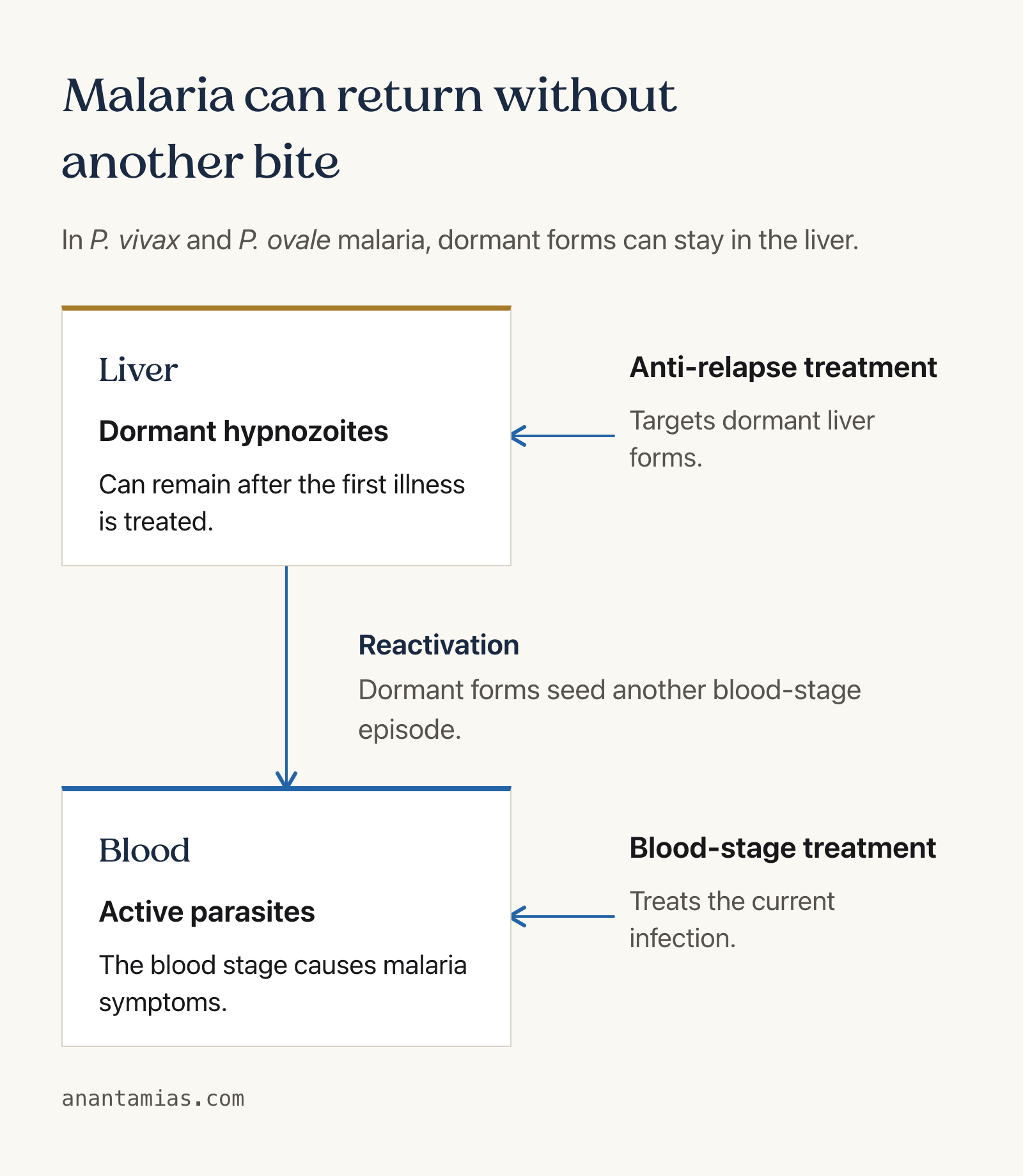
  • P. vivax and P. ovale can leave dormant forms called hypnozoites in the liver. These forms can later reactivate, creating a route back to illness even without another infective mosquito bite.
  • Blood-stage parasites cause the clinical symptoms of malaria, as explained by the CDC. Clearing that stage addresses the current illness, while dormant liver forms create a separate reason for considering anti-relapse treatment.
  • Relapse describes renewed infection arising from reactivated liver stages. Reinfection follows a fresh infection, while recrudescence involves blood-stage parasites that were not fully cleared; these mechanisms should not be treated as interchangeable explanations for recurrence.
  • Anti-relapse treatment targets the dormant reservoir that can restart infection. Its purpose complements treatment of the initial blood-stage illness; describing primaquine simply as another fever medicine would miss the reason it is used.
  • The parasite species matters when interpreting recurrence. The dormant liver-stage mechanism discussed here concerns P. vivax and P. ovale; it should not be generalized to every malaria episode or used to diagnose a returning fever.
Dormant liver-stage hypnozoites can reactivate and cause another blood-stage episode in P. vivax and P. ovale malaria; treatment targets differ.
Dormant liver parasites can reactivate without a new mosquito bite. Blood-stage and anti-relapse treatment address different parasite stages.

What Product Prequalification Establishes

WHO prequalification provides a product-level assessment, while national regulation, procurement and local service delivery remain separate parts of access.

  • WHO medicines prequalification includes assessment of product dossiers, inspection of relevant manufacturing and clinical sites, and quality-control testing. These activities support confidence in evaluated products and help purchasers make informed choices about their medicine supplies.
  • The newly listed paediatric tablet strengths broaden the assessed product options for relapse prevention. The announcement identifies specific products; it does not establish measured improvements in adherence, recovery or population-level malaria control from their use.
  • National registration remains a separate regulatory task. WHO technical assessments can support regulators, including through collaborative procedures, but inclusion on the prequalified list should not be described as automatic authorization in every country.
  • Procurement and distribution determine whether a listed product reaches a service. Budgeting, purchasing and reliable supply must follow product selection; the WHO announcement does not show that these steps have been completed in India.
  • Product quality and patient suitability answer different questions. A quality-assured medicine still needs an appropriate clinical decision for the person receiving it, with the required assessment and follow-up available where care is actually delivered.

Why G6PD Assessment Remains Essential

Safe anti-relapse care must account for how the medicine interacts with the patient, including inherited differences that affect red blood cells.

  • G6PD deficiency is an inherited condition that can make red blood cells vulnerable to acute haemolysis from certain anti-relapse medicines. WHO identifies this as a safety challenge associated with primaquine and related treatment decisions.
  • G6PD testing supplies information for clinical selection of an appropriate anti-relapse regimen. The WHO diagnostic assessment connects reliable testing with safer care; it does not remove the need to interpret results in clinical context.
  • Testing access is a service requirement, not a property of the tablet. Supplying a medicine without the capacity to assess patients can leave a major barrier unresolved, even when the product itself meets quality standards.
  • Clinical responsibility includes patient selection, explaining treatment and monitoring safety. Community workers may support access and follow-up, but the distinction between support and prescribing remains important, as discussed in JOSH teams and clinical boundaries.
  • Programme assessment should examine the whole care pathway: suitable medicines, dependable diagnostics, trained staff and continuing contact with patients. Tablet availability alone cannot demonstrate that relapse prevention is being delivered safely or consistently.

Way Forward

Connect Supply With Safe Care

  • Align medicine procurement and diagnostic access so treatment services can assess patients before making clinical decisions.
  • Train staff to distinguish product strength, patient selection and prescribed treatment, with clear responsibilities for counselling and follow-up.
  • Review service gaps and safety reporting alongside stock availability, identifying where a patient cannot complete the required assessment or obtain continuing care.

Conclusion

  • Paediatric primaquine prequalification strengthens the available quality-assurance information for product selection. Its public-health value depends on the services that connect an appropriate medicine with an assessed patient and safe continuing care.
  • For an answer on health-system capacity, connect the biology of relapse with delivery: clearing blood-stage infection, addressing dormant liver parasites and assessing G6PD-related risk are distinct tasks that must work together.

UPSC Practice Questions

Prelims MCQ 1

With reference to malaria relapse and primaquine, consider the following statements:

  1. P. vivax and P. ovale can leave dormant liver-stage parasites that later reactivate.
  2. A relapse necessarily requires a fresh infective mosquito bite.
  3. WHO prequalification automatically establishes national authorization and supply at every clinic.

How many of the above statements are correct?

(a) Only one (b) Only two (c) All three (d) None

Answer: (a) Only one

Explanation:

Only statement 1 is correct. Dormant liver parasites can reactivate without another bite, while product prequalification does not itself establish national registration or local availability.

Prelims MCQ 2

Why is G6PD assessment relevant to the safe use of primaquine for relapse prevention?

(a) It identifies the number of mosquitoes near the patient’s home (b) It determines whether a pharmaceutical factory meets manufacturing standards (c) It helps clinicians assess susceptibility to treatment-related destruction of red blood cells (d) It proves that all liver-stage parasites have already been eliminated

Answer: (c) It helps clinicians assess susceptibility to treatment-related destruction of red blood cells

Explanation:

G6PD deficiency can increase the risk of acute haemolysis with primaquine. Test information supports clinical treatment selection; it does not measure mosquito exposure or certify parasite clearance.

UPSC Mains Questions

  1. Explain how the biology of malaria relapse creates demands on diagnosis, medicine supply and clinical follow-up. (150 words)
  2. Quality-assured medicines require capable health services to produce public-health benefits. Discuss with reference to paediatric primaquine and G6PD assessment. (250 words)

Sources: WHO Prequalification and WHO, G6PD Testing and Anti-Relapse Treatment.

Frequently Asked Questions

What did WHO announce on 27 October 2026?

WHO added three Macleods paediatric primaquine tablet products to its prequalified list for preventing relapse of P. vivax and P. ovale malaria. The listed strengths describe products and are not individual treatment instructions.

Can malaria relapse occur without another mosquito bite?

Yes. P. vivax and P. ovale can leave dormant parasites in the liver. Their later reactivation can cause renewed illness without a new bite, which explains why relapse prevention has a separate treatment purpose.

Does prequalification mean the medicine is available everywhere?

No. Prequalification supports product quality assurance and selection. National regulatory processes, procurement and distribution remain necessary, and the announcement does not establish availability in every country or health facility.

Why does G6PD assessment matter?

G6PD deficiency can increase susceptibility to acute haemolysis with certain anti-relapse medicines. Reliable test information and clinical assessment help guide appropriate treatment decisions; a quality-assured tablet alone does not resolve this patient-specific risk.

What should a malaria programme assess beyond medicine stocks?

It should examine diagnostic access, trained clinical staff, patient selection, counselling and follow-up. These capabilities determine whether an available medicine can be used safely and whether gaps in the care pathway are addressed.

State IIP Revision: Making Industrial Output Comparable

Open article →Download PDF

Why in News?

On 27 October 2026, MoSPI announced a State IIP base-revision workshop for 28–30 October in Thiruvananthapuram, focusing on item selection, reporting factories and comparable industrial statistics.

  • The All-India IIP already uses the 2022–23 base. The workshop addresses State-level compilation following that revision; it is not a fresh launch of the national series.
  • State Directorates of Economics and Statistics compile and disseminate State IIP, while MoSPI provides technical guidance on consistency and comparability.
  • The workshop will discuss item baskets, reporting factories and classification changes. Its announcement does not establish that every State has adopted a revised series.
  • Comparable production data help distinguish a change in industrial activity from a change caused by how an index is assembled.
  • IIP measures industrial production, while the ASUSE redesign concerns unincorporated enterprises and their operating conditions. The two sources answer different economic questions.

UPSC Relevance

Prelims Relevance

  • IIP: a composite indicator of short-term changes in industrial production volume relative to a base period.
  • Base year: the reference period used to compare later production; the national series uses 2022–23.
  • Item basket: the products included in the index, combined through assigned weights.
  • Reporting unit: an establishment such as a factory, plant or mine, rather than an entire multi-establishment enterprise.
  • Price deflation: conversion of value-based production information into a volume measure where required.

Mains Relevance

GS Paper 3

  • Economic measurement: updating industrial indicators while maintaining meaningful comparisons across time and regions.
  • Industrial policy: interpreting production changes alongside evidence on employment, enterprises and sectoral structure.

GS Paper 2

  • Cooperative administration: common statistical guidance combined with State responsibility for data collection and publication.

Background and Context

What the Index Measures

A production index tracks how industrial activity changes relative to a reference period, using a defined set of products and reporting establishments.

  • The IIP combines changes in the volume of industrial production. Its central question is how much output has changed relative to the base period, rather than how much money producers received from sales.
  • A weighted basket allows different industrial products to contribute according to their assigned importance. An item with a larger weight influences the aggregate more strongly for the same proportional production change than a smaller-weight item.
  • The establishment is the elementary reporting unit in the national metadata: a factory, mill, plant or mine. This matters because one enterprise may operate several establishments with different products or locations that need separate reporting.
  • Revised national coverage extends beyond the earlier mining, manufacturing and electricity grouping to include gas, water supply, sewerage and waste management. Wider coverage changes what the industrial aggregate represents and how users should interpret it.
  • State DES compile their own State-level indices, with MoSPI supplying technical guidance. The current workshop concerns that compilation task; it does not announce new State growth estimates or certify that every revised series is ready.

Why Baskets and Factory Panels Need Revision

Industrial structure changes over time, so the products and establishments used to measure it must remain relevant without introducing arbitrary changes.

  • An outdated item basket can miss emerging products or retain products that no longer represent current industrial activity well. Revising the basket helps the index follow production patterns that matter in the economy being measured.
  • The factory panel identifies establishments supplying production information. Updating it helps maintain representative reporting as factories open, close or change production, but replacement requires a documented method so the panel itself does not distort the signal.
  • Non-response differs from zero production. The national metadata permits statistical estimation of missing returns until actual data arrive, with later revisions. Treating every missing report as a shutdown would incorrectly change the measured level of activity.
  • Where production is reported in monetary values, price deflation helps recover a volume measure. Current national metadata specifies Output Producer Price Index use; higher selling prices alone should not be interpreted as equivalent output growth.
  • Product and industry classifications help agencies describe comparable activities consistently. The workshop includes discussion of classification revisions, but discussion is not evidence that every State has already applied the same revised classification in its index.

How to Compare the Results Carefully

Common statistical rules improve interpretation, but an index remains a relative measure with a defined scope and reference period.

  • An index level describes movement relative to its own base. A higher State index does not by itself establish a larger industrial economy, because States can have different starting output, industrial structures and product weights.
  • Methodological comparability requires clear definitions, reporting periods and treatment of missing data. It does not require pretending that every State produces an identical mix of goods; local industrial composition must remain visible within the common framework.
  • Base revision can change products, weights and reporting units together. Comparing an old-series value directly with a new-series value may mix genuine production change with a measurement change unless the published linking approach supports that comparison.
  • The national metadata describes linking factors at general-index and sectoral levels. Users should follow the available linked series and its documentation, rather than assume that every detailed item can be carried unchanged across the revision.
  • Production growth is only one economic signal. The PLFS discussion concerns labour measurement; employment, household welfare and output need separate evidence, since the same production change can occur with different labour requirements.

Way Forward

Publish Methods Alongside the Series

  • Publish the basket, weights and reporting rules with each revised State series so users can see what changed and which comparisons remain valid.
  • Document factory substitution and missing-return treatment, with clear revision procedures when actual production information becomes available.
  • Provide usable linking guidance and explain remaining breaks, helping analysts avoid attributing every statistical discontinuity to a real change in industry.

Conclusion

  • State IIP revision is a measurement task: representative products, reliable reporting establishments and consistent methods must work together. Its value lies in clearer industrial evidence, while adoption and published results require their own verification.
  • For an answer on economic statistics, distinguish output volume from sales value, index movement from economic size and methodological revision from a real production shock. These distinctions make comparisons across regions and time more defensible.

UPSC Practice Questions

Prelims MCQ 1

With reference to the Index of Industrial Production, consider the following statements:

  1. It measures changes in industrial production volume relative to a base period.
  2. A higher State IIP level necessarily means that the State has a larger industrial economy.
  3. Missing production returns and zero production are conceptually different.

How many of the above statements are correct?

(a) Only one (b) Only two (c) All three (d) None

Answer: (b) Only two

Explanation:

Statements 1 and 3 are correct. An index level is relative to its base and does not establish the absolute size of a State industrial economy.

Prelims MCQ 2

Why is price deflation used when some production data are reported in monetary values?

(a) To separate price movements from changes in production volume (b) To give every industrial product the same index weight (c) To convert missing returns automatically into zero production (d) To measure the number of workers employed by factories

Answer: (a) To separate price movements from changes in production volume

Explanation:

A rise in monetary production value can reflect higher prices as well as greater output. Deflation helps derive the volume component where value-based data are used.

UPSC Mains Questions

  1. Explain how revising item baskets and reporting factory panels can improve State-level industrial statistics. What safeguards are needed to preserve comparability? (150 words)
  2. An industrial production index is useful only when users understand its scope and reference period. Discuss the risks of comparing index levels across States and across base revisions. (250 words)

Sources: PIB, Ministry of Statistics and Programme Implementation and MoSPI, IIP 2022–23 Metadata.

Frequently Asked Questions

What was announced about State IIP in October 2026?

MoSPI announced a workshop for 28–30 October to support State-level IIP base revision. It concerns item selection, reporting factories and consistent methods, following the existing national revision to the 2022–23 base.

Who compiles State-level IIP?

State Directorates of Economics and Statistics compile and disseminate State IIP. MoSPI provides technical guidance to improve consistency and comparability, while the State agencies carry out the relevant compilation work.

Does a higher IIP mean a State has more industrial output?

Not necessarily. An index shows movement relative to its own base period. Comparing absolute industrial size requires suitable output measures and comparable coverage, rather than comparing two index levels alone.

Why are factory panels updated?

Reporting panels must remain representative as industrial production changes. Documented updating and substitution procedures help maintain useful coverage while reducing the risk that changes in reporting establishments are mistaken for actual production movements.

Does the workshop mean every State has adopted the new series?

No. The announcement describes technical discussions and work on State compilation. It does not establish completed adoption in every State or provide a new set of State industrial growth estimates.

New Delhi’s ‘balancing act’ risks eroding Russia’s Trust

Open article →Download PDF

Why in News? 

India’s positions at the 2026 SCO Summit in Bishkek and the BRICS Summit in New Delhi have renewed debate over its ability to maintain close relations with competing powers.

At Bishkek, India endorsed a declaration condemning military strikes against Iran and supporting its sovereignty. The Indian Prime Minister publicly urged the Russian President to pursue peace in Ukraine.


UPSC Relevance: GS-2 International Relations: Bilateral Relations

Mains: India-Russia relations 

What do Recent Developments show?

  • Support for Iran’s sovereignty: The Bishkek Declaration condemned military strikes against Iran as contrary to international law, expressed condolences over the death of Ayatollah Ali Khamenei, and supported a diplomatic settlement.
  • Continued support for Palestinian rights: The 2026 BRICS New Delhi Declaration supported a ceasefire, humanitarian access, Palestinian self-determination and a two-state solution. It also opposed forced displacement and stressed the protection of civilians.
  • Public appeal for peace in Ukraine: At his meeting with Putin, Modi called for a shift from continuing war to its termination. India had already emphasised dialogue and diplomacy at the 2022 SCO Samarkand meeting, specifically highlighting the crisis in Ukraine. 

Editorial’s Central Argument:

The author identifies three possible costs of India’s balancing strategy:

  • Selective public criticism: Moscow may perceive public appeals directed at Russia, without comparable language towards other partners, as unequal treatment.
  • Conflicting reassurance: A statement intended to reassure Washington may unsettle Moscow, while support for a non-Western declaration may concern Western partners.
  • A more transactional relationship: If ties become concentrated on oil and arms purchases, disagreements may be harder to absorb through broader political trust.

Does Multi-Alignment necessarily Erode Trust?

(i) Arguments supporting the editorial’s concern:

  • Uncertainty about strategic commitments: India’s decision to procure Russia’s S-400 air-defence system, alongside closer defence cooperation with the U.S., generated American concerns about interoperability. This illustrates how cooperation with competing powers can create conflicting expectations.
  • Perception of inconsistency: India did not participate in discussions on the June 2025 SCO statement on Israel-Iran tensions, but endorsed the 2026 Bishkek Declaration condemning strikes against Iran. Such changes require clear explanation to prevent policy adjustment from being perceived as inconsistency. 
  • Limits of economic interdependence: Despite continuing defence and energy cooperation with Russia, India publicly advocated an end to the Ukraine war at Bishkek. This demonstrates that substantial commercial ties do not eliminate differences over major geopolitical issues. 

(ii) Counterarguments: Resilience of Strategic Autonomy

  • Partnership permits disagreement: Modi visited Moscow in 2024 and Kyiv in 2024. Engagement with both countries illustrates India’s ability to preserve relations with Russia while maintaining an independent diplomatic relationship with Ukraine.
  • Peace advocacy serves national interests: The 2023 G20 New Delhi Declaration highlighted the Ukraine war’s effects on food, fertiliser and energy security. India’s support for peace therefore has concrete economic and developmental foundations.
  • Multilateral consensus accommodates differences: The 2026 Bishkek Declaration recorded support for China’s Belt and Road Initiative from specified members, excluding India. India could endorse the broader declaration while retaining its distinct position on connectivity. 
  • Institutional cooperation provides stability: BrahMos joint development and the Kudankulam nuclear project give India-Russia relations long-term technological and institutional foundations beyond individual diplomatic statements.

Thus, Multi-alignment allows India to cooperate without complete convergence, but its sustainability depends on explaining differences clearly and delivering consistently on agreed commitments.

Why does Russia remain Important to India?

  • Defence cooperation: Russia remains a major supplier, while cooperation also includes licensed production and joint development. BrahMos, Su-30 aircraft and T-90 tanks illustrate the depth of this relationship. Existing platforms create continuing requirements for maintenance, spare parts and upgrades. 
  • Energy security: Oil trade and civil nuclear cooperation make Russia important to India’s energy interests. The Kudankulam Nuclear Power Project is a significant example of long-term cooperation extending beyond commodity purchases.
  • Eurasian engagement: Relations with Russia support India’s engagement with Eurasia and provide opportunities for cooperation on connectivity, regional security and multilateral diplomacy. 
  • Diversification of partnerships: A substantive relationship with Russia helps India retain foreign-policy options and avoid excessive dependence on any single external partner.

Why is the Relationship Changing?

  • India is diversifying defence procurement: According to SIPRI, Russia’s share of India’s imports of major arms declined from 70% in 2011-15 to 40% in 2021-25. 
  • India and Russia face different strategic pressures: India seeks stronger cooperation with Western partners while retaining Russian ties. Russia’s confrontation with the West creates a different set of priorities. These differences can complicate expectations of diplomatic support.
  • The China factor adds complexity: Russia’s growing closeness to China could reduce Moscow’s willingness or ability to accommodate Indian interests when they diverge from Beijing’s.

Way Forward: 

To preserve its strategic autonomy without eroding vital legacy partnerships, India should adopt a four-pronged diplomatic framework:

  • Transition to Principle-Based Diplomacy: Move away from reactive, audience-specific rhetoric toward a highly consistent, principle-based positioning. Ground all public statements strictly in the universal tenets of the UN Charter, state sovereignty, and international law, applying them uniformly regardless of the targeted geography.
  • Accelerate Defence Co-Production: Move rapidly from importing defence platforms to accelerating joint production. Use initiatives like Atmanirbhar Bharat to build co-development models with Russia (modelled on the BrahMos framework) while expanding similar technology transfers with France and the US.
  • Deepen Backchannel Strategic Dialogue: Utilise high-level, institutionalised national security advisor (NSA) and foreign office consulting frameworks to communicate sensitive diplomatic positions privately, mitigating the friction caused by public pronouncements.
  • Insulate Economic & Energy Vectors: Build and fortify independent, resilient bilateral payment channels (E.g., rupee-ruble mechanisms and interconnected local messaging systems) to shield essential commodity flows from secondary Western sanctions.

India’s strategic autonomy depends on retaining freedom of choice while remaining a predictable partner. Managing disagreements transparently and sustaining practical cooperation will be central to preserving trust with Russia.

Mains Practice Question:

Q. “Multi-alignment expands India’s diplomatic options but also increases the challenge of maintaining strategic trust.” Discuss with reference to India-Russia relations.

Delhi invites Pakistan Minister for SCO Civilisational Dialogue debut

Open article →Download PDF

Why in News?

India has invited all 10 Shanghai Cooperation Organisation (SCO) member states, including Pakistan, to the inaugural SCO Civilisational Dialogue Forum scheduled for November 20-22, 2026, in New Delhi.

The invitation comes amid strained bilateral relations following Operation Sindoor in May 2025. 

UPSC Relevance: GS-2 International Relations: Regional groupings 

Prelims: About SCO Civilisational Dialogue Forum, SCO, Purana Qila  
Mains: SCO: Key Achievements and Significance  

About the Civilisational Dialogue Forum:

  • Origin: PM Modi proposed the initiative at the 2025 SCO Summit in Tianjin, China, to strengthen cultural understanding and people-to-people ties. 
  • Organisers: The Ministry of Culture and the Ministry of External Affairs will jointly organise the event.
  • Venue: Purana Qila, New Delhi
  • Participation: Culture ministers and delegations from member states, alongside representatives of observer and dialogue-partner countries, have been invited.
  • Purpose: Promote understanding of shared heritage, art, literature and traditions, and encourage cooperation in heritage, education and traditional knowledge. 

What is Civilisational Diplomacy?

  • Civilisational diplomacy uses historical connections, cultural traditions and shared heritage to build understanding between countries. It can involve museum exchanges, manuscript translation, archaeological research, festivals and academic collaboration.

For India, relevant connections include:

  • Buddhist links: The movement of Buddhist ideas, texts and scholars between India, Central Asia and China.
  • Persianate connections: Exchanges involving language, literature, architecture and intellectual traditions between India, Iran and Central Asia.
  • Trade and migration: Historical networks that carried goods, artistic practices and knowledge across Eurasia.
  • Shared South Asian heritage: Cultural traditions and historical sites that extend across present-day national boundaries.

Soft power is the ability to influence through attraction and credibility. Cultural diplomacy is one means of developing that influence.

Key Facts about SCO:

FeatureDetails
EstablishedJune 15, 2001, in Shanghai; developed from the Shanghai Five process.
NatureAn intergovernmental organisation covering security, economic and cultural cooperation.
Members10 members (Belarus, China, India, Iran, Kazakhstan, Kyrgyzstan, Pakistan, Russia, Tajikistan and Uzbekistan)
2 observers (Afghanistan and Mongolia) and 15 dialogue partners.
India’s accessionIndia became a full member in 2017.
SecretariatBeijing, China.
Regional Anti-Terrorist Structure (RATS)Executive Committee headquartered in Tashkent, Uzbekistan.
Decision-makingConsensus-based.
Council of Heads of StateDetermines the organisation’s broad priorities and direction.
Council of Heads of GovernmentDeals with economic cooperation, the budget and other practical matters.

The SCO’s “Shanghai Spirit” emphasises mutual trust, mutual benefit, equality, consultation, respect for cultural diversity and common development.

Why is the Invitation to Pakistan Significant?

  • Separates multilateral participation from bilateral normalisation: The invitation forms part of India’s engagement with the SCO as a whole. It does not, by itself, establish that bilateral talks, trade or other suspended engagements will resume.
  • Maintains a channel for limited interaction: A cultural gathering can provide opportunities for official and scholarly contact despite political tensions.
  • Demonstrates India’s commitment as host: Inviting all members helps India conduct an inclusive SCO event and advance an initiative it proposed.
image 36

About Purana Qila: 

Purana Qila offers a setting where architecture and archaeology reflect several periods of Indian history.

  • Construction: The present 16th-century fort is associated with both Humayun and Sher Shah Suri, rather than Humayun alone.
  • Archaeological significance: Excavations have yielded Painted Grey Ware and material from Mauryan, Shunga, Kushana, Gupta, Rajput, Sultanate and Mughal periods.
  • Indo-Islamic Synthesis: Combines Islamic pointed/horseshoe arches with indigenous architectural components such as Rajasthani jharokhas, brackets, and rooftop chhatris (domed pavilions).
  • Diplomatic symbolism: The site can illustrate the interaction of cultures and the historical depth of Indian civilisation.

Prelims Trap: Purana Qila is not a UNESCO World Heritage Site (unlike the neighbouring Humayun’s Tomb and the Red Fort). 

The forum offers India an opportunity to turn shared heritage into sustained cooperation. Its value will depend on credible cultural exchange, practical outcomes and realistic expectations about what diplomacy can achieve amid unresolved security tensions.

UPSC Mains PYQ 2021:

Q. Critically examine the aims and objectives of SCO. What importance does it hold for India?

Mains Practice Question:

Q. “Cultural diplomacy can sustain regional engagement even when bilateral relations remain strained.” Examine with reference to India’s proposed SCO Civilisational Dialogue Forum. 

UPSC PYQ 2022

Q. Consider the following:

1. Asian Infrastructure Investment Bank

2. Missile Technology Control Regime

3. Shanghai Cooperation Organisation

India is a member of which of the above?

(a) 1 and 2 only 

(b) 3 only  

(c) 2 and 3 only  

(d) 1, 2 and 3 

Answer: (d)

Prelims Practice MCQ: 

Q. Consider the following statements:

  1. The SCO Secretariat is located in Beijing.
  2. The Executive Committee of SCO-RATS is headquartered in Tashkent.
  3. India was a founding member of the SCO.

Which of the statements given above are correct?

(a) 1 and 2 only
(b) 2 and 3 only
(c) 1 and 3 only
(d) 1, 2 and 3

Answer: (a). Statement 3 is incorrect: the SCO was established in 2001, while India became a full member in 2017.

Nobel winner backs GM crop innovation in Indian Labs

Open article →Download PDF

Why in News?

Addressing the 2nd Emerging Science, Technology and Innovation Conclave (ESTIC) at Bharat Mandapam, Richard J. Roberts, the 1993 Nobel laureate in Physiology or Medicine, advocated indigenous crop biotechnology research.

He argued that Indian laboratories can develop and own improved crops, reducing dependence on foreign corporations. 

UPSC Relevance: GS-3 Science and Technology: Biology and Biotechnology 

Prelims & Mains: Genetic engineering, CRISPR-Cas9, Bt crops, Golden Rice and biotechnology regulation. 

What are Genetically Modified Crops?

  • GM crops have their DNA modified (altered) through genetic engineering. It involves inserting new DNA into the genome of the plant. 
  • E.g., Bt cotton is a GM pest-resistant variety of cotton. It was genetically modified by the insertion of one or more genes (Cry1 Ac) from the soil bacterium Bacillus thuringiensis. Strains of the bacterium produce toxins harmful to a variety of insects, like the American bollworm, that commonly attack cotton crops. It is India’s first transgenic crop approved for commercial cultivation in 2002.

CRISPR-Cas9 uses a guide RNA to direct the Cas9 enzyme to a specific DNA sequence. The enzyme cuts the DNA, and cellular repair processes enable targeted alterations.

Roberts proposed the expression of “biotechnologically modified (BM)” crops to reduce negative perceptions associated with the term “Genetically Modified (GM)” crops. He noted that evolution itself is a continuous process of genetic modification. 

GM Crop status in India:

1. Bt Cotton (Transgenic Non-Food Crop)

  • Regulatory Status: Commercially approved since 2002; remains India’s only permitted commercially cultivated genetically modified crop.
  • Mechanism: Incorporates Cry genes from Bacillus thuringiensis to express proteins toxic specifically to Lepidopteran pests (e.g., American Bollworm); it offers no protection against sucking pests (e.g., whiteflies).
  • While government data records an initial reduction in chemical insecticide deployment and bollworm infestation, the emergence of Pink Bollworm (PBW) resistance highlights the failure of structural resistance management.

2. Bt Brinjal (Transgenic Food Crop)

  • Regulatory Status: Under an indefinite commercial moratorium since 2010 imposed by the Ministry of Environment, Forest and Climate Change (MoEFCC).
  • Highlights that the regulatory approval of food crops necessitates rigorous biosafety data transparency, independent multi-generational toxicity studies, and high public institutional trust. 

3. GM Mustard / DMH-11 (Transgenic Food Crop)

  • Mechanism: Developed by Delhi University, GM mustard uses the Barnase-Barstar-Bar gene system derived from soil bacteria to facilitate hybrid seed production. The resulting hybrids exhibit heterosis (hybrid vigour), such as higher yield than their parents. The bar gene confers herbicide tolerance.
  • Regulatory Status: Cleared for environmental release in 2022 (strictly for seed multiplication and conditional field testing), but not for unrestricted commercial cultivation.
  • In 2024, the Supreme Court delivered a split verdict on its environmental release but unanimously directed the Union Government to formulate a comprehensive National Policy on GM Crops via broad stakeholder consultation.

4. Golden Rice (Transgenic Biofortified Crop)

  • Mechanism: Engineered with genes from daffodil and a soil bacterium (Pantoea ananatis) to biosynthesise beta-carotene (Vitamin A precursor) in the rice endosperm to tackle Hidden Hunger.

5. Genome-Edited Rice / SDN-1 & SDN-2 (Non-Transgenic Innovation)

  • In 2025, India introduced DRR Dhan 100 (Kamala) and Pusa DST Rice 1, developed indigenously by ICAR institutions.
  • Developed via CRISPR-based genome editing. Under India’s biosafety guidelines, SDN-1 and SDN-2 categories (which do not introduce foreign DNA) are exempted from the rigorous multi-layered approvals required for transgenic Genetically Modified Organisms (GMOs) under the GEAC.

Benefits of GM crops: 

  • Yield protection and productivity: GM crops can reduce losses caused by insects, weeds, diseases and environmental stresses, thereby helping improve or protect crop yield.
  • Resistance to biotic stresses: They can be developed to resist insects, pests and viral diseases. E.g., Bt cotton is resistant to bollworm.
  • Tolerance to abiotic stresses: GM crops may be engineered for better tolerance to drought, salinity, heat, cold or flooding. 
  • Improved nutritional quality: GM technology can enhance nutritional content, such as vitamins, minerals, fatty acids or protein quality. E.g., Golden Rice was developed to produce beta-carotene.
  • Reduced pesticide use in some cases: Insect-resistant crops like Bt crops may reduce the need for chemical insecticides, though resistance management is necessary.
  • Herbicide tolerance: Some GM crops are made tolerant to specific herbicides, helping farmers control weeds more efficiently.
  • Better shelf life: GM crops can be developed for delayed ripening, improved taste, better processing quality or reduced post-harvest losses.

Concerns over GM crops:

  • Gene flow and genetic contamination: GM traits may spread to nearby non-GM farms, landraces or wild relatives through pollen flow, seed mixing or volunteer plants, creating concerns over contamination and loss of varietal purity.
  • Food and health safety: GM food products require case-by-case assessment for allergenicity, toxicity, nutritional changes, antibiotic-resistance marker transfer and long-term dietary exposure. 
  • Herbicide-linked risks: Herbicide-tolerant crops may encourage greater herbicide use, leading to resistant weeds, residue concerns and environmental contamination. 
  • Regulatory and trust deficit: Even confined trials need transparent approvals, public disclosure of trial protocols, independent monitoring, liability rules for contamination, and post-trial surveillance.

Way Forward: 

  • Institutional Streamlining: Standardise and strengthen the regulatory approvals handled by the Genetic Engineering Appraisal Committee (GEAC) under the MoEFCC.
  • Public Sector-led R&D: Pivot focus toward ICAR and state agricultural universities to engineer locally tailored, trait-specific, and economically accessible seed technologies. 
  • Institutional Data Transparency: Mandate public disclosure of multi-location trial methodologies, comparator benchmarks, and the explicit biosafety rationale behind GEAC decisions.
  • Rigorous Agronomic Validation: Evaluate each variety individually based on its exact genetic alteration, targeted utility, and distinct agro-climatic/ecological setting. Require mandatory, multi-season yield verification against modern, competitive alternatives to guarantee tangible net financial returns for farmers.
  • Sovereign Seed Security: Promote equitable licensing, competitive markets, and structural redressal mechanisms to safeguard smallholder autonomy and ensure GM-organic coexistence.
  • Consultative National Policy: Formulate a statutory national framework by synthesising independent scientific consensus with active state-level and farmer stakeholder inputs.

Thus, domestic research can align crop development with Indian agroclimatic conditions and reduce reliance on imported technologies. Improved varieties may strengthen oilseed productivity and farm incomes, provided benefits are established under actual cultivation conditions. 

Prelims Practice MCQ:

Q1. With reference to agricultural biotechnology in India, consider the following statements:

  1. The Genetic Engineering Appraisal Committee (GEAC), under the Ministry of Science and Technology, is the apex body for approving the commercial release of GM crops.
  2. Under India’s current biosafety regulatory guidelines, Site-Directed Nucleases (SDN-1 and SDN-2) genome-edited crops are exempted from the rigorous multi-layered environmental safety assessments required for transgenic GMOs.

Which of the statements given above is/are correct?

(a) 1 only

(b) 2 only

(c) Both 1 and 2 

(d) Neither 1 nor 2 

Answer: (b) 2 only

Explanation:

  • Statement 1 is incorrect: The GEAC is the apex regulatory body, but it functions under the Ministry of Environment, Forest and Climate Change (MoEFCC), not the Ministry of Science and Technology.
  • Statement 2 is correct: According to India’s regulatory guidelines, genome-edited plants falling under SDN-1 and SDN-2 categories (which do not introduce foreign DNA) are exempted from biosafety assessment by GEAC, distinguishing them from transgenic crops.

UPSC PYQ 2014

Q. Consider the following techniques/ phenomena

1.  Budding and grafting in fruit plants

2.  Cytoplasmic male sterility

3. Gene silencing

Which of the above is/are used to create transgenic crops?

(a) 1 only

(b) 2 and 3

(c) 1 and3

(d) None

Answer: (b)

Mains Practice Question: 

Q. “While agricultural biotechnology offers potent solutions to India’s dual challenges of climate resilience and nutritional security, its adoption remains mired in regulatory and socio-ecological anxieties.” Critically evaluate this in light of recent developments in genome-edited crops in India. 

CEC can be removed only like an SC Judge: ECI 

Open article →Download PDF

Why in News?

The Election Commission of India (ECI), Chief Election Commissioner Gyanesh Kumar and the two Election Commissioners have submitted a joint affidavit in the Supreme Court opposing petitions seeking to restrain the CEC from functioning.

The affidavit invokes the constitutional protection that the CEC can be removed only in the same manner and on the same grounds as a Supreme Court judge. It also rejects allegations of unilateral functioning, citing statutory provisions for collective decision-making.

UPSC Relevance: GS-2 Polity and Governance: Constitutional bodies, Electoral Reforms 

Prelims: Articles 324 and 124(4), Removal of the CEC and Election Commissioners, Election Commissioners Act, 2023. 
Mains: Constitutional bodies: Institutional independence and Accountability.

Constitutional Position of the ECI:

Under Article 324, the ECI supervises, directs and controls the preparation of electoral rolls and elections to Parliament, State Legislatures, and the offices of President and Vice-President.

  • Composition: The CEC and such number of other Election Commissioners as the President determines.
  • Chairperson: Where other Election Commissioners are appointed, the CEC acts as the Commission’s chairperson.
  • Institutional mandate: Electoral authority is vested in the Commission as a body, rather than exclusively in the CEC. 
image 38

How can the CEC be removed?

1. Constitutional and Statutory Safeguards

  • Article 324(5) protects the CEC against removal except through the procedure and grounds applicable to a Supreme Court judge. Section 11(2) of the Chief Election Commissioner and Other Election Commissioners (Appointment, Conditions of Service and Term of Office) Act, 2023 reiterates this protection.
  • Article 324(5) also prohibits changing the CEC’s conditions of service to their disadvantage after appointment.

2. Grounds and Parliamentary Majority

Reading Article 324(5) with Article 124(4):

  • Grounds of removal: Proved misbehaviour or incapacity.
  • Parliamentary requirement: Each House must adopt an address seeking removal, supported by both:
    • A majority of the total membership of that House; and
    • At least two-thirds of members present and voting.
  • Same-session requirement: The addresses must be presented to the President in the same session.
  • Final authority: Removal is effected through an order of the President.

Thus, the executive cannot dismiss the CEC at will, and a simple parliamentary majority is insufficient.

3. Different Protection for Other Election Commissioners:

  • Election Commissioners can be removed only on the CEC’s recommendation. They do not enjoy the same judge-like removal safeguards as the CEC.

The ECI’s independence depends on secure tenure, collective decision-making and accountability under law. The CEC’s removal safeguards protect impartial electoral administration, while majority rule ensures that the Commission functions as a constitutional institution.

Prelims Practice MCQ: 

Q. Consider the following statements:

1. The CEC can be removed on the grounds of proved misbehaviour or incapacity through the constitutional procedure applicable to a Supreme Court judge.

2. Other Election Commissioners enjoy the same removal procedure as the CEC.

3. When members of the ECI differ on a matter, the majority opinion prevails under the 2023 Act.

Which of the statements given above are correct?

(a) 1 and 2 only

(b) 1 and 3 only

(c) 2 and 3 only

(d) 1, 2 and 3  

Answer: (b) 

Explanation: Other Election Commissioners cannot be removed except on the CEC’s recommendation; their removal procedure differs from that of the CEC. 

Tackling Anaemia in India

Open article →Download PDF

Why in News?

The revised Anaemia Mukt Bharat (AMB) Abhiyaan operational guidelines (released in June 2026) transitioned India’s flagship anti-anaemia strategy from a 6×6×6 mechanism to an intensive 7×7×7 framework. This structural shift focuses on scaling up testing, therapeutic coverage, and digital tracking. 

Against this backdrop, expanding the distribution of Double Fortified Salt (DFS) serves as a critical, low-cost population-level preventive tool to address the structural drivers of iron-deficiency anaemia.

UPSC Relevance: GS-2 Social Justice: Health; GS-3 Science and Technology: Diseases 

Prelims: Micronutrients (Iron, Iodine, Folate, B12), Anaemia Mukt Bharat 7×7×7 matrix, National Family Health Survey (NFHS-5) indicators. 

Anaemia & Double Fortified Salt: 

(i) About Anaemia: 

  • Definition: A clinical condition characterised by a decrease in the total quantity of red blood cells (RBCs) or haemoglobin concentration, which systematically compromises the blood’s oxygen-carrying capacity.
  • Nutritional Drivers: Deficiencies in essential micronutrients, primarily Iron, Folate (Vitamin B9), Vitamin B12, and Vitamin A.
  • Non-Nutritional Drivers: Pathogenic infections (e.g., hookworm infestations, malaria), genetic hemoglobinopathies (Sickle Cell Disease, Thalassemia), and chronic systemic inflammation.

(ii) Double Fortified Salt (DFS): 

  • Composition: Edible common salt (NaCl) fortified simultaneously with Iron (typically as microencapsulated Ferrous Fumarate or Ferrous Sulfate) and Iodine (as Potassium Iodate).
  • Dual Health Targets:
    • Iron: Catalyses haemoglobin synthesis to counter Iron Deficiency Anaemia (IDA).
    • Iodine: Prevents Iodine Deficiency Disorders (IDDs), protecting cognitive development and thyroid function.
  • Regulatory Oversight: Governed by FSSAI’s Food Safety and Standards (Fortification of Foods) Regulations, mandated to carry the blue-colored +F logo for consumer identification.
image 40

India’s Anaemia Burden: 

Data from the National Family Health Survey (NFHS-5) highlights a systemic public health challenge across vulnerable demographics:

  • Infants & Toddlers (6-59 months): 67.1% (a sharp increase from 58.6% in NFHS-4).
  • Women of Reproductive Age (15-49 years): 57.0%.
  • Pregnant Women: 52.2% (directly linking maternal health to birth weights).
  • Adolescents (15-19 years): Significant gender divergence with 59.1% of girls and 31.1% of boys affected.

Socio-Economic Ramifications:

  • Erosion of Human Capital: Impairs cognitive and motor development in early childhood, leading to lifelong learning deficits.
  • Demographic Dividend at Risk: Induces chronic fatigue, lowering labour productivity and physical capacity in the adult workforce.
  • Intergenerational Cycle: Anaemic mothers give birth to low-birth-weight, micronutrient-deficient infants, perpetuating a systemic cycle of deprivation.

Strategic Advantages of DFS as a Public Health Tool:

  • Universal Penetration: Salt is an inelastic dietary staple consumed across all socio-economic strata, geography, and cultural divides.
  • Zero Adherence Burden: Delivers micronutrients passively through daily meals, eliminating compliance challenges associated with daily pill consumption.
  • Infrastructure Synergy: Leverages existing salt iodisation supply chains and large-scale public distribution channels (PDS, PM-POSHAN, ICDS/Anganwadi centres).
  • Proven Efficacy: Global evidence, including a 2022 Cochrane Review, indicates that DFS provides an approximate 21% relative reduction in anaemia prevalence compared to standard iodised salt.
  • High Cost-Benefit Ratio: Relies on existing baseline distribution networks, offering an affordable intervention for large-scale economic returns.

Key Government Initiatives: 

1. The Revised Anaemia Mukt Bharat (AMB) 7×7×7 Framework: 

The updated 2026 guidelines scale up the original 2018 strategy to build an interconnected ecosystem:

  • 7 Beneficiary Groups:
    1. Children (6-59 months)
    2. Children (5-9 years)
    3. Adolescents (10-19 years)
    4. Pregnant women
    5. Lactating mothers
    6. Women of reproductive age (20-49 years)
    7. Low-birth-weight infants (0-6 months)
  • 7 Interventions: Prophylactic Iron-Folic Acid (IFA) supplementation; point-of-care digital testing; therapeutic management; deworming & delayed cord clamping; mandatory food fortification (DFS/Rice); intensive behavior change communication (BCC); tracking non-nutritional causes.
  • 7 Institutional Mechanisms: Inter-ministerial convergence; National Centre of Excellence; robust supply chain automation; the centralised AMB digital portal; localised tracking dashboards.
  • The Core Operational Strategy: Driven by the T4 Approach (Test, Treat, Talk, and Track).

2. Mission Saksham Anganwadi and Poshan 2.0:

  • Converges supplementary nutrition programs with early childhood care.
  • Utilises Poshan Maah and Poshan Pakhwada to drive community-led behaviour change and remove social taboos around micronutrient interventions.

3. Mandatory Rice Fortification Scale-Up: 

  • Supplies customised rice grains enriched with Iron, Folic Acid, and Vitamin B12 through safety-net programs. The Union Cabinet extended this universal coverage across PMGKAY and all food welfare schemes up to December 2028.

Way Forward: 

  • Phased and Targeted Expansion: Prioritise high-burden districts mapped under the Aspirational Districts Programme before initiating a universal rollout.
  • Strict Quality Assurance (QA/QC): Establish independent third-party lab testing at production hubs to check stability, iodine retention, and uniform iron distribution.
  • Enforcing Dietary Diversification: Fortification must complement, not replace, natural diets. Promote localised Nutri-gardens, pulses, green leafy vegetables, and Vitamin C intake to maximise iron bioavailability.
  • Differentiated Screening Protocols: Utilise the AMB digital framework to isolate genetic hemoglobinopathies, preventing iron overload complications in endemic pockets.
  • Real-time Bio-Surveillance: Move beyond measuring distribution volumes. Establish periodic biometric tracking of serum ferritin, haemoglobin levels, and urinary iodine excretion to evaluate true clinical outcomes.

Double Fortified Salt represents a highly scalable, economically viable instrument in India’s public health toolkit. However, its success cannot be achieved in isolation. 

To transition from food security to nutritional security, DFS must be deployed alongside robust clinical diagnostics, clean sanitation, and comprehensive dietary diversification. This approach is essential to safeguard the country’s human capital and protect its long-term demographic dividend. 

Prelims Practice MCQ:

Q. Consider the following statements regarding the Food Safety and Standards (Fortification of Foods) Regulations and India’s anti-anaemia strategies:

1. Under FSSAI regulations, commercial fortification of open-market retail staple foods is voluntary for food business operators, but any such fortified product must mandatorily display the ‘+F’ logo.

2. The revised Anaemia Mukt Bharat 7×7×7 framework prescribes Weekly Iron and Folic Acid Supplementation uniformly across all seven target beneficiary cohorts to maintain operational simplicity. 

Which of the statements given above are correct?

(a) 1 only

(b) 2 only

(c) Both 1 and 2 

(d) Neither 1 nor 2

Answer: (a) 1 only 

Explanation: Statement 2 is incorrect: While the revised AMB strategy does operate on a 7×7×7 framework (7 beneficiaries, 7 interventions, 7 institutional mechanisms), the frequency of iron supplementation is not uniform. Weekly Iron and Folic Acid Supplementation (WIFS) is specifically designed for school-going and out-of-school adolescents (10-19 years) and children aged 5-9 years. 

Keralam defends generic SMA drug 

Open article →Download PDF

Why in News?

The Keralam government has defended its decision to provide generic risdiplam, marketed by Natco Pharma as Natsmart, to patients with Spinal Muscular Atrophy (SMA). 

It has also expressed its intention to negotiate further price reductions and eventually provide medicines free to all SMA patients.

UPSC Relevance: GS-2 Social Justice: Health; GS-3 Science and Technology: Biotechnology, Diseases 

Prelims: SMA, SMN1 and SMN2 genes, gene therapy, generic medicines. 

What is Spinal Muscular Atrophy?

  • SMA is a group of inherited neuromuscular disorders characterised by degeneration of motor neurons, causing progressive muscle weakness and wasting.
  • Caused by mutations or deletions in the SMN1 gene (Survival Motor Neuron 1) on chromosome 5 (5q SMA). This leaves them unable to make enough Survival Motor Neuron (SMN) protein, causing the nerve cells that control muscles to wither and die.
  • Effect on muscles: Loss of motor neurons disrupts nerve signals to muscles, causing weakness and atrophy (muscle death).
  • Inheritance: It is usually autosomal recessive, i.e., an affected child inherits an altered gene copy from each parent. Parents carrying one altered copy generally do not have symptoms.
image 41

Symptoms, Types and Diagnosis:

(i) Major Manifestations:

  • Progressive weakness, especially in the trunk and muscles closer to the body, such as the shoulders and hips. Difficulty achieving motor milestones, standing or walking.
  • In severe cases, impaired swallowing, coughing and breathing. Complications arise, such as scoliosis and joint contractures.

(ii) Clinical Spectrum:

  • SMA ranges from Type 0, with onset before birth, to Type IV, with adult onset. Type I generally appears before six months, Type II between six and 18 months, and Type III after 18 months.
  • Diagnosis is confirmed through genetic testing. Early diagnosis matters because treatment is most beneficial before extensive, irreversible motor-neuron loss. 

Major Treatment Approaches:

1. Risdiplam: Risdiplam is an oral, small-molecule medicine that helps the body use its backup gene (SMN2) to produce functional SMN proteins. 

  • Humans have a backup gene called SMN2, but it has a built-in spelling error (a missing piece called exon 7). Because of this error, it mostly produces unstable, useless protein fragments.
  • Risdiplam fixes this error and successfully transforms the backup gene into a reliable factory to produce functional SMN protein, keeping motor neurons healthy and preserving muscle strength. Risdiplam requires continued administration.

2. Gene-Replacement Therapy: Zolgensma uses an adeno-associated virus vector (AAV9) to deliver a functional SMN gene copy. It is a single-dose therapy for eligible patients. Its US-approved intravenous indication covers children under two years with specified SMN1 mutations. 

Need for Generic Risdiplam: 

  • Natco has announced a price of ₹15,900 per bottle, compared with reported innovator prices exceeding ₹6 lakh per bottle.
  • Lower procurement costs can enable governments to support more patients within existing budgets and reduce families’ dependence on fundraising.
  • As Risdiplam requires continued use, affordability affects both treatment initiation and continuity. A recurring therapy needs dependable long-term financing.

Generic development demonstrates the role of Indian manufacturers in improving access to specialised medicines, subject to regulatory requirements and applicable patent law.

India’s Policy Framework: 

  • National Policy for Rare Diseases, 2021: The policy provides for specialised care through Centres of Excellence, with financial assistance of up to ₹50 lakh per patient for eligible treatment at notified centres.
  • Tax and Duty Relief: The government has provided exemptions for specified rare-disease medicines imported for individual use and through Centres of Excellence, subject to applicable conditions. 
  • Compulsory Licensing: Under Section 84 of the Patents Act, 1970, an interested person may apply to the Controller after three years from patent grant on grounds including:
    • Unmet reasonable public requirements.
    • Lack of availability at a reasonably affordable price.
    • Failure to work on the patented invention in India.

Affordable generic risdiplam can expand access to SMA treatment. Its public-health benefit will depend on early diagnosis, assured quality, uninterrupted financing and comprehensive care, allowing lower prices to translate into better patient outcomes.

Practice Prelims MCQ: 

Q. Consider the following statements:

  1. The common SMN1-related form of SMA usually follows autosomal recessive inheritance.
  2. Risdiplam is a gene-replacement therapy that inserts a functional SMN1 gene.

Which of the statements given above are correct?

(a) 1 only
(b) 2 only
(c) Both 1 and2
(d) Neither 1 nor 2 

Answer: (a). Risdiplam does not introduce a replacement gene.

What was leaked in the Censor Board data breach?

Open article →Download PDF

Why in news?

A data breach on CBFC’s e-Cinepramaan portal exposed scripts, cut lists and distribution agreements of over 500 film titles. Leaked commercial terms breach confidentiality clauses and raises the question of how safely public bodies hold data submitted under a legal obligation.

UPSC Relevance  

Prelims: CBFC, Cinematograph Act 1952, Cinematograph (Amendment) Act 2023, film certification categories, Entry 60 of Union List. 

Mains: GS2 – Statutory, regulatory and quasi-judicial bodies; Fundamental Rights (Article 19); Government policies and interventions. GS3 – Cyber security, data protection.

CBFC – Legal and constitutional status

  • Nature – The Central Board of Film Certification is a statutory body under the Ministry of Information and Broadcasting, set up under Section 3 of the Cinematograph Act, 1952. It is popularly called the ‘Censor Board’, though in law its job is certification.
  • Composition – A Chairperson and not less than 12 and not more than 25 members, all appointed by the Central Government. It is headquartered in Mumbai with nine regional offices (Mumbai, Kolkata, Chennai, Bengaluru, Thiruvananthapuram, Hyderabad, New Delhi, Cuttack and Guwahati).
  • Advisory panels (Section 5) – Regional offices have advisory panels of persons nominated by the Centre to examine films. The Cinematograph (Certification) Rules, 2024 ask for fair representation of women on the Board and panels. 
  • Constitutional basis – Entry 60 of the Union List: ‘Sanctioning of cinematograph films for exhibition’ belongs to Parliament. Entry 33 of the State List covers cinemas and theatres, but subject to Entry 60. So certification is central, while regulation of cinema halls (licensing, safety, tax) is with the States.
  • Link with Article 19 – Films are a form of expression under Article 19(1)(a). Section 5B(1) of the Act lets CBFC refuse certification only on grounds that mirror Article 19(2): sovereignty and integrity of India, security of State, friendly relations with foreign States, public order, decency or morality, defamation, contempt of court, or incitement to an offence.
  • Pre-censorship allowed – Unlike newspapers, prior restraint on films is valid. In K.A. Abbas v. Union of India (1970), the Supreme Court held that films can be pre-censored because a visual medium has a stronger impact on viewers, but guidelines must be clear and applied with care.

Cinematograph (Amendment) Act, 2023 

  • Age-based UA categories – UA split into UA 7+, UA 13+ and UA 16+. These are advisory for parents, not binding.
  • Perpetual validity – Certificates are now valid forever. Earlier they were valid for 10 years.
  • Separate certificate for TV – An ‘A’ or ‘S’ film needs a fresh certificate for television or other media, with edits if needed.
  • Anti-piracy – Unauthorised recording or exhibition is punishable with imprisonment of 3 months to 3 years and fine of ₹3 lakh up to 5% of the audited gross production cost.
  • Revisional powers not brought back – The 2021 draft proposed giving the Centre power to re-examine certified films after complaints. It was dropped after strong objections from the film industry.
CategoryMeaningNote
UUnrestricted public exhibitionSuitable for all ages
UA 7+ / 13+ / 16+Unrestricted, with parental guidance below the age shownAdded in 2023; earlier a single UA category
ARestricted to adults (18+)Needs fresh certificate for TV broadcast
SRestricted to specialised audiencesE.g. doctors, scientists; needs fresh certificate for TV
  • OTT is outside CBFC – Web content on streaming platforms is governed by Part III of the IT Rules, 2021. Platforms self-classify content into U, U/A 7+, U/A 13+, U/A 16+ and A, with a three-tier grievance mechanism.

Important judgments on film certification

CasePrinciple
Viacom 18 v. Union of India (2018)Padmaavat case: stay on State bans; maintaining law and order is the State’s duty
Indibility Creative v. State of West Bengal (2019)State cannot informally block a certified film; costs imposed on the State
  • Udta Punjab case (Bombay HC, 2016) – The High Court reminded CBFC that its role is to certify, not to censor, and that creative freedom cannot be curtailed for vague reasons.

Issues with the present system

  • Executive control – The Centre appoints all Board and panel members, raising doubts about independence. Several appointments have been seen as political.
  • Outdated guidelines – The 1991 guidelines use broad words like ‘vulgarity’ and ‘depravity’, leading to subjective and inconsistent cuts.
  • Censoring, not certifying – CBFC often orders cuts in dialogues and scenes instead of just assigning a category.
  • Abolition of FCAT – Going to a High Court is costly and slow, hurting small and independent filmmakers who need quick release dates.
  • Extra-legal bans – Despite court rulings, films still face informal State bans, threats from groups and withdrawal by theatre owners.
  • Data security – As the breach shows, CBFC holds scripts and commercial contracts but its cyber security practices are not fully transparent.

Way forward

  • Shyam Benegal Committee (2016) – Said CBFC should be a certification body only and not order cuts. It suggested categories U, UA 13+, UA 16+, A and ‘A with caution’, and that refusal should be only for violation of Section 5B(1) or content beyond the highest category.
  • Updating guidelines – New guidelines based on the 2023 categories, with clear definitions and published reasons for every cut.
  • Independent appointments – Selection of Board members through a transparent process with people from cinema, law and civil society.
  • Speedy appeals – A fast-track bench or specialised mechanism for film appeals in place of FCAT.
  • Cyber hygiene – Regular security audits of e-Cinepramaan, encryption of uploaded scripts and contracts, and a public breach report.

Practice MCQ 

Q1. Consider the following statements:

1. ‘Sanctioning of cinematograph films for exhibition’ is a subject in the Union List of the Seventh Schedule.

2. After the Cinematograph (Amendment) Act, 2023, a CBFC certificate is valid for ten years.

3. Appeals against CBFC decisions now lie before the High Court after the abolition of the Film Certification Appellate Tribunal.

How many of the statements given above are correct?

(a) Only one

(b) Only two

(c) All three

(d) None

Answer: (b)

Explanation: Statement 2 is incorrect. The 2023 Amendment made certificates valid in perpetuity; the earlier limit was ten years.

Q2. Consider the following statements:

Statement-I: A State Government cannot prohibit the screening of a film certified by the CBFC merely on the ground of apprehended law and order problems.

Statement-II: ‘Public order’ is a subject in the State List of the Seventh Schedule.

Which one of the following is correct in respect of the above statements?

(a) Both Statement-I and Statement-II are correct and Statement-II explains Statement-I

(b) Both Statement-I and Statement-II are correct, but Statement-II does not explain Statement-I

(c) Statement-I is correct, but Statement-II is incorrect

(d) Statement-I is incorrect, but Statement-II is correct

Answer: (b)

Explanation: Both are correct. But Statement-I flows from Supreme Court rulings like Prakash Jha (2011) and Padmaavat (2018), which held that the State must protect, not stop, a certified film. Public order being a State subject does not explain this; it actually puts the duty on the State to maintain order.

InvITs Look at a Bigger Slice of India’s Household Savings

Open article →Download PDF

Why in news?

Investors in listed InvITs rose to 6.53 lakh in Q1 FY27, with assets under management touching ₹7.3 lakh crore.

UPSC Relevance

Prelims – InvITs, REITs, SEBI regulations.

Mains GS3 – Infrastructure (energy, ports, roads, airports, railways); mobilisation of resources; investment models.

What is an InvIT?

An Infrastructure Investment Trust (InvIT) is like a mutual fund for infrastructure. It pools money from investors and puts it into completed, income-generating infrastructure projects such as toll roads, power transmission lines, gas pipelines or telecom towers. Investors buy units of the trust and receive a regular share of the income earned from these assets.

  • Legal form – Set up as a trust under the Indian Trusts Act, 1882 and registered with SEBI.
  • Regulator – SEBI, under the SEBI (Infrastructure Investment Trusts) Regulations, 2014.
  • Tax status – Treated as a business trust under the Income Tax Act, which gives it pass-through status for certain incomes.
  • Examples – PowerGrid InvIT (first public InvIT sponsored by a PSU, 2021), National Highways Infra Trust (NHAI-sponsored), IndiGrid, IRB InvIT, Vertis Infrastructure Trust.

How an InvIT works – the four parties

PartyRole
SponsorSets up the InvIT and transfers its completed projects to it (e.g., NHAI, PowerGrid, a private developer). Must hold a minimum share of units for a lock-in period
TrusteeHolds the assets in trust for unitholders. Must be a SEBI-registered debenture trustee and not an associate of the sponsor or manager
Investment ManagerTakes investment decisions and manages the trust’s affairs
Project ManagerHandles day-to-day operation and maintenance of the projects

Projects are usually held through Special Purpose Vehicles (SPVs) or holding companies. The InvIT must hold a controlling interest in them. Income flows from the assets to the SPVs, then to the InvIT, and finally to unitholders.

Important rules under SEBI InvIT Regulations

  • Asset allocation – At least 80% of the value of InvIT assets must be in completed and revenue-generating infrastructure projects. Public InvITs can put up to 10% in under-construction projects.
  • Income distribution – At least 90% of Net Distributable Cash Flow (NDCF) must be distributed to unitholders. This is why InvITs give steady payouts.
  • Borrowing limit – Consolidated borrowings are capped at 49% of asset value. They can go up to 70% only with a AAA credit rating, a track record of distributions and unitholder approval.
  • Sponsor’s skin in the game – Sponsor must hold a minimum percentage of units with a lock-in after listing, so that it remains committed to the assets.
  • Public issue – For an initial offer, the value of assets must be at least ₹500 crore and the issue size at least ₹250 crore, with a minimum number of public unitholders.
  • Retail access – SEBI has cut the minimum application to ₹10,000-15,000 and the trading lot to one unit, so small investors can enter easily.
  • Valuation – An independent valuer must value the assets regularly (full valuation yearly, with half-yearly updates) and NAV is disclosed.
  • October 2026 amendment – SEBI permitted the issue of Depository Receipts on InvIT units, opening the door to listing at IFSC (GIFT City) and foreign exchanges.

Types of InvITs

FeaturePublic InvITPrivate InvIT
Fund raisingPublic offer to all investorsPrivate placement to select investors
ListingMandatoryCan be listed or unlisted
InvestorsRetail and institutionalMainly institutional and large investors
Investment flexibilityUp to 10% in under-construction projectsMore flexibility; can now put up to 10% in greenfield projects if 80% is in completed assets (2026 amendment)

InvIT vs REIT

BasisInvITREIT
Full formInfrastructure Investment TrustReal Estate Investment Trust
AssetsRoads, power lines, pipelines, telecom towers, warehousesOffice parks, malls, commercial real estate
RegulationSEBI (InvIT) Regulations, 2014SEBI (REIT) Regulations, 2014
Mutual fund classificationHybridEquity (from January 2026)
Common featuresTrust structure, 90% distribution, units listed on exchangesSame

Note: Small and Medium REITs (SM REITs) were introduced by SEBI in 2024 for assets worth ₹50-500 crore.

Why InvITs matter for India

  • Asset monetisation – Developers and government bodies sell completed assets to InvITs and use the money for new projects. This is the “recycling of capital” model behind the National Monetisation Pipeline (₹6 lakh crore, FY22-25) and NMP 2.0 announced in Budget 2025-26.
  • Long-term finance – Infrastructure needs patient capital. InvITs attract pension funds, insurers and foreign funds (e.g., CPPIB, OTPP) that prefer stable, long-duration returns.
  • Financialisation of savings – Households keep much of their savings in gold, real estate and bank deposits. InvITs offer a regulated option linked to the real economy.
  • Reduced burden on banks – Shifts long-term infrastructure risk away from banks, which faced high NPAs from infrastructure loans after 2015.
  • Stable income – Regular distributions make them attractive to retirees and income-seeking investors.

Concerns and challenges

  • Low retail awareness – Despite growth, 6.53 lakh investors is small compared to over 11 crore demat accounts.
  • Interest rate and traffic risk – Unit prices fall when interest rates rise; toll income depends on traffic, and power line income on regulated tariffs.
  • Thin trading – Many InvIT units have low liquidity on exchanges, making exit difficult.
  • Concession risk – Road and power concessions have fixed tenures; income stops when the concession ends.
  • Governance – Sponsor-related transactions and conflicts of interest need close watch.
  • Complex taxation – Different tax treatment for interest, dividend and debt repayment confuses small investors.

Way forward

  • Investor awareness campaigns by SEBI, exchanges and BIA, similar to “Mutual Funds Sahi Hai”.
  • Inclusion of InvITs in index products and higher limits for pension and provident funds.
  • Simplified and stable tax rules to build long-term confidence.
  • Bring more sectors (airports, railways, warehousing, renewable energy) into the InvIT fold.
  • Use Depository Receipts and GIFT City listing to tap global capital.

Practice MCQ

Q1. Consider the following statements regarding Infrastructure Investment Trusts (InvITs) in India:

  1. They are regulated by the Reserve Bank of India.
  2. At least 80% of the value of InvIT assets must be invested in completed and revenue-generating infrastructure projects.
  3. An InvIT must distribute at least 90% of its net distributable cash flows to unitholders.

Which of the statements given above are correct?

(a) 1 and 2 only

(b) 2 and 3 only

(c) 1 and 3 only

(d) 1, 2 and 3

Answer: (b)

Explanation: Statement 1 is incorrect. InvITs are regulated by SEBI under the SEBI (Infrastructure Investment Trusts) Regulations, 2014.

Q2. With reference to InvITs and REITs, consider the following statements:

Statement I: From January 2026, SEBI classifies units of both REITs and InvITs as equity instruments for mutual fund investment.

Statement II: Both REITs and InvITs are set up as trusts and their units can be listed on stock exchanges.

Which one of the following is correct in respect of the above statements?

(a) Both Statement I and Statement II are correct and Statement II explains Statement I

(b) Both Statement I and Statement II are correct and Statement II does not explain Statement I

(c) Statement I is correct but Statement II is incorrect

(d) Statement I is incorrect but Statement II is correct

Answer: (d)

Explanation: Only REIT units are classified as equity from January 2026. InvIT units continue to be treated as hybrid instruments. Statement II is correct.

Mains Practice Question

Q. “Infrastructure Investment Trusts can bridge India’s infrastructure financing gap by linking household savings to operational assets.” Examine the role of InvITs in asset monetisation and discuss the challenges in widening their investor base. (15 marks, 250 words)