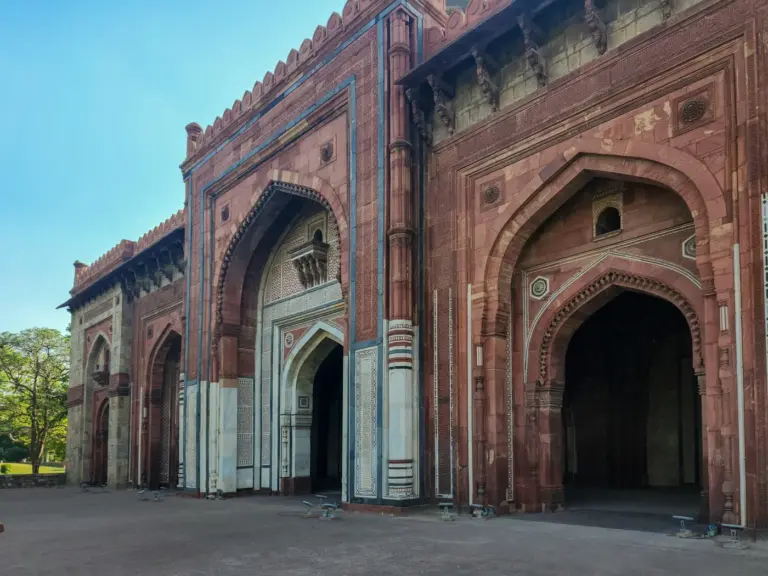
Fatehpur Sikri is the red sandstone city that the Mughal emperor Akbar built on a rocky ridge about 37 km west-southwest of Agra, in Uttar Pradesh. It was his capital from about 1571 until 1585, and it grew up around the hermitage of the Sufi saint Shaikh Salim Chishti, whose blessing Akbar credited for the birth of his heir. The ASI and UNESCO both describe it as the first planned city of the Mughals, and UNESCO inscribed it as a World Heritage Site in 1986.
Most readers carry two tidy stories about the place: Akbar built the Buland Darwaza to celebrate conquering Gujarat, and the city was abandoned because it ran out of water. The first is broadly right, though a later inscription on the gate once led writers to call it a Deccan victory arch. The second is a live debate, not a settled fact, and the popular name ‘Jodha Bai’s palace’ is shakier still. What follows keeps to what the sources support and flags where they part ways.
What Fatehpur Sikri is and when it was built
Fatehpur Sikri is a walled palace city, not a single monument, laid out along one ridge beside a lake that has now mostly dried up. The ASI protects 93 monuments in and around it, and these are the facts worth fixing first.
| Fact | Detail |
|---|---|
| Location | Agra district, Uttar Pradesh; about 37 km west-southwest of Agra |
| Built by | Akbar, the third Mughal emperor (r. 1556 to 1605) |
| Main construction | 1571 to 1573 (UNESCO); the Jama Masjid was finished first, in 1571-72 |
| Capital | The court lived at Sikri from 1572 to 1585 (ASI), then moved to Lahore |
| Name | Sikri, renamed after the Gujarat campaign; Fatehpur means “city of victory” |
| Style | Red sandstone in the trabeate (post-and-beam) order, with few domes |
| Landmark | Buland Darwaza, the Jama Masjid’s southern gate, built about 1575-76 |
| UNESCO | Inscribed in 1986 under criteria (ii), (iii) and (iv) |
| Protection | Archaeological Survey of India (Agra Circle), under the AMASR Act, 1958 |
Three lengths for Akbar’s stay are in circulation, and each counts from a different starting point:
- UNESCO’s short description says the city was the capital for only about 10 years.
- The ASI counts 13 years, from 1572 to 1585, starting when the court moved in.
- The Agra district administration says about 14 years, counting from the 1571 founding.
Writing “capital from about 1571 to 1585” keeps you right on all three.
Who built Fatehpur Sikri, and why at Sikri
The Mughal emperor Akbar built Fatehpur Sikri, and he built it at Sikri because of a saint. Akbar had come to the throne in 1556, after the death of his father Humayun, and by the late 1560s none of his children had survived. The ridge was home to Shaikh Salim Chishti, a Sufi of the Chishti order who lived in a cave there.
Sikri before Akbar
Sikri wasn’t an empty ridge. The ASI’s Agra Circle reports five cultural periods from excavations near the Hada Mahal, the earliest going back to the 2nd millennium BCE, and a Jain image of Saraswati dated 1010 CE whose inscription calls the place Sekrikya.
Babur came next. After defeating Rana Sanga at Khanwa in 1527, he laid out a garden and a water palace, the jal mahal, beside the lake, and by Abul Fazl’s account he renamed the village Shukri, “thanksgiving”, for the win.
The saint and the heir
By the account in the ASI’s older guidebook, Akbar visited the hermit and the saint foretold three sons. In 1569 a son was born at Sikri and named Salim after him; he later ruled as Jahangir. A second prince, Murad, followed the next year, and Akbar decided the place was auspicious enough to be his capital.
Akbar’s tie to the Chishtis runs through the record: even the order to build the Ibadat Khana was issued in early 1575 as he returned from Ajmer, the shrine of the order’s founder. The note on the Sufi movement in India covers the order’s ideas and saints.
Fatehpur Sikri’s history, phase by phase
Fatehpur Sikri was a capital for less than two decades, but the site’s story runs well before and after that.
| Phase | Period | What happened |
|---|---|---|
| Before the Mughals | Up to the early 16th century | Settlement by the lake; a Jain image of 1010 CE names the place Sekrikya |
| Babur | 1527 | A garden and water palace after the victory at Khanwa |
| Akbar’s capital | 1571 to 1585 | Mosque, palaces, offices and waterworks built; the court in residence from 1572 |
| After the move | 1585 onward | Capital shifts to Lahore; later emperors visit, and Jahangir stays three months in 1619 |
| Repair and protection | 19th century to today | Repairs from the British period on; ASI care; UNESCO listing in 1986 |
This was a working city, not only a palace. The English traveler Ralph Fitch, who came in 1585, found Agra and Fatehpur each “much greater than London”, as the ASI’s Agra Circle quotes him. The ASI also credits the Sikri years with several of Akbar’s best-known institutions:
- the Ibadat Khana, the hall of religious debate;
- sulh-i-kul, “peace with all”, as a principle of rule;
- jharokha darshan, the emperor’s daily appearance at a palace window;
- the Din-i-Ilahi, literally “divine faith”, and the Tarikh-i-Ilahi, Akbar’s Ilahi calendar era.
Why was Fatehpur Sikri abandoned?
Akbar left Fatehpur Sikri in 1585 and moved his capital to Lahore. Why he left is still argued over, and both explanations have serious sources behind them.
The water explanation
The older answer is water. Britannica says the capital moved because of the city’s “inadequate water supply”, and the ASI’s older guidebook blamed “inferior water, unhealthy climate and certain political reasons”. Britannica also names Delhi and 1586, where UNESCO and the ASI both say Lahore in 1585; go with Lahore and 1585.
The political explanation
The newer answer is politics. The ASI’s Agra Circle page says “political exigencies” took Akbar to Lahore, and the historian Syed Ali Nadeem Rezavi of Aligarh Muslim University argues in Fatehpur Sikri Revisited that the city was well supplied and that Mughal records give little evidence its water failed. His case rests on the city’s plumbing:
- A dammed reservoir: a valley closed off and flooded, which the ASI guidebook describes as a lake formed by blocking the Khari Nadi.
- Rainwater harvesting: tanks under the Jama Masjid and the saint’s tomb, whose porch columns are hollow to carry rain down into a tank beneath the courtyard.
- Lifting works: Persian wheels on the northern side that raised water in stages, through the Hathi Pol gate, up to the palaces.
The sensible reading
The fair position sits between the two. The move of 1585 was a political decision, which is how the ASI’s current account and Rezavi both read it; water may have added strain, but the evidence for it as the main cause is thin. Nor did the city empty overnight, since the ASI records Jahangir staying three months in 1619.
Fatehpur Sikri’s buildings, in the order you meet them
Fatehpur Sikri is built almost entirely in local red sandstone, and mostly with beams rather than arches. The ASI calls the style trabeate, meaning post-and-beam: flat stone beams laid across pillars, the way a tabletop sits on its legs. The comparison breaks at the joints, since the beams here often rest on carved brackets projecting from the pillars, something no table needs.
Four terms recur across Akbar’s buildings:
- Chhajja: a sloping stone eave on brackets that throws off sun and rain.
- Jharokha: a projecting balcony window; in the Khwabgah, the sleeping chamber, Akbar is said to have shown himself at one to the crowd every morning.
- Chhatri: a small domed kiosk raised on pillars.
- Jali: a pierced stone screen that lets in air and light but blocks the view.
UNESCO calls the result an amalgamation of indigenous and Persian styles, and the note on Mughal architecture places it in the longer story. The walk below follows the order a visitor meets the site, from the ticketed palace complex near the Diwan-i-Am to the mosque on the ridge top.
Diwan-i-Am and Diwan-i-Khas
The Diwan-i-Am, the hall of public audience, is an open court ringed by colonnades, with the emperor’s raised, screened seat on its west side opening straight into the private palace, by UNESCO’s description.
The Diwan-i-Khas, the hall of private audience, hides its main feature inside: a single carved pillar in the center carrying a raised seat, which the ASI guidebook calls “Akbar’s pillar throne” and the ASI’s Agra Circle the Hall of the Unitary Pillar. Even the familiar name is uncertain, since UNESCO says the building is only “popularly known” as the Diwan-i-Khas. A local tradition makes it the Ibadat Khana, which the ASI guidebook calls impossible.
Panch Mahal
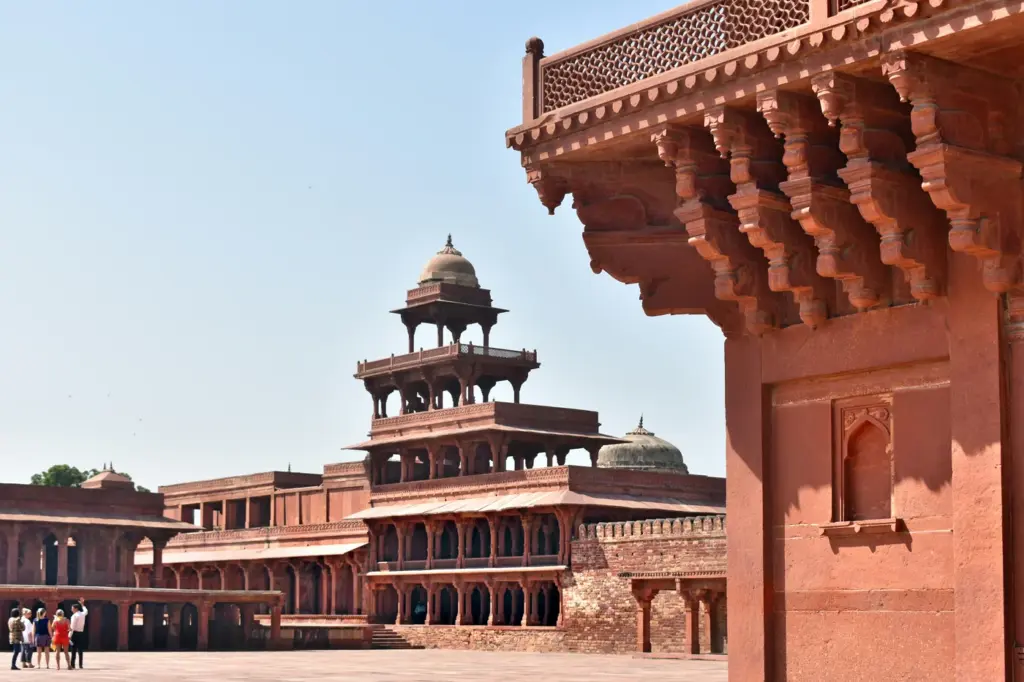
The Panch Mahal, the “five-level palace”, is an open pavilion of five floors, each smaller than the one below, standing entirely on columns. The ASI guidebook counts them floor by floor:
- ground floor: 84 columns;
- first floor: 56;
- second floor: 20;
- third floor: 12;
- the top kiosk: 4.
That’s 176 columns and no solid walls. Stone screens once filled the gaps, which is why the guidebook links the building to the women of the imperial harem, while UNESCO compares it to a Persian badgir, a wind-catcher tower that pulls breeze down into the rooms. The guidebook doubts an old claim that it copies a Buddhist monastery (vihara) and admits that “opinions differ” on its purpose.
Jodha Bai’s palace: a name, not a record
The largest house in the palace complex is known everywhere as Jodha Bai’s palace, and UNESCO uses the name for the largest building of the residential complex. Treat it as a label, not evidence. The popular story makes it the home of Akbar’s Rajput queen, Jahangir’s mother, but she appears in the record by her title, Mariam-uz-Zamani, which the ASI guidebook translates as “Mary of the age”.
The same guidebook notes that “Jodh Bai” was a different woman: Jagat Gosain, a Jodhpur princess who married Jahangir in 1585-86 and bore the future Shah Jahan. Rezavi puts the popular name in quotation marks and calls the complex the haramsara, the imperial women’s quarters.
The Jama Masjid, the saint’s tomb and the Buland Darwaza
The last stop, the mosque complex on the summit, is the oldest part of the city. UNESCO dates the Jama Masjid, the congregational mosque, to 1571-72, the earliest building on the summit of the ridge; Britannica gives its length as about 165 m.
In its courtyard stands the tomb of Salim Chishti, a marble shrine with jali screens and snake-like (serpentine) brackets under the eaves. A gilded Persian inscription over the door records the saint’s death in 1572, by the ASI guidebook’s reading, and UNESCO dates the tomb to 1580-81, with further decoration under Jahangir in 1606.
The Buland Darwaza, the “lofty gate”, is the mosque’s southern entrance, added after the mosque was finished. UNESCO dates it to 1575 and ties it to the conquest of Gujarat, as does the ASI’s Agra Circle. The wrinkle is an inscription on the central arch dated 1601-02 that refers to Akbar’s Deccan campaign. Some older writers took it for the building date, but the ASI’s guidebook reads it as a record of Akbar’s return from the Deccan, with the gate itself built in 1575-76.
Its height comes in two versions, 40 m from UNESCO and 54 m from the Agra district administration, most likely measured from different base points; UNESCO’s figure is the safer one to quote. The central doorway is the Horseshoe Gate, after the horseshoes that owners of sick animals nailed to its doors in hope of the saint’s blessing.
The Ibadat Khana: what it was and where it stood
The Ibadat Khana, the “house of worship”, was the hall at Fatehpur Sikri where Akbar held religious debates, first among Muslim scholars and later among scholars of many faiths. Its dates are firm even though its walls can’t be found:
- Early 1575: Akbar orders the building on his return from Ajmer, as Abul Fazl records.
- 1576: the building is complete, and debates run on Thursday evenings, sometimes through the night.
- 1578: after a pause, the debates resume, and from October 1578 scholars of many faiths take part.
- 2 September 1579: leading scholars sign the mahzar, a declaration that gave Akbar the final word where jurists disagreed.
- 1579: Akbar invites the first Jesuit mission; a Mughal painting of an Ibadat Khana session shows the Jesuit Rudolf Aquaviva speaking.
- About 1582: the debates have lapsed.
Abul Fazl’s list of those present from October 1578 runs from Sunni and Shia jurists to Jain monks and Christians, and it even includes the Charvakas, India’s materialist school. Rezavi reads the exercise as a way of putting reason (aql) above inherited authority (taqlid, following precedent without question), so that argument rather than rank would settle a religious claim.
Where it stood is disputed, and Rezavi counts seven or eight proposed sites. Three matter:
- The Diwan-i-Khas: a local tradition the ASI guidebook calls impossible, because Badayuni describes four halls built around a saint’s cell near the new khanqah (Sufi hospice).
- A mound east of the Jama Masjid: near its Badshahi Darwaza, an Aligarh Muslim University team under R. C. Gaur found three superimposed platforms, and since 1984 this has been the generally accepted site.
- The so-called Daftar Khana (record office): Rezavi’s own proposal, since he argues the excavated site doesn’t match what Abul Fazl and Badayuni describe.
The honest answer to “where was the Ibadat Khana?” is short: at Fatehpur Sikri, exact site disputed.
Fatehpur Sikri today: UNESCO status, protection and the 2024 suit
Fatehpur Sikri is a World Heritage Site and a centrally protected monument. UNESCO inscribed it at the 10th session of the World Heritage Committee, held in Paris from 24 to 28 November 1986, and the UNESCO listing rests it on three criteria. In plain words:
- Criterion (ii): the city influenced later Mughal town planning, and UNESCO names Shahjahanabad, Old Delhi, as the example.
- Criterion (iii): it’s exceptional evidence of Mughal civilization at the end of the 16th century.
- Criterion (iv): the city as a whole is an ensemble of very high quality, built between 1571 and 1585.
The Archaeological Survey of India manages it under the AMASR Act, 1958, over an inscribed area of 60.735 ha with a 475.542 ha buffer zone. UNESCO names the pressures:
- Mining and blasting: mining is banned within 10 km, but illegal blasting still needs watching.
- Town growth: the township’s unplanned spread threatens the views around the monuments.
- New facilities: any visitor infrastructure needs a Heritage Impact Assessment first.
The site also lies inside the Taj Trapezium Zone, the 10,400 sq km area where a Supreme Court ruling of December 1996 banned coal and coke in industry to shield the monuments from pollution.
The 2024 suit over the dargah
In May 2024 a group of trusts led by an Agra advocate filed a civil suit in an Agra court claiming that the dargah of Salim Chishti and the Jama Masjid premises stand on a former temple of the goddess Kamakhya. The defendants include the Uttar Pradesh Sunni Central Waqf Board and the committees that manage the dargah and the mosque. Hearings continued in December 2024 with no ruling reported, and the complex remains a protected monument in the ASI’s care.
Sarnath joins the list
On 25 July 2026 the World Heritage Committee’s 48th session in Busan inscribed the Ancient Buddhist Site of Sarnath, India’s 45th World Heritage Site by UNESCO’s count and Uttar Pradesh’s fourth after the three Agra-area sites. The note on Sarnath’s inscription has the details, and the roundup of UNESCO World Heritage Sites in India gives the wider picture.
How to study Fatehpur Sikri for exams
Fatehpur Sikri sits in General Studies Paper I under Indian heritage and culture, and in medieval history as the setting for Akbar’s religious policy. History optional candidates meet it again under Mughal architecture.
It’s tested from both ends. Prelims 2014 asked what the Ibadat Khana at Fatehpur Sikri was, and the answer was the hall where Akbar held discussions with scholars of various religions; Art and Culture accounts for 94 of the 1,403 questions in the Prelims PYQ bank. In Mains, 2025 GS Paper I asked “Examine the main aspects of Akbar’s religious syncretism.“, which the Ibadat Khana answers directly. The History optional digs deeper: Mains 2024 History Optional Paper I asked candidates to comment on “Instead of bringing credit, the Ibadat Khana brought growing discredit to Akbar.”, and Mains 2023 History Optional Paper I set “Mughal architecture was syncretic in character. Comment.”
Revise these facts until they’re automatic:
- Built by Akbar: main construction 1571 to 1573, and capital until the move to Lahore in 1585.
- Why Sikri: the hermitage of Shaikh Salim Chishti, and Prince Salim’s birth there in 1569.
- The name: Fatehpur, “city of victory”, after the Gujarat campaign of 1572-73.
- Buland Darwaza: the Jama Masjid’s southern gate, built about 1575-76; its 1601-02 inscription records a later event.
- Ibadat Khana: ordered in 1575 and open to many faiths from 1578; its site is disputed.
- Panch Mahal: five floors on 176 columns, which UNESCO compares to a Persian wind-catcher.
- UNESCO: inscribed in 1986 under criteria (ii) to (iv), one of four Indian sites listed that year.
The common confusions come in pairs:
- Buland Darwaza and the Deccan: the gate dates to 1575-76; the Deccan inscription on it is dated 1601-02.
- Ibadat Khana and Diwan-i-Khas: the Diwan-i-Khas is the one-pillar hall; the Ibadat Khana is unidentified.
- Ibadat Khana and Din-i-Ilahi: a debating hall isn’t a faith, so don’t merge them in an answer.
- Jodha Bai and Mariam-uz-Zamani: the palace name is popular usage; Jahangir’s mother is recorded by her title.
- Lahore and Delhi: the capital went to Lahore in 1585, as UNESCO and the ASI both say.
The sibling sites, including Agra Fort, compare like this:
| Fatehpur Sikri | Agra Fort | Humayun’s Tomb, Delhi | Red Fort, Delhi | |
|---|---|---|---|---|
| What it is | Planned palace city | Red sandstone fortress-palace | Garden tomb | Palace fort of Shahjahanabad |
| Period | 1571 to 1585 | 16th century, with later palaces | Built in 1570 | Shah Jahan’s reign |
| UNESCO year | 1986 | 1983 | 1993 | 2007 |
| Why it matters | First planned Mughal city | An imperial city inside 2.5 km of walls | First garden tomb on the subcontinent | The later city that UNESCO says Fatehpur Sikri influenced |
Fatehpur Sikri rewards the student who can hold a firm chronology and still say ‘disputed’ where the record runs thin. Get the building dates exactly right, then use the water debate and the lost Ibadat Khana to show you know where the evidence stops. An answer that does both reads like history; a list of buildings reads like a brochure.
Frequently Asked Questions
Who built Fatehpur Sikri and when?
Fatehpur Sikri was built by the Mughal emperor Akbar, with the main construction between 1571 and 1573 by UNESCO’s dating. The Jama Masjid was finished first, in 1571-72, and the court lived there from 1572 until the move to Lahore in 1585. Akbar chose the site because the Sufi saint Shaikh Salim Chishti lived on the ridge, and his son Salim was born there in 1569.
Why is it called Fatehpur Sikri?
Sikri was the name of the village on the ridge, and Fatehpur means ‘city of victory’. Akbar renamed the place after his conquest of Gujarat in 1572-73, and the ASI records that he first called it Fathabad before the name Fatehpur Sikri came into use.
Why did Akbar build the Buland Darwaza?
The usual account, which UNESCO and the ASI follow, is that the Buland Darwaza was added to the Jama Masjid around 1575-76 to mark the conquest of Gujarat. An inscription on the gate dated 1601-02 refers to Akbar’s Deccan campaign, which led some older writers to call it a Deccan victory arch. The ASI’s guidebook reads that inscription as a record of a later event, not the building date.
Why was Fatehpur Sikri abandoned?
Akbar moved his capital to Lahore in 1585, and historians disagree about why. The older explanation is a failing water supply, which Britannica repeats, while the ASI’s current account cites political exigencies and the historian Syed Ali Nadeem Rezavi argues the city was well supplied with water. The fairest answer is that the move was a political decision and water was at most a contributing strain.
What was the Ibadat Khana?
The Ibadat Khana, or house of worship, was a hall Akbar ordered at Fatehpur Sikri in 1575 for religious debates held on Thursday evenings. At first only Muslim scholars took part, but from 1578 scholars of many faiths joined, and Jesuit priests later attended too. Its exact location is still disputed.
Is the Panch Mahal really five stories high?
Yes. The Panch Mahal is an open pavilion of five floors, each smaller than the one below, carried on 176 columns in all by the ASI guidebook’s count. Its purpose is debated, since the guidebook links it to the women of the imperial harem while UNESCO compares it to a Persian wind-catcher tower.
Was Jodha Bai’s palace built for Akbar’s wife?
That’s the popular story, but the name is best treated as a label. Akbar’s Rajput queen, the mother of Jahangir, appears in the record by her title Mariam-uz-Zamani, and the ASI’s older guidebook says the name Jodh Bai belonged to Jagat Gosain, a Jodhpur princess who married Jahangir. Historians such as Rezavi treat it as part of the haramsara, the imperial women’s quarters.
When did Fatehpur Sikri become a UNESCO World Heritage Site?
UNESCO inscribed Fatehpur Sikri in 1986, at the 10th session of the World Heritage Committee in Paris. It was listed under criteria (ii) to (iv), which recognize its influence on later Mughal town planning and its quality as an ensemble of late 16th-century buildings.
Practice Questions
Prelims
1. Consider the following statements about Fatehpur Sikri: 1. The Jama Masjid was the earliest building constructed on the summit of the Sikri ridge. 2. The Buland Darwaza was part of the original design of the Jama Masjid. Which of the statements given above is/are correct?
- (a) 1 only
- (b) 2 only
- (c) Both 1 and 2
- (d) Neither 1 nor 2
Answer: (a) UNESCO dates the Jama Masjid to 1571-72 as the earliest building on the summit, while the Buland Darwaza was added after the mosque was finished.
2. Consider the following statements about the Ibadat Khana: 1. Akbar ordered it built in 1575, on his return from Ajmer. 2. Scholars of faiths other than Islam took part from its very first year. 3. Its location at Fatehpur Sikri has been identified beyond dispute. Which of the statements given above is/are correct?
- (a) 1 only
- (b) 1 and 2 only
- (c) 2 and 3 only
- (d) 1, 2 and 3
Answer: (a) The order came in early 1575 and other faiths joined only from 1578, while at least seven or eight sites have been proposed for the building.
3. Which one of the following pairs is correctly matched?
- (a) Panch Mahal : an open pavilion of five floors carried entirely on columns
- (b) Diwan-i-Am : a hall with a single central pillar carrying the emperor’s seat
- (c) Horseshoe Gate : the entrance to the Panch Mahal
- (d) Khwabgah : the congregational mosque of the city
Answer: (a) The Panch Mahal stands on 176 columns in five diminishing floors; the single-pillar hall is the Diwan-i-Khas.
4. Which of the following sites were inscribed on the UNESCO World Heritage List in the same year as Fatehpur Sikri? 1. Group of Monuments at Hampi 2. Khajuraho Group of Monuments 3. Taj Mahal Select the correct answer using the code given below.
- (a) 1 and 2 only
- (b) 2 and 3 only
- (c) 1 and 3 only
- (d) 1, 2 and 3
Answer: (a) Hampi and Khajuraho were inscribed in 1986 with Fatehpur Sikri, while the Taj Mahal was inscribed in 1983.
5. With reference to the Buland Darwaza, consider the following statements: 1. It forms the southern entrance of the Jama Masjid at Fatehpur Sikri. 2. An inscription on it dated 1601-02 refers to Akbar’s Deccan campaign. 3. UNESCO dates its completion to 1585. Which of the statements given above is/are correct?
- (a) 1 and 2 only
- (b) 2 and 3 only
- (c) 1 and 3 only
- (d) 1, 2 and 3
Answer: (a) UNESCO dates the gate’s completion to 1575, not 1585, and the 1601-02 inscription records a later event.
Mains
- Safeguarding the Indian art heritage is the need of the moment. Discuss. (10 marks, 150 words) Previous year: Mains 2018, GS Paper I.
- Fatehpur Sikri is often called a synthesis of Persian and Indian building traditions. Examine this claim with reference to its named buildings. (15 marks, 250 words)
- “Fatehpur Sikri was abandoned because it ran out of water.” Critically examine this explanation in the light of the available evidence. (15 marks, 250 words)
- Why did Akbar build his capital at Sikri? Discuss what the choice reveals about the place of Sufi saints in early Mughal political culture. (10 marks, 150 words)
- How far did the Ibadat Khana debates prepare the ground for Akbar’s policy of sulh-i-kul? (15 marks, 250 words)
Tell Google you want more of this.
Add Anantam IAS as a preferred sourceOne tap, and this site shows up more often in your own Top Stories, AI Overviews and AI Mode. Remove it any time.