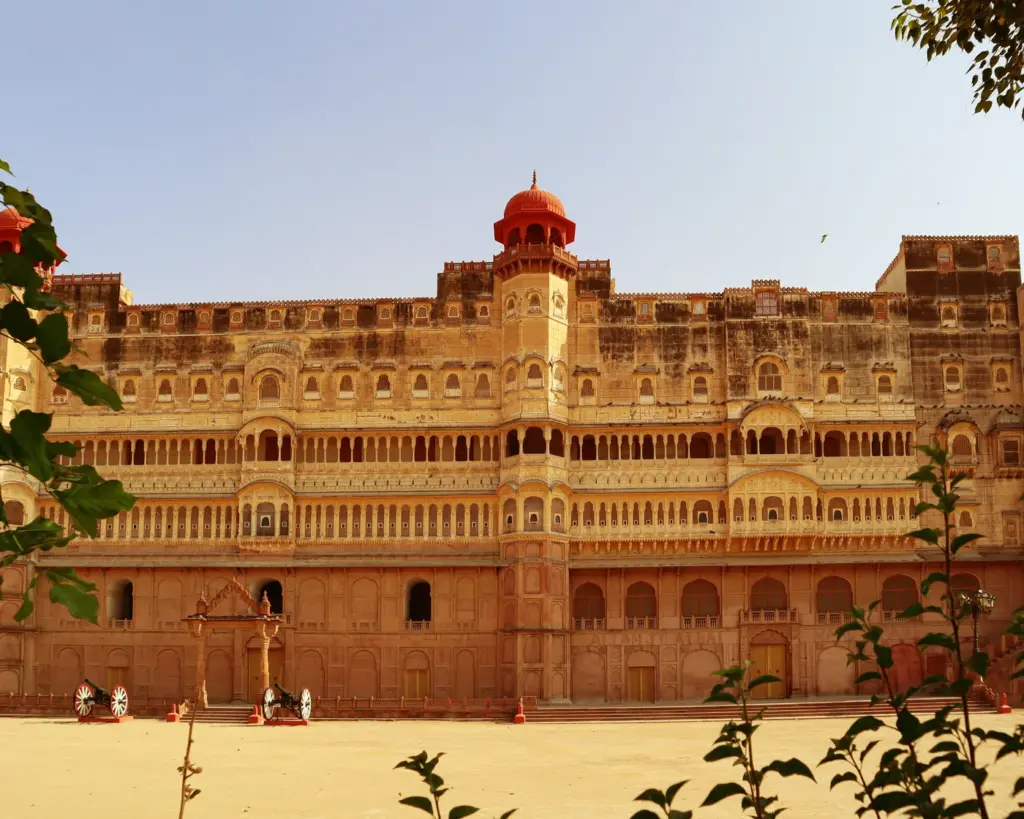
Junagarh Fort is the walled fortress-palace at the center of Bikaner, in the Thar Desert of northern Rajasthan. Raja Rai Singh, the Rathore ruler of Bikaner and one of Akbar’s generals, had it built between 1589 and 1594 on open, level ground, and his successors kept adding palaces inside it for about four centuries. It shows how a desert state fortified itself without a hill, and how a Rajput court’s service to the Mughals ended up in its architecture.
Three mix-ups follow this fort around. The first is the name: Junagarh in Bikaner has nothing to do with Junagadh in Gujarat, whose old citadel is Uparkot. The second is status: because Rajasthan’s best-known forts crown hills, Junagarh is often counted among the six UNESCO Hill Forts of Rajasthan, and it isn’t one of them. The third is the “never captured” line, which is fair for this fort but often comes attached to a capture that happened to an older one. This note settles all three.
What Junagarh Fort is and who built it
Junagarh is a land fort, a fortress raised on flat ground, wrapped around a palace complex in the middle of Bikaner city. Rai Singh called it Chintamani, after the wish-fulfilling gem of Hindu and Buddhist lore; the name Junagarh, “old fort”, came later.
| Fact | Detail |
|---|---|
| Location | Bikaner city, northern Rajasthan, in the Thar Desert; about 300 yards from the Kot gate of the old walled city (Imperial Gazetteer) |
| Type | Land fort on level sandy ground, rectangular in plan and ringed by a moat; not a hill fort |
| Built by | Raja Rai Singh (r. 1571-1611), with his minister Karm Chand Bachawat in charge of the work |
| Built when | Foundation 17 February 1589, completion 17 January 1594 (the trust, from Vikram Samvat dates); the gazetteers give 1588 to 1593 |
| Original name | Chintamani; later Junagarh, “old fort” |
| Later holders | The Rathore rulers of Bikaner throughout; besieged by Jodhpur armies, notably about 1740 and in 1808, but said never to have been taken |
| Defenses | A wall 1,078 yards (about 986 m) round and about 40 feet high, 37 bastions, a moat 20 to 25 feet deep, seven gates |
| Protection | Not on the ASI’s list of centrally protected monuments; its museum (1961) is run by the Maharaja Rai Singhji Trust of the former ruling family |
| UNESCO status | Not inscribed and not on India’s Tentative List; not one of the six Hill Forts of Rajasthan (2013) |
A fort this well known sits outside both the ASI’s list and UNESCO’s because its builders’ family still runs it through a trust.
Why Junagarh stands on flat ground
Junagarh stands on flat ground because Bikaner had no hill to offer. The trust that runs the fort calls it one of the strongest land forts in the plains, built in the sandy plains because no naturally strong site existed. The country around it is the northern Thar Desert, known in Rao Bika’s day as Jangaldesh.
Rao Jodha’s Mehrangarh sits on a sandstone hill above Jodhpur, and the Bhati fort at Jaisalmer sits on Trikuta hill. At Bikaner every defense had to be dug or built.
Think of a hill fort as a house on a cliff edge, where the cliff does half the guarding. A land fort is a house on an open plot that has to build its own cliff out of a ditch and a high wall. It holds for climbing: an attacker still had to cross the ditch and scale a 40-foot wall. It breaks on sight lines: a hill lets defenders see an enemy coming from far off, while on the plain the lookout was only as high as the bastions.
Bikaner’s first fort and the one capture on record
Junagarh wasn’t Bikaner’s first fort. Rao Bika, a son of Rao Jodha of Jodhpur, left Marwar in 1465 to win land of his own and founded Bikaner in 1488, the year every official source agrees on.
Why he left is told as legend. The 1909 Rajputana gazetteer, which counts Bika as Jodha’s sixth son, traces it to a jest from his father at a darbar, answered by Bika’s vow to win new lands. The trust adds that the goddess Karni Mata, whose temple is at Deshnok about 30 km away, blessed the venture. Both are tradition; the founding date is the record.
Bika first built a small fortress in the Rati Ghati area, at the south-west end of the old walled city near the Laxminath temple, and his family lived there until Rai Singh’s fort was ready. By 1908 the Imperial Gazetteer found it “now rather a shrine than a fort”.
That old fort is where Bikaner’s one recorded capture belongs, in the 1909 gazetteer’s sequence:
- In 1538 Kamran, a son of Babur, took Bhatner, a fort on the desert’s border, and marched on Bikaner, but Rao Jet Singh drove him off with a night attack.
- Three years later Maldeo of Jodhpur invaded, killed Jet Singh and captured the fort at the capital.
- Jet Singh’s son Kalyan Singh got his capital back only in 1544, after Sher Shah‘s army defeated Maldeo near Ajmer.
Popular accounts often say Kamran held Bikaner for a day in 1534, but the gazetteer’s fuller record differs. Either way, it all happened to Bika’s fort; Junagarh didn’t exist until 1589.
How Rai Singh’s Mughal service built Chintamani
Junagarh was paid for by Mughal service. In 1570 Kalyan Singh and his son Rai Singh waited on Akbar at Nagaur, and the Tabaqat-i-Akbari, quoted in the 1909 gazetteer, records that the emperor married Kalyan Singh’s daughter. The father went home; the son stayed in attendance on the emperor.
Rai Singh, born in 1541, succeeded in 1571. The district administration calls him one of Akbar’s most distinguished generals and the first Raja of Bikaner, and the gazetteer’s record of his service bears that out:
- He relieved Nagaur when Ibrahim Husain Mirza besieged it.
- He was Subahdar, or provincial governor, of Burhanpur in the Deccan, and later governor of Surat.
- He held a mansab of 4,000 at Akbar’s death in 1605, and Jahangir raised it to 5,000.
A mansab was a numbered rank that fixed a noble’s pay and the troops he kept, so 4,000 placed Rai Singh among the empire’s senior nobles. Akbar even gave him the formal grant of Jodhpur with the leadership of the Rathore clan, though Rai Singh never took possession.
The gazetteer says Rai Singh planned the fort while he was Subahdar of Burhanpur and had his minister, Karm Chand Bachawat (Karan Chand in many modern accounts), begin the work. The trust gives the calendar from the Vikram Samvat dates recorded at the time:
- first digging: 30 January 1589;
- foundation: 17 February 1589;
- completion: 17 January 1594.
Vikram Samvat is the Hindu calendar era that runs 56 or 57 years ahead of the Common Era, depending on the month, and that explains the two sets of dates. Subtract 57 from Vikram Samvat 1645 and 1650 and you get the gazetteers’ 1588 and 1593. The recorded days fall in January and February, though, when the gap is 56, which gives the trust’s 1589 and 1594. It is wise to write 1589 to 1594 and name the older figure alongside.
The minister’s story ends badly: the gazetteer records that Rai Singh’s son Sur Singh, carrying out his father’s dying wish, lured Karm Chand’s family back to Bikaner and had them killed.
Chintamani became Junagarh, the “old fort”, once the rulers had something newer to compare it with; by 1908 the Imperial Gazetteer was describing Lalgarh, the Maharaja’s new palace outside the city. No official source dates the renaming, so write “later”.
Sieges and later rulers, from Sur Singh to 1949
After Rai Singh, the fort’s story moves in three stages.
The Mughal century
Bikaner’s rulers kept serving the empire. Karan Singh (r. 1631-69) backed Aurangzeb in the war of succession among Shah Jahan’s sons. His son Anup Singh (r. 1669-98) took a prominent part in the capture of Golconda in 1687 and was made a Maharaja, a title his successors kept.
The Jodhpur sieges
As Mughal power faded, Bikaner and Jodhpur fought on and off, and the 1909 gazetteer records the attempts on the capital:
- 1733: a Jodhpur army under Bakht Singh was beaten near the capital, and his attempt on the fort about a year later failed.
- About 1740: Maharaja Abhai Singh of Jodhpur plundered the city and besieged the fort for three months and five days, lifting the siege only when Sawai Jai Singh of Jaipur, at Bikaner’s request, invaded Jodhpur’s territory.
- 1808: Maharaja Man Singh of Jodhpur invested the capital and withdrew once Surat Singh ceded Phalodi and paid an indemnity.
The Imperial Gazetteer’s verdict is that this fort “has been besieged several times, but is said to have never been taken, though the old one once was”. Rajasthan Tourism calls it simply never captured. The gazetteer’s “is said to” is the careful version, and it’s the one to write.
British paramountcy and the move to Lalgarh
On 9 March 1818 Maharaja Surat Singh signed a treaty binding Bikaner to “subordinate co-operation” with the British, who agreed to protect his territory. After that, the additions inside the fort are palaces, not defenses.
Dungar Singh (r. 1872-87), whom the trust calls the father of modern Bikaner, brought electricity to the city in 1886. His younger brother Ganga Singh, installed in 1887 and ruler until 1943, built Lalgarh Palace outside the city and added Vikram Vilas inside the fort in 1936-37. Bikaner acceded to India in 1947 and joined Rajasthan on 30 March 1949, according to the district administration.
The defenses, in the order an attacker meets them
Junagarh’s defenses are layered so that each makes up for the missing hill.
First comes the moat, 20 to 25 feet (6 to 7.6 m) deep by the trust’s figures, and wider at the top (30 feet) than at the base (15 feet). The Imperial Gazetteer notes that it ran parallel to the curtains, the straight stretches of wall between bastions, instead of curving round each bastion.
Next is the wall, a quadrangle 1,078 yards (about 986 m) round and about 40 feet (12 m) high; the trust puts its thickness at 14.5 feet. It carries 37 bastions, or burj, towers that project from the wall so defenders can fire along its face instead of only straight out.
One figure needs checking before you copy it. Incredible India gives the enclosed area as 63,119 square yards, about 5.3 hectares, while the trust’s site prints 1,63,119. A 1,078-yard wall can’t hold the larger number: even a perfect circle of that length encloses only about 92,000 square yards. So 63,119 is the figure to use.
Then the gates. The district administration names Karan Pol, facing east, as the main entrance; Chand Pol faces west. The trust says Karan Pol is guarded by four successive gates and Chand Pol by a double gate, close to the gazetteer’s “three or four successive gates” at each. Their doors carry spiked iron gratings, which the trust explains as a stumbling block for enemy elephants, the living battering rams of a medieval army.
There are seven gates (pol) in all, and two carry the stories visitors remember:
- Suraj Pol, the Sun Gate, which Incredible India groups with Karan Pol as built of golden sandstone, unlike the red Dulmera sandstone of the palaces.
- Daulat Pol, whose wall, Incredible India records, carries the handprints of royal women who died by sati, the burning of widows on their husbands’ pyres.
Last comes water. The trust counts four deep wells inside the walls, and in a desert, wells decide how long a garrison can sit out a siege like the three-month blockade of about 1740.
The palaces inside, from Phool Mahal to Vikram Vilas
Inside the walls, Junagarh is a stack of palaces, because nearly every ruler added rooms of his own. The trust sorts sixteen generations of building into three phases:
- 16th-century Rajput work shaped by Gujarati and Mughal design;
- a semi-western style under Dungar Singh (1872-87);
- a revivalist Rajput style under Ganga Singh (1887-1943).
The borrowing from Mughal architecture is the thread to follow, because it records whom these rulers served. Walk the main rooms roughly in the order they were built:
- Phool Mahal, the Flower Palace, is the oldest part and Rai Singh’s work; its flower vases and rose-water sprinklers echo motifs of Jahangir’s time.
- Karan Mahal, the hall of public audience, is named for Karan Singh, but the trust says his son Anup Singh built it around 1680 as his memorial. It’s Mughal work in white marble and stucco, lime plaster modeled into relief, with cusped arches, whose curves break into small lobes, on short bellied columns of the Aurangzeb period.
- Anup Mahal, the privy council room, is covered in gold and vermilion varnish work, with a glass mosaic of Rama and Sita.
- Gaj Mandir held the private rooms of Gaj Singh (r. 1745-88), with mirrors set behind carved panels in Mughal niches by an architect brought from Jaipur.
- Badal Mahal, the Hall of Clouds, is painted with blue-and-white clouds, which the trust reads as a longing for rain.
- Vikram Vilas, Ganga Singh’s throne room of 1936-37, is named after the legendary king Vikramaditya.
One conflict needs settling. The district administration’s older page says Karan Mahal marks a victory over Aurangzeb, but the trust’s version fits the dates: Karan Singh died in 1669 after backing Aurangzeb in the succession war, so a building of about 1680 by his son reads as a memorial.
Read in order, the rooms borrow from the Mughal court first and deliberately revive a Rajput style last, under a ruler allied to the British.
Junagarh Fort today: a trust-run museum outside the ASI and UNESCO lists
Junagarh is a museum run by the former ruling family’s trust, and it’s neither a centrally protected monument nor a World Heritage Site. Maharaja Karni Singh set up the Junagarh Fort Museum in 1961 under the Maharaja Rai Singhji Trust.
The ASI’s list of centrally protected monuments names only two sites in Bikaner district, both Jain temples, and Junagarh isn’t among the 73 monuments of its Jodhpur Circle. Bhatner, the fort Kamran took in 1538, is on the list.
UNESCO’s Hill Forts of Rajasthan were inscribed in 2013 under criteria (ii) and (iii). In plain words, the forts show an exchange of Rajput ideas in fort planning across Rajasthan’s varied terrain, and they embody Rajput traditions in stone. The six components are:
- Chittorgarh;
- Kumbhalgarh;
- Ranthambore, in Sawai Madhopur district;
- Gagron, in Jhalawar district;
- Amer, near Jaipur;
- Jaisalmer.
Junagarh isn’t one of them, and it isn’t on India’s Tentative List either. The series name is the clue: these are hill forts, and Junagarh is a plains fort. The roundup of UNESCO World Heritage Sites in India gives the full national list.
The live issue is governance. IANS reported on 27 November 2024 that cross-FIRs had been filed in Bikaner in a dispute over the former ruling family’s trusts, after the Devasthan Department, which administers Rajasthan’s public trusts law, changed the list of trustees in May 2024. On 2 January 2025 it reported that the department, on appeal, had recognized the trustees removed in May, giving them access to Junagarh and Lalgarh.
The lesson for a heritage answer is direct: a privately held monument’s upkeep depends on how well its trust is run, because the central protections for listed monuments don’t apply to it by default.
How to study Junagarh Fort for exams
Junagarh sits in three parts of the syllabus:
- medieval history, as a clean case of Rajput-Mughal alliance through service;
- art and culture, for Rajput palace architecture and its Mughal borrowings;
- modern India and heritage management, for the princely state and the trust that runs the fort.
A single fort rarely gets a question of its own. In the site’s Prelims question bank, 94 of the 1,403 questions from 2013 to 2026 are tagged Art and Culture, so Junagarh earns marks as an example. Mains 2020 GS Paper I asked “Indian philosophy and tradition played a significant role in conceiving and shaping the monuments and their art in India. Discuss.” Junagarh is a useful counterpoint there, because its rooms were shaped by political patronage as much as by tradition.
History Optional 2025 Paper I asked: “Akbar’s Rajput policy was shaped by considerations of factional politics in the Mughal court. Discuss.” History Optional 2021 Paper I asked: “Discuss with relevant illustrations the relations between Akbar and the Rajput states.” Bikaner’s submission at Nagaur in 1570 and Rai Singh’s career illustrate both.
Revise these facts until they come without effort:
- Rao Bika, a son of Rao Jodha, left Jodhpur in 1465 and founded Bikaner in 1488.
- Raja Rai Singh (r. 1571-1611), Akbar’s general and Bikaner’s first Raja, built Junagarh from 1589 to 1594 through his minister Karm Chand Bachawat.
- It was first called Chintamani; Junagarh means “old fort”.
- It’s a land fort with a 1,078-yard wall and 37 bastions, entered through Karan Pol.
- Maldeo of Jodhpur took Bika’s old fort; Junagarh, besieged about 1740 and in 1808, is said never to have been taken.
- Phool Mahal is the oldest palace. Karan Mahal (about 1680) is Mughal in style, while Vikram Vilas (1936-37) is Rajput revival.
- The Maharaja Rai Singhji Trust runs it, and it’s neither ASI-protected nor a Hill Fort of Rajasthan.
Four confusions cost marks:
- Junagarh and Junagadh. Junagarh is in Bikaner. Junagadh is a city in Gujarat whose old fort, Uparkot, Gujarat Tourism says is believed to date to the Mauryan period.
- Junagarh and the Hill Forts. Any option listing Junagarh among the six 2013 components is wrong.
- Junagarh and Bika’s fort. Kamran’s raid of 1538 and Maldeo’s capture belong to the old fort.
- Karan Mahal’s name and builder. It’s named after Karan Singh, who died in 1669, and was built about 1680 by Anup Singh.
A short comparison keeps the Rajasthan forts apart:
| Fort | Type | Builder and date | Protection | UNESCO |
|---|---|---|---|---|
| Junagarh, Bikaner | Land fort on flat ground | Raja Rai Singh, 1589-1594 | Private; museum run by a family trust since 1961 | Not inscribed |
| Mehrangarh, Jodhpur | Hill fort | Rao Jodha, from about 1459 | Private; run by a family trust | Not inscribed |
| Jaisalmer | Hill fort on Trikuta hill | Rawal Jaisal, about 1156 | ASI Monument of National Importance | Hill Forts of Rajasthan, 2013 |
| Kumbhalgarh | Hill fort in the Aravallis | Rana Kumbha, 1443-1458 | ASI Monument of National Importance | Hill Forts of Rajasthan, 2013 |
| Amer, Jaipur | Hill palace-fortress | Raja Man Singh I, from 1592 | State protected monument | Hill Forts of Rajasthan, 2013 |
Junagarh is worth your time for the contrast it carries. Most famous Rajasthan forts borrow their strength from a hill; this one had to build all of it, then spent four centuries filling its walls with rooms that track Bikaner’s changing overlords. Learn it as the plains exception, and it’ll serve you in a history answer as readily as in a heritage one.
Frequently Asked Questions
Who built Junagarh Fort?
Raja Rai Singh of Bikaner, a Rathore ruler who served Akbar as a general, built Junagarh Fort between 1589 and 1594, with his minister Karm Chand Bachawat supervising the work. Older gazetteers give the dates as 1588 to 1593, a gap that comes from converting Vikram Samvat years. Later rulers kept adding palaces inside it until the 20th century.
What was the original name of Junagarh Fort?
The fort was first called Chintamani, after the wish-fulfilling gem of Hindu and Buddhist lore. The name Junagarh, meaning ‘old fort’, came later, once the rulers had built newer palaces such as Lalgarh outside the city. The official sources don’t record the exact year of the change.
Is Junagarh Fort built on a hill?
No. Junagarh is a land fort on the sandy plain of Bikaner, so it relied on a moat and a ring of 37 bastions instead of a natural rock. Mehrangarh and Jaisalmer, by contrast, stand on hills.
Is Junagarh Fort a UNESCO World Heritage Site?
No. The Hill Forts of Rajasthan, inscribed in 2013, are a series of six hill forts, and Junagarh, a plains fort, isn’t one of them. It isn’t on India’s Tentative List either, and it isn’t a centrally protected ASI monument.
Was Junagarh Fort ever captured?
By the Imperial Gazetteer’s account, no. Jodhpur armies besieged it, most seriously for three months and five days around 1740, but it is said never to have been taken. The capture people often mention belongs to Rao Bika’s older fort, which Maldeo of Jodhpur took three years after Kamran’s 1538 raid.
Who manages Junagarh Fort today?
The Maharaja Rai Singhji Trust, set up by the former ruling family of Bikaner, runs the fort and its museum, which Maharaja Karni Singh established in 1961. Control of the family’s trusts was disputed in 2024 and 2025, with Rajasthan’s Devasthan Department ruling on who the trustees are.
Is Junagarh Fort the same as Junagadh in Gujarat?
No. Junagarh Fort is in Bikaner, Rajasthan, and was built by a Rathore ruler in the 16th century. Junagadh is a city in Gujarat, and its old fort is Uparkot, which Gujarat Tourism says is believed to date to the Mauryan period.
What are the main palaces inside Junagarh Fort?
The oldest is Phool Mahal, built by Rai Singh. Karan Mahal is a Mughal-style audience hall of about 1680, and Vikram Vilas was added by Ganga Singh in 1936-37. Between them they show how each ruler added rooms of his own over about four centuries.
Practice Questions
Prelims
1. Consider the following statements about Junagarh Fort: 1. It was built on level ground rather than on a hill. 2. It is one of the six components of the Hill Forts of Rajasthan World Heritage Site. Which of the statements given above is/are correct?
- (a) 1 only
- (b) 2 only
- (c) Both 1 and 2
- (d) Neither 1 nor 2
Answer: (a) Junagarh is a land fort on the plain of Bikaner, and it is not among the six forts inscribed in 2013.
2. Which one of the following forts is NOT a component of the Hill Forts of Rajasthan World Heritage Site?
- (a) Gagron
- (b) Junagarh
- (c) Kumbhalgarh
- (d) Jaisalmer
Answer: (b) The six components are Chittorgarh, Kumbhalgarh, Ranthambore, Gagron, Amer and Jaisalmer.
3. Consider the following statements: 1. Rao Bika founded the city of Bikaner in 1488. 2. Raja Rai Singh of Bikaner served as a general under Akbar. 3. Bikaner signed a treaty with the British in 1818. Which of the statements given above is/are correct?
- (a) 1 and 2 only
- (b) 2 and 3 only
- (c) 1 and 3 only
- (d) 1, 2 and 3
Answer: (d) All three statements match the gazetteer and the district’s own history of Bikaner.
4. Junagarh Fort in Bikaner was originally known as:
- (a) Sonar Qila
- (b) Chintamani
- (c) Lalgarh
- (d) Rati Ghati
Answer: (b) Rai Singh’s fort was called Chintamani; Rati Ghati was the site of Rao Bika’s earlier fort and Lalgarh is a later palace.
5. Consider the following statements: 1. Junagarh Fort is a centrally protected monument of the Archaeological Survey of India. 2. The Junagarh Fort Museum was set up in 1961 under the Maharaja Rai Singhji Trust. Which of the statements given above is/are correct?
- (a) 1 only
- (b) 2 only
- (c) Both 1 and 2
- (d) Neither 1 nor 2
Answer: (b) The ASI list for Bikaner district has only two Jain temples, while the trust set up the museum in 1961.
Mains
- Safeguarding the Indian art heritage is the need of the moment. Discuss. (10 marks, 150 words) Previous year: Mains 2018, GS Paper I.
- Junagarh Fort was built on flat desert ground rather than on a hill. How did its builders make up for the absence of natural defenses, and what does the comparison with Rajasthan’s hill forts reveal? (15 marks, 250 words)
- “Bikaner’s alliance with the Mughals is written into the palaces of Junagarh Fort.” Examine this statement with reference to the fort’s buildings from the late 16th to the 18th century. (15 marks, 250 words)
- Junagarh Fort is run by a private family trust and sits outside both the ASI and UNESCO lists. What are the strengths and risks of this model of heritage management? (10 marks, 150 words)
- Assess the main administrative issues and socio-cultural problems in the integration process of Indian Princely States. (10 marks, 150 words) Previous year: Mains 2021, GS Paper I.
Tell Google you want more of this.
Add Anantam IAS as a preferred sourceOne tap, and this site shows up more often in your own Top Stories, AI Overviews and AI Mode. Remove it any time.