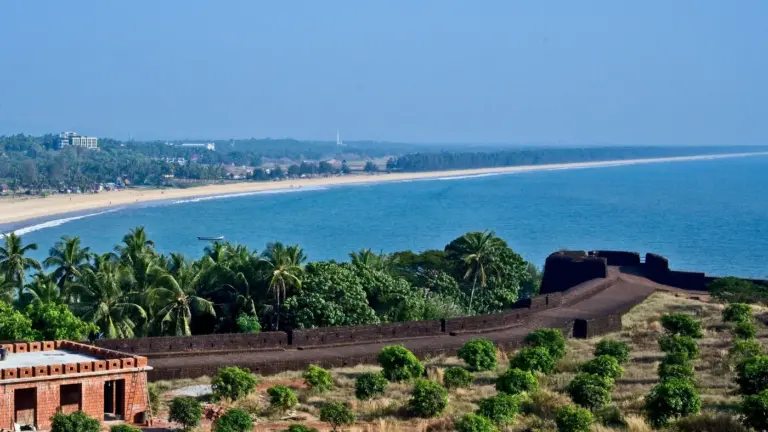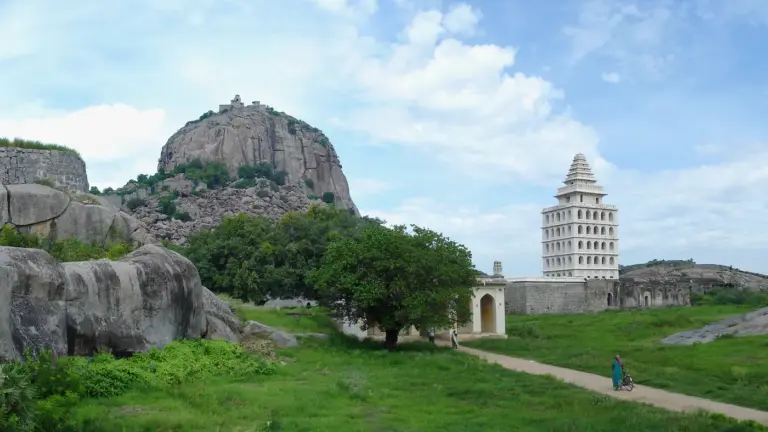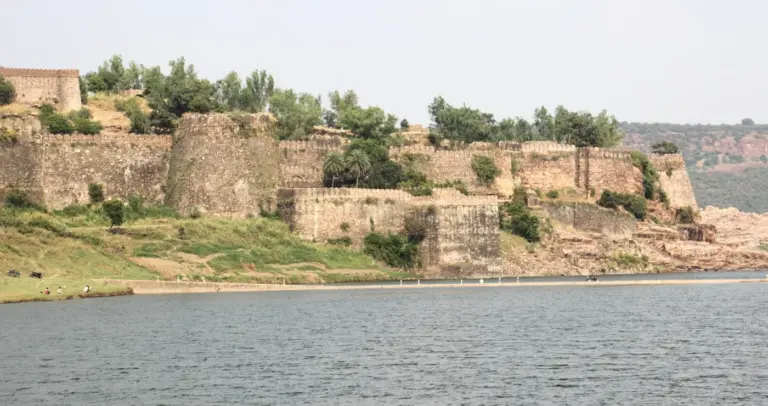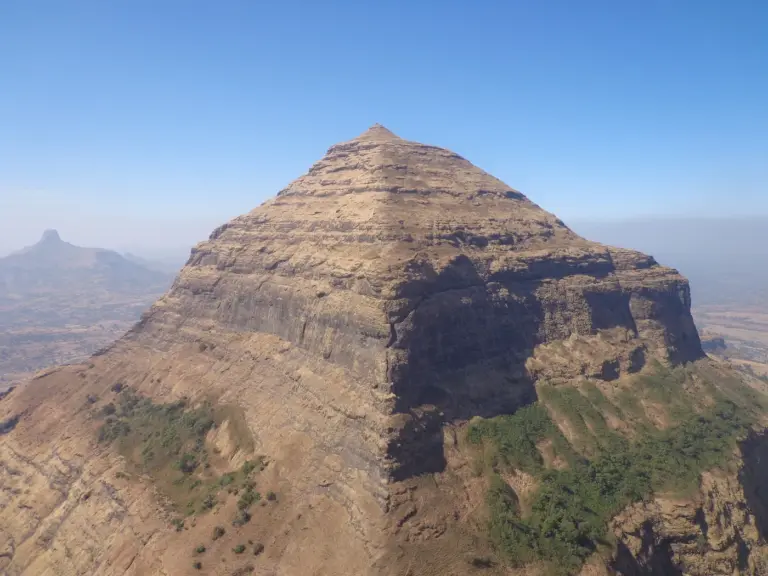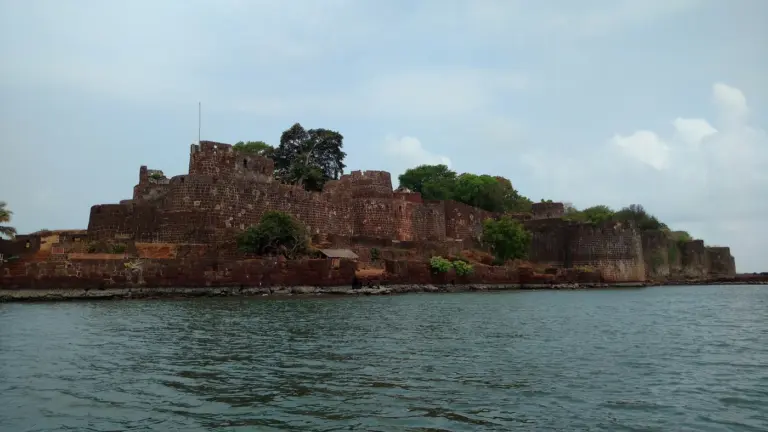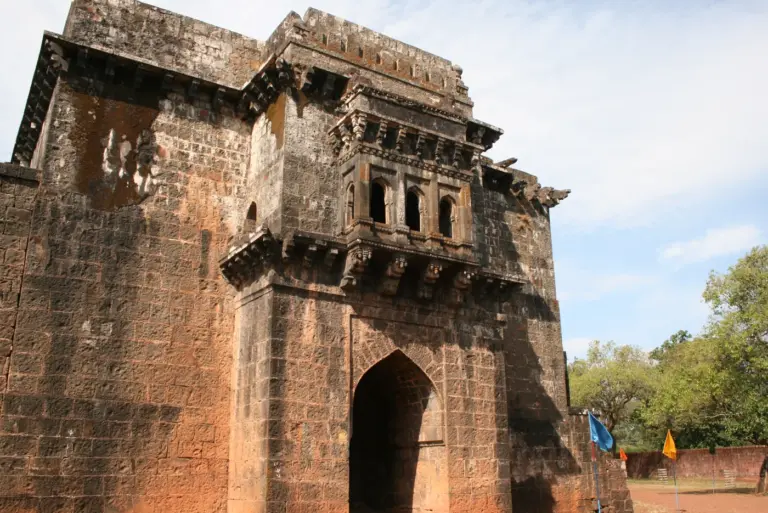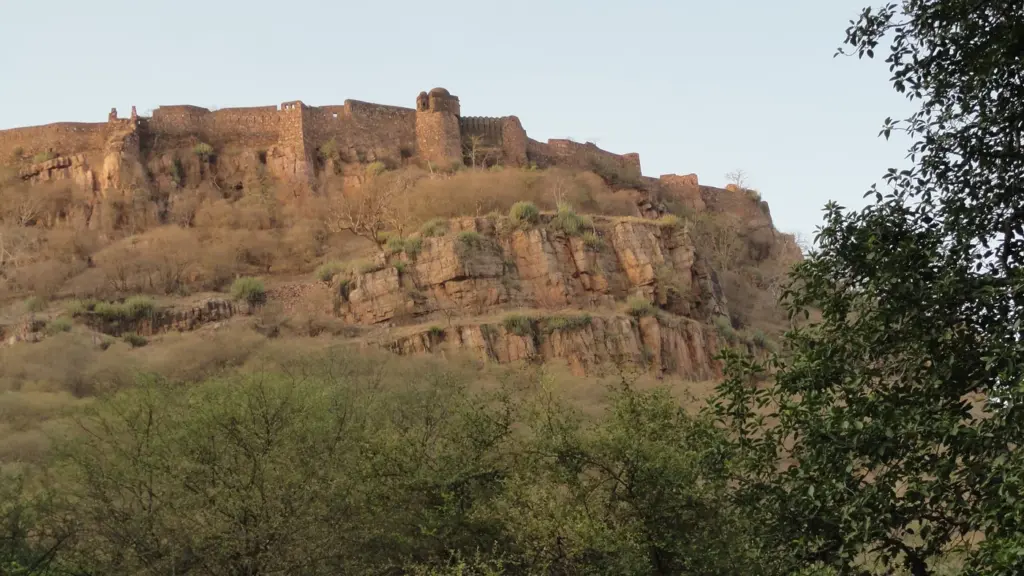
Ranthambore fort is a hill fort ringed by forest in eastern Rajasthan, standing on Thambhor Hill inside Ranthambore National Park near Sawai Madhopur. It was the seat of the Chauhan king Hammir Dev, whose defeat by Alauddin Khalji in 1301 ended in a jauhar, and it changed hands several times afterward before it settled with the Kachhwaha rulers of Jaipur. Since 2013 it has been one of the six Hill Forts of Rajasthan on UNESCO’s World Heritage List, and the only one of them chosen as a forest fort.
Most summaries give the fort a founding date, usually 944 AD, and move on. The sources don’t allow that. The Archaeological Survey of India repeats a tradition that puts the first fort in the 5th century. Rajasthan’s tourism department says the 10th. The evaluation UNESCO relied on finds the first certain mention of fortifications only in the 12th century, and the same tourism page even dates Alauddin’s siege to 1303, which is the year of Chittor. The version worth remembering keeps tradition and record apart and gets the siege year right.
What Ranthambore Fort is and where it stands
Ranthambore is a hill fort of the forest type: a walled plateau where the cliffs did much of the defending, set in dry forest that is now tiger habitat. These are the facts worth fixing first.
| Fact | Detail |
|---|---|
| Location | Thambhor Hill, inside Ranthambore National Park, near Sawai Madhopur in eastern Rajasthan |
| Type | Forest hill fort; the only forest fort among UNESCO’s six Hill Forts of Rajasthan |
| Earliest dates | Archaeological finds from the 5th century; first certain reference to fortifications in the 12th century (ICOMOS) |
| Fortified by | The Chauhans (Chahamanas), whose Ranthambore line ended with Hammir Dev in 1301 |
| Main sieges | Alauddin Khalji in 1301; Akbar in 1569 |
| Later holders | Delhi Sultanate after 1301; Sisodias of Mewar in the 14th and 15th centuries; Mughals from 1569; granted to Sawai Madho Singh of Jaipur in 1753 |
| Walls and gates | Circuit wall of 5.4 km; four gates (Naulakha, Hathi, Ganesh and Andheri Pol) on a zigzag climb from the north |
| Protection | Monument of National Importance, notified on 28 November 1951; ASI Jaipur Circle |
| UNESCO | Hill Forts of Rajasthan, inscribed on 21 June 2013 at the 37th session in Phnom Penh; criteria (ii) and (iii) |
The name turns up in several spellings, and they all mean the same fort:
- Ranthambore, the form on the UNESCO list;
- Ranthambhore and Ranthambhor, the forms the NTCA and the ASI use;
- Rantambhor, the form in older English translations of the Persian chronicles.
Who built Ranthambore Fort?
No source lets you name a founder with confidence. What the evidence supports is narrower: the fort was a Chauhan stronghold by the 12th century, and every date older than that belongs to tradition.
Three layers of evidence sit on top of each other here, and most confusion comes from reading them as one.
- Tradition, as the ASI records it. The ASI’s Jaipur Circle says the fort is said to have been built by a Maharaja Jayanta in the 5th century and held by the Yadavas until Prithviraja Chauhan expelled them in the 12th century.
- The tourism date. Rajasthan Tourism says the Chauhan rulers built the fort in the 10th century and gives the year 944 AD. The page cites no inscription for either.
- The archaeology. ICOMOS, the body that evaluated the fort for UNESCO, dates the earliest finds at Ranthambore to the 5th century but the earliest certain reference to fortification structures to the 12th century, when the hill was already a well-established Jain holy site.
So how should you write it? “Ranthambore was a Chauhan stronghold by the 12th century; tradition places its beginnings in the 5th or 10th century.” That sentence holds under every source above. “Built by the Chauhans in 944 AD” holds under one.
The link to Prithviraj Chauhan isn’t only local pride. Delhi’s own chroniclers drew it. Ziauddin Barani calls Hammir Dev a grandson of “Rai Pithaura”, the Persian chroniclers’ name for Prithviraj, and Amir Khusrau calls him a descendant. Ranthambore, in other words, was where a branch of Prithviraj’s house held on after his fall.
The ASI records that the Sultans of Delhi also occupied the fort for a time. The ruler who mattered most came at the end of the Chauhan line. The ASI calls Hammir Deo the most powerful ruler of Ranthambore and a patron of art and literature, and the palace UNESCO singles out today carries his name.
What happened at Ranthambore Fort in 1301?
Alauddin Khalji, Sultan of Delhi, besieged the fort through the spring and early summer of 1301 and took it in July, after famine and thirst had worn the garrison down. Hammir Dev died fighting, and the women of the fort died in a jauhar, collective self-immolation to escape capture. Chittor followed in 1303. The wider campaign is covered in the note on the Khilji dynasty.
Why Delhi marched on Ranthambore
The trigger was asylum. Part of Delhi’s army mutinied on its way back from the conquest of Gujarat, and some of the rebels, Mongols recently converted to Islam whom the chronicles call “New Muslims”, escaped to Ranthambore. Hammir took them in, and they became some of the fort’s staunchest defenders.
Distance mattered too. Barani describes Ranthambore as the Sultan’s first target and notes that it lay comparatively near Delhi. For a ruler with plans in Rajasthan, a defiant fortress that close to the capital couldn’t be left alone.
How the siege was fought
The first Delhi commanders were Ulugh Khan and Nusrat Khan. Barani says they captured the nearby town of Jhain and laid siege, and that Nusrat Khan, directing the works too close to the walls, was killed by a stone from a maghrabi, a stone-throwing siege engine.
Alauddin then came himself. An attempt on his life at Tilpat and revolts elsewhere, including one in Delhi, didn’t turn him around. His army built a pasheb, an inclined ramp raised against the western side of the fort, by weaving ropes into sacks, filling them with earth and piling them into the ditch. The defenders answered from three western towers with fire and arrows. Khusrau’s text says the army stayed camped at the foot of the fort from the month of Rajab to Zi Qa’d, about four months of the Islamic lunar calendar, running into midsummer.
How it ended: famine, fire and the jauhar
What broke Ranthambore was supply, not a breach. Khusrau writes that famine inside the fort grew so severe that people “would have purchased a grain of rice for two grains of gold” and still found none. He adds that the fort, which drew its water from the sky, dried out. A fort that depends on rain can run out of water long before it runs out of walls.
Khusrau then describes Hammir lighting a great fire one night and sending the women of his household into it, before he led a last sally to the head of the pasheb and was killed. Rajput tradition remembers the same event as the jauhar of Ranthambore. Khusrau should be read for what he was: the Sultan’s court poet, writing a victory text in ornate imagery, not a neutral observer. His date is precise, though. The fort fell on 3 Zi Qa’d 700 AH (the Islamic Hijri year), which falls in July 1301.
A second account reads the siege differently. The Hammira Mahakavya, a Sanskrit epic by the Jain poet Nayachandra Suri, written in the early 15th century at the Tomar court of Gwalior, makes Hammir its tragic hero and blames the fall on betrayal by his officers. It’s valuable because it tells the story from the defenders’ side, and it needs the same caution as Khusrau, because it too was written to make a point.
The victors didn’t spare the buildings. ICOMOS notes that the fort’s earliest structures were destroyed in the sack of 1301, and Delhi’s sources say Alauddin handed the fort to Ulugh Khan before he returned to the capital.
Who held Ranthambore Fort after 1301?
Delhi didn’t keep it long. The fort passed to the Sisodias of Mewar, then to the Mughals under Akbar in 1569 and finally to the Kachhwaha rulers of Jaipur by a grant of 1753.
Mewar and the Hadas
ICOMOS records that the Sisodia Rajputs of Mewar took the fort shortly after 1301 and expanded it under Rana Hamir Singh, who ruled from 1326 to 1364, and later under Rana Kumbha. The two Hammirs are easy to merge and worth keeping apart. Hammir Dev was the Chauhan who died at Ranthambore in 1301; Rana Hamir Singh was the Sisodia ruler of Mewar a generation later.
In 1569 the fort was held by a Hada Rajput, Rai Surjan Hada, and he was the man Akbar had to dislodge.
Akbar’s siege of 1569
Akbar turned to Ranthambore after taking Chittor from Mewar in 1568. His commanders built covered ways to bring artillery close to the walls, and in 1569 Surjan surrendered the fort. The Akbarnama paintings now at the Victoria and Albert Museum show Akbar directing the assault. You’ll find 1568 in a few captions, including one V&A record, but the ICOMOS evaluation and standard histories give 1569, and that is the year to write.
Set the two great sieges side by side and the change in warfare is plain. In 1301 Delhi needed a ramp of sandbags and months of hunger. In 1569 guns did much of the work, and the V&A’s caption credits the campaign with taking about a month. Surjan then joined Mughal service, which is the pattern of Akbar‘s Rajput campaigns: take the great forts, then bring their chiefs into the imperial system.
The Kachhwahas of Jaipur
The last change of hands was a grant, not a siege. ICOMOS records that the fort went to Sawai Madho Singh of Jaipur in 1753 as a feudal estate from the Mughal court. Britannica dates his reign as maharaja of Jaipur to 1751 to 1768 and credits him with laying out the walled town of Sawai Madhopur on a plan like Jaipur’s.
Some summaries put Jaipur’s takeover in the 17th century; the evaluation UNESCO used gives 1753. The Kachhwahas were the same house whose earlier seat was Amer, and the forest around Ranthambore became their hunting ground. ICOMOS describes the fort as standing guard over the Jaipur Maharaja’s former hunting grounds, which are now the national park.
How Ranthambore’s defenses work, from the forest to the palace
The clearest way to understand Ranthambore is to approach it the way an attacker would, from the outside in. Each layer made the next one harder to reach.
The forest and the cliff
The first defense was the forest itself. ICOMOS calls the dense jungle on every side an added defense of the Rajput forest fort and notes that it hid the fort, which is hardly visible from a distance.
Behind the trees rose the hill. In places its crest drops vertically to the valley, and there the builders added little. Where the rock didn’t do the work, they built strong ramparts with rounded bastions, towers that jut out from the wall so defenders can shoot along its face. ICOMOS notes square loopholes for firearms in these walls, narrow openings a gunner could fire through while staying covered, which suggests those stretches were built or refitted after guns arrived.
The gates and the zigzag climb
The main approach runs up from the north on stairs cut into the rock. Inside a circuit wall of 5.4 km, ICOMOS counts four gates on the way up:
- Naulakha Pol;
- Hathi Pol, the elephant gate;
- Ganesh Pol;
- Andheri Pol, the dark gate.
A pol is simply a gate. The path between them zigzags, and the ASI describes the entrance as a stepped, Z-shaped gateway with two strong, heavy doors. Picture an attacking column. On a straight road it could build speed and bring a ram or an elephant against the doors. On a Z-shaped climb it has to stop and turn at every gate, bunching up under the walls with its flank exposed to archers above. The final gate opens into the palace area.
Hammir’s palace and court at the center
Inside, the layout breaks the Rajasthan pattern. In the other hill forts the palaces sit on the western side; at Ranthambore, ICOMOS notes, the residential and official buildings stand in the center of the enclosure. The main structures are these:
- Hammir Mahal, Hammir’s palace, which ICOMOS dates to 1281 to 1301;
- Rani Mahal, the queens’ palace, dated 1283 to 1381;
- later additions of the 17th and 18th centuries, such as Supari Mahal and Dulha Mahal;
- the Hammir Badi Kachahari and the Chhoti Kachahari, the large and small courts the ASI lists (a kachahari is a court or office);
- the Battis Khamba Chhatri, a pavilion on 32 pillars, which ICOMOS places among the 18th-century additions.
A chhatri is a domed pavilion raised on pillars, often built as a memorial. UNESCO’s statement of value says the remains of Hammir’s palace are among the oldest surviving structures of an Indian palace. The ICOMOS evaluation behind that statement added a qualifier worth keeping: “if taken to be authentic”. It tells you the claim is accepted, not proven.
Temples, a mosque and the Jain past
Worship on the hill is older than most of its buildings. ICOMOS dates the founding of the Ganesh temple as early as the 5th century, and the ASI singles it out among the fort’s temples. It’s known today as the Trinetra Ganesh temple, trinetra meaning three-eyed, and devotees still travel the fort road to it.
The ASI also records a few Jain temples, which fits ICOMOS’s point that the hill was a well-established Jain holy site by the 12th century. ICOMOS further notes the remains of a mosque and a Muslim burial site from the 13th or 14th century, a trace of the fort’s years under Delhi.
Water, the weak point
A hill fort is only as strong as its water in the last month of a siege. Ranthambore’s supply came from the sky, as Khusrau put it, and the siege of 1301 ended in midsummer, when rain-fed stores are at their lowest. Rajasthan Tourism lists tanks among the fort’s defining features, and UNESCO notes that the six hill forts together hold extensive water-harvesting structures, many still in use.
Below the walls, ICOMOS names three large lakes, visible from the ramparts and now inside the fort’s buffer zone:
- Padam Talab;
- Malik Talab;
- Raj Bagh.
Ranthambore Fort today: UNESCO, the ASI and the tiger reserve
Ranthambore Fort holds three kinds of status at once, and each comes with its own rules:
- a World Heritage Site, as one of the six Hill Forts of Rajasthan;
- a Monument of National Importance protected by the ASI;
- a heritage site inside Ranthambhore Tiger Reserve.
The UNESCO listing
The World Heritage Committee inscribed the Hill Forts of Rajasthan on 21 June 2013, at its 37th session in Phnom Penh, Cambodia. It wasn’t a first-attempt success. At the 36th session in St Petersburg in 2012 the Committee had referred the nomination back, asking India to show more clearly how the chosen forts covered the full range of Rajput military architecture and terrain.
The six components were picked for contrast, and UNESCO describes each by what it adds:
- Chittorgarh, the former Sisodia capital and target of three famous sieges;
- Kumbhalgarh, built in a single process to a design attributed to the architect Mandan;
- Ranthambore, the forest fort;
- Gagron, protected by rivers and set on a pass that controlled trade routes;
- Amber, the key example of the 17th-century Rajput-Mughal court style;
- Jaisalmer, a desert fort with a town still living inside it.
The inscription rests on two criteria. In plain words, criterion (ii) means an exchange of ideas: Rajput fort planning drew on neighbors such as Sultanate and Mughal building and later influenced styles such as Maratha architecture. Criterion (iii) means exceptional evidence of a cultural tradition, here the courts of the ruling Rajput clans and their patronage of religion, arts and literature.
For Ranthambore itself, UNESCO names two things: the forest setting and the remains of Hammir’s palace. The official entry is on the UNESCO World Heritage Centre site, and the note on UNESCO World Heritage Sites in India places it among India’s other listings.
ASI protection and conservation
The fort was notified as a Monument of National Importance on 28 November 1951 under the Act of that year, and the ASI’s Jaipur Circle looks after it. Its buffer zone, a surrounding belt where building is controlled to protect the setting, covers 372 hectares around a property of 102 hectares, taking in the whole hill and the lakes below.
The ICOMOS evaluation of 2013 was frank about the fort’s condition. It found that:
- Ranthambore was not in an acceptable state of conservation to let visitors safely into some key structures;
- degraded and dilapidated buildings there needed urgent attention, and control of vegetation inside the fort had to improve;
- smaller temples and pavilions in the remote parts of the enclosure were in worse shape and should be surveyed;
- any relocation of dwellings inside the fort should be planned in full consultation with the people concerned.
Plant roots and falling trees are a real threat on a fort that stands in forest, which is why the vegetation point keeps coming back.
Inside a tiger reserve
The NTCA places Ranthambhore Tiger Reserve at the junction of the Aravalli and Vindhyan ranges and describes the fort, after which the park is named, towering over it. It puts the reserve at 1,411.28 sq km, of which 1,113.36 sq km is core habitat. ICOMOS judged the fort’s buffer adequate for exactly this reason: the national park around it gives a far larger protective ring than any heritage boundary could. The wildlife side of the story is in the note on Ranthambore National Park.
That overlap now shapes access to the fort. News reports from 2025 record three deaths in tiger attacks in the reserve within two months, two of them on the fort’s approach or inside it:
- On 16 April 2025 a seven-year-old child was killed on the road to the Trinetra Ganesh temple, and entry for devotees was restricted until 24 April.
- On 11 May 2025 a forest ranger was killed in the Jogi Mahal area; public access to the temple was halted and safaris were suspended in two of the park’s 10 zones.
- In June 2025 a priest of a Jain temple inside the fort was killed.
Pilgrims, forest staff and tigers share one road here, so managing the fort is now as much a wildlife question as a heritage one. The policy side is discussed in the current-affairs note on managing coexistence in human-wildlife conflict zones.
How to study Ranthambore Fort for exams
Ranthambore sits where three parts of the syllabus meet:
- Art and culture (GS Paper I): Rajput fort architecture and the Hill Forts of Rajasthan as a UNESCO site.
- Medieval history (GS Paper I): Alauddin Khalji’s expansion into Rajasthan and Akbar’s Rajput policy.
- Environment (GS Paper III): a protected monument inside a tiger reserve.
The history thread is tested through sources and policy rather than through the fort by name. Mains 2020 GS Paper I asked: “Persian literary sources of medieval India reflect the spirit of the age. Comment.” Khusrau’s account of 1301 is a ready example for both halves of that answer: exact on dates and siege works, openly partisan in tone.
History Optional 2017 Paper I asked: “Do you think that Akbar’s Rajput policy was a conscious attempt to incorporate the Indian ruling elite with the Mughal Imperial System?” Surjan Hada’s surrender in 1569 and his entry into Mughal service is the kind of case that answer needs. On the Prelims side, 94 of the 1,403 questions in the site’s Prelims question bank are tagged Art and Culture and 184 are tagged History, so the fort’s buildings deserve as much revision as its dates.
Revise these until they’re automatic:
- Forest hill fort on Thambhor Hill, Sawai Madhopur district; the only forest fort among the six Hill Forts of Rajasthan.
- Founding: tradition says the 5th century (ASI) or 944 AD (Rajasthan Tourism); first certain reference to fortifications, 12th century (ICOMOS).
- 1301: Alauddin Khalji takes it from Hammir Dev Chauhan after a siege built around a pasheb ramp; Amir Khusrau describes it in the Khazain-ul-Futuh.
- 14th and 15th centuries: the Sisodias of Mewar, under Rana Hamir Singh (1326 to 1364) and Rana Kumbha.
- 1569: Akbar takes it from Rai Surjan Hada, a year after Chittor.
- 1753: granted to Sawai Madho Singh of Jaipur, who laid out Sawai Madhopur.
- 2013: inscribed at the 37th session in Phnom Penh under criteria (ii) and (iii); ASI-protected since 1951.
Four confusions cost marks:
- 1301 or 1303? Ranthambore fell in 1301 and Chittor in 1303. Even Rajasthan Tourism’s page mixes them up.
- Two Hammirs. Hammir Dev Chauhan died at Ranthambore in 1301; Rana Hamir Singh of Mewar held it in the 14th century.
- Fort or park? The fort is an ASI monument and a UNESCO component; the park is a tiger reserve under forest law. One sits inside the other, but they are different legal objects.
- Hill fort or forest fort? UNESCO calls all six hill forts. “Forest fort” names Ranthambore’s terrain type within that group.
It also helps to set Ranthambore beside its five partners in the listing:
| Fort | District | Setting UNESCO highlights | What it adds to the series |
|---|---|---|---|
| Chittorgarh | Chittorgarh | Hill | Former Sisodia capital; three famous sieges |
| Kumbhalgarh | Rajsamand | Hill | Built in a single process; design attributed to Mandan |
| Ranthambore | Sawai Madhopur | Forest | Remains of Hammir’s palace |
| Gagron | Jhalawar | River | A pass that controlled trade routes |
| Amber | Jaipur | Hill | 17th-century Rajput-Mughal court style |
| Jaisalmer | Jaisalmer | Desert | Inhabited township and Jain temples |
Ranthambore rewards the aspirant who can tell tradition from record. Its founding date is tradition and its fall in 1301 is record, while its present is a daily negotiation between conservation and tiger management. Learn to say which is which, and one fort carries you from Alauddin’s Delhi to the policy questions of a working tiger reserve.
Frequently Asked Questions
Who built Ranthambore Fort?
No founder can be named with certainty. Tradition recorded by the ASI credits a Maharaja Jayanta in the 5th century, and Rajasthan Tourism credits the Chauhans with the year 944 AD, but the earliest certain reference to fortifications dates to the 12th century. The safe answer is that it was a Chauhan stronghold by the 12th century.
What happened at Ranthambore Fort in 1301?
Alauddin Khalji besieged the fort after its Chauhan ruler Hammir Dev sheltered Mongol rebels from Delhi’s army. After months of siege, famine and water shortage, Hammir died in a last sally and the women of the fort died in a jauhar. The fort fell in July 1301, and Amir Khusrau described the siege in his Khazain-ul-Futuh.
When did Akbar capture Ranthambore Fort?
Akbar captured Ranthambore in 1569, a year after taking Chittor. Its commander Rai Surjan Hada surrendered after the Mughals brought artillery close to the walls, and he then entered Mughal service. A few captions give 1568, but the UNESCO evaluation and standard histories give 1569.
Is Ranthambore Fort a UNESCO World Heritage Site?
Yes. It was inscribed on 21 June 2013, at the 37th session of the World Heritage Committee in Phnom Penh, as one of the six Hill Forts of Rajasthan. UNESCO singles it out as the only forest fort in the group and for the remains of Hammir’s palace.
Is Ranthambore Fort inside Ranthambore National Park?
Yes. The fort stands on Thambhor Hill inside the park, which forms part of Ranthambhore Tiger Reserve in Sawai Madhopur district. The forest was once the hunting ground of the Jaipur rulers, and the reserve takes its name from the fort.
Who protects Ranthambore Fort?
The Archaeological Survey of India protects it as a Monument of National Importance, notified in November 1951, through its Jaipur Circle. Because the fort sits inside a tiger reserve, the forest department can also restrict access to the fort road, as it did several times in 2025.
What is the Trinetra Ganesh temple at Ranthambore?
It is the Ganesh temple inside Ranthambore Fort, and ‘trinetra’ means three-eyed. The evaluation for UNESCO dates the founding of the fort’s Ganesh temple as early as the 5th century, and the ASI singles it out among the fort’s temples.
Which are the six Hill Forts of Rajasthan?
They are Chittorgarh, Kumbhalgarh, Ranthambore, Gagron, Amber and Jaisalmer, inscribed together by UNESCO in 2013. Each shows a different terrain or phase, from Gagron’s river setting and Ranthambore’s forest to Jaisalmer’s desert.
Practice Questions
Prelims
1. Consider the following statements about Ranthambore Fort:
1. It is the only forest fort among the six Hill Forts of Rajasthan inscribed by UNESCO.
2. It is protected as a state monument under the Rajasthan Monuments, Archaeological Sites and Antiquities Act, 1961.
Which of the statements given above is/are correct?
- (a) 1 only
- (b) 2 only
- (c) Both 1 and 2
- (d) Neither 1 nor 2
Answer: (a) Ranthambore has been an ASI Monument of National Importance since 1951; Gagron and Amber are the state-protected components.
2. Arrange the following events at Ranthambore Fort in chronological order:
1. Akbar takes the fort from Rai Surjan Hada.
2. Alauddin Khalji takes the fort from Hammir Dev.
3. The fort is granted to Sawai Madho Singh of Jaipur.
4. Rana Hamir Singh of Mewar holds and expands the fort.
Select the correct answer using the code given below.
- (a) 2-4-1-3
- (b) 4-2-1-3
- (c) 2-1-4-3
- (d) 4-2-3-1
Answer: (a) The order is 1301, the reign of Rana Hamir Singh (1326 to 1364), 1569 and 1753.
3. The Hammira Mahakavya, a Sanskrit epic on Hammir Dev of Ranthambore, was written by:
- (a) Chand Bardai
- (b) Nayachandra Suri
- (c) Amir Khusrau
- (d) Jayanaka
Answer: (b) The Jain poet Nayachandra Suri wrote it at the Tomar court of Gwalior; Khusrau wrote in Persian, and the other two are linked to Prithviraj Chauhan.
4. Consider the following statements:
1. Rana Hamir Singh of Mewar and Hammir Dev Chauhan of Ranthambore were the same ruler.
2. The Sisodias of Mewar held Ranthambore in the 14th century after the Khalji conquest.
Which of the statements given above is/are correct?
- (a) 1 only
- (b) 2 only
- (c) Both 1 and 2
- (d) Neither 1 nor 2
Answer: (b) Hammir Dev Chauhan died at Ranthambore in 1301, while Rana Hamir Singh ruled Mewar from 1326 to 1364.
5. Consider the following statements about the siege of Ranthambore in 1301:
1. The Delhi commander Nusrat Khan was killed during the siege.
2. The besiegers built a pasheb, a ramp of earth-filled sacks, to reach the walls.
3. Amir Khusrau described the siege in his Khazain-ul-Futuh.
How many of the statements given above are correct?
- (a) Only one
- (b) Only two
- (c) All three
- (d) None
Answer: (c) Barani records Nusrat Khan’s death and the pasheb, and Khusrau’s Khazain-ul-Futuh narrates the siege.
Mains
- Safeguarding the Indian art heritage is the need of the moment. Discuss. (10 marks, 150 words) Previous year: Mains 2018, GS Paper I.
- How should a historian use Amir Khusrau’s Khazain-ul-Futuh and Nayachandra Suri’s Hammira Mahakavya together to reconstruct the siege of Ranthambore? (10 marks, 150 words)
- The fall of Ranthambore in 1301 owed more to water and supply than to the strength of its walls. Examine this view with reference to the contemporary accounts of the siege. (15 marks, 250 words)
- Explain how the Hill Forts of Rajasthan use terrain for defense, with reference to Ranthambore, Gagron and Jaisalmer. (15 marks, 250 words)
- Heritage sites inside protected areas face problems that neither heritage law nor wildlife law can solve alone. Discuss with reference to Ranthambore Fort and Ranthambhore Tiger Reserve. (15 marks, 250 words)
Tell Google you want more of this.
Add Anantam IAS as a preferred sourceOne tap, and this site shows up more often in your own Top Stories, AI Overviews and AI Mode. Remove it any time.