Opens in a new tab
Join Anantam IAS Channel on Telegram

TOPIC

Legal Developments

9 UPSC Prelims MCQs tagged "Legal Developments". Free practice with answer keys, explanations, and timed mock tests on Anantam IAS.

  1. By which one of the following Acts was the Governor General of Bengal designated…

    By which one of the following Acts was the Governor General of Bengal designated as the Governor General of India?

    1. AThe Regulating Act
    2. BThe Pitt's India Act
    3. CThe Charter Act of 1793
    4. DThe Charter Act of 1833
    Answer and explanation

    Correct answer: D

    * The Charter Act of 1833 was the final step towards centralisation in British India.

    * It made the Governor-General of Bengal as the Governor-General of India and vested in him all civil and military powers. The act created, for the first time, the Government of India having authority over the entire territorial area possessed by the British in India.

    * Lord William Bentick was the first Governor-General of India.

    * It deprived the Governor of Bombay and Madras of their legislative powers. The Governor-General of India was given exclusive legislative powers for the entire British India.

    Hence option (D) is the correct answer.

  2. In the Government of India Act 1919, the functions of Provincial Government were divided…

    In the Government of India Act 1919, the functions of Provincial Government were divided into "Reserved" and "Transferred" subjects. Which of the following were treated as "Reserved" subjects? 1. Administration of Justice 2. Local Self-Government 3. Land Revenue 4. Police Select the correct answer using the code given below:

    1. A1, 2 and 3
    2. B2, 3 and 4
    3. C1, 3 and 4
    4. D1, 2 and 4
    Answer and explanation

    Correct answer: C

    The Government of India Act 1919 introduced the system of dyarchy in the provinces. Under this system, the provincial subjects of administration were divided into two categories 'Reserved' and 'Transferred'.

    The 'Reserved' subjects were administered by the Governor of the province with the help of his executive council of bureaucrats. These subjects were considered more crucial and included areas such as law and order, finance, land revenue, and irrigation.

    The 'Transferred' subjects were administered by the Governor with the help of Indian ministers. These subjects were considered less critical and included areas such as education, public health, and local self-government.

    Therefore, among the options provided, Administration of Justice, Land Revenue, and Police were treated as 'Reserved' subjects, while Local Self-Government was a 'Transferred' subject.

  3. Consider the following statements: 1. The Montagu-Chelmsford Reforms of 1919 recommended granting voting rights…

    Consider the following statements: 1. The Montagu-Chelmsford Reforms of 1919 recommended granting voting rights to all the women above the age 21. 2. The Government of India Act of 1935 gave women reserved seats in legislature. Which of the statements given above is/are correct?

    1. A1 only
    2. B2 only
    3. CBoth 1 and 2
    4. DNeither 1 nor 2
    Answer and explanation

    Correct answer: B

    Statement 1 is incorrect. The Montagu-Chelmsford Reforms of 1919 did not recommend granting voting rights to all women above the age of 21. While the reforms introduced some limited electoral reforms, including the extension of the franchise to a larger section of the Indian population, they did not grant universal suffrage to women.

    Statement 2 is correct. The Government of India Act of 1935 introduced reserved seats for women in the legislatures at both the central and provincial levels. These reserved seats were aimed at ensuring representation for women in the political process.

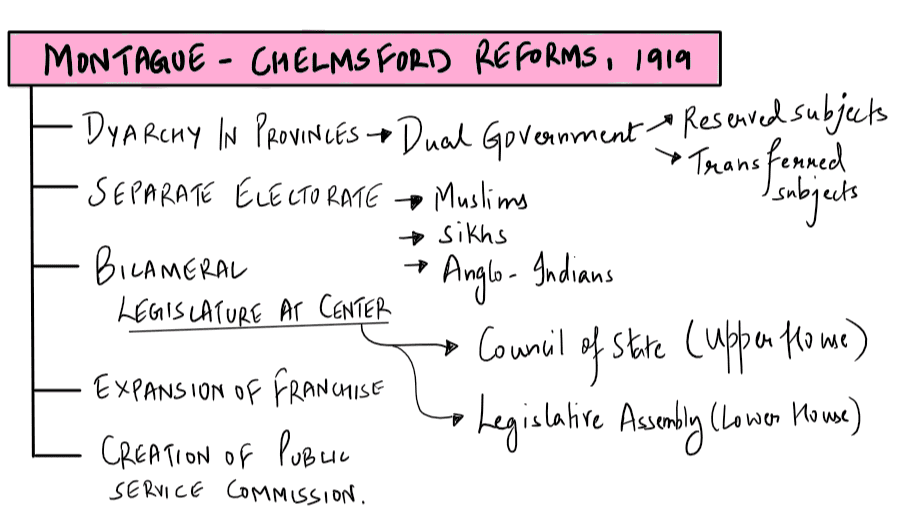
    Government of India, Act 1919 - Introduced limited self-government and increased Indian participation - Introduced Dyarchy (Dual Government) in provinces: 1. Transferred subjects → Administered by Indian ministers 2. Reserved subjects → Administered by British officials - Bicameral Legislature at the Central Level - Separate Electorates Continued - High Commissioner for India in London was created to represent Indian affairs in Britain. - Subjects divided into Central and Provincial lists - Voting rights were restricted based on property, income, and education. ![Government of India, Act 1919](https://d39jluplm5thpx.cloudfront.net//Montague_Chelmsford_Reforms_b5f1bfc85b.PNG)
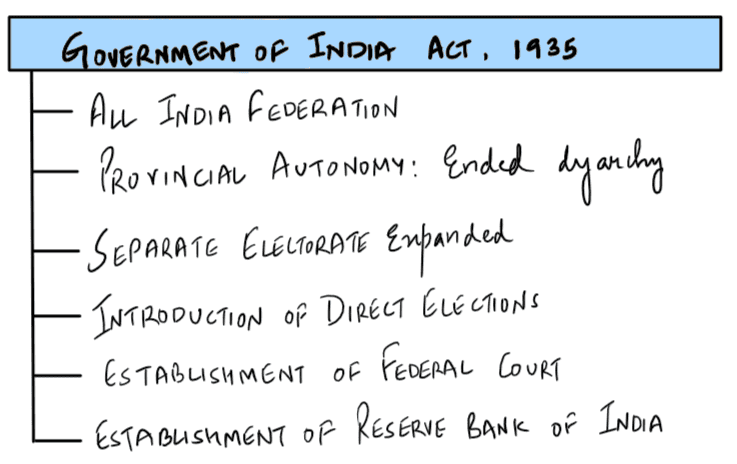
    Government of India, Act 1935 - Created an All-India Federation consisting of British Indian Provinces and Princely States. (Never Implemented) - Bicameralism extended to six provinces (Bengal, Bombay, Madras, Bihar, Assam, and United Provinces) - Abolished Dyarchy at the provincial level, Introduced Provincial Autonomy → Governors had to act on ministers' advice (except in special cases) - Three lists introduced: 1. Federal List (Centre) 2. Provincial List (Provinces) 3. Concurrent List (Both Centre & Provinces) - Ministers had full control over provincial subjects (except during emergencies) - Established the Federal Court of India (precursor to the Supreme Court) - Communal and separate electorates were retained and extended to groups such as Anglo-Indians and Indo-Christians. - Women were given reservations in Provincial and central legislature. ![Government of India, Act 1935](https://d39jluplm5thpx.cloudfront.net//Government_of_India_Act_659201e5ac.PNG)
  4. In the context of Indian history, the Rakhmabai case of (1884) revolved around? 1.…

    In the context of Indian history, the Rakhmabai case of (1884) revolved around? 1. women's right to gain education 2. age of consent 3. restitution of conjugal rights Select the correct answer using the code given below:

    1. A1 and 2 only
    2. B2 and 3 only
    3. C1 and 3 only
    4. D1, 2 and 3
    Answer and explanation

    Correct answer: B

    Statement 1 is Incorrect: While Rakhmabai was an educated woman who later became one of India's first practicing female doctors, the 1884 legal case itself did not revolve around the right to gain education; it focused on her refusal to live with her husband. Statement 2 is Correct: The case sparked a massive public debate on the practice of child marriage and was instrumental in the passage of the Age of Consent Act, 1891, which raised the age of consent for girls from ten to twelve years. Statement 3 is Correct: The litigation was initiated by Rakhmabai's husband, Dadaji Bhikaji, who filed a petition for the "restitution of conjugal rights" after she refused to live with him and consummate a marriage that took place when she was eleven years old.

  5. Consider the following statements about ‘the Charter Act of 1813’: 1. It ended the…

    Consider the following statements about 'the Charter Act of 1813': 1. It ended the trade monopoly of the East India Company in India except for trade in tea and trade with China. 2. It asserted the sovereignty of the British Crown over the Indian territories held by the Company. 3. The revenues of India were now controlled by the British Parliament. Which of the statements given above are correct?

    1. A1 and 2 only
    2. B2 and 3 only
    3. C1 and 3 only
    4. D1, 2 and 3
    Answer and explanation

    Correct answer: A

    Statement 1 is Correct: The Charter Act of 1813 abolished the trade monopoly of the East India Company in India, opening Indian trade to all British merchants. However, the Company's monopoly over trade in tea and trade with China was continued for another 20 years.

    Statement 2 is Correct: The Act explicitly asserted the sovereignty of the British Crown over the Indian territories held by the Company, marking a significant step in defining the constitutional position of British possessions in India.

    Statement 3 is Incorrect: While the Act of 1813 required the Company to maintain separate accounts for commercial and territorial revenues, the direct control of Indian revenues by the British Parliament was only established through the Government of India Act 1858, following the end of the Company's rule.

  6. In the federation established by the Government of India Act of 1935, residuary power…

    In the federation established by the Government of India Act of 1935, residuary power was given to the

    1. AFederal Legislature
    2. BGovernor General
    3. CProvincial Legislature
    4. DProvincial Governors
    Answer and explanation

    Correct answer: B

    Under the Government of India Act of 1935, the legislative powers were divided into three lists: the Federal List (for the center), the Provincial List (for the provinces), and the Concurrent List (for both).

    Residuary Powers: The subjects that were not included in any of these three lists were known as residuary powers. According to the Act, these residuary powers were vested in the Governor-General of India. He had the authority to decide whether the Federal or the Provincial Legislature would exercise power over such subjects.

    Note: In the modern Constitution of India, residuary powers are vested in the Union Parliament (Article 248), which is a departure from the 1935 Act.

  7. In the context of Indian history, the principle of “Dyarchy (diarchy)” refers to –

    In the context of Indian history, the principle of "Dyarchy (diarchy)" refers to -

    1. ADivision of the central legislature into two houses.
    2. BIntroduction of double government i.e., Central and State governments.
    3. CHaving two sets of rulers; one in London and another in Delhi.
    4. DDivision of the subjects delegated to the provinces into two categories.
    Answer and explanation

    Correct answer: D

    The principle of Dyarchy was introduced by the Government of India Act of 1919 in the provinces of British India.

    This system divided the functions of government into two categories central and provincial.

    The provincial subjects were further subdivided into transferred and reserved.

    Thus, the principle of Dyarchy refers to the division of the subjects delegated to the provinces into two categories.

  8. The Montagu-Chelmsford Proposals were related to –

    The Montagu-Chelmsford Proposals were related to -

    1. Asocial reforms
    2. Beducational reforms
    3. Creforms in police administration
    4. Dconstitutional reforms
    Answer and explanation

    Correct answer: D

    The Montagu-Chelmsford Proposals were aimed at the gradual introduction of self-governing institutions in India. They led to the enactment of the Government of India Act 1919, which introduced several landmark constitutional changes:

    - Dyarchy in Provinces: It divided provincial subjects into two parts—Transferred (administered by the Governor with the aid of ministers) and Reserved (administered by the Governor and his executive council without being responsible to the legislative council).

    - Bicameralism at the Center: For the first time, it introduced a bicameral legislature consisting of an Upper House (Council of State) and a Lower House (Legislative Assembly).

    - Direct Elections: It introduced direct elections in the country for the first time, though the franchise was limited based on property, tax, or education.

    - Separation of Budgets: It separated provincial budgets from the Central budget and authorized provincial legislatures to enact their own budgets.

  9. The Ilbert Bill controversy was related to the:

    The Ilbert Bill controversy was related to the:

    1. AImposition restrictions the Indians of certain to carry arms by Indians
    2. BImposition of restrictions on newspapers and magazines published in Indian languages
    3. CRemoval of disqualifications imposed on the Indian magistrates with regard to the trial of the Europeans
    4. DRemoval of a duty on imported cotton cloth
    Answer and explanation

    Correct answer: C

    - The Ilbert Bill (1883) of Lord Ripon sought to empower the Indian district Magistrates and sessions judges to try Europeans in criminal cases.

    - Under the existing laws, the Indian members of ICS were not authorized to try Europeans in their courts.

    - This move was aimed at eliminating the racial discrimination prevalent in the judiciary system, marking a significant step towards equality in colonial India.
