National Technology Day 2026 will be observed on Monday, 11 May 2026. India marks this day because on 11 May 1998, the country conducted three nuclear tests at Pokhran under Operation Shakti and publicly demonstrated a level of strategic and scientific capability that could not be ignored. Two more tests followed on 13 May 1998. The day also remembers other indigenous technology milestones around the same period, including the test flight of the Hansa-3 aircraft and the Trishul missile test.
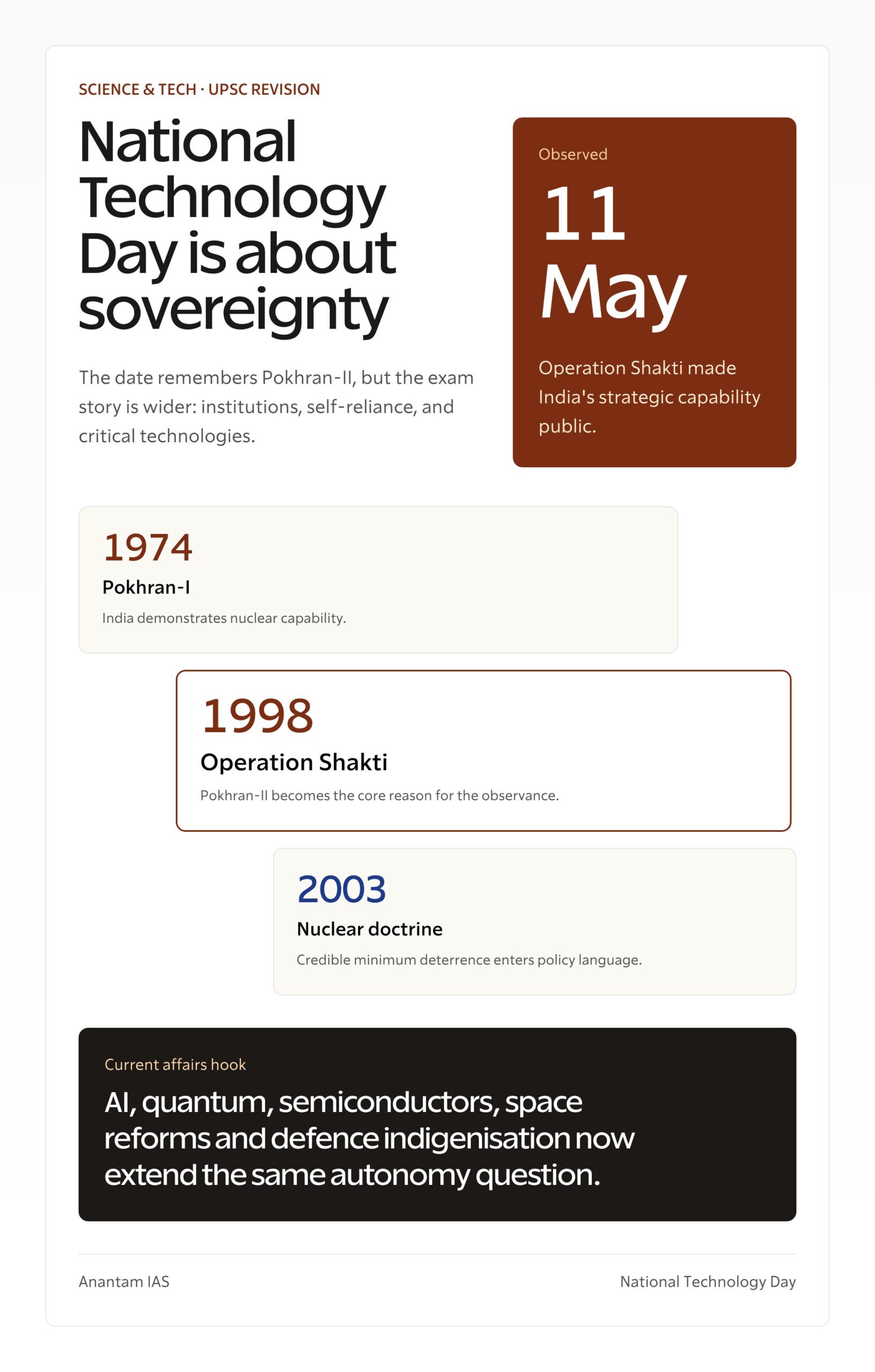
For UPSC preparation, this is not just a commemorative date. It is a clean revision point for science and technology, nuclear policy, national security, innovation institutions, deep-tech commercialization, startup policy, and India's long argument for strategic autonomy. If you remember only the ceremony and forget the policy story behind it, you miss the useful part.
National Technology Day 2026 Theme and Latest Update
The official theme for National Technology Day 2026 is "Responsible Innovation for Inclusive Growth", set by the Technology Development Board under the Department of Science and Technology. It frames technology as something that must be ethical, accessible and widely shared rather than confined to islands of excellence — a theme that sits naturally alongside the fixed, verified core of the day: 11 May, Pokhran-II, Operation Shakti, indigenous technology, Technology Development Board awards and India's current push for strategic technologies.
The best 2026 current-affairs hook is the renewed emphasis on critical and emerging technologies. The National Quantum Mission, semiconductor policy, IndiaAI Mission, space-sector reforms, digital public infrastructure and defence indigenisation all show how the meaning of "technology day" has expanded beyond one historic test site.
There is also a strong quantum-technology angle this year. Under the National Quantum Mission, 23 academic institutions have been approved for quantum teaching facilities and laboratories, with more than 100 additional proposals under consideration. That matters because National Technology Day is no longer only about the 1998 nuclear test. It has become an annual checkpoint for India's ability to move from research paper to prototype, and from prototype to public value.
Quick Facts at a Glance
| Parameter | Details |
|---|---|
| Date | 11 May every year |
| 2026 date | Monday, 11 May 2026 |
| 2026 theme | Responsible Innovation for Inclusive Growth |
| Core historical event | Pokhran-II nuclear tests under Operation Shakti |
| First major test date | 11 May 1998 |
| Follow-up tests | 13 May 1998 |
| Prime Minister | Atal Bihari Vajpayee |
| Key scientific leadership | Dr APJ Abdul Kalam and Dr R Chidambaram |
| Main institutions | DRDO, BARC, Department of Atomic Energy, Technology Development Board |
| Wider meaning | Indigenous technology, strategic autonomy, innovation commercialization |
| 2026 update | Bharat Mandapam showcase planned for 11-13 May with 3,000+ stakeholders and 500+ technologies |
| UPSC papers | Prelims, GS-III Science and Technology, GS-III Security, Essay |
Historical Background: Why 11 May Matters
India's nuclear story did not begin in 1998. It began much earlier, with Homi J. Bhabha's vision of atomic energy, the creation of the Atomic Energy Commission in 1948, the Department of Atomic Energy in 1954, and India's three-stage nuclear programme. The first nuclear test, Pokhran-I or "Smiling Buddha", was conducted on 18 May 1974 under Prime Minister Indira Gandhi.
But 1998 changed the public and strategic meaning of India's nuclear capability.
On 11 May 1998, India conducted three underground nuclear tests at Pokhran in Rajasthan. The operation was codenamed Shakti. Two additional tests were conducted on 13 May. India then declared itself a nuclear weapons state. The tests were carried out under Prime Minister Atal Bihari Vajpayee, with Dr APJ Abdul Kalam as a central scientific and strategic figure from DRDO, and Dr R Chidambaram playing a key role from the atomic energy establishment.
This was a calculated decision. India had refused to sign the Nuclear Non-Proliferation Treaty because it considered the treaty discriminatory. It had also resisted the Comprehensive Nuclear-Test-Ban Treaty in its then form because it did not adequately address universal nuclear disarmament. So the 1998 tests were not just laboratory events. They were a diplomatic statement: India would not outsource its security decisions.
That is the part students often remember too vaguely. Pokhran-II was about deterrence, yes. But it was also about the politics of technology denial, sanctions, indigenous capacity, and India's refusal to remain permanently at the receiving end of global technology regimes.
Operation Shakti: The Core Facts
Operation Shakti was the codename for India's May 1998 nuclear test series. It included five tests across 11 and 13 May. The tests demonstrated fission and thermonuclear design capability, though the yield and interpretation of the thermonuclear device have been debated by some experts.
The broad official claim was simple: India had demonstrated the scientific and technological ability required for a credible nuclear deterrent. That claim later fed into the draft nuclear doctrine, the no-first-use posture, and the institutional architecture around nuclear command and control.
For exam purposes, keep these points straight:
- Pokhran-I: 18 May 1974, "Smiling Buddha", described by India as a peaceful nuclear explosion.
- Pokhran-II: 11 and 13 May 1998, Operation Shakti, a series of five tests.
- Prime Minister in 1998: Atal Bihari Vajpayee.
- Key scientists: Dr APJ Abdul Kalam and Dr R Chidambaram.
- Location: Pokhran test range, Rajasthan.
- Strategic effect: India declared itself a nuclear weapons state.
- Policy follow-up: Draft nuclear doctrine in 1999, official nuclear doctrine in 2003, no-first-use posture and credible minimum deterrence.
If you are revising this for Prelims, this table is enough. If you are revising for Mains, connect it to technology denial, strategic autonomy and nuclear deterrence.
Why National Technology Day Is More Than a Nuclear Anniversary
The easiest mistake is to treat National Technology Day as just "Pokhran-II Day." That is true historically, but too narrow analytically.
The day also celebrates India's ability to develop and deploy indigenous technology under constraints. That includes defence technology, space technology, atomic energy, biotechnology, digital public infrastructure, semiconductors, quantum technology, clean energy, precision agriculture, cyber security and health technologies.
Think of the day as a yearly audit question: can India convert scientific capability into national capability?
That question is uncomfortable because India has always had islands of excellence. ISRO can land on the Moon. DRDO can build sophisticated missile systems. UPI can process transactions at population scale. But the broader challenge is diffusion. Can advanced research reach MSMEs? Can startups commercialize lab technology? Can state universities get modern research equipment? Can critical technologies be built without permanent dependence on imported components?
National Technology Day is useful because it forces all these questions into one frame.
Technology Development Board and National Technology Awards
The Technology Development Board (TDB), under the Department of Science and Technology, is closely associated with National Technology Day. It was established under the Technology Development Board Act, 1995 to support commercialization of indigenous technology and adaptation of imported technology for wider domestic application.
This matters for UPSC because India does not lack ideas. The harder problem is the valley between invention and deployment. A lab can build a prototype. A startup can build a demo. But scaling that technology into a reliable product needs money, manufacturing support, regulatory clarity, testing infrastructure, patient capital and procurement confidence.
The National Technology Awards recognize organizations, MSMEs, startups and institutions that have converted technology into useful products or processes. In a country where research output often gets measured through papers alone, this award system nudges the ecosystem toward impact.
In 2026, the Bharat Mandapam showcase planned around National Technology Day fits the same logic. If more than 500 technologies are being showcased to 3,000+ stakeholders, the message is not just celebration. It is matchmaking: labs, startups, industry, ministries and users need to meet each other.
India's 2026 Technology Context
The 2026 context is very different from 1998. Back then, the headline was nuclear technology under sanctions. Today, the challenge is broad-spectrum technology competition.
India is trying to build strength in several strategic areas:
- Quantum technologies: National Quantum Mission, quantum communication, quantum sensing, quantum computing and quantum materials.
- Semiconductors: fabrication, packaging, design ecosystem and electronics manufacturing.
- Artificial intelligence: IndiaAI Mission, public compute infrastructure, AI for governance and responsible AI frameworks.
- Space technology: private participation through IN-SPACe, NSIL, small satellite launch, Gaganyaan and downstream space applications.
- Defence technology: missiles, drones, electronic warfare, cyber systems, AI-enabled surveillance and hypersonics.
- Clean energy: green hydrogen, battery storage, nuclear energy, solar manufacturing and grid modernization.
- Digital public infrastructure: Aadhaar, UPI, DigiLocker, ONDC, Account Aggregator and health-stack systems.
National Technology Day is a good day to revise all of this because it gives you a single Mains hook: technology is not neutral hardware. It reshapes security, economy, welfare delivery and India's global bargaining power.
For related background, you can connect this article with APJ Abdul Kalam, nuclear energy in India, India's nuclear triad, space science in India and National Science Technology and Innovation Policy.
Pokhran-II and India's Nuclear Doctrine
The 1998 tests created the need for doctrinal clarity. India could not simply declare capability and stop there. A nuclear weapons state needs command and control, safety, communication, escalation logic and credible political messaging.
India's nuclear doctrine rests on three major ideas:
- Credible minimum deterrence: India does not seek unlimited arms racing. It maintains the capability needed to deter nuclear aggression.
- No first use: India has declared that it will not be the first to use nuclear weapons, but will respond massively to a nuclear attack.
- Civilian political control: Nuclear command rests with civilian authority, supported by institutional structures for command, control and communication.
For UPSC, do not write this like a slogan. The logic is deterrence. Nuclear weapons are meant to prevent nuclear war by making the cost of attack unacceptable. The hard part is credibility: the adversary must believe that India can respond even after absorbing a first strike. That is why the nuclear triad matters. Land-based missiles, aircraft delivery and sea-based deterrence together improve survivability.
The 1998 tests also triggered sanctions. But sanctions had a strange long-term effect. They pushed India harder toward indigenous development. The later India-US civil nuclear agreement and NSG waiver in 2008 marked India's partial reintegration into global nuclear commerce without joining the NPT as a non-nuclear weapon state.
Technology Denial and Strategic Autonomy
One of the best ways to teach National Technology Day is through the phrase "technology denial." India has repeatedly faced restrictions on access to dual-use technologies, high-end computing, cryogenic engines, nuclear fuel and defence systems. Some restrictions came after 1974. Others deepened after 1998.
That is why indigenous technology became more than a pride issue. It became a security issue.
Strategic autonomy does not mean isolation. It means the ability to make sovereign choices without being forced into dependence. India still imports technology, collaborates internationally and participates in global supply chains. But it wants bargaining power. Bargaining power comes from domestic capability.
This is where the educator's warning matters: do not romanticize self-reliance as "we will build everything ourselves." That is not how modern technology works. Even the most advanced countries depend on supply chains. The smarter goal is selective self-reliance in critical technologies, diversified partnerships, domestic manufacturing depth and control over chokepoints.
National Technology Day should be read in that mature sense.
Role of DRDO, BARC, DAE and ISRO
National Technology Day brings several institutions into the same revision frame.
DRDO represents defence research and development. Its work includes missiles, radars, electronic warfare systems, unmanned systems, armoured platforms and strategic systems. Dr APJ Abdul Kalam's role in missile development and Pokhran-II makes DRDO central to the National Technology Day story.
BARC and the Department of Atomic Energy represent the nuclear science and atomic energy side of the story. India's nuclear programme includes power reactors, fuel cycle capability, radiation applications, research reactors and strategic technologies.
ISRO represents a different but related model: patient public investment, institutional continuity, frugal engineering and mission-driven execution. Space technology also has strong strategic and civilian uses, from navigation and communication to disaster management and agriculture.
Technology Development Board represents commercialization. It asks a different question: after the lab succeeds, can the technology survive the market?
For Mains answers, this institutional mapping is more useful than a long list of names.
Current Affairs Hooks for 2026
Use these hooks for 2026 answers:
- The proposed National Technology Day 2026 showcase at Bharat Mandapam is expected to bring 3,000+ stakeholders and 500+ technologies.
- National Quantum Mission has moved into implementation through approval of quantum teaching labs in 23 institutions, with 100 more under consideration.
- The Anusandhan National Research Foundation framework is becoming important for research funding and coordination.
- IndiaAI, semiconductor manufacturing, space-sector reforms and defence indigenization are all part of the broader strategic technology conversation.
- Technology commercialization through CSIR, DST, DBT, BIRAC, ISRO-linked institutions and startups is now a major policy priority.
These are useful because they prevent the article or answer from sounding like it stopped in 1998.
UPSC Relevance
Prelims: National Technology Day is observed on 11 May. It commemorates Pokhran-II, Operation Shakti and India's technological achievements. Pokhran-I was in 1974; Pokhran-II was in 1998. The key institutions include DRDO, BARC, DAE, DST and the Technology Development Board.
GS-III Science and Technology: Use it for indigenous technology, research commercialization, strategic technologies, innovation ecosystems, quantum technology, AI, space technology, semiconductors and technology missions.
GS-III Internal Security: Use it for nuclear deterrence, credible minimum deterrence, no-first-use, nuclear triad, command and control, and the security implications of dual-use technology.
Essay: Use it for themes like "Science and sovereignty", "Technology as power", "Self-reliance in an interconnected world" and "Innovation for inclusive development."
Common Mistakes Students Make
The first mistake is confusing National Technology Day with National Science Day. National Science Day is observed on 28 February to mark the discovery of the Raman Effect. National Technology Day is observed on 11 May because of Pokhran-II and related technology milestones.
The second mistake is reducing Pokhran-II to one line: "India tested nuclear bombs." That line is factually correct but analytically weak. You need to mention deterrence, sanctions, strategic autonomy and nuclear doctrine.
The third mistake is treating self-reliance as a slogan. In a Mains answer, self-reliance should mean domestic capability in critical sectors, supply-chain resilience, R&D investment and commercialization.
The fourth mistake is ignoring the civilian technology side. National Technology Day is not only defence. It also includes health, agriculture, clean energy, digital infrastructure, quantum technologies and MSME-linked innovation.
Mains Practice Questions
- National Technology Day is not merely a commemoration of Pokhran-II but a reminder of India's continuing struggle for technological sovereignty. Discuss. (250 words)
- India's science and technology ecosystem has strong public institutions but often struggles with commercialization. Examine the role of the Technology Development Board, startups and research-industry collaboration in bridging this gap. (250 words)
Conclusion
National Technology Day 2026 is a good example of how one date can carry three stories at once. The first is historical: Pokhran-II and Operation Shakti changed India's strategic posture in May 1998. The second is institutional: DRDO, BARC, DAE, DST, ISRO and the Technology Development Board show how scientific capability is built over decades, not overnight. The third is current: in 2026, the focus has widened to quantum labs, AI, semiconductors, space-sector reforms, startup commercialization and technology showcases that connect research institutions with industry.
The clean way to remember the day is this: 11 May is about India's ability to convert knowledge into power. Sometimes that power is strategic deterrence. Sometimes it is a medical device, a payment system, a satellite, a quantum lab or a small technology that helps an MSME become more productive. That is why the day belongs in UPSC notes. It connects science with sovereignty, and technology with public purpose.
Frequently Asked Questions
What is National Technology Day?
National Technology Day is observed in India on 11 May every year to mark major technological achievements, especially the Pokhran-II nuclear tests conducted under Operation Shakti in 1998.
Why is National Technology Day celebrated on 11 May?
It is celebrated on 11 May because India conducted three nuclear tests at Pokhran on 11 May 1998. Two more tests followed on 13 May 1998.
What was Operation Shakti?
Operation Shakti was the codename for India’s 1998 nuclear test series at Pokhran in Rajasthan. It demonstrated India’s nuclear weapons capability and led India to declare itself a nuclear weapons state.
Who was the Prime Minister during Pokhran-II?
Atal Bihari Vajpayee was the Prime Minister of India during Pokhran-II in May 1998.
Which scientists are associated with Pokhran-II?
Dr APJ Abdul Kalam and Dr R Chidambaram are the two names most commonly associated with the scientific leadership of Pokhran-II, along with teams from DRDO, BARC and the Department of Atomic Energy.
What is the National Technology Day 2026 update?
The official theme for National Technology Day 2026 is “Responsible Innovation for Inclusive Growth”, set by the Technology Development Board under the Department of Science and Technology. The wider 2026 hook is India’s push in quantum labs, AI, semiconductors, space-sector reforms and technology commercialization.
Is National Technology Day the same as National Science Day?
No. National Science Day is observed on 28 February to mark the Raman Effect. National Technology Day is observed on 11 May to mark Pokhran-II and India’s broader technological achievements.
Why is National Technology Day important for UPSC?
It links directly with GS-III topics such as science and technology, nuclear doctrine, internal security, innovation ecosystems, strategic autonomy, quantum technology and research commercialization.
Tell Google you want more of this.
Add Anantam IAS as a preferred sourceOne tap, and this site shows up more often in your own Top Stories, AI Overviews and AI Mode. Remove it any time.