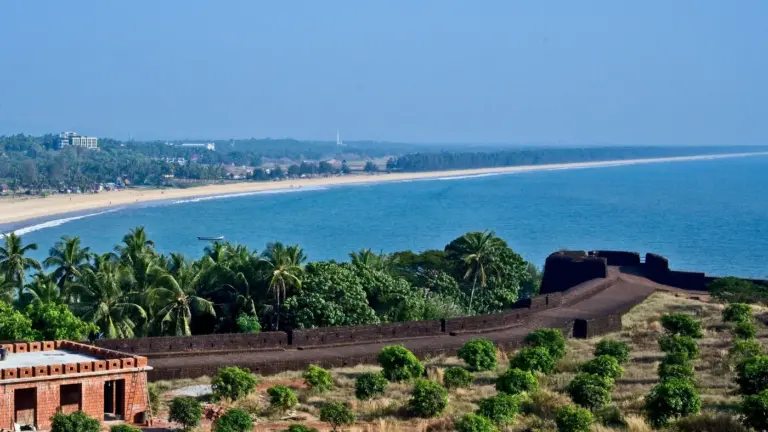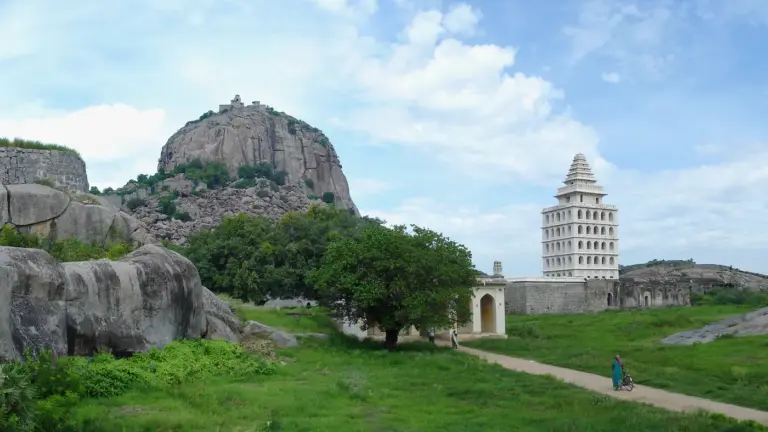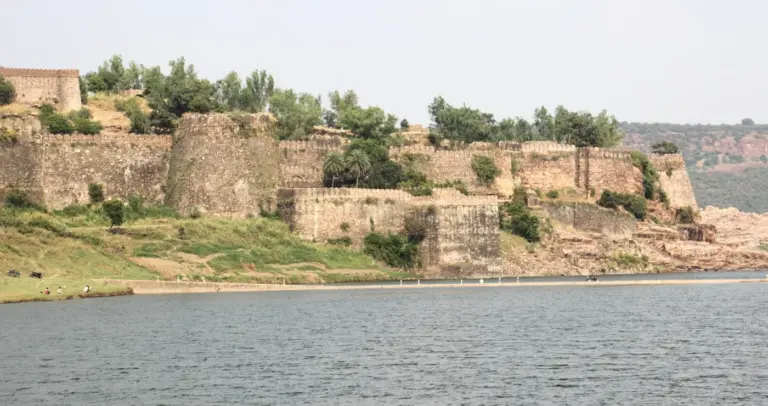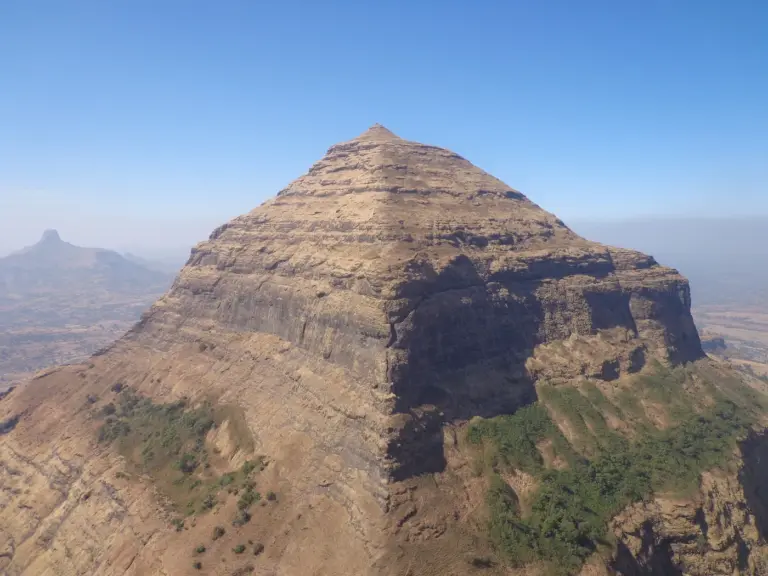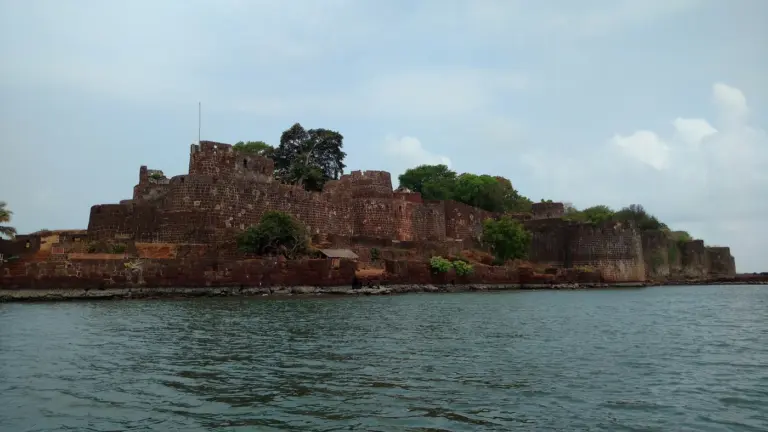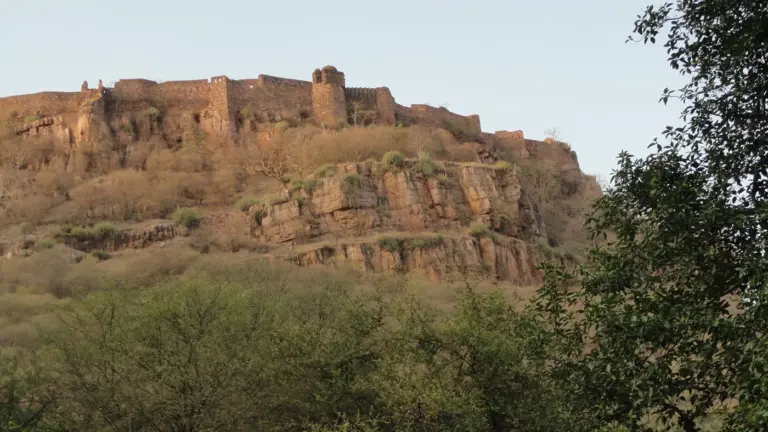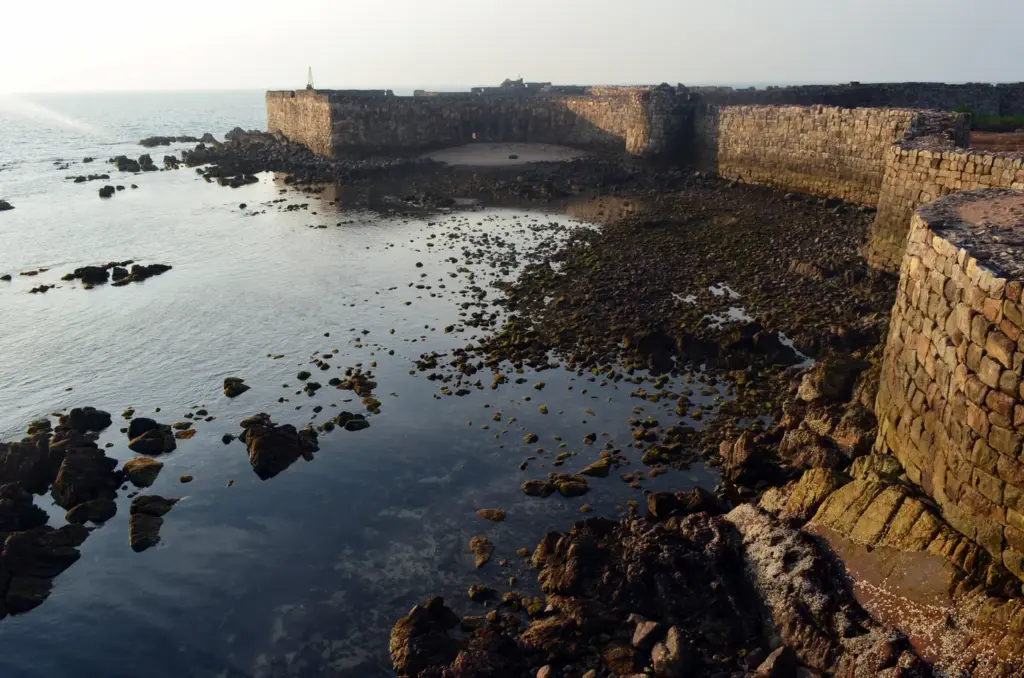
Sindhudurg fort is the island fort that Chhatrapati Shivaji Maharaj built on Kurte, a rocky islet off Malvan in Maharashtra’s Sindhudurg district. Its first stone was laid on 25 November 1664 and the work finished in 1667. It served as the headquarters of Shivaji’s navy and later gave the district its name. In July 2025 it became one of the 12 forts in UNESCO’s Maratha Military Landscapes of India.
Two mix-ups follow this fort around. The first is Janjira: the island fort that held out against Shivaji belonged to the Siddis and lies far up the coast off Murud, and Sindhudurg is what Shivaji built after failing to take it. The second is recent. The Shivaji statue inaugurated on Navy Day 2023, which collapsed in August 2024, stood at Rajkot, a small fort on the Malvan mainland, not inside Sindhudurg. Keep those two apart and the rest follows, from the hidden gate to the temple where Shivaji himself is worshipped.
Sindhudurg Fort at a Glance
Sindhudurg is an island fort, a narrower category than “sea fort”: it stands on an island with water on every side, unlike Vijaydurg, which sits on a headland joined to the mainland. These are the facts worth fixing first.
| Fact | Detail |
|---|---|
| Type | Island fort on Kurte island; one of three island forts in the UNESCO series |
| Location | Off Malvan, Sindhudurg district, Maharashtra; about 1 to 1.6 km from the shore, depending on the source |
| Built by | Chhatrapati Shivaji Maharaj; first stone laid 25 November 1664, finished in 1667 |
| Built for | Headquarters of the Maratha navy and a check on the Siddis of Janjira, the English and the Portuguese |
| Size | About 48 acres (19 ha); 42 bastions by modern counts |
| Later holders | Kolhapur Chhatrapatis from 1713; the English briefly in 1765, as Fort Augustus; the British from 1812 |
| Protection | Centrally protected monument of the Archaeological Survey of India |
| UNESCO status | Component 11 of the Maratha Military Landscapes of India, inscribed 11 July 2025; criteria (iv) and (vi) |
| Known for | The hidden gate, lead-set foundations, the Shivaji temple and the hand and foot prints |
Who Built Sindhudurg Fort, and Why Malvan
Shivaji built Sindhudurg as a new fort, not an old one taken over and strengthened like Suvarnadurg or Vijaydurg, and he built it because Janjira had beaten him. The 1880 gazetteer of Ratnagiri says so plainly: around 1665, having failed to take Janjira from the Siddi, Shivaji chose Malvan, with its rocky islands and reef-blocked harbor, as his headquarters on the coast.
The sieges of Janjira show why. From 1661 Shivaji attacked the Siddi island season after season without denting it, because he lacked the guns to breach its walls and the fleet to cut its supplies. A navy of his own, working from a secure harbor, was the missing piece.
The Marathi Vishwakosh, the encyclopedia published by the Maharashtra government, names the powers the fort was meant to check:
- the Siddi of Janjira;
- the English at Bombay, to the north;
- the Portuguese at Goa, about 130 km to the south.
So Sindhudurg wasn’t a border post facing one enemy. It was a base for ships on an open stretch of the Konkan coast, placed to watch all three. The reefs helped, and a 19th-century British writer, Alexander Nairne, even read the difficult harbor entrance as a sign that Shivaji meant Malvan as a place of refuge. The gazetteer reports that as a belief, and it’s best repeated as one.
Who ran the work
Who ordered the fort is certain; who supervised it is not. The Centre for Cultural Resources and Training (CCRT), a body under the Ministry of Culture, credits Hiroji Indulkar, working with 100 Portuguese experts from Goa and about 3,000 workers over three years, and says the booty from the sack of Surat paid for it. The Marathi Vishwakosh names Govind Vishwanath Prabhu instead. Both are government publications, so the fair line in an answer is “built by Shivaji, with the work credited to Hiroji Indulkar in one account and Govind Vishwanath Prabhu in another”.
The foundations carry the detail examiners like. Slots were cut for the foundation stones and molten lead was poured in to fix them, as the state tourism corporation describes it, and the Vishwakosh says the records mention several khandis of lead, a khandi being an old measure of weight. Think of it as metal grout that locked stone to stone. The totals for the lead that circulate online don’t trace to a dated source, so leave them out. The gazetteer also records that Shivaji is said to have worked on the fort with his own hands, which is tradition and should be written as tradition.
Sindhudurg’s History in Phases
Sindhudurg’s history turns on who held the Malvan harbor. Control passed from Shivaji to the Kolhapur branch and, after a brief English interlude in 1765, to the British in 1812.
1664 to 1680: Shivaji’s naval headquarters
ICOMOS, UNESCO’s advisory body on cultural sites, calls Sindhudurg the headquarters of the Maratha navy. Shivaji ringed its harbor with smaller works:
- Padmagad, on the smaller island nearer the shore, which screened the main fort and served as a shipyard;
- Rajkot, on rising ground inside Malvan town;
- Sarjekot, at the mouth of the creek about a mile and a half to the north.
Remember Rajkot. It returns in 2023.
The navy was a coastal one, and the CCRT is frank about it: Shivaji founded the Maratha navy but didn’t have the means or the time to build bigger ships and look beyond the coast to the open sea. Sindhudurg suited that navy, a harbor for smaller craft that an enemy fleet couldn’t easily enter.
1680 to 1713: the temple and the queen’s beach
After Shivaji’s death in 1680, a temple to him was built at the fort’s center during the reign of his younger son, Chhatrapati Rajaram (1689-1700). Below the south wall, a small crescent of sand is known as Ranichi Vela, the queen’s bathing place, which the CCRT links with Tarabai, Rajaram’s queen. That’s tradition; no dated record fixes it.
1713 to 1812: Kolhapur and Fort Augustus
By 1713, when Shivaji’s dominions divided between the Kolhapur and Satara houses of the Maratha state, Malvan fell to the Kolhapur chiefs. English records then called Malvan the base of the coast’s most active “pirates”, yet the same records note that none but the Raja fitted out the vessels. These were a ruler’s armed ships, and “pirate” was the word their English targets used.
In 1765 a Bombay expedition under Major Gordon and John Watson of the Bombay Marine took the fort quickly and renamed it Fort Augustus. Finding it unprofitable and hard to dismantle, the English handed it back to the Kolhapur chief on terms:
- a promise not to molest trade;
- security for good conduct and a cash payment;
- permission for an English factory at Malvan.
The deal didn’t last. In 1812, as part of a wider settlement, Kolhapur ceded the harbor of Malvan, fort and island included, to the British, and a force under Colonel Lionel Smith cleared out the Malvan fleet that year.
After 1812: from garrison to protected monument
British reports show how fast the sea works on a fort nobody is fighting over. In 1828 monsoon waves had washed away most of the parapet on the west and south faces and undermined the west wall. By 1862, after repairs, the walls were in fair order, with no garrison and nineteen old guns. In 1981 the fort gave its name to the new Sindhudurg district, carved out of Ratnagiri on 1 May, and the ASI now protects it.
How Sindhudurg’s Defenses Work, in the Order an Attacker Meets Them
Sindhudurg’s defense starts in the water. Follow it the way a hostile crew would have met it, and each feature answers a specific problem.
The reefs and the channel
The bay at Malvan is almost entirely blocked by rocky reefs, and boats reach the fort through a narrow channel between two smaller islands, Dhontara and Padmagad. The danger outlived the Marathas: in 1865 the steamer Johnston Castle was wrecked on a sunken rock a quarter of a mile off the island’s north end.
The wall that follows the shore
The wall follows the island’s coastline, so its outline is highly irregular, with many projecting points and deep indentations. A British survey of 1828 spelled out the advantage: there isn’t a single point outside the rampart that can’t be covered from some point inside.
That’s flanking fire, fire along the face of a wall from a point that juts out beside it. A boat that reaches the foot of the wall hasn’t escaped the guns; it has moved into the line of fire from the next projection along. Think of each projection as a car’s side mirror, showing the stretch of wall beside it. The comparison ends at seeing, because these mirrors carried cannon.
Height mattered less on the sea side. The gazetteer puts the walls at 29 to 30 feet high and 12 feet thick on average, yet in one place on the sea face they seem almost level with high water. There, the reefs did the work that height does elsewhere.
Sources disagree on the fort’s size, so know the spread before you write a number:
| Measure | 1880 gazetteer | Marathi Vishwakosh | CCRT |
|---|---|---|---|
| Circuit of the walls | A little under 2 miles (about 3.2 km) | About 3.5 km | 4 km |
| Bastions | About 32 towers | 42 | 42 |
| Wall height | 29 to 30 feet (about 9 m) | About 10 m | 9 m |
| Area | 48 acres | 19 hectares | 48 acres |
The safe answer is “42 bastions by modern counts and roughly 3 to 4 km of wall”. No source explains why the 1880 count is lower, so treat it as a disagreement rather than resolve it.
The bastions
The bastions are the fort’s gun platforms: half-round towers pushed out from the wall, 40 to 130 yards apart, with embrasures, the openings in the parapet through which a gun fires while its crew stays behind stone. Narrow staircases climb to the top of the wall from inside.
The hidden gate
The entrance is the part everyone remembers, and here the fame is earned. It sits at the north-east corner, where there’s deep water at the gate even at low tide, and it can’t easily be seen from outside. The CCRT places the gate behind two bastions, and ICOMOS calls it a hidden semi-circular entrance. A boat had to come close, under the guns of both bastions, before its crew could even see where the door was.
Above the gate stands a ruined nagarkhana, a drum house for the ceremonial band, and just inside is a shrine to Hanuman as guardian of the gate. The 1880 gazetteer calls such a shrine one mark of the forts Shivaji built or rebuilt.
Inside the walls: water and a way out
A sea fort under siege lives on its fresh water, and Sindhudurg’s wells give sweet water in a salt sea:
- Dudhbav, the milk well;
- Dahibav, the curd well;
- Sakharbav, the sugar well.
The Vishwakosh adds one feature a besieger wouldn’t see: a cross wall inside the fort, with arrangements for a secret escape by boat in an emergency.
The Shivaji Temple and the Hand and Foot Prints
The temple at Sindhudurg’s center is dedicated to Shivaji himself and was built during Rajaram’s reign, between 1689 and 1700. Known as the Shivrajeshwar temple, it treats the fort’s founder as its deity. The Vishwakosh describes it closely:
- a sandstone image seated in virasana, the seated posture of a hero;
- a headdress like a boatman’s cap and no beard;
- a sheathed sword kept at the shrine;
- an original temple of 13 by 7 m, with a hall in front added by Chhatrapati Shahu Maharaj of Kolhapur in 1907.
The worship is old and continuous. In 1880 the gazetteer found the stone image covered with a silver mask, or a gold one on festival days, and supported by a yearly allowance of Rs 1,522 assigned in 1812 by the Kolhapur chief. The Kolhapur Chhatrapatis still send a jiretop, the crested Maratha headdress, and clothes to the temple every year.
The gazetteer also repeats a line it traces to the historian Grant Duff: to the Marathas, Sindhudurg is Shivaji’s cenotaph, a memorial to someone cremated or buried elsewhere. The word is exact, because his samadhi, the memorial over the place of his cremation, is at Raigad, where he died in 1680.
The prints are a separate tradition. Two small niches on the wall to the right of the main gate hold the print of a left foot and of a right hand, and popular belief holds that they’re Shivaji’s. The 1880 gazetteer found them protected by small domes, and one of its correspondents noted dryly that they’d be accurate hands and feet if they weren’t so small. Kolhapur keeps a silver cast of the handprint for daily worship. The temple is history. The prints are tradition.
Sindhudurg Fort Today: UNESCO, ASI and the Rajkot Mix-up
Sindhudurg is a centrally protected monument of the Archaeological Survey of India, and since 11 July 2025 it has been component 11 of the Maratha Military Landscapes of India, inscribed at the 47th session of the World Heritage Committee in Paris. UNESCO’s page for the property lists the twelve forts, and the current affairs note on the Maratha Military Landscapes covers the listing as a whole.
What matters for Sindhudurg:
- The series became India’s 44th World Heritage property, as the Ministry of Culture’s release on the inscription records; the UNESCO World Heritage Sites in India note places it among the rest.
- Criterion (iv) recognizes an outstanding type of building or ensemble that illustrates a stage in human history; criterion (vi) recognizes a direct association with events, traditions or beliefs of outstanding universal significance.
- Sindhudurg, Khanderi and Suvarnadurg are the island forts; Vijaydurg is the only coastal fort; Gingee, in Tamil Nadu, is the only fort outside Maharashtra.
There’s a twist most notes skip. ICOMOS didn’t recommend this inscription. Its evaluation, approved on 12 March 2025, advised deferral and found criterion (vi) not demonstrated, yet the Committee inscribed the property, with 18 of the 20 State Parties supporting India’s proposal, according to the Ministry of Culture.
ICOMOS is also specific about Sindhudurg’s condition:
- island and coastal forts suffer intense weathering from saline spray, wind and wave action;
- Sindhudurg has localized damaged sections, though substantial conservation work has been done there;
- buildings in its buffer zone, the protected belt around the property, and a steel lamp on the fortification wall are flagged as harmful.
The Vishwakosh adds that the waves have brought down some bastions and stretches of wall over time. It’s the 1828 report again, two centuries on.
Sindhudurg is also a living fort. A few families still live inside, with an anganwadi and a pre-primary school within the walls, and the CCRT counts about twenty hereditary Hindu and Muslim families. The 1880 gazetteer found Gabits there too, a seafaring community of the Konkan, renting the fort’s coconut palms. Any management plan has to work with people whose homes are part of the monument. Boats run from the Malvan jetty, a crossing of 15 to 20 minutes, and the state tourism corporation advises visits between October and May.
Navy Day 2023 and the Rajkot statue
The recent headlines with “Sindhudurg” in them are mostly not about the island fort:
- On 4 December 2023 the Prime Minister attended the Navy Day celebrations at Sindhudurg, watched the navy’s demonstrations from Tarkarli beach and inaugurated a Shivaji statue at Rajkot Fort, the mainland fort in Malvan town. He also announced new epaulettes for naval officers reflecting Shivaji’s heritage and naval ranks renamed in line with Indian traditions.
- The Rajkot statue collapsed in August 2024, and on 29 August All India Radio reported that a joint technical committee headed by the navy was being formed to investigate.
In those reports “Sindhudurg” means the district. Neither event happened on Kurte island.
How to study Sindhudurg Fort for exams
Sindhudurg sits where three parts of the syllabus meet:
- GS Paper I, culture: fort architecture and World Heritage properties;
- GS Paper I and Prelims history: the Marathas, covered in full in the Chhatrapati Shivaji Maharaj note;
- GS Paper III, security: the history behind India’s coastal defense.
Mains doesn’t ask about Sindhudurg by name; it tests the themes the fort illustrates. Mains 2018 GS Paper I asked “Safeguarding the Indian art heritage is the need of the moment. Discuss.“, and Mains 2025 GS Paper III asked “Why is maritime security vital to protect India’s sea trade? Discuss maritime and coastal security challenges and the way forward.“. Sindhudurg gives the first a concrete case, a sea-battered monument with residents, and the second a historical opening. In Prelims, Art and Culture accounts for 94 of the 1,403 questions in the Prelims question bank, and the 2025 listing sits squarely in that share.
Fix these for revision:
- 25 November 1664 is the first stone and 1667 the finish, on Kurte island off Malvan.
- It was built after the failed Janjira sieges and became Shivaji’s naval headquarters, with Padmagad, Rajkot and Sarjekot as satellites.
- The Shivaji temple dates from Rajaram’s reign (1689-1700); Shahu of Kolhapur added its hall in 1907.
- The English called it Fort Augustus in 1765; Kolhapur ceded it to the British in 1812.
- In the 2025 series it’s an island fort, with Khanderi and Suvarnadurg; Vijaydurg is the coastal fort.
- It’s ASI protected, and the series was inscribed under criteria (iv) and (vi) against ICOMOS’s advice to defer.
The confusions that cost marks:
- Sindhudurg and Janjira. Janjira is the Siddi fort Shivaji couldn’t take, and it isn’t in the 2025 series; Sindhudurg is his answer to it.
- Sindhudurg and Rajkot. The 2023 statue and its 2024 collapse belong to Rajkot, a mainland fort in Malvan town.
- Sindhudurg and Vijaydurg. Sindhudurg was Shivaji’s naval headquarters; Vijaydurg later became one of Kanhoji Angre’s main bases, along with Kolaba.
- The fort and the district. Sindhudurg district, formed on 1 May 1981, is named after the fort.
Sindhudurg reads best beside its neighbors on the coast:
| Fort | Type | Who fortified it, and when | In the 2025 UNESCO series? |
|---|---|---|---|
| Sindhudurg | Island fort off Malvan | Built new by Shivaji, 1664 to 1667 | Yes |
| Janjira | Island fort off Murud | The Siddis; present walls begun in 1694 and finished in 1707 | No |
| Suvarnadurg | Island fort off Harnai | Bijapur Sultanate in the 16th century; reinforced under Shivaji in 1660 | Yes |
| Khanderi | Island fort between the Bombay islands and Janjira | Built by Shivaji in 1679 | Yes |
| Vijaydurg | Coastal fort on a promontory by the Vaghotan estuary | Built by the Shilaharas; expanded by Shivaji; later a base of Kanhoji Angre | Yes |
The hill forts in the same series, such as Pratapgad and Shivneri, make the opposite point. There the defense is height and forest; at Sindhudurg it’s the reef and a gate you can’t see.
Sindhudurg is a small topic that serves both papers. For Prelims it’s a clean set of facts. For Mains it’s evidence that Shivaji treated the sea as a frontier worth a fort of its own, and its crumbling bastions and resident families show what heritage protection is actually up against.
Frequently Asked Questions
Who built Sindhudurg fort?
Chhatrapati Shivaji Maharaj built Sindhudurg fort on Kurte island off Malvan, after his repeated attempts to take the Siddi island fort of Janjira failed. Sources differ on who supervised the work: the CCRT names Hiroji Indulkar, while the Marathi Vishwakosh names Govind Vishwanath Prabhu. Portuguese craftsmen from Goa are recorded as helping with the construction.
When was Sindhudurg fort built?
The first stone was laid on 25 November 1664, and the fort was completed about three years later, in 1667. The Sindhudurg district administration and the Marathi Vishwakosh both give the November 1664 start date. The 1880 Ratnagiri gazetteer dates Shivaji’s choice of Malvan to about 1665.
Why is Sindhudurg fort famous?
It was the headquarters of Shivaji’s navy, and the CCRT calls it the most formidable of the forts Shivaji built new. Its entrance is hidden behind two bastions and its foundation stones were fixed with molten lead. It also has a temple where Shivaji himself is worshipped. Since 2025 it has also been part of a UNESCO World Heritage property.
Is Sindhudurg fort a UNESCO World Heritage Site?
Yes. Sindhudurg is one of the 12 components of the Maratha Military Landscapes of India, which the World Heritage Committee inscribed on 11 July 2025 at its 47th session in Paris. The series was inscribed under cultural criteria (iv) and (vi), and Sindhudurg is listed as one of its three island forts.
Is Sindhudurg the same as Janjira fort?
No. Janjira is the Siddi island fort off Murud in Raigad district that Shivaji besieged but never took, while Sindhudurg is the island fort he built off Malvan after those sieges failed. Janjira isn’t part of the 2025 UNESCO listing, and Sindhudurg is.
Did the Shivaji statue that collapsed in 2024 stand at Sindhudurg fort?
No. The statue was inaugurated on 4 December 2023, during the Navy Day celebrations, at Rajkot Fort, a small mainland fort in Malvan town. It collapsed in August 2024, and a navy-led joint technical committee was formed to investigate. News reports often say ‘Sindhudurg’ because Malvan lies in Sindhudurg district.
Who built the Shivaji temple inside Sindhudurg fort?
The temple, known as the Shivrajeshwar temple, was built during the reign of Chhatrapati Rajaram, Shivaji’s younger son, who ruled from 1689 to 1700. Its sandstone image shows Shivaji seated and without a beard. The hall in front of the temple was added by Chhatrapati Shahu Maharaj of Kolhapur in 1907.
How do you reach Sindhudurg fort?
The fort is reached by boat from the Malvan jetty, a crossing of about 15 to 20 minutes. The state tourism corporation advises visiting between October and May.
Practice Questions
Prelims
1. Consider the following statements about Sindhudurg fort: 1. It was built on Kurte island off Malvan. 2. It was built by the Siddis and later captured by Shivaji. 3. It is one of the island forts in the Maratha Military Landscapes of India. Which of the statements given above is/are correct?
- (a) 1 and 2 only
- (b) 1 and 3 only
- (c) 2 and 3 only
- (d) 1, 2 and 3
Answer: (b) Shivaji built Sindhudurg himself after failing to take the Siddi fort of Janjira, so statement 2 is wrong.
2. Which one of the following forts in the Maratha Military Landscapes of India is classified as a coastal fort rather than an island fort?
- (a) Sindhudurg
- (b) Khanderi
- (c) Suvarnadurg
- (d) Vijaydurg
Answer: (d) Vijaydurg stands on a promontory joined to the mainland; the other three are island forts.
3. Consider the following statements about the Shivaji temple inside Sindhudurg fort: 1. It was built during the reign of Chhatrapati Rajaram. 2. The hall in front of it was added by Chhatrapati Shahu Maharaj of Kolhapur in 1907. Which of the statements given above is/are correct?
- (a) 1 only
- (b) 2 only
- (c) Both 1 and 2
- (d) Neither 1 nor 2
Answer: (c) The temple dates from Rajaram’s reign (1689-1700), and Shahu of Kolhapur added the hall in 1907.
4. In 1765 an English expedition from Bombay captured Sindhudurg and renamed it
- (a) Fort George
- (b) Fort Augustus
- (c) Fort Victoria
- (d) Fort St. David
Answer: (b) The English called it Fort Augustus but soon returned it to the Kolhapur chief on terms.
5. Consider the following pairs: 1. Janjira: held by the Siddis 2. Khanderi: built by Shivaji in 1679 3. Vijaydurg: originally built by the Shilaharas. How many of the pairs given above are correctly matched?
- (a) Only one
- (b) Only two
- (c) All three
- (d) None
Answer: (c) All three pairs match the historical record.
Mains
- “Sindhudurg was built less as a fortress than as a naval base.” Examine this statement with reference to its site, its design and its satellite forts. (15 marks, 250 words)
- Discuss how Shivaji’s coastal forts reflected his response to the Siddis of Janjira and the European trading powers on the Konkan coast. (15 marks, 250 words)
- ICOMOS recommended deferring the Maratha Military Landscapes nomination, yet the World Heritage Committee inscribed it in 2025. What does this reveal about how World Heritage decisions are made? (10 marks, 150 words)
- Island forts such as Sindhudurg face threats from both the sea and people. Discuss the conservation challenges they face and suggest measures to address them. (10 marks, 150 words)
- Monuments with resident communities pose a distinct management challenge. Discuss with reference to Sindhudurg fort. (10 marks, 150 words)
Tell Google you want more of this.
Add Anantam IAS as a preferred sourceOne tap, and this site shows up more often in your own Top Stories, AI Overviews and AI Mode. Remove it any time.