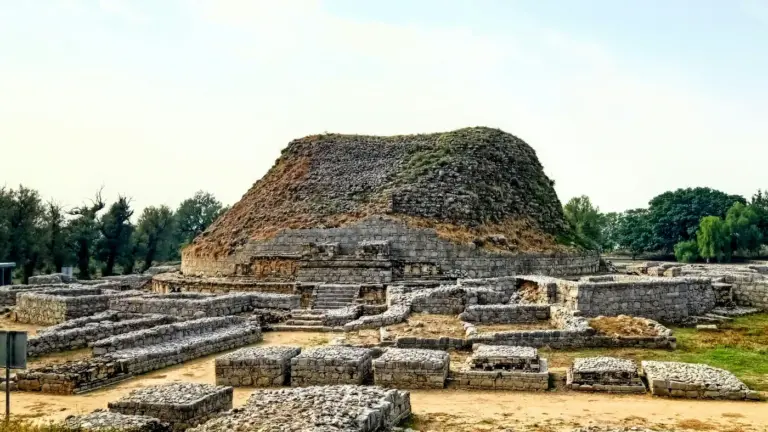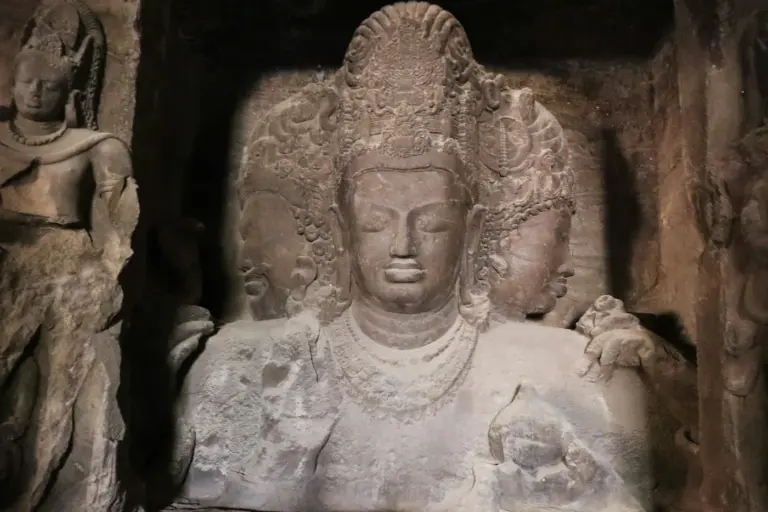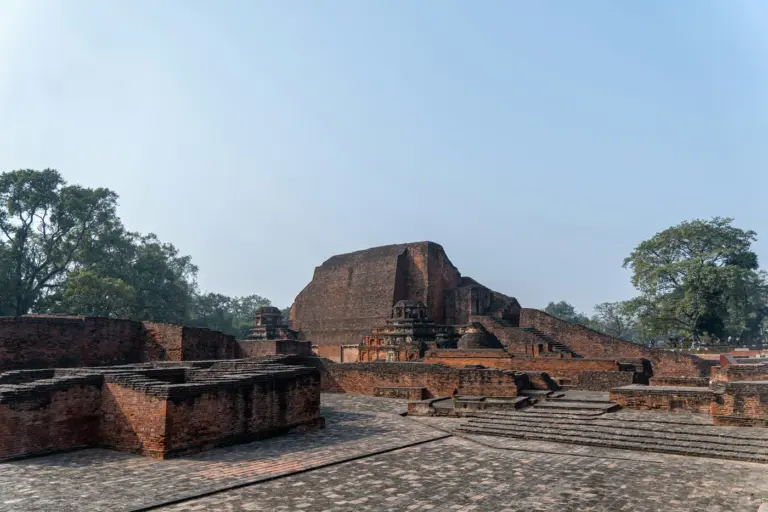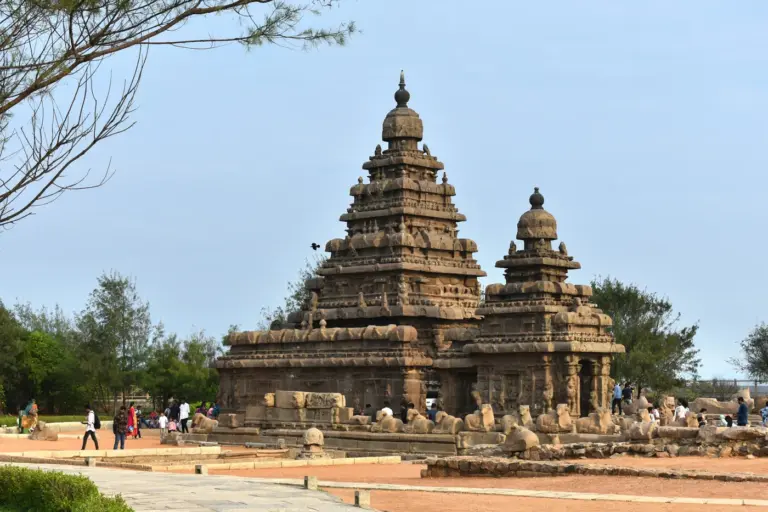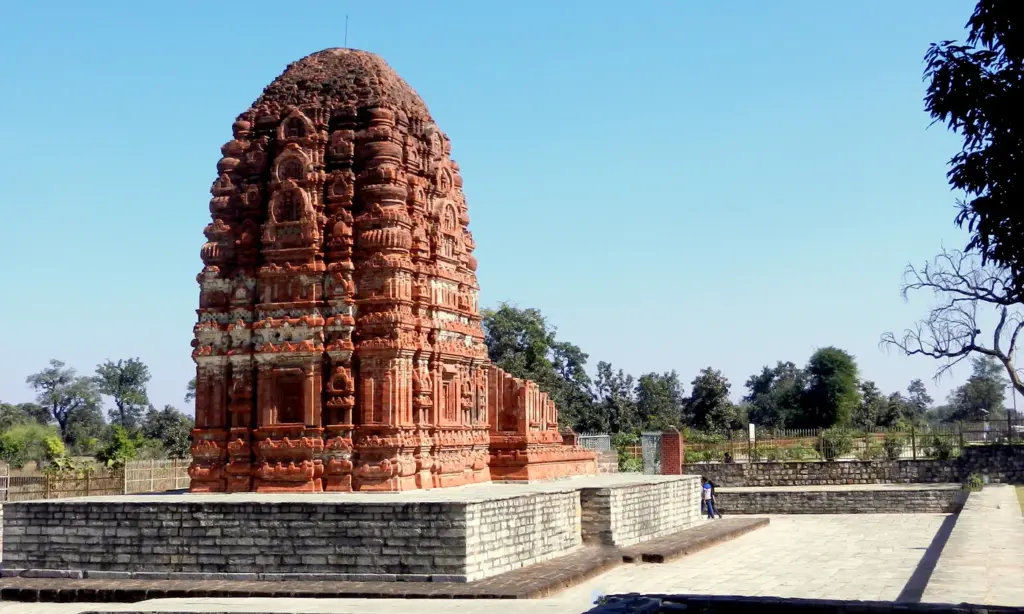
Sirpur is a village on the right bank of the Mahanadi in Mahasamund district of Chhattisgarh, and between the 6th and 8th centuries it was Shripura, the capital of the kings of Dakshina Kosala. Its brick Lakshmana temple, raised by a widowed queen named Vasata, is counted by the Archaeological Survey of India (ASI) among the best brick temples of ancient India. Buddhist monasteries went up on the same stretch of riverbank in the same reign, and the later digs found Jain remains too, which is why Sirpur keeps turning up in art and culture notes.
Two ideas trip up most readers. The first is that Sirpur already sits on UNESCO’s Tentative List. It doesn’t, and the formal push for a World Heritage nomination is recent. The second is the tidy story that Xuanzang stayed in Sirpur’s monasteries. His travelogue describes a Buddhist-friendly Kosala but never names its capital, so the visit is a later identification, not a line in his text. This note keeps what the inscriptions and excavations prove apart from what has been layered on top of them.
What is Sirpur, and why does it matter?
Sirpur matters because one short stretch of riverbank holds three things that are usually taught in separate chapters:
- the capital of an early medieval kingdom, Dakshina Kosala (South Kosala);
- a brick temple of Vishnu that ASI counts among the best of ancient India;
- Mahayana Buddhist monasteries built under the same royal family.
The inscriptions call the town Shripura, from pura, a city, and Shri, the goddess of fortune; Sirpur is the worn-down modern form of that name. When Alexander Cunningham toured the region in 1881-82, he found the oldest remains of the Chhattisgarh plain clustered in a few towns along the Mahanadi, and he had “but little doubt” that the ancient capital stood at Sirpur. Rajim lies 40 miles upstream on the same bank, which is why the two sites are so often studied together.
| Fact | Detail |
|---|---|
| Location | Right bank of the Mahanadi, Mahasamund district, Chhattisgarh |
| Ancient name | Shripura (Sripura), the name used in its own inscriptions |
| Political role | Capital of Dakshina Kosala under the Sharabhapuriyas and Panduvamshis, 6th to 8th century (ASI) |
| Signature monument | Lakshmana temple, a brick Vishnu temple built by Queen Vasata; ASI dates it to the 7th century |
| Buddhist remains | Anandaprabhu’s monastery-temple and the Swastika Vihara, excavated in the 1950s |
| Excavations | M. G. Dikshit in the 1950s; a longer campaign under A. K. Sharma from 2000 |
| Protection | The Lakshmana temple is an ASI-protected, ticketed monument |
| UNESCO status | Not on India’s Tentative List; a nomination proposal reached the Union Culture Ministry in 2025 |
| Festival | Sirpur Mahotsav, a three-day music and dance festival every February |
Who built the Lakshmana temple at Sirpur?
Queen Vasata built it as a temple of Hari, that is Vishnu, after she was widowed, while her son Mahashivagupta Balarjuna ruled. ASI gives that attribution on its own page for the monument, and it rests on an inscription found at the temple itself.
The family were the Panduvamshis, who claimed descent from the lunar race; that claim is why the Mahasamund district administration, like many books, calls them Somavamshi rulers. The inscription traces the line over three generations. It opens with a hero of the lunar race whose name can no longer be read. His son was Harshagupta, and Harshagupta’s son was Mahashivagupta, nicknamed Balarjuna, the young Arjuna, for his skill with weapons.
Vasata came from further north. The inscription calls her the daughter of Suryavarman, a king born in the Varman family, whose greatness came from ruling Magadha. So the temple is also the record of a marriage that tied the Mahanadi kingdom to a ruling house of the Ganga plain.
Before the Panduvamshis, the Sharabhapuriya kings held Shripura. The oldest layer of the town is dated by a gold coin of Prasannamatra, a Sharabhapuriya king, to the last quarter of the 5th century.
The inscription that names the builder
The inscription turned up while workers were clearing the debris of the temple’s collapsed hall, and it went to the Raipur Museum. Rai Bahadur Hira Lal published it in Epigraphia Indica: 26 lines in Nagari script, composed by a poet who signs himself Ishana. Its second half reads like a management deed. Five villages were granted for the temple’s upkeep, and their income paid for:
- the almshouse (sattra) attached to the temple;
- repairs to the building;
- the servants who ran the shrine;
- 12 Brahmanas versed in the Vedas, 4 each for the Rig, Yajur and Sama Veda;
- a sacrificial priest and 2 Bhagavatas, devotees of Vishnu.
The first three drew on three of the four shares; the priests and scholars split the fourth into 15 parts. A share passed to an heir only if the heir was qualified, and otherwise the family chose a relative, not the king. Read that list again and the temple stops being only a shrine. It was a landholder and an employer, and it fed people.
Why the dates don’t agree
Most notes pick one date and move on. The sources actually give four:
- ASI’s monument page: the 7th century CE;
- M. G. Dikshit’s excavation report of 1954-55: Balarjuna ruled in about the first quarter of the 8th century;
- Hira Lal in Epigraphia Indica: the script belongs to about the 8th or 9th century;
- Cunningham in 1881-82: the temple may be about AD 750, and not later than 800.
None of these rests on a date written in the stone. They rest on letter shapes and on reconstructed king lists, and the Panduvamshi king list is still argued over. If you have to give one date, give ASI’s 7th century and name the source. Adding that older scholarship placed it later shows you know the date is an estimate.
Sirpur’s history in phases
Sirpur’s story runs from the late 5th century to the 11th, and the clearest outline comes from the habitation mound that Dikshit’s team cut into in 1955-56. It showed three periods of occupation.
| Period | Date | Evidence |
|---|---|---|
| I | Last quarter of the 5th century | A fragmentary gold coin of Prasannamatra, a Sharabhapuriya king |
| II | About the 7th century | Large-scale building in brick and stone |
| III | 11th century and after | 106 copper coins of Ratnadeva of the Ratnapura Kalachuris; 43 rooms built from older material; many polychrome glass bangles |
The middle period is the city of the Lakshmana temple and the monasteries. The main monastery stayed in Buddhist hands for about two centuries, after which Shaiva occupants replaced the monks and remodeled the building; crude plaques of Shaiva deities in the upper layers mark the change. Kalachuri coins in the last period show that the town had passed into the orbit of the Kalachuris of Ratnapura, and the main monastery was finally abandoned around the end of the 11th century.
Why the city emptied is not settled. The excavation reports record the abandonment, not its cause, so treat the earthquake and invasion stories that circulate online as theories.
The modern rediscovery came in stages:
- Beglar of the Archaeological Survey had described the ruins in detail before Cunningham arrived;
- Cunningham toured in 1881-82, copied the inscriptions and argued that Sirpur was Kosala’s old capital;
- Henry Cousens, visiting in 1904, judged the temple’s bricks finer than any he had seen, ancient or modern;
- M. G. Dikshit excavated the monastery mounds in the 1950s, first for the University of Saugar and then for Madhya Pradesh’s archaeology department;
- a campaign under A. K. Sharma began in 2000 and ran for more than a decade, exposing complexes such as Surang Tila, the tunnel mound.
What to see at Sirpur, in the order you meet it
Sirpur’s monuments make sense if you walk them from the river inland, the way Cunningham did after crossing the Mahanadi from the west.
- Gandheshwar temple stands on the brink of the river. It’s a working Shiva temple rebuilt from older materials, and Cunningham found several of Sirpur’s inscriptions gathered inside its enclosure.
- The Lakshmana temple comes next. Hira Lal noted it was the only temple still standing as first built, on a high platform reached by steps from the north and the south.
- The monastery mounds lie about a mile south of the temple. The Anandaprabhu monastery-temple and its neighbors were dug here.
- The Swastika Vihara sits south of that cluster, a larger monastery whose four wings meet around a central courtyard.
Reading the Lakshmana temple
Start with the plan, because it’s the grammar every later temple in your syllabus uses. The garbhagriha, literally the womb-chamber, is the sanctum that held the image. In front of it comes the antarala, a short vestibule, and then the mandapa, the hall where worshippers gathered. At Sirpur the hall has fallen, and its rows of stone pillars are gone. Cunningham noticed that the hall was oblong rather than square, which set this temple apart from most he had seen in northern India.
Then look at the material. The walls are brick, but not plain brick. Hira Lal’s note describes bricks molded and carved with real skill, so the ornament on the tower was worked into the brick itself. The sanctum’s carved door frame shows Sheshashayi Vishnu, the god reclining on the cosmic serpent Shesha, along with his incarnations. A Vishnu temple announces its god at the door.
Why does a brick temple deserve this much attention? Brick weathers faster than stone, so few temples of this age survive in it. The Gupta-period temple at Bhitargaon near Kanpur shows that builders in the Ganga plain were already raising roofed shrines with tall spires in fired brick, and Sirpur carries that brick tradition to the Mahanadi. Put it beside the nagara temple architecture note and the logic of a sanctum crowned by a tower will look familiar, just in a different material.
What do Sirpur’s Buddhist viharas show?
They show Mahayana Buddhism thriving under a royal family that also built Vishnu temples. A vihara is a monastery: a courtyard ringed by monks’ cells, usually with a shrine for the Buddha. The inscription at the biggest one says the monk Anandaprabhu built it in the reign of Balarjuna, the same king whose mother built the Lakshmana temple. If the Mahayana idea of bodhisattvas is still hazy, the note on Buddhism in India sets out the schools first.
Dikshit’s team called Anandaprabhu’s building the Main Temple, because it mixed two plans. The front half worked as a temple, with a porch and a hall on 16 stone pillars leading to a shrine. The back half worked as a monastery, with cells around a courtyard. In the shrine sat a Buddha about 6.5 feet high in the bhumisparsha mudra, the earth-touching gesture that recalls his enlightenment, with a life-size Padmapani beside him. The river goddess Ganga guarded the door. A Hindu goddess at a Buddhist shrine is exactly the detail that makes Sirpur worth remembering.
The next season exposed the Swastika Vihara, named for the way its four wings are arranged. Its shrine held a seated Buddha 8 feet 6 inches high, again in the earth-touching gesture, with a Padmapani image on the pedestal and a sandstone Hariti in one corner of the courtyard. Smaller viharas held images of bodhisattvas and goddesses such as Avalokiteshvara and Tara, inscribed with the Buddhist creed that begins ye dharma, a verse on things that arise from a cause, in letters of the 7th-8th century.
The finds describe a working town, not only a pilgrim stop:
- a local bronze workshop whose figures, ASI’s reviewers judged, drew on the late Gupta tradition of modeling;
- a complete set of goldsmith’s tools, down to a touchstone still marked by gold;
- a monastery that was probably a nunnery, going by its many shell and glass bangles;
- a crystal miniature stupa and a gilt vajra, the thunderbolt emblem of Vajrayana Buddhism, found in an underground chamber.
Jain remains, including at least one Jain vihara, were reported from the digs after 2000, which completes the picture of three faiths on one riverbank.
Did Xuanzang visit Sirpur?
Possibly, but his text doesn’t say so. Xuanzang, the Chinese pilgrim who traveled in India between 629 and 645, describes a country he calls Kiao-sa-lo, or Kosala. Samuel Beal’s 1884 translation gives these details:
- the country was about 5,000 li around, and its capital about 40 li;
- the king was a Kshatriya who greatly honored the Buddha’s teaching;
- about 100 monasteries housed somewhat fewer than 10,000 monks, all studying the Great Vehicle, that is Mahayana;
- about 70 temples served other sects.
What he never gives is the capital’s name. Beal’s own footnote admits “some uncertainty” about it. Cunningham had placed it at Chanda, and James Fergusson suggested Wairagarh or Bhandak, all three now in Maharashtra. Cunningham’s later survey of 1881-82 put the old capital of Maha-Kosala at Sirpur, and the pilgrim’s Kosala has often been read onto it since. So the honest line is this: Xuanzang’s Kosala fits Sirpur’s Buddhist profile, and many historians identify the two, but the identification is an argument, not a quotation.
Xuanzang spent far longer at Nalanda, and his travelogue is now at the center of India-China talks on a joint UNESCO nomination.
Is Sirpur a UNESCO World Heritage Site?
No. Sirpur isn’t a World Heritage Site, and it isn’t on India’s Tentative List either. The list UNESCO publishes for India, as archived in August 2026, carries 69 Tentative List entries, and none of them is Sirpur.
The Tentative List is the first gate. UNESCO describes it as an inventory of the properties a country intends to consider for nomination, and asks countries to submit it at least one year before any nomination. The usual road runs in this order:
- India adds the site to its Tentative List with a short statement of its value.
- At least a year later, India files a full nomination dossier.
- The World Heritage Committee decides at one of its annual sessions.
Sarnath shows how long that road can be: it entered the Tentative List on 3 July 1998 and was inscribed only at the Committee’s 48th session. Odisha’s Buddhist sites took the first step in 2025, when a serial entry for the Buddhist Triangle joined the list. Sirpur hasn’t taken that step yet.
What has happened is groundwork. In mid-2025 a proposal seeking a World Heritage nomination went to the Union Culture Ministry, and in November 2025 the ASI and the Sirpur Special Area Development Authority (SADA) jointly inspected the monuments with the nomination in view. Reports from that month say the 34 identified monuments and sites will be grouped into four thematic clusters, each with its own visitor facilities.
The conservation problems are old ones. When the Lakshmana temple was taken under government care, about a third of its tower had gone and its hall lay in a heap of ruins. In 1881-82 Cunningham warned that the riverside Gandheshwar temple, standing below high-flood level with no platform, was always liable to damage. Today the temple is on ASI’s list of ticketed monuments, and the UNESCO World Heritage Sites in India roundup shows the company Sirpur hopes to join.
The site also doubles as a stage. The Sirpur Mahotsav, a three-day festival of music and dance, is held every February; the 2024 edition ran from 24 to 26 February and was organized by the Mahasamund Jila Panchayat, with a Mahanadi aarti added for the first time.
How to study Sirpur for exams
Sirpur belongs in GS Paper I, where Indian culture meets the regional kingdoms of early medieval India. For the CGPSC, it’s home-state heritage and deserves a fuller note than the national papers need.
Nationally, it’s tested through themes rather than by name. Mains 2018 GS Paper I asked: “Assess the importance of the accounts of the Chinese and Arab travellers in the reconstruction of the history of India.” Xuanzang’s Kosala makes a good example there, provided you flag that the capital’s identity is argued. On the Prelims side, Art and Culture accounts for 94 of the 1,403 questions in the Prelims question bank, so a site like this is worth a revision card.
The facts to revise:
- Shripura was the capital of Dakshina Kosala under the Sharabhapuriyas and then the Panduvamshis, also called Somavamshis.
- The Lakshmana temple is a brick Vishnu temple built by Queen Vasata, mother of Mahashivagupta Balarjuna; ASI dates it to the 7th century.
- Vasata’s inscription calls her the daughter of Suryavarman, a Varman king of Magadha, and records an endowment of five villages.
- The plan runs garbhagriha, antarala and mandapa on a high platform, and the sanctum door shows Sheshashayi Vishnu.
- M. G. Dikshit excavated the Anandaprabhu monastery-temple and the Swastika Vihara in the 1950s; A. K. Sharma’s campaign began in 2000.
- Xuanzang describes a Mahayana Kosala with about 100 monasteries but doesn’t name its capital.
- Sirpur isn’t on UNESCO’s Tentative List; the nomination proposal went to the Union Culture Ministry in 2025.
Three confusions cost marks here:
- Two Lakshmana temples. Sirpur’s is brick, Panduvamshi and 7th century. The Lakshmana temple at Khajuraho is a stone Chandela temple from the dynasty’s peak between 950 and 1050.
- Two Kosalas. Dakshina Kosala is the Mahanadi country of Chhattisgarh. The Kosala of the Buddha’s lifetime, with Shravasti and Ayodhya, lay in the Ganga plain, and Beal’s notes draw the same line.
- Proposal versus listing. A state proposal or a joint inspection is not a Tentative List entry; only the list UNESCO publishes counts.
It helps to set Sirpur beside the two temples it is most often confused with or compared to:
| Site | Material | Patron and date | Status |
|---|---|---|---|
| Lakshmana temple, Sirpur (Chhattisgarh) | Brick | Queen Vasata, Panduvamshi; 7th century per ASI | ASI-protected; not on UNESCO’s Tentative List |
| Bhitargaon temple (Uttar Pradesh) | Brick with terracotta panels | Gupta period | Oldest surviving roofed terracotta shrine with a high spire, per the district administration |
| Lakshmana temple, Khajuraho (Madhya Pradesh) | Stone | Chandela, peak of 950 to 1050 | Part of a World Heritage Site inscribed in 1986 |
Sirpur rewards the reader who checks sources instead of repeating summaries. Learn it as the place where a queen’s Vishnu temple and a monk’s monastery rose in the same reign, and where both the dates and the Xuanzang link are still argued. That framing turns a dot on the map into a ready Mains example on religious coexistence and on how historians date monuments.
Frequently Asked Questions
Where is Sirpur located?
Sirpur is a village on the right bank of the Mahanadi in Mahasamund district of Chhattisgarh, north-east of Raipur. Its inscriptions call it Shripura, and it served as the capital of Dakshina Kosala between the 6th and 8th centuries.
Who built the Lakshmana temple at Sirpur?
Queen Vasata, mother of the Panduvamshi king Mahashivagupta Balarjuna, built it as a Vishnu temple after she was widowed. Its inscription, found in the debris of the collapsed hall, names her as the daughter of Suryavarman, a king of Magadha. ASI dates the temple to the 7th century.
Why is the Lakshmana temple of Sirpur famous?
It’s among the best brick temples to survive from ancient India, built of molded and carved brick on a high platform. Its sanctum door is carved with Vishnu reclining on the serpent Shesha along with his incarnations.
Is Sirpur a UNESCO World Heritage Site?
No. Sirpur is neither a World Heritage Site nor on India’s Tentative List as published by UNESCO. In 2025 a proposal for a nomination went to the Union Culture Ministry, and the ASI and the local development authority inspected the site with that aim.
Did Xuanzang visit Sirpur?
Possibly. Xuanzang describes a Buddhist-friendly Kosala with about 100 Mahayana monasteries, but he doesn’t name its capital. Earlier scholars placed that capital at Chanda, Wairagarh or Bhandak, so the Sirpur identification remains a scholarly argument rather than a fact in his text.
Which Buddhist monuments are found at Sirpur?
The best known are the monastery-temple built by the monk Anandaprabhu in Balarjuna’s reign and the Swastika Vihara, named for the svastika shape of its four wings. Both were excavated in the 1950s and yielded large seated Buddhas in the earth-touching gesture along with bronze images.
Who excavated Sirpur?
M. G. Dikshit excavated the monastery mounds in the 1950s, first for the University of Saugar and then for the Madhya Pradesh archaeology department. A longer campaign led by A. K. Sharma began in 2000 and exposed many more temples and monasteries.
When is the Sirpur Mahotsav held?
The Sirpur Mahotsav is a three-day music and dance festival held every February at the site. The 2024 edition ran from 24 to 26 February and was organized by the Mahasamund Jila Panchayat.
Practice Questions
Prelims
1. Consider the following statements about the Lakshmana temple at Sirpur: 1. It is built mainly of brick. 2. It was built by Queen Vasata, mother of Mahashivagupta Balarjuna. 3. It is dedicated to Shiva. Which of the statements given above is/are correct?
- (a) 1 and 2 only
- (b) 2 and 3 only
- (c) 1 and 3 only
- (d) 1, 2 and 3
Answer: (a) The temple is a brick shrine built by Vasata, and it is dedicated to Vishnu, not Shiva.
2. Sirpur, an early medieval capital known in its inscriptions as Shripura, lies on the bank of which river?
- (a) Godavari
- (b) Mahanadi
- (c) Narmada
- (d) Son
Answer: (b) Sirpur lies on the right bank of the Mahanadi in Mahasamund district of Chhattisgarh.
3. Consider the following statements about Xuanzang’s account of Kosala: 1. It names Sirpur as the capital of Kosala. 2. It describes the monks of Kosala as followers of the Mahayana. Which of the statements given above is/are correct?
- (a) 1 only
- (b) 2 only
- (c) Both 1 and 2
- (d) Neither 1 nor 2
Answer: (b) He says the monks studied the Great Vehicle, but he never names the capital.
4. With reference to Sirpur, the Swastika Vihara is best described as:
- (a) a Jain temple with a star-shaped plan
- (b) a Buddhist monastery whose four wings form a svastika
- (c) a stepwell built by the Kalachuris
- (d) a Shaiva temple on the riverbank
Answer: (b) The 1955-56 excavation exposed a monastery whose wings were arranged in the shape of a svastika.
5. Consider the following statements about the UNESCO status of Sirpur: 1. Sirpur is on India’s Tentative List for World Heritage. 2. UNESCO asks countries to place a site on their Tentative List at least a year before nominating it. Which of the statements given above is/are correct?
- (a) 1 only
- (b) 2 only
- (c) Both 1 and 2
- (d) Neither 1 nor 2
Answer: (b) Sirpur is not on the Tentative List UNESCO publishes for India, and UNESCO wants Tentative Lists submitted at least one year before any nomination.
Mains
- Safeguarding the Indian art heritage is the need of the moment. Discuss. (10 marks, 150 words) Previous year: Mains 2018, GS Paper I.
- How will you explain that medieval Indian temple sculptures represent the social life of those days? (10 marks, 150 words) Previous year: Mains 2022, GS Paper I.
- Sirpur shows Buddhist monasteries and Brahmanical temples rising under the same royal family. Discuss what this reveals about religious patronage in early medieval Dakshina Kosala. (15 marks, 250 words)
- The dating of the Lakshmana temple at Sirpur ranges from the 7th to the 9th century across sources. Explain how historians date monuments that carry no dated inscription, using Sirpur as an example. (10 marks, 150 words)
- Examine the challenges in taking a site such as Sirpur from state-level heritage to the UNESCO World Heritage List. (15 marks, 250 words)
Tell Google you want more of this.
Add Anantam IAS as a preferred sourceOne tap, and this site shows up more often in your own Top Stories, AI Overviews and AI Mode. Remove it any time.