
Disclosure: this guide contains Amazon affiliate links. As an Amazon Associate, Anantam IAS earns from qualifying purchases — at no extra cost to you.
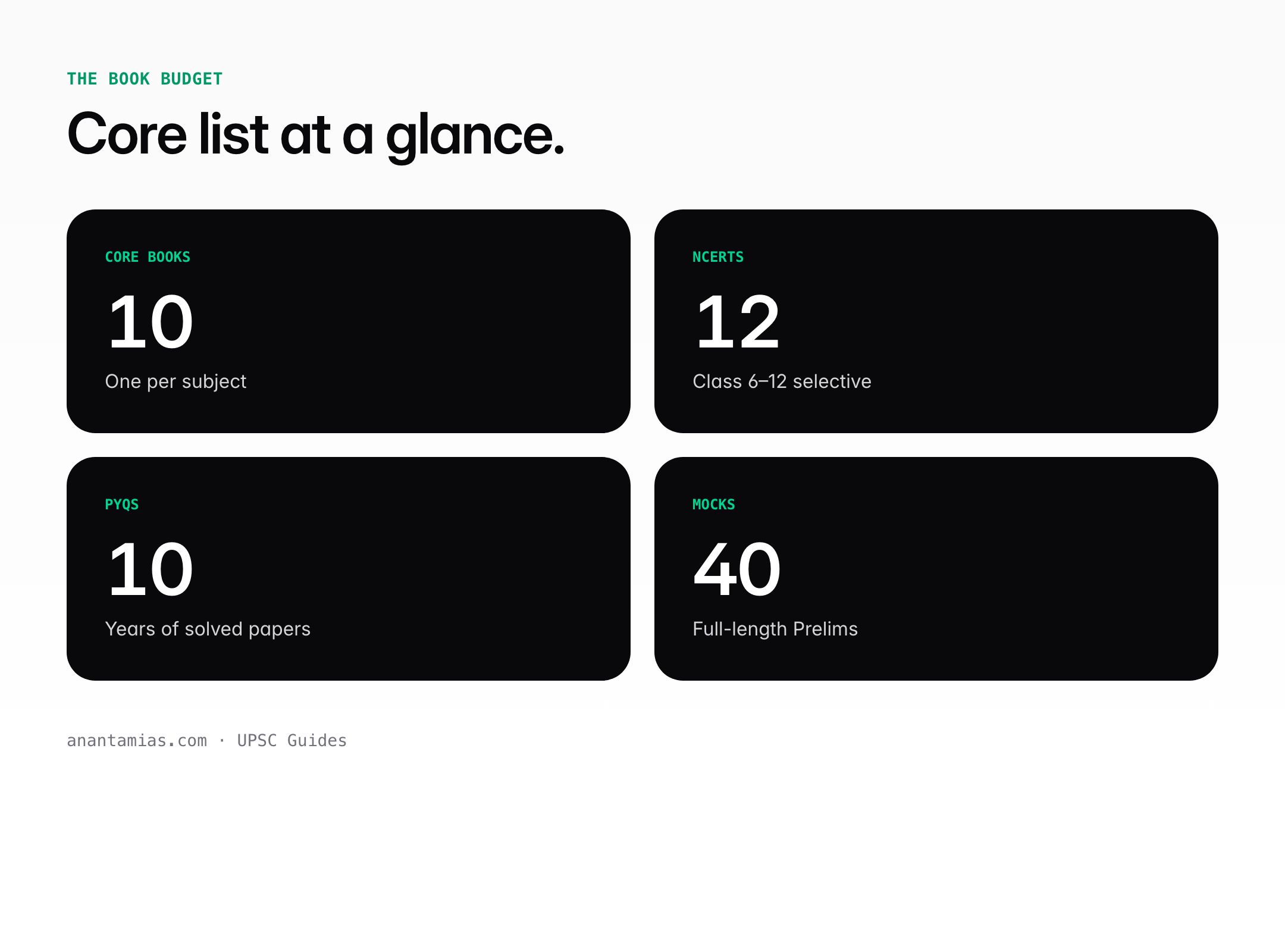
There are more UPSC book recommendation lists on the internet than the number of questions UPSC has asked in the last 25 years. This one is different only in that it’s short. You need roughly 15 books plus current affairs to cover Prelims 2026 — not 50, not 100. Buying more books is the most expensive form of procrastination in UPSC preparation.
This list assumes you’ll read each book 2–3 times. Depth beats breadth. Every topper says the same thing and every year thousands of aspirants ignore it.
Polity
Polity is the most scoring GS subject in Prelims — 15–18 questions out of 100, most of them factual. One book, read three times, with Constitution article numbers underlined, gets you 14–16 right.
- M. Laxmikanth — Indian Polity (7th edition or later). Non-negotiable. Cover to cover. Do all practice MCQs at chapter ends.
- DD Basu — Introduction to the Constitution of India (optional, only if you have extra time and want depth for Mains too).
- Bare text of the Constitution — skim the Preamble, Schedules, Part III and IV at least once.
Modern Indian History
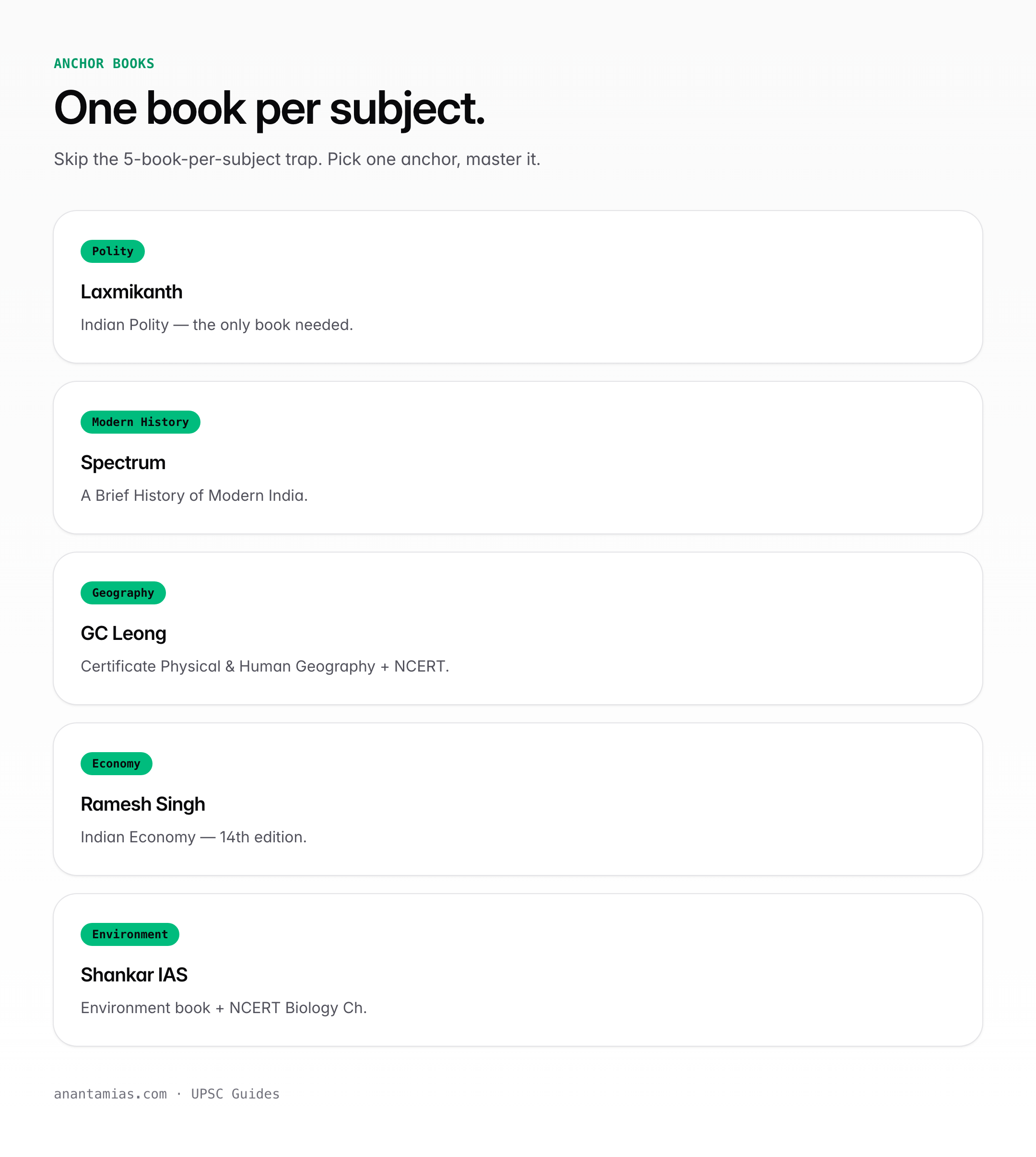
- Spectrum — A Brief History of Modern India by Rajiv Ahir. The standard, and sufficient.
- Bipan Chandra — India’s Struggle for Independence (only if you take History as Optional or want deeper reading).
- NCERT Class 8 — Our Pasts III (for a gentler start).
Ancient and Medieval History
- Old NCERT — Ancient India by R.S. Sharma
- Old NCERT — Medieval India by Satish Chandra
- Tamil Nadu Class 11 History textbook — exceptionally clear on South Indian dynasties.
Art and Culture
- Nitin Singhania — Indian Art and Culture. The universally-used reference.
- CCRT website (free) — for specific classical dance/music/painting details.
- NCERT Class 11 — An Introduction to Indian Art.
Geography
- NCERT Class 11 — Fundamentals of Physical Geography
- NCERT Class 11 — India: Physical Environment
- NCERT Class 12 — Fundamentals of Human Geography + India People and Economy
- G.C. Leong — Certificate Physical and Human Geography (optional but loved by many)
- Oxford Student Atlas — for daily 10-minute map practice.
Indian Economy
- Ramesh Singh — Indian Economy (most common choice, bulky but complete).
- Sanjeev Verma — The Indian Economy (leaner alternative).
- NCERT Class 11 — Indian Economic Development.
- Economic Survey summary (not the full volumes) + Budget highlights.
Environment and Ecology
- ShankarIAS — Environment. Single most-read Prelims-specific book.
- NCERT Class 12 — Biology, last 4 chapters (ecology).
- PIB environment tracker + India Year Book chapter on environment.
Science and Technology
No dedicated textbook works consistently. Build it from current affairs + NCERT Science (Classes 6–10 quick skim).
- NCERT Class 6–10 Science (skim in 1 week)
- Monthly current affairs magazine S&T section
- PIB press releases on ISRO, DRDO, CSIR, biotech missions
Current Affairs and PIB
- One daily newspaper — The Hindu or Indian Express
- Monthly compilation — Vision IAS Monthly / ForumIAS / InsightsIAS (pick one)
- PIB Daily website (free)
- RSTV / Sansad TV debates (optional, 2–3 per week)
CSAT (Paper 2)
Do not neglect CSAT. The qualifying cut-off is 33%, but with 2023 and 2024 papers getting harder, many aspirants failed Prelims because of CSAT, not GS.
- R.S. Aggarwal — Quantitative Aptitude
- Nishit Sinha — Logical Reasoning and Data Interpretation
- Arihant / TMH — CSAT Paper 2 Manual
- Solve all previous years’ CSAT papers (2011 onwards) — twice.
Complete Prelims Book List — At a Glance
| Subject | Primary Book | Pages |
|---|---|---|
| Polity | Laxmikanth | ~750 |
| Modern History | Spectrum | ~600 |
| Ancient/Medieval | Old NCERTs | ~400 |
| Art & Culture | Nitin Singhania | ~500 |
| Geography | NCERT + G.C. Leong | ~800 |
| Economy | Ramesh Singh | ~900 |
| Environment | ShankarIAS | ~400 |
| CSAT | R.S. Aggarwal + Nishit Sinha | ~1000 |
Previous Year Questions: The Single Most Underrated Book
Before you buy anything else, buy Disha Publications’ UPSC 32 Years Prelims Solved Papers or Arihant’s equivalent. Solve 10 years of papers before you finish your first full reading of any book. PYQs teach you what UPSC actually values — and the answer is rarely what coaching material emphasises.
What Not To Buy
- Any book with ‘100% Guaranteed’ in the title
- Three books for the same subject
- Fat current affairs compilations older than 12 months
- Every toppers’ handwritten notes PDF floating on Telegram
Frequently Asked Questions
How many books are enough for UPSC Prelims?
Around 15 standard books plus current affairs and a PYQ compilation. More books mean less revision; less revision means lower marks.
Is Laxmikanth enough for Polity?
Yes, for Prelims. Three readings of Laxmikanth plus current polity issues from the newspaper covers 90% of Prelims Polity questions.
Which is better: Ramesh Singh or Sanjeev Verma?
Ramesh Singh is more comprehensive but dense. Sanjeev Verma is leaner and easier to revise. For a first-timer with limited time, Sanjeev Verma works; for a 2-year preparation window, Ramesh Singh is better.
Do I need to read NCERTs if I have standard books?
Yes, read NCERTs once — they simplify concepts and UPSC has directly lifted questions from them. History and Geography NCERTs are especially valuable.
How important are PYQs?
Extremely. Ten years of Prelims PYQs should be solved twice — once at the end of foundation and once in the final month. They reveal UPSC’s thinking better than any book.
Should I read The Hindu or Indian Express?
Either works. The Hindu has stronger editorials on polity and governance; Indian Express has better coverage of policy and economy. Pick one and stay consistent — switching wastes time.
Tell Google you want more of this.
Add Anantam IAS as a preferred sourceOne tap, and this site shows up more often in your own Top Stories, AI Overviews and AI Mode. Remove it any time.