
UPSC CSE 2026 Essay Paper Discussion

YEAR ASKED IN

2023

Practice UPSC 2023 previous year questions on Anantam IAS: 100 Prelims MCQs and 80 Mains Q&A with answer keys, explanations and topic-wise links.

Prelims MCQs 100

  1. With reference to India’s projects on connectivity, consider the following statements: 1. East-West Corridor…

    With reference to India's projects on connectivity, consider the following statements: 1. East-West Corridor under Golden Quadrilateral Project connects Dibrugarh and Surat. 2. Trilateral Highway connects Moreh in Manipur and Chiang Mai in Thailand via Myanmar. 3. Bangladesh-China- India-Myanmar Economic Corridor connects Varanasi in Uttar Pradesh with Kunming in China. How many of the above statements are correct?

    1. AOnly one
    2. BOnly two
    3. CAll three
    4. DNone
    Answer and explanation

    Correct answer: D

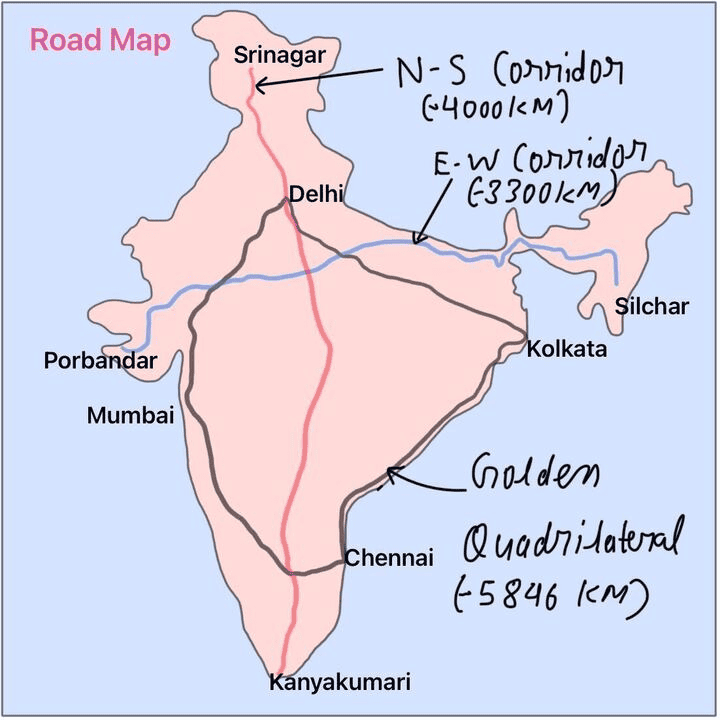
    Statement 1 is incorrect: The East-West Corridor is a part of the National Highways Development Project (NHDP) in India, which aims to connect Silchar in Assam to Porbandar in Gujarat. It does not connect Dibrugarh in Assam and Surat in Gujarat.
    ![QUAD](https://d39jluplm5thpx.cloudfront.net//Golden_Quadrilateral_ea02cfad8f.png)

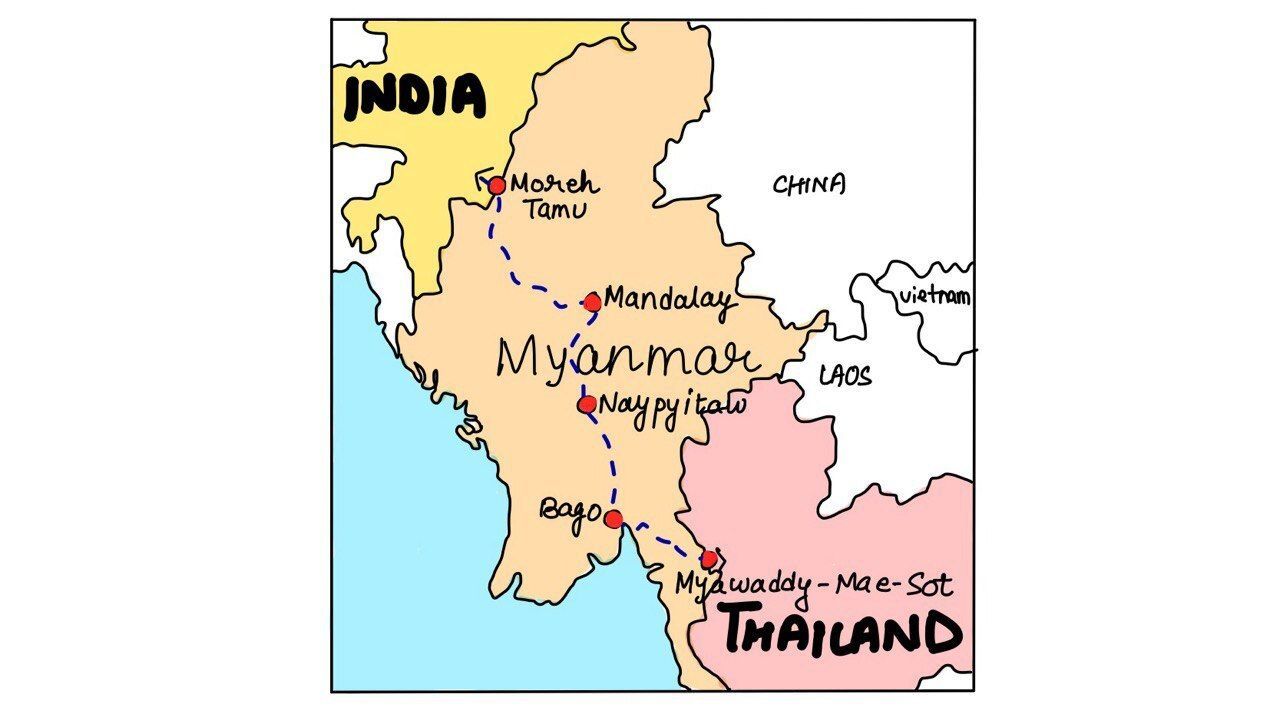
    Statement 2 is incorrect: The Trilateral Highway is a connectivity project that aims to connect Moreh in Manipur, India, with Mae Sot in Thailand via Myanmar. It is an important infrastructure project to enhance trade, connectivity, and people-to-people ties among the three countries.
    ![imt](https://d39jluplm5thpx.cloudfront.net//IMT_Higgway_08b30f7da2.jpg)

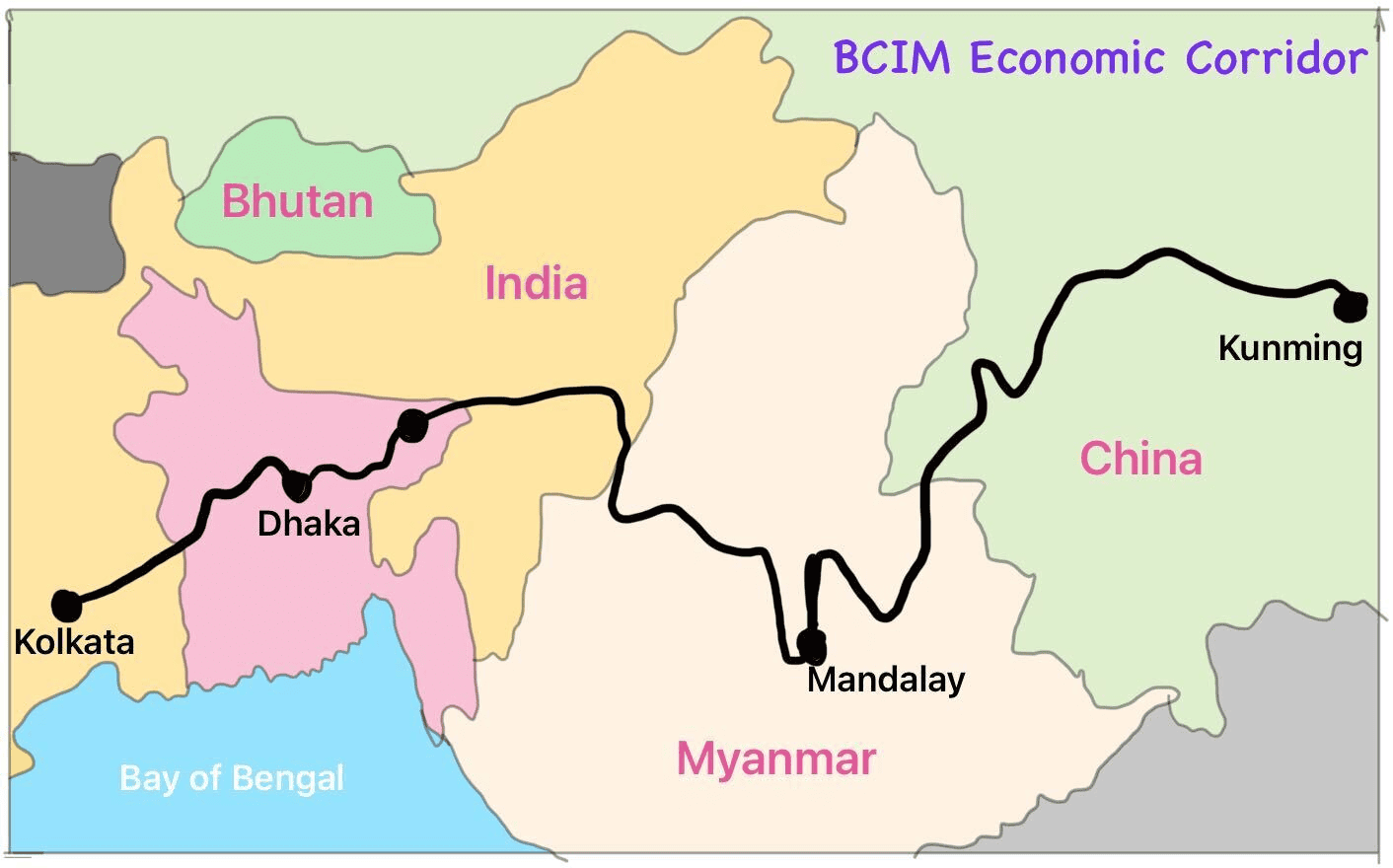
    Statement 3 is incorrect: The Bangladesh-China-India-Myanmar Economic Corridor (BCIM) is a proposed economic corridor that aims to connect Kunming in China with Kolkata in India, passing through Myanmar and Bangladesh. Varanasi in Uttar Pradesh is not directly connected to this corridor.
    ![BCIM](https://d39jluplm5thpx.cloudfront.net//BCIM_b1f45dad14.png)

    Thus, none of the statements are correct

  2. Which of the following organisms perform waggle dance for others of their kin to…

    Which of the following organisms perform waggle dance for others of their kin to indicate the direction and the distance to a source of their food?

    1. AButterflies
    2. BDragonflies
    3. CHoneybees
    4. DWasps
    Answer and explanation

    Correct answer: C

    * The honey bee dance, also known as the waggle dance, is a form of communication performed by worker honey bees to other members of the honey bee colony. The waggle dance was famously decoded by Austrian scientist, Karl von Frisch. * The direction the bee moves in relation to the hive indicates direction; if it moves vertically, the direction to the source is directly towards the Sun. * The duration of the waggle part of the dance signifies the distance. Hence, option (C) is the correct answer.

  3. ‘Wolbachia method’ is sometimes talked about with reference to which one of the following?

    'Wolbachia method' is sometimes talked about with reference to which one of the following?

    1. AControlling the viral diseases spread by mosquitoes
    2. BConverting crop residues into packing material
    3. CProducing biodegradable plastics
    4. DProducing biochar from thermochemical conversion of biomass
    Answer and explanation

    Correct answer: A

    The Wolbachia method is a biological method that utilises the Wolbachia bacteria to control the spread of mosquito-borne diseases, particularly dengue fever.

    * Wolbachia naturally infects some insect species, but not Aedes aegypti mosquitoes, the primary vector for dengue fever transmission. Scientists introduce Wolbachia into Aedes aegypti populations. Wolbachia reduces the ability of these mosquitoes to transmit dengue virus.

    * As Wolbachia spreads through the mosquito population, it can significantly reduce the incidence of dengue fever.

    * This method offers a natural and sustainable approach to controlling dengue fever, a major public health concern in tropical and subtropical regions.

  4. In the recent years Chad, Guinea, Mali and Sudan caught the international attention for…

    In the recent years Chad, Guinea, Mali and Sudan caught the international attention for which one of the following reasons common to all of them?

    1. ADiscovery of rich deposits of rare earth elements
    2. BEstablishment of Chinese Military bases
    3. CSouthward expansion of Sahara Desert
    4. DSuccessful coups
    Answer and explanation

    Correct answer: D

    * Successful Coups There have been several military coups in these countries in recent years - Chad (2021) - Guinea (2021) - Mali (2020, 2021) - Sudan (2019)

    * Military coups often lead to political instability, international concern about human rights, and potential disruption to trade and regional security.

    ![Sahara](https://d39jluplm5thpx.cloudfront.net//Sahara_and_Sahel_7a129b9eda.png)

  5. With reference to the Earth’s atmosphere, which one of the following statements is correct?

    With reference to the Earth's atmosphere, which one of the following statements is correct?

    1. AThe total amount of insolation received at the equator is roughly about 10 times of that received at the poles.
    2. BInfrared rays constitute roughly two-thirds of insolation.
    3. CInfrared waves are largely absorbed by water vapour that is concentrated in the lower atmosphere.
    4. DInfrared waves are a part of visible spectrum of electromagnetic waves of solar radiation.
    Answer and explanation

    Correct answer: C

    * While it is true that the equator receives more direct sunlight compared to the poles, the actual difference in insolation is not as large as ten times. The difference in insolation between the equator and poles is primarily due to the curvature of the Earth and the tilt of its axis, resulting in varying angles at which sunlight reaches different latitudes.

    * Insolation includes various wavelengths, such as visible light, ultraviolet rays, and infrared rays, but infrared rays do not constitute two-thirds of it.

    * Water vapour is a greenhouse gas that absorbs infrared radiation emitted by the Earth's surface. This absorption contributes to the greenhouse effect and helps regulate the Earth's temperature. Hence, this is the correct statement.

    * Infrared waves are not part of the visible spectrum; they have longer wavelengths than visible light.

  6. Consider the following: 1. Aerosols 2. Foam agents 3. Fire retardants 4. Lubricants In…

    Consider the following: 1. Aerosols 2. Foam agents 3. Fire retardants 4. Lubricants In the making of how many of the above are hydrofluorocarbons used?

    1. AOnly one
    2. BOnly two
    3. COnly three
    4. DAll four
    Answer and explanation

    Correct answer: C

    Statement 1 is Correct: Hydrofluorocarbons (HFCs) are used as propellants in aerosol products, such as hairsprays, deodorants, and various cleaning sprays, as they are non-flammable and serve as effective carriers for the product.

    Statement 2 is Correct: HFCs are widely used as foam-blowing agents in the manufacture of plastic foams (such as polyurethane and polystyrene) which are used for thermal insulation in buildings, refrigerators, and other appliances.

    Statement 3 is Correct: HFCs (such as HFC-227ea) are used as fire suppressants in fire protection systems. They are often referred to as "clean agents" and were developed to replace ozone-depleting Halons in fire extinguishers and total flooding systems.

    Statement 4 is Incorrect: HFCs are not used in the making of lubricants. Lubricants are typically formulated from mineral oils, synthetic hydrocarbons (like polyalphaolefins), or esters to reduce friction and wear between moving surfaces.

  7. Consider the following dynasties: 1. Hoysala 2. Gahadavala 3. Kakatiya 4. Yadava How many…

    Consider the following dynasties: 1. Hoysala 2. Gahadavala 3. Kakatiya 4. Yadava How many of the above dynasties established their kingdoms in early eighth century AD?

    1. AOnly one
    2. BOnly two
    3. COnly three
    4. DNone
    Answer and explanation

    Correct answer: D

    None of the listed dynasties established their kingdoms in the early eighth century AD (701-800 AD).

    1. Hoysala - 1006 AD 2. Gahadavala - 1026 AD 3. Kakatiya - 1000 AD (established as a sub-feudatory, declared independence around the 10th century) 4. Yadava - 850 AD (although some sources suggest a later date)

    Even the earliest of these estimates (Yadava dynasty) falls outside the early eighth-century range. Please note: Early eighth century AD refers to the beginning of the medieval period. At that time, there were 3 major dynasties that established their empires in India - Palas, Pratiharas, Rashtrakutas.

  8. Consider the investments in the following assets: 1. Brand recognition 2. Inventory 3. Intellectual…

    Consider the investments in the following assets: 1. Brand recognition 2. Inventory 3. Intellectual property 4. Mailing list of clients How many of the above are considered intangible investments?

    1. AOnly one
    2. BOnly two
    3. COnly three
    4. DAll four
    Answer and explanation

    Correct answer: C

    Out of the four listed assets, three are considered intangible investments

    * Brand recognition (Intangible): This is an intangible asset as it's not a physical good but represents the value associated with a brand's reputation and customer recognition.

    * Intellectual property (Intangible): This encompasses intangible assets like patents, copyrights, trademarks, and trade secrets. It represents intellectual creations that provide a competitive advantage.

    * Mailing list of clients (Intangible): This is a customer relationship asset that holds value because it allows you to connect with potential and existing customers.

    * Inventory (Tangible): Inventory refers to the stock of physical goods that a company holds for sale. It's a tangible asset with a physical form.

  9. In India, which one of the following Constitutional Amendments was widely believed to be…

    In India, which one of the following Constitutional Amendments was widely believed to be enacted to overcome the judicial interpretations of the Fundamental Rights?

    1. A1st Amendment
    2. B42nd Amendment
    3. C44th Amendment
    4. D86th Amendment
    Answer and explanation

    Correct answer: A

    The First Amendment Act (1951) was enacted specifically to address judicial decisions that hindered the government's socio-economic agenda, particularly regarding land reforms and reservations.

    1. Right to Equality (Article 15): In the case of *State of Madras v. Champakam Dorairajan (1951)*, the Supreme Court struck down a government order providing caste-based reservations in medical and engineering colleges. To overcome this, the 1st Amendment added Article 15(4), empowering the state to make special provisions for the advancement of socially and educationally backward classes.

    2. Right to Property (Articles 31A and 31B): Judicial challenges to various Zamindari abolition laws (such as *Kameshwar Singh v. State of Bihar*) led the government to introduce Articles 31A and 31B. It also created the Ninth Schedule to protect specific laws from being challenged in courts on the grounds of violating Fundamental Rights.

    3. Freedom of Speech (Article 19): Following judgments like *Romesh Thappar v. State of Madras*, which limited the state's power to curb free speech, the amendment added three new grounds of 'reasonable restrictions': public order, friendly relations with foreign states, and incitement to an offence.

    Note: While the 1st Amendment is the historically correct context for this question, UPSC dropped/deleted this specific question from the final official answer key for Prelims 2023.

  10. In essence, what does ‘Due Process of Law’ mean?

    In essence, what does 'Due Process of Law' mean?

    1. AThe principle of natural justice
    2. BThe procedure established by law
    3. CFair application of law
    4. DEquality before law
    Answer and explanation

    Correct answer: A

    * Option (a) is correct: The concept of 'Due Process of Law' primarily means that the procedure through which a person is deprived of life or liberty must be fair, just, and reasonable, following the principles of natural justice. It ensures that laws are not only enacted properly but also applied fairly and reasonably.

    * Option (b) is not correct: The phrase 'Procedure established by law', used in Article 21 of the Indian Constitution, refers to any procedure laid down by law, even if it is unfair. However, after the Maneka Gandhi v. Union of India (1978) judgment, the Supreme Court read into Article 21 the American concept of 'Due Process of Law', ensuring fairness and reasonableness in both substance and procedure.

    * Option (c) is not entirely correct: While fair application of law is part of due process, the phrase 'Due Process of Law' has a broader meaning that encompasses substantive fairness, procedural justice, and conformity with natural justice. Hence, option (a) captures its essence more accurately.

    * Option (d) is not correct: Equality before law (Article 14) is a distinct constitutional principle and not equivalent to due process.

Mains Q&A 80

  1. Vinod is an honest and sincere IAS officer. Recently, he has taken over as Managing Director of the State Road Transport Corporation, his sixth transfer in the past three years. His peers acknowledge his vast knowledge, affability and uprightness. The Chairman of the State Road Transport Corporation is a powerful politician and is very close to the Chief Minister. Vinod comes to know about many alleged irregularities of the Corporation and the high-handedness of the Chairman in financial matters. A Board Member of the Corporation belonging to the Opposition Party meets Vinod and hands over a few documents along with a video recording in which the Chairman appears to be demanding bribe for placing a huge order for the supply of QMR tyres. Vinod recollects the Chairman expediting clearing of pending bills of QMR tyres. Vinod confronts the Board Member as to why he is shying away from exposing the Chairman with the so-called solid proof he has with him. The member informs him that the Chairman refuses to yield to his threats. He adds that Vinod may earn recognition and public support if he himself exposes the Chairman. Further, he tells Vinod that once his party comes to power, Vinod’s professional growth would be assured. Vinod is aware that he may be penalized if he exposes the Chairman and may further be transferred to a distant place. He knows that the Opposition Party stands a better chance of coming to power in the forthcoming elections. However, he also realizes that the Board Member is trying to use him for his own political gains. (a) As a conscientious civil servant, evaluate the options available to Vinod. (b) In the light of the above case, comment upon the ethical issues that may arise due to the politicization of bureaucracy.

  2. You hold a responsible position in a ministry in the government. One day in the morning you received a call from the school of your 11-year-old son that you are required to come and meet the Principal. You proceed to the school and find your son in the Principal’s office. The Principal informs you that your son had been found wandering aimlessly in the grounds during the time classes were in progress. The class teacher further informs you that your son has lately become a loner and did not respond to questions in the class, he had also been unable to perform well in the football trials held recently. You bring your son back from the school and in the evening, you along with your wife try to find out the reasons for your son’s changed behaviour. After repeated cajoling, your son shares that some children had been making fun of him in the class as well as in the WhatsApp group of the students by calling him stunted, duh and a frog. He tells you the names of a few children who are the main culprits but pleads with you to let the matter rest. After a few days, during a sporting event, where you and your wife have gone to watch your son play, one of your colleague’s son shows you a video in which students have caricatured your son. Further, he also points out to the perpetrators who were sitting in the stands. You purposefully walk past them with your son and go home. Next day, you find on social media, a video denigrating you, your son and even your wife, stating that you engaged in physical bullying of children on the sports field. The video became viral on social media. Your friends and colleagues began calling you to find out the details. One of your juniors advised you to make a counter video giving the background and explaining that nothing had happened on the field. You, in turn posted a video which you have captured during the sporting event, identifying the likely perpetrators who were responsible for your son’s predicament. You have also narrated what has actually happened in the field and made attempts to bring out the adverse effects of the misuse of social media. (a) Based on the above case study, discuss the ethical issues involved in the use of social media. (b) Discuss the pros and cons of using social media by you to put across the facts to counter the fake propaganda against your family.

  3. At 9 pm on Saturday evening, Rashika, a Joint Secretary, was still engrossed in her work in her office. Her husband, Vikram, is an executive in an MNC and frequently out of town in connection with his work. Their two children aged 5 and 3 are looked after by their domestic helper. At 9:30 pm her superior, Mr. Suresh calls her and asks her to prepare a detailed note on an important matter to be discussed in a meeting in the Ministry. She realises that she will have to work on Sunday to finish the additional task given by her superior. She reflects on how she had looked forward to this posting and had worked long hours for months to achieve it. She had kept the welfare of people uppermost in discharging her duties. She feels that she has not done enough justice to her family and she has not fulfilled her duties in discharging essential social obligations. Even as recently as last month she had to leave her sick child in the nanny’s care as she had to work in the office. Now, she feels that she must draw a line, beyond which her personal life should take precedence over her professional responsibilities. She thinks that there should be reasonable limits to the work ethics such as punctuality, hard work, dedication to duty and selfless service. (a) Discuss the ethical issues involved in this case. (b) Briefly describe at least four laws that have been enacted by the Government with respect to providing a healthy, safe and equitable working environment for women. (c) Imagine you are in a similar situation. What suggestions would you make to mitigate such working conditions?

  4. A landslide occurred in the middle of the night on 20th July, 2023 in a remote mountain hamlet, approximately 60 kilometres from Uttarkashi. The landslide was caused by torrential rains and has resulted in large-scale destruction of property and life. You, as District Magistrate of that area, have rushed to the spot with a team of doctors, NGOs, media and police along with numerous support staff to oversee the rescue operations. A man came running to you with a request for urgent medical help for his pregnant wife who is in labour and is losing blood. You directed your medical team to examine his wife. They return and convey to you that this woman needs blood transfusion immediately. Upon enquiry, you come to know that a few blood collection bags and blood group test kits are available in the ambulance accompanying your team. Few people of your team have already volunteered to donate blood. Being a physician who has graduated from AIIMS, you know that blood for transfusion needs to be procured only through a recognized blood bank. Your team members are divided on this issue; some favour transfusion, while some others oppose it. The doctors in the team are ready to facilitate the delivery provided they are not penalized for transfusion. Now you are in a dilemma. Your professional training emphasizes on prioritising service to humanity and saving lives of individuals. (a) What are the ethical issues involved in this case? (b) Evaluate the options available to you, being District Magistrate of the area.

  5. You are working as an executive in a nationalised bank for several years. One day one of your close colleagues tells you that her father is suffering from heart disease and needs surgery immediately to survive. She also tells you that she has no insurance and the operation will cost about Rs. 10 lakh. You are also aware of the fact that her husband is no more and that she is from a lower middle class family. You are empathetic about her situation. However, apart from expressing your sympathy, you do not have the resources to fund her. A few weeks later, you ask her about the well-being of her father and she informs you about his successful surgery and that he is recovering. She then confides in you that the bank manager was kind enough to facilitate the release of Rs. 10 lakh from a dormant account of someone to pay for the operation with a promise that it should be confidential and be repaid at the earliest. She has already started paying it back and will continue to do so until it is all returned. (a) What are the ethical issues involved? (b) Evaluate the behaviour of the bank manager from an ethical point of view. (c) How would you react to the situation?

  6. Given below are three quotations of great thinkers. What do each of these quotations convey to you in the present context? (a) “The simplest acts of kindness are by far more powerful than a thousand heads bowing in prayer.” – Mahatma Gandhi (b) “To awaken the people, it is the women who must be awakened. Once she is on the move, the family moves, the village moves, the nation moves.” – Jawaharlal Nehru (c) “Do not hate anybody, because that hatred that comes out from you must, in the long run, come back to you. If you love, that love will come back to you, completing the circle.” – Swami Vivekananda