
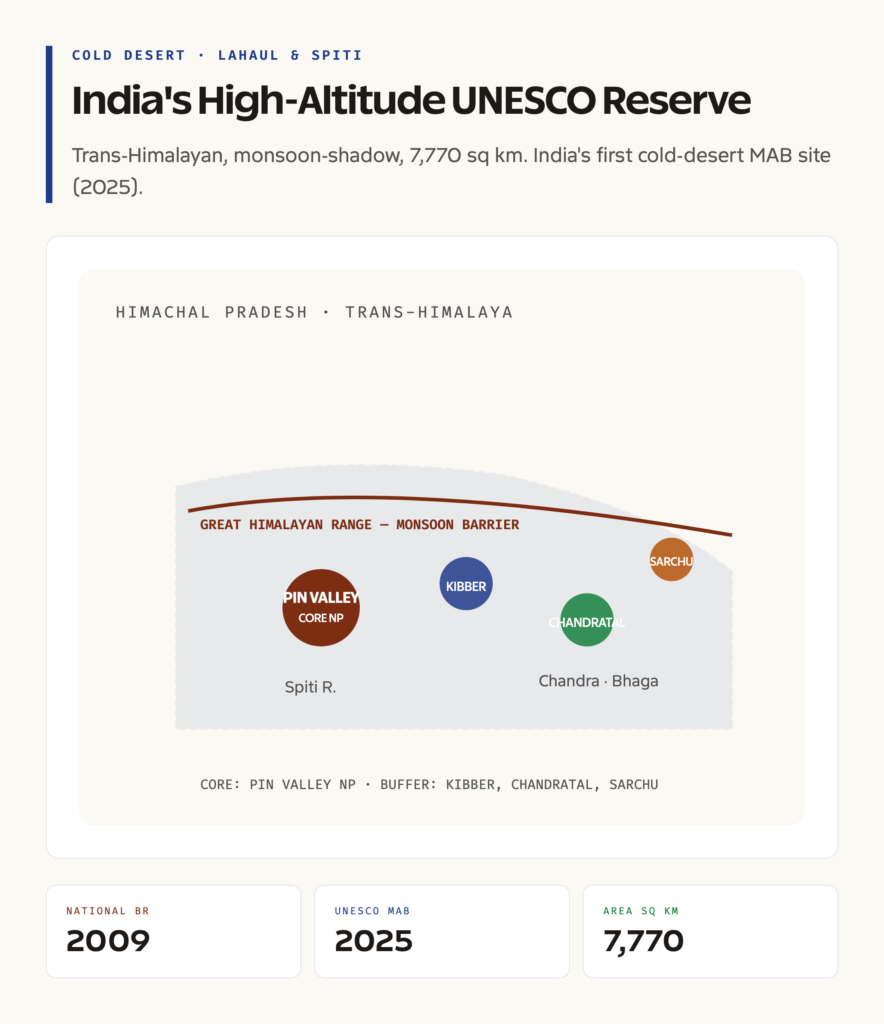
The Cold Desert Biosphere Reserve is India’s most spectacular high-altitude protected landscape and, since 2025, the country’s newest entry on the UNESCO Man and the Biosphere (MAB) network. Set in the Lahaul and Spiti district of Himachal Pradesh, the reserve covers a Trans-Himalayan landscape that the Indian summer monsoon never reaches. The Great Himalayan range cuts off the rain, leaving behind an arid, treeless, stunningly stark terrain that nevertheless supports some of India’s most charismatic wildlife.
For UPSC, this is a high-yield topic. The Cold Desert Biosphere Reserve has just achieved international recognition, it is the flagship habitat of the snow leopard, it overlaps with Pin Valley National Park and three other protected areas, and it is home to the Bhotia community whose Buddhist culture and pastoral economy have shaped the landscape for centuries. The reserve sits at the intersection of biodiversity, climate change, border security, and tribal rights.
Quick Facts
- State: Himachal Pradesh
- District: Lahaul and Spiti
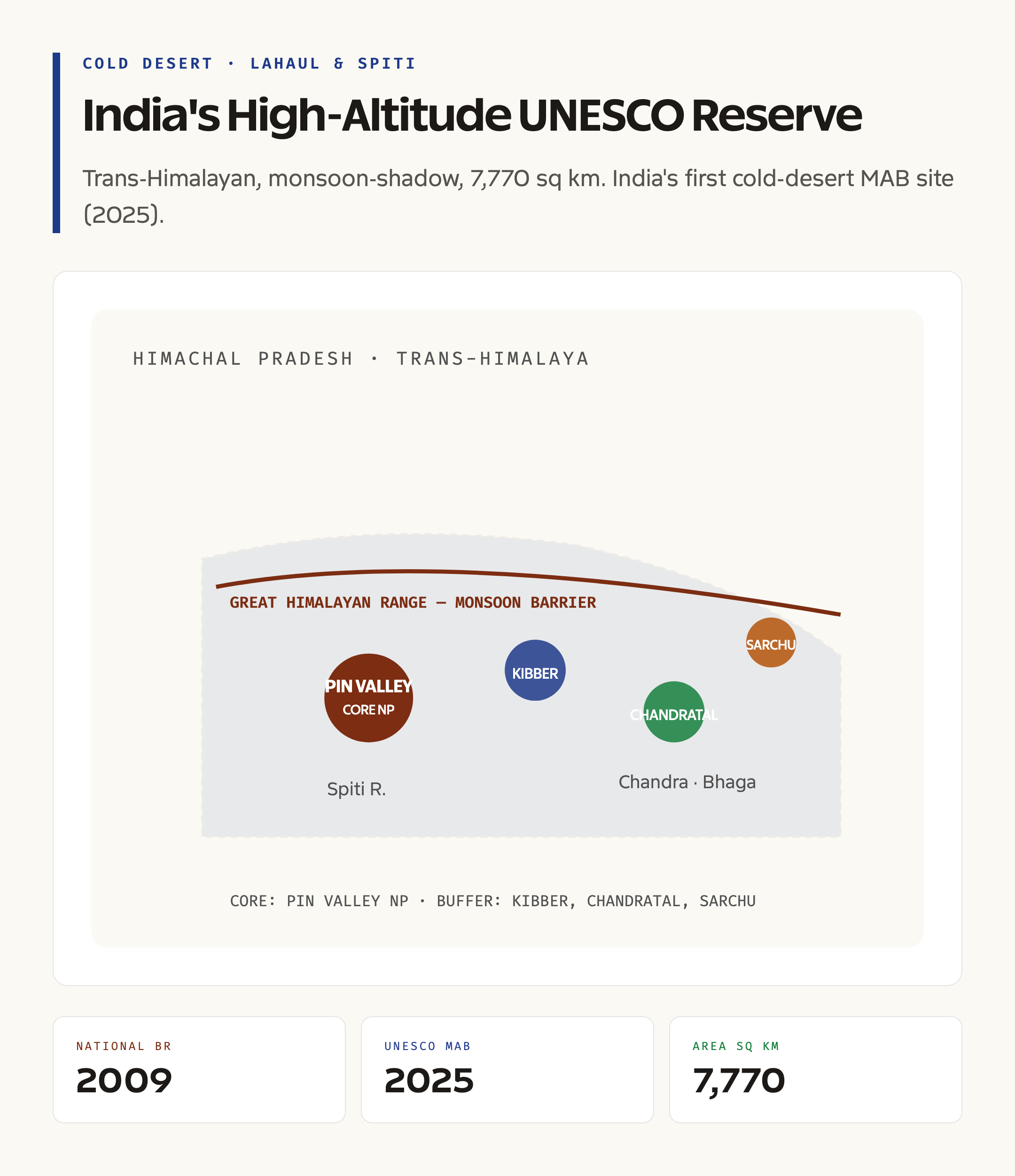
- Established as biosphere reserve: 2009
- UNESCO MAB inscription: 2025
- Type: High-altitude cold desert (Trans-Himalayan)
- Core zone: Pin Valley National Park
- Associated protected areas: Kibber Wildlife Sanctuary, Chandratal Wildlife Sanctuary, Sarchu
- Major rivers: Spiti, Pin, Chandra, Bhaga, Sutlej
- Climate: Arid, monsoon-shadow, freezing winters
- Flagship species: Snow Leopard
- Other key fauna: Himalayan Ibex, Bharal (Blue Sheep), Tibetan Wolf, Red Fox
- Notable flora: Ephedra, Seabuckthorn, Juniper
- Resident community: Bhotia tribe (largely Buddhist)
What is the Cold Desert Biosphere Reserve?
The Cold Desert Biosphere Reserve is a 7,770-square-kilometre Trans-Himalayan landscape designated to protect a unique high-altitude desert ecosystem. Most Indian biosphere reserves protect tropical or subtropical forests. The Cold Desert is the country’s clearest example of a temperate cold desert biome, comparable to parts of the Tibetan plateau or the Pamir mountains.
The reserve is structured around a core, buffer, and transition framework typical of UNESCO biosphere reserves. The core is Pin Valley National Park, where conservation is strict. The buffer includes Kibber Wildlife Sanctuary, Chandratal Wildlife Sanctuary, and the Sarchu area, where regulated traditional use is permitted. The transition zone hosts villages, tourism, and pastoral grazing under monitored conditions. The 2025 UNESCO inscription validated this multi-layered governance and gave India formal international recognition for protecting one of the most extreme landscapes on the subcontinent.
Background and Establishment
India established the Cold Desert as a national biosphere reserve in 2009, the seventeenth in its system. The proposal had been pending for years given the area’s combined ecological, cultural, and strategic significance. After 2009, the Wildlife Institute of India and the Himachal Pradesh Forest Department conducted detailed inventories, mapping snow leopard density, ibex population, Bharal numbers, and pastoral pressure on alpine pastures. These studies built the case for international recognition.
The 2025 UNESCO MAB inscription was the culmination of a long dossier process. India’s nomination highlighted three things. First, the reserve’s role as a stronghold for the snow leopard and other Trans-Himalayan species in the global biodiversity portfolio. Second, the cultural significance of the Bhotia community’s Buddhist pastoral traditions. Third, the reserve’s contribution to climate research, since cold deserts are sentinels of high-altitude climate change. India now has 13 biosphere reserves on the World Network, and the Cold Desert is its first cold-desert entry.
Constituent Protected Areas
The reserve integrates four protected areas under one biosphere governance umbrella.
- Pin Valley National Park: The strict core, covering 675 square kilometres in the Pin Valley. Established in 1987, it is one of the prime snow leopard habitats in India.
- Kibber Wildlife Sanctuary: Around the village of Kibber, often described as one of the highest motorable villages in the world. Excellent for snow leopard sightings in winter.
- Chandratal Wildlife Sanctuary: Surrounds the high-altitude Chandra Tal lake, a Ramsar site since 2005. Important for migratory waterbirds and alpine flora.
- Sarchu area: A high pastoral landscape on the Manali-Leh route, important for Bharal and migratory grazing.
This integration is one of the reasons UNESCO recognised the reserve. Few cold-desert protected-area complexes in Asia have this level of administrative coordination across a contiguous landscape.
Landscape, Climate, and Hydrology
The terrain ranges from roughly 3,000 to over 6,000 metres. The Great Himalayan range to the south blocks the monsoon, so annual rainfall is minimal, often under 200 millimetres. Snowfall in winter is heavy, and temperatures can drop below minus 30 degrees Celsius. The summer is short and intense, with strong solar radiation due to thin atmosphere.
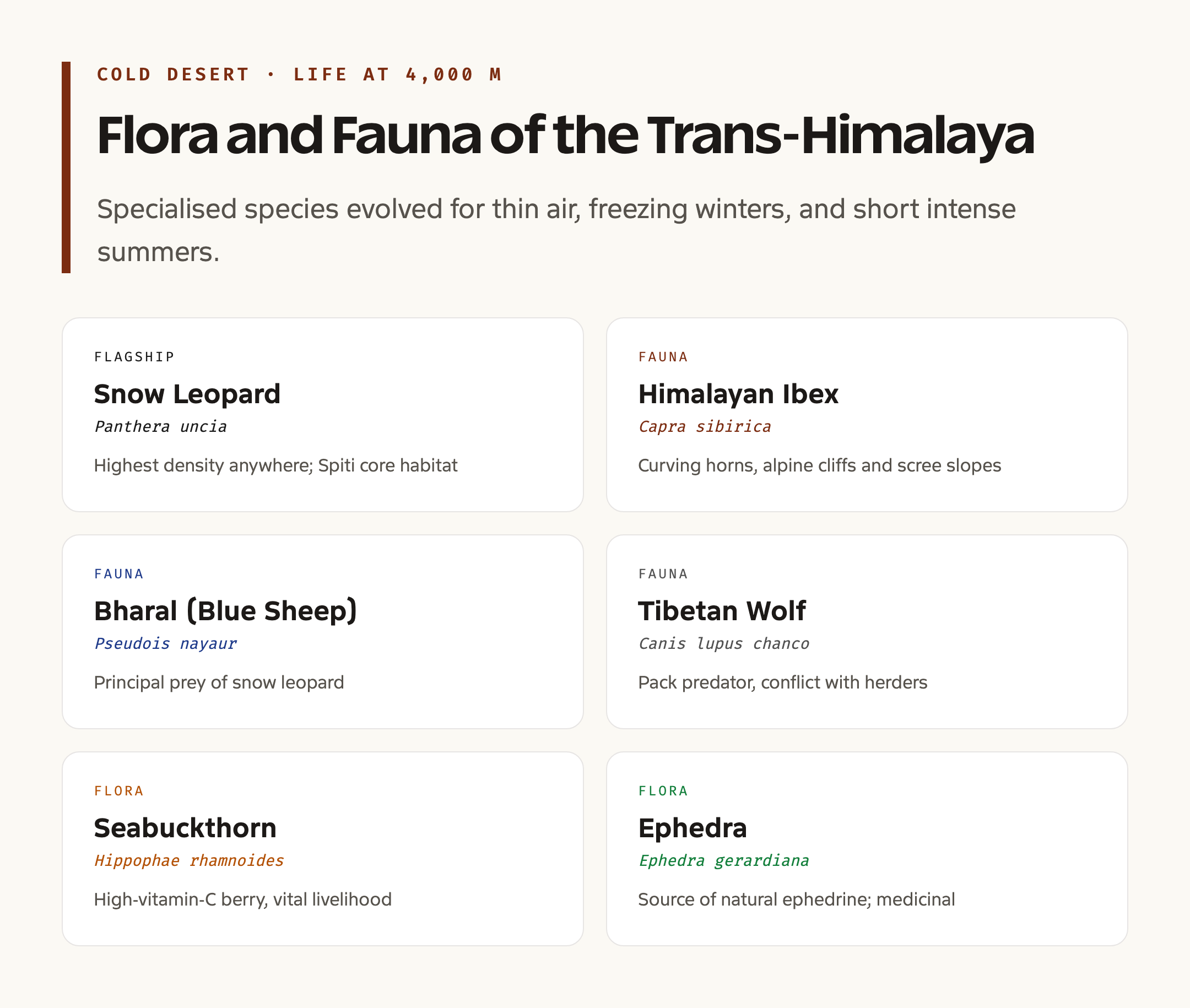
Vegetation is sparse but specialised. Ephedra (the source of natural ephedrine), Seabuckthorn (a high-vitamin-C berry critical to local livelihoods), Juniper, and a range of medicinal alpine herbs dominate. The Spiti, Pin, Chandra, Bhaga, and Sutlej rivers drain the landscape. The Chandra and Bhaga merge to form the Chenab. The Spiti flows into the Sutlej. These river systems make the reserve a critical headwater region for the Indus basin.
Key Species
The snow leopard is the flagship, with the Spiti landscape estimated to hold one of the highest densities anywhere in its global range. Camera-trap studies and the Snow Leopard Population Assessment in India (SPAI) have repeatedly underlined Spiti’s significance. Around Kibber, snow leopard sightings have become predictable enough to support a small but high-value wildlife tourism economy.
Other mammals include the Himalayan Ibex, with massive curving horns; the Bharal or Blue Sheep, the principal prey of the snow leopard; the Tibetan Wolf; and the Red Fox. Smaller fauna include the pika, marmot, Royle’s Pika, and the Tibetan Sandgrouse. Birds include the Lammergeier (bearded vulture), Golden Eagle, Himalayan Griffon Vulture, and the elusive Snow Partridge. The reserve’s species list reads like a textbook of Trans-Himalayan biodiversity, which is what makes it a key reference for UPSC questions on biodiversity in India and biosphere reserves.
Why the Cold Desert Biosphere Reserve Matters
The reserve matters for several layered reasons. Ecologically, it is one of the few large, well-connected snow leopard landscapes in India, contributing significantly to the species’ global conservation. Climatically, cold deserts are sensitive indicators of warming, with glacier retreat, treeline shifts, and snow cover changes happening faster here than at lower altitudes. Hydrologically, the Spiti, Chandra, Bhaga, and Sutlej rivers feed the Indus system, supporting agriculture and hydropower far downstream.
Culturally, the Bhotia community’s Buddhist heritage, including monasteries like Tabo, Key, Dhankar, and Lalung, is intertwined with the landscape. Strategically, the reserve sits close to the Indo-Tibetan border, making conservation decisions inseparable from infrastructure and security considerations. Internationally, the 2025 UNESCO recognition places India’s cold-desert conservation alongside high-altitude reserves in Mongolia, Nepal, Bhutan, and Pakistan, opening doors to cross-border research and funding.
Comparative Context: Cold Desert and Other Indian Biosphere Reserves

| Feature | Cold Desert (HP) | Nanda Devi (UK) | Khangchendzonga (SK) |
|---|---|---|---|
| Biome | Cold desert (Trans-Himalaya) | Subalpine to alpine | Subtropical to alpine |
| Year established (national) | 2009 | 1988 | 2000 |
| UNESCO MAB year | 2025 | 2004 | 2018 |
| Flagship species | Snow Leopard | Snow Leopard | Red Panda, Snow Leopard |
| Core area | Pin Valley NP | Nanda Devi NP, Valley of Flowers | Khangchendzonga NP |
| Climate | Arid cold | Wet monsoonal | Wet monsoonal |
The Cold Desert is India’s only high-altitude cold-desert biosphere reserve. Nanda Devi and Khangchendzonga, while also Himalayan, are wet, glacier-dominated, and forested at lower elevations.
Challenges
Climate change is the defining challenge. Glaciers in the Spiti basin are retreating, snow patterns are shifting, and the hydrology that sustains agriculture and ecosystems is becoming less predictable. Pasture degradation due to changing grazing patterns and free-ranging livestock, including the increasing number of horses and yaks, is altering forage availability for wild ungulates.
Tourism is a double-edged sword. It brings income to remote villages and gives conservation political support, but unregulated growth, plastic waste, and water demand from homestays and lodges strain fragile systems. Infrastructure projects, including the Atal Tunnel and proposed border roads, improve access but also fragment habitat and increase vehicular pressure. Human-wildlife conflict, particularly snow leopard predation on livestock, requires sustained compensation schemes and predator-proof corrals.
Prelims Pointers
- The Cold Desert Biosphere Reserve is in Himachal Pradesh, in Lahaul and Spiti district.
- It was established as a biosphere reserve in 2009 and inscribed in the UNESCO MAB network in 2025.
- The core zone is Pin Valley National Park (1987).
- Associated protected areas: Kibber Wildlife Sanctuary, Chandratal Wildlife Sanctuary, Sarchu.
- Major rivers: Spiti, Pin, Chandra, Bhaga, Sutlej.
- The flagship species is the Snow Leopard.
- It is a monsoon-shadow landscape, separated from the Indian monsoon by the Great Himalayan range.
- Notable flora: Ephedra, Seabuckthorn, Juniper.
- Resident community: Bhotia tribe (largely Buddhist).
- It is the 13th Indian biosphere reserve on the UNESCO MAB list.
Mains Angles
- GS-III, Environment: Discuss the ecological significance of cold deserts and the role of UNESCO biosphere reserve recognition in their conservation.
- GS-III, Climate Change: Cold deserts are sentinels of high-altitude climate change. Examine how biosphere reserves can serve as long-term climate observatories.
- GS-II, Federalism: Analyse the coordination between central agencies (MoEFCC, WII) and the state Forest Department in managing the Cold Desert Biosphere Reserve.
- GS-I, Society: Discuss how the Bhotia community’s Buddhist pastoral traditions have shaped the Spiti landscape and how modern conservation can integrate traditional knowledge.
- Essay: “Conservation at altitude: balancing fragility, faith, and the frontier.” Examine in the context of the Cold Desert Biosphere Reserve.
Way Forward
UNESCO recognition is a beginning, not a destination. The reserve needs a dedicated management plan that integrates climate adaptation, including glacier monitoring stations, pasture rotation protocols, and water harvesting in villages where springs are drying up. Snow leopard conservation should expand the Himachal Snow Leopard Project with adequate compensation for livestock loss and predator-proof corrals at scale.
Tourism needs a carrying-capacity assessment with clear quotas during peak season. Waste management infrastructure must be upgraded before, not after, more visitors arrive. Cross-border research collaboration with Ladakh’s Hemis National Park, Pakistan’s Khunjerab, and Mongolia’s snow leopard reserves can strengthen population-level conservation. Most importantly, the Bhotia community must remain co-stewards, not subjects of conservation. Their monasteries, festivals, and pastoral cycles are part of what makes this reserve worth UNESCO’s recognition in the first place.
Frequently Asked Questions
Where is the Cold Desert Biosphere Reserve located?
The Cold Desert Biosphere Reserve is in Himachal Pradesh, in the Lahaul and Spiti district. It is a Trans-Himalayan landscape, north of the Great Himalayan range that blocks the monsoon.
When was the Cold Desert added to the UNESCO Man and the Biosphere network?
The reserve was inscribed on the UNESCO MAB World Network of Biosphere Reserves in 2025, taking India’s total UNESCO biosphere reserves to 13.
What is the core zone of the Cold Desert Biosphere Reserve?
Pin Valley National Park, established in 1987, is the core zone. The buffer and transition zones include Kibber Wildlife Sanctuary, Chandratal Wildlife Sanctuary, and the Sarchu area.
Which is the flagship species of the Cold Desert Biosphere Reserve?
The snow leopard is the flagship species. The Spiti landscape, particularly around Kibber, is one of the highest-density snow leopard habitats in the world.
Why is it called a cold desert?
The Trans-Himalayan landscape is cut off from the Indian monsoon by the Great Himalayan range, so annual rainfall is very low, typically under 200 millimetres. Combined with high altitude and freezing winters, the climate produces a desert ecosystem that is cold rather than hot.
Which rivers flow through the Cold Desert Biosphere Reserve?
The major rivers are the Spiti, Pin, Chandra, Bhaga, and Sutlej. The Chandra and Bhaga merge to form the Chenab, while the Spiti flows into the Sutlej, all part of the Indus river system.
Who are the Bhotia people?
The Bhotia are the indigenous residents of Lahaul and Spiti. They are largely Buddhist, follow agro-pastoral traditions, and host some of India’s oldest monasteries including Tabo, Key, and Dhankar.
What plants are characteristic of the cold desert?
Ephedra, Seabuckthorn, Juniper, and a range of alpine medicinal herbs are characteristic. Seabuckthorn berries are an important local livelihood resource because of their high nutritional value.
Is Chandra Tal a Ramsar site?
Yes. Chandra Tal, a high-altitude lake within the Chandratal Wildlife Sanctuary in the buffer zone, was designated a Ramsar site in 2005.
How does the Cold Desert Biosphere Reserve compare with Hemis National Park in Ladakh?
Both are Trans-Himalayan and important for snow leopard conservation. Hemis is larger and lies in Ladakh, while the Cold Desert is in Himachal Pradesh. Together they form a connected mosaic of high-altitude conservation areas across the western Himalaya.
Tell Google you want more of this.
Add Anantam IAS as a preferred sourceOne tap, and this site shows up more often in your own Top Stories, AI Overviews and AI Mode. Remove it any time.





