Why in News?
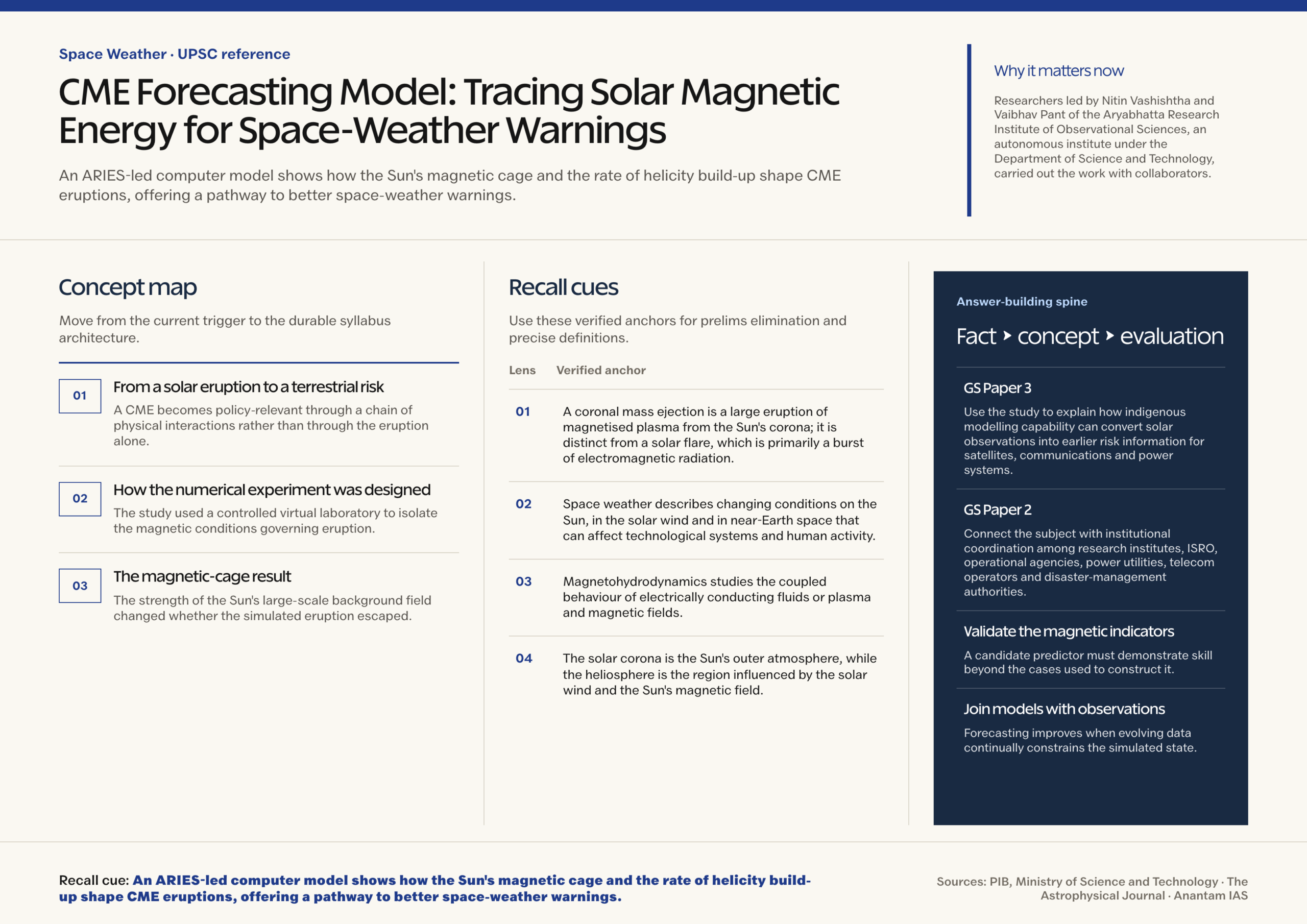
The Ministry of Science and Technology highlighted an ARIES-led computational study that simulates how coronal mass ejections begin and identifies magnetic conditions associated with successful, failed and repeated eruptions.
- Researchers led by Nitin Vashishtha and Vaibhav Pant of the Aryabhatta Research Institute of Observational Sciences, an autonomous institute under the Department of Science and Technology, carried out the work with collaborators.
- The team used magnetohydrodynamic simulations to study electrically conducting solar plasma interacting with magnetic fields in the corona.
- The simulation was based on the breakout model, in which magnetic reconnection in a multipolar field can remove restraining flux above a sheared core and enable an eruption.
- A stronger background poloidal magnetic field acted as a magnetic cage: a case that erupted under a weaker field became confined when the background field was strengthened.
- The rate of increase of Absolute Net Current Helicity emerged as a useful discriminator: slow build-up accompanied a failed eruption, while faster build-up preceded successful and, in the fastest case, multiple eruptions.
- Modern economies depend on space-based and grid infrastructure, so a solar eruption can become a disaster-management issue even though the hazard originates far beyond Earth’s atmosphere.
- Forecasting requires more than detecting an outward-moving plasma cloud. Forecasters must estimate whether it is Earth-directed, when it may arrive and how its embedded magnetic field may couple with Earth’s magnetosphere.
- The research links an eruption’s initiation to measurable or inferable magnetic quantities, creating a possible bridge from solar physics to risk-based early warning.
UPSC Relevance
Prelims Relevance
- A coronal mass ejection is a large eruption of magnetised plasma from the Sun’s corona; it is distinct from a solar flare, which is primarily a burst of electromagnetic radiation.
- Space weather describes changing conditions on the Sun, in the solar wind and in near-Earth space that can affect technological systems and human activity.
- Magnetohydrodynamics studies the coupled behaviour of electrically conducting fluids or plasma and magnetic fields.
- The solar corona is the Sun’s outer atmosphere, while the heliosphere is the region influenced by the solar wind and the Sun’s magnetic field.
- Magnetic helicity characterises the twist, writhe and linkage of magnetic-field structures; the study examined current-helicity measures as eruption diagnostics.
- A poloidal magnetic field lies in meridional planes around an axis and, in the simulation, its background strength altered the confinement of the erupting structure.
Mains Relevance
GS Paper 3
- Use the study to explain how indigenous modelling capability can convert solar observations into earlier risk information for satellites, communications and power systems.
- Discuss space weather as a technology-linked disaster risk requiring forecasting, infrastructure resilience, continuity planning and cross-sector warning protocols.
GS Paper 2
- Connect the subject with institutional coordination among research institutes, ISRO, operational agencies, power utilities, telecom operators and disaster-management authorities.
- Examine why space weather needs international data sharing: the Sun-Earth system crosses national jurisdictions and benefits from globally distributed observations.
Essay
- The study illustrates how societies become more vulnerable as technology becomes more capable: invisible solar processes can affect services on which everyday life depends.
Background and Context
From a solar eruption to a terrestrial risk
A CME becomes policy-relevant through a chain of physical interactions rather than through the eruption alone.
- The Sun’s corona contains hot, ionised matter whose motion is tightly coupled to magnetic fields. Stress can build in coronal magnetic structures as motions at the solar surface shear, twist or rearrange their anchored field lines.
- When a magnetic configuration loses equilibrium or restraining flux is removed, a large structure carrying plasma and magnetic field may accelerate outward as a CME. A solar flare can occur with a CME, but the two.
- If the CME intersects Earth, it first modifies the upstream solar wind and then interacts with the magnetosphere. Strong coupling is favoured when the interplanetary magnetic field contains a sustained southward component that can reconnect.
- Possible consequences include satellite charging or drag changes, navigation errors caused by ionospheric disturbance, degradation of high-frequency radio links, radiation exposure in space and at high aviation latitudes, and geomagnetically induced currents in long conductors and.
- This chain explains why operational forecasting needs several linked questions: Did an eruption occur? Is it Earth-directed? How will it propagate? What magnetic structure will arrive? Which systems are exposed?
How the numerical experiment was designed
The study used a controlled virtual laboratory to isolate the magnetic conditions governing eruption.
- The researchers used numerical magnetohydrodynamics, which represents plasma through conservation equations for mass, momentum and energy together with the evolution of magnetic fields. This is appropriate because the solar corona behaves as an electrically conducting.
- The simulations used the MPI-AMRVAC computational framework in a 2.5-dimensional configuration. In such a setup, physical quantities can have three components even though spatial variation is resolved in two dimensions, allowing detailed parameter experiments at lower.
- A multipolar magnetic configuration was placed within a background dipolar or poloidal field. Shearing motions were applied at the lower boundary to inject energy and magnetic helicity into the coronal system.
- The setup followed the magnetic-breakout mechanism. Reconnection near a coronal magnetic null can transfer overlying restraining flux, permitting the stressed core structure below it to rise and erupt.
- By changing one controlling quantity between runs, the team could compare failed, single and multiple eruption regimes. Such a controlled comparison identifies causal mechanisms, though it does not reproduce every complexity of the real Sun.
The magnetic-cage result
The strength of the Sun’s large-scale background field changed whether the simulated eruption escaped.
- Under a weaker background field, the stressed core could overcome the overlying restraint and produce a successful CME. A modestly stronger background poloidal field confined a comparable eruption, causing it to fail and fall back rather.
- The result gives physical meaning to the phrase magnetic cage: overlying field lines supply magnetic tension and pressure that an erupting structure must overcome or remove through reconnection.
- This offers a plausible interpretation of a Solar Cycle 24 puzzle noted by the researchers. That cycle was magnetically weaker than Solar Cycle 23 yet produced many relatively weak CMEs; lower heliospheric magnetic pressure may have.
- The comparison should not be simplified into ‘weaker Sun means stronger storms.’ It concerns the ease with which eruptions can escape in the model, while an individual event’s speed, trajectory, magnetic orientation and interaction with the.
- For answer writing, separate eruption probability from geoeffectiveness. A model that helps identify whether a CME will launch does not, by itself, predict its arrival time or the intensity of a geomagnetic storm.
Helicity build-up as an eruption clue
The rate at which magnetic complexity accumulated proved more informative than a static snapshot alone.
- Magnetic helicity captures the handedness and topological complexity of a magnetic field. In solar active regions, shear and twist can store free magnetic energy above the minimum-energy potential-field state.
- The researchers tracked magnetic energy, Total Unsigned Current Helicity and Absolute Net Current Helicity across different runs. These quantities describe related but not identical aspects of stored energy and electric-current-associated twist.
- The growth rate of Absolute Net Current Helicity was the clearest discriminator in the reported simulations. Slow injection was associated with a failed eruption, faster injection with a successful eruption and the fastest injection with multiple.
- The important forecasting insight is temporal: a changing magnetic parameter may carry more warning information than its value at one moment. Operational use would require reliable observations of the relevant magnetic quantities and thresholds calibrated across.
- A promising indicator is not the same as a deterministic trigger. Solar magnetic structures are three-dimensional, observations contain uncertainty, and different eruption mechanisms may produce similar outward signatures.
Way Forward
Validate the magnetic indicators
- Test helicity-growth indicators across a large catalogue of eruptive and non-eruptive active regions, including failed eruptions and events from different solar-cycle phases.
- Pre-register thresholds and evaluate probability of detection, false-alarm rate, calibration and lead time against baseline forecasting methods.
- Extend experiments into three-dimensional simulations and examine sensitivity to boundary conditions, magnetic topology, observational noise and numerical resolution.
Conclusion
- The ARIES-led work advances a central space-weather question: what allows a stressed magnetic structure to escape the Sun as a CME?
- The policy lesson is equally important.
UPSC Practice Questions
Prelims MCQ 1
With reference to coronal mass ejections (CMEs), consider the following statements:
- A CME is an eruption of magnetised plasma from the solar corona.
- Every CME necessarily strikes Earth and produces a severe geomagnetic storm.
- The orientation of the magnetic field carried by an Earth-arriving CME can influence its geomagnetic impact.
How many of the above statements are correct?
(a) Only one (b) Only two (c) All three (d) None
Answer: (b) Only two
Explanation:
Statements 1 and 3 are correct. A CME carries magnetised plasma, and its field orientation affects coupling with Earth’s magnetosphere. Statement 2 is incorrect because many CMEs are not Earth-directed, and Earth-arriving events vary widely in geoeffectiveness.
Prelims MCQ 2
In the ARIES-led CME simulation study, which of the following was reported as the clearest indicator distinguishing failed, successful and multiple eruptions?
(a) The visible size of a sunspot at one instant (b) The growth rate of Absolute Net Current Helicity (c) The distance between Earth and the Moon (d) The temperature of Earth’s lower atmosphere
Answer: (b) The growth rate of Absolute Net Current Helicity
Explanation:
The simulations compared magnetic diagnostics and found the rate of increase of Absolute Net Current Helicity to be the most reliable discriminator among the reported eruption regimes. It remains a research-stage indicator requiring observational validation.
UPSC Mains Questions
- Explain how the background solar magnetic field and the rate of helicity build-up can influence coronal mass ejections. What are the limits of converting such simulation results into operational forecasts?
- Space weather is an emerging disaster-risk and critical-infrastructure challenge for India. Discuss the elements needed for an effective Sun-to-Earth early-warning system.
Sources: PIB, Ministry of Science and Technology and The Astrophysical Journal.
Frequently Asked Questions
What is a coronal mass ejection?
A coronal mass ejection is a large eruption of magnetised plasma from the Sun’s corona into interplanetary space. It may accompany a solar flare, but the two are different phenomena. Only CMEs whose trajectories intersect Earth can directly drive geomagnetic.
What did the ARIES-led computer model find?
The simulations found that a stronger background poloidal magnetic field could confine an eruption that escaped under a weaker field. They also found that faster growth of Absolute Net Current Helicity was associated with successful or repeated eruptions, while slow.
What is magnetic helicity in simple terms?
Magnetic helicity describes the twist, writhe and linkage of magnetic-field structures. In the solar corona, motions at the lower boundary can inject helicity and free magnetic energy into a stressed field. Its rate of change may offer information about whether.
Why can a CME disrupt infrastructure on Earth?
An Earth-directed CME can compress and disturb the magnetosphere, alter the ionosphere and drive currents through long conductors. Possible effects include satellite anomalies, navigation and radio errors, increased radiation exposure, and geomagnetically induced currents that complicate power-grid operations. The impact.
Does the new model already predict geomagnetic storms operationally?
No. It is a physics-based research result about CME initiation and useful magnetic diagnostics. Operational prediction also needs real-time observations, validated thresholds, CME direction and propagation estimates, the arriving magnetic-field orientation, impact models and user-specific warning procedures.