Opens in a new tab
Join Anantam IAS Channel on Telegram

Daily Digest · Tuesday

15 September 2026 Current Affairs for UPSC

8 current affairs published on Tuesday, 15 September 2026

15 September 2026 Current Affairs for UPSC — every Why-in-News article AnantamIAS published on Tuesday, 15 September 2026, broken down with Why in News?, the exact GS paper it feeds, sub-topic mapping, MCQ-ready facts and a UPSC-style practice question. 8 articles in total, covering Polity, Economy, Environment, S&T, IR, Geography, History, Society and Internal Security — the same Why-in-News + GS-paper-mapping + practice-question format the Compass uses across every daily digest on the site.

Daily current affairs for UPSC is where new material enters your prep stream. Read this 15 September 2026 digest end-to-end in 25–35 minutes, attempt the practice question at the foot of each article (it's MCQ for some, 10/15-marker for others), then bookmark the entries that fall inside your active revision window. Everything stays cross-linked: tap any subject pill to jump to that subject's hub, or use the table of contents above to skip straight to a specific story.

Use this page three ways. Read sequentially for a one-sitting scan of everything that mattered on 15 September 2026. Download the 15 September 2026 PDF below for offline study or print revision. Or use the September 2026 Current Affairs compilation to see this day in the month's full context. For the previous day's reading, see 14 September 2026 Current Affairs; the next day's is 16 September 2026 Current Affairs.

Why we publish daily current affairs separately from the monthly compilation: daily is learning, monthly is revision. Use the daily page to add fresh material to your notes the day it breaks; come back to the September 2026 compilation 60 days before Prelims when the noise has settled and only the lasting takeaway is worth re-reading.

India-MERCOSUR PTA: Electronic Origin Proof and Expansion Talks

Open article →Download PDF

Why in News?

On 14 September 2026, India and MERCOSUR signed a protocol to recognise electronic Certificates of Origin under their Preferential Trade Agreement, while separately announcing expansion negotiations.

  • The First Additional Protocol amends Article 16 of Annex III, the agreement’s Rules of Origin annex.
  • Properly issued electronic certificates will receive equal legal validity and identical value to paper certificates once the protocol enters into force.
  • Electronic issuance and signatures must comply with domestic legislation and come from duly authorised entities and officials.
  • Commencement remains pending completion of internal procedures and reciprocal notification; the expansion talks’ Terms of Reference are still being finalised.
  • Earlier India-Argentina trade discussions reported progress towards digital origin documentation. The new development is a signed amendment specifying legal equivalence and safeguards.
  • Exporters need both tariff eligibility and usable documentary proof. Reducing paperwork can improve access to existing preferences without negotiating a new tariff concession.

UPSC Relevance

Prelims Relevance

  • PTA: preferential tariff treatment for goods covered by negotiated schedules.
  • Rules of origin: criteria determining which goods qualify as originating under an agreement.
  • Certificate of Origin: documentary evidence supporting an origin claim.
  • Article 16, Annex III: provision amended by the signed electronic-certificate protocol.
  • Entry into force: distinct from signature; specified commencement conditions must be satisfied.

Mains Relevance

GS Paper 3

  • Trade facilitation through reliable cross-border document recognition.
  • Administrative costs and practical use of preferential trade agreements.

GS Paper 2

  • Regional economic diplomacy and implementation of negotiated commitments.

Essay

  • Trustworthy institutions turn digital documents into usable economic opportunities.

Background and Context

What Legal Equivalence Changes

The amendment concerns whether customs can accept electronic origin evidence with the same legal standing as paper evidence under the existing agreement.

  • A Certificate of Origin supports the claim that goods satisfy agreed origin requirements. It connects a particular shipment with eligibility for preferential treatment; the document itself does not create a new tariff concession.
  • The signed Article 16 amendment gives qualifying electronic certificates the same legal validity and identical value as paper certificates. Its subject is documentary recognition, rather than a general rewrite of the agreement’s tariff schedules.
  • Equal validity does not mean accepting any digital file an exporter submits. The protocol couples electronic recognition with conditions about lawful issuance, authorised institutions and signatures, preserving the distinction between evidence and an unsupported claim.
  • The policy mechanism is cross-border acceptance: a document issued through the exporting side’s authorised process can serve the importing side’s preferential-origin requirements. Domestic digitisation alone cannot establish that shared legal standing between trading partners.
  • Consider an eligible shipment whose origin proof is issued electronically. Once the new rules operate, its certificate’s electronic format should not by itself diminish its legal value compared with the corresponding paper-format certificate.

Authorisation, Signatures and Commencement

Legal parity depends on who issues the certificate, how it is signed and when the protocol becomes operative for the parties.

  • Authorised entities and officials must issue and electronically sign the certificate. This requirement places responsibility with recognised issuers, instead of allowing an exporter’s ordinary email or self-created digital document to stand in for official certification.
  • Domestic legislation governs electronic issuance and signing on each side. The announcement does not prescribe a single shared software product, platform or signature technology; those implementation details should not be inferred from the protocol’s objective.
  • Signature records agreement on the protocol, but is not the announced commencement trigger. India and the MERCOSUR parties must complete their respective internal procedures and notify each other before the protocol enters into force.
  • The release provides no operational start date. Exporters should follow subsequently issued implementation instructions rather than assume that signing immediately replaces the documentation arrangements currently used for claiming preferential treatment at customs.
  • Verification remains important even when the medium changes. An electronic certificate cannot cure a shipment’s failure to meet origin requirements; legal recognition of the document and substantive eligibility of the goods answer different questions.

Facilitation Is Separate from Expansion

The same diplomatic engagement produced two announcements with different legal objects and different tests of progress for exporters and customs administrations.

  • The protocol improves how existing preferences can be administered. The separately announced expansion negotiations concern the future agreement’s scope; progress on one track does not establish that the other has reached a final settlement.
  • The parties are still finalising Terms of Reference, which will define the scope and structure of the expanded agreement. An announcement launching negotiations does not disclose agreed new tariff schedules or completed market-access commitments.
  • PIB expects electronic certificates to reduce transaction costs and processing time associated with issuance and verification. These are anticipated benefits, not measured savings demonstrated by the signing announcement or evidence of universal customs-system readiness.
  • Implementation quality determines practical value: recognised issuers, reliable signature checks and clear customs instructions must work together. Digitising a certificate while leaving acceptance uncertain can preserve the administrative friction that reform is intended to reduce.
  • For policy assessment, track commencement and actual acceptance separately from negotiation milestones. A signed documentary amendment offers a concrete advance, while wider commercial gains depend on what future negotiations conclude and subsequently put into operation.

Way Forward

Make Recognition Work at Customs

  • Publish commencement notices and clear instructions identifying accepted electronic certificates and authorised issuing arrangements.
  • Test signature verification and issuer recognition across the relevant administrations before treating legal parity as reliable everyday acceptance.
  • Monitor processing time and rejection reasons to establish whether exporters actually face less documentary friction.
  • Report expansion negotiations separately, distinguishing agreed scope, negotiated concessions and implementation.

Conclusion

  • The India-MERCOSUR protocol advances legal recognition of electronic origin proof, subject to authorised issuance, lawful signatures and commencement conditions. It does not announce immediate operation or a completed expansion of tariff preferences.
  • The useful distinction is between proving eligibility, making that proof easier to accept, and negotiating broader preferences. Each has a separate policy instrument and requires its own evidence of implementation.

UPSC Practice Questions

Prelims MCQ 1

With reference to the signed India-MERCOSUR origin protocol, consider the following statements:

  1. It provides equal legal validity for qualifying electronic and paper Certificates of Origin.
  2. Electronic certificates must be issued and electronically signed by duly authorised entities and officials under domestic legislation.
  3. Signature alone brings the protocol into force without further procedures or notification.

How many of the above statements are correct?

(a) Only one (b) Only two (c) All three (d) None

Answer: (b) Only two

Explanation:

Statements 1 and 2 are correct. Entry into force requires completion of internal procedures and notification between the parties.

Prelims MCQ 2

Which statement best distinguishes the electronic-origin protocol from PTA expansion negotiations?

(a) Both announcements establish new zero-duty treatment for all goods. (b) Electronic recognition replaces the need to satisfy rules of origin. (c) The protocol concerns documentary recognition, while expansion talks concern the future agreement’s scope. (d) Finalising Terms of Reference itself brings new tariff concessions into force.

Answer: (c) The protocol concerns documentary recognition, while expansion talks concern the future agreement's scope.

Explanation:

The protocol changes legal recognition of origin evidence. Terms of Reference define the scope and structure of future expansion negotiations; they are not final tariff concessions.

UPSC Mains Questions

  1. Electronic recognition of trade documents requires legal trust as well as technical digitisation. Discuss with reference to the India-MERCOSUR origin protocol.
  2. Distinguish trade facilitation from preferential market-access expansion. How should policymakers assess implementation of these two tracks?

Sources: PIB, Ministry of Commerce and Industry and PIB, Ministry of Commerce and Industry.

Frequently Asked Questions

What changed in the India-MERCOSUR PTA announcement?

The parties signed a protocol granting qualifying electronic Certificates of Origin equal legal validity to paper certificates once operative. It specifies authorised issuance and electronic signing under each side’s domestic legislation.

Is the electronic-origin protocol already in force?

The announcement does not establish commencement. Entry into force requires the parties to complete their internal procedures and notify each other. Signing should not be treated as confirmation of immediate operational acceptance.

Can exporters submit any electronic file as proof of origin?

No. The protocol requires certificates issued and electronically signed by duly authorised entities and officials in accordance with domestic legislation. Electronic format does not remove either those safeguards or the underlying origin requirements.

Does the protocol mean the expanded trade agreement is concluded?

No. Expansion negotiations are a separate track. The parties are still finalising Terms of Reference to define the future agreement’s scope and structure; the announcement does not provide concluded new tariff concessions.


August CPI: Reading Food Inflation and the Household Price Basket

Open article →Download PDF

Why in News?

The Ministry of Statistics and Programme Implementation released August 2026 Consumer Price Index estimates on September 14, showing faster annual retail inflation.

  • Combined CPI inflation was 4.82% provisionally in August, compared with July’s final 4.45% reading.
  • Annual food inflation, measured through the Consumer Food Price Index, was 5.95% provisionally.
  • The release uses the already operative 2024=100 base; it does not announce a new base-year change.
  • A national average describes a representative consumption basket; it cannot reproduce every household’s shopping bill.
  • Reading weights and comparison periods prevents confusing a dramatic vegetable-price movement with the largest contribution to overall inflation.

UPSC Relevance

Prelims Relevance

  • CPI: a consumer price index covering goods and services.
  • CFPI: the Consumer Food Price Index.
  • Year-on-year: comparison with the corresponding month a year earlier.
  • Expenditure weights: the relative importance of items in the basket.
  • Disinflation: a declining inflation rate, distinct from deflation.

Mains Relevance

GS Paper 3

  • Inflation measurement: aggregate indices and unequal household exposure.
  • Food-price management: separating supply pressures from broad price trends.

Essay

  • An average can measure society without describing every household.

Background and Context

What the consumer basket measures

CPI compresses many consumer prices into a single comparable measure, while retaining differences in how much households spend on different items. Its construction matters before interpreting the headline.

  • A price index tracks the cost of a representative basket relative to a reference period. It is neither a rupee bill nor the price of an individual product.
  • The basket includes goods and services, such as food, clothing, transport and health care. A vegetable-market visit illustrates only part of what the headline index is designed to measure.
  • An expenditure weight expresses an item’s importance within the basket. Frequently discussed prices do not receive extra statistical importance merely because they attract more public attention or appear in headlines.
  • Rural and urban indices reflect different consumption patterns and observed prices. Their combined measure is not obtained by casually averaging the two published inflation rates without the relevant aggregation weights.
  • A household spending unusually heavily on food or rent can experience a different cost increase from the national basket. Such differences do not, by themselves, make the aggregate index incorrect.

Index level, inflation rate and comparison period

The index tells us where the basket’s price level stands; inflation tells us how quickly that index changed over a specified interval. Always name that interval.

  • Year-on-year inflation compares August’s index with the previous August’s index. It is the percentage change between those two observations, rather than the change since the immediately preceding month.
  • Month-on-month change compares August with July. It answers a different question about recent movement, so it cannot replace the annual figure without explicitly changing the comparison period being discussed.
  • Disinflation means inflation slows. If the rate remains positive, the measured basket still becomes more expensive over the comparison period; prices need not return to their earlier level.
  • Deflation means the relevant aggregate price index declines over the stated interval. A cheaper tomato or potato alone does not establish deflation across the entire consumer basket of goods and services.
  • The base effect comes from the earlier comparison value. Annual inflation can change partly because last year’s prices were unusually high or low, even when current monthly movement is modest.

Why food inflation is not the headline rate

CFPI isolates food-price movements; headline CPI combines food with other household purchases, whose movements may reinforce or offset each other. The distinction matters when identifying the underlying pressure.

  • CFPI is narrower than headline CPI. It also differs from the broader food-and-beverages division shown in the release, so these labels should not be used interchangeably in an answer.
  • A large item inflation rate does not automatically imply the largest headline contribution. Contribution depends on the item’s importance and index movement within the relevant aggregation, not its percentage alone.
  • The release lists both rising and falling item prices. Their coexistence explains why one shopping experience can differ from the aggregate and why selecting only spectacular increases gives an incomplete picture.
  • Food-price shocks can arise through harvest conditions, storage or transport disruptions. These are possible mechanisms to investigate, not verified explanations for this particular month’s movement merely because food inflation rose.
  • A useful answer separates measurement from response: identify the basket, interval and weighted pressures first. Read the broader inflation-targeting debate separately; this release alone establishes no policy decision.

Way Forward

Diagnose pressures before choosing a response

  • Use disaggregated evidence to distinguish concentrated food pressures from widespread increases before recommending supply interventions.
  • Compare household exposure alongside national averages; targeted support should address the groups facing the greatest essential-spending pressure.
  • Track revision status and subsequent releases. A provisional reading is usable evidence, but its label must survive quotation and comparison.
  • Study LPG pricing as a separate sector-specific mechanism, without assuming it explains the August CPI result.

Conclusion

  • Read CPI as a weighted measure with a defined comparison period. The headline rate, the price level and a household’s actual bill answer related but different questions.
  • In an exam answer, explain weights and price transmission before recommending action. A striking item percentage is a clue for investigation, not proof of the largest inflation contribution.

UPSC Practice Questions

Prelims MCQ 1

With reference to consumer-price inflation, consider the following statements:

  1. Year-on-year inflation compares an index with its value in the corresponding month of the previous year.
  2. A decline in a positive inflation rate necessarily means the aggregate price level has fallen.
  3. An item’s expenditure weight matters when assessing its effect on the aggregate index.

How many of the above statements are correct?

(a) Only one (b) Only two (c) All three (d) None

Answer: (b) Only two

Explanation:

Statements one and three are correct. A slower positive inflation rate means prices rise more slowly over the comparison period; it does not establish a decline in the price level.

Prelims MCQ 2

Which is the best explanation for food inflation differing from headline CPI inflation?

(a) Headline CPI excludes all food items (b) CFPI measures only wholesale prices (c) The indices cover different baskets, while headline CPI also includes non-food purchases (d) Food inflation must always equal the rural CPI rate

Answer: (c) The indices cover different baskets, while headline CPI also includes non-food purchases

Explanation:

CFPI measures consumer food-price movements. Headline CPI also reflects other goods and services, whose prices and weights affect its overall movement.

UPSC Mains Questions

  1. Why can a national consumer price index differ from the inflation experienced by an individual household? Explain the roles of expenditure weights and consumption patterns.
  2. Distinguish disinflation from deflation. How should the interpretation of food-price movements guide, without predetermining, an inflation-management response?

Source: PIB, Ministry of Statistics and Programme Implementation.

Frequently Asked Questions

What does August’s CPI release show?

The provisional annual headline rate was 4.82%, above July’s final 4.45% reading. These figures compare each month’s index with the corresponding month a year earlier, rather than directly measuring August’s monthly increase.

Does lower inflation mean prices have fallen?

Not necessarily. A declining but positive inflation rate means prices are rising more slowly over the comparison period. A fall in the aggregate price index is deflation over that interval.

Why does an item’s weight matter?

The weight reflects its importance in the consumption basket. A dramatic increase in a lightly weighted item need not dominate the overall index; price movement and basket importance must be considered together.

Is CFPI the same as headline CPI?

No. CFPI measures consumer food-price movements. Headline CPI covers a wider basket of goods and services. CFPI should also be distinguished from the broader food-and-beverages division in the published tables.

Was a new CPI base introduced in this release?

No. The August release uses the already operative 2024=100 base. Its new information concerns August’s provisional price indices and inflation, alongside the final figures shown for the preceding month.

Pension Sakhis: Taking Retirement Support Through Rural SHG Networks

Open article →Download PDF

Why in News?

On 15 September 2026, PIB reported a Department of Rural Development–PFRDA MoU to expand rural pension outreach through a dedicated cadre of Pension Sakhis.

  • Pension Sakhis will draw on Banking Correspondent Sakhis and other trained community resource persons within the DAY-NRLM network.
  • The planned services cover awareness, enrolment and pension-related support for SHG members, rural women and underserved households.
  • The partnership envisages digital monitoring and recordkeeping-agency tracking; the announcement does not establish completed nationwide deployment.
  • Retirement inclusion depends on continued participation after registration, especially where earnings follow livelihood cycles.
  • A trusted local intermediary can reduce access barriers, but cannot remove income insecurity or change a pension product’s rules.

UPSC Relevance

Prelims Relevance

  • DAY-NRLM: community institutional network supporting rural livelihoods.
  • PFRDA: pension-sector regulator and partner in the MoU.
  • NPS: a defined-contribution pension system.
  • Central Recordkeeping Agencies: subscriber records, administration and services.

Mains Relevance

GS Paper 2

  • Community institutions and last-mile social security.
  • Accountability in assisted delivery and protection against misleading sales.

GS Paper 3

  • Irregular rural earnings and continuity of retirement savings.

Essay

  • Trust matters when public systems meet households with limited financial security.

Background and Context

What the SHG channel changes

The MoU connects a pension institution with an existing community network; its immediate contribution is a proposed service channel.

  • Department of Rural Development brings the DAY-NRLM community network, while PFRDA brings pension-sector expertise. Their partnership concerns access and support, not a newly announced universal retirement payment.
  • BC Sakhis and trained community resource persons are intended to explain pension products, facilitate enrolment and provide follow-up support. Local presence can reduce repeated journeys to unfamiliar offices.
  • SHG relationships can make questions about documentation and contributions easier to raise. Familiarity creates an opening for explanation, but trust must be supported by accurate information and clear accountability.
  • Rural women are explicitly included in the outreach. Participation in a livelihoods group does not itself establish pension enrolment, eligibility for every product, or capacity to make sustained contributions.
  • The wider connection between livelihoods and digital access is discussed in rural digital commerce. Here, the distinct challenge is maintaining a long-term relationship after initial pension registration.

Why contribution continuity matters

Understanding a pension product and being able to keep contributing are separate problems for a household with variable earnings.

  • Livelihood cycles can produce cash in uneven intervals rather than a monthly salary. The MoU announcement itself recognizes different savings patterns and risk profiles among SHG households.
  • Consider a seasonal earner: money available after a sale may fall sharply before the next earning period. This illustrative pattern explains why an enrolment count cannot demonstrate regular retirement saving.
  • Contribution gaps leave less money entering an accumulated pension account, all else equal. Outreach can explain account procedures, but cannot manufacture disposable income when essential household expenses absorb earnings.
  • Product literacy should explain contributions, charges, access conditions and risks before enrolment. A member needs to understand the actual product, not simply hear that a government-associated pension channel exists.
  • Women’s economic participation and retirement security are related but distinct. The female labour-force participation divide provides background; employment alone does not show that earnings are stable or retirement savings adequate.

NPS is different from social assistance

The word pension covers different arrangements; the source of financing and conditions for receiving support determine the distinction.

  • NPS is a defined-contribution system: contributions accumulate in an account and are invested. For the voluntary rural subscriber context discussed here, returns are market-linked rather than a newly promised fixed benefit.
  • Social assistance supports eligible people through public expenditure instead of requiring them to build an individual investment corpus first. Its eligibility conditions and benefit rules are separate from contributory pension enrolment.
  • A delivery intermediary does not change that distinction. Meeting a Pension Sakhi does not automatically confer a social-assistance entitlement or turn a contributory product into a guaranteed government payment.
  • No new subsidy or benefit amount is specified in the announcement. Do not infer one from the partnership’s social-security objective, or treat a future implementation commitment as an accomplished outcome.

Monitoring must follow the service, not just sign-ups

Recordkeeping provides a separate accountability mechanism, but a dashboard measures only what its design and follow-up procedures capture.

  • The announced approach includes digital dashboards, mobile and web tools, and unique-identifier tracking through Central Recordkeeping Agencies. These are intended to monitor outreach, enrolment and cadre performance.
  • Recordkeeping and investment management perform different jobs. PFRDA describes CRAs as handling records, administration and subscriber services; pension funds manage investments. A tracked account does not itself guarantee investment returns.
  • Implementation assessment should examine whether members understand the product, can obtain account support and resolve problems. Counting registrations alone misses inactive relationships and households that need further explanation.
  • Assisted access needs a route for correcting mistakes without depending indefinitely on one intermediary. This is a governance requirement for the proposed model, not evidence that such arrangements already operate everywhere.

Way Forward

Make continued support measurable

  • Train cadres to explain product-specific conditions accurately, distinguish pensions from assistance, and avoid promises unsupported by scheme rules.
  • Evaluate continued participation and resolved grievances alongside enrolment, with transparent follow-up responsibilities.
  • Offer understandable receipts, account-information access and correction routes so subscriber control survives a change of local intermediary.

Conclusion

  • Pension Sakhis offer a community route into retirement services; success depends on informed participation and usable support after enrolment.
  • For an answer on inclusive social security, separate the delivery channel, the financing model and the evidence of implementation. Each addresses a different problem.

UPSC Practice Questions

Prelims MCQ 1

With reference to the Pension Sakhis partnership, consider the following statements:

  1. It proposes using the DAY-NRLM community network for pension outreach.
  2. The announcement creates a new guaranteed pension amount for every SHG member.
  3. Central Recordkeeping Agencies are envisaged in monitoring arrangements.

How many of the above statements are correct?

(a) Only one (b) Only two (c) All three (d) None

Answer: (b) Only two

Explanation:

Statements 1 and 3 match the MoU announcement. It does not create a new guaranteed pension amount for every SHG member.

Prelims MCQ 2

Which best distinguishes a defined-contribution pension from non-contributory social assistance?

(a) Both require an individual investment corpus. (b) A local intermediary guarantees both benefits. (c) The former accumulates contributions; the latter provides eligible persons public support without first building such a corpus. (d) Neither depends on applicable eligibility rules.

Answer: (c) The former accumulates contributions; the latter provides eligible persons public support without first building such a corpus.

Explanation:

The distinction concerns financing and benefit design. The use of a community intermediary does not make these arrangements equivalent.

UPSC Mains Questions

  1. How can SHG networks improve rural retirement inclusion? Discuss the limits of enrolment-led assessment. (150 words)
  2. Distinguish contributory pensions from social assistance. Explain why irregular earnings complicate retirement inclusion through community intermediaries. (150 words)

Sources: PIB, Ministry of Rural Development and PFRDA, About National Pension System.

Frequently Asked Questions

What are Pension Sakhis?

Pension Sakhis are the proposed community cadre for pension awareness, enrolment facilitation and support under the rural development department’s partnership with PFRDA, drawing on BC Sakhis and other trained resource persons.

Does the MoU announce a guaranteed pension?

No. It announces an outreach and support partnership. It does not specify a new guaranteed pension amount, subsidy or universal entitlement for SHG members and does not change the stated nature of NPS.

Why do irregular earnings matter?

A household may understand a pension product but lack money to contribute consistently. Livelihood cycles and essential expenses affect continuity, so registrations alone cannot establish sustained retirement saving or adequate future security.

Is NPS the same as social assistance?

No. NPS is a defined-contribution pension system. Non-contributory social assistance supports eligible people through public funding without first requiring an individual investment corpus; the arrangements have different conditions and financing.

Are Pension Sakhis already deployed nationwide?

The release records an MoU and a commitment to support deployment. It does not establish that the cadre or every proposed monitoring feature is already functioning across the country.

Nepal Power Approval: Supply Windows, Circuits and Review Conditions

Open article →Download PDF

Why in News?

On 14 September 2026, the Ministry of Power announced approval for electricity exports to Nepal Electricity Authority through specified transmission lines, with a daily supply window and review conditions.

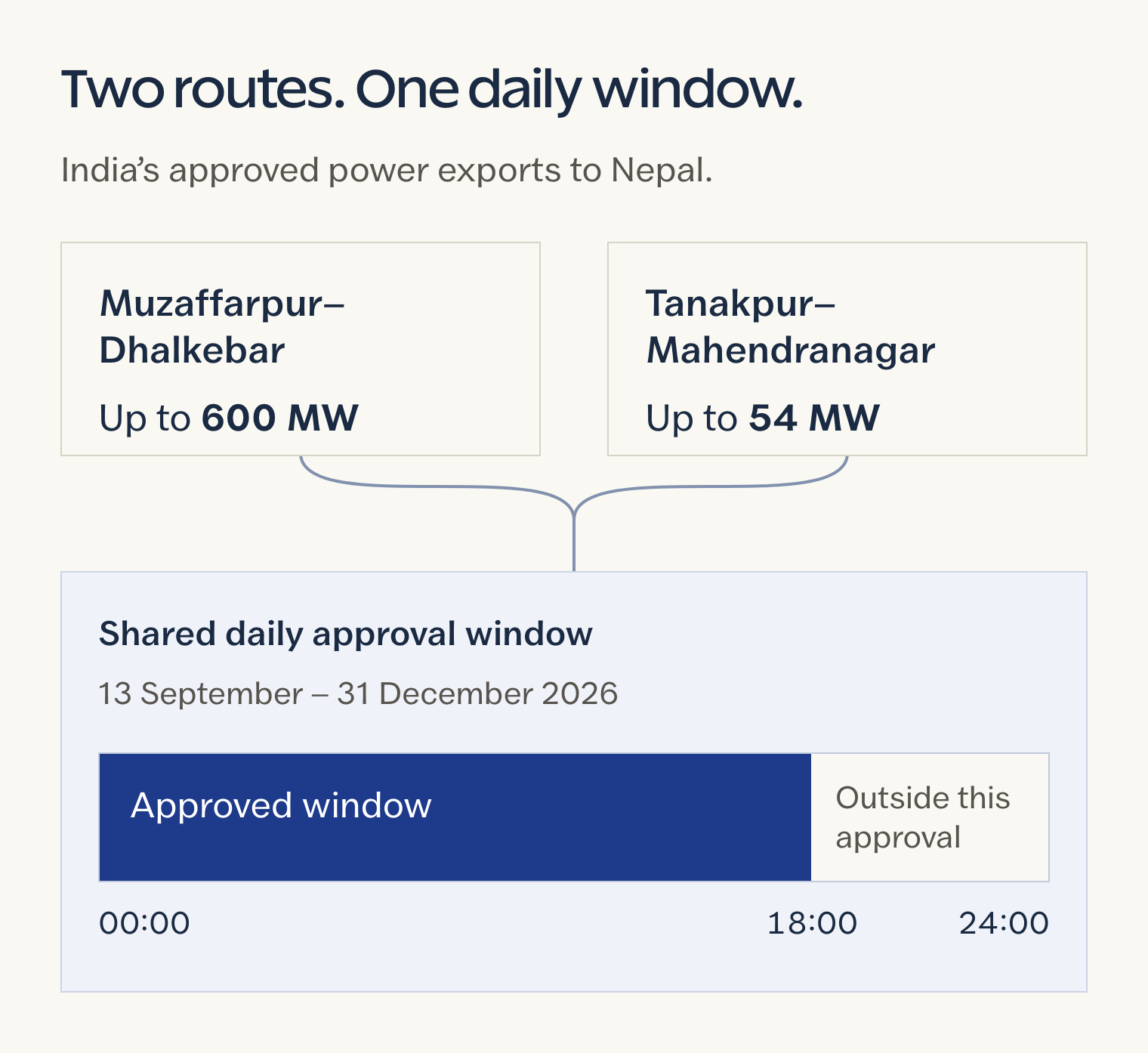
  • Approval permits up to 600 MW through Muzaffarpur-Dhalkebar and up to 54 MW through Tanakpur-Mahendranagar.
  • The approved daily window is 00:00 to 18:00, during the period from 13 September to 31 December 2026.
  • The export quantum from January 2027 will be reviewed in December 2026.
  • Flood damage reduced Nepal’s hydropower generation capacity. The new announcement grants approval; it does not report metered deliveries or guarantee continuous supply.
  • The earlier India-Nepal power-trade note described a pending request. The material advance is granted approval with named routes, ceilings, a daily window and an end date.
  • The practical question is how to read an authorisation: permitted power, actual scheduled flows and electricity ultimately delivered are related but different quantities.

UPSC Relevance

Prelims Relevance

  • MW: a unit of power, describing the rate of electricity transfer.
  • MWh: a unit of energy, recording power supplied over time.
  • Muzaffarpur-Dhalkebar: the higher-ceiling route named in the approval.
  • Tanakpur-Mahendranagar: the second route, with its own export ceiling.
  • Daily window and validity period: separate limits on an approved cross-border transaction.

Mains Relevance

GS Paper 2

  • India-Nepal cooperation through specific, time-bound operational decisions.

GS Paper 3

  • Infrastructure authorisation, supply scheduling and measurable delivery.
  • Review clauses in temporary disaster-support arrangements.

Background and Context

A Route Ceiling Is Not a Delivery Report

The approval specifies how much power may be exported through each named route, rather than recording how much electricity has already crossed the border.

  • The Muzaffarpur-Dhalkebar line carries the larger approved export ceiling; Tanakpur-Mahendranagar has a separate smaller ceiling. The route names matter because permission is tied to identified infrastructure rather than an unrestricted pool of cross-border capacity.
  • The words up to establish maximum authorised power, not an obligation to deliver that amount continuously. A report about the approval should preserve this qualification instead of turning a ceiling into an assured supply claim.
  • Route-specific limits must be read separately. Adding the ceilings does not demonstrate that both routes operated at their maxima simultaneously, and does not establish permission to move one route’s unused allowance onto the other.
  • Approval, scheduling and delivery describe different stages: authority permits a transaction, operators arrange the intended flow, and metering records actual energy. The Ministry’s release establishes the first stage without providing records for the later stages.
  • The announcement identifies the Nepal Electricity Authority as the recipient of the approved exports. It does not specify retail distribution, individual household service hours or a guaranteed end-user supply outcome across Nepal’s electricity network.

Read the Clock Together with the Calendar

A shipment of electricity must fit both the recurring daily window and the overall period covered by this particular approval.

  • The daily window runs from 00:00 to 18:00. This is permission for a defined portion of each day, not an announcement that the two routes will supply power around the clock without interruption.
  • The validity period runs from 13 September through 31 December 2026. These calendar dates limit the temporary arrangement, while the daily clock determines which part of each covered day falls within the stated approval.
  • The release was published after the stated starting date. Keep the publication date and approval period distinct: the earlier start in the announcement does not independently prove that exports actually began on that date.
  • Outside the stated window, this announcement supplies no permission for the described exports. That does not prove all electricity trade between the countries stops then; other arrangements cannot be inferred either way from this release.
  • An operator interpreting the notice must combine route, ceiling, daily window and calendar period. Satisfying only a capacity ceiling is insufficient to show that a proposed transaction fits every condition in the announced arrangement.
Two separate Nepal export ceilings share the daily 00:00 to 18:00 approval window: up to 600 MW through Muzaffarpur-Dhalkebar and 54 MW through Tanakpur-Mahendranagar, valid 13 September to 31 December 2026.
Both route-specific export ceilings share the same daily approval window. These are permitted limits, not a record of power delivered.

Measure Energy and Review the Next Period

To assess delivered support, follow energy records over time; to assess future permission, follow the review decision rather than extrapolating the present approval.

  • Megawatts measure power, the rate at which electricity is transferred. Megawatt-hours measure energy, the amount transferred over a duration. Confusing these units turns an approved transfer rate into an unsupported claim about total supply.
  • If power remains constant, energy equals power multiplied by time. When flow changes, energy must be added across the relevant intervals; a maximum permitted rate alone cannot establish the total electricity delivered during the day.
  • The planned December review concerns the quantum to be exported from January 2027. It is a future decision point, not a promise that the present ceilings will continue, increase or end when the review occurs.
  • A useful review would compare remaining supply needs with restored availability and feasible scheduled imports. These are policy considerations for assessing support, not criteria that the Ministry announcement explicitly lists or a forecast of its decision.
  • Metered energy and utilisation would help assess the arrangement’s practical contribution. A low realised flow could reflect several constraints or lower demand; the approval notice alone cannot identify its cause or establish successful delivery.

Way Forward

Keep Permission and Performance Visible

  • Publish clear operational instructions for the approved routes and window so scheduling follows the same conditions on both sides.
  • Report scheduled and metered energy separately from sanctioned MW ceilings when assessing the support provided.
  • Prepare the December review using updated needs and operational evidence, then communicate the next applicable arrangement before the current period ends.

Conclusion

  • The new India-Nepal decision converts a pending request into conditional export approval. Its meaning depends on named routes, separate power ceilings, the daily window and the covered calendar period.
  • Assess relief using actual energy delivered, and assess January arrangements through the December review outcome. Neither continuous delivery nor automatic extension follows from the present approval notice.

UPSC Practice Questions

Prelims MCQ 1

With reference to the announced power-export approval for Nepal, consider the following statements:

  1. It specifies separate ceilings for two named transmission routes.
  2. Its stated daily window provides round-the-clock approval.
  3. The quantum for January 2027 is to be reviewed in December 2026.

How many of the above statements are correct?

(a) Only one (b) Only two (c) All three (d) None

Answer: (b) Only two

Explanation:

Statements 1 and 3 are correct. The announced daily window is 00:00 to 18:00, not round-the-clock approval.

Prelims MCQ 2

Why can an approved MW ceiling not be treated as electricity already delivered?

(a) MW measures power, while delivered energy depends on actual flow over time. (b) MW measures energy accumulated over a calendar year. (c) Approval proves constant operation at the ceiling. (d) Every transmission line delivers its maximum power continuously.

Answer: (a) MW measures power, while delivered energy depends on actual flow over time.

Explanation:

Power is a transfer rate; energy incorporates duration and actual flow. Permission sets a ceiling, whereas delivery requires operational and metering evidence.

UPSC Mains Questions

  1. Time-bound electricity-export approvals require careful distinction between permitted capacity and delivered support. Discuss using the latest India-Nepal arrangement.
  2. Explain how route limits, daily supply windows and review clauses make temporary cross-border infrastructure cooperation accountable.

Source: PIB, Ministry of Power.

Frequently Asked Questions

What has India approved for Nepal?

India approved exports to Nepal Electricity Authority through two named transmission lines, with separate power ceilings. The arrangement has a specified daily window and calendar period, rather than unconditional or permanent supply authorisation.

What is the approved daily supply window?

The release states 00:00 to 18:00 each day for the period from 13 September to 31 December 2026. This defines the approved window; it does not confirm actual uninterrupted delivery within it.

Are the announced MW figures actual electricity delivered?

No. They are maximum approved power levels for the named routes. Actual energy delivered depends on realised flows over time and is measured in energy units such as MWh, supported by metering records.

Will the present export ceilings automatically continue in January?

The release says the quantum from January 2027 will be reviewed in December 2026. It does not announce an automatic extension, a predetermined increase or an assured continuation of the present arrangement.

Wave-Like Heat Transport: Restricting Atomic Motion for Thermoelectrics

Open article →Download PDF

Why in News?

A September 14 government release described wave-like heat transport in a copper-containing crystal studied by JNCASR researchers, offering a route toward improved thermoelectric materials.

  • The material is thallium copper selenide, TlCu5Se3; experiments and calculations connect its crystal framework with confined copper dynamics.
  • The study reports ultralow lattice thermal conductivity alongside favorable electronic transport, a useful combination for converting heat into electricity.
  • The reported zT of 1.7 is a dimensionless material-performance measure, not an electricity-conversion percentage or proof of an industrial device.
  • A useful thermoelectric must maintain a temperature difference while allowing charge transport; simply blocking everything would also prevent useful electrical output.
  • The finding concerns a material mechanism. Prospective waste-heat applications remain distinct from tested factory deployment or demonstrated commercial viability.

UPSC Relevance

Prelims Relevance

  • Thermoelectric conversion: generating electricity from a temperature difference.
  • Phonons: quantized modes of atomic vibration in a solid.
  • Anharmonicity: departure from the simple harmonic description of atomic vibrations.
  • Lattice thermal conductivity: heat transport associated with the vibrating atomic framework.
  • zT: a dimensionless thermoelectric figure of merit.

Mains Relevance

GS Paper 3

  • Materials research: connecting microscopic structure to useful energy performance.
  • Waste-heat recovery: distinguishing a promising material from a deployable system.

Essay

  • Scientific progress often comes from controlling movement rather than eliminating it.

Background and Context

Why heat flow and electrical flow need different treatment

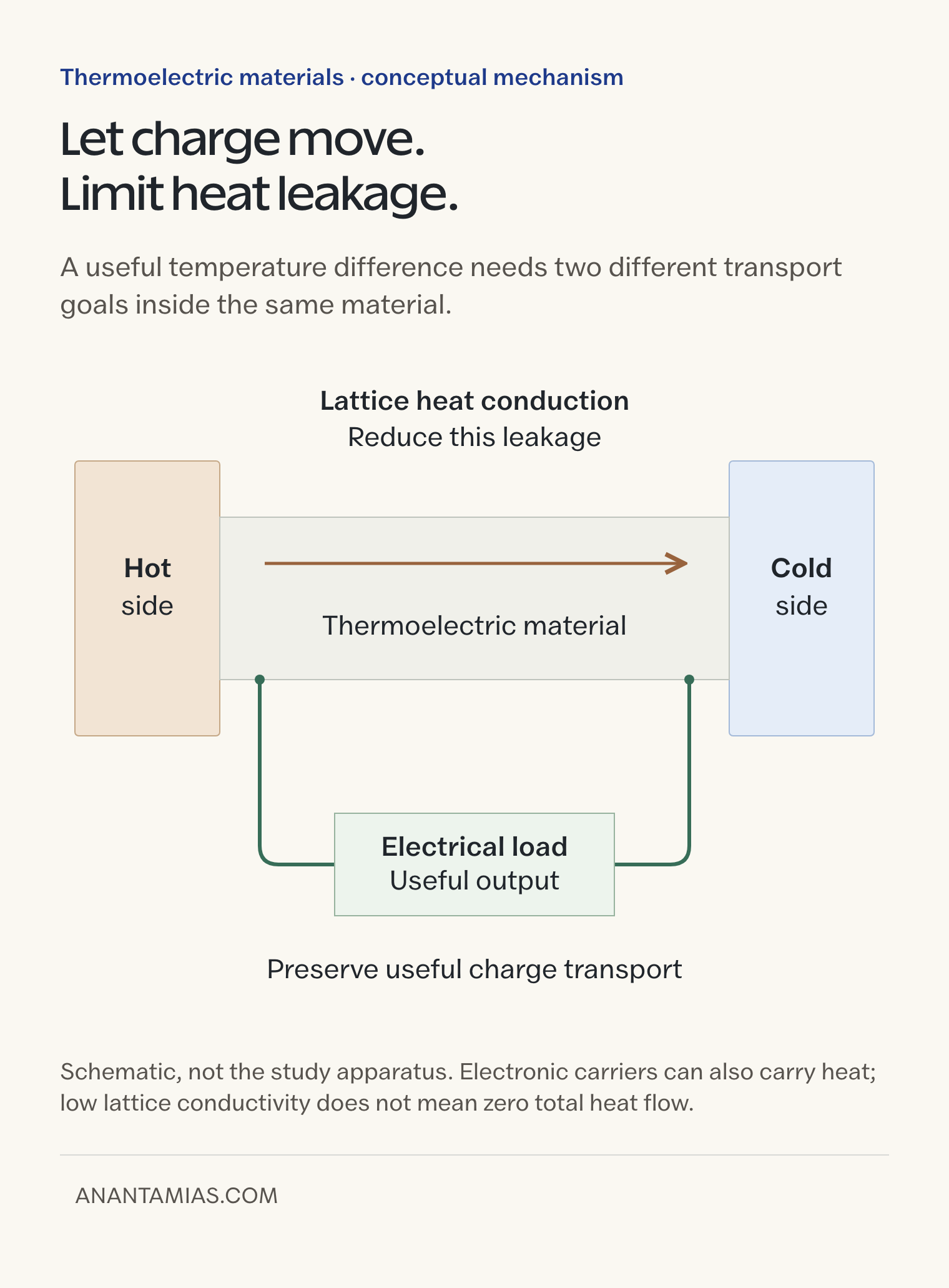
Thermoelectric generation uses a temperature difference. The design challenge is to reduce unwanted heat leakage without making the material a poor electrical conductor.

  • A temperature difference across a suitable material can generate a voltage. Useful electrical output requires a connected circuit; a material result alone does not specify the output of a complete generating system.
  • Unwanted thermal conduction carries heat from the hot side toward the cold side. Reducing this leakage helps preserve the difference that makes conversion possible, rather than treating heat flow as electricity itself.
  • Electrical conductivity concerns charge transport; thermal conductivity concerns energy transport. Favorable electrical behavior and low lattice heat conduction can coexist, so describing the finding as simply poor conductivity would hide the central distinction.
  • The lattice is the atomic framework, and its vibrations transport energy. Electronic carriers can also carry heat; lowering the lattice contribution is not equivalent to proving that every heat-transport channel has vanished.
  • The wider thermoelectric design problem is a balance of properties. A good thermal insulator is not automatically a good generator if its electrical transport or voltage response is unsuitable.
Thermoelectric material between hot and cold sides, showing lattice heat leakage and a separate external circuit delivering useful electrical output.
Thermoelectric materials must balance low lattice heat conduction with useful electrical transport. Conceptual schematic, not the reported experimental apparatus.

How confined copper dynamics change the heat-transport picture

The study connects a complex crystal framework with restricted atomic motion, strong anharmonicity and an unusual way for vibrational modes to exchange thermal energy.

  • In some superionic materials, highly mobile ions can impede lattice heat transport. The difficulty is that excessive migration may undermine structural stability; suppressing heat flow alone does not solve that stability problem.
  • Here, the crystal framework confines copper dynamics rather than allowing long-range, liquid-like migration. The point is restricted motion inside an ordered material, not a claim that all atoms become stationary or motionless.
  • This local motion produces strong anharmonicity: vibrations depart substantially from an ideal, simple harmonic pattern. It helps explain why the usual account of heat carried by well-defined particle-like phonons becomes insufficient here.
  • The study instead describes predominantly wave-like coherence between vibrational modes. This is a microscopic account of energy transfer, not evidence of visible waves passing through a device or sound replacing an electrical circuit.
  • The researchers combined experiments and theoretical calculations, including simulations of atomic motion. Agreement between structural behavior and the transport model supports the proposed explanation; simulations are evidence about a model, not industrial operating records.

What the performance claim proves, and what remains open

A promising material must still be distinguished from a practical module with durable contacts, stable operation and a useful source of temperature difference.

  • zT combines electrical conductivity, the voltage response to a temperature difference, temperature and thermal conductivity. Its dimensionless value summarizes material performance; interpreting it directly as a conversion percentage is a category error.
  • A device efficiency claim needs defined operating conditions and a measured ratio of useful electrical output to heat input. The release’s material figure cannot establish that ratio for a hypothetical factory installation.
  • The release identifies waste-heat recovery as a possible application. It does not demonstrate continuous service at a cement plant, a steelworks or a data center, nor provide a commercial cost comparison.
  • A sensible next assessment would test reproducibility and durability under repeated operating conditions. These are proposed checks before application, not claims that the reported compound has already failed or passed a deployment trial.
  • Compare the separate photocatalyst charge-separation study: both link structure to function, but light-driven chemistry and thermoelectric generation use different mechanisms. Similar energy goals do not make the materials or processes interchangeable.

Way Forward

Test the path from material to module

  • Measure heat and electrical transport separately under stated conditions before comparing candidate materials.
  • Evaluate contacts and repeated thermal operation when moving toward a device; preserve the distinction between a laboratory specimen and an integrated module.
  • Use the charged-droplet coating study as a separate example of service-condition testing, not as evidence about this compound’s durability.

Conclusion

  • The useful principle is selective control: restrict lattice heat leakage while retaining favorable electronic behavior. Confined ion dynamics offer a research route toward that combination, without requiring the crystal to behave like a liquid.
  • In an answer, connect structure, vibration and transport, then state the evidence limit. A material figure of merit supports further investigation; it does not certify a working industrial waste-heat system.

UPSC Practice Questions

Prelims MCQ 1

With reference to thermoelectric materials, consider the following statements:

  1. Low lattice thermal conductivity and favorable electrical transport can coexist.
  2. The dimensionless figure of merit zT is itself a percentage conversion efficiency.
  3. A temperature difference can generate a voltage in a suitable thermoelectric material.

How many of the above statements are correct?

(a) Only one (b) Only two (c) All three (d) None

Answer: (b) Only two

Explanation:

Statements one and three are correct. zT summarizes material properties and is dimensionless; it is not itself the percentage efficiency of a complete device.

Prelims MCQ 2

What is the central role of confined copper dynamics in the reported material?

(a) Eliminating all atomic vibration (b) Replacing electronic transport with visible waves (c) Producing strong anharmonicity while avoiding unrestricted long-range copper migration (d) Proving commercial operation in steel plants

Answer: (c) Producing strong anharmonicity while avoiding unrestricted long-range copper migration

Explanation:

The study associates confined copper motion with strong anharmonicity, wave-like vibrational transport and low lattice thermal conductivity. It does not report industrial deployment.

UPSC Mains Questions

  1. Explain why thermoelectric generation requires different treatment of thermal and electrical transport. How can control of atomic dynamics help address this challenge?
  2. How should public communication distinguish a promising materials-science result from a deployable energy technology? Discuss with reference to thermoelectric research.

Sources: PIB, Department of Science and Technology and US Department of Energy, thermoelectric research background.

Frequently Asked Questions

What was studied in the JNCASR research?

Researchers studied thallium copper selenide and linked its complex framework with confined copper motion, strong anharmonicity and predominantly wave-like heat transport. The release reports experiments alongside theoretical calculations supporting this interpretation.

Why is low thermal conductivity useful here?

It reduces unwanted heat leakage between the hot and cold sides. A thermoelectric material must also retain suitable electrical behavior; blocking heat alone does not guarantee useful electricity generation in a device.

Does wave-like transport mean visible waves or sound?

The phrase describes coherence between microscopic vibrational modes in the solid. It does not mean that visible waves pass through the material or that sound substitutes for electrical transport in a generator.

Is zT an efficiency percentage?

No. It is a dimensionless figure combining thermoelectric material properties. Device efficiency also depends on operating conditions and system performance, so the reported value cannot be read as a percentage conversion efficiency.

Has this compound been deployed in industry?

The government release presents a research result and possible waste-heat applications. It does not establish commercial deployment, prolonged industrial operation or a verified cost advantage for a complete generating system.

NHAI 1033 Upgrade: From Emergency Calls to Coordinated Dispatch

Open article →Download PDF

Why in News?

On 14 September 2026, NHAI announced plans to upgrade the 1033 National Highway Helpline, with IHMCL inviting industry interest in developing and operating the proposed platform.

  • The existing 1033 helpline provides round-the-clock assistance for emergencies, breakdowns and other National Highway problems.
  • The proposed platform combines location capture, AI-assisted multilingual handling and smart dispatch with improved coordination.
  • Human operators will remain important, particularly where emergencies require judgement and decision-making.
  • IHMCL has invited an Expression of Interest; the announcement does not establish that the proposed platform is already deployed.
  • An answered call is only the first step: useful assistance also requires a usable location, an understood problem and a suitable response.
  • The relevant governance question is how technology and operational teams work together, rather than whether a helpline uses AI.

UPSC Relevance

Prelims Relevance

  • 1033: the National Highway Helpline.
  • IHMCL: Indian Highways Management Company Limited, promoted by NHAI.
  • EOI: Expression of Interest, the announced industry-engagement stage.
  • Smart dispatch: matching a reported need with suitable assistance.

Mains Relevance

GS Paper 2

  • Accountability and accessibility in technology-assisted public services.
  • Coordination across agencies delivering emergency assistance.

GS Paper 3

  • AI-assisted response systems and road safety.

Essay

  • A public service succeeds when information leads to timely, appropriate action.

Background and Context

The helpline exists; the upgrade is proposed

Separate the current public service from the capabilities being proposed for its next platform.

  • 1033 already assists National Highway users with medical emergencies, vehicle breakdowns, toll-plaza and FASTag issues. It is a round-the-clock service, rather than a new number awaiting launch.
  • Ambulances, cranes and patrol vehicles are among the assistance categories described in the release. The proposal concerns improving how calls and response resources are connected, not inventing roadside assistance from scratch.
  • The existing service already supports multiple languages. What is proposed is AI-assisted language handling within an upgraded platform; multilingual access should not be described as an entirely new capability.
  • IHMCL, a company promoted by NHAI, invited an EOI for design, development, deployment, operation and maintenance. Industry suggestions will inform the requirements, so the announcement is not a completed implementation report.
  • The broader road-safety challenge includes prevention and enforcement. This proposal addresses the distinct assistance function: helping a traveller obtain appropriate support after a problem has been reported.

How a call becomes a suitable response

The proposed features address different links between receiving a call and sending help; none substitutes for all the others.

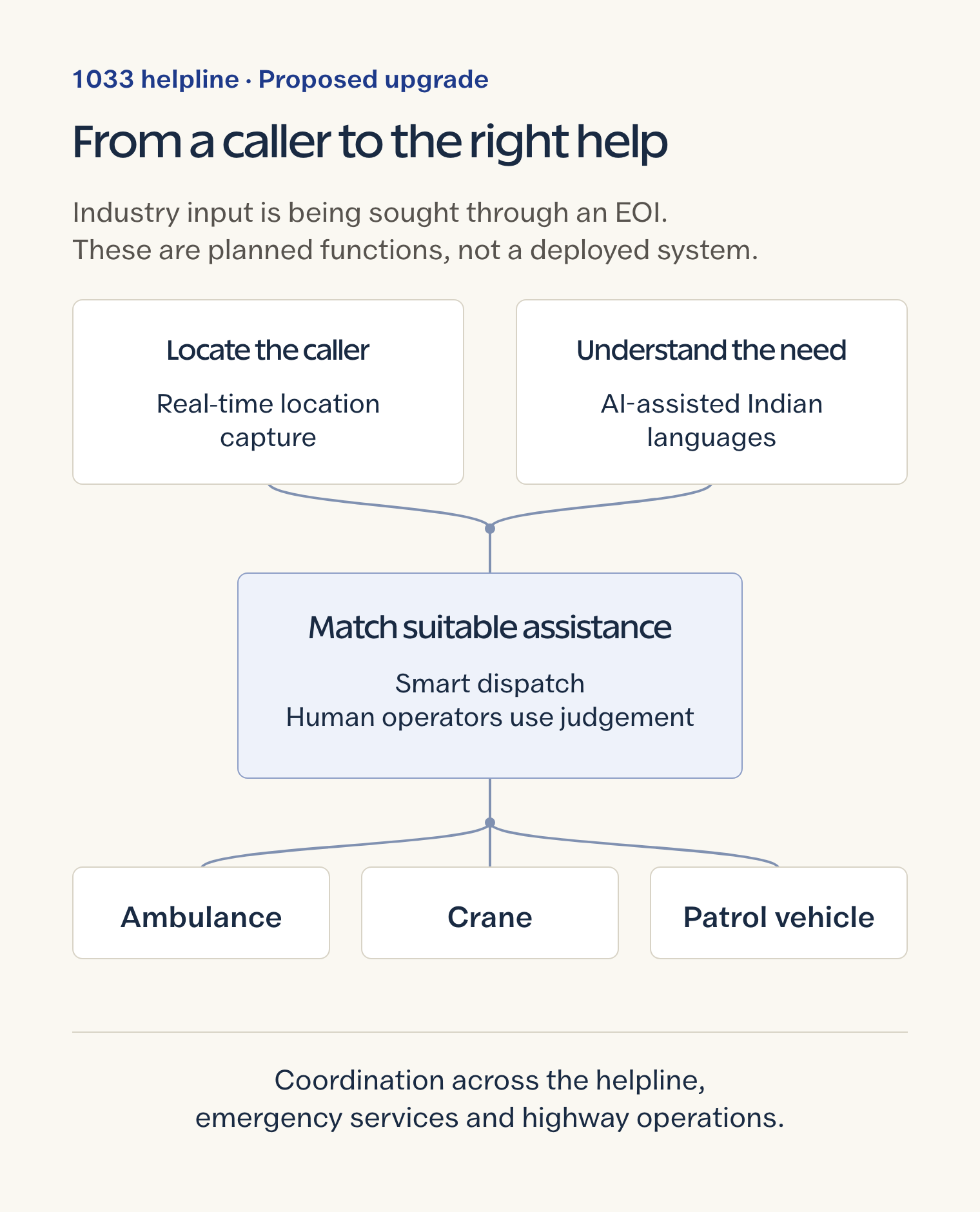
  • Locate the caller: real-time location capture is intended to help teams reach the incident. Knowing the reported problem without a usable location can still leave responders unable to find the person needing help.
  • Understand the need: AI-assisted Indian-language handling is intended to help interpret calls. A location alone does not reveal whether the caller needs medical assistance, vehicle recovery or a different highway service.
  • Select suitable assistance: smart dispatch is intended to identify the appropriate ambulance, crane or patrol vehicle. Correctly receiving a call is different from matching the response to what the incident requires.
  • Coordinate the response: the proposal links helpline staff, emergency services and highway operations teams more closely. Dispatching a resource and keeping the relevant teams coordinated are related but separate operational tasks.
  • Issue advisories: proactive alerts would inform highway users about incidents and important developments. This is a wider information function alongside assistance to the individual caller, not proof that an emergency has been resolved.
Proposed 1033 upgrade: caller location and AI-assisted language understanding feed suitable dispatch with human judgement, connecting to ambulance, crane or patrol assistance and coordination across response teams.
The proposed 1033 functions connect location and understood need with suitable assistance. This conceptual diagram does not represent a deployed platform.

Why human judgement remains necessary

The announced model combines technical assistance with people making decisions, particularly during emergencies.

  • Human operators retain an important role under the proposal. The release explicitly highlights judgement and decision-making; it does not describe fully autonomous emergency handling or the removal of call-centre staff.
  • An unclear account may need follow-up questions before a response can be matched. This illustrates why language-processing support should assist understanding rather than be treated as sufficient evidence of what happened.
  • Context can change: a reported breakdown might also involve an injured person. This is an illustrative scenario, not a newly announced protocol; it shows why response categories should not replace situational judgement.
  • Automation quality should be judged by whether operators can use, question and correct its outputs. Such oversight is a design consideration, not a claim that a particular safeguard has already been implemented.
  • Coordination failures can persist even when software functions correctly. The last-mile health-response gap offers a related governance lesson: information needs an available service and a team able to act.

Read the procurement stage accurately

An invitation to industry identifies a development process; it does not establish operational performance.

  • The EOI seeks combined expertise in digital platforms, continuous call-centre operations and emergency-response services. The task extends beyond purchasing an AI tool because the service depends on operational arrangements.
  • Industry feedback is intended to help finalize requirements. Avoid presenting an imagined rollout timetable, staffing standard, data-sharing rule or mandatory technical architecture as though NHAI has already specified it.
  • Faster assistance is the stated objective, not a guaranteed response time. The release supplies no measured before-and-after improvement, so assessment must await implementation evidence rather than infer success from the proposed features.

Way Forward

Test the service that users receive

  • Test location and language handling against difficult real-world conditions, with human review when the information is unclear.
  • Assess correct dispatch and coordination as well as call handling; report bottlenecks separately so improvements address the right stage.
  • Set clear operational accountability before rollout, including how teams correct errors and follow up unresolved requests.

Conclusion

  • Next Generation 1033 is a proposal to connect better information with suitable roadside assistance, while retaining human judgement.
  • In a governance answer, distinguish announced capability, operational deployment and demonstrated performance. An EOI establishes the first step in that sequence, not the final outcome.

UPSC Practice Questions

Prelims MCQ 1

With reference to the proposed Next Generation 1033 platform, consider the following statements:

  1. The existing 1033 helpline already provides round-the-clock assistance.
  2. The proposed platform eliminates the role of human operators.
  3. IHMCL has invited an Expression of Interest for the platform.

How many of the above statements are correct?

(a) Only one (b) Only two (c) All three (d) None

Answer: (b) Only two

Explanation:

Statements 1 and 3 are correct. Human operators remain important, especially where emergencies require judgement and decisions.

Prelims MCQ 2

In the proposed highway helpline upgrade, smart dispatch primarily refers to:

(a) Automatically imposing traffic penalties. (b) Guaranteeing a fixed response time nationwide. (c) Identifying and sending suitable assistance for the reported need. (d) Replacing emergency services with caller advisories.

Answer: (c) Identifying and sending suitable assistance for the reported need.

Explanation:

The release describes identifying the most suitable ambulance, crane or patrol vehicle. It does not promise a fixed response time or replace emergency services.

UPSC Mains Questions

  1. Explain how location capture, multilingual handling and suitable dispatch address different stages of highway emergency assistance. (150 words)
  2. Discuss why human judgement and institutional coordination remain necessary in AI-assisted public-service delivery, using the proposed 1033 upgrade. (150 words)

Source: PIB, Ministry of Road Transport and Highways.

Frequently Asked Questions

What is the 1033 helpline?

1033 is the existing round-the-clock National Highway Helpline. It assists travellers with medical emergencies, vehicle breakdowns, toll-plaza and FASTag issues, and other highway-related problems, including coordination of relevant roadside assistance.

Is the Next Generation platform already operational?

The announcement describes a planned upgrade and an Expression of Interest invited by IHMCL. It does not establish that the proposed platform, or all its advanced features, has already been deployed.

What does smart dispatch mean?

Smart dispatch means identifying and sending suitable assistance for the reported need, such as an ambulance, crane or patrol vehicle. It addresses resource matching rather than merely answering or translating a call.

Will AI replace human operators?

No. The release says human operators will continue to play an important role, especially where emergencies require human judgement and decision-making. AI-assisted handling is part of a combined technology-and-human approach.

Does NHAI guarantee a response time?

The release aims for faster, more coordinated assistance but specifies no guaranteed response time. A proposed capability should not be confused with demonstrated performance or a promise about every incident.

India-Vietnam JCM: Defence Co-Production and Connected Supply Chains

Open article →Download PDF

Why in News?

At their Joint Commission meeting in New Delhi on 14 September 2026, India and Vietnam identified defence co-production, market access and connectivity as pathways for deeper bilateral cooperation.

  • The meeting reviewed the Enhanced Comprehensive Strategic Partnership and identified co-production of Indian defence items as a way forward.
  • The economic agenda included market access for Indian marine and agricultural products and pharmaceuticals, alongside investments and supply chains.
  • Financial, port and air connectivity featured in the discussions. The Indian Express also reported cooperation in seafarer standards, citing the external affairs ministry’s statement.
  • The announcement identifies cooperation pathways; it does not announce a signed manufacturing contract, new factory, finished joint product or concluded trade deal.
  • Vietnam links India’s Act East Policy with practical economic and security cooperation. The significance lies in how production, regulatory access and transport can reinforce each other.
  • The India-Morocco defence committee illustrates another institutional channel. Here, the distinctive agenda connects defence production with trade access and wider economic connectivity.

UPSC Relevance

Prelims Relevance

  • Joint Commission: bilateral forum covering trade, economic, scientific and technological cooperation.
  • Co-production: participation by partners in producing equipment, distinct from purchasing a finished item.
  • Market access: conditions under which products may enter and be sold in another market.
  • Connectivity: links supporting movement and transactions, including ports, aviation and finance.
  • Act East Policy: India’s framework for deeper engagement with its eastern partners.

Mains Relevance

GS Paper 2

  • India-Vietnam relations and implementation of Act East cooperation.
  • Regional partnerships through economic and security institutions.

GS Paper 3

  • Defence production capabilities and industrial supply chains.
  • Regulatory access and transport as complementary parts of export competitiveness.

Essay

  • Strategic partnerships become useful when institutions connect ambition with practical capabilities.

Background and Context

Co-Production Goes Beyond Buying Equipment

The industrial question is how partners participate in making and supporting equipment, rather than simply whether one country purchases a finished item from another.

  • In a purchase, the buyer acquires equipment under agreed supply terms. Co-production involves shared participation in manufacture; its depth depends on the actual division of work, rather than the label attached to diplomatic cooperation.
  • An eventual project might distribute components, assembly or testing between partners. These are examples of possible production functions, not agreed India-Vietnam work packages; the meeting account does not identify a specific product or manufacturing site.
  • Technology access requires its own terms. Agreement to pursue co-production does not establish unrestricted design rights, a manufacturing licence or complete technology transfer; those questions must be assessed through specific subsequent industrial arrangements.
  • The potential benefit is industrial learning through repeatable production and quality control, rather than possession of equipment alone. The actual gain depends on what each partner performs, learns and can sustain over the equipment’s life.
  • Maintenance and spares matter when judging a future production proposal: an assembled product remains dependent if critical support is unavailable. This is an evaluation criterion, not a newly announced maintenance agreement between India and Vietnam.

Market Access and Connectivity Solve Different Problems

An exporter needs permission to sell and workable routes for doing so; improving transport alone cannot settle every product-level barrier in another market.

  • Marine products, agricultural goods and pharmaceuticals were named in the market-access agenda. Their inclusion identifies areas for further work; it does not establish that all products in those categories have received fresh entry approvals.
  • Market access concerns the applicable conditions for entering and selling in the importing market. For regulated goods, product requirements remain important even when companies have a buyer, freight capacity and an otherwise competitive price.
  • Port and air connectivity concern the routes through which goods and people move. More usable links can support trade, but cannot by themselves certify a medicine or demonstrate that an agricultural consignment meets applicable requirements.
  • Financial connectivity concerns the transaction side of economic exchange, alongside physical transport. Its inclusion does not announce a particular payment platform, settlement currency or banking arrangement; those operational features are not specified in the meeting account.
  • Supply chains connect inputs, production and delivery across firms and locations. Policy should examine the weakest link in that sequence: a reliable shipping route cannot compensate for unresolved product access or an unavailable critical input.

Standards Help Make Connections Usable

Physical assets and industrial ambition depend on people and institutions able to work together, making professional standards a distinct part of the maritime cooperation agenda.

  • The Indian Express, citing the ministry’s statement, reports cooperation in standards for seafarers. Treat this as an identified cooperation area, not evidence of a signed recognition agreement or newly granted credentials for individual maritime workers.
  • Professional standards concern the capabilities and practices expected of people operating maritime services. They complement port infrastructure: adding a transport link does not automatically resolve the human and institutional requirements for using that link effectively.
  • The Cochin ship-repair partnership offers related background on a maritime services ecosystem. The Vietnam agenda extends the discussion towards bilateral connectivity and professional cooperation, without announcing a corresponding shipyard or repair venture.
  • The Joint Commission can bring industrial, commercial and professional priorities into the same discussion. Its practical value should be judged by follow-up responsibilities and workable projects, rather than treating every listed cooperation area as completed delivery.
  • Act East implementation can be assessed through these concrete channels: agreed production work, resolved access requirements and usable connections. The partnership’s elevated diplomatic description gives context, but cannot substitute for evidence that individual initiatives operate.

Way Forward

Turn Priorities into Workable Projects

  • Evaluate co-production proposals through assigned work, quality standards, technology terms and long-term support requirements.
  • Create product-level follow-up on market access, recording the remaining requirements for the named export sectors.
  • Develop connectivity and professional cooperation alongside commercial demand, then report specific agreements and operational outcomes separately.

Conclusion

  • The India-Vietnam meeting links industrial cooperation, market access and connectivity within the strategic partnership. Each addresses a different constraint, and progress depends on making these channels work together.
  • The substantive next step is defined implementation: production responsibilities, workable product entry and usable connections. The announcement sets a direction; it does not establish finished joint equipment or automatic market access.

UPSC Practice Questions

Prelims MCQ 1

With reference to the India-Vietnam cooperation agenda, consider the following statements:

  1. Co-production is distinct from purchasing a finished defence item.
  2. Improved port connectivity automatically grants regulatory approval for all pharmaceuticals.
  3. The meeting identified market access for Indian marine and agricultural products and pharmaceuticals.

How many of the above statements are correct?

(a) Only one (b) Only two (c) All three (d) None

Answer: (b) Only two

Explanation:

Statements 1 and 3 are correct. Connectivity supports movement; it does not automatically satisfy product-entry or regulatory requirements.

Prelims MCQ 2

Which development would provide the strongest evidence that a proposed co-production pathway has become a defined industrial project?

(a) Repetition of a strategic-partnership title (b) A general commitment to deepen cooperation (c) Agreed production responsibilities and project terms for identified equipment (d) Discussion of unrelated tourism opportunities

Answer: (c) Agreed production responsibilities and project terms for identified equipment

Explanation:

Specific work allocation and project terms establish an industrial arrangement more clearly than broad diplomatic intent. The reported meeting did not announce such a contract.

UPSC Mains Questions

  1. Explain how defence co-production differs from equipment procurement. What should India assess when converting the India-Vietnam cooperation agenda into industrial projects?
  2. Market access, connectivity and professional standards are complementary components of economic diplomacy. Discuss with reference to the latest India-Vietnam Joint Commission meeting.

Sources: Akashvani News and The Indian Express.

Frequently Asked Questions

What did the India-Vietnam meeting identify on defence cooperation?

The meeting identified co-production of Indian defence items as a pathway for deeper cooperation. It did not announce a specific manufacturing contract, factory, finished joint product or unrestricted technology-transfer arrangement.

How is co-production different from purchasing defence equipment?

Purchasing acquires a finished item under supply terms, while co-production involves participation in manufacture. The depth of cooperation depends on the assigned work, technology terms, quality responsibilities and support arrangements of an actual project.

Did the meeting grant automatic market access for Indian products?

No such outcome was announced. Marine and agricultural products and pharmaceuticals featured in the market-access agenda. Identifying sectors for cooperation does not itself establish that their applicable entry and regulatory requirements have been satisfied.

Why discuss seafarer standards alongside port connectivity?

Ports provide physical connections, while professional standards concern people operating maritime services. The Indian Express reported this cooperation area from the ministry statement; it did not establish a new credential-recognition agreement.

Nepal and the Loss and Damage Fund: Why Access Speed Matters

Open article →Download PDF

Why in News?

The Indian Express reported on September 15 that Nepal’s request to the Loss and Damage Fund has exposed tension between urgent recovery needs and established funding procedures.

  • The report says Nepal sought special consideration for its request following destructive flooding, framing its appeal in terms of climate compensation.
  • The report describes procedural constraints around the request, including the timing of the funding window and the fund’s established decision process.
  • The adopted UNFCCC framework treats the arrangements as cooperation and facilitation, without liability or compensation; Nepal’s reported framing does not itself create an automatic entitlement.
  • A funding request, an approved allocation and money reaching affected people are different stages; urgency does not make them interchangeable.
  • The central issue is access design: crisis-affected administrations need timely support while fund managers must establish how resources will be used and accounted for.

UPSC Relevance

Prelims Relevance

  • FRLD: Fund for Responding to Loss and Damage.
  • Mitigation: action addressing the causes of climate change.
  • Adaptation: reducing vulnerability to actual or expected climate impacts.
  • Economic and non-economic losses: both matter in loss-and-damage discussions.
  • Funding stages: request, approval and disbursement have different meanings.

Mains Relevance

GS Paper 3

  • Climate finance: timely access, vulnerability and recovery needs.
  • Disaster management: connecting immediate assistance with longer-term recovery.

GS Paper 2

  • Global governance: balancing country needs, transparent decisions and accountable use.

Essay

  • The value of assistance depends partly on whether it arrives when people can still use it.

Background and Context

Mitigation, adaptation and loss and damage answer different questions

These concepts describe different purposes of climate action; treating them as synonyms can obscure which need a financial instrument is meant to address.

  • Mitigation tackles the causes of climate change, including greenhouse-gas emissions. It can reduce future warming pressures, but an emissions-reduction project does not by itself replace possessions already lost by an affected household.
  • Adaptation reduces vulnerability to actual or expected climate impacts. Measures such as safer building practices address exposure and resilience, while their success does not guarantee that every damaging impact can be avoided.
  • Loss and damage concerns climate-related harms that have not been avoided, including impacts beyond adaptation’s limits. The UN Climate Dictionary notes that international negotiations have no single agreed definition of the term.
  • Economic losses include damage to livelihoods or infrastructure; non-economic losses can include cultural disruption or trauma. A reconstruction bill alone cannot represent every kind of harm that a community has experienced.
  • The distinction is about purpose, not three sealed compartments. Recovery can incorporate safer rebuilding, but that overlap does not erase the different objectives of preventing emissions, reducing vulnerability and addressing harm.

What a fund can promise, approve and deliver

A fund is an institution with decision rules. An urgent request must be understood alongside its mandate, authority and the status of actual transfers.

  • The adopted UNFCCC framework covers assistance for particularly vulnerable developing countries facing economic and non-economic loss and damage associated with climate impacts, including extreme weather and slow-onset events; it is not limited to floods.
  • Its cooperation-based framing differs from establishing legal liability or compensation. A country may use compensation language in political advocacy, but that language cannot replace the adopted basis on which the funding arrangements operate.
  • The Indian Express describes Nepal seeking special treatment for its urgent circumstances. Treat this as reporting about the request, not proof that a new emergency-access rule has been adopted or money approved.
  • A request states what support is sought; approval authorizes a decision; disbursement transfers money. Subsequent delivery to households is another practical question, so announcing progress at one stage should not imply completion of all stages.
  • Institutional readiness matters alongside resource availability. Even when money exists, unclear requirements or unresolved decisions can delay its use; diagnosing an access problem requires identifying the actual bottleneck rather than assuming its cause.

How to reconcile urgent access with accountable spending

The practical question is which checks protect affected people, and how those checks can work without making an urgent response wait unnecessarily.

  • Urgency changes the cost of delay. A household may need help restoring essential living conditions before a full reconstruction plan is ready; this supports examining access speed without dismissing scrutiny altogether.
  • Accountability should establish who receives resources, which activities are financed and how results are checked. Weak oversight can exclude vulnerable people or misdirect assistance, undermining the same recovery objective that speed is meant to serve.
  • A possible staged approach would distinguish immediate needs from later reconstruction, with requirements proportionate to each decision. This is a policy option to assess, not a claim that FRLD already operates such a route.
  • Clear status reporting should distinguish requested, approved and transferred assistance. It should also make unresolved decisions visible, allowing observers to assess delay without mistaking a pledge, acknowledgement or sympathetic statement for completed delivery.
  • Connect recovery evidence with disaster-review learning: documenting needs and outcomes can inform later preparedness. The comparison concerns institutional learning, not a claim that a domestic review mechanism controls this international fund.

Way Forward

Make access decisions legible

  • Publish clear requirements and decision status so applicants know what remains unresolved and affected communities can track progress.
  • Assess proportionate checks for urgent needs alongside stronger follow-through on spending and delivery; present any redesign through the fund’s authorized governance process.
  • Maintain mitigation and adaptation alongside recovery finance. The separate climate-overshoot discussion explains why responding to harm cannot substitute for limiting future warming.

Conclusion

  • The Nepal report makes timeliness an important test of climate-finance design. Judge an access system by how it turns a documented need into accountable assistance, while keeping each funding stage distinct.
  • In a Mains answer, separate political claims, adopted rules and delivery evidence. Urgency strengthens the case for workable access; it does not establish automatic compensation or prove that an unverified transfer has occurred.

UPSC Practice Questions

Prelims MCQ 1

With reference to climate action, consider the following statements:

  1. Mitigation addresses the causes of climate change, including greenhouse-gas emissions.
  2. Adaptation guarantees that all climate-related loss and damage can be avoided.
  3. Loss and damage can include harms that are not easily expressed in money.

How many of the above statements are correct?

(a) Only one (b) Only two (c) All three (d) None

Answer: (b) Only two

Explanation:

Statements one and three are correct. Adaptation has limits and cannot guarantee avoidance of every impact. Loss and damage includes both economic and non-economic harms.

Prelims MCQ 2

Which statement best describes the adopted framing of the UNFCCC loss-and-damage funding arrangements?

(a) Every disaster automatically creates an enforceable compensation award (b) A funding request is identical to disbursement (c) The arrangements are based on cooperation and facilitation, without liability or compensation (d) They replace the need for mitigation

Answer: (c) The arrangements are based on cooperation and facilitation, without liability or compensation

Explanation:

The adopted decision explicitly uses a cooperative and facilitative basis. A political appeal for compensation does not itself alter that basis or establish that funds have been approved or transferred.

UPSC Mains Questions

  1. Distinguish mitigation, adaptation and loss and damage. Why must climate-finance design account for both the nature and timing of the need?
  2. How can international climate funds reconcile urgent access with accountability? Discuss using Nepal’s reported request as a case of institutional design rather than an assumed entitlement to compensation.

Sources: The Indian Express, Explained and UNFCCC, adopted climate-finance decisions.

Frequently Asked Questions

What is the FRLD?

The Fund for Responding to Loss and Damage is part of international climate-finance arrangements addressing harms associated with climate impacts in particularly vulnerable developing countries. Its purpose differs from simply funding emissions reduction.

Does Nepal’s request establish a right to compensation?

No automatic entitlement follows from the reported request. Nepal’s compensation framing is political advocacy; the adopted funding arrangements are based on cooperation and facilitation and do not involve liability or compensation.

How is loss and damage different from adaptation?

Adaptation seeks to reduce vulnerability to climate impacts. Loss and damage concerns harms that have not been avoided, including impacts beyond adaptation’s limits. Recovery activities may overlap with efforts to reduce future vulnerability.

Does an approved request mean households have received money?

No. Request, approval, disbursement and delivery are distinct stages. A sound assessment should establish which stage has been completed, rather than treating an acknowledgement or allocation as evidence of household-level assistance.

Why do access procedures matter in a disaster?

Delay can worsen hardship when people need essential support quickly. Procedures also protect accountable spending. The design challenge is to make requirements clear and proportionate while retaining verification of who benefits and how.