Join Anantam IAS Channel on Telegram

Daily Digest · Wednesday

18 November 2026 Current Affairs for UPSC

13 current affairs published on Wednesday, 18 November 2026

18 November 2026 Current Affairs for UPSC — every Why-in-News article AnantamIAS published on Wednesday, 18 November 2026, broken down with Why in News?, the exact GS paper it feeds, sub-topic mapping, MCQ-ready facts and a UPSC-style practice question. 13 articles in total, covering Polity, Economy, Environment, S&T, IR, Geography, History, Society and Internal Security — the same Why-in-News + GS-paper-mapping + practice-question format the Compass uses across every daily digest on the site.

Daily current affairs for UPSC is where new material enters your prep stream. Read this 18 November 2026 digest end-to-end in 25–35 minutes, attempt the practice question at the foot of each article (it's MCQ for some, 10/15-marker for others), then bookmark the entries that fall inside your active revision window. Everything stays cross-linked: tap any subject pill to jump to that subject's hub, or use the table of contents above to skip straight to a specific story.

Use this page three ways. Read sequentially for a one-sitting scan of everything that mattered on 18 November 2026. Download the 18 November 2026 PDF below for offline study or print revision. Or use the November 2026 Current Affairs compilation to see this day in the month's full context. For the previous day's reading, see 17 November 2026 Current Affairs; the next day's is 19 November 2026 Current Affairs.

Why we publish daily current affairs separately from the monthly compilation: daily is learning, monthly is revision. Use the daily page to add fresh material to your notes the day it breaks; come back to the November 2026 compilation 60 days before Prelims when the noise has settled and only the lasting takeaway is worth re-reading.

The Road to a Disease-Free World goes through Water

Open article →Download PDF

Why in News?

The upcoming 2026 UN Water Conference, to be hosted in Abu Dhabi, is expected to highlight the link between water security, sanitation and public health, with a focus on accelerating progress towards Sustainable Development Goal (SDG) 6.

UPSC Relevance: GS-2 Social Justice: Health; GS-3 Environment & Biodiversity: Pollution; Conservation; Global Conferences

Prelims: Global & India’s Initiatives: Water and Disease Surveillance; WASH

Mains: Water infrastructure & preventive healthcare. 

The Health-Water Nexus: 

  • Global WASH deficit: According to WHO and UNICEF data (2024), 2.1 billion people lack safely managed drinking water and 3.4 billion people lack safely managed sanitation.
  • Preventable Mortality: Inadequate water, sanitation, and hygiene (WASH) contributed to at least 1.4 million preventable deaths globally in 2019. Pathogens like poliovirus, cholera, typhoid, hepatitis A and other infections thrive in environments with compromised sewage containment and contaminated water supplies. 

Completing the “last mile” requires shifting our paradigm from reactive healthcare (treating symptoms and administering end-stage vaccines) to preventive environmental health by specifically positioning Water, Sanitation, and Hygiene (WASH) and Wastewater Surveillance at the core of public health architecture.

Global Initiatives: Integrating Water and Disease Surveillance:

  • Global Polio Eradication Initiative (GPEI): Launched in 1988, it brings together WHO, UNICEF, Rotary International, the US CDC, the Gates Foundation and GAVI to eradicate Polio through vaccination, surveillance and community mobilisation.
    • Wild poliovirus transmission remains endemic to Afghanistan and Pakistan. 
  • Reaching the Last Mile Fund: Established through a partnership between the UAE and the Gates Foundation, it supports the elimination of Polio and Neglected Tropical Diseases, particularly among underserved populations. 
  • AI-enabled wastewater surveillance: Abu Dhabi has adopted AI-enabled wastewater monitoring to identify potential public health risks and support early interventions.
  • European Wastewater Surveillance Dashboard (2025): Launched by the European Commission to track disease patterns through wastewater monitoring and analysis.

Cross-border surveillance, coordinated vaccination campaigns, technology transfer and development financing are essential to prevent the re-establishment of transmission.

2026 UN Water Conference:

Date: 8-10 December 2026
Venue: Abu Dhabi, United Arab Emirates.
Co-hosts: United Arab Emirates and Senegal.

Objective: Accelerate the implementation of SDG 6 (Clean Water and Sanitation), which aims to ensure the availability and sustainable management of water and sanitation for all by 2030.

Key focus areas: Water for People, Water for Prosperity, Water for Planet, Water for Cooperation, Water in Multilateral Processes and Investments in Water.

The conference will seek to strengthen international cooperation, mobilise investments and translate existing water-related commitments into practical action. 

India’s Initiatives: 

  • Jal Jeevan Mission: Seeks to provide functional household tap connections with adequate quantity and prescribed quality of drinking water in rural households.
  • Swachh Bharat Mission (SBM): Promotes sanitation, elimination of open defecation and improved solid and liquid waste management.
  • AMRUT 2.0: Strengthens urban water supply and sewerage infrastructure.
  • National Rural Drinking Water Quality Monitoring and Surveillance Framework: Provides for monitoring drinking water quality and community-level surveillance.
  • National Polio Surveillance Project: India’s polio eradication efforts have relied on immunisation, acute flaccid paralysis (AFP) surveillance and environmental surveillance of sewage samples. India was declared polio-free by the WHO in 2014, following the last reported case in Howrah, West Bengal, in 2011, achieved through the massive Pulse Polio Programme. 
  • National Centre for Disease Control (NCDC): Strengthens disease surveillance and outbreak investigation through the Integrated Disease Surveillance Programme (IDSP), now being strengthened under the Integrated Health Information Platform (IHIP).

Existing structural challenges in India: 

  • Fragmented governance: Rural water and sanitation fall under the Ministry of Jal Shakti, urban sewage is managed by the Ministry of Housing and Urban Affairs alongside under-resourced Urban Local Bodies (ULBs), and epidemiological tracking sits with the Ministry of Health and Family Welfare. This lack of inter-departmental convergence delays real-time data sharing between municipal water boards and disease surveillance units and limits policy coordination.
  • Infrastructure deficit: As per the Central Pollution Control Board, urban India generates roughly 72,368 million litres per day (MLD) of sewage, whereas installed treatment capacity stands at only 31,841 MLD (44%). Actual operational utilisation is even lower at 20,235 MLD, leaving nearly 72% of urban sewage untreated and discharged directly into rivers and groundwater aquifers. 
  • Last-Mile Access and Quality Disparity: Although the Jal Jeevan Mission (JJM) has expanded rural tap water coverage from 16.7% in 2019 to over 82.2% of rural households (15.91 crore homes) by late 2026, critical last-mile gaps persist. Official functionality assessments indicate that roughly 24% of surveyed rural households still do not receive tap water that meets prescribed quality standards.
  • Wastewater Surveillance and Diagnostic Bottlenecks: While the Indian Council of Medical Research (ICMR) initiated plans to scale wastewater surveillance across 50 cities, Tier-2 and Tier-3 towns still face shortages of biosafety labs, trained microbiologists, and high-throughput genomic sequencing facilities. 
  • Financial constraints: Establishing and sustaining modern sewage treatment plants, advanced surveillance systems and reliable water networks demands massive, continuous capital. Municipal bodies suffer from weak revenue generation and incomplete fiscal devolution under the 74th Constitutional Amendment. 
  • Climate change pressures: Floods can contaminate drinking water sources and overwhelm sewage systems, while droughts intensify water insecurity and compromise hygiene.

Way Forward: 

  • Institutional convergence: Strengthen coordination between the Ministries of Jal Shakti and Health and Family Welfare, urban local bodies and disease surveillance agencies.
  • Scale up wastewater surveillance: Expand environmental surveillance networks, particularly in densely populated cities, disease hotspots and underserved regions.
  • Leverage emerging technologies: Deploy AI, GIS and data analytics for pathogen detection, contamination mapping and early identification of public health risks.
  • Strengthen local infrastructure: Invest in sewage treatment plants, faecal sludge management, decentralised wastewater treatment and regular drinking water quality testing.
  • Prioritise vulnerable communities: Direct public investment towards rural, tribal, remote and informal settlements to ensure equitable access to WASH services.
  • Promote global cooperation: Encourage cross-border pathogen surveillance, data sharing, technology transfer and collaborative financing.
  • Adopt a preventive healthcare approach: Integrate WASH interventions with immunisation, nutrition, primary healthcare and disease surveillance under a broader public health strategy.

Thus, an integrated approach to SDG 3 (Good Health and Well-being) and SDG 6 (Clean Water and Sanitation) is essential to achieve a healthier and disease-resilient world.

Mains Practice Question:

Q. “Water infrastructure should be viewed as an essential component of preventive healthcare rather than merely a basic public utility.” Discuss in the context of wastewater surveillance and the global effort to eradicate infectious diseases.
How does India address Service Outages?

Open article →Download PDF

Why in News?

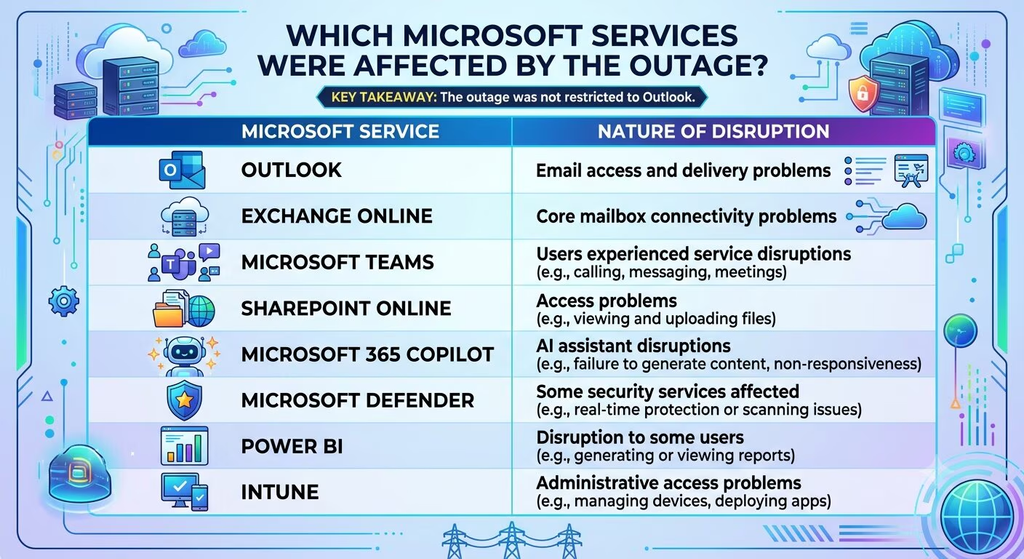
A global outage of Microsoft’s productivity suite, Microsoft 365, during November 12-13, 2026, disrupted access to Outlook and other services. Microsoft attributed the disruption to a fault during an upgrade of its network capacity and apologised to affected users.

In India, the outage affected email support and communication systems of airlines, including IndiGo and Akasa Air, while Air India had to reroute its email services.

The incident highlights India’s growing dependence on global cloud service providers and raises important questions about regulatory oversight, mandatory outage reporting and data protection.

UPSC Relevance: GS-2 Polity and Governance: Accountability; GS-3 Science and Technology: Cloud services; Data protection. 

Prelims & Mains: Dependence on cloud service providers and associated Risks 
image 27

Does Indian Law require Microsoft to Report the Outage?

No explicit legal mandate directly forces a cloud provider like Microsoft to report a non-cyberattack technical outage under a single, unified rule. Instead, three distinct legal and regulatory frameworks are relevant. 

(i) CERT-In Directions under the Information Technology Act, 2000:

The Indian Computer Emergency Response Team (CERT-In) is the national agency for responding to cybersecurity incidents under Section 70B of the IT Act, 2000.

  • Direction: Under the CERT-In directions (2022), companies (specified entities, including service providers, intermediaries, data centres and body corporates) must report cyber incidents within six hours. The reportable incidents include data breaches, data leaks, unauthorised access, attacks on IT systems and other specified cyber incidents.
  • Limitation: The directions primarily cover cybersecurity incidents and do not explicitly cover service outages caused by technical faults, software upgrades or infrastructure failures in the absence of a cyberattack.

However, under Section 70B(6), CERT-In can call for information and issue directions to service providers and other covered entities, enabling it to seek explanations regarding an incident.

(ii) RBI Directions on Outsourcing of IT Services:

  • The RBI’s directions on managing risks in outsourcing of IT services (2025) require regulated banks using cloud services to assess risks associated with outsourcing critical IT services, vendor dependence, and maintain exit strategies.
  • Limitation: These directions primarily regulate RBI-regulated entities and their outsourcing arrangements. They do not establish a universal direct reporting obligation for cloud providers across all sectors. 

(iii) Digital Personal Data Protection (DPDP) Act, 2023:

  • The DPDP Act introduces obligations relating to personal data security and breach reporting.
    • The Act includes unauthorised processing of personal data and accidental disclosure, acquisition, sharing, use, alteration, destruction or loss of access to personal data that compromises its confidentiality, integrity or availability.
    • The framework requires Data Fiduciaries to notify the Data Protection Board of India and affected individuals of personal data breaches.
    • Penalties: Failure to take reasonable security safeguards to prevent personal data breaches can attract a penalty of up to ₹250 crore under the Act.
  • Limitation: A temporary service outage does not automatically qualify as a personal data breach. Its classification depends on whether it involves a qualifying loss of access to personal data and compromises its availability. Further, the primary reporting responsibility rests with the Data Fiduciary, which may be the customer organisation using Microsoft’s services, rather than the cloud provider acting as a Data Processor. 

The phased implementation of the DPDP framework also means that the relevant breach-reporting obligations are scheduled to become operational in May 2027.

Global Regulatory Approach:

Several countries have moved towards regulating major cloud service providers directly, recognising their importance to financial systems, public administration and critical digital infrastructure.

Country / FrameworkKey Regulatory Provisions
European Union – DORAThe Digital Operational Resilience Act places critical third-party ICT service providers, including major cloud vendors, under direct oversight by European financial supervisory authorities.
European Union – NIS2 DirectiveCovers cloud computing providers across sectors. Significant incidents must be reported to the competent authority within 24 hours, followed by a detailed notification within 72 hours.
United KingdomThe Bank of England’s critical third parties regime enables direct oversight of designated technology providers whose services are important to financial institutions.
SingaporeIts digital infrastructure regulatory framework requires designated large data centres and cloud service providers to obtain licences and report service interruptions.
South KoreaFollowing the 2022 KakaoTalk disruption caused by a data-centre fire, large digital platforms and data centres have been required to submit disaster management plans since July 2023.

What are Indian Customers’ Options?

  • Contractual Recourse: Customers are mostly bound by Microsoft’s Service Level Agreements (SLAs), which typically offer limited financial remedies like service credits (discounts on future subscription bills) rather than consequential damage claims. 
  • Strategic Diversification / Indigenous Alternatives: The Union government reported to the Lok Sabha in December 2025 that over 12.68 lakh official email accounts had migrated to Zoho (a Chennai-based indigenous platform), reducing foreign dependency. However, domestic providers similarly lack mandatory uptime reporting duties to CERT-In. 

Key Issues and Regulatory Gaps in India:

  • Absence of mandatory outage reporting: India lacks a uniform framework requiring major cloud providers to report significant technical disruptions, irrespective of whether they result from cyberattacks.
  • Ambiguity in data breach classification: It remains unclear when temporary loss of access to cloud-hosted personal data qualifies as a reportable breach under the DPDP framework.
  • Limited direct oversight: Unlike the EU and UK, India does not have a comprehensive cross-sector framework for directly supervising systemically important cloud service providers.
  • Dependence on contractual accountability: Individual organisations must often rely on Service Level Agreements (SLAs) and contractual remedies, which may not adequately address large-scale disruptions.
  • Concentration risk: Heavy dependence on a few global cloud providers creates systemic vulnerabilities, as a single infrastructure failure can affect multiple sectors simultaneously.
  • Domestic providers face similar gaps: Shifting services to Indian vendors may reduce external dependence, but does not automatically ensure accountability or operational resilience.

Way Forward: 

  • Introduce mandatory outage reporting: Expand CERT-In’s reporting framework to cover major technical failures, infrastructure disruptions and prolonged service unavailability, irrespective of their cause.
  • Clarify DPDP provisions: Provide clear guidance on when temporary loss of access to personal data constitutes a reportable breach and distinguish between the obligations of Data Fiduciaries and Data Processors.
  • Adopt risk-based reporting thresholds: Define significant outages based on duration, geographical spread, number of affected users and the criticality of the service.
  • Strengthen domestic capabilities: Promote Indian cloud infrastructure and data centres while ensuring that domestic providers are subject to appropriate standards of transparency, resilience and accountability.
  • Enhance transparency: Require providers to publish incident reports detailing the cause, duration, affected services and corrective measures, subject to legitimate security and confidentiality considerations.

The Microsoft outage exposes gaps in India’s regulatory framework, particularly the absence of mandatory reporting of major technical failures. India needs to move beyond a cybersecurity-centric approach towards a broader digital operational resilience framework that ensures transparency, accountability, business continuity and protection of users. 

Mains Practice Question:

Q. The growing dependence on cloud computing has made service outages a matter of public interest rather than merely a contractual issue. Examine the regulatory gaps in India’s framework for ensuring accountability of cloud service providers.

Earthshot Prize

Open article →Download PDF

Why in news?

India hosted the Earthshot Prize for the first time in Mumbai. Bhutan and Mahindra Last Mile Mobility were among five winners.

UPSC Relevance

Prelims – Earthshot Prize, its categories and 2026 winners; PFAS; Bhutan’s forest cover mandate

Mains, GS3 – Conservation, environmental pollution and degradation 

About the Earthshot Prize

  • Founded: 2020 by Prince William (now the Prince of Wales), through The Royal Foundation, UK. Often called the “Green Oscars”.
  • Inspiration: US President John F. Kennedy’s “Moonshot” goal of 1961, which aimed to land a man on the Moon within a decade.
  • Idea: Find and scale up practical solutions to repair the planet within this decade. Its guiding line is “Urgency + Optimism = Action”.
  • Duration: Ten years, 2021 to 2030. Five winners every year, so 50 winners in all by 2030.
  • Prize: 15 finalists are chosen every year. One winner in each category gets £1 million (about Rs 10-11 crore) to scale up its solution. All finalists get mentoring, networks and investor access.
  • Who can win: Individuals, teams, start-ups, companies, NGOs, cities and even national governments.
  • 2026 cycle: Nearly 7,000 nominations from 169 countries. Ceremony held in Mumbai, the first time in India.

The five “Earthshots” (categories) and the 2026 winners

Category2026 winnerWhy it won
Protect and Restore NatureBhutanProtecting Himalayan forests that support water systems for about 1.6 billion people downstream in South Asia.
Clean Our AirMahindra Last Mile Mobility (India)Putting more electric three-wheelers on India’s roads, cutting urban air pollution.
Revive Our OceansNiue Ocean Wide TrustProtecting the ocean around Niue in the Pacific through indigenous, community-led conservation.
Build a Waste-Free WorldPFAS-Free FranceCross-party national movement to ban toxic “forever chemicals” in consumer products and make polluters pay for clean-up.
Fix Our ClimateØrsted (Denmark)Changed its business from coal-heavy power to renewable energy, mainly offshore wind.

India and the Earthshot Prize

  • Indian solutions have been finalists in almost every edition, and India has one of the highest counts of winners.
  • Takachar (2021, Clean Our Air): Small portable machine that turns crop residue into fuel and fertiliser, as an option to stubble burning.
  • Kheyti (2022, Protect and Restore Nature): Low-cost “greenhouse-in-a-box” for small farmers, using less water and giving higher yields.
  • Mahindra Last Mile Mobility (2026): Linked to India’s push for e-mobility through FAME and PM E-DRIVE schemes, where three-wheelers form a large share of EV sales.

Case studies

1. Bhutan’s forest mandate

  • Article 5 of Bhutan’s Constitution (2008) requires that at least 60% of the country’s land remain under forest cover for all time. Actual forest cover is over 70%.
  • Bhutan is often described as carbon negative, absorbing more carbon dioxide than it emits.
  • It measures development through Gross National Happiness rather than GDP alone.

2. PFAS (“forever chemicals”)

  • Per- and polyfluoroalkyl substances. Used in non-stick cookware, waterproof clothes, food packaging and firefighting foam.
  • Called “forever chemicals” because the carbon-fluorine bond is very strong and they hardly break down in nature. They build up in water, soil and the human body.
  • Linked to cancers, liver damage, hormone disruption and low immunity.
  • Some PFAS, such as PFOS, PFOA and PFHxS, are listed under the Stockholm Convention on Persistent Organic Pollutants.
  • France passed a law in 2025 to restrict PFAS in cosmetics, ski wax and clothing.

3. Niue

  • Small island nation in the South Pacific, in free association with New Zealand.
  • Has declared its entire exclusive economic zone a protected area, with a large part as a no-take marine protected area (Moana Mahu).

Practice MCQ

Q1. With reference to the Earthshot Prize, consider the following statements:

  1. It was founded by Prince William in 2020 and is inspired by John F. Kennedy’s “Moonshot” ambition.
  2. Apart from individuals and companies, national governments are also eligible to win it.
  3. Each of the five winners every year receives one million pounds to scale up its solution.

Which of the statements given above are correct?

(a) 1 and 2 only

(b) 2 and 3 only

(c) 1 and 3 only

(d) 1, 2 and 3

Answer: (d) All three statements are correct. Bhutan, a national government, won the 2026 prize in the “Protect and Restore Nature” category.

Q2. Consider the following statements about PFAS, often in news:

Statement-I: PFAS are called “forever chemicals”.

Statement-II: The carbon-fluorine bonds in PFAS are very strong, so these chemicals do not break down easily in the environment.

Which one of the following is correct in respect of the above statements?

(a) Both Statement-I and Statement-II are correct and Statement-II explains Statement-I

(b) Both Statement-I and Statement-II are correct, but Statement-II does not explain Statement-I

(c) Statement-I is correct, but Statement-II is incorrect

(d) Statement-I is incorrect, but Statement-II is correct

Answer: (a).

Mains Practice Question

Grassroots green innovation can do more for climate action than large international commitments alone. In light of this statement, discuss with three Indian examples how innovation in clean mobility and sustainable agriculture can help India meet its climate goals. (10 Marks, 150 words)

The battle for responsible microfinance

Open article →Download PDF

Why in news?

The RBI has turned down industry demands to relax microfinance lending norms, stressing that financial inclusion cannot come at the cost of household over-indebtedness.

UPSC Relevance

Prelims – RBI microfinance framework, FOIR, SHG-Bank Linkage, Self-Regulatory Organisations

Mains, GS3, Indian Economy – Inclusive Growth, Mobilisation of Resources, Banking and Financial Inclusion

What is Microfinance?

Microfinance means providing small loans and other financial services to people who are left out of mainstream banking – landless labourers, small vendors, informal workers and rural households living below or near the poverty line. Most borrowers are women, and loans are usually given without any collateral.

RBI definition (Master Direction, 2022): A microfinance loan is a collateral-free loan given to a household having an annual household income of up to ₹3 lakh. A household means an individual family unit, i.e., husband, wife and their unmarried children.

Key features of the RBI Microfinance Framework, 2022

ProvisionWhat it says
Income ceilingAnnual household income up to ₹3 lakh (rural and urban alike)
CollateralLoans must be collateral-free; cannot be linked to a lien on the borrower’s deposit account
Repayment cap (FOIR – Fixed Obligation to Income Ratio.)Total loan repayments (principal + interest of all loans) cannot exceed 50% of monthly household income
Interest rateNo regulatory ceiling; each lender fixes rates through a Board-approved policy, but they must not be usurious
PrepaymentNo prepayment penalty; borrower can choose repayment frequency
Who it coversAll regulated lenders – banks, Small Finance Banks, NBFC-MFIs and other NBFCs
NBFC-MFI statusAt least 75% of assets must be microfinance loans (reduced to 60% in June 2025)

Delivery models

  • SHG-Bank Linkage Programme (1992, NABARD): Groups of 10–20 women save together and then borrow from banks. It is the world’s largest microfinance programme by outreach.
  • Joint Liability Group (JLG) model: Small groups of 4–10 borrowers take individual loans from MFIs while guaranteeing each other’s repayment. This is the main model used by NBFC-MFIs.
  • Individual lending: Slightly larger loans to micro-entrepreneurs based on their own cash flows. Its share is rising.

Status of Microfinance in India

  • Signs of revival: Disbursements in April–June 2026 grew 17% to ₹62,302 crore. The sector recorded its first quarterly growth in March 2026 after seven quarters of decline.
  • Asset quality: loans overdue by more than 180 days stood at 17.4%, showing heavy legacy stress.
  • Lender mix: Banks’ direct microfinance portfolio was about ₹83,080 crore, roughly one-fourth of the industry. Yet microfinance is less than 0.4% of total scheduled commercial bank credit.
  • Economic footprint: Small in banking terms but big in impact – its contribution to India’s GVA was 2.03% in 2018-19, projected to rise to 2.7% by 2025-26. It supports rural consumption, women’s enterprise and household livelihoods.
  • Regional concentration: East, Northeast and South India together hold about 62% of the portfolio, with Bihar being the largest state.

The Present Debate – Industry vs RBI

IssueIndustry demandRBI’s view
₹3 lakh income limitRevise upward, as it was set in 2022 and does not reflect rise in wages and inflationFlexibility only after better income assessment and credit reporting
50% FOIR capUniform cap ignores regional differences in income and cost of living; count only interest component of some loansExcluding principal will understate real indebtedness; average borrower spends just 18.7% of monthly income on repayment
ConsentExisting credit checks are adequateLenders must avoid “pseudo-consent” – give the Key Facts Statement in a language the borrower understands and take an acknowledgement

RBI’s June 2026 directions on advertising, marketing and sale of financial products, which aim to stop deceptive practices and ensure explicit consent, will come into effect from January 1, 2027.

Challenges

  • Over-indebtedness: Multiple lending pushed borrowers into taking new loans to repay old ones. Earlier, some borrowers had five or more lenders.
  • Weak income assessment: Household incomes in the informal sector are mostly self-declared and hard to verify, so the FOIR cap is easy to bypass.
  • High cost of credit: MFI interest rates remain much higher than bank rates due to high operating and funding costs.
  • Coercive recovery: Harsh recovery practices led to the Andhra Pradesh crisis (2010) and the Karnataka ordinance (2025), and have even been linked to borrower suicides.
  • Pseudo-consent and mis-selling: Borrowers sign documents without understanding them. Bundling of insurance and other products adds to cost. With digital and instant loans, this is becoming a wider banking-sector problem.
  • Conflict of interest in SROs: MFIN and Sa-Dhan are industry bodies whose members are the very institutions they monitor.
  • Consumption-led borrowing: Costly crude oil, transport and food inflation squeeze incomes, so loans are used for consumption rather than income generation.
  • Funding squeeze: Banks cut lending to MFIs during the stress period, hurting smaller MFIs the most.
  • Risk of exclusion: Tight norms can push poor households back to informal moneylenders charging even higher rates.
  • Concentration risk: Heavy dependence on a few states exposes the sector to local floods, droughts and political loan-waiver promises.

Committee and Expert Recommendations

SourceKey recommendations
Rangarajan Committee on Financial Inclusion (2008)Expand SHG-Bank Linkage; create a Financial Inclusion Fund and a Financial Inclusion Technology Fund; launch a National Rural Financial Inclusion Plan
Malegam Committee (2011), after the Andhra Pradesh crisisSeparate NBFC-MFI category; income limit for borrowers; not more than two MFIs lending to one borrower; caps on margin and interest; ban on coercive recovery; a fair practices code
Nachiket Mor Committee (2014)Universal electronic bank account for every adult; differentiated banks like Small Finance Banks and Payments Banks – many large MFIs later became SFBs
Economic Survey 2025-26Questions whether chasing portfolio growth has weakened the welfare goal of MFIs; outreach numbers reward intensive lending and frequent top-ups; link investor exits and valuations to social-purpose metrics; strengthen household income assessment
RBI (Dy. Governors M. Rajeshwar Rao, 2025 and S.C. Murmu, 2026)Break the cycle of over-indebtedness, high interest and harsh recovery; ensure “mindful consent”; build stronger underwriting and resilience

Way Forward

  • Better income assessment: Use cash-flow data from bank accounts, the Account Aggregator framework and UPI trails instead of self-declared income.
  • Complete credit reporting: All lenders, including fintechs and those giving SHG loans, should report to credit bureaus so that total indebtedness is visible.
  • Calibrated flexibility: The ₹3 lakh limit can be linked to inflation at regular intervals, but any relaxation of FOIR should follow proof of better underwriting, as RBI suggests.
  • Make SROs truly independent: Add independent members, separate monitoring from lobbying and publish compliance reports.
  • Real consent: Strictly enforce the Key Facts Statement in local languages and create quick grievance redressal for rural borrowers.
  • Fair recovery: A uniform code against coercive recovery, so that states do not need emergency laws.
  • Revive the SHG model: Collective lending through SHGs has lower cost and better repayment. Linking it with DAY-NRLM can balance the MFI model.
  • Steady funding: Use credit guarantees (CGSMFI 2.0) and priority sector lending to support small and mid-sized MFIs.
  • Measure welfare, not just loans: Track whether borrowers are better off – income, assets, savings – as suggested by the Economic Survey.
  • Financial literacy: Teach borrowers to compare costs and avoid borrowing for consumption.

Microfinance has given crores of poor women their first access to formal credit. The task now is not to lend more, but to lend better, so that inclusion builds household resilience instead of debt traps.

Practice MCQ

Q1. With reference to the RBI’s regulatory framework for microfinance loans (2022), consider the following statements:

  1. A microfinance loan is a collateral-free loan given to a household with an annual income of up to ₹3 lakh.
  2. The framework caps the interest rate charged by NBFC-MFIs at 26% per annum.
  3. Total loan repayment obligations of a household cannot exceed 50% of its monthly household income.

Which of the statements given above are correct?

(a) 1 and 2 only

(b) 1 and 3 only

(c) 2 and 3 only

(d) 1, 2 and 3

Answer: (b). Statement 2 is incorrect: the 2022 framework removed the interest cap; rates are fixed by a Board-approved policy and must not be usurious.

Q2. Consider the following pairs:

CommitteeAssociated with
1. Malegam CommitteeRegulation of MFIs after the Andhra Pradesh microfinance crisis
2. Nachiket Mor CommitteeComprehensive financial services for small businesses and low-income households
3. Rangarajan Committee (2008)Financial inclusion

How many of the pairs given above are correctly matched?

(a) Only one

(b) Only two

(c) All three

(d) None

Answer: (c)

Practice Question

Q. “Financial inclusion through microfinance must not become a pathway to household over-indebtedness.” In light of this statement, discuss the recent trends in India’s microfinance sector and suggest measures to balance access to credit with borrower protection. (15 Marks, 250 words)

Statehood for Jammu and Kashmir: Promise, Delay and the Road Ahead

Open article →Download PDF

Why in news?

Recent terror incidents in Kulgam and Kishtwar have revived the debate on restoring Statehood to Jammu and Kashmir.

UPSC Relevance

Prelims – Article 3 and 4, Union Territories, J&K Reorganisation Act, 2019

Mains, GS2, Issues and Challenges Pertaining to the Federal Structure; Functions and Responsibilities of the Union and the States

GS3, Security Challenges and their Management in Border Areas; Linkages between Development and Spread of Extremism

Present Status of Jammu and Kashmir

Jammu and Kashmir was a State from the time of its accession in 1947 until 2019. On 5 August 2019, Article 370 was made inoperative and the J&K Reorganisation Act, 2019 split the State into two Union Territories (UTs) – J&K with a legislature and Ladakh without one. 

  • UT with legislature: Section 13 of the Reorganisation Act applies Article 239A (the Puducherry model) to J&K. The Assembly has 90 elected members, and the LG can nominate up to 5 more (including two Kashmiri migrants and one person displaced from PoJK).
  • Limited law-making power: Under Section 32, the Assembly can make laws on State and Concurrent List subjects, except “public order” and “police” (Entries 1 and 2 of the State List).
  • LG’s discretion: Under Section 53, the LG acts in his own discretion on police, public order, All India Services and the Anti-Corruption Bureau.
  • Financial control: Bills with financial implications need the LG’s prior recommendation. As a UT, J&K is outside regular Finance Commission tax devolution and depends on grants routed through the MHA.
  • Business Rules pending: Rules of business framed by the elected government are still awaiting Central approval, leaving the division of work between the CM and LG unclear.

This was the first time in independent India that a full State was downgraded to a UT. The Centre promised that Statehood would return at an “appropriate time”. More than seven years later, that promise is still pending.

Full State vs. UT of J&K

AspectFull StateUT of J&K (present)
HeadGovernor, generally bound by aid and advice of the Council of Ministers (Article 163)Lieutenant Governor, acts in his discretion in key areas
Police and public orderUnder the elected State governmentUnder the LG, i.e., effectively the MHA
Civil services and ACBPostings and transfers by the State governmentControlled by the LG
FinancesShare in central taxes as per Finance CommissionGrants from the Centre through MHA
Legislative powerEntire State List and Concurrent ListAll except police and public order
AccountabilityElected government answerable for law and orderElected government answerable to people but without matching powers

Why is there a Demand for Statehood?

  • A promise made to the people and the Court: The Centre’s assurance was recorded by the Supreme Court, and it was repeated during the 2024 election campaign. Delay hurts the credibility of the Union’s word.
  • Two centres of power: The elected government is answerable to voters but has no control over police, senior bureaucracy or anti-corruption machinery. As the Kulgam operation showed, the CM has no say even when civilian areas face prolonged restrictions.
  • Respect for the people’s mandate: Voter turnout of about 64% in 2024 showed faith in democracy. If elected leaders cannot deliver, that faith may weaken and give space to separatist narratives.
  • Federalism as basic structure: The Court in S.R. Bommai (1994) held federalism to be part of the basic structure. Keeping a former State as a UT for long sets a precedent that any State could be downgraded.
  • Accountable bureaucracy: In GNCTD vs Union of India (2023), the Supreme Court explained the “triple chain of accountability” – civil servants to ministers, ministers to the legislature, legislature to the people. In J&K this chain is broken.
  • Peace is more than absence of violence: Terror incidents and local recruitment have fallen, but alienation remains. A political voice is needed to convert security gains into lasting peace.
  • Fiscal autonomy and development: Statehood would bring J&K under Finance Commission devolution and give the elected government freedom to plan for local needs.
  • Strategic messaging: A fully democratic J&K strengthens India’s position against Pakistan’s propaganda on Kashmir at international forums.

Challenges and Apprehensions

  • Fragile security situation: The Pahalgam attack (April 2025), the Red Fort blast in Delhi (November 2025) and the shift of militancy towards the Jammu region (Poonch, Rajouri, Kathua, Doda, Kishtwar) make the Centre cautious about handing over police.
  • Need for unified command: Security agencies argue that counter-terror operations need a single chain of command; a change in control may slow intelligence sharing and operations.
  • Fear of reversal of post-2019 changes: A State legislature could revisit domicile rules, land laws and other changes made after 2019.
  • Trust deficit: References to the 2000 autonomy resolution and the “pre-1953 position” in the Assembly resolution raised fears that Statehood may become a step towards reviving Article 370.
  • Regional divide: Jammu and Kashmir regions have different political priorities. Some voices in Jammu fear Kashmir-centric governance; some demand a separate Jammu State.
  • Ladakh question: Ladakh’s own agitation for Sixth Schedule status and Statehood (including the violence in Leh in September 2025) complicates a uniform solution.
  • No timeline: Neither the 2023 judgment nor later hearings fixed a deadline. The Centre continues to use “appropriate time”, which is vague.
  • Financial burden: As a State, J&K would have to fund its own police and administration, while it already depends heavily on Central grants.

Supreme Court’s Stance

  • In Re: Article 370 (2023): A five-judge bench unanimously upheld the abrogation, holding Article 370 to be a temporary provision.
    • It upheld the creation of Ladakh as a UT under Article 3, but did not decide whether Parliament can convert an entire State into a UT, since the Solicitor General assured that Statehood would be restored.
    • It directed that Statehood be restored “at the earliest and as soon as possible” and that elections be held by 30 September 2024.
    • Justice S.K. Kaul recommended an impartial Truth and Reconciliation Commission to look into human rights violations by State and non-State actors since the 1980s.
  • Hearings on time-bound restoration (2024-26): Petitioners argued that delay violates federalism. The Court observed that security realities must be weighed and the decision lies largely with the government, but it has kept the matter alive by seeking the Centre’s response.
  • Key takeaway: The Court has relied on the executive’s assurance rather than ordering a deadline. This leaves an open constitutional question – can a State be kept as a UT indefinitely?

Constitutional Route for Restoration

  • Statehood can be restored by Parliament through an ordinary law under Articles 3 and 4 (amending the Reorganisation Act). Such a law is not a constitutional amendment under Article 368 (Article 4(2)).
  • Only a simple majority is needed in both Houses; the Bill requires the President’s prior recommendation.

Way Forward

  • Clear timeline: The Centre should announce a roadmap in Parliament and inform the Supreme Court, ending uncertainty.
  • Phased transfer of powers: Experts suggest restoring Statehood with a transition period in which counter-terror operations remain coordinated with the Centre, while normal policing moves to the State.
  • Use of existing models: Article 371A gives the Governor of Nagaland special responsibility for law and order. A similar time-bound arrangement can address security concerns without denying Statehood.
  • Revive the Unified Headquarters chaired by the CM: This pre-2019 model gave the elected leader a role in security planning while keeping Army and CAPFs in the loop.
  • Immediate steps: Approve the Business Rules, consult the CM on key postings and avoid collective restrictions on civilians during operations.
  • Keep Statehood separate from Article 370: Regional parties can build wider consensus by treating Statehood as a democratic and federal issue, not a reversal of 2019.
  • Dialogue and reconciliation: Structured talks with all stakeholders – Jammu, Kashmir, Kashmiri Pandits and youth – along with a Truth and Reconciliation process, as suggested by Justice Kaul.
  • Fiscal integration: Bring J&K under the Finance Commission framework with a special grant for security expenditure during the transition.

Security operations have reduced violence, but peace needs legitimacy. Restoring Statehood with sensible safeguards will show that national security and democratic self-rule in J&K are not opposed to each other but support each other.

Practice MCQ

Q1. With reference to Jammu and Kashmir, consider the following statements:

  1. Restoration of Statehood to Jammu and Kashmir requires a constitutional amendment under Article 368.
  2. Under the J&K Reorganisation Act, 2019, the Legislative Assembly of J&K cannot make laws on “police” and “public order”.
  3. In In Re: Article 370 (2023), the Supreme Court held that Parliament has the power to convert a State into a Union Territory under Article 3.

How many of the statements given above are correct?

(a) Only one

(b) Only two

(c) All three

(d) None

Answer: (a)

Explanation: Statement 1 is incorrect – a law under Articles 3 and 4 is not treated as an amendment under Article 368 (Article 4(2)). Statement 3 is incorrect – the Court left this question open, relying on the Centre’s assurance. Statement 2 is correct (Section 32 of the Act).

Q2. Given below are two statements, one labelled as Assertion (A) and the other as Reason (R):

  • Assertion (A): In the Union Territory of Jammu and Kashmir, the elected government does not control the police.
  • Reason (R): Article 239AA of the Constitution, which applies to Delhi, has been extended to Jammu and Kashmir.

In the light of the above statements, choose the correct option:

(a) Both (A) and (R) are correct, and (R) is the correct explanation of (A).

(b) Both (A) and (R) are correct, but (R) is NOT the correct explanation of (A).

(c) (A) is correct, but (R) is incorrect.

(d) (A) is incorrect, but (R) is correct.

Answer: (c)

Explanation: Section 13 of the J&K Reorganisation Act applies Article 239A (as for Puducherry), not Article 239AA. Police is outside the Assembly’s powers under Section 32 and under the LG’s discretion under Section 53.

Practice Question

“The restoration of Statehood to Jammu and Kashmir is as much a question of cooperative federalism as it is of internal security.” Examine the arguments for and against early restoration of Statehood and suggest a way forward. (15 Marks, 250 words)

All-too fallible: Death penalty requires a near-infallible criminal justice system

Open article →Download PDF

Why in news?

India voted against a UN resolution seeking a global moratorium on the death penalty, even as its death row population hit 574.

UPSC Relevance

Prelims – Pardoning powers (Articles 72 and 161), death penalty under BNS, landmark judgments, Law Commission’s 262nd report

Mains, GS2 – Fundamental Rights (Article 21)

GS4 – Ethics of punishment: retribution vs reformation, rights of the accused and victims

What happened at the UN?

  • On 13 November 2026, the UN General Assembly’s Third Committee (Social, Humanitarian and Cultural) took up a resolution titled “Moratorium on the use of the death penalty”, moved by Mexico.
  • It was adopted with 133 votes in favour, 33 against and 16 abstentions. India voted against, along with the US, China, Japan, Pakistan, Iran, Saudi Arabia and others.
  • The resolution asks countries to suspend executions with a view to abolition, reduce the number of capital offences, remove the mandatory death penalty, and not apply it to pregnant women, older persons and persons with mental or intellectual disabilities.
  • These resolutions are non-binding. They have been moved roughly every two years since 2007, and India has opposed each one.
  • India’s stand: Every country has a sovereign right to decide its own legal system. In India the death penalty is given only in the “rarest of rare” cases, after due process and many layers of judicial review.

Capital Punishment in India

Capital punishment (the death penalty) is the highest legal penalty awarded by the state for heinous offences. In India, it operates under the principle of procedural fairness under Article 21 of the Constitution, balancing state severity against individual rights.

Statutory & Legal Status 

  • Constitutional Validity: The death penalty is constitutionally valid under Article 21 (“no person shall be deprived of their life or personal liberty except according to a procedure established by law“).
  • Substantive Framework (BNSS & BNS):
    • Under the Bharatiya Nyaya Sanhita (BNS), 2023 (which replaced the IPC), capital punishment is retained for severe crimes, including aggravated murder, acts of terrorism, gang rape of a minor, and mob lynching resulting in death.
    • Section 393(5) of the Bharatiya Nagarik Suraksha Sanhita (BNSS), 2023 governs the execution process (hanging by the neck until dead).
  • Procedural Safeguards:
    • Confirmation by High Court: A death sentence awarded by a Sessions Court must be mandatorily confirmed by the High Court.
    • Special Reasons: The trial court must explicitly provide “special reasons” in writing for awarding the death penalty instead of life imprisonment.
    • Exemptions: Juveniles, pregnant women, and individuals suffering from severe mental illness are legally exempt from execution.
  • Pardoning power
    • President’s Power (Article 72): The President can grant a full pardon, reprieve, or commute any death sentence.
      •  The President acts on the advice of the Union Council of Ministers. 
    • Governor’s Power (Article 161): The Governor cannot grant a complete pardon for a death sentence. However, a Governor can commute or remit a death sentence.

Key Case Laws & Judicial Evolution

Case LawLegal Doctrine Established
Jagmohan Singh v. State of UP (1973)Upheld the constitutionality of the death penalty, ruling it does not violate Article 19 or Article 21.
Bachan Singh v. State of Punjab (1980)Formulated the “Rarest of Rare Cases” doctrine. Stated that life imprisonment is the rule, and the death penalty is an exception. Courts must weigh Aggravating vs. Mitigating circumstances before deciding.
Machhi Singh v. State of Punjab (1983)Broadened the “Rarest of Rare” framework by outlining 5 categories (manner of crime, motive, anti-social nature, magnitude, and personality of victim).
Kehar Singh v. Union of India (1989)Affirmed that the President’s exercise of pardoning power under Article 72 is subject to judicial review against arbitrary decisions.
Swami Shraddhananda v. State of Karnataka (2008)Created an intermediate sentencing option: “Special Category Life Imprisonment” without remission for 20–30 years (or life) as an alternative to execution.
Shatrughan Chauhan v. Union of India (2014)Ruled that inordinate and unexplained delay in deciding mercy petitions is a valid ground for commuting a death sentence to life imprisonment due to psychological torture (“Death Row Phenomenon“).
Manoj v. State of MP (2022)Mandated that trial courts must systematically collect psychological, socio-economic, and behavioural reports of the convict before considering the death penalty.

Arguments In Favour (Pro-Retention)

  • Retributive Justice: Satisfies societal outrage and provides moral closure to victims’ families for atrocious crimes (“lex talionis” or eye for an eye).
  • Deterrence Theory: The severity of the penalty serves as a powerful deterrent against severe national threats and brutal violent crimes.
  • National Security & Public Safety: Essential for combating state-sponsored terrorism, high treason, and organised violence that undermines sovereignty.
  • Proportionality of Punishment: Preserves the faith of society in the criminal justice system by matching the gravity of the punishment to the brutality of the offence.

Arguments Against (Pro-Abolition)

  • Irreversibility & Judicial Error: Fallibility in the judicial system poses the risk of executing innocent individuals, which cannot be undone.
  • Lack of Empirical Evidence: Global studies and reports (such as the Justice Verma Committee, 2013) show no direct correlation between the death penalty and lower crime rates.
  • Socio-Economic Bias: Death row statistics show that marginalised, illiterate, and poor defendants often lack access to top legal representation, bearing a disproportionate impact.
  • Focus on Reformative Justice: Focuses purely on retribution rather than rehabilitation, violating human dignity.
  • Judicial Vagueness: “Rarest of rare” remains subjectively applied across different benches, leading to inconsistency.

Global precedents on capital punishment 

  • ​UN Treaties: The ICCPR (Article 6) restricts executions to only “most serious crimes,” while the CRC (Article 37a) strictly prohibits the death penalty for juveniles.
  • ​Abolitionist Protocols: The Second Optional Protocol to the ICCPR and Protocol 13 to the European Convention on Human Rights (ECHR) aim for total abolition.
  • ​Global Trend: Over 70% of nations have legally or practically abolished capital punishment, supported by recurring UN General Assembly resolutions calling for a universal moratorium.

Law Commission Recommendations

  • 35th Report (1967): Recommended retaining the death penalty, citing the need to maintain law and order.
  • 262nd Report (2015): Recommended abolishing the death penalty for all crimes except terrorism-related offences and waging war against the state. It highlighted that the death penalty serves no penological purpose beyond retribution.

Way Forward

  • Strict Adherence to Mitigation: Trial courts must strictly follow the Manoj (2022) guidelines by requesting psychological evaluations before passing sentences.
  • Expanding Intermediate Options: Courts should rely more on “special category life imprisonment” (Shraddhananda case) without remission to avoid executing convicts while ensuring safety.
  • Systemic Criminal Reforms for real deterrence: Focus on police investigation quality, forensic capabilities rather than relying on capital punishment as a silver bullet.
  • Moratorium and review: Suspend executions and set up an expert review of all death-eligible offences and death row conditions, as the editorial suggests.
  • Limit to intentional killing: Remove death for offences that do not involve murder, in line with the “most serious crimes” standard.
  • Decide the Constitution Bench reference quickly and give clear, binding sentencing guidelines to reduce arbitrariness.
  • Victim-centric justice: Compensation, support and speedy trials matter more to victims than the form of punishment.

India’s courts have quietly moved away from the death penalty, but the law and trial courts have not caught up. When a system admits so many errors on appeal, the question is not only whether some crimes deserve death, but whether the system can be trusted to decide it correctly every time.

Practice MCQ  

Q1. With reference to the statutory and procedural framework governing capital punishment in India, consider the following statements:

  1. ​Under the Bharatiya Nagarik Suraksha Sanhita (BNSS), a criminal court is required to record “special reasons” in writing when awarding the death penalty instead of life imprisonment.
  2. ​The legal framework provides a statutory exemption barring the execution of death sentences on pregnant women and juveniles.
  3. The President’s power to grant pardon to a death sentence under Article 72 is entirely beyond the purview of judicial review.

​Which of the statements given above is/are correct?

​(a) 1 and 2 only

(b) 2 only

(c) 1 and 3 only

(d) 1, 2, and 3

Answer: (a) 1 and 2 only

Q2. With reference to the death penalty in India, consider the following statements:

1. A death sentence passed by a Sessions Court cannot be executed unless it is confirmed by the High Court.

2. The President’s power to grant pardon extends to cases where the sentence is a sentence of death.

3. The Governor of a State can grant a full pardon to a person sentenced to death under a State law.

How many of the statements given above are correct?

(a) Only one

(b) Only two

(c) All three

(d) None

Answer: (b). Statement 3 is incorrect. Under Article 161, the Governor can commute, remit or suspend a death sentence but cannot pardon it. Only the President can pardon a death sentence (Article 72).

Practice Question 

“The Supreme Court has steadily narrowed the use of the death penalty, yet India’s death row keeps growing.” Discuss the reasons for this gap and examine whether India should move towards a moratorium on the death penalty. (15 Marks, 250 words)

India needs a Comprehensive Doctrine on Space Security

Open article →Download PDF

Why in News?

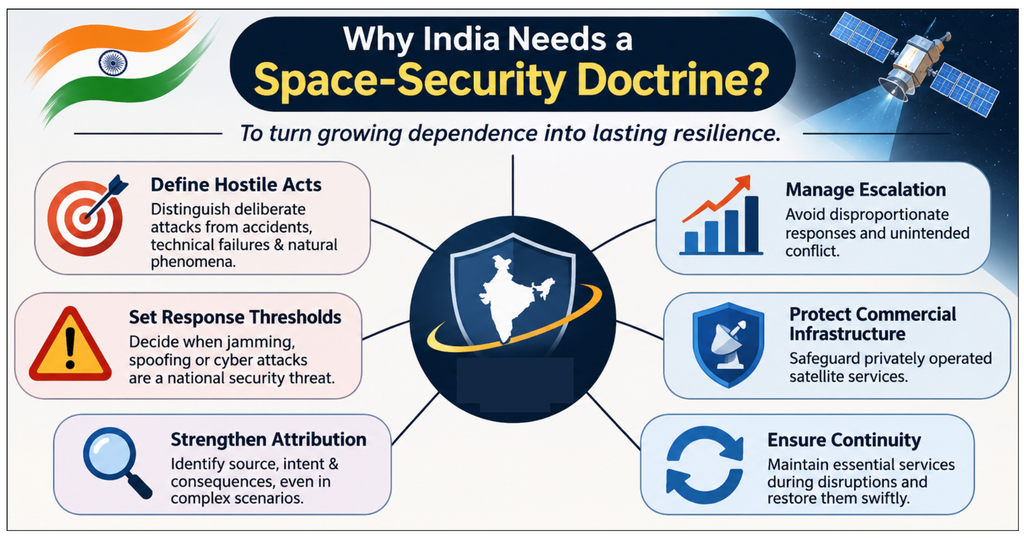
Growing dependence on satellite-based services and emerging threats such as satellite jamming, spoofing, cyberattacks and electronic warfare have highlighted the need for India to develop a comprehensive space-security doctrine.

While India has established a Joint Military Space Doctrine and an institutional framework for space activities, a broader national approach is needed to integrate civilian agencies, the armed forces and private-sector operators. 

UPSC Relevance: GS-3 Science and Technology: Space Technology
 
Prelims: Outer Space Treaty, India’s Existing Space-Security Framework
Mains: Need for Comprehensive Doctrine on Space Security; Weaponisation of Space

Strategic significance of Space Security:

Outer space has evolved from a domain of scientific exploration into critical infrastructure supporting economic activity, governance and national security.

  • Civilian applications: Satellites support telecommunications, banking, navigation, weather forecasting, agriculture, disaster management and logistics.
  • Military applications: Space assets provide secure communications, positioning, navigation and timing (PNT), intelligence, surveillance and reconnaissance (ISR), and battlefield coordination.
  • Economic security: Satellite-derived data and services underpin transport, financial networks, digital connectivity and critical infrastructure.
  • Strategic autonomy: Indigenous capabilities such as NavIC reduce dependence on foreign satellite-based services and strengthen India’s ability to protect its national interests.

Disruption of space-enabled services can produce cascading effects on the ground, affecting military operations, economic activity and essential public services. 

Changing threat landscape: From destruction to disruption:

Space-related threats are expanding beyond the physical destruction of satellites to the disruption of the services and networks they support.

Nature of threatMechanism and implications
Kinetic threatsAnti-satellite (ASAT) weapons can physically destroy satellites, generating space debris and disabling critical capabilities.
JammingInterference with satellite signals can disrupt communication and navigation services.
SpoofingTransmission of false signals can mislead navigation systems, affecting aircraft, ships and military operations.
CyberattacksSatellites, ground stations, control networks and data links can be targeted to compromise operations or manipulate information.
Electronic warfareElectromagnetic interference can degrade satellite communications and navigation without physically damaging spacecraft.
Orbital interferenceUnusual proximity operations by satellites can create security concerns because routine inspection and maintenance may be difficult to distinguish from hostile activities.

Unlike physical destruction, non-kinetic attacks can temporarily disable or degrade space services without visibly damaging satellites. This makes detection, attribution and proportionate response more difficult. 

The vulnerability extends beyond satellites to ground stations, communication networks, user terminals and commercial service providers.

International Legal and Governance Framework:

The existing international framework provides principles for peaceful use and cooperation in outer space, but does not comprehensively address emerging threats such as cyberattacks, jamming and other forms of hostile interference.

  • Outer Space Treaty, 1967:
    • Article IV prohibits placing nuclear weapons or other weapons of mass destruction in orbit or stationing them in outer space.
    • Article VI makes states internationally responsible for national space activities, including those undertaken by non-governmental entities, requiring their authorisation and continuing supervision.
    • Article IX requires states to undertake international consultations where their activities may cause potentially harmful interference with the peaceful exploration and use of outer space.
  • UN Open-Ended Working Group on reducing space threats (2022-24): Provided a platform to discuss threats to space systems and responsible behaviour in outer space.
  • COPUOS (United Nations Committee on the Peaceful Uses of Outer Space): Promotes international cooperation and the peaceful and sustainable use of outer space.

India’s Existing Space-Security Framework:

India has developed important institutional and technological capabilities, but these need to be integrated into a comprehensive national framework.

  • Indian Space Policy, 2023: Provides the overarching framework for space activities and encourages private-sector participation. It assigns distinct roles to ISRO, IN-SPACe and NewSpace India Limited (NSIL).
  • Defence Space Agency (DSA): Coordinates the development of India’s military space capabilities.
  • Defence Space Research Organisation (DSRO): Supports research and development of defence-related space technologies.
  • ISRO System for Safe and Sustainable Space Operations Management (IS4OM): Coordinates space situational awareness and space-sustainability activities to safeguard Indian space assets.
  • Network for Space Objects Tracking and Analysis (NETRA): Seeks to strengthen indigenous tracking and monitoring of space objects.
  • Mission Shakti (2019): Demonstrated India’s indigenous anti-satellite capability through a direct-ascent ASAT test in low Earth orbit.
  • Antariksha Abhyas (2024): India’s first space-focused military exercise, conducted by the Defence Space Agency, to assess threats and strengthen preparedness.

ISRO’s Indian Space Situational Awareness Report (ISSAR-2025) recorded 18 collision-avoidance manoeuvres for Indian satellites in low Earth and geostationary orbits during 2025. It also highlighted growing orbital congestion and the need for stronger indigenous tracking capabilities.

Policy gap: Existing arrangements provide important foundations for space activities, military preparedness and space situational awareness. However, India needs a common national framework connecting threat assessment, attribution, crisis response and recovery across civilian and military systems.

image 28

Key Pillars of a Comprehensive National Space-Security Doctrine:

India’s doctrine should move beyond protecting individual satellites towards securing the entire space ecosystem.

  • Clear response and attribution mechanisms: Establish protocols to assess the nature, origin, intent and impact of interference. Define institutional responsibilities and proportionate responses while accounting for uncertainty and escalation risks.
  • Space-domain awareness (SDA): Strengthen indigenous ground-based radars, optical telescopes and space-based sensors to monitor orbital activities, identify anomalies and improve early warning and attribution. Initiatives such as NETRA and IS4OM can be further developed.
  • Resilience and redundancy: Develop multiple satellite systems across different orbital regimes (LEO, MEO and GEO), alternative communication links and terrestrial backups so that disruption of one system does not cripple essential services.
  • Cybersecurity and electronic protection: Establish robust security standards for satellites, ground stations and user terminals, including encryption, secure command links, anti-jamming technologies and regular vulnerability assessments.
  • Public-private coordination: Involve ISRO, the armed forces, IN-SPACe, private satellite operators and critical-service providers in information sharing, incident reporting, joint exercises and crisis management.
  • Rapid recovery and reconstitution: Develop spare satellite capacity, alternative ground stations, responsive launch capabilities and arrangements for accessing commercial services to restore disrupted capabilities quickly.
  • International cooperation: Strengthen information sharing on space activities, collision avoidance, debris mitigation and responsible behaviour to reduce the risks of conflict and accidental interference.

The Joint Military Space Doctrine (2025) provides an important foundation for military preparedness; a broader national space-security framework must complement it by integrating civilian agencies, commercial operators and critical-service providers.

India’s space security should be measured not merely by the capabilities it develops, but by its ability to preserve essential services, withstand disruptions and recover quickly.

Mains Practice Question:

Q. Space has evolved into critical infrastructure underpinning India’s economic activity and national security. Discuss the emerging threats to space-based assets and examine the need for a comprehensive national space-security doctrine.

Export Promotion Mission: How Revised Support Addresses Export Barriers

Open article →Download PDF

Why in News?

On 18 November 2026, the Department of Commerce announced revised Export Promotion Mission guidelines, amended the previous day, covering market access, compliance assistance and freight support.

  • Market Access Support (MAS) broadens eligibility for assistance to attend overseas business events and reduces the required Export Promotion Council membership period.
  • TRACE expands the certifications eligible for reimbursement, helping MSMEs meet overseas quality, safety and technical requirements.
  • LIFT widens geographical and transport coverage, including waterways and additional categories of border facilities.
  • Export competitiveness depends on finding buyers, proving product conformity and delivering goods reliably, alongside access to working capital.
  • Non-financial barriers can remain binding even when an enterprise has a saleable product and sufficient funds to manufacture it.

UPSC Relevance

Prelims Relevance

  • Niryat Protsahan: the mission component concerned with access to trade finance.
  • Niryat Disha: market access and non-financial export barriers.
  • MAS: structured assistance for buyer-seller meetings, trade fairs and related market-access initiatives.
  • TRACE: support for internationally recognized certification and conformity-assessment requirements.
  • LIFT: freight and transport assistance addressing locational disadvantages.

Mains Relevance

GS Paper 3

  • Explain why export promotion requires different instruments for finance, compliance and logistics.
  • Assess whether wider scheme eligibility produces additional exports from smaller firms and under-represented regions.

GS Paper 2

  • Evaluate transparent eligibility, reimbursement procedures and outcome-based oversight of public assistance.

Background and Context

Market Access Is Different From Trade Finance

The mission separates the availability of money from the practical costs of entering and serving an overseas market.

  • Niryat Protsahan facilitates access to trade finance, while Niryat Disha addresses non-financial barriers. A firm may need both because financing production does not establish buyer contacts or satisfy destination-market requirements.
  • MAS supports buyer-seller meets, reverse buyer-seller meets, trade fairs and exhibitions. These activities help exporters present products and explore commercial relationships; participation itself does not guarantee a purchase order or continuing sales.
  • The amended airfare reimbursement provisions widen turnover eligibility and differentiate support between micro and small exporters and other eligible exporters. These are participation-cost measures, rather than a general payment for every shipment.
  • The required Export Promotion Council membership period falls from six months to three months. This shortens one qualifying condition, but exporters must still satisfy the other applicable requirements for the activity concerned.
  • Trade negotiations and exporter assistance operate at different levels. Talks such as the India-Egypt agreement-scoping exercise concern the wider trading framework; MAS helps firms approach potential buyers within available market conditions.

Certification Support Addresses Product Conformity

A buyer relationship is insufficient when an exporter cannot demonstrate that its product meets the destination market’s applicable requirements.

  • TRACE stands for Trade Regulations, Accreditation and Compliance Enablement. It assists MSMEs with internationally recognized quality, safety and technical requirements, covering certification and other eligible conformity-assessment requirements in overseas markets.
  • The amendment expands eligible certificates, rather than abolishing overseas standards. Its practical purpose is to widen the compliance costs that may receive support while preserving the obligation to meet the relevant requirement.
  • Mandatory and voluntary requirements can both affect market access. A legal rule may determine whether a product can enter; an eligible voluntary certification may help demonstrate qualities sought by particular customers.
  • Reimbursement concerns an eligible cost incurred under scheme conditions. It does not establish that every certification is covered, that a submitted application is approved, or that all spending will be recovered.
  • Product conformity is also distinct from origin. The certificate-of-origin system addresses origin documentation; satisfying a quality or safety requirement does not by itself establish where a product originates.

Freight Support Targets Locational Disadvantage

LIFT focuses on the additional transport burden that can weaken otherwise viable exports from low export-intensity areas.

  • Logistics Interventions for Freight and Transport addresses geographical disadvantages and logistics gaps faced by MSMEs. The rationale is that distance and available transport connections can affect delivered cost, not just factory productivity.
  • The revised coverage includes Land Customs Stations and Integrated Check Posts among eligible port categories. This brings additional land-border facilities into the support framework rather than treating only conventional seaports as relevant.
  • Waterways join road, rail and air among covered transport modes. Eligibility for a mode does not mean it is commercially suitable for every product, route or delivery schedule an exporter may face.
  • Air freight support extends to Jammu and Kashmir and Ladakh alongside the North Eastern Region. This is a specified geographical extension, not a statement that every exporter receives subsidized air cargo services.
  • Merchandise coverage remains subject to a negative list of products or export categories. Wider coverage must be read together with exclusions, eligible routes and other conditions before concluding that a shipment qualifies.

Way Forward

Measure Additional Market Access

  • Track whether supported participation leads to new buyer relationships and repeat orders, rather than treating attendance at an exhibition as the final result.
  • Publish clear eligible-cost guidance, documentary requirements and reasons for rejection so smaller exporters can assess their likely costs before applying.
  • Evaluate regional outcomes by examining whether freight support helps firms sustain exports from less-connected locations, rather than merely reimbursing activity that would occur anyway.

Conclusion

  • Export support works through distinct mechanisms: finding customers, meeting requirements and moving goods. An answer should connect each intervention to its specific barrier instead of treating all assistance as cheap credit.
  • Expanded eligibility is a policy change, not evidence of higher exports. Assessment must distinguish announced coverage, approved assistance and the additional commercial activity that can credibly be associated with that assistance.

UPSC Practice Questions

Prelims MCQ 1

With reference to the Export Promotion Mission, consider the following statements:

  1. Niryat Protsahan facilitates access to trade finance.
  2. TRACE removes the need to comply with overseas safety standards.
  3. LIFT is restricted to freight moving through seaports.

How many of the above statements are correct?

(a) Only one (b) Only two (c) All three (d) None

Answer: (a) Only one

Explanation:

Only statement 1 is correct. TRACE helps meet applicable requirements; it does not remove them. Revised LIFT coverage includes Land Customs Stations and Integrated Check Posts.

Prelims MCQ 2

An eligible MSME needs assistance with internationally recognized product certification for an overseas market. Which intervention most directly addresses this barrier?

(a) LIFT (b) MAS (c) Niryat Protsahan trade finance (d) TRACE

Answer: (d) TRACE

Explanation:

TRACE supports eligible certification and conformity-assessment requirements. MAS concerns market-access activities, LIFT addresses freight barriers and Niryat Protsahan concerns trade finance.

UPSC Mains Questions

  1. Explain how market-access, conformity-assessment and freight interventions address different barriers faced by smaller exporters.
  2. Wider eligibility under an export-support scheme does not by itself establish improved export competitiveness. Discuss suitable criteria for evaluating outcomes.

Source: PIB, Ministry of Commerce and Industry.

Frequently Asked Questions

What changed under the Export Promotion Mission?

The Department of Commerce revised support for market-access activities, certification and compliance, and freight. The changes widen specified eligibility and coverage; they do not create an unconditional entitlement for every exporter.

How do Niryat Protsahan and Niryat Disha differ?

Niryat Protsahan facilitates access to trade finance. Niryat Disha addresses market access and non-financial barriers, including the practical costs of finding buyers, meeting overseas requirements and transporting eligible export goods.

Does TRACE replace overseas product standards?

No. TRACE helps eligible MSMEs meet internationally recognized quality, safety and technical requirements. Support for a certification cost does not remove the underlying requirement or guarantee acceptance of every product.

Does LIFT cover all export shipments?

No. Revised LIFT coverage remains subject to geographical and other eligibility conditions, as well as a negative list. The announcement expands support but does not establish automatic assistance for every shipment.

Rural Employment Ombudspersons: Linking Complaints With Social Audits

Open article →Download PDF

Why in News?

On 18 November 2026, the Ministry of Rural Development announced Ombudsperson and Appellate Authority guidelines to strengthen accountability under the VB-G RAM G rural employment framework.

  • District Ombudspersons will address grievances concerning employment, wages, worksite facilities and denial of statutory entitlements.
  • Digital records will cover complaint registration, proceedings, awards and action taken, supported by documented field visits.
  • Community contact includes attendance at at least three social-audit public hearings or Gram Sabhas every month.
  • Individual complaints bring a worker’s specific problem into the accountability system; collective scrutiny can reveal discrepancies affecting several workers.
  • Traceable follow-up matters because recording a grievance and correcting the underlying failure are separate administrative steps.

UPSC Relevance

Prelims Relevance

  • Ombudsperson: a district-level grievance-redressal institution within the announced rural employment framework.
  • Social audit: community-led scrutiny that brings programme records and citizens’ experience into public discussion.
  • Muster rolls: employment records expressly included among the matters covered by the guidelines.
  • Action-taken monitoring: tracking the administrative response following proceedings and awards.
  • Appellate Authority: part of the announced institutional framework; detailed appeal conditions require the applicable guidelines.

Mains Relevance

GS Paper 2

  • Connect grievance redressal with participatory accountability and protection of vulnerable workers.
  • Evaluate whether digital documentation produces accessible remedies and verified corrective action.

Background and Context

What District Oversight Covers

The Ombudsperson gives rural workers a dedicated institutional avenue for complaints about programme implementation and the denial of entitlements.

  • Coverage extends beyond unpaid wages. The release includes job cards, access to employment, delay compensation, worksite facilities and muster rolls. These concern different stages of delivery and need different supporting records during examination.
  • Discrimination and harassment also fall within the announced scope, including violations affecting women and vulnerable groups. Accountability cannot be judged only by whether a payment entered an account when treatment at work remains disputed.
  • District-level access creates a point for bringing implementation failures to attention. Its usefulness depends on whether workers can explain their complaint, supply available evidence and understand the response without unaffordable travel or assistance.
  • The Ombudsperson route complements other mechanisms. Earlier rural employment grievance rules concern internal registration and escalation. Their procedural deadlines should not automatically be applied to this distinct Ombudsperson and Appellate Authority framework.
  • Institutional capacity is part of the announcement: eligibility draws on several professional backgrounds, and tenure and remuneration provisions are revised. The release does not specify their numerical terms or establish district staffing readiness.

How Records Support Corrective Action

The proposed digital record connects the original complaint with proceedings, an award and subsequent action, making different stages visible.

  • Complaint registration and tracking establish a record that can be followed over time. Registration is evidence that a grievance entered the system; it is not proof that the complaint was examined or resolved.
  • Proceedings and awards are to be recorded and uploaded. Keeping the reasoning and resulting decision available helps distinguish what the complainant alleged, what was considered and what action followed the examination.
  • Action-taken monitoring addresses the gap after a decision. A recorded award and a completed remedy are different outcomes: an unpaid-wage complaint still requires checking whether the relevant corrective steps actually reached the worker.
  • Field visits are emphasized alongside community engagement. Geo-tagged and time-stamped photographs can document where and when an observation was recorded; they cannot alone establish a worker’s complete employment or payment history.
  • Digital familiarity is an institutional requirement in the announcement. Accessible assistance remains important for workers who cannot independently use online systems; adopting a platform should not make the ability to operate it the practical entry condition.

Individual Complaints and Collective Scrutiny

A complaint and a social audit provide different kinds of evidence, and the guidelines connect them without treating either as a substitute.

  • An individual grievance starts with a particular alleged failure, such as a disputed wage payment. Its examination must establish the relevant facts and appropriate response, rather than assuming that every similar complaint has the same cause.
  • A social-audit hearing brings community findings and feedback into public discussion. Repeated discrepancies across workers can indicate a wider implementation problem that may remain less visible when each complaint is viewed in isolation.
  • Monthly participation requires Ombudspersons to attend at least three social-audit public hearings or Gram Sabhas. The requirement creates regular opportunities to hear concerns directly; attendance alone does not demonstrate that those concerns received effective follow-up.
  • Both sources of evidence can support identification of discrepancies and corrective action under prescribed procedures. The release does not require every individual complainant to complete a social audit before approaching the Ombudsperson.
  • The announced framework combines public disclosure, digital monitoring and community participation. Its effects must be assessed through actual accessibility, quality of examination and implementation of remedies, rather than inferred from the publication of guidelines.

Way Forward

Follow the Complaint Through to the Remedy

  • Provide assisted access and understandable complaint-status information so workers can use the institution without depending on paid intermediaries.
  • Check action-taken records against the underlying complaint and relevant work or payment evidence before treating a case as successfully addressed.
  • Use recurring social-audit findings to identify administrative failures affecting multiple workers while preserving examination of each individual grievance.
  • Assess hearing participation by the concerns recorded and follow-up completed, alongside compliance with the attendance requirement.

Conclusion

  • Accountability requires a connected record from the worker’s complaint through examination to corrective action. Digital tracking is useful when it makes that chain clearer to citizens and oversight institutions.
  • Community scrutiny and individual remedies reinforce one another. The new guidelines should be evaluated by whether they help identify recurring failures while securing appropriate responses to specific workers’ concerns.

UPSC Practice Questions

Prelims MCQ 1

With reference to the announced rural employment Ombudsperson guidelines, consider the following statements:

  1. The district Ombudsperson framework covers complaints relating to muster rolls and worksite facilities.
  2. Ombudspersons are required to attend at least three social-audit public hearings or Gram Sabhas every month.
  3. Uploading an award is, by itself, proof that the prescribed corrective action has been completed.

How many of the above statements are correct?

(a) Only one (b) Only two (c) All three (d) None

Answer: (b) Only two

Explanation:

Statements 1 and 2 are supported by the announcement. Statement 3 is incorrect: recording awards and monitoring action taken are separate steps, and an uploaded decision does not establish implementation.

Prelims MCQ 2

Which statement best explains the relationship between an individual grievance and a social audit?

(a) Both can provide evidence for accountability, with a grievance focusing on a particular problem and social audit bringing community findings into scrutiny. (b) A social-audit hearing automatically resolves every individual wage complaint. (c) Digital complaint registration removes the need to examine programme records. (d) Every individual grievance must first be approved by a social-audit hearing.

Answer: (a) Both can provide evidence for accountability, with a grievance focusing on a particular problem and social audit bringing community findings into scrutiny.

Explanation:

The guidelines connect individual grievances, social-audit findings and community feedback. They do not make a hearing an automatic remedy or a mandatory prior approval for every complaint.

UPSC Mains Questions

  1. Explain how linking rural employment Ombudspersons with social-audit hearings can strengthen accountability without substituting collective scrutiny for individual remedies.
  2. Digital documentation can improve traceability but does not by itself ensure grievance redressal. Discuss with reference to complaints, awards and action-taken monitoring.

Source: PIB, Ministry of Rural Development.

Frequently Asked Questions

What complaints can a rural employment Ombudsperson address?

The announced scope includes job cards, employment, wages, delay compensation, worksite facilities, muster rolls and denial of entitlements. It also covers discrimination, harassment and violations affecting women and vulnerable groups.

How are Ombudspersons connected with social audits?

The guidelines require attendance at at least three social-audit public hearings or Gram Sabhas each month. Community feedback and social-audit findings can support identification of discrepancies and appropriate follow-up under prescribed procedures.

Does a digital complaint record prove that a grievance is resolved?

No. Registration, examination, an award and action taken are different stages. A digital record improves traceability, but the corrective response must still be checked against the original complaint and relevant evidence.

Do these guidelines replace other accountability measures?

The announcement describes the Ombudsperson and Appellate Authority framework as complementary to digital monitoring, public disclosure and social audit. The mechanisms provide different routes for identifying problems and following corrective action.

Community Seed Banks: Conserving Varieties Through Farmer Seed Systems

Open article →Download PDF

Why in News?

On 18 November 2026, PIB reported the release of a DIVERSIFARM-India capacity-building manual and related policy outputs to strengthen community seed banks.

  • The outputs were presented at a national seminar held in New Delhi on 17–18 November.
  • The manual draws on Odisha case studies and combines technical guidance with organizational approaches for establishing and sustaining community seed banks.
  • The project brings together the M S Swaminathan Research Foundation and Norway’s Fridtjof Nansen Institute.
  • An Odisha policy roadmap recommends a secretariat; the release does not say that the proposed institution has been established.
  • Seed access links biodiversity conservation with the next sowing season: a conserved variety has greater practical value when farmers can obtain suitable planting material.
  • Local management matters because rules about collection, maintenance and access determine whether a community seed bank continues functioning after initial project support.

UPSC Relevance

Prelims Relevance

  • Community seed banks: locally governed institutions supporting seed conservation and access.
  • On-farm conservation: maintaining crop diversity through continued cultivation and farmer management.
  • Regeneration: growing stored material again to renew seed stocks.
  • Seed quality: planting material must remain viable and healthy.
  • Management typology: classification by institutional arrangements, rather than a ranking of seed quality.

Mains Relevance

GS Paper 3

  • How farmer institutions connect agricultural biodiversity with seed security.
  • Why conservation support must fund maintenance and local capacity, alongside physical storage.

Essay

  • Local knowledge and scientific institutions can support the same conservation objective through different roles.

Background and Context

How Seed Banks Support On-Farm Conservation

A community seed bank connects stored planting material with farmers who maintain crop diversity through cultivation and exchange.

  • Conservation through use depends on keeping varieties available to growers. A collection disconnected from cultivation cannot, by itself, sustain the farmer practices and knowledge associated with those varieties.
  • Local choice includes suitability for farming conditions and household preferences. Maintaining access to different varieties can widen options, but does not establish that every traditional variety tolerates every climatic stress.
  • Seed security concerns timely access to suitable, affordable, good-quality planting material. As FAO explains, production, distribution and quality assurance all influence whether that access actually reaches farmers.
  • Stored seed and on-farm conservation are linked but distinct. Storage preserves material outside the growing field; subsequent cultivation and farmer management sustain the living agricultural system around it.
  • Complementary institutions can connect local collections with national gene banks. The seminar recommended collaboration; it did not announce that community banks would replace national conservation facilities or their scientific functions.

Why Management Matters As Much As Storage

Keeping a seed bank useful requires decisions about people, planting material and maintenance, rather than a building alone.

  • Community participation should shape the services offered and access rules. FAO training guidance stresses consultation with farmers, including their preferences and expectations, when designing community seed-bank arrangements.
  • Regeneration renews stored material through cultivation. Its timing should reflect the crop and variety; assuming one fixed replacement interval for every seed collection would ignore differences in biological and storage requirements.
  • Quality management connects conservation to usable seed. FAO’s seed guidance identifies storage, sampling and testing within quality assurance; merely recording a variety’s name does not demonstrate that its seeds remain fit for planting.
  • Local knowledge adds information about cultivation and use. Recording that knowledge alongside planting material helps retain the practical context that a list of crop names or a location map cannot convey.
  • Institutional diversity explains why support cannot follow one template. The project identified different management structures; a community organization’s training, staffing and maintenance needs must be understood before prescribing its operating model.

What The New Outputs Establish

The manual, atlas and policy proposals serve different purposes, and their publication should not be confused with demonstrated outcomes.

  • The atlas is a mapping resource, not proof of complete national coverage. The release explicitly describes a wider surveyed universe than the institutions already mapped.
  • The manual offers capacity-building guidance based on Odisha case studies. Its publication supplies a resource for practitioners; adoption, continuing use and improvements in seed access still require separate evidence.
  • The proposed Odisha secretariat is a recommendation in a policy roadmap. Treating it as an operating government body would collapse the distinction between an institutional proposal and an implemented administrative arrangement.
  • Support for conservation should be assessed through maintained diversity and usable seed access. Counting mapped institutions alone cannot establish the condition of collections, fairness of access or continuity of local management.
  • Crop improvement and conservation address connected needs. The horticultural genome-editing centre concerns developing traits; this initiative concerns farmer institutions that maintain and circulate planting material.

Way Forward

Fund Continuing Capacity

  • Provide recurring training and maintenance support, with responsibilities for stock records, seed quality and collection renewal clearly assigned locally.
  • Assess access and continuity alongside institution counts: which farmers obtain suitable seed, and whether collections remain usable across seasons.
  • Build community–gene-bank partnerships around agreed roles while retaining farmer participation in local decisions.
  • Track implementation separately from proposals, especially the Odisha roadmap and any administrative mechanism later created under it.

Conclusion

  • Community seed banks connect agricultural biodiversity with practical seed access. Their value depends on usable collections, farmer participation and continuing management, rather than the presence of a storage room alone.
  • The new capacity-building outputs create tools for support, not proof of universal coverage or successful implementation. Evaluate the institutions through conservation quality and the seed services they actually provide.

UPSC Practice Questions

Prelims MCQ 1

With reference to community seed banks, consider the following statements:

  1. They can support on-farm conservation by maintaining access to planting material.
  2. Publication of an atlas establishes that every seed bank in the country has been mapped.
  3. Regeneration requirements can differ across crops and varieties.

How many of the above statements are correct?

(a) Only one (b) Only two (c) All three (d) None

Answer: (b) Only two

Explanation:

Statements 1 and 3 are correct. Community seed banks can support cultivation-based conservation, and regeneration must reflect the material maintained. An atlas may have partial coverage; the release describes a wider surveyed universe.

Prelims MCQ 2

Which is the most appropriate measure of the continuing usefulness of a community seed bank?

(a) Whether farmers can obtain suitable viable seed and collections are maintained (b) Whether its location appears on an online map (c) Whether all varieties follow an identical regeneration schedule (d) Whether it operates without any connection to scientific institutions

Answer: (a) Whether farmers can obtain suitable viable seed and collections are maintained

Explanation:

A seed bank’s practical contribution depends on maintained planting material and access. Mapping alone does not demonstrate seed quality, while uniform regeneration schedules and institutional isolation are not necessary features.

UPSC Mains Questions

  1. Explain how community seed banks connect on-farm conservation with seed security. Discuss the institutional conditions required for their continuity.
  2. Why should the performance of community seed banks be assessed beyond the number of institutions mapped? Suggest suitable dimensions of evaluation.

Sources: PIB, Ministry of Agriculture and Farmers Welfare and FAO community seed-bank training guidance.

Frequently Asked Questions

What is a community seed bank?

A community seed bank is a locally governed arrangement for maintaining and accessing planting material. It can support crop diversity through seed conservation, farmer knowledge and continued cultivation of varieties.

How does a community seed bank support on-farm conservation?

It helps farmers access planting material for cultivation and maintains knowledge associated with varieties. The storage component supports this activity, while on-farm conservation occurs through continued cultivation and management in agricultural systems.

Has the proposed Odisha secretariat been established?

The 18 November release describes a policy roadmap recommending a secretariat. It does not confirm establishment. A recommendation should be distinguished from an officially created and functioning administrative institution.

Does the atlas cover every community seed bank in India?

No complete-coverage claim is established by the release. It describes more institutions in the surveyed universe than in the atlas, so mapped entries should not be treated as a national census.

H5N1 Chicken Vaccine: Why Clade Matching and Surveillance Matter

Open article →Download PDF

Why in News?

On 18 November 2026, PIB announced that an indigenous H5N1 chicken vaccine developed by ICAR-NIHSAD would be dedicated to the nation on 20 November.

  • The inactivated vaccine targets H5N1 highly pathogenic avian influenza of clade 2.3.2.1a in chickens.
  • The developer is ICAR-NIHSAD, Bhopal, the National Institute of High Security Animal Diseases.
  • The scheduled dedication is a future event at this report’s cutoff; the announcement does not establish nationwide vaccination.
  • The announced product is for chickens, not for human vaccination.
  • Poultry disease control affects farm livelihoods, wildlife health and opportunities for animal-to-human exposure.
  • Vaccine availability and a functioning vaccination programme are separate policy questions; the latter requires decisions about use, delivery and monitoring.

UPSC Relevance

Prelims Relevance

  • H5N1: an avian influenza virus subtype.
  • Clade: a genetically related group within a viral lineage.
  • HPAI: high pathogenicity classification concerns disease in poultry.
  • ICAR-NIHSAD: the announced vaccine’s developer in Bhopal.
  • WOAH: international standards for animal health, surveillance and safe trade.

Mains Relevance

GS Paper 3

  • How targeted vaccines fit into animal-disease prevention and control.
  • Why laboratory capacity and field surveillance must develop together.

GS Paper 2

  • Coordination between veterinary, wildlife and public-health institutions under One Health.

Background and Context

What The Vaccine Announcement Establishes

The announcement identifies a product, host and target virus group; each limits the claims that can reasonably be made.

  • The target host is the chicken. A poultry vaccine announcement supplies no evidence of suitability for people, other livestock or wild birds, whose use would require its own supporting evidence.
  • The named clade narrows the virus group addressed by the product. Reading “H5N1” alone and assuming equivalent protection against every circulating lineage would discard an important part of the announcement.
  • The development claim comes from the official release. It does not supply a field-effectiveness percentage, approved dosing schedule or nationwide implementation order that could support those additional claims.
  • The dedication date concerns a planned public event. Product development, regulatory decisions, procurement and farm-level delivery are separate stages; the release should not be used to treat them as already completed.
  • Programme assessment must ask what is authorized, where use is proposed and how results will be measured. These are questions for subsequent evidence, rather than gaps to fill with assumptions.

Why Vaccine Matching Requires Continuing Evidence

A vaccine programme needs evidence about circulating viruses as well as the vaccine selected to address them.

  • Virus evolution can change the relationship between circulating strains and available vaccines. Genetic relatedness helps describe a lineage, but the clade label alone is not a measured guarantee of protection.
  • Vaccine composition needs continuing review against circulating strains. WOAH’s vaccination policy brief connects reliable vaccines with monitoring, surveillance and the changing epidemiological situation.
  • Field monitoring tests whether the control programme is achieving its purpose. A count of administered doses cannot, by itself, establish that infection is absent or that transmission has been interrupted.
  • National Veterinary Authorities decide whether vaccination is appropriate through risk evaluation. Their decision includes disease conditions and the capacity to deliver the programme, rather than the existence of a product alone.
  • Clade-specific scope should remain explicit in public communication. Without results supporting broader protection, the sound conclusion is that the announced vaccine targets the named group, with wider performance still requiring evidence.

Vaccination And Surveillance Perform Different Jobs

Vaccination can complement disease control, while surveillance establishes what is happening in birds and the wider environment.

  • Biosecurity limits opportunities for introduction and spread. WOAH guidance includes reducing contact with wild birds, cleaning housing and equipment, and reporting unusual illness or deaths to veterinary services.
  • Early detection supports timely investigation and response. Farm reports, diagnostic work and information from wildlife surveillance help authorities distinguish a suspicion from confirmed infection and understand where risks are changing.
  • Disease-free status cannot be inferred from vaccination alone. The WOAH Terrestrial Code allows vaccination without loss of a free country’s or zone’s status when surveillance supports absence of infection.
  • One Health coordination connects poultry, wild birds and people exposed to infected animals. It improves information sharing across sectors; it does not turn a chicken vaccine into a human medical intervention.
  • Preparedness remains an operational task, as the SAT-1 response exercise illustrates for a different livestock disease. Avian influenza still requires its own evidence-based detection, reporting and response arrangements.

Way Forward

Connect Product Evidence With Field Decisions

  • Publish authorization and deployment details separately from the dedication announcement, including the evidence supporting the intended use.
  • Maintain strain monitoring and review vaccine suitability as circulating viruses change.
  • Fund diagnostic and reporting capacity alongside any vaccination programme, with clear responsibilities across veterinary and wildlife services.
  • Communicate scope and uncertainty clearly: chickens are the intended host, and broader protection must be demonstrated.

Conclusion

  • The H5N1 chicken vaccine announcement is a specific product development. Its significance should be assessed within the named host and clade, without converting a planned dedication into evidence of completed deployment.
  • Vaccination and surveillance answer different questions. A useful disease-control programme connects an appropriate vaccine with field evidence, biosecurity and response capacity, while keeping human and veterinary uses distinct.

UPSC Practice Questions

Prelims MCQ 1

With reference to the announced H5N1 chicken vaccine, consider the following statements:

  1. It targets H5N1 clade 2.3.2.1a in chickens.
  2. Its announcement establishes authorization for human use.
  3. Its announcement proves that nationwide poultry vaccination has been completed.

How many of the above statements are correct?

(a) Only one (b) Only two (c) All three (d) None

Answer: (a) Only one

Explanation:

Only statement 1 is supported. The announced product is for chickens, and a future dedication does not establish human authorization or completed national deployment.

Prelims MCQ 2

Which statement best reflects WOAH guidance on avian influenza vaccination and disease-free status?

(a) Vaccination automatically demonstrates absence of infection. (b) A vaccinated country can never retain disease-free status. (c) Vaccination makes surveillance unnecessary. (d) Vaccination need not affect free status when surveillance supports absence of infection.

Answer: (d) Vaccination need not affect free status when surveillance supports absence of infection.

Explanation:

WOAH’s Terrestrial Code links retention of free status to surveillance evidence, not to vaccination alone. Vaccination remains a complementary control tool.

UPSC Mains Questions

  1. Explain why clade-specific vaccine development must be supported by continuing surveillance in avian influenza control.
  2. Distinguish the development of a veterinary vaccine from implementation of a disease-control programme. Discuss the institutional capacity required for the latter.

Sources: PIB, Ministry of Agriculture and Farmers Welfare and WOAH, Avian Influenza.

Frequently Asked Questions

Is the announced H5N1 vaccine intended for people?

No. The PIB announcement concerns an inactivated vaccine for chickens targeting H5N1 clade 2.3.2.1a. It does not establish authorization, suitability or a vaccination programme for humans.

Has the vaccine already been deployed nationwide?

The 18 November announcement schedules dedication for 20 November. It does not confirm nationwide deployment. Procurement, authorization and farm-level delivery require separate evidence beyond a planned public event.

Does clade-specific targeting prove protection against every H5N1 lineage?

No. The named clade defines the announced target. Broader protection requires evidence; it should not be inferred from the shared H5N1 subtype name or the fact of indigenous development.

Why is surveillance needed when poultry vaccination is used?

Surveillance tracks infection and circulating viruses, supports investigation and informs vaccine suitability. WOAH treats vaccination as a complementary measure; disease-free status still depends on evidence supporting the absence of infection.

Second Global Stocktake: How Collective Progress Informs Climate Action

Open article →Download PDF

Why in News?

On 18 November 2026, India called at COP31 in Antalya for an equitable, science-based second global stocktake covering climate action and implementation gaps.

  • PIB reported India’s call for balanced treatment of mitigation, adaptation and implementation support.
  • India highlighted national climate pledges, transparency reports and scientific assessments, including research from developing countries.
  • This was a national negotiating position; the statement did not announce an adopted stocktake outcome.
  • The second global stocktake connects evidence about collective progress with the next round of national action.
  • Its analytical question concerns the combined result of implementation, including the support needed to close gaps.

UPSC Relevance

Prelims Relevance

  • Article 14 of the Paris Agreement and the global stocktake
  • Collective assessment and nationally determined contributions
  • Information collection, technical assessment and consideration of outputs
  • Mitigation, adaptation and means of implementation

Mains Relevance

GS Paper 3

  • How climate evidence informs stronger implementation
  • Assessing adaptation and support alongside emissions reductions

GS Paper 2

  • National discretion within a multilateral assessment process

Essay

  • Public reporting becomes useful when evidence changes implementation choices.

Background and Context

What the Global Stocktake Assesses

The assessment asks how the collective effort measures up against the Paris Agreement’s purpose and long-term goals.

  • Article 14 establishes a collective review. Its subject is overall progress under the agreement, so it should not be read as a country-by-country compliance verdict assigning individual penalties.
  • The treaty requires a comprehensive, facilitative approach, considering emissions reduction, adaptation and implementation support. Assessing only emissions would leave out resilience needs and the resources that enable countries to act.
  • Equity and the best available science guide the exercise together. Scientific findings describe climate risks and pathways; equity keeps differences in responsibilities, capabilities and national circumstances within the assessment.
  • The first stocktake took place in 2023, with a five-year cycle specified unless Parties decide otherwise. The second assessment is expected to conclude in 2028; a preparatory intervention is not its final result.
  • An NDC describes a country’s contribution, while the stocktake examines the combined picture. This distinction prevents a national pledge, a global assessment and a negotiated response from being treated as interchangeable documents.

How Evidence Reaches National Decisions

The process separates gathering evidence, assessing it and considering what the findings mean for subsequent action.

  • Information collection and preparation gathers and synthesizes material for assessment. The UNFCCC GST2 outline places this work at the start of the process, before conclusions can be drawn from it.
  • Technical assessment examines implementation and collective progress, including opportunities to improve action and support. It turns submitted material into an assessment of the overall situation rather than treating each announcement as a verified achievement.
  • Consideration of outputs addresses the implications of technical findings. Parties discuss what the assessment means for the response; presenting evidence and agreeing on its political implications are related but distinct tasks.
  • Nationally determined updates follow from the outcome informing countries’ actions and support. The stocktake provides common evidence and direction, while countries retain responsibility for shaping their own subsequent measures under the agreement.
  • Feedback matters: information collection and technical work can interact, including requests for additional information. A simple flow describes their main relationship, but should not imply completely sealed stages with no exchange between them.
Three global stocktake components connect shared information, collective assessment and consideration of outputs, which inform nationally determined action.
The stocktake assesses collective progress. Its outcome informs national action and support; information collection and technical assessment can interact.

How to Read India's Intervention

India’s statement identifies priorities for the assessment; it does not establish that those priorities have already been accepted by all Parties.

  • India sought recognition of implementation gaps alongside achievements. The useful question is whether reported action addresses identified needs, and what constraints remain, rather than whether the process produces another list of announcements.
  • Transparency reports and NDCs serve different evidentiary roles: reported implementation helps assess progress, while pledges indicate intended action. Reading both can help expose a gap between plans and what has actually been delivered.
  • India requested attention to developing-country science alongside IPCC assessments. Inclusion broadens the evidence considered; individual studies still need careful interpretation rather than being accepted solely because of where they originated.
  • The earlier debate about delivery of climate commitments concerns performance. The stocktake’s distinctive role is organizing a collective assessment that can inform the next policy response.
  • India’s separate just-transition proposal concerns an implementation arrangement. Keeping that proposal separate from the stocktake avoids confusing a suggested mechanism with the wider assessment of progress across the agreement.

Way Forward

Make Findings Usable

  • Keep pledges, reported delivery and remaining needs distinguishable when preparing national submissions.
  • Explain uncertainties and evidence gaps so technical findings remain traceable to their underlying material.
  • Connect identified constraints with specific changes in action, support and international cooperation.

Conclusion

  • The global stocktake links collective evidence with nationally determined improvement; its value depends on how countries use the findings.
  • For GST2, distinguish India’s current negotiating priorities from the assessment process and from any eventual agreed outcome.

UPSC Practice Questions

Prelims MCQ 1

With reference to the global stocktake under the Paris Agreement, consider the following statements:

  1. It assesses collective progress towards the agreement’s purpose and long-term goals.
  2. Its scope includes adaptation and means of implementation and support.
  3. Its outcome informs Parties in updating actions in a nationally determined manner.

How many of the above statements are correct?

(a) Only one (b) Only two (c) All three (d) None

Answer: (c) All three

Explanation:

All three statements reflect Article 14. The stocktake is comprehensive and collective, and its outcome informs nationally determined updates.

Prelims MCQ 2

Which sequence best represents the main relationship among global stocktake components and their intended use?

(a) National penalties → individual compliance trials → replacement of all NDCs (b) Information preparation → technical assessment → consideration of outputs → informed national action (c) National target allocation → collection of fines → technical assessment (d) Political outcome → abolition of reporting → automatic emissions reductions

Answer: (b) Information preparation → technical assessment → consideration of outputs → informed national action

Explanation:

The three components organize evidence and findings to inform subsequent action. Collection and technical assessment can interact; the sequence does not imply perfectly isolated stages.

UPSC Mains Questions

  1. Explain how the global stocktake connects collective climate assessment with nationally determined action.
  2. Why should a global assessment of climate progress consider adaptation and implementation support alongside mitigation?

Sources: PIB, Ministry of Environment, Forest and Climate Change and UNFCCC.

Frequently Asked Questions

What is the second global stocktake?

It is the second collective assessment of progress under the Paris Agreement. The UNFCCC outlines a process beginning in November 2026 and concluding in November 2028, with findings intended to inform further action and support.

Does the stocktake assign a compulsory target to each country?

Its outcome informs Parties in updating and enhancing action and support in a nationally determined manner. It should not be described as an exercise that automatically allocates a new compulsory target to every country.

What are its main components?

They are information collection and preparation, technical assessment, and consideration of outputs. Together they connect evidence with discussion of its implications, which then informs national action and international cooperation.

Did India announce an agreed GST2 outcome at COP31?

No. The 18 November statement set out India’s priorities for an equitable, balanced and science-based assessment. It was a national intervention, not an announcement that the second stocktake had been completed.

Sports Leagues: What the New Financing Committee Will Examine

Open article →Download PDF

Why in News?

On 18 November 2026, the Ministry of Youth Affairs and Sports announced a committee to recommend a framework for professionally managed, financially sustainable sports leagues.

  • The 14-member committee is expected to submit recommendations within eight weeks.
  • Its mandate includes examining viability gap funding, financial assistance and concessional access to government sports infrastructure.
  • It will consider private capital, franchise ownership, sponsorship, broadcasting and digital rights, alongside possible CSR financing.
  • These are options under examination; the announcement does not approve a grant scheme, establish CSR eligibility or launch a league.
  • A league needs recurring competition and revenue, while athlete development also depends on access, welfare and links with local sporting institutions.
  • Public support needs a clear purpose: widening participation and competition opportunities, with safeguards against financing an indefinitely unviable commercial venture.

UPSC Relevance

Prelims Relevance

  • Sports-league financing and commercial viability.
  • Viability gap funding as a possible support instrument.
  • Broadcasting rights, sponsorship and franchise ownership.
  • Difference between a committee mandate and an approved assistance scheme.

Mains Relevance

GS Paper 2

  • Accountability in public support for sports and athlete welfare.
  • Linking national sporting ambitions with local participation.

GS Paper 3

  • Private investment, service-sector employment and sustainable revenue models.

Background and Context

Why a League Needs a Sustainable Operating Model

A league must organize repeat competition while meeting costs across successive seasons.

  • The ministry identifies early commercial viability as a constraint for several disciplines. Sporting or social value can exist before a league attracts sufficient paying audiences, sponsors and investors to sustain recurring operations.
  • Franchise investment and sponsorship serve different roles. An owner participates in the team business, while a sponsor pays for agreed association or exposure; neither automatically guarantees a stable competition calendar.
  • Broadcasting and digital rights concern permission to distribute coverage. Their commercial value depends on the audience proposition and negotiated arrangements, so a successful model in one sport cannot simply establish another sport’s viability.
  • The committee will examine tailored operational models, particularly for Olympic, women’s, youth, indigenous and emerging sports. These are priority categories for assessment, not a list of leagues already selected for financial assistance.
  • Financial sustainability requires matching expected receipts with continuing commitments. A useful assessment would distinguish initial establishment needs from recurring operating losses, rather than treating investment interest as proof of a durable business model.

What Government Facilitation Could Involve

The committee will evaluate support instruments; the announcement does not settle their design.

  • Viability gap funding is among the options named for examination. Any proposed use would need defined eligibility, public objectives and conditions; the release does not specify an approved amount, allocation formula or beneficiary.
  • Direct financial assistance and concessional infrastructure access can address different costs. A payment supports eligible expenditure, while lower-cost venue access changes the cost of using an existing facility; neither ensures commercial demand.
  • Use of government sports infrastructure also raises allocation questions. A sound proposal should explain scheduling and maintenance responsibilities, and how commercial events would coexist with training and public access at the same venue.
  • The mandate includes considering CSR financing, but a committee’s terms of reference do not themselves establish legal eligibility. Any eventual proposal must be assessed under the applicable framework rather than presented as an existing entitlement.
  • This financing exercise differs from recognition of sports bodies. Here, the immediate question concerns viable competitions and public facilitation, rather than reproducing the separate institutional recognition and compliance framework.

How League Growth Could Support Athlete Development

Commercial expansion contributes to sport only when it connects with participation and credible competition.

  • The committee is tasked with linking leagues to schools, colleges, universities and local clubs. These connections could create progression opportunities, but the announcement does not establish a guaranteed selection route from any institution.
  • Regular competition can create occasions to identify and develop talent. Its value depends on the quality and continuity of opportunities, not simply the number of event announcements or the commercial visibility of a launch.
  • The proposed framework must address athlete welfare and integrity alongside investment. These responsibilities should shape operating conditions and oversight, rather than appear only after commercial agreements have already fixed the incentives.
  • Financial transparency matters where private revenues and public facilitation interact. Clear records would help distinguish support received, commitments made and actual sporting delivery, instead of assuming that commercial growth automatically produces wider participation.
  • The committee may consult federations, league officials, investors and sports-technology firms. The resulting recommendations remain an intermediate step; implementation would require subsequent decisions and observable evidence that the selected arrangements work.

Way Forward

Tie Support to Clear Sporting Outcomes

  • Define the participation or competition gap each proposed intervention addresses before choosing a financing instrument.
  • Publish eligibility and performance conditions, including the treatment of recurring losses and any exit or review mechanism.
  • Protect athlete welfare and venue access through explicit obligations and accessible reporting arrangements.
  • Assess repeat competition and grassroots access alongside revenues when reviewing any supported league.

Conclusion

  • The committee opens a review of league financing and athlete pathways; it does not announce an approved subsidy or establish that every sport can follow the same commercial model.
  • The durable policy test is whether public facilitation produces continuing sporting opportunities with transparent obligations, while the underlying league develops a credible operating model beyond its launch.

UPSC Practice Questions

Prelims MCQ 1

With reference to the sports-league committee announced in November 2026, consider the following statements:

  1. It will examine concessional access to government sports infrastructure.
  2. Its constitution automatically approves viability gap funding for every new league.
  3. Its mandate includes athlete welfare and financial transparency.

How many of the above statements are correct?

(a) Only one (b) Only two (c) All three (d) None

Answer: (b) Only two

Explanation:

Statements 1 and 3 are in the committee’s mandate. Statement 2 is incorrect: examining a financing option does not approve assistance or establish eligibility.

Prelims MCQ 2

Which approach best connects public support for sports leagues with a defensible policy objective?

(a) Treating sponsorship interest as proof of permanent financial viability (b) Offering indefinite assistance without reviewing sporting outcomes (c) Assuming all sports can reproduce the revenue model of a successful league (d) Defining the participation gap, support conditions and measurable competition opportunities

Answer: (d) Defining the participation gap, support conditions and measurable competition opportunities

Explanation:

A defined sporting objective and reviewable conditions connect public facilitation with delivery. Investment interest alone does not establish sustainability, and the committee is expected to consider tailored models.

UPSC Mains Questions

  1. How can government facilitation support sports leagues without creating indefinite dependence on public assistance?
  2. Examine the role of grassroots links, athlete welfare and financial transparency in developing a sustainable sports-league ecosystem.

Source: PIB, Ministry of Youth Affairs and Sports.

Frequently Asked Questions

What has the government announced for sports leagues?

The sports ministry has constituted a committee to recommend a framework for sustainable leagues. Its mandate covers financing options, infrastructure access, grassroots links and governance; it does not itself approve financial assistance.

Has viability gap funding for sports leagues been approved?

The announcement identifies viability gap funding as an option the committee will examine. It does not specify an approved scheme, entitlement, allocation or beneficiary, so examination should not be described as implementation.

Why does the committee include athlete-development pathways?

The mandate seeks links between leagues and schools, colleges, universities and local clubs. Such links can support participation and progression, but the announcement does not guarantee selection or establish a completed pathway.

How does this differ from recognition of sports bodies?

This committee examines league viability, revenues, public facilitation and competition pathways. Recognition of sports bodies concerns a separate institutional framework; the two subjects should not be treated as the same announcement.