Join Anantam IAS Channel on Telegram

Daily Digest · Tuesday

17 November 2026 Current Affairs for UPSC

10 current affairs published on Tuesday, 17 November 2026

17 November 2026 Current Affairs for UPSC — every Why-in-News article AnantamIAS published on Tuesday, 17 November 2026, broken down with Why in News?, the exact GS paper it feeds, sub-topic mapping, MCQ-ready facts and a UPSC-style practice question. 10 articles in total, covering Polity, Economy, Environment, S&T, IR, Geography, History, Society and Internal Security — the same Why-in-News + GS-paper-mapping + practice-question format the Compass uses across every daily digest on the site.

Daily current affairs for UPSC is where new material enters your prep stream. Read this 17 November 2026 digest end-to-end in 25–35 minutes, attempt the practice question at the foot of each article (it's MCQ for some, 10/15-marker for others), then bookmark the entries that fall inside your active revision window. Everything stays cross-linked: tap any subject pill to jump to that subject's hub, or use the table of contents above to skip straight to a specific story.

Use this page three ways. Read sequentially for a one-sitting scan of everything that mattered on 17 November 2026. Download the 17 November 2026 PDF below for offline study or print revision. Or use the November 2026 Current Affairs compilation to see this day in the month's full context. For the previous day's reading, see 16 November 2026 Current Affairs; the next day's is 18 November 2026 Current Affairs.

Why we publish daily current affairs separately from the monthly compilation: daily is learning, monthly is revision. Use the daily page to add fresh material to your notes the day it breaks; come back to the November 2026 compilation 60 days before Prelims when the noise has settled and only the lasting takeaway is worth re-reading.

US Student Visas: Why a Court Rejected Fixed Admission Periods

Open article →Download PDF

Why in News?

PTI reported that a Massachusetts federal court on November 16, 2026, vacated a DHS final rule affecting US student visas and other nonimmigrant categories.

  • The ruling covers F students, J exchange visitors and I foreign-media representatives; its scope extends beyond university admissions alone.
  • Although PTI describes a proposal, the order expressly vacates a final rule; it does not merely close a consultation exercise.
  • PTI reported a proposed four-year limit for students without further federal approval; that limit should not be presented as an operative requirement.
  • For Indian students, predictable lawful stay matters when selecting courses, arranging finance and planning research; a court ruling cannot substitute for individual status compliance.
  • For governance, the issue is whether executive discretion remains connected to legislative purpose and supported by reasons that withstand scrutiny.

UPSC Relevance

Prelims Relevance

  • Duration of status: conditional admission linked to the permitted activity.
  • Visa validity: the period for using a visa to seek entry.
  • F, J and I: student, exchange-visitor and foreign-media categories.
  • Vacatur: setting aside the challenged rule.
  • Administrative Procedure Act: the framework used to review the agency action.

Mains Relevance

GS Paper 2

  • International relations: migration policy and cross-border educational mobility.
  • Governance: reasoned rulemaking, legislative purpose and judicial control of administrative discretion.

Essay

  • Predictability and opportunity: how procedural safeguards shape access to education.

Background and Context

Visa validity and permitted stay answer different questions

A travel document and an admission record perform different functions; confusing them can turn an accurate headline into misleading advice.

  • Visa validity concerns when a person may use the visa to seek entry; it does not itself guarantee admission or determine the permitted length of a particular stay.
  • Admission is decided at the border. The State Department explains that the admission record shows either an end date or duration of status, rather than simply repeating the visa expiry date.
  • Duration of status links continued stay to the qualifying study, exchange or employment activity. It is conditional permission, not permanent residence or an unrestricted entitlement to remain indefinitely in the country.
  • For example, visa expiry during an otherwise authorized stay does not by itself fix the departure deadline. Conversely, a visa with time remaining cannot excuse failure to maintain the required status.
  • The practical distinction is between permission to seek entry and permission to remain. The State Department’s visa-expiration guidance explains why students must read their admission record separately from their travel document.

Why the court rejected this rule

The judgment tested the agency’s reasoning and legal authority, rather than deciding whether immigration oversight should exist.

  • The court found inadequate justification: DHS had not properly assessed costs and benefits, answered significant comments or considered less burdensome alternatives. Fraud and security concerns did not adequately support this rule.
  • SEVIS, the Student and Exchange Visitor Information System, already supports monitoring. The court questioned the failure to assess improvements to that existing system before imposing a different renewal structure.
  • The order also found restrictions on academic mobility inconsistent with statutory purpose. An agency’s authority to regulate a category does not automatically authorize restrictions that undermine the reason Congress created it.
  • The policy lesson is to test additional controls against their additional benefit. More applications can consume administrative capacity without necessarily identifying the particular noncompliance that a regulator needs to address.
  • A useful proportionality question follows: could targeted checks address the identified problem with less disruption to legitimate study? This is an analytical lesson, not a claim that every immigration deadline is unlawful.

What the decision changes, and what it does not

The procedural stage matters: a final merits ruling has a different function from an interim pause or a new statute.

  • Vacatur sets the final rule aside. The order records that it had not taken effect; describe the outcome as preserving the existing framework, rather than reversing an already operating admission system.
  • Judicial review evaluates government action against legal standards. It does not mean the court enacted a replacement immigration statute, nor that Congress delegated every policy choice directly to a judge.
  • The broader India-facing implication is planning uncertainty: course duration, funding commitments and family decisions can depend on immigration administration. This is a policy inference, not evidence of a measured change in enrolment.
  • For comparison, study the Great Nicobar judicial-review dispute to separate reviewability from policy preference. The institutional question travels across jurisdictions; the applicable legal tests must still be identified separately.
  • The Coelho case discussion offers an Indian constitutional comparison. Do not import its basic-structure doctrine into this US administrative-law ruling; compare accountability functions while keeping their legal foundations distinct.

Way Forward

Make compliance targeted and understandable

  • Regulators should identify the enforcement gap, compare alternatives and explain why additional requirements improve compliance enough to justify their burden.
  • Universities should distinguish admission status from visa validity in student guidance and communicate verified changes without promising blanket protection.
  • Indian missions can direct students to official guidance and institutional advisers, while tracking subsequent court orders before describing any policy outcome as settled.

Conclusion

  • Duration of status makes lawful stay conditional on the permitted activity; it should never be described as an unlimited visa or automatic permanent residence.
  • The durable governance lesson is reasoned executive action: oversight needs a defensible connection between the problem, the chosen remedy and the authority granted by the legislature.

UPSC Practice Questions

Prelims MCQ 1

With reference to US immigration terminology, consider the following statements:

  1. Visa validity alone determines how long an admitted student may remain.
  2. Duration of status is conditional on maintaining the qualifying activity.
  3. A valid visa guarantees admission at the port of entry.

How many of the above statements are correct?

(a) Only one (b) Only two (c) All three (d) None

Answer: (a) Only one

Explanation:

Only statement 2 is correct. Visa validity concerns seeking entry; admission and permitted stay are separate decisions, and continued status is conditional.

Prelims MCQ 2

Which best describes judicial vacatur of an administrative rule?

(a) Enactment of a replacement statute (b) Automatic grant of permanent residence (c) Setting aside the challenged rule (d) Closure of every possible future appeal

Answer: (c) Setting aside the challenged rule

Explanation:

Vacatur sets a rule aside. It is not legislation, an immigration benefit granted to every individual, or a guarantee against subsequent appellate proceedings.

UPSC Mains Questions

  1. How can immigration regulators reconcile compliance oversight with predictable educational mobility? Discuss using the US student-admission dispute.
  2. Distinguish judicial review of administrative action from judicial substitution of policy preferences. Why do reasons and less burdensome alternatives matter?

Sources: US District Court for Massachusetts, November 16 order (NAFSA-hosted plaintiff copy) and PTI, reported by The Hindu.

Frequently Asked Questions

Does duration of status mean unlimited stay?

No. It links permission to remain to maintaining the qualifying activity and applicable conditions. It is neither permanent residence nor an unrestricted right to stay after those conditions cease to be met.

Is visa expiry the same as the end of permitted stay?

No. Visa validity concerns using the visa to seek entry. The admission record separately determines authorized stay, through a specified end date or duration-of-status notation, subject to applicable conditions.

Did the court reject only a proposal?

No. Although the PTI account uses that description, the court order expressly vacates a final DHS rule. Distinguishing the rule’s legal stage prevents readers from confusing consultation with judicial relief.

What should Indian students infer from the ruling?

The decision matters for the predictability of educational mobility. It should not be read as individual immigration clearance: students still need to maintain applicable status conditions and follow verified official guidance.


Big Cat Conservation: How Habitat Protection Can Preserve Carbon

Open article →Download PDF

Why in News?

India presented big cat conservation as a pathway for climate mitigation at a COP31 side event in Antalya, Türkiye, on 16 November 2026.

  • PIB reported the event on 17 November at 01:04 IST; the meeting itself took place the previous day.
  • The Environment Ministry and International Big Cat Alliance (IBCA) jointly organised the discussion on big cats and climate mitigation.
  • The minister argued that protecting big cat habitats safeguards carbon-rich ecosystems and supports communities dependent on those landscapes.
  • The release describes a conservation argument, not a new carbon-credit instrument, quantified additional sequestration result or negotiated COP31 decision.
  • Biodiversity protection and climate mitigation can reinforce each other when conservation prevents the loss or degradation of carbon-storing habitats.
  • Climate benefits depend on what happens to the landscape; an increase in animal numbers alone cannot establish a corresponding carbon gain.

UPSC Relevance

Prelims Relevance

  • Umbrella species: habitat protection organised around one species can benefit other species sharing that landscape.
  • Carbon stock: carbon held in a pool at a given time; it differs from an annual removal rate.
  • Carbon sequestration: capture and storage of atmospheric carbon, including through vegetation growth.
  • IBCA: a platform for cooperation, knowledge exchange and capacity building in big cat conservation.
  • Leakage: displacement of land-use pressures and associated emissions beyond the protected area.

Mains Relevance

GS Paper 3

  • Assess biodiversity-climate co-benefits using habitat condition, carbon evidence and community outcomes.
  • Explain why landscape conservation must complement direct emission reductions.

GS Paper 2

  • Evaluate international cooperation through shared conservation knowledge and institutional capacity.

Essay

  • Ecological security requires protecting relationships between species, habitats and people.

Background and Context

Why protecting a big cat can protect a landscape

The umbrella effect works through habitat protection, rather than carbon capture by the animal itself.

  • An umbrella species provides a practical focus for conserving a wider habitat. Protecting the space, prey and vegetation supporting a big cat can also shelter less conspicuous species within that landscape.
  • The key link is management action: reducing destructive habitat conversion can retain trees, vegetation and soils. The climate benefit arises from protecting these carbon pools, not from counting predators as carbon sinks.
  • A landscape approach looks beyond isolated reserves to surrounding habitats and connections. Wildlife corridors illustrate why infrastructure decisions outside a protected core can matter for animal movement and habitat continuity.
  • Umbrella protection does not guarantee every species receives adequate protection. Species-specific threats still need attention; pangolin trafficking illustrates why conserving habitat cannot replace action against targeted exploitation of wildlife.
  • According to PIB, IBCA supports knowledge exchange, cooperation and conservation capacity. Its role in this discussion is to strengthen habitat and wildlife protection, rather than to certify carbon quantities from individual animals.

Carbon stocks, sequestration and avoided emissions

Preserving existing carbon and adding new carbon storage are related but different climate outcomes.

  • A carbon stock is the amount held in a pool at a particular time. Forest biomass and soils store carbon; their existing stock is not the same as annual atmospheric carbon removal.
  • Sequestration describes capture and storage of atmospheric carbon. Vegetation growth can add carbon, but ecosystem losses also matter; gross plant uptake alone does not establish the net balance for a landscape.
  • Avoided emissions arise when protection prevents carbon losses that would otherwise occur. A forest can provide this benefit by remaining intact, even without evidence of faster growth or a larger annual removal rate.
  • The IPCC assessment identifies forest conservation as a mitigation option with biodiversity co-benefits. It also highlights leakage and permanence concerns, making the quality and durability of protection central to climate outcomes.
  • The minister also cited water purification, soil conservation and watershed functions of tiger landscapes. These are additional ecosystem services, but they should not be converted into carbon quantities without a separate measurement basis.

When the climate claim is justified

A credible assessment asks what changed, whether the gain lasts, and who bears the costs.

  • Additional benefit requires comparison with a credible situation without the intervention. Existing habitat protection has ecological value, but its entire stored carbon cannot automatically be presented as a newly achieved mitigation gain.
  • Permanence concerns how long stored carbon remains protected. Fire, degradation or later conversion can reverse gains, so a one-time designation or announcement cannot demonstrate durable climate performance across future disturbances.
  • Leakage occurs if damaging activities shift elsewhere. Protecting one forest while displaced clearing increases outside it can reduce the overall benefit; assessment needs to consider pressures beyond the project boundary.
  • Community participation should shape conservation decisions and livelihood arrangements. Protection that ignores local costs risks undermining cooperation; benefit sharing and conflict management belong within implementation, rather than appearing only as claimed outcomes.
  • The COP31 side-event report supplies no project-level carbon accounting. Its argument supports investigating habitat-based benefits; it does not establish a tradable credit or prove that tiger recovery caused measured additional sequestration.

Way Forward

Measure habitat outcomes and sustain local participation

  • Pair wildlife monitoring with repeated habitat and carbon assessments; report preserved stocks, avoided losses and new removals separately.
  • Assess leakage and reversal risks across the wider landscape, with management plans for degradation and damaging disturbances.
  • Include local communities in decisions, livelihood planning and conflict response; evaluate who receives benefits and who bears conservation costs.
  • Use conservation as a complement to emission cuts, with claims limited to what monitoring and credible comparisons can support.

Conclusion

  • Big cat conservation can preserve carbon by protecting the habitats that store it. The defensible causal chain runs through effective landscape management, not a presumed carbon value assigned to each animal.
  • Climate and biodiversity gains should be assessed together without treating them as interchangeable. Conservation remains valuable even where additional carbon benefits have not been quantified or converted into credits.

UPSC Practice Questions

Prelims MCQ 1

With reference to habitat conservation and carbon, consider the following statements:

  1. A carbon stock measures carbon held at a given time rather than an annual removal rate.
  2. Conservation can avoid emissions by preventing habitat degradation.
  3. An increase in tiger numbers by itself establishes an equivalent quantified increase in carbon sequestration.

How many of the above statements are correct?

(a) Only one (b) Only two (c) All three (d) None

Answer: (b) Only two

Explanation:

Statements 1 and 2 are correct. Statement 3 is incorrect: carbon outcomes require separate habitat and carbon evidence; animal abundance alone cannot quantify sequestration.

Prelims MCQ 2

Which situation best illustrates leakage in a habitat-conservation intervention?

(a) Stored carbon remains stable inside a protected forest. (b) Wildlife monitoring records more predators. (c) Restrictions on clearing inside a reserve displace clearing to nearby unprotected land. (d) Residents participate in habitat monitoring.

Answer: (c) Restrictions on clearing inside a reserve displace clearing to nearby unprotected land.

Explanation:

Leakage involves displaced pressures or emissions outside the intervention area. It can diminish the net climate benefit even when the protected site improves.

UPSC Mains Questions

  1. Explain how an umbrella-species approach can connect biodiversity conservation with climate mitigation. Distinguish carbon-stock protection from new sequestration.
  2. What evidence and safeguards are needed before habitat conservation can be claimed as an additional and durable climate benefit?

Sources: PIB, Ministry of Environment, Forest and Climate Change and IPCC, Climate Change 2022: Mitigation, Chapter 7.

Frequently Asked Questions

Do big cats directly sequester carbon?

The climate argument concerns their habitats. Conserving forests, grasslands, wetlands and other ecosystems can preserve stored carbon and prevent losses. Big cat abundance alone does not measure atmospheric carbon removal.

What is the difference between a carbon stock and sequestration?

A stock is carbon held in a pool at a particular time. Sequestration is capture and storage of atmospheric carbon. Protecting an existing stock does not automatically demonstrate additional new sequestration.

Did the COP31 side event create carbon credits?

The PIB release reports a discussion of conservation and climate benefits. It does not announce a new carbon-credit instrument, establish project-level carbon quantities or report a negotiated COP31 decision.

Why does community participation matter?

People living around conservation landscapes can bear costs from restrictions and wildlife conflict. Participation, livelihood planning and fair benefit sharing can support lasting protection, while monitoring should assess actual local outcomes.

AI Chip Export Controls: Why Overseas Computing Access Matters

Open article →Download PDF

Why in News?

On 17 November 2026, Singapore said it was seeking trusted access to advanced AI chips after new US restrictions, The Hindu reported citing AFP.

  • The report says US licensing requirements cover large volumes of advanced-chip computing supplied by overseas data centres to companies headquartered in China, Macau or other arms-embargoed countries.
  • It also reports licensing requirements for chip shipments to Singapore and several other destinations; these are distinct from restrictions on providing computing services.
  • Singapore said it was studying the measure, consulting affected businesses and engaging US authorities about its scope and implementation.
  • The statement seeks trusted access for legitimate companies; the report does not establish that an exemption or special access arrangement has been granted.
  • AI chip export controls concern access to computing capability as well as the movement of hardware across borders.
  • For India, cloud dependence and semiconductor supply security are connected policy concerns, but manufacturing capacity and dependable access to computing services require different responses.

UPSC Relevance

Prelims Relevance

  • AI accelerators: processors designed to perform specialised computing workloads efficiently.
  • Data centre: infrastructure housing servers, networking, power and cooling.
  • Remote compute: processing performed on servers accessed over a network.
  • End user: the ultimate user of the controlled item or capability.
  • End use: the purpose for which an item or capability is employed.

Mains Relevance

GS Paper 3

  • Technology security: regulating access to advanced computing without unnecessarily excluding legitimate research and enterprise.
  • Digital infrastructure: supply diversification, cloud continuity and domestic capability.

GS Paper 2

  • Economic diplomacy: trusted access negotiations and cross-border implementation of technology controls.

Essay

  • Digital sovereignty: ownership of infrastructure and control over its use can lie in different jurisdictions.

Background and Context

A chip can stay put while its computing power travels

Physical delivery and network access are different ways to obtain the benefit of the same processor.

  • Physical shipment moves a chip or server to a destination. A buyer can acquire hardware for installation, making the supplier, destination and ultimate recipient relevant to the transaction.
  • Server location identifies where the machine operates. It does not, by itself, identify every customer using that machine or the country where each customer directs its business.
  • Remote computing access lets customers send workloads to distant servers and receive results over a network. The customer can benefit from an accelerator without buying it or taking physical possession.
  • Consider a hypothetical cloud customer running an AI training job abroad: the provider retains the server, while the customer rents processing capacity. No chip needs to cross the customer’s national border.
  • This separates hardware ownership from effective access. Checking only the shipping destination may miss who benefits from the computing service, which explains the policy interest in overseas data centres.

Why service access creates a different enforcement problem

The reported measures address a route to capability that a shipment-only restriction may leave open.

  • Shipment controls focus on a hardware transfer; service-access controls focus on providing computing capability. They can apply to different transactions involving the same underlying server and should be analysed separately.
  • A licensing requirement is not automatically a blanket ban. Permission depends on the applicable rules and decision; seeking clarification or approval does not establish that the proposed activity is authorised.
  • Customer screening asks who receives access, while end-use checks ask what it supports. A local billing address alone cannot answer both questions when services involve intermediaries or corporate groups.
  • As a policy challenge, resellers and shared infrastructure can complicate identifying the ultimate user. Provider records and contractual controls may help, but their existence alone does not prove effective enforcement.
  • The reported rule should not be stretched into a claim that all cloud use is prohibited. The article describes targeted licensing; exact thresholds and exceptions require the governing instrument.

Trusted access: a request, with practical trade-offs

Singapore’s response illustrates the tension between preserving legitimate business access and addressing diversion concerns.

  • Trusted access is the objective Singapore says it is exploring. Treat it as an ongoing diplomatic and regulatory discussion, not an established certification or a country-wide exemption from US controls.
  • Commercial predictability matters because infrastructure operators plan equipment purchases and customer contracts together. Uncertainty about eligible users can affect the value of hardware even when a server remains physically available.
  • Targeted compliance can protect legitimate customers only if eligibility and review procedures are clear. Excessively broad restrictions may burden research and enterprise; weak checks may undermine the intended security objective.
  • For India, distinguish semiconductor manufacturing capability from service continuity: a domestic facility still needs suitable chips, software, power, cooling and dependable legal access to its inputs.
  • Wafer-fabrication coordination concerns producing devices; cloud governance concerns their use. An answer should identify the relevant layer before recommending industrial subsidies, alternative providers or customer-verification requirements.

Way Forward

Make eligibility and accountability workable

  • Authorities should publish clear eligibility criteria and review procedures so providers can distinguish permissible activity from transactions requiring approval.
  • Providers should verify ultimate customers, document approved access and review reseller arrangements, with proportionate privacy safeguards.
  • Indian users should assess provider concentration and workload portability alongside hardware procurement, rather than assuming an overseas server guarantees uninterrupted access.

Conclusion

  • Control over AI capability depends on who can use a processor, not merely where it is installed. Analyse hardware movement, server location and service access as separate policy questions.
  • Singapore’s request demonstrates the diplomatic stakes of that distinction. A balanced response should preserve legitimate computing access while making customer identification and licensing decisions credible and predictable.

UPSC Practice Questions

Prelims MCQ 1

With reference to access to advanced computing, consider the following statements:

  1. Remote users can obtain computing services without physically owning the server.
  2. The physical location of a server necessarily establishes the headquarters of every customer using it.
  3. A requirement to obtain a licence is conceptually distinct from an unconditional prohibition.

How many of the above statements are correct?

(a) Only one (b) Only two (c) All three (d) None

Answer: (b) Only two

Explanation:

Statements 1 and 3 are correct. Remote computing separates ownership from access; server location does not establish customer headquarters.

Prelims MCQ 2

Which situation best illustrates why overseas computing access matters for technology controls?

(a) A processor is stored unused in a warehouse. (b) A customer remotely rents processing capacity from a foreign data centre. (c) A manufacturer changes a server cabinet’s colour. (d) A retailer advertises an unpowered computer.

Answer: (b) A customer remotely rents processing capacity from a foreign data centre.

Explanation:

The customer obtains the benefit of computing capability without importing the processor. This is distinct from a physical chip shipment.

UPSC Mains Questions

  1. Explain why controls on physical semiconductor exports may not fully address access to advanced AI computing through overseas data centres.
  2. How can governments reconcile technology-security objectives with predictable access to computing services for legitimate businesses? Discuss with reference to Singapore’s reported response.

Source: The Hindu (AFP).

Frequently Asked Questions

What is remote computing access?

Remote computing access allows a customer to submit workloads to servers elsewhere and receive results through a network. The customer uses processing capacity without necessarily owning or importing the underlying hardware.

Has Singapore received an exemption?

The Hindu’s report describes Singapore seeking trusted access and engaging US authorities. It does not establish a granted exemption, approved special arrangement or completed agreement covering Singapore companies.

Is a licensing requirement the same as a ban?

A licensing requirement makes permission relevant to the covered activity; it is not inherently an unconditional prohibition. Whether a specific transaction can proceed depends on the applicable instrument and licensing decision.

Why does this matter for India?

Indian businesses and researchers can depend on hardware and computing services supplied through international networks. Assessing that dependence requires attention to supplier access, service continuity and customer eligibility alongside domestic infrastructure.

Govt. Health Spending Triples in a Decade: NHA

Open article →Download PDF

Why in News?

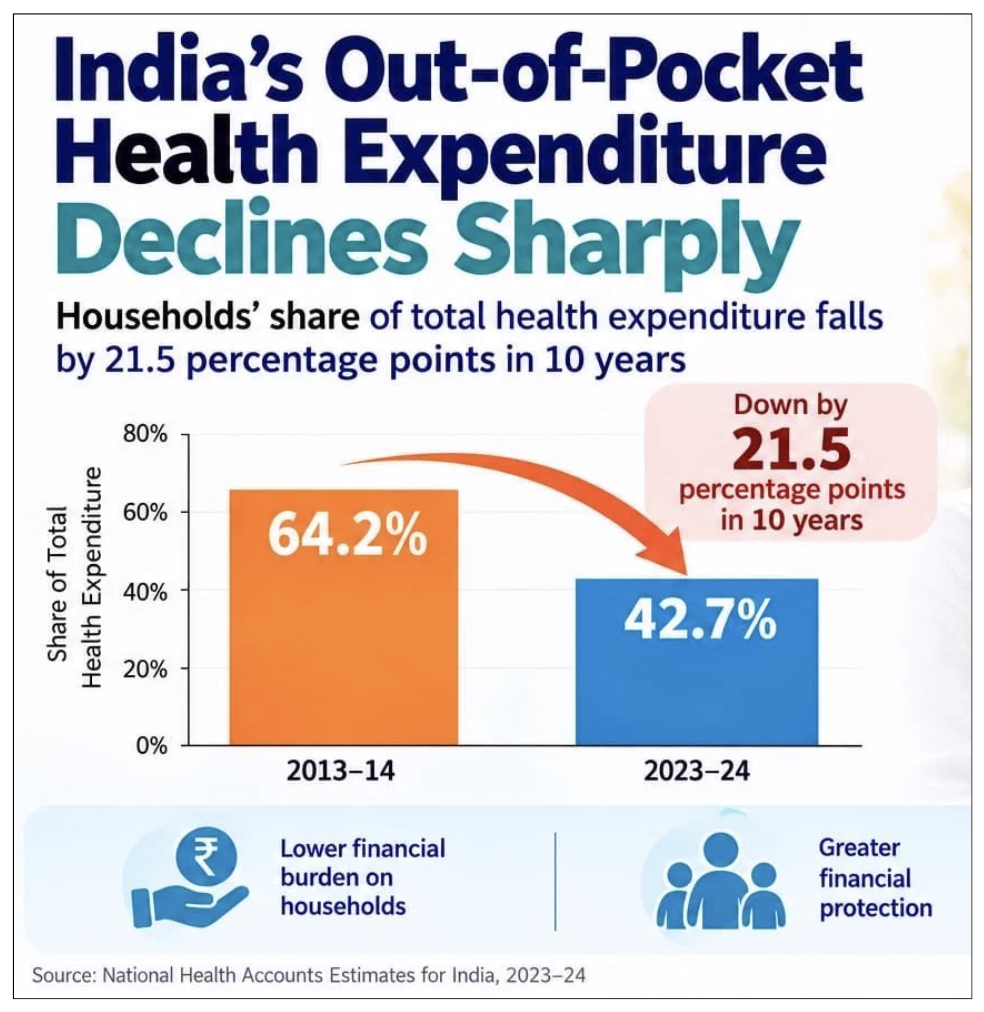
The Ministry of Health and Family Welfare released the latest National Health Accounts (NHA) Estimates for 2023-24, highlighting a significant increase in government health expenditure and a decline in out-of-pocket expenditure (OOPE) by households over the past decade.

The findings indicate progress towards Universal Health Coverage (UHC) and improved financial protection. 

UPSC Relevance: GS-2 Social Justice: Health; Welfare Schemes 

Prelims: National Health Accounts
Mains: Health Sector in India: Key Trends 

Key Findings of the National Health Accounts (2013-14 to 2023-24):

Indicator2013-142023-24
Union Government health expenditure₹1.30 lakh crore₹4.14 lakh crore
Out-of-pocket expenditure (OOPE) as % of total health expenditure64.2%42.7%
Social security expenditure as % of total health expenditure6%11%
Private health insurance expenditure as % of total health expenditure3.4%10.2%
Per capita government health expenditure₹1,042₹2,959
  • Rising public expenditure: The government’s health expenditure (Centre + States) has more than tripled over the decade, from ₹1.30 lakh crore in FY14 to ₹4.14 lakh crore in FY24. 
  • Declining household burden: OOPE declined by 21.5 percentage points, indicating reduced dependence on direct household payments for healthcare.
  • Increasing government contribution: The government’s share in total health expenditure increased by 14.9 percentage points.
  • Expansion of social security: The share of social security expenditure rose from 6% to 11%, reflecting greater coverage through publicly funded health insurance and medical benefits for government employees.
  • Growth of private insurance: Its share increased from 3.4% to 10.2%, indicating a growing role for private health insurance in healthcare financing.
image 23

Positive Impacts and Significance of the Findings:

  • Progress towards Universal Health Coverage (UHC): Increased public financing improves healthcare access for economically vulnerable sections. This directly supports India’s commitment to Sustainable Development Goal (SDG) 3.8, which targets Universal Health Coverage.
  • Improved Financial Risk Protection: A lower OOPE share (42.7%) reduces catastrophic health expenditure and prevents families from falling into the medical poverty trap. Publicly funded schemes like Ayushman Bharat-PMJAY have strengthened this safety net for poor households.
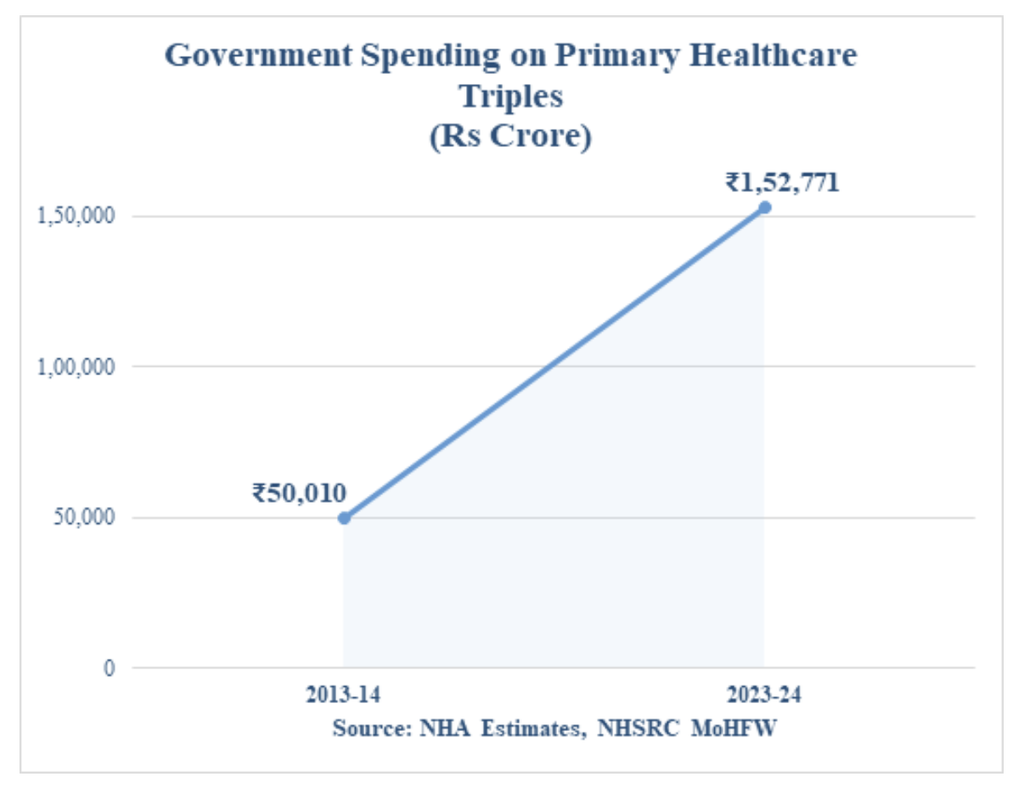
  • Strengthening Primary Healthcare: Public spending on primary care touched ₹1.53 lakh crore in 2023-24. Flagship initiatives like Ayushman Arogya Mandirs, the National Health Mission (NHM), and free drugs and diagnostics have boosted preventive, promotive, and grassroots care.
  • Institutional Expansion & Utilisation: Programs like Jan Aushadhi Kendras and the Pradhan Mantri National Dialysis Programme have lowered treatment costs and increased public healthcare utilisation.
  • Diversification & Risk-Pooling: The doubling of social security expenditure (11%) and growth in private health insurance (10.2%) show a shift toward formal, insurance-based financing. This reduces direct financial dependence on household savings.
image 22

Challenges and Concerns: 

Despite the improvement in healthcare financing indicators, several structural challenges remain:

  • Inadequate public health expenditure: Government health expenditure stood at only 1.43% of GDP in 2023-24, below the National Health Policy (2017) target of 2.5% of GDP by 2025.
  • Persistent household burden: Despite the decline, OOPE still accounted for 42.7% of total health expenditure, amounting to approximately ₹4.06 lakh crore in 2023-24.
  • High medicine and diagnostic costs: Expenditure on medicines, diagnostics and outpatient care continues to impose a substantial burden, particularly on low-income households.
  • Uneven healthcare infrastructure: Rural and remote areas continue to face shortages of doctors, specialists, diagnostic facilities and adequately equipped public health institutions.
  • Inter-State Disparities: Health financing gains are uneven across the country. Empowered Action Group (EAG) states and rural areas continue to lag in medical infrastructure and workforce availability.
  • Insurance coverage gaps: Insurance-based protection does not necessarily guarantee affordable and accessible treatment. Exclusions, inadequate coverage and high treatment costs can continue to expose households to financial hardship.
  • Focus on curative care: Greater emphasis on hospitalisation and insurance coverage must be complemented by investments in preventive and primary healthcare.

Way Forward:

  • Increase public health investment: Gradually scale up combined Union and State health spending to achieve the National Health Policy target of 2.5%.
  • Prioritise primary healthcare: Strengthen Ayushman Arogya Mandirs, sub-centres and Primary Health Centres, with greater emphasis on preventive and promotive healthcare.
  • Reduce medicine-related expenditure: Expand access to generic medicines through Pradhan Mantri Bhartiya Janaushadhi Pariyojana and strengthen free drugs and diagnostics programmes.
  • Strengthen public health infrastructure: Address shortages of healthcare professionals, improve rural health facilities and strengthen district-level hospitals.
  • Improve health insurance coverage: Strengthen PM-JAY implementation, improve portability and ensure timely reimbursement and access to empanelled hospitals.

About National Health Accounts (NHA):

  • NHA provides comprehensive estimates of healthcare expenditure and the flow of funds within India’s healthcare system.
  • It is prepared by the National Health Systems Resource Centre (NHSRC) under the Ministry of Health and Family Welfare.
  • It follows the internationally recognised System of Health Accounts (SHA), 2011 framework, facilitating international comparisons.
  • It tracks expenditure by financing sources, financing schemes, healthcare providers and healthcare functions.

Mains Practice Question:

Q. “Rising public expenditure on healthcare and declining out-of-pocket expenditure indicate progress towards Universal Health Coverage in India. However, significant structural challenges remain.” Discuss.

India eyes place among top 10 shipbuilding nations by 2030

Open article →Download PDF

Why in news?

India aims to be among the top 10 shipbuilding nations by 2030, backed by five greenfield coastal shipbuilding clusters.

UPSC Relevance

Prelims – Shipbuilding schemes, Maritime Development Fund, location of shipbuilding clusters, major shipyards

Mains, GS1 – Factors responsible for the location of industries

GS3 – Infrastructure: Ports; Changes in industrial policy and their effects on industrial growth; Indigenisation of technology; Security

What was announced?

The Ministry of Ports, Shipping and Waterways held the India Shipbuilding Investment Conclave 2026 in New Delhi on 16 November. The announcements:

  • Target: Top 10 shipbuilding nations by 2030 and top 5 by 2047. These targets come from Maritime India Vision 2030 and Maritime Amrit Kaal Vision 2047.
  • Investment: Nearly $10 billion is projected in five greenfield coastal shipbuilding clusters, developed jointly by the Centre and the five States.
  • Order book: More than 150 vessels worth over $1.7 billion are in the active pipeline. Over 80% of this value is from export orders.
  • Global interest: Around 30 international shipyards took part, including Korean and European majors, along with shipping lines like Maersk, MSC and CMA CGM.

The five proposed greenfield clusters

ClusterStateCoast
KuchhadiGujaratWest coast (Arabian Sea)
DighiMaharashtraWest coast (Arabian Sea)
ThoothukudiTamil NaduEast coast (Gulf of Mannar)
DugarajapatnamAndhra PradeshEast coast (Bay of Bengal)
KendrapadaOdishaEast coast (Bay of Bengal)

Why shipbuilding matters

  • Mother of heavy engineering: A ship needs steel, engines, electricals, electronics, paints and thousands of components. So one shipyard supports a long chain of MSMEs and ancillary units.
  • Jobs: It is labour intensive. Each job in a shipyard creates several more jobs in supplier industries.
  • Trade dependence: About 95% of India’s trade by volume and nearly 70% by value moves by sea. But most of it is carried on foreign ships, and India pays around $75 billion every year as freight to foreign shipping companies.
  • Strategic need: Warships, submarines and commercial ships use the same yards, skills and suppliers. A strong commercial base supports naval self reliance.
  • Supply chain security: Red Sea disruptions and container shortages during Covid showed the risk of depending on foreign fleets for energy and food imports.

Present status of the industry

  • Small global share: India has less than 1% of the global shipbuilding market (about 0.06% by gross tonnage) and ranks around 20th. Different reports place it between 16th and 22nd.
  • Dominance of three countries: China, South Korea and Japan together build more than 90% of the world’s ships.
  • Naval-centric: Most of the work is for the Navy and Coast Guard. INS Vikrant, the first indigenous aircraft carrier, was built by Cochin Shipyard.
  • Public sector yards: Cochin Shipyard is under the Ports and Shipping Ministry. Mazagon Dock, GRSE, Goa Shipyard and Hindustan Shipyard are under the Ministry of Defence.
  • Private yards: L&T Kattupalli, Swan Defence (Pipavav), Chowgule and others. Several private yards went into insolvency after the 2008 slowdown.
  • Strong in recycling: India is the world’s largest ship recycler, with Alang in Gujarat as the hub. The Hong Kong Convention on safe ship recycling came into force in 2025.
  • A lesson from the past: India’s share rose to about 1% during 2002-07 when a subsidy scheme was running. It fell once the subsidy ended. Policy continuity is therefore very important.

Opportunities for India

  • Full order books elsewhere: Yards in China, Korea and Japan are booked for years. Buyers are looking for new building locations.
  • China plus one: Many shipowners and governments want to reduce dependence on Chinese yards due to geopolitical tensions.
  • Fleet replacement: A large part of the global fleet is ageing and has to be replaced to meet the IMO goal of net zero emissions by around 2050.
  • Green ships: Demand is shifting to vessels running on LNG, methanol, ammonia and hydrogen. This is a new market where old leaders have less advantage.
  • Domestic demand: Oil PSUs, Shipping Corporation of India, coastal shipping, inland waterways and the Navy together offer steady orders. KPMG puts the commercial shipbuilding market up to 2047 at about $62 billion.
  • Cost of labour and demography: Korea and Japan face an ageing workforce. India has young, low cost labour and a large pool of engineers.
  • Niche segments: Small and medium vessels, tugs, offshore support vessels and ship repair are segments where big players are less focused.
  • Geography: A coastline of over 11,000 km on major East-West shipping routes is suited for both shipbuilding and ship repair.

Limitations

  • High cost of capital: Indian yards borrow at 9 to 11%, while yards in China and Korea get loans at 4 to 6%. Shipbuilding has long build cycles, so interest cost hurts more.
  • Cost disadvantage: Indian built ships are costlier by about 15 to 20%, and by some estimates even more. Reasons are costly steel, imported equipment and taxes.
  • Weak ancillary base: Marine engines, propulsion systems, navigation equipment and special grade steel are largely imported. Much of the value addition goes abroad.
  • Lack of scale: Indian yards are small. India has no yard that regularly builds very large crude carriers or large LNG carriers.
  • Low productivity: Longer construction time, older methods and low automation compared to Korean and Chinese yards.
  • Skill gaps: Shortage of naval architects, marine designers and certified welders. Ship design capability is limited.
  • Uneven demand: Orders have been irregular. For example, an earlier tender for building LNG carriers in India could not go through and the ships were hired from the market.
  • Heavily subsidised rivals: Competitors have enjoyed decades of state support, cheap credit and assured orders from national fleets.
  • Greenfield hurdles: New clusters need land, CRZ and environmental clearances, dredging and rail-road links, and may face concerns of fishing communities.

Steps taken by the government

1. Rs 69,725 crore shipbuilding and maritime package (September 2025)

ComponentOutlayPurpose
Shipbuilding Financial Assistance Scheme (SBFAS)Rs 24,736 croreExtended till 31 March 2036. Gives financial assistance to Indian yards per vessel. Includes Shipbreaking Credit Note of Rs 4,001 crore.
Maritime Development Fund (MDF)Rs 25,000 croreMaritime Investment Fund of Rs 20,000 crore with 49% government participation, and Interest Incentivisation Fund of Rs 5,000 crore to reduce cost of debt.
Shipbuilding Development Scheme (SbDS)Rs 19,989 croreMega shipbuilding clusters, expansion of yards, India Ship Technology Centre under Indian Maritime University, insurance and risk cover.
  • A National Shipbuilding Mission will oversee all the schemes.
  • Expected outcome: 4.5 million gross tonnage of capacity, nearly 30 lakh jobs and about Rs 4.5 lakh crore of investment.

2. Budget 2025-26 measures

  • Infrastructure status for large ships, which allows cheaper and longer term loans.
  • Customs duty exemption on raw materials and components for shipbuilding extended for ten years.
  • Credit note for scrapping a ship in an Indian yard, which can be used to buy a new Indian built ship.

3. Other steps

  • Right of First Refusal to Indian built ships in government and PSU tenders.
  • New maritime laws of 2025: Merchant Shipping Act, Coastal Shipping Act and Indian Ports Act replaced colonial era laws.
  • Green push: Green Tug Transition Programme and Harit Sagar guidelines create demand for green vessels.
  • Foreign partnerships: Tie-ups with South Korean majors, such as HD Hyundai with Cochin Shipyard, for technology and large vessel construction.

Way forward

  • Assured demand first: Pool the orders of oil PSUs, Shipping Corporation, ports and the Navy into a long term pipeline so that yards can invest with confidence.
  • Build the ancillary chain: Extend PLI type support to marine engines, propulsion and electronics. Develop supplier parks inside the clusters, as Korea and Japan did.
  • Cheaper finance: Operationalise the Maritime Development Fund quickly. Encourage ship leasing and financing from GIFT City.
  • Pick the right segments: Start with small and medium vessels, green ships and ship repair, then move up to large tankers and LNG carriers.
  • Technology transfer: Joint ventures with Korean, Japanese and European yards should include design and local sourcing, and not just assembly.
  • Skilling: Link Indian Maritime University, ITIs and the yards for training in welding, design and marine engineering.
  • Faster clearances with safeguards: Single window approvals for clusters, while protecting coastal ecology and livelihoods of fishing communities.
  • Policy stability: Keep support predictable till 2036 and beyond. The post-2007 decline should not be repeated.

Shipbuilding gives India a chance to combine manufacturing growth, jobs and maritime security. The money and the policy are now in place. Whether India reaches the top 10 will depend on how fast the clusters, suppliers and orders come together on the ground.

Practice MCQ

Q1. With reference to the shipbuilding and maritime package approved by the Union Cabinet in 2025, consider the following statements:

1. The Shipbuilding Financial Assistance Scheme has been extended till March 2036.

2. The Maritime Development Fund includes an Interest Incentivisation Fund to reduce the cost of debt.

3. The National Shipbuilding Mission will function under the Ministry of Defence.

How many of the statements given above are correct?

(a) Only one

(b) Only two

(c) All three

(d) None

Answer: (b). Statement 3 is incorrect. The package and the Mission are steered by the Ministry of Ports, Shipping and Waterways.

Q2. Consider the following pairs of proposed greenfield shipbuilding clusters and their States:

Shipbuilding clusterState
1. DighiGujarat
2. KuchhadiMaharashtra
3. DugarajapatnamAndhra Pradesh
4. KendrapadaOdisha

How many of the pairs given above are correctly matched?

(a) Only one

(b) Only two

(c) Only three

(d) All four

Answer: (b). Pairs 3 and 4 are correct. Dighi is in Maharashtra and Kuchhadi is in Gujarat.

Mains Practice Question

India carries most of its trade by sea but builds less than 1% of the world’s ships. Examine the factors that have held back India’s shipbuilding industry. How far can the recent policy measures help India become a leading shipbuilding nation? (15 Marks, 250 words)

A poverty line that falls short

Open article →Download PDF

Why in news?

World Bank’s latest brief shows India’s extreme poverty at 2.6%, renewing debate as India lacks an updated official poverty line.

UPSC Relevance

Prelims – Poverty line committees, National MPI, HCES, World Bank poverty lines

Mains, GS1 – Poverty and developmental issues

GS2 – Issues relating to poverty and hunger; welfare schemes for vulnerable sections

GS3 – Inclusive growth and issues arising from it

No Consensus on Poverty Numbers

  • Everyone agrees poverty has fallen sharply in the last decade in India. Nobody agrees on how many Indians are still poor.
  • For the same year, 2022-23, estimates range from about 3% to more than 26%. The country and the year are the same. Only the yardstick changes.
SourceYardstickPoverty
World Bank$3 a day2.6%
SBI Research (2025)Tendulkar line adjusted for inflation: ₹1,632 rural, ₹1,944 urban7.2% rural, 4.6% urban
Rangarajan and DevRangarajan line adjusted for inflation10.8%
NITI AayogNational MPI (projection)11.28%
World Bank$4.20 a day16.1%
  • The last official poverty estimate is for 2011-12 (Tendulkar method). Since then India has had no officially accepted poverty line.

What is poverty and how is it defined?

  • Poverty is a condition where a person cannot meet the minimum needs of life such as food, clothing, shelter, health and education.
  • Absolute poverty: living below a fixed minimum level of consumption or income. India has always used this approach.
  • Relative poverty: being poor in comparison to others in society, e.g. earning less than half the median income. Used mostly in developed countries.
  • Poverty line: the cut-off level of monthly per capita consumption expenditure (MPCE). Anyone below it is counted as poor.
  • Why consumption and not income? Most Indians work in the informal sector, incomes are irregular and under-reported. Consumption is more stable and easier to record.
  • Common measures:
    • Head Count Ratio (HCR): share of population below the poverty line. Most widely used.
    • Poverty Gap: how far below the line the poor are on average. Shows the depth of poverty.
    • Squared Poverty Gap: gives more weight to the poorest. Shows severity.

How has India measured poverty? The journey

EffortYearKey features
Dadabhai NaorojiPre-1947First estimate, in ‘Poverty and Un-British Rule in India’. Based on cost of a subsistence (jail) diet. Line of ₹16 to ₹35 per person per year.
Planning Commission Working Group1962₹20 (rural) and ₹25 (urban) per person per month. Left out health and education as the State was expected to provide them.
Dandekar and Rath1971First systematic study using NSS data. Based on 2,250 calories per day.
Y.K. Alagh Task Force1979Separate calorie norms: 2,400 kcal rural and 2,100 kcal urban. Poverty line was the spending needed to buy this food basket.
Lakdawala Expert Group1993Kept the calorie norm. Introduced State-specific poverty lines. Used CPI-AL (rural) and CPI-IW (urban) for price updates.
Tendulkar Committee2009Dropped the direct calorie method. Wider basket including private spending on health and education. Same basket for rural and urban. Poverty at 21.9% in 2011-12.
Rangarajan Committee2014Higher lines. Brought back separate rural and urban baskets with calorie, protein and fat norms. Poverty at 29.5% in 2011-12. Not officially accepted.
NITI Aayog Task Force (Arvind Panagariya)2015-16Did not fix a line. Suggested a new expert group to decide. No action since.

Data source: Household Consumption Expenditure Survey (HCES)

  • Conducted by the National Statistics Office under MoSPI. Earlier done every five years.
  • The 2017-18 survey was never published, citing data quality issues. The next full survey came only in 2022-23, followed by 2023-24.
  • HCES 2023-24: average MPCE of ₹4,122 (rural) and ₹6,996 (urban). Rural-urban gap fell from about 84% in 2011-12 to about 70%.
  • The new surveys use a changed method (multiple visits, more items, value of free items shown separately). So comparing them with 2011-12 is not straightforward.

Beyond consumption: Multidimensional Poverty Index (MPI)

  • National MPI is brought out by NITI Aayog with UNDP and OPHI, using National Family Health Survey (NFHS) data. It follows the Alkire-Foster method.
  • 3 dimensions with equal weight, 12 indicators:
    • Health: nutrition, child and adolescent mortality, maternal health
    • Education: years of schooling, school attendance
    • Standard of living: cooking fuel, sanitation, drinking water, electricity, housing, assets, bank account
  • Maternal health and bank account are India’s additions. The global MPI has 10 indicators.
  • A household is multidimensionally poor if it is deprived in one-third or more of the weighted indicators.
  • Multidimensional poverty fell from 24.85% (2015-16) to 14.96% (2019-21). The 11.28% figure for 2022-23 is a projection, not a survey result.

World Bank’s international poverty lines

  • Revised in June 2025 to 2021 PPP prices: $3 a day (extreme poverty, earlier $2.15), $4.20 (lower-middle-income countries) and $8.30 (upper-middle-income countries).
  • Useful for comparing countries. But they are not built on what it costs to meet basic needs in India.
  • About 80% of Indians lived below the $8.30 line in 2023, and about 30% still lack basic sanitation.

Problems and challenges in measuring poverty

  • No official line: The Tendulkar line is over 15 years old. Rangarajan was never accepted. Policy debate has no agreed anchor.
  • Line is too low: ₹27 to ₹33 a day was criticised as a ‘starvation line’. It tells us who survives, not who lives decently.
  • Data gaps: No published consumption data between 2011-12 and 2022-23. Census after 2011 was delayed, so sampling frames and beneficiary lists are old.
  • Comparability: Change in survey method and recall period means old and new numbers cannot be compared directly.
  • Method dispute: One group updates an old line for inflation. The other rebuilds the basket from present spending patterns. Results differ widely.
  • Outdated basket: Spending has shifted from food to non-food items like rent, transport, mobile data, private schooling and health care. Old baskets do not reflect this.
  • Survey vs national accounts: Consumption captured in surveys is far lower than in National Accounts. Richer households are under-covered.
  • Free goods: Should free foodgrain and other transfers be counted as consumption? Counting them lowers poverty but hides dependence on welfare.
  • Limits of MPI: It measures access, not quality (school attendance, not learning). It is based on NFHS, which comes at long gaps. It complements a poverty line but cannot replace it.
  • Vulnerability ignored: Many households are just above the line. One illness, crop failure or job loss pushes them back.
  • Estimation vs identification: Counting the poor (HCES) and identifying them for schemes (SECC 2011, NFSA lists based on Census 2011) are separate and both are outdated.
  • Regional and urban cost differences: One national number hides wide gaps between States and the high cost of living in cities.
  • Politicisation: Poverty numbers are tied to government performance and to entitlements, so every revision becomes controversial.

Why a proper measure matters for Viksit Bharat 2047

  • A higher bar: A country aiming at high-income status cannot judge itself by a $3 line. If 80% are below the upper-middle-income line, the distance to 2047 is clear only with honest measurement.
  • Better targeting: Welfare spending on food, housing, health cover and cash transfers runs into lakhs of crores. A credible benchmark reduces inclusion and exclusion errors.
  • Evaluating schemes: Without a baseline, we cannot say which programmes actually reduced poverty.
  • Fiscal federalism: Finance Commission transfers and central scheme allocations depend on reliable State-level poverty and income data.
  • SDG commitment: SDG target 1.2 asks countries to halve poverty ‘according to national definitions’ by 2030. That needs a national definition.
  • Inclusive growth: Low extreme poverty can hide inequality and insecurity. A developed India needs a large, secure middle class, not people hovering just above the line.
  • Human capital: The demographic dividend pays only if deprivation in nutrition, health and learning is tracked and removed.
  • Credibility: Agreed numbers improve public debate and investor and global confidence in Indian statistics.

Way forward

  • Set up a new expert group to fix an official poverty line using HCES 2022-23 and 2023-24 data.
  • Use more than one line: an extreme poverty line, plus a higher ‘decent living’ or vulnerability line suited to a lower-middle-income country. Track relative poverty too.
  • Use consumption line and MPI together. One shows purchasing power, the other shows access to services.
  • Modern basket: include housing rent, transport, communication, education and health at actual cost. Revise the basket every five years and keep State-wise, rural and urban lines.
  • Regular and timely data: fixed calendar for HCES, release of unit-level data, and a stronger, independent National Statistical Commission.
  • Measure income also: take forward MoSPI’s planned household income survey and use tax, GST and other administrative data to capture the top end.
  • Update beneficiary lists: use the coming Census to revise NFSA coverage and build a dynamic social registry in place of SECC 2011.
  • Add quality to MPI: learning outcomes, nutrition quality, and functional (not just built) toilets and taps.
  • De-link basic entitlements from a single line: health, education and nutrition should be near universal, so that a measurement error does not exclude the needy.

Conclusion

India’s progress against poverty is real. But without a credible, updated benchmark it is hard to say how much has been achieved and how much is left. A developed India by 2047 has to be measured not by how few people starve, but by how many can live decently.

Practice MCQ

Q1. With reference to poverty estimation in India, consider the following statements:

1. The Lakdawala Expert Group introduced State-specific poverty lines.

2. The Tendulkar Committee retained the calorie norm as the direct basis of the poverty line.

3. The poverty line recommended by the Rangarajan Committee is the current official poverty line of India.

How many of the statements given above are correct?

(a) Only one

(b) Only two

(c) All three

(d) None

Answer: (a). Only statement 1 is correct. Tendulkar moved away from the calorie norm. The Rangarajan report was never officially accepted.

Q2. With reference to the National Multidimensional Poverty Index, consider the following statements:

1. It is released by NITI Aayog and uses National Family Health Survey data.

2. It includes maternal health and bank account as indicators, which are not part of the global MPI.

3. A household is counted as multidimensionally poor only if it is deprived in at least half of the weighted indicators.

Which of the statements given above are correct?

(a) 1 and 2 only

(b) 2 and 3 only

(c) 1 and 3 only

(d) 1, 2 and 3

Answer: (a). Statement 3 is wrong. The cut-off is one-third (33%) of the weighted indicators, not half.

Mains Practice Question

“India has reduced poverty sharply, yet it cannot say with confidence how many of its people are poor.” Discuss the problems in the way poverty is measured in India. Why is a credible poverty benchmark important for the goal of Viksit Bharat 2047? (15 Marks, 250 words)

The Sachar report awaits its due

Open article →Download PDF

Why in news?

The Sachar Committee report on Muslims completes twenty years on 17 November 2026; several key recommendations remain unimplemented.

UPSC Relevance

Prelims: Articles 29 and 30; National Commission for Minorities; notified minorities; Sachar Committee; PMJVK; PM VIKAS

Mains, GS1: Salient features of Indian society, diversity of India; communalism, regionalism and secularism

GS2: Welfare schemes for vulnerable sections; mechanisms, laws, institutions and bodies for their protection and betterment

Who is a minority in India?

  • The Constitution uses the word ‘minority’ in Articles 29, 30, 350A and 350B but does not define it.
  • It recognises two types: religious and linguistic minorities.
  • Statutory definition: Section 2(c) of the National Commission for Minorities Act, 1992 says a minority is a community notified by the Central Government.
  • Six notified communities: Muslims, Christians, Sikhs, Buddhists and Parsis (1993) and Jains (2014).
  • Census 2011: Muslims 14.2%, Christians 2.3%, Sikhs 1.7%, Buddhists 0.7%, Jains 0.4%, Parsis about 57,000. Together they are about 19% of the population.
  • T.M.A. Pai Foundation case (2002): the Supreme Court held that the unit for deciding who is a religious or linguistic minority is the State, not the whole country.
  • This has led to a demand for state-wise identification, since Hindus are fewer in number in places like Punjab, Mizoram, Nagaland, Meghalaya, Lakshadweep and Jammu and Kashmir. The matter is before the Supreme Court.
  • AMU case (2024): a seven-judge bench overruled Azeez Basha (1967). It held that an institution does not lose its minority character only because it was incorporated by a statute. What matters is who established it.

Constitutional safeguards

ArticleWhat it provides
14, 15, 16Equality before law; no discrimination on grounds of religion; equal opportunity in public employment
25 to 28Freedom of conscience and religion; freedom to manage religious affairs
29Right of any section of citizens to conserve its distinct language, script or culture
30Right of religious and linguistic minorities to establish and administer educational institutions
350AInstruction in mother tongue at primary stage for children of linguistic minorities
350BSpecial Officer for Linguistic Minorities, appointed by the President

The Sachar Committee (2005-06)

  • What it was: the Prime Minister’s High Level Committee, set up in March 2005 with seven members under Justice (Retd.) Rajinder Sachar.
  • Mandate: to study the social, economic and educational status of the Muslim community.
  • Report submitted on 17 November 2006 and tabled in Parliament on 30 November 2006.
  • It looked at the problem through three lenses: identity, security and equity.
  • It also compared Muslims with SCs, STs, Hindu OBCs, Hindu upper castes and other minorities. So it is a rare database on all social groups.

Key findings

AreaWhat the Committee found
EducationLiteracy 59.1% against a national average of about 65% (2001). One in four Muslim children aged 6 to 14 had never been to school or had dropped out. Only about 4% of Muslim children studied in madrasas.
Government jobsShare of Muslims: IAS 3%, IFS 1.8%, IPS 4%. In Railways 4.5%, and almost all of them in lower posts.
EconomyHeavy dependence on self-employment and informal work. Low share in bank credit. Urban poverty of about 38%, higher than that of SCs and STs.
InfrastructureMany Muslim-concentrated villages lacked schools, health centres, roads and bank branches.
PoliticalSeveral constituencies with a high Muslim population were reserved for SCs, which reduced their chances of representation.
Social structureMuslims are not one block. About 41% were OBCs. Arzals (former ‘untouchable’ converts) were the worst off.

Overall, the condition of Muslims was found to be slightly better than SCs and STs but below Hindu OBCs on most indicators.

Main recommendations

  • Equal Opportunity Commission (EOC) to look into complaints of discrimination from any deprived group.
  • National Data Bank with data on all socio-religious groups, and an Assessment and Monitoring Authority to review progress.
  • Diversity Index to reward institutions and employers that have a diverse mix of people.
  • Nomination procedure to increase participation of minorities in local bodies and public bodies.
  • Fair delimitation: do not reserve constituencies with a high minority population for SCs.
  • Link madrasas with school boards and recognise their degrees for higher education and competitive exams.
  • More bank branches and priority sector lending in Muslim-concentrated areas; skill training for artisans.
  • Better use of Waqf properties; sensitisation of government staff; minority members on selection boards.
  • Arzals to be treated at par with SCs or placed in a Most Backward Class category.

Steps taken so far

After the Sachar report 

  • Government accepted 72 of the 76 recommendations.
  • Prime Minister’s New 15-Point Programme (2006) for welfare of minorities.
  • Multi-sectoral Development Programme (2008) in 90 Minority Concentration Districts.
  • Pre-matric, post-matric and merit-cum-means scholarships; Maulana Azad National Fellowship (2009).
  • Expert groups on the EOC (N.R. Madhava Menon) and the Diversity Index (Amitabh Kundu). No law followed.
  • Ranganath Misra Commission (report 2007): suggested 15% reservation for minorities and delinking SC status from religion. Not accepted.
  • Kundu Committee (2014) reviewed post-Sachar progress. It found that a start had been made but the gaps remained large.
  • PMJVK (2018): restructured MsDP. Builds schools, hostels, health centres and skill centres in about 1,300 minority concentration areas.
  • PM VIKAS: merges five schemes (Seekho aur Kamao, Nai Manzil, USTTAD, Nai Roshni, Hamari Dharohar) for skilling, entrepreneurship and women’s leadership.
  • NMDFC loans; Jiyo Parsi to arrest the decline in Parsi population.
  • Waqf (Amendment) Act, 2025 and the UMEED portal for registration and management of Waqf properties.
  • Muslim Women (Protection of Rights on Marriage) Act, 2019; Haj reforms.
  • The stated approach is ‘Sabka Saath, Sabka Vikas’: universal schemes like PM Awas, Ujjwala, Jan Dhan and Ayushman Bharat reach beneficiaries without looking at religion.
  • Budget 2026-27: Rs 3,400 crore for the Ministry of Minority Affairs.

Institutions: Ministry of Minority Affairs (2006), National Commission for Minorities (statutory, 1992), National Commission for Minority Educational Institutions (2004), Commissioner for Linguistic Minorities, State Minorities Commissions.

Two approaches to minority welfare

Targeted approachUniversal approach
IdeaSpecial schemes for minorities because their starting point is lowerSame schemes for all the poor; saturation coverage will reach minorities too
StrengthAddresses group-specific gaps like girls’ schooling, artisans’ creditAvoids the charge of appeasement; larger budgets; less leakage through DBT
LimitationSmall budgets; can deepen the sense of separatenessDoes not deal with discrimination or with area-specific neglect

The Sachar report itself asked for both: general policies of inclusive development along with some community-specific measures.

Challenges that remain

Political

  • The 18th Lok Sabha has 24 Muslim MPs, about 4.4% of the House, against a population share of over 14%. The highest was 49 in 1980.
  • No reserved seats, and parties give few tickets citing ‘winnability’.
  • Weak watchdog: the NCM is only a statutory and recommendatory body. It had no chairperson or member from April 2025 until July 2026, when Harjit Singh Grewal took charge.
  • Politicisation: the debate swings between ‘appeasement’ and ‘neglect’. Development of the community gets lost in between.

Educational

  • AISHE 2021-22: Muslims were 4.87% of higher education enrolment. Enrolment had fallen from 21 lakh to 19.21 lakh between 2019-20 and 2020-21.
  • High dropout after elementary level, mainly due to poverty and early entry into work.
  • Scholarships curtailed: pre-matric scholarship limited to Classes 9 and 10 (2022); Maulana Azad National Fellowship closed for new entrants from 2022-23. The government’s view is that these overlapped with other schemes and that the focus should shift to skills and infrastructure.

Economic

  • Concentration in informal work, small trade and traditional crafts with little social security.
  • Low share in regular salaried jobs and in institutional credit. Very low work participation of Muslim women.
  • Small and under-used budgets: allocations are often cut at the Revised Estimate stage.
  • Old data: all planning still rests on Census 2011. There has been no official study after the Kundu Committee.

Social and security related

  • Communal violence, hate speech and incidents of mob lynching create insecurity. The Supreme Court laid down preventive guidelines in Tehseen Poonawalla (2018) and against arbitrary demolitions in 2024.
  • Difficulty in renting or buying houses in mixed localities leads to ghettoisation.
  • Attacks on places of worship and disputes over conversion are concerns raised by Christian groups.
  • Scheme-based, not rights-based: there is no general anti-discrimination law for jobs, housing or education.

Within minorities

  • Minorities are not uniform. Jains and Parsis are better off; Pasmanda Muslims, Dalit Christians and neo-Buddhists are among the poorest.
  • Dalit Muslims and Dalit Christians do not get SC status under the Constitution (Scheduled Castes) Order, 1950.
  • Parsis face a demographic decline, not poverty. So one policy cannot fit all.

Way forward

  • Revisit the Sachar report in Parliament and commission a fresh status study of all socio-religious groups.
  • Set up an Equal Opportunity Commission by law. It should cover caste, religion, gender and disability together.
  • Build the National Data Bank using the coming Census, and publish group-wise data on education, jobs and credit.
  • Introduce a Diversity Index for universities, public bodies and large employers, linked with incentives.
  • Strengthen the NCM: time-bound appointments, a transparent selection panel and constitutional status on the lines of the NCSC and NCBC.
  • Keep children in school: restore scholarship support till Class 12, more girls’ hostels, and link madrasas with NIOS and state boards.
  • Livelihoods: connect artisans with PM Vishwakarma, MUDRA and e-commerce platforms; special focus on women’s work participation.
  • Target by deprivation: focus on the poorest groups within minorities such as Pasmandas and Dalit converts.
  • Security and trust: strict action on hate speech and mob violence, a more representative police force, and mixed housing.
  • Political voice: parties should give fair tickets; the nomination route suggested by Sachar can be tried in local bodies.

The Sachar report was never about one community alone. Its lasting message is that development should be measured group by group, so that no section is left behind. That fits well with the constitutional promise of equality and with the idea of Sabka Vikas.

Practice MCQs

Q1. With reference to minorities in India, consider the following statements:

1. Article 30 of the Constitution defines the term ‘minority’.

2. Six religious communities have been notified as minorities under the National Commission for Minorities Act, 1992.

3. In the T.M.A. Pai Foundation case, the Supreme Court held that the State is the unit for determining both religious and linguistic minorities.

How many of the statements given above are correct?

(a) Only one

(b) Only two

(c) All three

(d) None

Answer: (b)

Explanation: Statement 1 is incorrect. The Constitution uses the term but does not define it anywhere. Statements 2 and 3 are correct.

Q2. With reference to the Sachar Committee, consider the following statements:

1. It was a statutory commission set up under the National Commission for Minorities Act, 1992.

2. It recommended the setting up of an Equal Opportunity Commission.

3. It recommended 15% reservation for minorities in government jobs.

Which of the statements given above is/are correct?

(a) 1 and 2 only

(b) 2 only

(c) 2 and 3 only

(d) 1, 2 and 3

Answer: (b)

Explanation: It was the Prime Minister’s High Level Committee, not a statutory body. The 15% reservation was suggested by the Ranganath Misra Commission.

Mains Practice Question

Twenty years after the Sachar Committee report, development deficits among minorities continue. Discuss the challenges faced by minorities in India and examine the limitations of the present approach to their welfare. Suggest a way forward. (15 marks, 250 words)

India’s green law needs baselines, not snapshots

Open article →Download PDF

Why in News?

On August 22, the Supreme Court set aside the National Green Tribunal’s (NGT) December 2017 judgment holding the organisers of the 2016 World Culture Festival responsible for environmental damage to the Yamuna floodplain in Delhi. The Court directed the refund of the ₹5 crore deposited by the organisers (Vyakti Vikas Kendra India, associated with the Art of Living Foundation), as environmental compensation.

The judgment highlights: How should liability for ecological damage be determined when the affected ecosystem was already degraded before the alleged violation?

UPSC Relevance: GS-2 Polity and Governance: Environmental Jurisprudence; GS-3: Environment and Biodiversity: Conservation; EIA 

Prelims: National Green Tribunal Act 2010; Polluter Pays Principle, Precautionary Principle and Public Trust Doctrine
Mains: Environmental accountability: Role of judiciary and NGT. 

Background: World Culture Festival and Yamuna Floodplain:

  • The World Culture Festival was organised from March 11-13, 2016, on approximately 25 hectares of the Yamuna floodplain upstream of the DND Flyway in Delhi. The land had been allotted to the organisers by the Delhi Development Authority (DDA).
  • Environmental activists raised concerns that preparations for the event, including levelling, construction of roads, ramps and pontoon bridges, had damaged the floodplain ecosystem.
  • December 2017: NGT held the organisers responsible for environmental damage and directed them to undertake restoration measures.
  • August 2026: The Supreme Court subsequently set aside this judgment, finding that the NGT had failed to adequately establish the ecological condition of the land before the event and determine the additional damage attributable to the organisers.

Key Issues Highlighted by the Supreme Court:

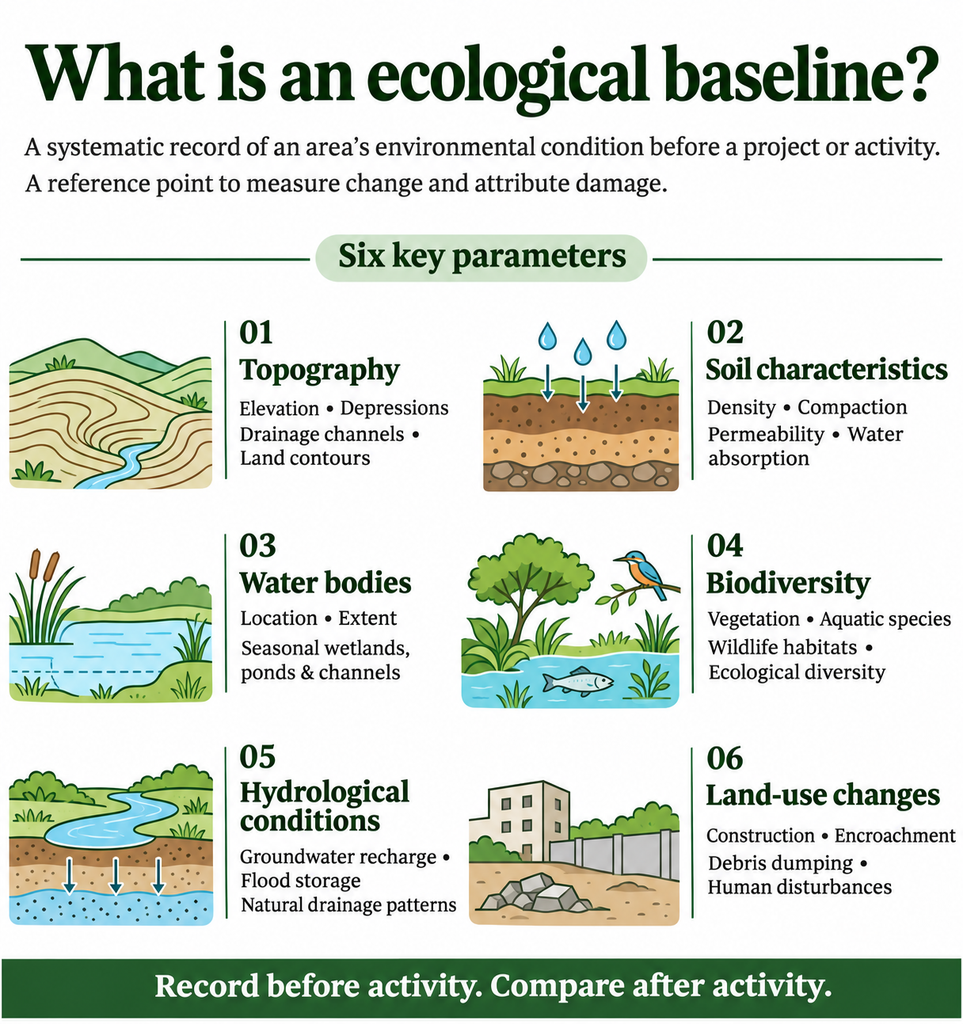
  • Failure to establish pre-existing ecological conditions: The floodplain was reportedly degraded even before the land was allotted for the festival. NGT had also recorded the non-implementation of earlier restoration directions in 2015. The committee constituted by the NGT failed to establish a reliable baseline against which the additional damage caused by the festival could be measured.
  • Weaknesses in the environmental assessment: The Supreme Court questioned the evidentiary value of the committee’s findings. Relying on post-facto or intermittent committee inspections (E.g., comparing random Google Earth images or inspecting 16 months later) cannot reliably reconstruct pre-event soil compaction, wetland presence, or hydrological function. 

The Court highlighted the need for a scientifically defensible assessment of activities such as soil compaction, land levelling and construction to establish additional ecological damage.

Important Environmental Law Principles Involved: 

(i) Polluter Pays Principle:

  • The principle requires those responsible for environmental pollution or degradation to bear the costs of preventing, controlling and remedying the damage caused.
  • It is an established principle of Indian environmental jurisprudence and is reflected in Section 17 of the National Green Tribunal Act, 2010.

The Supreme Court reiterated that environmental liability cannot be imposed merely because degradation exists; a causal link between the alleged polluter’s actions and the damage must first be established.

(ii) Precautionary Principle:

  • The precautionary principle requires preventive action where there is a threat of serious or irreversible environmental damage, even in the absence of complete scientific certainty. It places emphasis on anticipating and preventing ecological harm rather than merely compensating for it after it occurs.

In the present case, the Court criticised the DDA for permitting an event on an active floodplain without taking adequate preventive measures.

(iii) Public Trust Doctrine: 

  • The doctrine recognises that natural resources such as rivers, forests, wetlands and floodplains are held by the State in trust for the public. The State cannot treat these resources as ordinary commercial assets or permit their use in a manner that compromises their ecological functions.

The Court held that the DDA, as the authority responsible for the management and ecological maintenance of the Yamuna floodplain, had failed to discharge its public duties adequately.

Relevant Provisions of the National Green Tribunal Act, 2010: 

The judgment highlights the importance of correctly applying the statutory provisions governing environmental liability and restoration.

ProvisionSignificance
Section 15Empowers the NGT to provide relief, compensation and restitution of damaged property and the environment.
Section 17(1)Provides for liability to pay compensation where damage results from an accident or adverse impact of an activity or operation.
Section 17(2)Allows equitable apportionment of liability where damage results from the combined effect of several activities rather than a single activity.
Section 17(3)Requires the NGT to apply the principle of no-fault liability in cases of accidents.

The NGT had invoked the principle of no-fault liability under Section 17(3) to hold the organisers responsible. The Supreme Court held that the provision specifically applies to accidents, whereas the present dispute did not involve an accident.

What is an Ecological Baseline?

An ecological baseline is a systematic record of the environmental condition of an area before a proposed project or activity. It provides a reference point for measuring subsequent environmental changes and attributing damage.
image 35

Challenges in Environmental Governance in India:

  • Weak baseline documentation: Environmental assessments often lack sufficiently detailed, location-specific and long-term ecological data.
  • Fragmented institutional responsibility: Multiple agencies are responsible for river management, land-use regulation, wetland conservation and urban development, resulting in accountability gaps.
  • Weak enforcement: Environmental clearance conditions and restoration directions are not always effectively implemented.
  • Cumulative ecological degradation: Multiple activities, including encroachment, construction, pollution and waste dumping, contribute to environmental damage, making individual attribution difficult.
  • Inadequate scientific monitoring: Dependence on occasional inspections and satellite imagery without adequate ground-truthing can weaken environmental assessments.
  • Delayed environmental adjudication: Prolonged litigation can make ecological restoration more difficult and undermine timely accountability.

Way Forward:

  • Institutionalise baseline ecological assessments: Make pre-activity ecological baseline surveys mandatory before allotting floodplains, wetlands and other ecologically sensitive public lands for permitted activities. Record topography, soil characteristics, water bodies, vegetation and biodiversity through geo-tagged photographs, GIS mapping and field measurements.
  • Strengthen environmental monitoring: Introduce periodic environmental audits and independent third-party inspections. Use satellite imagery, remote sensing, drones and ground-based measurements to monitor changes in sensitive ecosystems.
  • Improve accountability and liability determination: Clearly identify the environmental responsibilities of project proponents, land-allotting authorities and regulatory agencies. Apply the polluter pays principle based on scientifically established causation.
  • Strengthen protection of ecological commons: Prevent the commercial or non-ecological use of active floodplains and wetlands where it threatens their ecological functions.
  • Ensure timely environmental justice: Strengthen the technical capacity of the NGT through access to independent environmental scientists, hydrologists and ecological experts. Promote time-bound environmental adjudication and implementation of restoration orders.

Environmental compensation must be linked to the damage attributable to the responsible party. It cannot become a mechanism for transferring the State’s pre-existing ecological restoration obligations to a private entity.

Practice Mains Question:

Q. ‘Environmental liability cannot be effectively enforced without reliable ecological baseline assessments.’ Discuss in the context of India’s environmental governance framework. 

Practice Prelims MCQ:

Q. Consider the following statements about the NGT Act, 2010:

1. Section 17(2) permits equitable apportionment of liability for damage resulting from several activities.

2. Section 20 requires application of the precautionary principle.

3. Section 17(3) makes every occupier liable for historical environmental damage regardless of causation.

Which of the statements given above are correct?

(a) 1 and 2 only

(b) 2 and 3 only

(c) 1 and 3 only

(d) 1, 2 and 3  

Answer: (a) Statement 3 incorrectly treats occupation as sufficient proof of responsibility.

Giving new momentum to Act East Policy

Open article →Download PDF

Why in News?

The Indian Prime Minister is participating in the ASEAN-India Summit and the 21st East Asia Summit (EAS) in Manila (November 16-17, 2026), alongside a potential Quad Leaders’ Summit.

The summit consolidates the outcomes of the 2026 ASEAN-India Year of Maritime Cooperation and sets the stage for 2027, which marks 35 years of the ASEAN-India Dialogue Partnership and 5 years of their Comprehensive Strategic Partnership (CSP).

image 24
UPSC Relevance: GS-2 International Relations: Regional Groupings 

Prelims & Mains: ASEAN bloc; India-ASEAN relations; Act East Policy

Evolution of India’s Engagement: 

  • Look East to Act East: Initiated in 1992 as the Look East Policy (focused primarily on economic integration after the Cold War), it was upgraded to the Act East Policy (AEP) in 2014 to include deeper strategic, security, cultural, and connectivity dimensions.
  • The 4Cs Framework: India’s Act East Policy is built on four pillars: Culture, Commerce, Connectivity, and Capacity Building, anchored in ASEAN centrality and operationalised through the ASEAN-India Plan of Action (2026-2030).
  • ASEAN Centrality: India views ASEAN as the core pillar of its Indo-Pacific Oceans Initiative (IPOI), actively supporting ASEAN’s strategic autonomy amidst major-power rivalries.

Key Pillars of Cooperation: 

(i) Maritime Security & Blue Economy:

  • Operational Synergy: Marked by the second ASEAN-India Maritime Exercise (AIME), MILAN 2026, the International Fleet Review, and the Indian Ocean Naval Symposium (IONS) in Visakhapatnam.
  • Institutional Mechanisms: Six ASEAN nations are integrated into India’s Information Fusion Centre- Indian Ocean Region (IFC-IOR) in Gurugram for real-time Maritime Domain Awareness (MDA).
  • Emerging Priorities: Focus is expanding toward protecting submarine cables, Search and Rescue (SAR), and Humanitarian Assistance and Disaster Relief (HADR).

(ii) Economic & Trade Integration:

  • Trade Dynamics: ASEAN accounts for approximately 11% of India’s overall global trade, making it one of India’s top four trading blocs/partners. Bilateral trade reached $128.37 billion in FY 2025-26, though India faced a trade deficit of over $51 billion. 
  • ASEAN-India Trade in Goods Agreement (AITIGA): Signed in 2009 and implemented in 2010, it provides the framework for preferential trade in goods between India and ASEAN. Under AITIGA, India eliminated tariffs on roughly 71% to 74% of its tariff lines; major economies like Indonesia eliminated tariffs on only ~50% of their lines, creating severe market-access asymmetry for Indian exporters. The review of the AITIGA remains pending. India seeks urgent resolution on asymmetric market access, strict Rules of Origin (to prevent Chinese goods rerouting), and non-tariff barriers.

(iii) Digital Public Infrastructure (DPI) & FinTech:

  • Cross-Border Payments: Project Nexus (linking national instant-payment systems like India’s UPI with ASEAN equivalents) promises seamless regional financial integration.
  • Digital Backbone & Innovation: Enhanced submarine cable connectivity supports AI and cloud ecosystems, while initiatives like the ASEAN-India Scale Hub in Bali (2026) foster startup and investor collaboration.

(iv) Geopolitical Balancing & Multilateral Convergence:

  • Bridging Divides: Amid tensions in the South China Sea, the Taiwan Strait, West Asia, and Europe, India’s multi-aligned posture (engaging simultaneously with the Quad, Russia, China, and the West) positions it as a credible voice for inclusive dialogue at the East Asia Summit.
  • BRICS-ASEAN Synergy: Expanding overlapping memberships with Indonesia as a full BRICS member and Malaysia, Thailand, and Vietnam as BRICS partners at the 2026 New Delhi Summit create new avenues for Global South cooperation.

(v) Soft Power & People-to-People Ties:

  • Knowledge & Mobility: Revival of Nalanda University attracting ASEAN scholars, increased direct flight connectivity boosting tourism, and joint initiatives in healthcare, renewable energy, and skill development.

Existing Challenges in India-ASEAN Relations:

  • Trade Imbalance & Asymmetric Market Access: India faces a persistent trade deficit with ASEAN alongside regulatory hurdles, non-tariff barriers, and delays in reviewing the ASEAN-India Trade in Goods Agreement (AITIGA).
  • Limited Supply-Chain Integration: Following its 2019 exit from the Regional Comprehensive Economic Partnership (RCEP), India remains under-integrated into ASEAN-centred regional value chains compared to its economic potential.
  • Connectivity Bottlenecks & Myanmar Instability: Internal conflict and political turmoil in Myanmar have severely delayed flagship physical infrastructure projects like the India-Myanmar-Thailand (IMT) Trilateral Highway and the Kaladan Multi-Modal Transit Transport Project, while also threatening border security.
  • China’s Economic & Infrastructure Shadow: As ASEAN’s largest trading partner, China wields immense economic influence through deep supply-chain ties and large-scale Belt and Road Initiative (BRI) infrastructure investments that outpace Indian capital.
  • Institutional & Regulatory Barriers: Divergent technical standards, complex customs procedures, and varying investment regulations across member states continue to raise transaction costs and constrain bilateral trade.
  • Intra-ASEAN Strategic Divergence: Differing national approaches among ASEAN members toward major powers (China and the U.S.) and territorial disputes in the South China Sea frequently dilute the bloc’s collective security consensus.

Way Forward:

  • Time-Bound AITIGA Review: Utilise political momentum from Manila to conclude the AITIGA review swiftly, ensuring a fair, balanced, and mutually beneficial trade regime. Encourage Indian businesses to participate more actively in ASEAN manufacturing and supply chains.
  • Alternative Connectivity Corridors: Expedite the completion of the India-Myanmar-Thailand Trilateral Highway and Kaladan project. While stabilising land routes through Myanmar, prioritise maritime connectivity (such as the Chennai-Vladivostok corridor linkages and port-led development) and digital corridors.
  • Expand Digital and Technological Partnerships: Promote interoperability between India’s digital payment infrastructure and ASEAN’s national payment systems. Leverage India’s manufacturing incentives (PLI schemes) and ASEAN’s industrial base to build China-Plus-One supply chains in semiconductors, pharmaceuticals, and clean energy.
  • Strengthen Institutional Cooperation: Implement the ASEAN-India Plan of Action (2026-2030) through measurable outcomes and time-bound initiatives. Support ASEAN centrality and the ASEAN Outlook on the Indo-Pacific (AOIP).
  • Deepen Maritime and Defence Cooperation: Expand joint naval exercises, maritime domain awareness and information-sharing. Strengthen cooperation in HADR, search and rescue and protection of critical maritime infrastructure.

India’s Act East Policy has matured from mere diplomatic outreach into a co-shaping partnership. By anchoring its Indo-Pacific vision in ASEAN centrality, digital innovation, and maritime security, India offers Southeast Asia a reliable, non-hegemonic partner in an increasingly fragmented global order.

Practice Mains Question:

Q. ‘ASEAN centrality and strategic autonomy are essential to India’s vision of an inclusive Indo-Pacific.’ Examine in the context of India’s Act East Policy and its growing engagement with regional groupings.

How did ISRO pick astronaut candidates and train them for the Gaganyaan mission?

Open article →Download PDF

Why in News? 

Gaganyaan Mission, India’s first indigenous human-spaceflight programme, requires astronauts capable of operating complex spacecraft, responding to emergencies and remaining healthy in space.

ISRO’s selection and training of astronaut-designates, in collaboration with the Indian Air Force (IAF) and international partners, marks an important step towards developing India’s indigenous human spaceflight ecosystem.

UPSC Relevance: GS-3 Science and Technology: Space Technology

Prelims & Mains: Gaganyaan Mission (Key facts & significance)

About Gaganyaan Mission:

  • Initiative of: Indian Space Research Organisation 
  • Human spaceflight mission to Low Earth Orbit  (400 kilometres). 
  • The mission aims to carry 3 astronauts (Vyomanauts) to LEO for a short-duration mission (~3–7 days), and bring them back safely to Earth by landing in Indian waters. 
  • Launch: Crewed launch is scheduled for the first quarter of 2027. 
  • Crew members: Astronauts have been shortlisted by the Indian Air Force (IAF) & ISRO, and trained with international collaboration. The crew will perform microgravity technology demonstrations and other scientific experiments. 
  • Launch Vehicle: Human-rated Launch Vehicle Mark 3 (LVM3)
  • The Human Space Flight Centre will coordinate the implementation of the project. 

How were Astronaut Candidates Selected?

  • ISRO has selected and trained the four astronaut-designates for the Gaganyaan Mission through a multi-tiered, joint selection process with the Indian Air Force (IAF) and medical evaluations by the Institute of Aerospace Medicine (IAM), Bengaluru.
  • The four designated astronauts are Group Captain Prasanth Balakrishnan Nair, Group Captain Ajit Krishnan, Group Captain Angad Pratap, and Wing Commander Shubhanshu Shukla.
image 25

Dimensions of Astronaut Selection and Training;

1. Selection Criteria and Process:

  • Source Pool: The selection started with a short-list from a pool of elite IAF test pilots who possess high G-force (gravitational force) tolerance, psychological calm, and experience in evaluating experimental aircraft.
  • Medical & Psychological Evaluation: Conducted by the Institute of Aerospace Medicine (IAM), Bengaluru, which specialises in high-stress physiological and psychological testing.
  • Parameters Tested: Candidates underwent intensive clinical, physical, and psychological assessments testing body mass index (BMI), cardiovascular fitness, mental resilience, and technical aptitude.

2. Training Phases:

  • Generic Cosmonaut Training: All four completed foundational and generic space training at the Yuri Gagarin Cosmonaut Training Centre in Russia between 2020 and 2021. This covered high-acceleration centrifuge runs, parabolic weightlessness flights, and cold-weather and sea survival drills.
  • Mission-Specific & International Training:
    • Training at the Astronaut Training Centre in Bengaluru tailored to ISRO’s human-rated LVM3 vehicle and crew module systems.
    • Specialised mission preparation, including training for select members like Wing Commander Shubanshu Shukla and Group Captain Prasanth Balakrishnan Nair linked to international cooperative programs (such as NASA’s Johnson Space Centre).
  • Simulator Workouts: Extensive use of fixed-base, motion-base, and part-task subsystem simulators, alongside virtual and augmented reality (VR/AR) tools to practice both nominal operations and emergency abort scenarios.

3. Health Protocols and Quarantine:

  • Pre-Launch Isolation: A mandatory quarantine protocol is enforced roughly two weeks before launch to prevent infectious illnesses from spreading inside the tight, sealed Crew Module. 
  • Bioastronautics Impact: The program establishes indigenous frameworks for bioastronautics- monitoring the human body’s behavioural, biological, and medical adaptations to microgravity and spaceflight. 

Significance of the Mission:

  • Strategic Milestone: Upon completion, India will become the 4th nation to independently launch a human spaceflight mission after the USA, Russia, and China.
  • Technological Indigenisation: Involves mastering critical subsystems like the Human-Rated Launch Vehicle (HLVM3), Crew Escape System (CES), and Environmental Control and Life Support System (ECLSS).
  • Spinoff & Institutional Growth: Strengthens collaboration between ISRO, the IAF, IAM, academic institutions, and private industry, laying the groundwork for future goals like the Bharatiya Antariksh Station (BAS) targeted for 2035.

UPSC PYQ 2025

Q. Consider the following space missions: 

I. Axiom-4 

II. SpaDex 

III. Gaganyaan

How many of the space missions given above encourage and support microgravity research?

(a) Only one 

(b) Only two 

(c) All three 

(d) None 

Answer: (c)