Join Anantam IAS Channel on Telegram

Daily Digest · Thursday

19 November 2026 Current Affairs for UPSC

11 current affairs published on Thursday, 19 November 2026

19 November 2026 Current Affairs for UPSC — every Why-in-News article AnantamIAS published on Thursday, 19 November 2026, broken down with Why in News?, the exact GS paper it feeds, sub-topic mapping, MCQ-ready facts and a UPSC-style practice question. 11 articles in total, covering Polity, Economy, Environment, S&T, IR, Geography, History, Society and Internal Security — the same Why-in-News + GS-paper-mapping + practice-question format the Compass uses across every daily digest on the site.

Daily current affairs for UPSC is where new material enters your prep stream. Read this 19 November 2026 digest end-to-end in 25–35 minutes, attempt the practice question at the foot of each article (it's MCQ for some, 10/15-marker for others), then bookmark the entries that fall inside your active revision window. Everything stays cross-linked: tap any subject pill to jump to that subject's hub, or use the table of contents above to skip straight to a specific story.

Use this page three ways. Read sequentially for a one-sitting scan of everything that mattered on 19 November 2026. Download the 19 November 2026 PDF below for offline study or print revision. Or use the November 2026 Current Affairs compilation to see this day in the month's full context. For the previous day's reading, see 18 November 2026 Current Affairs; the next day's is 20 November 2026 Current Affairs.

Why we publish daily current affairs separately from the monthly compilation: daily is learning, monthly is revision. Use the daily page to add fresh material to your notes the day it breaks; come back to the November 2026 compilation 60 days before Prelims when the noise has settled and only the lasting takeaway is worth re-reading.

Transgender rights, healthcare should not be compromised

Open article →Download PDF

Why in News?

The Transgender Persons (Protection of Rights) Amendment Act, 2026, has reignited debate over transgender rights by shifting the basis of legal recognition from self-identification towards medical and administrative certification.

The amendment raises concerns about constitutional autonomy, exclusion of gender-diverse identities and access to healthcare and welfare benefits.

UPSC Relevance: GS-2 Social Justice: Welfare schemes; Vulnerable Sections

Mains: Transgender Persons (Protection of Rights) Amendment Act, 2026: Key provisions & Challenges. 

Transgender Persons (Protection of Rights) Act, 2019:

The Act seeks to prohibit discrimination against transgender persons and provide for their welfare and social inclusion.

  • Definition: Includes trans men, trans women, persons with intersex variations, genderqueer persons and those with socio-cultural identities such as hijra and kinnar.
  • Self-identification: Recognises an individual’s right to self-perceived gender identity. A Certificate of Identity is issued by the District Magistrate without requiring medical examination.
  • Prohibition of discrimination: Prohibits discrimination in education, employment, healthcare, public services, housing and access to public facilities.
  • Offences and penalties: Criminalises bonded labour, denial of access to public places, forced removal from residence and physical, sexual, verbal, emotional or economic abuse. Punishment ranges from six months to two years, along with a fine.
  • National Council for Transgender Persons (NCTP): Advises the Central Government, monitors policy implementation and addresses grievances concerning transgender persons.

Landmark Judgements- Evolution of Transgender Rights:

  • NALSA v. Union of India (2014): Recognised transgender persons as a third gender and affirmed the right to self-identification as integral to personal autonomy, dignity and Article 21.
  • K.S. Puttaswamy v. Union of India (2017): Recognised privacy as a fundamental right, reinforcing individual autonomy and decisional freedom.
  • Navtej Singh Johar v. Union of India (2018): Decriminalised consensual same-sex relations by reading down Section 377 IPC, affirming equality, dignity and individual choice.
  • Deepika Singh v. CAT (2022): Recognised that families may take diverse forms beyond conventional marital arrangements, strengthening the understanding of non-traditional families.
  • Supriyo v. Union of India (2023): Declined to recognise a fundamental right to same-sex marriage or judicially extend the Special Marriage Act, while acknowledging the rights of queer persons to relationships, cohabitation and choice of partner.

Transgender Persons (Protection of Rights) Amendment Act, 2026:

The amendment significantly changes the framework of legal recognition under the 2019 Act.

  • Restrictive definition: Removes the broad recognition of self-perceived gender identity and excludes categories such as trans-men, trans-women and genderqueer persons from the statutory definition. It primarily recognises transgender people as:
    • Persons with specific socio-cultural identities (like kinner, hijra, aravani, jogta, eunuch)
    • Persons with a specified, medicalised list of congenital biological variations (primary sexual characteristics, external genitalia, chromosomal patterns, etc.)
    • Persons subjected to coercive procedures to assume a transgender identity (through mutilation, emasculation, castration, amputation, or surgical, chemical, or hormonal procedure). 
  • Medical certification: Requires examination and recommendation by a designated medical board headed by a Chief Medical Officer, followed by certification by the District Magistrate.
  • Revised identity certificate: Requires a revised certificate following gender-affirming surgery, with the medical institution required to inform the District Magistrate.
  • Stricter penalties: Introduces enhanced punishment for abduction, grievous bodily harm and coercion intended to force a person into a transgender identity or exploit them through begging.

Concerns Associated with the 2026 Amendment:

  • Dilution of self-identification: Replacing self-identification with medical certification undermines the autonomy and dignity recognised in the NALSA judgment. It makes legal recognition dependent on medical and administrative authorities.
  • Exclusion of gender identities: The narrower definition risks excluding trans-masculine individuals, trans women and non-binary persons who were covered under the 2019 Act.
  • Medicalisation of identity: Gender identity is treated as a matter requiring medical validation, contrary to the approach of the WHO’s ICD-11, which does not classify transgender identity as a mental disorder.
  • Bureaucratic barriers: Mandatory medical examinations and certification can cause delays, increase costs and expose applicants to intrusive procedures and discrimination.
  • Retrospective uncertainty: Concerns have also been raised about the validity of identity certificates issued under the earlier framework and the potential disruption of existing entitlements.
  • Inadequate safeguards: The lack of a clearly defined independent appeal and review mechanism increases the risk of arbitrary decisions.

Government’s rationale: The government argues that the earlier definition was too broad and lacked sufficient precision to identify the most marginalised groups. The revised framework seeks to identify beneficiaries more accurately and prevent coercion, exploitation and misuse of welfare provisions.

However, preventing exploitation need not require restricting the right to self-identification.

Implications for Transgender Healthcare:

The amendment has implications beyond legal identity, particularly for access to healthcare and social protection.

  • Restricted access to care: Uncertainty surrounding legal recognition and gender-affirming services may discourage healthcare providers from offering treatment or delay access to hormone therapy and other procedures.
  • Risk of unsafe treatment: Individuals facing barriers in formal healthcare may turn to unqualified providers and informal sources of hormones, increasing the risk of infections, complications and adverse effects.
  • Mental health concerns: Social exclusion, discrimination and uncertainty over legal recognition can aggravate anxiety, depression and psychological distress.
  • Barriers to mainstream healthcare: Fear of discrimination, lack of trained professionals, privacy concerns and inappropriate hospital documentation discourage transgender persons from accessing routine healthcare.

Way Forward: 

  • Restore Constitutional Alignment: Legal frameworks must harmonise statutory definitions with the Supreme Court’s NALSA (2014) and Puttaswamy (2017) rulings by upholding self-perceived gender identity without invasive medical gatekeeping.
  • Adopt a Tiered Welfare Model: Instead of narrowing legal recognition to prevent benefit misuse, the government can maintain an inclusive definition for identity certificates while using targeted socio-economic criteria to distribute reservations and financial aid.
  • Protect Existing Rights: The retrospective clause should be repealed or clarified to ensure that individuals who legally obtained identity certificates under the 2019 Act do not face sudden legal erasure or loss of documentation.
  • Streamline Certification & Privacy: Replace mandatory, multi-step medical boards with simplified administrative verification, and remove mandatory hospital reporting of gender-affirming surgeries to protect medical privacy.
  • Strengthen Sensitisation & Enforcement: Pair strict criminal penalties for forced begging and trafficking with nationwide sensitisation programmes for police, healthcare workers, and District Magistrates to ensure dignified implementation on the ground.

The protection of transgender rights must go beyond formal legal recognition to ensure dignity, equality and access to essential services. Inclusive healthcare, effective legal safeguards and social acceptance are essential to translating constitutional guarantees into lived equality.

Mains Practice Question:

Q. Examine the implications of the Transgender Persons (Protection of Rights) Amendment Act, 2026, for individual autonomy and access to healthcare. Suggest measures to ensure substantive equality for transgender persons.


AMR Diagnostics: Matching Tests to Health-System Capacity

Open article →Download PDF

Why in News?

WHO published an AMR diagnostic package and laboratory-procedure toolkit on 16 November 2026, offering practical support for expanding bacterial and fungal testing ahead of this week’s renewed attention to antimicrobial resistance.

  • The Essential Package of Diagnostic Tests organizes tests by health-system level, from primary care to tertiary hospitals, rather than treating every facility as an identical laboratory.
  • The accompanying standard operating procedure toolkit covers specimen handling, organism identification, susceptibility testing and reporting, alongside quality control and biosafety.
  • WHO’s 16 November findings report that only 22% of countries had both funding and full implementation of national AMR plans; these are country self-assessments.
  • India’s 18 November health-ministry release emphasized laboratory capacity and responsible antimicrobial use. It did not announce Indian adoption of these new WHO tools.
  • A national action plan establishes priorities. Patients benefit only when facilities can obtain reliable results and clinicians can use them within functioning care services.
  • Diagnostic access and antimicrobial stewardship belong together: expanding testing without dependable interpretation, reporting and treatment access leaves the implementation gap unresolved.

UPSC Relevance

Prelims Relevance

  • AMR concerns microbes becoming unresponsive to medicines used against them.
  • Organism identification and antimicrobial susceptibility testing answer different laboratory questions.
  • EPD–AMR is a WHO diagnostic-test catalogue mapped to health-system tiers.
  • SOPs standardize laboratory procedures; they still require adaptation and implementation in local services.
  • TrACSS monitors national AMR action through country self-assessment.

Mains Relevance

GS Paper 2

  • Public-health delivery: link national commitments to diagnostic services at different levels of care.
  • Equity: assess whether patients outside major hospitals can access reliable testing and receive usable results.

GS Paper 3

  • Science and technology: distinguish the availability of a diagnostic technology from the capacity to operate it reliably.

Background and Context

What Different Diagnostic Tests Establish

AMR diagnostics help establish the cause of an infection and whether relevant antimicrobial medicines remain active against the organism being tested.

  • Organism identification asks which bacterium or fungus is present in the specimen. Naming the organism alone does not establish its response to every antimicrobial medicine or settle the patient’s entire clinical assessment.
  • Susceptibility testing examines the organism’s response to relevant antimicrobial agents. It provides laboratory evidence for clinical decisions; interpretation must connect the result with the infection and the patient’s circumstances.
  • The WHO package includes rapid, microscopy, culture-based, serological and molecular tests. These are different methods with specified purposes, specimen types and requirements, rather than interchangeable names for one diagnostic procedure.
  • Clinical testing supports decisions about individual patients. When reliable results are assembled across patients, they can also support AMR surveillance, helping health authorities understand resistance patterns and identify gaps in available evidence.
  • The useful distinction is identification versus susceptibility: knowing what organism is present and knowing how it responds to medicines are related questions, but the answer to one cannot automatically substitute for the other.

Why Tests Are Matched to Levels of Care

The package helps health systems choose where diagnostic services should operate, considering the capabilities required to deliver accurate results consistently.

  • Tiered testing maps services from primary care through tertiary hospitals. Its planning value lies in assigning appropriate capabilities across the system, instead of assuming every clinic should immediately perform every available test.
  • A test’s purpose, specimen and methodology determine more than the machine purchased. Planners must consider staff competence, safe handling, supplies and supporting equipment before treating a listed test as an operational service.
  • Where testing is performed elsewhere, specimen transport and result reporting connect the patient’s facility with the laboratory. A distant testing capability is useful only when these connections work reliably in practice.
  • WHO presents the catalogue as support for national prioritization and implementation. Publication does not create a uniform service entitlement, finance new laboratories automatically or establish that a country has adopted every recommended test.
  • For India, the immediate policy question is how laboratory capacity supports existing AMR work. The health ministry identifies NCDC’s role in surveillance and laboratory strengthening; the release does not establish implementation of this new catalogue.

Why Standard Procedures Matter After Procurement

The companion toolkit addresses the reliability of the service, including work before analysis and the interpretation and reporting that follow it.

  • Specimen collection and transport are part of diagnostic quality. A laboratory’s analytical equipment cannot compensate for every weakness earlier in the process, making consistent handling procedures important to the usefulness of results.
  • The SOP toolkit covers quality control, biosafety and equipment management. These responsibilities continue after installation; an equipment inventory alone cannot show that a laboratory is producing dependable results.
  • WHO calls for adoption or adaptation to national requirements and local conditions. Procedures need review, verification or validation, staff training and maintenance; downloading a standard document is only the beginning of implementation.
  • Consistent methods support comparable surveillance data. This complements regional surveillance coordination: sharing information becomes more useful when laboratories can explain how their results were generated and quality assured.
  • Country self-assessment measures reported system progress, not a trial of patient outcomes. The existence of a national plan, a laboratory or a procedure manual cannot by itself prove fewer resistant infections.

Way Forward

Fund a Working Diagnostic Service

  • Match procurement to the tests assigned to each service level, including recurring supplies, equipment maintenance and the staff needed to perform them.
  • Track specimen referral and reporting as service responsibilities, so the availability of a laboratory elsewhere translates into access for patients at referring facilities.
  • Review quality systems alongside testing coverage. Training, validated procedures and equipment management should be maintained rather than treated as one-time launch activities.
  • Connect diagnostic improvements with infection prevention and stewardship. As with vaccination and surveillance, one intervention cannot replace the other parts of disease control.

Conclusion

  • WHO’s new tools connect test selection with laboratory quality. Their practical value depends on countries translating guidance into services that can collect specimens, perform appropriate testing and return reliable results.
  • Assess implementation through working capacity and access, while keeping publication, national adoption and demonstrated health outcomes separate. A diagnostic catalogue provides a planning foundation; it does not itself close the service gap.

UPSC Practice Questions

Prelims MCQ 1

With reference to WHO’s new AMR diagnostic tools, consider the following statements:

  1. The essential package maps diagnostic tests to different levels of the health system.
  2. Organism identification establishes susceptibility to every antimicrobial without further assessment.
  3. The SOP toolkit addresses specimen transport, quality control and equipment management.

How many of the above statements are correct?

(a) Only one (b) Only two (c) All three (d) None

Answer: (b) Only two

Explanation:

Statements 1 and 3 are correct. Organism identification and susceptibility testing answer different questions; identifying an organism does not establish its response to every antimicrobial.

Prelims MCQ 2

Which observation best demonstrates that a diagnostic service is being implemented beyond the publication of guidance?

(a) A national plan mentions laboratory modernization. (b) A facility displays a list of diagnostic tests. (c) Trained staff follow quality-assured procedures and return usable results to referring facilities. (d) A ministry downloads a laboratory manual.

Answer: (c) Trained staff follow quality-assured procedures and return usable results to referring facilities.

Explanation:

Implementation requires operational services. Plans and documents support that work but do not establish reliable testing, reporting or patient access.

UPSC Mains Questions

  1. Explain how tiered diagnostic services can strengthen India’s response to antimicrobial resistance. Discuss the institutional requirements beyond procurement of equipment.
  2. Why should national AMR action plans be assessed separately from laboratory service delivery and health outcomes? Illustrate with diagnostic quality and access.

Sources: World Health Organization and World Health Organization laboratory SOP toolkit.

Frequently Asked Questions

What is WHO’s EPD–AMR?

It is a prioritized catalogue of diagnostic tests for bacterial and fungal infections and antimicrobial resistance, mapped to health-system levels. WHO published it on 16 November 2026 to support national planning and implementation.

How does identification differ from susceptibility testing?

Identification determines which organism is present. Susceptibility testing examines its response to relevant antimicrobial agents. These results inform clinical assessment, but naming the organism does not establish its response to every medicine.

What does the laboratory SOP toolkit cover?

The toolkit covers specimen collection and transport, identification, susceptibility testing, interpretation and reporting. It also addresses quality control, biosafety and equipment management, with procedures adapted and maintained for local requirements.

Has India adopted the new WHO diagnostic package?

The cited Indian health-ministry release emphasizes laboratory strengthening and AMR action, but does not announce adoption of the new package. WHO publication and implementation within India’s health system must be treated as separate developments.

Himalayan Urban Bio-Sheds: Planning Beyond Municipal Boundaries

Open article →Download PDF

Why in News?

The Himalayan Urban Bio-Sheds initiative was launched during the 17–18 November 2026 Parvat Manthan Conclave, with pilot implementation planned in three towns across Himachal Pradesh, Uttarakhand and Sikkim.

  • The National Institute of Urban Affairs is undertaking HUBS with support from the environment ministry and National Mission on Himalayan Studies, in partnership with IUCN.
  • HUBS seeks to connect water, waste, biodiversity and ecosystem health within a common urban planning framework.
  • The official announcement describes a planned pilot; it does not report completed implementation or measured improvements in the three towns.
  • The conclave recommended including carrying-capacity assessments in statutory master plans. A conference recommendation does not itself change planning law.
  • A town depends on surrounding catchments for water and sends waste beyond individual properties. Its service problems cannot always be resolved within its administrative boundary.
  • The planning challenge is to align land use and service demand with ecological conditions, while identifying which institutions must act together.

UPSC Relevance

Prelims Relevance

  • HUBS means Himalayan Urban Bio-Sheds.
  • The initiative is undertaken by NIUA, with environment-ministry and NMHS support and an IUCN partnership.
  • The announced pilot covers three towns across Himachal Pradesh, Uttarakhand and Sikkim; the release does not identify the towns.
  • Ecological boundaries follow natural relationships, while municipal boundaries define administrative jurisdiction.
  • Carrying capacity connects development pressure with resource availability, infrastructure capacity and ecological sensitivity.

Mains Relevance

GS Paper 3

  • Explain why watershed conservation and urban services require joint planning in mountain settlements.
  • Assess how carrying-capacity evidence can inform land-use decisions without treating an assessment as a permanent population ceiling.

GS Paper 2

  • Examine inter-jurisdictional coordination, institutional responsibility and the financing of shared ecological assets.

Essay

  • Urban resilience depends on the landscapes that support a settlement as well as the infrastructure inside it.

Background and Context

What an Urban Bio-Shed Connects

HUBS places urban development within the wider ecological system supporting it, rather than treating municipal services as separate engineering tasks.

  • The initiative brings water, waste, biodiversity and ecosystem health into one planning framework. Its purpose is to make decisions about urban services consistent with the ecological conditions on which those services depend.
  • A catchment is an area draining towards a common outlet. It follows terrain and drainage relationships, so its extent need not coincide with the jurisdiction of the urban authority using its water.
  • Municipal boundaries determine an authority’s administrative reach. An ecological planning area asks a different question: which upstream sources, settlement pressures and downstream effects must be considered together to keep services sustainable?
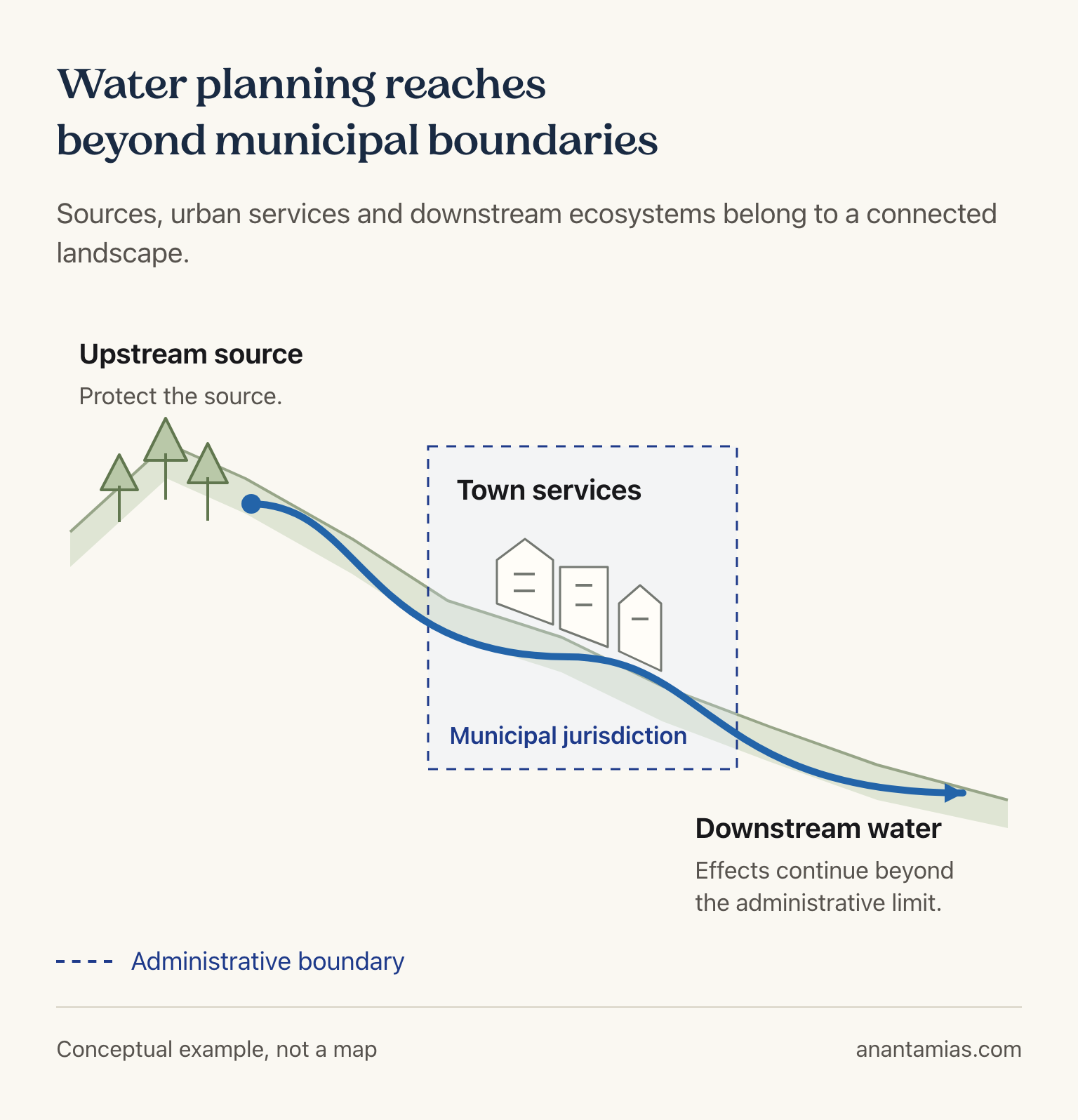
  • For example, a town may draw water from an upstream landscape outside its limits. Protecting the source then requires cooperation with the institutions responsible for that land, alongside investment in pipes and treatment.
  • The planned three-town pilot is an opportunity to examine this integrated approach. The announcement establishes its intended direction; it supplies no results showing that water security or biodiversity has already improved.

How Ecological Limits Inform Urban Decisions

Carrying-capacity assessment examines development pressure against available resources and service systems; it becomes useful when it informs actual land-use choices.

  • The conclave recommended integrating water availability, biodiversity and ecological sensitivity into land-use planning. These factors help explain why expanding a settlement cannot be judged solely by the availability of land for construction.
  • Service demand includes pressures from residents and visitors. The released Haridwar assessment examines population and tourism pressures on infrastructure, illustrating why a town’s needs cannot be inferred from its resident population alone.
  • Carrying capacity should be read as an evidence-based planning assessment, not a universal number applicable to every hill town. Local water conditions, infrastructure and ecological sensitivity must shape the assessment and its interpretation.
  • A proposed development may require both source protection and service investment. Adding supply infrastructure without examining the condition of its source leaves the underlying ecological dependency outside the investment decision.
  • The recommendation to include assessments in statutory master plans identifies a route from evidence to planning decisions. It is not proof that every Himalayan state has already adopted a binding common requirement.
Conceptual upstream water source, town services and downstream water connected across a dashed municipal boundary.
A conceptual example of ecological connections extending beyond municipal jurisdiction. It does not represent a real town or a mapped HUBS pilot.

Why Coordination Matters Beyond the Town

An integrated plan needs institutions able to act across boundaries and budgets that support the services and ecosystems identified in the assessment.

  • Shared planning must identify who manages a water source, who supplies the town and who handles waste. A common problem definition is useful only when responsibilities for the linked decisions are clear.
  • Upstream protection and downstream effects connect neighbouring communities. Municipal improvements should be assessed alongside their effects outside the town, rather than assuming a cleaner municipal area means the wider ecological problem has disappeared.
  • The conclave discussed cluster-based planning and project aggregation as financing approaches. Shared projects could address connected needs, but these recommendations do not establish that a particular joint project has received approval or funding.
  • Environmental monitoring can help compare planned improvements with actual conditions. Publicly explaining what is measured and which institution responds would make ecological planning more accountable than a one-time assessment alone.
  • HUBS differs from a sanitation assessment: its stated purpose is integrated ecological planning. Local source assessment remains important because a regional framework cannot substitute for evidence about individual sites.

Way Forward

Connect the Pilot to Decisions

  • Publish pilot baselines and responsibilities so changes in water, waste and ecosystem conditions can be assessed against clearly stated starting conditions.
  • Use catchment and service-demand evidence when comparing land-use and infrastructure choices, with participation from affected communities outside municipal limits.
  • Clarify the legal status of proposed planning changes before presenting conference recommendations as mandatory rules.
  • Link shared projects to identifiable operating responsibilities and financing arrangements, rather than leaving cross-boundary cooperation dependent on occasional meetings.

Conclusion

  • HUBS offers a framework for connecting Himalayan urban services with the ecological systems supporting them. Its planned pilot should be evaluated through implementation evidence, rather than treated as a demonstrated improvement at launch.
  • The durable planning lesson is to match the scale of decisions to the scale of the problem: municipal authority matters, but water sources, waste effects and ecological relationships may extend beyond its boundary.

UPSC Practice Questions

Prelims MCQ 1

With reference to the Himalayan Urban Bio-Sheds initiative, consider the following statements:

  1. It seeks to integrate water, waste, biodiversity and ecosystem health into urban planning.
  2. Its announced pilot is planned in three towns across Himachal Pradesh, Uttarakhand and Sikkim.
  3. Its launch automatically made carrying-capacity assessments a binding statutory requirement in every Himalayan state.

How many of the above statements are correct?

(a) Only one (b) Only two (c) All three (d) None

Answer: (b) Only two

Explanation:

Statements 1 and 2 match the official announcement. Including carrying-capacity assessments in statutory master plans was a conclave recommendation, not an automatically enacted legal requirement.

Prelims MCQ 2

Why might Himalayan urban water planning need to extend beyond a municipal boundary?

(a) Municipal authorities have no role in water services. (b) Every catchment is identical to a municipal jurisdiction. (c) Water sources and ecological effects may lie outside the authority’s administrative limits. (d) An ecological plan automatically transfers all land to the urban authority.

Answer: (c) Water sources and ecological effects may lie outside the authority’s administrative limits.

Explanation:

Natural drainage relationships and administrative jurisdiction need not coincide. Planning may require cooperation across boundaries; it does not remove municipal responsibilities or automatically change land ownership.

UPSC Mains Questions

  1. Explain how catchment-scale planning can improve water security in Himalayan towns. What institutional difficulties arise when ecological and municipal boundaries differ?
  2. Discuss the value and limitations of carrying-capacity assessments in Himalayan urban planning. How can pilot initiatives generate evidence for subsequent planning decisions?

Source: PIB, Ministry of Housing and Urban Affairs.

Frequently Asked Questions

What is the Himalayan Urban Bio-Sheds initiative?

HUBS is an NIUA initiative intended to integrate water, waste, biodiversity and ecosystem health into urban planning. Its announced pilot is planned in three towns across Himachal Pradesh, Uttarakhand and Sikkim.

Does the HUBS announcement identify the three pilot towns?

The PIB release identifies the three states but does not name the pilot towns. It describes planned implementation, so neither town identities nor completed environmental improvements should be inferred from the announcement.

How does a catchment differ from a municipal area?

A catchment is defined by drainage towards a common outlet. A municipal area is defined administratively. Water sources and ecological effects can cross those administrative limits, creating a need for coordinated planning.

Are carrying-capacity recommendations already binding law?

The conclave recommended incorporating carrying-capacity assessments into statutory master plans. That recommendation does not by itself enact a legal requirement. Adoption through the applicable planning processes would need to be established separately.

Barak Upgrade: Managing Electronics and Software Obsolescence

Open article →Download PDF

Why in News?

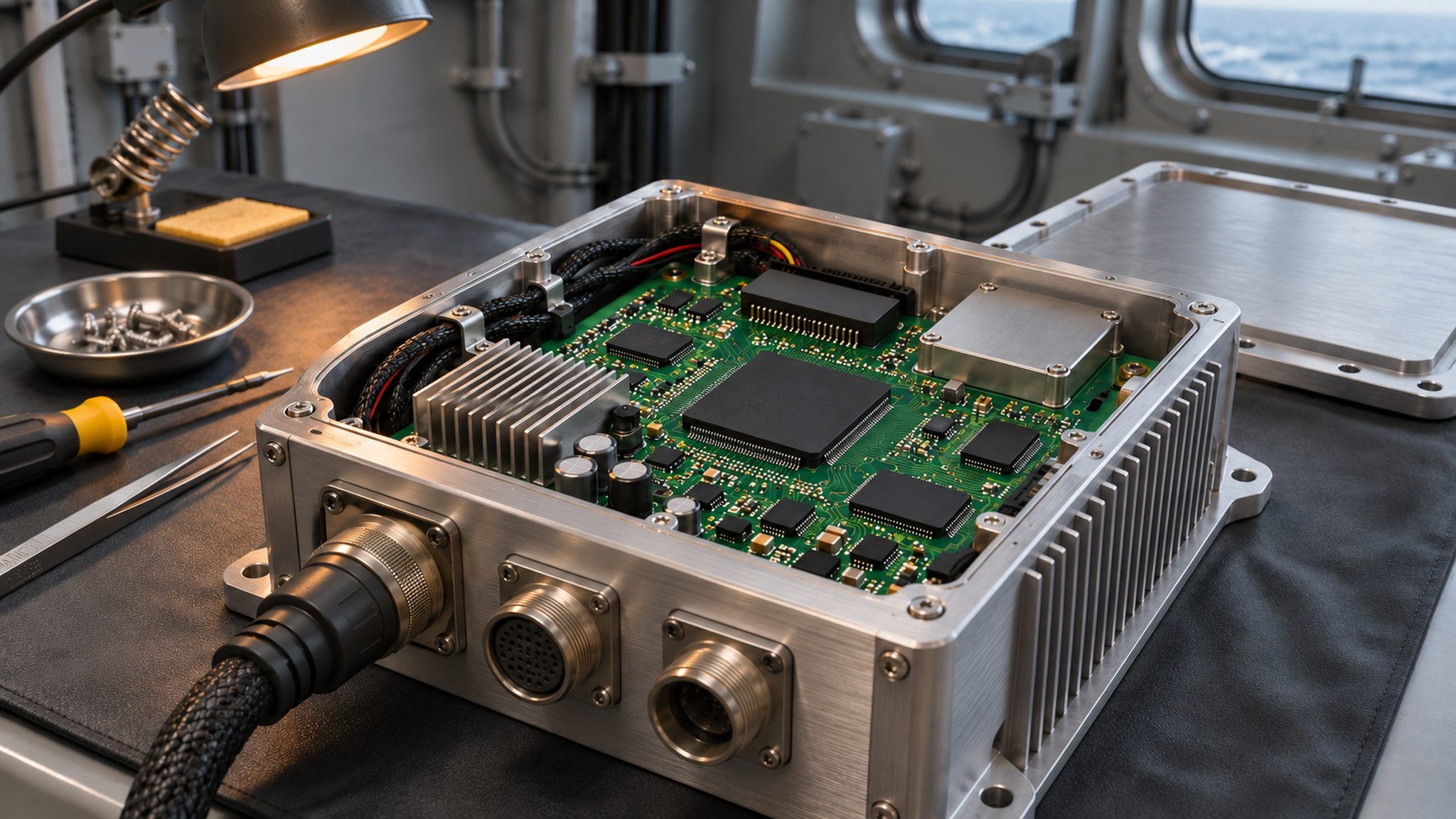
On 18 November 2026, the Ministry of Defence signed a contract with Israel Aerospace Industries to upgrade hardware and software and manage obsolescence in the Barak Point Defence Missile System aboard Indian Navy ships.

  • The announcement concerns an existing shipboard system; it does not describe the commissioning of a new ship or a completed upgrade.
  • The contracted scope expressly includes hardware and software. The release does not identify individual electronic components, software versions or installation milestones.
  • The ministry expects improved anti-air defence capability, but publishes no numerical range, ship count or independently measured performance results.
  • Obsolescence can arise when a supplier stops supporting an item, even while installed equipment still operates.
  • A replacement can also create compatibility problems elsewhere in a system. Keeping the parts available and keeping them working together are separate engineering tasks.

UPSC Relevance

Prelims Relevance

  • Barak Point Defence Missile System is the system named in the Ministry of Defence contract.
  • Israel Aerospace Industries is the contracted supplier.
  • Hardware refers to physical equipment; software supplies programmed instructions.
  • Functional obsolescence can follow changes that prevent an otherwise available item from performing its intended role.
  • Configuration management controls the identification and alteration of system versions.

Mains Relevance

GS Paper 3

  • Explain how component support and hardware-software compatibility affect defence preparedness.
  • Examine why technical modernization needs controlled changes and verification alongside procurement.

Background and Context

What the Barak Contract Establishes

The ministry describes a combined upgrade of the physical equipment and programmed functions of an existing naval defence system.

  • The named equipment is the Barak Point Defence Missile System already aboard Indian Navy ships. The announcement identifies the subsystem being upgraded without publishing its detailed internal design or operational configuration.
  • The hardware-and-software scope matters because the work is broader than buying replacement physical parts. Both categories appear in the announcement, although it does not specify their individual technical changes.
  • The expected anti-air defence improvement is the ministry’s stated objective. The announcement cannot establish a measured improvement, because it reports the contract rather than results from completed installation and assessment.
  • The system name should be retained exactly as published. Importing specifications from another similarly named missile programme would attach unverified performance claims to this particular upgrade.

How Obsolescence Differs From Wear

A component can become difficult to sustain because its supply or technical environment changes, without first suffering physical damage.

  • Supply obsolescence arises when needed parts or support cease to be available. Unlike wear, which concerns deterioration of an installed object, this problem concerns the continuing ability to obtain or support it.
  • The NASA-hosted obsolescence guide distinguishes functional obsolescence: equipment or software may remain commercially available yet fail to perform as intended after other parts or requirements change.
  • Compatibility is a relationship between components. New hardware may not run older software correctly; changing software can also disrupt assumptions made by retained equipment. A successful individual replacement is not automatically a successful system change.
  • Interfaces describe how parts connect or exchange information. A generic processor replacement illustrates the issue: compatible physical connections alone do not prove that existing programs will communicate and operate correctly.
  • These are general engineering mechanisms, not a diagnosis of the Barak fleet. The ministry has not disclosed which parts face supply loss or which specific compatibility issues the contracted work will address.

What Makes a Hardware-Software Change Dependable

Engineering guidance treats maintenance as controlled change, with records and checks that preserve the intended functioning of the combined system.

  • Parts monitoring identifies supply risks before they become immediate shortages. NASA’s electronic-parts standard recommends assessing availability when selecting parts and monitoring obsolescence throughout extended product lives.
  • Configuration records identify which hardware and software versions belong together. NASA’s software-maintenance guidance emphasizes controlled changes, verification and audits as operating requirements and hardware evolve.
  • Regression testing checks whether a change has disturbed previously working behaviour. Its purpose extends beyond proving that a new feature works: retained functions must continue to meet their requirements after the change.
  • Verification evidence connects a modification to its requirements. Maintenance documents and test records allow engineers to assess the changed configuration, rather than assuming a newer component or software version is inherently suitable.
  • General guidance and contractual obligations must remain distinct. These engineering principles explain why combined upgrades need care; the cited NASA documents are not Indian Navy requirements or evidence of the Barak contract’s undisclosed terms.

Way Forward

Track Supportability and Compatibility

  • Maintain component and software-version records so that future support decisions refer to the actual installed configuration.
  • Assess supplier support and availability before a shortage forces an urgent, poorly evaluated replacement.
  • Require appropriate verification of changed and retained functions before treating a modified configuration as dependable.

Conclusion

  • The Barak contract highlights electronics and software obsolescence as a defence-management issue. Continued supply and continued compatibility both matter when equipment remains in service through successive technical changes.
  • Modernization requires more than substituting a newer part. Explain the connection between availability, compatible interfaces and verified behaviour, while keeping general engineering principles separate from undisclosed contractual details.

UPSC Practice Questions

Prelims MCQ 1

With reference to equipment obsolescence, consider the following statements:

  1. An item may become functionally obsolete even when it remains commercially available.
  2. Hardware changes can affect the functioning of existing software.
  3. Obsolescence always requires visible physical damage to an installed component.

How many of the above statements are correct?

(a) Only one (b) Only two (c) All three (d) None

Answer: (b) Only two

Explanation:

Statements 1 and 2 are correct. Supply or compatibility changes can create obsolescence without physical deterioration.

Prelims MCQ 2

What is the principal purpose of regression testing after a software change?

(a) To confirm that the supplier still manufactures every component. (b) To establish the country of origin of the equipment. (c) To check whether previously working functions have been disturbed. (d) To replace the need for configuration records.

Answer: (c) To check whether previously working functions have been disturbed.

Explanation:

Regression testing examines existing behaviour after a change. It complements other verification work and does not establish supply availability or origin.

UPSC Mains Questions

  1. Distinguish supply obsolescence from functional obsolescence. Explain their significance for sustaining defence equipment.
  2. Why should hardware and software changes be managed together in complex public systems? Discuss the role of configuration records and verification.

Sources: PIB, Ministry of Defence and NASA-hosted obsolescence guide and software engineering guidance.

Frequently Asked Questions

What has India contracted for the Barak system?

The Ministry of Defence announced a contract with Israel Aerospace Industries for hardware and software upgrades and obsolescence management of the Barak Point Defence Missile System aboard Indian Navy ships.

Can equipment become obsolete without wearing out?

Yes. A supplier may discontinue a needed item or its support. An item can also become functionally unsuitable when changes elsewhere in the system prevent it from operating as intended.

Why can a hardware replacement require software work?

Existing software may depend on features or interfaces of the earlier hardware. Replacing that hardware can disturb those relationships, making compatibility assessment and verification necessary before relying on the changed system.

Does the announcement establish a new missile range?

The release states an expected improvement in anti-air defence capability but provides no numerical range. It also does not establish completion, ship counts, domestic production or technology-transfer arrangements.

How AI could reshape global growth and productivity

Open article →Download PDF

Why in news?

A recent analysis points out that output per worker in AI-adopting sectors of the US economy (information, finance and insurance, professional and business services) has risen sharply above its pre-2020 trend. This has revived the debate on whether AI will raise growth for everyone or only raise output while pushing workers out of jobs.

UPSC Relevance

Mains, GS3 – Indian Economy and issues relating to Planning, Mobilization of Resources, Growth, Development and Employment; Science and Technology – developments and their applications and effects in everyday life

What is Labour Productivity?

Labour productivity is the ratio of output to the number of workers employed.

Labour productivity = Output ÷ Workers employed

This ratio can rise in three ways:

  1. Output rises while the number of workers stays the same.
  2. Jobs are lost, so the denominator falls.
  3. Both output and jobs grow, but output grows faster than jobs.

The third case is the most desirable for any economy. AI may replace some white-collar work but create new jobs elsewhere, so the net effect on employment is not yet settled. What is clear is that AI is expected to raise productivity, and its success as a technology depends on that rise.

What does the data show?

  • In US AI-adopting sectors, real output per worker (indexed to 100 in Q1 2012) reached about 148 by Q2 2026, against about 121 had the 2012–19 trend continued.
  • The gap opened mainly after 2020, when digital and AI tools spread faster across services.
  • The bigger question is how far this gain will spread to agriculture, manufacturing and other services.

Two Schools of Thought: Does Productivity Create Jobs?

AspectNeoclassical (Supply-side) ViewHeterodox (Demand-side) View
Core ideaOutput growth = growth of labour force + growth of labour productivityOutput is produced only if it is demanded; productivity alone does not guarantee growth
ExampleWorkforce grows 2%, productivity 4% → economy grows 6%Demand grows 3%, productivity 4% → jobs fall by 1%
Message for AIAI-led productivity will lift growth almost automaticallyAI will create jobs only if demand grows faster than productivity

Labour as a global reserve: The demand-side view also says labour is never truly scarce. Historically, the Atlantic slave trade and indentured labour moved workers to colonies. Today, Punjab draws farm workers from Bihar and UP, and Silicon Valley relaxes work visas when it needs engineers. When job growth slows, borders close – which partly explains rising anti-immigrant politics in the global North.

How AI will alter Labour Productivity

  • Automation of routine tasks: Data entry, basic coding, document review and customer queries can be done faster and at lower cost.
  • Augmentation of workers: AI acts as a co-pilot – a doctor reads scans faster, a teacher prepares lessons quicker, a lawyer searches case law in minutes.
  • Faster innovation: AI speeds up drug discovery, material science and weather forecasting, raising productivity of research itself (the endogenous growth channel).
  • Better use of capital: Predictive maintenance, smart logistics and precision farming reduce waste of machines, inputs and time.
  • Lower cost of knowledge: Expertise that was costly earlier (translation, design, analysis) becomes cheap and widely available, including in regional languages.

Sector-wise Impact

SectorHow AI changes productivityEffect on jobs
AgricultureCrop advisories, soil and weather prediction, drone spraying, price forecastingBetter farm incomes; limited direct job loss as work is manual; need for agri-tech skills
ManufacturingRobotics, quality checks through computer vision, predictive maintenanceFewer assembly-line jobs; new jobs in maintenance and robotics
IT and BPM servicesCode generation, testing, automated customer supportMost exposed in India; pressure on entry-level coders and call-centre jobs; demand for AI engineers
Banking and FinanceCredit scoring, fraud detection, chatbots, algorithmic tradingFewer clerical roles; more roles in risk, compliance and data
HealthcareDiagnosis from scans, telemedicine, drug discoveryAugments doctors; can ease shortage in rural areas
EducationPersonalised learning, AI tutors in local languagesTeachers’ role shifts to mentoring; content jobs change
GovernanceGrievance redressal, fraud detection in welfare, document translation (e.g. Bhashini)Faster delivery; fewer routine clerical posts
Creative and MediaText, image, video generationPressure on writers, designers, translators; copyright disputes

Why it matters more for India

  • Demographic dividend: India adds millions to its workforce every year. If AI reduces entry-level jobs, the dividend can turn into a burden.The IMF (2024) estimated that nearly 40% of global employment is exposed to AI, rising to about 60% in advanced economies.
  • Services-led growth model: India skipped the classic manufacturing route and grew through IT and business services – precisely the area most exposed to AI.
  • Large informal sector: Most workers lack formal skills and social security, so they have little cushion against disruption.
  • Opportunity side: A large talent pool, cheap data and Digital Public Infrastructure (Aadhaar, UPI) give India a chance to build AI for scale in local languages.

Challenges and Problems

  • Jobless growth: Output may rise while employment stagnates, as the demand-side view warns.
  • Rising inequality: Gains may flow to capital owners and a few skilled workers, widening the gap between firms, regions and workers.
  • Uneven spread of productivity: Gains may stay confined to a few digital sectors, leaving agriculture and MSMEs behind.
  • Skill mismatch: The education system produces degrees, not the problem-solving and digital skills AI-era jobs need.
  • Market concentration: A handful of global firms control frontier models, chips and cloud compute, creating dependence for countries like India.
  • Gig and platform work: New jobs may be insecure, without fixed wages, pensions or health cover.
  • Bias, privacy and accountability: AI used in hiring, lending or policing can discriminate if trained on biased data.
  • Restrictions on migration: As the article argues, falling labour demand in rich countries tightens visa rules, hurting Indian professionals abroad and remittances.
  • Energy and environment: Data centres need large amounts of electricity and water.

Possible Solutions and Preventions

  • Reskilling at scale: Expand programmes like FutureSkills PRIME and Skill India Digital; focus on lifelong learning rather than one-time degrees.
  • Reform education: Implement NEP 2020’s focus on critical thinking, coding and multidisciplinary learning from school level.
  • Support demand, not just supply: Public investment in health, education, care economy and infrastructure can absorb workers and keep demand growing faster than productivity.
  • Social security for new workers: Effectively implement the Code on Social Security, 2020 provisions for gig and platform workers; explore portable benefits.
  • Human-in-the-loop design: Encourage AI that augments workers rather than fully replaces them, especially in public services.
  • Spread adoption to MSMEs and farms: Affordable AI tools, local-language models and shared compute through the IndiaAI Mission.
  • Fair sharing of gains: Debate on measures such as taxing windfall AI profits or digital services to fund transition support.
  • Risk-based governance: Clear rules on data protection (DPDP Act, 2023), algorithmic transparency and accountability, without choking innovation.
  • Global cooperation: Push for fair access to compute, data and skilled-worker mobility in forums like G20 and the Global Partnership on AI.

Government Initiatives on AI

InitiativeKey features
National Strategy for AI (2018)NITI Aayog’s ‘#AIforAll’ strategy; focus areas – healthcare, agriculture, education, smart cities, mobility
IndiaAI Mission (2024)Outlay of ₹10,371.92 crore; GPU compute capacity, foundation models, datasets platform, startup financing, AI skilling
BhashiniAI-based translation across Indian languages for digital inclusion
FutureSkills PRIMEMeitY–NASSCOM platform for reskilling in emerging technologies including AI
Digital Personal Data Protection Act, 2023Framework for lawful processing of personal data used in AI systems

Conclusion

AI may well be as epochal as the steam engine, but productivity growth by itself does not guarantee more or better jobs. Whether AI becomes a dividend or a disruption will depend on how fast demand grows, how widely gains are shared and how quickly workers are reskilled. For India, the goal should be ‘AI for jobs’, not just ‘AI for output’.

Mains Practice Question

“Rising labour productivity due to Artificial Intelligence does not automatically translate into more jobs.” In light of this statement, discuss the impact of AI on productivity and employment across different sectors of the Indian economy, and suggest measures to ensure an inclusive transition. (15 Marks, 250 words)

Police Reforms in India: From Supreme Court Directives to Police Station Practice

Open article →Download PDF

Why in news?

The Indian Police Foundation has finalised a “change manual” for internal police reforms, to be first implemented in Punjab.

UPSC Relevance

Prelims – Police as a State subject

Mains, GS2, Government Policies and Interventions; Transparency and Accountability; Role of Civil Services in a Democracy

Police in the Constitution

  • “Police” and “Public order” are State subjects (Entries 2 and 1 of List II, Seventh Schedule). States make police laws, but many still follow the colonial Police Act, 1861 or laws modelled on it.
  • The Union assists States through the scheme for Modernisation of State Police Forces, CCTNS (Crime and Criminal Tracking Network and Systems) and central training institutions like BPR&D.

Why are Police Reforms Needed?

  • Colonial mindset: The 1861 Act was designed to control people, not serve them. This “ruler’s police” image still keeps citizens away from police stations.
  • Shortage of personnel: As per Bureau of Police Research and Development (BPR&D)’s Data on Police Organisations (1 January 2020), over 5.31 lakh posts were vacant against a sanctioned strength of about 26.2 lakh. The actual police-population ratio (around 158 per lakh in 2019) is well below the sanctioned level.
  • Low share of women: Women formed only about 10% of the police force (2020), which affects the handling of crimes against women.
  • Overburdened constabulary: Constables form about 85% of the force but have limited role in investigation, long duty hours (often 12 hours or more) and few promotion chances.
  • Political interference: Frequent transfers and postings as a tool of control weaken professionalism and impartiality.
  • Custodial violence and misconduct: Illegal detention, custodial torture and deaths erode public trust. The Supreme Court has repeatedly intervened (D.K. Basu, 1997; Arnesh Kumar, 2014).
  • Poor infrastructure: Shortage of vehicles, forensic support, funds for investigation and housing. Many police stations still lack proper CCTV coverage.
  • Low conviction rates: Investigation and law and order duties are mixed, so investigation quality suffers.

Significance of the “Internal Reforms” Approach

  • Structural reforms (new Police Acts, Security Commissions) depend on political will and have been stuck for decades. Internal reforms work within the existing system.
  • Changes at the police station level are what the common citizen actually sees – how a complaint is received, how an arrested person is treated.
  • Low-cost and evidence-based, since they come from field surveys of both citizens and police personnel.
  • Earlier examples like Punjab’s SAANJH (community policing), Kerala’s Janamaithri Suraksha and Tamil Nadu’s Friends of Police show that such changes can work.

Challenges

  • Resistance to change: Old work culture and hierarchy in police stations.
  • Sustainability: Reforms often depend on individual officers and fade after transfers.
  • Structural issues remain: Vacancies, political control and lack of a separate investigation wing cannot be fixed at the police station level alone.
  • Digital divide: e-FIR and QR codes may not help those without smartphones or digital literacy.
  • Funding: Some recommendations like tablets for IOs, vehicles and rest rooms need money, and police budgets are mostly spent on salaries.

Major Recommendations 

Committee / CommissionYearKey Recommendations
National Police Commission (Dharma Vira)1977-81New Police Act; State Security Commission; fixed tenure for police chief; separation of investigation from law and order
Ribeiro Committee1998Review of NPC recommendations; Police Performance and Accountability Commissions
Malimath Committee2003Reforms in criminal justice system; separate investigation wing

Prakash Singh vs Union of India (2006)

The Supreme Court gave seven directives to the Centre and States:

  1. State Security Commission to lay down broad policy and ensure the government does not exert unwarranted influence on the police.
  2. DGP to be selected by the State government from among the three senior-most officers empanelled by the UPSC, with a minimum tenure of two years.
  3. Minimum two-year tenure for officers on operational duty (IG, DIG, SP, SHO).
  4. Separation of investigation from law and order duties.
  5. Police Establishment Board to decide transfers, postings and promotions of officers of DSP rank and below.
  6. Police Complaints Authority at State and district levels to look into complaints of serious misconduct.
  7. National Security Commission at the Union level for selection and placement of chiefs of Central Police Organisations.
  • Status: Most States have complied only partly. Many passed new Police Acts that dilute the directives, for example by keeping the government’s control over Security Commissions or making Complaints Authorities ineffective.

Steps Taken under New Criminal Laws (BNSS, 2023)

  • e-FIR and Zero FIR (Section 173): Information can be given electronically; it is taken on record once signed by the informant within three days. FIR can be lodged at any police station irrespective of jurisdiction.
  • Videography (Section 105): Search and seizure to be recorded through audio-video means. The e-Sakshya app helps police record and upload such evidence.
  • Forensics (Section 176(3)): Forensic experts must visit the crime scene for offences punishable with seven years or more.
  • Arrest safeguards: Information about arrests to be displayed at police stations and district control rooms; the arrested person can inform a relative or friend.
  • Other judicial push: In Paramvir Singh Saini (2020), the Supreme Court directed CCTV cameras with night vision and audio in all police stations.

Way Forward

IPF Manual Recommendations

Focus AreaKey Recommendations
1. Complaint/FIR registration and police responseBetter use of e-FIR under BNSS; Visitor Management System (VMS) for digital records at entry; help desks; QR codes at police stations for feedback
2. Crime prevention, community outreach and citizen servicesNight safety escorts for working women; QR codes and panic buttons in taxis linked to district control rooms; body-worn and dash cameras; more CCTV; citizen sentinel scheme; student internships; skill training for school drop-outs and drug addicts
3. Prevention of misconduct and harassmentScrutiny of reasons for arrest at DySP level; phone call for the accused after arrest; informing about right to free legal aid; videography of personal search; online monitoring of lock-ups by senior officers
4. Working conditions of police stationsRest rooms and weekly offs; transport and vehicle allowance for IOs; contingency funds for investigation; a tablet for every IO for the e-Sakshya app; recruitment board; soft-skill training; police e-academy; involving constables in investigation
  • Implement Prakash Singh directives in letter and spirit: with real independence of Security Commissions and Complaints Authorities.
  • Replace the 1861 Act: States should adopt laws on the lines of the Model Police Act, 2006.
  • Fill vacancies and increase women’s representation: with time-bound recruitment through independent recruitment boards.
  • Separate investigation wing: with forensic support, to improve conviction rates.
  • Institutionalise internal reforms: turn the change manual into standing orders and SOPs, with regular citizen feedback and third-party audits.

Police reform is not only about laws and commissions. Real change happens when a citizen walks into a police station without fear. The IPF’s change manual is a practical step in this direction, but it must be backed by structural reforms and political will.

Practice MCQ

    Q1. With reference to the Bharatiya Nagarik Suraksha Sanhita (BNSS), 2023, consider the following statements:

    1. Information about a cognizable offence can be given through electronic communication, which is taken on record once signed by the informant within three days.
    2. The process of search and seizure is to be recorded through audio-video electronic means.
    3. A forensic expert must visit the crime scene for offences punishable with imprisonment of seven years or more.

    Which of the statements given above are correct?

    (a) 1 only

    (b) 2 only

    (c) 1 and 2 only

    (d) 1, 2 and 3

    Answer: (d)

    Explanation: All three are correct – Section 173(1), Section 105 and Section 176(3) of the BNSS respectively.

    Practice Question

    “Police reforms in India have largely remained on paper despite the Supreme Court’s directions in the Prakash Singh case (2006).” In this context, discuss how internal reforms at the police station level can complement structural reforms in making policing citizen-centric. (15 Marks, 250 words)

    The need to expand Jan Aushadhi

    Open article →Download PDF

    Why in news?

    Jan Aushadhi Kendras have crossed 20,500, but low awareness, stock-outs and doubts over quality still limit the scheme’s reach.

    UPSC Relevance

    Prelims – PMBJP, generic medicines, NPPA, NLEM, Jan Aushadhi Sugam app

    Mains, GS2, Government Policies and Interventions; Issues relating to Development and Management of Health

    Pradhan Mantri Bhartiya Janaushadhi Pariyojana (PMBJP)

    PMBJP is a scheme to sell quality generic medicines at affordable prices through dedicated outlets called Jan Aushadhi Kendras (JAKs).

    • Launch: Started in 2008 as the Jan Aushadhi Scheme; revamped in 2015 and renamed PMBJP in 2016.
    • Ministry: Department of Pharmaceuticals, Ministry of Chemicals and Fertilizers (not the Health Ministry).
    • Implementing agency: Pharmaceuticals and Medical Devices Bureau of India (PMBI), earlier called BPPI.
    • Product basket: 2,110 medicines and 315 surgical items, covering major therapeutic groups like anti-diabetics, cardiovascular drugs, anti-cancers and antibiotics.
    • Pricing: Medicines are priced at least 50% lower, and in many cases 80–90% lower, than branded medicines.
    • Quality: Medicines are bought only from WHO-GMP certified suppliers, and every batch is tested in NABL-accredited labs before supply.
    • Who can open a Kendra: Individual pharmacists, entrepreneurs, NGOs, hospitals and Primary Agricultural Credit Societies (PACS). An incentive of up to ₹5 lakh is given, with an extra one-time grant for women, SC/ST, Divyang owners and those in North-East, Himalayan, island and aspirational districts.
    • Special products: Jan Aushadhi Suvidha oxo-biodegradable sanitary napkins at ₹1 per pad.
    • Digital support: Jan Aushadhi Sugam app – store locator, Google Maps navigation and medicine-wise price comparison.
    • Jan Aushadhi Diwas: Observed on 7 March every year.

    Status 

    • Outlets: Kendras grew from just 80 in 2014-15 to 17,990 in December 2025 and 20,547 by July 2026. The target is 25,000 Kendras by March 2027.
    • Sales: Sales at MRP rose from ₹7.29 crore in 2014-15 to ₹1,235.95 crore in 2022-23, ₹1,470 crore in 2023-24 and ₹2,252 crore in 2025-26.
    • Savings: The government estimates savings of about ₹9,000 crore for citizens in 2025-26 and about ₹45,000 crore over 12 years – an average discount of around 80%.

    The growth is steady, but the scale is still small. The 20,547 Kendras are only about 1.7% of the roughly 12 lakh chemists and druggists in the country.

    Generic Medicines 

    TypeMeaning
    Branded (innovator) medicineDeveloped and patented by a company; sold under its brand name at a high price during the patent period
    Branded genericOff-patent medicine sold by a company under its own brand name. Most medicines sold in Indian pharmacies fall here
    Generic (unbranded)Sold under the name of the salt or active ingredient (e.g., Paracetamol). Jan Aushadhi medicines fall here
    BioequivalenceThe generic must release the same active ingredient into the blood at the same rate and extent as the original. This proves it works the same

    India supplies about one-fifth of the world’s generic medicines and is often called the “pharmacy of the world”. So manufacturing capacity is not the problem – reaching the patient is.

    Why does it matter?  

    • Medicines drive out-of-pocket expenditure: Medicines make up roughly 60–70% of household out-of-pocket expenditure (OOPE) on health in India.
    • Insurance gap: Schemes like Ayushman Bharat PM-JAY mainly cover hospitalisation. Outpatient drug costs, especially for chronic diseases like diabetes and hypertension, are largely not covered.
    • Low public spending: Government health expenditure was 1.43% of GDP in 2023-24, while the National Health Policy, 2017 target was 2.5% of GDP by 2025.
    • Rising NCDs: Lifelong medicines for non-communicable diseases make monthly drug bills a long-term burden. In the article, one family’s monthly bill fell from about ₹2,900 to ₹663 at a Kendra.
    • Constitutional link: Right to health is part of Article 21 (as interpreted by the Supreme Court), and Article 47 directs the State to improve public health.

    Challenges

    • Low awareness: In a small study of 200 outpatients in Port Blair, only a third had heard of the scheme and more than half did not know what the outlets sell.
    • “Shop for the poor” image: Many see Kendras as charity counters, which keeps away middle-class buyers and limits demand.
    • Doctors’ prescriptions: Patients buy what doctors write. The National Medical Commission’s 2023 order to prescribe generic names was put on hold after doctors’ bodies objected over quality and autonomy. Only 6% of patients in the Port Blair study had ever asked for generics.
    • Quality perception: The government reports 0.34% substandard medicines in Jan Aushadhi compared to 3.70% in the open market, but the period and testing method are not disclosed. A 2020 report counted 106 batch recalls in four years.
    • Stock-outs: When medicines are not available, buyers lose trust and do not return. This leads to fewer customers and weaker stores.
    • Location and viability: Kendras are often in less busy areas to save rent, and the low-margin model makes it hard for owners to survive.
    • No data on users: There is no nationally representative survey on why people use or avoid Kendras.
    • Supply chain: Most suppliers are MSMEs, which face raw-material price swings and procurement delays.

    Way Forward

    • Measure first: Department of Pharmaceuticals and Health Ministry should commission an independent national survey on awareness, prescriptions and stock availability.
    • Transparent quality testing: Publish regular random-batch test results with the period, method and labs named, so that the 0.34% claim can be verified.
    • Win doctors’ trust: Prove quality consistently, discuss with doctors’ bodies and then bring back the generic prescription mandate. Bioequivalence data on labels will help.
    • No stock-outs: An online stock-tracking system that reorders automatically, and live stock positions on the Sugam app.
    • Rebrand for all: Promote Kendras as shops for everyone through social media and targeted advertising.
    • Better locations: Open Kendras inside government hospitals, railway stations and busy markets; use PACS and post offices in rural areas.
    • Dedicated funding: As public health spending rises, a dedicated allocation for expanding and promoting Jan Aushadhi will directly cut household medical burden.
    • Link with insurance: Cover outpatient medicines bought from Kendras under health insurance and Ayushman Arogya Mandirs.

    A bill that fell by 77% in one visit shows what India has already built. The challenge now is to make that experience normal for every family, through evidence, trust and funding.

    Practice MCQ

    Q1. Consider the following statements regarding the Pradhan Mantri Bhartiya Janaushadhi Pariyojana (PMBJP):

    1. The scheme is administered by the Ministry of Health and Family Welfare.
    2. Medicines sold at Jan Aushadhi Kendras are procured only from WHO-GMP certified suppliers and tested at NABL-accredited laboratories.
    3. Under the “Janaushadhi Suvidha” initiative, oxo-biodegradable sanitary napkins are sold at ₹1 per pad.
    4. The product basket is limited to medicines; surgical items and medical consumables are outside its scope.

    How many of the above statements are correct?
    (a) Only one
    (b) Only two
    (c) Only three
    (d) All four
    Answer: (b)
    Explanation

    Statement 1 is incorrect. This is the trap, since aspirants often assume a health scheme sits with the Health Ministry. PMBJP is a flagship scheme administered by the Department of Pharmaceuticals under the Ministry of Chemicals and Fertilisers. The Pharmaceuticals & Medical Devices Bureau of India (PMBI) implements it.
    Statement 2 is correct. Suppliers must be WHO-GMP certified, and each batch is tested at NABL-accredited labs before it is sold. This quality step is what separates the scheme from simply selling cheap generics.
    Statement 3 is correct. The “Janaushadhi Suvidha” initiative sells oxo-biodegradable sanitary napkins for ₹1 per pad. By January 2026, over 100 crore pads were sold.
    Statement 4 is incorrect. As of August 2026, the basket had 2,110 medicines and 315 surgicals, medical consumables and devices.

    Q2. Given below are two statements, one labelled as Assertion (A) and the other as Reason (R):

    • Assertion (A): The National Medical Commission’s direction making it mandatory for doctors to prescribe medicines by generic names is currently in force across India.
    • Reason (R): Medicines account for the largest share of household out-of-pocket expenditure on health in India.

    In the light of the above statements, choose the correct option:

    (a) Both (A) and (R) are correct, and (R) is the correct explanation of (A).

    (b) Both (A) and (R) are correct, but (R) is NOT the correct explanation of (A).

    (c) (A) is correct, but (R) is incorrect.

    (d) (A) is incorrect, but (R) is correct.

    Answer: (d) The NMC’s generic prescription mandate was put on hold after objections from doctors’ bodies.

    Practice Question

     “Despite India being the pharmacy of the world, affordable generic medicines have not reached most Indian households.” In this context, examine the performance of the Pradhan Mantri Bhartiya Janaushadhi Pariyojana and suggest measures to expand its reach. (15 Marks, 250 words)

    Climate Promises need to become Praxis

    Open article →Download PDF

    Why in News? 

    At COP31 in Antalya, the Turkish presidency’s 35-by-35 Global Electrification Pledge seeks to raise electricity’s share of global final energy consumption from just over 20% to 35% by 2035. 

    For India, the question is how to finance the grids, storage and local infrastructure needed to make cleaner electricity reliable and affordable. 

    UPSC Relevance: GS-3: Environment and Biodiversity: Climate change; Energy infrastructure

    Prelims & Mains: Climate finance goals, non-fossil capacity and final energy consumption; COP 31. 

    From Climate Commitments to Climate Action:

    Climate change has emerged as a major developmental, economic and environmental challenge. However, the gap between international commitments and their implementation remains significant.

    (i) COP29 Climate Finance Commitments: 

    At COP29 (Baku, 2024), countries agreed on a New Collective Quantified Goal (NCQG) on climate finance.

    • New finance goal: Developed countries committed to taking the lead in mobilising at least $300 billion annually for developing countries by 2035.
    • Broader mobilisation target: All actors were called upon to scale up climate finance from public and private sources to at least $1.3 trillion annually by 2035.
    • Focus: The financing is intended to support climate mitigation, adaptation and resilience in developing countries.

    Article 9 of the Paris Agreement requires developed countries to provide financial resources for both mitigation and adaptation. The earlier $100 billion annual goal, due in 2020, was first met in 2022. Such delays make it harder for developing countries to plan multi-year investments. 

    (ii) COP31 and the Global Electrification Agenda:

    • 35 by 35 Global Electrification Pledge: The initiative seeks to increase electricity’s share of total final energy consumption to 35% globally by 2035. 
    • This means increasing the use of electricity across major economic sectors, i.e., transport, domestic use, industrial use and agriculture. 

    The 35% target refers to electricity’s share in total final energy consumption, not the share of renewable electricity in total power generation. The climate benefits will depend on how clean the electricity supply is and how efficiently it is used.

    India’s Energy Transition: Opportunities and Challenges:

    The International Energy Agency (IEA) projects India’s electricity demand to grow by an average of 6.4% annually between 2026 and 2030, driven by industrialisation, urbanisation, cooling requirements and electrification.

    (i) India’s progress:

    • Non-fossil energy capacity: India achieved 300.5 GW of installed non-fossil fuel-based electricity capacity by July 2026, exceeding 60% of its 500 GW target for 2030. 
    • Renewable Consumption Obligation (RCO): Distribution licensees and designated consumers are required to progressively increase their consumption of non-fossil electricity, with the target reaching 43.33% by 2029-30.

    (ii) Major Challenges in India’s Energy Transition:

    • Capacity-Generation Gap: While non-fossil sources reached over 53% of India’s installed capacity in 2026, they accounted for only 29.2% of actual electricity generation in FY 2025-26.
    • Weather Intermittency: Solar and wind power suffer from low Capacity Utilisation Factors (CUF) compared to thermal plants.
    • Storage Imperative: Meeting peak evening demand requires scaling up Battery Energy Storage Systems (BESS) projected by the Central Electricity Authority (CEA) at 208 GWh by 2030, alongside Pumped Storage Hydropower (PSP) and flexible gas/hydro balancing.
    • Transmission Modernisation: Rapid expansion of inter-state Green Energy Corridors and high-voltage transmission lines is essential to evacuate power from renewable-rich states (like Rajasthan and Gujarat) to demand centres.
    • DISCOM Distress: Financially weak state Distribution Companies (DISCOMs) struggle with Aggregate Technical and Commercial (AT&C) losses, limiting last-mile grid reliability for rural and urban consumers.
    • Continued Dependence on Coal: Coal still generates roughly 70-73% of India’s electricity, remaining indispensable for grid stability, heavy industries (steel, cement), and energy security.
    • Regional and Livelihood Risks: Abruptly phasing out coal threatens the fiscal revenues of coal-bearing states (e.g., Jharkhand, Odisha, Chhattisgarh) and the livelihoods of millions of formal and informal workers.
    • High Capital and Borrowing Costs: India needs an estimated $220 billion over the next three years to meet its 2030 targets, yet high interest rates, short debt tenures, and expensive storage technologies inflate project costs.
    • Supply Chain Dependence: Despite domestic module capacity exceeding 116 GW via the Production Linked Incentive (PLI) Scheme, India remains heavily reliant on imports for upstream components (polysilicon, wafers, solar cells) and critical minerals (lithium, cobalt) for batteries. 

    Way Forward: 

    • Accelerate Storage Deployment: Fast-track Viability Gap Funding (VGF) for Battery Energy Storage Systems (BESS) and streamline environmental clearances for Pumped Storage Hydropower (PSP) projects to ensure 24/7 dispatchable clean power.
    • Thermal Flexibilisation: Retrofit existing coal power plants to operate flexibly at lower minimum technical loads (down to 40-55%), allowing them to ramp down during peak solar hours and ramp up at night.
    • Fast-Track Transmission Corridors: Synchronise renewable generation timelines with the commissioning of the Inter-State Transmission System (ISTS) and Green Energy Corridors to eliminate curtailment.
    • Smart Grids & Decentralised Generation: Deploy smart metering under the Revamped Distribution Sector Scheme (RDSS) and scale decentralised solarisation (such as PM-KUSUM and PM Surya Ghar) to reduce transmission losses and ease grid congestion.
    • DISCOM Reforms: Enforce cost-reflective tariffs, timely subsidy disbursements by state governments, and strict compliance with Renewable Consumption Obligations (RCO) to restore DISCOM financial viability.
    • Just Transition for Coal Regions: Establish a national Just Transition Policy and repurpose existing funds (such as the District Mineral Foundation) to finance structured worker reskilling, social security nets, and economic diversification in fossil-fuel-dependent districts.
    • Low-Cost Finance: Expand blended finance facilities, green bonds, and sovereign credit guarantees to lower the cost of capital and attract long-term institutional investors (pension and sovereign wealth funds).
    • Deepen Domestic Manufacturing: Expand PLI schemes beyond solar module assembly to upstream manufacturing (polysilicon, ingots, wafers, and advanced chemistry cells) to reduce import dependence.
    • Securing Critical Minerals: Operationalise the National Critical Mineral Mission through domestic exploration, urban mining (battery recycling), and strategic overseas acquisitions via KABIL (Khanij Bidesh India Ltd.) to secure lithium, cobalt, and rare earth supplies.

    Thus, transitioning from climate promises to praxis requires aligning affordable global climate finance with domestic grid modernisation and inclusive skilling. Only by ensuring that green growth is both technologically reliable and socially equitable can India achieve energy security alongside its net-zero vision. 

    Prelims Practice MCQ: 

    Q. Consider the following statements.

    1. The Baku climate finance decision sets US$300 billion as an annual ceiling.

    2. The 35-by-35 pledge concerns electricity’s share of global final energy consumption.

    3. Nuclear power counts towards India’s non-fossil installed capacity.

    Which of the above statements are correct?

    (a) 1 and 2 only 

    (b) 2 and 3 only 

    (c) 1 and 3 only 

    (d) 1, 2 and 3

    Answer: (b) 

    Explanation:

    • Statement 1 is incorrect: The COP29 Baku climate finance decision (New Collective Quantified Goal) establishes a minimum target or floor of “at least US$300 billion” per year by 2035 for developing nations, rather than an upper ceiling.
    • Statement 2 is correct: The 35-by-35 pledge proposed under the COP31 Presidency aims to raise electricity’s share of total global final energy consumption to 35% by 2035 across transport, buildings, and industry.
    • Statement 3 is correct: India’s non-fossil fuel installed capacity (300.50 GW as of July 2026) includes renewable energy sources (solar, wind, hydro, bio-power) as well as nuclear power. 

    Practice Mains Question:

    Q. “The measure of climate finance and energy transition lies not in the magnitude of global declarations, but in the equity and reliability of ground-level execution.” Discuss this statement in the context of recent COP commitments and India’s clean energy transition.

    COVID-19 lessons should inform response to Air Pollution

    Open article →Download PDF

    Why in News?

    India must treat air pollution as a year-round public health emergency rather than a seasonal inconvenience, adopting the mission-mode governance, surveillance, and scientific rigour demonstrated during the COVID-19 pandemic.  

    UPSC Relevance: GS-2 Polity and Governance: Environmental Jurisprudence; GS-3: Environment and Biodiversity: Pollution 

    Prelims & Mains: Air Pollution: Challenges & Govt Approach/Policies  

    Multi-Dimensional Analysis of India’s Air Pollution Crisis:

    1. Public Health & Physiological Dimension:

    • Systemic Multi-Organ Impact: Like SARS-CoV-2, toxic particulate matter and gases enter via the respiratory tract and trigger systemic inflammation affecting the lungs, heart, and brain. Chronic exposure drives cardiovascular disease, stroke, lung cancer, diabetes, and neurological disorders like dementia.
    • Intergenerational Vulnerability: An adult inhales roughly 20,000 to 25,000 times daily, making even slight air degradation harmful. Pregnant women, fetuses, and young children face irreversible damage to lung and cognitive development, with thoracic surgeons already observing “black lungs” in teenagers.
    • Life Expectancy Loss: Persistent exposure to toxic air reduces the average life expectancy of Indians by an estimated 6 to 8 years. Air pollution caused over 2 million deaths in India in 2023.

    2. Constitutional, Legal & Ethical Dimension:

    • Violation of Fundamental Rights: Under Article 21 of the Indian Constitution, the Supreme Court has repeatedly affirmed that the Right to Life encompasses the right to a clean and pollution-free environment.
    • Environmental Injustice & Equity: Outdoor air exposure is involuntary. Poorer households, outdoor labourers, and children bear the highest exposure while lacking resources to afford indoor mitigation.
    • State Accountability vs. Citizen Burden: Over-reliance on masks, air purifiers, and hybrid schooling shifts the burden of protection from elected governments to individual citizens without reducing emissions at the source.

    3. Economic & Developmental Dimension:

    • Macroeconomic Drag: A study in The Lancet Planetary Health estimated that air pollution cost India 1.36% of its GDP in 2019 through premature mortality, healthcare expenditure, and lost labour productivity.
    • High Return on Investment: Global health estimates indicate that every $1 invested in air quality improvement yields over $15 in economic and health benefits.

    4. Governance & Policy Flaws:

    • Misaligned Resource Allocation: A 2026 assessment by the Centre for Research on Energy and Clean Air (CREA) revealed that out of ₹13,415 crore released under the National Clean Air Programme (NCAP) and Finance Commission grants, 68% of utilised funds went toward road-dust management (PM10). Meanwhile, major sources of deadly PM2.5, such as industrial emissions and domestic fuel use, received less than 1% each.
    • Siloed Data Systems: Air Quality Index (AQI) monitors operate independently from hospital admission records, preventing authorities from tracking real-time morbidity spikes or evaluating health outcomes.
    • Reactive Emergency Measures: Tools like the Graded Response Action Plan (GRAP) rely on temporary bans on construction and vehicles. These measures act as short-term stopgaps rather than permanent structural reforms.

    COVID-19 Governance vs. Current Air Pollution Response:

    ParameterCOVID-19 Pandemic ResponseCurrent Air Pollution Approach
    Policy FramingTreated as an urgent national public health emergency.Treated largely as a localised, seasonal winter inconvenience.
    Governance ModelMission-mode inter-ministerial and Centre-State task forces.Fragmented jurisdiction across environment, transport, and agriculture ministries.
    Data & SurveillanceIntegrated daily tracking of cases, hospitalisations, and deaths.Daily AQI reporting disconnected from clinical and mortality data.
    Intervention FocusTargeted root-cause containment, testing, and vaccination.Heavy focus on visible dust (PM10) and reactive bans rather than PM2.5 sources.
    Success MetricsMeasured by infection rates, recovery, and mortality reduction.Measured by administrative compliance and number of restrictions imposed.

    Existing Institutional Framework in India:

    India has several initiatives to address air pollution, but their effectiveness depends on coordination, implementation and enforcement.

    InitiativeKey Objective
    National Clean Air Programme (NCAP), 2019Improve air quality in identified cities through city-specific action plans; targets up to 40% reduction in PM10 levels or achievement of national standards by 2025-26.
    National Ambient Air Quality Standards (NAAQS), 2009Prescribe permissible ambient concentration limits for 12 pollutants.
    National Air Quality Monitoring Programme (NAMP)Monitor ambient air quality across the country.
    PRANA PortalTrack the physical and financial progress of NCAP implementation.
    Graded Response Action Plan (GRAP)Implement emergency pollution-control measures in Delhi-NCR based on AQI levels.
    Commission for Air Quality Management (CAQM), 2021Coordinate and monitor air-quality management in Delhi-NCR and adjoining areas.

    Recent government assessments indicate improvements in PM10 levels in several NCAP cities. However, continued attention to PM2.5, regional pollution sources, and health outcomes remains necessary.

    Way Forward: 7-Point COVID-Inspired Action Plan

    • Mission-Mode Cooperative Federalism: Establish empowered national and regional airshed task forces uniting Ministries of Environment, Health, Transport, Power, Agriculture, and Urban Development across state boundaries.
    • Integrated Environmental Health Surveillance: Build a unified national climate and health platform linking real-time AQI and weather data with hospital admissions, outpatient visits, and mortality registries to map hotspots.
    • Outcome-Based Public Dashboards: Upgrade public transparency portals to track annual PM2.5 exposure trends, sectoral emission cuts, fund utilisation, and health indicators rather than daily AQI numbers alone.
    • Risk-Aligned Financing: Reorient NCAP and Finance Commission funds away from superficial dust suppression toward high-impact PM2.5 sources, including clean household fuels, industrial retrofitting, and electric public transit.
    • Shift from GRAP to Structural Prevention: Replace recurring winter lockdowns with year-round investments in reliable public transport, strict industrial emission compliance, clean energy transitions, and walkable urban design.
    • Tighter National Ambient Air Quality Standards (NAAQS): Adopt a phased, science-backed roadmap to lower India’s annual PM2.5 standard of 40 µg/m³, currently eight times higher than the World Health Organisation (WHO) air quality guideline of 5 µg/m³.
    • Institutional Capacity & Risk Communication: Strengthen regulatory and research bodies to guide policy while crafting public communication that empowers communities without shifting state responsibility onto citizens.

    Practice Mains Question: 

    Q. “Air pollution in India is not merely an environmental challenge, but a chronic public health and governance emergency.” In light of institutional lessons from the COVID-19 pandemic, critically examine the structural gaps in India’s clean air strategy and suggest a multi-sectoral roadmap for reform.

    QUAD (Japan-Australia-India-U.S.) Leaders’ Summit 2026

    Open article →Download PDF

    Why in News?

    The Indian Prime Minister attended the Quad Leaders’ Summit, ASEAN-India Summit and East Asia Summit (EAS) in Manila, Philippines (November 2026).

    The Quad leaders issued a joint statement opposing economic and maritime coercion in the Indo-Pacific and reaffirmed their commitment to regional peace, stability and a rules-based order.

    UPSC Relevance: GS-2 International Relations: Regional groupings 

    Prelims: About Quad 
    Mains: Quad: Key Achievements, Significance, Challenges 

    What is Quad?

    The Quadrilateral Security Dialogue (Quad) is a diplomatic partnership comprising India, Australia, Japan and the United States, committed to a free, open, inclusive, resilient and prosperous Indo-Pacific.

    • It is not a military alliance and has no collective-defence clause or mutual defence obligation.
    • It follows an issue-based approach to cooperation, focusing on maritime security, economic resilience, critical technologies and regional public goods.

    Genesis and Evolution

    • 2004 – Tsunami Cooperation: The four countries coordinated humanitarian assistance following the Indian Ocean tsunami, laying the foundation for subsequent cooperation.
    • 2007 – Formation: The first Quad consultation was held alongside the ASEAN Regional Forum in Manila. Differences in strategic priorities subsequently led to a prolonged hiatus.
    • 2017 – Revival: The four countries revived consultations amid growing strategic and maritime concerns in the Indo-Pacific.
    • 2019 – Ministerial Level: Quad consultations were elevated to the Foreign Ministers’ level.
    • 2021 – Leaders’ Level: The first virtual Quad Leaders’ Summit was held in March, followed by the first in-person summit in Washington in September.
    • 2024 – Wilmington Summit: Expanded cooperation in maritime security, health, ports, semiconductors, digital public infrastructure, climate and clean energy, space and STEM education.

    Recent Developments: Quad Leaders’ Summit, Manila (2026):

    The November 2026 summit reflected the Quad’s growing focus on economic and maritime security.

    Key outcomes:

    • Free and Open Indo-Pacific: Reaffirmed commitment to a free, open, stable and prosperous Indo-Pacific; opposed unilateral attempts to change the status quo through force or coercion and expressed concern over economic coercion, including arbitrary export restrictions.
    • Quad Business Leaders’ Forum: Announced the first Quad Business Forum in Mumbai in 2027 to strengthen business-to-business cooperation and investment among the four countries.
    • Super Intelligence (SI) Accelerator: Reaffirmed the Super Intelligence Accelerator, announced earlier by Quad Foreign Ministers in Atlanta, to coordinate and fund trusted AI access, deployment and technical assistance across the Indo-Pacific.
    • Indo-Pacific Maritime Surveillance Collaboration (IPMSC): Announced enhanced information-sharing and maritime domain awareness to improve maritime security.
    • Joint Maritime Exercise (2027): P-8 and P-3C maritime patrol aircraft of the four countries are scheduled to participate in a maritime exercise for the first time in a Quad context.
    • Cable Connectivity and Resilience: Expanded Australia’s contribution to the Quad Partnership for Cable Connectivity and Resilience, with a focus on electricity cables. Also welcomed upcoming undersea cable projects in the Indian Ocean.
    • Cybersecurity Cooperation: Announced enhanced Quad Cybersecurity Cooperation to address increasing cyber incidents and promote an open and secure cyberspace.
    • Counterterrorism Cooperation: Condemned terrorism and violent extremism in all forms, including cross-border terrorism, and committed to strengthening cooperation against these threats.
    • ASEAN Centrality: Reaffirmed support for ASEAN centrality and unity in maintaining an inclusive and stable Indo-Pacific regional architecture.
    image 29

    The summit indicates that the Quad’s agenda is expanding beyond traditional maritime security to encompass economic security, strategic supply chains and commercial cooperation.

    Key Areas of Quad Cooperation

    PillarMajor initiatives
    Maritime securityIndo-Pacific Partnership for Maritime Domain Awareness (IPMDA), MAITRI, Quad-at-Sea Ship Observer Mission and Indo-Pacific Maritime Surveillance Collaboration
    Economic securityQuad Critical Minerals Framework, energy security cooperation, Ports of the Future Partnership and semiconductor supply-chain resilience
    TechnologyQuad Investors Network, DPI principles, AI-ENGAGE, BioExplore and Quad STEM Fellowship
    HealthQuad Cancer Moonshot, focusing on cervical cancer prevention, screening and treatment
    Climate and disaster resilienceQuad HADR Partnership, Indo-Pacific Logistics Network (IPLN), Q-CHAMP and satellite-data sharing

    Strategic Significance for India: 

    • Balancing China’s Assertiveness: The Quad provides a platform to coordinate responses to China’s expanding maritime presence and unilateral actions in the South China Sea and wider Indo-Pacific, without formally creating an anti-China military alliance.
    • Strategic Autonomy: The Quad enables India to deepen strategic cooperation with the US, Japan and Australia without entering a treaty-based military alliance, preserving its engagement with other platforms such as BRICS and SCO.
    • Enhanced Maritime Domain Awareness: Initiatives such as IPMDA and the new Indo-Pacific Maritime Surveillance Collaboration strengthen maritime domain awareness, information-sharing and monitoring of illicit activities.
    • Strengthening Indo-Pacific Architecture: Quad complements India’s Act East Policy, SAGAR, Indo-Pacific Oceans Initiative (IPOI) and the more recent MAHASAGAR vision.
    • Economic Security: Cooperation in critical minerals, semiconductors, energy and resilient supply chains can reduce India’s dependence on concentrated global sources, particularly China.
    • Technology Partnerships: Collaboration in AI, cybersecurity, biotechnology and digital infrastructure can strengthen India’s technological capabilities and innovation ecosystem.

    Key Challenges and Constraints: 

    • Divergent Strategic Priorities: The four countries do not have identical threat perceptions or geographical priorities. India attaches particular importance to the Indian Ocean and continental security, while the US, Japan and Australia have stronger strategic concerns regarding the Western Pacific and East/South China Seas. Differences in members’ approaches towards China, Russia and ongoing conflicts can constrain strategic coordination.
    • Implementation Gap: The absence of a permanent secretariat and common budget can make implementation dependent on the national capacities and political priorities of individual members. 
    • No Collective-Defence Commitment: The Quad cannot automatically provide military assistance in the event of an armed attack against a member or partner.
    • Regional Sensitivities: ASEAN and Pacific Island countries generally prefer an inclusive regional architecture and may resist being drawn into great-power rivalry. This makes demand-driven and development-oriented Quad initiatives particularly important.
    • Chinese Opposition: China views the Quad with suspicion and considers it an attempt to contain its regional influence, potentially increasing geopolitical tensions.

    Way Forward:  

    • Strengthen Implementation Mechanisms: Use measurable deliverables, implementation dashboards and regular reviews to ensure that summit commitments translate into projects on the ground.
    • Deepen Economic Cooperation: Move from broad frameworks towards practical cooperation in critical-mineral processing, recycling, semiconductors, clean energy and pharmaceuticals.
    • Enhance Maritime Cooperation: Integrate maritime surveillance, information-sharing and capacity-building initiatives while respecting the sovereignty of regional partners.
    • Expand Non-Traditional Security Cooperation: Deepen cooperation in cybersecurity, counterterrorism, HADR, climate resilience and transnational organised crime.
    • Promote Regional Inclusivity: Strengthen engagement with ASEAN, IORA and Pacific Island countries and align initiatives with their developmental priorities.
    • Maintain Strategic Flexibility: Avoid turning the Quad into a rigid military bloc and preserve its flexible, issue-based character.

    The Quad is an important instrument of India’s multi-alignment strategy and its vision of a free, open and inclusive Indo-Pacific. Its effectiveness will depend not merely on strategic signalling but on its ability to deliver tangible regional public goods, strengthen economic resilience and uphold international law. 

    Mains Practice Question

    Q. The Quad is evolving from a strategic consultation mechanism into a broader platform for economic and maritime security cooperation. Examine its significance for India’s Indo-Pacific strategy and the challenges to its effectiveness. 

    Why does Ukraine keep targeting the Kerch Bridge?

    Open article →Download PDF

    Why in News?

    Ukraine has carried out another attack on the Kerch Bridge (also known as the Crimean Bridge), damaging a key road span and the parallel railway bridge. The attack highlights the bridge’s strategic importance to Russia’s military logistics, territorial control and presence in Crimea. 

    UPSC Relevance: GS-2 International Relations: Locations in News

    Prelims: Location of Kerch Bridge 
    image 32

    About the Kerch Bridge:

    • Location: Spans the Kerch Strait, connecting Russia’s mainland with the Crimean Peninsula.
    • Length: Approximately 19 km, making it the longest bridge in Europe.
    • Connectivity: Comprises parallel road and railway bridges.
    • Strategic location: The Kerch Strait connects the Black Sea with the Sea of Azov.
    • Construction: Opened in 2018, following Russia’s annexation of Crimea in 2014.
    image 31

    Why does Ukraine keep targeting the Kerch Bridge?

    The bridge has military, economic, logistical and symbolic significance for Russia.

    • Disrupting military logistics: It serves as an important supply route for Russian forces operating in southern Ukraine and Crimea, facilitating the movement of military equipment, personnel and supplies.
    • Weakening Russia’s control over Crimea: The bridge provides direct connectivity between mainland Russia and Crimea, strengthening Moscow’s administrative and military control over the peninsula.
    • Economic disruption: Crimea depends significantly on mainland Russia for food, fuel and other essential supplies. Attacks can disrupt civilian movement and commercial transportation.
    • Symbolic significance: The bridge represents Russia’s claim over Crimea and its integration with mainland Russia. Ukraine views it as a symbol of occupation.
    • Demonstrating military capabilities: Repeated attacks demonstrate Ukraine’s ability to strike heavily protected Russian infrastructure using drones, naval drones and missiles.

    Why is the impact of recent attacks relatively limited?

    Unlike in 2022, Russia is no longer almost entirely dependent on the Kerch Bridge for connectivity with Crimea.

    • Land corridor: Russia has established an alternative land route through occupied territories in southern Ukraine, connecting mainland Russia with Crimea.
    • Alternative transportation: Ferry services across the Kerch Strait provide additional connectivity.
    • Logistical redundancy: Multiple supply routes reduce the strategic impact of disruptions to the bridge.

    Nevertheless, repeated attacks increase security costs, disrupt transportation and expose vulnerabilities in Russia’s critical infrastructure.

    Wider Geopolitical and Strategic Implications:

    • Infrastructure as a military target: The conflict demonstrates how bridges, ports, energy networks and transport corridors can become strategically significant in modern warfare.
    • Changing nature of warfare: Long-range drones, precision missiles, electronic warfare and intelligence capabilities are increasingly shaping battlefield operations.
    • Black Sea security: Disruptions around the Kerch Strait have implications for maritime movement and regional security.
    • Escalation risks: Attacks on critical infrastructure can trigger retaliation and increase the intensity of the conflict.

    The repeated targeting of the Kerch Bridge reflects its importance beyond physical connectivity. Although alternative land and maritime routes have reduced Russia’s dependence on the bridge, its vulnerability continues to have significant military and political implications. 

    Prelims Practice MCQ: 

    Q1. With reference to the Kerch Bridge, consider the following statements:

    1. It connects the Crimean Peninsula with the Taman Peninsula in Russia.

    2. It spans the Kerch Strait, bridging the gap between the Black Sea and the Sea of Azov.

    3. It is exclusively a single-track railway bridge built solely for military logistics.

    Which of the statements given above are correct?

    (a) 1 and 2 only 

    (b) 2 and 3 only 

    (c) 1 and 3 only 

    (d) 1, 2 and 3

    Answer: (a) The bridge features both a multi-lane highway and a double-track railway line for civilian and dual-use transport.

    Q2. Which of the following countries share a coastline with the Black Sea?

    1. Moldova

    2. Georgia

    3. Bulgaria

    4. Armenia

    5. Turkey

    Select the correct answer using the code given below:

    (a) 1, 2 and 3 only

    (b) 2, 3 and 5 only

    (c) 1, 4 and 5 only

    (d) 2, 3, 4 and 5

    Answer: (b) Georgia (east), Bulgaria (west/southwest), and Turkey (south) are all Black Sea littoral states. Moldova and Armenia are both landlocked nations in the region.