Opens in a new tab
Join Anantam IAS Channel on Telegram

Daily Digest · Monday

31 August 2026 Current Affairs for UPSC

13 current affairs published on Monday, 31 August 2026

31 August 2026 Current Affairs for UPSC — every Why-in-News article AnantamIAS published on Monday, 31 August 2026, broken down with Why in News?, the exact GS paper it feeds, sub-topic mapping, MCQ-ready facts and a UPSC-style practice question. 13 articles in total, covering Polity, Economy, Environment, S&T, IR, Geography, History, Society and Internal Security — the same Why-in-News + GS-paper-mapping + practice-question format the Compass uses across every daily digest on the site.

Daily current affairs for UPSC is where new material enters your prep stream. Read this 31 August 2026 digest end-to-end in 25–35 minutes, attempt the practice question at the foot of each article (it's MCQ for some, 10/15-marker for others), then bookmark the entries that fall inside your active revision window. Everything stays cross-linked: tap any subject pill to jump to that subject's hub, or use the table of contents above to skip straight to a specific story.

Use this page three ways. Read sequentially for a one-sitting scan of everything that mattered on 31 August 2026. Download the 31 August 2026 PDF below for offline study or print revision. Or use the August 2026 Current Affairs compilation to see this day in the month's full context. For the previous day's reading, see 30 August 2026 Current Affairs; the next day's is 1 September 2026 Current Affairs.

Why we publish daily current affairs separately from the monthly compilation: daily is learning, monthly is revision. Use the daily page to add fresh material to your notes the day it breaks; come back to the August 2026 compilation 60 days before Prelims when the noise has settled and only the lasting takeaway is worth re-reading.

Makkah Defence Pact: First Committee Meeting Begins Operationalisation

Open article →Download PDF

Why in News?

Turkiye hosted the first Strategic Political and Defence Committee meeting under its new defence pact with Saudi Arabia and Pakistan in Istanbul on 31 August 2026.

  • The committee was created under the pact, making the meeting an early institutional step rather than proof of a fully operational alliance.
  • Turkiye’s official notice listed its foreign minister, defence minister and chief of general staff alongside Pakistani and Saudi officials.
  • The notice announced the meeting but did not publish an agenda, decisions, command arrangement or agreed response procedure.
  • The meeting followed the pact’s signing in Makkah on 7 August 2026 by Turkiye, Saudi Arabia and Pakistan.
  • The arrangement links three states with different strategic assets, partnerships and threat perceptions, making implementation rules central to its credibility.
  • For India, Pakistan’s participation raises questions about crisis signalling, defence cooperation and diplomatic balancing with Turkiye and Saudi Arabia.
  • The careful distinction is between a political commitment to collective defence and the military machinery needed to execute it.

UPSC Relevance

Prelims Relevance

  • The pact parties are Turkiye, Saudi Arabia and Pakistan.
  • The agreement was signed in Makkah on 7 August 2026.
  • Its collective-defence clause treats an armed attack on one party as an attack on all three.
  • The first Strategic Political and Defence Committee meeting was scheduled in Istanbul.
  • Article 51 of the UN Charter recognises individual and collective self-defence after an armed attack.
  • Article 51 also requires self-defence measures to be reported immediately to the UN Security Council.

Mains Relevance

GS Paper 2

  • Changing security partnerships in West Asia and their implications for India’s strategic interests
  • Difference between treaty commitments, institutional coordination and operational military integration

GS Paper 3

  • Collective deterrence, defence-industrial cooperation and escalation risks in regional security architectures

Essay

  • Security institutions gain credibility through clear rules, communication and restraint, not declarations alone.
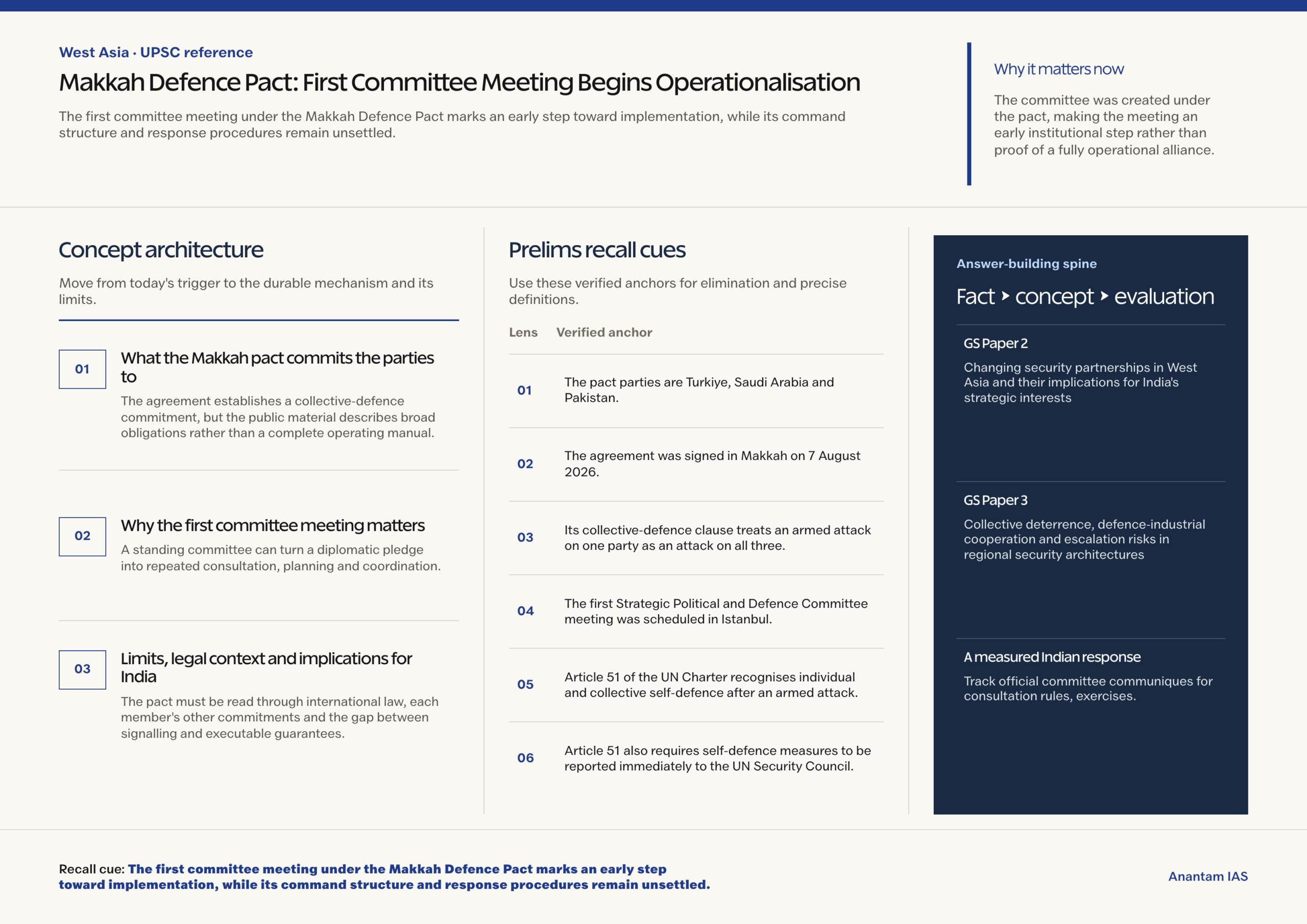
Mindmap explaining Makkah Defence Pact: First Committee Meeting Begins Operationalisation for UPSC revision
Revision mindmap: Makkah Defence Pact: First Committee Meeting Begins Operationalisation. Open the full-size image for details.

Background and Context

What the Makkah pact commits the parties to

The agreement establishes a collective-defence commitment, but the public material describes broad obligations rather than a complete operating manual.

  • The central clause says an armed attack against any one party shall be regarded as an attack against all three.
  • Official statements describe the pact as defensive, not directed against a named state, and intended to strengthen collective deterrence against external aggression.
  • The pact also covers wider defence cooperation, including joint capabilities, defence-industry projects and cooperation against terrorism, so its scope extends beyond a crisis-response clause.
  • Its public justification refers to UN Charter Article 51, which preserves individual and collective self-defence when an armed attack occurs against a UN member.
  • The public statements do not establish that every attack produces an identical or automatic military response; implementation depends on agreed procedures and political decisions.

Why the first committee meeting matters

A standing committee can turn a diplomatic pledge into repeated consultation, planning and coordination, but one meeting does not prove operational integration.

  • The committee’s combined political and defence character can connect diplomatic assessment, legal interpretation and military advice before any collective decision is made.
  • Its first meeting creates a venue to clarify threats, consultation triggers, information sharing, crisis communication and the division of responsibilities among the parties.
  • Credible deterrence requires potential adversaries to understand both political resolve and the partners’ capacity to coordinate under pressure without misreading defensive preparations as escalation.
  • Effective coordination would eventually require interoperable communications, exercises, logistics and planning; none of these should be treated as established without official evidence.
  • No publicly verified outcome was available when this note was prepared, so the meeting marks early operationalisation, not a completed security architecture.

Limits, legal context and implications for India

The pact must be read through international law, each member’s other commitments and the gap between signalling and executable guarantees.

  • Article 51 applies after an armed attack, requires measures to be reported to the Security Council and preserves the Council’s continuing authority.
  • Turkiye remains a NATO member, but the Makkah pact does not automatically convert a trilateral contingency into a NATO obligation; each treaty has its own parties and procedures.
  • The three parties bring different military capabilities, economic resources and regional relationships, which may strengthen bargaining power while also complicating a common threat assessment and response choice.
  • For India, the key concern is not an assumed automatic front but how the pact changes Pakistan’s diplomatic and defence options during a crisis.
  • India should distinguish verified clauses from speculation about nuclear guarantees, integrated command or predetermined responses, none of which the cited public notices establish.

Way Forward

A measured Indian response

  • Track official committee communiques for consultation rules, exercises, procurement links and any command or intelligence-sharing mechanisms.
  • Maintain direct strategic dialogue with Saudi Arabia and Turkiye while conveying Indian concerns about crisis stability and cross-border terrorism.
  • Strengthen India’s own maritime awareness, defence partnerships and evacuation planning across West Asia without treating the pact as a settled hostile bloc.
  • Anchor diplomatic assessments in the pact’s published language and observed conduct rather than unsupported claims about automatic intervention or nuclear cover.

Conclusion

  • The first committee meeting matters because it begins building an institutional bridge between a collective-defence promise and the consultation, planning and coordination needed to make it credible.
  • In an answer, separate the pact’s verified legal-political commitment from unresolved questions of command, interoperability, trigger interpretation and the form of any response.
  • For India, calibrated monitoring and sustained engagement offer a stronger response than treating an early-stage arrangement as a fully integrated alliance.

UPSC Practice Questions

Prelims MCQ 1

With reference to the Makkah Joint Defence Agreement, consider the following statements:

  1. It was signed by Turkiye, Saudi Arabia and Pakistan.
  2. It treats an armed attack against one party as an attack against all three.
  3. Its first Strategic Political and Defence Committee meeting was held in Makkah.

How many of the above statements are correct?

(a) Only one (b) Only two (c) All three (d) None

Answer: (b) Only two

Explanation:

Statements 1 and 2 are correct. The pact was signed in Makkah, but the first committee meeting was scheduled in Istanbul.

Prelims MCQ 2

Which provision of the UN Charter expressly recognises the inherent right of individual and collective self-defence after an armed attack?

(a) Article 2(4) (b) Article 33 (c) Article 51 (d) Article 99

Answer: (c) Article 51

Explanation:

Article 51 recognises this right, requires measures taken in self-defence to be reported immediately to the Security Council and preserves the Council’s authority.

UPSC Mains Questions

  1. The credibility of a collective-defence pact depends as much on institutions and procedures as on treaty language. Discuss with reference to the Makkah Joint Defence Agreement.
  2. Assess the implications of the emerging Turkiye-Saudi Arabia-Pakistan security arrangement for India’s interests in West Asia and its crisis-management choices.

Sources: Republic of Turkiye Ministry of Foreign Affairs and The Hindu.

Frequently Asked Questions

What is the Makkah Joint Defence Agreement?

It is a 2026 agreement among Turkiye, Saudi Arabia and Pakistan that treats an armed attack on one as an attack on all and seeks stronger defence cooperation.

Why is the first committee meeting significant?

It creates an institutional venue for political and defence coordination. It signals movement toward implementation, but does not by itself prove an integrated command or agreed response mechanism.

Does the pact require an automatic military response?

The public clause establishes collective-defence solidarity, but the cited official material does not specify an identical automatic response, operational trigger process or pre-agreed military action.

How is UN Charter Article 51 connected to the pact?

Article 51 recognises individual and collective self-defence after an armed attack, requires immediate reporting to the Security Council and preserves the Council’s responsibility for international peace.

Why does the pact matter to India?

Pakistan’s participation may affect regional signalling and defence cooperation. India must monitor implementation while sustaining relations with Saudi Arabia and Turkiye and avoiding claims unsupported by public evidence.
iFMS: Data Architecture for Fertilizer Management

Open article →Download PDF

Why in News?

On 30 August 2026, the Department of Fertilizers described how the Integrated Fertilizer Management System (iFMS) is being expanded from transaction recording into data-linked monitoring and decision support.

  • The architecture connects production, imports, movement, stocks, retail sales and subsidy processing, allowing officials to examine one supply chain through linked records.
  • Haryana’s Meri Fasal Mera Byora integration and subsequent AgriStack work tested links among fertilizer purchases, farmer identity, land records and crop information.
  • The Framework for Fertilizer Sale adds mobile booking and a verification step before the existing iFMS Point of Sale transaction.
  • The framework is being implemented in phases; the official release does not establish that every state database, booking flow or financial integration is nationally complete.
  • Linked data can reveal stock delays, unusual purchases and mismatches between booked requirement and final sale, but a flagged pattern is an audit lead, not proof of diversion.
  • Land-linked controls can improve targeting while excluding cultivators whose tenancy, inheritance, crop or plot details are missing, disputed or stale in the underlying record.

UPSC Relevance

Prelims Relevance

  • iFMS is developed and technically supported by the National Informatics Centre for the Department of Fertilizers.
  • Under fertilizer DBT, subsidy settlement is linked to actual sales recorded through PoS devices; the subsidized amount is not a cash transfer to the farmer.
  • The Framework for Fertilizer Sale connects AgriStack-based identity and land verification, mobile booking, a generated QR reference and the retailer’s PoS transaction.
  • AgriStack uses a federated structure: states compile registries under common standards, while standardized interfaces support authorized exchange.
  • The core AgriStack building blocks include the Farmer and Farmland Plot Registries, Crop Sown Registry, Unified Farmer Service Interface and Consent Manager.

Mains Relevance

GS Paper 3

  • Issues related to direct and indirect farm subsidies and the movement, storage and marketing of agricultural inputs.
  • Technology missions, farm-sector digital infrastructure and supply-chain monitoring.

GS Paper 2

  • Government policies and interventions, transparency, accountability and electronic service delivery.
  • Data protection, grievance redress and the exclusion risks created by automated eligibility checks.

Essay

  • Digital governance becomes trustworthy when efficiency is matched by explainability, correction rights and a working human appeal channel.
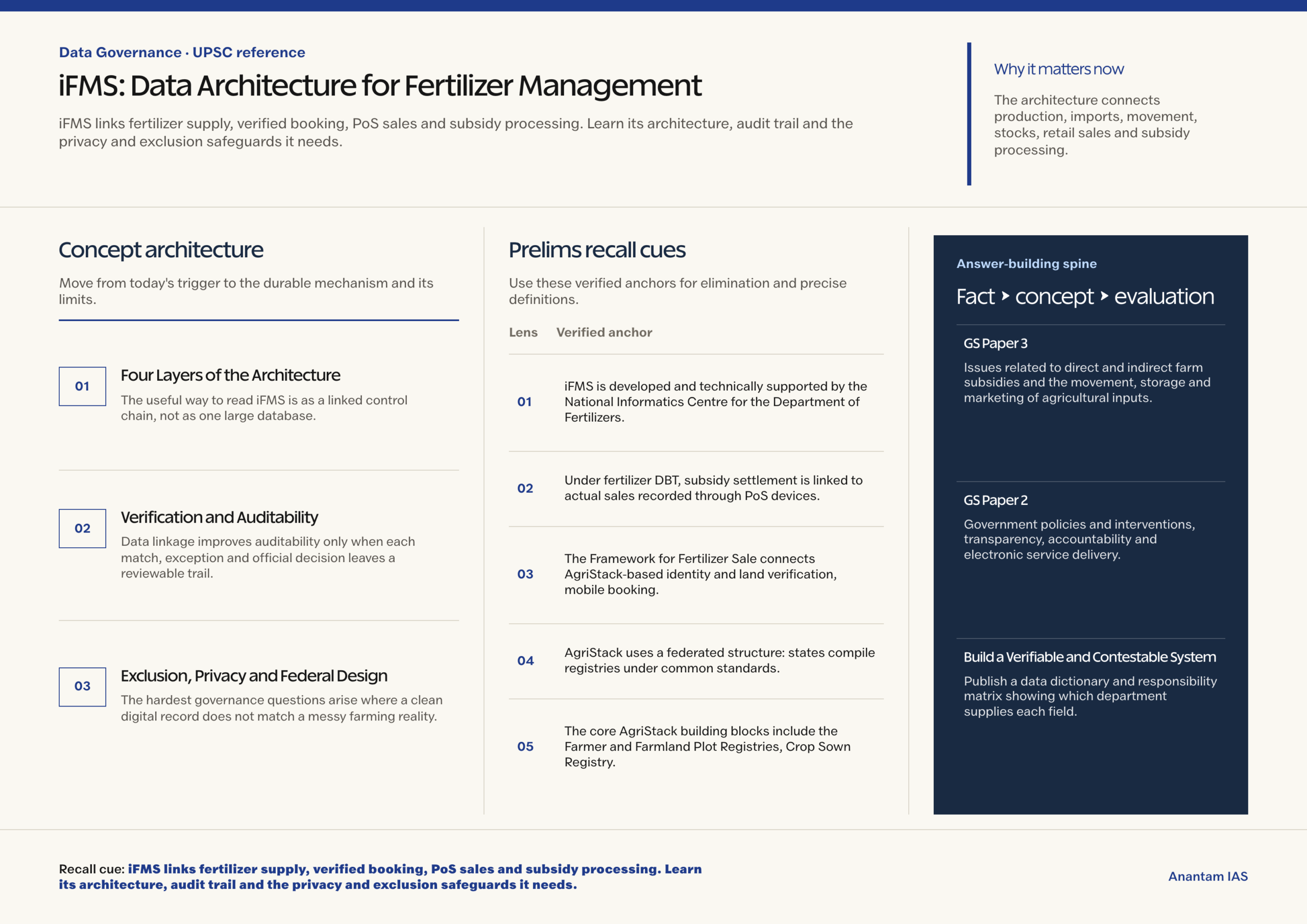
Mindmap explaining iFMS: Data Architecture for Fertilizer Management for UPSC revision
Revision mindmap: iFMS: Data Architecture for Fertilizer Management. Open the full-size image for details.

Background and Context

Four Layers of the Architecture

The useful way to read iFMS is as a linked control chain, not as one large database. Each layer answers a different control question.

  • The supply layer records production, imports, dispatch, goods in transit, stock position and retail availability, making gaps visible across successive stages.
  • The identity and farm layer matches a fertilizer buyer with state-held farmer, land and crop records through integrations such as MFMB and AgriStack.
  • The booking layer records assessed requirement before purchase, then carries the booking reference to the retailer’s PoS device for comparison with the quantity sold.
  • The transaction layer records the final retail sale. This is the event to which fertilizer subsidy processing is linked under the present DBT design.
  • The settlement layer links electronic subsidy bills with financial processes such as PFMS and e-Bill, creating traceable stages from claim to payment.

Verification and Auditability

Data linkage improves auditability only when each match, exception and official decision leaves a reviewable trail. A dashboard alone cannot supply this.

  • Dashboards can compare dispatch, stock and sale records across administrative levels, helping officials locate delays or unusual movement before a local shortage deepens.
  • Booking-versus-purchase comparison tests whether the final sale corresponds with an assessed requirement, but weather, crop change or revised sowing can produce legitimate variation.
  • Analytical flags should trigger risk-based verification, not automatic guilt. The rule, threshold, data version and officer action must remain available for later review.
  • Electronic bills reduce paper movement, while timestamps, maker-checker controls and payment-stage logs allow an auditor to reconstruct how a subsidy claim was examined.
  • A strong audit design preserves both positive and negative decisions: who approved a claim, who stopped it, what evidence was used and how an error was corrected.

Exclusion, Privacy and Federal Design

The hardest governance questions arise where a clean digital record does not match a messy farming reality. That mismatch is where exclusion begins.

  • A land title may name an owner while a tenant, joint holder or cultivator buys the input. The official dispute system recognizes these competing farmer roles.
  • Inheritance, mutation and crop updates can lag. A failed match should open an exception route, not silently convert a record-quality problem into denial.
  • Because AgriStack is federated, state ownership of registries can limit central duplication, but common standards are still needed for access control, correction and interoperability.
  • Farmer identity, land, crop and purchase history can reveal livelihood patterns. Collection should be purpose-bound, minimal, encrypted and retained only for a defined period.
  • Consent-based sharing is one AgriStack safeguard, but consent cannot replace clear notices, role-based access, breach response, grievance handling and independent security and bias audits.

Way Forward

Build a Verifiable and Contestable System

The next phase should measure successful correction and fair access, not only the number of linked transactions.

  • Publish a data dictionary and responsibility matrix showing which department supplies each field, how often it updates and who corrects an error.
  • Provide assisted and offline fallbacks for connectivity or authentication failure, with a time-bound human appeal that pauses adverse action during a genuine dispute.
  • Log every data access and automated flag, restrict fields by official role and subject the system to periodic privacy, security and exclusion-impact audits.
  • Scale each integration only after pilots disclose match errors, unresolved cases, turnaround time and outcomes for tenants, joint holders and other non-standard records.

Conclusion

  • iFMS can connect physical fertilizer movement, farm-linked demand, verified sale and subsidy settlement into one auditable chain, but integration quality matters more than database size.
  • A balanced Mains answer should pair targeting and traceability with federal data ownership, purpose limitation, correction rights and a human route for resolving exclusion.

UPSC Practice Questions

Prelims MCQ 1

With reference to the Integrated Fertilizer Management System (iFMS), consider the following statements:

  1. It is technically supported by the National Informatics Centre for the Department of Fertilizers.
  2. Fertilizer subsidy processing is linked to actual retail sales recorded through the Point of Sale network.
  3. The Framework for Fertilizer Sale links AgriStack-based verification and booking with the existing iFMS PoS ecosystem.

How many of the above statements are correct?

(a) Only one (b) Only two (c) All three (d) None

Answer: (c) All three

Explanation:

All three describe the official architecture. The booking framework adds a verification layer before the final PoS sale recorded in iFMS.

Prelims MCQ 2

Which one of the following best describes the federated design of AgriStack?

(a) All state land records are replaced by a single centrally owned register (b) States maintain registries under common standards and authorized interfaces enable data exchange (c) Private input dealers determine farmer eligibility without government-held records (d) Crop data can be exchanged without authentication, authorization or consent controls

Answer: (b) States maintain registries under common standards and authorized interfaces enable data exchange

Explanation:

AgriStack places states at the center of registry ownership while common schemas and interfaces support authorized, consent-brokered exchange.

UPSC Mains Questions

  1. Data integration can make fertilizer subsidy administration more targeted, but it can also turn record errors into exclusion. Critically examine with reference to iFMS and AgriStack.
  2. Digitization creates traceability, not accountability by itself. Discuss the institutional safeguards needed to make data-driven fertilizer management auditable and contestable.

Sources: PIB, Department of Fertilizers and AgriStack, Department of Agriculture and Farmers Welfare.

Frequently Asked Questions

What is iFMS?

The Integrated Fertilizer Management System is the Department of Fertilizers’ digital platform for monitoring production, imports, movement, stocks, retail sales and subsidy-related transactions.

Does fertilizer DBT transfer subsidy money to a farmer’s bank account?

No. Under the present design, subsidy is released to fertilizer companies based on actual retail sales captured through the PoS network.

How does the Framework for Fertilizer Sale fit into iFMS?

It adds farmer, land and crop verification plus mobile booking before the retailer records the final purchase through the existing iFMS PoS system.

Why can land-linked verification exclude a genuine cultivator?

Land records may be outdated or may name an owner rather than the tenant or joint cultivator. A correction and dispute route is needed before denying access.

Is iFMS-AgriStack integration complete across India?

The official release describes pilots, state integrations and phased implementation. It should not be read as proof that every database and booking process is nationally complete.

Cauvery Backlog Plea Tests Federal Water Enforcement

Open article →Download PDF

Why in News?

Tamil Nadu moved the Supreme Court on August 30 seeking directions for Cauvery releases, placing the enforceability of the basin’s institutional water-sharing mechanism under scrutiny.

  • Tamil Nadu pleaded a 17.604 tmcft backlog as of August 27 under its pro-rata calculation; this is the State’s claim, not an adjudicated finding.
  • It also sought compliance with the 9,000-cusecs release direction for the specified late-August to early-September period and correction of any measured shortfall at Billigundulu.
  • Tamil Nadu alleged that the CWRC and CWMA did not account for accumulated arrears while fixing current releases; the allegation still requires judicial assessment.
  • The hearing tests whether a court should issue an immediate release direction or require the statutory implementation bodies to quantify and remedy the asserted default.
  • The dispute is now about implementation and accounting: what was ordered, what crossed the gauge, whether distress adjustments applied, and how a shortfall should be made good.
  • Effective river federalism needs a chain from verified hydrological data to a reasoned order and timely compliance; a numerical allocation alone cannot enforce itself.
  • Judicial supervision can protect binding outcomes, but routine release management depends on specialised basin institutions that can revise directions as rainfall and storage change.

UPSC Relevance

Prelims Relevance

  • Section 6A of the Inter-State River Water Disputes Act, 1956 empowers the Union government to frame schemes implementing tribunal decisions.
  • The Cauvery Water Management Scheme, 2018 constituted both the CWMA and the CWRC.
  • Billigundulu is the identified inter-State gauge and discharge point for regulated flows from Karnataka towards Tamil Nadu.
  • The CWMA authorises releases and determines distress adjustments; its implementation decisions are final and binding on the party States and Puducherry.
  • The CWRC gathers reservoir and flow data, monitors releases, reconciles water accounts and acts under CWMA directions.

Mains Relevance

GS Paper 2

  • Cooperative federalism and compliance with binding inter-State water-sharing arrangements
  • Institutional accountability when an implementing authority’s direction is alleged to be ineffective

GS Paper 3

  • Data-led reservoir regulation during hydrological distress
  • Water-accounting capacity as infrastructure for climate-resilient basin governance

Essay

  • Federal institutions earn legitimacy when agreed rules remain enforceable during scarcity, not only when water is abundant.
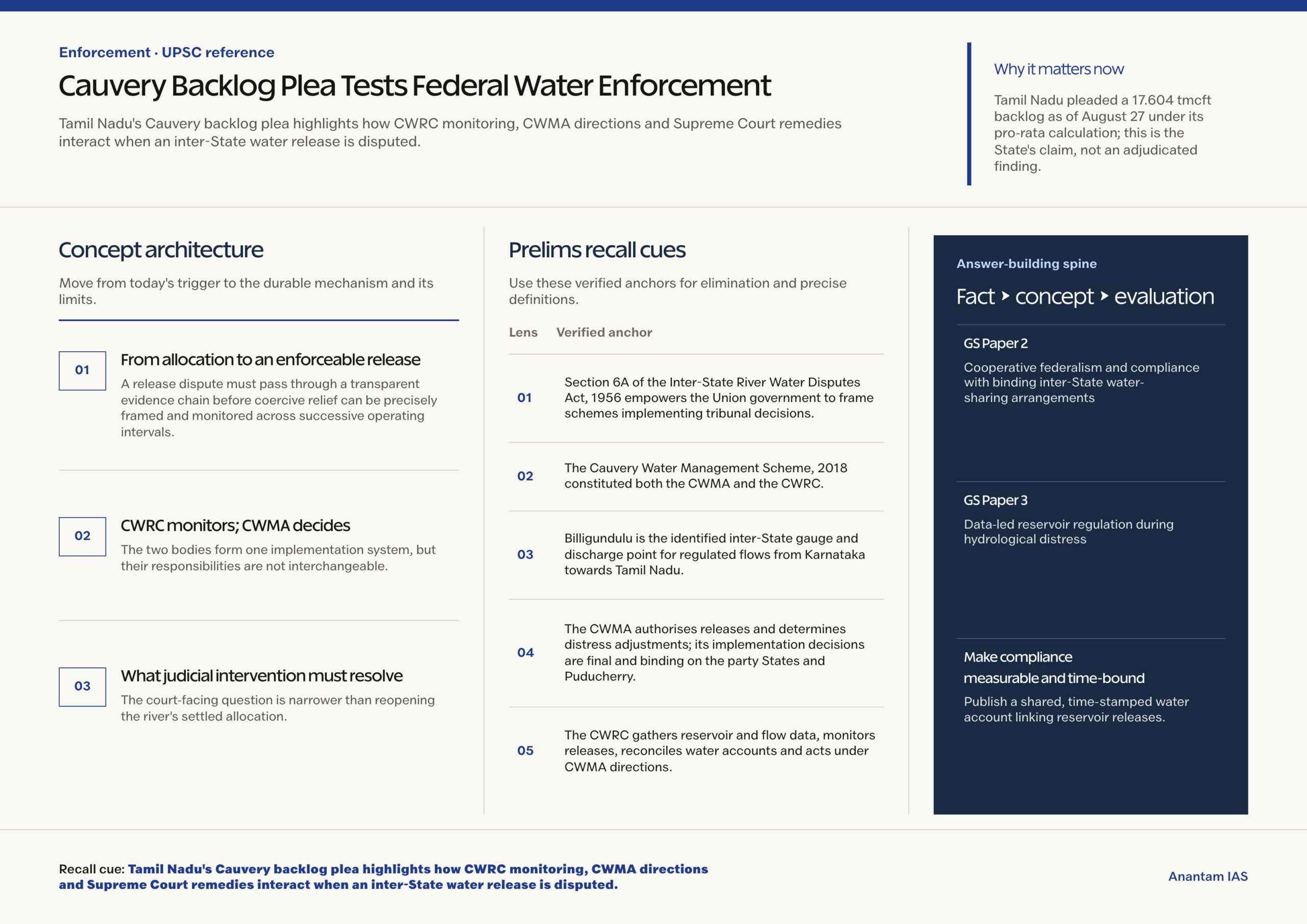
Mindmap explaining Cauvery Backlog Plea Tests Federal Water Enforcement for UPSC revision
Revision mindmap: Cauvery Backlog Plea Tests Federal Water Enforcement. Open the full-size image for details.

Background and Context

From allocation to an enforceable release

A release dispute must pass through a transparent evidence chain before coercive relief can be precisely framed and monitored across successive operating intervals.

  • The governing baseline is the tribunal award as modified by the Supreme Court, implemented through the 2018 scheme rather than renegotiated during each shortage.
  • For each operating interval, storage, inflows, realised flows, authorised withdrawals and State indents must be compared to determine the release obligation.
  • Water crossing Billigundulu supplies the crucial measured-flow record; a release from an upstream reservoir and a flow realised at the border are not automatically identical.
  • In a deficiency month, the CWMA may consider proportionate reductions after the CWRC reports availability; distress is an institutional determination, not a unilateral State label.
  • The alleged 17.604 tmcft arrear must be tested against the applicable direction, accepted data and distress calculation on a common evidentiary record before it becomes an enforceable quantified default.

CWRC monitors; CWMA decides

The two bodies form one implementation system, but their responsibilities are not interchangeable.

  • The CWRC’s operational role includes collecting daily reservoir levels and inflows, twelve-hourly release data, rainfall information and daily flows at Billigundulu.
  • It must ensure ten-daily releases as directed by the CWMA, monitor deviations, reconcile monthly reservoir accounts and report changing monsoon performance.
  • The CWMA’s decisional role covers apportionment, reservoir supervision, release authorisation, distress identification and revision of directions as new hydrological data arrive.
  • CWMA decisions for implementing the modified award are final and binding; CWRC action remains subject to the Authority’s directions and delegated powers.
  • If a State does not cooperate, the CWMA may seek Central government assistance; where default causes delay or shortfall, the scheme provides for action to make good the deficiency.

What judicial intervention must resolve

The court-facing question is narrower than reopening the river’s settled allocation.

  • Tamil Nadu asks for a specific performance-type remedy: release the pleaded backlog and ensure current flows, rather than alter the settled inter-State shares.
  • A judicial direction requires clarity on the operative CWMA order, the measurement period, actual border flows and whether the asserted arrear already reflects distress adjustment.
  • The Court can examine alleged non-compliance with its earlier judgment and implementation framework without becoming the basin’s day-to-day reservoir operator.
  • Prematurely treating a pleaded number as proved would bypass the scheme’s technical process; refusing all review could weaken the binding character of the institutional arrangement.
  • The durable balance is judicial enforcement of reasoned, lawful decisions alongside institutional primacy for measurement, short-interval regulation and hydrological revision.

Way Forward

Make compliance measurable and time-bound

  • Publish a shared, time-stamped water account linking reservoir releases, travel-time assumptions and Billigundulu flows to each CWMA direction.
  • Require the CWMA to record whether a claimed shortfall is a default, measurement variance or distress adjustment, with reasons accessible to every basin party.
  • Use the scheme’s deficiency-correction and Central-assistance powers through a graduated compliance protocol before disputes repeatedly require emergency court hearings.
  • Place concise compliance reports before the Court when litigation is pending, allowing targeted judicial relief without displacing technical reservoir management.

Conclusion

  • The present controversy shows that federal water rights become real through institutions: common data, reasoned release orders, reconciled accounts and credible consequences for default.
  • In an answer, distinguish the pleaded 17.604 tmcft figure from a judicial finding, then assess how CWRC monitoring, CWMA authority and judicial enforcement should complement one another.

UPSC Practice Questions

Prelims MCQ 1

With reference to the Cauvery Water Management Scheme, consider the following statements:

  1. The CWRC collects flow data at Billigundulu and reconciles reservoir water accounts.
  2. The CWMA may identify basin distress and authorise revised releases.
  3. CWRC decisions supersede CWMA directions when an affected State disagrees.

How many of the above statements are correct?

(a) Only one (b) Only two (c) All three (d) None

Answer: (b) Only two

Explanation:

Statements 1 and 2 are correct. The CWRC implements and monitors releases under CWMA directions; it does not supersede the Authority.

Prelims MCQ 2

Section 6A of the Inter-State River Water Disputes Act, 1956 primarily enables the Union government to:

(a) alter a tribunal award without adjudication (b) nationalise every inter-State river (c) frame a scheme to implement a tribunal decision (d) transfer river-water disputes to State legislatures

Answer: (c) frame a scheme to implement a tribunal decision

Explanation:

Section 6A permits the Union government to notify implementation schemes, including authorities and committees needed to give effect to a tribunal’s decision.

UPSC Mains Questions

  1. Inter-State river-water adjudication is incomplete without credible institutions of implementation. Discuss with reference to the respective roles of the CWMA, CWRC and Supreme Court.
  2. How can judicial remedies enforce federal water-sharing obligations without converting constitutional courts into day-to-day reservoir managers?

Sources: The Hindu and Supreme Court of India, Cauvery Water Management Scheme order.

Frequently Asked Questions

Is 17.604 tmcft a Supreme Court finding?

No. It is the backlog Tamil Nadu pleaded as of August 27 using its pro-rata calculation. The Court must assess the claim against orders, flow records and applicable distress adjustments.

What is the main role of the CWMA?

The CWMA implements the modified Cauvery award by authorising releases, supervising reservoir regulation, determining distress adjustments and issuing final, binding implementation decisions for the basin parties.

What does the CWRC do?

The CWRC is the operational monitoring body. It gathers reservoir, rainfall and flow data, tracks releases, reconciles accounts and implements ten-daily release directions issued by the CWMA.

Why is Billigundulu important?

Billigundulu is the scheme’s identified inter-State gauge and discharge site. Its measured flows help determine whether water directed from Karnataka was realised at the Tamil Nadu border.

What can happen if a State defaults on releases?

The scheme permits the CWMA to act to make good a default-caused deficiency and to seek Central government help when a basin State does not cooperate with implementation.

India-Chile CEPA Negotiations: Beyond the Existing Trade Preferences

Open article →Download PDF

Why in News?

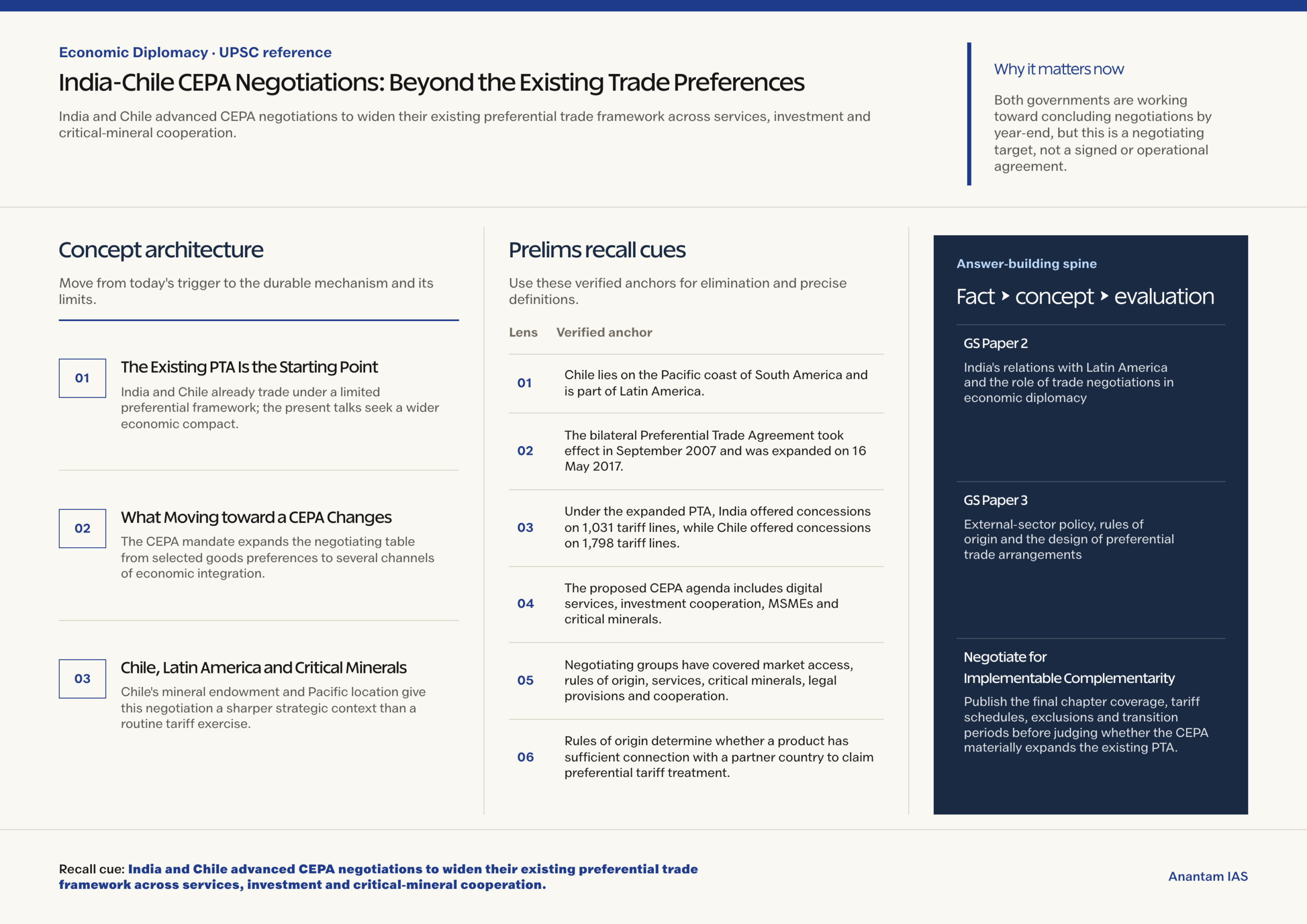
India’s Commerce Secretary met Chile’s Vice-Minister for International Economic Relations in Santiago on 26 August 2026 to advance the ongoing India-Chile CEPA negotiations.

  • Both governments are working toward concluding negotiations by year-end, but this is a negotiating target, not a signed or operational agreement.
  • The proposed Comprehensive Economic Partnership Agreement would build on the bilateral Preferential Trade Agreement rather than replace a vacuum in trade relations.
  • Chile reported that most chapters were closed, while work continued on market-access conditions, critical minerals and other unresolved matters.
  • The Indian side identified healthcare, pharmaceuticals, energy, minerals, agriculture, machinery and engineering as possible areas of deeper cooperation, without announcing negotiated concessions.
  • The shift from selected tariff preferences to a wider negotiating agenda makes the talks a test of India’s economic engagement with Pacific South America.
  • Chile’s copper and lithium base gives critical-mineral cooperation a strategic dimension beyond ordinary merchandise trade.
  • The final value of a CEPA will depend on its agreed schedules, rules and implementation institutions; official expectations do not establish guaranteed market-access outcomes.

UPSC Relevance

Prelims Relevance

  • Chile lies on the Pacific coast of South America and is part of Latin America.
  • The bilateral Preferential Trade Agreement took effect in September 2007 and was expanded on 16 May 2017.
  • Under the expanded PTA, India offered concessions on 1,031 tariff lines, while Chile offered concessions on 1,798 tariff lines.
  • The proposed CEPA agenda includes digital services, investment cooperation, MSMEs and critical minerals.
  • Negotiating groups have covered market access, rules of origin, services, critical minerals, legal provisions and cooperation.
  • Rules of origin determine whether a product has sufficient connection with a partner country to claim preferential tariff treatment.

Mains Relevance

GS Paper 2

  • India’s relations with Latin America and the role of trade negotiations in economic diplomacy
  • South-South cooperation through balanced institutions rather than commodity exchange alone

GS Paper 3

  • External-sector policy, rules of origin and the design of preferential trade arrangements
  • Critical-mineral security, processing partnerships and resilient clean-energy supply chains

Essay

  • A durable economic partnership must connect market access with technology, investment and resilient supply chains.
Mindmap explaining India-Chile CEPA Negotiations: Beyond the Existing Trade Preferences for UPSC revision
Revision mindmap: India-Chile CEPA Negotiations: Beyond the Existing Trade Preferences. Open the full-size image for details.

Background and Context

The Existing PTA Is the Starting Point

India and Chile already trade under a limited preferential framework; the present talks seek a wider economic compact.

  • The India-Chile PTA was signed in March 2006, entered into force in September 2007 and was expanded by both countries in May 2017, giving it an established institutional base.
  • A PTA grants tariff concessions on an agreed selection of goods; it does not automatically provide comprehensive treatment for services, investment or regulatory cooperation.
  • The expanded arrangement covers selected agricultural and industrial products, including pharmaceuticals, chemicals, textiles, machinery, iron, steel and copper-related goods across the two countries’ schedules.
  • It also contains product-specific rules of origin and protocols on sanitary measures and technical barriers, showing that even limited preferences require compliance rules.
  • The negotiated tariff lines, concession margins and origin tests govern actual eligibility; the label preferential does not mean duty-free access for every product.

What Moving toward a CEPA Changes

The CEPA mandate expands the negotiating table from selected goods preferences to several channels of economic integration.

  • The May 2025 Terms of Reference launched negotiations to build on the PTA and cover digital services, investment promotion and cooperation, MSMEs and critical minerals.
  • Separate negotiating tracks on goods access, services and rules of origin matter because progress in one chapter does not settle obligations in another.
  • Investment provisions can support longer business relationships, but their legal protections, exclusions and dispute arrangements depend on the text that the parties eventually accept.
  • Services discussions are relevant to India’s digital and professional capabilities, yet no sector-specific access can be assumed until commitments and domestic regulatory conditions are published.
  • Chile’s statement that most chapters are closed signals advanced drafting; unresolved access conditions can still shape the agreement’s commercial balance and timetable.

Chile, Latin America and Critical Minerals

Chile’s mineral endowment and Pacific location give this negotiation a sharper strategic context than a routine tariff exercise.

  • Chile is a major producer and exporter of copper and lithium, materials central to electricity networks, batteries, renewable-energy systems and several advanced manufacturing chains.
  • For India, cooperation could cover geological knowledge, responsible extraction, processing, recycling, technology and predictable commercial relationships rather than only purchases of unprocessed mineral output.
  • For Chile, India offers another large Asian market and a possible partner for value addition, helping diversify commercial relationships without guaranteeing demand for any particular product.
  • A minerals chapter cannot by itself secure supplies; projects still need finance, environmental safeguards, community legitimacy, processing capacity, logistics and contracts between viable commercial entities.
  • The CEPA also fits India’s wider engagement with Latin America, where commodity complementarity must be matched by services, technology, investment, diversified trade and durable institutional contact beyond episodic diplomatic visits.

Way Forward

Negotiate for Implementable Complementarity

  • Publish the final chapter coverage, tariff schedules, exclusions and transition periods before judging whether the CEPA materially expands the existing PTA.
  • Design workable rules of origin and customs procedures that enable genuine bilateral production while preventing simple trans-shipment through either economy.
  • Link critical-mineral cooperation to processing, recycling, skills, technology and transparent environmental standards instead of treating higher extraction volumes as the sole measure of success.
  • Create regular government-business review channels to identify regulatory obstacles and assess whether smaller firms can use the agreement after implementation.

Conclusion

  • The current development is progress in negotiations, not the conclusion of a CEPA; the 2007 PTA, as expanded in 2017, remains the operative trade arrangement.
  • A balanced answer should explain the proposed shift toward services, investment and mineral cooperation, then test future claims against the signed text, schedules and implementation record.

UPSC Practice Questions

Prelims MCQ 1

With reference to India-Chile trade relations, consider the following statements:

  1. The bilateral Preferential Trade Agreement entered into force in 2007.
  2. The expanded PTA provides concessions on selected tariff lines rather than universal duty-free access.
  3. The India-Chile CEPA was signed in August 2026.

How many of the above statements are correct?

(a) Only one (b) Only two (c) All three (d) None

Answer: (b) Only two

Explanation:

Statements 1 and 2 are correct. India and Chile were still negotiating the CEPA in August 2026; no concluded agreement was announced.

Prelims MCQ 2

Which one of the following is included in the stated scope of the proposed India-Chile CEPA?

(a) A common currency (b) A bilateral military command (c) Critical-mineral cooperation (d) A common agricultural tax

Answer: (c) Critical-mineral cooperation

Explanation:

The Terms of Reference identify critical minerals alongside digital services, investment promotion and cooperation and MSMEs within the proposed CEPA’s broader scope.

UPSC Mains Questions

  1. The proposed India-Chile CEPA represents a shift from selective tariff preferences toward wider economic cooperation. Discuss its significance for India’s engagement with Latin America.
  2. Critical-mineral partnerships must extend beyond mineral imports to create resilient and responsible value chains. Examine with reference to India-Chile economic relations.

Sources: PIB, Ministry of Commerce and Industry and SUBREI, Government of Chile.

Frequently Asked Questions

Has India signed a CEPA with Chile?

No. As of 31 August 2026, the two countries were negotiating a CEPA and aiming for an early conclusion. The existing bilateral PTA remained in force.

How is the proposed CEPA different from the existing PTA?

The PTA grants concessions on selected goods. The CEPA negotiations have a wider stated scope covering services, investment cooperation, MSMEs, critical minerals and related institutional rules.

Why are critical minerals important in India-Chile relations?

Chile has substantial copper and lithium strengths, while India needs resilient inputs and processing partnerships for clean energy, electricity networks, batteries and advanced manufacturing.

What do rules of origin do in a trade agreement?

They establish when a product qualifies as originating in a partner country and can claim preferential tariffs, while limiting simple trans-shipment from third countries.

What should be watched as negotiations continue?

The decisive details are final tariff schedules, exclusions, transition periods, services commitments, origin rules, mineral-cooperation provisions and the institutions created to implement and review the agreement.

India-Uzbekistan Outcomes: Critical Minerals, Heritage and Connectivity

Open article →Download PDF

Why in News?

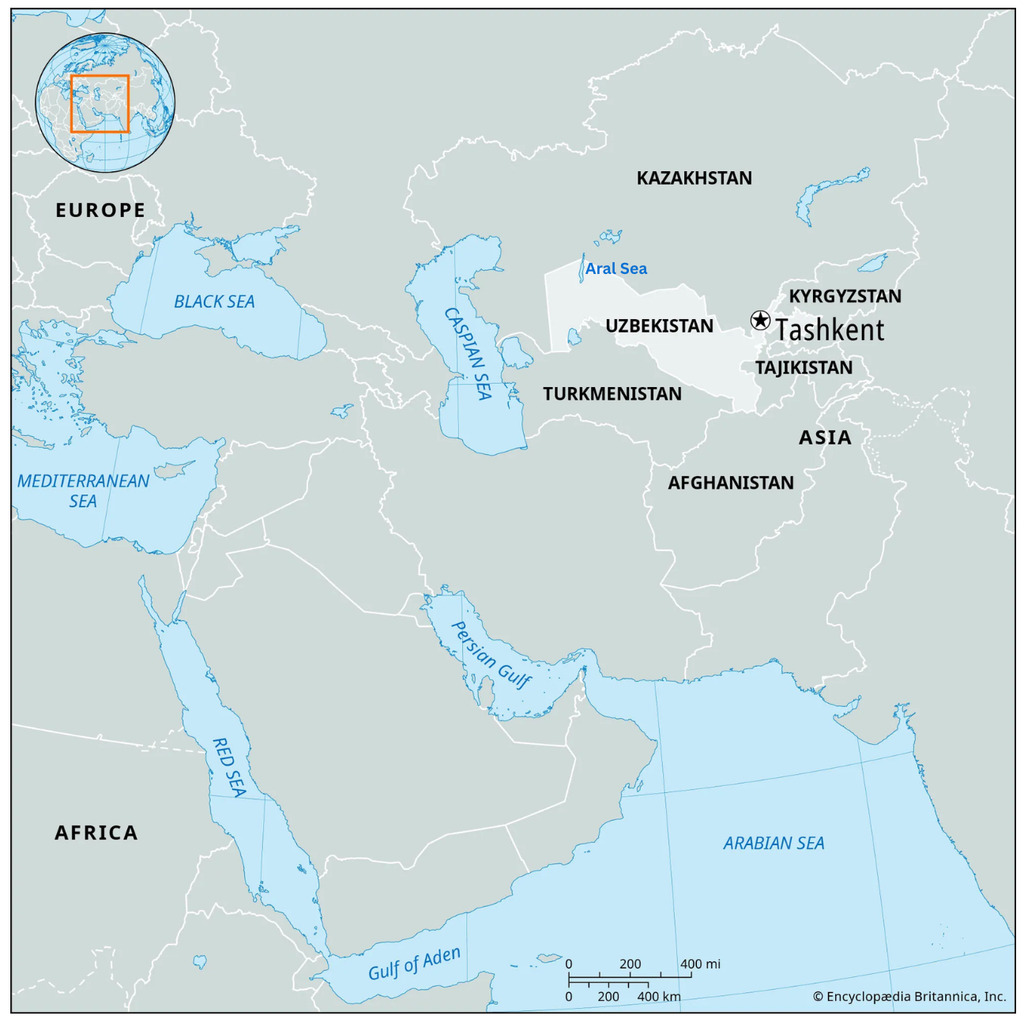
India and Uzbekistan concluded a package of instruments and announcements on 30 August 2026 after the Indian Prime Minister’s State Visit to Uzbekistan.

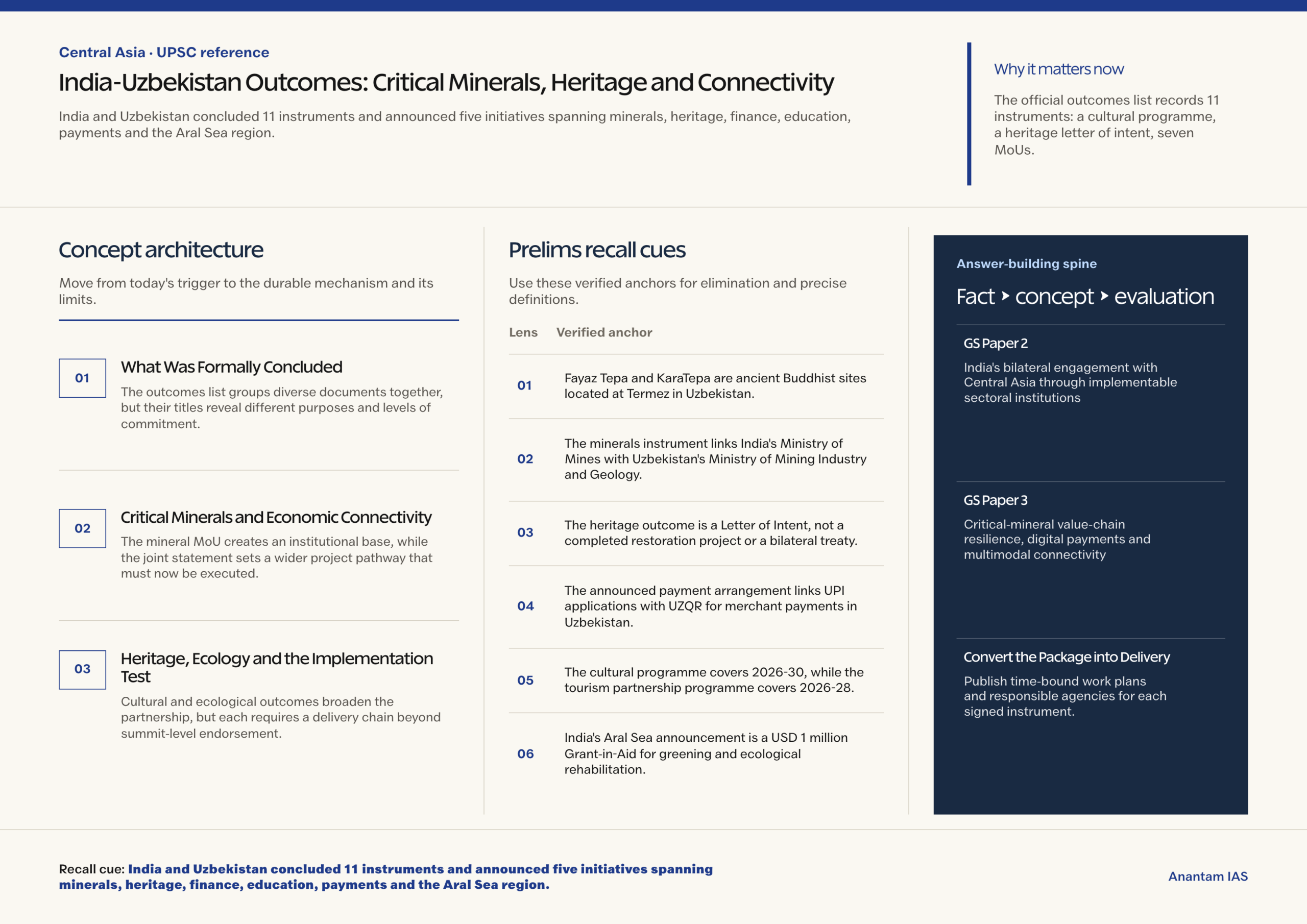
  • The official outcomes list records 11 instruments: a cultural programme, a heritage letter of intent, seven MoUs, a tourism partnership programme and two cooperation agreements.
  • A geology and mineral-resources MoU was paired with a political commitment to pursue projects across exploration, mining, processing and integrated critical-mineral value chains.
  • The package announced a Comprehensive Strategic Partnership, a USD 1 million Aral Sea greening grant, 100 Hindi scholarships and an ICCR Sanskrit Chair.
  • A separate commercial agreement between NIPL and Uzbekistan’s NIPC is intended to let Indian UPI apps scan UZQR for merchant payments in Uzbekistan.
  • The outcome package converts parts of the pre-visit agenda into named institutional channels covering minerals, finance, heritage, education, health, tourism and environmental cooperation.
  • Its legal and operational weight varies: a signed MoU, a letter of intent, a commercial agreement and a leaders’ commitment should not be treated as interchangeable.
  • The central test is implementation through projects, regulator-level work and follow-up, not the breadth of sectors mentioned in the joint statement.

UPSC Relevance

Prelims Relevance

  • Fayaz Tepa and KaraTepa are ancient Buddhist sites located at Termez in Uzbekistan.
  • The minerals instrument links India’s Ministry of Mines with Uzbekistan’s Ministry of Mining Industry and Geology.
  • The heritage outcome is a Letter of Intent, not a completed restoration project or a bilateral treaty.
  • The announced payment arrangement links UPI applications with UZQR for merchant payments in Uzbekistan.
  • The cultural programme covers 2026-30, while the tourism partnership programme covers 2026-28.
  • India’s Aral Sea announcement is a USD 1 million Grant-in-Aid for greening and ecological rehabilitation.

Mains Relevance

GS Paper 2

  • India’s bilateral engagement with Central Asia through implementable sectoral institutions
  • The difference between diplomatic declarations, signed instruments and delivery mechanisms

GS Paper 3

  • Critical-mineral value-chain resilience, digital payments and multimodal connectivity
  • Heritage conservation and ecological rehabilitation as instruments of development partnership

Essay

  • Diplomacy gains durability when civilisational links are matched by institutions, investment and measurable delivery.
Mindmap explaining India-Uzbekistan Outcomes: Critical Minerals, Heritage and Connectivity for UPSC revision
Revision mindmap: India-Uzbekistan Outcomes: Critical Minerals, Heritage and Connectivity. Open the full-size image for details.

Background and Context

What Was Formally Concluded

The outcomes list groups diverse documents together, but their titles reveal different purposes and levels of commitment.

  • The Cultural Exchange Programme provides a defined 2026-30 framework, while the tourism partnership programme establishes a separate 2026-28 cooperation window with scheduled institutional continuity.
  • Seven listed MoUs cover archives, traditional medicine, geology and minerals, diplomatic training, economic and financial dialogue, higher education and scientific research through dedicated government channels.
  • An environmental cooperation agreement and a Gujarat-Samarkand partnership agreement add national and subnational channels rather than relying only on central diplomatic exchanges.
  • The Buddhist-site document is explicitly a Letter of Intent; it signals intent to conserve Fayaz Tepa and KaraTepa but does not itself prove restoration has begun.
  • The UPI-UZQR arrangement is a commercial agreement between payment-system entities, distinct from an intergovernmental MoU and still dependent on technical integration, regulatory readiness and operational rollout.

Critical Minerals and Economic Connectivity

The mineral MoU creates an institutional base, while the joint statement sets a wider project pathway that must now be executed.

  • The leaders identified geological exploration, mining, mineral processing and integrated value chains as fields for possible joint critical-mineral projects involving companies and specialist institutions.
  • Processing and value addition matter because access to ore alone does not secure the refining, intermediate materials and recycling capabilities required by batteries, electronics and strategic manufacturing.
  • A proposed Joint Working Group on non-tariff issues and investment barriers is a political commitment requiring follow-up, not one of the 11 listed signed instruments.
  • The two sides also directed ministries to explore time-bound next steps after completing a feasibility study on a preferential trade agreement; no trade agreement was concluded during this visit.
  • Transport language remained exploratory: the leaders backed multimodal routes, freight restoration and logistics cooperation without announcing a new corridor treaty, completed route or immediate reduction in trade costs.

Heritage, Ecology and the Implementation Test

Cultural and ecological outcomes broaden the partnership, but each requires a delivery chain beyond summit-level endorsement.

  • The Termez heritage initiative can combine conservation expertise, archaeological research and digital documentation through museums and restoration centres, but its scope, schedule and implementing arrangements remain unsettled.
  • The Aral Sea Grant-in-Aid is a concrete funding announcement for greening and ecological rehabilitation, accompanied by technical support under India’s development partnership framework.
  • A Foreign Ministers-led mechanism was politically agreed to coordinate implementation of agreements and priority projects, with timely realisation as its stated purpose and principal test.
  • The elevation to a Comprehensive Strategic Partnership raises political ambition, but the designation is not evidence that every sectoral proposal is funded, operational or supported by delivery milestones.
  • For answers, classify outcomes as signed instruments, commercial arrangements, funded announcements or future commitments before judging their strategic value.

Way Forward

Convert the Package into Delivery

  • Publish time-bound work plans and responsible agencies for each signed instrument, with periodic review through the Foreign Ministers-led mechanism.
  • Move the minerals MoU toward bankable projects that cover exploration data, environmental safeguards, processing capacity, recycling and predictable offtake arrangements.
  • Complete technical and regulatory integration before presenting UPI-UZQR merchant acceptance as an available service.
  • Define conservation standards, site responsibilities and monitoring for Termez, while linking Aral Sea support to locally suitable restoration and transparent outcome reporting.

Conclusion

  • The visit’s significance lies in its layered outcome package: institutional instruments, a commercial payments link, funded announcements and political commitments serving different functions.
  • A strong UPSC answer should distinguish those categories, then assess whether follow-up produces mineral projects, usable connectivity, conserved heritage and accountable ecological outcomes.

UPSC Practice Questions

Prelims MCQ 1

With reference to the outcomes of the 2026 India-Uzbekistan State Visit, consider the following statements:

  1. A Letter of Intent concerned conservation and restoration of Buddhist sites at Termez.
  2. The geology and mineral-resources instrument was signed by India’s Ministry of Mines and its Uzbek counterpart.
  3. The visit concluded a bilateral preferential trade agreement.

How many of the above statements are correct?

(a) Only one (b) Only two (c) All three (d) None

Answer: (b) Only two

Explanation:

Statements 1 and 2 are correct. The leaders directed their ministries to explore next steps after a feasibility study; they did not conclude a preferential trade agreement.

Prelims MCQ 2

The announced NIPL-NIPC commercial agreement primarily seeks to:

(a) settle bilateral trade exclusively in national currencies (b) connect securities depositories of the two countries (c) enable Indian UPI apps to scan UZQR for merchant payments in Uzbekistan (d) create a common central-bank digital currency

Answer: (c) enable Indian UPI apps to scan UZQR for merchant payments in Uzbekistan

Explanation:

The official outcomes list describes merchant-payment interoperability between Indian UPI applications and Uzbekistan’s national QR system through a commercial agreement between NIPL and NIPC.

UPSC Mains Questions

  1. Distinguishing signed instruments from political commitments is essential for assessing summit diplomacy. Examine with reference to the 2026 India-Uzbekistan State Visit outcomes.
  2. How can cooperation with Uzbekistan strengthen India’s critical-mineral resilience and Central Asian connectivity? Discuss the implementation challenges.

Sources: PIB, Prime Minister's Office: List of Outcomes and PIB, Prime Minister's Office: Joint Statement.

Frequently Asked Questions

What were the main India-Uzbekistan outcomes in August 2026?

The package covered minerals, archives, traditional medicine, education, finance, environment, tourism and heritage, alongside partnership elevation, scholarships, Aral Sea support and a payments arrangement.

Did India and Uzbekistan sign a critical-minerals agreement?

They signed an MoU on geology and mineral resources. The joint statement separately expressed intent to develop projects in exploration, mining, processing, recycling and integrated value chains.

What is the status of the Termez Buddhist-site initiative?

It is a Letter of Intent concerning conservation and restoration of Fayaz Tepa and KaraTepa. It signals cooperation but does not establish that restoration work is complete or underway.

What does the UPI-UZQR announcement mean?

NIPL and Uzbekistan’s NIPC signed a commercial agreement intended to let Indian UPI apps scan UZQR for merchant payments in Uzbekistan, subject to operational implementation.

How should UPSC answers evaluate the visit?

Classify each outcome by status, identify its delivery mechanism and judge progress through implemented projects, functioning payment links, reduced trade barriers and verifiable conservation or ecological results.

Railway Freight Lines Under the Hybrid Annuity Model

Open article →Download PDF

Why in News?

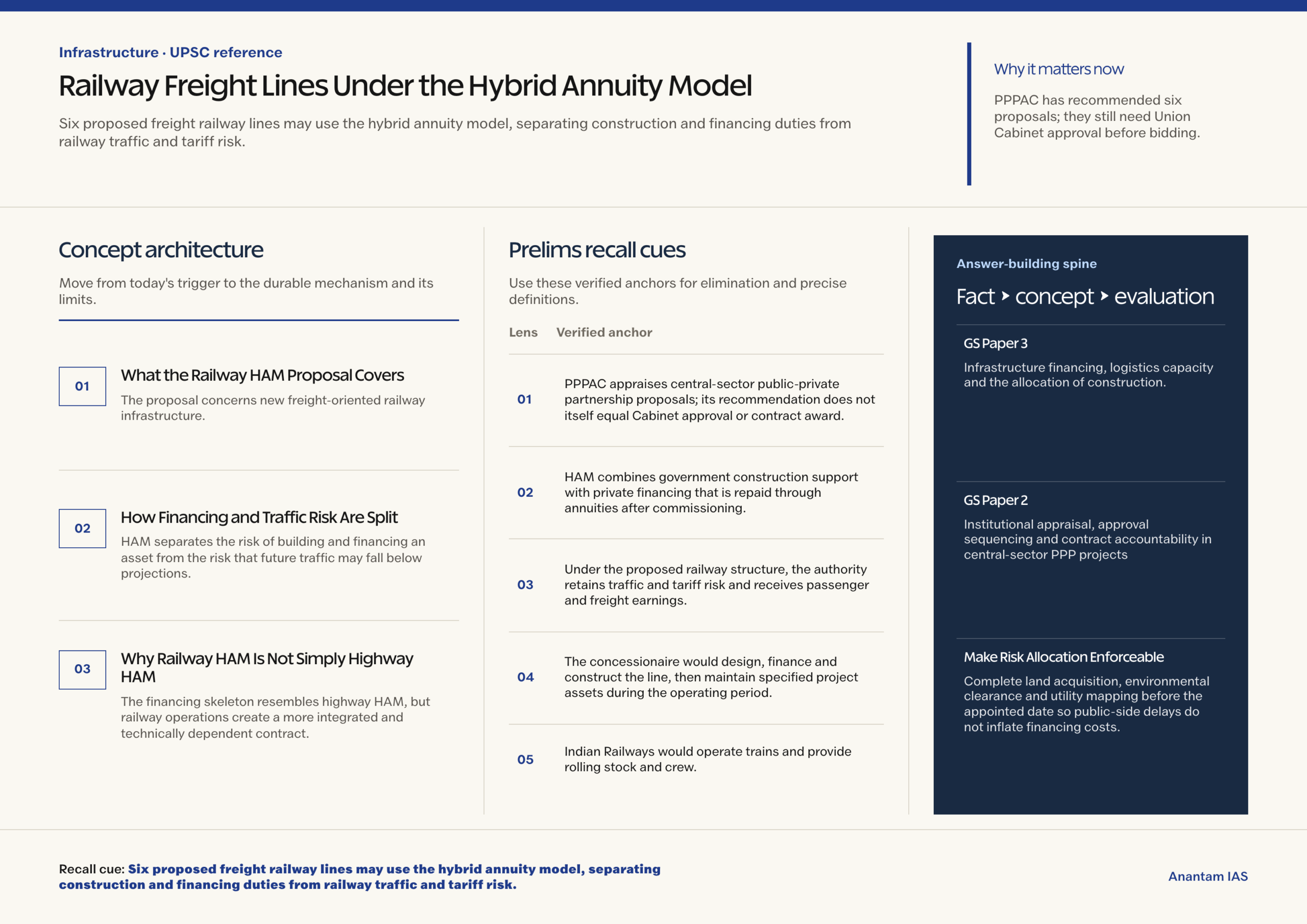
The Indian Express reported that the PPPAC recommended six proposed freight railway lines for development under the Hybrid Annuity Model, a first for Indian Railways.

  • The six proposals cover about 647 km: four lines in Odisha, one in Telangana and one in Jharkhand.
  • Indian Railways would provide 40% of the bid project cost during construction, while the concessionaire would finance the remaining 60%.
  • After commissioning, the authority would make annuity and indexed maintenance payments; passenger and freight earnings would accrue to Indian Railways.
  • The PPPAC recommendation is not Cabinet approval, project award or construction commencement; the proposals still require competent-authority approval and subsequent procurement steps.
  • The shift followed market feedback on an earlier DBFOT structure, indicating that freight-demand exposure had weakened private appetite.
  • The design seeks private capital and delivery capacity without making the builder depend on uncertain freight loading or tariff decisions for repayment.
  • For public policy, the key test is whether better risk allocation produces timely assets without creating poorly monitored long-term fiscal commitments.

UPSC Relevance

Prelims Relevance

  • PPPAC appraises central-sector public-private partnership proposals; its recommendation does not itself equal Cabinet approval or contract award.
  • HAM combines government construction support with private financing that is repaid through annuities after commissioning.
  • Under the proposed railway structure, the authority retains traffic and tariff risk and receives passenger and freight earnings.
  • The concessionaire would design, finance and construct the line, then maintain specified project assets during the operating period.
  • Indian Railways would operate trains and provide rolling stock and crew, unlike a concession in which the private party runs the transport service.

Mains Relevance

GS Paper 3

  • Infrastructure financing, logistics capacity and the allocation of construction, financing and demand risks in railway PPPs
  • Fiscal implications of converting private upfront finance into long-term annuity and maintenance obligations

GS Paper 2

  • Institutional appraisal, approval sequencing and contract accountability in central-sector PPP projects

Essay

  • Public-private partnership succeeds when each risk is assigned to the party best able to manage it, not when risk merely disappears from the headline budget.
Mindmap explaining Railway Freight Lines Under the Hybrid Annuity Model for UPSC revision
Revision mindmap: Railway Freight Lines Under the Hybrid Annuity Model. Open the full-size image for details.

Background and Context

What the Railway HAM Proposal Covers

The proposal concerns new freight-oriented railway infrastructure, not the privatisation of train operations or freight tariff setting.

  • The corridors connect coal, mineral, port and industrial areas, where freight demand can vary with production, trade and commodity cycles, making forecasts sensitive to anchor-user demand.
  • The concessionaire would undertake design, financing and construction, placing delivery obligations and construction performance with the private project company.
  • The authority would handle land acquisition and statutory approvals, risks that depend heavily on public powers and inter-agency coordination. A clean site is essential before the appointed date.
  • During operations, Indian Railways would run trains, supply rolling stock and crew, and collect passenger and freight earnings from the completed lines.
  • The private party would maintain project assets and stations and replace specified assets at the end of their prescribed life, while rails are excluded from that replacement duty.

How Financing and Traffic Risk Are Split

HAM separates the risk of building and financing an asset from the risk that future traffic may fall below projections.

  • Indian Railways would pay 40% during construction against milestones, reducing the private capital that must remain exposed before the line earns public revenue.
  • The concessionaire would arrange the balance 60% through debt and equity, so financial closure and construction-period funding remain private responsibilities shaped by project risk and payment certainty.
  • After commercial operation, the authority would repay this financed portion through annuities with interest and make separate price-indexed payments for operation and maintenance duties.
  • Indian Railways would bear traffic and tariff risk; lower-than-expected freight loading or revenue would not directly reduce the concessionaire’s agreed annuity stream.
  • This can attract long-term investors through predictable payments, but it also creates a multi-year public liability requiring transparent budgeting and performance verification across the concession period.

Why Railway HAM Is Not Simply Highway HAM

The financing skeleton resembles highway HAM, but railway operations create a more integrated and technically dependent contract.

  • In both models, the authority provides construction support, the concessionaire finances the balance, and user-demand revenue risk remains with the public authority.
  • On a highway, the authority collects toll revenue; here, Indian Railways would control train paths, rolling stock, crew, tariffs and freight receipts.
  • Railway track, signalling, electrification and safety certification function as one system, so delays or failures can involve both authority-controlled operations and concessionaire-maintained assets, complicating attribution of liability.
  • The PPPAC asked for clearer provisions on future line augmentation, equipment inspection, commercial-operation certification, utility shifting and contractor substitution before procurement documents are finalised.
  • Most importantly, the PPPAC action is an appraisal-stage recommendation. Cabinet or competent-authority approval, bidding, award, financial closure and construction are separate later stages.

Way Forward

Make Risk Allocation Enforceable

A sound concession must match control with accountability across construction, railway operations and long-term public payments.

  • Complete land acquisition, environmental clearance and utility mapping before the appointed date so public-side delays do not inflate financing costs.
  • Define measurable construction, safety, availability and maintenance standards, with independent certification and payments linked to verified performance.
  • Disclose the full annuity, interest and indexed maintenance commitments in medium-term budgets rather than assessing affordability only through upfront support.
  • Provide contractual rules for traffic blocks, future doubling, asset replacement and disputes where railway operations and concessionaire maintenance responsibilities overlap.

Conclusion

  • Railway HAM can mobilise private finance by shielding the builder from freight-demand and tariff risk while retaining private responsibility for designing, financing, constructing and maintaining the asset.
  • In a Mains answer, assess the model through risk-control alignment, lifecycle fiscal cost and contract governance, while keeping PPPAC recommendation distinct from final approval and execution.

UPSC Practice Questions

Prelims MCQ 1

With reference to the proposed Hybrid Annuity Model for railway freight lines, consider the following statements:

  1. A PPPAC recommendation itself constitutes final Cabinet approval and project award.
  2. Indian Railways would bear traffic and tariff risks under the proposed structure.
  3. The private concessionaire would operate trains and collect all freight revenue.

How many of the above statements are correct?

(a) Only one (b) Only two (c) All three (d) None

Answer: (a) Only one

Explanation:

Only statement 2 is correct. PPPAC recommended the proposals for competent-authority consideration. Indian Railways would operate trains and receive freight earnings; recommendation, award and construction are distinct stages.

Prelims MCQ 2

Which option best describes the financing arrangement proposed for these railway lines?

(a) The concessionaire bears the entire cost and recovers it only from freight charges (b) The authority pays 40% during construction, while the concessionaire finances 60% that is repaid through annuities (c) Indian Railways funds the full construction cost and privately leases train paths (d) The concessionaire receives a one-time viability-gap grant and bears all traffic risk

Answer: (b) The authority pays 40% during construction, while the concessionaire finances 60% that is repaid through annuities

Explanation:

The proposed HAM uses public construction support for 40% of bid project cost. The concessionaire finances the remaining 60%, followed by authority annuity, interest and maintenance payments.

UPSC Mains Questions

  1. Explain how the proposed Hybrid Annuity Model allocates construction, financing, traffic and operational risks in railway freight-line projects. Why does this allocation matter?
  2. Railway HAM borrows a financing structure from highways but operates within a more integrated technical system. Discuss the governance and fiscal safeguards required.

Sources: The Indian Express and Public Private Partnership Appraisal Committee, Department of Economic Affairs.

Frequently Asked Questions

What is the Hybrid Annuity Model?

HAM combines public construction support with private financing. The authority later repays the privately financed portion through annuities, while contractually allocating construction, maintenance and demand risks.

Who bears freight traffic risk in the proposed railway HAM?

Indian Railways would bear traffic and tariff risk, operate trains and receive freight earnings. The concessionaire’s return would come mainly from annuity and maintenance payments.

Does PPPAC approval mean the railway projects have Cabinet approval?

No. PPPAC recommended the proposals for consideration by the competent authority. This is not Cabinet approval, bid award, financial closure or commencement of construction.

How does railway HAM differ from highway HAM?

Both use public support plus private finance and keep demand risk with the authority. Railways also retain control over trains, crew, rolling stock, tariffs and network operations.

What is the main fiscal concern with HAM?

Lower upfront public spending creates later annuity, interest and indexed maintenance commitments. Governments must disclose, budget and monitor these lifecycle obligations alongside asset-performance standards.

Indian Standard Time Rules: Building a Traceable National Clock

Open article →Download PDF

Why in News?

The Department of Consumer Affairs notified the Indian Standard Time Rules on 27 August 2026, but they will come into force only after the stated 180-day window.

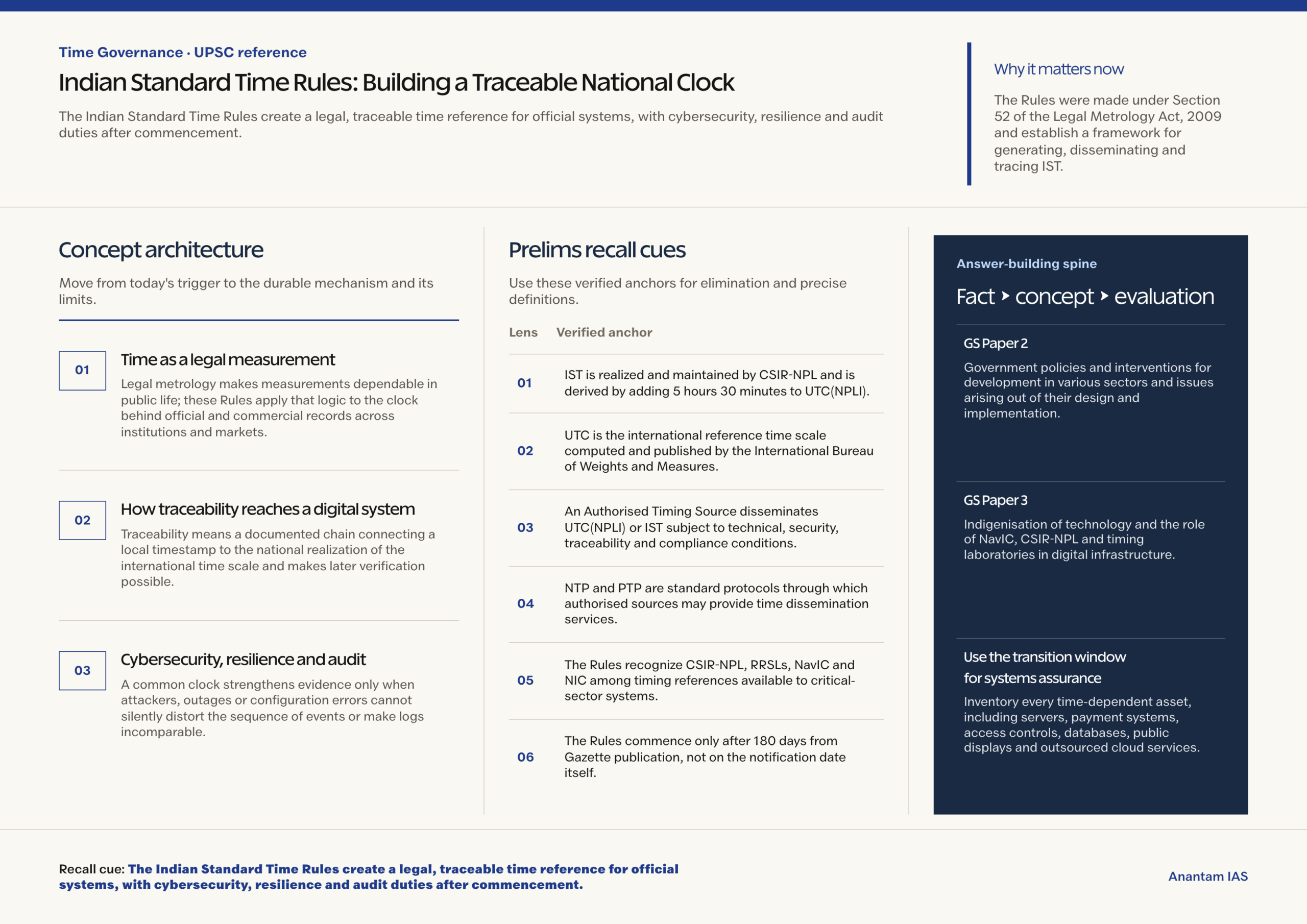
  • The Rules were made under Section 52 of the Legal Metrology Act, 2009 and establish a framework for generating, disseminating and tracing IST.
  • The 180-day commencement window runs from Gazette publication; it is a preparation period, so the notification should not be presented as immediately operative.
  • IST becomes the common reference for legal, administrative, commercial and official purposes, including time-dependent records and systems.
  • The framework connects timekeeping with critical infrastructure, cybersecurity, continuity planning and auditable proof that system time traces to the national standard.
  • A timestamp is evidence only when its source, accuracy and chain of synchronisation can be demonstrated, not merely because a screen displays the correct hour.
  • Common time supports transaction ordering, incident reconstruction and coordination across banking, telecom, transport, power, data centres and government records.
  • The compliance challenge is operational: organisations must align clocks, logs, fallback sources and audit evidence during the transition window.

UPSC Relevance

Prelims Relevance

  • IST is realized and maintained by CSIR-NPL and is derived by adding 5 hours 30 minutes to UTC(NPLI).
  • UTC is the international reference time scale computed and published by the International Bureau of Weights and Measures.
  • An Authorised Timing Source disseminates UTC(NPLI) or IST subject to technical, security, traceability and compliance conditions.
  • NTP and PTP are standard protocols through which authorised sources may provide time dissemination services.
  • The Rules recognize CSIR-NPL, RRSLs, NavIC and NIC among timing references available to critical-sector systems.
  • The Rules commence only after 180 days from Gazette publication, not on the notification date itself.

Mains Relevance

GS Paper 2

  • Government policies and interventions for development in various sectors and issues arising out of their design and implementation.
  • Transparency and accountability through common timestamps, traceable records and auditable administrative systems.

GS Paper 3

  • Indigenisation of technology and the role of NavIC, CSIR-NPL and timing laboratories in digital infrastructure.
  • Cybersecurity and protection of critical infrastructure through resilient, redundant and verifiable time synchronisation.

Essay

  • Digital trust depends on invisible public standards that make records comparable, systems accountable and infrastructure resilient.
Mindmap explaining Indian Standard Time Rules: Building a Traceable National Clock for UPSC revision
Revision mindmap: Indian Standard Time Rules: Building a Traceable National Clock. Open the full-size image for details.

Background and Context

Time as a legal measurement

Legal metrology makes measurements dependable in public life; these Rules apply that logic to the clock behind official and commercial records across institutions and markets.

  • Indian Standard Time is the official scale for civil, commercial and legal purposes, realized by CSIR-NPL from UTC(NPLI) with a 5-hour-30-minute offset.
  • After commencement, references in legal, administrative and official documents default to IST unless another basis is stated explicitly, reducing ambiguity over when an act occurred.
  • The standard reaches commerce, transport, public administration, contracts and financial operations; it concerns recorded events and machine clocks, not simply wall-clock uniformity.
  • Other time references are generally prohibited, but clearly labelled foreign zones may accompany IST where law or directions permit; approved alternatives remain possible for research, navigation or astronomy.
  • This is metrology because a usable time value needs a defined unit, an authoritative realization and an unbroken comparison chain, just like other regulated measurements.

How traceability reaches a digital system

Traceability means a documented chain connecting a local timestamp to the national realization of the international time scale and makes later verification possible.

  • The BIPM computes and publishes UTC from participating national laboratories; CSIR-NPL maintains UTC(NPLI) and realizes IST while preserving its traceability to UTC.
  • CSIR-NPL, RRSLs, ISRO and other authorised sources disseminate official signals, while the Legal Metrology Division maintains secondary time scales at Regional Reference Standards Laboratories.
  • Critical systems may synchronise through authorised NTP, PTP or NavIC services; the Director of Legal Metrology is to publish the designated addresses or access protocols.
  • The authorised source protects signal accuracy, but the end entity remains responsible for accuracy, stability and traceability inside its own servers, devices, databases and applications.
  • End users must monitor clock deviation, record it under applicable standards and retain auditable data proving that local time traces back to the national standard.

Cybersecurity, resilience and audit

A common clock strengthens evidence only when attackers, outages or configuration errors cannot silently distort the sequence of events or make logs incomparable.

  • False time can reorder payments, confuse network logs or weaken incident reconstruction; the Rules require safeguards against jamming, spoofing and cyber-attacks on synchronisation systems.
  • Entities must use redundant synchronisation and contingency plans so loss of one reference does not interrupt traceable time for networks and mission-critical services.
  • Critical sectors, including power, telecom, finance, transport, broadcasting and data centres, must include NavIC or another authorised source alongside an additional authorised reference.
  • Secure housing, hardware, software and procedures must preserve integrity, availability, accountability and traceability; accurate time is treated as a protected infrastructure service.
  • Periodic audits will test compliance, including the traceability and availability of authorised sources, while the Legal Metrology Division oversees monitoring and enforcement.

Way Forward

Use the transition window for systems assurance

The 180-day interval should become a controlled migration, not a last-minute clock-setting exercise.

  • Inventory every time-dependent asset, including servers, payment systems, access controls, databases, public displays and outsourced cloud services; identify its present source and tolerance.
  • Design primary and fallback synchronisation paths using authorised timing sources, then test failover under spoofing, jamming, network loss and clock-drift scenarios.
  • Preserve configuration histories, deviation records and incident logs so auditors can reconstruct the traceability chain from each important timestamp to UTC(NPLI) or IST.
  • Issue sector-specific technical guidance before commencement so smaller institutions can meet security and evidence requirements without interpreting protocol-level duties alone.

Conclusion

  • The durable lesson is that IST is becoming a governed measurement chain, joining national time realization, authorised dissemination, secure system synchronisation and auditable local use.
  • In a Mains answer, separate notification from commencement, then connect standardisation with digital trust, cybersecurity, critical-infrastructure resilience and accountable record-keeping.

UPSC Practice Questions

Prelims MCQ 1

With reference to the Legal Metrology (Indian Standard Time) Rules, 2026, consider the following statements:

  1. IST is realized and maintained by CSIR-NPL and derived from UTC(NPLI).
  2. End entities remain responsible for accuracy, stability and traceability within their systems.
  3. The Rules came into force immediately upon notification on 27 August 2026.

How many of the above statements are correct?

(a) Only one (b) Only two (c) All three (d) None

Answer: (b) Only two

Explanation:

Statements 1 and 2 are correct. The Rules come into force only after 180 days from publication in the Official Gazette, not immediately on notification.

Prelims MCQ 2

In the context of the Indian Standard Time Rules, what does time traceability most accurately mean?

(a) A clock displays the same hour as a nearby mobile phone (b) Every device receives time directly from a foreign satellite (c) A documented comparison chain connects a system’s time to UTC(NPLI) or IST (d) All records are stored in one central database

Answer: (c) A documented comparison chain connects a system's time to UTC(NPLI) or IST

Explanation:

Traceability requires evidence linking the local time value through authorised references to the national standard; visual agreement alone does not establish that chain.

UPSC Mains Questions

  1. A common legal time reference is both a metrology reform and a digital-governance reform. Discuss with reference to traceability, accountability and public infrastructure.
  2. Examine how secure and resilient time synchronisation can strengthen India’s critical infrastructure. What implementation challenges must be addressed during the transition period?

Sources: PIB, Department of Consumer Affairs and Department of Consumer Affairs, Gazette Notification G.S.R. 761(E).

Frequently Asked Questions

Are the Indian Standard Time Rules already in force?

No. They were notified in August 2026 but commence only after 180 days from publication in the Official Gazette. The interval is meant for technical and organisational preparation.

Who maintains India’s official time?

CSIR-NPL maintains UTC(NPLI), India’s realization of Coordinated Universal Time, and realizes IST by adding 5 hours 30 minutes while preserving traceability to UTC.

What is time traceability?

It is a documented, auditable chain connecting a local clock or timestamp through authorised timing sources to UTC(NPLI) or IST, including records of deviations and synchronisation.

Why is common time important for cybersecurity?

Security logs, payment records and incident timelines depend on event order. Spoofed or drifting clocks can obscure that order, so systems need protected sources, redundancy and contingency plans.

Can foreign time zones still be displayed?

The Rules allow clearly labelled foreign-zone time alongside IST where another law, order, direction or guideline permits it; approved alternative scales may serve specified scientific uses.

Parliament Prorogation Delay: When a Session Formally Ends

Open article →Download PDF

Why in News?

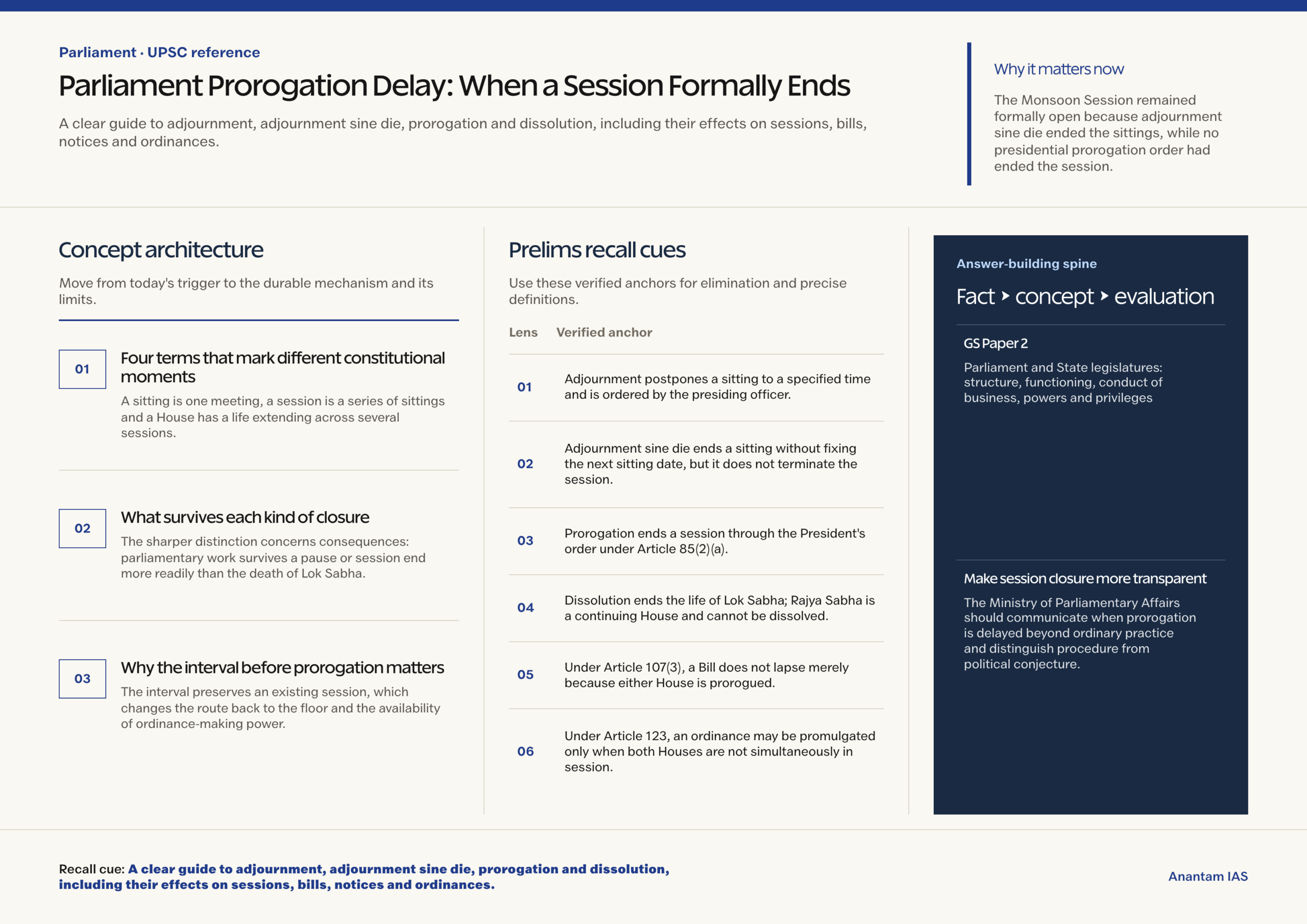
On 30 August 2026, The Hindu reported that Parliament had not been prorogued 17 days after both Houses adjourned sine die on 13 August.

  • The Monsoon Session remained formally open because adjournment sine die ended the sittings, while no presidential prorogation order had ended the session.
  • An unprorogued House may be reconvened within the same session without a fresh presidential summons, although members must still be informed of the resumed sitting.
  • The reported gap was unusual but not unprecedented: the 2015 Monsoon Session was prorogued 28 days after adjournment sine die.
  • The report recorded political concern and speculation, but no official announcement established that Parliament would be reconvened or that particular legislation would be introduced.
  • The exam trap is to treat the end of a sitting, the end of a session and the end of the Lok Sabha as the same event.
  • The distinction decides whether fresh summons are needed, whether notices survive and whether the constitutional condition for an ordinance exists.
  • A delay between adjournment sine die and prorogation is not by itself unconstitutional because Article 85 sets no deadline linking those two acts.

UPSC Relevance

Prelims Relevance

  • Adjournment postpones a sitting to a specified time and is ordered by the presiding officer.
  • Adjournment sine die ends a sitting without fixing the next sitting date, but it does not terminate the session.
  • Prorogation ends a session through the President’s order under Article 85(2)(a).
  • Dissolution ends the life of Lok Sabha; Rajya Sabha is a continuing House and cannot be dissolved.
  • Under Article 107(3), a Bill does not lapse merely because either House is prorogued.
  • Under Article 123, an ordinance may be promulgated only when both Houses are not simultaneously in session.

Mains Relevance

GS Paper 2

  • Parliament and State legislatures: structure, functioning, conduct of business, powers and privileges
  • Executive-legislature relations, constitutional conventions and the accountability value of transparent session management

Essay

  • Constitutional government depends on both legal power and transparent procedure.
Mindmap explaining Parliament Prorogation Delay: When a Session Formally Ends for UPSC revision
Revision mindmap: Parliament Prorogation Delay: When a Session Formally Ends. Open the full-size image for details.

Background and Context

Four terms that mark different constitutional moments

A sitting is one meeting, a session is a series of sittings and a House has a life extending across several sessions.

  • An adjournment pauses a sitting until a stated hour or date; the Speaker or Chairman controls it and pending business remains alive.
  • An adjournment sine die closes a sitting without naming a return date. The Latin phrase means without a day, not that the session has constitutionally ended.
  • A prorogation terminates the session. Under Article 85(2)(a), the President may prorogue both Houses together or either House separately.
  • A dissolution terminates Lok Sabha itself, either on completion of its constitutional term or earlier under Article 85(2)(b). Members then lose their representative capacity in that House.
  • Rajya Sabha is not subject to dissolution under Article 83(1); roughly one-third of its members retire every second year.

What survives each kind of closure

The sharper distinction concerns consequences: parliamentary work survives a pause or session end more readily than the death of Lok Sabha.

  • Adjournment, including adjournment sine die, does not make pending business lapse because the same session and the same House continue.
  • Prorogation ends the session, but Article 107(3) protects pending Bills, including Bills before Select or Joint Committees, from lapsing merely for that reason.
  • In Lok Sabha, already moved motions, resolutions and amendments may continue, while most pending notices lapse and must be given afresh for the next session.
  • Parliamentary committee business continues through prorogation. This continuity allows scrutiny to proceed between sessions rather than restarting every time a session closes.
  • Dissolution is stronger: a Bill pending in Lok Sabha, or passed there and pending in Rajya Sabha, lapses; a Bill pending only in Rajya Sabha does not.

Why the interval before prorogation matters

The interval preserves an existing session, which changes the route back to the floor and the availability of ordinance-making power.

  • Before prorogation, a House adjourned sine die can be reconvened as another part of the same session; a fresh presidential summons is unnecessary.
  • After prorogation, another sitting requires a new summons under Article 85(1). The gap between the last sitting of one session and first sitting of the next cannot exceed six months.
  • While both Houses remain technically in session, Article 123 does not permit an ordinance because its threshold is that both Houses must not be simultaneously in session.
  • This makes prorogation constitutionally consequential, but it does not prove a hidden legislative plan. Reconvening and the business taken up require separate official decisions.
  • For a related ordinance-power revision, see The Ordinance Question before the Supreme Court.

Way Forward

Make session closure more transparent

  • The Ministry of Parliamentary Affairs should communicate when prorogation is delayed beyond ordinary practice and distinguish procedure from political conjecture.
  • Prorogation orders and related bulletins should be published promptly in searchable form so members and citizens can identify the House’s exact constitutional status.
  • Any reconvening should provide members adequate notice and a clear agenda, preserving effective participation even when a fresh presidential summons is legally unnecessary.
  • Parliamentary reform should protect predictable calendars while retaining limited flexibility for genuine urgency and respecting the six-month ceiling under Article 85(1).

Conclusion

  • Adjournment pauses a sitting, prorogation ends a session and dissolution ends Lok Sabha. Keep those three levels separate in every answer.
  • The 17-day delay kept the session formally alive and preserved a route to reconvene, but it did not establish that a special sitting or specified Bill was planned.
  • Use Articles 83, 85, 107 and 123 together to explain the institutional consequences rather than inferring political purpose from procedural timing.

UPSC Practice Questions

Prelims MCQ 1

With reference to parliamentary procedure in India, consider the following statements:

  1. Adjournment sine die ends a sitting without fixing a date for the next sitting.
  2. Prorogation causes every Bill pending in Parliament to lapse.
  3. Rajya Sabha is not subject to dissolution.

How many of the above statements are correct?

(a) Only one (b) Only two (c) All three (d) None

Answer: (b) Only two

Explanation:

Statements 1 and 3 are correct. Article 107(3) expressly provides that a Bill pending in Parliament does not lapse merely because the Houses are prorogued.

Prelims MCQ 2

Which statement best describes the effect of dissolving Lok Sabha on pending Bills?

(a) Every Bill pending anywhere in Parliament lapses (b) No pending Bill lapses until Rajya Sabha is also dissolved (c) A Bill pending only in Rajya Sabha and not passed by Lok Sabha does not lapse (d) Only Money Bills lapse

Answer: (c) A Bill pending only in Rajya Sabha and not passed by Lok Sabha does not lapse

Explanation:

Article 107(4) protects such a Bill. A Bill pending in Lok Sabha, or passed by Lok Sabha and pending in Rajya Sabha, lapses under Article 107(5).

UPSC Mains Questions

  1. Distinguish adjournment, adjournment sine die, prorogation and dissolution. Explain their consequences for parliamentary business and executive ordinance-making.
  2. Procedural transparency is a substantive part of legislative accountability. Discuss with reference to the summoning, prorogation and reconvening of Parliament.

Sources: The Hindu and Digital Sansad, Lok Sabha FAQ.

Frequently Asked Questions

Does adjournment sine die end a parliamentary session?

No. It ends a sitting without fixing the next sitting date. The session formally ends only when the President prorogues the House under Article 85(2)(a).

Can Parliament meet again before prorogation?

Yes. A House adjourned sine die may be reconvened as part of the same session without a fresh presidential summons, after members receive notice of the sitting.

Do Bills lapse when Parliament is prorogued?

No. Article 107(3) protects Bills pending in Parliament from lapsing merely because of prorogation, including Bills being examined by Select or Joint Committees.

Can the President issue an ordinance before both Houses are prorogued?

Not while both Houses remain technically in session. Article 123 permits an ordinance only when both Houses are not simultaneously in session and immediate action is considered necessary.

Is a long gap before prorogation unconstitutional?

Not by itself. Article 85 prescribes no deadline between adjournment sine die and prorogation, though an unexplained delay may raise legitimate questions about transparency and parliamentary planning.

India and Uzbekistan agree on Uranium Deal

Open article →Download PDF

Why in News?

India and Uzbekistan have elevated their ties to a Comprehensive Strategic Partnership and set a target of increasing annual bilateral trade from over $1 billion to $5 billion by 2030. 

Eleven agreements were concluded across uranium supply, critical minerals, digital payments, defence, tourism and cultural conservation.

UPSC Relevance: GS-2 International Relations: India and its neighbourhood; bilateral relations

Prelims: Uzbekistan, Central Asia, Uranium, Chabahar Port
Mains: India’s engagement with Central Asia and energy security

Major Highlights: 

  • Uranium cooperation: A framework will be established for the long-term supply of Uranium from Uzbekistan to India for peaceful civil nuclear use.
  • Critical minerals: Both sides will undertake joint projects in geological exploration, mining, processing and integrated mineral value chains.
  • Trade and investment: Market-access barriers, banking arrangements, payment systems and connectivity constraints will be addressed systematically.
  • Digital integration: An agreement between NPCI International Payments Ltd and Uzbekistan’s National Interbank Processing Centre will allow Indian UPI applications to scan Uzbekistan’s UZQR for merchant payments.
  • Defence and security: The countries will promote direct industry linkages, co-production and co-development while strengthening cooperation against terrorism, extremism and separatism.
  • Wider cooperation: Agreements cover infrastructure, agriculture, pharmaceuticals, healthcare, Ayurveda, education, tourism and digital public infrastructure.
  • Cultural diplomacy: India will assist in restoring the Buddhist sites of Fayaz Tepa and Kara Tepa, which testify to the spread of Buddhism through the Silk Road.
  • Climate cooperation: India announced a $1-million grant for afforestation in the Aral Sea region, which faces severe desertification and ecological degradation.
image 36

Strategic Significance: 

  • Energy security: Uzbek Uranium will diversify India’s nuclear fuel supply and reduce dependence on a limited group of suppliers. It can support India’s clean energy transition and its objective of expanding nuclear power capacity to 100 GW by 2047.
  • Access to critical resources: Uzbekistan possesses significant deposits of uranium, gold, copper and other strategic minerals. Cooperation in exploration and processing can strengthen India’s supply chain resilience and support its manufacturing and clean energy industries.
  • Gateway to Central Asia: Located at the centre of the region and sharing borders with all other Central Asian republics, Uzbekistan is central to India’s Connect Central Asia Policy, India-Central Asia Dialogue and engagement through the Shanghai Cooperation Organisation (SCO).
  • Security convergence: Both countries have common concerns regarding terrorism, radicalisation, narcotics trafficking and instability in Afghanistan. Defence cooperation, including the DUSTLIK joint military exercise, reflects growing strategic trust.
  • Soft-power linkages: Buddhist heritage, Silk Road connections, Sufi traditions, education, Ayurveda and tourism provide a strong civilisational foundation for contemporary relations.

Challenges: 

  • Absence of direct land connectivity limits trade and raises transport costs.
  • India’s access through Pakistan and Afghanistan remains constrained.
  • Bilateral trade remains modest compared with its potential.
  • Banking, customs, visa and payment difficulties impede business exchanges.
  • China’s extensive economic presence and Russia’s traditional influence intensify geopolitical competition in Central Asia.
  • Uranium supplies require reliable transport arrangements, long-term commercial viability and adherence to international nuclear-safeguard obligations.

Way Forward: 

  • India should operationalise connectivity through Iran’s Chabahar Port and the International North-South Transport Corridor
  • Expand direct air-cargo links and facilitate banking settlements. 
  • Joint ventures in uranium, pharmaceuticals, textiles, agriculture and critical-mineral processing should be prioritised. 
  • Regular defence dialogue, capacity-building and cultural restoration can give the partnership greater strategic depth.

The Comprehensive Strategic Partnership moves India-Uzbekistan relations beyond diplomatic engagement towards energy, economic and security interdependence. 

Effective implementation of the uranium, connectivity and critical-mineral agreements can make Uzbekistan a key pillar of India’s long-term engagement with Central Asia.

OBC Creamy layer and the Income Test

Open article →Download PDF

Why in News?

The Supreme Court has agreed to consider constituting a Bench to hear the Centre’s request for clarification regarding its March 11, 2026 judgment in Union of India v. Rohith Nathan. 

The case concerns whether parental salary can be counted when applying the income test to exclude the creamy layer among Other Backwards Classes (OBCs).

UPSC Relevance: GS-2 Polity and Governance: Right to Equality, reservation policy and judicial review 

Prelims: Articles 14, 16(4); Indra Sawhney judgment; Creamy-layer criteria
Mains: Substantive equality, reservation and administrative implementation

Origin of the Creamy-Layer Principle:

  • In Indra Sawhney v. Union of India (1992), the Supreme Court upheld 27% reservation for OBCs in Central civil posts and services, while directing the government to identify and exclude the socially advanced sections (creamy layer). The objective was to prevent the relatively advanced sections within OBCs from disproportionately capturing reservation benefits. 
  • DoPT’s 1993 Office Memorandum (OM): Following the judgment and the recommendations of the Ram Nandan Prasad Expert Committee, the DoPT issued an OM in 1993, laying down the criteria for identifying the creamy layer.
    • The OM prescribed exclusion based on the status or position of the parents, covering children of:
      • holders of specified constitutional posts, including the President, Vice-President, Supreme Court and High Court judges, CEC, CAG and members of the UPSC and State PSCs
      • specified Group A and Group B officers of the Central and State governments
      • officers of the armed and paramilitary forces at the rank of Colonel or above, or equivalent ranks; and
      • employees holding equivalent or comparable posts in PSUs, banks, insurance organisations, universities, autonomous bodies and private employment. 
    • It also prescribed an income/wealth test, operating as a residual criterion and applying to specified categories such as:
      • persons engaged in professions, trade, business or industry
      • certain property owners, including holders of large agricultural landholdings, plantations and vacant land or buildings in urban areas; and
      • children of employees in PSUs and similar organisations where equivalence with government posts had not been established. 

The income ceiling was originally ₹1 lakh and currently stands at ₹8 lakh annually for three consecutive years, last revised in 2017. 

What is the Dispute?

The controversy arose from an apparent inconsistency between the 1993 DoPT Office Memorandum and a subsequent 2004 DoPT clarification.

What did the 1993 Office Memorandum provide?

  • Creamy-layer status of children of government employees was determined primarily by the rank or status of the parents’ posts (Group A or B, or Group C or D).
  • It prescribed an income/wealth test for certain residual categories. While applying this test, income from salaries and agricultural land was to be excluded.

What changed after the 2004 clarification?

  • In 2004, the DoPT issued a letter to clarify difficulties in interpreting the 1993 rules. Its paragraph 9 addressed children of employees of PSUs where equivalence with government posts had not been established.
  • The clarification was interpreted as allowing parental salary to be counted under the income test for such candidates. This interpretation was subsequently applied to candidates whose parents worked in PSUs and, in some cases, the private sector.

How did this create unequal treatment?

Consider two similarly placed candidates:

  • Candidate A’s parent is a lower-ranking government employee earning ₹10 lakh annually.
  • Candidate B’s parent holds a comparable PSU post and earns the same salary.

Candidate A could remain non-creamy layer because the parent’s post was not senior enough to attract exclusion. Candidate B could be excluded because the parent’s salary exceeded ₹8 lakh.

Thus, candidates with comparable socio-economic backgrounds were treated differently merely because their parents worked in different sectors.

Supreme Court’s Interpretation: 

The Court in its 2026 judgment in Union of India v. Rohith Nathan held that:

  • The income/wealth test is a residual filter, not the sole criterion for determining social advancement.
  • Salary and agricultural income were consciously excluded under the 1993 framework. The ambiguous 2004 letter could not justify counting salary only for PSU or private-sector employees.
  • Until the government establishes equivalence between PSU posts and government posts, PSU and private-sector candidates cannot be subjected to a discriminatory income test.
  • Excluding them solely based on parental salary, without considering the status of the post, amounts to “hostile discrimination” under Articles 14 and 16.

The Court directed the Centre to create supernumerary posts and allot appropriate services to the affected Civil Services Examination candidates according to their ranks.

Why is the Centre seeking Clarification?

The Centre argues that retrospective implementation would create serious administrative difficulties:

  • Civil Services allocations made since 2012 may face fresh claims.
  • Reallocation could disturb seniority, promotions, cadre strength and service preferences.
  • Creating supernumerary posts may affect other OBC candidates as well as unreserved-category candidates.
  • If salary is completely excluded, children of highly paid private-sector employees may continue to qualify as non-creamy layer.
  • Existing allocations for CSE 2025 candidates may be unsettled even after the commencement of their Foundation Course.

The Centre has therefore sought guidance on implementing the judgment and protecting settled appointments.

Wider Constitutional and Policy Dimensions:

  • Formal versus substantive equality: Identical income thresholds may produce unequal outcomes when employment structures differ.
  • Social backwardness versus economic income: The creamy-layer principle is intended to identify accumulated social advancement, which income alone may not adequately capture.
  • Horizontal fairness: The rules must treat similarly placed children of government, PSU and private-sector employees consistently.
  • Administrative certainty: Judicial relief must be balanced with the need to protect settled seniority and service allocations.
  • Outdated framework: The absence of equivalence between government, PSU and private-sector positions has allowed inconsistent interpretation for decades.

Way Forward: 

  • Establish transparent equivalence between government and PSU posts.
  • Develop objective indicators for assessing senior private-sector positions.
  • Periodically revise the ₹8 lakh ceiling through an evidence-based and preferably inflation-linked mechanism.
  • Clearly specify the treatment of salary, agricultural income, business income, property and other wealth.
  • Standardise non-creamy-layer certificates and introduce secure digital verification.
  • Use supernumerary posts to provide relief without displacing already appointed candidates.
  • Frame transitional rules that distinguish pending claims from long-settled appointments.

The dispute is not merely about the ₹8 lakh ceiling. It concerns whether social advancement should be assessed through parental income, occupational status or a fair combination of both. 

India needs a transparent and sector-neutral framework that reconciles substantive equality, targeted affirmative action and administrative stability. 

Rani Avantibai Lodhi: Icon of the Revolt of 1857

Open article →Download PDF

Why in News?

The Defence Minister of India paid tribute to Rani Avantibai Lodhi by unveiling her statue, lauding her courage, patriotism, and supreme sacrifice during the 1857 War of Independence, which marked a glorious chapter in India’s history. 

UPSC Relevance: GS-1 History and Culture: Personalities in News; Women freedom fighters 

Prelims: Rani Avantibai Lodhi, Battle of Khairi
Mains: Regional and women leaders in India’s freedom struggle; Modern Indian history and the Revolt of 1857

About Rani Avantibai Lodhi: 

  • Rani Avantibai was born in 1831 in the present-day Seoni district of Madhya Pradesh.
  • She married Vikramaditya Singh Lodhi, the ruler of the small princely State of Ramgarh, located in present-day Dindori district.
  • When her husband became incapable of administering the State and their sons were minors, Avantibai assumed responsibility for governance.
  • The British placed Ramgarh under the Court of Wards and appointed an administrator, thereby undermining the ruling family’s authority. This intervention, rather than a straightforward application of the Doctrine of Lapse, became the immediate source of conflict. 
image 37

Role in the Revolt of 1857: 

  • When the uprising spread to Central India, Avantibai expelled the British-appointed officials and reclaimed control over Ramgarh.
  • She mobilised local rulers, zamindars, malguzars, peasants and soldiers against colonial rule.
  • According to popular tradition, she sent letters and bangles to neighbouring chiefs, asking them either to join the struggle or accept submission.
  • She reportedly raised an army of around 4000 soldiers and confronted the British near Mandla.
  • At the Battle of Khairi in November 1857, her forces compelled the troops of Mandla’s Deputy Commissioner, Captain Waddington, to retreat.
  • The British subsequently attacked and burnt Ramgarh. Avantibai continued resistance from the forests and hills around Devharigarh.
  • Surrounded by British forces, she took her own life with her sword on March 20, 1858, rather than face capture.  

Historical Significance: 

  • Regional character of 1857: Her role shows that the uprising was not confined to sepoys or north Indian centres such as Delhi, Kanpur and Lucknow. It spread into the forested and rural regions of Central India.
  • Broad social participation: Her mobilisation of chiefs, landlords, peasants and local communities illustrates the diverse social coalition behind the revolt.
  • Resistance to indirect annexation: The struggle reflected resentment against colonial devices such as the Court of Wards, political interference and erosion of indigenous sovereignty.
  • Women’s leadership: Alongside Rani Lakshmibai, Begum Hazrat Mahal, Jhalkari Bai and Uda Devi, Avantibai challenged both colonial rule and prevailing assumptions about women’s political and military capabilities.
  • Popular memory: Much of her story survives through folklore and regional traditions. This underlines the importance of oral history in recovering freedom fighters who received limited attention in colonial records.

Legacy: 

  • An all-woman Provincial Armed Constabulary battalion in Badaun has also been named after her.
  • India Post issued commemorative stamps in her honour.
  • A part of the Bargi Dam project has been named Rani Avantibai Sagar. 
  • Institutions and women’s security battalions bearing her name reflect her continuing association with courage and women’s empowerment.

Rani Avantibai Lodhi’s resistance represents the regional depth, social diversity and women-led character of the Revolt of 1857, making her an important figure in India’s transition from scattered anti-colonial resistance to a broader national consciousness.

Aditya-L1 detects Possible Precursors to Solar Flares

Open article →Download PDF

Why in News?

Scientists analysing observations from India’s Aditya-L1 mission have identified small, short-lived brightenings in the Sun’s atmosphere several hours before the eruption of major solar flares. These events could improve the understanding and forecasting of hazardous space weather. 

UPSC Relevance: GS-3 Science and Technology: Astronomy and Space Technology 

Prelims: Aditya-L1, Solar flares, Coronal mass ejections, Geomagnetic storms

Key Findings: 

  • Scientists detected numerous small pre-flare transient events in magnetically active regions of the Sun. These brightenings occurred hours before major flares and clustered near the locations where the flares subsequently erupted.
  • Some events produced both ultraviolet and X-ray signatures, indicating small-scale releases of magnetic energy.
  • Repeated energy releases may gradually disturb and weaken the stability of the magnetic field, eventually producing a major solar flare.

However, further observations are necessary to determine whether these events can serve as reliable predictors rather than merely being associated with flare-prone regions.

Role of Aditya-L1: 

Aditya-L1 is India’s first dedicated solar observatory. It operates in a halo orbit around the Sun-Earth L1 point, about 1.5 million km from Earth, providing a nearly continuous view of the Sun. The study combined ultraviolet and X-ray observations from three Aditya-L1 payloads:

  • Solar Ultraviolet Imaging Telescope (SUIT): Observes the Sun through 11 near-ultraviolet filters, covering layers from the upper photosphere to the chromosphere. These wavelengths are largely inaccessible from Earth because the atmosphere absorbs ultraviolet radiation.
  • Solar Low Energy X-ray Spectrometer (SoLEXS): Measures low-energy X-ray emissions from solar activity.
  • High Energy L1 Orbiting X-ray Spectrometer (HEL1OS): Studies high-energy X-rays produced during energetic events in the solar corona.

Their simultaneous observations help connect activity in the Sun’s lower atmosphere with magnetic-energy release in the corona.

What are Solar Flares?

  • Solar flares are sudden explosions caused by the release of magnetic energy in the Sun’s atmosphere. They emit intense radiation across the electromagnetic spectrum, especially X-rays and ultraviolet radiation.
  • Solar flares are often associated with (but do not always produce) coronal mass ejections (CMEs): large clouds of magnetised plasma expelled from the Sun. 
image 38

Impacts on Earth: 

  • Radio blackouts: X-rays and ultraviolet radiation disturb the ionosphere, affecting high-frequency communication on the Sun-facing side of Earth.
  • Satellite disruption: Energetic particles may damage electronics, solar panels and sensors.
  • Navigation errors: Ionospheric disturbances can degrade GPS and other GNSS signals.
  • Geomagnetic storms: Earth-directed CMEs can disturb the magnetosphere and produce intense auroras.
  • Power-grid damage: Geomagnetically induced currents may disrupt transformers and transmission networks.
  • Radiation hazards: Solar energetic particles endanger astronauts and high-altitude polar flights.
  • Orbital changes: Heating and expansion of the upper atmosphere increase drag on low-Earth-orbit satellites. 

Reliable early warning can help satellite operators place spacecraft in safe mode, protect power grids, reroute polar flights and safeguard astronauts. The study therefore strengthens India’s capabilities in space-weather forecasting and protection of critical infrastructure. 

UPSC PYQ 2022

Q. If a major solar storm (solar flare) reaches the Earth, which of the following are the possible effects on the Earth?

1.     GPS and navigation systems could fail.

2.     Tsunamis could occur at equatorial regions.

3.     Power grids could be damaged.

4.     Intense auroras could occur over much of the Earth.

5.     Forest fires could take place over much of the planet.

6.     Orbits of the satellites could be disturbed.

7.     Shortwave radio communication of the aircraft flying over polar regions could be interrupted.

Select the correct answer using the code given below:

(a)     1, 2, 4 and 5 only

(b)     2, 3, 5, 6 and 7 only

(c)     1, 3, 4, 6 and 7 only

(d)     1, 2, 3, 4, 5, 6 and 7

Answer: (c) 1, 3, 4, 6 and 7 only

Adopt Policies for Reuse of Treated Water

Open article →Download PDF

Why in News?

The recently notified treated wastewater reuse policies of Uttar Pradesh and Uttarakhand demonstrate how water governance can be adapted to local geography, settlement patterns and sectoral needs.

UPSC Relevance: GS-2: Government policies and urban governance; GS-3: Water conservation, pollution, climate resilience and sustainable urbanisation

Prelims: AMRUT, National Framework on Safe Reuse of Treated Water
Mains: Urban water security, circular economy and wastewater management

Treated Wastewater: An Untapped Resource

India faces growing water stress due to groundwater over-extraction, rapid urbanisation, climate variability and competing sectoral demands.

Treated wastewater offers a reliable and drought-resilient alternative that can:

  • Supply agriculture, horticulture and industrial processes
  • Meet non-potable urban needs such as construction, landscaping and road washing
  • Support groundwater recharge where hydrogeologically suitable
  • Restore rivers, lakes and wetlands by reducing untreated sewage discharge
  • Drought-proof cities and industries while enabling growth within ecological limits
  • Reduce the energy and cost involved in transporting freshwater over long distances; and
  • Promote a circular water economy, contributing to SDG 6 on clean water and sanitation.

India’s water security may therefore depend less on discovering new freshwater sources and more on safely recycling the water it already possesses.

Policy Framework: From Treatment to Reuse

Programmes such as the Atal Mission for Rejuvenation and Urban Transformation (AMRUT) have expanded sewage-treatment infrastructure. However, building treatment plants alone does not complete the water cycle. A plant that discharges treated water into a drain rather than supplying it to a farm, industry or urban utility represents underutilised infrastructure.

The National Framework on Safe Reuse of Treated Water, 2022 seeks to mainstream wastewater reuse while allowing States to formulate policies suited to local conditions. It is not a funding scheme but an important guiding framework. The Uttar Pradesh and Uttarakhand policies illustrate this contextual approach by incorporating:

  • Fit-for-purpose standards, with water quality determined by its intended use
  • Integration with urban planning and river rejuvenation
  • Different strategies for hill settlements and densely populated plains
  • Community participation and public awareness 
  • Blended finance and public-private partnerships; and
  • Digital monitoring to ensure quality and accountability.

The Framework is not a funding scheme but an important guiding framework.

Major Government Initiatives: 

India addresses wastewater treatment through several overlapping schemes rather than a single dedicated programme. 

  • AMRUT 2.0: Supports sewerage networks, sewage treatment plants, faecal-sludge management and recycling of treated water in urban areas. It seeks universal sewerage and septage management coverage in the original 500 AMRUT cities. Approved projects include dedicated capacity for recycling and reuse of treated wastewater.
  • Jal Hi AMRIT: A specialised initiative under AMRUT 2.0. Incentivises urban local bodies to improve STP performance and consistently produce recyclable quality water. Uses Clean Water Credits and star ratings, along with third-party assessment, capacity-building and performance-linked incentives. 
  • Swachh Bharat Mission-Urban 2.0: Its Used Water Management component primarily covers towns with populations below one lakh that are not covered under AMRUT. Supports interception of drains, STPs, faecal sludge treatment plants and decentralised treatment systems. Seeks to ensure that untreated wastewater does not enter water bodies and that treated water is optimally reused. 
  • Namami Gange Programme: Finances interception and diversion of drains, sewer networks and sewage-treatment infrastructure in the Ganga basin. Its Arth Ganga component promotes monetisation and reuse of treated wastewater and conversion of sewage sludge into manure, bricks and other usable products. 
  • National River Conservation Plan: Supports States in controlling pollution in rivers other than the Ganga and its tributaries. Major interventions include interception and diversion of sewage and construction of STPs. 
  • Swachh Bharat Mission-Grameen Phase II: Covers rural greywater and faecal-sludge management. Promotes household soak pits and kitchen gardens as well as community-level constructed wetlands, waste-stabilisation ponds and decentralised wastewater-treatment systems. 

India already possesses substantial treatment programmes; the real gap lies in linking treatment plants with reuse networks, reliable quality monitoring, appropriate pricing and assured end-users. 

Key Constraints: 

  • Fragmented institutional responsibilities: Urban local bodies, pollution control boards, irrigation departments and industrial agencies often work in silos. No single agency is accountable for the entire reuse chain.
  • Inadequate distribution infrastructure: Most STPs lack separate pipelines, storage facilities and pumping systems to transport treated water to farms, industries or construction sites.
  • Mismatch between supply and demand: Treatment plants may be located far from major users. This increases transportation and energy costs.
  • Poor operation and maintenance: Many STPs operate below capacity or fail to consistently meet prescribed standards due to inadequate funds, skilled personnel and electricity supply.
  • Inconsistent quality monitoring: Periodic testing may not detect sudden deterioration in water quality. Real-time monitoring and independent verification remain limited.
  • Uncompetitive pricing: Industries may continue using cheap or subsidised freshwater. Treated water becomes unattractive when users must bear additional transportation and treatment costs.
  • Weak and uncertain demand: Industries are often reluctant to sign long-term purchase agreements. Farmers may doubt the reliability and safety of treated water.
  • Public resistance: Treated wastewater is frequently perceived as dirty or unsafe, even when it meets the required quality standards.
  • Absence of uniform standards: Different uses require different levels of treatment. However, clear and enforceable fit-for-purpose standards are not uniformly applied across States.

Way Forward: 

  • Prepare city-level reuse plans: Cities should assess wastewater generation, treatment capacity and potential demand before approving new projects.
  • Map nearby users: Industrial clusters, thermal power plants, construction sites, parks and peri-urban farms located near STPs should be identified as priority consumers.
  • Mandate freshwater substitution: Treated water should progressively replace freshwater for cooling, landscaping, road washing, construction and other suitable non-potable purposes.
  • Adopt fit-for-purpose standards: Water used for industrial cooling need not meet the same standards as water used for food-crop irrigation or groundwater recharge.
  • Strengthen quality assurance: STPs should have real-time monitoring, independent audits and publicly accessible water-quality data.
  • Build reuse infrastructure: Investment must cover tertiary treatment, storage reservoirs, dual-pipeline networks and last-mile connections, not merely STP construction.
  • Ensure viable pricing: Treated water should be cheaper than freshwater, while tariffs must generate sufficient revenue for operation and maintenance.
  • Use economic incentives: Industries using treated water may receive tariff concessions or faster approvals. Excessive freshwater extraction can be discouraged through rational user charges.
  • Create assured demand: Urban bodies can enter long-term purchase agreements with industries, power plants, railways and large commercial establishments.
  • Mobilise blended finance: Funds under AMRUT, SBM-U, Namami Gange, industrial development and irrigation programmes should be converged with municipal bonds, viability gap funding and PPPs.
  • Fix institutional accountability: A nodal agency or city-level water-reuse cell should coordinate treatment, distribution, pricing and monitoring.
  • Reframe treated water as a resource: Terms such as “Apna Jal” or “our water” can support the psychological transition from wastewater disposal to a circular water economy.

Safe wastewater reuse is no longer an optional urban service; it is a strategic necessity for water, climate and economic security. 

Uttar Pradesh and Uttarakhand provide useful models, but their real significance lies in encouraging every State to transform treated wastewater from a discarded by-product into a dependable public resource.