Forest fires are not always catastrophic. Small, controlled fires in the form of prescribed burning are actually useful and essential for healthy forest regeneration: they clear the annual buildup of litter, reduce the risk of larger catastrophic fires, improve silvicultural opportunities, increase forage, enhance wildlife habitat and support biodiversity. But uncontrolled forest fires are one of India’s fastest-growing environmental threats, destroying biodiversity, releasing stored carbon and damaging livelihoods. The Forest Survey of India reported over 2.23 lakh fire points in 2024, up sharply from previous years. For UPSC aspirants, forest fires are a key GS Paper III theme on environment, disaster management and climate change.
Why forest fires matter
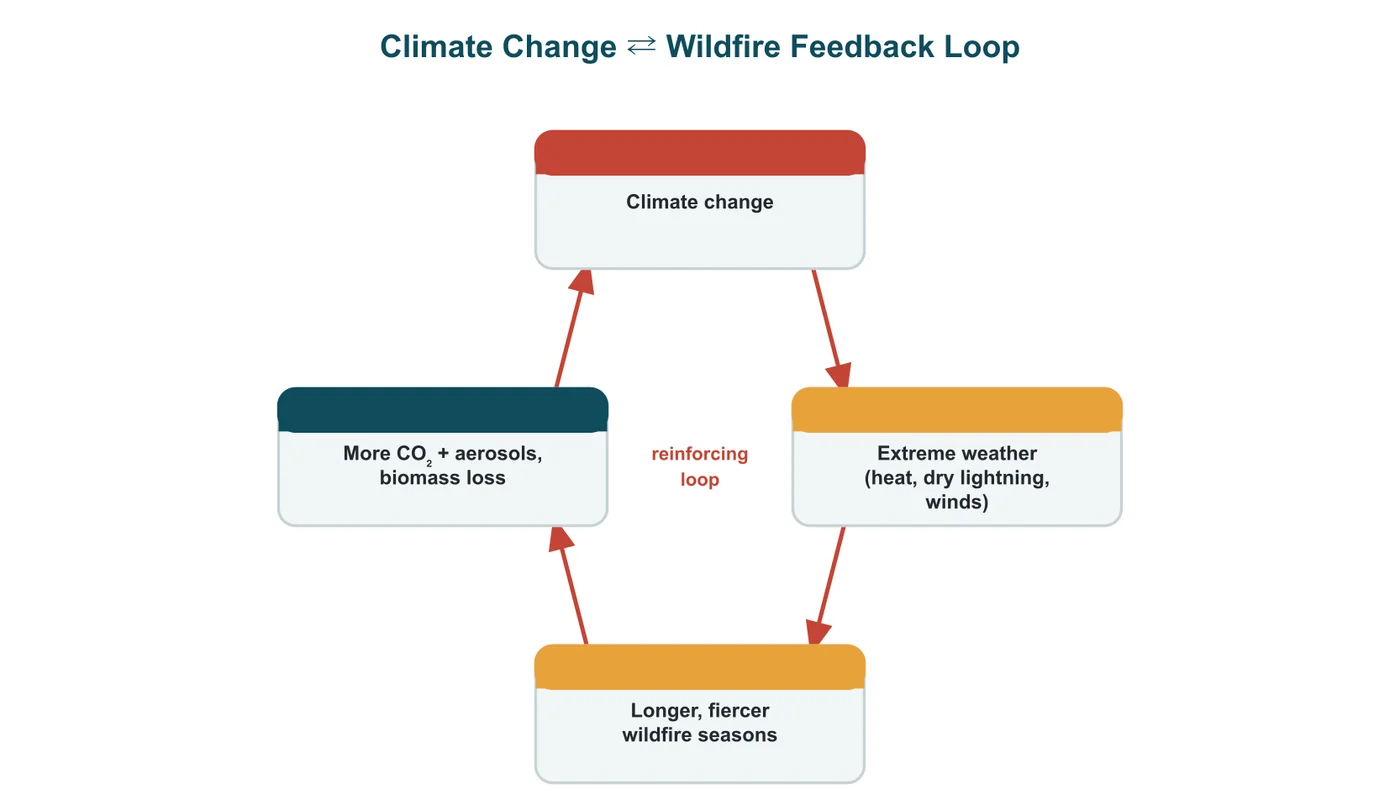
Forests in India account for about 24 percent of the land area. They are major carbon sinks, biodiversity reservoirs, watersheds and livelihood sources. Fires not only damage these services but also release greenhouse gases that accelerate climate change, which in turn increases future fire risk – a classic positive feedback loop.
Causes of forest fires
Forest fires are caused by both natural and anthropogenic factors.
Natural causes
- Lightning: Common trigger in high-altitude and dry forests.
- Friction of rolling stones: Rare but documented in steep mountain terrain.
- Rubbing of dry bamboo clumps: In bamboo-dominated forests of central and north-east India.
- Volcanic explosion: Not a significant driver in India.
- Spontaneous combustion: Dry biomass can ignite under extreme temperatures.
Anthropogenic causes
Deliberate
- Shifting cultivation (jhum) in North-East India and central India.
- To flush growth of tendu leaves (used in bidi-making).
- To promote growth of grass and fodder.
- To settle scores with the forest department or in personal rivalry.
- To clear path by villagers.
- To encroach upon forest land.
- For concealing illicit felling.
- Tribal traditions and customs.
Accidental
- Collection of non-timber forest produce (e.g. lighting fires to collect honey).
- Burning farm residues that spread into adjacent forests.
- Driving away wild animals that raid crops.
- Throwing burning bidis or cigarettes.
- Campfires by picnickers.
- Sparks from vehicle exhaust.
- Sparks from electrical transformers.
- Uncontrolled prescribed burning.
- Resin tapping in pine forests.
Forest Survey of India Fire Alert System
The Forest Survey of India, Dehradun, runs India's main forest fire monitoring system.
- Near-real-time alerts based on MODIS and VIIRS satellite sensors.
- SMS alerts to field officials across India.
- Annual India State of Forest Report includes fire alerts.
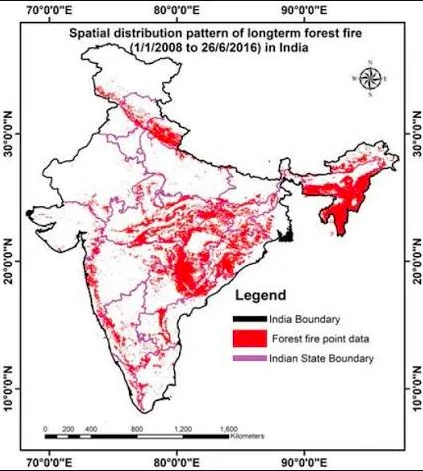
- Forest Fire Prone Areas mapping at district level.
Major fire seasons are March to May in the Himalayas and central India, and October to December in parts of the Western Ghats and North-East.
Major forest fire hotspots
- Uttarakhand: Chir pine forests are notoriously fire-prone because pine needles form a thick, highly combustible litter layer.
- Himachal Pradesh: Similar chir pine dynamics.
- Odisha and Chhattisgarh: Sal and mixed deciduous forests.
- North-East: Jhum-related fires, especially in Nagaland, Manipur and Mizoram.
- Andhra Pradesh and Telangana: Nallamala and Eastern Ghats.
- Kerala: Wayanad and Nilgiri biosphere.
- Madhya Pradesh: Largest forest area in absolute terms; several fire hotspots.
Impact of extensive forest fires
Biodiversity change
Fire alters species composition. In the Himalayas, fires have made the environment less favourable for oaks to regenerate and more favourable for chir pine to dominate, creating a self-reinforcing fire cycle. In grasslands, repeated fires favour fire-adapted grasses over fire-sensitive woody species.
Reduced soil moisture
Fires kill the plants that hold moisture and create hot, dry conditions that increase future fire probability.
Reduced water infiltration
Heat-induced chemical and physical changes in the upper layer of soil create water-repellent (hydrophobic) layers, reducing infiltration and increasing surface runoff.
Enhanced global warming
- Destruction of forest carbon sequestration potential.
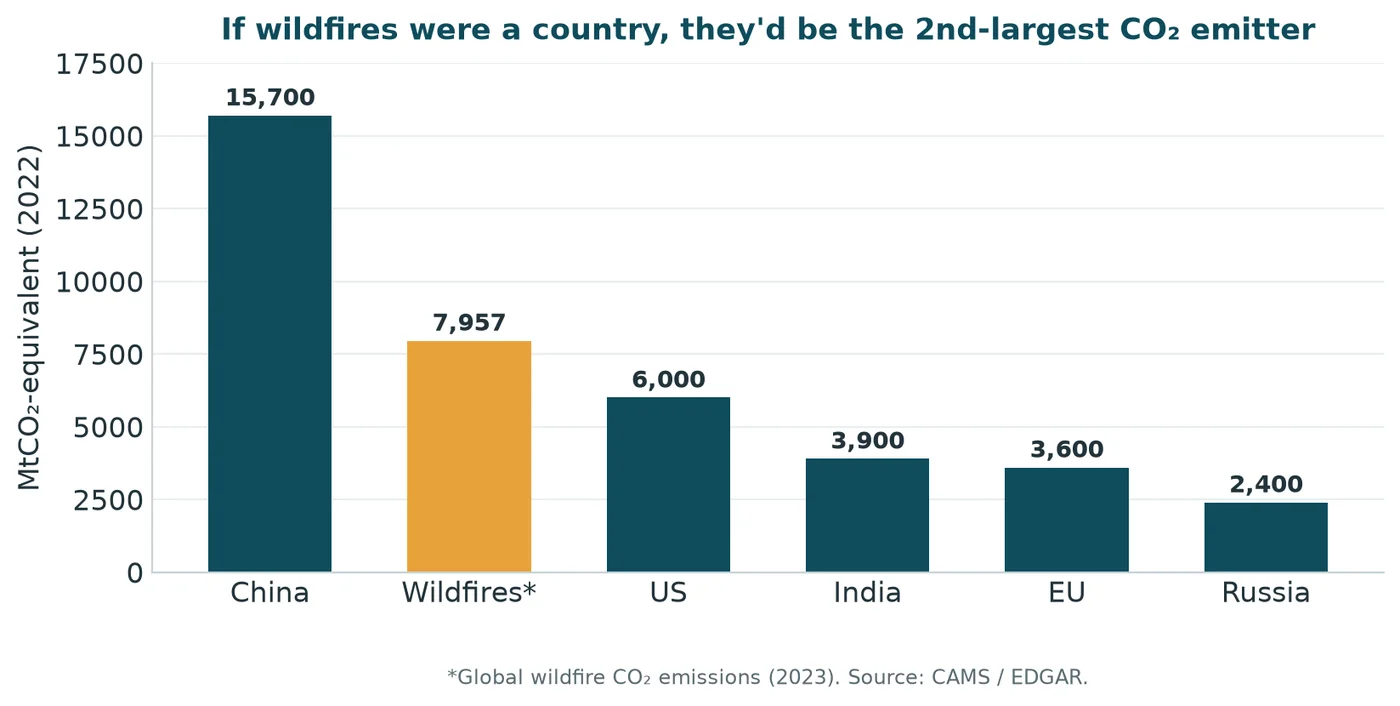
- Emissions of carbon dioxide, carbon monoxide, methane, hydrocarbons, nitric oxide and nitrous oxide.
- Black carbon deposition on snow and ice surfaces accelerates melting in the Himalayas.
Microclimate change
- Removal of litter and duff.
- Opening of the canopy by killing overstorey shrubs and trees.
- Darkening of soil surface by residual soot and charcoal increases insolation absorption, raising soil temperature.
Soil erosion
Intense fires heat the soil at depths of 7 to 10 cm. The affected soil loses its water-holding capacity and becomes vulnerable to erosion during subsequent rains.
Flooding
Water-repellent soils and vegetation cover loss give rise to higher chances of flash floods during the next heavy rainfall.
Air quality and public health
Forest fire smoke contributes to particulate matter pollution. In high-fire seasons, fine particulate matter in the Doon valley, the Uttarakhand hills and North-East cities rises noticeably.
Economic impact
- Loss of timber, NTFP and ecotourism revenue.
- Damage to hydropower reservoirs from increased siltation.
- Costs of firefighting and post-fire rehabilitation.
- Livelihood loss for forest-dependent communities.
Management and policy framework
- Forest (Conservation) Amendment Act 2023 governs land use change but also indirectly affects fire management through reduced forest oversight in certain categories.
- National Action Plan on Forest Fires (2018) by MoEFCC.
- FSI Fire Alert System.
- Fire lines: Firebreaks along forest boundaries.
- Prescribed burning: Controlled early-season burning to reduce fuel load.
- Community fire management: Van Panchayats in Uttarakhand, Joint Forest Management committees.
- CAMPA funds: Compensatory Afforestation Fund for rehabilitation.
- Forest Fire Prevention and Management Scheme (FPM): Central assistance to states.
Way forward
- Strengthen community-based fire management with forest-dependent communities, especially in chir pine zones.
- Modernise fire lines and create fire-resilient species buffers.
- Pine needle-based biomass utilisation (briquettes, electricity generation) reduces ground fuel load while generating rural income.
- Improve early detection with higher-resolution satellites and drones.
- Train and equip state forest departments with modern firefighting gear, aerial water-bombing capacity, and coordination with IAF helicopters.
- Integrate fire risk in EIA and FCA clearances for hill station and infrastructure projects.
- Public awareness campaigns, especially for picnickers and tourists in hill stations.
Latest developments (2024-26)
- 2024 Uttarakhand fire season: Over 1,100 major fire incidents; led to sharpened state protocols.
- FSI fire alert upgrade (2024): Real-time dashboard with improved VIIRS integration.
- Chir pine needle utilisation: Commercial briquette plants in Uttarakhand and Himachal Pradesh; pilot biomass power projects.
- Forest (Conservation) Amendment Act 2023 implementation has been criticised by environmentalists for reducing protections in border forests that could face increased fire risk.
- COP29 Baku (2024): India's updated NDCs include forest restoration as a climate action pillar; fire prevention is a direct enabler.
- Biological Diversity Amendment Act 2023 provisions are being used to enhance community fire management rights.
- CAMPA deployment accelerated for fire-affected regeneration.
- International cooperation: India is part of the Global Forest Watch Fires platform for cross-border data.
UPSC Relevance
Prelims focus
- FSI Fire Alert System: MODIS, VIIRS satellites.
- Chir pine (Pinus roxburghii) and oak (Quercus) dynamics.
- National Action Plan on Forest Fires 2018.
- Forest Fire Prevention and Management Scheme (FPM).
- CAMPA funds.
- Van Panchayats of Uttarakhand.
Mains focus (GS III)
Typical question framings evaluate the causes of increasing forest fires, climate change impacts, the role of community-based fire management, and the economic value of chir pine needle utilisation. Strong answers cite FSI data, NAP on Forest Fires, specific disasters like 2024 Uttarakhand, and international frameworks.
Linkages
Forest fires connect to SDG 13 (climate action), SDG 15 (life on land), the Sendai Framework for Disaster Risk Reduction, India's updated NDCs after COP29, the Paris Agreement's forest carbon commitments, the Forest (Conservation) Amendment Act 2023, the Biological Diversity Amendment Act 2023 and the Wildlife (Protection) Amendment Act 2022.
Tell Google you want more of this.
Add Anantam IAS as a preferred sourceOne tap, and this site shows up more often in your own Top Stories, AI Overviews and AI Mode. Remove it any time.