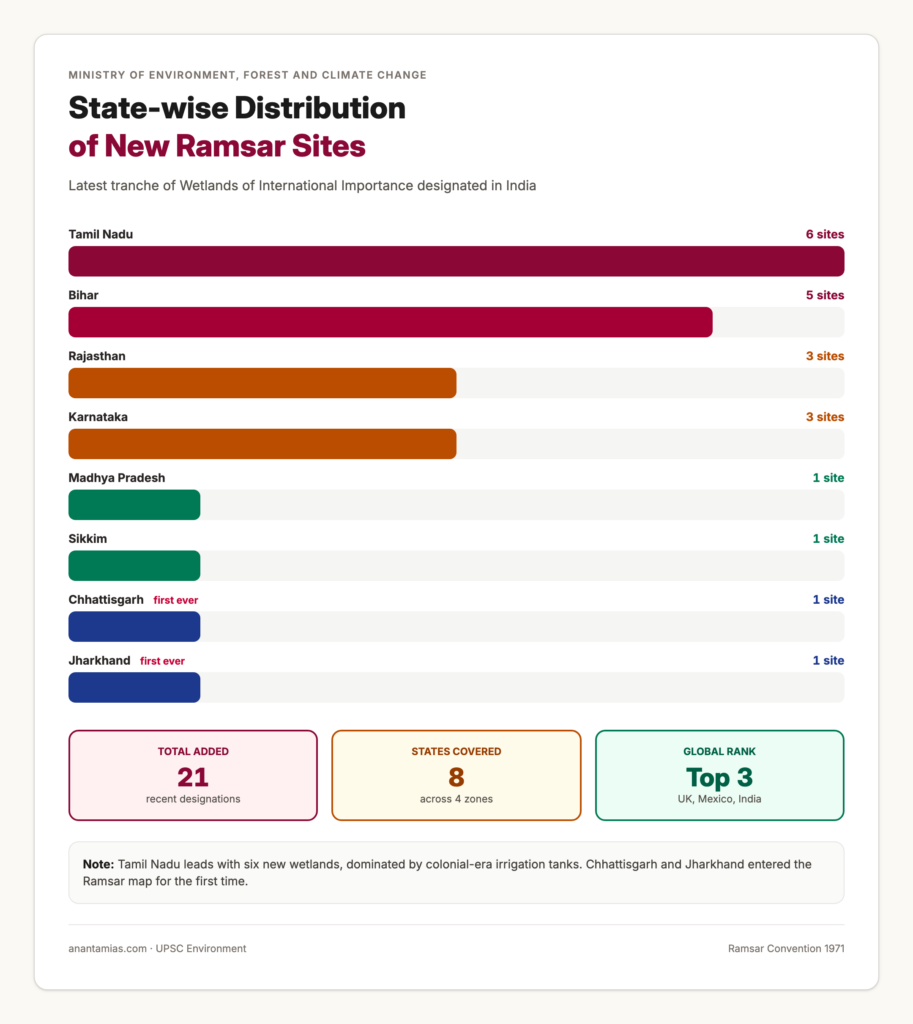
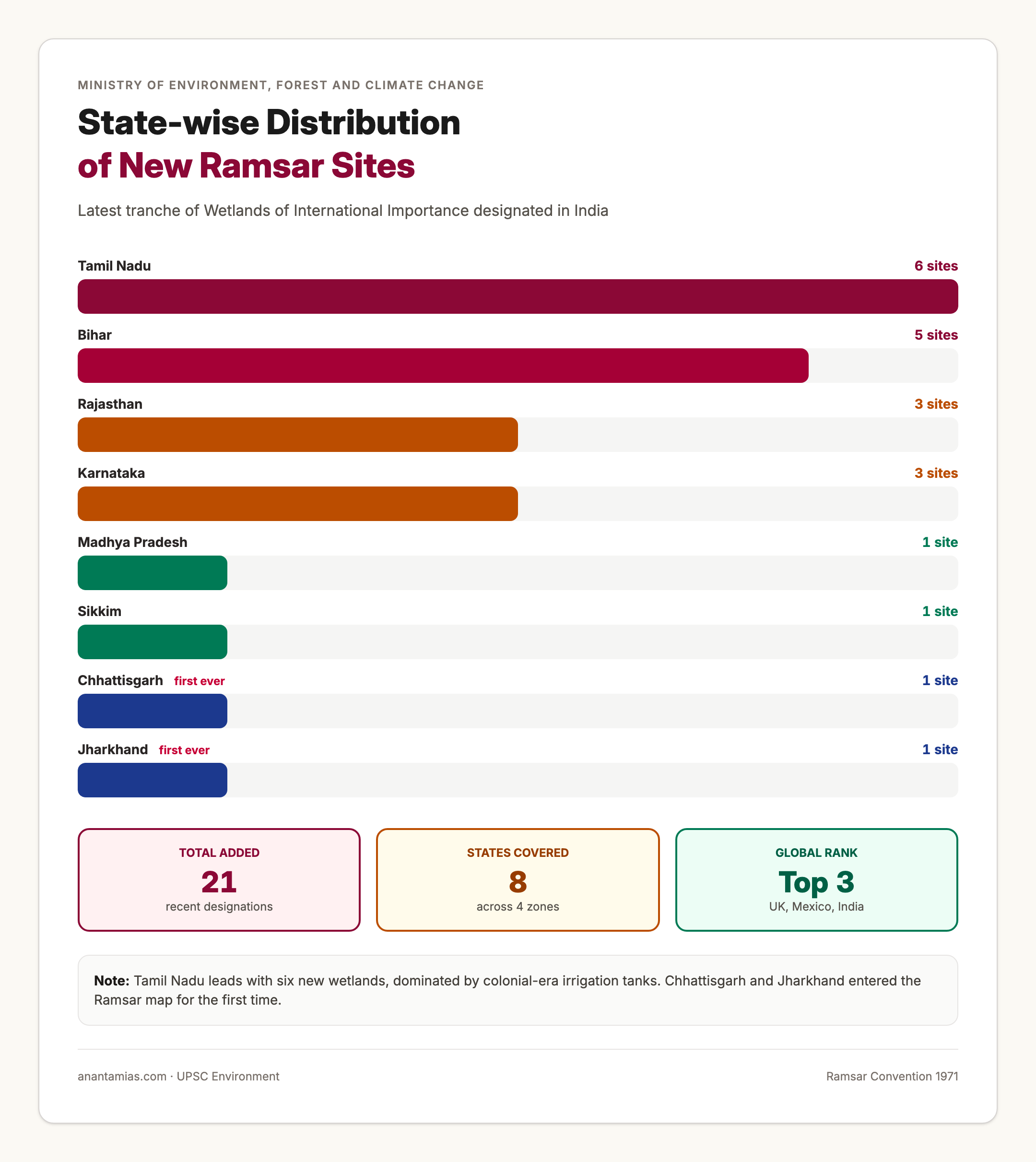
The list of Ramsar Sites in India has expanded rapidly in the last few years, and the most recent batch of additions has reshaped how the country thinks about wetland conservation. The fresh notifications spread protection across new geographies, including the first Ramsar Sites of Chhattisgarh and Jharkhand, multiple sacred and community-managed wetlands, and a clutch of inland tanks in Tamil Nadu and Karnataka that have served local irrigation for centuries. India now ranks among the top three countries in the world by number of Ramsar Sites, behind only the United Kingdom and Mexico, and the trajectory shows no sign of slowing.
For a UPSC aspirant the topic carries weight in both prelims and mains. Prelims questions on wetlands have grown sharper, asking about specific Ramsar designations, the Montreux Record, the difference between a wetland and a Ramsar Site, and the role of the Wetlands Conservation and Management Rules 2017. Mains questions sit at the intersection of environment, federalism, livelihoods, and biodiversity, and increasingly demand command over recent additions, not just the older Chilika or Keoladeo cases. The wetland chapter is also one of the few areas where current affairs and static portions are tightly fused.
This guide unpacks the latest Ramsar Sites added to India, explains the ecological logic of each new entry, and connects the additions to the larger framework of the Ramsar Convention and India’s domestic wetland policy.
Quick Facts at a Glance
The Ramsar Convention on Wetlands was signed in the Iranian city of Ramsar on 2 February 1971 and entered into force in 1975. India became a contracting party in 1981 by initially designating Chilika Lake in Odisha and Keoladeo National Park in Rajasthan. The convention defines a wetland broadly to include marshes, lakes, rivers, peatlands, oxbows, mangroves, coral reefs, estuaries, and human-made sites such as reservoirs and salt pans. The three pillars of the treaty are wise use of all wetlands, designation of Wetlands of International Importance for the Ramsar List, and international cooperation. India is among the global leaders by number of designated sites, with the latest additions pushing the count well above ninety. The United Kingdom holds the largest number of Ramsar Sites globally, followed by Mexico and India. World Wetlands Day is observed every year on 2 February, the anniversary of the convention’s signing.
What the Latest Ramsar Sites in India Are
The most recent additions to the Indian Ramsar list span eight states and a remarkable diversity of wetland types. Some are sacred lakes, some are colonial-era irrigation tanks, several are oxbow lakes carved by meandering Gangetic and Himalayan rivers, and a few are brackish coastal lagoons. The table below compiles the new entrants with their state and key ecological signature.
Background and Historical Context
India’s wetland conservation policy has gone through three distinct phases. The first phase, between 1981 and the early 2000s, was characterised by sparse additions, dominated by flagship national parks and lagoons such as Chilika and Keoladeo. The second phase, from 2002 to roughly 2020, saw the formalisation of domestic wetland law through the Wetlands Conservation and Management Rules 2010, replaced by the more robust Rules of 2017 under the Environment Protection Act 1986. These rules created a Wetlands Authority at central and state levels, mandated brief documents for each notified wetland, and prohibited activities such as solid waste dumping, encroachment, and conversion for non-wetland use.
The third phase has been the most active. Beginning around 2022, India accelerated nominations dramatically, with the latest tranche announced in batches before and after the Conference of Parties cycles. The current additions include the first Ramsar designations for Chhattisgarh and Jharkhand, signalling a deliberate widening of the spatial coverage of protection beyond the older clusters in Kerala, Punjab, and Tamil Nadu. The new sites also reflect a shift in the type of wetlands recognised. Earlier designations privileged large lagoons and bird sanctuaries; the latest entries include sacred lakes such as Khecheopalri in Sikkim, community-managed wetlands like Menar in Rajasthan, and shola-grassland systems like Longwood in the Nilgiris.
State-wise Breakdown of the New Sites
| Site Name | State | Key Features |
|---|---|---|
| Siliserh Lake | Rajasthan | Man-made freshwater lake built by Maharaja Vinay Singh in 1845. Critical buffer for Sariska Tiger Reserve. Vital water source in arid Aravalli landscape |
| Kopra Jalashay | Chhattisgarh | First Ramsar Site of Chhattisgarh. Man-made reservoir in the Mahanadi River basin. Supports the vulnerable Lesser Adjutant stork |
| Udhwa Lake Bird Sanctuary | Jharkhand | First Ramsar Site of Jharkhand. Located on the floodplains of the Ganga River. Two water bodies, Patauran and Berhale. Only bird sanctuary in the entire state |
| Gogabeel Lake | Bihar | An oxbow lake formed by the meandering of rivers Mahananda and Kankai. Supports the Lesser Adjutant and Black-necked Stork |
| Udaipur Jheel | Bihar | An oxbow lake formed by the Gandak River. Large congregations of migratory waterfowl such as Gadwall and Northern Pintail |
| Gokul Jalashay | Bihar | Man-made reservoir in Buxar district. Located near the Ganga River, acting as a flood buffer and bird habitat |
| Menar Wetland | Rajasthan | Known as the Bird Village of Udaipur. Unique example of community conservation. Hosts the Great Crested Grebe |
| Khichan Wetland | Rajasthan | Globally famous for hosting thousands of migratory Demoiselle Cranes. Located near the Thar Desert fringe; showcases human-wildlife coexistence |
| Sakkarakottai Bird Sanctuary | Tamil Nadu | Critical inland tank irrigated by the Vaigai River system. Supports agriculture and groundwater recharge in Ramanathapuram |
| Therthangal Bird Sanctuary | Tamil Nadu | Human-made irrigation tank. Colonial nesting site for Spot-billed Pelicans and Painted Storks |
| Khecheopalri Wetland | Sikkim | Sacred Lake located in the Khangchendzonga Biosphere Reserve landscape |
| Longwood Shola Reserve Forest | Tamil Nadu | Represents the Shola-Grassland ecosystem in the upper Nilgiris. Habitat for Nilgiri Tahr, Nilgiri Wood Pigeon, Laughingthrush. Source of tributaries for the Bhavani River |
| Aghanashini Estuary | Karnataka | Confluence of the Aghanashini River and the Arabian Sea. Critical for bivalve shell mining and traditional Gazni saline-resistant rice farming |
| Tawa Reservoir | Madhya Pradesh | Formed by the Tawa Dam on the Tawa River, longest tributary of the Narmada. Inside Satpura Tiger Reserve, connecting Satpura and Bori sanctuaries |
| Nagi Bird Sanctuary | Bihar | Man-made reservoir created by damming the Nagi River. Hosts Bar-headed Geese. Often cited alongside Nakti as Nagi-Nakti twin sanctuaries |
| Nakti Bird Sanctuary | Bihar | Man-made reservoir on the Nakti River. Habitat for the Indian Courser and Yellow-wattled Lapwing |
| Kazhuveli Bird Sanctuary | Tamil Nadu | Brackish water wetland that connects to the Bay of Bengal via the Uppukalli Creek |
| Nanjarayan Bird Sanctuary | Tamil Nadu | Located on the banks of the Noyyal River |
| Karaivetti Bird Sanctuary | Tamil Nadu | Large inland freshwater tank. Fed by the Pullambadi canal system in the Cauvery basin |
| Magadi Kere Conservation Reserve | Karnataka | Man-made tank used for irrigation. Bar-headed Goose is the flagship species. Designated an Important Bird Area |
| Ankasamudra Bird Conservation Reserve | Karnataka | Village tank that supports the breeding of Painted Storks and Black-headed Ibis. Acacia trees serve as nesting sites |
For a comparable static treatment of the older list, the article on total Ramsar Sites in India is a useful companion read.
Why These Additions Matter
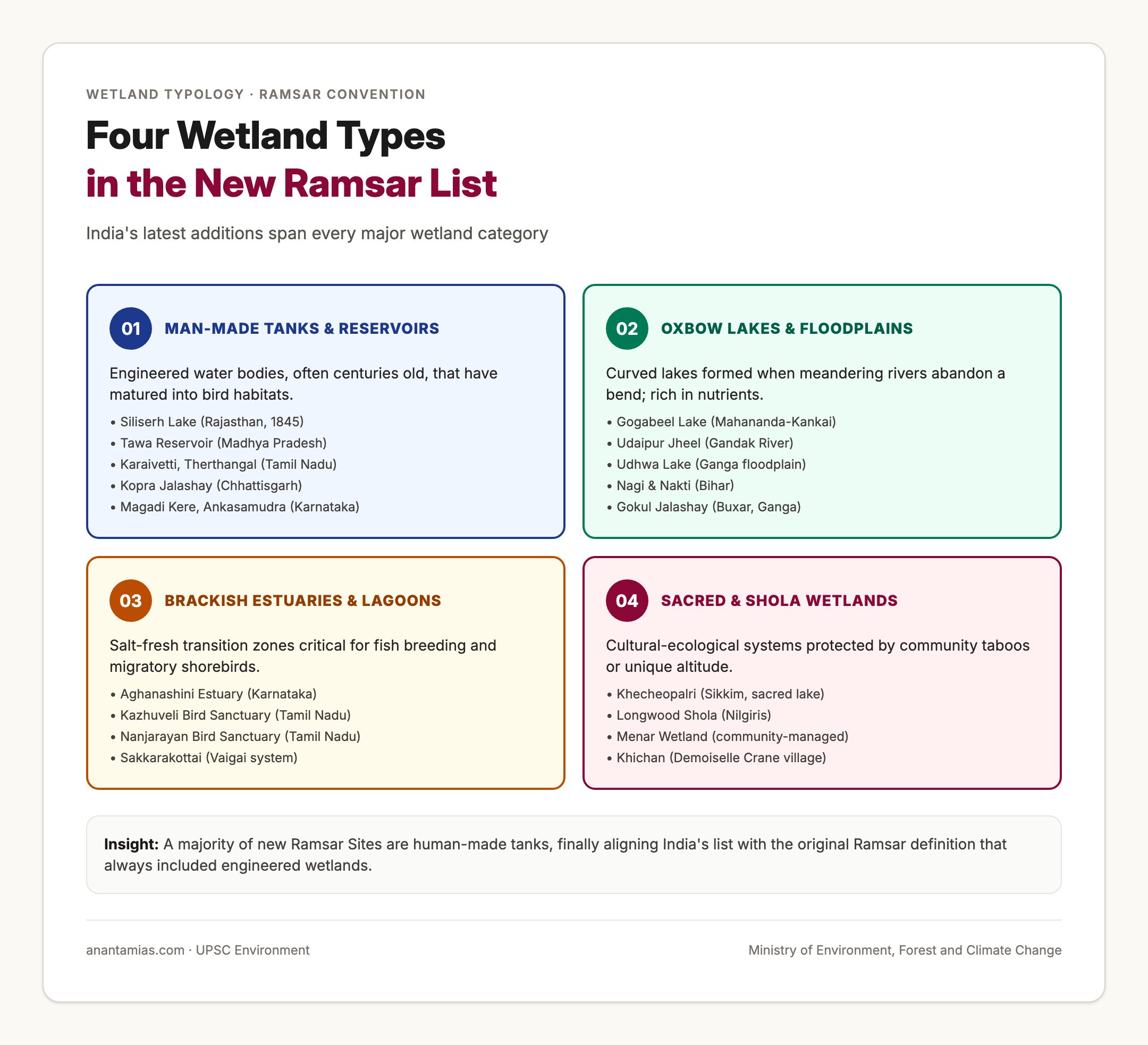
The latest tranche of Ramsar Sites is more than a count. It tells a story about how India is now thinking about wetlands. The first signal is geographical balance. By bringing Chhattisgarh and Jharkhand into the Ramsar map for the first time, the central government has acknowledged that the eastern and central tribal belts also harbour ecologically important water bodies. The second signal is the recognition of human-made wetlands. A majority of the new entries, from Siliserh to Karaivetti, are tanks or reservoirs built centuries ago for irrigation. This finally aligns the Indian list with the original Ramsar definition, which has always included human-made wetlands.
The third signal is community participation. Menar in Rajasthan and Magadi Kere in Karnataka are wetlands managed by local communities, where residents themselves regulate access, hunting, and harvest cycles. Their inclusion validates a model of conservation that does not depend on fortress-style exclusions. Finally, the shola wetland at Longwood and the sacred lake at Khecheopalri expand the definition of a Ramsar Site to ecosystems that earlier sat outside conventional bird-sanctuary frames.
Diversity of Wetland Types in the New List
The new Ramsar list spans almost every wetland category that ecologists recognise. Oxbow lakes, formed where a river abandons a curving meander, dominate the Bihar additions and demonstrate how floodplain dynamics create habitat. The reservoirs and tanks of Tamil Nadu, Karnataka, Madhya Pradesh, and Rajasthan illustrate how engineered water bodies can mature into rich ecosystems given a few decades of stable hydrology. The brackish wetlands of Kazhuveli and Aghanashini show the salt-fresh transition zones that are critical for fish breeding and migratory shorebirds. Khecheopalri demonstrates a sacred-cultural wetland, where local taboos against fishing and littering deliver protection without statute. Longwood Shola represents a montane wet ecosystem, with peat and grassland mosaics critical to the Nilgiri water cycle. For the related ecosystem context, see biodiversity and conservation and mangrove forest in India.
Detailed Profile of Marquee Sites
Khichan Wetland, Rajasthan
Khichan is one of the rare sites where the entire economy of a village turns around bird conservation. From October each year, thousands of Demoiselle Cranes arrive from Mongolia and Central Asia to overwinter at the village pond, and the Marwari Jain community feeds them with grain in a community feeding ground locally called the Chuga Ghar. The Ramsar listing legalises and amplifies this community-led model.
Aghanashini Estuary, Karnataka
The Aghanashini is one of the few rivers on the west coast that remains undammed in its main course, which preserves the natural sediment and salinity gradient at its estuary. The Gazni rice farming system, where saline-tolerant traditional varieties are grown in the brackish portion of the estuary, exists in only a handful of places in India, and its inclusion in a Ramsar Site provides both ecological and cultural protection.
Tawa Reservoir, Madhya Pradesh
Tawa is the longest tributary of the Narmada and its dam reservoir sits inside the Satpura Tiger Reserve, providing a hydrological link between Satpura and Bori sanctuaries. Its Ramsar designation means that the reservoir must now be managed in a way compatible with the wetland values of the convention, not only as an irrigation and power source.
Longwood Shola Reserve Forest, Tamil Nadu
Sholas are stunted tropical montane forests in the upper Nilgiris, growing in pockets surrounded by grasslands. Longwood is one of the largest contiguous shola patches and feeds tributaries of the Bhavani. Designating a shola as a Ramsar Site recognises the wetland character of the high-altitude grassland-forest mosaic, which holds peat and acts as a sponge.
Comparison with Older Ramsar Sites
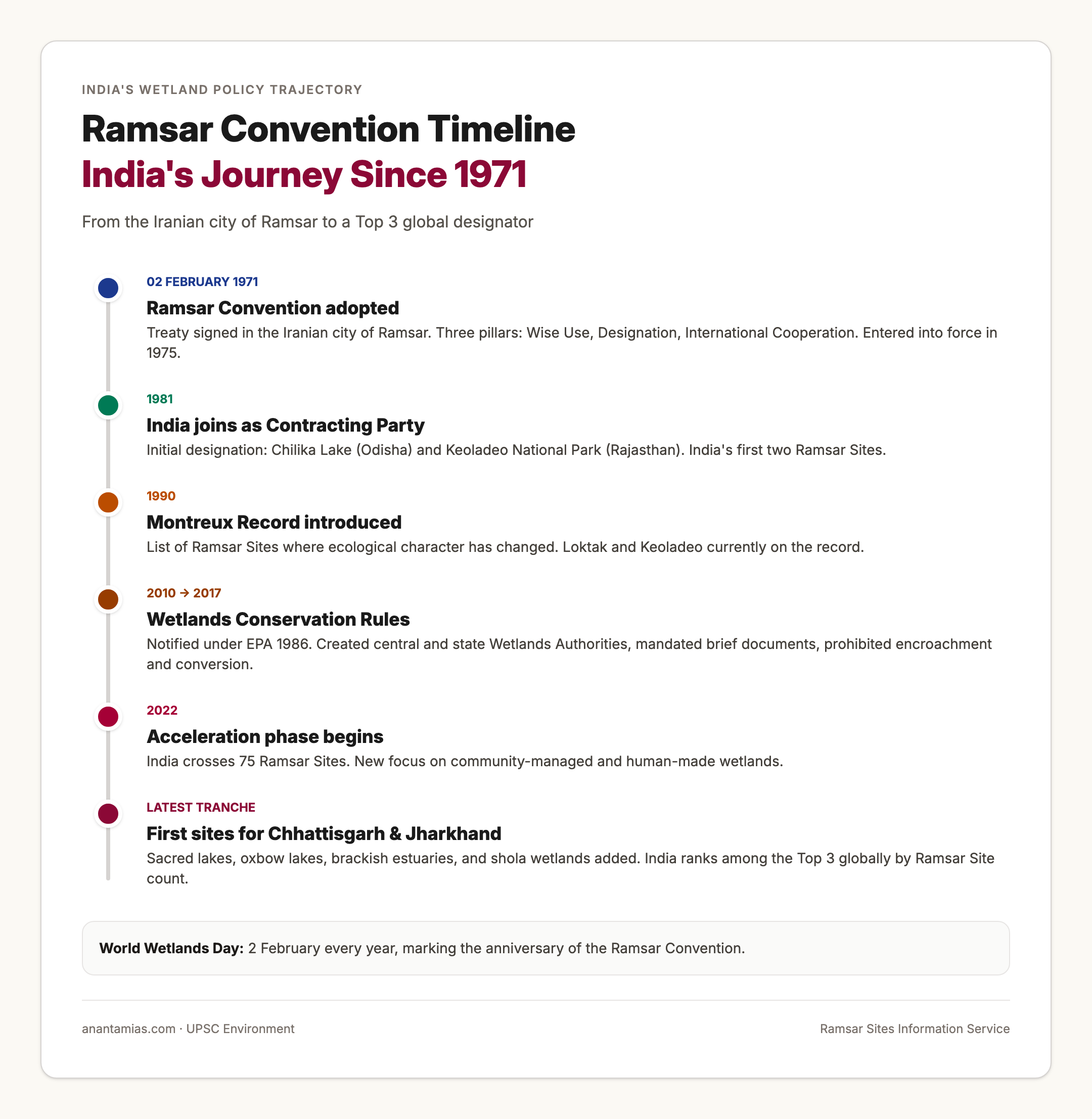
The pre-2020 Ramsar list was dominated by lagoons such as Chilika, deep lakes such as Loktak and Wular, and bird sanctuaries with strong colonial protection histories such as Keoladeo. The latest entries are smaller, often human-made, and tied to community livelihoods. Older sites like Loktak, Keoladeo, and Chilika have all spent time on the Montreux Record, the list of Ramsar Sites that face ecological change due to pollution or human pressure. None of the new sites are on the Montreux Record yet, but several face risks that need active management, including encroachment around Tawa, water scarcity at Khichan in summer, and pesticide runoff into Tamil Nadu tanks.
Challenges and Implementation Gaps
Designation alone does not protect a wetland. The Wetlands Rules 2017 require each notified wetland to have a brief document and a state-level wetland authority in place, but compliance has been uneven across states. The new sites in Bihar and Tamil Nadu will need brief documents, integrated management plans, and zoned regulations to convert paper protection into outcomes. Funding through the National Plan for Conservation of Aquatic Ecosystems is limited, and most state forest departments are stretched. Hydrological connectivity is another challenge. Many of the new tanks depend on canal feeders or river diversions, which can be cut off by upstream construction. Pollution from urban runoff threatens Sakkarakottai and other tanks downstream of growing towns. Climate-driven changes in rainfall patterns will alter the seasonal regimes of oxbow lakes such as Gogabeel and Udaipur Jheel.
Prelims Pointers
The Ramsar Convention was adopted in 1971 in Ramsar, Iran, and entered into force in 1975. India joined in 1981, designating Chilika and Keoladeo first. The Montreux Record lists Ramsar Sites where ecological character has changed or is likely to change. India currently has Loktak and Keoladeo on the Montreux Record, while Chilika was removed from it after restoration. The Wetlands Conservation and Management Rules 2017 were notified under the Environment Protection Act 1986 and are administered by the Ministry of Environment, Forest and Climate Change. Khichan is famous for Demoiselle Cranes, Aghanashini for Gazni rice, Khecheopalri as a sacred lake, Longwood Shola for the Nilgiri Tahr, Magadi Kere for Bar-headed Geese, and Menar as a community-conserved bird village. World Wetlands Day is celebrated on 2 February. The recent UPSC analogy question asking why wetlands are called the kidneys of the Earth tests the filtration and pollutant-absorption function of wetlands.
Mains Practice Questions
GS-III: Wetlands have been described as the kidneys of the Earth. In the light of recent Ramsar additions in India, evaluate how India’s wetland policy is responding to ecological and livelihood challenges. (250 words)
GS-III: Discuss the role of community-managed and human-made wetlands in achieving the objectives of the Ramsar Convention with examples from recent Indian designations. (250 words)
GS-II: Examine the institutional framework under the Wetlands Conservation and Management Rules 2017 and assess its effectiveness in implementing Ramsar commitments at the state level. (250 words)
GS-I: How do oxbow lakes form, and what makes them ecologically valuable? Illustrate with reference to recent Bihar additions to the Ramsar list. (150 words)
Way Forward
A wetland-by-wetland approach now needs to harden into a landscape approach. Each new Ramsar Site should be tied to its catchment, its source rivers, and its surrounding land use, so that conservation is not islanded inside a notified boundary. State wetland authorities need staff, scientific support, and budget that match the responsibility on paper. Brief documents must be backed by hydrological monitoring, water-quality data, and bird counts that can detect change before it becomes irreversible. Incentives should flow to communities such as those at Khichan and Menar that already absorb the costs of conservation. Finally, India should integrate its Ramsar list with the Eco-Sensitive Zone notifications and the environment impact assessment regime so that wetland values are factored into upstream project clearance decisions.
Frequently Asked Questions
What is the Ramsar Convention?
The Ramsar Convention is an international treaty signed in 1971 in the Iranian city of Ramsar that provides a framework for the conservation and wise use of wetlands and their resources. It came into force in 1975. India became a contracting party in 1981.
Which is the first Ramsar Site of Chhattisgarh?
Kopra Jalashay, a man-made reservoir in the Mahanadi River basin, is the first Ramsar Site of Chhattisgarh. It supports the vulnerable Lesser Adjutant stork.
Which is the first Ramsar Site of Jharkhand?
Udhwa Lake Bird Sanctuary on the floodplains of the Ganga River is the first Ramsar Site of Jharkhand. It comprises two water bodies, Patauran and Berhale, and is the only bird sanctuary in the state.
What makes Khichan Wetland special?
Khichan in Rajasthan hosts thousands of Demoiselle Cranes that migrate from Mongolia and Central Asia every winter. The local Marwari Jain community feeds them at a community feeding ground, making Khichan a global example of human-wildlife coexistence.
What is the Montreux Record?
The Montreux Record is a register maintained under the Ramsar Convention that lists Ramsar Sites where ecological character has changed, is changing, or is likely to change as a result of pollution or human interference. India has Loktak and Keoladeo on this record at present.
How many Ramsar Sites does India have now?
After the latest additions, India has more than ninety Ramsar Sites. India ranks among the top three countries globally by Ramsar Site count, after the United Kingdom and Mexico.
What is the difference between a wetland and a Ramsar Site?
Every Ramsar Site is a wetland, but not every wetland is a Ramsar Site. A Ramsar Site is a wetland of international importance that has been specifically designated by the contracting party under the convention’s criteria such as supporting threatened species or migratory waterbirds.
Which national legislation governs wetlands in India?
The Wetlands Conservation and Management Rules 2017, notified under the Environment Protection Act 1986, govern wetlands in India. They are administered by the Ministry of Environment, Forest and Climate Change with state-level wetland authorities responsible for implementation.
Why are wetlands called the kidneys of the Earth?
Wetlands act as kidneys because aquatic plants, microbes, and sediments filter heavy metals, nutrients, and pollutants from water that flows through them, mirroring the filtration role kidneys play in animal bodies.
Which sacred lake was added to the Ramsar list recently?
Khecheopalri Wetland in Sikkim, located within the Khangchendzonga Biosphere Reserve landscape, is a sacred lake that has been added to the Ramsar list. Local taboos against fishing and littering have protected it for generations.
Tell Google you want more of this.
Add Anantam IAS as a preferred sourceOne tap, and this site shows up more often in your own Top Stories, AI Overviews and AI Mode. Remove it any time.