UPSC CSE 2026 Essay Paper Discussion

YEAR ASKED IN

2021

Practice UPSC 2021 previous year questions on Anantam IAS: 100 Prelims MCQs and 80 Mains Q&A with answer keys, explanations and topic-wise links.

Prelims MCQs 100

  1. With reference to India, the terms ‘Halbi, Ho and Kui’ pertain to

    With reference to India, the terms 'Halbi, Ho and Kui' pertain to

    1. ADance forms of Northwest India
    2. BMusical instruments
    3. CPre-historic cave paintings
    4. DTribal languages
    Answer and explanation

    Correct answer: D

    Halbi, Ho, and Kui are tribal languages spoken in different regions of India:

    1. Halbi (Halabi): An Indo-Aryan language spoken primarily by the Halba tribe in Chhattisgarh, Odisha, Madhya Pradesh, and Maharashtra. 2. Ho: An Austroasiatic language (Munda group) spoken by the Ho people, mainly in Jharkhand and Odisha. 3. Kui (Kondh): A South-Central Dravidian language spoken by the Kandha (Khond) tribe, primarily in Odisha. It is closely related to Gondi and Pengo languages.

  2. With reference to 8th August 1942 in Indian history, which one of the following…

    With reference to 8th August 1942 in Indian history, which one of the following statements is correct?

    1. AThe Quit India Resolution was adopted by the AICC.
    2. BThe Viceroy's Executive council was expanded to include more Indians.
    3. CThe Congress ministries resigned in seven provinces.
    4. DCripps proposed an Indian Union with full Dominion Status once the Second World War was over.
    Answer and explanation

    Correct answer: A

    On 8th August 1942, the Quit India Resolution was adopted by the All India Congress Committee (AICC). This was a significant event in the Indian freedom struggle as it marked the launch of the Quit India Movement, led by Mahatma Gandhi, demanding an end to British Rule in India.

    The other options are not related to this specific date. - The Viceroy's Executive council was indeed expanded to include more Indians, but this was part of the August Offer in 1940, not on 8th August 1942. - The Congress ministries did resign in seven provinces, but this happened in 1939, not in 1942. - Lastly, Cripps did propose an Indian Union with full Dominion Status, but this was part of the Cripps Mission, which also did not occur on 8th August 1942.

    Therefore, the correct answer is that the Quit India Resolution was adopted by the AICC on this date.

    ![Quit India Movement](https://d39jluplm5thpx.cloudfront.net//Quit_India_Movement_4dad48a270.PNG)

  3. Which one of the following statements is correct?

    Which one of the following statements is correct?

    1. AAjanta Caves lie in the gorge of Waghora river.
    2. BSanchi Stupa lies in the gorge of Chambal river.
    3. CPandu-lena Cave shrines lie in the gorge of Narmada river.
    4. DAmaravati Stupa lies in the gorge of Godavari river.
    Answer and explanation

    Correct answer: A

    Option A is correct: The Ajanta Caves are a series of 29 rock-cut Buddhist cave monuments located in the Aurangabad district of Maharashtra. They are situated in the horseshoe-shaped gorge of the Waghora River.

    Option B is incorrect: Sanchi Stupa is located on a hilltop at Sanchi in the Raisen District of Madhya Pradesh. It is situated near the Betwa River, not the Chambal River.

    Option C is incorrect: The Pandu-Lena Caves (also known as Nasik Caves) are a group of 24 Buddhist caves carved into the Trirashmi hills near Nashik, Maharashtra. They are not located in the gorge of the Narmada River.

    Option D is incorrect: The Amaravati Stupa is located on the banks of the Krishna River in the Guntur district of Andhra Pradesh, not the Godavari River.

  4. Consider the following kinds of organisms: 1. Copepods 2. Cyanobacteria 3. Diatoms 4. Foraminifera…

    Consider the following kinds of organisms: 1. Copepods 2. Cyanobacteria 3. Diatoms 4. Foraminifera Which of the above are primary producers in the food chains of oceans?

    1. A1 and 2
    2. B2 and 3
    3. C3 and 4
    4. D1 and 4
    Answer and explanation

    Correct answer: B

    Statement 1 is Incorrect: Copepods are a group of small crustaceans found in nearly every freshwater and saltwater habitat; they are zooplankton that function as consumers (secondary producers) rather than primary producers. Statement 2 is Correct: Cyanobacteria are photosynthetic bacteria that obtain energy through photosynthesis and are significant primary producers in marine environments. Statement 3 is Correct: Diatoms are a major group of microalgae (phytoplankton) found in the oceans and are among the most important primary producers in the marine food chain. Statement 4 is Incorrect: Foraminifera are single-celled amoeboid protists that primarily function as consumers (zooplankton) by catching food with their ectoplasm.

  5. According to Portuguese writer Nuniz, the women in Vijayanagara Empire were expert in which…

    According to Portuguese writer Nuniz, the women in Vijayanagara Empire were expert in which of the following areas? 1. Wrestling 2. Astrology 3. Accounting 4. Soothsaying Select the correct answer using the codes given below.

    1. A1, 2 and 3 Only
    2. B1, 3 and 4 Only
    3. C2 and 4 Only
    4. D1, 2, 3 and 4
    Answer and explanation

    Correct answer: D

    All the statements are correct.

    Being employed in a Royal Household of the Vijayanagar empire implies that women served a variety of roles and were crucial to the workings of the palace.

    It was during the zenith of the Vijayanagar empire that female artists were encouraged to contribute to literature. Krishnadevaraya, besides having dominion over peninsular India, patronised female writers and poets.

    According to Portuguese writer Ferno Nuniz, the women in the Vijayanagara Empire were experts in various fields, including : - Wrestling (skilled in martial arts) - Astrology (predicted celestial events) - Accounting (managed financial records) - Soothsaying (foretold the future based on signs and omens)

    So the correct answer is 1, 2, 3 and 4.

  6. Which one of the following is used in preparing a natural mosquito repellent?

    Which one of the following is used in preparing a natural mosquito repellent?

    1. ACongress grass
    2. BElephant grass
    3. CLemongrass
    4. DNut grass
    Answer and explanation

    Correct answer: C

    The Lemongrass plant is known to be an excellent mosquito repellant.

    According to a study conducted in 2011, around 95% of mosquitos from a specific range of species were either killed or completely repelled due to the intense odour of lemongrass oil.

    Commonly known as Citronella oil, the impact of the essential oil from Lemongrass is known to last for around two and a half hours. For some species of mosquitos, it is even more.

  7. In a pressure cooker, the temperature at which the food is cooked depends mainly…

    In a pressure cooker, the temperature at which the food is cooked depends mainly upon which of the following? 1. Area of the hole in the lid. 2. Temperature of the flame 3. Weight of the lid Select the correct answer using the code given below.

    1. A1 and 2 Only
    2. B2 and 3 Only
    3. C1 and 3 Only
    4. D1, 2 and 3
    Answer and explanation

    Correct answer: C

    Statement 1 is correct: The size of the hole in the lid regulates the amount of steam released. A larger hole permits more steam to escape, leading to reduced pressure and subsequently affecting the temperature.

    Statement 2 is incorrect: Boiling water can never exceed 100 degrees Celsius, regardless of the intensity of the flame beneath the pot. However, within a pressure cooker, the temperature can elevate to as high as 121 degrees Celsius. The heightened cooking temperature serves to decrease the cooking duration rather than the temperature itself.

    Statement 3 is correct: If the weight is heavier, it will require higher pressure to lift it, resulting in higher pressure inside the cooker before excess steam can escape. Higher pressure leads to a higher boiling point for the water inside the cooker, which in turn increases the cooking temperature. Conversely, if the weight is lighter, it results in a lower pressure inside the cooker and a lower boiling point for the water, leading to a lower cooking temperature.

  8. Why is there a concern about copper smelting plants? 1. They may release lethal…

    Why is there a concern about copper smelting plants? 1. They may release lethal quantities of carbon monoxide into environment. 2. The copper slag can cause the leaching of some heavy metals into environment. 3. They may release sulphur dioxide as a pollutant. Select the correct answer using the codes given below.

    1. A1 and 2 Only
    2. B2 and 3 Only
    3. C1 and 3 Only
    4. D1, 2 and 3
    Answer and explanation

    Correct answer: B

    Statement 1 is Incorrect: Copper smelting plants are not typically associated with the release of lethal quantities of carbon monoxide into the environment; the primary gaseous pollutant of concern is sulfur dioxide. Statement 2 is Correct: Copper slag is a byproduct of the smelting process that contains heavy metals such as arsenic, lead, and cadmium. These metals can leach into the environment, potentially contaminating soil and groundwater resources. Statement 3 is Correct: Copper smelting plants are a major source of sulfur dioxide (SO2) emissions. This occurs because most copper ores are sulfide minerals (like chalcopyrite), and the sulfur within the ore is oxidized and released as SO2 gas during the roasting and smelting processes.

  9. In case of which one of the following biogeochemical cycles, the weathering of rocks…

    In case of which one of the following biogeochemical cycles, the weathering of rocks is the main source of release of nutrient to enter the cycle?

    1. ACarbon cycle
    2. BNitrogen cycle
    3. CPhosphorus Cycle
    4. DSulphur Cycle
    Answer and explanation

    Correct answer: C

    The Phosphorus Cycle is unique among major biogeochemical cycles because it does not involve a gaseous phase. Instead, phosphorus primarily moves through the lithosphere (rocks), hydrosphere (water), and biosphere (organisms).

    - Weathering of Rocks: The main source of phosphorus in this cycle comes from the weathering of phosphate-rich rocks. Over time, geological processes break down these rocks, releasing phosphate ions (PO₄³⁻) into the soil and water. - Absorption by Plants: Plants absorb phosphorus from the soil, and it moves up the food chain as herbivores and carnivores consume plants and other organisms. - Return to the Soil: When organisms die, decomposition releases phosphorus back into the environment, where it can re-enter the cycle. ![Phosphorus Cycle](https://d39jluplm5thpx.cloudfront.net//phosphorus_cycle_46e60589a9.jpg)

    - Carbon Cycle: The main source of carbon is atmospheric CO₂, released by respiration, combustion, and volcanic activity. ![Carbon Cycle](https://d39jluplm5thpx.cloudfront.net//carbon_cycle_326ba82622.jpg)

    - Nitrogen Cycle: Nitrogen is primarily cycled through the atmosphere, with nitrogen fixation (by bacteria) being a key process. ![Nitrogen Cycle](https://d39jluplm5thpx.cloudfront.net//nitrogen_cycle_e29b12f7a6.JPG)

    - Sulphur Cycle: Sulfur is mainly released from volcanic eruptions, decaying organic matter, and fossil fuel combustion, rather than rock weathering. ![Sulphur Cycle](https://d39jluplm5thpx.cloudfront.net//sulfur_cycle_ca4db2b2c8.jpg)

  10. Consider the following pairs: | Historical Place | Well-known for | |——————–|———————| | Burzahom…

    Consider the following pairs: | Historical Place | Well-known for | |--------------------|---------------------| | Burzahom | Rock-cut shrines | | Chandra-Ketugarh | Terracotta art | | Ganeshwar | Copper artefacts | Which of the pairs given above is/are correctly matched?

    1. A1 only
    2. B1 and 2
    3. C3 only
    4. D2 and 3
    Answer and explanation

    Correct answer: D

    Pair 1 is incorrect. Burzahom, located in the Kashmir Valley, is an archaeological site known for its Neolithic and Megalithic phases. Rock-cut shrines were not a prominent feature of the Neolithic period.

    Pair 2 is correct. Chandra-Ketugarh is indeed well-known for its terracotta art. Excavations at Chandra-Ketugarh, located near Kolkata in West Bengal, have revealed a vast collection of terracotta objects dating back to the 3rd century BCE to the 3rd century CE.

    Pair 3 is correct. Ganeshwar is an archaeological site located in Rajasthan, India. It is known for its Copper Hoard Culture, dating back to the Chalcolithic period (approximately 4000-2000 BCE). Ganeshwar is renowned for its large number of copper artefacts, including tools, weapons, and ornaments, providing valuable insights into ancient metallurgy and trade networks.

    Therefore, pairs 2 and 3 are correct.

  11. With reference to Chausath Yogini Temple situated near Morena, consider the following statements: 1.…

    With reference to Chausath Yogini Temple situated near Morena, consider the following statements: 1. It is a circular temple built during the reign of Kachchhapaghata Dynasty. 2. It is the only circular temple built in India. 3. It was meant to promote the Vaishnava cult in the region. 4. Its design has given rise to a popular belief that it was the inspiration behind the Indian Parliament building. Which of the statements given above are correct?

    1. A1 and 2
    2. B2 and 3 Only
    3. C1 and 4
    4. D2, 3 and 4
    Answer and explanation

    Correct answer: C

    Statement 1 is correct: (Circular temple, Kachchhapaghata Dynasty) The Chausath Yogini Temple near Morena is a circular temple complex built during the reign of the Kachchhapaghata dynasty, estimated to be around the 11th century CE.

    Statement 2 is incorrect: (Not the only circular temple) While the Chausath Yogini Temple is a well-known example, it's not the only circular temple in India. There are other circular temples across the country, such as the Shiva temple at Bhringari in Andhra Pradesh.

    Statement 3 is incorrect: (Vaishnava cult) The temple is not primarily associated with the Vaishnava cult, which worships Vishnu. The specific dedication of the temple is debated, with some theories suggesting a connection to Shaktism or Tantric practices.

    Statement 4 is correct: (Inspiration for Parliament building) There's a popular belief that the circular design of the Chausath Yogini Temple might have inspired the architects of the Indian Parliament building in New Delhi. However, there's no definitive historical evidence to confirm this connection.

    Therefore, the correct statements are 1 and 4.

  12. Magnetite particles, suspected to cause neurodegenerative problems, are generated as environmental pollutants from which…

    Magnetite particles, suspected to cause neurodegenerative problems, are generated as environmental pollutants from which of the following? 1. Brakes of motor vehicles 2. Engines of motor vehicles 3. Microwave stoves within homes 4. Power plants 5. Telephone lines Select the correct answer using the code given below

    1. A1, 2, 3 and 5 Only
    2. B1, 2 and 4 Only
    3. C3, 4 and 5 Only
    4. D1, 2, 3, 4 and 5
    Answer and explanation

    Correct answer: B

    Statement 1 is Correct: The friction and mechanical wear between brake pads and discs in motor vehicles generate iron-rich particulate matter, which can oxidize to form magnetite nanoparticles.

    Statement 2 is Correct: High-temperature combustion within vehicle engines produces magnetite as a byproduct of fuel burning and engine component wear, which is then released as an environmental pollutant.

    Statement 3 is Incorrect: Microwave stoves use electromagnetic radiation to heat food; they do not involve combustion or mechanical abrasion that would release magnetite particles into the environment.

    Statement 4 is Correct: Power plants, especially coal-fired ones, are significant sources of magnetite. The high-temperature combustion of fossil fuels produces fly ash that contains magnetic iron oxides.

    Statement 5 is Incorrect: Telephone lines carry electrical or optical signals and generate electromagnetic fields, but they do not undergo processes that emit physical magnetite particles.

  13. Bollgard I and Bollgard II technologies are mentioned in the context of

    Bollgard I and Bollgard II technologies are mentioned in the context of

    1. Aclonal propagation of crop plants.
    2. Bdeveloping genetically modified crop plants.
    3. Cproduction of plant growth substances.
    4. Dproduction of biofertilizers.
    Answer and explanation

    Correct answer: B

    Bollgard I and Bollgard II technologies are mentioned in the context of developing genetically modified (GM) cotton plants resistant to insect pests.

    * Bollgard I: This was India's first commercially approved GM crop technology introduced in 2002. It incorporates a single gene (Cry1Ac) from the bacterium Bacillus thuringiensis (Bt) into cotton plants. This Bt gene produces an insecticidal protein that targets and kills certain insect pests, particularly the American Bollworm (Helicoverpa armigera).

    * Bollgard II: This is a more advanced technology introduced in mid-2006. It incorporates two genes (Cry1Ac and Cry2Ab) from Bt into cotton. This provides broader resistance against a wider spectrum of insect pests, including lepidopteran caterpillars like the Spodoptera species, in addition to the American Bollworm.

  14. Consider the following statements: 1. Adenoviruses have single-stranded DNA genomes whereas retroviruses have double-stranded…

    Consider the following statements: 1. Adenoviruses have single-stranded DNA genomes whereas retroviruses have double-stranded DNA genomes. 2. Common cold is sometime caused by an adenovirus whereas AIDS is caused by a retrovirus. Which of the statements given above is/are correct?

    1. A1 Only
    2. B2 Only
    3. CBoth 1 and 2
    4. DNeither 1 nor 2
    Answer and explanation

    Correct answer: B

    Statement 1 is incorrect: Adenoviruses have double-stranded DNA genomes. Retroviruses have single-stranded RNA genomes.

    Statement 2 is correct: Adenoviruses are one of the many viruses that can cause the common cold. AIDS (Acquired Immunodeficiency Syndrome) is caused by the Human Immunodeficiency Virus (HIV), which is a type of retrovirus.

  15. ‘R2 Code of Practices constitutes a tool available for promoting the adoption of

    'R2 Code of Practices constitutes a tool available for promoting the adoption of

    1. Aenvironmentally responsible practices in electronics recycling industry.
    2. Becological management of 'wetlands of International Importance' under the Ramsar Convention.
    3. Csustainable practices in the cultivation of agricultural crops in degraded lands.
    4. D'Environmental Impact Assessment' in the exploitation of natural resources
    Answer and explanation

    Correct answer: A

    * The R2 Code of Practices is a tool available for promoting the adoption of environmentally responsible practices in the electronics recycling industry.

    * R2 stands for Responsible Recycling. The Code of Practices outlines a set of standards that electronics recyclers should follow to ensure responsible handling of electronic waste.

  16. With reference to furnace oil, consider the following statements: 1. It is a product…

    With reference to furnace oil, consider the following statements: 1. It is a product of oil refineries. 2. Some industries use it to generate power. 3. Its use causes sulphur emissions into Environment. Which of the statements given above are correct?

    1. A1 and 2 Only
    2. B2 and 3 Only
    3. C1 and 3 Only
    4. D1, 2 and 3
    Answer and explanation

    Correct answer: D

    Statement 1 is correct. Furnace oil is indeed a product of oil refineries. It is a dark viscous residual fuel obtained by blending heavier components of crude oil.

    Statement 2 is correct. Furnace oil is widely used in industries like cement, steel, and textiles for power generation and heating. It is burned in boilers, furnaces, and engines to produce energy.

    Statement 3 is correct. Furnace oil contains high sulfur content, and its combustion releases sulfur oxides (SOₓ), contributing to air pollution and acid rain.

  17. How is permaculture farming different from conventional chemical farming? 1. Permaculture Farming discourages monocultural…

    How is permaculture farming different from conventional chemical farming? 1. Permaculture Farming discourages monocultural practices but in conventional chemical farming, monoculture practices are pre-dominant. 2. Conventional chemical farming can cause increase in soil salinity but the occurrence of such phenomenon is not observed in permaculture farming. 3. Conventional chemical farming is easily possible in semi-arid regions but permaculture farming is not so easily possible in such regions. 4. Practice of mulching is very important in permaculture farming but not necessarily so in conventional chemical farming. Select the correct answer using the codes given below.

    1. A1 and 3
    2. B1, 2 and 4
    3. C4 Only
    4. D2 and 3
    Answer and explanation

    Correct answer: B

    Statement 1 is correct: Permaculture farming indeed discourages monocultural practices, promoting biodiversity and the efficient use of available resources. On the other hand, conventional chemical farming often involves monoculture practices.

    Statement 2 is correct: Conventional chemical farming can lead to an increase in soil salinity due to the heavy use of synthetic fertilizers and pesticides, while permaculture farming promotes soil health and does not contribute to soil salinity.

    Statement 3 is incorrect: The statement about conventional chemical farming being easily possible in semi-arid regions but permaculture farming not being so easily possible in such regions is not necessarily true. Permaculture farming can be adapted to various climates and environments, including semi-arid regions, by using appropriate design principles and techniques.

    Statement 4 is correct: The practice of mulching, which involves covering the soil with organic material to conserve moisture, suppress weeds, and improve soil health, is an important aspect of permaculture farming, but it is not necessarily a key practice in conventional chemical farming.

  18. Which one of the following is a reason why astronomical distances are measured in…

    Which one of the following is a reason why astronomical distances are measured in light-years?

    1. ADistances among stellar bodies do not change.
    2. BGravity of stellar bodies does not change.
    3. CLight always travels in a straight line.
    4. DSpeed of light is always same.
    Answer and explanation

    Correct answer: D

    Statement A is incorrect: The distance between stellar bodies does change, but often very slowly or in predictable orbits. Planets orbit stars, stars orbit galactic centers, and galaxies orbit each other, all causing continuous changes in distance. And this statement is not related to why distance is measured in light years.

    Statement B is incorrect: While the gravitational constant is fundamental, the effective gravity of stellar bodies changes due to shifts in their mass (e.g., fusion, stellar winds), changes in their radius/size (expanding into red giants, collapsing into white dwarfs/neutron stars), and changes in the distance between them as they orbit. And this statement is not related to why distance is measured in light years.

    Statement C is incorrect: Though mostly light travels in a straight line, it can be bent by Gravity- phenomenon known as Gravitational Lensing.

    Statement D is correct: the speed of light does not change in a vacuum. So, it is a constant that can be used for measurement.

  19. Water can dissolve more substances than any other liquid because

    Water can dissolve more substances than any other liquid because

    1. Ait is dipolar in nature
    2. Bit is a good conductor of heat
    3. Cit has high value of specific heat
    4. Dit is an oxide of hydrogen
    Answer and explanation

    Correct answer: A

    Water molecules are polar, meaning they have a positive charge on one end (the hydrogen atoms) and a negative charge on the other end (the oxygen atom). This polarity allows water molecules to attract and interact with other polar or charged molecules, facilitating the dissolution of a wide range of substances in water.

    Therefore, option (a) is correct.

  20. Consider the following statements: **Statement 1:** The United Nations Capital Development Fund (UNCDF) and…

    Consider the following statements: **Statement 1:** The United Nations Capital Development Fund (UNCDF) and the Arbor Day Foundation have recently recognized Hyderabad as 2020 Tree City of the World. **Statement 2:** Hyderabad was selected for the recognition for a year following its commitment to grow and maintain the urban forests. Which one of the following is correct in respect of the above statements?

    1. ABoth Statement 1 and Statement 2 are correct and Statement 2 is the correct explanation of Statement 1.
    2. BBoth Statement 1 and Statement 2 are correct and Statement 2 is not the correct explanation of Statement 1.
    3. CStatement 1 is correct but Statement 2 is not correct.
    4. DStatement 1 is not correct but Statement 2 is correct
    Answer and explanation

    Correct answer: D

    Statement 1 is incorrect: Hyderabad was indeed recognized as a Tree City of the World, but not by the UNCDF and Arbor Day Foundation together. The recognition comes from a joint program by the UN Food and Agriculture Organization (FAO) and the Arbor Day Foundation.

    Statement 2 is correct: Hyderabad was selected as a 2020 Tree City of the World by the Arbor Day Foundation in recognition of the city's commitment to urban forestry, including growing and maintaining its urban forests.

    Therefore, only the second statement is correct, and the first statement is incorrect.

  21. Who among the following was associated as Secretary with Hindu Female School which later…

    Who among the following was associated as Secretary with Hindu Female School which later came to be known as Bethune Female School?

    1. AAnnie Besant
    2. BDebendranath Tagore
    3. CIshwar Chandra Vidyasagar
    4. DSarojini Naidu
    Answer and explanation

    Correct answer: C

    Ishwar Chandra Vidyasagar - He was associated as Secretary with Hindu Female School which later came to be known as Bethune Female School. As the secretary of the Bethune School established in 1849, Ishwar Chandra Vidyasagar did important work in the field of higher education for women in India. - Ishwar Chandra Vidyasagar's most significant contribution was his advocacy for widow remarriage and girls' education, leading to the enactment of the Hindu Widow Remarriage Act of 1856.

    Annie Besant: - In September 1916, Annie Besant along with Bal Gangadhar Tilak established the All-India Home Rule League. - In 1917, Annie Besant was elected the President of the Indian National Congress (INC) Calcutta session, becoming the first woman to hold this position. - In 1898, she founded the Central Hindu College in Benares. Theosophists from abroad assisted in this effort, and the institution eventually became the foundation for Banaras Hindu University. - She also established the Central Hindu School for Girls in Varanasi, advancing female education in India.

    Debendranath Tagore: - He founded the Tattvabodhini Sabha and Adi Brahmo Samaj.

    Sarojini Naidu: - In recognition of her service during the plague epidemic in India, the British government honored her with the 'Kaisar-i-Hind' Medal. - In 1925, she became the first Indian woman to be elected president of the Indian National Congress (INC) during its Kanpur Session and held the position until 1928. - In 1930, Mahatma Gandhi chose her to lead the Salt Satyagraha, a nonviolent protest against the British monopoly on salt production. - She also accompanied Gandhi to London for the second session of the Round Table Conference in 1931, which ultimately remained inconclusive.

  22. Who among the following is associated with ‘Songs from Prison’, a translation of ancient…

    Who among the following is associated with 'Songs from Prison', a translation of ancient Indian religious lyrics in English?

    1. ABal Gangadhar Tilak
    2. BJawaharlal Nehru
    3. CMohandas Karamchand Gandhi
    4. DSarojini Naidu
    Answer and explanation

    Correct answer: C

    Mohandas Karamchand Gandhi translated a collection of ancient Indian religious lyrics from Sanskrit and other Indian languages into English during his imprisonment in Yerwada Jail in 1930. This work was published in London in 1934 under the title 'Songs from Prison'.

    * Bal Gangadhar Tilak: He is well-known for his work 'Gita Rahasya', which he wrote while imprisoned in Mandalay, and 'The Arctic Home in the Vedas'. * Jawaharlal Nehru: His major literary contributions include 'The Discovery of India' and 'Glimpses of World History', both written during his various terms in prison. * Sarojini Naidu: Known as the 'Nightingale of India', she was a prolific poet whose works include 'The Golden Threshold', 'The Bird of Time', and 'The Broken Wing', but she is not associated with the translation 'Songs from Prison'.

  23. Consider the following rivers: 1. Brahmani 2. Nagavali 3. Subarnarekha 4. Vamsadhara Which of…

    Consider the following rivers: 1. Brahmani 2. Nagavali 3. Subarnarekha 4. Vamsadhara Which of the above rise from the Eastern Ghats?

    1. A1 and 2
    2. B2 and 4
    3. C3 and 4
    4. D1 and 3
    Answer and explanation

    Correct answer: B

    Statement 1 is Incorrect: The Brahmani river is formed by the confluence of the Sankh and South Koel rivers near Rourkela; these headstreams originate in the Chota Nagpur Plateau of Jharkhand, not the Eastern Ghats.

    Statement 2 is Correct: The Nagavali river (also known as Langulya) originates in the Eastern Ghats near Lakhbahal in the Kalahandi district of Odisha.

    Statement 3 is Incorrect: The Subarnarekha river originates in the Chota Nagpur Plateau near Ranchi in Jharkhand and flows through West Bengal and Odisha before entering the Bay of Bengal.

    Statement 4 is Correct: The Vamsadhara river originates in the Eastern Ghats near Lanjigarh in the Kalahandi district of Odisha and flows through Andhra Pradesh before joining the Bay of Bengal.

  24. Consider the following statements: 1. In the tropical zone, the western sections of the…

    Consider the following statements: 1. In the tropical zone, the western sections of the oceans are warmer than the eastern sections owing to the influence of trade winds. 2. In the temperate zone, westerlies make the eastern sections of oceans warmer than the western sections. Which of the statements given above is/are correct?

    1. A1 Only
    2. B2 Only
    3. CBoth 1 and 2
    4. DNeither 1 nor 2
    Answer and explanation

    Correct answer: C

    Statement 1 is correct. The trade winds in the tropical zone blow from east to west, causing the western sections of the oceans to be warmer than the eastern sections. This is because these winds push the warm surface waters towards the west.

    Statement 2 is correct. On the other hand, in the temperate zone, the westerlies blow from west to east. These winds push the warm waters towards the eastern sections of the oceans, making them warmer than the western sections.

    Therefore, both statements are correct.

    ![Wind Systems](https://d39jluplm5thpx.cloudfront.net//pressure_belt_wind_system_330d34289f.jpg)

  25. Consider the following statements in respect of Bharat Ratna and Padma Awards: 1. Bharat…

    Consider the following statements in respect of Bharat Ratna and Padma Awards: 1. Bharat Ratna and Padma Awards are titles under the Article 18(1) of the Constitution of India. 2. Padma Awards, which were instituted in the year 1954, were suspended only once. 3. The number of Bharat Ratna Awards is restricted to a maximum of five in a particular year. Which of the above statements are not correct?

    1. A1 and 2 Only
    2. B2 and 3 Only
    3. C1 and 3 Only
    4. D1, 2 and 3
    Answer and explanation

    Correct answer: D

    Statement 1 is incorrect: The national awards such as Bharat Ratna, Padma Vibhushan, Padma Bhushan, and Padma Shri do not amount to titles within the meaning of Article 18(1) of the Constitution.

    Statement 2 is incorrect: Padma awards were instituted in the year 1954 and have been suspended in years 1978, 1979, 1993, and 1997.

    Statement 3 is incorrect: Although there is a general guideline to limit the Bharat Ratna to three recipients per year, this rule has been exceeded twice: In 1999, four awards were conferred (Jayaprakash Narayan, Amartya Sen, Gopinath Bordoloi, and Ravi Shankar) and in 2024, Five awards were conferred (M.S. Swaminathan, P.V. Narasimha Rao, Chaudhary Charan Singh, Karpoori Thakur, and L.K. Advani).

  26. Triclosan considered harmful when exposed to high levels for a long time, is most…

    Triclosan considered harmful when exposed to high levels for a long time, is most likely present in which of the following?

    1. AFood preservatives
    2. BFruit-ripening substances
    3. CReused plastic containers
    4. DToiletries
    Answer and explanation

    Correct answer: D

    Triclosan (sometimes abbreviated as TCS) is an antibacterial and antifungal agent present in some consumer products, including - toothpaste, - soaps, - detergents, - toys, - surgical cleaning treatments.

  27. In the first quarter of the seventeenth century, in which of the following was/were…

    In the first quarter of the seventeenth century, in which of the following was/were the factory/factories of the English East India Company located? 1. Broach 2. Chicacole 3. Trichinopoly Select the correct answer using the codes given below

    1. A1 Only
    2. B1 and 2
    3. C3 only
    4. D2 and 3
    Answer and explanation

    Correct answer: A

    Statement 1 is correct: Broach (Bharuch, Gujarat) was among the early factories of the English East India Company in the first quarter of the 17th century, soon after Surat.

    Statement 2 is incorrect: Chicacole was not an English factory during this period; the Company's early eastern base was at Masulipatnam.

    Statement 3 is incorrect: Trichinopoly was not an early trading post; it gained importance only in the 18th century during the Carnatic Wars.

    ![British Settlements in India](https://d39jluplm5thpx.cloudfront.net//english_cca07d03c1.jpg)

  28. With reference to the history of ancient India, Bhavabhuti, Hastimalla and Kshemeshvara were famous

    With reference to the history of ancient India, Bhavabhuti, Hastimalla and Kshemeshvara were famous

    1. AJain monks
    2. BPlaywrights
    3. CTemple architects
    4. DPhilosophers
    Answer and explanation

    Correct answer: B

    Bhavabhuti, Hastimalla, and Kshemeshvara were renowned playwrights in ancient and early medieval India.

    Bhavabhuti: An 8th-century scholar and playwright in the court of King Yashovarman of Kannauj. He is famous for his Sanskrit plays *Malatimadhava*, *Mahaviracharita*, and *Uttararamacharita*.

    Hastimalla: A 13th-century Jain playwright who lived during the Hoysala period. He is known for his Sanskrit plays such as *Vikrantakaurava*, *Maithilikalyana*, and *Anjanapavananjaya*.

    Kshemeshvara: A 10th-century playwright who served in the court of King Mahipala of the Pala dynasty. His notable works include the plays *Chandakaushika* and *Naishadhananda*.

  29. Which one of the following ancient towns is well-known for its elaborate system of…

    Which one of the following ancient towns is well-known for its elaborate system of water harvesting and management by building a series of dams and channelizing water into connected reservoirs?

    1. ADholavira
    2. BKalibangan
    3. CRakhigarhi
    4. DRopar
    Answer and explanation

    Correct answer: A

    * Dholavira is one of the five largest Harappan sites and is located in the present-day state of Gujarat, India. It was a prominent city of the ancient Indus Valley Civilization, flourishing around 4500 years ago.

    * Dholavira is renowned for its sophisticated water management system, which includes reservoirs, dams, channels, and other hydraulic structures.

    * Dholavira was a well-planned city with three distinct divisions: the citadel, middle town, and lower town. The city also had a large stadium or public gathering area, suggesting community events or administrative functions. A remarkable discovery at Dholavira was the earliest known signboard, with inscriptions on a large wooden board, indicating the use of writing for communication or identification.
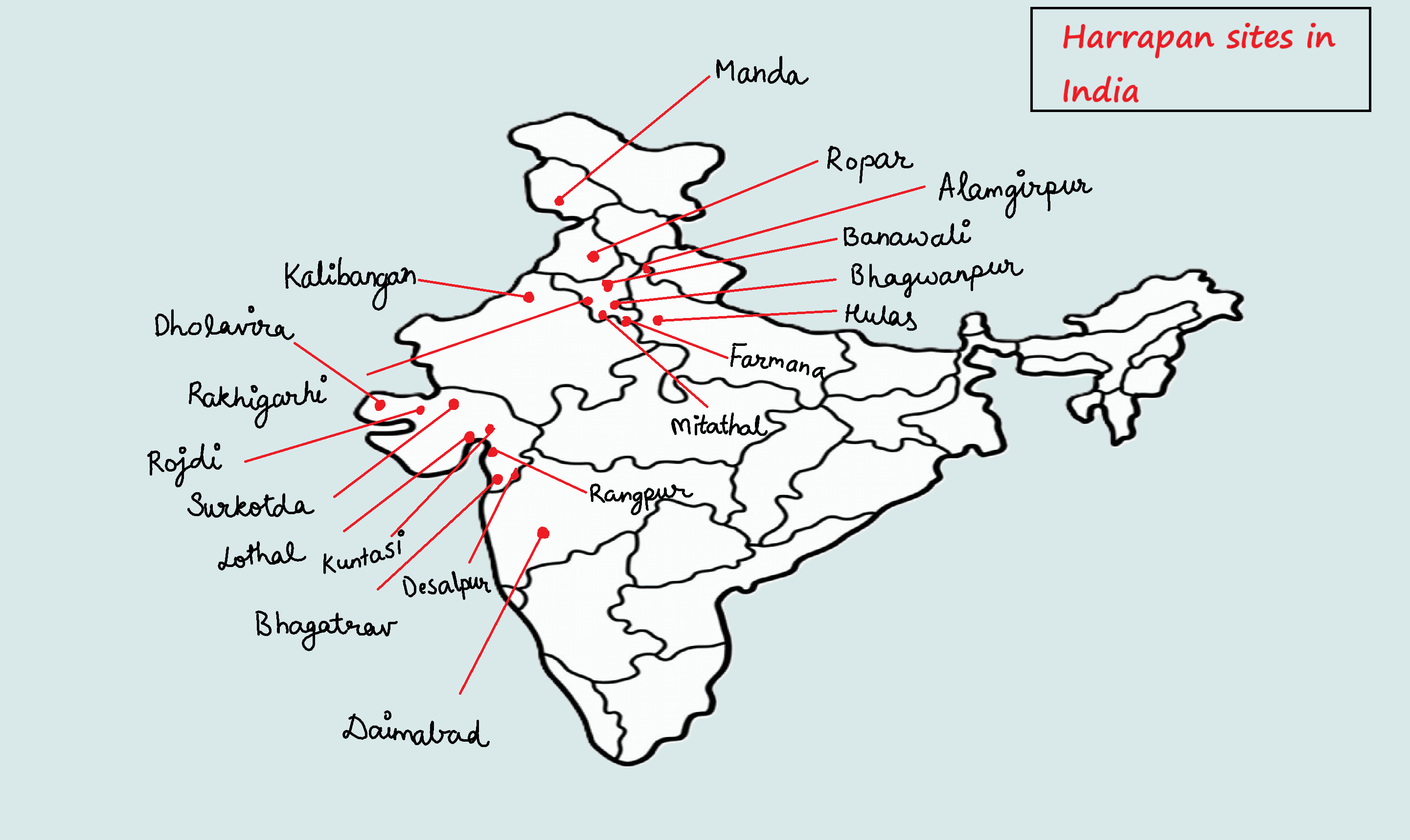
    ![Harappan sites in India](https://d39jluplm5thpx.cloudfront.net//harrapan_sites_22cbb16912.png)

    Kalibangan (Rajasthan) - First site to show ploughed field patterns. - Fire altars, indicating ritualistic practices. - Houses made of mud bricks instead of baked bricks. - No large water reservoirs like Dholavira.

    Rakhigarhi (Haryana) - Largest IVC site in India. - Evidence of multi-roomed houses, pottery, and jewelry making. - Skeletons found suggest the continuity of Harappan genes. - No evidence of large-scale fortifications like Dholavira.

    Ropar (Punjab) - First Harappan site excavated after India's independence. - Harappan culture overlapped with later Vedic culture. - Evidence of burials with pottery and personal belongings. - Found near the Sutlej River, showing river-based settlement.

  30. In the nature, which of the following is/are most likely to be found surviving…

    In the nature, which of the following is/are most likely to be found surviving on a surface without soil? 1. Fern 2. Lichen 3. Moss 4. Mushroom Select the correct answer using the code given below

    1. A1 and 4 Only
    2. B2 Only
    3. C2 and 3
    4. D1, 3 and 4
    Answer and explanation

    Correct answer: C

    Fern: * Ferns typically require soil and moisture to grow, as they rely on water-conducting tissues and need a substrate to anchor their roots.

    Lichen: * Lichens are a symbiotic association between a fungus and an algae or cyanobacteria. * Lichens are well-adapted to survive on surfaces without soil, such as rocks, tree bark, and even bare ground, as they can obtain their nutrients and moisture directly from the air and precipitation. * Lichens are sensitive to airborne pollutants, such as sulfur dioxide (SO2), nitrogen oxides (NOx), ozone (O3), and heavy metals (like lead and mercury). Sulfur dioxide, for instance, causes chlorosis (yellowing) and necrosis (cell death) in lichen thalli. This sensitivity makes lichens an effective indicator of air quality.

    Moss: * Mosses are non-vascular plants that can grow on surfaces without soil, such as rocks, tree trunks, and even roofs. * Mosses have specialised structures that allow them to absorb water and nutrients directly from the environment.

    Mushrooms: * Mushrooms are the reproductive structures of fungi, and they typically require a substrate, such as decaying organic matter, to grow. Mushrooms are not able to directly survive on a surface without soil or a nutrient-rich medium.

    Therefore, among the given options, lichens and mosses are the most likely to be found surviving on a surface without soil in the natural environment.

Mains Q&A 80