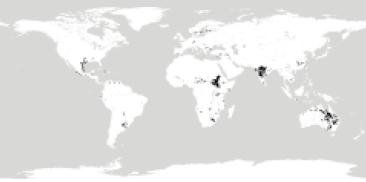
Black soil is the dark, clay-rich soil of the Deccan trap, and Indian geography calls it regur, from the Telugu word for the soil that grows cotton. It covers roughly 16 percent of the country’s land surface, mostly across Maharashtra, Madhya Pradesh, Gujarat, and parts of Andhra Pradesh and Karnataka, and it is the single most important soil for India’s cotton economy. Anyone preparing for UPSC geography meets black soil within the first few pages of the soils chapter, usually paired with alluvial soil as the two anchor types you have to know cold.
What makes black soil interesting is not just where it sits but how it behaves. It swells when wet, shrinks when dry, opens deep cracks in summer that pull surface litter down into its depths, and holds moisture long after the monsoon has retreated. Soil scientists classify it as a Vertisol, and the FAO uses that same name. The properties trace back to its parent rock, the basalt of the Deccan trap, and to the dry-wet climate of the peninsular interior where it formed.
Formation: From Deccan Basalt to Regur
Black soil owes its existence to one of the largest volcanic events in earth’s history. Sixty-six million years ago, fissure eruptions on the western Indian plate poured out flood basalts that hardened into the Deccan trap, a layered stack of lava flows covering about half a million square kilometres of peninsular India. As these basalts weathered slowly in a climate that alternates between a wet monsoon and a long dry season, they released iron, magnesium, aluminium, and calcium, and the clay minerals that formed from them give regur its distinctive properties.
The dominant clay mineral in black soil is montmorillonite, a smectite-group clay that has a remarkable ability to absorb water between its lattice layers. When the soil takes in moisture, the clay layers expand, the soil mass swells, and the surface heaves. When the water evaporates, the layers contract, the mass shrinks, and the surface cracks open. This shrink-swell behaviour, called vertic movement, is the defining feature of black soil and the reason it qualifies as a Vertisol.
The black colour, despite popular belief, does not come from organic matter. Organic content in regur is usually modest. The colour comes from iron and titanium compounds locked into the clay lattice, with magnetite and ilmenite contributing the darkest tones. In the deeper profile the soil can shade into brown or grey, but the surface layer in a freshly ploughed Maharashtra field is unmistakably dark, almost black when wet.
Why Basalt, Not Granite
Basalt weathers faster than the granite and gneiss of the rest of peninsular India because its iron-magnesium silicates are less stable in tropical conditions. The breakdown releases bases that buffer the soil against the acidification you see in the laterites of the Western Ghats. The result is a soil that stays close to neutral or slightly alkaline, rich in lime, and dominated by 2:1 expanding clays rather than the 1:1 kaolinite clays that form on granite.
Self-Ploughing: The Cracking Mechanism
Indian geographers call black soil self-ploughing because the shrink-swell cycle does the work of a plough without a farmer lifting a hand. As summer dries the soil, vertical cracks open in the surface, sometimes a centimetre or more wide and a metre or more deep. Surface litter, dust, and topsoil fall into these cracks. When the first monsoon rains arrive, the clay swells, the cracks close, and the material that fell in becomes mixed into the deeper profile. Over years this churns the soil column from top to bottom, which is why Vertisols have such poorly developed horizon layers compared with the alluvial soils of the coastal plains or the Gangetic basin.
This natural mixing has consequences. It buries seeds deeper than a farmer intends. It can damage building foundations and road surfaces, which is why engineers in Vidarbha and Marathwada have to design for vertic ground. And it makes black soil one of the harder substrates to plough mechanically once the rains begin, because wet regur becomes a sticky paste that clings to wheels and blades. The window for tillage is short, between the end of the dry season and the first heavy rain.
Moisture Retention and Why Cotton Thrives
The same clay that opens cracks holds water with extraordinary tenacity. Black soil can store enough moisture in its profile to carry a crop through a dry spell of several weeks, sometimes longer. Cotton, which has a long growing season and a deep taproot, exploits this stored moisture. The crop matures into the dry post-monsoon months and pulls water from deep in the soil column long after the rains have ended. This is the agronomic logic behind the cotton belt of Maharashtra, Gujarat, Madhya Pradesh, and northern Karnataka.
Beyond cotton, black soil supports jowar, tur, soybean, sugarcane in irrigated patches, oilseeds such as groundnut and sunflower, and pulses. Wheat grows on it in the cooler Malwa plateau of Madhya Pradesh. What black soil does not support well is paddy, because the soil drains poorly and the standing water that rice needs is hard to maintain across a season without engineering. Rice on regur tends to do worse than rice on the alluvium of the Indo-Gangetic plain.
The Trade-off with Drainage
Moisture retention is a virtue in a rain-fed agriculture, but it becomes a liability when the monsoon overshoots. Saturated black soil drains slowly because the clay particles pack tightly when wet. Excess water sits at the surface or in the upper profile and waterlogs the crop. Vidarbha sees this in years of heavy rain, when cotton suffers from root rot in fields that should have been the most productive in the country. Tile drainage is rare on Indian farms, so the only mitigation is shallow tillage and ridging, which lets surface water move off the field.
Distribution Across India
Black soil occupies a clear geographic block that maps almost exactly onto the Deccan trap and its weathered margins. The core lies in Maharashtra, where black soil covers most of Vidarbha, Marathwada, western Maharashtra excluding the Konkan coast, and the Khandesh plateau. From Maharashtra it extends northward into the Malwa plateau of Madhya Pradesh and Chhattisgarh, westward into the cotton belt of Saurashtra and central Gujarat, and southward into the Hyderabad-Karnataka region and northern Karnataka up to the Krishna valley. A thin extension reaches the Tamil Nadu uplands and the Rayalaseema region of Andhra Pradesh.
Outside this block, true black soil is rare. The Gangetic plain has its own alluvium. The Western Ghats have laterite where the basalt is more deeply weathered and leached. The Himalayan slopes and the desert margins of Rajasthan have entirely different soil regimes. The boundary of black soil and the boundary of the Deccan trap basalt are almost the same line on a map, and that is the simplest way to remember its distribution.
Sub-Types: Deep, Medium, Shallow
Indian soil surveys split regur into three sub-types by depth. Deep black soil, often called kali mitti in Madhya Pradesh, runs more than a metre deep on the Malwa plateau and the Tapi valley. It is the most productive and the basis of the Malwa cotton tradition. Medium black soil, around 60 centimetres to a metre, dominates Vidarbha and Marathwada. Shallow black soil, often less than 30 centimetres on hillslopes and the margins of the Deccan trap, is poor agricultural land and is usually left under coarse grain or pasture.
Characteristics at a Glance
The textbook properties of black soil break down cleanly. The texture is fine, clayey, with clay content often above 50 percent of the soil mass. The structure is blocky when dry and massive when wet, with the deep cracks that define a Vertisol. The colour ranges from black to dark grey on the surface, lighter in the deeper profile. The chemistry is alkaline to neutral, rich in lime and magnesium carbonate, moderately rich in potash, and low in nitrogen, phosphorus, and organic matter.
Cation exchange capacity is high because of the 2:1 expanding clays, which means black soil holds nutrients well once they are applied. The high lime content can immobilise phosphorus, so fertiliser timing matters more on regur than on the alluvial soils of the north. Field capacity, the amount of water the soil can hold against gravity, is among the highest of Indian soils. Permeability is low. The combination produces a soil that is rich in stored water but slow to drain.
Limitations of Regur
For all its virtues, black soil has well-known problems. Nitrogen deficiency is endemic, because the low organic matter content cannot supply the nitrogen demand of modern hybrid cotton or oilseed varieties. Farmers compensate with urea and DAP, sometimes excessively. Phosphorus availability is held back by the high pH and lime. Zinc deficiency is widespread, particularly in irrigated wheat areas of Madhya Pradesh. Sulphur deficiency shows up in soybean and oilseed fields.
Salinity and sodicity emerge on poorly drained black soils under canal irrigation, especially in parts of the Tungabhadra and Krishna command areas. The same moisture-holding property that helps rain-fed cotton allows salts to accumulate in the root zone when surface irrigation is heavy and drainage is absent. Reclamation needs gypsum, drainage, and a salt-tolerant crop rotation, which is not cheap and not fast.
The workability problem deserves its own line. Black soil is difficult to plough when wet and almost impossible when dry-baked. The window between is narrow. Mechanisation has helped, but tractors get stuck in waterlogged regur, and the timing of operations is the single biggest constraint on yields in the cotton belt.
Erosion on Slopes
On the shallower black soils of the Deccan margins, sheet and rill erosion are serious during high-intensity monsoon rain. The Krishna and Godavari basins lose millions of tonnes of black soil each year to the Bay of Bengal. Once eroded, this soil does not regenerate in any human timescale, because basalt weathering is slow even by geological standards. The link between fluvial landforms cut by these rivers and the soil loss they carry is direct: the same monsoon that nourishes the cotton also strips the topsoil from upland fields.
Black Soil and the UPSC Syllabus
For the UPSC General Studies paper, the testable points cluster around three areas. First, parent material and chemistry: basalt of the Deccan trap, montmorillonite clay, alkaline pH, high lime, low organic matter, low nitrogen. Second, properties and behaviour: self-ploughing through shrink-swell cycles, deep cracking in summer, high moisture retention, low permeability. Third, distribution and crops: peninsular India centred on Maharashtra-Madhya Pradesh-Gujarat, the cotton tradition, supporting role in jowar, tur, soybean, and oilseeds.
Prelims questions often contrast black soil with alluvial soil on a property-by-property basis, or with laterite on the weathering regime. Mains questions tend to ask about land degradation, irrigation management, and the link between geology and agriculture in the peninsula. The crossover with the chapter on types of weathering is direct, because regur formation is a textbook case of in-situ chemical weathering of mafic igneous rock under a seasonal tropical climate.
Frequently Asked Questions
Why is black soil called regur?
The term regur is a Telugu word that originally described the dark cotton-growing soil of the peninsular interior. It was carried into English by colonial soil surveyors in the nineteenth century and has stuck in Indian textbooks ever since. The international classification calls the same soil a Vertisol.
What is the parent rock of black soil?
Black soil forms from the weathering of basalt, the dark igneous rock of the Deccan trap. The trap was laid down by fissure eruptions about sixty-six million years ago and now covers roughly five hundred thousand square kilometres of peninsular India. Where the trap weathers, regur develops.
Why does black soil crack in summer?
The clay in black soil, mostly montmorillonite, expands when wet and contracts when dry. As the dry season progresses and the soil loses moisture, the clay contracts and pulls apart, opening vertical cracks that can be a centimetre wide and more than a metre deep. The cracks close when the monsoon rains return.
Which crop is most associated with black soil?
Cotton. The long growing season of cotton matches the moisture-storage capacity of regur, and the crop’s deep taproot exploits water held in the lower profile. The cotton belt of Maharashtra, Gujarat, and Madhya Pradesh sits almost entirely on black soil.
Is black soil good for paddy?
No. Black soil drains poorly and is hard to flood evenly, which makes it unsuitable for traditional paddy cultivation. Rice in the black soil regions is grown only where engineering creates the right water regime, and even then yields lag behind those on the alluvial soils of the Gangetic plain.
What nutrients are deficient in black soil?
Nitrogen, phosphorus availability, organic matter, and often zinc and sulphur. The high lime content immobilises phosphorus and the low organic content cannot meet the nitrogen demand of modern crops. Fertiliser management is the single biggest agronomic intervention on black soil farms.
How is black soil distributed in India?
It centres on Maharashtra and Madhya Pradesh, with major extensions into Gujarat, northern Karnataka, parts of Andhra Pradesh, Telangana, and small patches in Tamil Nadu and Chhattisgarh. The distribution follows the Deccan trap basalt almost exactly.
What is the difference between black soil and laterite?
Black soil forms from the moderate weathering of basalt under a seasonal climate that conserves bases, so it is alkaline, lime-rich, and clayey. Laterite forms from intense weathering under high rainfall that leaches all bases, leaving iron and aluminium oxides in a porous mass that is acidic and infertile. The two soils sit on opposite ends of the chemical weathering spectrum that the types of weathering chapter sets out.
Tell Google you want more of this.
Add Anantam IAS as a preferred sourceOne tap, and this site shows up more often in your own Top Stories, AI Overviews and AI Mode. Remove it any time.