Opens in a new tab
Join Anantam IAS Channel on Telegram

Daily Digest · Tuesday

16 June 2026 Current Affairs for UPSC

8 current affairs published on Tuesday, 16 June 2026

16 June 2026 Current Affairs for UPSC — every Why-in-News article AnantamIAS published on Tuesday, 16 June 2026, broken down with Why in News?, the exact GS paper it feeds, sub-topic mapping, MCQ-ready facts and a UPSC-style practice question. 8 articles in total, covering Polity, Economy, Environment, S&T, IR, Geography, History, Society and Internal Security — the same Why-in-News + GS-paper-mapping + practice-question format the Compass uses across every daily digest on the site.

Daily current affairs for UPSC is where new material enters your prep stream. Read this 16 June 2026 digest end-to-end in 25–35 minutes, attempt the practice question at the foot of each article (it's MCQ for some, 10/15-marker for others), then bookmark the entries that fall inside your active revision window. Everything stays cross-linked: tap any subject pill to jump to that subject's hub, or use the table of contents above to skip straight to a specific story.

Use this page three ways. Read sequentially for a one-sitting scan of everything that mattered on 16 June 2026. Download the 16 June 2026 PDF below for offline study or print revision. Or use the June 2026 Current Affairs compilation to see this day in the month's full context. For the previous day's reading, see 15 June 2026 Current Affairs; the next day's is 17 June 2026 Current Affairs.

Why we publish daily current affairs separately from the monthly compilation: daily is learning, monthly is revision. Use the daily page to add fresh material to your notes the day it breaks; come back to the June 2026 compilation 60 days before Prelims when the noise has settled and only the lasting takeaway is worth re-reading.

Reforming the IBC: Towards a Faster, Fairer Insolvency Regime

Open article →Download PDF
image 80

Why in News?

A The Hindu editorial (around 15 June 2026) revisited the case for reforming India’s Insolvency and Bankruptcy Code (IBC), 2016, the country’s flagship law for resolving the debts of stressed companies. The editorial argued that despite a decade of operation, the regime is slowed by NCLT congestion, long resolution timelines and steep value erosion for lenders, even as a fresh set of statutory fixes awaits rollout.

The trigger is the Insolvency and Bankruptcy Code (Amendment) Act, 2026 — assented by the President in April 2026 — whose provisions are being notified in stages. The editorial weighed whether creditor-led resolution, group and cross-border insolvency and tighter admission deadlines can fix the delay-and-haircut problem that IBBI data keeps flagging.

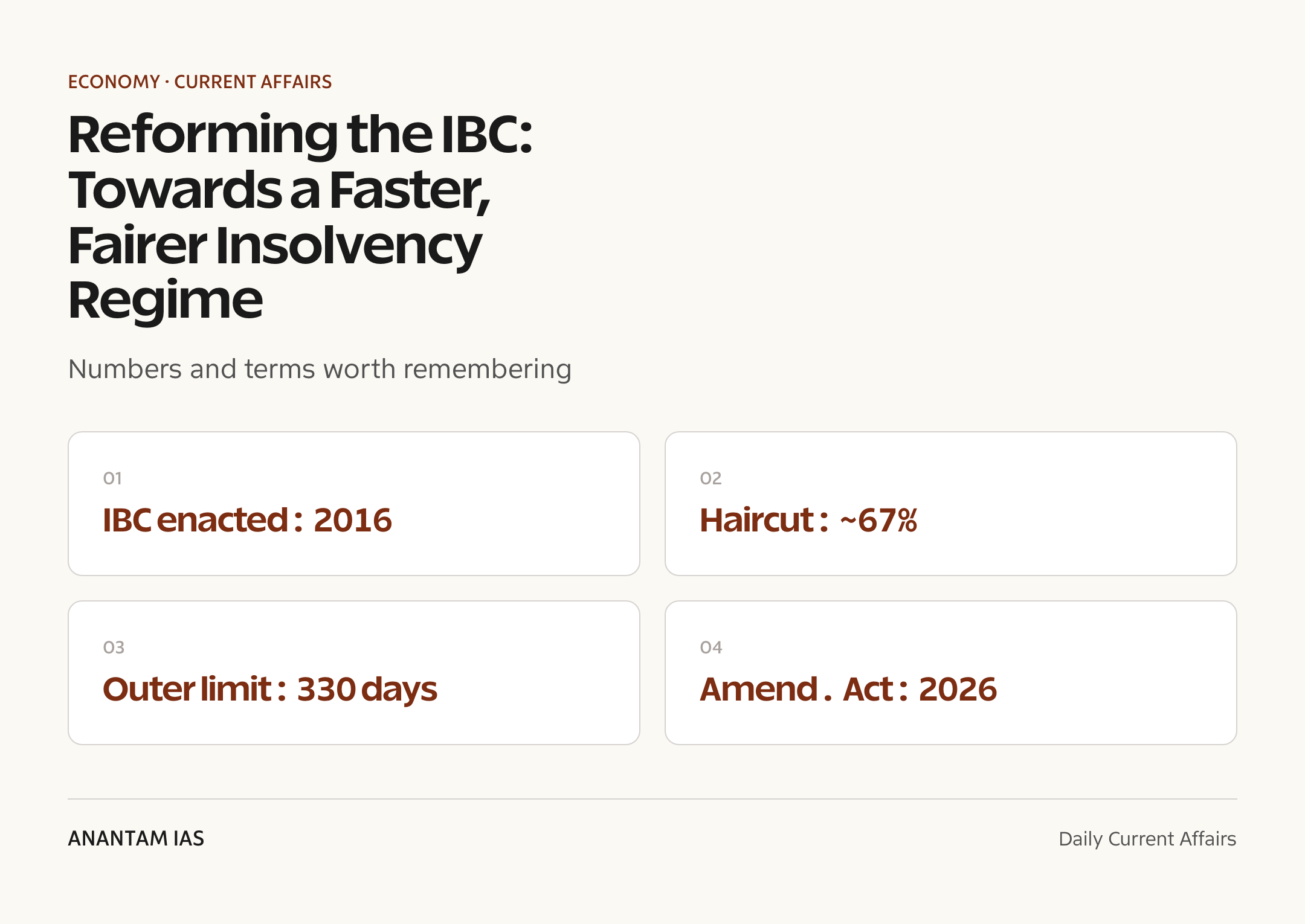
  • Per published IBBI/CIRP data (realisations till around September 2025), lenders took an aggregate haircut of roughly 67% on admitted claims under resolved cases.
  • Financial creditors realised about ₹3.99 lakh crore under approved resolution plans against admitted claims of about ₹12.31 lakh crore (IBBI, published figures).
  • A large share of ongoing CIRP cases had crossed the 270-day mark, with average resolution running far beyond the 330-day statutory ceiling (IBBI, ~early 2026).
  • The Amendment Act, 2026, introduces a creditor-initiated process, an enabling framework for cross-border and group insolvency, and fixed admission deadlines for the NCLT.

The development matters in the context of:

  • Matters because the IBC underpins credit discipline in the Indian economy: faster, higher recoveries, lower banks’ cost of capital and reduces non-performing assets (NPAs).
  • Matters because delayed resolution destroys going-concern value — pushing more firms into liquidation, where recoveries are a fraction of those under resolution.
  • Matters because investor confidence in India’s ease of doing business hinges on a predictable, time-bound exit mechanism for failed firms.
Reforming the IBC: Towards a Faster, Fairer Insolvency Regime — quick facts

UPSC Relevance

Prelims Relevance

  • IBC, 2016 — single, consolidated law for corporate and individual insolvency; replaced a patchwork including SICA and the BIFR.
  • IBBI — the regulator for insolvency professionals, agencies, valuers and information utilities; a statutory body under the IBC.
  • NCLT (adjudicating authority for corporate insolvency) and NCLAT (appellate tribunal); appeals lie further to the Supreme Court.
  • CIRP — Corporate Insolvency Resolution Process; the time-bound process to revive or resolve a defaulting company.
  • Committee of Creditors (CoC) — body of financial creditors that approves a resolution plan; key voting thresholds of 66% and 51%.
  • 330-day outer limit for completing CIRP (including litigation), versus the original 180+90-day design.
  • Resolution vs liquidation — a resolution plan revives the firm as a going concern; liquidation breaks it up and sells assets.
  • Haircut — the share of admitted claims that creditors forgo; the inverse of the recovery rate.
  • UNCITRAL Model Law on Cross-Border Insolvency — the global template the 2026 framework draws on (Section 240C).
  • Amendment Act, 2026 — adds creditor-initiated, group and cross-border insolvency; assented April 2026.

Mains Relevance

GS Paper 3

  • Insolvency reform as an instrument of credit discipline, NPA resolution and capital-market deepening.
  • Balancing speed of recovery with fairness to operational creditors, workers and minority stakeholders.

GS Paper 2

  • Institutional capacity of quasi-judicial tribunals (NCLT/NCLAT) and the governance challenge of judicial delay.

Essay

  • Markets need clean exits as much as clean entries: the role of orderly failure in a dynamic economy.
  • Speed and fairness in justice — can a time-bound law deliver both?

Background and Context

What the IBC set out to do

The Code rewired how India handles business failure.

  • Enacted in 2016, the IBC consolidated fragmented laws into a single, time-bound framework for resolving the insolvency of firms and individuals.
  • It shifted control from defaulting promoters to a Committee of Creditors, supervised by a licensed resolution professional, during a moratorium.
  • The original design targeted resolution within 180 days (extendable by 90), later capped at an outer limit of 330 days, including litigation.
  • Twin goals: maximise value for creditors and preserve the firm as a going concern wherever viable, rather than default to liquidation.
Reforming the IBC: Towards a Faster, Fairer Insolvency Regime — exam lens

The institutional architecture

Four pillars carry the process.

  • IBBI regulates insolvency professionals, professional agencies, valuers and information utilities — the market plumbing of the regime.
  • The NCLT admits applications, supervises the CIRP and approves resolution plans; the NCLAT hears appeals.
  • The Committee of Creditors — drawn from financial creditors — exercises the ‘commercial wisdom’ that approves or rejects plans by a 66% vote.
  • Resolution professionals run the company as a going concern through the process and file applications against avoidance and fraudulent transactions.

Why recoveries disappoint: delays and haircuts

The numbers explain the editorial’s worry.

  • Per IBBI‘s published data, the aggregate haircut on admitted claims under resolved cases ran near 67% — creditors recovering roughly a third of what they were owed.
  • Recoveries under resolution plans (around a third of claims) far exceed those in liquidation (a low single-digit share) — so delay-driven liquidation is costly.
  • A large majority of pending CIRP cases had crossed the 270-day mark, with average resolution stretching well past the 330-day statutory ceiling.
  • Root causes: NCLT vacancies and case overload, drawn-out litigation, and slow admission of fresh applications that let asset value erode before resolution begins.

What the 2026 amendments change

The Amendment Act, 2026, attacks the delay problem on several fronts.

  • Creditor-initiated resolution — a new chapter lets specified financial creditors run an out-of-court process with lower approval thresholds, easing the load on the NCLT.
  • Cross-border insolvency — Section 240C empowers the Centre to frame rules drawing on the UNCITRAL Model Law, covering recognition of and cooperation with foreign proceedings.
  • Group insolvency — a new framework lets two or more linked corporate debtors be resolved together, reducing today’s case-by-case judicial improvisation.
  • Tighter timelines — fixed admission deadlines with recorded reasons for delay, a supervised liquidation timeline, and curbs on withdrawal of admitted applications.
  • The Act was assented to in April 2026; provisions are being notified in stages rather than all at once.

Where the editorial sees unfinished work

Statutory fixes are necessary but not sufficient.

  • Tighter deadlines mean little without NCLT bench strength — more members, registrars and benches to clear the backlog.
  • Cross-border rules and group insolvency need careful subordinate legislation; an enabling clause is only the first step.
  • The personal and partnership insolvency framework remains largely unimplemented, leaving guarantors and small businesses in limbo.
  • Deep haircuts raise a fairness question for operational creditors, workers and small suppliers, who rank below financial creditors in the waterfall.

Why this matters for the wider economy

Insolvency reform is macroprudential, not just procedural.

  • Faster, higher recoveries lower banks’ provisioning burden and free capital for fresh lending across the Indian economy — easing the NPA overhang.
  • A credible exit option sharpens credit discipline: borrowers price in the cost of default, and lenders price risk better.
  • A predictable insolvency regime is a key input to ease of doing business and to attracting long-term and foreign capital.
  • Resolution that preserves the going concern protects jobs and supply chains that liquidation would otherwise destroy.

Way Forward

Build tribunal capacity

  • Fill NCLT/NCLAT vacancies and add benches so the new admission deadlines are met in practice, not just on paper.
  • Invest in digital case management and an electronic portal to cut procedural lag.

Operationalise the new tools carefully

  • Notify clear rules for cross-border and group insolvency, aligned with the UNCITRAL Model Law, to reduce uncertainty.
  • Sequence the creditor-initiated process with safeguards against misuse by dominant creditors.

Widen and balance the regime

  • Implement the long-pending personal and partnership insolvency chapters in calibrated phases.
  • Improve outcomes for operational creditors and workers, and curb avoidable liquidation by admitting cases before value erodes.

Conclusion

The IBC remains India’s most important market-discipline reform of the past decade, but its promise is throttled by delay. The 2026 amendments rightly target the bottlenecks — creditor-led resolution, group and cross-border frameworks and firmer timelines — yet a law is only as fast as the tribunals that apply it.

The editorial’s message is that fairness and speed must advance together: clearing benches, protecting weaker creditors and notifying the new rules with care. Done well, a faster, fairer insolvency regime would lower the cost of credit and make orderly business failure a feature, not a fault, of a dynamic economy.

UPSC Practice Questions

Prelims MCQ 1

With reference to the Insolvency and Bankruptcy Code, 2016, consider the following statements:

  1. The Committee of Creditors is composed of the operational creditors of the corporate debtor.
  2. The National Company Law Tribunal is the adjudicating authority for the corporate insolvency resolution process.
  3. The Corporate Insolvency Resolution Process is to be completed within an outer limit of 330 days, including the time taken in litigation.

How many of the above statements are correct?

(a) Only one (b) Only two (c) All three (d) None

Answer: (b) Only two

Explanation:

Statement 1 is incorrect — the Committee of Creditors comprises financial creditors, not operational creditors. Statements 2 and 3 are correct: the NCLT adjudicates corporate insolvency, and the CIRP carries a 330-day outer limit, including litigation.

Prelims MCQ 2

The Insolvency and Bankruptcy Code (Amendment) Act, 2026, is most closely associated with which of the following changes?

(a) Abolishing the Committee of Creditors and replacing it with a government-appointed board

(b) Introducing a creditor-initiated process and enabling frameworks for cross-border and group insolvency

(c) Transferring all insolvency cases from the NCLT to the regular civil courts

(d) Ending resolution plans and making liquidation the default outcome

Answer: (b) Introducing a creditor-initiated process and enabling frameworks for cross-border and group insolvency

Explanation:

The 2026 amendments add a creditor-initiated resolution route, an enabling clause for cross-border insolvency (Section 240C, drawing on the UNCITRAL Model Law) and a group-insolvency framework, while tightening NCLT timelines.

UPSC Mains Questions

  1. The Insolvency and Bankruptcy Code has reshaped India’s approach to business failure, yet delays and deep haircuts persist. Examine the structural reasons for low recoveries and assess how far the 2026 amendments address them. (250 words)
  2. “A time-bound insolvency law is only as effective as the tribunals that enforce it.” In light of NCLT delays, discuss the institutional and procedural reforms needed to make India’s insolvency regime faster and fairer. (250 words)
  3. Discuss the significance of cross-border and group insolvency frameworks for India’s integration with global capital, and the challenges in operationalising them under the UNCITRAL Model Law. (150 words)

Sources: The Hindu (Editorial) and Insolvency and Bankruptcy Board of India (IBBI).

Frequently Asked Questions

What is the Insolvency and Bankruptcy Code, 2016?

It is India’s single, time-bound law for resolving the insolvency of companies and individuals. Enacted in 2016, it consolidated earlier fragmented laws and shifted control from defaulting promoters to creditors during a structured resolution process, aiming to maximise value and revive viable firms.

What is a haircut in insolvency?

A haircut is the portion of their admitted claims that creditors give up when a company is resolved or liquidated. If lenders recover only a third of what they are owed, the haircut is about two-thirds. It is the inverse of the recovery rate and a key measure of how well the regime works.

What is the difference between resolution and liquidation?

Resolution revives a defaulting company as a going concern under a court-approved plan, usually with a new owner, preserving jobs and value. Liquidation breaks up the firm and sells its assets piecemeal. Recoveries under resolution are typically far higher than under liquidation, so resolution is the preferred outcome.

What does the 330-day timeline mean?

The Code requires the Corporate Insolvency Resolution Process to be completed within an outer limit of 330 days, including time spent in litigation. In practice, many cases run well beyond this because of tribunal backlogs and appeals, eroding the value available for recovery.

What do the 2026 amendments to the IBC change?

The Insolvency and Bankruptcy Code (Amendment) Act, 2026 introduces a creditor-initiated resolution process, enabling frameworks for cross-border and group insolvency, and fixed admission deadlines for the NCLT. It received Presidential assent in April 2026, with its provisions being notified in stages.

What is cross-border insolvency?

Cross-border insolvency deals with companies that have assets, creditors or operations in more than one country. India’s 2026 framework, drawing on the UNCITRAL Model Law, lets Indian and foreign proceedings recognise and cooperate with each other, making it easier to resolve globally connected firms.
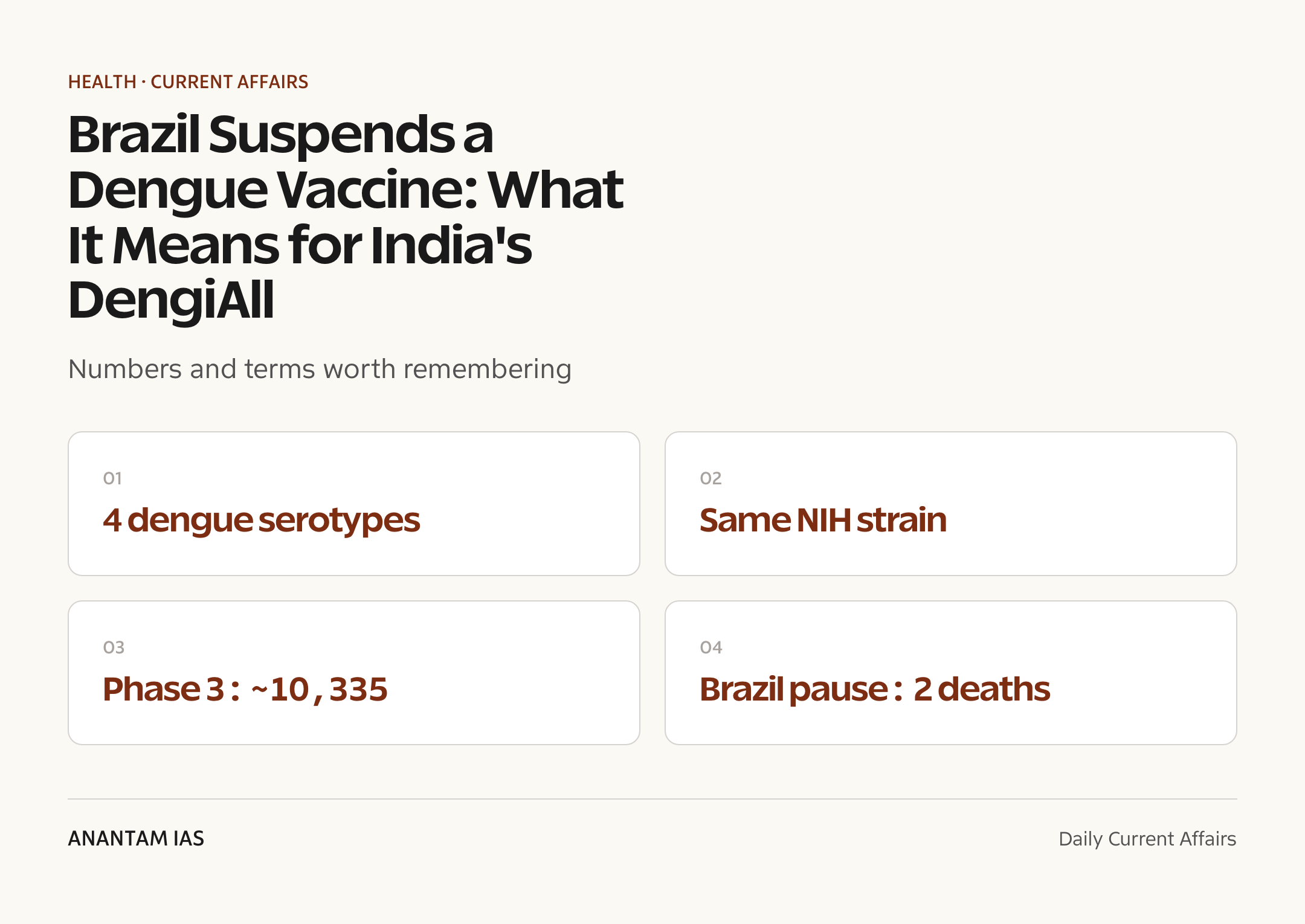
Brazil Suspends a Dengue Vaccine: What It Means for India’s DengiAll

Open article →Download PDF
image 79

Why in News?

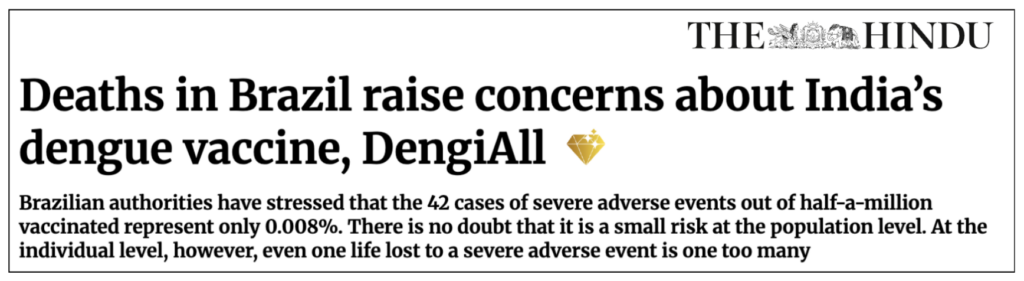
In mid-June 2026, Brazil temporarily suspended its national rollout of a single-dose dengue vaccine made by the Butantan Institute, after pharmacovigilance data flagged two deaths and a cluster of serious adverse events among people already vaccinated. The Health Minister stressed the pause is precautionary and that there is not yet enough data to prove the vaccine caused the deaths.

The episode draws Indian attention because the Butantan vaccine and India’s own indigenous candidate, DengiAll (developed by the ICMR with Panacea Biotec), trace back to the SAME parent strain — the TV003/TV005 live-attenuated tetravalent strain originally engineered by the U.S. National Institutes of Health (NIH).

DengiAll is in late-stage Phase 3 trials in a high-dengue-burden country, so a safety signal in a sister vaccine is a watch-point, not a verdict.

  • The suspended product is the Butantan Institute’s single-dose vaccine, approved by Brazil’s regulator ANVISA in late 2025 and rolled out from February 2026.
  • About 501,000 people had been vaccinated; pharmacovigilance recorded 2 deaths and roughly 42 severe adverse cases (intense abdominal pain, persistent vomiting, bleeding).
  • Officials called it a precautionary suspension — no causal link established — while ANVISA and the health ministry analyse the data.
  • This is a DIFFERENT vaccine from Takeda’s two-dose Qdenga (TAK-003), which continues to be used in Brazil and is unaffected by this pause.

The development matters in the context of:

  • Dengue vaccines are famously hard to design because the virus has four serotypes, and prior immunity can paradoxically worsen later infection through antibody-dependent enhancement (ADE).
  • India carries one of the world’s heaviest dengue burdens, so the safety and roll-out path of any tetravalent vaccine is a major public-health and regulatory question.
Brazil Suspends a Dengue Vaccine: What It Means for India's DengiAll — quick facts

UPSC Relevance

Prelims Relevance

  • Dengue — a viral disease spread by Aedes aegypti mosquitoes; four serotypes: DENV-1 to DENV-4
  • Antibody-Dependent Enhancement (ADE) — antibodies from one serotype worsen a later infection by a different serotype
  • DengiAll — India’s indigenous tetravalent live-attenuated dengue vaccine (ICMR + Panacea Biotec)
  • TV003/TV005 — parent strain developed by the U.S. NIH, licensed to both Panacea Biotec and Butantan in 2008
  • ICMR — Indian Council of Medical Research, apex biomedical research body
  • CDSCO and the DCGI — India’s drug regulator and Drugs Controller General for vaccine approval
  • Qdenga (TAK-003) — Takeda’s two-dose dengue vaccine; Dengvaxia (CYD-TDV) — Sanofi’s vaccine restricted to seropositives
  • WHO SAGE and GACVS — WHO advisory bodies on immunisation and vaccine safety
  • Pharmacovigilance — monitoring of adverse events following immunisation (AEFI)
  • Live-attenuated vaccine — uses a weakened virus to trigger immunity without causing disease

Mains Relevance

GS Paper 3

  • Indigenisation of technology and developing new vaccines; India’s biotechnology and public-health R&D capacity.
  • Science and ethics of clinical trials, Phase 3 design, and post-marketing safety surveillance.

GS Paper 2

  • Issues relating to development and management of the health sector; the role of regulators (CDSCO/DCGI) and global bodies (WHO).
  • Government policies for a high-burden vector-borne disease and the public-trust dimension of vaccine roll-outs.

Essay

  • Science advances by learning from failure as much as from success.
  • Self-reliance in health: the promise and the responsibility of an indigenous vaccine.

Background and Context

What Brazil actually suspended — and what it did not

The pause hit one specific vaccine; precision matters because several dengue vaccines coexist.

  • The suspended product is the Butantan Institute’s single-dose tetravalent vaccine, the world’s first single-dose dengue shot, approved by ANVISA in late 2025.
  • Roll-out began in February 2026; by mid-June, about 501,000 people had received it, mostly priority groups such as health workers.
  • Pharmacovigilance flagged 2 deaths and around 42 severe adverse cases; the health ministry ordered a precautionary suspension pending analysis.
  • Officials, including Health Minister Alexandre Padilha, were explicit that no cause-and-effect link has been established — the deaths are a signal to investigate, not a proven harm.
  • Takeda’s two-dose Qdenga (TAK-003) is a separate product and was NOT suspended; this is not a blanket dengue vaccine ban.
Brazil Suspends a Dengue Vaccine: What It Means for India's DengiAll — exam lens

Why dengue vaccines are uniquely hard

Dengue defeats the usual one-virus-one-vaccine logic, which is why safety signals are watched so closely.

  • Dengue has four distinct serotypes (DENV-1 to DENV-4); recovering from one gives only short-lived cross-protection against the others (see our explainer on dengue in India).
  • Antibody-Dependent Enhancement (ADE) means antibodies raised against one serotype can bind a different serotype and help it enter cells more efficiently, making a SECOND infection more severe.
  • A vaccine that primes the immune system imperfectly can mimic a first infection and risk worsening a later natural infection — the core safety puzzle.
  • This is why a dengue vaccine must be truly tetravalent — protecting against all four serotypes in balance — rather than dominant against just one.
  • Long-term post-marketing surveillance matters more than for most vaccines, because risks like enhanced disease can appear only years after vaccination.

The Dengvaxia precedent — the cautionary tale

An earlier dengue vaccine showed exactly how ADE can turn protection into harm, shaping today’s caution.

  • Dengvaxia (CYD-TDV), made by Sanofi Pasteur, was rolled out in a school programme in the Philippines in 2016.
  • Follow-up data showed higher rates of severe dengue and hospitalisation among seronegative children — those with no prior dengue infection — consistent with ADE.
  • The Philippines suspended the programme in 2017 after more than 800,000 children had received at least one dose, triggering a major public-trust crisis.
  • The WHO now recommends Dengvaxia only for people with a confirmed prior dengue infection (seropositives).
  • The lesson embedded in modern dengue R&D: balanced tetravalent immunity and rigorous safety monitoring are non-negotiable.

India’s DengiAll — the indigenous candidate

DengiAll is India’s bid for an affordable, home-made dengue vaccine, now in its decisive trial phase.

  • DengiAll is a tetravalent, live-attenuated dengue vaccine co-developed by the ICMR and Panacea Biotec (compare the major vaccine types).
  • It is built on the TV003/TV005 strain from the U.S. NIH, the SAME parent strain that Butantan licensed — both companies took it up in 2008.
  • Panacea Biotec re-engineered the formulation so it can be stored at routine 2–8 degrees Celsius, instead of the deep-freeze the original NIH strain needed.
  • The Phase 3 trial enrolled about 10,335 healthy adult participants across roughly 19 sites in 18 states/UTs, with two years of follow-up.
  • Earlier Phase 1 and Phase 2 trials (2018–19) gave encouraging immunogenicity results; market availability is anticipated around 2027 if data hold.

Why the Brazil signal is relevant — and why it is not a DengiAll verdict

Shared genetics create a watch-point, but the two vaccines are not identical products.

  • The shared TV003/TV005 backbone means Indian regulators and ICMR will study Brazil’s safety data for any common mechanism.
  • But formulation, manufacturing, dosing schedule and the trial populations differ — a signal in one is a prompt to verify, not proof for the other.
  • DengiAll’s own Phase 3 data and India-specific safety monitoring, not Brazil’s roll-out, will decide its fate.
  • India’s regulator CDSCO (via the DCGI) and an independent data-safety board are the gatekeepers before any approval.
  • Transparent, timely communication — as Brazil attempted — is itself part of protecting public trust in a future Indian roll-out.

India’s dengue burden — the stakes

A working dengue vaccine would matter enormously because India faces large, recurring outbreaks.

  • India reports lakhs of dengue cases each monsoon; the NCVBDC (National Centre for Vector-Borne Diseases Control) recorded over 1.8 lakh cases in 2024 by late October.
  • DENV-2 has been the predominant circulating serotype across many Indian states in recent seasons, with newer lineages emerging.
  • All four serotypes circulate in India, so any vaccine must protect broadly to be useful — raising the ADE stakes.
  • Current control relies almost entirely on vector management (source reduction, fogging) and supportive clinical care, with no vaccine in routine use.
  • An affordable indigenous vaccine like DengiAll could be a major addition to the public-health toolkit and India’s wider science and technology capacity, which is exactly why its safety bar is set high.

Way Forward

Investigate transparently

  • Let ANVISA and Brazil’s health ministry complete the causality analysis; India’s ICMR should review the findings for any strain-level lessons.
  • Share pharmacovigilance data openly so that a precautionary pause does not harden into avoidable vaccine hesitancy.

Strengthen India’s safety machinery

  • Reinforce AEFI surveillance and an independent data-safety monitoring board around the DengiAll trial.
  • Ensure CDSCO/DCGI evaluate India-specific Phase 3 and long-term follow-up data before any approval.

Pair vaccines with vector control

  • Keep investing in Aedes source reduction, community sanitation and early-warning surveillance — a vaccine complements, not replaces, vector control.
  • Build clear public communication so a future roll-out is trusted and well-targeted.

Conclusion

Brazil’s pause is a textbook example of vaccine pharmacovigilance working as intended — a signal triggers a precautionary halt and an investigation, before any causal claim is made. For a disease as immunologically tricky as dengue, that caution is a feature, not a failure.

For India, the message is one of attentive optimism. DengiAll shares a strain with Brazil’s vaccine but is its own product, and only its own Phase 3 and safety data can decide its future. The episode underlines that an indigenous dengue vaccine is worth pursuing precisely because India’s burden is huge — and that it must clear an unusually high safety bar before reaching the public.

UPSC Practice Questions

Prelims MCQ 1

With reference to dengue and dengue vaccines, consider the following statements:

  1. The dengue virus has four distinct serotypes, DENV-1 to DENV-4.
  2. Antibody-Dependent Enhancement (ADE) refers to a phenomenon where prior antibodies can make a subsequent dengue infection more severe.
  3. India’s DengiAll and Brazil’s Butantan dengue vaccine are derived from the same NIH TV003/TV005 parent strain.

How many of the above statements are correct?

(a) Only one (b) Only two (c) All three (d) None

Answer: (c) All three

Explanation:

All three are correct. Dengue has four serotypes; ADE explains why a second, different-serotype infection can be worse; and both DengiAll and the Butantan vaccine trace to the NIH-developed TV003/TV005 strain licensed in 2008.

Prelims MCQ 2

Which one of the following statements about DengiAll is correct?

(a) It is an inactivated (killed-virus) vaccine targeting only DENV-2.

(b) It is a tetravalent, live-attenuated vaccine developed by ICMR with Panacea Biotec.

(c) It is manufactured by Takeda and marketed as Qdenga.

(d) It has already received WHO prequalification and is in routine use in India.

Answer: (b) It is a tetravalent, live-attenuated vaccine developed by ICMR with Panacea Biotec.

Explanation:

DengiAll is a tetravalent live-attenuated candidate from ICMR and Panacea Biotec, in Phase 3 trials. Qdenga is Takeda’s separate vaccine, and DengiAll is not yet in routine use.

UPSC Mains Questions

  1. Dengue vaccines are uniquely difficult to develop. Explaining the roles of serotype diversity and antibody-dependent enhancement, discuss the safety challenges that India’s indigenous dengue vaccine programme must address. (250 words)
  2. “A precautionary suspension is a sign that pharmacovigilance is working, not failing.” Examine this statement in the context of recent dengue vaccine safety signals and India’s regulatory readiness. (250 words)
  3. Why does India need an affordable indigenous dengue vaccine, and what institutional safeguards should accompany its roll-out? Critically analyse. (150 words)

Sources: The Hindu and The Hindu.

Frequently Asked Questions

Which vaccine did Brazil suspend?

Brazil temporarily suspended the single-dose dengue vaccine made by its Butantan Institute, after pharmacovigilance flagged two deaths and several severe adverse events among the roughly 501,000 people vaccinated. The health ministry called it a precautionary pause, stressing that no causal link to the vaccine has yet been established. Takeda’s separate Qdenga vaccine was not affected.

Is this the same as India’s DengiAll?

No, but they are related. DengiAll, developed by ICMR and Panacea Biotec, and Brazil’s Butantan vaccine are both built on the same parent strain, TV003/TV005, originally engineered by the U.S. NIH. However, the formulation, dosing and manufacturing differ, so a safety signal in one is a prompt to investigate, not proof of risk in the other.

What is antibody-dependent enhancement (ADE)?

ADE is the reason dengue vaccines are so hard to make. After infection with one of the four dengue serotypes, the antibodies you develop can bind a different serotype during a later infection and actually help the virus enter cells, making that second infection more severe. A vaccine that mimics a first infection imperfectly can risk the same effect.

What is DengiAll and what stage is it at?

DengiAll is India’s first indigenous dengue vaccine, a tetravalent live-attenuated shot from ICMR and Panacea Biotec. It is in Phase 3 trials, which enrolled about 10,335 adult participants across roughly 19 sites in 18 states and union territories, with two years of follow-up. If the data hold, market availability is anticipated around 2027.

Why does India need a dengue vaccine?

India carries one of the world’s heaviest dengue burdens, with lakhs of cases each monsoon and all four serotypes in circulation. Control today relies on mosquito management and supportive care, with no vaccine in routine use. An affordable, home-made vaccine like DengiAll could be a major public-health tool, which is exactly why its safety bar is set so high.

Who decides if DengiAll is safe to use in India?

India’s drug regulator, the CDSCO, acting through the Drugs Controller General of India (DCGI), evaluates the trial data before any approval. An independent data-safety monitoring board oversees the trial, and AEFI surveillance tracks adverse events. Global bodies like the WHO’s SAGE and GACVS also shape best practice, but the national approval decision rests with CDSCO.

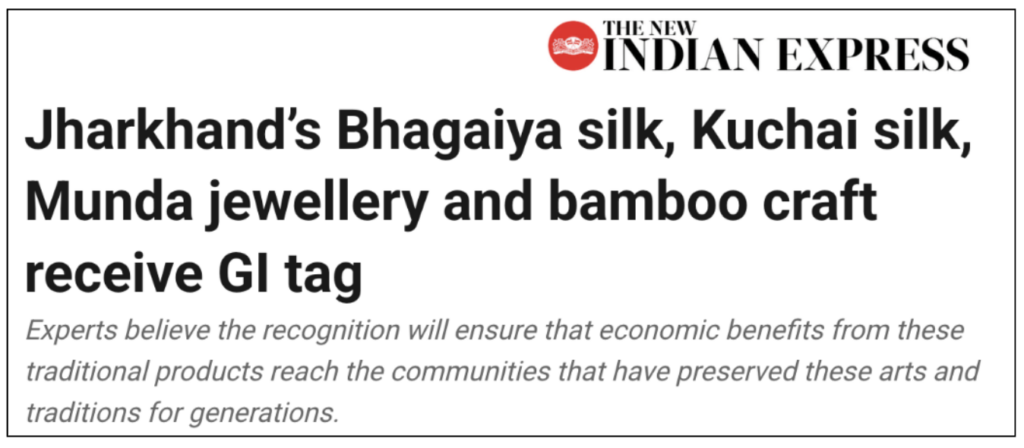
Jharkhand’s Four New GI Tags: Tribal Silk, Jewellery and Bamboo Craft

Open article →Download PDF
image 78

Why in News?

Four traditional Jharkhand products secured the Geographical Indication (GI) tag in mid-June 2026, the state’s biggest single haul of GI recognitions to date.

The four products are Bhagaiya silk (Godda district), Kuchai silk — a tasar variety from the Seraikela-Kharsawan district, Munda jewellery made by the Munda tribal community, and Jharkhand’s bamboo craft. GI status is granted by the Geographical Indications Registry, Chennai, and ties each product legally to its place and producer community of origin.

  • Bhagaiya silk originates in the Bhagaiya belt of Godda district.
  • Kuchai silk is a tasar (tussar) silk from the Kuchai region of Seraikela-Kharsawan, reared on Asan and Arjun host trees.
  • Munda jewellery reflects the motifs and metal craft of the Munda tribe; bamboo craft covers utility and decorative items.
  • NABARD facilitated documentation, producer organisation and the GI filing under its Tribal Development Fund interventions.

The development matters in the context of:

  • GI is the legal instrument that lets tribal and rural artisans capture a price premium and block imitation — directly relevant to tribal livelihoods and the One District One Product (ODOP) agenda.
  • Jharkhand, a tribal-majority state with a thin formal-manufacturing base, gains a branding and export lever for its handloom and handicraft clusters.
Jharkhand's Four New GI Tags: Tribal Silk, Jewellery and Bamboo Craft — quick facts

UPSC Relevance

Prelims Relevance

  • Geographical Indications of Goods (Registration and Protection) Act, 1999 — entered into force in 2003.
  • GI is an intellectual property right under the WTO’s TRIPS Agreement (Articles 22-24).
  • GI Registry, Chennai — under the Office of the Controller General of Patents, Designs and Trade Marks (CGPDTM), Ministry of Commerce and Industry.
  • GI registration is valid for 10 years and is renewable.
  • Darjeeling tea was India’s first registered GI (2004-05).
  • GI protects a community/collective, not a single firm — unlike a trademark or patent.
  • Jharkhand’s four 2026 GIs: Bhagaiya silk, Kuchai silk, Munda jewellery, and bamboo craft.
  • Kuchai silk is a tasar variety; tasar is a wild silk reared outdoors, distinct from mulberry silk.

Mains Relevance

GS Paper 1

  • GI as a tool to safeguard and revive tribal art, craft and intangible cultural heritage.
  • Role of indigenous knowledge systems in India’s handloom and handicraft traditions.

GS Paper 3

  • GI and One District One Product as drivers of rural livelihoods, branding and exports.
  • Institutional handholding (NABARD, state departments) in formalising the unorganised craft economy.

Essay

  • Heritage is not a museum piece — it is a living livelihood.
  • Protecting the maker protects the craft: intellectual property and the informal economy.

Background and Context

What a Geographical Indication is

A GI is a sign on goods that have a specific geographical origin and possess qualities or a reputation due to that origin.

  • Governed by the Geographical Indications of Goods (Registration and Protection) Act, 1999, operational from 2003.
  • Flows from India’s obligations under the TRIPS Agreement of the WTO, which mandates GI protection for members.
  • Registration is handled by the GI Registry, Chennai, under the CGPDTM in the Ministry of Commerce and Industry.
  • A registered GI protects a producer community collectively and bars unauthorised users from passing off goods as the genuine article.
  • Covers agricultural, natural, manufactured and handicraft goods — from Darjeeling tea to Banarasi sarees.
Jharkhand's Four New GI Tags: Tribal Silk, Jewellery and Bamboo Craft — exam lens

GI vs trademark vs patent

Students confuse these three intellectual-property rights; the distinctions are frequently tested.

  • GI — collective right tied to a place and a community; cannot be assigned or transferred individually; valid 10 years, renewable indefinitely.
  • Trademark — protects a single proprietor’s brand/logo; assignable and licensable; renewable every 10 years.
  • Patent — protects a novel invention for a fixed 20-year term, after which it enters the public domain.
  • A GI guards origin and reputation, not novelty or a brand name; it is the natural fit for traditional crafts and produce.

The registration process

GI registration is a structured, multi-stage process that turns informal know-how into a defended right.

  • An association of producers, an authority or an organisation files the application with the GI Registry.
  • The application must define the product, its geographical boundary, the production method and the historical/cultural link to the place.
  • Steps include examination, publication in the GI Journal, an opposition window, and finally registration.
  • Once registered, authorised users (the actual artisans/producers) must also enrol to use the GI and enforce it.
  • NABARD here did the heavy lifting — documentation, producer mapping and stakeholder consultations through its Tribal Development Fund.

The four Jharkhand products

Each of the four GIs encodes a distinct cluster of tribal and rural skills.

  • Bhagaiya silk — a silk tradition from the Bhagaiya belt of Godda district, rooted in local weaving knowledge.
  • Kuchai silk — a tasar (tussar) silk from the Kuchai region of Seraikela-Kharsawan, where worms are reared on Asan and Arjun trees.
  • Munda jewellery — ornaments of the Munda tribe with distinctive motifs and metalwork, carrying cultural and ritual meaning.
  • Bamboo craft — utility and decorative bamboo products, an example of low-input, sustainable rural manufacturing.

Why GI matters for tribal livelihoods

For a tribal-majority state, a GI tag is less about prestige and more about price, protection and market access.

  • Premium pricing — a verified origin lets artisans command a higher value than an anonymous handloom or handicraft.
  • Anti-counterfeit protection — outsiders cannot legally sell mass-produced lookalikes as the genuine Kuchai silk or Munda jewellery.
  • Market and export visibility — GI products gain shelf identity in domestic markets and on e-commerce and export channels.
  • Cultural preservation — formal recognition incentivises the next generation to keep the craft alive.
  • Collective bargaining — producer organisations built for the GI filing become durable institutions for the cluster.

GI, ODOP and India’s craft map

Jharkhand’s haul fits a wider national push to formalise district-level products.

  • The One District One Product (ODOP) initiative identifies a flagship product per district for branding and value-chain support.
  • GI registrations feed directly into ODOP, ground-truthing which products deserve protection and promotion.
  • Comparable handloom/handicraft GIs include Madhubani painting (Bihar), Pochampally Ikat (Telangana) and Channapatna toys (Karnataka).
  • India has registered well over 600 GIs, but handicraft producers often struggle to convert recognition into enforced, monetised rights — the next challenge for Jharkhand.

Way Forward

Convert tags into authorised users

  • Enrol the actual artisans and weavers as authorised users so the GI is enforceable on the ground, not just on paper.
  • Build and fund producer organisations that can market, certify and litigate on behalf of the cluster.

Market and enforce

  • Link the four GIs to ODOP, GeM, and e-commerce, so premium pricing actually reaches the maker.
  • Invest in quality control, packaging and traceability, and act against counterfeits to protect the price premium.

Pair GI recognition with skilling, design support and credit so the next generation of tribal artisans stays in the craft rather than migrating out of it.

Conclusion

Jharkhand’s four GI tags turn quiet tribal know-how — Bhagaiya and Kuchai silk, Munda jewellery, bamboo craft — into legally defended, marketable assets. The recognition rewards generations of indigenous skill and gives a tribal-majority state a rare branding and livelihood lever.

But a GI is only as strong as its enforcement and market follow-through. The real test is whether artisans become enrolled authorised users, command a premium, and beat back counterfeits — turning a certificate into income and a living heritage.

UPSC Practice Questions

Prelims MCQ 1

With reference to Geographical Indications (GI) in India, consider the following statements:

  1. A GI is registered under the Geographical Indications of Goods (Registration and Protection) Act, 1999.
  2. A registered GI is valid for ten years and can be renewed.
  3. The GI Registry is located in Chennai under the Office of the CGPDTM.

How many of the above statements are correct?

(a) Only one (b) Only two (c) All three (d) None

Answer: (c) All three

Explanation:

All three are correct. The 1999 Act (in force 2003) governs GIs, registration runs 10 years and is renewable, and the GI Registry sits at Chennai under the CGPDTM, Ministry of Commerce and Industry.

Prelims MCQ 2

Kuchai silk, which recently received a GI tag, is best described as:

(a) A mulberry silk woven in the Godda district

(b) A tasar (tussar) silk from the Seraikela-Kharsawan region

(c) A muga silk from Assam

(d) An eri silk from Manipur

Answer: (b) A tasar (tussar) silk from the Seraikela-Kharsawan region

Explanation:

Kuchai silk is a tasar (tussar) variety from the Kuchai area of Seraikela-Kharsawan, Jharkhand, reared on Asan and Arjun host trees — distinct from mulberry, muga and eri silks.

UPSC Mains Questions

  1. Geographical Indication tags are increasingly used as instruments of tribal livelihood and cultural preservation. Examine, with reference to Jharkhand’s recent GI registrations, how GI protection can revive indigenous crafts and the conditions needed to make that protection effective. (250 words)
  2. Distinguish between a Geographical Indication, a trademark and a patent. How does the GI framework, backed by institutions such as NABARD, help formalise India’s unorganised craft economy? (250 words)
  3. Heritage crafts survive only when their makers earn from them. Discuss the role of GI tagging and the One District One Product approach in linking cultural preservation to rural incomes. (150 words)

Sources: Business Standard / The Pioneer and NABARD statement (via Business Standard, The Pioneer).

Frequently Asked Questions

What are the four new Jharkhand GI tags?

Around 15 June 2026, four Jharkhand products received Geographical Indication tags: Bhagaiya silk from Godda district, Kuchai tasar silk from Seraikela-Kharsawan, Munda tribal jewellery, and the state’s bamboo craft. NABARD facilitated all four filings, and the tags were granted by the GI Registry in Chennai.

What is a Geographical Indication (GI) tag?

A GI is an intellectual-property sign on goods that originate from a specific place and owe their quality or reputation to that origin. In India it is granted under the Geographical Indications of Goods Act, 1999, flowing from the WTO’s TRIPS Agreement, and protects the producer community collectively rather than a single firm.

Who grants GI tags in India and for how long?

The Geographical Indications Registry in Chennai, under the Office of the CGPDTM in the Ministry of Commerce and Industry, registers GIs. A registration is valid for ten years and can be renewed indefinitely, keeping the protection alive as long as the producers maintain it.

How is a GI different from a trademark or a patent?

A GI is a collective right tied to a place and a community and cannot be individually transferred. A trademark protects a single owner’s brand and is assignable. A patent protects a novel invention for a fixed 20-year term. Only the GI is built specifically for origin-linked traditional products.

Why does Kuchai silk’s tasar status matter?

Kuchai silk is a tasar (tussar) silk, a wild variety reared outdoors on Asan and Arjun trees, not the cultivated mulberry silk. This distinction is commonly tested in prelims, and the tasar tradition is central to Jharkhand’s tribal sericulture economy in Seraikela-Kharsawan.

How do GI tags help tribal artisans?

GI tags let artisans command a premium price, block counterfeiters from selling lookalikes, and gain market and export visibility. They also strengthen producer organisations and preserve cultural skills. The real benefit comes when actual artisans enrol as authorised users so the protection is enforceable on the ground.

The Army’s New Dress Manual: Phasing Out Colonial-Era Practices

Open article →Download PDF
image 77

Why in News?

The Indian Army has released a new dress code, the Army Uniforms-2026 pamphlet — a 174-page manual that overhauls uniforms, accoutrements and turnout standards and consciously phases out several colonial-era practices.

It is the first comprehensive revision of the Army’s dress regulations in about eight years and forms part of the wider drive to shed colonial legacies from the armed forces. The Adjutant General, Lt Gen VPS Kaushik, framed it as a step towards aligning dress rules with a contemporary Indian ethos.

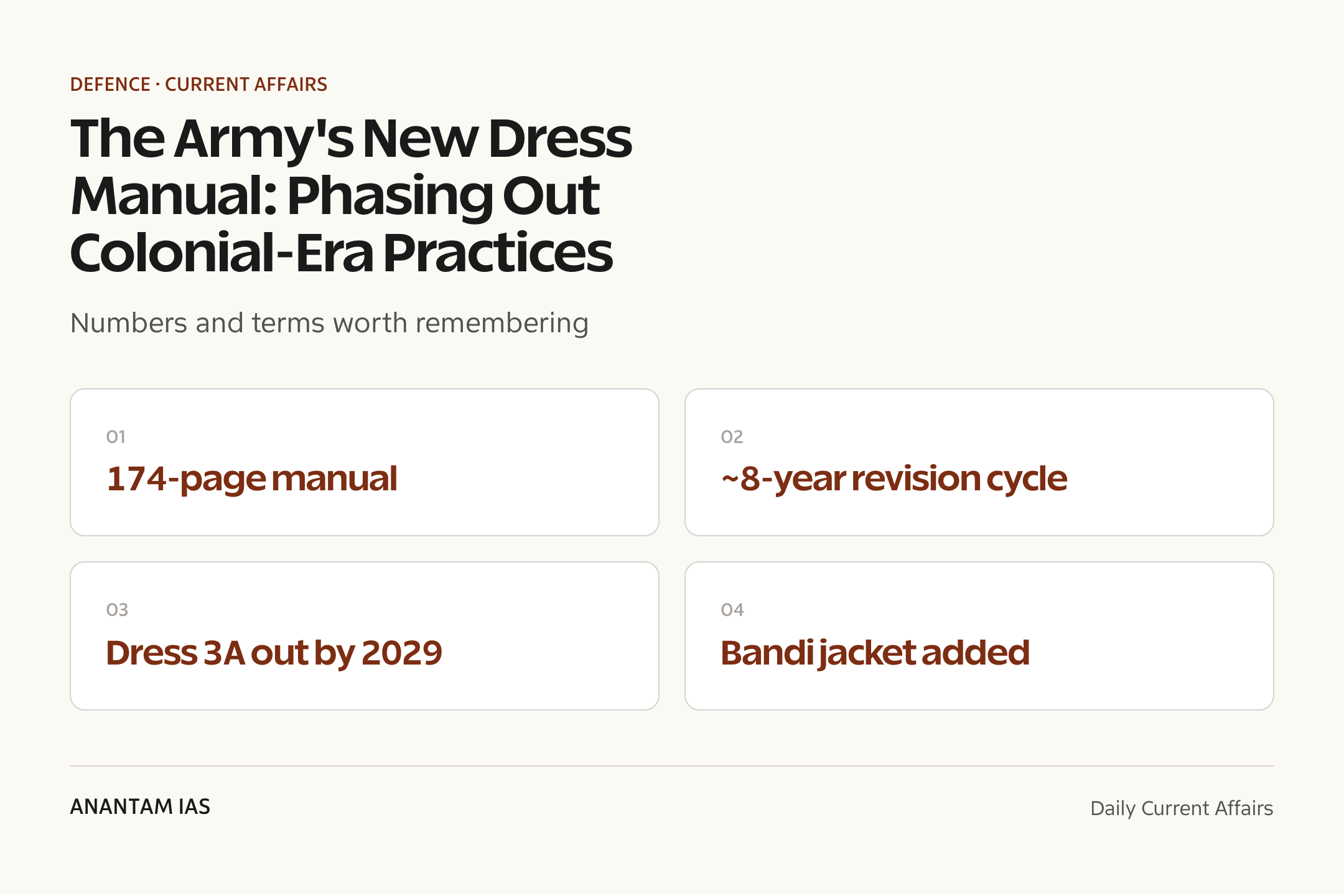
  • 174-page ‘Army Uniforms-2026’ manual replaces the previous edition issued ~8 years ago.
  • The pouch belt is dropped from Mess Dress No. 5 and No. 6.
  • Mandatory carriage of the ceremonial sword by Reviewing Officers on parade is made optional.
  • Archaic terminology, such as ‘Royal’, is removed across dress descriptions.
  • The indigenous Bandi jacket is approved as formal civil attire for officers.
  • A new Battle Jacket winter dress will replace the jersey-based Dress 3A by June 2029.

The development matters in the context of:

  • It matters because uniforms and customs are civil-military symbols — visible markers of how a republic narrates its own identity.
  • It extends a decade-long pattern of decolonising state symbols, from the Navy’s ensign to Amrit Udyan and the criminal-law codes.
  • It tests the balance between honouring the regimental tradition and discarding the imperial residue embedded in it.
The Army's New Dress Manual: Phasing Out Colonial-Era Practices — quick facts

UPSC Relevance

Prelims Relevance

  • Army Uniforms-2026 — 174-page Army dress pamphlet, ~8-year revision cycle.
  • Adjutant General — the Principal Staff Officer who owns discipline, ceremonial and dress policy.
  • Pouch belt — a colonial ceremonial accoutrement, now dropped from Mess Dress No. 5/No. 6.
  • Bandi jacket — a closed-neck Indian formal garment approved as officers’ civil attire.
  • Battle Jacket / Dress 3A — new winter working dress replacing the jersey by June 2029.
  • Decolonisation moves — Navy ensign redesign, IPC/CrPC/Evidence Act to BNS/BNSS/BSA, Mughal Gardens to Amrit Udyan.The The
  • Indian Navy earlier permitted the kurta-pyjama in messes as an Indianisation step.
  • Regimental system — the class/regional regiment structure inherited from the British Indian Army.
  • Term ‘Royal’ — an imperial prefix being stripped from dress nomenclature.

Mains Relevance

GS Paper 3

  • Decolonisation of the armed forces — symbolism, force cohesion and the limits of rebranding for actual capability.
  • Civil-military relations and the politics of military tradition, regimental identity and ‘Indianisation’.

GS Paper 1

  • Uniforms, customs and dress as markers of national identity and the post-colonial reconstruction of culture.

GS Paper 2

  • Institutional reform of legacy state symbols and the executive’s role in shaping public memory.

Essay

  • Shedding the colonial past: substance versus symbolism in nation-building.
  • Tradition and modernity — what a republic chooses to keep and to discard.

Background and Context

What the new manual actually changes

The 2026 pamphlet is a turnout document — it rewrites dress, accoutrements and grooming, not the order of battle.

  • Spans roughly 174 pages, covering ceremonial attire, parade customs, working dress, grooming and personal-appearance standards for all ranks.
  • Drops the pouch belt — a slung leather/chain belt of imperial cavalry origin — from Mess Dress No. 5 and No. 6; it may still appear at select regimental functions.
  • Makes the ceremonial sword optional for Reviewing Officers, ending a mandatory parade custom carried over from British practice.
  • Strips the prefix ‘Royal’ and other archaic terms from dress descriptions.
  • Frames the exercise as standardisation, simplification and modernisation while keeping military dignity intact.
The Army's New Dress Manual: Phasing Out Colonial-Era Practices — exam lens

What gets added — the Indianisation side

Removing imperial items is paired with introducing indigenous and functional alternatives.

  • The Bandi jacket — a closed-neck Indian garment — is approved as formal civil attire for officers, worn over a full-sleeved shirt with sober trousers and closed footwear.
  • A new Battle Jacket winter working dress is introduced and will progressively replace the jersey-based Dress 3A by June 2029, a roughly three-year transition.
  • Grooming and turnout rules are tightened — restrictions on tattoos and piercings, regulated moustache length, and bars on wearing uniform at political, religious or commercial events without sanction.
  • Together, these signal a shift from imperial pageantry toward a uniform vocabulary rooted in Indian dress and field utility.

The Adjutant General’s branch — who owns dress policy

Dress and discipline are not random choices; they sit with a specific staff function.

  • The Adjutant General (AG) is a Principal Staff Officer at Army Headquarters responsible for discipline, ceremonial, welfare and dress regulations.
  • Lt Gen VPS Kaushik, the current AG, authored the foreword, situating the change in a wider decolonisation intent.
  • Such pamphlets are policy instruments — once issued, they bind turnout across commands and become examinable as ‘organisation’ facts.
  • The roughly 8-year revision cycle shows dress codes evolve slowly and deliberately, not on impulse.

A pattern, not a one-off — the decolonisation arc

This is the latest entry in a sustained effort to recast inherited state symbols.

  • The Indian Navy redesigned its ensign in 2022, dropping the St George’s Cross for a seal inspired by Chhatrapati Shivaji.
  • The Navy also permitted the kurta-pyjama in officers’ messes as an Indianisation measure.
  • Three colonial-era criminal codes — the IPC, CrPC and Indian Evidence Act — were replaced by the BNS, BNSS and BSA.
  • Rashtrapati Bhavan’s Mughal Gardens were renamed Amrit Udyan; the Rajpath became Kartavya Path.
  • Earlier, the Army began reviewing colonial-origin unit and regiment names and customs — the dress manual fits this trajectory.

The regimental system — why is this sensitive

Customs, accoutrements and names are the connective tissue of the regiment, so change touches morale, not just cloth.

  • The regimental system — class and regional regiments — was institutionalised under the British Indian Army and survives as a source of cohesion and pride.
  • Many honours, mottos, accoutrements and ceremonies trace to imperial battles, raising the question of what is heritage and what is residue.
  • Reformers argue colonial symbols should go; traditionalists caution that abrupt erasure can dilute hard-won esprit de corps.
  • The manual’s gradualism — optional swords, phased dress changes — reads as an attempt to decolonise with sensitivity.

Symbolism versus substance — the standing debate

The core analytical tension is whether renaming and re-dressing changes anything that matters for fighting power.

  • Critics note that capability rests on doctrine, training, jointness and equipment, not on belts and prefixes.
  • Supporters argue that symbols shape identity and morale, and that a sovereign force should not parade in imperial costume.
  • The strongest case treats symbolic reform as necessary but not sufficient — meaningful only if paired with hard modernisation.
  • Done well, it strengthens institutional legitimacy; done as mere optics, it invites the charge of tokenism.

Way Forward

Pair symbolism with capability

  • Anchor the cultural reset to real modernisation — theatre commands, indigenisation and training — so the change is more than cosmetic.
  • Sequence symbolic moves so they reinforce, not distract from, hard-power reform.

Reform with regimental sensitivity

  • Retain heritage that builds cohesion while discarding genuinely imperial residue, ideally through internal consultation.
  • Use phased, optional transitions to protect esprit de corps, as the 2026 manual already attempts.

Communicate the rationale clearly so the public reads decolonisation as confident self-definition rather than a campaign against history, and document changes so they enter institutional memory cleanly.

Conclusion

The Army Uniforms-2026 manual is a small object with a large meaning — by dropping the pouch belt, the optional sword and the ‘Royal’ label while welcoming the Bandi jacket, the Army edits the visible grammar of a colonial inheritance.

Read alongside the Navy’s ensign, the new criminal codes and Amrit Udyan, it confirms a deliberate decolonisation of state symbols. Its lasting worth will depend on whether this confidence in identity is matched by equal seriousness about doctrine, jointness and capability.

UPSC Practice Questions

Prelims MCQ 1

With reference to the Indian Army’s ‘Army Uniforms-2026’ dress manual, consider the following statements:

  1. It drops the pouch belt from certain categories of mess dress.
  2. It makes the carriage of the ceremonial sword by Reviewing Officers optional.
  3. It abolishes the regimental system of the Indian Army.

How many of the above statements are correct?

(a) Only one (b) Only two (c) All three (d) None

Answer: (b) Only two

Explanation:

Statements 1 and 2 are correct — the pouch belt is dropped from Mess Dress No. 5/No. 6, and the sword is made optional for Reviewing Officers. Statement 3 is wrong: the manual changes dress and accoutrements, not the regimental system itself.

Prelims MCQ 2

Which one of the following pairs of decolonisation measures is correctly matched?

(a) Navy’s new ensign — replacement of the St George’s Cross design

(b) Amrit Udyan — renaming of the Rajpath

(c) BNS, BNSS, BSA — new codes replacing the Constitution

(d) Bandi jacket — a colonial-era accoutrement being removed

Answer: (a) Navy’s new ensign — replacement of the St George’s Cross design

Explanation:

The 2022 naval ensign dropped the St George’s Cross for a Shivaji-inspired seal. Amrit Udyan renamed the Mughal Gardens (Rajpath became Kartavya Path); BNS/BNSS/BSA replaced the IPC/CrPC/Evidence Act, not the Constitution; the Bandi jacket is a newly added Indian garment, not a colonial item removed.

UPSC Mains Questions

  1. The Indian Army’s ‘Army Uniforms-2026’ manual phases out several colonial-era practices. Critically examine the significance of decolonising military symbols and customs, and assess whether such reform meaningfully strengthens the armed forces. (250 words)
  2. Uniforms, names and customs are markers of national identity. Discuss how recent efforts to shed colonial legacies in India’s institutions reflect a wider project of cultural self-definition, and the cautions such reform must observe. (250 words)

Sources: Business Standard and The Hindu / Indian Express.

Frequently Asked Questions

What is the Army Uniforms-2026 manual?

It is a roughly 174-page pamphlet issued by the Indian Army that revises uniforms, accoutrements, ceremonial customs and grooming standards. Reported around 15 June 2026, it is the first comprehensive update to Army dress regulations in about eight years and consciously phases out several colonial-era practices.

Which colonial-era practices does it phase out?

It drops the pouch belt from Mess Dress No. 5 and No. 6, makes the ceremonial sword optional for Reviewing Officers, and removes archaic terminology such as the prefix ‘Royal’. These are presented as residual colonial accoutrements and customs being replaced under a standardisation and modernisation drive.

What new dress items are introduced?

The indigenous closed-neck Bandi jacket is approved as formal civil attire for officers. A new Battle Jacket winter working dress is introduced and will progressively replace the older jersey-based Dress 3A by June 2029. The reforms also tighten grooming and turnout standards across ranks.

Who is responsible for Army dress policy?

Dress regulations sit with the Adjutant General, a Principal Staff Officer at Army Headquarters who handles discipline, ceremonial and dress. The current Adjutant General, Lt Gen VPS Kaushik, wrote the foreword, framing the changes as aligning the Army’s dress with a contemporary Indian ethos.

How does this fit India’s wider decolonisation of symbols?

It continues a pattern that includes the Navy’s redesigned ensign, permission for kurta-pyjama in messes, the replacement of the IPC, CrPC and Evidence Act by the BNS, BNSS and BSA, and the renaming of the Mughal Gardens as Amrit Udyan. The dress manual recasts inherited imperial symbols in the armed forces.

Does dropping colonial customs make the Army stronger?

Symbolic reform shapes identity, morale and institutional legitimacy, but capability ultimately rests on doctrine, training, jointness and equipment. Most analysts treat such changes as necessary but not sufficient — valuable only when paired with genuine modernisation rather than pursued as optics alone.

NCR Regional Plan 2041: Why the Natural Conservation Zone Was Retained

Open article →Download PDF
image 75

Why in News?

The National Capital Region Planning Board (NCRPB) has moved to retain the Natural Conservation Zone (NCZ) in its long-term blueprint, the Regional Plan 2041 — the framework that will guide land-use and development across the National Capital Region up to 2041. The decision, taken at a recent Board meeting, closes a contested push to replace the NCZ with a weaker category.

The existing NCZ provisions of the Regional Plan 2021 — which cap construction at just 0.5% of the protected area and bind states to all environmental laws and court directions — will carry over into the 2041 plan, keeping the Aravalli range, forests, rivers and water bodies under protection.

  • NCRPB moved to keep the Natural Conservation Zone in the Regional Plan 2041.
  • The rejected draft proposal would have renamed NCZ as a less stringent Natural Zone, dropping mandatory conservation duties on states.
  • NCZ permits construction on only 0.5% of the total protected area and bars most non-forest activity.
  • The zone covers the Aravalli hills and ridge, forests, rivers, lakes, water bodies and groundwater-recharge areas across the NCR.
  • The NCR spans 55,083 sq km across 24 districts of Haryana, Uttar Pradesh and Rajasthan, plus all of Delhi.

The development matters in the context of:

  • It matters because NCR forest cover is roughly 6.2% against a national average near 21% — the Aravalli green is the region’s main ecological buffer.
  • It matters because urban-planning pressure to open land for housing and industry repeatedly tests the strength of ecological zoning.
NCR Regional Plan 2041: Why the Natural Conservation Zone Was Retained — quick facts

UPSC Relevance

Prelims Relevance

  • National Capital Region Planning Board (NCRPB) Act, 1985 — administrative ministry: Housing and Urban Affairs
  • Natural Conservation Zone (NCZ) — origin in Regional Plan 2021, retained in Regional Plan 2041
  • 0.5% construction cap inside the NCZ
  • NCR composition: Delhi + districts of Haryana, Uttar Pradesh, Rajasthan (~55,083 sq km)
  • Aravalli range — the oldest fold mountains in India, a barrier against the Thar Desert
  • M.C. Mehta v. Union of India and T.N. Godavarman Thirumalpad v. Union of India (forest cases)
  • Forest (Conservation) Act, 1980 — diversion of forest land needs central approval
  • Transferable Development Rights (TDR) as a conservation-financing tool
  • Delhi Ridge — northern extension of the Aravalli in the capital

Mains Relevance

GS Paper 3

  • Conservation vs urban expansion in an ecologically sensitive region — how zoning instruments like the NCZ balance development and ecology
  • Role of the Aravalli range in groundwater recharge, air quality and arresting desertification

GS Paper 2

  • Cooperative federalism in regional planning — a central board coordinating four states through a statutory plan
  • Citizen movements and judicial directions shaping environmental governance outcomes

Essay

  • Development and ecology need not be adversaries — but only if planning treats nature as infrastructure.
  • The cost of a city is paid by the land around it.

Background and Context

The NCRPB and the Regional Plan framework

The Board is a statutory body that plans for a region straddling four jurisdictions.

  • The NCRPB was set up under the National Capital Region Planning Board Act, 1985, under the Ministry of Housing and Urban Affairs.
  • It coordinates harmonised land-use, infrastructure and development across Delhi and the contiguous districts of Haryana, Uttar Pradesh and Rajasthan.
  • The Union Minister in charge chairs the Board; the three states’ Chief Ministers and central nominees are members — a model of cooperative federalism.
  • Its core instrument is a Regional Plan — successive blueprints (RP-2001, RP-2021, now RP-2041) that bind states’ sub-regional and master plans.
  • The plan classifies land into use zones; the Regional Plan 2041 is the framework now under finalisation.
NCR Regional Plan 2041: Why the Natural Conservation Zone Was Retained — exam lens

What the Natural Conservation Zone protects

The NCZ is the plan’s strictest ecological category, and it is wide in scope.

  • Introduced in the Regional Plan 2021, the NCZ demarcates environmentally sensitive land for protection.
  • It covers the Aravalli ridge and hills, forest areas, rivers and tributaries, major lakes, water bodies, sanctuaries and groundwater-recharge zones.
  • Inside the NCZ, construction is capped at only 0.5% of the area, and non-forest activity is tightly regulated.
  • States must follow all central and state environmental laws, plus binding court directions within the zone.
  • The protection applies irrespective of land records — the ecological character, not the title, decides the rule.

The dilution attempt that was rolled back

A draft proposal sought to soften the language and, with it, the legal force.

  • An earlier draft of the Regional Plan 2041 proposed renaming the NCZ as a plain Natural Zone.
  • Critics argued that a Natural Zone carries no mandatory conservation duty, so states would no longer be bound to enforce the strict regime.
  • Environmental groups and residents warned this would weaken protection for the Aravalli and other sensitive landscapes.
  • The retained framework instead keeps the RP-2021 safeguards and explores tools like Transferable Development Rights (TDR) to reward conservation.
  • The Hindu reported the Board moved to retain the NCZ at its meeting, ending a years-long campaign.

Why the Aravalli matters ecologically

The range is a living ecological infrastructure for the whole capital region.

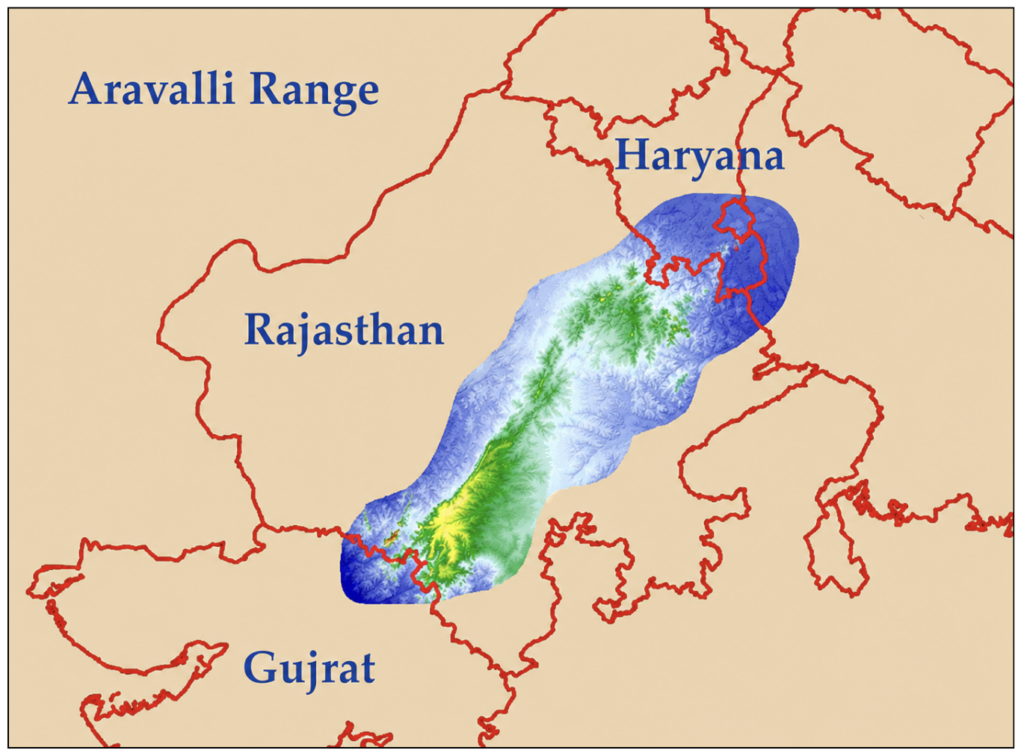
  • The Aravalli are among the world’s oldest fold mountains, running across Gujarat, Rajasthan, Haryana and Delhi.
  • They act as a natural barrier against the Thar Desert, slowing the spread of arid dust toward Delhi-NCR.
  • Their forests aid groundwater recharge, stabilise microclimates, and help regulate rainfall and humidity.
  • Breaches in the range — where hills have been mined away — let desert dust drift in, worsening Delhi’s air pollution.
  • NCR forest cover is only about 6.2% against a national average near 21%, so every protected hill counts.
image 76

The legal and judicial backbone

Decades of litigation and statute sit behind the NCZ regime.

  • The Forest (Conservation) Act, 1980, requires central clearance before forest land is diverted to non-forest use.
  • In M.C. Mehta v. Union of India, the Supreme Court repeatedly restrained mining and quarrying that damaged the Aravalli.
  • The continuing T.N. Godavarman case broadened the meaning of ‘forest’ and tightened oversight of forest land nationwide.
  • A Court order of 2002 halted mining in stretches of the Aravalli; later orders kept the brakes on fresh leases.
  • Such directions are exactly the ‘judicial directives’ the NCZ obliges states to honour — making the zoning enforceable, not advisory.

Urban sprawl versus ecology — the core tension

The NCR is among India’s fastest-urbanising belts, and land is the prize.

  • Cities like Gurugram, Faridabad, Noida and Ghaziabad press against the green edge for housing, roads and industry.
  • Real estate value makes conservation land a constant target for re-zoning and exemptions.
  • Diluting a zone’s name or norms can quietly unlock large tracts without visibly removing protection.
  • Conservation-finance tools such as TDR aim to make landowners gain from protecting, not building on, sensitive land.
  • The retention decision signals that ecological zoning can hold even under intense development pressure — if backed by law and public scrutiny.

Way Forward

Lock in the protection legally

  • Notify the final Regional Plan 2041 with the NCZ language intact and unambiguous.
  • Harmonise state master plans so no sub-region quietly re-zones NCZ land.

Make conservation pay

  • Operationalise Transferable Development Rights so owners are compensated for keeping land green.
  • Channel funds into Aravalli restoration, plantation and water-recharge works.

Monitor and enforce

  • Use satellite mapping to track encroachment and illegal construction inside the NCZ.
  • Align NCR zoning with the Supreme Court’s evolving definition and protection of the Aravalli.

Conclusion

Retaining the Natural Conservation Zone in the Regional Plan 2041 is a quiet but consequential win for ecological governance. It keeps the strict 0.5% construction cap and the binding duty on states intact, protecting the Aravalli, the region’s forests and its water bodies from being re-zoned out of existence.

The deeper lesson is that the strength of a conservation rule lies as much in its name and legal force as in its map. Sustained citizen pressure and standing court directions turned a planning footnote into a durable safeguard — a reminder that in the contest between urban sprawl and ecology, planning frameworks decide the outcome.

UPSC Practice Questions

Prelims MCQ 1

With reference to the Natural Conservation Zone (NCZ) in the National Capital Region, consider the following statements:

  1. It was introduced through the Regional Plan 2021 and covers the Aravalli hills, forests and water bodies.
  2. It permits construction on up to half (50%) of the zone’s total area.
  3. Within the NCZ, states are bound by central and state environmental laws and applicable court directions.

How many of the above statements are correct?

(a) Only one (b) Only two (c) All three (d) None

Answer: (b) Only two

Explanation:

Statements 1 and 3 are correct. Statement 2 is wrong — the NCZ caps construction at just 0.5% of the area, not 50%.

Prelims MCQ 2

The National Capital Region Planning Board (NCRPB) functions under which Union Ministry, and the Board is chaired by which authority?

(a) Ministry of Environment, Forest and Climate Change, chaired by the Cabinet Secretary

(b) Ministry of Housing and Urban Affairs, chaired by the Union Minister in charge

(c) Ministry of Home Affairs, chaired by the Lieutenant Governor of Delhi

(d) NITI Aayog; chaired by the Prime Minister

Answer: (b) Ministry of Housing and Urban Affairs, chaired by the Union Minister in charge

Explanation:

The NCRPB, set up under the NCRPB Act, 1985, is under the Ministry of Housing and Urban Affairs; the Union Minister in charge chairs the Board, with the three states’ Chief Ministers as members.

UPSC Mains Questions

  1. The Natural Conservation Zone in the NCR illustrates how land-use classification can become a frontline tool of environmental protection. Examine the ecological role of the Aravalli range and discuss how planning instruments can balance urban expansion with conservation. (250 words)
  2. Regional planning across multiple states tests India’s cooperative federalism. With reference to the National Capital Region Planning Board, analyse the institutional and legal mechanisms that enable coordinated environmental governance, and the challenges they face. (250 words)

Sources: National Capital Region Planning Board, Ministry of Housing and Urban Affairs and The Hindu.

Frequently Asked Questions

What is the Natural Conservation Zone in the NCR?

The Natural Conservation Zone (NCZ) is the strictest ecological land-use category in the NCR Regional Plan. Introduced in the Regional Plan 2021, it covers the Aravalli hills, forests, rivers, lakes, water bodies and groundwater-recharge areas. Construction is capped at only 0.5% of the zone, and states must follow all environmental laws and court directions inside it.

What changed in the Regional Plan 2041?

An earlier draft of the Regional Plan 2041 proposed renaming the Natural Conservation Zone as a weaker ‘Natural Zone’ with no mandatory conservation duty. After objections, the NCR Planning Board moved at its June 2026 meeting to retain the NCZ, carrying the Regional Plan 2021 safeguards forward into the 2041 blueprint.

Why is the Aravalli range ecologically important?

The Aravalli are among the world’s oldest fold mountains and act as a natural barrier slowing the Thar Desert’s spread toward Delhi-NCR. Their forests recharge groundwater, stabilise the local climate and help regulate rainfall. Breaches in the range let desert dust drift in, worsening the capital’s air pollution.

What is the NCRPB and which states does it cover?

The National Capital Region Planning Board, set up under the NCRPB Act, 1985, plans land-use and infrastructure for the NCR under the Ministry of Housing and Urban Affairs. The NCR covers Delhi plus contiguous districts of Haryana, Uttar Pradesh and Rajasthan, spanning about 55,083 sq km.

How do Supreme Court orders affect Aravalli protection?

In the M.C. Mehta and T.N. Godavarman cases, the Supreme Court restrained mining that damaged the Aravalli and broadened the meaning of ‘forest’. A 2002 order halted mining in parts of the range. These judicial directions are binding inside the NCZ, which obliges states to honour all applicable court orders.

Why does retaining the NCZ matter for development?

NCR forest cover is only about 6.2% against a national average near 21%, so the Aravalli green is the region’s main ecological buffer. Retaining the NCZ keeps the strict 0.5% construction cap intact, preventing fast-urbanising cities like Gurugram and Faridabad from re-zoning sensitive land out of protection.

India’s First Ship Recycling Credit Note: Linking Green Recycling to Shipbuilding

Open article →Download PDF
image 74

Why in News?

The Directorate General of Shipping (DG Shipping), under the Ministry of Ports, Shipping & Waterways, has issued India’s first-ever Ship Recycling Credit Note (around 15 June 2026). PIB and the ministry describe India as the first country in the world to operationalise such a credit-note system within the framework of the Hong Kong International Convention.

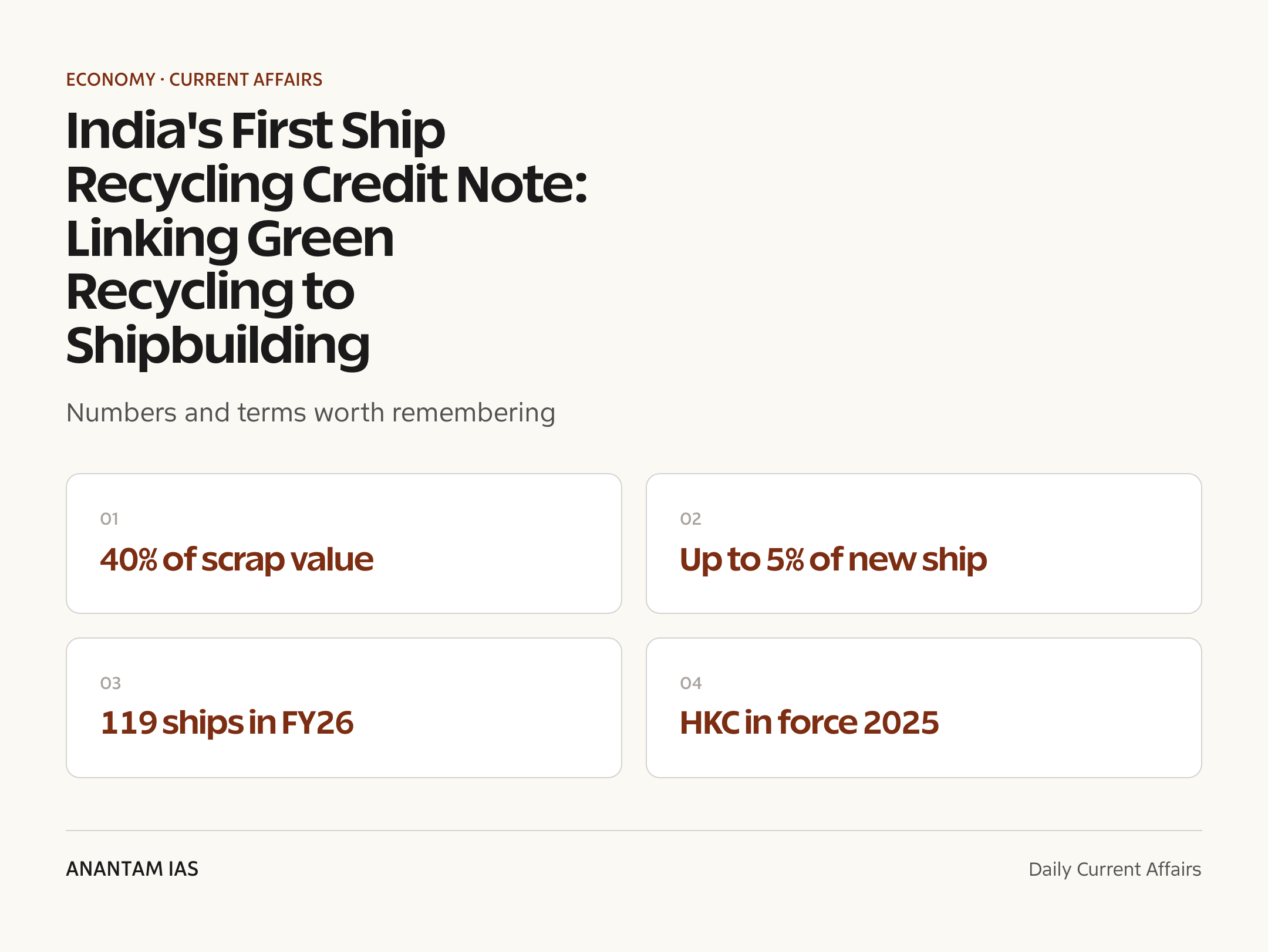
The instrument lets a shipowner who recycles a vessel “green” at an HKC-compliant Indian yard, such as Alang-Sosiya in Gujarat, earn a tradable credit worth 40% of the ship’s scrap value, redeemable for up to 5% of the fair price of a new vessel built in an Indian shipyard. It directly links the Recycling of Ships Act, 2019, to the national shipbuilding push.

  • DG Shipping launched a digital Ship Recycling Credit Note Module / Unified Ship Recycling Portal to process and verify the credits.
  • Credit value: 40% of the scrap value of the recycled ship; redeemable for up to 5% of the fair price of a new India-built vessel.
  • The scheme was announced in the Union Budget 2025-26 and sits under the Shipbuilding Financial Assistance Policy (SBFAP) 2.0.
  • Eligibility is restricted to HKC-compliant recycling yards, certified by DG Shipping and State Maritime Boards.
  • It is part of a wider ₹70,000-crore maritime development package announced in 2025.

The development matters in the context of:

  • Closes the loop between a ship’s end-of-life (recycling) and the start of life (shipbuilding) inside the same domestic economy — an EPR-style, circular-economy design.
  • Comes as the Hong Kong Convention entered into force on 26 June 2025, making safe, green recycling a global compliance requirement.
  • Aims to revive demand at Alang, the world’s largest ship-recycling yard, which has seen tonnage fall as compliance costs rose.
India's First Ship Recycling Credit Note: Linking Green Recycling to Shipbuilding — quick facts

UPSC Relevance

Prelims Relevance

  • Ship Recycling Credit Note — 40% of scrap value, up to 5% of a new ship’s fair price.
  • Recycling of Ships Act, 2019 — India’s domestic law implementing the Hong Kong Convention.
  • Hong Kong International Convention — adopted 2009, in force 26 June 2025; applies to ships of 500 GT and above.
  • Inventory of Hazardous Materials (IHM) — mandatory hazardous-material list under HKC.
  • Alang-Sosiya — Gulf of Khambhat, Gujarat; the world’s largest ship-recycling cluster.
  • SBFAP 2.0 — Shipbuilding Financial Assistance Policy under which the credit note operates.
  • Maritime Amrit Kaal Vision 2047 — long-term roadmap for India’s maritime sector.
  • DG Shipping — issuing/certifying authority, under the Ministry of Ports, Shipping & Waterways.
  • Extended Producer Responsibility (EPR) — the circular-economy logic the credit mirrors.
  • India recycled 119 ships in FY26 — about one-third of global ship recycling by number of vessels.

Mains Relevance

GS Paper 3

  • Circular economy and resource recovery — using a credit note to link recycling to manufacturing.
  • Infrastructure and industrial policy — reviving shipbuilding and the Alang recycling cluster as a value chain.
  • Environment and sustainable development — balancing green-recycling compliance with industry viability.

GS Paper 2

  • Implementation of international conventions (Hong Kong Convention) through domestic law and incentive design.

Essay

  • Turning waste into worth — the circular economy as an engine of self-reliance.
  • Sustainability and competitiveness need not be rivals.

Background and Context

What does the Credit Note actually do?

It is a financial instrument that monetises green recycling and channels it back into shipbuilding.

  • A shipowner who recycles a vessel at an HKC-compliant Indian yard receives a credit note worth 40% of the ship’s scrap value.
  • The note can be redeemed for up to 5% of the fair price of a new vessel built in an Indian shipyard.
  • It is designed to be tradable/transferable, processed digitally through DG Shipping’s Credit Note Module.
  • The mechanism rewards owners for choosing safe, compliant recycling over cheaper, hazardous beaching abroad — and keeps the value within India’s maritime economy.
  • By bridging end-of-life and new-build, it functions like an Extended Producer Responsibility (EPR) credit for the shipping industry.
India's First Ship Recycling Credit Note: Linking Green Recycling to Shipbuilding — exam lens

The legal anchor: Recycling of Ships Act, 2019

India’s domestic law gives the recycling industry a compliance framework and global standing.

  • The Recycling of Ships Act, 2019, domesticates the Hong Kong Convention, which India ratified in November 2019.
  • It mandates an Inventory of Hazardous Materials (IHM), authorised yards, ship-recycling plans, and worker-safety norms.
  • Yards must be certified; DG Shipping and State Maritime Boards oversee approvals and inspections.
  • It made Alang one of the few clusters in the developing world with a high concentration of HKC Statements of Compliance.

The global frame: Hong Kong Convention in force

Green recycling is now a worldwide legal obligation, not just a voluntary standard.

  • Adopted at an IMO conference in Hong Kong in 2009; entry-into-force conditions were met in 2023.
  • It entered into force on 26 June 2025, applying to ships of 500 GT and above.
  • It requires safe design, an up-to-date IHM, authorised recycling facilities, and survey/certification.
  • By acting early under the 2019 Act, India is positioned to capture demand as non-compliant beaching yards lose business.

Alang-Sosiya: the world’s largest ship graveyard

The cluster is the physical backbone of the scheme — and the reason it was needed.

  • Located on the Gulf of Khambhat coast in Gujarat, Alang-Sosiya is the world’s largest ship-recycling yard.
  • It hosts around 120 operational plots and a large share of globally HKC-compliant facilities.
  • India recycled about 119 ships in FY26 — roughly one-third of global ship recycling by vessel count, and around 13% by tonnage.
  • Rising compliance costs and thin margins had cut work at Alang; the credit note is meant to revive demand and reward upgrades.

Linking recycling to the shipbuilding push

The credit is one lever inside a much larger plan to rebuild India’s shipyards.

  • It operates under the Shipbuilding Financial Assistance Policy (SBFAP) 2.0 and the Budget 2025-26 maritime agenda.
  • It is part of a wider ₹70,000-crore maritime development package announced in 2025.
  • The long-horizon goal is the Maritime Amrit Kaal Vision 2047 — to lift India among the top global shipbuilding nations.
  • By recycling at home, an owner earns credits that lower the cost of building a new ship at home — a deliberately closed domestic loop.

Why is it a circular-economy template

The design converts a waste stream into an input for domestic manufacturing.

  • Recovered steel from scrapped ships feeds rolling mills and reduces reliance on virgin-ore steelmaking.
  • Incentivising compliant recycling improves worker safety and curbs coastal pollution from hazardous waste.
  • The credit ties an environmental “good” (green recycling) to an economic reward (cheaper new-build), aligning incentives.
  • It is being read as an EPR-style model that other heavy industries could adapt for end-of-life assets.

Open questions and limits

The instrument is novel, so its real-world traction is still untested.

  • Uptake depends on a healthy order book at Indian shipyards — credits are only useful if owners are building here.
  • The 5% cap on new-ship price may be modest against the cost gap with foreign yards.
  • Verification, valuation of scrap, and preventing gaming of credits will test DG Shipping’s digital systems.
  • Global recycling volumes are cyclical; demand at Alang also hinges on freight markets and fleet-renewal cycles.

Way Forward

Build the demand side

  • Pair the credit with a stronger shipbuilding order book via SBFAP 2.0 and public-sector demand so credits can actually be redeemed.
  • Develop ancillary ecosystems — steel, marine equipment, design — around Alang and major shipyards.

Deepen compliance and trust

  • Scale up HKC certification, IHM auditing, and worker-safety training across all Alang plots.
  • Make the credit-note registry transparent and auditable to prevent valuation gaming.

Position India as the default green-recycling destination as the Hong Kong Convention bites globally, while ensuring the gains reach yard workers through better wages and safety.

Conclusion

India’s first Ship Recycling Credit Note is a small instrument with an outsized idea — it makes the end of a ship’s life pay for the start of a new one, inside the domestic economy. By tying the Recycling of Ships Act, 2019, to the shipbuilding drive, it turns a compliance burden into a competitive edge.

Its success will depend less on the elegance of the design and more on execution: a credible order book at Indian shipyards, honest valuation of scrap, and continued upgrades at Alang. If those align, it offers a replicable circular-economy template for heavy industry.

UPSC Practice Questions

Prelims MCQ 1

With reference to the Ship Recycling Credit Note recently introduced in India, consider the following statements:

  1. It allows a shipowner to claim a credit equal to 40% of a recycled ship’s scrap value.
  2. The credit can be redeemed against the cost of building a new vessel in an Indian shipyard.
  3. It is available for recycling carried out at any ship-breaking yard in the world.

How many of the above statements are correct?

(a) Only one (b) Only two (c) All three (d) None

Answer: (b) Only two

Explanation:

Statements 1 and 2 are correct — the credit is 40% of the scrap value, redeemable for up to 5% of the fair price of a new India-built ship. Statement 3 is wrong: eligibility is limited to HKC-compliant Indian yards such as Alang-Sosiya.

Prelims MCQ 2

The Hong Kong International Convention, in the news, primarily deals with which of the following?

(a) Trade in endangered marine species

(b) Safe and environmentally sound recycling of ships

(c) Prevention of oil pollution from tankers

(d) Regulation of deep-sea mining

Answer: (b) Safe and environmentally sound recycling of ships

Explanation:

The Hong Kong International Convention, adopted under the IMO in 2009 and in force from 26 June 2025, governs safe and environmentally sound ship recycling, including the Inventory of Hazardous Materials. India implements it through the Recycling of Ships Act, 2019.

UPSC Mains Questions

  1. India has become the first country to operationalise a Ship Recycling Credit Note. Examine how such an instrument can link green recycling to domestic shipbuilding, and assess the challenges in making it work at scale.
  2. “A circular economy turns waste streams into inputs for production.” In light of India’s ship-recycling reforms, discuss how policy instruments can align environmental compliance with industrial competitiveness.
  3. Discuss the significance of the Hong Kong International Convention and the Recycling of Ships Act, 2019, for India’s ship-recycling industry at Alang-Sosiya.

Sources: Directorate General of Shipping, Ministry of Ports, Shipping & Waterways (PIB) and The Hindu / Business Standard.

Frequently Asked Questions

What is the Ship Recycling Credit Note?

It is a financial instrument issued by India’s Directorate General of Shipping that gives a shipowner a credit worth 40% of a recycled ship’s scrap value. The credit can be redeemed for up to 5% of the fair price of a new vessel built in an Indian shipyard, linking green recycling to shipbuilding.

Why is India’s credit note called a world first?

India is the first country to operationalise a credit-note system that ties green ship recycling under the Hong Kong Convention to building new ships domestically. It converts a recycling decision into a redeemable incentive for new shipbuilding within the same economy, an approach not done before at national scale.

Which yards are eligible for the credit?

Only Hong Kong Convention (HKC)-compliant recycling yards qualify, certified by DG Shipping and State Maritime Boards. In practice this centres on the Alang-Sosiya cluster in Gujarat, the world’s largest ship-recycling hub, which holds a high concentration of HKC Statements of Compliance.

What is the Recycling of Ships Act, 2019?

It is India’s domestic law that implements the Hong Kong International Convention. It mandates an Inventory of Hazardous Materials, authorised yards, ship-recycling plans, and worker-safety norms, and it gives the industry a compliance framework that boosts its global standing and credibility.

When did the Hong Kong Convention come into force?

The Hong Kong International Convention was adopted under the IMO in 2009 and entered into force on 26 June 2025. It applies to ships of 500 GT and above on international voyages, making safe, environmentally sound recycling a binding global requirement rather than a voluntary standard.

How does the credit note support a circular economy?

It rewards recovering value from end-of-life ships — recycled steel and materials re-enter manufacturing — and channels that reward into building new vessels at home. By linking an environmental good to an economic incentive, it works like an Extended Producer Responsibility (EPR) credit for the shipping sector.

BRICS Indore Declaration: A Farmer-Centric Roadmap for Global Agriculture

Open article →Download PDF
image 73

Why in News?

Under India’s BRICS Presidency, the 16th BRICS Agriculture Ministers’ Meeting at Indore (Madhya Pradesh) unanimously adopted the Indore Declaration on 13 June 2026 — a shared, farmer-centric roadmap for food security and sustainable agriculture across BRICS nations.

It is the first such meeting to bring together both member and partner countries, with around 100 delegates, and to launch four new cooperation networks anchored in Indian research institutions.

  • Hosted by Union Agriculture Minister Shivraj Singh Chouhan at Indore, 12-13 June 2026, under India’s 2026 BRICS chairship.
  • Outcome: a consensus Indore Declaration covering food and nutritional security, agricultural trade, climate-resilient farming, and technology partnerships.
  • Four new platforms launched — on agro-ecology, digital agriculture, farmers’ rights in seed systems, and an agri-inputs/ genetic-resources network (BRICS AgriN).
  • A dedicated dialogue, ‘Small Farmers, Women and Youth’, centred on smallholder access to credit, inputs, markets and remunerative prices.
  • Chouhan reaffirmed India’s input support — urea held at Rs 266/bag and DAP at Rs 1,350/bag despite rising global costs.

The development matters in the context of:

  • Slots into India’s wider BRICS-2026 theme of resilience, innovation and a ‘Humanity First’ approach, with food security as a flagship priority.
  • Advances South-South cooperation by pooling research and digital tools among the Global South’s largest food producers.
BRICS Indore Declaration: A Farmer-Centric Roadmap for Global Agriculture — quick facts

UPSC Relevance

Prelims Relevance

  • BRICS — bloc of major emerging economies; original five (Brazil, Russia, India, China, South Africa) plus the 2024-25 expansion.
  • India holds the 2026 BRICS Presidency (its fourth); the 18th Summit is slated for New Delhi.
  • New Development Bank (NDB) — BRICS-led multilateral lender, Shanghai HQ, founded 2014/2015.
  • Indore Declaration adopted at the 16th BRICS Agriculture Ministers’ Meeting.
  • ICAR-IIFSR, Modipuram, coordinates the BRICS agro-ecology Centres-of-Excellence network.
  • PPV&FRA — Protection of Plant Varieties and Farmers’ Rights Authority, anchor for the seed-rights forum.
  • BRICS member vs partner countries distinction: ten partner states, including Belarus and Uzbekistan.
  • India’s administered prices: urea Rs 266/bag, DAP Rs 1,350/bag.

Mains Relevance

GS Paper 2

  • BRICS as a vehicle for India’s middle-power diplomacy and South-South cooperation
  • Plurilateral groupings, food diplomacy and India’s role in shaping a multipolar order

GS Paper 3

  • Climate-resilient and sustainable agriculture; smallholder welfare and food security
  • Agricultural research, digital public infrastructure and technology transfer

Essay

  • Cooperation, not competition: the Global South’s search for food security
  • From green revolution to a regenerative one — farming for a warming planet

Background and Context

What BRICS is and how it has grown

The bloc has evolved from a five-nation grouping into an enlarged Global-South coalition.

  • BRICS began as BRIC (2009) and added South Africa (2010); the acronym stands for Brazil, Russia, India, China and South Africa.
  • The 2024-25 expansion brought in Egypt, Ethiopia, Iran, the UAE and Indonesia, widening the bloc to a Global-South majority of food producers and energy suppliers.
  • A second tier of partner countries — including Belarus, Bolivia, Cuba, Kazakhstan, Malaysia, Nigeria, Thailand, Uganda, Uzbekistan and Vietnam — was created to broaden engagement without full membership.
  • The New Development Bank (NDB), headquartered in Shanghai, is the bloc’s flagship institution, financing infrastructure and sustainable-development projects across members.
BRICS Indore Declaration: A Farmer-Centric Roadmap for Global Agriculture — exam lens

The Indore Declaration — core commitments

The declaration frames a shared roadmap built around four priority areas.

  • Food and nutritional security — coordinated action to protect supply chains and affordable access amid global volatility.
  • Agricultural trade — easing barriers and building resilient, predictable trade flows among members.
  • Climate-resilient and sustainable farming — promoting natural, organic and regenerative systems to cut emissions and protect soils.
  • Innovation and technology partnerships — joint research, digital tools and capacity-building across BRICS institutions.
  • The text is explicitly farmer-centric, recognising smallholders and family farmers as central to food security and rural development.

Four new cooperation networks

The meeting institutionalised cooperation through four India-anchored platforms.

  • BRICS Network of Centres of Excellence on Agro-Ecology and Regenerative Agriculture, coordinated by ICAR-IIFSR, Modipuram, for research and knowledge-sharing in organic and regenerative farming.
  • Network on Digital Agriculture, coordinated by IIT Delhi, covering artificial intelligence, geospatial technologies, digital public infrastructure and data-driven solutions.
  • Global Forum on Farmers’ Rights in Seed Systems, anchored by PPV&FRA in New Delhi, to safeguard farmers’ rights and traditional knowledge.
  • BRICS AgriN (agro-inputs and genetic-resources network) for information-sharing, technical cooperation and capacity-building on seeds and inputs.

The farmer-centric core and India’s pitch

India used the platform to foreground small and marginal farmers.

  • A dedicated session, ‘Small Farmers, Women and Youth: Shaping the Future of Food Security’, focused on access to inputs, credit, remunerative prices and markets.
  • Minister Shivraj Singh Chouhan said the meeting sent a message of ‘hope, trust and collective responsibility’, and framed agriculture as the path to a more secure and prosperous future.
  • India reaffirmed input affordability, holding urea at Rs 266/bag and DAP at Rs 1,350/bag despite rising international fertiliser prices.
  • The approach echoes India’s millets legacy — its push for the International Year of Millets (2023) showcased climate-hardy, smallholder-friendly nutri-cereals as a food-security model.

Why it matters for India and the Global South

The declaration deepens India’s food diplomacy within a plurilateral frame.

  • It positions India as a norm-setter on sustainable agriculture and farmers’ rights within BRICS, complementing its G20 food-security agenda and wider international relations playbook.
  • South-South cooperation lets the Global South pool research, genetic resources and digital tools rather than depend on Western technology transfer.
  • Anchoring networks in ICAR institutes and IIT Delhi gives Indian science a continuing coordinating role across the bloc.
  • It strengthens India’s domestic food-security architecture — the National Food Security Act, minimum support prices and the PDS — linking the wider Indian economy to a cooperative platform.

BRICS vs G20 — the framing

India works in both forums, but they serve different ends.

  • The G20 is a North-South bridge of major economies where India shaped a development-and-digital agenda during its 2023 presidency.
  • BRICS is a Global-South-weighted bloc emphasising reform of global governance and alternatives like the NDB.
  • On agriculture, BRICS lets India build deeper, like-minded coalitions on smallholder welfare and regenerative farming than the broader G20 consensus allows.
  • India’s challenge is to keep the BRICS issue-based and non-bloc-ist, avoiding an anti-West framing while advancing concrete cooperation.

Way Forward

Operationalise the networks

  • Move the four platforms from declaration to delivery with funded work plans, host institutes and measurable milestones.
  • Use the agro-ecology and digital-agriculture networks to pilot joint field trials and shared data standards.

Centre the smallholder

  • Translate the farmer-centric language into concrete access to credit, inputs, markets and crop insurance for small and marginal farmers.
  • Protect farmers’ rights over seeds and traditional knowledge through the new seed-systems forum.

Keep the agenda issue-based and inclusive — engaging partner countries and avoiding a polarising anti-West posture so that food security, not geopolitics, stays the headline. Link BRICS cooperation back to India’s domestic food-security architecture and its millets and natural-farming push for credibility.

Conclusion

The Indore Declaration converts India’s BRICS chairship into a usable agriculture agenda — farmer-centric in language and institutional in design, with four India-anchored networks giving it staying power beyond the summit.

Its real test is delivery: whether smallholders across the Global South see better access to inputs, credit, technology and markets, and whether the platforms outlast the presidency that created them.

UPSC Practice Questions

Prelims MCQ 1

With reference to the BRICS Indore Declaration (2026), consider the following statements:

  1. It was adopted at the 16th BRICS Agriculture Ministers’ Meeting hosted by India.
  2. It launched a Network on Digital Agriculture coordinated by IIT Delhi.
  3. It was the first BRICS agriculture meeting to include both member and partner countries.

How many of the above statements are correct?

(a) Only one (b) Only two (c) All three (d) None

Answer: (c) All three

Explanation:

All three are correct. The Indore Declaration came out of the 16th BRICS Agriculture Ministers’ Meeting at Indore under India’s presidency; one of its four networks on digital agriculture is coordinated by IIT Delhi; and per PIB it was the first such meeting to bring member and partner countries together.

Prelims MCQ 2

Which institution is the designated coordinator of the BRICS Network of Centres of Excellence on Agro-Ecology and Regenerative Agriculture?

(a) IIT Delhi

(b) ICAR-Indian Institute of Farming System Research (IIFSR), Modipuram

(c) Protection of Plant Varieties and Farmers’ Rights Authority

(d) National Bank for Agriculture and Rural Development

Answer: (b) ICAR-Indian Institute of Farming System Research (IIFSR), Modipuram

Explanation:

ICAR-IIFSR, Modipuram, coordinates the agro-ecology and regenerative-agriculture network. IIT Delhi leads the digital-agriculture network, and PPV&FRA anchors the farmers’ rights seed-systems forum.

UPSC Mains Questions

  1. The Indore Declaration positions agriculture at the centre of BRICS cooperation. Examine how plurilateral groupings like BRICS advance India’s food diplomacy and South-South cooperation, and the limits of such platforms. (250 words)
  2. Climate-resilient and farmer-centric agriculture is now a recurring theme in India’s multilateral engagements. Discuss the role of agro-ecology, digital agriculture and farmers’ seed rights in securing food security for the Global South. (250 words)
  3. Compare India’s use of BRICS and the G20 to pursue its agricultural and food-security interests. What strategy should India adopt to keep the BRICS issue-based and effective? (150 words)

Sources: PIB, Ministry of Agriculture & Farmers Welfare and The Hindu.

Frequently Asked Questions

What is the BRICS Indore Declaration?

It is a joint declaration adopted at the 16th BRICS Agriculture Ministers’ Meeting held in Indore, Madhya Pradesh, on 12-13 June 2026 under India’s presidency. It sets a farmer-centric roadmap covering food and nutritional security, agricultural trade, climate-resilient farming and technology partnerships across BRICS member and partner countries.

Which four cooperation networks did it launch?

It launched a Network of Centres of Excellence on agro-ecology and regenerative agriculture (ICAR-IIFSR, Modipuram), a Network on Digital Agriculture (IIT Delhi), a Global Forum on Farmers’ Rights in Seed Systems (PPV&FRA), and BRICS AgriN for agri-inputs and genetic resources. Together they institutionalise research, digital tools and seed-rights cooperation.

Why is the declaration called farmer-centric?

It explicitly recognises smallholders and family farmers as central to food security and rural development. A dedicated session on small farmers, women and youth focused on their access to inputs, credit, remunerative prices and markets, and the new networks aim to protect farmers’ rights over seeds and traditional knowledge.

Who are the BRICS members in 2026?

After the 2024-25 expansion, BRICS includes Brazil, Russia, India, China, South Africa, Egypt, Ethiopia, Iran, the UAE and Indonesia, alongside a tier of partner countries such as Belarus and Uzbekistan. India holds the 2026 presidency, its fourth, with food security as a flagship priority.

How does this link to India’s millets push?

India’s farmer-centric, climate-resilient framing builds on its earlier advocacy for millets, which led to the United Nations declaring 2023 the International Year of Millets. Millets are hardy, low-input nutri-cereals well suited to smallholders, making them a natural model for the food-security cooperation the declaration promotes.

How is BRICS different from the G20 for India?

The G20 is a North-South forum of major economies where India shapes broad development and digital agendas. BRICS is a Global-South-weighted bloc focused on reforming global governance and building alternatives like the New Development Bank. On agriculture, BRICS lets India form deeper coalitions on smallholder welfare and regenerative farming.

India-France Nice Summit: Innovation Roadmap 2030 and 13 Key Outcomes

Open article →Download PDF
image 72

Why in News?

Prime Minister Narendra Modi and French President Emmanuel Macron jointly inaugurated Bharat Innovates 2026 at the Palais des Expositions in Nice on 14 June 2026, a deep-tech conclave that opened the first leg of the Prime Minister’s France visit and showcased Indian innovation to European investors.

The two leaders adopted an India-France Innovation Roadmap 2030 and unveiled 13 key outcomes spanning AI, trade, defence, space, education and deep-tech, the most concrete deepening of the Special Global Strategic Partnership since it was elevated in Mumbai in February 2026. The Hindu and Indian Express both reported the outcomes from Nice.

  • Bharat Innovates 2026 ran at the Palais des Expositions, Nice, featuring 120 Indian startups, 20+ institutes of excellence and 350+ investors across 13 technology domains.
  • Leaders adopted the Innovation Roadmap 2030 and agreed to set up a Joint India-France AI Working Group on AI cooperation and global governance.
  • A high-level mechanism was created to double bilateral trade within five years, alongside a new Economic Security Dialogue.
  • 19 institutional agreements were signed across the two countries’ innovation ecosystems.
  • Cooperation was reinforced in semiconductors, deep-tech, agritech, medtech, renewable energy, space and defence.

The development matters in the context of:

  • The Nice meeting builds on the India-France Year of Innovation 2026, launched by both leaders in Mumbai in February 2026.
  • It operationalises the long-term Horizon 2047 Roadmap in the technology and economic-security pillars.
  • It marks India pitching itself as a provider of frontier technology, not only a consumer.
India-France Nice Summit: Innovation Roadmap 2030 and 13 Key Outcomes — quick facts

UPSC Relevance

Prelims Relevance

  • Bharat Innovates 2026 venue — Palais des Expositions, Nice (France)
  • Innovation Roadmap 2030 — bilateral roadmap for emerging tech and research
  • Joint India-France AI Working Group — AI cooperation and governance
  • Horizon 2047 Roadmap — adopted in 2023 on the 25th anniversary of the Strategic Partnership
  • Special Global Strategic Partnership — elevation announced in Mumbai, February 2026
  • UPI in France — first European country to accept India’s Unified Payments Interface
  • CNES (France) and ISRO (India) — space-agency cooperation
  • Rafale-Marine — 26 jets contract; Scorpene P75 (Kalvari-class) submarines
  • SMR/AMR — Small and Advanced Modular Reactors in civil-nuclear cooperation
  • IMEC — India-Middle East-Europe Economic Corridor

Mains Relevance

GS Paper 2

  • India-France Special Global Strategic Partnership — drivers, the Horizon 2047 framework, and its place in India’s strategic autonomy.
  • Tech-diplomacy as a new lever of Indian foreign policy: how innovation conclaves and AI governance shape bilateral partnerships.

GS Paper 3

  • India-France cooperation in deep-tech, semiconductors and space — implications for India’s self-reliance and supply-chain resilience.
  • Economic security and the goal of doubling bilateral trade: opportunities and structural constraints.

Essay

  • Technology as the new currency of diplomacy.
  • Strategic autonomy in a multipolar world.

Background and Context

Bharat Innovates 2026 and the Innovation Roadmap 2030

The Nice conclave was the stage for a new long-term technology blueprint between the two countries.

  • Bharat Innovates 2026 is a deep-tech and education showcase at the Palais des Expositions, Nice, inaugurated by Modi and Macron on 14 June 2026.
  • It assembled 120 Indian startups, 20+ institutes of excellence and 350+ investors across 13 technology domains — quantum computing, semiconductors, biotech, defence, space, medtech, advanced materials and clean energy.
  • Leaders adopted the India-France Innovation Roadmap 2030 to give long-term direction to cooperation in emerging technologies and research.
  • 19 institutional agreements were signed linking incubators, universities and research bodies of both countries.
  • The conclave extends the India-France Year of Innovation 2026 launched in Mumbai in February.
India-France Nice Summit: Innovation Roadmap 2030 and 13 Key Outcomes — exam lens

The 13 outcomes at a glance

The summit produced a dense package of deliverables across economy, tech, defence and people-to-people ties.

  • Adoption of the Innovation Roadmap 2030; creation of a Joint India-France AI Working Group on AI and its global governance.
  • A high-level mechanism to double bilateral trade within five years; a new Economic Security Dialogue.
  • 19 institutional agreements; expanded use of India’s UPI in France.
  • An Aeronautics skilling centre (National Centre of Excellence) at the NSTI, Kanpur; 10 more Indian startups to be incubated at Station F, Paris.
  • A Centre for Digital Sciences between India’s DST and France’s INRIA; an ICCR India Chair on AI, Innovation and Culture at Universite Paris-Saclay.
  • A healthcare Letter of Intent between ICMR and France’s Health Data Hub; a Joint Declaration on high-speed railway development in India.
  • A General Security Agreement on classified information; an ISRO-CNES Letter of Intent on microgravity research and human spaceflight.

The durable architecture: Horizon 2047 and the Special Global Strategic Partnership

The Nice outcomes sit inside a layered framework that the two countries have built over 25 years.

  • India and France marked 25 years of Strategic Partnership in 2023 and adopted the Horizon 2047 Roadmap — a course up to 2047, the centenary of India’s independence.
  • In February 2026 the leaders elevated ties to a Special Global Strategic Partnership during Macron’s visit, the official India-France Joint Statement recorded.
  • An annual Foreign Ministers Comprehensive Dialogue reviews progress on economic security, global issues and people-to-people exchanges.
  • France firmly backs India’s permanent membership of the UN Security Council and reform of the world body — a recurring theme in India’s international relations agenda.
  • The partnership is explicitly framed to reinforce both countries’ strategic autonomy and a rules-based Indo-Pacific.

Defence and space spine of the partnership

France is among India’s foremost defence partners, anchored in co-design and co-production.

  • Defence ties rest on the Defence Industrial Roadmap (2024) and a new Joint Advanced Technology Development Group for critical military tech.
  • The leaders earlier commended the contract for 26 Rafale-Marine fighter jets and the made-in-India Scorpene (P75 Kalvari-class) submarine programme.
  • Cooperation on jet engines continues via Safran and HAL, with MRO facilities for LEAP and M-88 engines set up in India.
  • In space, the CNES-ISRO partnership is the core; a fresh Letter of Intent covers microgravity research and human spaceflight.
  • India confirmed participation in France’s International Space Summit in July 2026.

Economy, trade and civil-nuclear cooperation

Beyond technology, the leaders pushed trade, investment and clean-energy cooperation.

  • The Economic Security Dialogue and trade-doubling mechanism aim at resilient supply chains and de-risking.
  • The recently concluded India-EU Free Trade Agreement is expected to lift India-France-Europe economic links.
  • Civil-nuclear cooperation spans the Jaitapur project and new work on Small and Advanced Modular Reactors (SMR/AMR), backing India’s target of 100 GW nuclear capacity by 2047.
  • France is the first European country to accept UPI, now being expanded to more merchants.
  • Both sides remain committed to the IMEC (India-Middle East-Europe Economic Corridor).

AI governance and tech-diplomacy

Artificial intelligence has become the connective tissue of the partnership.

  • The new Joint India-France AI Working Group follows the India-France Declaration on Artificial Intelligence and the leaders’ co-chairing of the AI Action Summit (Paris, Feb 2025) and AI Impact Summit (India, Feb 2026).
  • Both stress secure and trustworthy AI, democratising AI resources and bridging the global AI divide.
  • AI is embedded across sectors — an Indo-French centre on AI in health links AIIMS, Sorbonne University and the Paris Brain Institute, part of a wider science and technology push.
  • The Innovation Network connects startups, incubators and research bodies digitally.
  • For India, hosting deep-tech abroad signals a shift from tech consumer to tech provider.

Way Forward

Operationalise the deliverables

  • Convert the 19 agreements and the AI Working Group into time-bound joint projects with milestones, not just MoUs.
  • Stand up the trade-doubling mechanism with measurable targets and a clear secretariat.

Build sovereign tech capacity

  • Use the semiconductor and deep-tech tracks to anchor manufacturing and IP in India, not only assembly.
  • Leverage CNES-ISRO human-spaceflight cooperation for India’s Gaganyaan and beyond.

Sustain the partnership beyond summit headlines by funding the innovation network, scaling startup incubation at Station F, and locking in skilling pipelines so the Roadmap 2030 commitments survive political cycles.

Conclusion

The Nice summit reframes the India-France relationship around innovation and economic security, layering a fast-moving technology agenda on the durable defence, space and civil-nuclear spine of the Special Global Strategic Partnership.

Its real test is execution: whether the Innovation Roadmap 2030, the AI Working Group and the trade-doubling mechanism translate into Indian capability and jobs, or remain a well-staged showcase. For now, it marks India’s confident pivot to tech-diplomacy on European soil.

UPSC Practice Questions

Prelims MCQ 1

With reference to the India-France Nice summit (Bharat Innovates 2026), consider the following statements:

  1. The leaders adopted the India-France Innovation Roadmap 2030.
  2. They agreed to set up a Joint India-France AI Working Group.
  3. A mechanism was created to double bilateral trade within five years.

How many of the above statements are correct?

(a) Only one (b) Only two (c) All three (d) None

Answer: (c) All three

Explanation:

All three were among the 13 outcomes announced at Nice on 14 June 2026 — the Innovation Roadmap 2030, the Joint AI Working Group, and the trade-doubling mechanism alongside a new Economic Security Dialogue.

Prelims MCQ 2

The ‘Horizon 2047 Roadmap’, often cited with India-France ties, refers to:

(a) A bilateral roadmap up to 2047, the centenary of India’s independence

(b) A France-led EU climate-finance plan

(c) An ISRO-CNES Mars mission timeline

(d) A target year for India’s 100 GW nuclear capacity

Answer: (a) A bilateral roadmap up to 2047, the centenary of India’s independence

Explanation:

Adopted in 2023 on the 25th anniversary of the Strategic Partnership, Horizon 2047 sets the course for the relationship up to 2047 — also the centenary of India-France diplomatic relations and 50 years of the Strategic Partnership.

UPSC Mains Questions

  1. The India-France partnership has shifted from a primarily defence-led relationship to one anchored in innovation and economic security. Critically examine this transition and its significance for India’s strategic autonomy. (250 words)
  2. Tech-diplomacy is emerging as a central instrument of India’s foreign policy. Discuss with reference to India-France cooperation in AI, semiconductors and space. (250 words)
  3. Evaluate the durability of summit-level outcomes such as the Innovation Roadmap 2030. What institutional mechanisms are needed to ensure bilateral commitments translate into delivery? (150 words)

Sources: India-France Joint Statement, PM India and The Hindu / Indian Express.

Frequently Asked Questions

What is Bharat Innovates 2026?

It is a deep-tech and education showcase held at the Palais des Expositions in Nice, France, inaugurated by PM Modi and President Macron on 14 June 2026. It assembled around 120 Indian startups, 20-plus institutes of excellence and 350-plus investors across 13 technology domains, opening India’s innovation ecosystem to European partners and capital.

What is the India-France Innovation Roadmap 2030?

It is a long-term blueprint adopted at the Nice summit to direct bilateral cooperation in emerging technologies and research up to 2030. It covers AI, semiconductors, deep-tech, space and startups, and is backed by 19 institutional agreements between universities, incubators and research bodies of both countries.

What are the 13 outcomes of the Nice summit?

They include the Innovation Roadmap 2030, a Joint AI Working Group, a mechanism to double bilateral trade in five years, an Economic Security Dialogue, 19 institutional agreements, wider UPI use in France, startup incubation at Station F, a DST-INRIA digital sciences centre, an ICMR healthcare pact, a high-speed railway declaration, and a General Security and ISRO-CNES space agreement.

How does this link to the Special Global Strategic Partnership?

India and France elevated ties to a Special Global Strategic Partnership in Mumbai in February 2026. The Nice outcomes operationalise that partnership in its technology and economic-security pillars, sitting inside the broader Horizon 2047 Roadmap that charts the relationship to 2047.

What is the Joint India-France AI Working Group?

It is a new bilateral mechanism agreed at Nice to deepen cooperation on artificial intelligence and its global governance. It builds on the India-France Declaration on AI and the two countries’ co-chairing of the Paris AI Action Summit (2025) and India’s AI Impact Summit (2026).

Why does the Nice summit matter for UPSC?

It is a high-yield GS2 case study on India-France relations, strategic autonomy and tech-diplomacy, and a GS3 anchor for innovation, semiconductors, space and economic security. Prelims value lies in the Roadmap 2030, AI Working Group, Horizon 2047 and the defence-space-nuclear specifics.