Opens in a new tab
Join Anantam IAS Channel on Telegram

Daily Digest · Wednesday

17 June 2026 Current Affairs for UPSC

8 current affairs published on Wednesday, 17 June 2026

17 June 2026 Current Affairs for UPSC — every Why-in-News article AnantamIAS published on Wednesday, 17 June 2026, broken down with Why in News?, the exact GS paper it feeds, sub-topic mapping, MCQ-ready facts and a UPSC-style practice question. 8 articles in total, covering Polity, Economy, Environment, S&T, IR, Geography, History, Society and Internal Security — the same Why-in-News + GS-paper-mapping + practice-question format the Compass uses across every daily digest on the site.

Daily current affairs for UPSC is where new material enters your prep stream. Read this 17 June 2026 digest end-to-end in 25–35 minutes, attempt the practice question at the foot of each article (it's MCQ for some, 10/15-marker for others), then bookmark the entries that fall inside your active revision window. Everything stays cross-linked: tap any subject pill to jump to that subject's hub, or use the table of contents above to skip straight to a specific story.

Use this page three ways. Read sequentially for a one-sitting scan of everything that mattered on 17 June 2026. Download the 17 June 2026 PDF below for offline study or print revision. Or use the June 2026 Current Affairs compilation to see this day in the month's full context. For the previous day's reading, see 16 June 2026 Current Affairs; the next day's is 18 June 2026 Current Affairs.

Why we publish daily current affairs separately from the monthly compilation: daily is learning, monthly is revision. Use the daily page to add fresh material to your notes the day it breaks; come back to the June 2026 compilation 60 days before Prelims when the noise has settled and only the lasting takeaway is worth re-reading.

Prescription-Only Cough Syrups: India Tightens Drug Safety

Open article →Download PDF
image 91

Why in News?

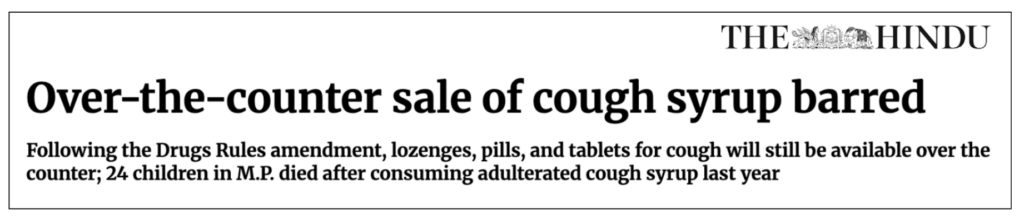
The Hindu reported that the Union government has barred the over-the-counter sale of cough syrup, making a registered doctor’s prescription mandatory for buying all medicinal syrups, including cough preparations. The move tightens how a widely self-medicated category of drugs reaches consumers.

An Indian Express explainer linked the decision to a string of child deaths connected to toxic or adulterated cough syrups contaminated with industrial solvents such as diethylene glycol (DEG), and to gaps in quality control and self-medication that regulators have moved to close.

  • Cough syrups and other medicinal syrups can no longer be sold over the counter; a prescription from a registered medical practitioner is now required.
  • The change is administered through India’s drug law — the Drugs and Cosmetics Act, 1940 and the Drugs and Cosmetics Rules, 1945 — which classify medicines into prescription schedules.
  • The trigger was repeated child fatalities tied to syrups contaminated with toxic solvents, notably diethylene glycol and ethylene glycol.
  • Regulators have flagged the misuse of cough syrups for self-medication and, in some preparations, for their psychoactive (codeine-type) content.
  • Enforcement runs through the Central Drugs Standard Control Organisation (CDSCO), the Drugs Controller General of India (DCGI) and state drug controllers.

The development matters in the context of:

  • This sits at the intersection of drug regulation, quality control and consumer protection — a recurring GS2 governance theme.
  • It follows earlier global episodes in which India-made syrups were linked to deaths abroad, putting the spotlight on export quality and domestic oversight.
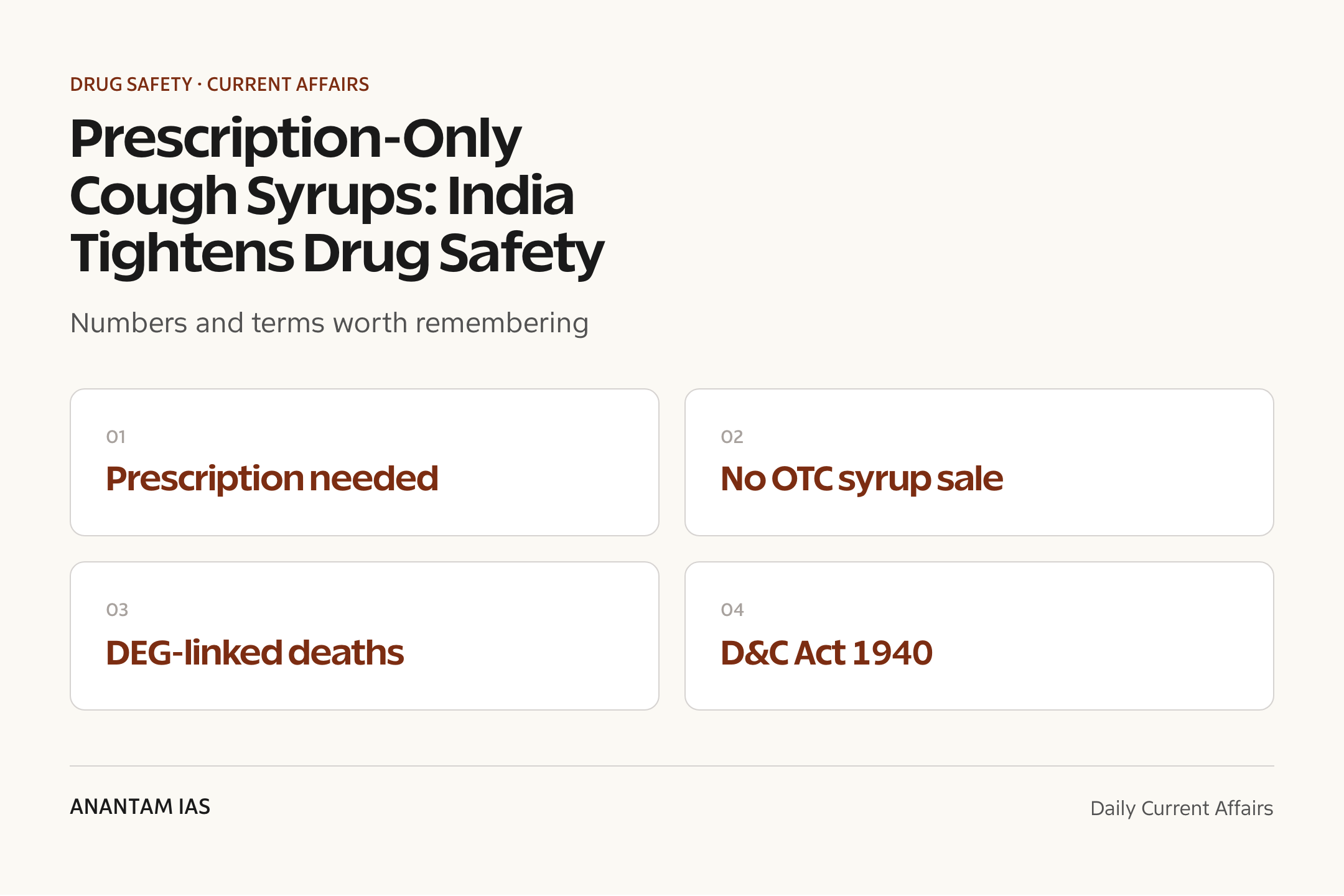
Prescription-Only Cough Syrups: India Tightens Drug Safety — quick facts

UPSC Relevance

Prelims Relevance

  • Drugs and Cosmetics Act, 1940 — parent law regulating import, manufacture, and sale of drugs
  • Drugs and Cosmetics Rules, 1945 — operational rules, including drug schedules
  • Schedule H — prescription-only drugs sold against a doctor’s prescription
  • Schedule H1 — restricted drugs (some antibiotics, habit-forming) needing extra record-keeping
  • Schedule K — categories granted specified exemptions from certain provisions
  • CDSCO — Central Drugs Standard Control Organisation, the national drug regulator
  • DCGI — Drugs Controller General of India, heads CDSCO
  • State Drug Controllers — license and inspect the manufacture and retail sale within states
  • Diethylene glycol (DEG) / ethylene glycol — toxic industrial solvents found as contaminants
  • Pharmacovigilance — monitoring adverse drug reactions; PvPI is India’s programme
  • Antimicrobial resistance (AMR) — driven partly by over-the-counter self-medication

Mains Relevance

GS Paper 2

  • Issues relating to the development and management of the health sector; regulation of drugs as a governance function.
  • Government policies and statutory bodies (CDSCO, DCGI) for protecting consumers and ensuring drug quality.

GS Paper 3

  • Pharmaceutical industry, quality control and the challenge of contaminated or substandard medicines.
  • Antimicrobial resistance and the public-health costs of unregulated self-medication.

Essay

  • When prevention fails: regulation as the last line of defence in public health.
  • Trust in medicine begins with the safety of the smallest bottle.

Background and Context

What changed, and what the rule means

The core shift is from free retail sale to controlled, prescription-gated sale of all medicinal syrups.

  • Earlier, many cough syrups sat in the over-the-counter grey zone and were sold without any prescription at chemist counters.
  • The new requirement means a chemist can dispense a medicinal syrup only against a valid prescription from a registered medical practitioner.
  • It applies broadly to medicinal syrups, not only branded cough formulations, closing routes for casual purchase.
  • The aim is to insert a doctor’s judgement between the patient and a drug that is easy to misuse or over-consume.
  • It strengthens the existing prescription-schedule architecture under the drug-regulation framework rather than creating a wholly new law.
Prescription-Only Cough Syrups: India Tightens Drug Safety — exam lens

The legal framework: Act, Rules and schedules

India regulates medicines through one parent statute and a set of rules that sort drugs into schedules.

  • The Drugs and Cosmetics Act, 1940, governs import, manufacture, distribution and sale of drugs and cosmetics.
  • The Drugs and Cosmetics Rules, 1945, operationalise the Act, including the drug schedules that set sale conditions.
  • Schedule H lists prescription-only drugs that must be sold against a doctor’s prescription.
  • Schedule H1 covers restricted drugs — certain antibiotics and habit-forming medicines — needing extra retailer record-keeping.
  • Schedule K grants specified exemptions to certain drug categories from some provisions of the Rules.
  • Tightening syrup sales works by moving such products firmly into the prescription-required zone.

Why the crackdown: the contamination crisis

The decision is a direct response to deaths caused by toxic adulterants in syrups, especially among children.

  • Several tragedies were traced to syrups laced with diethylene glycol (DEG) or ethylene glycol, industrial solvents used illegally in place of pharmaceutical-grade glycerine or propylene glycol.
  • These solvents are cheap but highly toxic, causing acute kidney failure and death, with children most vulnerable.
  • India-made syrups were earlier linked to child deaths abroad, including reported cases in The Gambia and Uzbekistan, drawing WHO medical-product alerts.
  • Such episodes exposed weaknesses in raw-material testing and batch quality control at some manufacturers.
  • Beyond contamination, easy retail access encouraged self-medication and misuse of codeine-based syrups.

Who regulates drugs in India?

Drug oversight in India is shared between a central regulator and the states, a structure that shapes enforcement.

  • The Central Drugs Standard Control Organisation (CDSCO) is the national regulator under the Health Ministry, setting standards and approving new drugs.
  • The Drugs Controller General of India (DCGI) heads CDSCO and approves licences for new drugs and clinical trials.
  • State Drug Controllers license and inspect manufacturing units and retail pharmacies within their states.
  • This split means manufacturing-quality enforcement often depends on uneven state-level capacity.
  • The Pharmacovigilance Programme of India (PvPI) tracks adverse drug reactions to flag unsafe products, complementing inspections by bodies like the WHO at the global level.

Self-medication, AMR and the public-health stakes

Restricting casual sale also targets the wider harms of unsupervised medicine use.

  • Routine over-the-counter buying normalises self-medication, where people dose themselves without diagnosis.
  • Unsupervised use of medicines, especially antibiotics, fuels antimicrobial resistance, a top global health threat.
  • Cough syrups containing codeine can be misused for their psychoactive effect, creating a substance-abuse risk.
  • Children are dosed by caregivers using easily bought syrups, raising the danger from any contaminated batch.
  • A prescription gate restores a clinical check and supports a wider preventive-health culture.

Trade-offs and implementation concerns

A tighter rule brings real safety gains but also practical and access challenges.

  • Access may suffer in rural areas with few doctors, where families rely on chemists for minor ailments.
  • Enforcement depends on chemists actually demanding prescriptions and on inspectors auditing sales records.
  • The bigger risk — contaminated raw materials — needs upstream testing, not only point-of-sale control.
  • Over-restriction could push purchases toward informal or online channels that are harder to police.
  • Genuine impact rests on pairing the rule with stricter manufacturing-quality checks and lab capacity.

Way Forward

Fix quality at the source

  • Mandate testing of every batch of glycerine and propylene glycol for DEG and ethylene glycol before use.
  • Expand accredited drug-testing labs and risk-based inspection of high-volume syrup manufacturers.

Strengthen the regulatory chain

  • Build uniform capacity across state drug controllers so enforcement does not vary by geography.
  • Use pharmacovigilance data to detect unsafe batches early and trigger fast recalls.

Protect access while controlling sale

  • Pair the prescription rule with telemedicine and primary-care access so rural families are not stranded.
  • Run awareness drives on the risks of self-medication and the importance of finishing prescribed courses.

Conclusion

Making cough syrups prescription-only is a sensible response to a grim pattern of preventable child deaths, inserting a clinical check into a category that had drifted into casual, unsupervised retail sale.

But the rule treats the symptom more than the disease. Lasting safety depends on testing raw materials, levelling up state-level enforcement and active pharmacovigilance — so that the smallest bottle on the chemist’s shelf can be trusted again.

UPSC Practice Questions

Prelims MCQ 1

With reference to drug regulation in India, consider the following statements:

  1. The Drugs and Cosmetics Act, 1940, is the parent law governing the manufacture and sale of drugs in India.
  2. Schedule H of the Drugs and Cosmetics Rules lists drugs that can be sold without a doctor’s prescription.
  3. The Central Drugs Standard Control Organisation is the national regulatory authority for drugs in India.

How many of the above statements are correct?

(a) Only one (b) Only two (c) All three (d) None

Answer: (b) Only two

Explanation:

Statements 1 and 3 are correct. Statement 2 is wrong — Schedule H lists prescription-only drugs that must be sold against a doctor’s prescription, not over the counter.

Prelims MCQ 2

The contamination of certain cough syrups that triggered child deaths in recent years was primarily caused by which of the following?

(a) Excess paracetamol content

(b) Diethylene glycol and ethylene glycol are used as cheap solvents

(c) Microbial contamination from poor packaging

(d) Overdose of codeine in standard formulations

Answer: (b) Diethylene glycol and ethylene glycol are used as cheap solvents

Explanation:

Toxic industrial solvents diethylene glycol (DEG) and ethylene glycol, used illegally in place of pharmaceutical-grade glycerine or propylene glycol, cause acute kidney failure and were behind the deaths.

UPSC Mains Questions

  1. “Restricting the over-the-counter sale of medicinal syrups addresses the symptom but not the disease of poor drug quality in India.” Critically examine in light of recent contamination episodes. (250 words)
  2. Discuss the structure of drug regulation in India under the Drugs and Cosmetics Act, 1940. What reforms are needed to prevent the recurrence of contaminated-medicine tragedies? (250 words)
  3. How does the easy over-the-counter availability of medicines contribute to self-medication and antimicrobial resistance in India? Suggest a balanced way forward. (150 words)

Sources: The Hindu and Indian Express.

Frequently Asked Questions

What did the new cough-syrup rule change?

The Centre barred the over-the-counter sale of all medicinal syrups, including cough preparations. A registered doctor’s prescription is now mandatory to buy them at a pharmacy. The aim is to insert a clinical check into a widely self-medicated category and reduce both misuse and exposure to unsafe batches.

Why did the government tighten the rules now?

The move followed repeated child deaths linked to cough syrups contaminated with toxic solvents such as diethylene glycol and ethylene glycol. These cheap industrial chemicals, used illegally instead of pharmaceutical-grade ingredients, cause acute kidney failure. The episodes exposed weak quality control and the dangers of unsupervised purchase.

What are Schedule H, H1 and K?

They are categories under the Drugs and Cosmetics Rules, 1945. Schedule H lists prescription-only drugs. Schedule H1 covers restricted drugs such as certain antibiotics and habit-forming medicines needing extra record-keeping. Schedule K grants specified exemptions from some provisions to certain drug categories. Together they set how different drugs may be sold.

Who regulates drugs and their quality in India?

The Central Drugs Standard Control Organisation, headed by the Drugs Controller General of India, is the national regulator that sets standards and approves new drugs. State drug controllers licence and inspect manufacturing units and retail pharmacies within their states. The Pharmacovigilance Programme of India tracks adverse drug reactions.

How is this linked to antimicrobial resistance?

Easy over-the-counter access encourages self-medication, where people take medicines, including antibiotics, without diagnosis or a full course. This misuse is a major driver of antimicrobial resistance. Requiring a prescription restores clinical oversight, helping curb the unsupervised use of drugs that breeds resistant infections.

Will the rule hurt access to medicines?

It can, especially in rural areas with few doctors, where families relied on chemists for minor ailments. Pairing the rule with telemedicine, stronger primary care and awareness drives can protect access. The deeper fix, however, lies in testing raw materials and improving manufacturing quality, not only controlling retail sale.
Why India Blocked Telegram Until the NEET Re-Exam

Open article →Download PDF
image 90

Why in News?

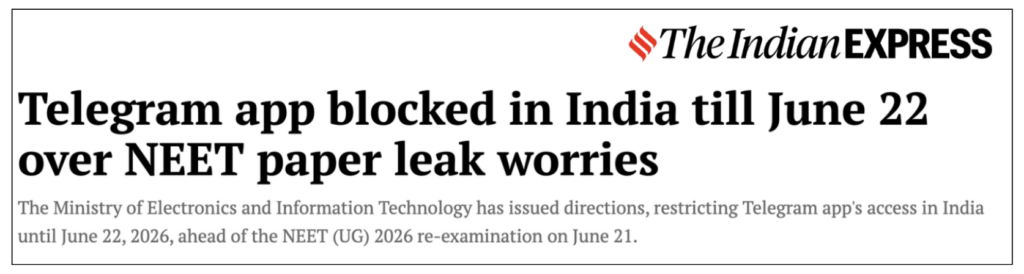
The Government of India temporarily blocked access to the messaging platform Telegram across the country, with The Indian Express reporting in its Explained section that the curb was timed to disrupt paper-leak and “solver” networks operating in the run-up to a NEET re-exam. The action sits squarely within India’s content-blocking architecture under Section 69A of the Information Technology Act, 2000, and the 2009 Blocking Rules.

The top-line issue is governance under stress: investigators alleged that organised channels were used to circulate leaked question papers, coordinate impersonators, and run real-time answer-sharing. Blocking an entire encrypted-friendly platform — rather than individual channels — pushes the debate toward proportionality, the safeguards from the Supreme Court’s Anuradha Bhasin (2020) ruling, and free speech under Article 19(1)(a).

  • The block was ordered as a temporary, targeted measure tied to a specific exam window, not a permanent ban on the platform.
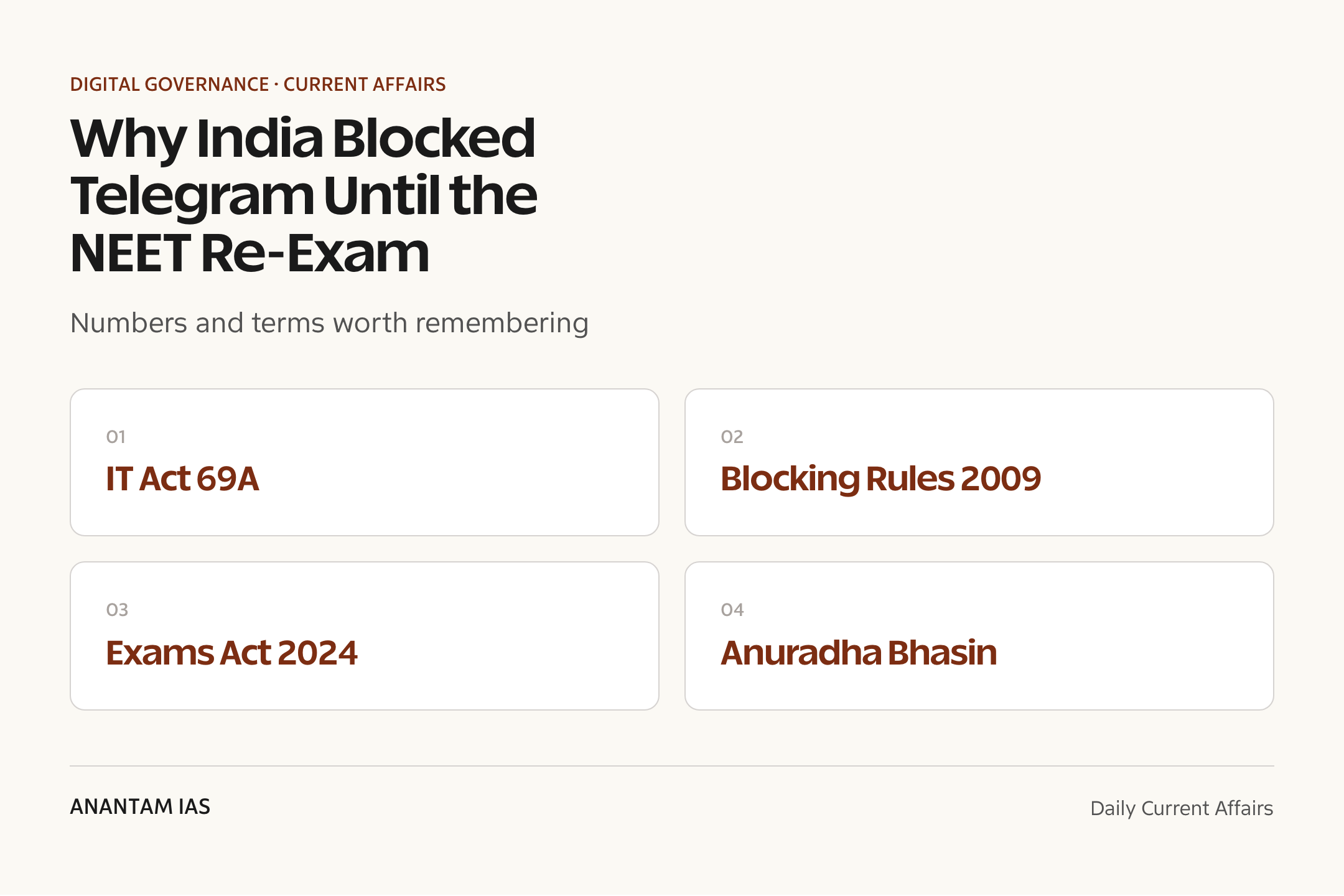
  • The legal hook is Section 69A of the IT Act, 2000, read with the Blocking Rules, 2009, which let the government direct intermediaries to disable public access to information.
  • Authorities cited use of Telegram channels for circulating leaked papers, arranging solvers/impersonators, and live answer-sharing during exams.
  • The move dovetails with the Public Examinations (Prevention of Unfair Means) Act, 2024, which criminalises organised exam malpractice.
  • Telegram founder Pavel Durov has previously criticised state-ordered blocks as disproportionate curbs on private communication.
  • The episode reopened questions about the National Testing Agency (NTA) reform after earlier paper-leak controversies.

The development matters in the context of:

  • Matters because it tests the line between a targeted intermediary block and a disproportionate shutdown of an entire communication channel.
  • Matters because encrypted platforms sit at the intersection of privacy, law enforcement and exam integrity.
  • Matters because the secrecy built into Section 69A blocking orders strains the transparency standard set in Anuradha Bhasin.
Why India Blocked Telegram Until the NEET Re-Exam — quick facts

UPSC Relevance

Prelims Relevance

  • Section 69A, IT Act 2000 — power to block public access to information through intermediaries
  • Information Technology (Blocking) Rules, 2009 — procedure, committee and confidentiality for blocking orders
  • Section 79, IT Act — intermediary ‘safe harbour’ conditional on due diligence
  • IT (Intermediary Guidelines and Digital Media Ethics Code) Rules, 2021 — due diligence, grievance officers, traceability
  • Public Examinations (Prevention of Unfair Means) Act, 2024 — offences, penalties up to ₹1 crore and 3-10 years
  • Anuradha Bhasin vs Union of India (2020) — proportionality, periodic review, publication of shutdown orders
  • Article 19(1)(a) and Article 19(2) — free speech and the eight grounds for reasonable restriction
  • Shreya Singhal vs Union of India (2015) — Section 69A upheld with procedural safeguards; Section 66A struck down
  • National Testing Agency (NTA) — conducts NEET-UG, JEE and other national entrance exams
  • Telegram — cloud-based messaging app; founder Pavel Durov; ‘channels’ for broadcast

Mains Relevance

GS Paper 2

  • Examine whether blocking an entire messaging platform to curb exam fraud satisfies the proportionality test laid down in Anuradha Bhasin (2020).
  • Discuss the adequacy of safeguards in the IT Act Section 69A blocking regime, especially its confidentiality requirement.

GS Paper 2

  • Assess the Public Examinations (Prevention of Unfair Means) Act, 2024 as a tool against organised paper-leak networks, and the institutional reform NTA still needs.

GS Paper 3

  • Analyse the tension between encrypted-platform governance, lawful interception and the citizen’s right to privacy.

Essay

  • Security and liberty are not rivals to be ranked but values to be reconciled.
  • A fair examination is the quiet promise a state makes to its young.

Background and Context

What the block actually does

The action is a time-bound restriction on platform access, framed as a law-enforcement measure rather than a policy ban.

  • The government directed internet service providers and the platform to disable public access to Telegram for a defined window around the exam.
  • The stated aim was to break real-time coordination — sharing of leaked papers, arranging solvers, and live answer relays — that thrives on broadcast-style channels.
  • Officials describe it as temporary and targeted; access is meant to be restored once the exam-integrity risk passes.
  • Because Telegram’s channels can reach large audiences instantly, regulators treat them as a force multiplier for organised cheating.
  • Critics counter that an app-wide block is overbroad, disrupting millions of lawful users to target a few networks.
Why India Blocked Telegram Until the NEET Re-Exam — exam lens

The legal engine: Section 69A and the 2009 Blocking Rules

India’s content-blocking power flows from one IT Act provision and a confidential rule-based procedure.

  • Section 69A of the IT Act, 2000 empowers the Centre to direct any intermediary to block public access to information in the interest of sovereignty, security, public order, and related grounds.
  • The Information Technology (Blocking) Rules, 2009 set the procedure: requests are routed through a nodal officer and examined by an inter-departmental committee before an order is issued.
  • Rule 16 imposes confidentiality on blocking requests and complaints, which is why specific orders are rarely public.
  • Non-compliance can attract criminal liability for the intermediary under Section 69A, giving the directive real teeth.
  • In free-speech jurisprudence, the Supreme Court upheld 69A in Shreya Singhal (2015), noting its narrower grounds and procedural checks compared with the struck-down Section 66A.

Intermediary liability and the safe-harbour bargain

Platforms enjoy protection from user content only if they follow due diligence and lawful directions.

  • Section 79 of the IT Act grants intermediaries ‘safe harbour’ — immunity from liability for third-party content — conditional on due diligence and acting on lawful orders.
  • The IT (Intermediary Guidelines and Digital Media Ethics Code) Rules, 2021 require large platforms to appoint grievance, compliance and nodal officers and respond to takedown demands within set timelines.
  • An intermediary that ignores a valid blocking direction risks losing safe harbour, exposing itself to liability for the offending content.
  • Telegram’s reputation for light-touch moderation and pseudonymous channels makes it a recurring focus of Indian regulators.
  • The standoff illustrates the global encrypted-platform governance dilemma: how to compel cooperation without breaking end-to-end privacy.

Exam integrity and the 2024 anti-cheating law

The block is one prong of a wider crackdown that the law now backs with criminal force.

  • The Public Examinations (Prevention of Unfair Means) Act, 2024, criminalises organised malpractice in public exams, with penalties reaching three to ten years and fines up to ₹1 crore for service-provider collusion.
  • It targets paper leaks, impersonation, tampering with answer sheets, and the solver gangs that monetise these on messaging apps.
  • Exams under the National Testing Agency (NTA) — including NEET-UG — were the trigger for the law after high-profile leak controversies.
  • Blocking a platform during the exam window is meant to remove the distribution layer that turns a single leak into a mass advantage.
  • Reformers argue the deeper fix lies in NTA process reform — secure question banks, encrypted logistics, and computer-based testing — not just app blocks.

The proportionality test from Anuradha Bhasin

Any restriction on access must clear the constitutional bar that the Supreme Court set for internet curbs.

  • In Anuradha Bhasin vs Union of India (2020), the Court held that access to the internet is integral to Article 19(1)(a) and Article 19(1)(g), so curbs must satisfy proportionality.
  • It required that restriction orders be the least restrictive, time-bound, backed by recorded reasons, and subject to periodic review.
  • Crucially, the Court directed that such orders be published so they can be challenged — a transparency standard in tension with 69A’s confidentiality.
  • A platform-wide block raises the over-breadth question: was a narrower remedy, like targeting specific channels, available and ignored?
  • Restrictions still have to fit the eight grounds of Article 19(2) and remain proportionate to the harm being prevented.

The free-speech and privacy pushback

Civil-liberties critics and the platform’s founder frame the block as a blunt instrument.

  • Telegram founder Pavel Durov has publicly criticised state-ordered blocks as disproportionate intrusions on private and lawful communication.
  • Digital-rights groups warn that app-wide blocks set a precedent for shutting down communication channels whenever misuse is alleged.
  • Privacy advocates note the right recognised in K.S. Puttaswamy (2017) requires legality, necessity and proportionality for any state intrusion.
  • There is a collateral-cost concern: small businesses, students and communities that depend on the platform lose access due to the conduct of a few.
  • Supporters reply that a short, exam-specific block is a calibrated response to a real, time-sensitive threat to fairness.

Way Forward

Prefer the least-restrictive remedy

  • Target specific channels and accounts through the platform’s compliance channel before resorting to an app-wide block.
  • Build sunset clauses and automatic review into every block so restrictions lapse the moment the integrity risk ends.

Reform the exam, not just the app

  • Overhaul NTA logistics — encrypted question transmission, randomised papers, tamper-evident custody, and a shift toward computer-based testing.
  • Use the Public Examinations Act, 2024, to prosecute solver gangs and colluding service providers, attacking the supply chain rather than only the broadcast layer.

Reconcile security with liberty by publishing reasoned blocking orders where confidentiality is not strictly essential, by building a transparent appeal route for affected users, and by negotiating lawful, privacy-preserving cooperation protocols with messaging platforms so that genuine threats can be addressed without disabling an entire channel of communication.

Conclusion

The Telegram block crystallises a recurring governance question: when a lawful communication tool is hijacked for fraud, how far may the State go in switching it off? The Centre’s case rests on a real harm — organised paper-leak networks that can wreck the fairness of a high-stakes exam for lakhs of honest aspirants — and on settled statutory power under Section 69A.

The harder test is whether the remedy is proportionate. Anuradha Bhasin and the privacy doctrine demand that curbs be least restrictive, time-bound, and accountable. A short, exam-specific block paired with deeper NTA reform and channel-level enforcement can protect integrity without normalising platform shutdowns; an open-ended habit of blocking apps whenever misuse is alleged would erode the very liberty the Constitution guards.

UPSC Practice Questions

Prelims MCQ 1

With reference to the power to block online content in India, consider the following statements:

  1. Section 69A of the Information Technology Act, 2000, empowers the Central Government to direct intermediaries to block public access to information.
  2. The Information Technology (Blocking) Rules, 2009, require blocking requests and complaints to be kept confidential.
  3. The Supreme Court struck down Section 69A in the Shreya Singhal case as unconstitutional.

How many of the above statements are correct?

(a) Only one (b) Only two (c) All three (d) None

Answer: (b) Only two

Explanation:

Statements 1 and 2 are correct. Statement 3 is wrong: in Shreya Singhal vs Union of India (2015) the Court upheld Section 69A as constitutionally valid, citing its narrower grounds and procedural safeguards; it struck down Section 66A, not 69A.

Prelims MCQ 2

Which one of the following best describes the proportionality safeguard laid down in Anuradha Bhasin vs Union of India (2020)?

(a) Internet restrictions can be imposed indefinitely without review

(b) Restriction orders must be the least restrictive, time-bound, reasoned and published for review

(c) Only Parliament, not the executive, can restrict internet access

(d) Access to the internet is not protected under Article 19

Answer: (b) Restriction orders must be the least restrictive, time-bound, reasoned and published for review

Explanation:

The Court held that internet access is integral to Article 19(1)(a) and 19(1)(g), and that any restriction must satisfy proportionality — least restrictive, time-bound, supported by recorded reasons, subject to periodic review, and published so it can be challenged.

UPSC Mains Questions

  1. The Centre temporarily blocked an entire messaging platform to disrupt paper-leak networks ahead of a national exam. Examine this action against the proportionality safeguards laid down in Anuradha Bhasin vs Union of India (2020). (250 words)
  2. “Safe harbour for intermediaries is a bargain, not a birthright.” Discuss the conditions under which platforms retain immunity under the IT Act and the duties cast on them by the IT Rules, 2021. (250 words)
  3. Organised paper-leak networks have repeatedly undermined public examinations. Evaluate the Public Examinations (Prevention of Unfair Means) Act, 2024 and the institutional reform the National Testing Agency still requires. (150 words)

Sources: Ministry of Electronics and Information Technology and The Indian Express (Explained).

Frequently Asked Questions

Why did India block Telegram?

As reported by The Indian Express, the Centre temporarily blocked Telegram to disrupt organised paper-leak and solver networks ahead of a NEET re-exam. Investigators alleged that channels on the platform were being used to circulate leaked question papers, arrange impersonators, and share answers in real time. The block was framed as a time-bound, targeted law-enforcement measure rather than a permanent ban on the app.

What law allows the government to block a platform?

The power flows from Section 69A of the Information Technology Act, 2000, read with the Blocking Rules, 2009. Section 69A lets the Centre direct intermediaries to block public access to information on grounds such as sovereignty, security and public order. The 2009 Rules set the procedure through a nodal officer and an inter-departmental committee, and Rule 16 makes the requests confidential.

Is blocking an entire app constitutional?

It depends on proportionality. In Anuradha Bhasin vs Union of India (2020) the Supreme Court held that internet curbs must be the least restrictive option, time-bound, backed by recorded reasons, periodically reviewed, and published for challenge. A platform-wide block invites the over-breadth question — whether a narrower remedy, like targeting specific channels, was available before disabling the whole app.

What is the Public Examinations Act, 2024?

The Public Examinations (Prevention of Unfair Means) Act, 2024 criminalises organised malpractice in public exams. It targets paper leaks, impersonation, tampering and solver gangs, with penalties of up to three to ten years’ imprisonment and fines reaching ₹1 crore for colluding service providers. It backs the exam-integrity effort that the Telegram block was part of.

What did Pavel Durov say about such blocks?

Telegram founder Pavel Durov has publicly criticised state-ordered blocks as disproportionate intrusions on private and lawful communication, arguing they punish millions of ordinary users to target a few bad actors. His stance reflects the platform’s light-touch moderation philosophy, which often puts it at odds with governments seeking faster takedowns and cooperation.

Does blocking the app fix exam leaks?

Only partly. A block removes the distribution layer during the exam window, but the root problem lies in exam logistics. Experts argue the durable fix is National Testing Agency reform — encrypted question transmission, tamper-evident custody, randomised papers and computer-based testing — combined with prosecution of solver gangs under the 2024 anti-cheating law, rather than relying on platform shutdowns alone.

CAG on State Finances: Who Ran a Revenue Surplus in FY25

Open article →Download PDF
image 89

Why in News?

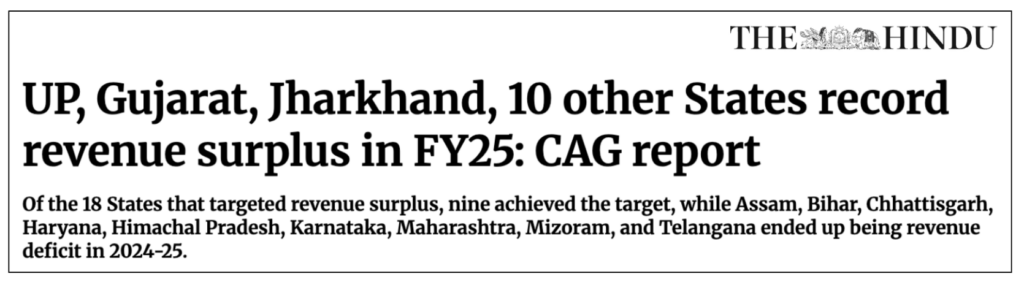
A report compiled by the Comptroller and Auditor General of India (CAG) on State finances has found that several States closed FY25 (2024-25) with a revenue surplus rather than a deficit, signalling a partial recovery in the quality of State budgets after the pandemic years.

As reported by The Hindu, 13 States recorded a revenue surplus in FY25, with Uttar Pradesh, Gujarat and Jharkhand among those that earned more on the revenue account than they spent.

  • A revenue surplus means a State’s revenue receipts exceed its revenue expenditure — current spending is fully met without borrowing.
  • 13 States were in revenue surplus in FY25, per the CAG compilation cited by The Hindu.
  • Uttar Pradesh, Gujarat and Jharkhand are named among the surplus States.
  • A surplus on the revenue account frees up borrowed funds for capital outlay (asset creation) instead of routine consumption.
  • The picture comes from the CAG’s audit and compilation role under Articles 148-151 of the Constitution.

The development matters in the context of:

  • Revenue-account health is the single best signal of whether a State is borrowing to build assets or just to pay salaries — the core of fiscal sustainability.
  • State finances matter as much as the Union’s: States together spend more than the Centre on health, education, agriculture and police.
CAG on State Finances: Who Ran a Revenue Surplus in FY25 — quick facts

UPSC Relevance

Prelims Relevance

  • Revenue deficit = revenue expenditure minus revenue receipts
  • Fiscal deficit = total expenditure minus total receipts (excluding borrowings); equals the year’s borrowing
  • Primary deficit = fiscal deficit minus interest payments
  • Effective revenue deficit = revenue deficit minus grants for the creation of capital assets
  • CAG appointed by the President under Article 148; reports under Articles 149-151
  • CAG reports laid before State Legislatures via the Governor (Article 151(2))
  • FRBM Act, 2003 (Union) and State FRBM/FRL laws cap deficits and debt
  • Committed expenditure = salaries + pensions + interest payments
  • States’ own-tax revenue vs central transfers (devolution + grants)
  • Finance Commission (Article 280) recommends tax devolution and grants-in-aid
  • GST and the 101st Constitutional Amendment; GST Council (Article 279A)

Mains Relevance

GS Paper 3

  • Fiscal sustainability of States: revenue deficit vs capital outlay, and why the composition of spending matters more than the headline deficit.
  • Off-budget borrowing, committed expenditure and the freebies debate as threats to State fiscal space.

GS Paper 2

  • The CAG’s constitutional role and its place in ensuring legislative control over the public purse.
  • Fiscal federalism: vertical and horizontal imbalances and the Finance Commission’s balancing role.

Essay

  • Accountability of the public exchequer is the quiet foundation of democracy.
  • A budget reveals a government’s real priorities more honestly than any manifesto.

Background and Context

The three deficits — read the budget correctly

A single ‘deficit’ number hides what a government is actually doing with borrowed money.

  • Revenue deficit: revenue expenditure exceeds revenue receipts. It means a government is borrowing to fund day-to-day running costs — a warning sign, since the borrowing creates no assets.
  • Fiscal deficit: total expenditure minus total receipts excluding borrowings. It equals the amount the government must borrow in the year and is the headline indicator of fiscal pressure.
  • Primary deficit: fiscal deficit minus interest payments. It strips out the cost of past borrowing to show the fresh imbalance created this year.
  • Effective revenue deficit: revenue deficit minus grants given for creating capital assets — a refinement that treats some transfers as quasi-capital.
  • A revenue surplus is the healthy mirror image — revenue receipts cover all current spending, so every rupee borrowed can go to capital works.
CAG on State Finances: Who Ran a Revenue Surplus in FY25 — exam lens

FRBM and State fiscal-responsibility laws

Deficit ceilings are not just convention — they are statutory.

  • The FRBM Act, 2003, binds the Union to a glide-path on fiscal and revenue deficits and on debt.
  • Every State has its own Fiscal Responsibility Legislation (FRL) capping the fiscal deficit (commonly around 3% of GSDP) and the debt-to-GSDP ratio.
  • Borrowing limits for States are set under Article 293, which requires Union consent when a State is indebted to the Centre.
  • The Finance Commission recommends the deficit and debt path States should follow, and net borrowing ceilings are tied to FRL compliance.
  • Crossing the cap typically forces corrective steps; the audit by the CAG is how breaches and creative accounting come to light.

The CAG’s constitutional role (Articles 148-151)

The CAG is the auditor of the entire public purse — Union and States alike.

  • The CAG is appointed by the President under Article 148, with security of tenure and salary charged on the Consolidated Fund.
  • Article 149 defines the duties and powers; the CAG audits all receipts and expenditure of the Union and the States.
  • Article 150 lets the President, on the CAG’s advice, prescribe the form of Union and State accounts.
  • Article 151 requires CAG reports to be laid before Parliament and, for States, before the State Legislature through the Governor.
  • State Finance Audit Reports feed the Public Accounts Committee, the legislative arm that scrutinises how money was actually spent.

Where State money comes from

A State’s fiscal health depends heavily on how much it raises for itself versus how much it receives.

  • Own-tax revenue: State GST, stamp duty and registration, State excise (liquor), motor-vehicle tax and electricity duty — the part a State controls.
  • Own non-tax revenue: royalties (especially mining, which lifts mineral-rich States like Jharkhand), interest, dividends and user charges.
  • Tax devolution: a State’s share of the divisible central pool, recommended by the Finance Commission under Article 280.
  • Grants-in-aid: Finance Commission grants plus centrally sponsored scheme transfers — important for weaker States.
  • GST shifted many State taxes into a shared pool decided by the GST Council; compensation for revenue loss has since lapsed, tightening State finances.

Spending quality — committed expenditure vs capital outlay

What a State spends on is the real test the CAG reports help answer.

  • Committed expenditure — salaries, pensions and interest payments — is largely unavoidable and crowds out development spending when it grows too large.
  • Capital outlay builds assets — roads, irrigation, schools, hospitals — and is the spending that supports future growth.
  • A revenue surplus is valuable precisely because it lets a State direct its entire borrowing toward capital outlay rather than current consumption.
  • Rising pension burdens and the debate over the Old Pension Scheme are key pressures the CAG flags for many States.
  • High subsidy and transfer outgo (power, water, direct benefits) can swing a State from surplus to revenue deficit quickly.

Off-budget borrowing and the transparency problem

The headline numbers can flatter a budget when borrowing is hidden.

  • Off-budget borrowing routes loans through State public-sector undertakings or special vehicles so they don’t show in the State’s own deficit.
  • The CAG has repeatedly flagged such borrowing, which understates the true fiscal and debt position.
  • Guarantees extended by States create contingent liabilities — risks that fall on the budget if the entity defaults.
  • The Union has tightened rules so that off-budget borrowing is increasingly counted within a State’s net borrowing ceiling.
  • Transparency in accounts is why the CAG’s independent audit matters — it converts political budget claims into verified numbers.

Way Forward

Protect the revenue account

  • Treat a revenue surplus, not just a low fiscal deficit, as the headline target, so borrowing funds assets, not consumption.
  • Contain committed expenditure growth — salaries, pensions and interest — to preserve space for capital outlay.

Raise and broaden one’s own revenue

  • Improve State GST compliance and rationalise stamp duty, excise and property-related levies to lift own-tax revenue.
  • Use mineral and resource royalties prudently, recognising they are finite and volatile.

Strengthen transparency

  • End off-budget borrowing and bring guarantees and contingent liabilities fully onto the books.
  • Act on CAG observations through an active Public Accounts Committee and timely tabling of audit reports.

Conclusion

A revenue surplus in 13 States is a modest but real signal that some State budgets are healing — borrowing more for building than for spending. But the surplus tells only part of the story; the composition of revenue and the honesty of the accounts matter just as much.

The CAG’s audit turns budget rhetoric into verified fact, and its constitutional independence is what makes State finances accountable to legislatures and citizens. For India’s fiscal federalism, the durable lesson is to defend the revenue account, raise its own revenue and bring all borrowing into the open.

UPSC Practice Questions

Prelims MCQ 1

With reference to the deficits in government finance, consider the following statements:

  1. Revenue deficit arises when revenue expenditure exceeds revenue receipts.
  2. Fiscal deficit equals total expenditure minus total receipts excluding borrowings.
  3. Primary deficit is the fiscal deficit minus interest payments.

How many of the above statements are correct?

(a) Only one (b) Only two (c) All three (d) None

Answer: (c) All three

Explanation:

All three definitions are correct. Fiscal deficit indicates the borrowing requirement; primary deficit strips out interest on past debt; a revenue deficit signals borrowing for current spending.

Prelims MCQ 2

Which one of the following best describes the constitutional position of the Comptroller and Auditor General of India?

(a) Appointed by the Prime Minister and removable by a simple majority

(b) Appointed by the President; duties and powers governed by Article 149; reports laid before Parliament and State Legislatures

(c) An officer of the Finance Ministry who frames the Union Budget

(d) Appointed by and answerable to the GST Council

Answer: (b) Appointed by the President; duties and powers governed by Article 149; reports laid before Parliament and State Legislatures

Explanation:

The CAG is appointed by the President under Article 148, with duties under Article 149; reports are laid before Parliament and the State Legislatures under Article 151.

UPSC Mains Questions

  1. Distinguish between revenue deficit, fiscal deficit and primary deficit. Why is the quality of expenditure financed by borrowing a better measure of a State’s fiscal health than the headline fiscal deficit alone? (250 words)
  2. Examine the role of the Comptroller and Auditor General in ensuring fiscal accountability of States. How does off-budget borrowing undermine the transparency of State finances? (250 words)
  3. Indian fiscal federalism balances State autonomy against fiscal discipline. Discuss the instruments — FRBM/FRL laws, the Finance Commission and Article 293 borrowing limits — that shape State finances. (250 words)

Sources: Comptroller and Auditor General of India (CAG) and The Hindu.

Frequently Asked Questions

What is a revenue surplus?

A revenue surplus occurs when a government’s revenue receipts (taxes, devolution, grants, non-tax income) exceed its revenue expenditure (salaries, pensions, interest, subsidies). It means current spending is fully met without borrowing, so any borrowed funds can be channelled into capital assets like roads and schools rather than routine consumption.

How is fiscal deficit different from revenue deficit?

Fiscal deficit is total expenditure minus total receipts excluding borrowings, so it equals the amount a government must borrow in a year. Revenue deficit is the shortfall only on the revenue (current) account. A government can run a fiscal deficit yet still have a revenue surplus if its borrowing funds capital outlay rather than day-to-day expenses.

What is the CAG’s role in auditing State finances?

The CAG is appointed by the President under Article 148 and audits all receipts and expenditure of both the Union and the States under Article 149. Its reports on State finances are laid before each State Legislature through the Governor under Article 151 and are examined by the Public Accounts Committee, making the executive accountable for how public money is spent.

What is committed expenditure?

Committed expenditure refers to spending a State cannot easily cut in the short run — mainly salaries, pensions and interest payments. When committed expenditure grows large, it crowds out development and capital spending. Controlling it is essential to keep a State’s revenue account in surplus and preserve room for asset creation.

What is off-budget borrowing and why does it matter?

Off-budget borrowing is debt raised through State public-sector undertakings or special vehicles so it does not appear in the State’s own deficit figures. It flatters the headline numbers while raising the true debt burden. The CAG repeatedly flags it, and rules now increasingly count such borrowing within a State’s net borrowing ceiling.

How do States earn their revenue?

States rely on own-tax revenue (State GST, stamp duty, State excise on liquor, motor-vehicle tax), own non-tax revenue (royalties, interest, user charges), tax devolution from the central pool recommended by the Finance Commission under Article 280, and grants-in-aid. The balance between self-raised revenue and central transfers shapes a State’s fiscal autonomy and health.

The ‘Dancing Girl’ of Mohenjo-daro: Art, Identity and a Naming Debate

Open article →Download PDF
image 88

Why in News?

A fresh debate has revived public and academic attention on the ‘Dancing Girl’, a roughly 4,500-year-old bronze figurine from Mohenjo-daro, the largest city of the Indus Valley Civilisation (Harappan Civilisation). The Indian Express, in its Explained series, traced how a small Bronze Age statuette acquired its enduring popular name and why that label is now being questioned.

The renewed discussion centres on a naming controversy — whether the term ‘Dancing Girl’ is an interpretation imposed by early excavators rather than an established identity. The figurine is housed in the National Museum, New Delhi, and remains one of the most reproduced symbols of India’s prehistoric art.

  • The figurine stands about 10.5 cm tall and was cast in bronze using the lost-wax (cire perdue) technique.
  • It was excavated at Mohenjo-daro (in present-day Sindh, Pakistan) during the 1920s excavations led by the Archaeological Survey of India.
  • The name ‘Dancing Girl’ was popularised by archaeologist John Marshall, who read the figure’s pose as that of a dancer.
  • The artefact dates to roughly 2500 BCE, placing it in the Mature Harappan phase.
  • The figure wears a stack of bangles on the left arm and fewer on the right, with a confident, hand-on-hip stance.
  • The piece is one of only a handful of Harappan bronzes recovered, underlining the rarity of metal sculpture from the period.

The development matters in the context of:

  • Shows why interpretation matters in art history — a label can shape how millions perceive an artefact.
  • Connects to live questions over artefact ownership between India and Pakistan after Partition.
  • Reinforces the syllabus link between Indus art and early Indian metallurgy.
The 'Dancing Girl' of Mohenjo-daro: Art, Identity and a Naming Debate — quick facts

UPSC Relevance

Prelims Relevance

  • Lost-wax / cire perdue bronze-casting technique
  • Mohenjo-daro — site on the Indus, present-day Sindh
  • Indus Valley Civilisation chronology (~2500 BCE, Mature phase)
  • John Marshall and the 1920s ASI excavations
  • RD Banerji (Mohenjo-daro) and Daya Ram Sahni (Harappa)
  • Other Harappan art: ‘Priest-King’ steatite bust, bronze buffalo, terracotta figurines
  • Material of the ‘Dancing Girl’ — bronze (copper-tin alloy)
  • National Museum, New Delhi as the housing institution
  • Steatite seals and the Pashupati seal as Harappan art forms

Mains Relevance

GS Paper 1

  • Discuss the salient features of Indus Valley art and craftsmanship with reference to the bronze and steatite figurines.
  • Examine how early excavators’ interpretations have shaped the popular understanding of Harappan artefacts.

GS Paper 1

  • Evaluate the technological sophistication of the lost-wax casting method as evidence of Harappan metallurgy.

Essay

  • Who owns the past? Heritage, naming and the politics of interpretation.
  • Art outlives empires: small objects as carriers of civilisational memory.

Background and Context

What the figurine is

A small but technically remarkable Bronze Age statuette.

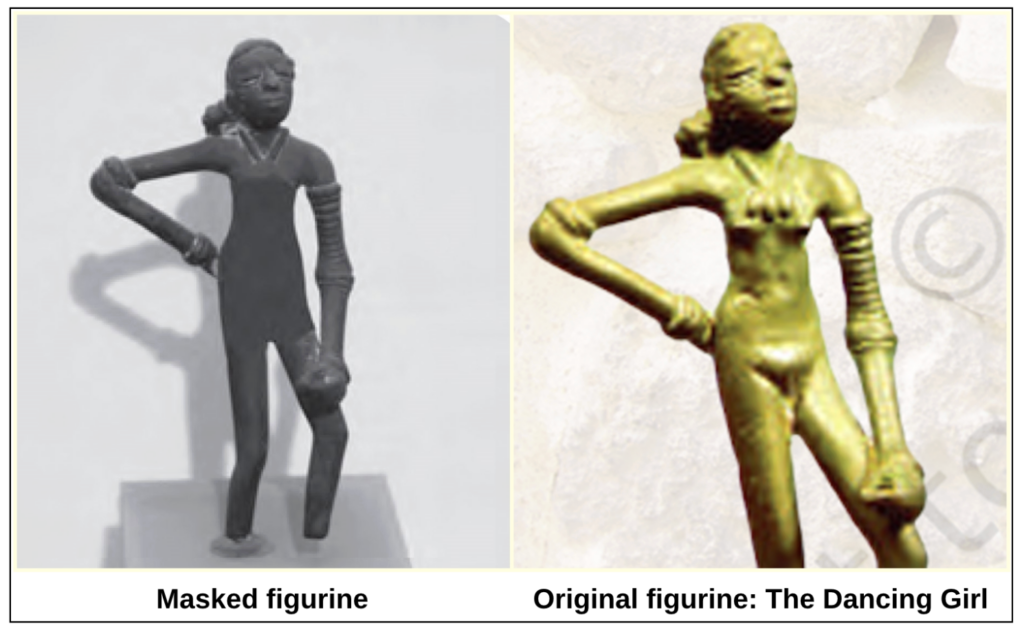
  • The ‘Dancing Girl’ is a bronze figurine roughly 10.5 cm tall, depicting a slender, standing female figure with one hand on her hip and the other resting on a thigh.
  • She wears a stack of bangles along the left arm — nearly the full length — and a few on the right, plus a necklace; the figure is otherwise unclothed.
  • The pose is naturalistic and relaxed, with the head slightly tilted, conveying poise and confidence rare in such an early work.
  • It belongs to the Mature Harappan phase, dated to about 2500 BCE, making it roughly 4,500 years old and part of the wider Harappan Civilization.
image 87
The 'Dancing Girl' of Mohenjo-daro: Art, Identity and a Naming Debate — exam lens

Lost-wax (cire perdue) casting

The figurine showcases an advanced metal-casting method mastered by Harappan craftsmen.

  • In lost-wax casting (cire perdue), a wax model of the object is made, coated in clay to form a mould, then heated so the wax melts and drains out.
  • Molten bronze — an alloy of copper and tin — is poured into the hollow, hardens, and the mould is broken to release the finished figure.
  • The technique allowed fine, free-standing three-dimensional figures and is still used in traditional Indian metal-craft (for example, Dhokra work).
  • Its presence at Mohenjo-daro is strong evidence of sophisticated Harappan metallurgy and an organised craft economy.

Mohenjo-daro and its excavation

The artefact comes from one of the two great Harappan cities, uncovered a century ago.

  • Mohenjo-daro (‘Mound of the Dead’) sits on the Indus in present-day Sindh, Pakistan, and was the largest urban centre of the civilisation.
  • It was excavated in the 1920s by the Archaeological Survey of India; RD Banerji worked at Mohenjo-daro while Daya Ram Sahni excavated Harappa.
  • Overall direction lay with John Marshall, then Director-General of the ASI, who announced the discovery of the civilisation in 1924.
  • The city is famous for its grid town planning, the Great Bath and an advanced covered drainage system — hallmarks of Harappan architecture.

The naming debate

Whether the figure is truly a ‘dancer’ is an interpretation, not a settled fact.

  • The label ‘Dancing Girl’ came from John Marshall and early observers who read the pose as mid-dance — a description, not an inscription from the makers.
  • Critics argue the name projects a modern reading onto a society whose language and intent remain undeciphered, since the Indus script is still unread.
  • Alternative readings see a young woman in an everyday confident stance, or a figure of ritual or social significance whose role we cannot recover.
  • The renewed controversy — including disputes over how the artefact is described in textbooks — shows how heritage gets labelled and how labels then become fixed in public memory.

Other Indus art and its place

The figurine belongs to a wider, varied Harappan artistic tradition.

  • The contemporaneous ‘Priest-King’, a steatite bust from Mohenjo-daro, is another iconic Harappan sculpture, equally an interpretive name.
  • Harappan art also includes a small bronze buffalo, terracotta figurines (the ‘Mother Goddess’), painted pottery and finely carved steatite seals.
  • Seals such as the so-called Pashupati seal show animals and a seated figure, hinting at belief systems that remain debated.
  • Across these works, Indus artists favoured small scale, realism and craft precision over monumental scale, a thread that runs through the wider story of Indian ancient history.

Ownership, housing and dating disputes

Where the object sits and how old it is have both drawn contestation.

  • The figurine is held at the National Museum, New Delhi, having come to India in the division of antiquities after Partition in 1947.
  • Pakistan has at times claimed Mohenjo-daro artefacts on the grounds that the site lies within its territory.
  • Precise dating of individual Harappan objects is inferred from stratigraphy and context, so figures are usually given as approximate ranges.
  • Such disputes underline how prehistoric heritage straddles modern borders and competing national narratives.

Way Forward

Interpretive humility

  • Present popular names like ‘Dancing Girl’ as interpretations, flagging that the makers’ intent is unknown, while the Indus script stays undeciphered.
  • Encourage textbooks and museums to pair traditional labels with their descriptive, provisional nature.

Conservation and access

  • Invest in scientific conservation, high-resolution digitisation and open scholarship on Harappan bronzes.
  • Strengthen museum interpretation so visitors learn the technique (lost-wax casting) and the context, not only the name.

Sustained research, careful labelling and cross-border academic cooperation can let the artefact teach Harappan craft and history without freezing it inside a single contested name.

Conclusion

The ‘Dancing Girl’ endures because it compresses a whole civilisation into ten centimetres of bronze — proof of Harappan mastery of lost-wax casting and of an artistic confidence 4,500 years old.

The naming debate is a reminder that history is partly authored by those who unearth it. For UPSC, the durable lessons are the technique, the site, the chronology and the wider Indus artistic tradition, with the label held lightly as one reading among several.

UPSC Practice Questions

Prelims MCQ 1

With reference to the ‘Dancing Girl’ figurine of Mohenjo-daro, consider the following statements:

  1. It was made of bronze using the lost-wax (cire perdue) casting technique.
  2. It belongs to the Mature phase of the Indus Valley Civilisation.
  3. It is currently housed in the National Museum, New Delhi.

How many of the above statements are correct?

(a) Only one (b) Only two (c) All three (d) None

Answer: (c) All three

Explanation:

The figurine is a Mature Harappan (~2500 BCE) bronze made by lost-wax casting and is displayed at the National Museum, New Delhi. All three statements are correct.

Prelims MCQ 2

The site of Mohenjo-daro, where the ‘Dancing Girl’ was found, is located on the banks of which river?

(a) Ravi (b) Indus (c) Ghaggar-Hakra (d) Sutlej

Answer: (b) Indus

Explanation:

Mohenjo-daro lies on the Indus in present-day Sindh, Pakistan. Harappa, by contrast, is on the Ravi.

UPSC Mains Questions

  1. The ‘Dancing Girl’ of Mohenjo-daro is celebrated as a masterpiece of Indus art. Discuss its artistic and technological significance, and explain what it reveals about Harappan society. (250 words)
  2. Popular names given to ancient artefacts often reflect the assumptions of their excavators. Critically examine this statement with reference to Harappan art, such as the ‘Dancing Girl’ and the ‘Priest-King’. (250 words)
  3. Examine the lost-wax (cire perdue) casting technique as evidence of metallurgical and craft sophistication in the Indus Valley Civilisation. (150 words)

Sources: Indian Express, Explained and Archaeological Survey of India.

Frequently Asked Questions

What is the ‘Dancing Girl’ of Mohenjo-daro?

It is a small bronze figurine, about 10.5 cm tall, of a slender standing female figure with bangles on her arm. Made around 2500 BCE using lost-wax casting, it is one of the most famous artefacts of the Indus Valley Civilisation and is housed in the National Museum, New Delhi.

How was the ‘Dancing Girl’ made?

It was cast in bronze using the lost-wax (cire perdue) technique. A wax model is coated in clay to make a mould, the wax is melted out, and molten bronze is poured in. The mould is then broken to free the figure, showing advanced Harappan metallurgy.

Why is its name controversial?

The label ‘Dancing Girl’ came from early excavators, chiefly John Marshall, who read the pose as a dance. Critics say this is a modern interpretation imposed on a society whose script is undeciphered, so the figure’s actual role and identity remain unknown.

Where was the figurine found and who excavated it?

It was found at Mohenjo-daro on the Indus in present-day Sindh, Pakistan, during the 1920s excavations by the Archaeological Survey of India. RD Banerji worked at Mohenjo-daro, with John Marshall directing the wider effort that announced the civilisation in 1924.

Why does India hold an artefact found in Pakistan?

The figurine came to India in the division of antiquities after the 1947 Partition and is kept at the National Museum, New Delhi. Pakistan has at times claimed Mohenjo-daro artefacts because the site lies within its territory, making ownership a recurring dispute.

What other art comes from the Indus Valley Civilisation?

Besides the ‘Dancing Girl’, the Harappans produced the steatite ‘Priest-King’ bust, a small bronze buffalo, terracotta ‘Mother Goddess’ figurines, painted pottery and finely carved steatite seals such as the Pashupati seal, all marked by small scale and realism.

Preventive Detention and Its Limits: The Constitutional Balance

Open article →Download PDF
image 85

Why in News?

The Supreme Court and High Courts have repeatedly quashed preventive-detention orders in recent years, faulting States for treating an extraordinary power as a routine policing tool. A fresh editorial in The Hindu has again warned against the casual invocation of preventive detention, reviving a long-standing debate over how far the state may curb personal liberty in the name of public order and security.

At the core is Article 22 of the Constitution, which permits detention without trial under specially enacted laws but hedges it with safeguards. Judicial concern centres on the gap between those constitutional safeguards on paper and the mechanical, often poorly-reasoned, detention orders passed on the ground.

  • Preventive detention means detention without trial to prevent a person from acting in a way prejudicial to the state, public order, or security — distinct from punitive detention that follows a conviction.
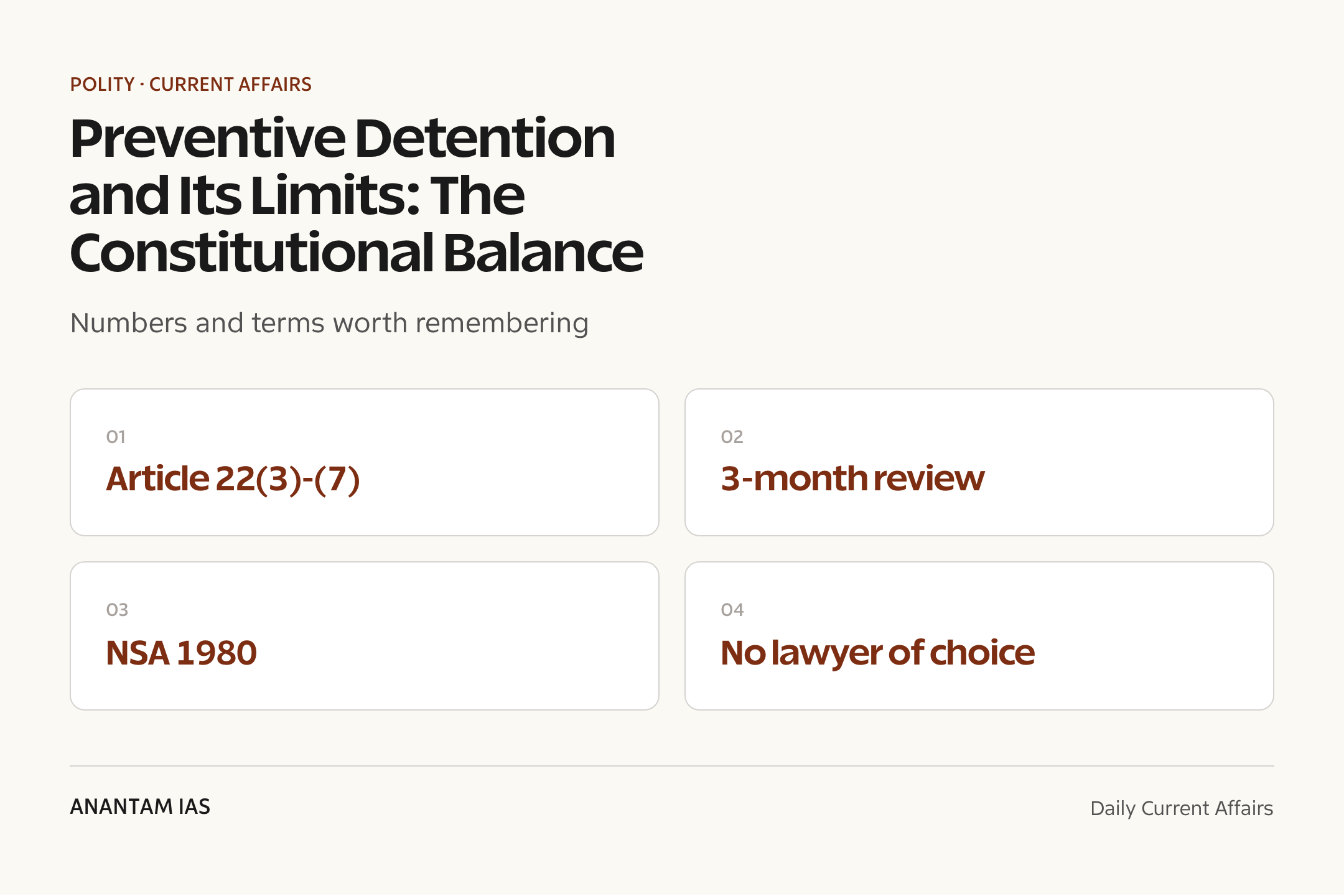
  • Article 22 (clauses 3 to 7) is the constitutional source of preventive detention law and its safeguards.
  • Central laws include the National Security Act, 1980 (NSA) and the PIT-NDPS Act, 1988; States run their own goonda or PASA-style laws.
  • Courts have flagged non-application of mind, vague grounds, and the conflation of law-and-order with public order as recurring defects.
  • An Advisory Board must review the detention within three months unless a parliamentary law allows longer detention.

The development matters in the context of:

  • Tests the friction between personal liberty (Article 21) and the state’s preventive powers — a perennial GS2 theme.
  • Preventive detention is one of the few constitutional powers that authorise detention without trial, making its limits critical.
  • Frequent judicial quashing signals a systemic accountability gap in how States exercise this exceptional power.
Preventive Detention and Its Limits: The Constitutional Balance — quick facts

UPSC Relevance

Prelims Relevance

  • Article 22: protections against arrest and detention; clauses (1)-(2) for ordinary arrest, clauses (3)-(7) for preventive detention.
  • Preventive detention vs punitive detention — without trial vs after conviction.
  • Safeguards under Article 22(4)-(7): Advisory Board, three-month limit, communication of grounds, right to representation.
  • Article 22(3): preventive detainees do NOT get the Article 22(1)-(2) protections (lawyer of choice, production before a magistrate within 24 hours).
  • National Security Act, 1980 (NSA); PIT-NDPS Act, 1988; COFEPOSA, 1974.
  • State PASA / goonda Acts (e.g. Gujarat PASA, Telangana/Tamil Nadu goonda laws).
  • Entry 9 of the Union List and Entry 3 of the Concurrent List on preventive detention.
  • Article 22(7): Parliament may prescribe detention beyond three months without an Advisory Board.
  • 44th Amendment (1978) sought to cut the maximum pre-Advisory-Board period to two months — that change was never notified.
  • Distinction between ‘law and order’ and ‘public order’ (Ram Manohar Lohia case).

Mains Relevance

GS Paper 2

  • Preventive detention as a constitutional exception: how Article 22 balances individual liberty against collective security.
  • Why courts repeatedly quash detention orders — the gap between safeguards on paper and executive practice.

GS Paper 2

  • Role of Advisory Boards and judicial review in checking the abuse of detention without trial.

Essay

  • Liberty versus security: where should a constitutional democracy draw the line?
  • The cost of extraordinary powers becoming ordinary tools of governance.

Background and Context

What Preventive Detention Means

Preventive detention is custody aimed at the future, not the past.

  • It detains a person to PREVENT an anticipated act prejudicial to the security of the state, public order, maintenance of essential supplies, or foreign relations — no offence need yet have been committed.
  • Punitive detention, by contrast, punishes a person AFTER trial and conviction for an offence already committed.
  • Because no charge, trial, or conviction is involved, preventive detention is widely seen as the most drastic curtailment of personal liberty a peacetime state can impose.
  • India is one of the few democracies that permits preventive detention during normal times, written into the Constitution itself rather than left to emergency-only powers.
Preventive Detention and Its Limits: The Constitutional Balance — exam lens

Article 22: The Constitutional Source

Article 22 splits into two halves — one for ordinary arrests, one for preventive detention.

  • Article 22(1)-(2) gives every arrested person the right to be informed of the grounds, to consult a lawyer of choice, and to be produced before a magistrate within 24 hours — protections sharpened by the mandatory disclosure of arrest grounds doctrine.
  • Article 22(3) expressly DENIES these protections to (i) enemy aliens and (ii) persons detained under a preventive-detention law — a built-in carve-out.
  • So a preventive detainee has NO right to a lawyer of choice and NO 24-hour magistrate production — the safeguards instead come from clauses (4) to (7).
  • Preventive detention sits inside the chapter on Fundamental Rights but operates as a constitutionally sanctioned exception to liberty under Article 21.

The Safeguards Under Article 22(4)-(7)

The Constitution offsets the carve-out with four procedural safeguards.

  • Advisory Board review: detention beyond three months requires an Advisory Board — comprising persons qualified to be High Court judges — to find sufficient cause.
  • Maximum period: no detention beyond the maximum prescribed by the relevant law; the three-month threshold triggers Board scrutiny.
  • Communication of grounds: the detaining authority must, as soon as may be, inform the detainee of the grounds of detention.
  • Right to representation: the detainee must get the earliest opportunity to make a representation against the order.
  • Under Article 22(7), Parliament may by law allow detention beyond three months WITHOUT an Advisory Board, and prescribe the maximum period and the Board’s procedure.
  • The 44th Amendment, 1978, tried to shrink the pre-Board period from three to two months, but that specific provision was never brought into force.

The Laws in Force

Preventive detention operates through a layered set of central and state statutes.

  • National Security Act, 1980 (NSA): the principal central law, allowing detention to prevent threats to national security, public order, and essential supplies.
  • PIT-NDPS Act, 1988 targets illicit drug trafficking; COFEPOSA, 1974 targets smuggling and foreign-exchange offences.
  • Numerous state laws — Gujarat’s PASA, and ‘goonda’ Acts in Telangana, Tamil Nadu, Karnataka and others — extend preventive detention to bootleggers, land-grabbers, and habitual offenders.
  • Legislative competence flows from Entry 9 of the Union List (security-related) and Entry 3 of the Concurrent List of the Seventh Schedule, so both the Centre and the States can legislate.
  • Detenus are held without the regular Code of Criminal Procedure protections, relying solely on the Article 22 framework and the parent statute.

Judicial Concern and Doctrine

Courts treat preventive detention as exceptional and police its misuse closely.

  • The Supreme Court has consistently held that preventive detention is an extraordinary power that erodes liberty and must be exercised with great caution and strict procedural compliance.
  • A recurring ground for quashing orders is non-application of mind — copy-paste grounds, stale incidents, or failure to consider that ordinary criminal law already covers the conduct.
  • Courts distinguish ‘public order’ (a wider disturbance affecting the community at large) from mere ‘law and order’ (an individual breach) — detention is valid only for the former, a line drawn in the Ram Manohar Lohia line of cases.
  • Delay in deciding the detenu’s representation, or failure to supply legible and complete grounds, regularly invalidates orders for breaching Article 22(5).
  • Judges have warned that turning preventive detention into routine policing inverts the constitutional design, where it was meant to be a narrow, last-resort safeguard.

Why the Power Is Controversial

The criticism is structural, not merely about individual cases.

  • It permits the state to detain on suspicion, reversing the presumption of innocence that underpins criminal justice.
  • The detenu cannot cross-examine, has no lawyer of choice, and the Advisory Board sits in camera — limiting adversarial testing of the grounds.
  • Repeated judicial quashing shows orders are often legally weak, yet detainees lose months of liberty before relief arrives.
  • Vague statutory grounds give wide executive discretion, raising the risk of targeting dissenters, activists, and the marginalised.
  • Many democracies confine such powers to declared emergencies; in India, they remain available in normal times, inviting overuse.

Way Forward

Tighten executive discipline

  • Detaining authorities must record specific, contemporaneous, and individualised reasons — not boilerplate — and first ask whether ordinary criminal law suffices.
  • Build an internal review so weak orders are filtered before they reach a court.

Strengthen the Advisory Board and representation

  • Time-bound disposal of representations and reasoned Advisory Board opinions, with detenus given complete, legible grounds and documents.
  • Consider statutory legal aid at the Advisory Board stage to balance the in-camera process.

Periodic legislative review

  • Audit state goonda and PASA laws for overbreadth, and revisit notifying the 44th Amendment’s tighter timeline.
  • Publish anonymised data on detention orders and their judicial outcomes to enable accountability.

Conclusion

Preventive detention is a power the Constitution permits but plainly distrusts — it is hedged with safeguards precisely because it suspends the ordinary guarantees of a fair trial. The persistent stream of quashed orders is less a story of bad luck than of a power exercised carelessly against the grain of its constitutional purpose.

The fix is not abolition by judicial fiat but discipline by design: narrow grounds, reasoned orders, swift review, and real accountability. Used as a genuine last resort, preventive detention can serve security; used as a shortcut, it corrodes the very liberty the Constitution was written to protect.

UPSC Practice Questions

Prelims MCQ 1

With reference to preventive detention under the Constitution of India, consider the following statements:

  1. A person detained under a preventive-detention law is entitled to consult a legal practitioner of their choice under Article 22(1).
  2. Detention beyond three months ordinarily requires the opinion of an Advisory Board.
  3. Preventive detention finds place in both the Union List and the Concurrent List of the Seventh Schedule.

How many of the above statements are correct?

(a) Only one (b) Only two (c) All three (d) None

Answer: (b) Only two

Explanation:

Statement 1 is wrong: Article 22(3) expressly denies the clause (1)-(2) protections (lawyer of choice, 24-hour production) to preventive detainees. Statements 2 and 3 are correct — the three-month Advisory Board threshold under Article 22(4), and legislative competence under Entry 9 (Union List) and Entry 3 (Concurrent List).

Prelims MCQ 2

Which one of the following is the principal CENTRAL law dealing with preventive detention for threats to national security and public order?

(a) Unlawful Activities (Prevention) Act, 1967

(b) National Security Act, 1980

(c) Code of Criminal Procedure, 1973

(d) Maintenance of Internal Security Act, 1971

Answer: (b) National Security Act, 1980

Explanation:

The NSA, 1980, is the main central preventive-detention law. The UAPA is an anti-terror penal (punitive) law, the CrPC governs ordinary criminal procedure, and MISA was repealed in 1978.

UPSC Mains Questions

  1. Preventive detention is described as a constitutional power the Constitution itself distrusts. In light of Article 22 and recent judicial pronouncements, examine how the law seeks to balance personal liberty against the security of the state. (250 words)
  2. Courts have repeatedly quashed preventive-detention orders for non-application of mind and the conflation of law-and-order with public order. Discuss the safeguards under Article 22 and suggest measures to curb the misuse of preventive detention laws. (250 words)
  3. Distinguish between preventive and punitive detention. Why is the routine invocation of preventive detention seen as inverting its constitutional purpose? (150 words)

Sources: The Hindu (editorial) and Constitution of India, Article 22.

Frequently Asked Questions

What is preventive detention?

Preventive detention is custody imposed to STOP a person from doing something prejudicial to the security of the state, public order, or essential supplies. It is forward-looking: no offence need have been committed and no trial takes place. It differs sharply from punitive detention, which follows conviction for a crime already committed.

How is preventive detention different from punitive detention?

Punitive detention punishes a person after a trial finds them guilty of an offence. Preventive detention restrains a person before any offence, purely on the apprehension that they may act against public order or state security. One looks to the past and requires proof; the other looks to the future and rests on official satisfaction.

Which article of the Constitution governs preventive detention?

Article 22 governs it. Clauses (1) and (2) protect persons arrested under ordinary law, but clause (3) denies those protections to preventive detainees. Clauses (4) to (7) then supply separate safeguards — Advisory Board review, a maximum period, communication of grounds, and the right to make a representation.

What safeguards does a preventive detainee have?

The detenu must be told the grounds of detention as soon as possible and given the earliest chance to make a representation. Detention beyond three months ordinarily needs an Advisory Board of persons qualified to be High Court judges to find sufficient cause, and detention cannot exceed the maximum the relevant law allows.

Why do courts frequently quash preventive-detention orders?

Courts strike down orders for non-application of mind — vague or copy-paste grounds, stale incidents, or failure to consider that ordinary criminal law already covers the conduct. They also quash orders that confuse mere law-and-order with public order, or that delay deciding the detenu’s representation, breaching Article 22(5).

Which laws allow preventive detention in India?

The main central law is the National Security Act, 1980; others include COFEPOSA, 1974 and the PIT-NDPS Act, 1988. Many States have their own goonda or PASA-style laws targeting bootleggers, land-grabbers, and habitual offenders. Legislative power flows from Entry 9 of the Union List and Entry 3 of the Concurrent List.

Heat Plus Ozone: The Hidden Driver of India’s Cardiac Deaths

Open article →Download PDF
image 84

Why in News?

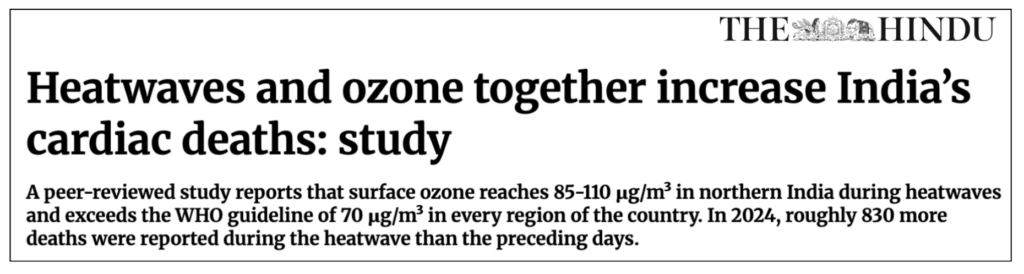
A study reported by The Hindu and the Indian Express (June 2026) finds that heatwaves occurring alongside high levels of ground-level (tropospheric) ozone significantly increase cardiac and cardiovascular deaths in India — the two stressors together prove far more lethal than either acting alone.

The finding reframes extreme heat as not just a thermal hazard but an air-quality event: hot, sunny, stagnant days that drive heat illness are the very conditions that cook up dangerous ozone, compounding the strain on the heart.

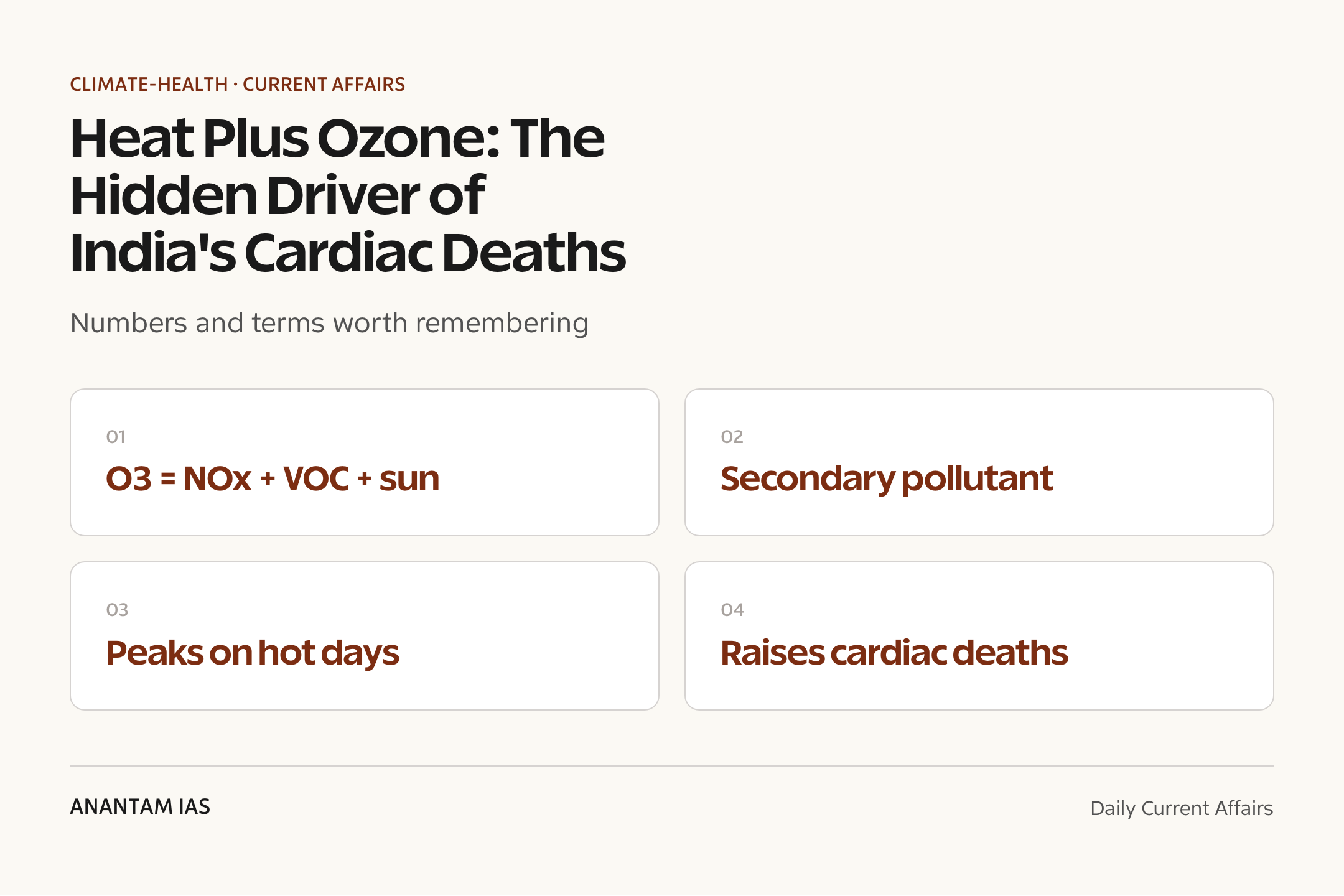
  • Ground-level ozone is a secondary pollutant — it is not emitted directly but forms when nitrogen oxides (NOx) and volatile organic compounds (VOCs) react in sunlight.
  • It is the same chemistry behind photochemical smog, so ozone peaks on hot, bright, low-wind days — exactly when heatwaves strike.
  • The combined heat-plus-ozone exposure raises cardiovascular stress (blood pressure, clotting, inflammation), pushing up cardiac deaths beyond what heat alone explains.
  • India’s Heat Action Plans (HAPs) warn about temperature but rarely factor in air pollution co-exposure, leaving a policy blind spot.

The development matters in the context of:

  • Most heat-death tolls and HAPs treat heat and air pollution as separate problems; this study shows they interact and amplify each other.
  • It links three durable syllabus threads — climate change and heat extremes, air-quality regulation, and public health — into one governance challenge.
Heat Plus Ozone: The Hidden Driver of India's Cardiac Deaths — quick facts

UPSC Relevance

Prelims Relevance

  • Tropospheric (ground-level) ozone — secondary pollutant; harmful to lungs and heart
  • Stratospheric ozone — the protective “ozone layer” that absorbs UV; distinct from ground-level ozone
  • Ozone precursors — NOx and VOCs reacting in sunlight
  • Photochemical smog — brown haze formed by the same sunlight-driven reactions
  • NAAQS — National Ambient Air Quality Standards (notified for 12 pollutants, including ozone)
  • CPCB — Central Pollution Control Board; sets and monitors standards
  • AQI — National Air Quality Index covers 8 pollutants, including O3
  • NCAP — National Clean Air Programme (launched 2019)
  • Urban Heat Island (UHI) — cities run hotter than surrounding rural areas
  • Heat Action Plan (HAP) — the Ahmedabad 2013 plan was India’s first
  • IMD heatwave criteria — based on temperature thresholds/departures

Mains Relevance

GS Paper 3

  • Environmental pollution and degradation; secondary pollutants and their health impacts.
  • Climate change and disaster management — heatwaves as a notified disaster and the need for integrated heat-air warnings.

GS Paper 2

  • Issues relating to the health sector and the governance of preventive public health.
  • Coordination across pollution-control boards, disaster authorities and health departments.

Essay

  • When the air we breathe turns against the heart: invisible costs of a warming city.
  • Development, heat and health: who pays the price of the urban summer?

Background and Context

Ground-level ozone vs the ozone layer

Ozone is the same molecule (O3) in two very different roles — protective high up, harmful at the surface.

  • Stratospheric ozone (10-50 km up) forms the protective ozone layer that absorbs harmful ultraviolet (UV) radiation — “good” ozone, governed globally by the Montreal Protocol.
  • Tropospheric (ground-level) ozone sits near the surface where we breathe — “bad” ozone, a toxic air pollutant and greenhouse gas.
  • Ground-level ozone is a secondary pollutant: it is not emitted from any chimney or tailpipe directly.
  • It is created when NOx (from vehicles, power plants) and VOCs (fuels, solvents, paints) react in strong sunlight.
  • Because sunlight drives the reaction, ozone concentrations typically peak on hot afternoons — the link to heat is chemical, not coincidental.
Heat Plus Ozone: The Hidden Driver of India's Cardiac Deaths — exam lens

Why heat and ozone arrive together

The weather that produces a heatwave is the same weather that brews ozone and photochemical smog.

  • Heatwaves bring clear skies, intense sun and stagnant, low-wind air — ideal for the photochemical reactions that make ozone.
  • Stagnant air traps pollutants and lets ozone build up instead of dispersing.
  • This is the chemistry of photochemical smog — a brown summer haze, distinct from winter particulate smog.
  • The Urban Heat Island effect makes cities hotter than their surroundings, intensifying both heat stress and ozone formation.
  • So a single hot, sunny, windless day stacks two health hazards on top of each other — extreme heat and high ozone.

How the combination harms the heart

Heat and ozone each stress the cardiovascular system, and together they push vulnerable people over the edge.

  • Heat stress forces the heart to work harder — raising heart rate, thickening the blood through dehydration, and straining circulation.
  • Ground-level ozone triggers airway and systemic inflammation, oxidative stress and changes that can raise blood pressure and clotting risk.
  • The study finds that the two together raise cardiac/cardiovascular deaths more than the sum of their separate effects.
  • The worst hit are the elderly, people with existing heart or lung disease, outdoor workers, and the urban poor without cooling.
  • Crucially, ozone harm occurs even at levels once thought safe, and outdoors, where masks offer little protection.

How India regulates and monitors ozone

Ozone is already a regulated pollutant, but monitoring and warning systems lag behind the heat-ozone reality.

  • Ground-level ozone is one of the pollutants under India’s National Ambient Air Quality Standards (NAAQS), notified by the CPCB under the Air (Prevention and Control of Pollution) Act, 1981.
  • Ozone is also one of the 8 pollutants reflected in the National Air Quality Index (AQI).
  • The National Clean Air Programme (NCAP), launched in 2019, targets particulate pollution in non-attainment cities, but ozone gets far less policy attention than PM2.5.
  • Surface-ozone monitoring is patchy, so its true health burden across Indian cities is poorly mapped.
  • Tackling ozone requires cutting its precursors — NOx and VOCs — not the pollutant itself, which makes control indirect and harder.

The policy blind spot in Heat Action Plans

India’s heat-warning machinery largely ignores the air-quality dimension of a hot day.

  • India’s first Heat Action Plan was the Ahmedabad model (2013), now copied by many states and cities.
  • HAPs focus on temperature thresholds, early warnings, cooling shelters, hydration and rescheduling outdoor work.
  • Few HAPs integrate air-quality / ozone alerts, even though the worst heat days are also the worst ozone days.
  • Heatwaves are not yet a notified disaster under the national Disaster Management Act, limiting dedicated funding.
  • The study’s message: warnings should be joint heat-and-air-quality advisories, especially for the heart-vulnerable.

Way Forward

Issue joint heat-air warnings

  • Combine IMD heat alerts with CPCB ozone/AQI data into a single advisory for hot, high-ozone days.
  • Flag risk explicitly to the elderly and people with heart and lung disease.

Upgrade Heat Action Plans

  • Build an air-quality trigger into every Heat Action Plan, not just temperature.
  • Equip primary health centres to anticipate cardiac and respiratory surges on peak heat-ozone days.

Cut ozone precursors

  • Reduce NOx and VOC emissions from vehicles, power plants, refineries and solvents.
  • Expand surface-ozone monitoring and bring ground-level ozone firmly into NCAP targets.

Cool the city

  • Counter the Urban Heat Island with green cover, cool/reflective roofs and shaded public spaces.
  • Protect outdoor and informal workers with rest-shade-water rules and rescheduled hours.

Conclusion

The study’s insight is deceptively simple: a heatwave is rarely just hot — it is also smoggy, because the same blazing, stagnant air that overheats the body is what cooks ground-level ozone. Treating the two as one combined hazard, rather than separate problems, is the key shift.

For India, where summers are lengthening, and cities are warming, the answer is to fuse heat and air-quality governance — joint warnings, ozone-aware Heat Action Plans, and steady cuts to NOx and VOCs — so the country protects not just against the heat, but against the hidden chemistry that turns a hot day deadly for the heart.

UPSC Practice Questions

Prelims MCQ 1

With reference to ground-level (tropospheric) ozone, consider the following statements:

  1. It is a secondary pollutant formed by the reaction of nitrogen oxides and volatile organic compounds in sunlight.
  2. It is the same protective ozone that forms the stratospheric ozone layer, shielding the Earth from ultraviolet radiation.
  3. It is one of the pollutants covered under India’s National Ambient Air Quality Standards.

How many of the above statements are correct?

(a) Only one (b) Only two (c) All three (d) None

Answer: (b) Only two

Explanation:

Statements 1 and 3 are correct. Statement 2 is wrong — ground-level ozone is a harmful surface pollutant, distinct from the protective stratospheric ozone layer; though chemically the same molecule, its role and location differ.

Prelims MCQ 2

Ground-level ozone concentrations in Indian cities typically peak under which of the following conditions?

(a) Cold, foggy winter mornings with low sunlight

(b) Hot, sunny, low-wind summer afternoons

(c) Heavy monsoon downpours with high humidity

(d) Cool, windy nights with rapid air mixing

Answer: (b) Hot, sunny, low-wind summer afternoons

Explanation:

Ozone forms through sunlight-driven photochemical reactions, so it builds up on hot, bright, stagnant days — the same conditions that produce heatwaves and photochemical smog.

UPSC Mains Questions

  1. “Extreme heat in Indian cities is increasingly also an air-quality crisis.” In light of the link between heatwaves and ground-level ozone, examine the cardiovascular health risks and the gaps in current Heat Action Plans. (250 words)
  2. Distinguish between stratospheric and tropospheric ozone, and discuss why ground-level ozone is a difficult pollutant to regulate in India. (150 words)
  3. Climate change and air pollution are often treated as separate challenges. Discuss how heatwaves and ground-level ozone illustrate the case for integrated environmental-health governance. (250 words)

Sources: The Hindu and Indian Express.

Frequently Asked Questions

What is ground-level ozone?

Ground-level or tropospheric ozone is ozone (O3) near the Earth’s surface, where we breathe. Unlike the protective ozone layer high in the stratosphere, it is a harmful air pollutant. It is a secondary pollutant, formed when nitrogen oxides and volatile organic compounds react in sunlight, and it is a key ingredient of photochemical smog.

How is it different from the ozone layer?

They are the same molecule but in opposite roles. Stratospheric ozone, 10-50 km up, shields us from harmful ultraviolet radiation and is “good” ozone. Ground-level ozone sits at the surface, irritates the lungs and strains the heart, and is “bad” ozone. So ozone is protective high above us but toxic down where we live.

Why do heatwaves and ozone occur together?

Ozone forms through sunlight-driven reactions, so it builds up on hot, bright, stagnant days. Those are exactly the conditions that cause heatwaves: clear skies, intense sun and low winds that trap pollutants. The same weather that overheats the body also cooks ozone, stacking two health hazards on the same day.

How does the heat-ozone mix affect the heart?

Heat makes the heart work harder and thickens the blood through dehydration, while ground-level ozone triggers inflammation and can raise blood pressure and clotting risk. The study finds that together they push up cardiac and cardiovascular deaths more than either does alone, with the elderly and people with heart or lung disease most at risk.

How does India regulate ground-level ozone?

Ground-level ozone is one of the pollutants under the National Ambient Air Quality Standards set by the Central Pollution Control Board under the Air Act, 1981, and it features in the National Air Quality Index. But monitoring is patchy, and the National Clean Air Programme focuses mainly on particulate matter, so ozone gets less attention than PM2.5.

What should Heat Action Plans add?

Most Heat Action Plans, modelled on the Ahmedabad 2013 plan, warn only about temperature. They should add an air-quality or ozone trigger, issue joint heat-and-air advisories, alert heart-vulnerable groups, and prepare health centres for cardiac surges on peak heat days. Cutting ozone precursors and cooling cities through greenery and reflective roofs also helps.

Bank of Japan’s 31-Year-High Rate: Why It Matters for India

Open article →Download PDF
image 83

Why in News?

The Bank of Japan (BoJ) has raised its policy interest rate to a 31-year high, citing persistent inflation. The move marks the decisive end of Japan’s decades-long experiment with ultra-loose, near-zero interest-rate policy — the longest such episode by any major central bank.

For years, Japan kept borrowing costs at or below zero to fight deflation. With prices and wages now rising durably, the BoJ has shifted to monetary tightening. Because Japanese money is woven through global markets, a higher yield in Japan reverberates far beyond Tokyo — including through the yen carry trade and the flow of foreign capital into emerging markets like India.

  • The Bank of Japan lifted its policy rate to its highest level in about 31 years, the clearest break yet from zero-rate policy.
  • The stated trigger is sustained inflation running near or above the BoJ’s 2% target, backed by stronger wage growth.
  • The decision ends an era of quantitative and qualitative easing (QQE), negative interest rates and yield-curve control that defined Japanese policy.
  • A higher Japanese yield narrows the gap with other economies and can pull global capital back toward Japan, unwinding the yen carry trade.

The development matters in the context of:

  • Why it matters for the rupee: shifts in global rate differentials move capital flows, the rupee and India’s bond yields.
  • Why it matters for markets: an unwinding carry trade can spark sudden, synchronised sell-offs across emerging-market equities and currencies.
  • Why it matters strategically: Japan is a major source of investment and concessional finance for India, so its monetary stance touches trade and capital ties.
Bank of Japan's 31-Year-High Rate: Why It Matters for India — quick facts

UPSC Relevance

Prelims Relevance

  • Bank of Japan as Japan’s central bank; meaning of the policy/repo-equivalent rate
  • Concept of the yen carry trade and how its unwinding works
  • Quantitative easing, negative interest rates and yield-curve control
  • Difference between FPI (foreign portfolio investment) and FDI
  • Meaning of an interest-rate differential and its link to currency value
  • Imported inflation and exchange-rate pass-through to domestic prices
  • Role of the RBI in managing the rupee and forex reserves
  • Bond yield basics and the inverse yield-price relationship

Mains Relevance

GS Paper 3

  • How a major central bank’s monetary shift transmits into India’s capital flows, currency and bond markets
  • Tools available to the RBI to cushion external monetary shocks and currency volatility

GS Paper 3

  • The carry trade as a channel of global financial contagion for emerging markets

GS Paper 2

  • India-Japan economic and strategic ties amid shifting global monetary conditions

Essay

  • When distant decisions decide domestic destinies in a connected economy
  • The price of cheap money and the discipline of its withdrawal

Background and Context

What the Bank of Japan did — and why

The BoJ has reversed the most unconventional monetary stance among major economies.

  • The Bank of Japan is Japan’s central bank; like the RBI, it sets the policy interest rate and steers money supply through monetary policy.
  • For decades, Japan battled deflation — persistently falling prices — by holding rates near or below zero to encourage spending and borrowing.
  • It deployed quantitative easing (QE) (large-scale bond buying), negative interest rates, and yield-curve control (YCC) (capping long-term bond yields).
  • With inflation now sustained near the 2% target and wages rising, the BoJ has raised its rate to a 31-year high, formally exiting ultra-loose policy.
  • The shift signals confidence that Japan has finally escaped its long deflationary trap.
Bank of Japan's 31-Year-High Rate: Why It Matters for India — exam lens

The yen carry trade — explained simply

Cheap Japanese money funded bets across the world; that logic is now reversing.

  • A carry trade means borrowing in a currency where interest rates are very low and investing the money where returns are higher.
  • Because Japan’s rates were near zero for years, global investors borrowed cheap yen and put it into higher-yielding assets abroad — US bonds, emerging-market equities, even cryptocurrencies.
  • The profit is the gap (the ‘carry’) between near-zero Japanese borrowing costs and the higher yield earned elsewhere.
  • When Japan raises rates, borrowing in yen becomes costlier, and the yen tends to strengthen, shrinking that profit.
  • Investors then unwind the trade — selling foreign assets and repaying yen loans — which can trigger sharp, synchronised sell-offs in global markets.

How it reaches India — capital flows and the rupee

The transmission runs through interest-rate differentials and portfolio money.

  • A higher Japanese yield narrows the interest-rate differential between Japan and emerging markets, making Indian assets relatively less attractive at the margin.
  • Some foreign portfolio investors (FPIs) may pull money out of Indian equities and bonds to repay yen loans or chase safer yields, pressuring share prices.
  • Outflows and a stronger yen can weaken the rupee against the dollar, since FPIs sell rupees to exit.
  • A weaker rupee raises the cost of imports — crude oil, electronics, edible oils — feeding imported inflation. See our note on inflation.
  • Indian bond yields can rise if foreign demand for government debt softens, lifting borrowing costs.

The US Fed and the global rate map

Japan’s move is one piece of a wider tug-of-war over global capital.

  • Global capital chases the best risk-adjusted return, so it is the relative stance of central banks that matters, not Japan’s alone.
  • If the US Federal Reserve holds rates high while Japan tightens too, emerging markets face a double squeeze on capital.
  • A narrower Japan-US yield gap can strengthen the yen and unsettle the dollar-funded trades that dominate global finance.
  • Episodes of carry-trade unwinding — as seen in past spikes of volatility — tend to hit emerging-market currencies and equities first.
  • India’s relatively strong growth and large forex reserves offer a buffer, but it is not insulated from global repricing.

India-Japan economic ties

Japan is among India’s most important long-term economic partners.

  • Japan is a major source of foreign direct investment (FDI) into India — autos, electronics, manufacturing and infrastructure. For the wider picture, see India-Japan relations.
  • It provides large Official Development Assistance (ODA) and concessional loans, including for flagship projects like the Mumbai-Ahmedabad high-speed rail.
  • The two are partners in the Quad and share a deep strategic and supply-chain agenda.
  • Japanese monetary normalisation can raise the cost of yen-denominated financing for some Indian projects over time.
  • A stronger, more confident Japanese economy can also mean steadier long-term investment in India.

RBI’s room to respond

India’s central bank has tools to smooth, not eliminate, external shocks.

  • The RBI can intervene in the forex market using its foreign-exchange reserves to curb sharp rupee swings.
  • It can adjust its own repo rate to keep India’s yields competitive without choking growth.
  • Macroprudential measures and a flexible-but-managed exchange rate help absorb volatility.
  • A credible inflation-targeting framework anchors expectations even when external pressure rises.
  • Deep domestic savings and a large home market reduce India’s dependence on any single source of foreign capital.

Way Forward

Build external resilience

  • Maintain healthy forex reserves and a flexible exchange rate to absorb sudden capital swings.
  • Deepen domestic bond and equity markets so India relies less on volatile foreign portfolio flows.

Diversify capital sources

  • Court stable, long-horizon FDI over hot portfolio money to reduce contagion risk.
  • Broaden funding partners and currencies so no single global rate cycle dominates India’s costs.

Coordinate policy and communication

  • Keep monetary and fiscal policy aligned and clearly signalled to steady investor expectations.
  • Track global central-bank moves closely so the RBI can act early, not reactively.

The episode is a reminder that in an interconnected financial system, a rate decision in Tokyo can move the rupee in Mumbai. India’s best defence is structural — strong fundamentals, ample reserves, deep domestic markets and credible, well-communicated policy.

Conclusion

The Bank of Japan‘s shift to a 31-year-high policy rate closes a remarkable chapter of near-zero money that shaped global finance for decades. As cheap yen stops fuelling the worldwide carry trade, capital is repricing across markets — and emerging economies like India sit squarely in the path of that adjustment.

For India, the spillovers run through FPI flows, the rupee, bond yields and imported inflation. None of these is catastrophic on its own, but together they test the cushioning power of the RBI and the resilience of India’s macro fundamentals. The lesson is durable: in a connected world, monetary policy is never purely domestic.

UPSC Practice Questions

Prelims MCQ 1

With reference to the yen carry trade, consider the following statements:

  1. It involves borrowing in a low-interest-rate currency to invest in higher-yielding assets elsewhere.
  2. A rate hike by the Bank of Japan tends to encourage an unwinding of the trade.
  3. An unwinding of the carry trade typically strengthens emerging-market currencies.

How many of the above statements are correct?

(a) Only one (b) Only two (c) All three (d) None

Answer: (b) Only two

Explanation:

Statements 1 and 2 are correct: the carry trade borrows cheap yen to invest for higher yields, and a BoJ rate hike makes yen borrowing costlier, prompting unwinding. Statement 3 is wrong — unwinding usually pulls capital out of emerging markets, weakening their currencies, not strengthening them.

Prelims MCQ 2

An increase in the Bank of Japan’s policy rate, other things being equal, is most likely to:

(a) Increase foreign portfolio inflows into Indian equities

(b) Strengthen the Indian rupee against the US dollar

(c) Encourage some investors to repay yen loans and reduce risk exposure

(d) Lower Indian government bond yields

Answer: (c) Encourage some investors to repay yen loans and reduce risk exposure

Explanation:

Higher Japanese rates make yen borrowing costlier, so carry-trade investors repay yen loans and trim risky positions. This tends to pull capital out of emerging markets, can weaken the rupee, and may raise (not lower) Indian bond yields.

UPSC Mains Questions

  1. Explain the concept of the carry trade and discuss how the unwinding of the yen carry trade following monetary tightening by the Bank of Japan can transmit financial volatility to emerging economies like India. (250 words)
  2. Interest-rate decisions by major central banks shape capital flows to and from India. Examine the channels through which such decisions affect the rupee, foreign portfolio investment and domestic inflation, and assess the policy tools available to the RBI. (250 words)
  3. Discuss the significance of India-Japan economic ties and analyse how Japan’s exit from ultra-loose monetary policy could affect investment and financing flows to India. (150 words)

Sources: The Hindu and Reserve Bank of India.

Frequently Asked Questions

What did the Bank of Japan do?

The Bank of Japan, Japan’s central bank, raised its policy interest rate to a roughly 31-year high, citing sustained inflation. The move ends decades of ultra-loose, near-zero-rate policy that Japan used to fight deflation. It signals confidence that prices and wages are now rising durably, allowing a shift toward normal monetary tightening.

What is the yen carry trade?

The yen carry trade is when investors borrow Japanese yen at very low interest rates and invest the money in higher-yielding assets abroad, such as foreign bonds or emerging-market shares. The profit is the gap between cheap yen borrowing costs and the higher returns earned elsewhere. It thrives only while Japanese rates stay extremely low.

Why does it matter for India?

When Japan raises rates, borrowing yen becomes costlier and the yen often strengthens, so investors unwind the carry trade by selling foreign assets. Some foreign portfolio money may exit Indian equities and bonds, pressuring share prices, weakening the rupee, lifting bond yields and adding to imported inflation through costlier imports.

How can a stronger yen weaken the rupee?

As carry-trade investors repay yen loans, they sell assets in markets like India and buy back yen. Selling rupees to exit pushes the rupee down against the dollar, while demand for the yen lifts it. A weaker rupee then raises the cost of imports such as crude oil, feeding domestic inflation.

What can the RBI do about it?

The RBI can sell dollars from its large foreign-exchange reserves to steady the rupee, adjust its own repo rate to keep Indian yields competitive, and use macroprudential measures to limit volatility. A credible inflation-targeting framework and deep domestic savings give India a meaningful cushion, though not full insulation, against external shocks.

Why was Japan’s rate near zero for so long?

Japan suffered decades of deflation — persistently falling prices — after its 1990s asset-bubble collapse. To revive spending and borrowing, the Bank of Japan cut rates to near or below zero and used tools like quantitative easing and yield-curve control. Only when inflation and wages turned durably positive did it begin raising rates again.

Solar on the Move: Powering India’s Rail and Road with the Sun

Open article →Download PDF
image 81

Why in News?

An Indian Express Explained piece set out how solar-integrated rail and road infrastructure can become a quiet workhorse of India’s clean-energy transition — putting solar photovoltaic (PV) generation directly on and along railway land, station roofs, track corridors and highway margins.

The idea, often called Rail- and Road-Integrated Photovoltaics (RIPV), matters because it produces clean power on land the country already owns and uses, sidestepping the single biggest constraint on large utility-scale renewables — competition for scarce, costly land.

  • Indian Railways operates one of the world’s largest rail networks and is one of the country’s single biggest electricity consumers, making it a natural anchor for in-house solar generation.
  • Railways has committed to becoming a net-zero carbon emitter through its Mission Net Zero, combining full route electrification, solar and wind power, and energy efficiency.
  • Station rooftops, workshops, sheds and the long ribbons of land beside tracks and along National Highways offer ready-made, already-acquired space for rooftop and ground-mounted solar.
  • The approach aligns with the National Solar Mission and India’s headline target of 500 GW of non-fossil generation capacity by 2030.

The development matters in the context of:

  • Why this matters for land: solar’s chief bottleneck is land — RIPV uses railway and highway corridors already in public hands, so it is broadly land-neutral.
  • Why this matters for the grid: distributed solar near load centres and traction substations can cut transmission losses and ease grid-integration stress.
  • Why this matters for net-zero: greening a transport behemoth like Railways advances India’s net-zero by 2070 goal and its climate pledges.
Solar on the Move: Powering India's Rail and Road with the Sun — quick facts

UPSC Relevance

Prelims Relevance

  • National Solar Mission (JNNSM, 2010) — one of the eight missions under the National Action Plan on Climate Change (NAPCC)
  • 500 GW non-fossil capacity target by 2030; net-zero by 2070 announced at COP26 (Glasgow)
  • Indian Railways Mission Net Zero — carbon-neutral railway via electrification, solar and wind
  • Photovoltaic (PV) effect — direct conversion of sunlight to electricity using semiconductor cells
  • Rooftop vs utility-scale (ground-mounted) solar; captive generation for own use
  • PM-KUSUM — farmer solarisation; relevant to solarising land along corridors and feeders.
  • Ministry of New and Renewable Energy (MNRE) — nodal ministry for renewables.
  • Grid integration, battery energy storage systems (BESS) and the intermittency of solar.
  • Capacity factor — solar runs only in daylight, so nameplate capacity overstates actual generation.
  • Domestic Content Requirement and ALMM for solar modules and cells.

Mains Relevance

GS Paper 3

  • Land-neutral renewable models: using rail and road corridors to scale solar without fresh land acquisition.
  • Greening transport infrastructure and the role of energy efficiency, storage and grid integration in the energy transition.
  • Indian Railways’ Mission Net Zero as a case study in decarbonising a large public utility.

GS Paper 2

  • Governance and inter-ministerial coordination (Railways, MNRE, MoRTH) for embedding solar in public assets.
  • Public infrastructure as a delivery platform for climate commitments and SDG 7 (affordable clean energy).

Essay

  • The cheapest land for tomorrow’s energy is the land we already use.
  • Decarbonisation begins where the country moves — its roads and its rails.

Background and Context

What is Rail- and Road-Integrated Photovoltaics (RIPV)?

RIPV embeds solar generation into existing transport infrastructure rather than building separate solar parks.

  • Definition: mounting solar PV panels on station roofs, workshop and shed rooftops, over parking and platforms, and along the unused margins of railway corridors and highways.
  • Core appeal: it generates clean power on land that is already acquired and serviced, so it is broadly land-neutral and avoids fresh acquisition and its social friction.
  • Two siting modes: rooftop solar on buildings and structures, and ground-mounted arrays on vacant strips beside tracks and roads.
  • Captive use: much of the power can be consumed on-site — by stations, signalling, traction and highway lighting — reducing draw from the grid.

How does Photovoltaic Technology work?

PV technology converts sunlight directly into electricity through the photovoltaic effect, where semiconductor materials in a PV cell absorb photons (particles of energy) from sunlight and release electrons, generating a flow of electricity.

image 82
Solar on the Move: Powering India's Rail and Road with the Sun — exam lens

Why land is solar’s binding constraint

Utility-scale solar needs large, contiguous tracts, and land is scarce, costly and contested.

  • Land intensity: large solar parks demand vast, level land, often competing with agriculture, grazing, forests and habitation.
  • Acquisition friction: assembling land triggers cost, delay, displacement concerns and legal disputes that slow projects.
  • Corridor advantage: railway land banks and highway rights-of-way are long, linear and already in public ownership — ideal for distributed solar.
  • Dual use: the same parcel keeps serving transport while also producing electricity, a textbook case of multi-use land.

Indian Railways’ Mission Net Zero

Railways aims to become a net-zero carbon emitter by greening both its energy supply and its operations.

  • Three pillars: complete route electrification (shifting traction off diesel), sourcing solar and wind power, and improving energy efficiency.
  • Massive consumer: as one of the country’s largest single electricity users, Railways can absorb its own solar output and cut its emissions footprint sharply.
  • Built-in real estate: thousands of stations, sheds and workshops give Railways a vast in-house rooftop and land base for PV — see Indian Railways.
  • Showcase assets: solar-powered stations and a growing fleet of solar installations signal how a public utility can lead decarbonisation.

Highway solarisation and PM-KUSUM links

Roads offer their own ribbons of margin land and a ready electrical demand for lighting and tolls.

  • Highway margins: the verges and medians of National Highways can host ground-mounted solar to power lighting, signage, tolls and EV charging.
  • Agency fit: Highway authorities can pair solar with road assets as Railways does with its corridors.
  • Feeder solarisation: the PM-KUSUM scheme’s logic of placing solar near where power is used maps neatly onto corridor-based generation.
  • EV synergy: highway solar can feed charging infrastructure, knitting clean generation to clean mobility.

The National Solar Mission and India’s targets

RIPV is a delivery channel for India’s national solar and net-zero commitments.

  • National Solar Mission (JNNSM, 2010): launched under the National Action Plan on Climate Change to scale grid and rooftop solar — see Solar Energy in India.
  • 500 GW by 2030: India’s target of 500 GW of non-fossil capacity needs every available siting option, including corridors and rooftops.
  • Net-zero by 2070: announced at COP26, Glasgow; greening transport energy is central to the pathway.
  • Distributed model: RIPV complements large parks by adding renewable energy close to the load, easing transmission needs.

Technical and policy challenges

Corridor solar is promising but faces engineering, safety and integration hurdles.

  • Intermittency: solar generates only by day and varies with weather, so battery energy storage and grid balancing are essential.
  • Grid integration: connecting many small, scattered arrays to traction and distribution networks needs careful planning and protection.
  • Safety and access: panels near live tracks and high-speed traffic raise maintenance, glare, dust, vibration and security concerns.
  • Capacity factor: nameplate capacity overstates output; real generation depends on a modest solar capacity factor, so figures must be read with care.

Way Forward

Map and unlock the corridor land

  • Survey and digitise railway land banks and highway rights-of-way to identify viable, safe solar sites.
  • Set clear inter-agency rules so Railways, MNRE and highway authorities can deploy rooftop and ground-mounted solar quickly.

Pair generation with storage and the grid

  • Co-locate battery energy storage and smart controls to manage intermittency and feed traction loads reliably.
  • Strengthen grid-integration standards so distributed corridor solar plugs in safely and efficiently.

Build the ecosystem and learn at scale

  • Use captive and PPP models to crowd in investment while keeping power costs low for public assets.
  • Run transparent pilots, publish verified generation data, and scale what works under Mission Net Zero and the National Solar Mission.

Conclusion

Solar on the move reframes infrastructure India already owns — its tracks, stations and highways — as a distributed power plant, turning the country’s biggest renewable constraint, land, into an asset.

Done with storage, smart grid integration and rigorous safety, rail- and road-integrated photovoltaics can help Railways hit net-zero, advance the 500 GW goal, and move India a step closer to its 2070 climate promise — proving that the cleanest energy can be generated right where the nation moves.

UPSC Practice Questions

Prelims MCQ 1

With reference to solar power and India’s transport infrastructure, consider the following statements:

  1. Indian Railways’ Mission Net Zero seeks to make the railways a net-zero carbon emitter through electrification, solar and wind power, and energy efficiency.
  2. The National Solar Mission was launched as one of the missions under the National Action Plan on Climate Change.
  3. Solar photovoltaic plants generate power at their full nameplate capacity throughout the day and night.

How many of the above statements are correct?

(a) Only one (b) Only two (c) All three (d) None

Answer: (b) Only two

Explanation:

Statements 1 and 2 are correct: Mission Net Zero combines electrification, solar/wind and efficiency, and the National Solar Mission (JNNSM, 2010) sits under the NAPCC. Statement 3 is wrong — solar PV generates only in daylight and below nameplate capacity, giving a modest capacity factor.

Prelims MCQ 2

The chief advantage of rail- and road-integrated photovoltaics (RIPV) over conventional utility-scale solar parks is that it:

(a) Generates power even at night without storage (b) Uses land that is already acquired and in public use, avoiding fresh land acquisition (c) Eliminates the need for any grid connection (d) Produces electricity at a higher capacity factor than rooftop solar

Answer: (b) Uses land that is already acquired and in public use, avoiding fresh land acquisition

Explanation:

RIPV places solar on station roofs and along corridors and highway margins — land already owned and serviced — making it broadly land-neutral and sidestepping the cost and friction of fresh acquisition, solar’s biggest constraint.

UPSC Mains Questions

  1. Land scarcity is the single biggest constraint on India’s utility-scale solar expansion. Examine how rail- and road-integrated photovoltaics can deliver land-neutral clean power, and discuss the technical challenges involved. (15 marks, 250 words)
  2. Discuss Indian Railways’ Mission Net Zero as a model for decarbonising a large public utility. How do route electrification, solar generation and energy efficiency together advance India’s climate goals? (10 marks, 150 words)
  3. “The cleanest energy can be generated where the nation already moves.” In the light of this statement, assess the potential and limitations of solarising India’s transport corridors for the energy transition. (15 marks, 250 words)

Sources: Ministry of New and Renewable Energy and The Indian Express.

Frequently Asked Questions

What is rail- and road-integrated photovoltaics?

Rail- and road-integrated photovoltaics (RIPV) means generating solar electricity directly on and along transport infrastructure — station roofs, workshops, the margins of railway corridors and the verges of highways. Because this land is already acquired and in public use, RIPV adds clean power without fresh land acquisition, addressing the biggest constraint on large utility-scale solar projects in India.

Why is land a problem for solar power in India?

Utility-scale solar parks need large, level, contiguous tracts of land, which is scarce, expensive and often competes with farming, grazing, forests and settlements. Acquiring such land brings cost, delay, displacement concerns and legal disputes. Using railway and highway corridors already owned by the state sidesteps this, letting the same parcel serve both transport and power generation.

What is Indian Railways’ Mission Net Zero?

Mission Net Zero is Indian Railways’ commitment to become a net-zero carbon emitter. It rests on three pillars: completing route electrification to shift traction off diesel, sourcing solar and wind power, and improving energy efficiency across operations. As one of India’s largest electricity consumers, Railways can absorb much of its own solar output, cutting emissions sharply.

What is the National Solar Mission?

The National Solar Mission, also called the Jawaharlal Nehru National Solar Mission (JNNSM), was launched in 2010 as one of the missions under the National Action Plan on Climate Change. It set out to scale up grid-connected and rooftop solar in India and remains the central policy framework behind the country’s ambitious solar capacity targets.

How does solar on transport corridors help net-zero?

Greening transport energy is central to India’s net-zero-by-2070 pathway. Corridor solar lets a huge consumer like Railways power itself with clean electricity, while highway solar can feed lighting, tolls and EV charging. By adding distributed renewable capacity close to where power is used, it advances both the 500 GW non-fossil target and climate commitments.

What are the main challenges of corridor solar?

The biggest challenges are intermittency, since solar works only in daylight and needs battery storage and grid balancing, and grid integration, as many small scattered arrays must connect safely to traction and distribution networks. Panels near live tracks and fast traffic also raise maintenance, glare, dust and safety concerns that careful engineering must manage.