15 current affairs published on Sunday, 24 May 2026
24 May 2026 Current Affairs for UPSC — every
Why-in-News article AnantamIAS published on Sunday, 24 May 2026, broken down with
Why in News?, the exact GS paper it feeds, sub-topic mapping, MCQ-ready facts and a
UPSC-style practice question. 15 articles in total, covering Polity, Economy, Environment, S&T, IR, Geography, History, Society and Internal
Security — the same Why-in-News + GS-paper-mapping + practice-question format the Compass uses across
every daily digest on the site.
Daily current affairs for UPSC is where new material enters your prep stream. Read this
24 May 2026 digest end-to-end in 25–35 minutes, attempt the practice question
at the foot of each article (it's MCQ for some, 10/15-marker for others), then bookmark the entries
that fall inside your active revision window. Everything stays cross-linked: tap any subject pill to jump
to that subject's hub, or use the table of contents above to skip straight to a specific story.
Use this page three ways. Read sequentially for a one-sitting scan of everything that
mattered on 24 May 2026. Download the
24 May 2026 PDF below for offline study or print revision. Or use
the May 2026 Current Affairs compilation
to see this day in the month's full context. For the previous day's reading, see
23 May 2026 Current Affairs;
the next day's is 25 May 2026 Current Affairs.
Why we publish daily current affairs separately from the monthly compilation: daily is learning,
monthly is revision. Use the daily page to add fresh material to your notes the day it breaks;
come back to the May 2026 compilation 60 days before Prelims when the
noise has settled and only the lasting takeaway is worth re-reading.
Maria Corina Machado received the Noble Peace Prize for 2025 edition.
UPSC Relevance:
Important awards.
PYQ:
Q) Wangari Maathai, the Noble Prize winner from Kenya is known for her contribution to which one of the following?
(a) Journalism
(b) International Economics
(c) Sustainable development
(d) Child development
About Nobel Peace Prize 2025:
The Nobel Peace Prize 2025 was awarded to Maria Corina Machado for her tireless efforts in promoting democratic rights in Venezuela and striving for a peaceful transition from dictatorship to democracy.
The Norwegian Nobel Committee, responsible for selecting laureates, received a total of 338 nominations, including 94 organisations.
The committee considers candidates whose work aligns with Alfred Nobel’s stipulation of promoting fraternity between nations, reducing standing armies, or supporting peace congresses.
Nominations are strictly confidential and cannot be made posthumously, ensuring that the prize reflects ongoing contributions to global peace.
Nobel Peace Prize Historical Background:
The Nobel Peace Prize , established in 1901 by Alfred Nobel, recognizes individuals or organisations promoting peace, disarmament, and global harmony.
Foundation and Purpose (1895-1901)
1895: Alfred Nobel’s will specified a prize for those promoting fraternity between nations, reducing standing armies, or supporting peace congresses.
Influence: Nobel was inspired by Bertha von Suttner, a peace activist, to include the peace category.
Awarding Body: The prize is administered by the Norwegian Nobel Committee, elected by Norway’s Parliament (Stortinget).
First Award: The prize was first awarded in 1901.
Organisations Recognized: The International Committee of the Red Cross won the prize in 1917 and 1944 for humanitarian efforts during wars.
1954: The Office of the UN High Commissioner for Refugees (UNHCR) received the prize for assisting refugees, repeated in 1981.
Women Laureates: Increased recognition of women leaders in peace, with 19 women receiving the prize historically.
2024 Award: Nihon Hidankyo, representing Hiroshima and Nagasaki atomic bomb survivors, honoured for raising awareness on nuclear weapons and advocating disarmament.
S Mahendra Dev, Chairman, Economic Advisory Council to the Prime Minister (EAC-PM)has remarked that Private sector investment is critical and should increase as there is no twin balance sheet issue now and no problem of capital availability.
UPSC Relevance
GS 3, Indian Economy and issues relating to Planning, Mobilization of Resources, Growth, Development and Employment.
Investment-Led Growth Model
The two primary strategies for driving Gross Domestic Product (GDP) growth are the Investment-Led Model and the Consumption-Led Model. They differ fundamentally in which component of aggregate demand (GDP = C + I + G + (X-M)) they emphasize.
The Investment-Led Growth Model is an economic strategy that posits that the primary engine for sustained economic expansion is a significant and continuous increase in investment in an economy’s productive capacity.
This model focuses on boosting the supply side of the economy by channeling capital into assets that enhance future output.
Key Components of Investment-Led Growth
Capital Formation: Increased spending on Gross Fixed Capital Formation (GFCF)—which includes machinery, factories, research and development (R&D), new infrastructure (like roads, ports, and power plants), and human capital (education and health).
Productivity and Efficiency: Investments in modern technology and infrastructure lead to higher labor and capital productivity, allowing the economy to produce more goods and services more efficiently.
Multiplier Effect: Initial investment, especially public investment (government capital expenditure or Capex), creates demand for raw materials and labor, which in turn leads to higher incomes and further consumption, creating a powerful multiplier effect on the overall GDP.
Crowding-In: Public investment in critical areas like infrastructure often “crowds in” or encourages private sector investment by reducing their operational costs and improving the business environment.
Long-Term Capacity: It is a strategy for long-term, sustainable growth, as it builds the essential physical and technological base for future production and higher living standards.
Investment-Led vs. Consumption-Led Growth Models
Feature
Investment-Led Growth Model (I-Led)
Consumption-Led Growth Model (C-Led)
Primary Driver
Investment (I) in Gross Fixed Capital Formation (e.g., machinery, infrastructure, R&D, factories).
Consumption (C) or Household Final Consumption Expenditure (e.g., buying cars, appliances, services).
Focus
Supply Side (Increasing the economy’s productive capacity).
Demand Side (Boosting immediate purchasing power).
Growth Horizon
Long-term and sustainable.
Short-term and immediate.
Impact on GDP
Creates a stronger and more sustained multiplier effect as new capital/assets are built, raising the potential GDP.
Creates a quicker, but less sustained multiplier effect; can lead to immediate utilization of existing capacity.
Economic Vulnerability
Less vulnerable to short-term changes in consumer confidence; requires sufficient savings to fund the investment.
Vulnerable to shifts in consumer confidence and income; can lead to inflation if supply cannot keep up with demand.
Goal
Increase Productivity, build an industrial base, and lower long-term costs.
Increase Utility, reduce accumulated inventory, and maintain high employment rates in the short run.
Policy Examples
Government Capex (capital expenditure) on roads/ports; PLI Schemes; subsidies for R&D.
Tax Cuts for individuals; Direct Benefit Transfers (DBT); interest rate cuts to boost housing/car loans.
Significance for India
1. Building Foundational Infrastructure
A massive and rapidly growing country like India needs world-class infrastructure to sustain high growth. Investment-led growth prioritizes this.
The National Infrastructure Pipeline (NIP), which outlines a massive investment plan in infrastructure projects across various sectors like energy, roads, and railways, is a clear application of this model. The construction of new Expressways and Dedicated Freight Corridors (e.g., Delhi-Mumbai Expressway or the Eastern and Western DFCs) is a direct capital investment that reduces logistics costs and boosts the competitiveness of the manufacturing sector.
2. Boosting Manufacturing and Job Creation
To leverage its large working-age population, India needs to create millions of jobs in the formal sector, which manufacturing is best suited to provide. Investment is critical to building manufacturing capacity.
The Production-Linked Incentive (PLI) Scheme is a prime example. By offering incentives for incremental production, the government is essentially encouraging companies (both domestic and foreign) to invest in setting up or expanding manufacturing facilities in sectors like electronics, automobiles, and pharmaceuticals, thereby creating jobs and making India a global manufacturing hub (Make in India).
3. Sustainable and Stable Growth
While consumption-led growth can be quick, it’s often vulnerable to economic shocks. Investment-led growth creates capacity, making growth more sustainable.
Continuous public capital expenditure (Capex) by the Union and State governments, particularly in recent budgets, is a deliberate strategy. This government spending on creating assets (like hospitals, schools, and digital infrastructure) aims to crowd in private investment, providing a more stable base for high long-term GDP growth rather than temporary boosts from consumer spending.
4. Enhancing Human Capital
Investment isn’t just about physical assets; it’s also about improving the skills and health of the population, which increases national productivity.
Government and private investment in education (skill development programs like PM Kaushal Vikas Yojana) and healthcare infrastructure (Ayushman Bharat) improves the quality of the labor force, making them more productive and adaptable to high-tech industries, which is essential for a long-term growth engine.
Challenges to Investment-Led Growth in India
1. Sluggish Private Capital Expenditure (Capex)
Despite the government’s significant push in public infrastructure spending, the private sector’s investment response—the “crowd-in” effect—has been subdued.
Weak Domestic Demand: A primary constraint is the weakness in consumer demand (private consumption). Businesses are hesitant to invest in expanding capacity when they do not foresee a strong, sustained rise in customer demand for their products.
Corporate investment as a percentage of GDP has remained low compared to its peak, indicating a cautious approach where companies prefer to hold cash or conduct ‘brownfield’ expansion (upgrading existing units) over riskier ‘greenfield’ investments (setting up new units).
High Borrowing Costs: Elevated interest rates make financing large, long-term projects more expensive, further deterring businesses from taking on new debt for major capital investments.
Declining household savings : Now at a four-decade low of around 30% as compared to 34.6% in 2011-12, the household savings are impacting investment by making it harder for the country to fund its growth and creating household vulnerability due to rising debt. The shift in savings from financial assets to physical assets, while increasing, is happening alongside a sharp rise in household debt from sources like easy-to-obtain personal loans, which threatens economic stability.
2. Structural and Systemic Hurdles
Structural bottlenecks increase the cost, time, and risk of setting up new projects, dampening the “animal spirits” of entrepreneurs.
Land Acquisition Difficulties: Acquiring land for large-scale infrastructure and industrial projects remains a complex, time-consuming, and contentious process. The legal framework, even with the new Land Acquisition Act, often leads to prolonged disputes, litigation, and delays.
Major projects like the Mumbai-Ahmedabad Bullet Train have faced significant delays in land acquisition, impacting the project timeline and cost.
Regulatory and Legal Uncertainty: Businesses often face complex and non-uniform regulatory compliance requirements across different states. Policy volatility and a lingering trust deficit can also make long-term investment decisions riskier
Low Capacity Utilisation: In several sectors such as steel, chemicals and capital goods, existing manufacturing capacity is not fully utilized. This provides little incentive for firms to invest in building new capacity until the existing one is fully stretched.
Bottlenecks for MSMEs (Micro, Small, and Medium Enterprises): This vital sector, a key source of employment and innovation, faces structural constraints, including:
Limited Access to Long-Term Finance/Credit: Many lack the collateral or credit history for formal financing, leaving a large credit gap.
Technology Adoption Gaps: Uneven adoption of advanced digital tools limits their productivity and global competitiveness
3. Global and External Risks
External factors add to the caution, making exports and globally connected sectors volatile.
Global Uncertainty and Trade Issues: Geopolitical tensions and rising protectionism (e.g., US-China tariffs, global sanctions) create supply chain vulnerabilities and unpredictable global trade growth, which is a key driver for investment in export-oriented manufacturing
Commodity Price Volatility: Reliance on imported materials for manufacturing makes firms cautious due to the risk of fluctuating global commodity prices.
Strategy for Investment led Growth in India
World Bank Recommendation: Increase the investment rate from the current 33.5% of GDP to around 40% by 2035 (World Bank Report).
Economic Survey (2024-25) : While recognizing the efforts of the public sector, the Survey stresses that to realize the vision of ‘Viksit Bharat’ (Developed India) by 2047, which requires an average growth of around 8% for a decade or two,the private corporate sector must step up its investments to complement state-led growth.
S Mahendra Dev, Chairman, Economic Advisory Council to the Prime Minister (EAC-PM) : India’sinvestment rateneeds to increase to 34-35 % as share of the GDP from 31-32 % at present for it to achieve 7 % growth along with a push towards exports.
Systematic Deregulation: This is highlighted as a critical policy priority. The Survey advocates for systematic deregulation under ‘Ease of Doing Business 2.0’ to lower the cost of business, enhance economic freedom, and empower organizations to pursue economic activity with greater ease.
The Invest India initiative and the continuous effort to improve the country’s ranking in the World Bank’s Ease of Doing Business Index. Establishing ‘Single-Window Desks’ at the state level, like the ‘Foxconn Desk’ in Tamil Nadu, to fast-track issue resolution and expansion for major investors.
Strengthening Medium-Term Growth Levers: Given the global backdrop of Geo-Economic Fragmentation (GEF) and slower world trade growth, the Survey recommends focusing on domestic levers of growth.
Private Participation in Infrastructure: It’s deemed crucial to ensure increasing private participation in infrastructure projects by improving their confidence in risk and revenue-sharing mechanisms, contract management, and conflict resolution.
Creating a Viable Mittelstand (SME Sector): Policy focus must be on the creation of a viable Mittelstand, referring to a strong and healthy Small and Medium-sized Enterprise (SME) sector in India.
Targeted Policy Support: The Survey advocates for targeted structural reforms at the grassroots level and continued policy steps (like the Production Linked Incentive (PLI) schemes) to enhance the global competitiveness of the Indian economy.
Building State Capabilities: Measures are needed to boost talent and productivity through private sector investment in skills, physical and digital connectivity, and building state capacity and capabilities.
Promoting Export-Led Manufacturing Growth
Production Linked Incentive (PLI) Scheme: Provide time-bound incentives on incremental production to attract large-scale, anchor investments in key sectors.
The PLI scheme for Large-Scale Electronics Manufacturing has led to a significant surge in iPhone production and exports from India by global players like Foxconn and Pegatron, making electronics one of India’s fastest-growing export categories.
Improving Competitiveness and Cost Structure: Benchmark domestic production costs against global competitors and implement a roadmap to reduce costs related to logistics, energy, raw materials, and compliance.
Initiatives to draft a cost-reduction roadmap for sectors like Textiles, examining factors like labor law rationalization, tax structure, and logistics to regain a competitive edge against countries like Vietnam and Bangladesh.
Trade and Market Access: Actively pursue Free Trade Agreements (FTAs) with major global economies and diversify export destinations.
Expediting negotiations for FTAs with trading blocs like the European Union (EU) and the UK to secure duty-free access for Indian goods, particularly for labor-intensive products.
Strategies for Enhancing Domestic Savings
Higher domestic savings provide a stable and cheaper source of capital to finance the required high investment rate, reducing reliance on volatile foreign capital.
Increasing Public Sector Savings:Focus on fiscal prudence, expenditure rationalization, and boosting public sector enterprise profits to reduce the fiscal deficit and increase public savings.
Adhering to the path of fiscal consolidation mandated by the FRBMA (Fiscal Responsibility and Budget Management Act) has historically improved the public sector’s contribution to overall savings.
Incentivizing Household Financial Savings: Offer a mix of tax concessions and attractive, inflation-beating returns on small savings instruments.
Continuing to offer tax benefits under Section 80C for instruments like the Public Provident Fund (PPF) and National Savings Certificates (NSC), which encourage long-term financial saving among households.
Financial Inclusion and Product Diversification: Expand the reach of the formal financial system and introduce a variety of instruments tailored for different income groups and tenures.
The Jan Dhan Yojana has brought vast populations into the formal banking system, while reforms promoting investment in mutual funds and a push for the development of domestic debt markets provide diverse avenues for financial savings.
Leveraging Public Capex
Increased public Capex is not just about asset creation; it is a counter-cyclical tool with a high multiplier effect that ‘crowds in’ private investment.
Infrastructure Development to Enhance Competitiveness: The government must prioritize Capex in core, long-gestation infrastructure sectors to reduce logistics costs and increase efficiency for the private sector.
The government’s significant allocation of Capex for the National Infrastructure Pipeline (NIP) or schemes like Bharatmala Pariyojana (for highways) and Sagarmala Scheme (for ports) reduces bottlenecks. This ‘crowds in’ private investment by making locations for manufacturing and logistics more viable. A logistics park built by the government, for instance, encourages private companies to set up factories nearby.
Social Sector Capex for Human Capital: Invest in social infrastructure like education and healthcare to improve human capital, which boosts long-term productivity and demand.
Setting up high-quality educational institutions creates a more productive workforce, which is a major long-term incentive for private companies to invest in high-tech and skill-intensive sectors.
Japan successfully reduced its dependence on China for rare earth elements (REEs) after China weaponized rare-earths exports in 2010, and how the world—including India—can emulate Japan’s strategy in 2024–25 amid fresh Chinese restrictions.
UPSC Relevance:
Economy, Geography
UPSC PYQ Prelims:
Q1.Consider the following minerals: (2020)
Bentonite
Chromite
Kyanite
Sillimanite
In India, which of the above is/are officially designated as major minerals?
(A) 1 and 2 only
(B) 4 only
(C) 1 and 3 only
(D) 2, 3 and 4 only
Q2.Recently, there has been a concern over the short supply of a group of elements called ‘rare earth metals’. Why? (2012)
China, which is the largest producer of these elements, has imposed some restrictions on their export.
Other than China, Australia, Canada and Chile, these elements are not found in any country.
Rare earth metals are essential for the manufacture of various kinds of electronic items and there is a growing demand for these elements.
Which of the statements given above is/are correct?
(A) 1 only
(B) 2 and 3 only
(C) 1 and 3 only
(D) 1, 2 and 3
UPSC PYQ Mains:
Q. Discuss the multi-dimensional implications of uneven distribution of mineral oil in the world. (2021)
China’s Rare Earth Weaponization and How Japan Reduce Dependency on China- A Case Study
China’s new rare earth export controls mark another step in what analysts increasingly call the “weaponization of interdependence.” Just as the U.S. leveraged its technological dominance through export bans on advanced semiconductors, China is now flexing its power in critical raw materials.
A Chinese fishing boat collided with Japanese coast guard vessels near the East China Sea in 2010.
China retaliated by:
Using minerals as a political weapon
Stopping REE exports to Japan
Raising prices sharply
Impact on Japan:
Prices of rare earths surged 10 times.
Japan imported 90% of its REEs from China.
Japanese auto, electronics, and robotics industries suffered.
How Japan Fought Back – A Playbook for the World:
Diversification of Supply:
Invested in Australia’s Lynas (now China’s biggest competitor)
Funded mining projects in: Vietnam Brazil India Kazakhstan
Recycling Rare Earths
Reducing Usage
Japanese manufacturers pushed: Technological redesign, Using less rare earths per device, Substituting materials wherever possible
Reducing Usage
Japanese manufacturers pushed:
Technological redesign
Using less rare earths per device
Substituting materials wherever possible
Alternative Technologies
Investment in REE-free motors
New materials for EVs, robotics, wind turbines
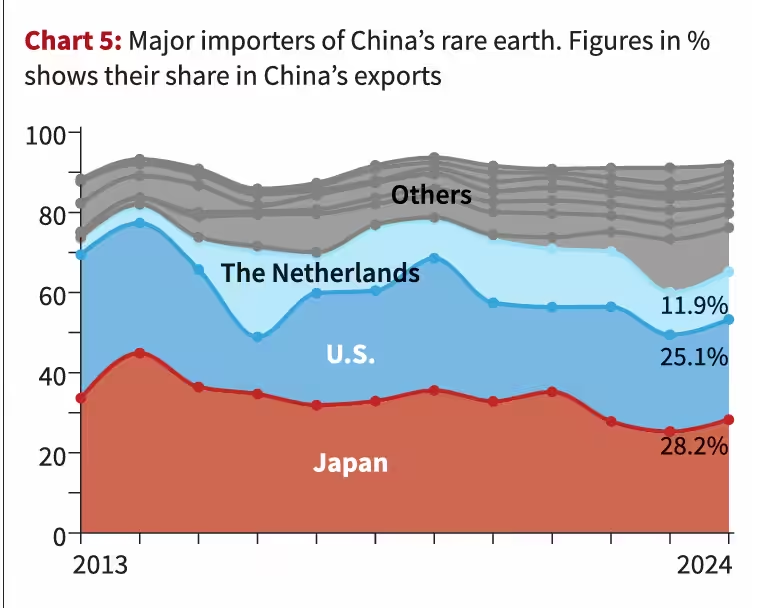
Japan reduced dependence on China from 90% → 58%, with a target of 30% by 2025.
About Rare Earth Elements:
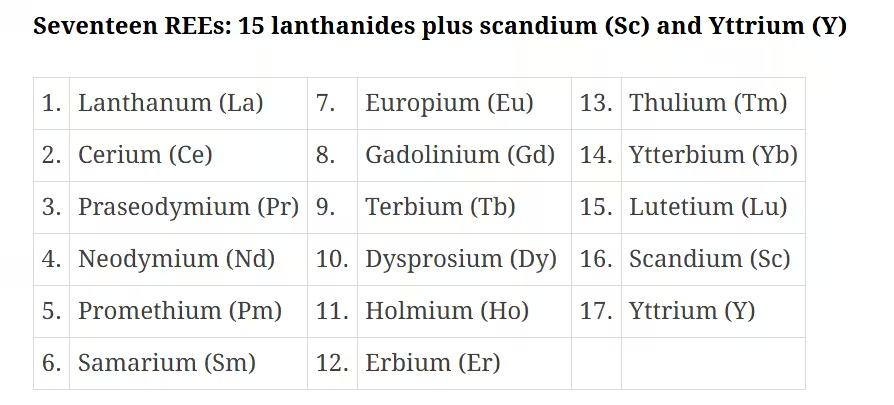
Rare Earths are a group of 17 elements starting with lanthanum in the periodic table of elements and include scandium and yttrium. They are moderately abundant in earth’s crust but not concentrated enough to make them economically exploitable.
Why we called ‘rare earth’: Despite the name – rare earth elements – these elements are not so rare. They are found in abundance in the Earth’s crust. However, they’re rarely found in concentrations that are economically viable for mining. Therefore, extracting and processing REEs is complex and expensive, requiring high-end techniques and specialised labour to isolate and purify them.
REEs are characterised by high density, high melting point, high conductivity and high thermal conductance. A number of rare-earth minerals contain thorium and uranium in variable amounts, but they do not constitute essential components in the composition of the minerals.
The Rare-earth Elements (REE) are a collection of 17 elements, namely, scandium, yttrium and lanthanides (15 elements in the periodic table with atomic numbers 57 to 71, namely,
lanthanum (La)
cerium (Ce)
praseodymium (Pr)
neodymium (Nd)
promethium (Pm)
samarium (Sm)
europium (Eu)
gadolinium (Gd)
terbium (Tb)
dysprosium (Dy)
holmium (Ho)
erbium (Er)
thulium (Tm)
ytterbium (Yb)
lutetium (Lu)
Note: The first commercial use was in an incandescent lamp mantle, which is composed of 99% thorium oxide and 1% cerium oxide.
Application:
The REEs find key applications in defence, electronics, energy systems etc. For instance, magnets made from rare earths are many times more powerful than conventional ones. Along with energy critical elements (ECE), such as, lithium which has become ubiquitous battery material, REEs have emerged as strategic elements essential for sustainable energy systems.
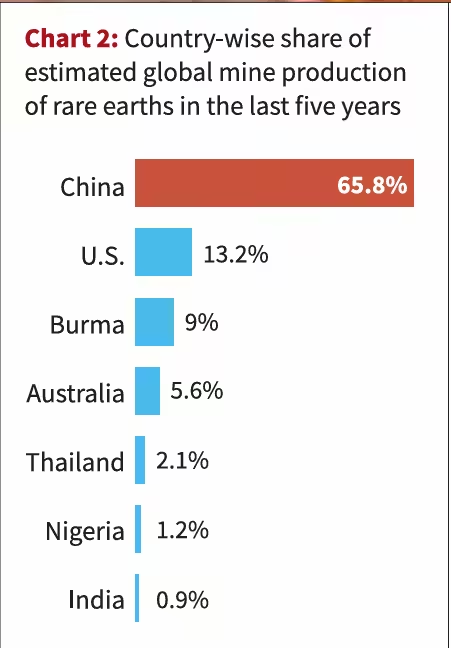
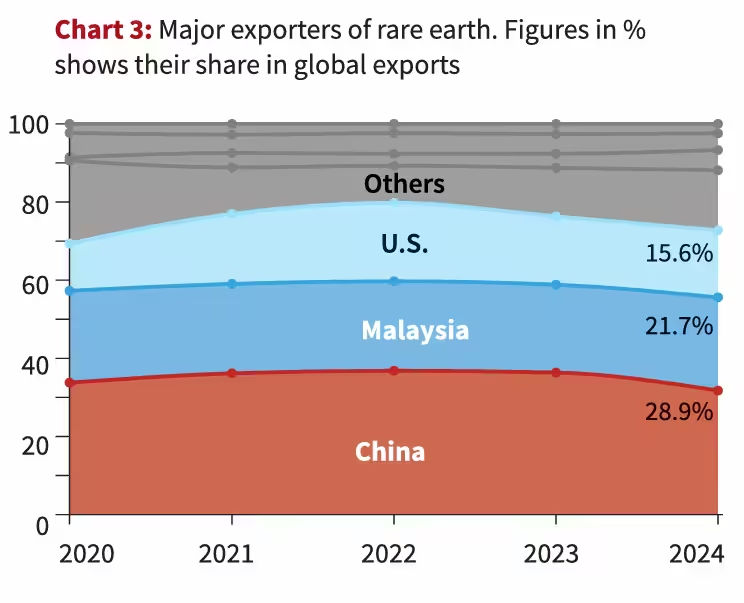
China dominated the global production of rare earth minerals, separated compounds, and metals
Major Importer:
India:
According to Indian Minerals Yearbook
Indian Rare Earth Limited (IREL), a Mini Ratna Company, is the only entity processing monazite to produce Rare-earth (RE) compounds.
India’s REE reserves are mostly found in monazite sands (which contain thorium).
Coastal states have the most rare earth deposits, namely Tamil Nadu, Kerala, Andhra Pradesh, and Odisha.
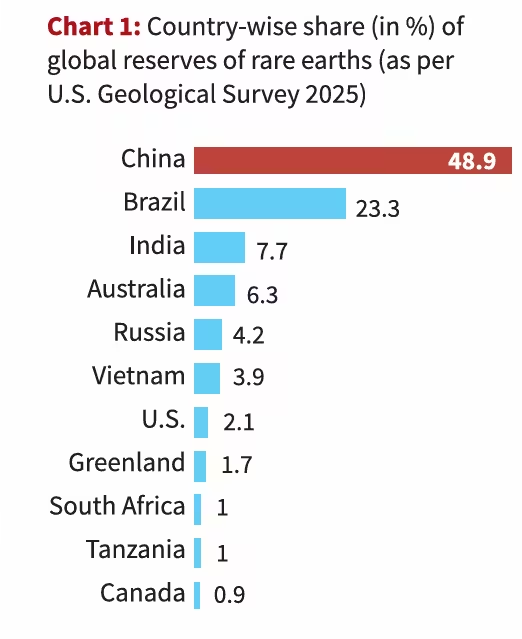
Despite having large reserves of REEs,India produces less than one per cent of the total world share. There are numerous reasons behind this. The primary being the negligible involvement of the private sector in the mining of REEs. IREL (India) Ltd (the erstwhile Indian Rare Earths Limited or IREL) has been the primary entity involved in the mining and processing of Rare Earth. However, recently, the government has opened up REE exploration for private entities.
India Initiatives:
Budgetary provision:
In Budget 2024-25: National Critical Mineral Mission to ensure supply chain.
The Mines and Minerals (Development and Regulation) Amendment Act, 2023: Now allows private companies to bid for the exploration of critical minerals, including REEs.
Recently Department of Atomic Energy discovered around in-situ Rare Earth Elements Oxide (REO) in Balotra, Rajasthan.
PM Modi introduced the MANAV framework, meaning human-centric AI.
M – Moral and Ethical Systems
AI must be built on ethical guidelines.
A – Accountable Governance
Transparent rules, oversight mechanisms.
N – National Sovereignty
Data belongs to those who generate it (Data sovereignty).
A – Accessible and Inclusive
AI should not become monopoly of few companies/countries.
V – Valid and Legitimate
AI must be lawful, verifiable and compliant with regulations.
Core Commitments:
1. Evaluate AI in real-world contexts
Assess AI impact on jobs, economy, skills.
2. Strengthen multilingual & contextual AI
Improve cross-lingual AI support.
Focus on under-represented languages (important for India & Global South).
3. Publish anonymised AI usage insights
Support evidence-based policymaking.
Understand AI diffusion across economy.
Multidimensional Impact of Artificial Intelligence
1. Economic Growth and Development
AI enhances productivity through automation, predictive analytics and intelligent manufacturing, thereby accelerating GDP growth and digital economy expansion. It also enables the emergence of new industries such as robotics, data analytics and autonomous systems. However, unequal access to AI capabilities may widen technological and income disparities across countries and firms.
2. Employment and Labour Markets
AI substitutes routine and repetitive tasks in manufacturing, clerical work and services, leading to structural labour displacement. At the same time, it generates new high-skill employment in AI engineering, data science and robotics. The core policy challenge lies in workforce reskilling, education reform and managing technological unemployment during the transition.
3. Governance and Public Service Delivery
Governments increasingly deploy AI for welfare targeting, tax compliance, smart cities, policing and disaster prediction, improving efficiency and evidence-based policymaking. However, risks of mass surveillance, exclusion due to algorithmic errors and opacity in automated decision-making raise concerns regarding accountability, transparency and citizens’ rights.
4. Ethical and Societal Implications
AI systems often reproduce biases embedded in training data, resulting in discrimination in hiring, lending or policing. Emerging threats such as deepfakes, misinformation and behavioural manipulation undermine trust, democratic discourse and human autonomy. Therefore, ethical AI principles such as fairness, transparency and human oversight are essential.
5. Security and Military Transformation
AI is transforming warfare through autonomous drones, cyber operations, intelligence analysis and surveillance systems. Lethal Autonomous Weapons Systems (LAWS) raise profound moral and legal questions regarding machine decision-making over life and death and may trigger a global AI arms race.
6. Data Governance and Privacy
AI relies on massive datasets, making data a strategic economic and political resource. Issues of data ownership, consent, facial recognition and surveillance threaten privacy and civil liberties. Robust data protection and accountable data governance frameworks are therefore critical.
7. Geopolitics and Global Power
AI capability is emerging as a determinant of economic competitiveness, technological sovereignty and geopolitical influence. The global AI race among major powers risks technological bifurcation and strategic dependence for developing countries lacking domestic capabilities.
8. Regulatory and Institutional Challenges
Balancing innovation with safety is the central regulatory dilemma in AI governance. Divergent global approaches — ranging from innovation-led to rights-based regulation — highlight the need for international cooperation, standards and ethical governance mechanisms.
India’s Position in the Global AI Landscape: Strengths and Challenges
1. Structural Strengths of India in AI
Large IT Workforce
India possesses one of the world’s largest pools of software engineers, data professionals and technology graduates, enabling rapid AI development, deployment and service provision.
Digital Public Infrastructure
India’s digital identity, payments and data platforms provide interoperable datasets and scalable architecture conducive to AI applications in governance, finance and public services.
Vibrant Startup Ecosystem
India hosts a rapidly expanding AI startup landscape across fintech, healthtech, agritech and SaaS sectors, fostering innovation and indigenous technological solutions.
Large and Diverse Data Pool
India’s vast population, linguistic diversity and expanding digital penetration generate extensive datasets essential for training AI systems, particularly in language technologies and public service applications.
Semiconductor Push
AI models require: High-performance chips (GPUs, AI accelerators), Data processing hardware
India is Promoting semiconductor manufacturing under national initiatives, Trying to reduce dependence on imports, Building chip design and fabrication capacity.
Domestic data centres, Cloud infrastructure, Data localisation mechanisms
2. Challenges to AI Development in India
Low R&D Expenditure
India’s research spending remains around 0.6–0.7% of GDP, constraining frontier AI research, indigenous innovation and advanced model development.
Talent Gap in Advanced AI
Despite abundant IT talent, shortages persist in high-end AI research, semiconductor design, deep learning and core algorithmic innovation.
Computing Infrastructure Deficit
AI development requires high-performance computing, semiconductor capability and cloud infrastructure, areas where India remains import-dependent and capacity-constrained.
Data Quality and Accessibility Issues
Fragmented, unstructured and low-quality datasets limit reliable AI training and deployment across many governance and economic sectors.
3. Key Sectors Where AI Can Transform India
Agriculture
AI can enable precision farming, crop prediction, pest detection, climate advisory and market intelligence, improving productivity and farmer incomes.
Healthcare
AI-based diagnostics, telemedicine, disease surveillance and resource optimisation can strengthen public health delivery and address doctor shortages.
Education
Personalised learning systems, adaptive assessments and multilingual digital content can improve learning outcomes and educational access.
Governance
AI can enhance welfare targeting, fraud detection, smart city management and service delivery efficiency, improving state capacity.
Language Technology
AI-based translation and speech technologies can enable digital inclusion across India’s diverse linguistic landscape.
Climate and Disaster Management
AI can support flood forecasting, climate modelling, early warning systems and resource planning for climate adaptation.
Emerging Global Governance and Regulatory Challenges in AI
Artificial Intelligence has cross-border impacts on economies, security and societies, necessitating global governance responses.
Need for Global AI Governance
AI risks such as misinformation, autonomous weapons and economic disruption transcend national boundaries. However, there is no universal regulatory framework, creating demand for multilateral cooperation through platforms such as the Global Partnership on Artificial Intelligence.
Frontier AI Risks and Safety
Highly capable frontier AI systems introduce risks such as large-scale misinformation, cyber manipulation, biosecurity misuse and loss of human control over autonomous systems. The absence of global safety standards heightens systemic risks.
Concentration of AI Power
Advanced AI development requires massive data, compute and capital, concentrating power within a few corporations and countries. This raises concerns of monopolisation, opacity and technological dependence of developing nations.
Responsible and Ethical AI
Bias, privacy invasion, surveillance and lack of explainability create ethical risks in AI deployment. Responsible AI frameworks emphasise fairness, transparency, accountability and human oversight.
Global AI Inequality
AI capabilities are concentrated in technologically advanced countries, creating an “AI divide” where developing countries become technology consumers rather than producers. Bridging this gap requires capacity building and technology cooperation.
Open vs Closed AI Debate
A key policy debate concerns whether advanced AI models should be open-source or proprietary. Balancing innovation diffusion with safety control and accountability remains a major governance challenge.
Labour Market Disruption
AI-driven automation will reshape employment structures worldwide, requiring large-scale reskilling, education reform and social protection to ensure inclusive transition.
Conclusion
Artificial Intelligence is a transformative general-purpose technology with profound economic, social and strategic implications. India possesses significant structural advantages in AI adoption but must bridge gaps in research investment, advanced talent and computing infrastructure. At the global level, human-centric governance, ethical regulation and international cooperation are essential to ensure that AI advances inclusive, safe and sustainable devel
Practice Mains Questions
“Artificial Intelligence is a double-edged sword for developing countries.” Discuss.
How can Artificial Intelligence improve governance and public service delivery in India?
AI and employment: threat or opportunity? Examine.
What ethical and regulatory challenges are posed by Artificial Intelligence?
“Artificial Intelligence presents both opportunities and structural challenges for India.” Discuss.
On 18 March 2026, Ministry of Civil Aviation put Passenger Facilitation Measures Gain Attention in Civil Aviation in the spotlight through an official communication. The development is relevant because it speaks directly to themes that UPSC regularly tests in both factual and analytical form.
The official source, titled Strengthening Passenger Facilitation in Indian Aviation, helps place the issue in a wider policy context. For aspirants, the topic is useful not only for remembering the headline event but also for connecting it to governance, economy, diplomacy, infrastructure, environment, or social policy as required.
UPSC Relevance
Prelims: projects, corridors, airports, waterways, logistics institutions, and regulatory bodies
Mains: GS III on infrastructure, transport, growth, and regional development
What Happened?
India has emerged as the third-largest domestic aviation market globally, with air travel becoming increasingly accessible and inclusive under the UDAN scheme. Indian airports today handle over five lakh passengers daily, reflecting the rapid growth of the sector.
Passenger facilitation remains the highest priority of the Ministry of Civil Aviation. In line with this commitment, the Ministry has undertaken several passenger-centric initiatives to enhance ease of travel, including UDAN Yatri Cafés for affordable food, Flybrary for free access to books and provision of free Wi-Fi at airports.
Prelims Focus
Event date: 18 March 2026
Primary source: Ministry of Civil Aviation
Ministry of Civil Aviation
Strengthening Passenger Facilitation in Indian Aviation
Civil aviation sector
Passenger rights and airport processes
Mains Focus
This issue shows why infrastructure is treated as a force multiplier for growth, logistics, and regional integration.
It is relevant for GS III answers on multimodal connectivity, PPPs, urbanisation, and productivity gains.
The topic also underlines the importance of regulation, last-mile delivery, and coordination across levels of government.
A good mains answer should assess both capacity creation and the challenge of inclusive access.
Why it Matters
For UPSC, the event matters because infrastructure announcements are rarely just engineering stories; they reshape mobility, economic geography, logistics, and state capacity. In exam terms, this topic can strengthen both short factual notes and longer answer-writing examples.
Exam Takeaways
The event belongs to 18 March 2026 and should be linked to that day's current-affairs revision.
The official source was Ministry of Civil Aviation.
Passenger rights and airport processes
Service quality in transport
Institutional preparedness
Bottom Line
Passenger Facilitation Measures Gain Attention in Civil Aviation is relevant because it combines immediate current-affairs value with wider exam utility. For UPSC, the event matters because infrastructure announcements are rarely just engineering stories; they reshape mobility, economic geography, logistics, and state capacity.
Exam Oriented Questions
Why is this topic in the news?
It is in the news because an official development linked to passenger facilitation measures gain attention in civil aviation was recorded on 18 March 2026.
Which official source is associated with this development?
The primary official source is Ministry of Civil Aviation, and aspirants should revise the linked release or official document.
What is the core issue involved in this topic?
The core issue involves passenger rights and airport processes and its policy significance.
How is this topic relevant for UPSC Prelims?
It is useful for Prelims because it involves factual details such as institutions, initiatives, locations, or technical terms that can be directly asked.
How is this topic relevant for UPSC Mains?
It is useful for Mains because it can be linked to broader themes such as governance, economy, foreign policy, infrastructure, environment, or social inclusion.
Which broader policy area does this topic touch?
It touches transport, logistics, connectivity, regional development, and state capacity.
What should aspirants remember first from this topic?
Aspirants should first remember the event date, the official institution involved, and the headline takeaway from passenger facilitation measures gain attention in civil aviation.
How can this topic be used in answer writing?
It can be used as a recent example to support analytical points in GS answers, especially when explaining implementation, strategic relevance, or policy direction.
What factual areas should be revised from this topic?
Revise the institution involved, the exact development, and these quick points: Passenger rights and airport processes, Service quality in transport, Institutional preparedness.
What is the one-line exam takeaway?
Passenger Facilitation Measures Gain Attention in Civil Aviation shows how a current event can combine factual recall with wider analytical value for both Prelims and Mains.
On 5 March 2026, NITI Aayog put NITI Aayog and UNICEF Partner for Better Nutrition Outcomes in the spotlight through an official communication. The development is relevant because it speaks directly to themes that UPSC regularly tests in both factual and analytical form.
The official source, titled NITI Aayog and UNICEF India Sign Statement of Intent to Strengthen Nutrition and Health Outcomes in Aspirational Districts and Blocks, helps place the issue in a wider policy context. For aspirants, the topic is useful not only for remembering the headline event but also for connecting it to governance, economy, diplomacy, infrastructure, environment, or social policy as required.
UPSC Relevance
Prelims: schemes, target groups, campaigns, and institutions
Mains: GS II on inclusion, welfare, gender, youth, and human development
What Happened?
In a significant step towards strengthening collaborative efforts for improving nutrition and health outcomes, NITI Aayog and UNICEF India today signed a Statement of Intent to support strategic interventions in Aspirational Districts and Aspirational Blocks. The SOI was signed by Shri Rohit Kumar, Additional Secretary and Mission Director, Aspirational Districts and Blocks Programme, NITI Aayog and Mr.
Arjan de Wagt, Deputy Representative, UNICEF India. This collaboration aims to leverage the strengths of both institutions to advance efforts toward improved maternal and child nutrition outcomes in underserved regions.
Prelims Focus
Event date: 5 March 2026
Primary source: NITI Aayog
NITI Aayog
NITI Aayog and UNICEF India Sign Statement of Intent to Strengthen Nutrition and Health Outcomes in Aspirational Districts and Blocks
Joint statement or official statement
Aspirational districts focus
Mains Focus
The issue is useful for GS II answers on inclusion, empowerment, and state support for vulnerable groups.
It highlights the importance of participation, access, and institutional delivery in social policy.
The topic also helps relate welfare goals to broader developmental outcomes such as health, education, and dignity.
A good mains answer should combine policy intent with implementation realities.
Why it Matters
For UPSC, the event matters because social-sector measures are important not only for welfare outcomes but also for questions of equity, participation, and state legitimacy. In exam terms, this topic can strengthen both short factual notes and longer answer-writing examples.
Exam Takeaways
The event belongs to 5 March 2026 and should be linked to that day's current-affairs revision.
The official source was NITI Aayog.
Aspirational districts focus
Nutrition and health convergence
Institutional partnership for human development
Bottom Line
NITI Aayog and UNICEF Partner for Better Nutrition Outcomes is relevant because it combines immediate current-affairs value with wider exam utility. For UPSC, the event matters because social-sector measures are important not only for welfare outcomes but also for questions of equity, participation, and state legitimacy.
Exam Oriented Questions
Why is this topic in the news?
It is in the news because an official development linked to niti aayog and unicef partner for better nutrition outcomes was recorded on 5 March 2026.
Which official source is associated with this development?
The primary official source is NITI Aayog, and aspirants should revise the linked release or official document.
What is the core issue involved in this topic?
The core issue involves aspirational districts focus and its policy significance.
How is this topic relevant for UPSC Prelims?
It is useful for Prelims because it involves factual details such as institutions, initiatives, locations, or technical terms that can be directly asked.
How is this topic relevant for UPSC Mains?
It is useful for Mains because it can be linked to broader themes such as governance, economy, foreign policy, infrastructure, environment, or social inclusion.
Which broader policy area does this topic touch?
It touches inclusion, gender, youth, welfare delivery, and human development.
What should aspirants remember first from this topic?
Aspirants should first remember the event date, the official institution involved, and the headline takeaway from niti aayog and unicef partner for better nutrition outcomes.
How can this topic be used in answer writing?
It can be used as a recent example to support analytical points in GS answers, especially when explaining implementation, strategic relevance, or policy direction.
What factual areas should be revised from this topic?
Revise the institution involved, the exact development, and these quick points: Aspirational districts focus, Nutrition and health convergence, Institutional partnership for human development.
What is the one-line exam takeaway?
NITI Aayog and UNICEF Partner for Better Nutrition Outcomes shows how a current event can combine factual recall with wider analytical value for both Prelims and Mains.
On 6 February 2026, Skill Development for Bastar Youth Shows the Link Between Industry and Inclusion emerged as an important current-affairs theme through an official communication linked to Press Information Bureau. For UPSC aspirants, the topic is valuable not only because it marks a specific event, but because it opens a wider window into how policy, institutions, and development processes are evolving in India.
The official anchor for the topic is NMDC Powers Viksit Bharat Through Skill Development, Celebrates 100% Placement for Bastar Youth. That matters because serious preparation requires moving beyond headlines and asking three connected questions: what happened, why now, and what deeper historical, economic, political, or governance trend this event reflects.
UPSC Relevance
Prelims: welfare programmes, social campaigns, education, employment, and target groups in policy
Mains: GS II on social justice, education, livelihoods, and human development
Easy to Remember
India’s largest iron ore producer, NMDC Limited, hosted the first batch of 80 youth from
The programme was conducted under NMDC’s Skill Development initiative, implemented as
The initiative aims to empower unemployed and less privileged tribal youth of Bastar by
What Happened?
India’s largest iron ore producer, NMDC Limited, hosted the first batch of 80 youth from the Bastar division, who have successfully completed job-oriented skill training and secured 100% placement, marking a significant milestone in making the youth of Chhattisgarh Atmanirbhar and reinforcing NMDC’s commitment to skill development, inclusive growth, and nation building. The programme was conducted under NMDC’s Skill Development initiative, implemented as part of its CSR efforts, in association with the Central Institute of Petrochemicals Engineering & Technology (CIPET).
The initiative aims to empower unemployed and less privileged tribal youth of Bastar by equipping them with industry-relevant skills and enabling sustainable livelihoods. The felicitation and interaction session was held in the presence of NMDC’s senior leadership, including Shri Amitava Mukherjee, Chairman & Managing Director, Shri Vinay Kumar, Director (Technical) and Director (Commercial, Additional Charge), Shri Joydeep Dasgupta, Director (Production) and Director (Personnel, Additional Charge), Shri P Shyam, GM (CSR) and Shri B.
Read together, the event can be understood through three immediate takeaways: India’s largest iron ore producer, NMDC Limited, hosted the first batch of 80 youth from the Bastar division, who have successfully completed job-oriented skill training and secured 100% placement, marking a significant milestone in making the youth of Chhattisgarh Atmanirbhar and reinforcing NMDC’s commitment to skill development, inclusive growth, and nation building., The programme was conducted under NMDC’s Skill Development initiative, implemented as part of its CSR efforts, in association with the Central Institute of Petrochemicals Engineering & Technology (CIPET)., and The initiative aims to empower unemployed and less privileged tribal youth of Bastar by equipping them with industry-relevant skills and enabling sustainable livelihoods.. These are the factual anchors, but the real UPSC value lies in connecting those facts with the broader story behind them.
Why it Matters
For UPSC, the significance of this topic lies in the fact that it sits at the intersection of current developments and structural change. Whether one looks at it from the lens of governance, economy, diplomacy, social policy, or strategic planning, the topic shows how day-to-day announcements often reveal larger shifts in India's state capacity and developmental priorities.
In answer writing, this makes the topic especially useful. It can serve as a factual illustration in Prelims preparation and as a layered example in Mains where the examiner expects candidates to connect institutions, outcomes, and wider policy direction.
What You Must Learn
0/5 completed
Bottom Line
Skill Development for Bastar Youth Shows the Link Between Industry and Inclusion is important because it allows aspirants to move from a narrow event-based reading of current affairs to a broader understanding of how history, institutions, economy, politics, and governance intersect in contemporary India.
Exam Strategy
Use the topic to connect welfare or education developments with long-term capability creation.
It is in the news because an official development related to **Skill Development for Bastar Youth Shows the Link Between Industry and Inclusion** was recorded on 6 February 2026.
Which official institution or source is associated with this topic?
The topic is anchored in an official source associated with **Press Information Bureau**, and aspirants should remember the source title **NMDC Powers Viksit Bharat Through Skill Development, Celebrates 100% Placement for Bastar Youth**.
What is the core issue involved here?
The core issue revolves around india’s largest iron ore producer, nmdc limited, hosted the first batch of 80 youth from the bastar division, who have successfully completed job-oriented skill training and secured 100% placement, marking a significant milestone in making the youth of chhattisgarh atmanirbhar and reinforcing nmdc’s commitment to skill development, inclusive growth, and nation building, along with its wider institutional and policy implications.
How is this topic relevant for UPSC Prelims?
It is relevant for Prelims because it covers welfare programmes, social campaigns, education, employment, and target groups in policy.
How is this topic relevant for UPSC Mains?
It is relevant for Mains because it can be used in GS II on social justice, education, livelihoods, and human development.
What wider context should aspirants connect with this topic?
Aspirants should connect this event with the wider context of historically, india's social policy has expanded through a mix of welfare provision, institution-building, and behavioural change campaigns.
Does this topic have an economic, political, or social angle?
Yes. Economically, investments in education, livelihoods, and social protection affect productivity, labour force participation, and long-term human capital. Politically, social-sector measures matter because they shape legitimacy, inclusion, and the lived relationship between citizen and state.
How can this topic be used in answer writing?
It can be used as a recent example to strengthen analytical arguments, especially where the question asks how policy intent translates into institutional or developmental outcomes.
What factual points should be revised first?
Revise the event date, the official source, and these quick points: India’s largest iron ore producer, NMDC Limited, hosted the first batch of 80 youth from the Bastar division, who have successfully completed job-oriented skill training and secured 100% placement, marking a significant milestone in making the youth of Chhattisgarh Atmanirbhar and reinforcing NMDC’s commitment to skill development, inclusive growth, and nation building., The programme was conducted under NMDC’s Skill Development initiative, implemented as part of its CSR efforts, in association with the Central Institute of Petrochemicals Engineering & Technology (CIPET)., The initiative aims to empower unemployed and less privileged tribal youth of Bastar by equipping them with industry-relevant skills and enabling sustainable livelihoods..
What is the one-line exam takeaway?
Skill Development for Bastar Youth Shows the Link Between Industry and Inclusion is important because it combines current relevance with a larger story about institutions, development, and public policy.
The Securities and Exchange Board of India (SEBI) has notified the SEBI (Alternative Investment Funds) (Amendment) Regulations 2026. The amendment reduces the minimum investment for Social Impact Funds from ₹2 lakh earlier to ₹1,000. It aims to boost retail participation in the Social Stock Exchange.
UPSC Relevance: GS-3 Economy: Capital Markets; Financial Regulation
Prelims: Alternative Investment Funds; Social Stock Exchange; Zero Coupon Zero Principle Instruments; SEBI AIF Amendment 2026.
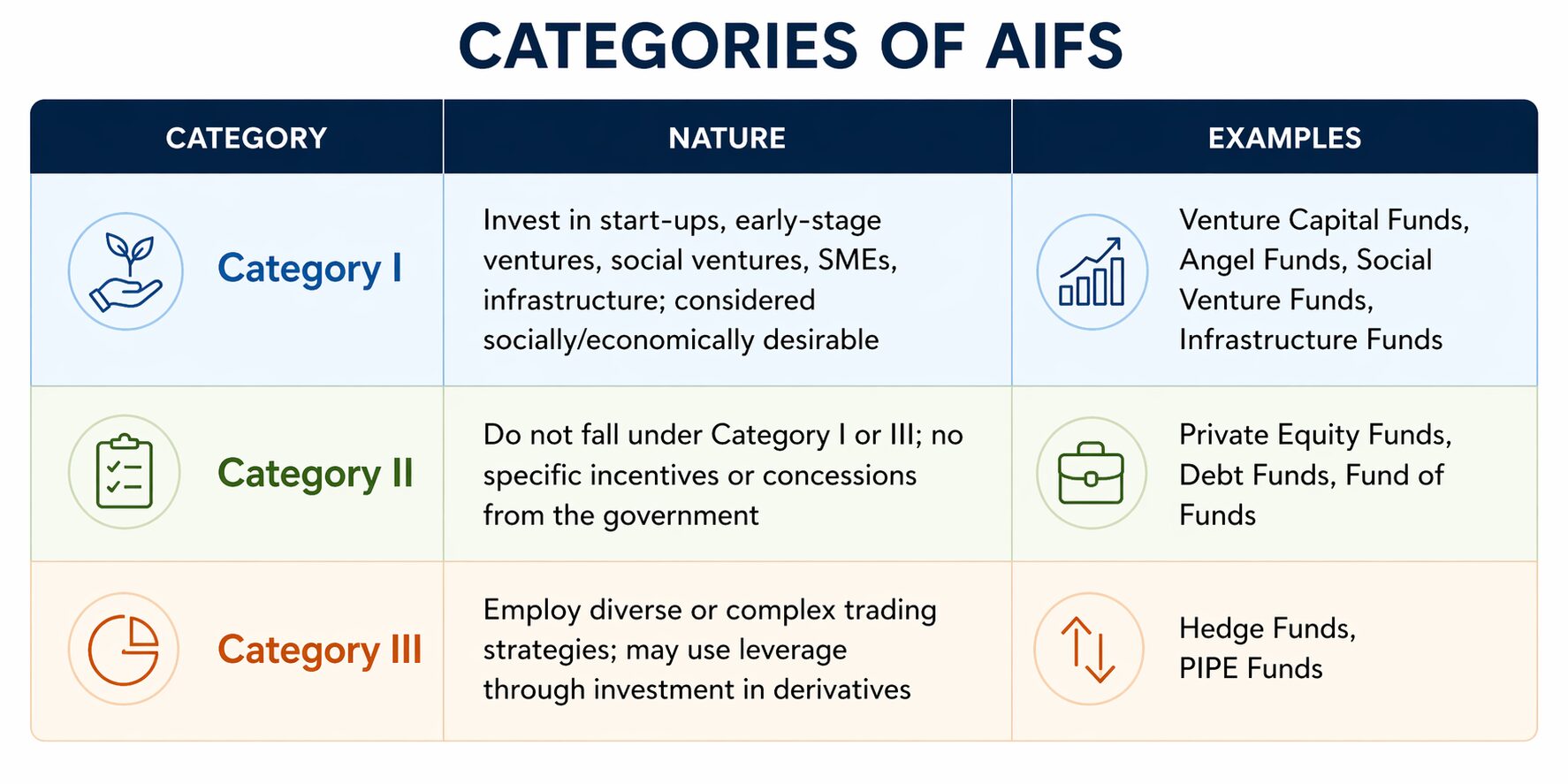
What are Alternative Investment Funds (AIFs)?
AIFs are privately pooled investment vehicles that collect funds from investors to invest in assets beyond traditional avenues like stocks and bonds.
Regulated by SEBI under the SEBI (Alternative Investment Funds) Regulations, 2012.
Investors: High-net-worth individuals (HNIs), institutional investors, and family offices.
Eligibility: Minimum fund corpus of ₹20 crore; Individual investments must exceed ₹1 crore per investor, and a tenure of at least 3 years.
Risk: High-risk investments, typically targeting categories with high returns.
India’s Social Stock Exchange:
Social Stock Exchange (SSE) is a SEBI-regulated platform in India that allows Not-for-Profit Organisations (NPOs/NGOs) and For-Profit Enterprises (FPEs) to raise funds for social impact projects. These projects focus on areas like education, livelihood, healthcare, and infrastructure (water, housing, sanitation, etc.).
Purpose: To bridge the gap between social enterprises and donors/investors, enabling access to capital beyond traditional grants and Corporate Social Responsibility (CSR).
Fundraising Mechanisms: NPOs can list on exchanges like the Bombay Stock Exchange (BSE) and the National Stock Exchange (NSE). Enables NPOs to raise funds via Zero Coupon Zero Principal (ZCZP) instruments. Social Venture Funds (SVFs) under Category I AIFs are the primary conduit for retail money into the SSE.
Zero Coupon Zero Principal (ZCZP) instruments:
ZCZP instruments are specialised financial instruments designed for registered NPOs to raise funds on the SSE for specific social projects.
Recognised as securities by the Indian government in 2022. They are listed on SSE and regulated by SEBI.
No Returns: They do not pay interest, and the principal amount is not returned at maturity. They are effectively donations.
Eligibility: Only registered NPOs that comply with SEBI regulations can issue these instruments to raise funds.
Transferability: Generally non-transferable (no secondary market trading), but can be transferred to legal heirs.
SEBI (Alternative Investment Funds) (Amendment) Regulations 2026:
Reduced Minimum Investment: The minimum investment requirement for individuals in social impact funds is slashed to ₹1000 from ₹2 lakh earlier.
Inoperative status: AIFs that have exhausted their funds can now request “inoperative” status, providing a cleaner exit mechanism.
‘AI Only’ Funds: A new category of funds exclusively using Artificial Intelligence (AI) for investment decision-making. It will have a relaxed regulatory framework to foster fintech-driven innovation.
Registration Validity: Not-for-Profit Organisations (NPOs) on the Social Stock Exchange can now remain registered for 3 years (from 2 years earlier) without raising funds.
SEBI lowered the minimum subscription requirement for Zero Coupon Zero Principal (ZCZP) instruments from 75% to 50%.
Significance of the Amended Rules:
Democratisation of Impact Investing: By reducing the investment floor to ₹1000, SEBI enables ordinary citizens to participate in socially driven capital formation. This broadens the capital base available for NPOs on the SSE.
Strengthens SSE Ecosystem: Greater retail investment in SSE can unlock significant dormant capital for sectors like rural healthcare, affordable education, and micro-livelihoods.
Easing regulatory burden: The inoperative status for dormant AIFs reduces unnecessary compliance costs and improves resource allocation within SEBI.
Recognising AI in Financial Regulation: The introduction of “AI-Only” funds signals SEBI’s proactive approach to regulating emerging technologies.
Lowering the minimum subscription requirement for ZCZP instrumentsaims to enhance fundraising flexibility for NPOs listed on the SSE.
The amendment supports India’s voluntary and mandatory ESG disclosure framework and moves capital towards enterprises delivering measurable social and environmental returns. This is consistent with the UN Sustainable Development Goals (SDGs).
Practice MCQ:
Q. Consider the following statements:
1. Social Stock Exchange (SSE) allows both NPOs and for-profit enterprises to raise funds.
2. Minimum investment in Social Impact Funds is ₹1000.
3. Zero-Coupon Zero Principal (ZCZP) instruments provide fixed interest returns to investors.
Which of the statements given above is/are correct?
The Aryabhata satellite weighed 360 kilograms, looked like a 26-sided polygon wrapped in solar cells, and lived for exactly 60 hours of useful science before a power failure silenced it. By every modern metric, the mission was a flop. By every metric that actually mattered to a country with a per-capita income of 1,400 rupees and no launch vehicle of its own, it was a triumph, the kind a nation only gets once.
April 19, 1975. A Soviet Kosmos-3M rocket lifted off from Kapustin Yar and put India in the orbit club. The Aryabhata satellite was India’s first, named after the 5th-century mathematician-astronomer who calculated pi to four decimals and proposed that the Earth rotates on its axis. The naming was not decoration. It was a deliberate signal: India’s space programme would be Indian, intellectually and culturally, even when its rocket came from somewhere else.
The 51st anniversary in April 2026 lands at a moment when ISRO is preparing for crewed flight, lunar return missions, and a Mars orbiter sequel. The distance from Aryabhata to Gaganyaan is not just five decades of engineering. It is a story of how a developing country built the institutional muscle for science at scale.
Quick Facts at a Glance
Launch date: April 19, 1975
Launch vehicle: Soviet Kosmos-3M rocket from Kapustin Yar
Mass: 360 kg
Orbit: 619 x 562 km, inclination 50.7 degrees
Mission objectives: X-ray astronomy, solar neutron and gamma-ray detection, aeronomy (ionosphere research)
Mission lifespan: 60 hours of usable science before power failure; remained in orbit until atmospheric re-entry on February 11, 1992
Project director: U.R. Rao
Cost: Approximately 30 lakh rupees in the Indian portion; Soviets bore launch costs
Naming: After Aryabhata, the 5th-century Indian astronomer-mathematician
Why the Aryabhata Satellite Is Back in News
The 51st anniversary of the Aryabhata satellite passed quietly on April 19, 2026, but ISRO marked it with an exhibition at U.R. Rao Satellite Centre in Bengaluru, a release of declassified construction photos, and an interview series with surviving members of the original team. National media picked up the thread because the timing aligned with two larger stories: the run-up to Gaganyaan’s first crewed launch later this year, and the 80th anniversary of Indian independence, where the post-colonial scientific build-out is getting fresh attention.
There is a UPSC angle that comes up almost every cycle. Aryabhata is on the Prelims short-list of “firsts” India should know cold, and it shows up in Mains as an example of post-Independence scientific institution-building or Indo-Soviet technology cooperation. The question is rarely “what was Aryabhata” and almost always “what does Aryabhata teach us about how India built capacity.”
Background and Historical Context
The Road to April 19, 1975
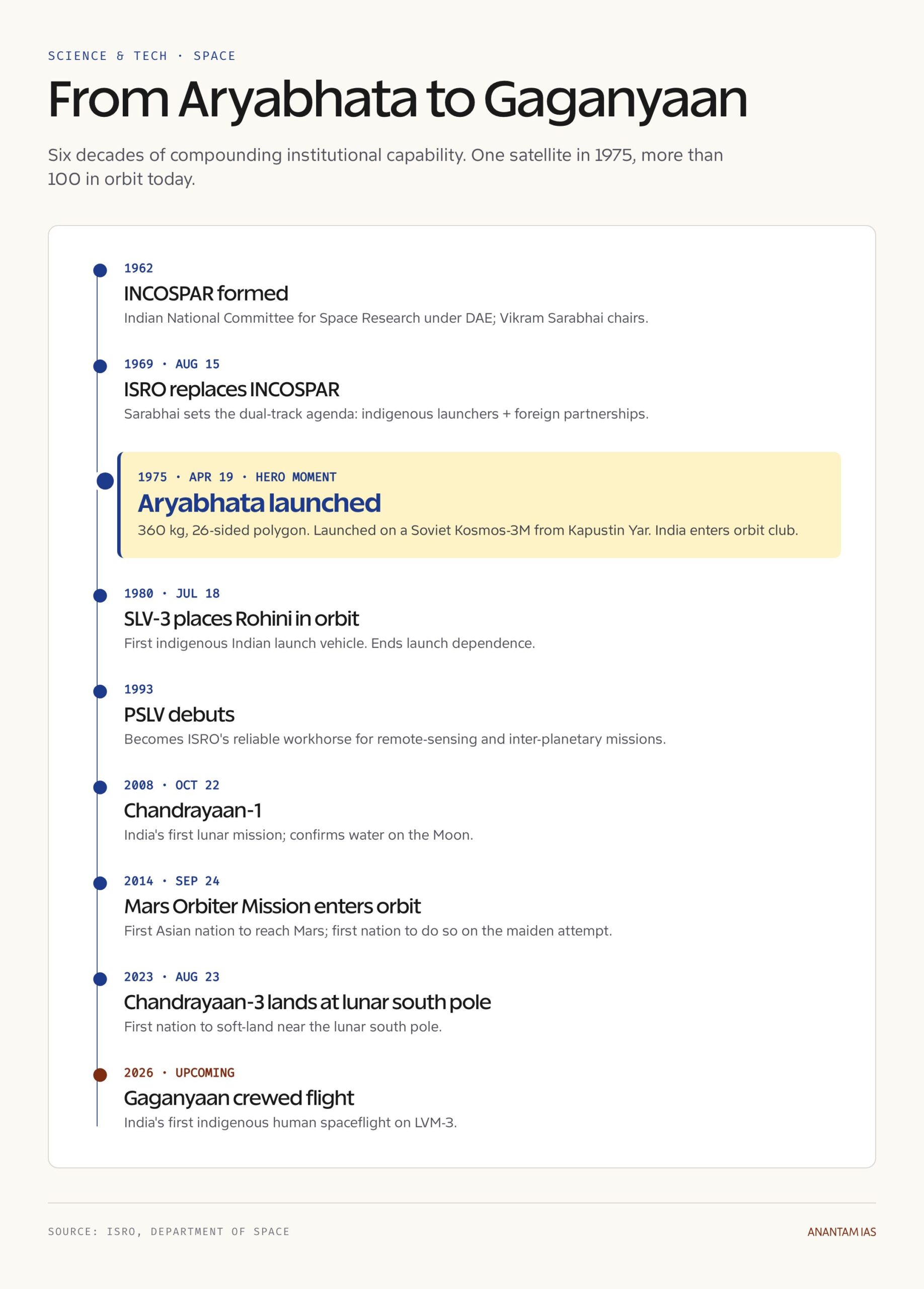
India’s space story does not start with Aryabhata. It starts in 1962, when the Indian National Committee for Space Research (INCOSPAR) was set up under the Department of Atomic Energy, with Vikram Sarabhai as its driving force. The first sounding rocket flew from Thumba on November 21, 1963, a Nike-Apache supplied by the Americans. Sarabhai’s argument, which still reads sharper than most policy papers written today, was that a developing country could not afford the luxury of space research unless space research could earn its keep through tangible benefits in communication, weather forecasting, education, and resource mapping.
ISRO formally replaced INCOSPAR on August 15, 1969. Sarabhai died unexpectedly in December 1971. Satish Dhawan took over and inherited a programme that had two parallel tracks: build sounding rockets and small launch vehicles in-house, and acquire bigger experience by partnering with the Soviets and the Americans. The 1972 Indo-Soviet space cooperation agreement opened the door for what became Aryabhata.
A team of about 250 scientists and engineers, working out of a converted shed in Peenya industrial area near Bengaluru, built the satellite in roughly three years. The project gave India hands-on experience with thermal control, attitude stabilization, telemetry, and command systems. None of these had been built indigenously before. The Aryabhata satellite was, in effect, India’s graduate thesis in spacecraft engineering.
Key Features of the Aryabhata Satellite
The spacecraft was a 26-sided polyhedron, 1.4 meters in diameter, with all but the top and bottom faces covered in solar cells generating about 46 watts of power. The body-stabilized design used spin for attitude control. Three scientific payloads were carried: an X-ray astronomy instrument, a solar gamma-ray and neutron detector, and an aeronomy package for ionospheric research.
A power failure on the fourth day after launch crippled the science programme. Telemetry continued for several more days but the experiments could not return useful data after that point. ISRO has been candid about the failure: it was a learning mission first, a science mission second. The hardware lessons fed directly into Bhaskara-1 (1979) and Bhaskara-2 (1981), which became India’s first earth observation satellites.
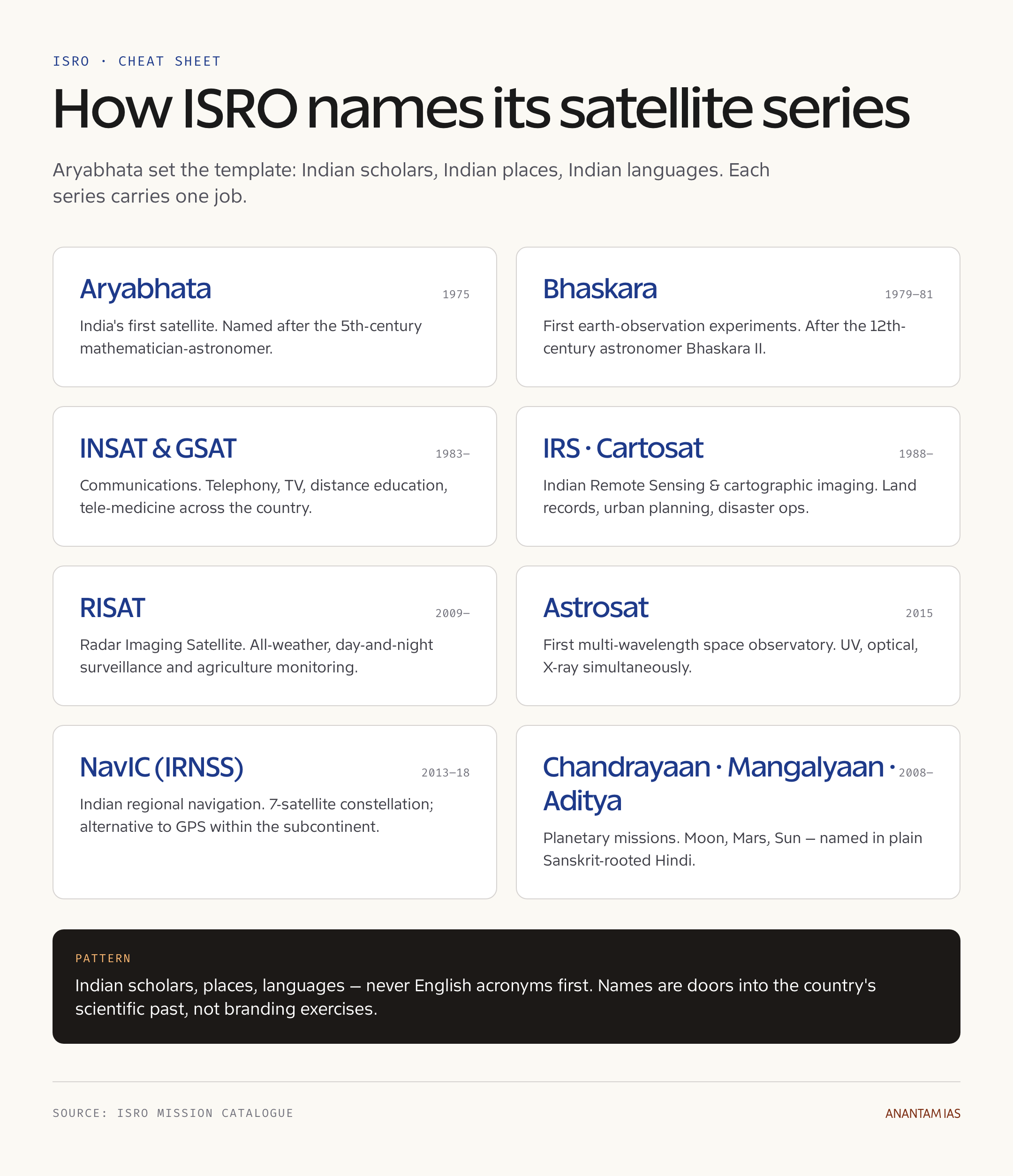
The naming convention started with Aryabhata set a template ISRO has stuck to with discipline. Indian scientific and cultural figures, Indian places, and Indian languages provide the names. Bhaskara (after the medieval astronomer-mathematician), Rohini (a Vedic figure and the name of India’s first SLV-3 launched satellite), Apple (Ariane Passenger Payload Experiment), INSAT (Indian National Satellite), IRS (Indian Remote Sensing), Cartosat, GSAT, RISAT, Astrosat, Chandrayaan, Mangalyaan, Aditya. Each name carries a small story.
Why the Aryabhata Satellite Matters Today
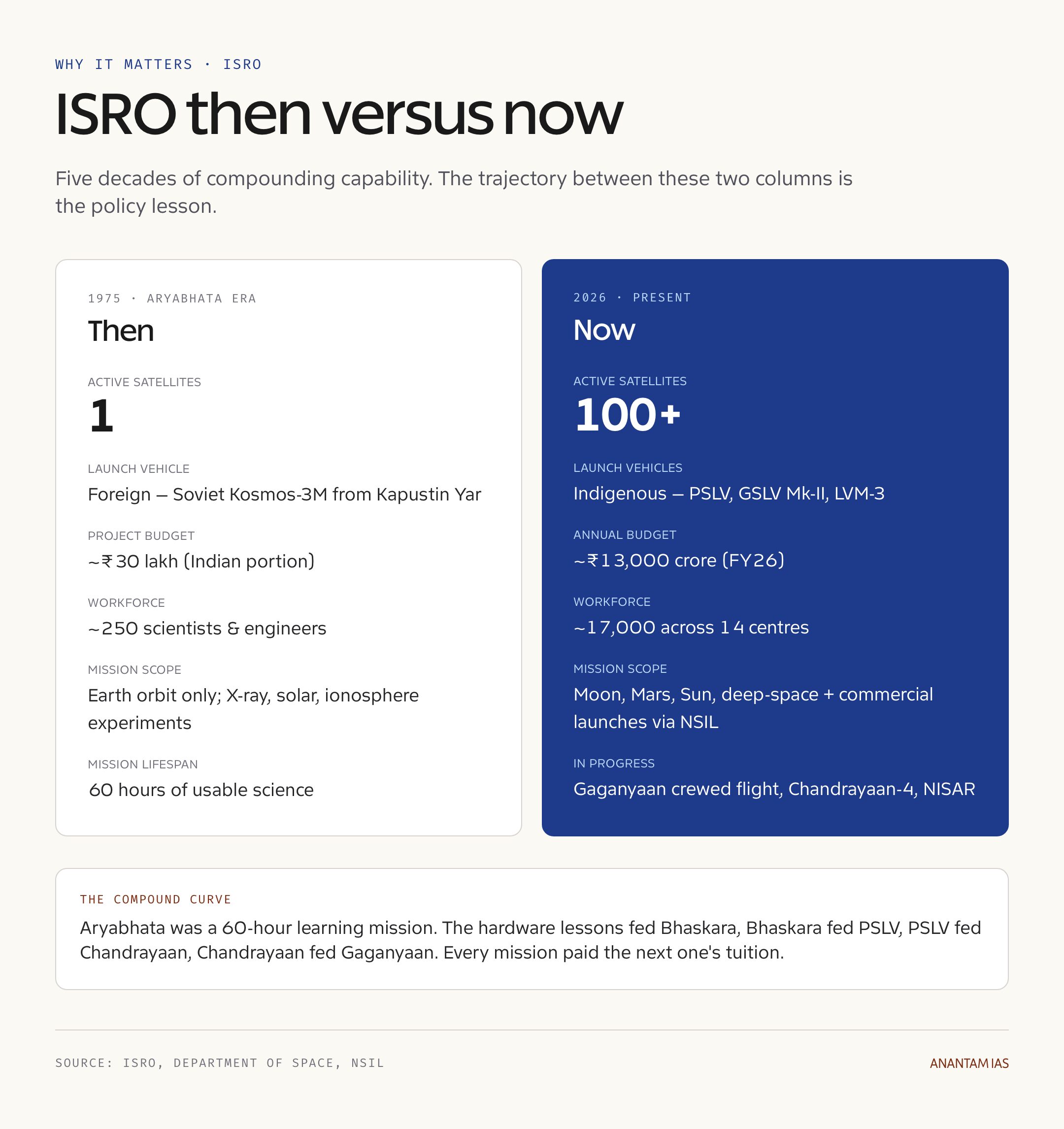
Aryabhata is the origin point of an institutional capability that has compounded for five decades. Treat the date as a benchmark and you can chart a clean trajectory: SLV-3 launching Rohini in 1980 (first Indian launcher), ASLV in 1987, PSLV’s debut in 1993, GSLV in 2001, Chandrayaan-1 in 2008, Mars Orbiter Mission in 2014, Chandrayaan-3’s south-pole landing in August 2023, and Gaganyaan ramping up in 2026. As of April 2026, ISRO has more than 100 active satellites in orbit, runs three operational launchers (PSLV, GSLV Mk-II, LVM-3), and has begun routine commercial launches through NewSpace India Limited.
The civilian dividends are vast. INSAT and GSAT carry television, telephony, distance education, and tele-medicine across the country. Cartosat and RISAT support land records, urban planning, and disaster response. NavIC provides regional navigation. The applied science Sarabhai promised in 1969 has been delivered, in scale and consistency that few other developing-world space programmes can match. Read the related explainer on the current ISRO chairman for context on present leadership.
Detailed Analysis: From One Satellite to a Hundred
The Aryabhata satellite seeded a pattern ISRO has stuck to: build incrementally, retain ownership of critical technologies, partner where useful but never depend. Through the 1980s, ISRO built up earth observation (Bhaskara, IRS series) and communications (INSAT) in parallel. The 1990s were the launcher decade, with PSLV becoming a reliable workhorse after a 1993 failure was fixed. The 2000s and 2010s pushed planetary exploration. The 2020s have been about scale: human spaceflight, reusable launch, commercial market access, and a stronger private-sector ecosystem.
A useful frame is to think of ISRO’s history in four eras. The Sarabhai era (1962-71) built the case for a programme. The Dhawan era (1972-84) built the institution and got Aryabhata flying. The Madhavan Nair and Radhakrishnan eras (mid-1980s through mid-2010s) built the launchers and the planetary missions. The Sivan and Somanath eras (late 2010s onward) built the commercial muscle and pushed for crewed flight.
The cost discipline ISRO is famous for, “Mars on a Hollywood-movie budget” was a cliche during Mangalyaan, has roots in Aryabhata. The team that built it had no choice but to be frugal. That working culture compounded.
Comparative Perspective: Aryabhata in the World Context
By the time India joined the club, the orbital game had been played for 18 years and over 1,500 spacecraft had been launched. India was late and small. What India did differently was lean hard into applied space services from the start. The Soviet partnership for Aryabhata was a strategic shortcut, similar to how Australia’s Wresat used a US Redstone rocket. Within five years of Aryabhata, India was launching its own satellites with SLV-3.
China and India are now the two large emerging-power space programmes. China started later (Dong Fang Hong was launched five years before Aryabhata, but India’s first satellite came on a foreign rocket while China’s flew on a domestic Long March 1) but caught up faster on launchers and has surged ahead on human spaceflight, lunar sample return, and Mars rover operations. India has held its lead on cost-per-mission and on a particular flavor of frugal engineering.
Challenges and Critiques
Aryabhata’s failure on day four was not a one-off. ISRO has had a string of setbacks: SLV-3’s first flight failure in 1979, the GSLV’s troubled cryogenic engine saga, Chandrayaan-2’s lander crash in 2019, the EOS-3 failure in 2021. The pattern has been to absorb the lessons and recover. Critics argue ISRO has been slow to involve the private sector and slower still to commercialize.
The 2020 space sector reforms, which opened the door to private players through IN-SPACe and NewSpace India, address that critique. The next decade will test whether a Sarabhai-style state-led model can coexist with a Skyroot or Agnikul-style private-launcher ecosystem. Read the primer on Gaganyaan progress for the human spaceflight angle.
A separate critique is opportunity cost. India spends roughly 0.04% of GDP on space, lower than the United States (0.25%) or Russia (0.18%) but in absolute terms still around 13,000 crore rupees a year. Some argue this is too much for a country with the social-sector gaps India still has. The counter-argument, the same one Sarabhai made, is that space is one of the few sectors where Indian science is competitive at the global frontier and where the dividend (telecom, weather, navigation, education) flows back to the social sectors.
UPSC Prelims Pointers
Aryabhata satellite was launched on April 19, 1975, by a Soviet Kosmos-3M rocket from Kapustin Yar.
It was named after the 5th-century mathematician-astronomer Aryabhata.
The mission’s project director was U.R. Rao.
ISRO was formed on August 15, 1969, replacing INCOSPAR (1962).
Vikram Sarabhai is regarded as the father of the Indian space programme.
The first sounding rocket flew from Thumba on November 21, 1963.
SLV-3 was India’s first indigenous launch vehicle; it placed Rohini RS-1 in orbit on July 18, 1980.
ISRO is administered by the Department of Space, which reports directly to the Prime Minister.
NewSpace India Limited (NSIL) is the commercial arm of ISRO.
IN-SPACe was set up in 2020 to promote the private space sector.
Mains Practice Questions
“The Aryabhata satellite was a learning mission, not a science mission, and that distinction explains the success of India’s space programme over the next five decades.” Discuss. (GS Paper III, 250 words)
Trace the evolution of ISRO from INCOSPAR to the present day. How does its institutional design balance state leadership with private participation? (GS Paper II / III, 250 words)
The Indo-Soviet space cooperation that produced Aryabhata is an early example of strategic technology partnership. Examine its lessons for India’s current technology diplomacy. (GS Paper II, 150 words)
India’s space programme has been described as “frugal but ambitious.” Critically evaluate the trade-offs implicit in this description. (GS Paper III, 150 words)
Way Forward
Five decades after Aryabhata, India’s space programme stands at an inflection point. Crewed flight is months away. The Bharatiya Antariksh Station is on the drawing board for the late 2030s. A lunar sample return is on the cards. Private launchers are flying their first orbital missions. The agenda is denser than at any previous moment in ISRO’s history.
The right way to honor the Aryabhata satellite’s anniversary is not to dwell on the past but to ask what the next Aryabhata-equivalent looks like. Probably it is not a single hardware milestone. It is the consolidation of a Indian space ecosystem where ISRO does the deep R&D, private players handle scaled commercial launches, academic institutions feed the talent pipeline, and the dividends, in jobs, in services, in soft power, flow back to a country still solving very basic problems on the ground. That ecosystem is what Sarabhai imagined. It is what U.R. Rao’s team prototyped. It is what the next 50 years should deliver.
Frequently Asked Questions
Q1. When was the Aryabhata satellite launched?
The Aryabhata satellite was launched on April 19, 1975, by a Soviet Kosmos-3M rocket from the Kapustin Yar cosmodrome.
Q2. Why was the Aryabhata satellite named Aryabhata?
The satellite was named after the 5th-century Indian mathematician-astronomer Aryabhata, who is credited with early calculations of pi, the concept of zero in advanced positional mathematics, and the proposition that the Earth rotates on its axis.
Q3. What were the scientific objectives of the Aryabhata satellite?
The satellite carried three payloads: an X-ray astronomy experiment, a solar gamma-ray and neutron detector, and an aeronomy instrument for ionospheric research.
Q4. How long did the Aryabhata satellite operate?
A power failure on the fourth day after launch crippled the science programme. Telemetry continued for several more days but no useful science data was returned after that. The satellite remained in orbit until atmospheric re-entry on February 11, 1992.
Q5. Who was the project director of the Aryabhata satellite?
U.R. Rao was the project director. He later became chairman of ISRO from 1984 to 1994.
Q6. Why did India launch its first satellite using a Soviet rocket?
India did not have an indigenous launch vehicle in 1975. SLV-3, India’s first indigenous launcher, was still under development and flew successfully only in 1980. The 1972 Indo-Soviet space cooperation agreement provided a launch slot at no cost to India.
Q7. How many active satellites does ISRO operate today?
As per latest available data, ISRO operates over 100 active satellites, including the INSAT and GSAT communication fleet, IRS and Cartosat earth observation series, NavIC navigation satellites, and several scientific missions.
Q8. What is the significance of the Aryabhata satellite for the UPSC syllabus?
Aryabhata appears regularly in Prelims as part of the “firsts” list and in Mains as an example of post-Independence institution-building, Indo-Soviet technology cooperation, and the role of frugal engineering in Indian science.
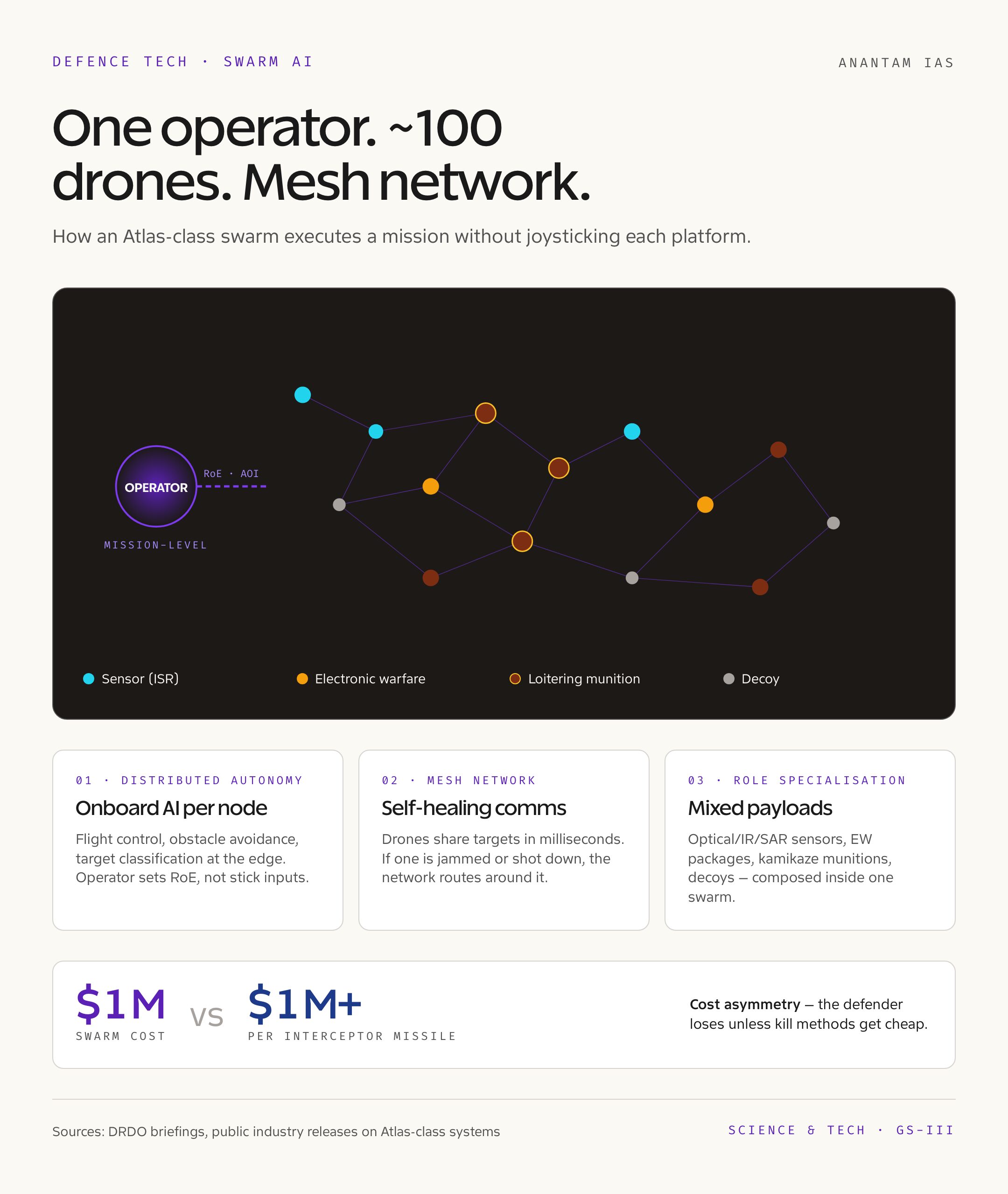
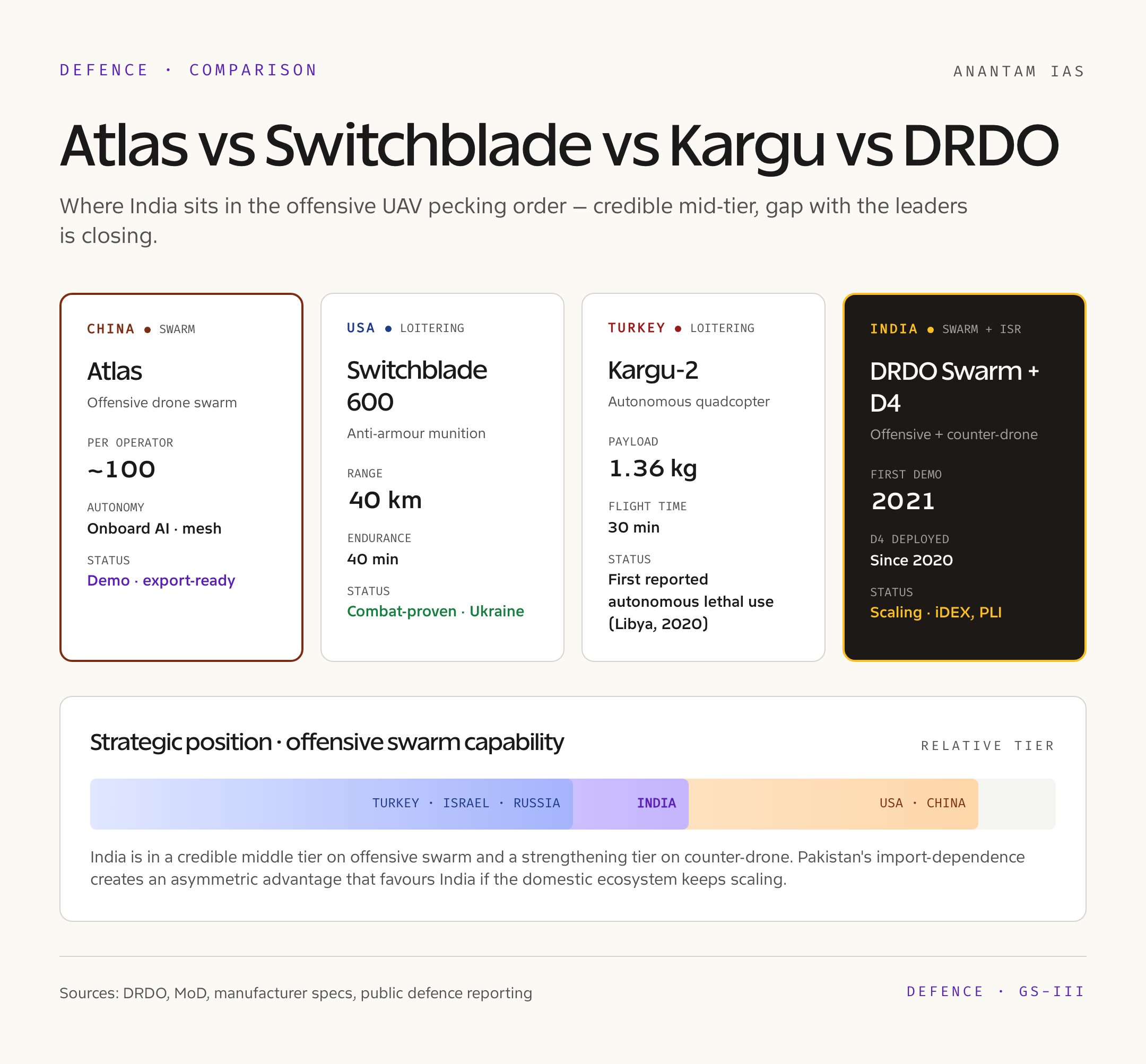
The defining weapon of the next decade probably won’t be a stealth fighter or a hypersonic missile. It’ll be a swarm of cheap drones, each one disposable on its own, devastating in coordinated formation. China’s recent demonstration of the Atlas Drone Swarm pushes that future closer. A single operator, nearly 100 autonomous UAVs, real-time coordination across a mesh network, and decision-making that runs at machine speed. For India, sitting between two militarized neighbors and managing a 3,488-kilometer disputed border with China alone, the Atlas Drone Swarm story is less a technology curiosity and more a planning input.
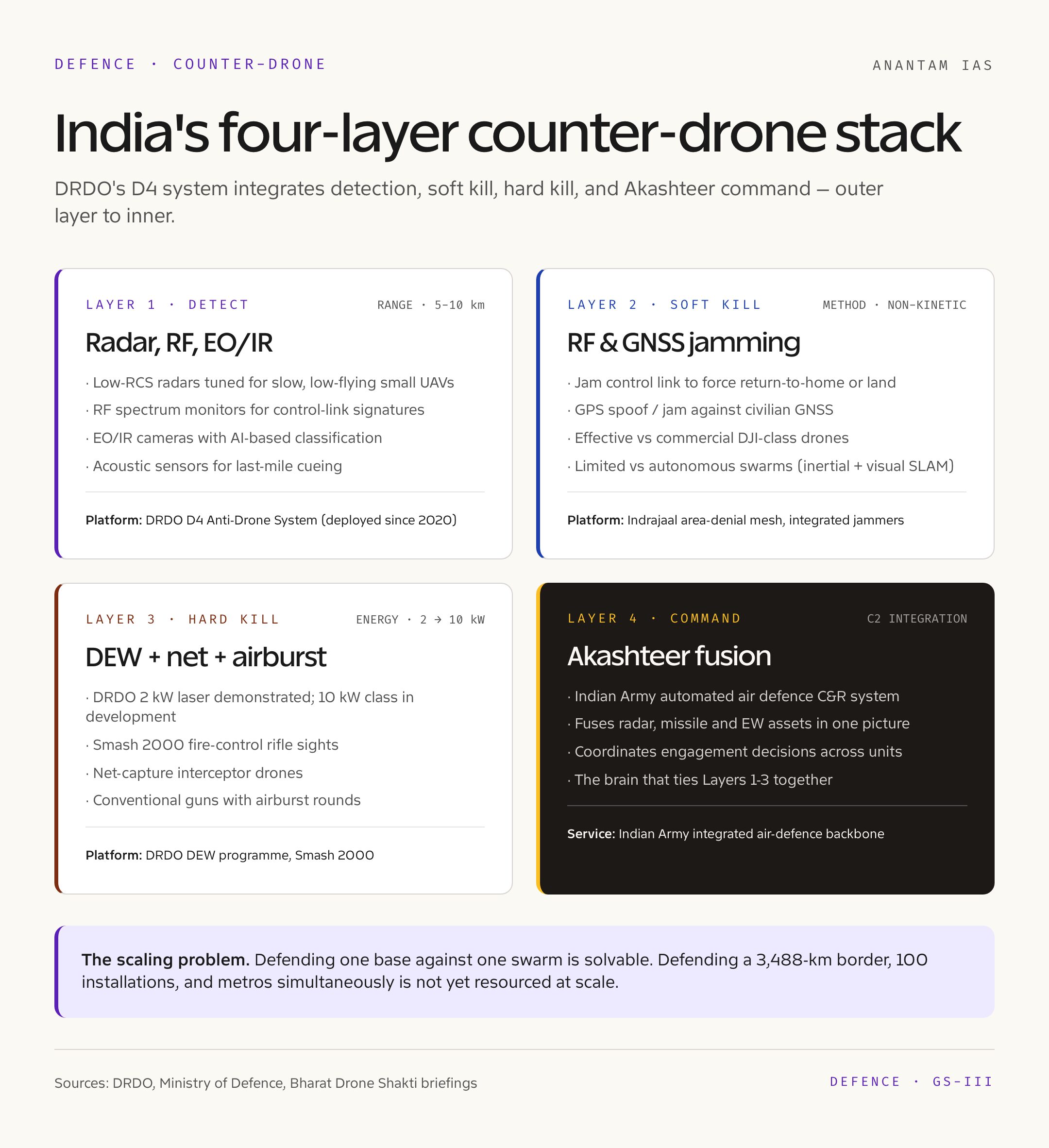
Swarm warfare changes the math of air defense. Traditional surface-to-air systems are built to engage a few high-value targets at once. They don’t scale gracefully when 100 cheap quadcopters arrive together, each capable of independent target selection. India’s defense ecosystem, including DRDO, the Indian Army, the Indian Air Force, and a growing cluster of private drone companies, is responding through a layered counter-drone push. The Bharat Drone Shakti exercise series and the operationalization of the DRDO Anti-Drone System are visible parts of that response.
This piece walks through what Atlas actually is, why swarms break old defense assumptions, where India stands, and what the realistic paths forward look like.
Quick Facts at a Glance
System name: Atlas Drone Swarm (reported designation; specifics tied to Chinese defense industry releases in April 2026)
Operator load: One human operator controlling up to ~100 drones
Architecture: Decentralized mesh networking with shared situational awareness
Autonomy level: Onboard AI for navigation, target classification, and engagement
Indian counterparts: DRDO Anti-Drone System (D4), Smash 2000, Indrajaal, Akashteer
Key Indian exercise: Bharat Drone Shakti, joint exercise demonstrating offensive and defensive UAV capabilities
Strategic backdrop: LAC tensions, drone use in Russia-Ukraine and Israel-Hamas conflicts, rising borderless drone threat from non-state actors
Why in News: A New Threshold for Drone Warfare
Footage and technical claims around the Atlas Drone Swarm circulated in late April 2026, showing coordinated flight of nearly 100 drones executing reconnaissance, target identification, and simulated strike profiles. The claim that one operator can manage that many autonomous platforms isn’t entirely new in concept. The US Defense Advanced Research Projects Agency (DARPA) demonstrated swarm prototypes years ago, and the Israeli, Russian, and Turkish industries have all moved versions into the field. What’s notable about Atlas is the integration depth, the operational packaging, and the explicit positioning toward export.
Coming on the heels of intensive drone use in the Russia-Ukraine war and the 2023-2025 Israel-Hamas conflict, where small, cheap UAVs disabled multi-million-dollar armor, the Atlas reveal pushes Indian defense planners to ask a hard question. Are existing air defense systems, even modern ones, designed for the war that’s now arriving?
Background and Historical Context
Drone warfare didn’t start with quadcopters. Reconnaissance UAVs go back to the Vietnam War. Israel pioneered tactical drones in the 1980s, and the US Predator and Reaper programs through the 2000s normalized armed drones in counter-terrorism operations. India operated Israeli-origin Searcher and Heron platforms for ISR (intelligence, surveillance, reconnaissance) for years.
The shift in the last five years has been from a few expensive drones in the hands of major militaries to many cheap drones in the hands of almost everyone. Commercial DJI quadcopters retrofitted with grenades changed Ukrainian battlefield economics. Iranian Shahed loitering munitions, costing tens of thousands of dollars each, threaten infrastructure designed against million-dollar missiles. Houthi drones from Yemen have hit Saudi oil facilities and Red Sea shipping.
Swarm theory pushes this further. Instead of single-platform engagement, the swarm distributes capability. Some drones become sensors. Others become decoys. Others carry payloads. The mesh network shares targeting data, and onboard AI lets the swarm continue functioning even if individual nodes are destroyed. The defense problem becomes geometric, not linear.
For India, this isn’t abstract. The 2025-26 LAC standoffs included reported drone incursions on multiple sectors. Western border flashpoints have seen drone-based smuggling and weapons drops. Kashmir has logged drone-borne IEDs. Our earlier explainer on the unmanned aerial vehicle lays out the broader UAV landscape that this Atlas story sits inside.
How It Works: Anatomy of a Swarm
Three pieces define a swarm system, and Atlas integrates all three at high maturity.
One, distributed autonomy. Each drone runs onboard AI that handles low-level flight control, obstacle avoidance, and target classification. The operator doesn’t joystick each platform. The operator sets mission parameters, area of interest, target priorities, rules of engagement, and the swarm executes.
Two, mesh networking. The drones talk to each other, not just to the operator. If one drone spots a target, the information propagates across the swarm in milliseconds. If one drone is shot down or jammed, the network heals around the gap. This makes the swarm resilient to losses and to electronic warfare.
Three, role specialization. Inside a single swarm, drones can carry different payloads. Some are pure sensors with optical, infrared, and SAR (synthetic aperture radar) cameras. Some carry electronic warfare packages to jam enemy communications. Some are loitering munitions, kamikaze drones that fly until they find a target. Some are simply decoys, drawing defensive fire away from the strike platforms.
The operator’s job is to manage the swarm at mission level. Modern swarm interfaces look more like real-time strategy game dashboards than traditional radar consoles. The cognitive load is on understanding the situation, not on flying individual aircraft.
Why It Matters: Five Reasons This Changes Indian Defense Planning
One, cost asymmetry. A swarm of 100 drones at $10,000 each costs $1 million. The interceptor missiles needed to engage them individually can cost more than that per missile. The defender always loses the cost trade unless the defense itself shifts to cheap, scalable kill methods.
Two, attribution ambiguity. Swarms can be launched from civilian platforms, trucks, ships, even commercial drones modified in basements. Attributing an attack to a state actor becomes harder, which lowers the threshold for use.
Threee, force multiplication for smaller adversaries. Pakistan, even China at certain points along the LAC, can punch above their weight if swarm technology reaches them at scale. Non-state actors operating from across borders gain serious leverage.
Four, infrastructure vulnerability. Civilian targets, oil refineries, power substations, ports, airports, weren’t designed against drone attack. India’s infrastructure security planning has to catch up, and that’s a Ministry of Home Affairs and state-level problem as much as a Ministry of Defence one.
Five, AI governance. Lethal autonomous weapons sit at the heart of an unresolved global ethical and legal debate. India’s position in the Group of Governmental Experts at the UN matters, and so does its domestic doctrine on human-in-the-loop versus human-on-the-loop targeting.
Detailed Analysis
India’s Counter-Drone Stack
India’s counter-drone response operates across four layers.
Detection. Radars optimized for small, slow, low-flying targets. Acoustic sensors. Optical and IR cameras with AI-based classification. RF spectrum monitors that pick up drone control links. The DRDO Anti-Drone System (D4) integrates several of these into a unified picture.
Soft kill. RF jamming targeting the command-and-control link or the GPS/GNSS signal the drone uses for navigation. Effective against commercial drones that rely on civilian GPS. Less effective against autonomous swarms that use inertial navigation and visual SLAM.
Hard kill. Directed energy weapons (high-power laser systems) that physically destroy drones. DRDO has demonstrated 2 kW class systems and is working on 10 kW class platforms. Net-capture drones that physically grab smaller UAVs. Conventional gun systems with airburst rounds.
Layered air defense integration. Akashteer, the Indian Army’s air defense control and reporting system, ties radar, missile, and electronic warfare assets together for coordinated response.
DRDO and Indian Industry
DRDO’s portfolio includes the D4 Anti-Drone System, the Rustom and TAPAS UAV programs, and ongoing swarm drone development. Indian industry is pushing fast. NewSpace Research, ideaForge, Garuda Aerospace, Asteria, Botlab, Veda Defence, and others are building both offensive UAVs and counter-drone systems. The 2026 procurement environment, with Defence Acquisition Council clearances under iDEX (Innovations for Defence Excellence) and Make-in-India guidelines, is finally moving capability into deployable form.
For deeper context on the broader tech-industrial push, our coverage of the semiconductor fab story is useful, since drone capability ultimately depends on indigenous chip and sensor supply.
Bharat Drone Shakti
Bharat Drone Shakti is a periodic exercise series organized by the Indian Air Force in coordination with the Drone Federation of India. Editions have featured live demonstrations of swarm drones, anti-drone systems, drone-launched missiles, autonomous logistics drones, and integrated battlefield management. The exercise functions as both a capability showcase and a procurement signal for industry. It’s the closest Indian analogue to large-scale Western drone demonstrations like the US Air Force’s various Skyborg and Replicator initiatives.
Comparative Perspective
System
Country
Type
Notable Feature
Atlas Drone Swarm
China
Offensive swarm
Up to ~100 drones per operator
Replicator Initiative
USA
Distributed swarm
Thousands of attritable autonomous systems
Kargu-2
Turkey
Loitering munition
First reported autonomous lethal use (Libya)
Switchblade 300/600
USA
Loitering munition
Used extensively in Ukraine
Lancet
Russia
Loitering munition
Anti-armor, used in Ukraine
Shahed-136
Iran
Long-range loitering munition
Used by Russia, Houthis
DRDO Swarm Drones
India
Offensive swarm
Demonstrated in Army Day 2021 onward
D4 Anti-Drone System
India
Counter-drone
Detection, jamming, laser hard-kill
India is in a credible middle tier on offensive swarm technology and a strengthening tier on counter-drone. The gap with the top tier (US, China) is real but closing, and the import-dependence of countries like Pakistan creates an asymmetric advantage that favors India if domestic ecosystem development continues.
Challenges and Critiques
Honest assessment requires naming the gaps.
Chip dependence. Indian drones still rely heavily on imported components, processors, sensors, batteries, motors. The semiconductor mission and the Production Linked Incentive scheme are addressing this, but the timeline is years, not months.
Procurement velocity. Defence procurement in India remains slow compared to the operational tempo at which drone tech is evolving. iDEX has helped, but scaling from prototype to mass deployment is still uneven.
Ethical and legal ambiguity. India’s doctrine on autonomous lethal targeting, fully autonomous decision to fire versus human authorization, is not publicly articulated in detail. The country needs a clearer position before crisis use forces an ad hoc one.
Civilian airspace integration. Drone proliferation needs UTM (unmanned traffic management). The Digital Sky platform is in operation, but enforcement against rogue drones in civilian airspace is patchy.
Counter-swarm scaling. Defending one base against one swarm is solvable. Defending a 3,000-kilometer border, a hundred installations, multiple metros, and key infrastructure simultaneously is a different problem and not yet resourced at scale.
UPSC Prelims Pointers
DRDO is the primary Indian defense R&D organization, headquartered in New Delhi
The DRDO Anti-Drone System (D4) was first reported deployed in 2020 and includes radar detection, RF jamming, and laser-based kill
Bharat Drone Shakti is a joint exercise involving the Indian Air Force and the Drone Federation of India
iDEX (Innovations for Defence Excellence) is the platform under the Ministry of Defence for engaging startups and MSMEs
The Akashteer system is the Indian Army’s automated air defense control and reporting platform
Lethal autonomous weapons systems (LAWS) are debated under the UN Convention on Certain Conventional Weapons (CCW)
The Drone Federation of India is the apex industry body for the Indian drone sector
Civilian drone operations in India are governed by the Drone Rules, 2021
Mains Practice Questions
GS Paper III: Discuss the strategic implications of drone swarm technology like the Atlas Drone Swarm for India’s national security. Outline the layered counter-drone capability India needs to build. (250 words)
GS Paper III: “The future of warfare belongs to autonomous systems and swarm intelligence.” Examine India’s preparedness in this domain with reference to DRDO programs and indigenous industry. (250 words)
GS Paper II: What is India’s position on lethal autonomous weapons systems in international forums like the UN CCW? Should India support a binding treaty? Discuss. (150 words)
GS Paper III: Analyze the role of dual-use technologies, including commercial drones, in modern asymmetric warfare. How should India balance innovation with regulation? (250 words)
Way Forward
India needs to move on five tracks at once. First, accelerate indigenous swarm offensive capability through DRDO and private industry, with clear Air Force and Army doctrine for employment. Second, scale counter-drone deployment beyond major bases to forward areas, critical infrastructure, and key urban centers. Third, harden chip and sensor supply chains so the drone fleet doesn’t carry strategic dependencies into a crisis. Fourth, articulate a clear doctrine on autonomous lethal targeting and engage seriously in international LAWS negotiations. Fifth, build the regulatory and UTM framework needed for civilian drone integration without leaving security gaps.
The Atlas Drone Swarm reveal isn’t a one-off shock. It’s a marker of a transition that’s already happening across every modern military. India can either ride the curve, with capability matched to threat, or absorb the cost of catching up later. The choice is being made now, in budget allocations, procurement decisions, and exercises like Bharat Drone Shakti.
Frequently Asked Questions
What is the Atlas Drone Swarm system?
Atlas is a Chinese drone swarm system reportedly enabling a single operator to control nearly 100 autonomous UAVs through onboard AI and mesh networking, designed for coordinated reconnaissance and strike missions.
How does a drone swarm differ from regular drone operations?
A swarm uses distributed autonomy and inter-drone communication so that one operator manages a mission rather than flying each drone. The swarm continues to function and adapt even if individual drones are lost.
What is India’s counter-drone capability?
India operates a layered counter-drone stack including the DRDO Anti-Drone System, RF jammers, directed energy weapons under development, and integrated air defense via Akashteer. Counter-drone capability is being deployed at major bases and key infrastructure.
What is Bharat Drone Shakti?
Bharat Drone Shakti is a joint exercise organized by the Indian Air Force and the Drone Federation of India to demonstrate offensive and defensive UAV capabilities and accelerate domestic industry adoption.
Why does swarm technology change the cost equation?
Each drone in a swarm can cost a few thousand dollars, while interceptor missiles can cost millions. The defender loses the cost trade unless cheap, scalable kill methods like directed energy or interceptor drones are deployed.
Are autonomous drones legal under international law?
Lethal autonomous weapons systems are debated at the UN Convention on Certain Conventional Weapons. There’s no binding treaty yet, and state positions vary on whether human authorization should be mandatory for any lethal engagement.
How is India’s drone industry evolving?
Indian companies like ideaForge, NewSpace Research, Garuda Aerospace, and others are scaling production of both offensive UAVs and counter-drone systems, supported by iDEX, PLI schemes, and Make-in-India procurement preferences.
What’s the Indian doctrine on drone warfare?
India’s drone doctrine has been evolving rapidly since 2020, with operational lessons from the LAC standoffs, Operation Sindoor and other ground operations, and observation of Russia-Ukraine and West Asian conflicts feeding into joint service planning.
Every approved drug, every licensed vaccine, every implantable medical device passes through a stage that almost nobody outside the industry talks about: pre-clinical research. It’s the long, expensive, deeply unglamorous phase where a candidate molecule moves from a promising lab finding to something that’s safe enough to put into the first human volunteer. India has had pre-clinical capacity for decades, scattered across CSIR labs, academic institutions, ICMR centers, and private CROs. What it hasn’t had is a single, dedicated, GLP-grade national hub. The newly announced NIPCR ICMR institute is meant to fix that gap.
The National Institute for Pre-Clinical Research, or NIPCR, has been positioned by the Indian Council of Medical Research (ICMR) as a consolidated facility for pharmacological, toxicological, and biomedical product validation. The reasoning is simple. India runs the world’s largest generic drug industry and the world’s largest vaccine manufacturing base, but a meaningful share of pre-clinical work for original Indian innovation has historically been outsourced abroad or fragmented across small, under-resourced labs. NIPCR is about closing that loop.
For UPSC aspirants, the NIPCR story sits at the intersection of health policy, science and technology, industrial policy, and regulatory architecture. It’s also a clean example of how a single institutional decision can re-shape an entire pipeline.
Quick Facts at a Glance
Full name: National Institute for Pre-Clinical Research
Parent body: Indian Council of Medical Research (ICMR), Department of Health Research, Ministry of Health and Family Welfare
Mandate: Pre-clinical validation of drugs, vaccines, biologics, medical devices, and diagnostics
Standards: Compliance with Good Laboratory Practice (GLP) and OECD principles
Why it matters: Reduces dependence on foreign CROs, shortens drug development timelines, supports Atmanirbhar Bharat in healthcare
Strategic context: Builds on India’s COVID-19 vaccine experience, post-pandemic health resilience push, and the broader National Health Research Policy
Related ecosystem: NIV Pune, NIE Chennai, NIN Hyderabad, NIRRH Mumbai, ICMR-NCDC Delhi, and over 25 other ICMR institutes
Why in News: A Long-Overdue Institutional Move
ICMR formally announced the NIPCR upgrade in late April 2026, framing it as a flagship initiative to consolidate India’s pre-clinical capacity. The move comes against a specific backdrop. India’s biotech and pharma industry has been pushing for years for better domestic GLP-compliant facilities. The COVID-19 pandemic exposed how dependent the country was on foreign capability for novel platform validation, even as Indian manufacturing scaled to deliver billions of doses. And the recent push under National Biotechnology Development Strategy and the BioE3 (Biotechnology for Economy, Environment, and Employment) policy has made domestic translational infrastructure a stated priority.
NIPCR isn’t being built from scratch in the literal sense. ICMR has indicated that the institute will absorb and upgrade existing pre-clinical wings (including legacy facilities at NIN Hyderabad and other centers), bring them under unified governance, and add capacity. The announcement language has emphasized “validation,” meaning third-party, regulator-grade testing that pharmaceutical and biotech companies can rely on for IND (Investigational New Drug) submissions to the Central Drugs Standard Control Organisation (CDSCO).
Background and Historical Context
ICMR is the apex body for biomedical research in India, tracing its lineage to the Indian Research Fund Association founded in 1911. After Independence it was reconstituted as the Indian Council of Medical Research in 1949. Today it operates through more than 25 permanent institutes and centers, plus a dense network of collaborative programs with universities, AIIMS, and state medical colleges.
India’s drug discovery and development arc has changed significantly since the 1970s patent regime allowed process patents only, fueling the generic industry. After the 2005 amendment that introduced product patents, the industry slowly began investing in original research. Companies like Biocon, Dr. Reddy’s, Sun Pharma, Bharat Biotech, and Serum Institute have built genuine R&D capability, but the pre-clinical bottleneck remained.
A pre-clinical study isn’t a single test. It’s a battery: pharmacokinetics, pharmacodynamics, acute toxicity, sub-chronic and chronic toxicity, genotoxicity, carcinogenicity, reproductive toxicity, immunotoxicity, biodistribution for biologics, and specialized animal models for efficacy. Doing all of this to OECD GLP standards requires expensive infrastructure, including barrier-grade animal facilities, qualified veterinarians and pathologists, validated analytical labs, and a quality assurance unit independent from the testing teams.
For most Indian innovators, especially small biotech startups, getting comprehensive GLP pre-clinical work done domestically has been hard. Many have either gone to global CROs in the US, Europe, China, or Singapore, or worked piecemeal across multiple Indian labs and stitched the dossier together. NIPCR is meant to make a one-stop, GLP-grade, regulator-trusted alternative.
Drug development is often summarized as discovery, pre-clinical, clinical, regulatory, and post-market. Pre-clinical sits between two worlds, after a candidate has shown lab promise and before any human gets a dose.
Step 1: Lead identification and optimization. Out of thousands of compounds screened, a handful become “leads,” molecules that hit the target with reasonable potency and selectivity. Lead optimization tweaks structure to improve drug-like properties.
Step 2: In vitro testing. Cell-based assays for efficacy, cytotoxicity, off-target effects, and metabolic profiling using human liver microsomes and hepatocytes.
Step 3: In vivo pharmacology. Animal models for proof of concept. Disease-relevant models, like mice with induced diabetes, primates with simulated immune responses, are used to confirm efficacy.
Step 4: GLP toxicology. This is the regulator-facing core of pre-clinical work. Two species typically (rodent and non-rodent), multiple dose levels, full pathology, blood and urine analysis, and detailed reporting. Genotoxicity (Ames test, micronucleus assay) and chronic toxicity studies follow.
Step 5: ADME and PK/PD. Absorption, distribution, metabolism, excretion. Pharmacokinetic and pharmacodynamic modeling to predict human dosing.
Step 6: Special studies. Reproductive toxicity, juvenile toxicity for pediatric drugs, abuse liability for CNS drugs, immunogenicity for biologics.
Step 7: IND-enabling package. All data is compiled into a regulatory-grade dossier submitted to CDSCO (in India) or FDA, EMA, etc. Approval here permits Phase 1 human trials.
NIPCR is being designed to handle every step from in vitro screening through IND-enabling toxicology, all under one quality umbrella.
Why It Matters: Five Reasons NIPCR Is Strategic
One, it shortens timelines. Fragmented pre-clinical work across labs adds months to years. A consolidated facility with parallel-tracking capability can compress that.
Two, it reduces foreign dependence. Sending dossiers abroad for GLP studies costs hard currency, exposes IP, and creates strategic vulnerability during pandemics or geopolitical crises.
Three, it supports startup and academic translation. Most Indian biotech startups can’t build their own GLP facilities. NIPCR can serve as the public infrastructure they need to move from publication to product.
Four, it strengthens regulatory credibility. When CDSCO trusts the data coming from a domestic institute, the IND review is faster and cleaner. Eventually, FDA and EMA recognition of Indian GLP facilities matters too.
Five, it builds workforce capacity. Toxicologists, pharmacologists, lab animal veterinarians, and quality assurance specialists are scarce skill categories in India. A flagship institute trains hundreds of them and seeds the broader ecosystem.
Detailed Analysis
Where NIPCR Fits in the ICMR Ecosystem
ICMR runs a thematic network. NIV Pune handles virology and pandemic response, NIE Chennai handles epidemiology, NIN Hyderabad handles nutrition, NIRRH Mumbai handles reproductive and child health, NCDIR Bengaluru handles non-communicable disease research, and so on. NIPCR plugs into this network as the validation backbone. A vaccine candidate developed at NIV can move through NIPCR for pre-clinical, then back into the clinical network. A drug discovered in a CSIR lab or a startup can use NIPCR to bridge to CDSCO submission.
GLP and Regulatory Architecture
Good Laboratory Practice is a quality system that governs how non-clinical safety studies are planned, conducted, recorded, archived, and reported. It’s enforced in India by the National GLP Compliance Monitoring Authority under the Department of Science and Technology. Globally, OECD GLP principles are the reference standard, and OECD member acceptance of test data (MAD) means a study run in an OECD-compliant facility can be accepted across multiple countries.
NIPCR’s value depends on it achieving and maintaining OECD GLP certification, with mutual recognition. That’s not automatic. It takes audits, infrastructure, and consistent quality processes over years.
Comparison With Global Pre-Clinical Hubs
Globally, pre-clinical capacity is a mix of public institutes and large commercial CROs. The US has the National Toxicology Program at NIEHS, plus commercial giants like Charles River, Labcorp Drug Development, and Inotiv. The UK has NIBSC (National Institute for Biological Standards and Control). China built up its CRO ecosystem aggressively, with WuXi AppTec dominating globally. India’s commercial pre-clinical CROs (Syngene, Aragen, Sai Life Sciences) are competitive but private. NIPCR adds a public anchor that India hasn’t had at scale.
For background on India’s broader R&D infrastructure push, our coverage of graphene research illustrates how dedicated material-specific labs accelerate translation.
Comparative Perspective
Stage
Duration
Cost (rough)
Subjects
Regulator
Discovery
3-5 years
$$
None (in vitro)
None
Pre-clinical
1-3 years
$$$
Animal models
CDSCO (IND review)
Phase 1 trial
6-18 months
$$$
20-100 healthy volunteers
DCGI
Phase 2 trial
1-3 years
$$$$
100-300 patients
DCGI
Phase 3 trial
1-4 years
$$$$$
1,000-5,000 patients
DCGI
Regulatory review
0.5-2 years
$
N/A
CDSCO/FDA
Post-market
Ongoing
$$
Real-world
PvPI, CDSCO
Pre-clinical is the cheapest formal stage but also the most failure-prone. Roughly 90% of candidates that enter clinical trials fail before launch, and most of those failures are signaled, but missed, in pre-clinical data. Better pre-clinical means fewer expensive late-stage failures.
Challenges and Critiques
NIPCR is a good idea, and that doesn’t make it automatically successful.
Animal facility capacity. GLP toxicology runs on barrier-grade animal facilities. India has a chronic shortage of trained lab animal technicians and veterinarians. Without that workforce, infrastructure alone doesn’t deliver studies.
Ethics and 3Rs. Reduce, refine, replace. Modern pre-clinical science is moving toward organoids, organ-on-chip, in silico models, and humanized cell systems. NIPCR needs to integrate these from day one, not bolt them on later.
Bureaucratic governance. ICMR institutes vary widely in operational efficiency. NIPCR will need autonomous, mission-mode governance to compete with private CROs on turnaround time.
IP and confidentiality. Pre-clinical data is sensitive. Companies will only use NIPCR if confidentiality is bulletproof. That’s a process and culture problem as much as a legal one.
Funding sustainability. GLP facilities are expensive to maintain. A one-time capital grant doesn’t run a facility for 30 years. NIPCR needs a hybrid model with public mandate and competitive service revenue.
Regulatory upgrading. CDSCO itself needs continuous capacity building. A great pre-clinical institute is wasted if the regulator can’t review submissions efficiently.
UPSC Prelims Pointers
ICMR (Indian Council of Medical Research) is headquartered in New Delhi and is the apex body for biomedical research in India
ICMR functions under the Department of Health Research, Ministry of Health and Family Welfare
Good Laboratory Practice (GLP) is a quality system for non-clinical safety studies, with OECD principles as the global reference
The National GLP Compliance Monitoring Authority is under the Department of Science and Technology
CDSCO (Central Drugs Standard Control Organisation) is India’s national regulatory authority for drugs and medical devices
The Drugs Controller General of India (DCGI) heads CDSCO
Major ICMR institutes include NIV Pune (virology), NIE Chennai (epidemiology), NIN Hyderabad (nutrition), NIRRH Mumbai (reproductive health)
Pre-clinical research typically uses two species (rodent and non-rodent) for toxicology
The 3Rs in animal research are Replace, Reduce, Refine
Mains Practice Questions
GS Paper III: Discuss the strategic significance of the National Institute for Pre-Clinical Research (NIPCR) for India’s pharmaceutical and biotechnology ecosystem. How does it fit into the Atmanirbhar Bharat vision in healthcare? (250 words)
GS Paper III: “India is the pharmacy of the world but lags in original drug discovery.” Examine the structural reasons for this gap and the role of institutions like NIPCR in bridging it. (250 words)
GS Paper II: Evaluate the regulatory architecture for drug approval in India. What reforms can strengthen CDSCO’s capacity to handle innovative therapies? (150 words)
GS Paper III: Discuss the ethical considerations in pre-clinical animal research. How can India balance the needs of biomedical innovation with the principles of the 3Rs? (250 words)
Way Forward
NIPCR’s success will turn on a few things that are within India’s ability to control. Mission-mode governance with a competent CEO-equivalent and operational autonomy. Early OECD GLP certification with mutual recognition pathway. Integration of new approach methodologies (NAMs) like organoids and in silico models from inception, not as afterthoughts. A transparent fee schedule that startups and academics can actually afford. Tight coordination with CDSCO so that NIPCR data flows smoothly into the IND review system. And aggressive workforce development, including dedicated training programs for toxicologists, pathologists, and lab animal scientists.
If those pieces come together, NIPCR could become to pre-clinical what NIV Pune has been to virology, an anchor institution that quietly underwrites a much larger industry. If they don’t, it becomes another building with a name plate. The institutional quality of the next five years will decide which it is.
Frequently Asked Questions
What is NIPCR ICMR?
The National Institute for Pre-Clinical Research is a flagship facility under the Indian Council of Medical Research dedicated to validating drugs, vaccines, biologics, and medical devices before they enter human trials.
Why is pre-clinical research important?
Pre-clinical studies establish safety, dosing, and efficacy in laboratory and animal models before any human is exposed. This stage is required by every drug regulator before clinical trials can begin.
How does NIPCR support Indian pharma and biotech?
By providing GLP-compliant, regulator-trusted pre-clinical capacity domestically, NIPCR reduces the need to outsource studies abroad, shortens timelines, and lowers costs for Indian innovators.
What is GLP and why does it matter?
Good Laboratory Practice is a quality system for non-clinical safety studies, governing planning, conduct, recording, and reporting. GLP-compliant data is required by drug regulators worldwide.
How is NIPCR different from existing ICMR institutes?
Other ICMR institutes focus on disease areas like virology or nutrition. NIPCR is dedicated specifically to pre-clinical validation across therapeutic areas and product types.
Who regulates drugs and clinical trials in India?
The Central Drugs Standard Control Organisation (CDSCO), headed by the Drugs Controller General of India, is the national regulator. State drug control authorities handle manufacturing licenses and quality oversight.
What are the 3Rs in pre-clinical research?
The 3Rs are Replace (alternatives to animal testing), Reduce (use fewer animals), and Refine (minimize suffering). They guide ethical animal research globally.
How does NIPCR fit India’s healthcare self-reliance goal?
NIPCR strengthens the domestic R&D pipeline, reduces foreign dependence for critical validation, and aligns with Atmanirbhar Bharat priorities in pharmaceuticals, vaccines, and medical devices.
The India Meteorological Department (IMD) has launched two new AI-powered weather forecasting systems under the Ministry of Earth Sciences (MoES). The two systems launched are:
IMD’s AI-enabled forecast of monsoon’s arrival over 15 States and comprising about half of India’s roughly 7,200-odd blocks (first-ever block-level monsoon advance forecast).
High Spatial Resolution Rainfall Forecast for Uttar Pradesh: a pilot project providing 1 km-resolution rainfall data up to 10 days ahead.
UPSC Relevance: GS-1 Geography: Monsoon; GS-3 Science and Technology: Artificial Intelligence and Weather Forecasting.
Prelims: Southwest Monsoon; Artificial Intelligence applications in Weather Forecasting
Block-Level Monsoon Advance Forecast System:
For the first time, farmers in about 3,067-3,196 blocks across 15 States and one Union Territory will receive block-specific monsoon forecasts. This will cover the arrival of the monsoon, rainfall probability, rainfall intensity and monsoon progression.
The AI system can provide forecasts up to 4 weeks in advance for monsoon progression.
The latest system, developed using a combination of numerical weather prediction models and AI-based data-driven approaches, is part of IMD’s ambitious push for highly localised, high-resolution weather forecasts.
UP High-Resolution Rainfall Forecast System:
It is an independent pilot model to provide highly detailed rainfall forecasts for Uttar Pradesh.
The AI-based system uses the dense weather observational network of the state to generate 1 km resolution forecasts up to 10 days in advance. It combines data from weather stations, Doppler radars, satellites, and weather models, and uses AI-driven downscaling to provide more localised alerts.
Need and Significance:
Currently, the global models run by IMD provide forecasts at 12.5 kms and 3-4 kms resolution with hourly updates. While useful for broad weather predictions, they cannot accurately capture local rainfall patterns needed for precision farming and other localised actions.
The AI model will improve hourly forecasts by refining them from 12.5 km resolution to 4 km and then to 1 km, making them more useful for local planning and precision agriculture.
The UP pilot was developed by NCMRWF (National Centre for Medium Range Weather Forecasting), and its outputs will be made available via NCMRWF’s public APIs and websites.
Uttar Pradesh has the most extensive network of automatic weather stations (AWS) in the country; there is sufficiently dense observational data to downscale output to 1 km resolution.
Potential Use Cases:
Agriculture: Farmers can plan sowing/transplanting with a 4-week probabilistic window; reduces crop losses from premature sowing before the actual monsoon onset at the block level.
Water Management: Local authorities can better manage reservoir releases, groundwater recharge timelines, and irrigation scheduling with sub-district precision.
Disaster Management: Early localised flood and drought warnings enable pre-positioned relief, evacuation planning, and NDRF deployment.
Renewable Energy: Solar and hydro energy planners can optimise operations with high-resolution rainfall and cloud-cover data.
Urban Planning: Municipal bodies get actionable lead time for drainage upgrades and waterlogging prevention.
Food Security: Rainfed agriculture accounts for ~40% of India’s food production — precision forecasting directly protects food supply chains.
Policy: Both systems feed into India’s National Monsoon Mission goals and the broader push for AI-enabled governance in climate adaptation.
UPSC PYQ 2017:
Q. With reference to ‘Indian Ocean Dipole (IOD)’ sometimes mentioned in the news while forecasting Indian monsoon, which of the following statements is/are correct?
1. IOD phenomenon is characterised by a difference in sea surface temperature between tropical Western Indian Ocean and tropical Eastern Pacific Ocean.
2. An IOD phenomenon can influence an El Nino’s impact on the monsoon.
Select the correct answer using the code given below:
AI-powered financial inclusion in India has moved from pilot to policy mainstream. Through May 2026, the Reserve Bank’s quarterly Financial Inclusion Index, MoF speeches at the G20 finance track, and a flurry of partnerships between banks and fintechs have made one trend unmistakable. India is no longer trying to extend credit by opening more bank branches or by mandating priority sector quotas alone. It is trying to underwrite previously unbankable customers using machine learning models that read consented digital data trails left by everyday transactions.
The architecture has three load-bearing pillars. The Account Aggregator framework, live since 2021 and now carrying more than 150 crore data-sharing consents, lets a citizen instruct one financial entity to pull data from another with cryptographic proof. The Open Credit Enablement Network, OCEN, standardizes how lenders, aggregators, and credit marketplaces talk to each other. The Unified Payments Interface generates a real-time transactional footprint that lenders can read with consent. Around these rails, AI models build a credit picture of customers who were invisible to traditional bureau scoring.
For UPSC, AI-powered financial inclusion India sits at the intersection of GS Paper 3 economy themes, GS Paper 2 governance themes around regulatory bodies and digital rights, and the ethics paper through the question of algorithmic fairness. It is also a stock topic in interview boards through the lens of digital public infrastructure and Stack-based governance.
Quick Facts
Account Aggregator framework regulated by the Reserve Bank under the NBFC-AA license, live since September 2021
More than 150 crore cumulative consents recorded across AA ecosystem as of Q1 2026 (Sahamati industry reports)
OCEN reference architecture released in 2020, anchored by the iSPIRT volunteer group, with API specifications now adopted by several public sector banks
UPI processed over 18 billion monthly transactions in early 2026, generating one of the world’s largest real-time payment datasets
Reserve Bank Financial Inclusion Index rose from 43.4 in 2017 to 64.2 in 2024, a steady upward trend
World Bank Findex 2021 placed India’s account ownership rate at roughly 78 percent, up from 35 percent in 2011
MSME credit gap estimated at over 25 lakh crore rupees by various studies including U.K. Sinha Committee 2019
NITI Aayog DPI for 2047 roadmap published in 2026 identifies AI-led financial inclusion as a top-three priority
What Just Happened
In the second week of May 2026, three policy and market signals converged. The Reserve Bank released a discussion paper on AI and machine learning in financial services on May 8, opening public consultation until June 30. The paper introduces a tiered risk framework, fairness audit obligations for high-risk models, and a mandatory model inventory for regulated entities. It is the most detailed Indian regulatory document on AI in finance to date.
On May 12, NITI Aayog hosted a closed-door workshop on the DPI for 2047 roadmap, with a dedicated session on AI-led financial inclusion. The workshop produced a draft action agenda focused on extending Account Aggregator coverage to insurance and pensions data, building a national synthetic dataset for credit model training, and standardizing alternative credit scoring vendor accreditation.
On May 14, three large public sector banks announced partnerships with fintech platforms to run AI-powered MSME underwriting pilots using OCEN rails and AA-consented bank statements. The pilots target loan tickets between 50,000 and 25 lakh rupees, traditionally the costliest segment for banks to underwrite manually.
The convergence matters because each piece reinforces the others. AA and OCEN supply the data and routing standards. AI models supply the underwriting capacity. The RBI discussion paper supplies the guardrails. Without any one of these, inclusion stalls. With all three, India can plausibly aim to close most of the formal credit gap within a decade.
Background and Historical Context
India’s financial inclusion story falls into three distinct phases. The first, from bank nationalization in 1969 through the 1990s, used branch expansion and priority sector lending mandates to push banks into rural areas. The second, from 2005 through the early 2010s, used business correspondents, no-frills accounts, and the Pradhan Mantri Jan Dhan Yojana launched in 2014 to push the account ownership rate from roughly 35 percent to over 78 percent. Both phases focused on opening accounts. Neither closed the credit gap.
The third phase, from roughly 2016 onwards, built on JAM, the trinity of Jan Dhan accounts, Aadhaar authentication, and mobile penetration. UPI launched in 2016 and crossed one billion monthly transactions by 2019. Aadhaar provided a verifiable identity layer that drove account opening costs down by an order of magnitude. The Account Aggregator framework, conceptualized by the Reserve Bank’s Inter-Regulatory Group in 2016 and operationalized through 2021, added a consented data-sharing layer.
The architecture sits inside what the country calls India Stack, a layered set of digital public goods including identity (Aadhaar), payments (UPI), data (Account Aggregator), and signature (DigiLocker, eSign). It builds directly on the DPI India Stack approach that has matured over a decade, and feeds into newer agendas tracked in the NITI Aayog DPI 2047 roadmap. This is what makes the Indian model different from purely market-led fintech ecosystems. The public layer is publicly governed, while applications on top are competitive.
AI’s role grew as data volumes did. By 2022, lenders had access to enough transaction history through UPI, GST, and AA to begin building behavioral credit scores that did not rely on bureau histories. The thin-file segment, customers without prior formal credit, started becoming addressable at scale.
Key Provisions of the Architecture
The Account Aggregator framework is a class of regulated NBFC that holds no data itself but routes consents and encrypted data flows between Financial Information Providers (banks, mutual funds, insurers, NPS) and Financial Information Users (lenders, advisors, wealth managers). The framework uses revocable, time-bound, purpose-limited consents that the user controls through a dashboard.
OCEN is a set of API specifications that allow loan service providers, lenders, and account aggregators to interoperate without custom integration. A small business that uses an accounting software can in principle accept a loan offer from any participating lender through that software, with the data flow handled in the background via AA. The model decouples customer relationship from underwriting capital.
AI-powered alternative credit scoring uses combinations of UPI transaction patterns, GST filing data, telecom usage, utility bill history, e-commerce purchase patterns, and AA-sourced bank statements to estimate creditworthiness. Models typically use gradient boosting or deep neural networks, with explainability layers added to comply with regulatory and fairness expectations.
The Reserve Bank’s May 2026 discussion paper proposes classifying AI deployments into low, medium, and high risk tiers based on impact on customer outcomes. High-risk uses, including credit underwriting and pricing, would face mandatory fairness audits, human-in-the-loop requirements for adverse decisions, and a model inventory submitted annually to the regulator.
The Digital Personal Data Protection Act, 2023, governs personal data handling across this stack. AA’s consent architecture predates the DPDP Act but aligns closely with its principles of purpose limitation, data minimization, and explicit consent.
Why It Matters
The MSME credit gap, estimated by various studies including the U K Sinha Expert Committee 2019 at more than 25 lakh crore rupees, is the most consequential gap in India’s financial system. Closing it links directly to broader work on the fintech sector opportunities challenges and strategies and on the financial inclusion India story. Formal credit reaches roughly 14 to 20 percent of MSMEs by most estimates. The rest rely on informal lenders, supplier credit, or self-financing. AI-powered underwriting on AA-consented bank statements and GST data is the first credible technology shot at closing this gap at scale.
For individual borrowers, the gain is access. Salaried workers in the informal economy, gig workers, and small traders, who previously failed bureau-based credit checks because they had no formal credit history, can now be underwritten using their digital footprint. Tickets that were once economically unviable for banks because of underwriting costs become viable when most of the work happens algorithmically.
For lenders, the gain is risk-adjusted return. AI models on rich digital data routinely outperform traditional bureau scores on default prediction, especially in the thin-file and new-to-credit segment. This shifts the economics of small-ticket lending and encourages competition.
For the state, AI-powered financial inclusion is a productivity story. Credit-constrained small businesses are the bottleneck in employment and export performance. Closing the credit gap meaningfully accelerates non-agricultural job creation and formalization.
The risks scale with the opportunities. Algorithmic discrimination, opacity in adverse decisions, and concentration of underwriting power in a handful of large platforms are real concerns. The Reserve Bank’s discussion paper directly addresses these but its effectiveness depends on enforcement and audit capacity.
Detailed Analysis: How the Models Actually Work
Modern alternative credit scoring blends three categories of features. Transactional features capture income regularity, expense patterns, savings behavior, and recurring obligations from bank statements pulled via AA. Behavioral features capture digital engagement, app usage stability, device characteristics, and location stability. Network features look at the borrower’s transaction counterparties, especially in MSME models where supplier-buyer networks matter for assessing business stability.
Models are typically built using gradient boosting or transformer-based architectures, with separate models for thin-file new-to-credit borrowers, MSMEs, and returning borrowers. Training data is sourced from lenders’ own portfolios, with synthetic augmentation where coverage is thin. The largest Indian AI lenders now hold credit performance datasets of several crore observations.
Explainability is a regulatory and business requirement. The Reserve Bank expects adverse credit decisions to be explainable, and customers can challenge denials. Most lenders use SHAP or similar techniques to convert model outputs into customer-readable reasons, though the quality of these explanations varies widely.
Fairness audits, newly proposed in the May 2026 discussion paper, would require lenders to test models for disparate impact across protected groups including gender, religion, and rural-urban location. India’s experience with fairness audits is limited and would need to draw on emerging international standards including those from the European Banking Authority and the United States CFPB.
Comparative Lens: India Versus Other DPI Adopters
Brazil’s Pix payment system, launched in 2020, mirrors UPI’s transaction footprint, and Brazilian regulators have built an Open Finance framework similar to AA. Adoption of AI-based credit scoring is widespread but the data layer is less unified than India’s. Brazil’s lead in credit transformation is comparable but its policy architecture is less integrated.
The European Union’s PSD2 mandate, which since 2018 has required banks to share customer data with authorized third parties, created a consent-based open banking ecosystem. Adoption has been slower than India’s AA, partly because Europe’s pre-existing credit infrastructure was already deep, lowering urgency.
Kenya’s M-Pesa demonstrated how mobile money can drive inclusion, but Kenya lacks the data-sharing and standardized credit-routing layers that India has built. Credit scoring based on M-Pesa data exists but remains proprietary to a few large operators.
China built a credit ecosystem around Alipay and WeChat Pay, with AI scoring as a private-sector phenomenon. The state-led Social Credit System and recent regulatory crackdowns on platform lenders have constrained the space. India’s publicly governed DPI model represents a third path that several developing countries are now studying.
Challenges and Risks
Data quality and coverage remain uneven. AA adoption is concentrated in urban segments and among customers of larger banks. Many cooperative banks, regional rural banks, and small finance institutions have lagged on AA integration. Without their participation, the data picture for rural borrowers stays partial.
Algorithmic bias is a documented risk. Studies of credit AI in the United States and Europe have shown disparate outcomes across racial and socioeconomic groups even when protected attributes are excluded. India’s social fault lines, including caste, region, and gender, could replicate similar biases. Without large-scale fairness audits, these biases stay invisible.
Concentration risk is significant. A handful of AA operators, technology platforms, and lending marketplaces dominate the architecture. If one large player fails or is compromised, ripple effects could be substantial. The Reserve Bank’s systemic risk monitoring of these entities is still maturing.
Consumer protection in algorithmic adverse decisions is weak in practice. Customers denied credit by AI models often receive boilerplate reasons that do not enable meaningful challenge. Grievance redressal under the Reserve Bank Integrated Ombudsman is open but rarely used for algorithmic disputes.
Cybersecurity at the data routing layer is a top concern. AA carries some of the most sensitive financial data in the country. A breach at a major AA could expose millions of customer financial profiles. The Reserve Bank’s prudential standards for AAs are in place but stress-testing is limited.
Prelims Pointers
The Account Aggregator framework operates under the NBFC-AA license issued by the Reserve Bank, with NBFC-AA registered as a non-banking financial company
OCEN, the Open Credit Enablement Network, is an open protocol architecture associated with iSPIRT, not a regulated entity itself
UPI is operated by the National Payments Corporation of India, a not-for-profit entity owned by member banks
The Reserve Bank Financial Inclusion Index combines parameters of access, usage, and quality with weighted components
The Digital Personal Data Protection Act, 2023, applies to personal data processing by AA, FIUs, and FIPs
Sahamati is the industry collective for AA participants, registered as a not-for-profit company
NITI Aayog released the DPI for 2047 roadmap in 2026 with specific chapters on financial DPI
The Pradhan Mantri Jan Dhan Yojana launched on August 28, 2014, anchors basic account access
Mains Questions
“Digital Public Infrastructure has redefined how India approaches financial inclusion.” Examine the architecture of Account Aggregator, OCEN, and UPI, and assess their combined impact on the credit gap. (GS Paper 3, 15 marks)
AI-driven credit underwriting promises inclusion but raises concerns about fairness, opacity, and concentration. Critically evaluate India’s regulatory readiness to govern algorithmic lending. (GS Paper 3, 15 marks)
Compare India’s publicly governed DPI model for financial inclusion with private-sector-led fintech ecosystems in Brazil, China, and the European Union. What lessons should India draw? (GS Paper 2, 10 marks)
Discuss the role of MSME credit access in India’s growth and employment trajectory. How can AI and Account Aggregator change the economics of small-ticket lending? (GS Paper 3, 10 marks)
Way Forward
Extending AA coverage is the immediate priority. All public sector and major private banks are live, but regional rural banks, cooperative banks, and small finance banks remain uneven. The Reserve Bank should mandate full AA integration with a calendar for laggards and provide technical support to smaller institutions.
OCEN adoption needs a similar push. Today, most OCEN-style flows happen through bespoke integrations between banks and fintechs. A standardized OCEN-conformant infrastructure layer, possibly operated as a non-profit utility similar to NPCI, would reduce friction and prevent the protocol from fragmenting.
Fairness audits should move from voluntary to mandatory for high-risk AI deployments. The Reserve Bank’s May 2026 discussion paper points in this direction. Operationalizing it requires audit standards, accredited auditors, and a publicly accessible audit registry.
Consumer protection in algorithmic adverse decisions needs a clear right to explanation, a turnaround timeline for grievance redressal, and a default human review for high-impact denials. The Integrated Ombudsman framework can be extended to cover these obligations.
Synthetic dataset programs for credit AI training, especially covering underrepresented borrowers, would help reduce bias. NITI Aayog’s DPI for 2047 roadmap proposes a national synthetic dataset utility, which deserves rapid implementation with strong privacy guarantees.
Skilling matters and connects to wider conversations on the Jan Dhan Yojana ecosystem. Underwriters, compliance officers, and customer-service teams need AI literacy. Regulatory sandboxes should include explicit training and assessment components, not just product trials.
Frequently Asked Questions
What is AI-powered financial inclusion in India?
It is the use of machine learning models on consented digital data, including bank statements, UPI transactions, and GST filings, to underwrite borrowers who lack a traditional credit bureau history. It combines India’s DPI rails with AI-based scoring to extend formal credit to thin-file customers and MSMEs.
How does the Account Aggregator framework work?
An Account Aggregator is a regulated NBFC that routes encrypted financial data between a data provider, such as a bank, and a data user, such as a lender, only with the customer’s explicit, revocable, and purpose-limited consent. AAs do not store the data themselves.
What is OCEN and why does it matter?
The Open Credit Enablement Network is a set of open API specifications that allows loan service providers, account aggregators, and lenders to interoperate. It standardizes how credit offers, applications, and disbursements flow across the ecosystem, reducing custom integration costs.
Can AI replace credit bureau scores in India?
AI models on AA-sourced and DPI data can complement and in some segments outperform bureau scores, especially for thin-file and new-to-credit customers. Bureaus still play a critical role for repeat borrowers and for cross-lender exposure visibility, so the future is hybrid rather than replacement.
What are the main risks of algorithmic credit decisions?
Risks include disparate impact on protected groups, opacity in adverse decisions, concentration of underwriting power, cybersecurity exposure at routing layers, and customer protection gaps when grievance redressal cannot meaningfully interrogate model outputs.
How does India’s model compare with Brazil and the European Union?
India’s model is publicly governed end-to-end across identity, payments, and data sharing, while Brazil and the European Union rely more on private-sector platforms or bank-led open finance. India’s integration across layers is deeper, though enforcement and audit capacity remain catching up.
What is the role of the Reserve Bank in AI lending?
The Reserve Bank regulates the financial entities deploying AI lending, including banks, NBFCs, and AAs. Its May 2026 discussion paper proposes a risk-tiered framework with fairness audits, model inventories, and human-in-the-loop requirements for high-risk uses.
How does AI lending help MSMEs specifically?
MSME underwriting has historically been expensive because of manual document collection and high default uncertainty. AI on AA-sourced bank statements and GST data reduces per-loan cost and improves default prediction, making small-ticket business loans economically viable for banks.
What happens to a customer’s data once they consent through an AA?
The data flows in encrypted form to the requesting institution for the specific purpose and duration the customer authorized. The AA does not retain the data. The receiving institution must use it only for the stated purpose and delete it after the retention period unless other regulations apply.
Is AI-powered credit accessible in rural India?
Coverage is expanding but uneven. Public sector banks and large private banks are AA-integrated, but cooperative banks and regional rural banks lag. Smartphone penetration, broadband quality, and digital literacy still gate adoption in many rural districts. Closing these gaps is a central goal of the DPI for 2047 roadmap.
The Indian rupee has depreciated significantly over 2025-26, breaching ₹90 and touching record lows near ₹95.65 per US dollar. The depreciation is driven by persistent capital outflows, a widening current account deficit, geopolitical tensions affecting global energy markets, and structural vulnerabilities in India’s external account.
UPSC Relevance: GS-3 Economy: Balance of Payments, Capital Flows, Exchange Rate Management
Prelims: Capital Flight, Current Account Deficit (CAD), Taper Tantrum, FPI, FDI, RBI Forex Intervention
Capital Flight and Pressure on the Rupee:
India’s economy is once again facing the twin pressures of capital outflow and currency depreciation, a combination that has periodically tested the resilience of its external sector.
Despite robust GDP growth of 6.6% in 2025 and inflation averaging just 1.7% in April-December 2025, the rupee has faced persistent weakness, indicating that the problem lies not in domestic fundamentals but in capital account dynamics.
India has a long-standing structural issue: it has recorded a current account surplus only four times in the last 25+ years (2001-02, 2002-03, 2003-04, and 2020-21). In every other year, India imported more than it exported, resulting in a current account deficit.
This structural deficit creates a chronic dependence on capital inflows to finance the gap. Capital outflows directly weaken the exchange rate, and the rupee comes under pressure.
What is Capital Flight?
Capital flight refers to the large-scale exit of financial assets and capital out of a country due to economic uncertainty, political instability, inflation fears, expectations of currency depreciation, rising foreign interest rates, or declining investor confidence.
It generally occurs when:
Foreign investors sell domestic assets and move funds abroad.
Domestic investors shift wealth to safer foreign assets.
Investors anticipate lower returns or higher risks in the domestic economy.
In India’s case, recent capital outflows have largely come through Foreign Portfolio Investors (FPIs) withdrawing investments from equity and debt markets.
Interest Rate Differentials and Capital Flows:
Emerging market economies like India offer higher nominal returns on assets than advanced economies. However, this higher return must compensate investors for two additional risks: (i) currency depreciation risk and (ii) inflation risk. The net attractiveness of holding Indian assets, therefore, depends critically on the interest rate differential (the gap between Indian and foreign interest rates).
When foreign interest rates rise (particularly those in the United States), global capital finds US assets relatively more attractive, triggering outflows from emerging markets. The single most influential factor behind the 2025 INR/USD trend has been the US Federal Reserve’s higher-for-longer interest rate stance.
With the US yields remaining elevated, capital outflows from India have created a structural disadvantage for the rupee.
Taper Tantrum of 2013: • The phenomenon of capital flight triggered by expectations of interest rate changes, rather than actual changes, was starkly demonstrated in 2013. • With the US interest rates near zero following the 2008 Great Recession, the Federal Reserve signalled a possible end to its quantitative easing (QE) programme. The mere expectation of higher future interest rates caused a massive withdrawal of capital from emerging market economies (including India), a phenomenon known as the Taper Tantrum.
The simultaneous occurrence of deficits in both current and capital accounts created significant pressure on the rupee in both periods (2013 & 2026). The rupee has depreciated by about 9.6% in FY2025-26, almost identical to the 9.5% fall recorded in FY2013-14.
Why is the Rupee under Pressure?
Rising Crude Oil Prices: India imports nearly 85% of its crude oil requirements. When global oil prices rise, India’s import bill increases, and demand for U.S. dollars rises to pay for imports. As a result, the rupee weakens against the dollar. Disruptions near the Strait of Hormuz have pushed Brent crude above $100 per barrel, sharply increasing pressure on the rupee.
Foreign Capital Outflows: Foreign Portfolio Investors have been net sellers of Indian equities, with net sales of nearly $19 billion in 2025, partly driven by concerns over US tariffs and to invest in safer assets such as U.S. Treasury bonds. The U.S. 10-year bond yield recently climbed above 4.5%, increasing pressure on emerging market currencies, including the rupee.
Collapse of Net FDI: The combined effect of high repatriations and outward investment has compressed net FDI inflows for FY2025-26 to just under $4 billion, despite gross inflows rising 16% to $73.31 billion. This is a sharp deterioration from a peak of $43.9 billion in FY21.
Widening Current Account Deficit (CAD): The Current Account Deficit occurs when a country’s imports exceed exports. India’s CAD has widened primarily due to higher crude oil imports, rising gold imports, and weak global trade conditions. RBI data show that India’s CAD widened to 1.3% of GDP in Q3 FY26 due to a larger merchandise trade deficit.
The RBI has aggressively sold foreign exchange reserves (which dropped to $688.9 billion on August 1, 2025) to defend the rupee against volatility. India’s economic stability faces continued pressure as the government has raised gold import duties to 15% to curb consumption and reduce the rising import bill.
If the U.S. Federal Reserve raises interest rates from their current 3.75% level, it could further trigger significant capital outflows from India.
UPSC PYQ 2019
Q. Which one of the following is not the most likely measure the Government/ RBI takes to stop the slide of the Indian rupee? (a) Curbing imports of non-essential goods and promoting exports (b) Encouraging Indian borrowers to issue rupee-denominated Masala Bonds (c) Easing conditions relating to external commercial borrowing (d) Following an expansionary monetary policy
Answer: (d)
UPSC PYQ 2022
Q. With reference to the Indian economy, consider the following statements:
1. If the inflation is too high, Reserve Bank of India (RBI) is likely to buy government securities.
2. If the rupee is rapidly depreciating, RBI is likely to sell dollars in the market.
3. If interest rates in the USA or European Union were to fall, that is likely to induce RBI to buy dollars.
India and Cyprus have elevated their bilateral relationship to the level of a Strategic Partnership during the visit of Cyprus President Nikos Christodoulides to India. Both countries signed multiple agreements covering defence, cyber security, maritime cooperation, innovation, higher education and counter-terrorism while also expressing commitment to broader initiatives such as the India–Middle East–Europe Economic Corridor (IMEEC).
UPSC Relevance
Prelims: India–Cyprus relations, IMEEC, GIFT City, strategic partnerships, Mediterranean region.
Mains:GSII: India and its neighbourhood and international relations; bilateral and regional groupings; India-EU relations.
Background/Context
India and Cyprus have traditionally maintained cordial relations based on shared support for sovereignty, territorial integrity and multilateralism. Cyprus has consistently supported India’s position on several international issues, including India’s candidature in global institutions.
The latest elevation of ties assumes significance because Cyprus currently holds the Presidency of the Council of the European Union and occupies a strategically important location at the crossroads of Europe, Asia and Africa.
The partnership also reflects India’s broader strategy of deepening engagement with Europe, enhancing connectivity initiatives and strengthening its role in emerging geopolitical frameworks.
Evolution of India–Cyprus Relations
India established diplomatic relations with Cyprus soon after Cyprus gained independence in 1960.
Relations have been marked by several important areas of cooperation:
Political cooperation
Cyprus has supported India on issues concerning territorial integrity and multilateral reforms. India has similarly supported the sovereignty and reunification efforts of Cyprus.
Economic and investment relations
Cyprus has emerged as one of the important sources of Foreign Direct Investment (FDI) into India and remains among India’s top investment partners.
Over the last decade, investment flows from Cyprus into India have nearly doubled.
People-to-people linkages
Indian students, professionals and businesses in Cyprus have strengthened social and cultural engagement.
Major Outcomes of the Visit
Elevation to Strategic Partnership
The two countries agreed to formally upgrade bilateral ties to a Strategic Partnership.
Strategic partnerships generally involve long-term cooperation across political, economic, security and technological sectors beyond ordinary diplomatic engagement.
Defence cooperation roadmap (2026–2031)
India and Cyprus unveiled a five-year roadmap to strengthen defence cooperation.
The roadmap is expected to include:
Expansion of military exchanges and training programmes between defence personnel.
Cooperation in defence production and procurement.
Enhanced maritime security collaboration.
Increased strategic dialogue on regional security concerns.
Cyber security cooperation
The two countries agreed to establish a structured cyber security dialogue.
Growing cyber threats, cybercrime and digital vulnerabilities have made cybersecurity an important dimension of modern diplomacy.
Potential areas of cooperation include information sharing, cyber resilience and digital infrastructure protection.
Counter-terrorism cooperation
An MoU was signed for establishing a Joint Working Group on Counter-Terrorism.
The agreement aims to strengthen:
Intelligence sharing.
Capacity building and training.
Cooperation against terror financing and organised crime.
Cooperation in innovation and education
Agreements were signed to strengthen:
Higher education and research collaboration.
Technology and innovation partnerships.
Cultural cooperation for the period 2026–2030.
Educational partnerships can support knowledge exchange and human resource development.
Maritime cooperation and Search and Rescue (SAR)
Given Cyprus’s strategic location in the Mediterranean Sea and India’s growing maritime outreach, cooperation in maritime transport and Search and Rescue operations assumes importance.
Strategic Significance of Cyprus for India
Gateway to Europe
Cyprus can act as a bridge connecting India with European markets and institutions.
Its Presidency of the Council of the European Union further enhances its strategic value.
Support for India–EU relations
Cyprus has expressed support for early conclusion of the India–European Union Free Trade Agreement (FTA).
Stronger India-Cyprus relations may facilitate broader India-EU engagement.
Maritime and connectivity significance
Cyprus occupies a critical location connecting Europe, West Asia and the Mediterranean.
This position aligns with India’s wider connectivity initiatives.
Geopolitical relevance
The Mediterranean region is increasingly becoming important due to:
Energy security concerns.
Trade routes and shipping networks.
Security challenges in West Asia.
Emerging strategic competition among global powers.
India–Middle East–Europe Economic Corridor was announced during the 2023 G20 Summit.
The project aims to establish a transport and economic network connecting India with Europe through West Asia.
Major objectives include:
Enhancing trade connectivity: The corridor aims to reduce transportation costs and improve logistics efficiency.
Energy and digital connectivity: It proposes energy pipelines and digital infrastructure networks across participating countries.
Strategic diversification: The initiative seeks to diversify supply chains and reduce dependence on traditional routes. Cyprus’s location strengthens its potential role in this initiative.
Link with India’s Wider Foreign Policy Objectives
Act West Policy
India’s engagement with Cyprus aligns with its increasing outreach towards West Asia and Europe.
Indo-Pacific and maritime strategy
Maritime cooperation reflects India’s growing focus on secure sea lanes and global maritime governance.
Economic diplomacy
Partnerships in investment, innovation and infrastructure support India’s objective of becoming a major global economic actor.
Reform of global institutions
Both countries emphasized reforming international institutions to make them more representative and effective.
Regional geopolitical complexities: Cyprus has complex relations with Turkey, which may occasionally create diplomatic sensitivities.
Need for greater institutional connectivity: Strategic partnerships require sustained implementation mechanisms to convert agreements into outcomes.
Global uncertainties: Conflicts in West Asia and Europe may affect connectivity and investment initiatives.
Way Forward
Strengthen economic engagement
Greater focus should be placed on investment partnerships, digital economy cooperation and infrastructure development.
Enhance defence industrial cooperation
India’s expanding defence manufacturing ecosystem offers opportunities for exports and joint production.
Accelerate connectivity initiatives
Projects like IMEEC should be implemented through coordinated efforts involving all participating countries.
Promote academic and innovation ecosystems
Joint research programmes and technology partnerships can generate long-term strategic benefits.
Expand maritime cooperation
Joint exercises, maritime security dialogue and port connectivity initiatives can strengthen regional engagement.
Conclusion
The elevation of India-Cyprus relations into a Strategic Partnership marks an important step in India’s expanding engagement with Europe and the Mediterranean region. The partnership goes beyond traditional diplomacy and encompasses security, connectivity, technology and economic cooperation. For India, Cyprus can serve not merely as a bilateral partner but also as an important bridge connecting India with Europe and wider global strategic initiatives.
Practice Questions
Prelims Question 1
With reference to the India–Middle East–Europe Economic Corridor (IMEEC), consider the following statements:
It was announced during the G20 Summit.
It aims to improve trade and connectivity between India and Europe.
It includes only maritime connectivity.
Which of the statements given above is/are correct?
(a) 1 only (b) 1 and 2 only (c) 2 and 3 only (d) 1, 2 and 3
Correct Answer: (b)
Explanation: IMEEC was announced during the G20 Summit and seeks to strengthen connectivity through railways, ports, digital and energy networks. It is not limited only to maritime connectivity.
Prelims Question 2
Cyprus occupies strategic significance primarily because of its location in:
(a) South China Sea (b) Mediterranean region (c) Arctic region (d) Pacific Ocean
Correct Answer: (b)
Explanation: Cyprus is located in the Eastern Mediterranean and acts as a bridge between Europe, Asia and Africa.
Mains Questions
Discuss the strategic significance of Cyprus in India’s evolving engagement with Europe and the Mediterranean region.
Connectivity initiatives such as IMEEC are increasingly becoming instruments of geopolitics and economic diplomacy. Examine.