Opens in a new tab
Join Anantam IAS Channel on Telegram

Daily Digest · Friday

13 November 2026 Current Affairs for UPSC

22 current affairs published on Friday, 13 November 2026

13 November 2026 Current Affairs for UPSC — every Why-in-News article AnantamIAS published on Friday, 13 November 2026, broken down with Why in News?, the exact GS paper it feeds, sub-topic mapping, MCQ-ready facts and a UPSC-style practice question. 22 articles in total, covering Polity, Economy, Environment, S&T, IR, Geography, History, Society and Internal Security — the same Why-in-News + GS-paper-mapping + practice-question format the Compass uses across every daily digest on the site.

Daily current affairs for UPSC is where new material enters your prep stream. Read this 13 November 2026 digest end-to-end in 25–35 minutes, attempt the practice question at the foot of each article (it's MCQ for some, 10/15-marker for others), then bookmark the entries that fall inside your active revision window. Everything stays cross-linked: tap any subject pill to jump to that subject's hub, or use the table of contents above to skip straight to a specific story.

Use this page three ways. Read sequentially for a one-sitting scan of everything that mattered on 13 November 2026. Download the 13 November 2026 PDF below for offline study or print revision. Or use the November 2026 Current Affairs compilation to see this day in the month's full context. For the previous day's reading, see 12 November 2026 Current Affairs; the next day's is 14 November 2026 Current Affairs.

Why we publish daily current affairs separately from the monthly compilation: daily is learning, monthly is revision. Use the daily page to add fresh material to your notes the day it breaks; come back to the November 2026 compilation 60 days before Prelims when the noise has settled and only the lasting takeaway is worth re-reading.

Turning Battery Waste into Strategic Mineral Wealth

Open article →Download PDF

Why in News?

The Directorate General of Foreign Trade (DGFT), under the Ministry of Commerce and Industry, has prohibited the export of specified lithium-ion battery waste and scrap containing black mass, with immediate effect.

  • The move aims to ensure that valuable critical minerals recovered from discarded batteries are recycled and refined domestically, strengthening India’s mineral security and battery manufacturing ecosystem.
UPSC Relevance: GS-3 Economy: Critical Minerals; Circular Economy; GS-3 Environment: Waste Recycling 

Prelims: Black Mass; Lithium-ion batteries; Battery Waste Management Rules 2022; National Critical Mineral Mission. 

Understanding Lithium-ion Battery Recycling:

What is Black Mass?

  • Black mass is a powder-like material obtained by dismantling, shredding and processing end-of-life lithium-ion batteries and battery manufacturing waste.
  • It contains recoverable quantities of valuable materials, including lithium, cobalt, nickel, manganese and graphite.
  • Further processing, including hydrometallurgical and pyrometallurgical methods, can recover these materials for reuse in battery manufacturing.

Thus, retaining it within India can help domestic recyclers and refiners develop capabilities to extract higher-value materials instead of exporting partially processed waste. 

Why Battery Recycling Matters?

  • Growing demand for critical minerals: The global transition towards electric mobility, renewable energy storage and digital technologies is increasing demand for lithium, cobalt, nickel, manganese and graphite.
  • Supply-chain concentration: Mining and processing of several critical minerals are geographically concentrated, particularly in China-dominated processing supply chains. This exposes countries to geopolitical tensions, export restrictions and supply disruptions.
  • India’s import dependence: India has limited domestic availability and processing capacity for several critical minerals, making diversification of mineral sources a strategic priority.
  • Growing battery waste: India is witnessing rapid EV adoption, with over 8.7 million EVs on its roads by FY 2025-26. The growing use of batteries in EVs, smartphones and electronic devices will generate substantial quantities of end-of-life batteries.

Battery recycling offers an opportunity to recover valuable minerals from discarded products, reducing dependence on primary mining and imports. This process is also known as ‘urban mining’. It is estimated that recycling could meet about 10% to 12% of India’s lithium demand for EV battery manufacturing.

Existing Policy Framework:

1. Battery Waste Management Rules, 2022:

  • Notified by the Ministry of Environment, Forest and Climate Change, the rules establish an Extended Producer Responsibility (EPR) framework for environmentally sound battery waste management.

Key provisions:

  • Extended Producer Responsibility (EPR): Producers, including manufacturers and importers, are responsible for ensuring the collection and recycling/refurbishment of batteries introduced into the market.
  • Coverage: Applies to all types of batteries, including EV, portable, automotive and industrial batteries.
  • EPR certificates: A centralised online portal developed by the Central Pollution Control Board (CPCB) facilitates registration and exchange of EPR certificates between producers and recyclers.
  • Recycled material requirements: Producers are required to incorporate prescribed minimum percentages of domestically recycled materials in new batteries from FY 2027-28 onwards.

2. National Critical Mineral Mission (2025):

  • Launched to strengthen India’s critical mineral supply chains through domestic exploration, overseas acquisitions, processing and recycling.
  • Promotes recovery of critical minerals from secondary sources, including battery waste and electronic waste.

3. Incentive Scheme for Critical Mineral Recycling:

  • A ₹1,500-crore incentive scheme was approved in 2025 to develop domestic recycling capacity for extracting critical minerals from secondary sources such as battery waste and e-waste.
  • It seeks to encourage investment in recycling and mineral recovery infrastructure.

Challenges in Developing India’s Battery Recycling Ecosystem:

  • Informal recycling: A significant proportion of electronic waste enters informal recycling channels, where unsafe dismantling and rudimentary extraction methods can cause environmental pollution and resource losses. E.g., Material recovery rates are just 10%-20%, compared with over 90% in formal recycling facilities. 
  • Inadequate collection infrastructure: Fragmented collection networks, limited consumer awareness and poor reverse logistics make it difficult to aggregate sufficient quantities of end-of-life batteries.
  • Technological limitations: Different battery chemistries require different recycling processes. Recovering minerals at high purity and efficiency remains technologically challenging.
  • Economic viability: High initial capital costs, fluctuating mineral prices and uncertain feedstock availability can make recycling facilities financially vulnerable, particularly during the early stages of EV adoption.
  • Environmental concerns: Improper battery handling and recycling can cause fires, toxic emissions, soil contamination and water pollution.
  • Regulatory enforcement: Effective implementation of EPR provisions requires reliable tracking of batteries, monitoring of recyclers and prevention of illegal disposal and diversion.

Way Forward:

  • Strengthen collection mechanisms: Establish accessible battery collection and take-back systems through EV manufacturers, dealerships, service centres and authorised recyclers.
  • Formalise the recycling ecosystem: Integrate informal waste workers into organised collection networks through training, registration and safe working practices.
  • Promote R&D: Encourage collaboration between industry, research institutions and startups to develop cost-effective recycling technologies with higher recovery rates and mineral purity.
  • Ensure policy certainty: Provide long-term incentives, patient capital and predictable regulatory frameworks to encourage investment in recycling facilities.
  • Adopt design for recycling: Encourage battery manufacturers to develop batteries that are easier to dismantle, repair, repurpose and recycle.
  • Develop quality standards: Establish standards for recovered minerals, black mass processing, battery characterisation and second-life applications.
  • Strengthen traceability: Use digital tracking mechanisms to monitor batteries throughout their lifecycle and improve compliance with EPR obligations.

Battery recycling should be treated as an integral component of India’s critical mineral security strategy rather than merely a waste-management activity. While recycling cannot replace primary mining or eliminate import dependence, it can provide a valuable secondary source of critical minerals, strengthen domestic processing capabilities and improve supply-chain resilience.

India must build a circular battery ecosystem in which the EV revolution does not end with the disposal of a battery but creates a new source of strategic resources.

Mains Practice Question:

Q. India’s transition towards electric mobility must be accompanied by the development of a robust battery recycling ecosystem. Discuss its significance for critical mineral security and the circular economy.
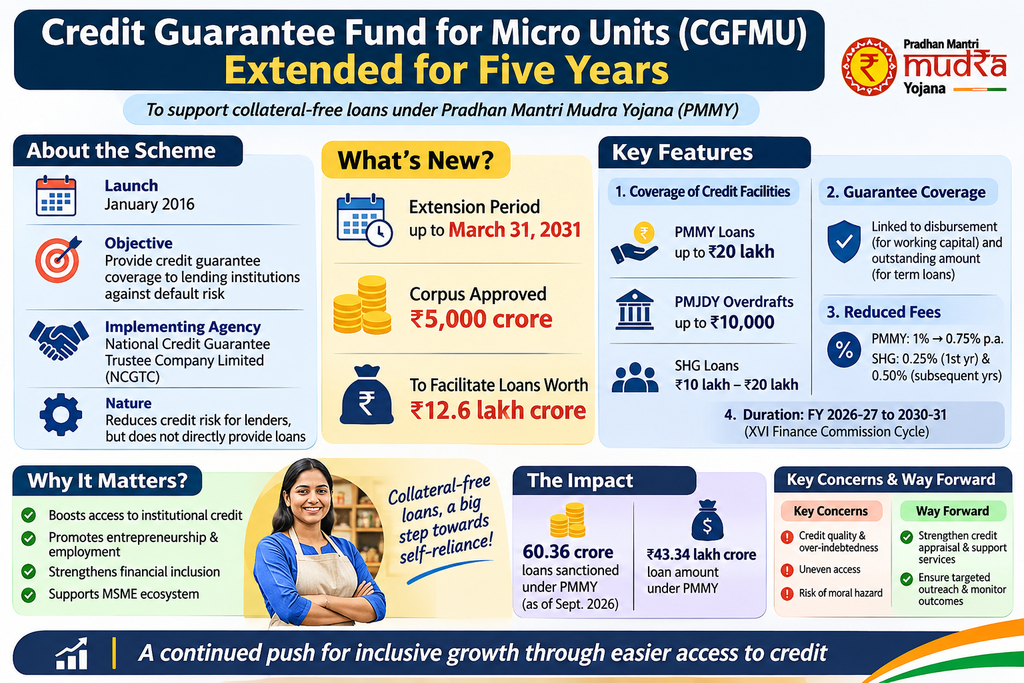

Credit Guarantee Fund for Micro Units Extended for Five Years

Open article →Download PDF

Why in News?

The Union Cabinet has approved the continuation of the Credit Guarantee Fund for Micro Units (CGFMU) for five years, up to March 31, 2031, with a corpus of ₹5,000 crore. The extension is expected to facilitate ₹12.6 lakh crore in loans, primarily under the Pradhan Mantri Mudra Yojana (PMMY).

UPSC Relevance: GS-3 Economy: Financial Inclusion; Government Schemes

Prelims: Credit Guarantee Fund for Micro Units

About the Credit Guarantee Fund for Micro Units (CGFMU):

  • Launch: 2016
  • Objective: To provide credit guarantee coverage to lending institutions against default risks on specified loans, thereby encouraging collateral-free lending to micro enterprises and underserved borrowers.
  • Implementing agency: National Credit Guarantee Trustee Company Limited (NCGTC), which manages the fund and provides guarantee coverage to eligible lending institutions.
  • Nature: It reduces the credit risk borne by lenders but does not directly provide loans to borrowers.

Salient Features of the Extended Scheme:

  • Coverage of Credit Facilities: The fund provides guarantees for the following:
    • Pradhan Mantri Mudra Yojana (PMMY): Loans of up to ₹20 lakh to eligible micro enterprises.
    • Pradhan Mantri Jan Dhan Yojana (PMJDY): Overdraft facilities of up to ₹10,000 in eligible accounts.
    • Self-Help Groups (SHGs): Loans where the portfolio size ranges between ₹10 lakh and ₹20 lakh.
  • Guarantee Coverage:
    • For working capital limits, guarantee coverage is linked to the disbursement amount.
    • For term loans, it is linked to the outstanding amount, reflecting the actual credit risk exposure of lending institutions.
  • Reduction in Guarantee Fees:
    • For PMMY-related credit facilities, the annual guarantee fee has been reduced from 1% to 0.75%.
    • For SHG loans, the existing fee structure continues: 0.25% in the first year and 0.50% in subsequent years.
  • Duration: The extended scheme will cover eligible loans sanctioned during the XVI Finance Commission Cycle (FY 2026-27 to FY 2030-31).
image 11

Significance of the Extension:

  • Improving credit access: Credit guarantees encourage banks and other lending institutions to extend loans to borrowers who lack collateral or an established credit history.
  • Promoting entrepreneurship: It can support first-generation entrepreneurs, small businesses and self-employed individuals who face difficulties accessing formal finance.
  • Employment generation: Greater access to microcredit can facilitate the establishment and expansion of small enterprises, generating local employment opportunities.
  • Financial inclusion: It complements financial inclusion initiatives such as PMJDY by facilitating access to productive credit beyond basic banking services.
  • Strengthening the MSME ecosystem: Improved access to institutional credit can reduce dependence on informal moneylenders and support the formalisation of micro enterprises.

Prelims Practice MCQ:

Q. With reference to the Credit Guarantee Fund for Micro Units (CGFMU), consider the following statements:

  1. It is a credit guarantee fund established to guarantee collateral-free credit facilities extended to micro units.
  2. The fund is managed and operated by the National Credit Guarantee Trustee Company Ltd. (NCGTC).

Which of the statements given above is/are correct?

(a) 1 only

(b) 2 only

(c) Both 1 and 2

(d) Neither 1 nor 2 

Answer: (c) 

Booker Prize 2026: M. John Harrison Wins for The End of Everything

Open article →Download PDF

Why in News?

British author M. John Harrison won the 2026 Booker Prize for fiction with his 13th novel, The End of Everything. He became the oldest winner in the history of the award.

UPSC Relevance: GS-1 Art and Culture: Literature, Awards and Honours 

Prelims: Booker Prize 2026 
image 12

About the Winning Novel:

  • The End of Everything is Harrison’s 13th novel and is published by the independent publisher Serpent’s Tail.
  • It depicts a post-apocalyptic Britain where mysterious entities called iGhetti, capable of imitating humans, appear after an unexplained catastrophe.
  • Through its dystopian setting, the novel explores:
    • Artificial intelligence and uncertainty about machine sentience.
    • Social collapse and the failure of conventional explanations.
    • Technology’s growing influence on everyday life.
    • Contemporary political and economic anxieties.

The novel reflects concerns about AI and the difficulty of distinguishing human understanding from technological simulation.

Key Facts about the Booker Prize: 

  • Established: 1969 in the United Kingdom
  • Awarding body: Booker Prize Foundation.
  • Eligibility: Open to authors of any nationality, provided the work is originally written in English and published in the UK and/or Ireland.
  • Award: £50,000 for the winner and £2,500 for each shortlisted author.
  • Historical change: Initially restricted to writers from the Commonwealth, Ireland and later Zimbabwe; opened to authors of all nationalities in 2014.
  • Previous Indian winners:
    • Arundhati Roy: The God of Small Things (1997).
    • Kiran Desai: The Inheritance of Loss (2006).
    • Aravind Adiga: The White Tiger (2008).

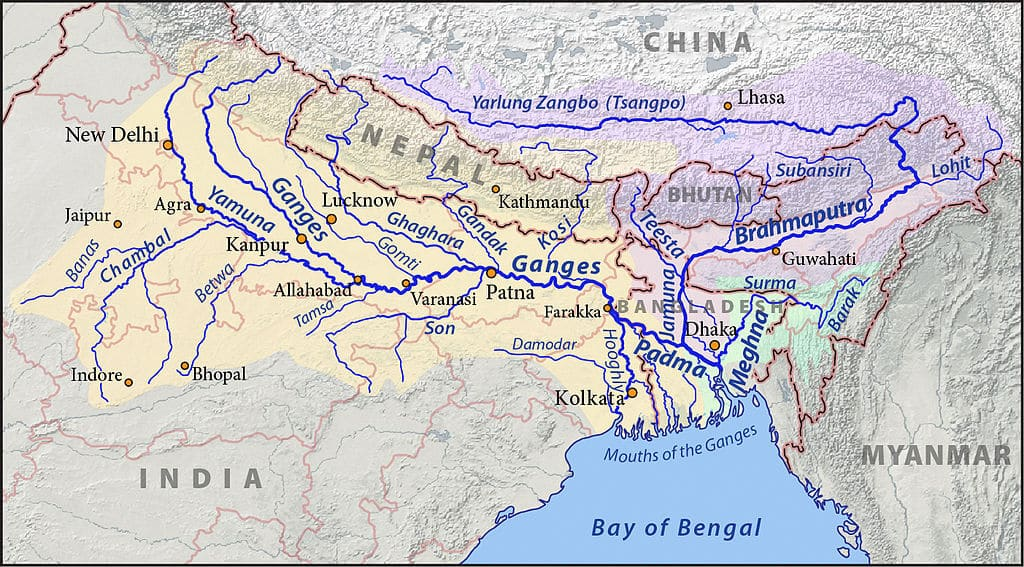
Dibang Multipurpose Project: Opposition over third mega dam project in Arunachal Pradesh

Open article →Download PDF

Why in News?

Downstream communities have intensified protests against the 2880 MW Dibang Multipurpose Project (DMP) in Arunachal Pradesh, demanding rehabilitation, flood protection and safety safeguards before its commissioning.

UPSC Relevance: GS-3 Environment & Biodiversity: Conservation; GS-3 Economy: Infrastructure 

Prelims: Dibang Multipurpose Project, Brahmaputra River system. 

About the Dibang Multipurpose Project:

  • Location: Lower Dibang Valley district, Arunachal Pradesh.
  • River: Dibang, a major tributary of the Brahmaputra.
  • Developer: NHPC Limited.
  • Installed capacity: 2880 MW.
  • Dam height: 278 metres, making it India’s tallest dam upon completion.
  • Project cost: Approximately ₹31,875 crore.
  • Expected commissioning: February 2032, as reported.

Significance of the Project:

  • Renewable energy: The project is expected to generate approximately 11,223 million units of electricity annually, strengthening India’s clean energy capacity.
  • Flood moderation: Its storage reservoir is designed to regulate monsoon flows and reduce downstream flood damage in Assam.
  • Regional development: It can generate employment, improve infrastructure and provide revenue to Arunachal Pradesh through free power and local development funds.

Why is the Project Facing Opposition?

  • Rehabilitation: Recognition of downstream families as Project Affected Families (PAFs), ensuring appropriate rehabilitation and compensation.
  • Downstream protection: Construction of guide walls, embankments and protection walls along vulnerable stretches of the Dibang River.
  • Dam safety: Safeguards against sudden water releases, dam failure and downstream flooding.

The Dibang Dam Assam-Arunachal Downstream Action Alliance has threatened to obstruct the transportation of construction materials and machinery if its demands remain unaddressed.

Major Environmental and Governance Concerns:

  • Downstream ecological impacts: Altered river flows, sediment transport and aquatic habitats can affect fisheries, agriculture and riverine ecosystems.
  • Geological vulnerability: The Eastern Himalayas are seismically active and geologically fragile. Large dams in the region require rigorous seismic risk assessment and dam-break analysis.
  • Biodiversity and forests: Large reservoirs and associated infrastructure can lead to forest submergence, habitat fragmentation and biodiversity loss.
  • Cumulative impact: Multiple hydropower projects in the Brahmaputra basin can collectively alter river ecology, sediment flows and downstream hydrology.
  • Inter-State coordination: Since the project is located in Arunachal Pradesh but has implications for downstream Assam, effective coordination and information-sharing between the two States are essential.

The Dibang project reflects the challenge of balancing hydropower development, flood management and ecological security in the Eastern Himalayas. 

The infrastructure development must therefore be founded on transparency, scientific assessment, meaningful community participation and respect for constitutional and statutory safeguards. 

Brahmaputra River System: 

The Brahmaputra is a transboundary river system shared by China, India and Bangladesh.

Course of the River:

  • Origin: The Yarlung Tsangpo originates in the Tibetan Plateau, near the Angsi Glacier in the vicinity of Mount Kailash.
  • Tibet: It flows eastwards across southern Tibet before making a dramatic horseshoe-shaped bend around the Namcha Barwa massif.
  • India:
    • Arunachal Pradesh: It enters India as the Siang (also called Dihang).
    • Assam: Siang joins the Dibang and Lohit rivers to form the Brahmaputra’s main channel.
  • Bangladesh: It enters Bangladesh as the Jamuna and eventually joins the Ganga-Padma system before draining into the Bay of Bengal.

Important Tributaries:

  • Left-Bank Tributaries (South Bank): Dibang, Lohit, Noa Dihing, Burhi Dihing, Disang, Dikhow (Dikhu), Dhansiri (South), Kopili, etc. 
  • Right-Bank Tributaries (North Bank): Subansiri (largest tributary of the Brahmaputra by volume), Ranganadi, Dikrong, Jia Bharali (Kameng), Dhansiri (North), Manas, Sankosh, Teesta  (joins in Bangladesh), etc. 
image 13

Mains Practice Question:

Q. Large hydropower projects in the Eastern Himalayas present both opportunities for regional development and challenges of ecological sustainability. Discuss with reference to the upcoming Hydropower Projects in Arunachal Pradesh. 

Practice Prelims MCQ:

Q. With reference to the Brahmaputra river system, consider the following statements:

  1. The Yarlung Tsangpo enters India through Arunachal Pradesh, where it is known as the Siang.
  2. The Brahmaputra is formed in Assam by the confluence of the Siang, Dibang and Lohit rivers.
  3. The Teesta is a tributary of the Brahmaputra system and joins the river in India.
  4. India and China have a comprehensive bilateral treaty governing the equitable sharing of Brahmaputra waters.

Which of the statements given above are correct?

(a) 1 and 2 only

(b) 1, 2 and 3 only

(c) 2, 3 and 4 only

(d) 1, 2, 3 and 4

Answer: (a) 

Explanation: 

  • Statement 3: Incorrect. The Teesta joins the Brahmaputra (Jamuna) in Bangladesh, not India.
  • Statement 4: Incorrect. No comprehensive bilateral water-sharing treaty exists between India and China.

UPSC PYQ 2017:

Q. With reference to river Teesta, consider the following statements: 

  1. The source of river Teesta is the same as that of Brahmaputra but it flows through Sikkim.  
  2. River Rangeet originates in Sikkim and it is a tributary of river Teesta.  
  3. River Teesta flows into Bay of Bengal on the border of India and Bangladesh.  

Which of the statements given above is/are correct?

(a) 1 and 3 only  

(b) 2 only  

(c) 2 and 3 only  

(d) 1, 2 and 3  

Answer: (b)

More women work, but in informal and less secure jobs

Open article →Download PDF

Why in News?

A 2026 ICRIER report, The Participation Paradox, highlights the growing participation of women in India’s workforce but raises concerns about the quality, security and remuneration of their employment.

Despite a near doubling of working women between 2017-18 and 2025, much of the increase has been concentrated in agriculture, informal employment and unpaid family work.

UPSC Relevance: GS-1 Indian Society: Role of Women; GS-2 Social Justice: Human Resources, Vulnerable Sections; GS-3 Economy: Employment; Inclusive Growth 

Mains: Women’s Employment Paradox

Key Findings: India’s Women’s Employment Paradox:

1. Rising employment, but limited structural transformation:

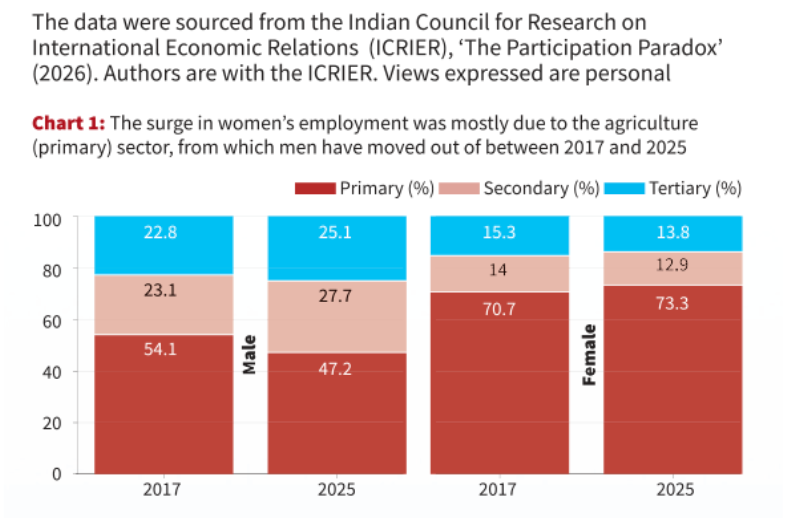
  • The number of working women nearly doubled from 104 million in 2017-18 to 201 million in 2025, while the female Worker Population Ratio (WPR) increased from 22% to 38%.
  • Women’s employment remains concentrated in agriculture. The share of women employed in the primary sector increased from 70.7% to 73.3% between 2017 and 2025.
    • In contrast, men’s dependence on agriculture declined from 54.1% to 47.2%, indicating gender differences in the pace of structural transformation.
image 15

2. Increasing informal and marginal employment:

  • Outside agriculture, women’s employment gains have largely occurred in garments, retail and construction, where informal and own-account work is prevalent.
    • Rural women’s participation in own-account work increased substantially, while the share of regular salaried employment declined from 10.5% to 9.3%.
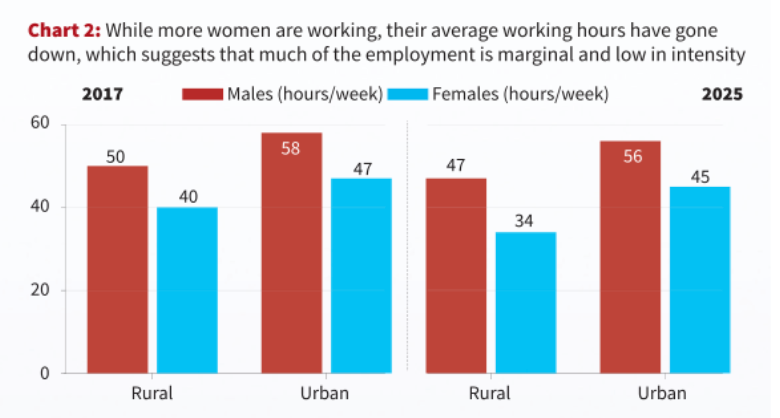
  • Despite rising workforce participation, average weekly working hours declined between 2017 and 2025. Rural women’s working hours fell from 40 to 34 hours, suggesting an increase in marginal or low-intensity employment.
  • In textiles and garments, widening gender gaps in working hours indicate the persistence of home-based, piece-rate and informal work rather than regular factory employment.
image 14

3. Persistent gender wage gap:

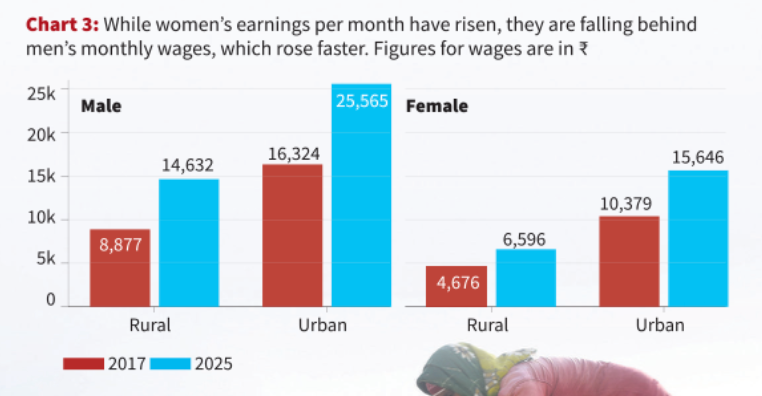
  • Women’s earnings have increased, but men’s wages have grown faster. In rural India, women earned approximately 45% of men’s monthly earnings in 2025, compared with 53% in 2017.
  • Significant hourly wage disparities persist in sectors employing large numbers of women, including tobacco manufacturing, education, textiles and crop production.
image 16

4. Disproportionate burden of unpaid care work:

  • According to the Time Use Survey 2024, women spend approximately 3.7 hours more per day on domestic work than men and nearly one additional hour on caregiving.
  • Even employed women continue to spend around four hours daily on domestic work and nearly two hours on care activities.
  • Around 60% of women citing reasons for not participating in the labour force identify childcare and household responsibilities, compared with less than 1% of men.

Major Challenges:

  • Occupational segregation: Women remain concentrated in low-productivity sectors and occupations with limited opportunities for career progression.
  • Informal Employment: Home-based work, unpaid family labour and self-employment often lack social security, stable incomes and employment protection.
  • Unpaid care economy: Unequal domestic responsibilities restrict women’s time, mobility and ability to undertake full-time paid employment.
  • Wage inequality: Gender-based wage disparities reflect occupational segregation, differences in working hours and unequal access to better-paying jobs.
  • Limited workplace infrastructure: Inadequate childcare facilities, safe transport, hostels and workplace flexibility constrain women’s access to formal employment.

Way Forward:

  • Strengthen care infrastructure: Expand affordable childcare facilities, crèches and elderly-care services. Promote paid paternity and shared parental leave to redistribute care responsibilities.
  • Promote formal employment: Encourage women’s recruitment in MSMEs and labour-intensive manufacturing through targeted incentives, better working conditions and access to social security.
  • Improve workplace infrastructure: Develop safe transport, working women’s hostels and childcare facilities in industrial clusters and textile parks.
  • Enhance rural livelihoods: Strengthen women’s self-help groups, producer organisations and rural enterprise clusters to create productive, remunerative employment closer to home.
  • Improve economic opportunities: Expand women’s access to credit, technology, market linkages, vocational training and digital skills.
  • Recognise unpaid work: Improve measurement and recognition of unpaid domestic and care work in economic policymaking.

India’s challenge is no longer merely to increase women’s workforce participation but to ensure that participation translates into productive, remunerative and secure employment. 

The focus must shift from counting women at work to improving the quality of their work while addressing the unequal distribution of unpaid care responsibilities.

Mains Practice Question:

Q. Despite rising women’s workforce participation in India, concerns regarding informalisation, wage inequality and unpaid care work persist. Examine the challenges and suggest measures to improve the quality of women’s employment.

Air pollution spikes 200 times above WHO limits in Delhi during Deepavali

Open article →Download PDF

Why in news?

PM2.5 in parts of Delhi crossed 150–200 times WHO limits after Deepavali, with data missing from several monitoring stations.

UPSC Relevance 

Prelims: AQI, PM2.5/PM10, WHO Air Quality Guidelines, NCAP, CAQM, GRAP, SAFAR, green crackers, Pusa decomposer. 

Mains, GS3 – Environmental pollution and degradation, conservation, agriculture (crop residue management). 

Air Pollution  

Air pollution is the presence of harmful substances in the air – gases, particles and biological matter – at levels that damage human health and the environment. The most dangerous pollutant for health is particulate matter (PM).

  • PM10 – particles of 10 micrometres or less; mostly dust, enter the nose and throat.
  • PM2.5 – fine particles of 2.5 micrometres or less (about 1/30th the width of a hair); enter deep into lungs and the bloodstream, causing heart and lung disease.
  • Other pollutants – nitrogen dioxide (vehicles), sulphur dioxide (coal), carbon monoxide, ground-level ozone, ammonia and lead.

Standards at a glance (µg/m³)

PollutantWHO Guidelines (2021)Indian NAAQS (2009)
PM2.5 – 24 hours1560
PM2.5 – Annual540
PM10 – 24 hours45100
PM10 – Annual1560

India’s standards are much looser than WHO’s and have not been revised since 2009. This is why Delhi can be ‘moderate’ on the Indian scale while being many times above WHO limits.

National Air Quality Index (AQI)

Launched in 2014, the AQI turns data on eight pollutants (PM10, PM2.5, NO2, SO2, CO, O3, NH3 and Pb) into one number and colour. The CPCB’s daily bulletin at 4 p.m. gives the 24-hour average, which is taken as the day’s AQI.

AQI rangeCategory
0–50Good
51–100Satisfactory
101–200Moderate
201–300Poor
301–400Very poor
401–500Severe

Why Delhi Chokes Every Winter 

Natural / meteorological factors

  • Temperature inversion – in winter, a layer of warm air sits over cold surface air and traps pollutants close to the ground. The mixing height of the air falls sharply.
  • Low wind speed – calm winds stop pollutants from dispersing.
  • Wind direction – north-westerly winds after the monsoon carry smoke from stubble burning in Punjab and Haryana.
  • Landlocked geography – Delhi lies in the Indo-Gangetic Plain, bounded by the Himalayas to the north, so pollution has no easy outlet.
  • Fog and moisture – particles mix with moisture to form smog.

Man-made factors

  • Vehicles – a major year-round source of PM2.5 and NO2; Delhi has one of the largest vehicle fleets in India.
  • Road and construction dust – the IIT Kanpur source apportionment study (2016) found dust and vehicles among the biggest contributors to Delhi’s particulate pollution.
  • Stubble burning – farmers burn paddy residue as the window before wheat sowing is short. Its share in Delhi’s PM2.5 varies daily – 5.1% on the day after Deepavali, but much higher on some peak days.
  • Firecrackers – release PM, metals and sulphur in a few hours, when weather is already unfavourable.
  • Industries and power plants – coal-based units in the NCR and nearby States.
  • Biomass and waste burning – burning of garbage, wood and coal for heating and cooking.

Other issues

  • Poor enforcement – firecrackers were burst well past the 10 p.m. deadline, and traditional crackers were sold despite the Supreme Court allowing only green crackers in fixed time windows.
  • Data gaps – several Continuous Ambient Air Quality Monitoring Stations (CAAQMS) did not report data at the peak hours. Missing peak values make the average look better than the reality.
  • Blame game – Delhi and Punjab governments blamed each other over missing data and stubble fires. Air pollution crosses State boundaries, so blame does not solve it – coordinated action does.
  • Episodic response – the issue gets attention only in October–November, while the sources work all year.

Impact of Air Pollution

  • Health – respiratory diseases, asthma, heart disease, stroke and lung cancer. A Lancet Planetary Health study estimated about 16.7 lakh deaths in India in 2019 due to air pollution.
  • Children and elderly – most vulnerable; children breathe faster and their lungs are still developing.
  • Economy – lost working days, medical costs, lower productivity and a negative image for investment and tourism.
  • Agriculture and environment – stubble burning kills soil microbes and nutrients; ozone reduces crop yields.
  • Inequality – the poor, outdoor workers and slum dwellers are most exposed and least protected.

Steps Taken

  • BS-VI fuel norms – India leapfrogged from BS-IV to BS-VI in April 2020.
  • Green crackers – developed by CSIR-NEERI; about 30% lower emissions; identified through a QR code.
  • Crop residue management – subsidised machines like Happy Seeder and Super SMS; IARI’s Pusa decomposer turns stubble into manure; co-firing of biomass pellets in thermal plants.
  • Clean energy – PM Ujjwala Yojana (LPG), FAME scheme for EVs, Eastern and Western Peripheral Expressways to divert trucks.
  • Delhi measures – odd-even scheme, smog towers, anti-dust campaigns and green war rooms.

Global Good Practices

City / CountryPractice
Beijing (China)Air Pollution Action Plan (2013) – coal-to-gas shift, closing polluting industries, regional coordination; PM2.5 fell sharply within five years
London (UK)Ultra Low Emission Zone (2019) – daily charge on polluting vehicles
Mexico City‘Hoy No Circula’ driving restrictions and a regional environmental commission
Los Angeles (US)South Coast Air Quality Management District – single regional authority with strong powers

Lesson: successful cities treated pollution as a regional, year-round problem with one empowered authority, clear targets and strict enforcement.

Way Forward

  • Airshed approach – manage air quality across the whole Indo-Gangetic Plain, not city by city.
  • Year-round action – shift from emergency GRAP measures to permanent control of vehicles, dust and industry.
  • Transparent data – audit monitoring stations, publish raw data, and use satellites to fill gaps.
  • Farmer-friendly solutions – crop diversification away from paddy, MSP support for alternate crops, and a market for stubble (biofuel, pellets, packaging).
  • Revise NAAQS – bring Indian standards closer to WHO 2021 guidelines in a phased manner.
  • Public transport and EVs – last-mile connectivity, more buses and electric mobility.
  • Cooperative federalism – Centre, Delhi, Punjab, Haryana and UP must work together through CAQM instead of blame.
  • Behaviour change – awareness on firecrackers, waste burning and the health cost of pollution.

Conclusion: Clean air is part of the right to life under Article 21. Delhi’s winter smog is not a seasonal accident but the result of year-round neglect. Science-based, regional and transparent governance is the only lasting answer.

Practice MCQ

Q1. Consider the following:

  1. Carbon monoxide
  2. Ammonia
  3. Lead
  4. Methane
  5. Ozone

How many of the above are included in the National Air Quality Index (AQI) of India?

(a) Only two     (b) Only three     (c) Only four     (d) All five

Answer: (c). The AQI covers eight pollutants: PM10, PM2.5, NO2, SO2, CO, O3, NH3 and Pb. Methane is a greenhouse gas but is not part of the AQI.

Q2. With reference to the Commission for Air Quality Management (CAQM), consider the following statements:

  1. It is a statutory body for the National Capital Region and adjoining areas.
  2. It replaced the Environment Pollution (Prevention and Control) Authority (EPCA).
  3. Its directions are only advisory and not binding on State governments.

Which of the statements given above are correct?

(a) 1 and 2 only     (b) 2 and 3 only     (c) 1 and 3 only     (d) 1, 2 and 3

Answer: (a). Statement 3 is incorrect. Under the CAQM Act, 2021, the Commission’s directions are binding, and non-compliance is punishable.

Mains Practice Question

Q. “Delhi’s winter air pollution is less a seasonal crisis and more a failure of year-round, regional governance.” Discuss the natural and man-made factors behind the problem and suggest an effective framework for clean air in the Indo-Gangetic Plain. (15 Marks, 250 words)

Protests in Kolhapur over Gokul Dairy board nominations; election for chairperson today

Open article →Download PDF

Why in news?

Maharashtra ordinance letting State nominate directors to large cooperatives, including Gokul Dairy, sparked protests. The Bombay High Court did not stay the ordinance. It allowed the chairperson election, but directed that votes of the four nominated directors be kept and counted separately.

The State says the ordinance is about better oversight of big cooperatives. Opposition parties and farmer groups call it interference in an elected body.

UPSC Relevance 

Prelims: 97th Constitutional Amendment, Part IXB, Article 43B, Multi-State Cooperative Societies Act, National Cooperative Policy 2025.

Mains GS2: Federalism and Centre-State relations; statutory and regulatory bodies; role of cooperatives and SHGs in development.

What is a Cooperative?

  • Meaning: An autonomous association of persons who come together voluntarily to meet common economic, social and cultural needs through a jointly owned and democratically controlled enterprise (International Cooperative Alliance).
  • Principles: Voluntary and open membership, democratic member control (one member, one vote), member economic participation, autonomy and independence, education and training, cooperation among cooperatives, and concern for community.
  • Scale in India: About 8.3 lakh cooperative societies with around 30 crore members, spread across credit, dairy, sugar, fertiliser, housing, fisheries and marketing.
  • Success stories: Amul (Anand pattern, Operation Flood), IFFCO and KRIBHCO (fertilisers), Maharashtra’s sugar cooperatives, Kerala’s credit societies.

Constitutional Provisions

Legislative competence

  • State List, Entry 32: Incorporation, regulation and winding up of cooperative societies. Each State has its own Cooperative Societies Act.
  • Union List, Entry 44: Covers corporations with objects not confined to one State. Multi-State Cooperative Societies are governed by the MSCS Act, 2002.
  • Banking: Banking is in the Union List (Entry 45), so cooperative banks are also regulated by the RBI under the Banking Regulation Act.

97th Constitutional Amendment Act, 2011 

ProvisionWhat it says
Article 19(1)(c)Right to form associations, unions “or co-operative societies” – made a Fundamental Right
Article 43B (DPSP)State shall promote voluntary formation, autonomous functioning, democratic control and professional management of cooperatives
Part IXB (Articles 243ZH to 243ZT)Framework for governance of cooperative societies

Key features of Part IXB

  • Board size: Maximum 21 directors.
  • Reservation: One seat for SC/ST and two seats for women on boards of societies having such members.
  • Term: Five years for elected members; elections must be held before the term ends, conducted by a body set up by the State law.
  • Co-opted members: The board can co-opt two experts in banking, management or finance, but they cannot vote in elections of office bearers.
  • Supersession: A board cannot be superseded or kept under suspension for more than six months (one year for cooperative banks).
  • Audit and accountability: Accounts to be audited within six months of the financial year; annual general body meeting; members’ right to information.

Union of India v. Rajendra N. Shah (2021)

  • The Supreme Court (2:1) struck down the parts of Part IXB that dealt with State cooperative societies.
  • Reason: Cooperatives are a State subject, so the amendment needed ratification by half the State legislatures under Article 368(2). This was not done.
  • Result: Part IXB now applies only to Multi-State Cooperative Societies and to cooperatives in Union Territories. The rights under Articles 19(1)(c) and 43B remain intact.
  • State laws, not Part IXB, now decide matters like nominated directors in State cooperatives. This has widened the scope for State control.

Legal and Institutional Framework

  • Multi-State Cooperative Societies (Amendment) Act, 2023: Cooperative Election Authority for free elections, Cooperative Ombudsman for member complaints, Cooperative Rehabilitation, Reconstruction and Development Fund for sick societies, reservation for women and SC/ST on boards, and stricter audit.
  • Banking Regulation (Amendment) Act, 2020: Brought urban and multi-state cooperative banks under closer RBI supervision after the PMC Bank crisis (2019).
  • Ministry of Cooperation (2021): Separate Union ministry to give policy focus under the slogan ‘Sahkar se Samriddhi’.
  • Key initiatives: Steps taken since 2021 include:
    • Model bye-laws for PACS (2023) to make them multipurpose, covering dairy, fisheries, storage, LPG and Jan Aushadhi outlets.
    • Computerisation of PACS and a National Cooperative Database.
    • World’s largest grain storage plan in the cooperative sector.
    • Three new national multi-state cooperatives for exports (NCEL), organic products (NCOL) and seeds (BBSSL).
    • Tribhuvan Sahkari University at Anand for cooperative education and training.
    • 2025 was observed as the UN International Year of Cooperatives.

National Cooperative Policy, 2025

  • Background: Launched in July 2025, it replaces the National Policy on Cooperatives, 2002. Drafted by a 48-member committee headed by former Union Minister Suresh Prabhu. It covers the period 2025 to 2045.
  • Six pillars: Strengthening foundations, promoting vibrancy, future-readiness, enhancing inclusivity and reach, entering new and emerging sectors, and engaging the young generation.

Key targets

TargetDetails
GDP contributionTriple the cooperative sector’s share in GDP by 2034
Number of cooperativesIncrease by 30%, from about 8.3 lakh to over 10.7 lakh
MembershipBring 50 crore citizens into active participation in cooperatives
Universal reachAt least one cooperative (PACS, dairy, fishery or multipurpose) in every village/panchayat
New sectorsTourism, taxi services, insurance, green energy and other emerging areas
InclusionGreater participation of women, SCs, STs and youth; cooperatives as a career option

Challenges Faced by Cooperatives

  • Politicisation: Large cooperatives, especially in sugar and dairy, often become political power centres. Control of boards is fought along party lines, as seen in the Gokul Dairy case.
  • Excessive State interference: Nomination of directors, supersession of boards, and control by Registrars weaken autonomy promised under Article 43B.
  • Elite capture: Rich and influential members dominate boards, while small farmers and producers have little say.
  • Weak governance and corruption: Irregular elections, poor audits, frauds and nepotism, as seen in several cooperative bank failures.
  • Financial weakness: Many PACS have low capital, high overdues and depend on refinance; a large number are dormant or loss-making.
  • Lack of professional management: Shortage of trained managers, technology and marketing skills.
  • Dual control of cooperative banks: Both the RBI and State Registrars regulate them, causing gaps in oversight.
  • Regional imbalance: The movement is strong in Maharashtra, Gujarat, Kerala and Karnataka, but weak in the North-East and eastern States.
  • Low member participation: Members are often passive; women and marginalised groups are under-represented.
  • Federal tension: A Union ministry for a State subject and Central schemes for PACS have raised concerns about centralisation, while States themselves are increasing control through laws and ordinances.

Committee Recommendations

CommitteeYearKey recommendations
All India Rural Credit Survey Committee (A.D. Gorwala)1954Famous line: “Co-operation has failed, but co-operation must succeed”; State partnership in cooperative credit
Choudhary Brahm Prakash Committee1991Model Cooperatives Act to reduce government control and ensure autonomy and democratic functioning
R. Gandhi Committee (RBI)2015Allow large urban cooperative banks to convert into Small Finance Banks; professional boards
N.S. Vishwanathan Committee (RBI)2021Four-tier regulatory structure for urban cooperative banks; umbrella organisation for UCBs

Way Forward

  • Respect autonomy: Limit State nominations to cases where the State has real financial stake, and keep nominees without voting rights in elections, in the spirit of Part IXB.
  • Model law for States: States may voluntarily adopt the core principles of Part IXB (fixed term, timely elections, limits on supersession) in their own Acts.
  • Independent election bodies: State Cooperative Election Authorities on the lines of the 2023 MSCS amendment.
  • Professionalise management: Trained CEOs, expert directors, digital accounts and regular audits.
  • Financial strength: Implement Vaidyanathan-type recapitalisation, revive dormant PACS and diversify their business.
  • Clear regulation of cooperative banks: Reduce dual control; RBI for banking functions, Registrars for administrative matters.
  • Inclusion: Reach uncovered villages, especially in eastern and north-eastern States; more women and youth on boards.
  • Cooperative federalism: Centre and States should work through consultation, since cooperatives are a State subject.
  • Member education: Awareness and training so that members actively take part and hold boards accountable.

Cooperatives work best when they are run by members, not by governments or political parties. Strong State support with minimum control is the balance India needs to achieve ‘Sahkar se Samriddhi’.

Practice MCQ

Q1. With reference to the 97th Constitutional Amendment Act, 2011, consider the following statements:

1. It made the right to form cooperative societies a part of Article 19(1)(c).

2. It inserted Article 43B in the Directive Principles of State Policy.

3. The Supreme Court in Union of India v. Rajendra N. Shah (2021) struck down Part IXB in its entirety.

How many of the above statements are correct?

(a) Only one     (b) Only two     (c) All three     (d) None

Answer: (b)

Explanation: Statement 3 is incorrect. The majority struck down only the provisions relating to State cooperative societies. Part IXB still applies to Multi-State Cooperative Societies.

Q2. Consider the following statements:

Statement-I: Part IXB of the Constitution continues to apply to Multi-State Cooperative Societies.

Statement-II: Parliament has the power to make laws on corporations whose objects are not confined to one State, so ratification by States was not needed for this part.

Which one of the following is correct in respect of the above statements?

(a) Both Statement-I and Statement-II are correct and Statement-II explains Statement-I

(b) Both Statement-I and Statement-II are correct but Statement-II does not explain Statement-I

(c) Statement-I is correct but Statement-II is incorrect

(d) Statement-I is incorrect but Statement-II is correct

Answer: (a)

Explanation: Multi-State cooperatives fall under Entry 44 of the Union List. Since Parliament is competent here, the Court saved Part IXB for them even though State ratification under Article 368(2) was not obtained.

Mains Practice Question

 “Cooperatives in India suffer less from lack of State support than from excess of State control.” Examine this statement in the light of constitutional provisions on cooperatives and suggest measures to make them autonomous and democratic. (15 Marks, 250 words)

India raises fertilizer subsidy by 64%, overshoots Budget estimates

Open article →Download PDF

Why in news?

Cabinet approved ₹62,370 crore subsidy for Rabi 2026-27, 64% above last Rabi, as Iran war raised urea and LNG prices. Economists estimate the fiscal deficit could rise by up to 0.3% of GDP because of this overshoot.

UPSC Relevance 

Prelims: Nutrient Based Subsidy (NBS), urea pricing, neem-coated urea, nano urea, DBT in fertilizers, PM-PRANAM, One Nation One Fertiliser.

Mains GS-3: Issues related to direct and indirect farm subsidies; Government budgeting; Mobilisation of resources; Conservation and environmental degradation (soil health).

Fertilizer subsidy – what it is and how it works

Fertilizer subsidy is the money the Centre pays to manufacturers and importers so that farmers can buy fertilizers below their actual cost. The farmer never gets this money directly. It is paid to companies after the bag is sold to a farmer through a Point of Sale (PoS) machine.

There are two separate systems, and most of the problems in this sector come from the difference between them.

BasisUreaP&K fertilizers (DAP, MOP, NPK complexes)
PricingPrice fixed by Centre. MRP ₹242 per 45 kg bag (excluding neem coating charge and taxes), almost unchanged for over a decadeUnder Nutrient Based Subsidy (since April 2010). Companies fix MRP, but the Centre informally keeps it in check
SubsidyVariable – difference between cost of production/import and fixed MRP. Any rise in gas or import price is fully borne by the governmentFixed rate per kg of nutrient (N, P, K, S), announced every Kharif and Rabi season
Share in subsidy (FY27 BE)About ₹1.17 lakh crore out of ₹1.71 lakh crore₹54,000 crore budgeted

Why the subsidy is needed

  • Food security: Chemical fertilizers were central to the Green Revolution. Without affordable nutrients, yields of rice and wheat – the base of the PDS – would fall.
  • Protecting small farmers: Over 85% of Indian landholdings are small and marginal. A sudden jump in fertilizer prices would push many into debt or force them to under-apply.
  • Shock absorber: When global prices spike (2022, 2026), the subsidy keeps farm-gate prices stable, so the shock does not hit the farmer directly.
  • Checking food inflation: Fertilizer is a key input cost. Higher input cost quickly turns into higher MSP demands and food prices.
  • Keeping domestic industry viable: Gas-based urea plants cannot compete with imports without assured subsidy support.

Challenges and issues

  • Fiscal unpredictability: Budget estimates are routinely overshot. Since the urea subsidy is open-ended, the government cannot control the final bill.
  • Skewed NPK ratio: The recommended N:P:K ratio is about 4:2:1. Because urea is kept artificially cheap while P&K prices are freer, farmers overuse urea. The ratio is badly distorted, more so in Punjab, Haryana and western UP.
  • Soil health and falling efficiency: Overuse of nitrogen, neglect of potash, sulphur and micronutrients (zinc, boron) has reduced soil organic carbon. Crops respond less to each extra kg of fertilizer. Only about a third of applied nitrogen is actually used by the crop.
  • Environmental cost: Excess nitrogen leaches into groundwater as nitrates and escapes as nitrous oxide, a greenhouse gas nearly 300 times more potent than CO₂.
  • Diversion and smuggling: Cheap urea gets diverted to plywood, resin, paint and even milk adulteration, and is smuggled to Nepal and Bangladesh.
  • Import dependence and geopolitics: LNG from West Asia, potash from Canada, Russia and Belarus, phosphates from Morocco, Jordan and China. Wars, sanctions and Chinese export curbs directly raise India’s bill.
  • Inequitable benefit: Subsidy follows usage. Larger farmers in irrigated, high-input regions get a bigger share than rainfed small farmers.
  • Crowding out investment: Money spent on input subsidy leaves less for irrigation, research, storage and extension, which give higher long-term returns.
  • Payment delays: When allocations run out mid-year, subsidy arrears to companies pile up and are rolled over to the next year.

Steps taken by the government to reduce the burden

MeasureWhat it does
Nutrient Based Subsidy (2010)Fixed per-kg subsidy for P&K so that the government’s liability is capped
100% Neem-coated urea (2015)Makes urea unfit for industrial use (curbs diversion) and slows nitrogen release
New Urea Policy 2015 and Gas PoolingEnergy efficiency norms for plants; uniform gas price for all urea units
DBT in fertilizers (pan-India 2018)Subsidy released only after Aadhaar-linked sale on PoS machines; better tracking of buyers
One Nation One Fertiliser (2022)Single ‘Bharat’ brand to cut cross-hauling and freight subsidy; retail shops turned into PM Kisan Samriddhi Kendras
Nano urea and nano DAP (IFFCO)Liquid fertilizers meant to replace part of bagged urea and DAP and cut imports
PM-PRANAM (2023)States that reduce chemical fertilizer use get 50% of the subsidy saved as a grant
Soil Health Card (2015)Soil testing-based fertilizer advice to farmers
Market Development Assistance for Fermented Organic Manure (2023)₹1,500 per tonne support to organic manure from GOBARdhan plants
National Mission on Natural Farming (2024)Promotes chemical-free farming in clusters to reduce input dependence

Assessment: These steps have improved tracking and reduced diversion to some extent. But the core design problem – fixed urea price with open-ended subsidy – has not been touched. 

Committee recommendations

  • Shanta Kumar Committee (2015): Recommended paying fertilizer subsidy directly to farmers as cash (around ₹7,000 per hectare) and decontrolling fertilizer prices.
  • Economic Survey 2015-16: Flagged large leakages of urea through diversion and smuggling. Suggested bringing urea under NBS-type decontrol and using JAM (Jan Dhan-Aadhaar-Mobile) for direct transfers.
  • Ashok Dalwai Committee on Doubling Farmers’ Income (2018): Stressed balanced nutrient use, soil health and cutting input costs through efficiency rather than higher subsidy.
  • Parliamentary Standing Committee on Chemicals and Fertilizers: Has repeatedly asked for realistic budgeting, timely release of subsidy, lower import dependence and wider use of organic and bio-fertilizers.

Case studies 

  • Sri Lanka (2021) – how not to do it: An overnight ban on chemical fertilizers led to a sharp fall in rice and tea output, food shortages and contributed to the economic crisis. Lesson: transition must be gradual and backed by science.
  • China – Zero Growth Action Plan (2015): Targeted zero growth in fertilizer use by 2020 through soil testing and precision application. Fertilizer use peaked and started declining without hurting grain output.
  • Andhra Pradesh Community Managed Natural Farming (APCNF): Covers lakhs of farmers. Shows lower input costs are possible, though long-term yield data is still being studied.
  • Punjab: India’s most input-intensive state. High nitrogen use has been linked to nitrate contamination in groundwater and declining soil organic carbon.
  • Talcher Fertilizers (Odisha): Uses domestic coal gasification instead of imported LNG – a model for reducing dependence on gas imports.

Way forward

  • Gradual urea reform: Bring urea under NBS in phases, starting with a modest price revision, so that the urea-P&K price gap narrows and nutrient balance improves.
  • Direct cash transfer to farmers: Once land records are digitised and linked, shift to per-hectare transfers as suggested by the Shanta Kumar Committee, with a way to include tenant farmers.
  • Soil-test-based use: Make Soil Health Card advice actionable through PoS machines, customised and fortified fertilizers, and drone-based precision spraying.
  • Secure supplies: Long-term import contracts, overseas mining stakes (phosphate and potash), strategic buffer stocks and a price stabilisation mechanism.
  • Domestic alternatives: Coal gasification and green ammonia under the National Green Hydrogen Mission to cut LNG dependence.
  • Independent evaluation: Large multi-location trials of nano fertilizers before scaling them up.
  • Balanced approach to natural farming: Promote it first in rainfed and tribal areas where chemical use is already low, as the Sri Lanka example warns against a sudden shift.
  • Realistic budgeting: Build global price scenarios into budget estimates to avoid repeated mid-year overshoots.

The fertilizer subsidy is unlikely to go away, and it should not, given its role in food security. The real task is to make every rupee of subsidy buy more soil health and productivity, rather than just cheaper urea.

Practice MCQ 

Q1. Consider the following statements regarding fertilizer subsidy in India:

1. Under the Nutrient Based Subsidy scheme, a fixed subsidy is given per kg of nutrients such as nitrogen, phosphorus, potash and sulphur.

2. Urea has been covered under the Nutrient Based Subsidy scheme since its launch in 2010.

3. Subsidy is released to fertilizer companies on the basis of sales to farmers recorded on Point of Sale devices.

How many of the above statements are correct?

(a) Only one     (b) Only two     (c) All three     (d) None

Answer: (b)

Explanation: Statement 2 is incorrect. Urea is outside NBS; its MRP is fixed by the Centre and the subsidy is the difference between cost and MRP. Statements 1 and 3 are correct.

Q2. Consider the following statements:

Statement-I: Neem coating of urea has helped reduce the diversion of subsidised urea for non-agricultural purposes.

Statement-II: Neem coating slows down the release of nitrogen in the soil, improving nitrogen use efficiency.

Which one of the following is correct in respect of the above statements?

(a) Both Statement-I and Statement-II are correct and Statement-II explains Statement-I

(b) Both Statement-I and Statement-II are correct, but Statement-II does not explain Statement-I

(c) Statement-I is correct, but Statement-II is incorrect

(d) Statement-I is incorrect, but Statement-II is correct

Answer: (b)

Explanation: Both are correct. Diversion fell because neem-coated urea is unsuitable for industrial uses like resin and plywood, not because of slower nitrogen release. So Statement-II does not explain Statement-I.

Mains Practice Question 

“Fertilizer subsidy in India has protected farmers from global price shocks, but at the cost of fiscal stability and soil health.” Critically examine this statement and suggest reforms needed in the fertilizer subsidy regime. (15 marks, 250 words)

SC and the OBC creamy layer test

Open article →Download PDF

Why in news?

Supreme Court reaffirmed that parental salary alone cannot decide OBC creamy layer status; ruling will apply to CSE 2025 allocation.

UPSC Relevance  

Prelims: Creamy layer, Indra Sawhney judgment, Articles 15(4), 16(4), 340 and 338B, NCBC, Rohini Commission.

Mains GS-2: Indian Constitution – significant provisions; Welfare schemes and mechanisms for vulnerable sections.

Creamy layer – meaning and origin

  • Meaning: The ‘creamy layer’ refers to the socially and economically advanced members of the OBCs who are excluded from reservation benefits. The idea is that benefits should reach those who are still backward, not those who have already moved ahead.
  • Origin: The concept was laid down by the nine-judge bench in Indra Sawhney v. Union of India (1992), which upheld 27% OBC reservation in central government jobs (based on the Mandal Commission) but directed that the creamy layer be excluded.
  • Implementation: Following the judgment, an expert committee headed by Justice R.N. Prasad suggested the criteria. These were notified through the DoPT Office Memorandum of 8 September 1993, which still forms the basis of creamy layer determination.
  • Constitutional basis: Article 15(4) and 15(5) (special provisions in education), Article 16(4) (reservation in public employment), Article 340 (commission to investigate backward classes), Article 338B (National Commission for Backward Classes).

The 1993 Office Memorandum – how creamy layer is decided

The 1993 OM uses a set of categories. A candidate falls in the creamy layer if the parents fall in any of these:

CategoryWho is excluded (creamy layer)
Constitutional postsChildren of persons holding posts like President, judges of SC/HC, UPSC and State PSC members, CAG etc.
Service categoryChildren of Group A officers (directly recruited) and children of parents who are both Group B officers, among others
Armed forcesChildren of officers of the rank of Colonel and above (and equivalent in Navy and Air Force)
Professionals and businessDoctors, lawyers, chartered accountants, traders etc. – covered through the income/wealth test
Property ownersFamilies owning agricultural land or vacant land/buildings above specified limits
Income/Wealth testGross annual income above ₹8 lakh for three consecutive years. Salary and agricultural income are not counted in this test
  • Key point: Salary matters only through the ‘status’ of the post (Group A, Group B etc.), not through the amount of salary. A Group C employee earning a high salary is still not creamy layer on the basis of salary.
  • Income limit revisions: ₹1 lakh (1993) → ₹2.5 lakh (2004) → ₹4.5 lakh (2008) → ₹6 lakh (2013) → ₹8 lakh (2017). It has not been revised since 2017.
  • 2004 clarification: For employees of PSUs, banks and private organisations where post equivalence with government posts was not established, DoPT said the income test would apply – and in practice it started including their salary.

Significance of the ruling

  • Upholds the original intent: Creamy layer is about social advancement, not just a salary figure. Children of lower-grade employees are not automatically ‘advanced’.
  • Equal treatment: Ends the anomaly where a government Group C employee’s child was NCL but a PSU employee’s child at a similar level was treated as creamy layer.
  • Limits on executive clarifications: An administrative letter cannot change the substance of a policy framework.
  • Balances certainty: By not reopening past selections, the Court avoided disturbing settled appointments and seniority.

Issues and challenges with the creamy layer framework

  • Outdated income limit: ₹8 lakh has not been revised since 2017 despite inflation, while DoPT’s own norm suggested revision every three years.
  • Lack of post equivalence: Equivalence of posts in PSUs, banks, universities and private sector with government posts is still incomplete, leading to arbitrary decisions.
  • Exclusion of salary – debated: Critics say a family with high salary income may still enjoy NCL benefits. Supporters say status, not income, captures social advancement.
  • Benefits captured by a few castes: The Rohini Commission (2017, report submitted 2023) examined sub-categorisation of OBCs as data suggested a small number of castes take a large share of benefits.
  • Certificate misuse: Cases of fake NCL certificates (including in civil services) have raised questions on verification.
  • Litigation and delay: Repeated court cases delay appointments and service allocation, causing uncertainty for candidates.
  • Unfilled vacancies: Strict or unclear criteria sometimes leave reserved seats vacant.

Committees and related judgments

Committee / CaseKey point
Mandal Commission (1980)Recommended 27% reservation for OBCs in central jobs; implemented in 1990
Indra Sawhney (1992)Upheld OBC reservation; creamy layer exclusion; 50% ceiling; no reservation in promotions
Justice R.N. Prasad Committee (1993)Framed creamy layer criteria adopted in the 1993 OM
Indra Sawhney II (2000)Struck down Kerala’s attempt to not identify creamy layer; exclusion is a constitutional requirement
Ashoka Kumar Thakur (2008)Upheld OBC reservation in central educational institutions with creamy layer exclusion
B.P. Sharma Committee (2019)Suggested including salary in income for creamy layer calculation; not implemented after opposition
Rohini Commission (2017-2023)Sub-categorisation of central OBC list for fairer distribution of benefits
Jarnail Singh (2018) and Davinder Singh (2024)Creamy layer can apply to SC/ST in promotions; several judges in 2024 suggested a creamy layer for SC/ST too

Case example

  • CSE candidates and PSU parents: A candidate whose father worked in a mid-level PSU post with a salary above ₹8 lakh was denied OBC-NCL, while a candidate whose father held a similar government post was not. This is exactly the unequal treatment the Court corrected.
  • Kerala (Indra Sawhney II): Kerala’s law declaring that no creamy layer existed among its backward classes was struck down – showing the creamy layer is not optional.

Way forward

  • Complete post equivalence quickly: DoPT should finalise equivalence of PSU, bank, university and autonomous body posts with government posts in a time-bound manner.
  • Regular revision of income limit: Link the limit to inflation or a fixed review cycle.
  • Clear and consolidated rules: Issue one updated, comprehensive guideline instead of scattered clarifications.
  • Act on Rohini Commission findings: Sub-categorisation can ensure benefits reach the most backward among OBCs.
  • Better verification: Digitised income and service records to cut down fake certificates.
  • Caste-wise data: Updated data on social and economic status of OBC communities for evidence-based policy.

The creamy layer is meant to make reservation reach those who still need it. The ruling restores the original logic of the 1993 framework, but the larger task of updating the criteria remains with the government.

Practice MCQ 

Q1. Consider the following statements regarding the creamy layer among OBCs:

1. The concept of creamy layer was laid down by the Supreme Court in the Indra Sawhney case.

2. Under the 1993 Office Memorandum, salary income of parents is included in the income/wealth test.

3. The current income limit of ₹8 lakh was fixed through a constitutional amendment.

How many of the above statements are correct?

(a) Only one    

(b) Only two     

(c) All three     

(d) None

Answer: (a)

Explanation: Only Statement 1 is correct. Salary and agricultural income are kept outside the income/wealth test. The income limit is revised through executive orders (DoPT), not constitutional amendments.

Q2. Consider the following statements:

Statement-I: Under the 1993 Office Memorandum, creamy layer status of children of government employees depends on the category of the parent’s post rather than the amount of salary.

Statement-II: Advancement within the government service hierarchy is treated as an indicator of social progression.

Which one of the following is correct in respect of the above statements?

(a) Both Statement-I and Statement-II are correct and Statement-II explains Statement-I

(b) Both Statement-I and Statement-II are correct, but Statement-II does not explain Statement-I

(c) Statement-I is correct, but Statement-II is incorrect

(d) Statement-I is incorrect, but Statement-II is correct

Answer: (a)

Explanation: The Supreme Court described the criteria as status-based because rising in the service hierarchy reflects social advancement. That is why the post category, not salary, decides creamy layer status.

Mains Practice Question 

“The creamy layer principle is meant to ensure that reservation benefits reach the truly backward.” In the light of the recent Supreme Court ruling on determining OBC creamy layer status, discuss whether the existing criteria need revision. (15 marks, 250 words)

Union govt. simplifies visa norms; categories cut, forms to be leaner

Open article →Download PDF

Why in news?

MHA has cut visa categories from 13 to 9, renamed Tourist Visa as ‘Visitor Visa’ and trimmed forms by 65–70%.

UPSC Relevance

Prelims: Visa categories and new changes, e-Visa, Immigration and Foreigners Act 2025, constitutional provisions on aliens, OCI, Bureau of Immigration.

Visa: Basic Concepts

  • Visa: Permission given by a country to a foreign national to enter, stay for a fixed period and for a fixed purpose. It does not guarantee entry – the immigration officer at the port of entry takes the final call.
  • Passport vs Visa: A passport is issued by one’s own country and proves identity and nationality. A visa is issued by the country one wants to visit.
  • Who handles what in India: Visa policy and immigration – Ministry of Home Affairs (Foreigners Division). Passports for Indians – Ministry of External Affairs under the Passports Act, 1967. Visas are physically issued by Indian Missions abroad, and e-Visas online.
  • Bureau of Immigration (BoI): Handles immigration checks at airports, seaports and land checkposts. Foreigners Regional Registration Offices (FRROs) handle registration and extension of stay (online through e-FRRO).
  • No visa needed: Citizens of Nepal and Bhutan do not need a visa to enter India (they need valid ID when coming from places other than their own country).

What Has Changed? 

FeatureEarlierNow (2026)
Main visa categories22 (before Oct 2025), then 139
Sub-categories63 (before Oct 2025), then 4923
Tourist VisaOnly for tourismRenamed ‘Visitor Visa’ with wider permitted purposes
Application formLengthy, many columnsFields cut by 65–70%
Visa for foreign technical expertsNo specific categoryProduction Investment Business Visa
Rollout–Visas as per new system by end of 2026; IT systems being updated

The rationalisation is happening in two rounds – October 2025 and August 27, 2026. The MHA says it studied visa systems of developed countries and global standards before making the changes.

New Visa Structure 

VisaCoversValidity / Entries
Visitor Visa (V-1)Tourism plus business meetings, medical consultations, wellness retreats, short medical treatment, short courses in Indian languages, music, art and craft30 days, multiple entries
Visitor Visa (V-2)Longer visits – all V-1 activities plus mountaineering1, 5 or 10 years
Medical Visa (M-1)Treatment under conventional (allopathic) medicine1 year (default), multiple entries
Medical Visa (M-3)Treatment under AYUSH systems1 year (default), multiple entries
Medical Attendant VisaFor persons accompanying the patientLinked to the medical visa
Production Investment Business VisaForeign specialists, engineers, technicians working with firms on installation, commissioning, quality checks, maintenance, production, IT, training, supply chain, plant design, senior management, transfer of know-howAs per category rules

Note: M-1 and M-3 visas, including their e-Visa versions, will be granted for one year by default.

e-Visa 

  • Launched in 2014 as ‘Tourist Visa on Arrival enabled with Electronic Travel Authorisation (ETA)’; later renamed e-Visa and split into categories like e-Tourist, e-Business, e-Medical, e-Conference etc.
  • Processed through Electronic Travel Authorisation (ETA) under 13 sub-categories at present.
  • Available to nationals of 172 countries.
  • Entry allowed only through designated airports and seaports; applicant gets approval online before travel.
  • Global practice: Similar online pre-travel authorisations exist elsewhere – ESTA (USA), ETA (UK) and ETIAS (European Union).

Constitutional provisions

  • Union List, Entry 17: Citizenship, naturalisation and aliens.
  • Union List, Entry 19: Admission into, emigration and expulsion from India; passports and visas.
  • So only Parliament can make laws on visas and foreigners. 

Practice MCQ

Q1. Consider the following statements regarding the recent changes in India’s visa regime:

1. The Tourist Visa has been renamed as Visitor Visa, and its V-1 sub-category also allows short-duration medical treatment.

2. Treatment under AYUSH systems is covered under a separate visa within the Medical Visa framework.

3. The e-Visa facility is available to nationals of all countries except those sharing land borders with India.

How many of the statements given above are correct?

(a) Only one     (b) Only two     (c) All three     (d) None

Answer: (b). Statement 3 is incorrect – e-Visa is available to nationals of 172 countries; it is not based on sharing land borders.

Q2. With reference to the Immigration and Foreigners Act, 2025, consider the following statements:

1. It has replaced the Foreigners Act, 1946 and the Passport (Entry into India) Act, 1920.

2. ‘Passports and visas’ is a subject in the Concurrent List, so States can also legislate on it.

3. It gives statutory status to the Bureau of Immigration.

Which of the statements given above are correct?

(a) 1 and 2 only     (b) 1 and 3 only     (c) 2 and 3 only     (d) 1, 2 and 3

Answer: (b). Statement 2 is incorrect – ‘Passports and visas’ is in Entry 19 of the Union List.

New deal: Nations must deliver on past promises before committing to lofty climate goals

Open article →Download PDF

Why in news?

COP31 has begun in Antalya, Türkiye, amid weak attendance, finance shortfalls and disputes over new targets versus past promises.

UPSC Relevance

Prelims: UNFCCC, COP, Paris Agreement, NCQG, Global Stocktake, Loss and Damage Fund, IPCC, India’s NDC.

Mains: GS3 – Conservation, environmental pollution and degradation, Climate change. 

The Climate Negotiation Framework

  • UNFCCC: Adopted at the Rio Earth Summit, 1992; in force from 1994. 198 Parties. Based on ‘Common But Differentiated Responsibilities and Respective Capabilities’ (CBDR-RC).
  • COP: Conference of the Parties – the supreme decision-making body of the UNFCCC, meets every year. Decisions are taken by consensus.
  • Paris Agreement (2015): Aims to keep warming well below 2°C and pursue 1.5°C. Countries set their own targets through Nationally Determined Contributions (NDCs), updated every 5 years.
  • COP31 arrangement: Hosted by Türkiye (Antalya) with negotiations presided over by Australia – an unusual shared arrangement. Pre-COP meetings were held in the Pacific (Fiji and Tuvalu) to highlight small island vulnerability.

Recent COPs at a glance

COPVenueKey outcome
COP26 (2021)Glasgow, UK‘Phase down’ of unabated coal; India announced net zero by 2070
COP27 (2022)Sharm el-Sheikh, EgyptAgreement to set up a Loss and Damage Fund
COP28 (2023)Dubai, UAEFirst Global Stocktake; call for ‘transitioning away from fossil fuels’; tripling renewables and doubling energy efficiency by 2030; Loss and Damage Fund operationalised
COP29 (2024)Baku, AzerbaijanNew Collective Quantified Goal (NCQG): $300 billion a year by 2035, led by developed countries; Article 6 carbon market rules finalised
COP30 (2025)Belém, BrazilCall to triple adaptation finance by 2035; no formal roadmap away from fossil fuels
COP31 (2026)Antalya, TürkiyeSecond Global Stocktake begins; electrification target proposed by presidency

Why Past Promises Remain Undelivered

  • History of missed targets: The $100 billion a year promise made in Copenhagen (2009) for 2020 was met only in 2022, two years late, and much of it came as loans.
  • Loans over grants: A large share of climate finance comes as loans, adding to the debt burden of poor countries.
  • Geopolitical stress: The West Asia war, the US withdrawal from the Paris Agreement and economic strain in Europe have shrunk budgets for climate aid.
  • Vague targets: The NCQG counts finance ‘from a wide variety of sources’, including private money, making accountability difficult.
  • Adaptation neglected: Most finance goes to mitigation projects with returns, while adaptation (seawalls, drought-resistant farming) gets less.
  • Consensus decision-making: Any country can block ambitious language, leading to diluted outcomes.

The Debate: New Targets vs Delivering Old Promises

Case for new, ambitious targetsCase for delivering past promises first
Emissions are still rising; 1.5°C is slipping awayNew targets without money lose credibility
Clear sectoral goals (like electrification) guide investmentUniform targets ignore national circumstances and development needs
Keeps political momentum aliveTrust deficit between North and South is the biggest barrier
Small islands want urgent actionParis model is ‘nationally determined’, not top-down

India’s Position

  • Equity and CBDR: Developed countries caused most historical emissions and must lead in cutting emissions and providing finance (Article 9.1 of Paris Agreement).
  • Predictable finance and technology transfer: Finance must be public, grant-based and predictable, not mainly private loans.
  • Against top-down targets: India declined the electrification pledge, just as it earlier stayed away from the global methane pledge and the COP28 renewable tripling pledge, preferring nationally determined pathways.
  • Against unilateral trade measures: Opposes measures like the EU’s Carbon Border Adjustment Mechanism (CBAM) as disguised trade barriers.
  • Its own commitments: Updated NDC (2022) – reduce emissions intensity of GDP by 45% by 2030 from 2005 levels; 50% installed power capacity from non-fossil sources by 2030 (crossed in 2025); net zero by 2070; Mission LiFE.
  • Leadership: International Solar Alliance, CDRI, Global Biofuels Alliance; India has offered to host COP33 in 2028.

Implications for India

  • India’s energy transition needs huge investment; weak global finance raises the cost of capital for renewables.
  • Rising heatwaves, floods and glacial melt make adaptation finance vital for India’s farmers and coastal communities.
  • Pressure to accept sectoral targets may limit policy space for development and energy security, as coal still meets most power demand.
  • Global South leadership: India can bridge the gap between small islands, LDCs and large emerging economies.

Way Forward

  • Clear finance roadmap: Define how much of the $300 billion will be public grants, with a yearly tracking mechanism.
  • Adaptation first: Ring-fence adaptation finance and simplify access for vulnerable countries.
  • Reform of MDBs: Multilateral development banks should give more concessional and long-tenure finance.
  • Strengthen Loss and Damage Fund: Through innovative sources like levies on aviation, shipping or fossil fuel windfall profits.
  • Science-backed stocktake: IPCC timelines should align with the Global Stocktake so decisions are based on latest evidence.
  • Trust building: Delivery on old promises will make countries more willing to raise ambition in their NDCs.

Practice MCQ

Q1. With reference to international climate negotiations, consider the following pairs:

ConferenceOutcome
1. COP27, Sharm el-SheikhAgreement to set up the Loss and Damage Fund
2. COP28, DubaiConclusion of the first Global Stocktake
3. COP29, BakuNet zero target by 2070 announced by India

How many of the pairs given above are correctly matched?

(a) Only one     (b) Only two     (c) All three     (d) None

Answer: (b). Pair 3 is incorrect – India announced net zero by 2070 at COP26, Glasgow (2021). COP29 adopted the NCQG.

Q2. Consider the following statements:

Statement-I: The Global Stocktake under the Paris Agreement is held every five years to assess collective progress towards its long-term goals.

Statement-II: Under the Paris Agreement, emission reduction targets of each country are fixed by the Conference of the Parties.

Which one of the following is correct in respect of the above statements?

(a) Both Statement-I and Statement-II are correct and Statement-II explains Statement-I

(b) Both Statement-I and Statement-II are correct but Statement-II does not explain Statement-I

(c) Statement-I is correct but Statement-II is incorrect

(d) Statement-I is incorrect but Statement-II is correct

Answer: (c). Targets under the Paris Agreement are nationally determined (NDCs), not fixed by the COP.

Mains Practice Question

“The credibility of global climate governance depends less on announcing new targets and more on delivering past promises.” Examine this statement in the context of recent COP negotiations and India’s position on climate finance. (15 Marks, 250 words)

Why did Ladakh groups decry the announcement of polls?

Open article →Download PDF

Why in news?

Ladakh announced panchayat, municipal and hill council polls; the Leh Apex Body (LAB) and the Kargil Democratic Alliance (KDA) seek postponement amid stalled talks on statehood and Sixth Schedule.

UPSC Relevance  

Prelims: Union Territories (Article 239), Sixth Schedule, Article 371, LAHDC, J&K Reorganisation Act 2019, geography of Ladakh.

Mains GS-2: Functions and responsibilities of the Union and the States; Devolution of powers and finances up to local levels; Comparison of constitutional schemes; Mechanisms for protection of vulnerable sections.

Ladakh – Political and administrative setup

Before 2019: Ladakh was a region of the State of Jammu and Kashmir. It sent four members to the J&K Legislative Assembly and was governed locally through the two hill councils.

After 2019: The J&K Reorganisation Act, 2019 split the State into two UTs from 31 October 2019 – J&K with a legislature and Ladakh without a legislature.

LevelPresent arrangement
Union GovernmentLadakh is administered by the President under Article 239 through a Lieutenant Governor (LG). Laws come from Parliament and regulations under Article 240
LG-led administrationLG, Chief Secretary and bureaucracy run the UT. No elected Council of Ministers
ParliamentOne Lok Sabha seat (Ladakh); no Rajya Sabha seat
Hill Councils (LAHDC)Statutory bodies, earlier only in Leh (1995) and Kargil (2003). Now restructured into district-level councils
Urban bodiesLeh Municipal Council (21 wards) and Kargil Municipal Council (17 wards)
PanchayatsPanchayat halqas with elected sarpanches and panches

The hill councils (LAHDC)

  • Nature: Created under the Ladakh Autonomous Hill Development Council Act. They are statutory, not constitutional, bodies – unlike Sixth Schedule councils.
  • Earlier structure: Two councils (Leh and Kargil), each with 26 elected and some nominated members, covering 52 constituencies in total.
  • Functions: Local planning, land use within the district, health, education, rural development and use of funds allotted to them.
  • Limitations: They cannot make laws, have limited control over land and jobs, and depend on the UT administration for funds and staff. After 2019, power shifted further towards the LG and bureaucracy.

What is new in the upcoming polls

  • New districts and councils: The administration has restructured local governance by creating new districts, each with its own hill council. In August 2024, the MHA had announced five new districts – Zanskar, Drass, Sham, Nubra and Changthang.
  • 100 constituencies: Each council will have 7 to 24 elected members. Average of about 1,900 voters per constituency (around 1.9 lakh voters overall).
  • Women’s reservation: For the first time, 36 of 100 hill council seats are reserved for women (one-third reservation introduced through 2025 regulations).
  • Unopposed results: 55 of 192 sarpanches and 1,186 of 1,428 panches have already been elected unopposed. Four of 17 wards in Kargil Municipal Council also went uncontested.

Why civil society groups object

  • Who they are: Leh Apex Body (LAB) and Kargil Democratic Alliance (KDA) – umbrella groups of political, social and religious organisations from both districts.
  • Timing: Winter polls may keep out students and elderly people who move to warmer places. They want hill council polls in April-May next year. Ladakh’s MP has made the same demand.
  • Short window: Parties have little time to campaign or form alliances.
  • Trust deficit: Allegations of ‘unilateral decisions without consultation’. They also demand that the judicial inquiry report on the September 2025 Leh violence (four civilians killed, around 80 injured) be made public.
  • Talks stalled: They fear elections will be used to project normalcy while core demands remain unaddressed.

Core demands of Ladakh

  1. Statehood – an elected legislature for Ladakh.
  2. Sixth Schedule – constitutional safeguards for land, culture, jobs and identity.
  3. Separate Public Service Commission and job protection for locals.
  4. Two Lok Sabha seats – one each for Leh and Kargil.

Sixth Schedule vs Article 371 – the core debate

BasisSixth ScheduleArticle 371-type special provision
Where it appliesTribal areas of Assam, Meghalaya, Tripura, Mizoram (Articles 244(2) and 275(1))Specific states such as Nagaland (371A), Mizoram (371G), Sikkim (371F)
InstitutionAutonomous District Councils – up to 30 members, 4 nominated by GovernorNo separate council necessarily; protections written into the Constitution for the state
PowersLaw-making on land, forests, water use, village administration, inheritance, marriage and customs; judicial and taxation powersProtection of customary law, land ownership, local resources – varies from state to state
Ladakh’s viewPreferred demandRejected the MHA draft as ‘a departure from earlier promises’
  • Centre’s concerns about the Sixth Schedule: Designed for the Northeast; strategic border area; experience of ADCs shows weak finances and frequent friction with state governments.
  • Constitutional catch: Article 371 provisions currently apply only to states. A ‘sui generis’ arrangement for a UT would need a constitutional amendment.

Way forward

  • Resume dialogue: Restart talks with LAB and KDA and share the draft openly to rebuild trust.
  • Empower hill councils: Real control over land, local jobs, planning and funds, with legislative-type powers on local matters.
  • Constitutional safeguards: A tailor-made provision (via amendment) protecting land, culture and jobs, combining features of the Sixth Schedule and Article 371.
  • Recruitment and youth: Set up a dedicated recruitment body and fill vacancies quickly.
  • Climate-sensitive elections: Schedule polls when maximum people can vote; consult stakeholders on timing.
  • Ecology-first development: Environmental assessment and local consent for large projects.
  • Transparency: Release the judicial inquiry report on the 2025 violence to address grievances.

Ladakh needs a model that respects its strategic importance and also gives its people a real say in their own governance. Local elections are a good start, but they will work only if backed by trust and meaningful powers.

Practice MCQ 

Q1. Consider the following statements regarding the Sixth Schedule of the Constitution of India:

1. It applies to tribal areas of Assam, Meghalaya, Tripura and Mizoram.

2. An Autonomous District Council can have up to 30 members, of whom four are nominated by the Governor.

3. The Union Territory of Ladakh is administered under the Sixth Schedule.

How many of the above statements are correct?

(a) Only one     (b) Only two     (c) All three     (d) None

Answer: (b)

Explanation: Statement 3 is incorrect. Ladakh is not under the Sixth Schedule; its inclusion is one of the main demands of LAB and KDA.

Q2. Consider the following statements:

Statement-I: The Ladakh Autonomous Hill Development Councils of Leh and Kargil are not constitutional bodies.

Statement-II: These councils were created under the Sixth Schedule of the Constitution.

Which one of the following is correct in respect of the above statements?

(a) Both Statement-I and Statement-II are correct and Statement-II explains Statement-I

(b) Both Statement-I and Statement-II are correct, but Statement-II does not explain Statement-I

(c) Statement-I is correct, but Statement-II is incorrect

(d) Statement-I is incorrect, but Statement-II is correct

Answer: (c)

Explanation: LAHDCs are statutory bodies created under a law, not under the Sixth Schedule. That is exactly why Ladakh is demanding Sixth Schedule protection.

Mains Practice Question 

“Ladakh’s demands for statehood and Sixth Schedule status reflect the tension between local democratic aspirations and the strategic concerns of the Union.” Critically analyse this statement in the light of Ladakh’s governance framework after 2019. (15 marks, 250 words)

Kurumba: a language and community fighting for visibility

Open article →Download PDF

Why in news?

Kurumba, an oral language of a Kerala PVTG, faces erasure as the Census clubs languages under 10,000 speakers as ‘others’.

UPSC Relevance

Prelims: PVTGs, Eighth Schedule, classical languages, Census language classification, SPPEL, PLSI, UNESCO endangerment categories, constitutional provisions on language.

About the Kurumba Community

  • An Adivasi community living in the hilly forests of Attappadi, Palakkad district, Kerala. Population only 2,719 (2024).
  • Classified as a Particularly Vulnerable Tribal Group (PVTG) by the Ministry of Tribal Affairs.
  • Kerala has 5 PVTGs – Kurumbas, Kadar, Koraga, Kattunayakan and Cholanaikayan (a section of Kattunayakan).
  • Attappadi is also home to the Irula and Muduga tribes; it lies next to Silent Valley National Park.
  • Kurumba language: Purely oral, with no script. It belongs to the Dravidian family. Malayalam words are steadily entering it – e.g. young people now say ‘chechi’ (Malayalam) instead of ‘akke’ for elder sister.

Endangered Languages and Language Shift

  • Endangered language: A language whose speakers are declining across generations and children are no longer learning it.
  • Language shift: The process in which a community gradually stops using its own language and adopts the dominant regional or national language. It can happen within one or two generations, or slowly over a long period.
  • Sign of endangerment: The average age of speakers keeps rising till the younger generation stops speaking it altogether.

Why tribal languages like Kurumba are dying

  • Migration: Few schools beyond primary level in tribal areas force children to move out for education and adopt Malayalam.
  • Work and livelihood: Adults move for jobs and must speak the language of the place.
  • No script, no documentation: Oral languages have no written record, so changes and loss go unnoticed.
  • Dominant language in schools, media and administration: Little economic value is seen in the mother tongue.
  • Statistical invisibility: The Census threshold of 10,000 speakers pushes small languages into the ‘others’ group.
  • Social stigma: Younger members may see the tribal language as a mark of backwardness.

How the Census Classifies Languages

  • People report their ‘mother tongue’. These are then rationalised and grouped under languages.
  • Mother tongues with 10,000 or more speakers are grouped under appropriate languages; those with fewer speakers go under ‘others’.
  • Census 2011: 19,569 raw returns → 1,369 rationalised mother tongues → 121 languages (22 scheduled + 99 non-scheduled).
  • People’s Linguistic Survey of India (PLSI): Started in 2010 by Bhasha Research and Publication Centre, Vadodara, under Prof. G.N. Devy. It does not follow the 10,000 rule and has identified around 800 languages.
  • The ongoing Census is the first since SPPEL began in 2013.

UNESCO Classification of Language Vitality

CategoryMeaning
SafeSpoken by all generations; transmission is uninterrupted
VulnerableMost children speak it, but only in certain places (e.g. home)
Definitely endangeredChildren no longer learn it as mother tongue at home
Severely endangeredSpoken by grandparents; parents understand but don’t speak it to children
Critically endangeredOnly the elderly speak it, and that too partially and rarely
ExtinctNo speakers left

UNESCO’s Atlas of the World’s Languages in Danger listed around 197 Indian languages as endangered – among the highest for any country.

Why Saving Such Languages Matters

  • Identity: Language carries the community’s songs, rituals, oral history and daily practices. Losing it weakens identity.
  • Traditional knowledge: Tribal languages hold knowledge of forest plants, medicine and ecology that is not written anywhere.
  • Learning outcomes: Children learn better when first taught in their home language.
  • Linguistic diversity: Each lost language reduces India’s cultural richness.

Way Forward

  • Record small languages separately in Census data instead of merging them into ‘others’.
  • Document oral languages through audio-video archives, dictionaries and grammars, with community participation.
  • Open secondary schools near tribal settlements and use mother-tongue teachers in early grades.
  • Develop scripts or use existing scripts (like Malayalam or Ol Chiki models) where the community wants it.
  • Use digital tools like Bhashini to bring tribal languages online.

Practice MCQ

Q1. Consider the following statements regarding Particularly Vulnerable Tribal Groups (PVTGs):

1. Pre-agricultural level of technology and a stagnant or declining population are among the criteria for their identification.

2. The Kurumbas of Kerala are classified as a PVTG.

3. Madhya Pradesh has the highest number of PVTGs in India.

How many of the statements given above are correct?

(a) Only one     (b) Only two     (c) All three     (d) None

Answer: (b). Statement 3 is incorrect – Odisha has the highest number of PVTGs (13).

Q2. With reference to language-related provisions in India, consider the following statements:

1. In the Census, mother tongues with fewer than 10,000 speakers are grouped under ‘others’.

2. Article 350A directs States to provide facilities for primary education in the mother tongue to children of linguistic minority groups.

3. The Scheme for Protection and Preservation of Endangered Languages (SPPEL) is implemented by the Sahitya Akademi.

Which of the statements given above are correct?

(a) 1 and 2 only     (b) 2 and 3 only     (c) 1 and 3 only     (d) 1, 2 and 3

Answer: (a). Statement 3 is incorrect – SPPEL is implemented by the Central Institute of Indian Languages (CIIL), Mysuru.

Mains Practice Question

 “When a tribal language dies, a whole world of knowledge dies with it.” Discuss the factors responsible for the endangerment of tribal languages in India and suggest measures for their preservation. (10 Marks, 150 words)

India sees 38% drop in TB mortality since 2015: WHO 

Open article →Download PDF

Why in News?

As per the World Health Organisation (WHO)’s Global Tuberculosis Report 2026, India has seen a 38% reduction in tuberculosis (TB) mortality since 2015, compared to a global average of 35%, and a 94% treatment success rate among patients with drug-susceptible TB. 

UPSC Relevance: GS-2 Social Justice: Health; GS-3 Science and Technology: Diseases

Prelims: Tuberculosis; National TB Elimination Programme; PM TB Mukt Bharat Abhiyan
Mains: TB control- challenges associated & policies launched. 

Key Highlights of the WHO Global Tuberculosis Report 2026:

1. Global TB Burden: 

  • An estimated 10.6 million people developed TB globally in 2025. Approximately 1.13 million people died from TB in 2025. Multidrug-resistant TB remains a public health crisis and a health security threat.
  • The South-East Asia Region accounted for the largest share of new TB cases (35%), followed by the Western Pacific Region (27%) and the African Region (25%).
  • India has the highest share of global TB cases (25%). 

2. TB Status in India:

  • India recorded a 38% reduction in TB mortality between 2015 and 2025, compared with the global decline of 35%.
  • India’s estimated TB mortality rate declined from 28 deaths per lakh population in 2015 to 18 per lakh in 2025.
  • India accounted for approximately 23% of global TB deaths in 2025, indicating that the disease continues to pose a major public health challenge.
  • India achieved a 94% treatment success rate among patients with drug-susceptible TB.

Between December 7, 2024 and November 8, 2026, the TB Mukt Bharat Abhiyaan achieved significant progress, identifying and bringing over 25 crore individuals within the scope of screening.

image 17

What is Tuberculosis?

  • An airborne, communicable disease caused by the bacterium Mycobacterium tuberculosis. 
  • Can cause:
    • Pulmonary TB (Infection in the lungs): Typically, the bacteria grow in the body where oxygen and blood are in high amounts. As a result, 80% of TB cases are pulmonary. 
    • Extra-pulmonary TB: 20% of cases are extra-pulmonary, which can infect the brain, uterus, stomach, mouth, kidneys and bones.
  • High-risk groups: People with weak immunity, like those infected with HIV, undernutrition, diabetes, smoking and alcohol consumption.
  • Prevention: BCG vaccine for children. Currently, there is no effective vaccine for adults. 
  • Treatment: DOTS strategy (Directly Observed Treatment Short Course) is a WHO-recommended cost-effective strategy. 
  • Latent TB Infection: A condition in which a person is infected with TB bacteria but does not have active disease and cannot transmit TB.
  • Drug-Resistant TB: Develops when TB bacteria become resistant to medicines used to treat the disease.
    • MDR-TB: Multidrug-resistant TB, resistant to at least isoniazid and rifampicin, the two most powerful first-line anti-TB drugs.
    • XDR-TB: Extensively drug-resistant TB, a form of MDR/RR-TB with additional resistance to important medicines, including fluoroquinolones and other Group A drugs. 

Challenges in Eliminating TB in India: 

  • High Disease Burden: India continues to account for approximately one-fourth of global TB cases, making elimination particularly challenging.
  • Drug-Resistant TB: Incomplete treatment, delayed diagnosis and inappropriate use of antibiotics can contribute to drug resistance, making treatment longer, more complex and expensive.
  • Undernutrition and Poverty: Poor nutritional status increases susceptibility to TB and can worsen treatment outcomes. Poverty also limits access to timely diagnosis and healthcare.
  • Missing Cases: Undiagnosed and unreported cases continue to facilitate transmission within communities. Asymptomatic cases further complicate detection.
  • Stigma and Social Discrimination: Fear of social exclusion discourages people from seeking diagnosis and completing treatment.
  • Private Healthcare Fragmentation: A significant proportion of patients seek treatment in the private sector, making standardised reporting, treatment protocols and follow-up essential.
  • Financial Burden: Indirect costs, including lost wages, transportation and nutritional expenses, can push TB-affected households into poverty.
  • Comorbidities: HIV, diabetes, tobacco consumption and undernutrition increase vulnerability to TB and complicate treatment.

Efforts towards TB Eradication:

(i) Global Efforts:

  • End TB Strategy: WHO declared TB a global epidemic in 1993. End TB Strategy is a global strategy by WHO to reduce TB deaths by 90% and cut new cases by 80% by 2030. It includes five pillars: integrated patient-centred care and prevention, bold policies and supportive systems, intensified research and innovation, universal health coverage, and social and economic interventions.

(ii) Initiatives by the Indian Government: 

  • National TB Elimination Programme (NTEP) was adopted in 1997 (earlier known as the Revised National Tuberculosis Control Programme).
    • DOTS strategy: Focus on Early Diagnosis and Treatment in accordance with the DOTS strategy and supported with high-quality, free diagnostics, treatment and medicines.
    • Nikshay Portal (Ni-Kshay: End TB) is a web-enabled patient management system for tracking of notified TB cases and TB control under the NTEP. 
    • Nikshay Poshan Yojana provides ₹1000 per month to support patients’ nutrition during their treatment.
    • Nikshay Mitra initiative: Mobilises voluntary community support for TB-affected persons.
    • Intensified IEC campaigns to reduce stigma, raise community awareness and improve health-seeking behaviour.
  • National Strategic Plan for TB Elimination 2017-2025: Adopted in 2018 in line with WHO’s TB Elimination Strategy. It set the ambitious target to reduce TB incidence, prevalence and mortality rates in India by 2025.
    • Includes 4 strategic pillars: Detect – Treat – Prevent – Build
    • Specific targets include: 80% reduction in TB incidence; 90% reduction in TB mortality ; 0% of patients with catastrophic expenditure due to TB. 
  • Pradhan Mantri TB Mukt Bharat Abhiyan campaign: Launched in 2022, the campaign encourages communities to adopt TB patients and support them through nutritional support and vocational support for a minimum of 6 months or up to 3 years.

India’s reduction in TB mortality and improvement in treatment success reflect progress in public health interventions. 

The continuing disease burden and drug-resistant TB highlight the need to move beyond treatment-centric interventions towards comprehensive prevention, nutritional security, accessible healthcare and community-led action. 

Mains Practice Question: 

Q. Despite improvements in diagnosis and treatment, tuberculosis remains a major public health challenge in India. Examine the socio-economic and healthcare-related factors responsible for its persistence and suggest measures to achieve TB elimination.

Retail Inflation goes past RBI’s limit to 6.1% in Oct

Open article →Download PDF

Why in News?

Retail inflation in India rose to 6.1% in October 2026, breaching the Reserve Bank of India’s (RBI) upper tolerance limit of 6% for the first time since October 2024.

The increase, initially driven by food and fuel prices, has become more broad-based, with inflation accelerating across several categories, including transport, clothing, housing, health and services.

UPSC Relevance: GS-3 Economy: Inflation, Monetary Policy, Price Stability and Inclusive Growth.

Prelims: Consumer Price Index (CPI), Retail Inflation, Flexible Inflation-Targeting Framework, Monetary Policy Committee (MPC), Causes and consequences of inflation.

What is Retail Inflation?

  • Retail inflation is the rate at which the average prices of goods and services purchased by households rise over time, reflecting changes in the cost of living and purchasing power.
  • Measurement Index: Tracked through the Consumer Price Index (CPI)-Combined, covering both rural and urban areas.
  • Policy Benchmark: Used by the RBI as the primary measure for monetary policy decisions, including changes in the repo rate, under India’s flexible inflation-targeting framework. 

Retail Inflation Across Categories (October 2026):

image 18

India’s Flexible Inflation-Targeting Framework:

  • Statutory Basis: Established in 2016 through amendments to the RBI Act, 1934.
  • Target Setting: The Central Government, in consultation with the RBI, determines the inflation target once every five years.
  • Current Mandate (April 2026-March 2031): 4%, with a tolerance band of ±2% (minimum 2%, maximum 6%).
  • Definition of Accountability Failure: The RBI is considered to have failed to meet its target if average inflation remains above 6% or below 2% for three consecutive quarters. A single monthly breach does not constitute failure.
  • Remedial Action: In case of failure, the RBI must submit a report to the Central Government explaining:
    1. Reasons for failure to achieve the inflation target.
    2. Proposed remedial actions.
    3. The estimated time frame within which inflation will return to the target range.

Implications of the October Inflation Data:

  • The 6.1% reading breaches the upper tolerance limit but does not, by itself, amount to a failure of the inflation-targeting framework.
  • Persistent inflation above the tolerance band could weaken the credibility of monetary policy and require corrective action by the RBI.

Structural Challenges in Controlling Food-Led Inflation:

  • Inefficacy of Monetary Policy: Higher interest rates (monetary tightening) cannot fix supply-side disruptions like erratic monsoons, pest attacks, or crop damage.
  • Imported Inflation and Rupee Depreciation: Global crude oil price shocks and currency depreciation increase domestic fuel, transportation and production costs.
  • Second-Round Spillovers: Persistent food inflation risks de-anchoring inflation expectations, spilling over into wages, core services, and manufacturing costs.
  • Regressive Impact: Inflation disproportionately affects poorer households, which spend a larger share of their income on essential goods such as food, fuel and housing. 
  • Demand-Pull Pressures: Stronger consumer demand, including festive-season purchases, may add to inflationary pressures when supply is unable to respond adequately.
  • Cost-Push Inflation in Services: Rising food, transport and input costs can be passed on to consumers through restaurants, accommodation and other services.

Policy Matrix to Manage Inflation:

Monetary Measures (RBI)Administrative/Fiscal Measures (Govt)Long-Term Structural Fixes
• Policy Rate Hikes: Calibrating the Repo rate to temper aggregate demand.
• Liquidity Management: Absorbing excess system liquidity to prevent inflation from becoming entrenched.
• Inflation Expectations: Maintaining credible monetary policy communication to anchor inflation expectations.
• Supply Interventions: Open Market Sale Scheme (OMSS), distribution of subsidised Bharat Atta/Rice.
• Trade Policy: Rationalising import duties and facilitating imports of essential commodities such as pulses when domestic supplies are inadequate. 
• Anti-Hoarding Measures: Stock disclosure requirements and action against hoarding and speculative activity.
• Agricultural Infrastructure: Expanding cold chains, modern warehousing, food processing and integrated supply chains.
• Climate Resilience: Investing in micro-irrigation, climate-smart seeds, and crop diversification. 
• Market Reforms: Improving agricultural marketing, logistics, storage and the efficiency of agricultural value chains.

While the RBI must prevent temporary price shocks from becoming persistent inflation, the government must address agricultural supply constraints, improve logistics and strengthen climate resilience. 

UPSC PYQ 2020:

Q. Consider the following statements:

1. The weightage of food in Consumer Price Index (CPI) is higher than that in Wholesale Price Index (WPI).

2. The WPI does not capture changes in the prices of services, which CPI does.

3. The Reserve Bank of India has now adopted WPI as its key measure of inflation and to decide on changing the key policy rates.

Which of the statements given above is/are correct?

(a) 1 and 2 only

(b) 2 only

(c) 3 only

(d) 1, 2 and 3

Answer: (a)    

UPSC PYQ 2015:

Q. With reference to inflation in India, which of the following statements is correct?

(a) Controlling the inflation in India is the responsibility of the Government of India only

(b) The Reserve Bank of India has no role in controlling the inflation

(c) Decreased money circulation helps in controlling the inflation

(d) Increased money circulation helps in controlling the inflation

Answer: (c) 

Does the Temple wearable reveal useful information about Brain Health?

Open article →Download PDF

Why in News?

Temple, a wearable health-monitoring device launched by Deepinder Goyal, co-founder of Zomato and Blinkit, claims to monitor changes in cerebral blood flow and provide insights into brain health and ageing.

However, medical experts have questioned its claims, particularly the scientific validity of its proprietary Brain Flow (Temple-BF) index and its ability to measure blood flow within the brain.

UPSC Relevance: GS-3 Science and Technology: Emerging Technology; Developments and applications in everyday life. 

Prelims: Photoplethysmography (PPG), Wearable health technologies
Mains: Wearable health technologies: Benefits & concerns.  

What is Temple?

  • Temple is a wearable device attached to the side of the head (temple region) that uses optical sensors to monitor changes in blood flow in underlying tissues.
  • It combines physiological signals to generate a proprietary Brain Flow index, intended to indicate changes in cerebral circulation and brain-related health.
  • The device is also associated with broader claims concerning biological ageing, health-related entropy and voice-based digital assistance.

How does Temple Work?

Temple uses a technique related to Photoplethysmography (PPG), an optical method that detects changes in blood volume beneath the skin.

  • Optical sensing: It emits green, red and infrared light into the skin and measures the reflected light.
  • Blood-volume changes: Blood absorbs light, and variations in blood volume during each heartbeat alter the intensity of reflected light.
  • Physiological signals: The device analyses pulse amplitude, pulse shape, heart rate, blood oxygen-related signals, skin temperature and movement.
  • Brain Flow index: These signals are combined through a proprietary mathematical model to generate the Temple-BF score.
image 21

Why is Cerebral Blood Flow Important?

  • The brain accounts for approximately 20% of the body’s energy consumption and requires a continuous supply of oxygen and glucose through blood circulation.
  • Reduced cerebral blood flow has been associated with ageing, cognitive decline and an increased risk of dementia.
  • Research has also explored links between impaired cerebral circulation and neurological conditions such as Alzheimer’s disease.

Reduced blood flow may contribute to cognitive decline, but brain tissue loss associated with cognitive decline may also reduce the brain’s blood-flow requirements. 

Conventional methods of measuring cerebral blood flow

TechniqueWhat it measures?
Magnetic Resonance Imaging (MRI)Estimates blood flow through brain tissue.
Transcranial Doppler (TCD)Measures blood-flow velocity in major arteries supplying the brain.
Near-Infrared Spectroscopy (NIRS)Uses light to monitor changes in haemoglobin and blood oxygenation in tissues.

Key Scientific Concerns:

  • Measurement versus inference: The sensor primarily detects changes in blood flow in the skin and underlying tissues. Measuring blood-flow changes in superficial tissues is not equivalent to measuring blood flow within the brain. Inferring cerebral blood flow from these signals requires further scientific validation.
  • Temple’s preliminary studies provide some evidence of its measurement capabilities, but do not establish its clinical usefulness. The studies involve small participant groups and limited experimental conditions.
  • The proprietary algorithm behind the Brain Flow index is not sufficiently transparent, making its interpretation and comparison across individuals difficult.
  • Long-term studies establishing its ability to predict dementia, cognitive decline, longevity or other health outcomes are lacking.

Temple’s measurement capabilities should be tested through larger, peer-reviewed studies involving diverse age groups and populations. Developers should disclose the methodology, limitations and validation standards underlying proprietary health indices.

Thus, Wearable health technologies should be subject to appropriate scrutiny based on their intended medical claims, particularly when marketed for disease detection or clinical decision-making.

Mains Practice Question: 

Q. Wearable health technologies are expanding the possibilities of preventive healthcare, but their scientific and regulatory limitations remain significant. Discuss.

Who Enforces Revised Prices for Cancer Medicines?

Open article →Download PDF

Why in News?

On 13 November 2026, the National Pharmaceutical Pricing Authority directed strict monitoring of revised cancer medicine prices, asking State Drug Controllers to check compliance and report action taken.

  • The direction concerns 137 non-scheduled anti-cancer drugs covered by the trade-margin rationalisation order; revised prices took effect on 9 November.
  • Manufacturers, retailers, dealers, stockists, hospitals and medical institutions must comply and prominently display updated price lists at their premises and websites.
  • State Drug Controllers must submit Action Taken Reports to NPPA by 16 November; this is a reporting deadline, not the date prices begin to apply.
  • A lower listed price protects a patient only when the seller uses it. Hospital billing and retail transactions are where implementation becomes measurable.
  • Published price lists reduce information asymmetry: patients gain a reference against which to question charges, while regulators gain a common basis for checking compliance.

UPSC Relevance

Prelims Relevance

  • NPPA: National Pharmaceutical Pricing Authority, under the Department of Pharmaceuticals.
  • State Drug Controllers: authorities directed to monitor compliance and report action taken.
  • DPCO, 2013: Drugs (Prices Control) Order, cited as the basis for possible overcharging proceedings.
  • Price-list disclosure: applies at premises and on websites under the announced direction.
  • Complaint scope: overcharging, shortage and non-availability of medicines.

Mains Relevance

GS Paper 2

  • Issues relating to development and management of health services: translating medicine price regulation into patient protection.
  • Government policies and interventions: implementation challenges, transparency and coordination between Union and state authorities.

Background and Context

How Does the Monitoring Direction Reach the Patient?

NPPA sets the implementation requirement, while State Drug Controllers must monitor whether the covered businesses pass revised prices on to patients.

  • The latest intervention concerns compliance with prices already effective. It follows the earlier pricing decision, so an answer should examine seller conduct and supervision rather than repeat the margin formula.
  • Manufacturers and distributors matter because medicines move through a supply chain before sale. The direction names manufacturers, dealers and stockists alongside retailers, making implementation relevant beyond the final pharmacy counter.
  • Hospitals and medical institutions are expressly covered. A compliance assessment should examine medicines supplied through institutional pharmacies as well as those purchased from independent retail shops by patients or their families.
  • State Drug Controllers must monitor the named entities and communicate action to NPPA. This creates a link between a national pricing intervention and supervision of transactions within individual states.
  • The Action Taken Report is an accountability requirement. The announcement does not establish that reports have already arrived, that every premises has been inspected, or that compliance is complete.

What Makes a Price List Useful for Enforcement?

Disclosure gives patients and inspectors a reference, but a meaningful check must connect the listed medicine to the medicine actually sold.

  • Updated price lists are available through NPPA and Pharma Sahi Daam. The official direction also requires prominent display where the covered entities operate and on their websites.
  • Product matching is essential: compare the manufacturer, brand, strength, dosage form and pack quantity. The earlier revised retail price explainer shows why superficially similar packs can have different listed prices.
  • A useful inspection check would connect the relevant price-list entry, the supplied pack and the dated bill. Displaying a compliant list alone cannot establish what an individual buyer was charged.
  • For a hospital bill, separating the medicine charge from other services would make comparison clearer. This is a practical verification step, not a claim that the direction regulates every treatment expense.
  • The earlier trade-margin and ceiling-price discussion explains the policy background. Here, the central question is implementation evidence: whether an applicable revised medicine price reaches the purchaser.

What Can Complaints and Proceedings Establish?

Complaints can identify suspected failures, while regulatory proceedings determine the response under the applicable rules and evidence.

  • Patients can report overcharging, shortage or non-availability through Pharma Sahi Daam, NPPA’s helpline or its monitoring email. The announcement covers access problems alongside possible breaches of revised prices.
  • Keeping the bill and pack details would help officials assess an overcharging complaint. These records connect the alleged charge to a particular seller, medicine and transaction rather than an unmatched price claim.
  • Violations may attract overcharging proceedings under DPCO, 2013. The release describes a possible enforcement consequence; it does not announce a finding against a named seller or a completed recovery.
  • Availability and affordability need separate observation. A correctly displayed price cannot establish that the medicine is in stock, just as stock availability cannot establish that the seller charged the applicable amount.
  • A useful state report would distinguish checks completed, suspected violations and action initiated. Treating these stages separately would let NPPA assess follow-through without confusing a complaint with a proven breach.

Way Forward

Make State Reports Demonstrate Follow-Through

  • Record matched product and billing checks so inspection results show more than whether a price list was displayed.
  • Track complaints through disposal, recording the evidence examined and action taken rather than reporting only complaints received.
  • Report shortages separately from overcharging so price enforcement does not conceal problems with medicine availability.

Conclusion

  • The enforcement task connects national price regulation to state supervision and seller compliance. Its success should be judged through relevant transaction evidence and medicine availability, beyond the publication of revised lists.
  • In a governance answer, distinguish the effective date, the reporting deadline and demonstrated outcomes. The direction establishes duties; inspections, complaint handling and subsequent action must supply evidence of implementation.

UPSC Practice Questions

Prelims MCQ 1

With reference to the cancer medicine price monitoring direction, consider the following statements:

  1. Hospitals and medical institutions are among the entities required to comply.
  2. The Action Taken Report deadline is also the date revised prices take effect.
  3. The complaint mechanism covers medicine shortages as well as overcharging.

How many of the above statements are correct?

(a) Only one (b) Only two (c) All three (d) None

Answer: (b) Only two

Explanation:

Statements 1 and 3 are correct. Revised prices took effect on 9 November, while State Drug Controllers must report action taken by 16 November.

Prelims MCQ 2

Which evidence would most directly support checking whether a seller applied a revised cancer medicine price?

(a) The existence of a hospital website (b) A national estimate of treatment costs (c) A dated bill matched to the relevant product and revised price-list entry (d) The number of medicines manufactured in a state

Answer: (c) A dated bill matched to the relevant product and revised price-list entry

Explanation:

Matching the product and transaction to its applicable price permits a concrete compliance check. General information cannot establish the amount charged for that sale.

UPSC Mains Questions

  1. Discuss how coordination between NPPA and State Drug Controllers can translate medicine price regulation into patient protection.
  2. Why is price-list disclosure insufficient by itself to establish effective medicine price regulation? Examine the roles of billing evidence and complaint resolution.

Source: PIB, Department of Pharmaceuticals.

Frequently Asked Questions

Who must monitor compliance with revised cancer medicine prices?

State Drug Controllers have been directed to monitor manufacturers, dealers, hospitals and medical institutions and report action taken to NPPA. The wider compliance direction also expressly covers retailers and stockists.

Does the reporting deadline postpone the revised prices?

No. Revised prices took effect on 9 November 2026. The 16 November deadline concerns State Drug Controllers submitting Action Taken Reports to NPPA, rather than giving sellers additional time to apply prices.

What medicine problems can patients report?

The announcement identifies overcharging, shortage and non-availability as reportable problems. Complaints can be made through Pharma Sahi Daam, NPPA’s helpline or its monitoring email; retaining bills and pack details can support examination.

Have penalties already been imposed under this direction?

The release says violations may attract overcharging proceedings under DPCO, 2013. It does not announce completed penalties or recoveries against named entities, so those outcomes cannot be inferred from the monitoring direction.

Unlawful Associations Under UAPA: Notification and Tribunal Review

Open article →Download PDF

Why in News?

On 13 November 2026, the Ministry of Home Affairs announced an extension of the Islamic Research Foundation’s ban as an unlawful association under UAPA.

  • The Islamic Research Foundation (IRF) is the association named in the announcement. The reported action concerns its unlawful-association status under the Unlawful Activities (Prevention) Act.
  • The ministry cited communal hatred and promotion of terrorism among its grounds. These are the government’s stated reasons; the announcement does not itself establish a criminal conviction.
  • The PIB release does not report tribunal confirmation of this extension. It also does not supply the notification’s operative dates, so an exact extension period cannot be inferred from it.
  • An executive declaration, tribunal confirmation and criminal conviction answer different legal questions. Conflating them turns an announcement about an association into an unsupported claim about individual guilt.
  • The review mechanism connects security action with an opportunity to contest its basis, making this a concrete example of government accountability.

UPSC Relevance

Prelims Relevance

  • Central Government: authority that declares an association unlawful through a Gazette notification.
  • Tribunal: statutory body that tests whether sufficient cause exists for the declaration.
  • Immediate effect: a reasoned exception that remains subject to the tribunal’s order.
  • First Schedule: terrorist-organisation listing, distinct from unlawful-association declaration.

Mains Relevance

GS Paper 2

  • Statutory bodies: how independent adjudication checks executive decisions.
  • Governance and accountability: reasoned decisions and meaningful opportunity to respond.

GS Paper 3

  • Internal security: distinguishing preventive restrictions on associations from prosecution for offences.

Essay

  • Security powers gain legitimacy through procedures that allow their factual basis to be tested.

Background and Context

How Does an Unlawful-Association Declaration Work?

The executive initiates the process, but the Act also specifies when its declaration can take effect and how it must face scrutiny.

  • Under Section 3, the Central Government may declare an association unlawful through publication in the Official Gazette. A press statement communicates the decision; the statutory notification supplies its legal terms.
  • The notification must state its grounds and relevant particulars. The Act permits withholding facts whose disclosure the government considers contrary to public interest, creating a practical tension between secrecy and effective rebuttal.
  • Ordinarily, the declaration takes effect after tribunal confirmation and publication of that order in the Official Gazette. Issuing the original notification and bringing it into operation are distinct steps in this sequence.
  • For reasons recorded in writing, the government can direct immediate effect from Gazette publication. This exception remains subject to the tribunal’s order; urgency does not remove the statutory scrutiny that follows.
  • For the IRF extension, the announcement establishes what the ministry says it has done. The applicable notification is needed to establish whether immediate operation was directed and on what recorded basis.

What Does the Tribunal Decide?

Tribunal review asks whether the material justifies declaring the association unlawful. It gives the affected association a statutory opportunity to answer the case.

  • Under Section 4, the government must refer the notification to the tribunal within 30 days of publication. This mandatory reference makes scrutiny part of the declaration process, rather than an optional executive reconsideration.
  • The tribunal issues a show-cause notice, allowing the association 30 days from service to explain why it should not be declared unlawful. This response period runs from service of the notice.
  • After considering the response, the tribunal conducts an inquiry and may seek further information from the government or the association’s office-bearers or members. It must decide whether sufficient cause supports the declaration.
  • It can confirm or cancel the declaration. Its decision must come within six months of the original notification’s issue, not six months from the date when the association submits its response.
  • The tribunal consists of a High Court judge appointed by the Central Government. As with administration and adjudication in tribunals, the appointing authority and the adjudicator perform different functions.

Why Are Conviction and Terrorist Listing Separate?

The word ‘ban’ can hide different legal routes. The decision-maker, subject and legal consequence identify what has actually happened in a particular case.

  • An unlawful-association declaration concerns the association’s statutory status. Tribunal confirmation upholds that declaration; it does not pronounce a criminal sentence against everyone associated with the organisation or decide every possible prosecution.
  • A criminal conviction follows adjudication of a charged offence against an accused. The existence of a declaration cannot, by itself, substitute for establishing the elements required for that offence in criminal proceedings.
  • A terrorist organisation is addressed through the Act’s First Schedule listing framework. An unlawful-association announcement does not automatically add the organisation to that Schedule or establish a new terrorist designation.
  • For this news, confirmed tribunal approval remains an unsupported claim. The accurate formulation is that MHA announced the IRF extension; the release does not establish the outcome of tribunal proceedings concerning it.

Way Forward

Make the Basis and Stage of Action Clear

  • Government communication should identify the operative notification and distinguish its publication from any later tribunal order.
  • The reference and hearing timetable should preserve timely scrutiny and a meaningful opportunity to answer the grounds.
  • Public explanations should attribute allegations accurately and distinguish association status from the outcome of individual criminal cases.

Conclusion

  • The IRF announcement illustrates a specific statutory safeguard: an executive declaration of unlawful status must face tribunal scrutiny, including when the government directs immediate operation.
  • A sound security-governance answer distinguishes declaration, confirmation and conviction. It explains what each decision establishes before assessing whether secrecy, urgency and the opportunity to respond have been properly balanced.

UPSC Practice Questions

Prelims MCQ 1

With reference to unlawful associations under UAPA, consider the following statements:

  1. The Central Government initiates the declaration through a Gazette notification.
  2. A direction giving immediate effect eliminates tribunal scrutiny.
  3. The tribunal may confirm or cancel the declaration.

How many of the above statements are correct?

(a) Only one (b) Only two (c) All three (d) None

Answer: (b) Only two

Explanation:

Statements 1 and 3 are correct. Immediate effect remains subject to the tribunal’s order; it does not remove the reference and inquiry mechanism.

Prelims MCQ 2

What is the principal question before the UAPA tribunal reviewing an unlawful-association declaration?

(a) Whether every member should receive a criminal sentence (b) Whether the association must automatically enter the First Schedule (c) Whether sufficient cause exists for declaring the association unlawful (d) Whether the ministry should receive additional funding

Answer: (c) Whether sufficient cause exists for declaring the association unlawful

Explanation:

The tribunal adjudicates the basis for the declaration. This statutory inquiry is distinct from a criminal trial and the terrorist-organisation listing process.

UPSC Mains Questions

  1. Examine how tribunal scrutiny of unlawful-association declarations under UAPA seeks to reconcile urgent security action with procedural accountability.
  2. Distinguish an unlawful-association declaration, tribunal confirmation and criminal conviction. Why do these distinctions matter for public communication about internal security?

Sources: PIB, Ministry of Home Affairs and National Investigation Agency, Unlawful Activities Prevention Act and Rules.

Frequently Asked Questions

What was announced about IRF?

MHA announced an extension of IRF’s ban as an unlawful association under UAPA. The PIB release does not report tribunal confirmation of this extension or specify its precise operative dates.

Can a declaration operate before tribunal confirmation?

Yes. The Central Government can direct immediate operation from Gazette publication for reasons recorded in writing. That direction remains subject to the tribunal’s order and does not dispense with statutory scrutiny.

Does tribunal confirmation convict an association’s members?

No. Confirmation addresses whether sufficient cause exists to declare the association unlawful. Criminal conviction concerns a charged offence against an accused and requires the relevant elements to be established in criminal proceedings.

Is unlawful-association status the same as terrorist listing?

No. Unlawful-association declaration and First Schedule terrorist-organisation listing are separate statutory routes. An announcement extending the former does not, by itself, establish that the latter designation has been made.

IAEA Safeguards in Iran: What Inspectors Can Verify

Open article →Download PDF

Why in News?

On November 13, 2026, AFP reported in The Hindu that an IAEA report urged Iran to enable inspectors’ return through gradual measures, highlighting unresolved access problems affecting IAEA safeguards in Iran.

  • According to AFP, the report sought prompt verification activities and acknowledged the exceptional conditions created by military attacks on Iranian nuclear facilities.
  • The reported finding concerned an inability to conclude non-diversion of declared nuclear material. It should not be rewritten as a finding that material had been diverted.
  • The Hindu’s account also reported a visit to Bushehr in September. Access to one facility did not resolve the wider restrictions described in the report.
  • The immediate issue is what can be verified: without sufficient evidence, international institutions must state the limits of their conclusions while seeking the cooperation needed to resolve them.
  • For West Asian diplomacy, an unresolved verification gap can deepen mistrust. Calling that gap proof of a weapons programme would turn uncertainty into an unsupported factual claim.

UPSC Relevance

Prelims Relevance

  • IAEA safeguards verify compliance with nuclear non-proliferation obligations.
  • A comprehensive safeguards agreement supplies binding verification obligations.
  • An Additional Protocol supplements a safeguards agreement with expanded information and access provisions.
  • Non-diversion and the absence of undeclared nuclear material are distinct safeguards questions.
  • The Board of Governors has a statutory role in addressing safeguards non-compliance.

Mains Relevance

GS Paper 2

  • Important international institutions: legal mandate, verification powers and institutional limits of the IAEA.
  • International agreements and regional security: how inspection access and evidence-based reporting affect diplomacy over Iran.

Essay

  • International trust depends on institutions that can explain both their findings and their uncertainty.

Background and Context

What Gives the IAEA Its Verification Mandate?

Safeguards give international commitments a means of independent checking; their authority comes from legal instruments that specify the state’s obligations.

  • The International Atomic Energy Agency verifies compliance with peaceful-use commitments through safeguards. This provides an independent basis for confidence between states whose own political assurances may be disputed by other governments.
  • The IAEA legal framework rests on binding agreements, alongside its Statute and relevant treaty obligations. The applicable agreement determines the verification responsibilities assumed by the state and the agency.
  • A comprehensive safeguards agreement covers nuclear material in all peaceful nuclear activities of the state concerned. Its scope explains why an unresolved material-accounting question can matter beyond one individual facility.
  • An Additional Protocol provides expanded information and access to strengthen verification. It supplements an existing agreement; a demand for cooperation does not itself establish that this additional legal instrument applies.
  • Peaceful nuclear cooperation depends on credible commitments and verification arrangements. The related U.S.-Saudi civil nuclear discussion illustrates why negotiated permissions, legal obligations and political announcements must each be read separately.

Why Does Inspection Access Affect Assurance?

The agency needs evidence sufficient to support a conclusion about nuclear material; access problems can prevent it from completing that assessment.

  • State declarations tell the agency what the state reports about its nuclear material and activities. Verification tests that account independently, so receiving an assurance from officials cannot by itself complete the task.
  • Inspection access enables the agency to carry out activities authorised under the relevant arrangements. When needed access remains unavailable, the resulting information gap limits what the agency can establish about compliance.
  • Partial access has a limited evidentiary reach. A visit to one facility can support findings about that visit, but cannot automatically settle unresolved questions concerning material or activities beyond its coverage.
  • A verification gap should be described by identifying the unanswered question. In the reported Iran assessment, the central question was whether declared nuclear material had remained in peaceful nuclear activities.
  • Safeguards address non-proliferation obligations, while nuclear safety concerns protection against radiation risks. Broader nuclear-energy policy raises both issues, but an assurance on one does not answer the other.

What Does the Reported Finding Establish?

Read the conclusion at its stated strength: the reported loss of assurance leaves a serious question unresolved without supplying proof of diversion.

  • Non-diversion concerns whether nuclear material has remained within peaceful activities. Being unable to confirm this means the evidentiary basis is insufficient; it does not establish the opposite proposition as a proven fact.
  • An assessment of undeclared material and activities asks a broader question about completeness. The IAEA distinguishes this from verification of declared material, making the exact wording and scope of each conclusion essential.
  • Safeguards non-compliance can concern failures to meet verification obligations. Such failures matter independently; describing them accurately does not require an additional claim that an assembled nuclear weapon has been found.
  • Under the IAEA Statute, the Board of Governors addresses reported non-compliance and has reporting duties to UN bodies. This institutional process should be distinguished from the technical evidence gathered by inspectors.
  • For this development, AFP’s account establishes what the newspaper reported about the agency’s assessment. It describes a request for restored verification, rather than confirmation that comprehensive access had already resumed.

Way Forward

Restore the Basis for a Verifiable Conclusion

  • Agree on practical access arrangements that allow the agency to fulfil its mandate while addressing the conditions created by attacks on facilities.
  • Resolve outstanding information requests with material that the agency can assess independently, rather than relying on general declarations of peaceful intent.
  • Protect confidential information while explaining publicly which verification questions remain unresolved and which findings subsequent cooperation supports.

Conclusion

  • The Iran case shows how legal authority, cooperation and evidence work together. A mandate establishes the task; sufficient access and information allow the agency to reach a defensible conclusion.
  • In an answer, distinguish missing assurance, an identified breach of obligations and proven diversion. Each requires its own evidence, and each points to a different institutional response.

UPSC Practice Questions

Prelims MCQ 1

With reference to IAEA safeguards, consider the following statements:

  1. Safeguards agreements provide a legal basis for IAEA verification.
  2. An Additional Protocol supplements a safeguards agreement.
  3. An inability to verify non-diversion conclusively proves that nuclear material has been diverted.

How many of the above statements are correct?

(a) Only one (b) Only two (c) All three (d) None

Answer: (b) Only two

Explanation:

Statements 1 and 2 are correct. Statement 3 confuses insufficient assurance with affirmative evidence of diversion.

Prelims MCQ 2

An inspection at one facility takes place while access to other relevant facilities remains unresolved. Which inference is most justified?

(a) All nuclear material in the country has been verified (b) A nuclear weapon has been discovered (c) The visit alone cannot establish that the wider verification gap has closed (d) The state’s safeguards agreement automatically ceases to apply

Answer: (c) The visit alone cannot establish that the wider verification gap has closed

Explanation:

A conclusion must match the scope and sufficiency of the evidence. A single visit cannot automatically resolve wider outstanding verification questions.

UPSC Mains Questions

  1. Explain how legal authority, state cooperation and inspection access shape the effectiveness of IAEA safeguards. Illustrate with the reported Iran verification gap.
  2. Distinguish an inability to verify non-diversion from a finding of diversion. Why does this distinction matter for international diplomacy and institutional credibility?

Sources: AFP via The Hindu and IAEA: Safeguards Legal Framework.

Frequently Asked Questions

What are IAEA safeguards?

IAEA safeguards are verification measures used to assess compliance with nuclear non-proliferation obligations. They operate under legal agreements and help establish whether nuclear material remains in peaceful activities.

Does missing assurance mean Iran has diverted nuclear material?

No. The reported inability to conclude non-diversion identifies an unresolved verification problem. Establishing that diversion occurred requires evidence supporting that finding; a gap in assurance does not supply it.

What does an Additional Protocol do?

An Additional Protocol supplements a safeguards agreement with expanded information and access provisions. These strengthen the agency’s ability to assess the absence of undeclared nuclear material and activities.

Had full inspection access resumed in the November 13 report?

AFP’s account described the agency seeking steps towards inspectors’ return and resolving access problems. The reported Bushehr visit did not establish that the wider verification gap had closed.

Measuring Knowledge Products: MoSPI’s Proposed Framework

Open article →Download PDF

Why in News?

On 13 November 2026, the Ministry of Statistics and Programme Implementation invited feedback on a committee report proposing a framework to measure knowledge and knowledge products in India’s economy.

  • The Committee on Knowledge Systems has submitted its final report, containing an actionable policy paper; the Ministry has opened it for public consultation.
  • Feedback is invited until 12 December 2026. This is the consultation deadline, not an announced date for introducing revised GDP estimates.
  • The paper recommends a family of thematic statistics/accounts consistent with the System of National Accounts 2025, rather than one aggregate covering the entire knowledge ecosystem.
  • Measuring productive knowledge could help identify whether capability gaps lie in research, usable products or their application, informing where public support is needed.
  • A measurement proposal sets out how evidence could be organised. Submission of a final committee report does not itself establish government adoption or a revised GDP series.

UPSC Relevance

Prelims Relevance

  • MoSPI: Ministry of Statistics and Programme Implementation, which invited comments on the report.
  • Thematic statistics/accounts: focused measurement of selected parts of the knowledge ecosystem.
  • SNA: System of National Accounts; the paper recommends consistency with its 2025 framework.
  • Federated model: common measurement arrangements combined with specialised institutional responsibilities.
  • Codification: expressing knowledge in a recorded form; one proposed guiding condition for identifying knowledge products.

Mains Relevance

GS Paper 3

  • Indian economy: measurement of growth, productivity and knowledge-intensive activity.
  • Science and technology: connecting research capabilities with economic application.

GS Paper 2

  • Government policies and interventions: institutional coordination and evidence for policy design.

Background and Context

What Would the Framework Measure?

The paper examines how knowledge supports production, from capabilities and research to usable products and their application in economic activity.

  • Productive knowledge concerns knowledge that helps generate economic value. The policy question is where the ability to create, absorb, adapt or apply knowledge strengthens productivity, competitiveness and livelihoods.
  • The knowledge ecosystem links capabilities, enabling infrastructure, creation activities, products, entrepreneurship and application. These describe connected parts of an economic process; measuring a research activity alone cannot describe every subsequent use.
  • The proposed boundaries consider knowledge as input, knowledge content, identifiability, codification and economic value. Together, these guide examination of what a product contains and whether it can be recognised as a distinct object.
  • Codification makes knowledge available in recorded form, such as organised language material. The example of validated language corpora illustrates why collecting information and making it usable require different work.
  • These conditions are broad guiding principles, not rigid eligibility rules. The paper leaves flexibility for diverse and evolving products; the illustrative corpus example does not establish its formal classification under an adopted framework.

Why Propose Separate Thematic Accounts?

The committee considers simultaneous measurement of the entire ecosystem infeasible and recommends building focused statistics or accounts for selected themes.

  • A thematic account concentrates measurement on a defined area. Shared accounting concepts would help relate its findings to the wider economy while retaining the detail needed to answer questions about that particular activity.
  • Suggested priorities include human capital, research and development, the creative economy, AI systems, data and databases, high-tech products, frontier technologies and the digital economy. These are proposed areas for consideration, not completed accounts.
  • The paper would prioritise themes using policy significance and cost-effective measurability. A relevant area still needs usable evidence; a readily counted activity may deserve less priority if it explains little about development.
  • For example, research financing through the RDI Fund concerns resources reaching innovation. A measurement framework asks a different question: how research activity and its economic contribution should be described consistently.
  • Overlapping coverage would need attention: an AI system may also feature in digital-economy statistics. Adding thematic totals without checking their boundaries could count the same activity repeatedly; separate accounts need reconciliation before aggregation.

Who Would Measure It, and What Is the Status?

The proposed federated model distributes work across institutions while retaining a common framework; its recommendations remain open to stakeholder feedback.

  • System integrators would provide the common measurement framework. Their role is to make specialised contributions fit shared concepts, so differences between sectors reflect economic activity rather than incompatible definitions used by different institutions.
  • Domain institutions, including sectoral ministries and departments, would measure specialised components. Their subject expertise can help identify relevant activity and available evidence that a single central team might struggle to capture in sufficient detail.
  • Key partners would include state governments, regulators, research bodies and academic institutions. The proposal recognises their different strengths rather than assigning every measurement task to the same organisation or requiring identical evidence everywhere.
  • The report is final as a committee submission, while the Ministry’s consultation is still open. The announcement establishes neither implementation of every recommendation nor publication of revised national accounts incorporating these proposed thematic measures.
  • For an exam answer, separate recommendation, adoption and statistical release. The current event concerns the first stage and consultation; conclusions about later stages require an official decision or published estimates that establish them.

Way Forward

Make the Proposed Accounts Comparable

  • Publish scope and definitions for each proposed theme, explaining overlaps with other accounts before presenting any combined estimate.
  • Pilot data collection in selected domains and disclose coverage gaps, valuation assumptions and collection costs before expanding the exercise.
  • Assign institutional responsibility for reconciling submissions and releasing estimates, so specialised inputs remain comparable across sectors and states.

Conclusion

  • The proposal’s contribution is a shared method for specialised measurement. Its usefulness would depend on whether thematic evidence identifies capability gaps and economic contributions clearly enough to guide decisions about research, skills and application.
  • Describe the development as a committee report under consultation. An adopted GDP revision requires separate evidence; the existence of a final report and a feedback deadline cannot establish that later statistical change.

UPSC Practice Questions

Prelims MCQ 1

With reference to the Committee on Knowledge Systems report opened for consultation, consider the following statements:

  1. It recommends thematic statistics/accounts consistent with SNA 2025.
  2. Its proposed boundary conditions for knowledge products are rigid eligibility criteria.
  3. Its federated model includes domain institutions and key partners.

How many of the above statements are correct?

(a) Only one (b) Only two (c) All three (d) None

Answer: (b) Only two

Explanation:

Statements 1 and 3 are correct. The paper treats the boundary conditions as broad guiding principles with flexibility for diverse and evolving products.

Prelims MCQ 2

Under the proposed federated measurement model, which role provides the common measurement framework?

(a) System integrators (b) Every individual enterprise independently (c) Only state regulatory bodies (d) Only institutions financing research

Answer: (a) System integrators

Explanation:

System integrators provide the common framework, while domain institutions measure specialised components and partners contribute according to their strengths.

UPSC Mains Questions

  1. Why might thematic statistics/accounts be more useful than a single aggregate for measuring the knowledge economy? Discuss the challenges of overlapping coverage and comparability.
  2. Examine how a federated institutional model could improve measurement of knowledge products. What safeguards are needed to convert specialised inputs into reliable policy evidence?

Source: PIB, Ministry of Statistics and Programme Implementation.

Frequently Asked Questions

Has India adopted a GDP revision through this report?

The announcement invites feedback on a submitted committee report. It does not announce an adopted GDP revision or release revised estimates incorporating the proposed framework for knowledge products.

Why does the paper recommend thematic accounts?

The committee considers simultaneous measurement of the whole knowledge ecosystem infeasible. Focused accounts would allow selected areas to be measured according to their policy significance and the feasibility of collecting useful evidence.

Are the proposed knowledge-product boundaries compulsory criteria?

The paper describes them as broad guiding principles, with flexibility for diverse and evolving products. They cover knowledge inputs, content, identifiability, codification and economic value rather than a rigid eligibility checklist.

When does the public consultation close?

MoSPI has invited stakeholder and public feedback by 12 December 2026. That date concerns suggestions on the policy paper; it does not establish a timetable for implementing recommendations or releasing new accounts.

Ola Pre-Ride Tips: When an App Prompt Becomes an Unfair Trade Practice

Open article →Download PDF

Why in News?

On 13 November 2026, PIB reported that the Central Consumer Protection Authority imposed a ₹10 lakh penalty on Ola for misleading pre-ride payment prompts and ordered their discontinuation.

  • The order concerns ANI Technologies Private Limited, which operates Ola, and prompts seeking extra payment while the platform searched for a driver.
  • The CCPA found the practice misleading, an unfair trade practice and a dark pattern; changing its name from tip to add-on did not resolve the problem.
  • The direction covers additional-payment prompts before journey completion, whatever their label. It is an enforcement order, not merely a proposal for regulating future app designs.
  • The announcement establishes the order and penalty. It does not establish that Ola has removed the feature or paid the penalty.
  • A voluntary gratuity after service rewards an experience already delivered. A payment presented as improving driver matching asks the passenger to pay for an uncertain future benefit.
  • The passenger cannot independently check driver availability. That information gap makes the timing, wording and evidence behind a payment prompt central to meaningful consumer choice.

UPSC Relevance

Prelims Relevance

  • CCPA: the Central Consumer Protection Authority, acting here against misleading platform practices.
  • Consumer Protection Act, 2019: the statutory framework invoked in the enforcement action.
  • Confirm shaming: influencing decisions through fear, shame, ridicule or guilt.
  • Clause 14.15: the aggregator-guidelines provision allowing a tipping feature only after journey completion.
  • Enforcement status: an order to discontinue a feature is distinct from evidence of compliance.

Mains Relevance

GS Paper 2

  • Government policies and interventions: consumer protection in digital service markets.
  • Mechanisms and institutions for protecting vulnerable sections: scrutiny of payment prompts during urgent travel.

GS Paper 4

  • Ethics of persuasion, informed choice and responsibility for interface design.

Essay

  • Consumer autonomy depends on how choices are presented as well as whether choices formally exist.

Background and Context

When Does a Tip Become a Payment for Access?

The key distinction is what the payment appears to buy and when the passenger is asked to make it.

  • A post-service tip lets a passenger assess the completed journey before rewarding the driver. It does not ask the passenger to purchase a better chance of obtaining that same journey.
  • In this case, the prompt appeared during driver matching. The suggested benefit was faster acceptance, so a passenger could interpret payment as a practical requirement for securing the ride promptly.
  • The CCPA observed that the upfront fare already accounted for peak pricing and the driver’s pickup distance. Seeking another premium for those supply constraints undermined the fare presented to the passenger.
  • The aggregator-guidelines amendment permits the tipping feature only after completion. It also requires the entire tip to reach the driver without an aggregator deduction.
  • Renaming the charge an add-on left the timing and promised benefit unchanged. The lesson is to examine the transaction a feature encourages, rather than accepting its marketing label as its legal character.

How Did the Interface Influence Choice?

A payment can appear optional while the surrounding design makes refusal feel risky to a passenger waiting for transport.

  • The CCPA identified confirm shaming: suggesting that non-payment could mean delay or failure to obtain a ride created fear. The finding concerned the pressure generated by the booking context.
  • Under the dark-pattern guidelines, confirm shaming includes fear-based persuasion. An interface need not directly insult a user to influence a purchase through this mechanism.
  • The Authority noted pre-set amounts and no option to close the prompt. Suggested figures can anchor spending, while a persistent message keeps the additional payment prominent during the wait.
  • For a patient leaving a hospital or a traveller alone at night, time pressure can weaken the practical ability to refuse. The same screen may burden users differently depending on their circumstances.
  • The wider dark-patterns framework helps explain consumer autonomy: assess what users understand and can freely decline, alongside the choices technically displayed on screen.

What Does the Evidence Establish?

Read the enforcement finding carefully: unsupported persuasion, observed booking outcomes and proven causation are different questions.

  • PIB reports that Ola’s booking data showed lower acceptance for requests with add-ons than without them. This comparison did not support the interface’s suggestion that paying extra improved ride acceptance.
  • That comparison alone does not prove the payment caused lower acceptance. Ride conditions could differ between requests. The immediate consumer-protection question is whether evidence supported the benefit offered to passengers.
  • Ola stated that the add-on did not influence ride allocation, according to PIB. The CCPA contrasted this position with messages suggesting quicker confirmation, exposing a mismatch between platform claims and interface design.
  • The related discussion of digital consumer protection provides context for transparent disclosures. Here, omitted information about booking outcomes and suggested-payment calculations mattered to the Authority’s assessment.
  • PIB describes proceedings involving Uber and Namma Yatri as under investigation. Their status should not be treated as equivalent to the finding and penalty announced against Ola.

Way Forward

Separate Gratuity From Ride Access

  • Place any voluntary tipping option after journey completion, with clear information about who receives the payment.
  • Review the entire booking journey, including persistent prompts and pre-set amounts, rather than checking promotional wording in isolation.
  • Require evidence for claimed service benefits and record whether ordered interface changes have actually been implemented.

Conclusion

  • The Ola case shows how timing, information and interface design can turn an apparently optional payment into pressure on a passenger seeking an essential service.
  • In an answer, connect information asymmetry to impaired choice, then distinguish the regulator’s finding, its remedy and the evidence needed to establish compliance.

UPSC Practice Questions

Prelims MCQ 1

With reference to the tipping provision in the Motor Vehicles Aggregators Guidelines, consider the following statements:

  1. The tipping feature may be visible during driver matching.
  2. The entire tip must be credited to the driver without aggregator deduction.
  3. A tipping mechanism must not be misleading or manipulative.

How many of the above statements are correct?

(a) Only one (b) Only two (c) All three (d) None

Answer: (b) Only two

Explanation:

Statements 2 and 3 are correct. Clause 14.15 permits the feature only after completion of the journey.

Prelims MCQ 2

Which inference is justified by the booking comparison cited in the Ola enforcement announcement?

(a) Paying an add-on necessarily causes rejection. (b) Every passenger was compelled to pay an add-on. (c) The comparison did not support the suggested acceptance benefit. (d) The penalty automatically compensates every affected passenger.

Answer: (c) The comparison did not support the suggested acceptance benefit.

Explanation:

The observed acceptance comparison undermined the suggested benefit. It does not by itself prove causation, universal compulsion or automatic individual compensation.

UPSC Mains Questions

  1. Examine how information asymmetry and interface design can impair consumer choice in ride-hailing services.
  2. Distinguish voluntary tipping from payment prompts tied to service access. Discuss the regulatory safeguards needed to preserve meaningful consent.

Source: PIB, Ministry of Consumer Affairs, Food & Public Distribution.

Frequently Asked Questions

What action was announced against Ola?

PIB reported a ₹10 lakh penalty on ANI Technologies Private Limited and an immediate discontinuation direction for additional-payment prompts before journey completion. The announcement does not itself confirm implementation or payment.

Does this mean passengers cannot tip drivers?

The cited aggregator provision allows voluntary tipping after completion of the journey. It requires the entire tip to reach the driver without deduction and prohibits misleading or manipulative tipping mechanisms.

Why was the prompt classified as confirm shaming?

The CCPA found that suggesting faster acceptance through payment generated fear that refusing could mean delay or no ride. Confirm shaming can operate through fear, even without an explicitly insulting refusal message.

Did the data prove that add-ons caused rejection?

No. The comparison showed lower acceptance among requests carrying add-ons, which did not support the advertised benefit. Establishing a causal effect would require analysis of differences between the ride requests being compared.

Prepaid Wallets: What an In-Principle RBI Approval Allows

Open article →Download PDF

Why in News?

On 13 November 2026, Reuters reported in The Hindu that Paytm Payments Services Limited received in-principle RBI approval for prepaid payment instruments, including wallets, with issuance dependent on final authorisation.

  • The reported recipient is Paytm Payments Services Limited, a wholly owned subsidiary of One 97 Communications; it is a separate entity from Paytm Payments Bank.
  • The company said it could offer these services after receiving final RBI authorisation. Preliminary approval does not establish that customer wallet issuance has begun.
  • The relevant regulatory activity is issuing prepaid payment instruments (PPIs). Approval for that activity must be distinguished from permission to conduct banking business.
  • A familiar brand name can conceal different regulated companies. Identifying the issuer helps customers understand who holds responsibility for their wallet and complaints.
  • The public-policy question is how to admit new payment providers while checking their readiness to protect customer money before commercial operations begin.

UPSC Relevance

Prelims Relevance

  • PPI: an instrument used to transact against stored value.
  • RBI authorisation: distinguish preliminary approval from the final certificate.
  • Payment and Settlement Systems Act, 2007: the statutory framework for PPI authorisation.
  • Small PPIs and full-KYC PPIs: different permitted uses.
  • Issuer identity: a payments services company and a payments bank are separate entities.

Mains Relevance

GS Paper 3

  • Indian economy: regulation of digital payments and protection of stored customer funds.
  • Inclusive growth: balancing payment-provider entry with reliable service and consumer redress.

GS Paper 2

  • Regulatory bodies: conditional approvals, supervision and accountability of financial-service providers.

Essay

  • Trust in digital services depends on institutions behind the interface.

Background and Context

What Does a Prepaid Wallet Hold?

A prepaid wallet records value loaded before spending. The balance explains the payment mechanism; the app’s appearance does not identify its legal issuer.

  • A prepaid payment instrument lets its holder buy permitted goods or services against stored value. Imagine loading a wallet before buying groceries: the purchase uses money already placed in the instrument.
  • The RBI’s PPI explanation distinguishes small PPIs, used for purchases, from full-KYC PPIs, which can support transfers and withdrawals under applicable conditions. Every wallet does not offer identical functions.
  • KYC means Know Your Customer, the process of identifying the holder. Completing it changes which PPI category may be offered; it does not remove the issuer’s regulatory obligations or applicable transaction limits.
  • An issuer cannot pay interest on PPI balances. A wallet is designed for permitted payments; a familiar app interface should not lead the holder to assume it has the features of a savings account.
  • For the wider economy, distinguish payment convenience from the replacement of cash. The discussion of cash and digital payments provides context for why expanding electronic options need not eliminate demand for currency.

What Remains After In-Principle Approval?

Preliminary approval is a conditional stage in the non-bank authorisation process. The applicant must still demonstrate readiness before receiving its final certificate.

  • Under the RBI’s PPI directions, initial scrutiny covers eligibility, management suitability, customer service and technical security. Passing this stage allows the application to advance; it does not complete the regulatory process.
  • The applicant must submit a satisfactory System Audit Report and a certificate confirming the required net worth. These address operational readiness and financial capacity, which a company announcement alone cannot establish.
  • RBI grants the final Certificate of Authorisation after satisfactory documentation and due diligence. For this news item, the decisive missing step is final authorisation before the subsidiary can offer the reported wallet services.
  • If adverse information emerges about the applicant or its business practices, RBI can impose additional conditions or withdraw preliminary approval. An in-principle decision is conditional, rather than an assurance of eventual approval.
  • Consider an applicant whose audit remains incomplete: the announcement of preliminary approval cannot substitute for the missing assessment. In an exam answer, connect permission to the stage actually reached, rather than the company’s intended launch.

Why Does the Company's Identity Matter?

Regulatory permissions attach to an entity and an activity. Shared branding does not make separate companies interchangeable recipients of an approval.

  • The reported applicant, Paytm Payments Services Limited, must be named accurately. Describing the development simply as approval for ‘Paytm bank’ changes the institution and invites a mistaken conclusion about the scope of permission.
  • A PPI authorisation concerns issuing and operating prepaid instruments under the payment-system framework. It does not itself confer a banking licence or establish that a separate bank’s regulatory restrictions have been removed.
  • RBI requires the authorised issuer’s name to appear prominently alongside the PPI brand. This makes legal responsibility visible where customers might otherwise identify only the familiar commercial name on their screens.
  • The preliminary decision alone establishes no automatic transfer of old wallets to the subsidiary. Any claim about existing balances or customer migration needs separate evidence specifying the entities and arrangements involved.
  • In assessing financial resilience, match each safeguard to the activity it protects. Payment-system entry and banking supervision answer different questions, even when consumers encounter both through similarly branded services.

Way Forward

Make the Approval Stage Visible

  • Public announcements should identify the legal entity, permitted activity and remaining conditions, so preliminary approval cannot be mistaken for an operational launch.
  • Before launch, verify audit findings and remediation rather than treating submission of documents as proof that operational weaknesses have been resolved.
  • Customer notices should explain the issuer, complaint channel and any separately approved migration arrangements before users are asked to move balances.

Conclusion

  • Read an approval through the entity, activity and stage named in it. Here, the reported preliminary decision concerns the payments services subsidiary, with customer issuance still dependent on final RBI authorisation.
  • For a Mains answer, explain why conditional entry matters: competition can expand payment choices, while the final authorisation process checks whether the applicant is ready to carry responsibility for the service.

UPSC Practice Questions

Prelims MCQ 1

With reference to prepaid payment instruments, consider the following statements:

  1. Non-bank entities may issue PPIs after obtaining RBI authorisation.
  2. Small PPIs permit funds transfers and cash withdrawals.
  3. In-principle approval and a final Certificate of Authorisation are different stages.

How many of the above statements are correct?

(a) Only one (b) Only two (c) All three (d) None

Answer: (b) Only two

Explanation:

Statements 1 and 3 are correct. Small PPIs are for purchases of goods and services; funds transfers and cash withdrawals are not permitted.

Prelims MCQ 2

An RBI in-principle PPI approval is granted to a payments services subsidiary. Which conclusion follows?

(a) A separately incorporated payments bank has regained its banking licence. (b) All existing wallets under the same brand automatically move to the subsidiary. (c) The subsidiary has reached a conditional stage before final authorisation. (d) The subsidiary may immediately offer every banking service.

Answer: (c) The subsidiary has reached a conditional stage before final authorisation.

Explanation:

The approval concerns the named entity and PPI activity. It neither substitutes for final authorisation nor establishes rights for a separate bank or automatic wallet migration.

UPSC Mains Questions

  1. Explain how conditional authorisation of non-bank payment providers can balance competition with consumer protection.
  2. Why should digital-payment regulation distinguish between a commercial brand, the legal issuer and the activity authorised? Discuss with reference to prepaid wallets.

Sources: Reserve Bank of India, Master Directions on Prepaid Payment Instruments and The Hindu, Reuters.

Frequently Asked Questions

Can Paytm Payments Services issue wallets immediately?

The supplied Reuters report says the subsidiary can offer the services after final RBI authorisation. The reported in-principle approval is an intermediate stage and does not establish that issuance has begun.

Is Paytm Payments Services the same as Paytm Payments Bank?

No. They are separate entities. The reported preliminary PPI approval concerns Paytm Payments Services Limited. It should not be described as a banking permission granted to Paytm Payments Bank.

What does RBI assess before final PPI authorisation?

The non-bank authorisation process includes a satisfactory System Audit Report, a certificate confirming the required net worth and RBI due diligence. Preliminary approval does not remove these remaining requirements.

Does this decision automatically move old wallet balances?

No automatic transfer is established by the reported preliminary approval. A claim about migration would require separate evidence identifying the affected customers, responsible entities and arrangements for their existing balances.