The Elephanta Caves are 7 rock-cut caves on Elephanta Island, called Gharapuri in Marathi, in Mumbai Harbour, about 11 km north-east of Apollo Bandar by the ASI’s measure. The main group is Shaiva, cut mostly around the 6th century CE, and its Great Cave holds the colossal three-faced image of Shiva that UNESCO cited when it made the Elephanta caves a World Heritage Site in 1987. Two small caves on the island’s eastern hill are counted as Buddhist.
Three things about Elephanta usually get told wrong. The great bust gets called a Trimurti, a word that suggests the Hindu trinity, when every one of its faces is Shiva. The island’s name gets pinned on elephant carvings, when the Portuguese named it after one stone elephant near the landing place, which now stands at a museum entrance in Mumbai. And the caves get a firm date and builder, when the one inscription that might have settled both was carried off and lost. Get those three straight and the rest of the site falls into order.
What the Elephanta Caves are and where they stand
Elephanta is a small island of two hills separated by a narrow valley, and the caves are cut into both. The western hill carries the Shaiva caves, the Great Cave among them. The eastern hill, known as Stupa Hill, carries Buddhist remains that go back further still.
| Fact | Detail |
|---|---|
| Location | Elephanta Island (Gharapuri), Mumbai Harbour; Uran taluka, Raigad district, Maharashtra |
| Distance | About 11 km north-east of Apollo Bandar and 7 km from the mainland shore (ASI) |
| Caves | 7 rock-cut excavations (ASI): a Shaiva group on the western hill and 2 Buddhist caves on the eastern hill |
| Date | Disputed; UNESCO gives the mid-5th to 6th century CE, the ASI about the 6th to 7th century |
| Probable patron | The Early Kalachuri king Krishnaraja, on coin evidence; no inscription survives |
| Main monument | Cave 1, the Great Cave: 39 m from the front entrance to the back, with a four-door linga shrine |
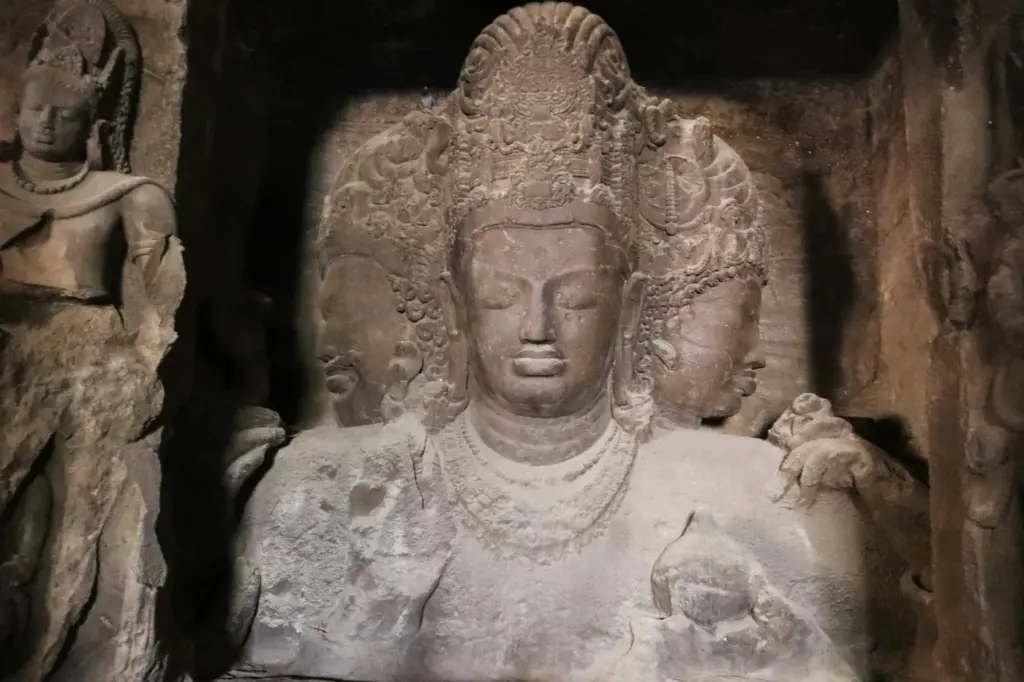
| Best-known image | The Maheshmurti, also called Sadashiva and popularly the Trimurti: three faces of Shiva |
| Earlier remains | Buddhist stupas on the eastern hill; occupation from as early as the 2nd century BCE (UNESCO) |
| Status | Protected by the ASI; UNESCO World Heritage Site since 1987, under criteria (i) and (iii) |
Gharapuri is the name of the village on the island’s south side, and it’s read two ways. The art historian Dulari Qureshi takes it to mean a hill settlement, while the scholar A.P. Jamkhedkar traces it to Agraharapuri, a settlement of Brahmin scholars living on revenue a king assigned them. It is wise to learn the name and not stake an answer on one etymology.
Who built the Elephanta Caves, and when
Nobody knows for certain, and the reason is a lost stone. The Portuguese chronicler Diogo de Couto recorded that when the Portuguese took Bassein (Vasai) and its dependencies, they removed a stone with a large, well-cut inscription from over the cave entrance and sent it to the king. Neither the Portuguese governor in India nor King John III could find anyone to read it, and no trace of it survives. That isn’t surprising: Brahmi was only deciphered by James Prinsep in 1837, long after the stone had gone.
So every date for Elephanta is an argument from style or from coins. The two official bodies don’t even agree: UNESCO says the mid-5th to 6th century CE, while the ASI says about the 6th to 7th. Scholars spread wider still:
- Kalachuri, mid-6th century: Walter Spink, resting on the copper coins of the Kalachuri king Krishnaraja found on the island in large numbers, following Shobhana Gokhale’s study of them.
- Kalachuri, early 7th century: V.V. Mirashi, who argued that the local Konkan Mauryas were feudatories too small to pay for such a cave, and that the Chalukyas, as Vaishnavas, were unlikely patrons of a Shiva temple.
- Chalukya: R.S. Gupte, who pointed to the pearled sacred thread (maniyajnopavita) and kirtimukha armlets familiar from Aihole, Badami and Pattadakal.
- Rashtrakuta, 8th century: Stella Kramrisch in Sahapedia’s summary of her view, with James Fergusson placing the caves around 750 CE and James Burgess later still.
The Chalukyas of Badami took Gharapuri in the 7th century, by Mirashi’s own account, and the Rashtrakutas later cut the Kailasa temple at Ellora. The trouble is style: Jamkhedkar notes that the sculpture at Aihole, Badami and Pattadakal looks very different from Elephanta’s.
The Kalachuri case has the firmest material support. The Early Kalachuris ruled from Mahishmati on the Narmada and rose as successors of the Vakatakas, the dynasty behind the second phase of the Ajanta caves.
Coins sound like proof, so pause on what they can and can’t show. A mass of Krishnaraja’s copper on the island tells you his money circulated there in the mid-6th century, so his state was present. It doesn’t carry a dedication. That’s why the Kalachuri date is the strongest view and not a settled fact.
For an answer, “about the 6th century CE, most likely under the Early Kalachuris, though the date is disputed” is accurate under every school. Add one rival view with its scholar’s name.
Elephanta Island’s history in phases
The caves are one layer in a longer island story. Elephanta was a Buddhist site first, then a port and probably a royal seat, then a Shaiva center and only much later a colonial curiosity.
Buddhist stupas and an early port
UNESCO dates the earliest occupation to as early as the 2nd century BCE, marked by stupas now buried on the eastern side of the island. Jamkhedkar reads the plain cells nearby as the homes of a Buddhist monastic community, with the stupa on the hill beyond, the same kind of relic mound you meet at the Sanchi Stupa. He also reads remains at Mora Bandar and Shet Bandar as the sites of old jetties where ships docked.
Puri, the port on the western sea
The ASI notes that Gharapuri is identified with Puri, a city named in the Aihole inscription of the Chalukya king Pulakeshin II. The Kolaba district gazetteer calls the Mora landing, on the island’s north-east corner, the most likely site of Puri, the capital of the Konkan Silaharas. Treat that as probable, not proven.
The ASI lists the powers that held the island over the centuries:
- the Konkan Mauryas and the Traikutakas;
- the Chalukyas of Badami;
- the Silaharas and the Rashtrakutas;
- the Chalukyas of Kalyani and the Yadavas of Devagiri;
- the sultans of Gujarat, ruling from Ahmedabad;
- the Portuguese, then the Marathas and finally the British.
The Portuguese and the name
Near the old landing place stood a large stone elephant, and the Portuguese named the island after it. The Dr. Bhau Daji Lad Museum, which holds the sculpture today, says it greeted royal visitors at the Rajabunder jetty and dates it to the 5th century CE.
The Portuguese period also takes the blame for much of the damage inside the caves: the account repeated in most surveys, Sahapedia’s among them, says soldiers used the reliefs for target practice. The one loss documented beyond doubt is the inscription stone de Couto describes.
Where the elephant went
The elephant didn’t stay on the island. In 1864 the British tried to take it to England, and it fell and broke into several pieces. With the help of Sir George Birdwood, the museum’s curator, the pieces were moved to the Victoria Gardens, now the Veermata Jijabai Bhonsale Udyan, and in 1914 Cecil Burns put them back together. It has stood at the entrance of the Dr. Bhau Daji Lad Museum ever since, which is why the ASI describes the statue as housed at the Jijamata Garden in Mumbai.
So the one elephant that gave Elephanta its name is no longer on Elephanta.
The Great Cave: plan and a walk-through
Cave 1, the Great Cave, is a temple cut into the hill, not built on it. UNESCO measures it at 39 m from the front entrance to the back, with a main body about 27 m square carried on rows of six columns. Both UNESCO and the ASI note that its plan closely matches the Dumar Lena, Cave 29 at Ellora. The main entrance is on the north, with two more openings on the east and west.
The layout carries an idea. The cave runs on a north-south axis, which Sahapedia’s survey calls unusual for a Shiva shrine, yet the linga shrine inside can be approached along the east-west line. Jamkhedkar explains why. Enter from the east and you face the linga, Shiva without form; enter from the north and you face the Maheshmurti, Shiva half emerged into form. One cave, two approaches and two levels of the same god.
The linga shrine is a free-standing square cell with a door on each of its four sides. That plan is called sarvatobhadra, a four-door sanctum meant to be seen from all sides, where the usual temple sanctum, the garbhagriha, has a single door. On the south wall, pilasters carrying giant dvarapalas, the door guardians, divide the wall into 3 recesses, with the Maheshmurti in the middle and Ardhanarishvara to its east.
The panels in the order you meet them
UNESCO counts fifteen large reliefs around the linga chapel. The easiest way to hold the main ones in memory is the route Dulari Qureshi suggests in her Sahapedia survey: start at the panel to the left of the north entrance and move clockwise, the way a devotee circles a shrine.
- Yogishvara: Shiva seated in padmasana, the lotus posture, on a lotus stalk held by two nagas. Some scholars read him as Lakulisha, a figure central to the Pashupata tradition; others as a form of Dakshinamurti.
- Ravananugraha: Ravana shaking Mount Kailasa and Shiva pressing it down with his foot, then granting him a boon. Sahapedia’s survey rates the Ellora version of this scene far above it.
- Uma-Maheshvara: Shiva and Parvati seated together on Kailasa, with Nandi below; badly damaged.
- Ardhanarishvara: Shiva as half male, half female, with gods on their mounts gathered around.
- Maheshmurti: the three-faced bust at the center of the south wall, facing the north entrance.
- Gangadhara: Shiva receiving the descending Ganga in his matted hair, with three small heads above for the three sacred rivers.
- Kalyanasundara: the marriage of Shiva and Parvati, with Brahma as the officiating priest.
- Andhakasuravadha: Shiva in his fierce form killing the demon Andhaka, a skull cup held out to catch the demon’s blood.
- Nataraja: Shiva dancing, the panel to the right of the north entrance, which closes the circuit.
Read in that order, the panels swing between Shiva’s gentle and terrible sides, marriage beside slaughter and dance beside stillness. That range is the theme in Jamkhedkar’s reading: the panels draw on the epics and the Puranas to show Rudra-Shiva as both benign and fearsome.
The smaller caves and the Buddhist caves
The smaller caves beside the Great Cave on the western hill are badly damaged, much of it by monsoon water collecting inside. Across the ravine, the eastern hill holds the two caves counted as Buddhist: plain excavations near the buried stupas. Most modern guides number them Caves 6 and 7, but published numbering on that hill isn’t uniform, so learn them by place, Stupa Hill, rather than by number. Their Buddhist identity rests on the stupas and the plain monastic plan, not on any inscription.
Trimurti or Maheshmurti: what the three faces show
Both names point to the same relief, but Maheshmurti is the precise one. Trimurti usually means the trinity of creator, preserver and destroyer gods, and that’s the trap: every face on this panel is Shiva. The ASI calls it the Mahesa-murti, the image of Mahesha, the Great Lord. UNESCO’s own statement calls it Sadashiva in one paragraph and the Trimurti in another, which tells you how loosely the names travel.
The ASI names each of the three faces:
- the face on the left is Aghora, also called Bhairava, fierce and turbulent;
- the central face is Tatpurusha, the Mahadeva, calm and meditative;
- the face on the right is Vamadeva, gentle and feminine, which UNESCO also identifies with Uma.
Why three faces and not five? The form behind the panel is Sadashiva, Shiva with five faces. Jamkhedkar explains the convention: a Sadashiva image shows at most four faces, and the fifth, Ishana, on top, is present but never carved. At Elephanta three faces are visible and a fourth is understood at the back.
Jamkhedkar, following Stella Kramrisch, ties this to the plan and reads Elephanta as showing Shiva at three levels:
- nishkala, without form: the linga inside the four-door shrine;
- sakala-nishkala, partly formed: the Maheshmurti, faces emerging from the rock;
- sakala, fully formed: the narrative panels, where Shiva marries, dances and fights.
One way to hold the idea is a single actor wearing three masks on one stage, rather than three actors. The comparison works up to a point. An actor’s masks are costumes over one real face, while in Shaiva theology the fierce and gentle faces are equally real aspects of the one god.
The scheme also points to the patrons’ sect. Kramrisch and the historian Charles Collins argued that the Great Cave meets the requirements of the Pashupata teachings, a Shaiva order whose initiates moved through stages that included living in a cave and meditating on Shiva’s five faces. The Yogishvara panel, which some read as Lakulisha, fits the same reading.
UNESCO puts the Sadashiva at about 7 m high, though Sahapedia’s survey gives 18 feet, about 5.5 m; quote UNESCO’s figure.
Elephanta Caves today: UNESCO status and conservation
Elephanta is protected by the Archaeological Survey of India and has been a World Heritage Site since 1987, inscribed at the 11th session of the World Heritage Committee in Paris, 7-11 December 1987. The UNESCO record still lists the property under District Kolaba, the old name of Raigad district. UNESCO’s reasons for the listing are specific:
- Criterion (i), a masterpiece of human creative genius: the fifteen large reliefs around the linga chapel, which UNESCO calls one of the most important collections for the cult of Shiva.
- Criterion (iii), exceptional testimony to a cultural tradition: the caves as the finest achievement of rock architecture in western India, with the Trimurti named in the citation.
The legal cover is the Ancient Monuments and Archaeological Sites and Remains Act, 1958, its 1959 Rules and the 2010 amendment. Sahapedia’s survey adds a 1985 notification that protects the whole island, with a prohibited band running 1 km out from the shoreline.
UNESCO’s own assessment names the problems plainly:
- saline activity and the general decay of the rock surface, the price of an island in the sea;
- industrial development nearby, a risk already flagged at the time of listing;
- pillar repairs from the 1960s that have cracked and need to be dismantled and redone;
- a Conservation Management Plan that still has to be completed, approved and put in place.
What the 2026 excavations found
In April 2026 the ASI reported new finds from excavations on the island, among them a stepped reservoir and several copper coins of the Kalachuri king Krishnaraja. A column in The Week on 17 July 2026 described more of the work, carried out with Deccan College:
- a T-shaped stepped water reservoir;
- fragments of Roman amphorae and West Asian torpedo jars, the storage jars of long-distance sea trade;
- imported ceramics, stone anchors and iron ingots.
Two things follow. The coins add weight to the Kalachuri presence Spink argued for, though they still show presence and not authorship. And the trade finds support the old idea that Gharapuri was a working port, which fits the identification with Puri. For Elephanta’s place among India’s inscribed sites, see the full list of UNESCO World Heritage Sites in India.
How to study the Elephanta Caves for exams
Elephanta belongs to the Indian culture part of GS Paper I, under art forms and architecture, and it doubles as the standard case of post-Gupta sculpture, the generation after the classical art of the Gupta age. On the Prelims side, Art and Culture accounts for 94 of the 1,403 questions from 2013 to 2026 in the site’s Prelims question bank.
The theme is tested as rock-cut architecture rather than as one site. Mains 2020 GS Paper I asked “The rock-cut architecture represents one of the most important sources of our knowledge of early Indian art and history. Discuss.” Elephanta answers the art half of that question, and the Krishnaraja coins answer the history half. History Optional 2015 Paper I asked “Kailasa temple built at Ellora marks the culmination of rock-cut architecture in India. Elucidate.” The Dumar Lena match lets you place Elephanta on the road from the Mauryan Barabar caves to Kailasa.
Revise these until they’re automatic:
- Place: Elephanta Island, called Gharapuri, in Mumbai Harbour; Uran taluka, Raigad district.
- Caves: 7 in all; the Shaiva group on the western hill and 2 Buddhist caves on Stupa Hill.
- Date: disputed, about the 6th century CE, most likely Early Kalachuri under Krishnaraja.
- Great Cave: 39 m deep, a north-south axis and a four-door sarvatobhadra linga shrine on the plan of Ellora’s Dumar Lena.
- Maheshmurti: Aghora, Tatpurusha and Vamadeva, all of them Shiva; popularly the Trimurti.
- Name: from a stone elephant, broken in 1864, reassembled in 1914 and now at the Dr. Bhau Daji Lad Museum.
- UNESCO: 1987, 11th session, criteria (i) and (iii).
Three confusions cost marks:
- Trimurti and Maheshmurti. Same panel. Write “Maheshmurti, popularly called the Trimurti” and say that all three faces are Shiva.
- Elephanta and Ellora. Ellora’s Cave 29 shares the Great Cave’s plan, but Ellora is a 34-cave site of three faiths, while Elephanta is a Shaiva island site with Buddhist remains.
- Elephanta and Kanheri. Both sit in Mumbai’s orbit, but Kanheri, inside Sanjay Gandhi National Park, is a Buddhist complex of about 109 caves.
Set it beside its two great Maharashtra siblings:
| Site | Faith | Main period (UNESCO) | Signature | UNESCO listing |
|---|---|---|---|---|
| Ajanta | Buddhist | 2nd to 1st century BCE, then 5th to 6th century CE | 30 caves; paintings; chaityas and viharas | 1983; criteria (i), (ii), (iii) and (vi) |
| Ellora | Buddhist, Brahmanical and Jain | 6th to 12th century CE | 34 caves; the Kailasa temple (Cave 16) | 1983; criteria (i), (iii) and (vi) |
| Elephanta | Shaiva, with Buddhist remains | Mid-5th to 6th century CE | The Great Cave and the Maheshmurti | 1987; criteria (i) and (iii) |
Elephanta rewards the aspirant who can hold an uncertainty without blurring it. The name comes from an elephant that’s no longer there, the famous Trimurti is one god and the builder is a strong inference from coins rather than a signature. An answer that says so plainly, with one named scholar, reads as more authoritative than one that invents a firm date.
Frequently Asked Questions
Who built the Elephanta Caves?
No inscription names the builder, so every answer is an inference. The strongest view, argued by Walter Spink, credits the Early Kalachuri king Krishnaraja in the mid-6th century CE, because his copper coins turn up on the island in large numbers. Other scholars have argued for the Chalukyas of Badami or the Rashtrakutas.
Why is it called Elephanta?
The Portuguese named the island after a large stone elephant that stood near its old landing place. The island’s local Marathi name is Gharapuri, after the village on its south side. The elephant itself was taken to Mumbai after it broke in 1864.
Is the Elephanta sculpture a Trimurti or a Maheshmurti?
It’s the same panel under two names, and Maheshmurti is the precise one. All three faces are Shiva, which the ASI identifies as Aghora on the left, Tatpurusha in the center and Vamadeva on the right. The popular label Trimurti wrongly suggests the Hindu trinity of three different gods.
Which caves at Elephanta are Buddhist?
The two small, plain caves on the eastern hill, known as Stupa Hill, are counted as Buddhist, along with the buried stupas beside them. Most guides number them Caves 6 and 7, though the numbering varies between surveys. The Shaiva caves, including the Great Cave, are on the western hill.
When were the Elephanta Caves declared a UNESCO World Heritage Site?
UNESCO inscribed the Elephanta Caves in 1987, at the 11th session of the World Heritage Committee in Paris. They were listed under criteria (i) and (iii), for the great reliefs of Shiva and as the finest rock architecture in western India.
Where is the Elephanta elephant statue now?
It stands at the entrance of the Dr. Bhau Daji Lad Museum in Mumbai, in the gardens now called Veermata Jijabai Bhonsale Udyan. The British tried to ship it to England in 1864 and it broke on the way; Cecil Burns reassembled the pieces in 1914.
How old are the Elephanta Caves?
Most sources place the Shaiva caves around the 6th century CE, but the exact date is disputed. UNESCO gives the mid-5th to 6th century and the ASI about the 6th to 7th, while older scholars went as late as the 8th. The Buddhist remains on the island are older, going back to the 2nd century BCE.
Practice Questions
Prelims
1. Consider the following statements about the Elephanta Caves:
1. UNESCO inscribed them as a World Heritage Site in 1987.
2. They were inscribed under criteria (i) and (iii).
3. The plan of the Great Cave closely resembles the Dumar Lena cave at Ellora.
Which of the statements given above is/are correct?
- (a) 1 and 2 only
- (b) 2 and 3 only
- (c) 1 and 3 only
- (d) 1, 2 and 3
Answer: (d) UNESCO’s record gives 1987 and criteria (i) and (iii), and both UNESCO and the ASI compare the Great Cave’s plan with Dumar Lena (Cave 29) at Ellora.
2. Consider the following statements about the Maheshmurti panel in the Great Cave at Elephanta:
1. Its three faces represent Brahma, Vishnu and Shiva.
2. The ASI identifies its faces as Aghora, Tatpurusha and Vamadeva.
Which of the statements given above is/are correct?
- (a) 1 only
- (b) 2 only
- (c) Both 1 and 2
- (d) Neither 1 nor 2
Answer: (b) All three faces are forms of Shiva; the name Trimurti is popular but misleading.
3. The stone elephant after which the Portuguese named Elephanta Island now stands at:
- (a) the jetty at Gharapuri village
- (b) the entrance of the Dr. Bhau Daji Lad Museum, Mumbai
- (c) the Chhatrapati Shivaji Maharaj Vastu Sangrahalaya, Mumbai
- (d) the Victoria and Albert Museum, London
Answer: (b) It broke during a British attempt to ship it to England in 1864 and was reassembled at the museum in 1914.
4. Walter Spink’s mid-6th-century Kalachuri date for the Great Cave at Elephanta rests mainly on:
- (a) a dated inscription over the cave entrance
- (b) copper coins of the Kalachuri king Krishnaraja found on the island
- (c) a copper-plate grant of the Chalukya king Pulakeshin II
- (d) the Aihole inscription’s description of the cave
Answer: (b) The inscribed stone over the entrance was removed by the Portuguese and lost, so the coins are the main material evidence.
5. Consider the following pairs:
1. Sarvatobhadra : a shrine with a door on each of its four sides
2. Nishkala : Shiva shown with face and limbs
3. Gharapuri : the local Marathi name of the island
Which of the pairs given above is/are correctly matched?
- (a) 1 and 2 only
- (b) 1 and 3 only
- (c) 2 and 3 only
- (d) 1, 2 and 3
Answer: (b) Nishkala is Shiva without form, worshipped as the linga; the Maheshmurti is the partly formed sakala-nishkala image.
Mains
- The Elephanta Caves carry no surviving inscription, yet historians assign them to a dynasty and a century. Examine the evidence and the competing views on their dating. (15 marks, 250 words)
- Explain how the plan of the Great Cave at Elephanta expresses the idea of Shiva at different levels of manifestation. (10 marks, 150 words)
- The Maheshmurti of Elephanta is often called a Trimurti. Discuss the iconography of the panel and explain why the popular name misleads. (10 marks, 150 words)
- Elephanta was a Buddhist site and a port before it became a Shaiva center. Trace these phases using archaeological evidence, including recent excavations. (15 marks, 250 words)
- Safeguarding the Indian art heritage is the need of the moment. Discuss. (10 marks, 150 words) Previous year: Mains 2018, GS Paper I.
Tell Google you want more of this.
Add Anantam IAS as a preferred sourceOne tap, and this site shows up more often in your own Top Stories, AI Overviews and AI Mode. Remove it any time.