Mahabalipuram is a Pallava port town on the Coromandel Coast of Tamil Nadu, about 60 km south of Chennai, and the site of shrines carved and built there in the 7th and 8th centuries. Government records call it Mamallapuram, the city of Narasimhavarman I Mamalla. UNESCO inscribed the ensemble in 1984 as the Group of Monuments at Mahabalipuram. It matters because on one stretch of coast you can watch South Indian builders move from carving temples out of the bedrock to building them from cut stone.
Most short notes flatten Mahabalipuram into one king and one story. They credit everything to Mamalla and call the great relief Arjuna’s Penance as if both points were settled. Neither is. The work ran across at least three reigns, and scholars still disagree over who paid for which monument. Even UNESCO’s page calls the relief the Descent of the Ganges in one paragraph and Arjuna’s Penance in another. This note puts the kings in order, then lays out the debate, so you can write about the site with exactly the certainty the evidence allows.
What Is the Mahabalipuram Group of Monuments?
The Group of Monuments at Mahabalipuram is a serial World Heritage property, which means several separate monuments in and around one town listed together as a single site. UNESCO sorts them into five kinds, running from cave shrines cut into rock faces to temples built of dressed stone.
| Fact | Detail |
|---|---|
| Location | Mamallapuram, Chengalpattu district, Tamil Nadu; on the Coromandel Coast, about 60 km south of Chennai |
| Builders | The Pallava kings of Kanchipuram, in the 7th and 8th centuries CE |
| Kings named by the ASI | Mahendravarman I (600 to 630), Narasimhavarman I Mamalla (630 to 668), Rajasimha (700 to 728) |
| Name | The city of Mamalla, a title of Narasimhavarman I |
| Kinds of monument | Cave shrines (mandapas), monolithic temples (rathas), rock reliefs, structural temples and excavated remains |
| Best known | The Shore Temple, the Pancha Rathas and the great relief called Arjuna’s Penance or the Descent of the Ganges |
| UNESCO | Inscribed 1984 at the 8th session, Buenos Aires, under criteria (i), (ii), (iii) and (vi) |
| Protection | Archaeological Survey of India, Chennai Circle, under the AMASR Act, 1958 |
Settle the name first. Mamallapuram is the form in government use, and both the district administration and the ASI write it that way. Mahabalipuram is the other long-standing form, which UNESCO kept in the site’s title. Same town, two spellings. The town has sat in Chengalpattu district since that district was carved out of Kancheepuram on 29 November 2019, so older books place it in Kancheepuram.
Who Built Mahabalipuram, and When?
The Pallava kings of Kanchipuram built it across the 7th and early 8th centuries, and the ASI’s summary of the site names three of them. The full dynasty is in the note on the Pallava dynasty; this section covers what happened on this coast.
The place was a working port before the carving began. The ASI describes it as a sea-port in the time of the Periplus, a 1st-century Greek sailing guide, and of the geographer Ptolemy around 140 CE. Britannica adds that ancient foreign coins, Roman ones among them, have turned up here.
The Pallava sequence
Each king left a different kind of work behind:
- Mahendravarman I (c. 600 to 630): the ASI finds some evidence of building from his reign, and Britannica credits him with a new manner in Dravidian architecture that art historians call the Mahendra style. A Jain who turned to Shaivism, he also wrote the Sanskrit farce Mattavilasa-prahasana.
- Narasimhavarman I Mamalla (630 to 668): the ASI attributes most of the rock-cut work to him, the rathas and the great relief included. His armies also took the Chalukya capital Vatapi in campaigns Britannica dates to 641 to 647, a chapter of the long Pallava-Chalukya rivalry.
- Paramesvaravarman I: Mamalla’s grandson, usually counted as the middle builder in the standard account.
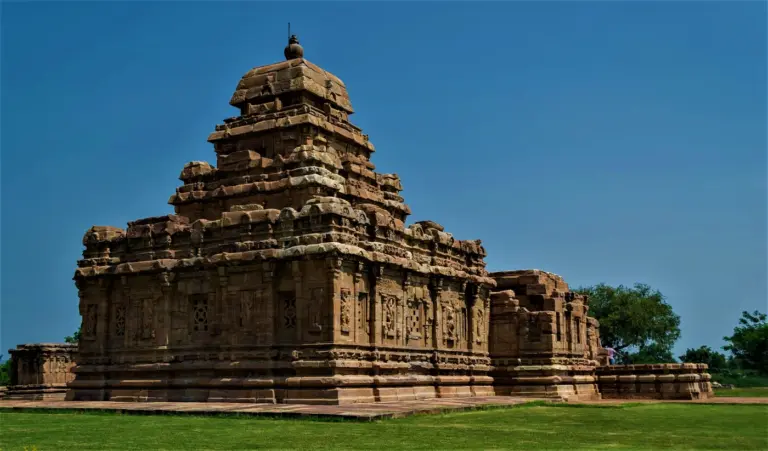
- Narasimhavarman II Rajasimha (700 to 728): UNESCO credits him with bringing in structural architecture on a large scale, a series that ends in the Shore Temple.
What scholars still dispute
That sequence is the majority view. It is wise to treat it as one, because three positions are in print:
- Three kings: most scholars have split the credit from Mamalla down to his great-grandson Rajasimha, as a 2015 Times of India report summed it up.
- Rajasimha alone: the archaeologist R. Nagaswamy argued in a 1962 paper that Rajasimha built everything. In 2015 a forgotten transcript of two Rajasimha inscriptions in the Tiger Cave complex, one in Nagari script and one in Pallava Grantha, was reported as fresh support.
- An earlier start: Marilyn Hirsh argued in Artibus Asiae in 1987 for Mahendravarman I as artist and patron of Mamallapuram.
The Shore Temple is the one attribution all these sources share, and it goes to Rajasimha. For the rock-cut work, “mainly under Narasimhavarman I, on the majority view” is accurate without overclaiming.
After the Pallavas
After Rajasimha the ASI records a lull with a few late-Pallava and Chola additions, and then a larger Vijayanagara phase that added the raja gopurams (tall gateway towers) and the Sthala-Sayana temple right beside the great relief. The Pallava lands themselves passed to the Cholas about 880, by Britannica’s date.
In later centuries the town was known as the Seven Pagodas, and the sources don’t agree on what the seven were. Britannica treats the rathas as the remnants of seven temples, while the Ministry of Tourism tells of seven shore temples, six of them claimed by the sea. The drowned temples belong to legend until the seabed shows otherwise.
What to See at Mahabalipuram, From the Hill to the Sea
The monuments make the most sense in the order they developed, and that order roughly matches a walk from the granite outcrops in town down to the beach.
The great relief and the Govardhana panel
Start in the middle of town at the great relief, a bas-relief (figures carved to stand out from the rock) spread over two granite boulders and facing east. Its subject gets a section of its own below. Of the 4 reliefs UNESCO counts, the other one to know is the Govardhanadhari: Krishna holding up Govardhan hill to shelter the cowherds from Indra’s storm.
The cave shrines
The Chengalpattu district counts 9 cave temples at Mamallapuram. UNESCO ties the new cave style to Mamalla’s reign and names the Varaha mandapa and the Mahishasuramardini cave among its best examples. UNESCO picks out these panels:
- Mahishasuramardini: Durga killing the buffalo demon Mahisha.
- Bhuvaraha: Vishnu as the boar, lifting the earth goddess out of the ocean.
- Gajalakshmi: Lakshmi seated while elephants pour water over her.
- Trivikrama: Vishnu taking the giant stride that measures the worlds.
The Mahishasuramardini cave is the one to remember. On one wall Vishnu sleeps in the cosmic ocean; on the opposite wall Durga fights the buffalo-headed demon. Rest and battle face each other across one small hall. The ASI adds that these caves were once plastered and painted, and the remains still show it.
The Pancha Rathas
The Pancha Rathas, or Five Rathas, are what the ASI calls the most important of the site’s 9 monolithic temples. Ratha means chariot, and the name comes from their likeness to the cars that carry a deity in procession. The ASI’s own wording is that they are known after the five Pandava brothers of the Mahabharata, and that is a label, not a dedication.
What makes them worth studying is that no two share a design. Two words help here: a vimana is the tower that rises over the sanctum, and a tala is one tier of it. The ASI’s notes give the plans:
- Draupadi ratha: a small square shrine shaped like a hut (a kutagara), the simplest of the five.
- Arjuna ratha: square, a two-tier dvitala vimana with a front porch (mukhamandapa).
- Bhima ratha: rectangular, under a wagon-vaulted roof (shala), like a barrel laid on its side.
- Dharmaraja ratha: square, a three-tier tritala vimana with working shrines on every tier.
- Nakula-Sahadeva ratha: apsidal, meaning rounded at one end, which the ASI reads as the architect experimenting.
Think of the group as a builder’s sample book, with plans from square to apsidal and towers from one tier to three set out side by side. The comparison holds for the range of forms and breaks at the purpose. A sample book exists to sell later work, while UNESCO treats each ratha as a temple in its own right, one that shows “the full form and features of the contemporary temple form”.
The Shore Temple
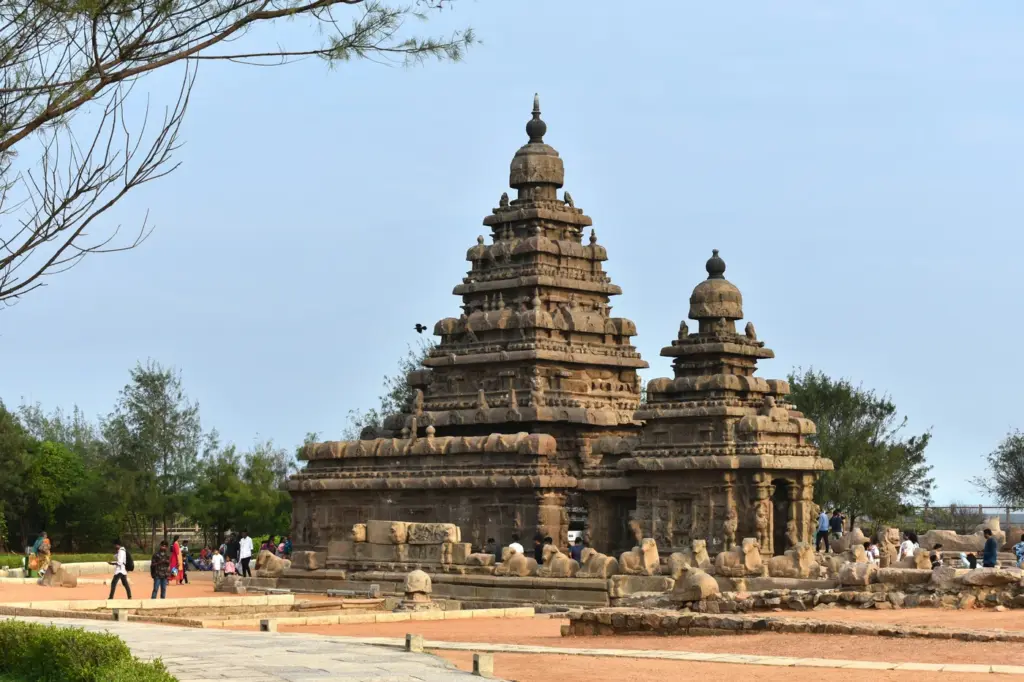
The Shore Temple is where the site’s experiment ends: a temple built up from granite blocks rather than carved out of the rock, credited to Rajasimha in the early 8th century. UNESCO singles out its layout as a Dravida vimana, the stepped, pyramid-shaped tower that marks the southern style, and the note on Dravidian temple architecture traces where that tower went next. The complex holds three shrines, and the ASI names each:
- Kshatriyasimhesvara: the larger tower, facing east to the sea.
- Rajasimhesvara: a small three-tier tower facing west.
- Nripatisimha Pallava Vishnugriha: an oblong, flat-roofed shrine that houses Vishnu reclining.
Two enclosure walls (prakaras) surround them. The ASI attributes the reclining Vishnu at the rear of the complex to Mamalla’s period, a reign earlier than Rajasimha’s. The likely reading, and it is an inference, is that Rajasimha’s builders set a new Shiva complex around an older Vishnu shrine.
Clearing the sand around the temple has exposed an older layer. The ASI lists these finds:
- rock-cut figures to the north and south, older than the temple;
- a monolithic Bhuvaraha and a reclining Vishnu;
- the base of a Durga shrine with a deer;
- a stepped ghat facing the sea, south of the temple.
Arjuna’s Penance or the Descent of the Ganga?
Nobody has settled it, so the accurate answer names both readings. The two boulders are split by a natural vertical cleft and carry more than 100 figures. Both readings agree on what is carved; they disagree on who the central figure is. Start with what everyone can see:
- The ascetic: an emaciated man standing on one leg in deep meditation, the posture of tapas, or severe penance.
- Shiva: four-armed, near the ascetic, with one hand in varada mudra, the gesture of granting a boon.
- The cleft: carved with nagas, serpent deities shown half human and half snake.
- The animals: elephants carved close to life size, with their calves.
- The cat: lower down, a cat standing on one leg like the ascetic, with rats around it.
The case for Arjuna
In the Mahabharata, Arjuna performs penance to win the Pashupata, Shiva’s own weapon, for the war to come. Shiva tests him in the guise of a kirata, a mountain hunter, before granting it. The episode was expanded in Bharavi’s Sanskrit poem Kiratarjuniya, a text well known in the Pallava country. Read this way, the ascetic is Arjuna and the god beside him is about to hand over the boon.
The case for the Descent of the Ganga
In the other story, King Bhagiratha performs penance to bring the Ganga down from heaven, because only her waters can free his ancestors, burned to ashes by a sage’s curse. Shiva catches the falling river in his hair so her force doesn’t wash the earth away. Read this way, the cleft stands for the river and the nagas rise in its water. The ascetic becomes Bhagiratha. The fissure may once have carried a real stream of water, though that is an inference, not a record.
Why both names survive
Some scholars think the ambiguity is the point. Padma Kaimal’s 1994 study treats the double reading as deliberate play tied to political authority, and Michael Rabe read the whole composition in 1997 as a prasasti, a poem of royal praise, told in figures instead of verse. Britannica, like UNESCO, simply prints both names.
Then there is the cat. Most scholars link it to a Panchatantra tale about a cat that fakes holiness to catch its prey. Whoever the hero above is, the carvers put a joke about false penance right under the real one. That tells you the same workshop could carry scripture and satire on one rock face.
In your own notes, write “the great relief, read as Arjuna’s Penance or the Descent of the Ganga”. The phrase is accurate, and it shows you know the argument exists.
Why Mahabalipuram Matters for Indian Temple Architecture
Because it keeps the whole experiment in one town. Three stages survive within walking distance of each other:
- Cut into the rock: the cave shrines.
- Cut out of the rock: the rathas, with nothing assembled.
- Built from cut stone: the Shore Temple.
UNESCO’s statement on authenticity says the site shows “creation and experimentation in rupestral architecture”, meaning architecture carved in rock, “which culminated in the evolution of structural temples”. That is the southern half of the story told in the note on temple architecture in India. The Dravida vimana that Rajasimha’s builders raised here points toward the towers of later Chola temples such as the Brihadeeswara at Thanjavur.
UNESCO’s second criterion reaches beyond India: the soft, supple modeling of the sculpture here spread to Cambodia and Java, among other places. The ASI notes that many Indian settlers sailed to Southeast Asia through this port, the likely route the style took.
Mahabalipuram Today: UNESCO Status, Protection and Recent Events
Mahabalipuram is a World Heritage property that UNESCO describes as well conserved, protected by the ASI and pressed on two sides: by building around it and by the sea in front of it.
UNESCO inscribed it in 1984 at the 8th session of the World Heritage Committee, held in Buenos Aires from 29 October to 2 November that year. The same session inscribed the Sun Temple at Konark, so both of India’s entries in 1984 came from its eastern coast. The four criteria, in plain words:
| Criterion | What UNESCO says | In plain words |
|---|---|---|
| (i) | The Descent of the Ganges relief is, like the Elephanta reliefs, a unique artistic achievement | A work of creative genius |
| (ii) | The soft, supple modeling of its sculpture spread to Cambodia, Annam and Java | It shaped art beyond India |
| (iii) | Pre-eminently the testimony to the Pallava civilization of southeast India | The best surviving record of a vanished culture |
| (vi) | One of the major centers of the cult of Shiva | Tied to a living religious tradition |
The ASI protects the property under the Ancient Monuments and Archaeological Sites and Remains (AMASR) Act, 1958, with its 1959 Rules and the amendments of 1992 and 2010. Two zones surround it: a 100 m prohibited area, where new construction isn’t allowed, and a 200 m regulated area beyond that, where building needs permission. The UNESCO listing and the ASI’s page on the site are the two official references worth reading.
UNESCO’s listing, as archived in 2025, reports no major threats and names the risk it does see: encroachment and unauthorized building inside those protected zones. The sea is the other pressure. News reports in December 2019 described severe erosion on the shoreline north of the Shore Temple. The 2004 Indian Ocean tsunami showed how exposed that edge is; the Ministry of Tourism records that it temporarily revealed submerged ruins offshore.
Recent dated events have kept the town in the news:
- 2017: Mahabalipuram Stone Sculpture received a Geographical Indication (GI) tag, the legal mark that ties a craft to its place of origin.
- October 2019: Prime Minister Narendra Modi and President Xi Jinping held the second India-China informal summit at Mamallapuram, which the PIB release called the “Chennai Connect”.
- 2022: the 44th Chess Olympiad was held in Chennai from 28 July to 9 August, and PIB notes that its torch relay ended at Mahabalipuram.
For the wider list the site belongs to, see UNESCO World Heritage Sites in India.
How to Study Mahabalipuram for Exams
Mahabalipuram sits in GS Paper I under Indian culture, which covers art forms and architecture from ancient to modern times. It also comes up in Prelims under Art and Culture and in History optional Paper I under the Pallavas.
GS Paper I has tended to come at the site sideways. Mains 2020 GS Paper I asked: “The rock-cut architecture represents one of the most important sources of our knowledge of early Indian art and history. Discuss.” Mahabalipuram is your best southern evidence for that answer, because it shows rock-cut work turning into structural building. History optional has named the site outright. Paper I in 2015 asked “Why is Mamallapuram famous?” as a 150-word short answer, and Paper I in 2020 asked candidates to “Describe the evolution and development of regional temple architecture of South India with special reference to Pallavas.” For Prelims, 94 of the 1,403 questions in the site’s Prelims question bank are tagged Art and Culture.
Revise these until they come without thinking:
- 1984: inscribed at the 8th session in Buenos Aires, alongside Konark, under criteria (i) to (iii) and (vi).
- Narasimhavarman I Mamalla (630 to 668): the town’s namesake and, on the majority view, the patron of most rock-cut work.
- Rajasimha (700 to 728): structural temples, ending in the Shore Temple.
- Pancha Rathas: 5 monolithic temples with 5 different plans; the Pandava names are later labels.
- Shore Temple: 3 shrines, with 2 Shiva towers and a flat-roofed shrine for Vishnu reclining.
- Great relief: 2 readings, Arjuna or Bhagiratha, and UNESCO uses both names.
These confusions cost the most marks:
- Mahabalipuram and Mamallapuram: one town. The district has been Chengalpattu since 2019 and was Kancheepuram before.
- Narasimhavarman I and Narasimhavarman II: Mamalla (630 to 668) is the rock-cut patron and Rajasimha (700 to 728) is the Shore Temple king. UNESCO’s own summary slips here, dating a well near the Shore Temple to “Narasimhavarman Rajasimha’s reign (638-660 CE)”, which are dates inside Mamalla’s reign. Go with the ASI’s dates.
- Monolith and structure: the rathas are carved from boulders and the Shore Temple is built of blocks.
- Rathas and Pandavas: the names are later labels, and the Ganesha ratha isn’t one of the five.
- Kanchipuram and Mamallapuram: Kanchipuram was the Pallava capital and Mamallapuram was its port.
Set it beside its nearest siblings on the World Heritage List:
| Site | Inscribed | Criteria | What sets it apart |
|---|---|---|---|
| Mahabalipuram, Tamil Nadu | 1984 | (i), (ii), (iii), (vi) | Pallava granite work, with cave, monolith and built temple on one site |
| Sun Temple, Konark, Odisha | 1984 | (i), (iii), (vi) | Inscribed at the same 1984 session |
| Ellora Caves, Maharashtra | 1983 | (i), (iii), (vi) | 34 caves cut into a basalt cliff; the Kailasa, cut under the Rashtrakutas, is the largest monolithic temple |
| Elephanta Caves, Maharashtra | 1987 | (i), (iii) | An island cave shrine to Shiva near Mumbai, known for its huge reliefs |
Mahabalipuram rewards the reader who keeps two kinds of fact apart. The settled ones, the 1984 listing and Rajasimha’s Shore Temple, should be learned cold; the argued ones, the patron of the rathas and the hero of the relief, should be learned by name, with both sides. Do that and this one site gives you a complete, well-evidenced account of how South Indian temples came to be built.
Frequently Asked Questions
Who built the Mahabalipuram monuments?
The Pallava kings of Kanchipuram built them in the 7th and 8th centuries. By the ASI’s reading, most of the rock-cut work belongs to Narasimhavarman I Mamalla, who ruled from 630 to 668, and the structural Shore Temple belongs to Narasimhavarman II Rajasimha, who ruled from 700 to 728. Some scholars assign far more to Rajasimha, so the split between kings is still debated.
Why is Mahabalipuram also called Mamallapuram?
Mamallapuram means the city of Mamalla, a title of the Pallava king Narasimhavarman I, and it’s the form used in government records today. Mahabalipuram is the other long-standing form and survives in UNESCO’s title for the site. Both names refer to the same town in Chengalpattu district, Tamil Nadu.
Who built the Shore Temple, and what is inside it?
The Shore Temple was built in the early 8th century under Narasimhavarman II Rajasimha, from granite blocks rather than carved out of the rock. It combines two Shiva shrines with a flat-roofed shrine for Vishnu reclining. The ASI dates that Vishnu image to Mamalla’s reign, which suggests the temple was built around an older shrine.
What are the Pancha Rathas?
The Pancha Rathas are five monolithic temples at Mahabalipuram, each carved as one piece from the rock and usually dated to Mamalla’s 7th-century reign. They are named after the Pandava brothers and Draupadi, but those names are later labels rather than dedications. Each has a different plan, from the hut-shaped Draupadi ratha to the apsidal Nakula-Sahadeva ratha.
Is Arjuna’s Penance the same as the Descent of the Ganges?
Yes, both names describe the same great relief, and scholars still disagree on which story it shows. One reading sees Arjuna doing penance to win Shiva’s weapon, while the other sees King Bhagiratha bringing the Ganga down to earth through the natural cleft in the rock. Some scholars argue that the double meaning was intended.
When did Mahabalipuram become a UNESCO World Heritage Site?
The Group of Monuments at Mahabalipuram was inscribed in 1984 at the 8th session of the World Heritage Committee in Buenos Aires. It was listed under criteria (i), (ii), (iii) and (vi), at the same session as the Sun Temple at Konark. The Archaeological Survey of India protects it under the AMASR Act, 1958.
Why was Mahabalipuram called the Seven Pagodas?
Seven Pagodas was the town’s name in later centuries, after a group of seven temples. Britannica links the name to the rathas, while the Ministry of Tourism tells of seven shore temples of which the sea took six. The drowned temples remain a legend, although the 2004 tsunami briefly exposed submerged ruins offshore.
Practice Questions
Prelims
1. Consider the following statements about the Group of Monuments at Mahabalipuram: 1. It was inscribed on the World Heritage List at the same 1984 session as the Sun Temple at Konark. 2. The Shore Temple is a monolith carved out of a single boulder. Which of the statements given above is/are correct?
- (a) 1 only
- (b) 2 only
- (c) Both 1 and 2
- (d) Neither 1 nor 2
Answer: (a) Both sites were inscribed at the 8th session in 1984, but the Shore Temple is a structural temple built of stone blocks.
2. Structural temple building on a large scale at Mamallapuram, ending in the Shore Temple, is credited to which Pallava ruler?
- (a) Mahendravarman I
- (b) Narasimhavarman I Mamalla
- (c) Paramesvaravarman I
- (d) Narasimhavarman II Rajasimha
Answer: (d) UNESCO and the ASI credit Rajasimha, who ruled from 700 to 728, with structural temples and the Shore Temple.
3. Consider the following statements about the great relief at Mamallapuram: 1. It is carved across two boulders separated by a natural cleft. 2. Scholars agree that the ascetic in the relief is Arjuna. Which of the statements given above is/are correct?
- (a) 1 only
- (b) 2 only
- (c) Both 1 and 2
- (d) Neither 1 nor 2
Answer: (a) The ascetic is read as either Arjuna or Bhagiratha, and the identification is still debated.
4. Among the Pancha Rathas at Mamallapuram, which one has an apsidal plan?
- (a) Draupadi ratha
- (b) Dharmaraja ratha
- (c) Nakula-Sahadeva ratha
- (d) Bhima ratha
Answer: (c) The ASI describes the Nakula-Sahadeva ratha as apsidal; the Bhima ratha is rectangular and the other two are square.
5. Consider the following statements: 1. Mamallapuram is named after Narasimhavarman I, who bore the title Mamalla. 2. The site is protected by the Archaeological Survey of India under the AMASR Act, 1958. 3. The site is on the List of World Heritage in Danger. Which of the statements given above is/are correct?
- (a) 1 and 2 only
- (b) 2 and 3 only
- (c) 1 and 3 only
- (d) 1, 2 and 3
Answer: (a) UNESCO reports the property in a good state of conservation with no major threats, and it is not on the danger list.
Mains
- Estimate the contribution of Pallavas of Kanchi for the development of art and literature of South India. (10 marks, 150 words) Previous year: Mains 2024, GS Paper I.
- The monuments of Mamallapuram record the Pallava move from cutting temples out of rock to building them in stone. Examine this with reference to the rathas and the Shore Temple. (15 marks, 250 words)
- The great relief at Mamallapuram is read both as Arjuna’s Penance and as the Descent of the Ganga. Discuss the evidence for each reading and what the ambiguity tells us about Pallava art. (15 marks, 250 words)
- UNESCO cited the spread of Mahabalipuram’s sculptural style to Southeast Asia when it inscribed the site. Explain how the Pallava port made that spread possible. (10 marks, 150 words)
- Coastal monuments face pressure from the sea and from building around them. With reference to Mamallapuram, suggest measures to conserve such sites. (10 marks, 150 words)
Tell Google you want more of this.
Add Anantam IAS as a preferred sourceOne tap, and this site shows up more often in your own Top Stories, AI Overviews and AI Mode. Remove it any time.