Join Anantam IAS Channel on Telegram

Daily Digest · Friday

20 November 2026 Current Affairs for UPSC

9 current affairs published on Friday, 20 November 2026

20 November 2026 Current Affairs for UPSC — every Why-in-News article AnantamIAS published on Friday, 20 November 2026, broken down with Why in News?, the exact GS paper it feeds, sub-topic mapping, MCQ-ready facts and a UPSC-style practice question. 9 articles in total, covering Polity, Economy, Environment, S&T, IR, Geography, History, Society and Internal Security — the same Why-in-News + GS-paper-mapping + practice-question format the Compass uses across every daily digest on the site.

Daily current affairs for UPSC is where new material enters your prep stream. Read this 20 November 2026 digest end-to-end in 25–35 minutes, attempt the practice question at the foot of each article (it's MCQ for some, 10/15-marker for others), then bookmark the entries that fall inside your active revision window. Everything stays cross-linked: tap any subject pill to jump to that subject's hub, or use the table of contents above to skip straight to a specific story.

Use this page three ways. Read sequentially for a one-sitting scan of everything that mattered on 20 November 2026. Download the 20 November 2026 PDF below for offline study or print revision. Or use the November 2026 Current Affairs compilation to see this day in the month's full context. For the previous day's reading, see 19 November 2026 Current Affairs; the next day's is 21 November 2026 Current Affairs.

Why we publish daily current affairs separately from the monthly compilation: daily is learning, monthly is revision. Use the daily page to add fresh material to your notes the day it breaks; come back to the November 2026 compilation 60 days before Prelims when the noise has settled and only the lasting takeaway is worth re-reading.

Antimicrobial Medicines and Proposed Central Regulatory Scrutiny

Open article →Download PDF

Why in News?

On November 19, the Health Ministry explained a draft proposal to bring antimicrobials within the new-drug framework and require central permission before state manufacturing licensing.

  • The draft notification dated November 6 proposes adding antimicrobials to the relevant definition under the New Drugs and Clinical Trials Rules, 2019.
  • Manufacturers would obtain Central Licensing Authority permission before applying to the concerned State Licensing Authority for a manufacturing licence.
  • The proposal remains at the consultation stage, with objections and suggestions invited before government finalisation.
  • Medicine quality is one part of the wider public-health response to antimicrobial resistance.
  • Clear regulatory responsibilities help connect the evidence submitted for a product with the authority deciding whether permission should be granted.

UPSC Relevance

Prelims Relevance

  • Central Licensing Authority and State Licensing Authority
  • New Drugs and Clinical Trials Rules, 2019
  • Draft notification and final notification
  • Bioavailability, bioequivalence and stability as regulatory evidence

Mains Relevance

GS Paper 2

  • Coordination between central and state health regulators
  • Public consultation and administrative capacity in drug regulation

GS Paper 3

  • Scientific evidence in regulatory decisions
  • Quality assurance within the response to antimicrobial resistance

Background and Context

What the Proposed Approval Sequence Changes

The proposal places a central permission step before the state manufacturing licence application for the covered products.

  • The ministry identifies insufficient regulatory scrutiny in some antimicrobial licensing as the problem being addressed. Its concern includes the adequacy of supporting studies when decisions about product quality, safety and efficacy are made.
  • The proposed central permission would be obtained first. The manufacturer would then approach the concerned state authority for a manufacturing licence, retaining distinct decisions at the two levels of the regulatory system.
  • A legal category can determine the approval framework applying to a medicine. Adding antimicrobials to this definition would bring covered products under the specified rules even when a product is familiar to the public.
  • The sequence of permissions is the central institutional change described in the release. It does not establish that state licensing functions disappear or that every existing product immediately receives a new permission.
  • Administrative coordination would matter when the proposal is implemented. Authorities need consistent records of central decisions and the corresponding state applications so that a permission can be checked against the product concerned.

Why the Supporting Evidence Matters

Regulatory scrutiny depends on evidence that addresses how a finished medicine performs and whether its quality can be maintained.

  • Bioavailability concerns how an active ingredient becomes available in the body. Bioequivalence supports comparison between products using relevant measures of availability, helping regulators assess whether an appropriate comparison has been demonstrated.
  • Stability evidence concerns the maintenance of a medicine’s quality over time under specified conditions. It supports regulatory assessment of the finished product and its stated storage life, without removing later quality responsibilities.
  • The ministry names these assessments because evidence gaps can affect confidence in quality, safety and efficacy. The proposal concerns the regulatory evidence supporting permission, with detailed obligations determined by the applicable rules.
  • Product-specific requirements need careful interpretation. The announcement does not establish a universal requirement for every antimicrobial product to undergo an identical set of clinical trials, so such a claim would exceed its wording.
  • Continuing quality assurance extends beyond an initial permission. The separate drug batch-release framework addresses responsibility for quality decisions during production, illustrating another stage of oversight.

How the Proposal Fits the Wider AMR Response

Reliable medicines support resistance prevention alongside diagnosis, appropriate use and the broader functioning of health systems.

  • The ministry states that substandard or ineffective antimicrobials can contribute to resistance and harm patients. Better scrutiny seeks to reduce this quality-related risk while supporting confidence in medicines that enter the supply system.
  • Diagnostic capacity addresses a different part of care by helping identify infections and guide decisions. The recent WHO diagnostics guidance explains how testing capacity can be organised across health services.
  • Implementation capacity influences the value of a legal change. Regulators need enough trained staff and dependable review processes to examine submissions consistently, communicate decisions and manage queries without leaving responsibilities unclear.
  • Public consultation allows affected parties to identify practical difficulties before finalisation. Useful submissions can clarify transitions, documentation and the relationship between existing permissions and the proposed approval sequence.
  • The effective date remains dependent on final government action. The draft says commencement will be specified when final rules are published, so the November announcement should be read as a proposed regulatory change.

Way Forward

Make Responsibilities and Transitions Clear

  • Publish clear transition provisions explaining how the final change would apply to existing products and pending applications.
  • Provide consistent guidance on documentary expectations and communication between central and state authorities.
  • Build review capacity and track decisions so that additional scrutiny is supported by a workable administrative process.

Conclusion

  • The proposal links central permission with the subsequent state licensing application, aiming to strengthen the evidence behind antimicrobial product decisions.
  • Its public-health value would depend on final rules, capable review and continuing quality oversight, together with the wider measures used to address antimicrobial resistance.

UPSC Practice Questions

Prelims MCQ 1

With reference to the proposed antimicrobial amendment, consider the following statements:

  1. Central permission would precede application for the state manufacturing licence.
  2. The draft is open to objections and suggestions before finalisation.
  3. The announcement states that state licensing authorities will cease to exist.

How many of the above statements are correct?

(a) Only one (b) Only two (c) All three (d) None

Answer: (b) Only two

Explanation:

The first two statements follow the proposal. The release retains a state manufacturing licence application after central permission.

Prelims MCQ 2

Which type of regulatory evidence concerns whether a medicine maintains its quality over time under specified conditions?

(a) Stability evidence (b) A publicity campaign (c) A sales forecast (d) An unrelated institutional ranking

Answer: (a) Stability evidence

Explanation:

Stability evidence supports assessment of the maintenance of a product’s quality over time under specified conditions.

UPSC Mains Questions

  1. Explain how coordination between central and state drug regulators can strengthen medicine quality assurance.
  2. Discuss the role and limits of product regulation within a wider public-health response to antimicrobial resistance.

Sources: PIB, Ministry of Health and Family Welfare and Draft Gazette notification.

Frequently Asked Questions

What has the Health Ministry proposed?

The ministry proposes adding antimicrobials to the relevant new-drug definition. Manufacturers would seek central permission before applying for the concerned state manufacturing licence, subject to finalisation of the draft rules.

Are these changes already operational?

The cited announcement describes a draft under consultation. The draft provides that commencement will be specified at final publication, so its announcement alone does not establish an operational new requirement.

Why does the release mention supporting studies?

The ministry raises concerns about licensing without adequate scrutiny of evidence relevant to quality, safety and efficacy. It identifies bioavailability, bioequivalence and stability assessments as part of those concerns.

How does medicine quality relate to AMR?

The ministry states that substandard or ineffective antimicrobials can contribute to resistance and patient harm. Product quality oversight forms one part of a wider response involving health services and appropriate use.


Himalayan Marmot Pollen as a Reference for Past Environments

Open article →Download PDF

Why in News?

On November 19, 2026, the Department of Science and Technology highlighted a study using Himalayan marmot droppings to build a modern reference for environmental reconstruction.

  • The PLOS ONE study was published on October 28 and examined pollen, fungal spores and elemental composition in recent droppings.
  • Researchers from the Birbal Sahni Institute of Palaeosciences and collaborators studied material from Pensila Pass and Rimkhim in the higher Himalaya.
  • The findings provide a modern analogue that can inform future interpretation of preserved animal remains.
  • Remote alpine terrain can lack accessible lake-sediment or peat records, making additional biological evidence useful.
  • An animal links vegetation to its diet, but feeding choices influence which plants enter the resulting sample.

UPSC Relevance

Prelims Relevance

  • Palynology studies pollen and spores.
  • Coprophilous fungi grow on dung.
  • Coprolites are preserved ancient faeces.
  • A modern analogue connects a present-day biological signal with known conditions.

Mains Relevance

GS Paper 3

  • Use of biological proxies in environmental research and biodiversity monitoring.
  • The need to calibrate proxy evidence before drawing conclusions about climate change.

Background and Context

The Animal and Its Ecological Setting

The Himalayan marmot is a herbivore whose food links its droppings to the vegetation of cold, dry alpine habitats.

  • Alpine steppe supports low vegetation adapted to demanding mountain conditions. A marmot feeds within this environment, bringing plant material into its digestive system and leaving recoverable traces in its droppings.
  • The study compared material from Pensila Pass and Rimkhim. Sampling different localities helps researchers examine whether the biological signal varies between habitats and how consistently it reflects their vegetation.
  • Pollen grains have recognizable features that allow identification of plant groups. Those recovered from faeces help describe dietary plants and provide evidence about the vegetation available around the animal.
  • The researchers found a mixed plant diet, including sagebrush-related plants, grasses and other alpine groups. The combination supported interpretation of the samples within their known cold and arid environmental setting.
  • As in local plant conservation, recognizing vegetation matters. Here, however, the material serves as ecological evidence, with its value depending on how reliably it represents the surrounding habitat.

How the Samples Become Environmental Evidence

Researchers combine different clues from the same material to build a reference linking biological remains with present-day conditions.

  • Palynological analysis identifies pollen and spores under a microscope. Reference collections help match the recovered forms to known groups, giving researchers a basis for interpreting the plant and fungal assemblage.
  • Dung-associated fungal spores add information about the animal-linked environment. Their presence complements pollen evidence because fungi record a different biological relationship, including the availability of dung as a growth substrate.
  • Elemental analysis identifies constituents of the faecal material. In this study, microscopy coupled with spectroscopy added evidence relevant to dietary composition alongside the pollen and fungal observations from the samples.
  • The team examined ratios between selected pollen groups and compared assemblages statistically. Such comparisons can describe differences within the sampled material, while interpretation still depends on knowledge of local vegetation and ecology.
  • A modern reference links those observations to an environment researchers can inspect directly. Later investigators may compare preserved droppings with this reference when assessing past diets, vegetation or habitat conditions.
Diagram linking modern Himalayan marmot droppings to pollen and fungal-spore clues and a baseline for interpreting older samples.
Pollen and fungal spores in modern Himalayan marmot droppings provide a baseline for investigating older preserved samples.

What a Modern Analogue Can Establish

The study provides a baseline for future reconstruction and monitoring, with the strength of each inference depending on additional evidence.

  • Fresh droppings describe recent biological inputs. Reconstructing environmental change through time requires older material with a reliable age, sufficient preservation and a defensible basis for comparison with the modern reference.
  • Dietary selection affects the signal because animals choose particular foods. A plant frequently eaten by marmots may be prominent in the sample even when its share of surrounding vegetation is smaller.
  • Preservation and transport also matter when interpreting pollen. Researchers must consider how grains reached the material and which survived, especially when applying present-day observations to a different deposit or time period.
  • The authors propose the marmot as a potential bioindicator for future studies of habitat and vegetation shifts. Repeated observations would be needed to establish the direction, timing and causes of such changes.
  • Continuous climate observations can supply independent context. Combining them with biological evidence strengthens interpretation and helps distinguish climate influences from local ecological processes affecting the same habitat.

Way Forward

Build Comparable Evidence

  • Repeat sampling across seasons and habitats while recording local vegetation and collection conditions.
  • Compare preserved material using reliable dating and preservation checks before inferring environmental change.
  • Combine biological signals with independent climate and ecological observations to test alternative explanations.

Conclusion

  • Marmot droppings connect animal diet with microscopic environmental clues, creating a useful reference where conventional sedimentary archives may be scarce.
  • The study establishes a modern baseline. Its contribution to reconstructing past environments depends on carefully matched older material, reliable dates and independent evidence.

UPSC Practice Questions

Prelims MCQ 1

With reference to biological evidence used in palaeoecology, consider the following statements:

  1. Palynology includes the study of pollen and spores.
  2. Coprophilous fungi are associated with dung.
  3. Fresh droppings alone establish the chronology of ancient climate change.

How many of the above statements are correct?

(a) Only one (b) Only two (c) All three (d) None

Answer: (b) Only two

Explanation:

Statements 1 and 2 are correct. A chronology of past change requires dated older evidence; a modern sample supplies a present-day reference.

Prelims MCQ 2

What is the main purpose of a modern analogue in environmental reconstruction?

(a) To connect biological evidence with known present-day conditions (b) To replace dating of older deposits (c) To determine exact ancient temperatures from any pollen grain (d) To remove the influence of animal feeding choices

Answer: (a) To connect biological evidence with known present-day conditions

Explanation:

Modern observations help calibrate interpretation of similar remains from the past. Dating, ecological context and potential biases still require examination.

UPSC Mains Questions

  1. Explain how animal-derived biological material can complement conventional records in reconstructing past environments. Discuss the limits of such evidence.
  2. Assess the value of modern ecological baselines for studying climate-sensitive mountain ecosystems.

Sources: PIB, Department of Science and Technology and PLOS ONE study archived by NIH.

Frequently Asked Questions

What did the Himalayan marmot study examine?

The researchers examined recent droppings for pollen, fungal spores and elemental composition. These observations linked the animal’s diet with its present habitat and created a reference for later ecological studies.

What is a modern analogue?

A modern analogue connects an observable biological signal with known environmental conditions today. Researchers can use it to interpret similar preserved material, provided differences in context and preservation are considered.

Why are fungal spores useful?

Dung-associated fungi provide evidence about animal-linked habitats and the availability of dung. Their spores can complement pollen evidence, helping researchers interpret several biological relationships within the same material.

Does the study reconstruct an ancient climate timeline?

The study supplies a modern reference from recent samples. An ancient timeline would require dated older material, suitable preservation and independent evidence connecting biological changes with past environmental conditions.

Drug Storage and Distribution Under Proposed Quality Rules

Open article →Download PDF

Why in News?

On November 19, 2026, the Health Ministry announced a proposal to incorporate Good Storage and Distribution Practices for pharmaceutical products into the Drugs Rules, 1945.

  • The proposed GSDP framework builds on guidance developed by the Central Drugs Standard Control Organisation.
  • It covers procurement, storage, transport and records across the chain from manufacturer or importer to patient supply.
  • The ministry has invited objections and suggestions. The announcement describes a proposed amendment awaiting finalisation.
  • A medicine can lose quality during handling even after it leaves the manufacturing facility.
  • Distribution controls help regulators identify where a failure occurred and which supplies may be affected.

UPSC Relevance

Prelims Relevance

  • Good Storage and Distribution Practices
  • Central Drugs Standard Control Organisation
  • Drugs Rules, 1945
  • Traceability and product identity
  • Storage conditions and distribution records

Mains Relevance

GS Paper 2

  • Regulatory capacity across a fragmented medicine supply chain
  • Coordination between Central and State drug-control authorities

Background and Context

Why Quality Controls Continue After Manufacture

Quality must survive the journey through warehouses, transport vehicles and supply points.

  • Manufacturing controls establish whether a product meets the relevant requirements before release. Subsequent handling adds a different set of risks, so distribution oversight extends quality assurance through the product’s movement and storage.
  • Deterioration can result when a medicine experiences unsuitable environmental conditions. The ministry also identifies contamination, mix-ups, falsification, diversion and unauthorised distribution as risks that the proposed framework seeks to address.
  • Product identity matters alongside physical condition. A package must remain correctly associated with its contents and records as it changes hands, allowing each operator to know what was received and supplied onward.
  • Responsibility is shared across the chain. The proposal includes manufacturers, importers, wholesalers, distributors and stockists, recognising that a failure at one handover can undermine controls exercised by other participants.
  • The distinction complements drug batch-release responsibility. Release decisions concern the manufacturing stage, while this proposal addresses maintaining the established quality during subsequent storage and distribution.

How Storage and Transport Safeguards Work

The required environment depends on the product and must remain suitable throughout handling.

  • Specified storage conditions provide the reference for assessing handling. Products have different requirements, so a distribution system must identify the applicable conditions for each item rather than assume one common environment.
  • Environmental monitoring creates evidence of conditions experienced in storage or transit. Records help responsible personnel assess departures from specified conditions and decide whether further investigation or product disposition is needed.
  • Handling arrangements must account for movement between facilities as well as time inside them. Loading, temporary holding and receipt are practical points where responsibility and information can become unclear.
  • Packaging and product separation help preserve identity and prevent mix-ups. Orderly storage and clear records make it easier to distinguish usable supplies from items whose status requires investigation or another decision.
  • Suspect stock needs controlled handling so it does not accidentally return to supply. WHO guidance addresses quarantine and recalls as distribution safeguards; these principles provide context for understanding the proposed Indian framework.

What Traceability Adds to Regulatory Oversight

Records make it possible to follow a product and connect decisions across organisations.

  • Traceability links receipt and dispatch records to identifiable products and batches. When a concern emerges, this trail helps determine where affected supplies came from and which recipients may need to be contacted.
  • A recall depends on locating affected supplies and communicating with the relevant parties. Clear responsibilities and usable records help translate a quality concern into action across a chain involving several independent businesses.
  • Documentation supports inspection by showing who handled a product and what controls were applied. Records need to correspond to actual practice, because a completed form alone cannot establish that conditions were maintained.
  • Central and State authorities would oversee the proposed requirements within the regulatory framework. Coordination matters when a product crosses jurisdictions, while responsibilities for inspection and follow-up must remain clear to the regulated entities.
  • Consultation and final notification determine the binding provisions and their application. This follows the distinction between draft and operative requirements also relevant to proposed allied-health registration rules.

Way Forward

Make Compliance Traceable

  • Define handover responsibilities clearly so conditions and product information remain available when custody changes.
  • Match inspection priorities to product risks and the weaknesses found in storage or transport systems.
  • Use consultation feedback to clarify implementation requirements and support practical compliance across the distribution chain.

Conclusion

  • Distribution quality assurance connects a medicine’s condition at manufacture with its condition when supplied. Environmental controls, reliable identity and traceable movement are complementary safeguards.
  • The Indian measure remains a proposal. Its significance lies in extending explicit accountability across storage and transport, with final requirements dependent on the regulatory process.

UPSC Practice Questions

Prelims MCQ 1

With reference to good storage and distribution practices, consider the following statements:

  1. They address quality risks after manufacture.
  2. Traceability can help locate recipients of an affected batch.
  3. All pharmaceutical products necessarily require identical storage conditions.

How many of the above statements are correct?

(a) Only one (b) Only two (c) All three (d) None

Answer: (b) Only two

Explanation:

Statements 1 and 2 are correct. Storage requirements depend on the product and its specified conditions.

Prelims MCQ 2

Which record most directly supports tracing a medicine batch through distribution?

(a) A general statement about warehouse size (b) A receipt and dispatch trail identifying the batch and recipient (c) An unrelated manufacturing investment estimate (d) A list of national health priorities

Answer: (b) A receipt and dispatch trail identifying the batch and recipient

Explanation:

A batch-linked receipt and dispatch trail connects product movements and recipients, helping identify affected supplies when a quality concern arises.

UPSC Mains Questions

  1. Explain how storage and distribution controls complement manufacturing quality assurance for medicines.
  2. Discuss the institutional and practical requirements for traceability across India’s pharmaceutical distribution chain.

Sources: PIB, Ministry of Health and Family Welfare and WHO storage and distribution guidance.

Frequently Asked Questions

What has the Health Ministry proposed?

It proposes incorporating Good Storage and Distribution Practices for pharmaceutical products into the Drugs Rules, 1945. The framework seeks to maintain product quality and identity through storage, transport and other distribution activities.

Has the proposal become a final rule?

The November 19 announcement describes a proposed amendment and invites objections and suggestions. The final notification and its provisions would determine the binding requirements, scope and application.

Why does traceability matter?

Traceability connects identifiable products and batches with receipt and dispatch records. It helps locate affected supplies, identify recipients and support investigation when a quality concern requires action across multiple organisations.

Do all medicines need refrigeration?

Storage requirements vary by product. Distribution systems must follow the specified environmental conditions for the relevant medicine, supported by suitable handling and records, rather than apply one assumption to every product.

India–Japan Defence Cooperation Through Bilateral Institutions

Open article →Download PDF

Why in News?

India and Japan held their fourth 2+2 Foreign and Defence Ministerial Meeting in Tokyo on November 19, 2026, reviewing bilateral security institutions and defence industrial cooperation.

  • The ministers welcomed a recently signed Maritime Security Cooperation arrangement and sought concrete outcomes in information sharing, search and rescue, and disaster relief.
  • They agreed to explore joint naval shipbuilding and design, while identifying further arrangements and approvals needed for the UNICORN project.
  • They directed officials to renew the existing cybersecurity cooperation memorandum and convene the next bilateral cyber dialogue.
  • Ministerial coordination helps align diplomatic priorities with defence institutions and industrial policy.
  • Implementation status varies across the agenda, from existing agreements to future consultations and exploratory projects.

UPSC Relevance

Prelims Relevance

  • 2+2 dialogue brings the foreign and defence ministers of two countries together.
  • ACSA concerns reciprocal provision of supplies and services between the two countries’ forces.
  • HADR means Humanitarian Assistance and Disaster Relief.
  • Joint development requires agreed responsibilities for a project, while a ministerial statement supplies political direction.

Mains Relevance

GS Paper 2

  • Institutional mechanisms in India’s bilateral relations and their contribution to strategic autonomy.
  • The relationship between diplomatic commitments, administrative arrangements and implementation.

GS Paper 3

  • Defence industrial capacity, technology partnerships and resilient critical infrastructure.

Background and Context

How the 2+2 Format Coordinates Policy

The format places diplomatic priorities and defence cooperation within one ministerial discussion, with officials responsible for carrying agreed tasks forward.

  • Joint ministerial participation allows foreign-policy concerns and defence requirements to be discussed together. It can help resolve coordination problems when a proposal involves diplomatic relations, technical institutions and domestic administrative procedures.
  • Political direction comes from the ministers, while specialised authorities handle subsequent work. The statement repeatedly identifies future coordination, arrangements and dialogues, showing that a high-level meeting is one stage in an institutional process.
  • Bilateral scope matters because India and Japan can assign responsibilities directly to their own agencies. Their wider participation in the Quad has a separate membership and agenda.
  • Policy continuity is supported by recurring consultations. The ministers agreed to hold the next meeting in India and directed work across several specialised channels, allowing unresolved issues to return for review.
  • Reading commitments accurately requires attention to verbs such as signed, directed and exploring. Each describes a different stage, so an announced intention should be assessed against the subsequent agreement, approval or delivered outcome.

What Industrial Cooperation Requires

A defence industry partnership becomes concrete through agreed project responsibilities, domestic approvals and arrangements governing the knowledge and equipment involved.

  • Naval shipbuilding and design were identified as areas for possible joint development. The statement describes exploration of this possibility, leaving the eventual project scope, commercial arrangements and production responsibilities to further work.
  • Technology cooperation may connect designers, manufacturers and government agencies. Its value depends on which knowledge and responsibilities are actually shared, so local production alone does not establish the depth of a technical partnership.
  • UNICORN appears in the statement as a project still needing further arrangements and Indian approval steps. The disclosed wording supports a prospective cooperation story, without establishing that a completed transfer has already occurred.
  • Industrial dialogue provides a channel for companies and officials to identify practical obstacles. The ministers welcomed the recent defence industries forum, linking political interest with continuing discussion among potential implementing organisations.
  • Long-term support deserves attention when evaluating industrial cooperation. Equipment requires maintenance and future updates, as the separate Barak obsolescence case illustrates, making support arrangements relevant to procurement assessment.

Logistics Agreements and Maritime Arrangements

Different bilateral instruments address different administrative needs, so their scope and legal effect must be read from the relevant texts.

  • Reciprocal logistics has an institutional basis in the Acquisition and Cross-Servicing Agreement. India’s Defence Ministry describes it as a framework for the two sides to provide supplies and services to one another.
  • Agreed activities define where the arrangement applies. The ministry identifies bilateral training, United Nations peacekeeping, humanitarian relief and other mutually agreed activities. The scope follows the agreement between the two governments.
  • Maritime cooperation in the new statement covers public functions such as search and rescue and humanitarian assistance. The ministers sought concrete outcomes under a recently signed arrangement, indicating that follow-through remains part of the agenda.
  • Information governance accompanies closer cooperation because agencies need agreed responsibilities for the material they exchange. The statement identifies information sharing as a field of cooperation, while leaving detailed implementation arrangements outside its public account.
  • Legal interpretation should remain tied to the instrument being discussed. A supplies-and-services framework or maritime arrangement cannot, by its title alone, establish an automatic obligation to use force in another country’s defence.

Way Forward

Track Agreements Through Implementation

  • Publish implementation milestones that distinguish agreed arrangements, outstanding approvals and completed projects where disclosure is appropriate.
  • Assess industrial depth through documented responsibilities for design, production, maintenance and training.
  • Maintain institutional review so specialised dialogues can report unresolved administrative issues to the ministerial level.

Conclusion

  • India–Japan cooperation operates through several institutions, each with its own purpose and implementation requirements. Understanding those instruments makes the bilateral relationship easier to assess.
  • The November meeting supplied direction for industrial and maritime cooperation. Its outcomes should be followed through the arrangements, approvals and practical results that the statement itself identifies.

UPSC Practice Questions

Prelims MCQ 1

With reference to bilateral defence cooperation, consider the following statements:

  1. A 2+2 meeting may bring together foreign and defence ministers.
  2. The India–Japan ACSA provides a framework for reciprocal supplies and services.
  3. Exploring joint development necessarily means that a completed production contract has been signed.

How many of the above statements are correct?

(a) Only one (b) Only two (c) All three (d) None

Answer: (b) Only two

Explanation:

The first two statements describe the institutions correctly. Exploration is a prospective stage and does not establish a completed production contract.

Prelims MCQ 2

Which evidence would most directly establish progress from a ministerial intention toward an industrial project?

(a) Repetition of a general statement of friendship (b) A larger ceremonial delegation (c) Agreed project responsibilities and the necessary approvals (d) Membership of an unrelated forum

Answer: (c) Agreed project responsibilities and the necessary approvals

Explanation:

Project responsibilities and approvals make implementation concrete. General political statements alone cannot establish those steps.

UPSC Mains Questions

  1. Explain how the 2+2 format supports coordination in India’s bilateral relations, using the India–Japan relationship.
  2. Discuss the institutional requirements for translating defence industrial cooperation into sustained domestic capability.

Sources: PIB, Ministry of Defence and Ministry of Defence via PIB, 2020 reciprocal supplies agreement.

Frequently Asked Questions

What is an India–Japan 2+2 meeting?

It brings together the foreign and defence ministers of India and Japan. The format allows diplomatic priorities and defence cooperation to be considered jointly, with specialised officials carrying agreed work forward.

What does ACSA cover?

Japan’s foreign ministry describes ACSA as a framework for reciprocal supplies and services between the two countries’ forces, including settlement procedures. Its scope should be understood from the agreement itself.

Did the meeting announce completed joint shipbuilding?

The statement said the countries would explore possible joint development in naval shipbuilding and design. That wording leaves project scope and implementation to further work and does not establish completed production.

Why do approval stages matter?

Political support can precede domestic approval and detailed arrangements. Keeping these stages clear helps readers distinguish an existing instrument from an intended project and assess the evidence of implementation.

EPF Systematic Withdrawals and Retirement Income

Open article →Download PDF

Why in News?

On November 19, 2026, EPFO’s Central Board of Trustees approved a proposal for voluntary systematic withdrawals from retiring members’ provident fund savings.

  • The proposed Systematic Withdrawal Plan would allow periodic instalments, including monthly, quarterly or half-yearly payments, according to the member’s preference.
  • The remaining corpus would continue generating returns while the member retained ownership of the underlying savings.
  • The ministry stated that scheme amendments require its approval and notification; a corresponding income-tax amendment is being taken up with the Finance Ministry.
  • The proposal concerns the payment phase of retirement saving, when accumulated contributions must support spending after regular employment income ends.
  • Its policy purpose is to supplement pension benefits through a chosen stream of withdrawals while preserving access to the member’s remaining account balance.

UPSC Relevance

Prelims Relevance

  • EPFO administers provident fund and pension arrangements.
  • CBT represents government, employers and employees.
  • Systematic withdrawal means drawing money at regular intervals from an accumulated corpus.
  • Longevity risk is the possibility that retirement resources run out during a person’s lifetime.

Mains Relevance

GS Paper 3

  • Retirement income design and the balance between immediate liquidity and sustained financial protection.
  • Social security administration for workers with differing contribution histories.

GS Paper 2

  • Accountability in communicating approved proposals, notified entitlements and implementation conditions.

Background and Context

How Periodic Corpus Withdrawals Work

A systematic withdrawal arrangement changes the timing of access to accumulated savings.

  • An EPF corpus consists of accumulated retirement savings and credited returns. Under the proposed arrangement, the member could receive portions periodically while the remaining balance stays within the arrangement.
  • Each withdrawal reduces the available balance. Subsequent returns accrue on what remains, so the size and duration of payments depend on withdrawals and the returns credited over time.
  • The ministry describes participation as voluntary. Members would choose whether to use this route, while the final notified provisions would determine the precise eligibility and operating conditions.
  • The proposal includes family continuity. If a member dies during the payout period, the nominee or dependent could withdraw the remaining balance or continue periodic payments, subject to final provisions.
  • This is a different administrative question from returning inactive EPF balances. Here, the policy choice concerns arranging future payments from a retiring member’s existing savings.

How Drawdown Differs from Pension Benefits

A payment’s regular frequency does not determine the financial promise behind it.

  • A corpus drawdown pays from an identifiable stock of savings. A pension entitlement operates under its own scheme rules, which govern qualifying conditions and the benefits payable to members or families.
  • The release presents SWP as a supplement to pension. It does not announce replacement of the Employees’ Pension Scheme or convert every scheduled EPF withdrawal into a lifetime pension guarantee.
  • Longevity risk remains relevant to a finite account. If withdrawals persistently exceed returns, the account shrinks, and a payment schedule alone cannot establish how long the balance will last.
  • Inflation affects the purchasing power of money received after retirement. A regular nominal payment can buy less over time; the announcement does not specify automatic inflation-linked increases.
  • Liquidity and continuity serve different needs. Access to a remaining balance may help with large expenses, while predictable intervals can support routine budgeting; the final design must explain their interaction.

What Approval and Implementation Still Require

The Board’s decision establishes a proposal that still requires the stated government steps.

  • Ministry approval and scheme notification are expressly pending in the release. Readers should distinguish this decision from an operational facility with a confirmed application process and effective date.
  • The announcement also proposes UAN-linked voluntary contributions outside employer payrolls, including third-party micro-contributions. These are design proposals whose detailed treatment would depend on the final legal and administrative provisions.
  • Extending social protection to workers with irregular earnings also requires reliable contribution collection. The role of social security boards for gig and unorganised workers belongs to this wider institutional context.
  • The reference to a proposed income-tax amendment leaves tax treatment dependent on the relevant legislative process. The release does not establish a new blanket tax exemption for all periodic payouts.
  • Implementation details matter for informed participation. Eligibility, payment changes, residual-balance access, beneficiary verification and grievance handling need clear published rules so members can understand the facility before choosing it.

Way Forward

Make the Final Terms Understandable

  • Publish effective dates and eligibility with the notified scheme provisions.
  • Explain account depletion and purchasing power using clear illustrations with disclosed assumptions.
  • Provide accessible nomination and grievance procedures, including assisted routes for members who cannot use digital services.

Conclusion

  • Systematic withdrawals can arrange retirement savings into periodic payments while preserving a remaining balance. The resulting income depends on the corpus and the final scheme terms.
  • The current development is Board approval of a voluntary proposal. Ministry approval, notification and the stated tax-law process remain central to understanding its eventual operation.

UPSC Practice Questions

Prelims MCQ 1

With reference to the EPF systematic withdrawal proposal, consider the following statements:

  1. Participation is proposed to be voluntary.
  2. The remaining corpus would continue generating returns.
  3. CBT approval by itself completes the notification process described in the release.

How many of the above statements are correct?

(a) Only one (b) Only two (c) All three (d) None

Answer: (b) Only two

Explanation:

Statements 1 and 2 reflect the proposal. The release states that necessary scheme amendments will be notified after ministry approval.

Prelims MCQ 2

Which factor explains longevity risk in a retirement drawdown arrangement?

(a) A finite corpus may be exhausted during the retiree’s lifetime (b) Every monthly payment automatically becomes a lifetime pension (c) Nomination eliminates the effect of withdrawals on the balance (d) Inflation necessarily increases the nominal account balance

Answer: (a) A finite corpus may be exhausted during the retiree’s lifetime

Explanation:

A drawdown uses a finite balance. Its duration depends on withdrawals and returns, while the retiree’s lifespan is uncertain.

UPSC Mains Questions

  1. Explain how periodic withdrawal of provident fund savings can supplement retirement income. Discuss the safeguards required for informed member choice.
  2. Distinguish corpus drawdown from pension benefits. How should social security institutions communicate their respective risks and entitlements?

Sources: Ministry of Labour and Employment via PIB and PIB, EPFO social security schemes.

Frequently Asked Questions

What did the EPFO trustees approve?

The trustees approved a proposal for voluntary periodic withdrawals from retiring EPF members’ accumulated savings. The ministry said that necessary scheme amendments would be notified after its approval.

Will EPF systematic withdrawals replace pension benefits?

The release describes the proposed facility as supplementing pension benefits. Periodic payments would draw from the member’s corpus, while pension benefits remain governed by the applicable pension scheme provisions.

What would happen to the remaining savings?

The proposal envisages continued returns on the remaining corpus, with ownership retained by the member. The account balance would also reflect withdrawals, making the final terms and payment choices significant.

Is the proposed facility already available?

The November 19 release records Board approval and further approval and notification steps. It does not establish that members can already activate the facility or specify a final operational application process.

Panchayat Finances and Local Fiscal Capacity

Open article →Download PDF

Why in News?

The RBI released its report on Panchayat finances on November 19, highlighting dependence on government transfers and the need to strengthen local revenue and administrative capacity.

  • Intergovernmental transfers accounted for about 90% of Gram Panchayat receipts, while own-source revenue contributed about 10%.
  • Water supply and sanitation formed the largest spending category, accounting for about 40% of total expenditure in the RBI release.
  • The report identifies rural-to-urban transition as a fiscal challenge when responsibilities expand faster than revenue systems and administrative preparation.
  • Fiscal decentralisation requires local bodies to have usable funds, spending responsibilities and the capacity to deliver services.
  • Aggregate improvement can coexist with differences between states in service access, quality and functionality.

UPSC Relevance

Prelims Relevance

  • Own-source revenue includes local tax and non-tax receipts.
  • Article 243H enables state legislation on Panchayat taxes, assigned revenues, grants and funds.
  • Article 243I provides for State Finance Commissions reviewing Panchayat finances.
  • Tied grants carry specified spending purposes.
  • Gram Panchayats are the village-level tier of rural local government.

Mains Relevance

GS Paper 2

  • Local autonomy and the design of state-local fiscal relations.
  • Administrative capacity during the transition from rural to urban governance.

GS Paper 3

  • Revenue mobilisation, expenditure quality and maintenance of public assets.

Background and Context

Where Panchayat Money Comes From

A Panchayat budget combines resources raised locally with money received from other governments, each carrying different degrees of spending flexibility.

  • Own-source revenue consists of receipts attributable to the local body, including permitted taxes and non-tax income. User charges pay for specified services, while property-related levies depend on the applicable state law.
  • Transfers move resources from higher levels of government to local bodies. They help finance services where a village has limited taxable property or economic activity, making them an essential part of fiscal equalisation.
  • Article 243H permits state legislatures to authorise Panchayat taxes and fees, assign state revenues and provide grants. The actual tax base, collection procedure and limits must be read in the relevant state legislation.
  • Article 243I requires a State Finance Commission every fifth year to review Panchayat finances and recommend revenue-sharing principles, grants and improvement measures. Its recommendations require governmental consideration and follow-through.
  • Collection capacity affects realised revenue even when a levy is legally available. Accurate property records, billing, receipts and arrears tracking help a Panchayat collect what is due while keeping assessments open to scrutiny.

How Funding Conditions Shape Local Services

The practical value of a local budget depends on which services it can finance and whether those services remain functional.

  • Tied grants reserve money for specified purposes, helping protect priority services. A Panchayat must comply with those conditions when planning expenditure, which can restrict the amount available for other locally identified needs.
  • Untied resources allow greater choice within applicable rules. A predictable local revenue stream can help address small repairs or emerging needs, provided spending decisions remain transparent and subject to accounting controls.
  • Water and sanitation dominated the spending pattern described by RBI. The report links expenditure to Finance Commission mandates and national schemes, showing how funding architecture influences the services that receive attention.
  • Functionality requires recurring expenditure after construction. A public tap needs reliable supply and repairs, while a drain needs cleaning; an asset register should help planners connect new works with future maintenance obligations.
  • Public accountability connects budgets to observable services. Published accounts and local scrutiny can expose gaps between payments and delivery, complementing mechanisms such as social audits and grievance redress.

Preparing a Growing Village for Urban Responsibilities

A change in local-government status can increase service demands before the institution has the staff, records and revenues to meet them.

  • Urban transition can require more intensive drainage, waste management and public infrastructure as settlements become denser. RBI flags the risk that these functional demands may grow faster than fiscal and administrative readiness.
  • Transitional support can bridge this mismatch while the new local body develops its revenue systems. A support plan should identify which services continue, who maintains existing assets and how staff responsibilities change.
  • Revenue reform includes improving collection efficiency and rationalising property taxes and licence fees, as RBI suggests. Local assessments should consider affordability and service access when deciding how costs are distributed across residents.
  • Administrative preparation includes dependable accounts, trained staff and reliable asset records. Digital systems help when records are accurate and officials can use them, a constraint also seen in last-mile public infrastructure.
  • Comparison across local bodies needs care because revenue bases and assigned functions differ. A low collection total alone cannot establish poor performance without examining legal powers, local economic conditions and the services being financed.

Way Forward

Connect Revenue Plans With Service Costs

  • States should clarify assigned functions, provide predictable transfers and act on State Finance Commission recommendations.
  • Local bodies should maintain current property and asset records, publish collection figures and budget for recurring maintenance.
  • Transition plans should map expanded service responsibilities to staff, revenue authority and temporary fiscal support.

Conclusion

  • Local fiscal capacity rests on a workable combination of transfers, own revenue and administrative competence. More money becomes useful when local bodies can plan, spend and maintain services responsibly.
  • Rural-to-urban transition needs advance preparation of revenue systems and service responsibilities. Tracking functionality alongside expenditure gives a clearer account of what local public finance achieves.

UPSC Practice Questions

Prelims MCQ 1

With reference to Panchayat finances, consider the following statements:

  1. State legislation may authorise Panchayats to levy specified taxes and fees.
  2. Article 243I provides for periodic State Finance Commissions.
  3. All government transfers to Panchayats are necessarily unrestricted in their use.

How many of the above statements are correct?

(a) Only one (b) Only two (c) All three (d) None

Answer: (b) Only two

Explanation:

The first two statements follow Articles 243H and 243I. Transfers can carry conditions specifying eligible expenditure, so the third statement is incorrect.

Prelims MCQ 2

Which measure most directly improves a Panchayat’s ability to collect an existing, legally authorised property levy?

(a) Replacing all local receipts with grants (b) Counting completed projects without recording costs (c) Updating property records and tracking billed amounts and arrears (d) Treating every transfer as untied revenue

Answer: (c) Updating property records and tracking billed amounts and arrears

Explanation:

Reliable assessment records and collection tracking help convert an authorised levy into actual receipts. Grant dependence and project counts do not perform this collection function.

UPSC Mains Questions

  1. Explain how the composition of Panchayat revenue affects local fiscal autonomy and service delivery.
  2. Discuss the fiscal and administrative preparation needed when large Gram Panchayats transition into urban local bodies.

Sources: Reserve Bank of India and Government of Tamil Nadu, constitutional provisions.

Frequently Asked Questions

What is own-source revenue of a Panchayat?

It is revenue attributable to the local body from authorised tax and non-tax sources. Examples include permitted local levies, user charges and other receipts recognised under the applicable accounting and legal framework.

Why are Panchayats dependent on government transfers?

Local revenue bases and collection capacities vary widely. Transfers help finance assigned services and reduce disparities, while their conditions and timing influence how much freedom a Panchayat has to address local priorities.

What does a State Finance Commission do?

Under Article 243I, it reviews Panchayat finances and recommends principles for state-local revenue sharing, assigned taxes, grants and measures to improve financial conditions. The Governor constitutes it every fifth year.

Why does urban transition create a funding challenge?

A growing settlement can acquire more demanding service responsibilities before its revenue records, staff and collection systems are ready. Transitional financial support and administrative preparation help it maintain services during this change.

Indonesia Peat Fires and the Measurement of Smoke

Open article →Download PDF

Why in News?

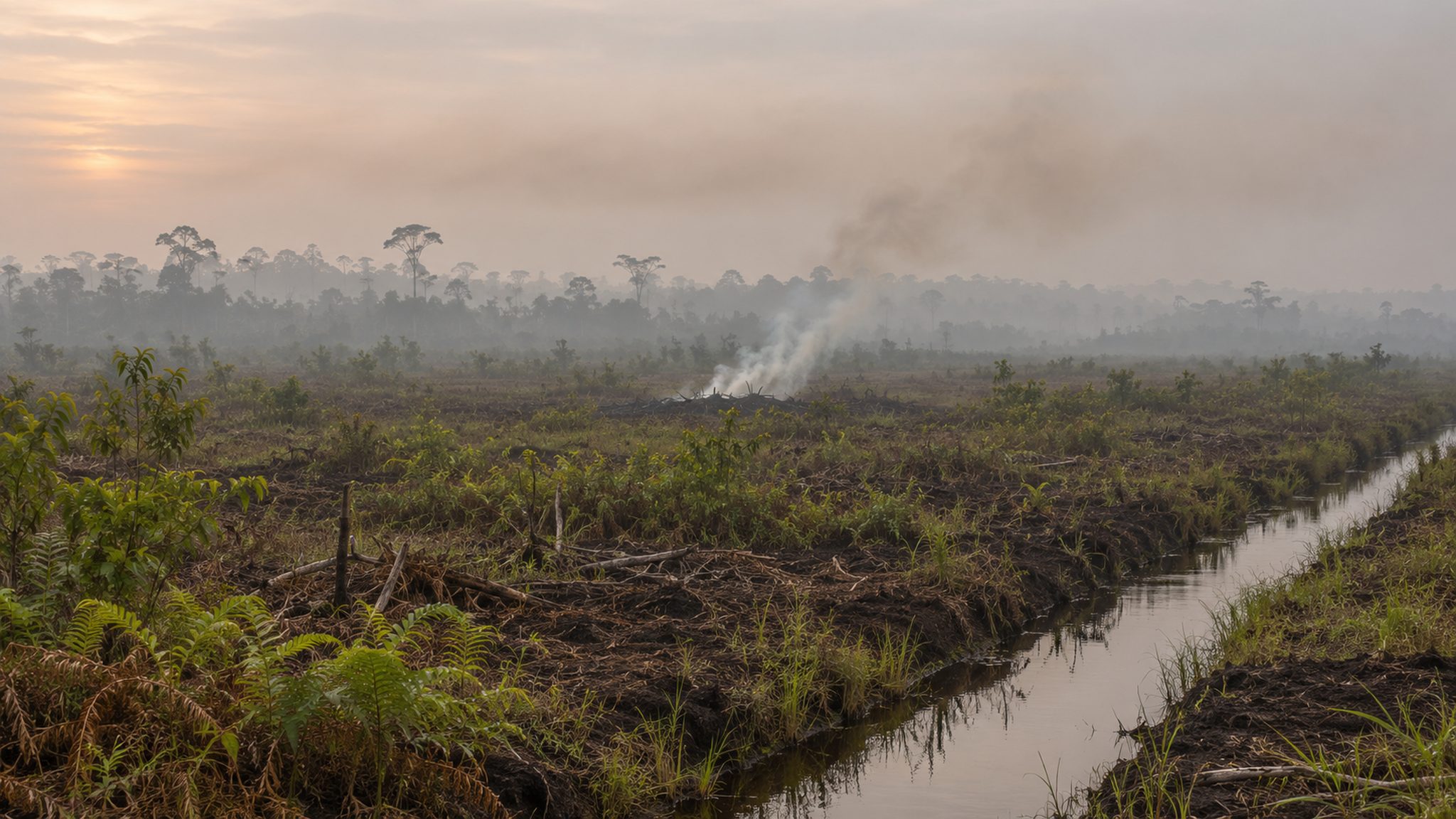
The Hindu’s November 20 coverage highlighted Indonesian fires, following a November 17 Copernicus report on persistent burning and haze across Southeast Asia.

  • CAMS estimated Indonesia’s cumulative fire emissions were approaching 200 megatonnes of carbon by mid-November, remaining well below the exceptional 2015 level.
  • The report described prolonged haze in Kalimantan and Sumatra, with smoke affecting neighbouring Singapore and Peninsular Malaysia.
  • CAMS combined fire-emission estimates and atmospheric forecasts to examine the persistence and movement of smoke.
  • Drained peat can sustain prolonged smouldering during dry conditions, connecting land management with regional air quality.
  • Different measurements describe emissions, airborne particles and atmospheric haze, so their units and interpretation require care.

UPSC Relevance

Prelims Relevance

  • Peat is accumulated partly decomposed organic material.
  • El Niño can intensify dry conditions in Indonesia.
  • GFAS uses satellite fire radiative power observations to estimate emissions.
  • Aerosol optical depth describes an atmospheric column.
  • PM2.5 refers to fine particulate matter.

Mains Relevance

GS Paper 3

  • Land management, persistent peat fires and regional pollution.
  • Environmental monitoring and interpretation of different evidence types.

GS Paper 2

  • Transboundary coordination for timely air-quality information.

Background and Context

Why Drained Peat Can Keep Burning

Peatland conditions help explain why smoke can persist after a fire becomes less visually dramatic.

  • Peat accumulates organic material where decomposition is limited by wet conditions. When a peatland is drained, its surface can become drier and more exposed to burning during periods of low rainfall.
  • Smouldering is prolonged combustion that can continue without a large visible flame. CAMS identifies drained peat as a source of persistent smoke and greenhouse-gas emissions during Indonesia’s dry season.
  • El Niño can intensify regional dryness, increasing vulnerability where combustible material and ignition sources are present. The report treats it as one contributing influence within a wider combination of environmental and land-use conditions.
  • Persistence matters because repeated emissions can sustain poor air quality over many days. A short-lived reduction in visible flames or the arrival of some rain does not by itself establish that all hotspots have ended.
  • Spatial variation also matters. CAMS reported substantial differences between provinces, so a national total can conceal where burning is concentrated and where the practical need for monitoring is greatest.

What the Three Measurements Describe

Emissions, near-surface concentrations and atmospheric-column observations answer different questions about the same fire episode.

  • Carbon emissions quantify the mass of carbon released over a defined area and period. The report’s megatonnes of carbon describe a cumulative emissions estimate, rather than the concentration of particles inhaled at a location.
  • Surface PM2.5 concentration describes fine-particle mass in a volume of near-ground air, commonly expressed in micrograms per cubic metre. Its interpretation depends on the location and averaging period of the observation or forecast.
  • Aerosol optical depth expresses how particles affect light passing through an atmospheric column. It is dimensionless and includes particles above the surface, making their vertical distribution important when relating it to ground-level conditions.
  • Fire radiative power provides a satellite-observed input to GFAS emissions estimates. Converting an observation into emissions requires a model, so the resulting totals should retain their stated estimation basis and time window.
  • Measurement continuity makes comparisons more meaningful when methods and coverage remain consistent. This is also the central concern in maintaining long-term climate observation records.

How Smoke Becomes a Regional Problem

Atmospheric transport connects burning in one area with haze and particle concentrations elsewhere.

  • Wind transport can carry smoke across administrative and national boundaries. CAMS described haze affecting Singapore and Peninsular Malaysia, illustrating why local air conditions can depend on emissions outside the immediate jurisdiction.
  • Plume height and mixing influence how much smoke reaches the surface. An elevated layer may contribute to optical depth while having a different relationship with ground-level particle concentrations than a low-lying plume.
  • Model evaluation compares forecasts with independent observations. CAMS checked aerosol optical-depth forecasts against AERONET measurements, which supports assessment of that variable while leaving other quantities to their appropriate observations and validation.
  • Exposure assessment needs information about concentrations where people spend time and for how long. Emission totals alone cannot supply this detail, which also matters when using air-pollution evidence in public policy.
  • Source attribution requires evidence linking emissions, atmospheric movement and observations. A hazy photograph or one elevated reading cannot by itself identify the exact contribution of a particular fire to conditions at another site.

Way Forward

Connect Land and Atmospheric Monitoring

  • Track persistent hotspots alongside peatland conditions so changes in rainfall are assessed against continuing fire activity.
  • Report units and time windows clearly when communicating emissions, particle concentrations and optical depth.
  • Compare forecasts with observations and share regional information promptly so authorities can follow smoke movement across borders.

Conclusion

  • Peat-fire management requires attention to the land conditions sustaining combustion and the atmosphere carrying its emissions.
  • Sound interpretation starts by asking what a number measures, where it applies and over what period it was calculated.

UPSC Practice Questions

Prelims MCQ 1

With reference to fire and smoke monitoring, consider the following statements:

  1. Carbon emissions can be expressed as a mass over a specified period.
  2. Aerosol optical depth represents an atmospheric-column property.
  3. A national fire-emission total directly determines every city’s surface PM2.5 concentration.

How many of the above statements are correct?

(a) Only one (b) Only two (c) All three (d) None

Answer: (b) Only two

Explanation:

The first two statements are correct. Surface concentrations also depend on transport, mixing and local conditions.

Prelims MCQ 2

Which observation most directly helps assess fine-particle concentration near ground level at a particular location?

(a) A cumulative national carbon-emission total (b) A count of provinces (c) A surface PM2.5 measurement with a defined averaging period (d) A photograph of distant haze alone

Answer: (c) A surface PM2.5 measurement with a defined averaging period

Explanation:

A surface measurement records the relevant particle concentration at the monitoring location and period. Wider totals and images provide different information.

UPSC Mains Questions

  1. Explain how drained peatlands and atmospheric transport can turn seasonal fires into a regional environmental problem.
  2. Distinguish carbon-emission estimates, surface PM2.5 concentrations and aerosol optical depth in assessing a smoke episode.

Source: Copernicus Atmosphere Monitoring Service.

Frequently Asked Questions

Why can peat fires persist?

Drained peat can become dry and sustain smouldering for long periods. Continued burning releases smoke even when large flames are absent, making hotspot monitoring important.

What does a megatonne of carbon measure?

It measures carbon mass. In a fire-emissions estimate, it refers to carbon released over a defined area and period, rather than particle concentration at a particular monitoring site.

Does aerosol optical depth give surface PM2.5 directly?

Aerosol optical depth describes particles through an atmospheric column. Relating it to surface PM2.5 requires information about vertical distribution, particle properties and atmospheric conditions.

Why can haze cross national borders?

Winds can transport smoke from fire regions into neighbouring countries. Plume height, mixing and changing weather influence where the smoke travels and how it affects surface air.

Women are yet to achieve substantive equality: SC judge

Open article →Download PDF

Why in news?

Justice B.V. Nagarathna said that women in high office do not prove equality across society; substantive equality is still missing.

UPSC Relevance

Prelims – constitutional provisions, 106th Amendment

Mains, GS1, Role of women and women’s organisations; Social empowerment

GS2, Indian Constitution – significant provisions; Structure and functioning of the Judiciary; Mechanisms, laws and institutions for the protection of vulnerable sections

What did the judge say?

Justice Nagarathna, who is in line to become India’s first woman Chief Justice, delivered the inaugural Cornelia Sorabji Memorial Lecture at Somerville College, Oxford. Cornelia Sorabji was the first woman to study law at Oxford and later India’s first woman advocate. Key points from the lecture:

  • Token presence is not equality: One woman in a senior post does not mean other women have access to education, jobs, property or legal remedies.
  • Limits of judgments and laws: A judgment cannot by itself make every workplace safe or ensure every woman gets her inheritance. Laws fail if remedies are inaccessible, officials do not act or social attitudes stop women from asserting rights.
  • Reservation in legislatures: The one-third reservation for women in Parliament and State legislatures shows that women must take part in decision-making and not remain content with a formal right to vote.
  • Wrong yardstick: Progress cannot be measured by the number of discriminatory provisions struck down or a few beneficial laws passed.

Formal Equality vs Substantive Equality

BasisFormal EqualitySubstantive Equality
MeaningTreat everyone alike; same rules for allEqual outcomes and real opportunities, considering existing disadvantages
View of differenceIgnores social and historical differencesRecognises structural disadvantage, care burden, caste, class, religion
ToolRemoving discriminatory provisionsAffirmative action, reasonable accommodation, changing institutions
Constitutional basisArticle 14 (equality before law), 15(1)Article 14 (equal protection of laws), 15(3), 16(4), 39, 42, 243D, 243T, 330A, 332A
ExampleSame entrance test for men and womenMaternity benefits, crèches, reservation in local bodies and legislatures

Indian courts have slowly moved from a “protective” approach (treating women as weak and needing protection) to a “rights-based” and substantive approach (removing stereotypes and structural barriers).

Constitutional Framework for Gender Equality

  • Article 14: Equality before law and equal protection of laws.
  • Article 15(1) and 15(3): No discrimination on grounds of sex; State can make special provisions for women and children.
  • Article 16(2): No discrimination in public employment on grounds of sex.
  • Article 21: Right to life with dignity, including bodily autonomy, privacy and reproductive choice.
  • DPSPs: Article 39(a) equal right to livelihood, 39(d) equal pay for equal work, 42 maternity relief.
  • Article 51A(e): Fundamental duty to renounce practices derogatory to the dignity of women.
  • Articles 243D and 243T: One-third reservation in Panchayats and Municipalities (73rd and 74th Amendments).
  • Articles 330A and 332A: One-third reservation in Lok Sabha and State Assemblies (106th Amendment, 2023), to be operational after delimitation following the next census.

Judicial Evolution in Ensuring Gender Equality

Phase 1: Early years – formal equality and protective approach (1950s–1970s)

  • Yusuf Abdul Aziz v State of Bombay (1954): Upheld a law that punished only men for adultery, treating it as a special provision for women under Article 15(3). This reflected the paternalistic view of women as victims, not as equal agents.
  • C.B. Muthamma v Union of India (1979): Struck down IFS rules that required women officers to seek permission to marry and allowed their removal after marriage. Justice Krishna Iyer called it a hangover of “masculine” culture in services.

Phase 2: Rights in workplace and family (1980s–1990s)

  • Air India v Nargesh Meerza (1981): Termination of air hostesses on first pregnancy was held arbitrary and an insult to womanhood.
  • Mohd. Ahmed Khan v Shah Bano Begum (1985): Divorced Muslim women entitled to maintenance under Section 125 CrPC. Later upheld in spirit in Danial Latifi (2001).
  • Mary Roy v State of Kerala (1986): Syrian Christian women got equal share in father’s property under the Indian Succession Act.
  • Vishaka v State of Rajasthan (1997): Laid down guidelines on sexual harassment at the workplace using CEDAW, in the absence of a law. Led to the POSH Act, 2013.
  • Githa Hariharan v RBI (1999): The word “after” in the Hindu Minority and Guardianship Act was read to allow the mother to be a natural guardian even when the father is alive.

Phase 3: Rejecting stereotypes and paternalism (2000s–2010s)

  • Laxmi v Union of India (2015): Regulated the sale of acid and ordered compensation for acid-attack survivors.
  • Shayara Bano v Union of India (2017): Instant triple talaq declared unconstitutional. Later criminalised by the Muslim Women (Protection of Rights on Marriage) Act, 2019.
  • Joseph Shine v Union of India (2018): Section 497 IPC (adultery) struck down. It treated the wife as the husband’s property. This overruled the logic of Yusuf Abdul Aziz.
  • Indian Young Lawyers Association (Sabarimala, 2018): Exclusion of women aged 10–50 from the temple held unconstitutional. The matter has been referred to a larger bench on wider questions of essential religious practices.

Phase 4: Substantive equality as a constitutional standard (2020 onwards)

  • Secretary, Ministry of Defence v Babita Puniya (2020): Women officers to get Permanent Commission in the Army. The Court rejected arguments based on “physiological limitations” as sex stereotypes.
  • Vineeta Sharma v Rakesh Sharma (2020): Daughters are coparceners by birth under the Hindu Succession (Amendment) Act, 2005, whether or not the father was alive on that date.
  • Kush Kalra v Union of India (2021): Women allowed to appear for the NDA examination.
  • X v Principal Secretary, Health, Govt. of NCT of Delhi (2022): Unmarried women equally entitled to safe abortion up to 24 weeks. For the MTP Act, “rape” includes marital rape.
  • Handbook on Combating Gender Stereotypes (2023): Released by the Supreme Court to replace stereotypical words like “eve-teasing” and “housewife” in legal writing.
  • Mohd. Abdul Samad v State of Telangana (2024): Justice Nagarathna’s bench held that Muslim women can claim maintenance under Section 125 CrPC. She stressed the value of the homemaker’s work and advised joint bank accounts for financial security of wives.

Why judgments alone are not enough

GapExample
Weak implementationMany workplaces still lack Internal Committees under the POSH Act
Inaccessible remediesCost, delay and distance of courts; low legal awareness in rural areas
Social attitudesDaughters often give up property rights under family pressure despite Vineeta Sharma
Under-representationWomen remain a small share of judges in higher judiciary and of MPs
Economic exclusionLow female labour force participation; unpaid care work

Way Forward

  • Implementation focus: Fix accountability of public authorities in laws like POSH Act, PWDV Act, 2005 and Maternity Benefit Act.
  • Access to justice: Strengthen legal aid under NALSA, fast-track courts and One Stop Centres.
  • Gender diversity in judiciary: More women judges in High Courts and the Supreme Court bring wider perspectives.
  • Early operation of the 106th Amendment: Timely census and delimitation so that the reservation becomes real.
  • Change social norms: Gender sensitisation in schools, police and judiciary; equal sharing of care work.
  • Economic empowerment: Women’s ownership of land and assets, credit through SHGs, workplace crèches.

Courts have moved from protecting women to empowering them. As Justice Nagarathna points out, the real test is whether rights reach every woman in daily life, not just the number of laws and judgments.

Practice MCQ

Q1. With reference to the Constitution (106th Amendment) Act, 2023, consider the following statements:

1. It reserves one-third of seats for women in the Lok Sabha, State Legislative Assemblies and the Legislative Assembly of the NCT of Delhi.

2. The reservation will come into effect after delimitation is done on the basis of the first census taken after its commencement.

3. It also provides reservation for women in the Rajya Sabha and State Legislative Councils.

Which of the statements given above are correct?

(a) 1 and 2 only

(b) 2 and 3 only

(c) 1 and 3 only

(d) 1, 2 and 3

Answer: (a)

Explanation: Statement 3 is incorrect. The Amendment does not cover the Rajya Sabha or Legislative Councils, which are indirectly elected.

Practice Question

“Formal equality alone may not be sufficient to secure meaningful representation of women.” Trace the evolution of the Supreme Court’s approach from protective discrimination to substantive equality with the help of landmark judgments. Also discuss why judicial pronouncements alone cannot ensure gender justice. (15 Marks)

What protections do workers in India have in case of layoffs?

Open article →Download PDF

Why in news?

As India marks the first anniversary of the implementation of the four Labour Codes (21 November 2025), layoffs linked to AI adoption and restructuring in the tech sector have raised questions on severance pay, its taxation and the lack of an unemployment relief system in India.

UPSC Relevance

Prelims – Labour Codes, retrenchment provisions, Article 41, e-Shram, ESIC schemes

Mains, GS2 – Welfare schemes for vulnerable sections; Mechanisms, laws and institutions for their protection and betterment

GS3 – Indian Economy and issues relating to Growth, Development and Employment; Inclusive growth

Layoff vs Retrenchment

‘Layoff’ is a term borrowed from American usage. Indian labour law uses three different terms, and the difference is important for exams: 

TermMeaningNature
Lay-offEmployer fails or refuses to give work due to shortage of raw material, power, breakdown of machinery, etc.Temporary; worker stays on rolls and gets 50% of wages as compensation
RetrenchmentTermination of service by the employer for any reason other than punishmentPermanent; excludes voluntary retirement, superannuation, end of fixed-term contract and termination due to ill-health
ClosurePermanent shutting down of a place of employment or a part of itPermanent; all workers lose jobs

In the West, a layoff usually means a pink slip, settlement of dues and exit. In India, it carries a much heavier social cost – loss of income, health cover, social standing and often a hidden sense of shame within the family.

What protections does a retrenched worker have?

Constitutional Basis

  • Article 41 (DPSP): The State shall, within its economic capacity, make effective provision for securing the right to work and public assistance in cases of unemployment, old age, sickness and disablement.
  • Article 43 (DPSP): Living wage and decent conditions of work for all workers.
  • Entries 22, 23 and 24 of the Concurrent List: Trade unions and industrial disputes; social security and social insurance, employment and unemployment; welfare of labour.

Under the Industrial Relations Code, 2020

  • Notice: One month’s written notice with reasons, or wages in lieu of notice, for a worker with at least one year of continuous service.
  • Retrenchment compensation: 15 days’ average pay for every completed year of continuous service.
  • Prior government permission: Needed for lay-off, retrenchment and closure only in factories, mines and plantations employing 300 or more workers (the threshold was 100 under the Industrial Disputes Act, 1947).
  • Worker Re-skilling Fund: The employer contributes 15 days’ last drawn wages for each retrenched worker, which is credited to the worker for re-skilling.
  • Last in, first out: The worker who joined last in a category is normally retrenched first.
  • Right to re-employment: Retrenched workers get preference if the employer hires again.

Under the Code on Social Security, 2020

  • Gratuity: 15 days’ wages for every completed year of service; fixed-term employees now become eligible after one year instead of five.
  • ESIC unemployment relief: Insured workers who lose jobs can get cash relief of a part of their average earnings for a limited period under ESIC schemes such as the Atal Bimit Vyakti Kalyan Yojana.
  • Provident Fund: Partial withdrawal is allowed during unemployment.

Concerns 

  • Narrow coverage: The strongest protections (prior permission) apply mainly to manufacturing, mining and plantations. Services and IT workers, who have faced some of the biggest layoffs in recent years, are largely outside this net. Informal workers are left out entirely.
  • Taxation of severance: Severance pay is treated as ‘profit in lieu of salary’ and taxed like salary. Critics argue that taxing a payment meant to cushion job loss weakens its purpose.
  • One-time payment culture: Most Indian employers prefer to pay compensation in one go and close the file. Progressive practice abroad also includes counselling, legal advice, retraining and help with job search.
  • Gig, platform and informal workers: How to compensate for loss of earning potential when income itself is irregular. 
  • Dispute resolution: The IR Code replaced Labour Courts with Industrial Tribunals. Whether vacancies are filled on time and tribunals work efficiently remains to be seen.
  • Reforms seen as employer-friendly: Critics feel the Codes were driven mainly by ease of doing business and attracting investment, with workers’ concerns secondary.
  • Weak health cover after job loss: ESI hospitals are too few compared to the number of beneficiaries.
  • No unemployment relief system: India has no general unemployment insurance. The joint family once acted as a cushion, but this support is weakening with urbanisation and nuclear families.

How other countries protect workers

CountryModel
GermanyEarnings-linked unemployment insurance – payout is a percentage of the worker’s previous earnings, not a flat rate
USAUnemployment insurance funded through payroll tax; employer’s rate based on ‘experience rating’ (history of past layoffs); run jointly by federal and state governments
UKJobseeker’s Allowance and Universal Credit linked to job search
SingaporeSkillsFuture Jobseeker Support – temporary financial help linked to training and job search
Sri Lanka and many European countriesStricter rules and procedures on termination than India

Way Forward

  • Unemployment insurance for India: A contributory scheme, possibly built on ESIC and EPFO, with payouts linked to past earnings and conditional on re-skilling and job search.
  • Extend retrenchment safeguards to services and IT: Advance notice, transition support and counselling, irrespective of sector.
  • Rethink taxation of severance: A higher tax exemption limit for retrenchment compensation would make it a real cushion.
  • Make the Re-skilling Fund work: Link it to Skill India and industry-led courses, with tracking of re-employment outcomes.
  • Portable benefits for gig workers: Use e-Shram and Aadhaar-linked accounts so benefits move with the worker across platforms. One suggestion is a small voluntary premium paid by the gig worker and matched by the aggregator and the customer.
  • Urban employment guarantee: Rural India has MGNREGA/VB-GRAM-G; urban schemes need different design (skills, wages, type of work).
  • Strengthen ESI infrastructure: More hospitals and dispensaries in industrial and urban clusters.
  • Two-pronged approach: Bring workers into the formal social security net, and build synergy between citizens and government agencies. Labour market governance may increasingly shift towards the Skills Ministry.

Conclusion

AI-driven restructuring will make job loss a more frequent part of working life, especially for white-collar and gig workers. India has a good set of laws and institutions on paper, but the real gap lies in coverage and implementation. A modern labour market needs not just flexibility for employers, but a dependable safety net that helps workers move from one job to the next.

Practice MCQ

Q1. With reference to the Industrial Relations Code, 2020, consider the following statements:

  1. Industrial establishments employing 300 or more workers need prior permission of the appropriate government before retrenchment.
  2. A retrenched worker is entitled to compensation of 15 days’ average pay for every completed year of continuous service.
  3. The Code retains Labour Courts along with Industrial Tribunals for settling disputes.

Which of the statements given above are correct?

(a) 1 and 2 only

(b) 2 and 3 only

(c) 1 and 3 only

(d) 1, 2 and 3

Answer: (a)

Explanation: Statement 3 is incorrect. The Code has done away with Labour Courts; disputes now go to Industrial Tribunals.

Q2. Which Article of the Constitution of India directs the State to make effective provision for public assistance in cases of unemployment?

(a) Article 39A

(b) Article 41

(c) Article 43

(d) Article 47

Answer: (b)

Explanation: Article 41 deals with the right to work, to education and to public assistance in certain cases. Article 39A is on free legal aid, Article 43 on living wage and Article 47 on nutrition and public health.

Mains Practice Question

“With AI-driven layoffs on the rise, India’s retrenchment framework protects too few workers and offers too little support.” Critically examine the safeguards available to workers under the new Labour Codes and suggest a suitable model of unemployment protection for India. (15 Marks, 250 words)