Opens in a new tab
Join Anantam IAS Channel on Telegram

Daily Digest · Saturday

7 November 2026 Current Affairs for UPSC

11 current affairs published on Saturday, 7 November 2026

7 November 2026 Current Affairs for UPSC — every Why-in-News article AnantamIAS published on Saturday, 7 November 2026, broken down with Why in News?, the exact GS paper it feeds, sub-topic mapping, MCQ-ready facts and a UPSC-style practice question. 11 articles in total, covering Polity, Economy, Environment, S&T, IR, Geography, History, Society and Internal Security — the same Why-in-News + GS-paper-mapping + practice-question format the Compass uses across every daily digest on the site.

Daily current affairs for UPSC is where new material enters your prep stream. Read this 7 November 2026 digest end-to-end in 25–35 minutes, attempt the practice question at the foot of each article (it's MCQ for some, 10/15-marker for others), then bookmark the entries that fall inside your active revision window. Everything stays cross-linked: tap any subject pill to jump to that subject's hub, or use the table of contents above to skip straight to a specific story.

Use this page three ways. Read sequentially for a one-sitting scan of everything that mattered on 7 November 2026. Download the 7 November 2026 PDF below for offline study or print revision. Or use the November 2026 Current Affairs compilation to see this day in the month's full context. For the previous day's reading, see 6 November 2026 Current Affairs; the next day's is 8 November 2026 Current Affairs.

Why we publish daily current affairs separately from the monthly compilation: daily is learning, monthly is revision. Use the daily page to add fresh material to your notes the day it breaks; come back to the November 2026 compilation 60 days before Prelims when the noise has settled and only the lasting takeaway is worth re-reading.

I-STEM: How Startups Can Request Shared Research Equipment

Open article →Download PDF

Why in News?

On 6 November, the Office of the Principal Scientific Adviser and DPIIT linked Startup India with I-STEM to help recognised startups find shared research equipment and request access.

  • The Indian Science, Technology and Engineering Facilities Map lists equipment held by academic and research institutions.
  • The new application programming interface (API) connects the two services and supports automated verification of startup recognition.
  • The government proposed single sign-on for a subsequent phase. Host institutions continue to decide individual requests.
  • A young company may need an expensive instrument for just one stage of prototype testing. Finding an existing facility can change the cost of that trial.
  • A university knows its instrument settings, staff availability and operating limits. A national directory makes that local capacity easier for outside users to find.

UPSC Relevance

Prelims Relevance

  • DPIIT administers Startup India.
  • I-STEM stands for the Indian Science, Technology and Engineering Facilities Map.
  • An API allows software services to exchange information.
  • The host institution evaluates each equipment request.

Mains Relevance

GS Paper 3

  • Explain how sharing instruments can lower the cost of experimental work for startups.
  • Assess equipment sharing through completed tests and time to access.

GS Paper 2

  • Examine how common digital services can coexist with decisions taken by individual institutions.

Background and Context

Why a Startup Might Share an Instrument

Consider a team developing a metal part that must bend under a load without breaking. It needs a measurement before it can improve the prototype.

  • To test a specimen, the team could use a universal testing machine. Its grips hold the sample while the machine applies a controlled load and measures the response.
  • If the team needs only a few test runs, buying a machine ties up money that could pay for the next prototype. It would also need space and staff to operate the equipment.
  • A laboratory with spare capacity could perform the measurement between its own experiments. The team would still have to find a machine with a suitable load range and an available time slot.
  • Sharing addresses the cost of getting a particular measurement. A financing instrument such as the Research, Development and Innovation Fund addresses a different problem, the supply of capital for research.

How the Two Services Connect

A startup brings its recognition record to one service and its technical question to another. The link helps it move between them.

  • The Department for Promotion of Industry and Internal Trade recognises eligible startups. The integration lets the services verify that status automatically as a business seeks access to research facilities.
  • The I-STEM catalogue helps a team identify institutions with equipment for the test it has in mind. Two laboratories may list the same type of machine yet support different specimen sizes or operating ranges.
  • After identifying a possible match, the team can request access. A description of the specimen and the measurement sought gives the host a practical basis for deciding whether its instrument can do the work.
  • The launch covered an API connection. A separate proposal would add single sign-on, allowing users to reach the connected service through one login. The announcement placed that feature in a later phase.

What the Host Laboratory Decides

The host has to establish that it can perform the proposed test safely and within its existing commitments.

  • Technical suitability depends on the actual experiment. A tensile testing machine might cover the required load range but lack the grips needed to hold a fragile specimen without damaging it.
  • Availability includes the instrument time the host can offer. A catalogue entry can remain accurate while the machine is fully booked, under maintenance or reserved for a longer experiment.
  • Safety requirements depend on the material and procedure. A biological sample, for instance, may need a facility with appropriate laboratory biosafety provisions before the host can accept it.
  • Hosts also apply their own charges and permissions. A startup comparing two offers should check what each charge covers, including any specimen preparation or operator time needed to obtain a usable measurement.

Way Forward

Make Equipment Listings Useful for Booking

  • Hosts can publish measurement ranges, specimen requirements and contact details alongside each instrument name.
  • Showing availability and charges before submission would let teams compare feasible options.
  • Track completed requests and waiting times to see which instruments need additional staff, maintenance or capacity.

Conclusion

  • Equipment sharing can make a short experiment affordable when a host has the right instrument and can offer a slot at a workable price. Recognition makes it easier for a startup to seek that opportunity.
  • An assessment of public research capacity should ask how many teams actually complete suitable tests, how long they wait and whether the results help them decide what to build next.

UPSC Practice Questions

Prelims MCQ 1

Consider these statements about the Startup India and I-STEM integration.

  1. The connection supports automated verification of DPIIT recognition.
  2. Single sign-on was proposed for a later phase.
  3. Recognition entitles a startup to a free slot on any listed instrument.

How many of the above statements are correct?

(a) Only one (b) Only two (c) All three (d) None

Answer: (b) Only two

Explanation:

The first two statements match the announcement. Hosts decide on requests and may apply charges.

Prelims MCQ 2

A recognised startup finds the instrument it needs, but its specimen exceeds the permitted load. Who decides whether to accept the request?

(a) The host institution (b) DPIIT (c) The startup itself (d) The portal operator

Answer: (a) The host institution

Explanation:

The host checks technical suitability, availability, safety, applicable charges and institutional permissions.

UPSC Mains Questions

  1. How can shared laboratory equipment improve the use of public research investment while supporting early-stage firms?
  2. Suggest criteria for evaluating whether easier discovery of scientific equipment leads to timely access for startups.

Source: PIB, Office of the Principal Scientific Adviser.

Frequently Asked Questions

Who can use the new Startup India connection?

The integration is aimed at DPIIT-recognised startups looking for research, testing or prototyping facilities. It helps verify their recognition status and links them to equipment listed on I-STEM.

Does DPIIT recognition guarantee equipment access?

The host institution evaluates each request against the experiment, its equipment and available capacity. It also applies its own safety requirements, relevant charges and permissions before granting access.

What is the difference between an API and single sign-on?

An API lets software services exchange information, such as a recognition status. Single sign-on lets a user reach connected services through one login. The government proposed the latter for a later phase.

Why would a startup request a shared instrument?

A prototype may require a specialised test only occasionally. Booking time on an existing instrument can help the team obtain a measurement without buying and maintaining equipment for that limited use.
Electronics Manufacturing: Where Materials, Components and Machines Fit

Open article →Download PDF

Why in News?

On 6 November, the Ministry of Electronics and Information Technology approved 12 applications under the Electronics Component Manufacturing Scheme (ECMS), including its first approval for copper foil.

  • The approvals cover bare components, supply chain products and capital goods. Each plays a different role in manufacturing an electronic device.
  • The ministry also recorded first-time ECMS approvals for cathode active material and specialty ceramics.
  • A separate announcement opened applications for parts of Semicon 2.0, the semiconductor programme.
  • Following a material through production shows which activities a country can perform locally even when it still imports other inputs.
  • The earlier ECMS approvals explain the scheme’s wider aim of developing domestic suppliers for electronics manufacturers.

UPSC Relevance

Prelims Relevance

  • Copper foil is an input for copper-clad laminate.
  • A multilayer printed circuit board contains conducting layers separated by insulating material.
  • A precision mould counts as tooling used in production.
  • The ministry placed heat sinks in the components category.

Mains Relevance

GS Paper 3

  • Explain how domestic materials and equipment suppliers can change the share of value added within India.
  • Assess an industrial incentive scheme using production and buyer adoption alongside project approvals.

Essay

  • Industrial capability can grow in the less visible stages of making an everyday device.

Background and Context

How Copper Foil Becomes Part of a Circuit Board

Follow a thin sheet of copper through a factory and the distinction between a material and a component becomes easier to see.

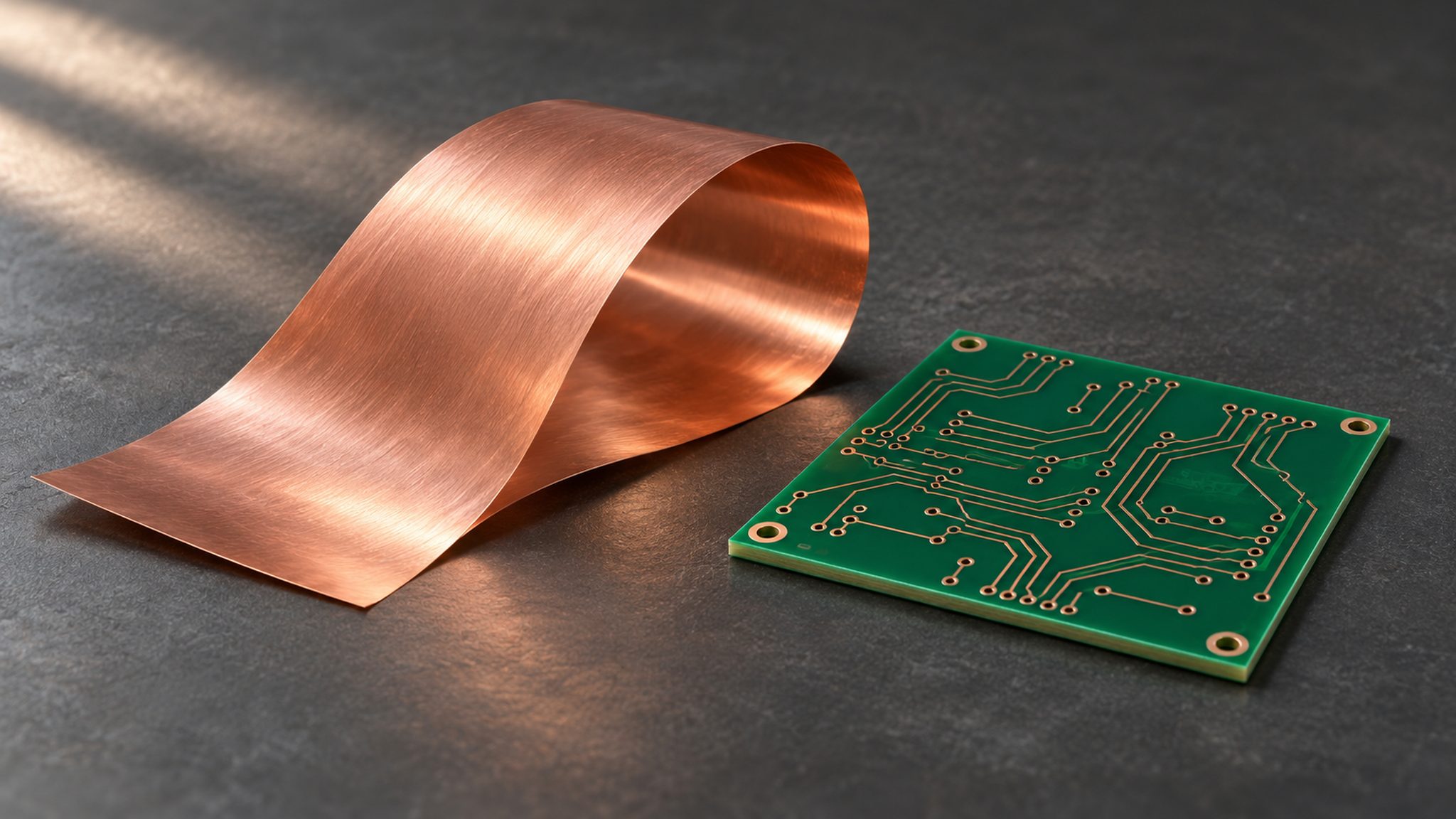
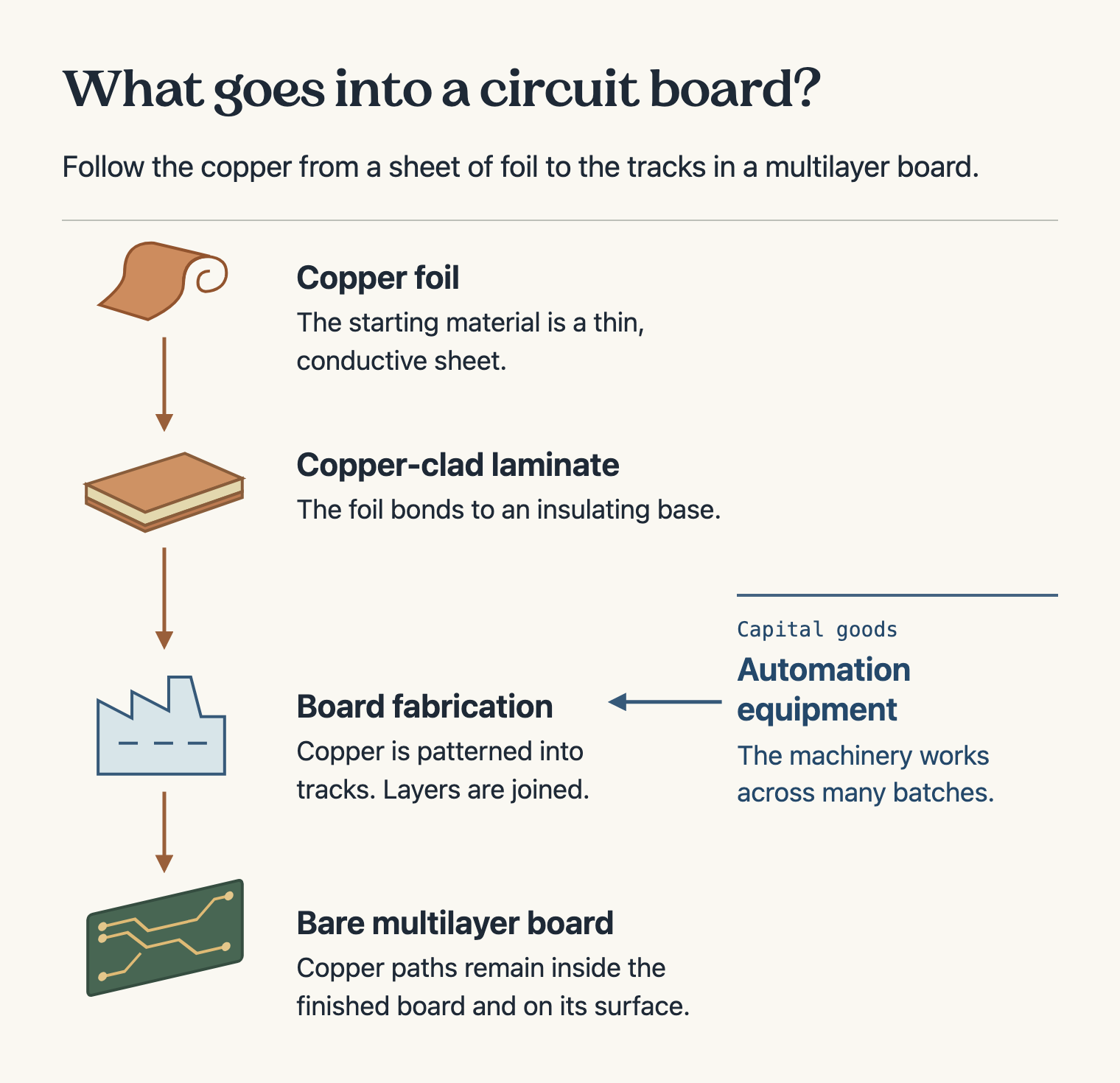
  • Copper foil supplies the conducting metal. Bonding the foil to an insulating base produces copper-clad laminate, a board maker’s starting material that combines electrical conduction with physical support.
  • A board maker forms conductive tracks by selectively removing copper. The copper that remains carries signals or distributes power between points specified by the circuit designer.
  • In a multilayer board, insulating material keeps copper layers apart. Designers can route connections on different layers and join selected points through the thickness of the board.
  • The ministry classified the bare board as a component. It already contains wiring, although an assembler still has to mount chips and other devices to provide the intended electronic functions.
  • Consider a camera with a vision processing chip. The chip processes image data while the circuit board supports and connects it to the rest of the system.

Where Factory Equipment Fits

The same factory buys things that enter its product and equipment that stays on the production floor.

  • A precision mould gives successive parts their shape. Its purchase adds productive capacity because the factory can use the same tool to make many units for delivery to customers.
  • A heat sink, by contrast, travels with the equipment in which it is installed. It carries heat away from a working part and releases it across a larger surface.
  • The approved power and control systems serve capital equipment. A controller fitted to a production machine can help operate the line through many batches of finished electronic goods.
  • The ministry included factory automation and system integration under capital equipment. Connecting machines so that they work together can improve a factory’s capabilities even when its final product design stays the same.
  • Classify a purchase by asking what the buyer does with it. Copper foil can be the foil maker’s finished product and the board supply chain’s purchased input at the same time.
Copper foil becomes part of a multilayer board through lamination and fabrication. Automation equipment enters at fabrication and stays in the factory.
The material path through a board factory and the separate role of its capital equipment.

What Project Approval Establishes

Look for a separate piece of evidence at each stage from a project decision to a sale.

  • An approved application identifies a proposed manufacturing activity accepted under the scheme. A subsequent commissioning announcement would establish that the firm had brought facilities or equipment into service.
  • For a domestic foil supplier, customer acceptance matters. A board maker needs foil that meets its specifications consistently before it can rely on that supplier across production batches.
  • To assess domestic value addition, ask what processing takes place locally and which intermediate goods still come from abroad. Counting every rupee of a finished device’s price would include imported inputs.
  • The ministry reported expected employment and projected output for this group of applications. Payroll and actual sales would answer the later questions of how many people work there and what buyers purchased.

Way Forward

Track the Supplier Through to Its Customer

  • Record commissioning and first commercial supply separately for each product.
  • Check whether manufacturers receive repeat orders for inputs that meet buyers’ specifications.
  • Measure local processing at each stage to avoid counting the same purchased input twice.

Conclusion

  • A multilayer board brings several manufacturing capabilities into view. The copper supplier provides a material, the board maker builds connections into it, and the assembler fits electronic devices onto the board.
  • The industrial policy question is which capabilities buyers can actually obtain in India. Follow approved projects through commissioning, supply and repeat purchases to judge how the domestic production chain changes.

UPSC Practice Questions

Prelims MCQ 1

With reference to the recent ECMS approvals, consider the following statements:

  1. Copper foil was classified as a supply chain product.
  2. Precision moulds and tooling were approved under capital goods.
  3. The ministry classified heat sinks as factory automation equipment.

How many of the above statements are correct?

(a) Only one (b) Only two (c) All three (d) None

Answer: (b) Only two

Explanation:

The first two statements match the ministry’s categories. Heat sinks were included among bare components.

Prelims MCQ 2

Which observation gives the strongest evidence that a new domestic foil supplier can meet sustained demand?

(a) A projection of employment (b) The submission of a project application (c) Repeat purchases by a laminate manufacturer (d) The announcement of a factory location

Answer: (c) Repeat purchases by a laminate manufacturer

Explanation:

Repeat purchases show a customer has used the material and continues to order it. The other observations describe earlier stages.

UPSC Mains Questions

  1. Using copper foil and printed circuit boards as examples, explain how developing intermediate goods industries can increase domestic value addition.
  2. Which indicators would you use to assess whether approvals for electronics components and capital goods have improved industrial capability?

Source: PIB, Ministry of Electronics and Information Technology.

Frequently Asked Questions

Why is copper foil useful in a printed circuit board?

Copper conducts electricity and can be patterned into tracks. Foil bonded to an insulating base provides material from which the board maker can form those connections.

What distinguishes a component from a capital good in these approvals?

A component such as a heat sink becomes part of the product sold to its user. A capital good such as a precision mould stays with the manufacturer for repeated production.

Did the approved ECMS projects start commercial production on 6 November?

The ministry announced project approvals and gave projections for output and jobs. Establishing commercial production for a particular project requires subsequent evidence of operations at that facility.

How was the Semicon 2.0 announcement different?

The ministry opened applications for selected parts of the semiconductor programme. In a separate decision, it announced approvals already granted to applicants under the Electronics Component Manufacturing Scheme.

Cancer Drug Repricing: How to Read the Revised Retail Price

Open article →Download PDF

Why in News?

On 6 November, the Press Information Bureau reported that companies had submitted revised maximum retail prices for 120 cancer drugs ahead of the new prices taking effect on 9 November.

  • The 17 October order covers 137 listed non-scheduled cancer drugs, including patented medicines. The National Pharmaceutical Pricing Authority (NPPA) issued it under the public-interest provision in the Drugs (Prices Control) Order, 2013.
  • The reporting date matters. NPPA’s published list records prices received from companies through 4 November. The list shows how far reporting had progressed before the revised prices were due to apply.
  • The trade margin is limited to 30% of the retail price before applicable goods and services tax. The size of the reduction for a particular pack depends on its previous price.
  • A patient buying the same ingredient in another strength or pack may see a different figure. The official list identifies a specific formulation and pack for each pair of old and revised prices.
  • For a hospital that buys an injectable medicine directly, the gap between its purchase price and the amount charged to a patient can matter as much as the margin at a retail pharmacy.

UPSC Relevance

Prelims Relevance

  • NPPA and Paragraph 19 of the Drugs (Prices Control) Order
  • Price to stockist or distributor
  • Pre-tax retail price as the margin denominator
  • Revised MRP and date of application

Mains Relevance

GS Paper 2

  • Assess how public price lists can help patients detect overcharging.
  • Distinguish compliance reporting from evidence of reduced household spending.

Background and Context

How the Margin Determines the Maximum Price

Start with the price paid at the first sale to a distributor. The order sets the largest permissible gap between that price and the pre-tax retail price.

  • For an existing formulation, the starting figure is its average March 2026 distributor price. For a listed drug launched after March, the order uses its current distributor price to calculate the maximum.
  • Take the regulator’s example of a distributor price of 70 rupees. A pre-tax retail price of 100 rupees leaves 30 rupees for the trade. Applicable tax enters the calculation afterward.
  • The fraction uses the retail price as its denominator. Multiplying the distributor price by 1.30 would calculate a markup on the purchase price and produce a different answer to the regulator’s example.
  • A manufacturer with an existing MRP below the amount calculated under the formula must retain that lower MRP. The order gives no permission to raise an already cheaper pack to the calculated amount.

How to Find the Correct Pack in the Price List

The entries for abiraterone acetate illustrate why a search by drug name alone can return several plausible prices.

  • In the NPPA price list, match the manufacturer and brand first. Several companies supply abiraterone acetate, and their products occupy separate rows even when the ingredient and tablet strength coincide.
  • Check the strength, dosage form and pack size against the pack on the bill. A jar of 60 tablets and a pack of 120 tablets represent different quantities even before any repricing.
  • Read across that row from the old MRP to the revised MRP. Some entries for abemaciclib show the same figure in both columns. Inclusion in the list alone cannot establish a price cut.
  • Use the effective date when checking a sale. Pharmacies must display the applicable price list where customers can consult it. Hospitals and medical institutions must also display the revised prices on their websites.

What the Savings Estimate Measures

The government estimated potential savings by applying the price changes to medicines sold in an earlier period.

  • The calculation applies the old-to-revised price difference to volumes sold from April 2025 through March 2026. This answers what those quantities would have cost at the two sets of maximum prices.
  • The estimate holds sales volumes constant. Changes in the number of packs sold or the mix of medicines bought after implementation can alter the saving even if every seller follows the order.
  • An individual bill supplies different evidence. Compare the actual amount paid per matching pack before and after the effective date. A past pharmacy discount could have reduced the earlier bill below its printed MRP.

Way Forward

Check Prices at the Point of Sale

  • Display the revised list beside the dispensing counter and identify the exact pack on the bill.
  • Have State Drug Controllers check matched invoices against the effective list and refer suspected violations to NPPA.
  • Track medicine availability alongside transaction prices to assess access after the order takes effect.

Conclusion

  • An implementation check follows a named product from the manufacturer’s reported price to the amount on a dated bill. This gives regulators an identifiable transaction to examine when a patient reports overcharging.
  • Two different records support two different findings. The price list establishes the applicable maximum for a particular pack. Comparable receipts show how much of the change reached the buyer.

UPSC Practice Questions

Prelims MCQ 1

With reference to the October cancer medicine order, consider the following statements:

  1. The margin is calculated as a share of the pre-tax retail price.
  2. Existing manufacturers must retain an MRP that is already below the amount computed under the formula.
  3. Every listed pack must receive the same percentage price reduction.

How many of the above statements are correct?

(a) Only one (b) Only two (c) All three (d) None

Answer: (b) Only two

Explanation:

Statements 1 and 2 follow the pricing formula and lower-price provision. Statement 3 is incorrect because the previous price differs across packs.

Prelims MCQ 2

Which evidence most directly establishes a change in the amount a patient paid for the same cancer medicine?

(a) Count of firms that reported prices (b) Maximum price reduction across products (c) A list of covered active ingredients (d) Comparable dated bills for matching packs

Answer: (d) Comparable dated bills for matching packs

Explanation:

Matching packs and quantities on invoices reveal the actual transaction prices. An announced maximum alone cannot establish the price paid.

UPSC Mains Questions

  1. Explain how the choice of denominator affects trade margin regulation in India’s pharmaceutical market.
  2. How would you assess whether the October cancer medicine order lowered household expenditure after its implementation?

Sources: Press Information Bureau and National Pharmaceutical Pricing Authority.

Frequently Asked Questions

When do the revised cancer drug prices apply?

The order specifies 9 November 2026. The list available on 4 November records prices submitted by companies in preparation for that date. Check the sale date when comparing a bill with that list.

Can an existing lower MRP rise to the calculated maximum?

The October order requires an existing manufacturer to keep its current MRP when that price falls below the amount given by the formula. Some entries show identical old and revised MRPs.

Why can two packs of the same drug have different revised prices?

The list gives a price for a specific product. Manufacturer, brand, strength, dosage form and pack quantity identify that product. Match all these particulars before comparing the MRP on a bill.

How did the government estimate savings?

It applied the differences between old and revised prices to historical sales volumes. Measuring actual household savings after 9 November requires evidence about the medicines bought, quantities purchased and transaction prices.

Barrier-Free Tolling: How NHAI Is Redesigning Toll Plazas

Open article →Download PDF

Why in News?

On 6 November 2026, the Ministry of Road Transport and Highways announced NHAI guidelines for barrier-free tolling on upcoming and ongoing national highway projects with four or more lanes.

  • The National Highways Authority of India (NHAI) has specified how projects should plan tolling lanes, overhead gantries, signs and lighting.
  • The design requirements enter project documents at the planning stage. Awarded projects adopt changes through applicable contract provisions.
  • The ministry describes shorter queues and lower fuel use as expected benefits. Its announcement gives no measured savings.
  • A toll plaza can create a bottleneck even where the highway has enough capacity between junctions.
  • The layout must give drivers time to choose a lane and follow it through the tolling zone.

UPSC Relevance

Prelims Relevance

  • MLFF means Multi-Lane Free Flow tolling.
  • A gantry spans the roadway and can support tolling equipment.
  • A variable message sign displays information that the operator can change.
  • The circular covers four-lane and wider national highway projects within its stated scope.

Mains Relevance

GS Paper 3

  • Explain how removing a compulsory stop changes the capacity needed at a collection point.
  • Identify measures of safety and delay for evaluating a redesigned tolling zone.

GS Paper 2

  • Compare incorporating a design change before award with implementing it under an existing contract.

Background and Context

Why Removing the Stop Changes the Plaza Layout

At a conventional toll plaza, vehicles arrive in a stream but pass the collection point one at a time in each booth lane.

  • At a barrier, even a brief pause occupies the lane. If vehicles arrive faster than the booth releases them, the queue grows upstream and can extend back onto the approach road.
  • Parallel booth lanes let several vehicles complete that stop at once. The approach can widen to distribute arrivals, then narrow again as drivers leave the booths and rejoin the highway.
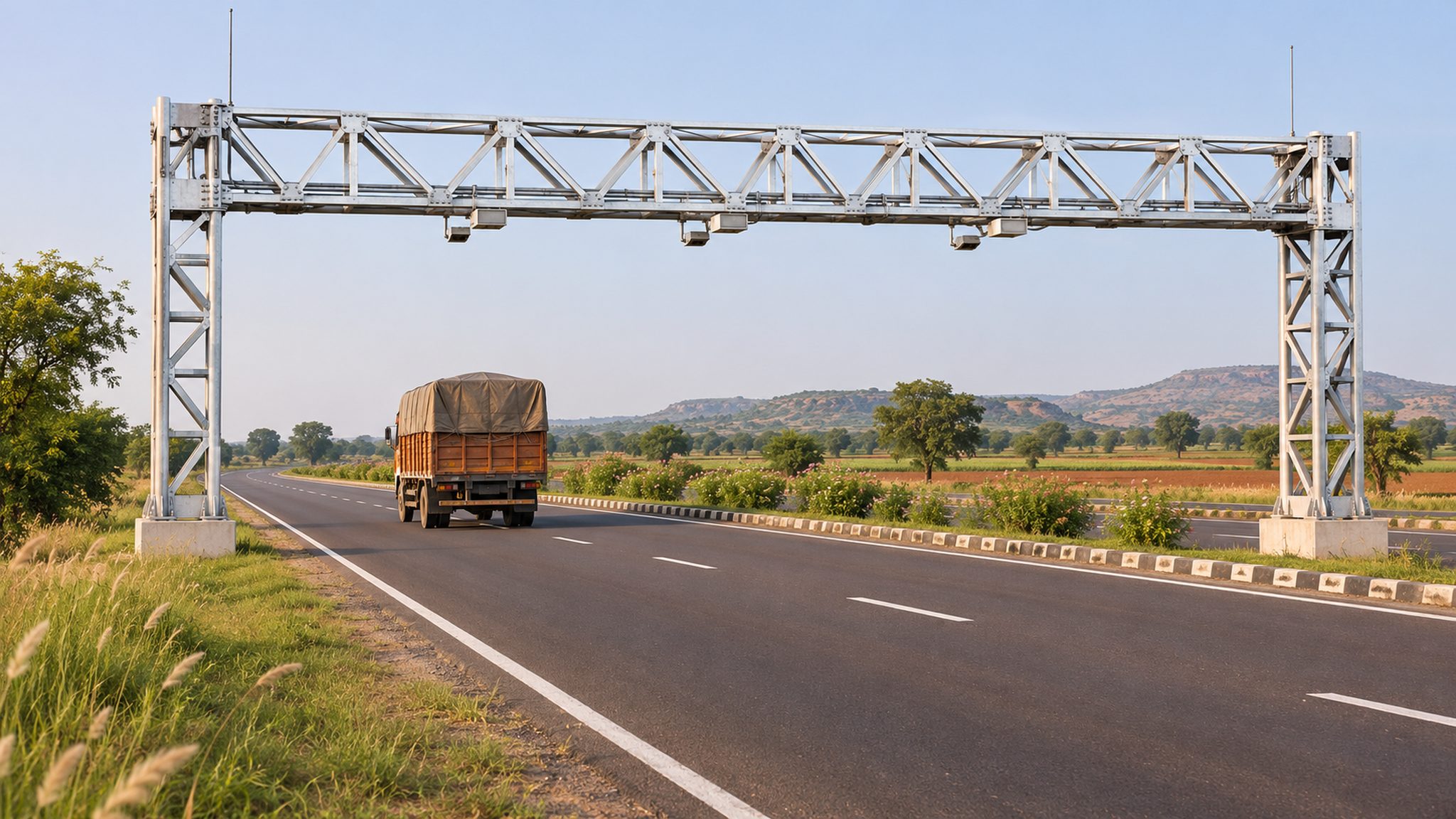
  • With multi-lane free flow, vehicles pass through the collection zone while moving. An overhead gantry can carry tolling equipment across the carriageway, leaving the road surface available for through traffic.
  • NHAI can now match the number of tolling lanes to the highway configuration. A design that needs less space for stationary vehicles can use the available road width more efficiently.

What Drivers Need on the Approach

Drivers who pass a gantry in moving traffic have less time to interpret an instruction than someone waiting at a booth.

  • Advance signs give drivers time to recognise the tolling zone and settle into the correct lane. A direction first visible under the gantry leaves little room for a safe lane change.
  • Variable message signs allow operators to give instructions suited to conditions on the road. A driver approaching a disrupted lane needs that information while there is still space to change course.
  • Lighting helps drivers see the lane alignment and guidance through the zone at night. A clear approach in daylight can present a different problem when lane edges are harder to distinguish.
  • Removing the compulsory stop should reduce idling and repeated acceleration. To assess the fuel benefit at a particular plaza, an evaluator would need traffic volumes and observations of actual delays.
  • The circular provides for an operations and maintenance centre. Even with no booth barrier to lift, the operator needs a place from which to manage the plaza and maintain its facilities.

How the Project Stage Determines Adoption

Two stretches of comparable width can fall under the same circular but require different decisions before contractors can build the revised layout.

  • At the Detailed Project Report stage, planners incorporate the new design into the project documents. This lets them specify the lane layout and gantry locations while the plans are still being prepared.
  • For an awarded project, a contractor already has an agreed scope of work. NHAI directs adoption through applicable contractual provisions, so the agreement matters even if physical construction has barely begun.
  • Field offices must include the requirements in upcoming projects and facilitate adoption on ongoing ones. Which documents need revision depends on how far the project has progressed when the design changes.
  • A driver may ask whether an existing booth will disappear immediately. The project scope answers that question. The ministry described future and under-construction projects and gave no nationwide conversion date for operating plazas.

Way Forward

Check the Design Against Traffic on the Ground

  • Record queue length and travel time before and after conversion at comparable times of day.
  • Review night visibility from the approach and check where drivers first encounter each instruction.
  • Document the approved design revision for each ongoing contract so field engineers can inspect what the contractor was asked to build.

Conclusion

  • The gantry changes where collection happens. The gain depends on whether vehicles can reach it and leave it in a predictable stream, without queuing or weaving between lanes.
  • Treat project readiness and live operation as separate questions. A signed design change establishes what will be built. Observed traffic after commissioning shows how well it works.

UPSC Practice Questions

Prelims MCQ 1

With reference to NHAI guidelines for multi-lane free flow tolling, consider the following statements:

  1. The guidelines cover future projects on four-lane and wider national highways.
  2. An awarded project adopts the revised design through applicable contractual provisions.
  3. The guidelines require every operational national highway plaza to convert on the same date.

How many of the above statements are correct?

(a) Only one (b) Only two (c) All three (d) None

Answer: (b) Only two

Explanation:

Statements 1 and 2 describe the scope and implementation route. The announcement gives no common conversion date for existing operational plazas.

Prelims MCQ 2

Which feature most directly explains why the lane configuration can change under multi-lane free flow tolling?

(a) Drivers can choose their own toll rate (b) The highway excludes all heavy vehicles (c) Vehicles can pass the tolling point while moving (d) All approaches must have identical lane counts

Answer: (c) Vehicles can pass the tolling point while moving

Explanation:

Removing the compulsory stop changes the space needed to queue and serve vehicles at parallel booths.

UPSC Mains Questions

  1. Explain how barrier-free tolling changes the design and safety requirements of a national highway toll plaza.
  2. How does the stage of a highway project affect the implementation of new infrastructure standards? Illustrate with the NHAI tolling guidelines.

Source: PIB, Ministry of Road Transport and Highways.

Frequently Asked Questions

What is multi-lane free flow tolling?

It is a toll collection arrangement in which vehicles travel through the collection zone without stopping at a booth barrier. The road layout and overhead infrastructure support collection across traffic lanes.

Which highway projects do the guidelines cover?

The ministry identifies upcoming and ongoing projects on national highways with four or more lanes. A project at the report stage incorporates the design in its documents. An awarded project follows its contract.

Does barrier-free travel remove the toll?

Vehicles still pass a fee collection point. Barrier-free describes how traffic moves through that point. A concession such as a local toll pass concerns the separate question of who pays which fee.

Why does a barrier-free plaza still need electronic signs?

Drivers approach at road speed and need enough distance to respond. Electronic variable message signs can communicate current guidance, while advance signs and lighting help drivers recognise the tolling zone.

Foot-and-Mouth Disease: How India Rehearsed Its SAT-1 Response

Open article →Download PDF

Why in News?

India’s Department of Animal Husbandry and Dairying and ICAR-NIVEDI rehearsed the response to foot-and-mouth disease serotype SAT-1 in Bengaluru on 4–5 November.

  • The VAJRA-SAT tabletop exercise used a simulated outbreak to test decisions by state veterinary services, diagnostic laboratories and other agencies.
  • On 6 November, the department said SAT-1 had never been reported in India. Its spread from Africa into parts of West Asia prompted the exercise.
  • Participants discussed emergency vaccination and possible animal movement controls as responses to the hypothetical outbreak.
  • The phrase foot-and-mouth disease identifies the disease. SAT-1 specifies one immunologically distinct type of the virus that causes it.
  • For a family selling milk, production losses can continue after a sick cow survives. An outbreak also affects the movement and sale of livestock.

UPSC Relevance

Prelims Relevance

  • FMD affects cloven-hoofed livestock, including cattle, pigs, sheep and goats.
  • SAT-1 is one of the virus’s seven serotypes.
  • Laboratory testing confirms a suspicion raised by clinical signs.
  • ICAR-NIVEDI helped organise the exercise in Bengaluru.

Mains Relevance

GS Paper 3

  • Relate livestock disease surveillance to dairy incomes and trade.
  • Explain how sample referral and virus typing inform emergency vaccination.

GS Paper 2

  • Examine the need for inter-state coordination when a livestock movement crosses jurisdictions.

Essay

  • How public institutions practise decisions before an emergency.

Background and Context

Why SAT-1 Changes the Vaccine Question

A cow with mouth blisters may alert a veterinarian to disease. Its appearance cannot identify which type of virus a vaccine would need to cover.

  • Foot-and-mouth disease spreads readily among susceptible livestock. Painful lesions can make an animal reluctant to eat or walk, while reduced milk production can cut the income from a surviving dairy cow.
  • A serotype groups viruses by the way antibodies recognise them. FMD virus has seven recognised serotypes, including SAT-1. Protection against one type cannot be assumed to extend to another.
  • Consider a vaccinated herd in a hypothetical SAT-1 investigation. Even a complete record of previous doses leaves a question for the veterinary team. Which serotypes did the vaccine cover?
  • Laboratories that characterise the virus can help officials assess vaccine suitability. Manufacturers can then advise on the availability of an appropriate vaccine and the practical steps involved in supplying it.

From the First Report to Laboratory Confirmation

Field officers and diagnostic laboratories answer different questions about the same animal. An early warning works only when the report reaches both.

  • A farmer may notice lameness or mouth lesions before a laboratory receives a sample. The location of the affected herd and when signs first appeared give investigators a starting point for follow-up.
  • Clinical suspicion justifies prompt investigation. Other diseases can produce similar blisters, so the field report alone leaves both the cause of illness and the identity of any FMD serotype unresolved.
  • The Bengaluru exercise brought state departments and laboratories into the same scenario. Participants could examine who would receive a suspect report, arrange testing and relay the finding to the officers investigating the herd.
  • The department identified regional diagnostic capacity as a priority. Regional FMD laboratories and Regional Disease Diagnostic Laboratories can draw on technical support from the ICAR National Institute of Foot-and-Mouth Disease.
  • In a tabletop exercise, a facilitator can supply a hypothetical test result and ask officials what they would do next. An actual case report requires evidence from specimens collected during a real investigation.

How Animal Movements Guide an Investigation

An exposed herd can have links to a farm beyond the district where the first report arrived. Tracing follows those links across administrative boundaries.

  • Suppose a trader moved cattle from a suspect holding to another state. The origin team can share the destination and movement date so its counterpart can investigate animals that may have been exposed.
  • Transport vehicles can also carry contaminated material between holdings. Investigators who ask only about the sale of an animal could miss a vehicle that visited two farms on the same day.
  • Movement controls were among the options teams discussed in Bengaluru. The simulation allowed officials to examine their consequences for farms and markets before any decision on an actual outbreak.
  • Clear risk communication matters at this stage. Farmers need to know what signs to report and whom to contact, while neighbouring districts need to distinguish a suspected exposure from a confirmed infection.

Way Forward

Test the Route From Farm to Laboratory

  • Give field veterinarians a current laboratory contact and a referral route for suspect cases.
  • Use a simulated cross-border livestock movement to check whether two state teams can identify and contact each other promptly.
  • Review vaccine readiness alongside typing capacity so a laboratory finding can inform a supply decision.

Conclusion

  • A SAT-1 preparedness exercise gives officials a chance to find a missing link while the livestock case is still hypothetical. One such gap would be a test result that never reaches the investigating district.
  • With transboundary animal disease, the response depends on several kinds of evidence. The field report identifies a suspect herd, the laboratory identifies the agent and movement records point to the next premises to investigate.

UPSC Practice Questions

Prelims MCQ 1

With reference to foot-and-mouth disease, consider the following statements:

  1. It can affect both cattle and pigs.
  2. Protection against one serotype guarantees protection against SAT-1.
  3. Several diseases can produce clinical signs resembling FMD.

How many of the above statements are correct?

(a) Only one (b) Only two (c) All three (d) None

Answer: (b) Only two

Explanation:

Statements 1 and 3 are correct. Vaccine protection is serotype-specific.

Prelims MCQ 2

What prompted India’s VAJRA-SAT exercise?

(a) Confirmation of SAT-1 in Bengaluru (b) Certification of every Indian herd as FMD-free (c) Spread of SAT-1 beyond Africa into parts of West Asia (d) Withdrawal of all FMD vaccines

Answer: (c) Spread of SAT-1 beyond Africa into parts of West Asia

Explanation:

The department cited the changing geographical risk when explaining the exercise.

UPSC Mains Questions

  1. How do field surveillance and laboratory confirmation contribute differently to the management of transboundary animal diseases?
  2. Using livestock movement as an example, discuss the role of inter-state coordination in protecting farm incomes during an animal disease investigation.

Sources: Press Information Bureau and World Organisation for Animal Health.

Frequently Asked Questions

Was SAT-1 found in India during VAJRA-SAT?

The department reported on 6 November that India had recorded no SAT-1 occurrence. Teams used a simulated outbreak in Bengaluru to rehearse decisions they might face if a suspected case arose.

What does serotype mean for vaccination?

A serotype is an immunologically distinct type of virus. In foot-and-mouth disease, vaccine planners must consider which virus type threatens the herd when assessing whether a vaccine offers suitable protection.

Can a veterinarian identify SAT-1 from visible blisters?

A veterinarian can recognise signs that warrant testing and report a suspect animal. Laboratory investigation is needed to establish the cause and determine which FMD virus type may be involved.

Why would another state need an alert?

A trader or transporter might have moved exposed animals across a state boundary. The destination state’s veterinary service needs enough information to locate the receiving herd and investigate potential exposure.

Rice Stock Disclosure: How Reporting and Open Market Sales Work

Open article →Download PDF

Why in News?

On 6 November, the Centre ordered weekly disclosure of commercial rice and paddy stocks across India and doubled the quantity of rice it aims to sell through open market auctions.

  • Covered businesses in every state and Union Territory must update their stock declarations each Friday.
  • Five southern states received central concurrence to impose limits where necessary through their own control orders.
  • The revised 2026–27 auction target is 50 lakh metric tonnes. Private parties had bought 25 lakh metric tonnes by 31 October.
  • A public authority needs to know where grain is held before deciding whether an apparent shortage warrants intervention.
  • Measures that change commercial supply can take time to affect the price a household pays for its usual variety.

UPSC Relevance

Prelims Relevance

  • Paddy is unhusked grain. The disclosure order lists it separately from categories of rice.
  • Weekly reporting covers traders, wholesalers, retailers, large retail chains and processors or millers.
  • A state control order specifies an applicable holding limit under the concurrence given to the five states.
  • OMSS (D) is the Open Market Sale Scheme (Domestic). Private parties bought rice through e-auctions.

Mains Relevance

GS Paper 3

  • Assess how stock information and sales from public inventories affect food availability and retail prices.

GS Paper 2

  • Explain the respective roles of the Centre and the states in implementing the November measures.

Background and Context

What Does a Friday Stock Return Reveal?

A stock return records how much grain a business holds on the reporting date.

  • A miller can hold paddy awaiting processing as well as rice ready for dispatch. Keeping the two entries separate helps officials distinguish grain in the production queue from rice available to wholesalers.
  • The order also separates rice categories, including basmati, parboiled and broken rice. A large holding of one variety can coexist with thin supplies of the variety a local household normally buys.
  • Successive Friday returns can flag an unusual build-up for inquiry. Deliveries arriving just before the reporting date, slower milling or difficulty finding transport could each account for a higher closing balance.
  • An inventory figure alone gives no measure of grain condition. Storage losses can affect how much stock remains fit for sale, a distinction illustrated by the grain fumigation trials.

When Can a State Impose a Stock Limit?

Disclosure applies nationwide. The separate decision on holding limits gives five states room to respond to local market conditions.

  • The Centre conveyed concurrence to Andhra Pradesh, Karnataka, Kerala, Tamil Nadu and Telangana. Each may issue an appropriate control order if it considers a limit necessary, up to 31 January 2027.
  • For a trader in one of these states, compliance starts with the applicable state order. Its terms determine whether the trader’s holding exceeds a ceiling. The central announcement supplies no single nationwide tonnage threshold.
  • A miller outside those five states still falls within the national reporting requirement. Conversely, submitting an accurate weekly return does not excuse a business from observing a holding limit that applies to it.
  • The ministry invokes the Essential Commodities Act, 1955 in describing action for failure to register or breach of a prescribed limit. Evidence of excess holdings requires a comparison with the relevant legal ceiling.

How Does Auctioned Rice Reach the Market?

The Open Market Sale Scheme (Domestic) makes rice available to private buyers through electronic auctions.

  • By the end of October, buyers had already purchased the quantity originally intended for the whole year. The revised auction target leaves an equal additional quantity to be sold before the financial year ends.
  • An auction sale is an intermediate transaction. Buyers still have to take delivery and move the grain. The speed of release depends in part on foodgrain depot operations.
  • Bharat Rice follows another route. The Centre is allocating additional rice to NAFED, NCCF and Kendriya Bhandar for wider sale to consumers, with particular attention to the southern states.
  • To assess the retail effect, compare arrivals and prices for the same variety in the affected market after deliveries. A national auction total says little about when cheaper rice reaches a particular shop.

Way Forward

Check Availability Where Consumers Buy Rice

  • Compare successive stock declarations with mill receipts and dispatches before attributing a rise in stocks to hoarding.
  • Publish the applicable state control order where a limit is introduced so businesses can identify their obligations.
  • Track auction deliveries and local shop prices separately to see whether increased supply reaches consumers.

Conclusion

  • A stock declaration gives officials evidence to investigate a local shortage. A binding ceiling requires an applicable order. The two measures answer different questions about the same bags of grain.
  • Judge open market sales by the rice that buyers take into distribution and the prices consumers subsequently face. The annual target sets the scale of intended intervention.

UPSC Practice Questions

Prelims MCQ 1

With reference to the November rice measures, consider the following statements:

  1. The stock declaration requirement extends to covered entities in Union Territories.
  2. The Centre prescribed one uniform holding limit for all Indian rice retailers.
  3. Paddy is a separate category in the weekly declaration.

How many of the above statements are correct?

(a) Only one (b) Only two (c) All three (d) None

Answer: (b) Only two

Explanation:

Statements 1 and 3 are correct. The Centre conveyed concurrence to five states to impose limits through their own control orders where necessary.

Prelims MCQ 2

Which figure records a completed transaction under OMSS (D)?

(a) The full revised annual auction target (b) The additional Bharat Rice allocation (c) Rice sold to private parties through e-auctions by 31 October (d) Rice held by a miller on the reporting date

Answer: (c) Rice sold to private parties through e-auctions by 31 October

Explanation:

The ministry reported completed sales of 25 lakh metric tonnes by that date. The revised target covers the full financial year.

UPSC Mains Questions

  1. Explain how stock disclosure and limits on commercial holdings address different food-market problems.
  2. How would you assess whether an increase in open market rice sales has improved affordability for households?

Source: PIB, Ministry of Consumer Affairs, Food & Public Distribution.

Frequently Asked Questions

Who must declare rice and paddy stocks each Friday?

The order covers traders and wholesalers, retailers, large retail chains and processors or millers across all states and Union Territories. They must update the stocks they hold by category.

Does the Centre’s concurrence set a limit for each trader?

The five southern states may introduce limits where they consider them necessary. The applicable state control order determines the ceiling and the obligations of a trader holding rice or paddy.

How much rice had been sold through open market auctions?

By 31 October, private parties had bought 25 lakh metric tonnes in the financial year. The Centre subsequently increased the annual auction sale target to 50 lakh metric tonnes.

How does Bharat Rice differ from an open market auction?

The government allocates Bharat Rice to designated agencies for sale to consumers. Under the domestic open market sale scheme, private buyers purchase rice through e-auctions before distributing it further.

Delhi-NCR Air Pollution: Construction Controls Under GRAP Stage III

Open article →Download PDF

Why in News?

On 6 November, the Commission for Air Quality Management invoked Stage III of the Graded Response Action Plan (GRAP) across the National Capital Region (NCR), bringing immediate restrictions on construction and demolition.

  • Delhi recorded a daily average AQI of 382, in the Very Poor category. Unfavourable weather limited the dispersion of pollutants, and forecasts indicated a likely deterioration to Severe in the coming days.
  • The GRAP subcommittee acted on that forecast. Stage III added controls to those already in force under Stages I and II, so agencies had to implement the three stages together.
  • The construction schedule applies across the NCR. It identifies the operations that must stop, the smaller tasks that may continue and the categories of project eligible for wider exceptions.
  • On a single building site, an excavator may have to stop while a worker can continue a minor indoor repair. The task being performed matters when an inspector applies the order.
  • Construction dust can leave the site twice, first during handling of loose material and again when wheels disturb dust on an unpaved road. The schedule addresses both points.

UPSC Relevance

Prelims Relevance

  • CAQM and its GRAP subcommittee
  • Delhi AQI and the regional scope of construction controls
  • Stage III exceptions for specified work and project categories
  • Duties of public and private plot owners

Mains Relevance

GS Paper 3

  • Control of fugitive dust from urban construction
  • Maintaining essential infrastructure during an air pollution episode

GS Paper 2

  • Division of enforcement responsibilities across municipal and pollution control authorities

Background and Context

Which Construction Activities Face Restrictions?

The schedule follows dust from the ground being broken to the vehicle carrying material away.

  • At the start of a project, excavation, filling and piling fall within the restricted list. An open trench dug to lay cables or pipes also comes within the list, subject to the project exceptions.
  • As work moves above ground, the order covers brickwork and demolition. Taking down a wall and building one can both release dust, even though the two operations occur at different points in a project.
  • The restriction on loading and unloading covers dusty material such as bricks, sand and cement inside or outside the project site. Moving the loading point beyond the gate does not remove the restriction.
  • The schedule separately covers vehicles carrying construction material or demolition waste on unpaved roads. An inspection confined to the excavation pit would miss the route by which vehicles enter and leave.

Which Tasks Can Continue on an Ordinary Site?

A site supervisor can distinguish a narrowly permitted task from a larger operation using the examples in the Stage III schedule.

  • The schedule restricts major welding and gas cutting. It expressly allows minor welding for mechanical, electrical and plumbing work, so both the scale of the job and its purpose matter.
  • The restrictions on plastering and floor work allow minor indoor repairs or maintenance. Repairing a small patch of damaged indoor flooring differs from cutting and fixing tiles throughout a new building.
  • Road construction and major repairs appear in the restricted list, while pothole repair is expressly permitted. A crew repairing a local road defect can rely on a narrower provision than one rebuilding the carriageway.
  • Other less dusty activities outside the restricted list may continue if the site follows construction and demolition waste rules, dust prevention norms and applicable directions issued by the commission.

How Do Project Exceptions Work?

An exception for a named project category can cover a wider range of work than permission for a minor repair.

  • The schedule allows construction at railway and metro facilities, hospitals and specified public infrastructure to continue, including listed operations. Sanitation works such as sewage treatment plants and water supply projects also qualify.
  • For example, excavation for a public pipeline can fall within the linear public project exception. The same machine digging a basement at an ordinary private housing site faces the general excavation restriction.
  • The exception extends to ancillary work specific to and supporting an eligible project. For a contractor claiming it, the practical question is which eligible project the work directly serves.
  • Even on an eligible project, the agencies and plot owners remain responsible for dust and waste controls. The schedule assigns implementation roles to governments, pollution control authorities, urban local bodies and construction agencies.

Way Forward

Checking Compliance at the Worksite

  • Record the activity observed, including any handling of loose material outside the site boundary.
  • Identify the specific project category or minor task that permits work to continue.
  • Check dust and waste controls at sites permitted to operate, including their approaches and loading points.

Conclusion

  • The Stage III construction rules give two sites using the same equipment different obligations when one serves a listed essential project. Classify the activity and the project before deciding what may continue.
  • For regional enforcement, connect the restriction to the source of exposure. Demolition, loading loose debris and moving it along an unpaved approach each offer a distinct point at which an agency can intervene.

UPSC Practice Questions

Prelims MCQ 1

With reference to the November Stage III construction controls, consider the following statements:

  1. The schedule allows pothole repair.
  2. Minor welding for mechanical, electrical and plumbing works is permitted.
  3. A hospital project is exempt from dust prevention norms.

How many of the above statements are correct?

(a) Only one (b) Only two (c) All three (d) None

Answer: (b) Only two

Explanation:

The schedule permits both specified tasks. Hospital projects must still comply with waste and dust control requirements.

Prelims MCQ 2

Which operation at an ordinary private housing project falls within the restricted list?

(a) Repairing a small patch of indoor plaster (b) Minor welding for a plumbing repair (c) Loading sand outside the project gate (d) Repairing a pothole on the approach road

Answer: (c) Loading sand outside the project gate

Explanation:

The restriction on handling dusty material extends to loading and unloading inside and outside the project site.

UPSC Mains Questions

  1. Explain how Stage III of GRAP reconciles control of construction dust with continuity of essential infrastructure work in the NCR.
  2. Why must a municipal inspection of a construction site examine material handling and transport as well as the work underway inside the site?

Sources: Commission for Air Quality Management and Press Information Bureau.

Frequently Asked Questions

Why did Stage III take effect at an AQI of 382?

Delhi was in the Very Poor category, with weather limiting dispersion. The subcommittee considered forecasts of Severe air quality and ordered Stage III measures to prevent further deterioration.

Can a metro project keep excavating?

Metro services and stations are among the listed project categories that can continue construction, including excavation, as long as they comply with dust prevention norms, waste rules and commission directions.

Can a builder unload sand outside a site gate?

The general restriction on loading and unloading dusty material covers locations inside and outside a project site. Moving delivery vehicles just beyond the gate does not create an exception.

Do all repair works have the same treatment?

The schedule allows specific tasks, including pothole repair and minor indoor repairs involving plaster or flooring. The extent and nature of the proposed repair determine which provision applies.

Horizon Europe: How Association Opens Collaborative Research Calls

Open article →Download PDF

Why in News?

On 7 November 2026, India and the European Union announced that they had concluded negotiations on India’s association with Horizon Europe, the EU research and innovation programme.

  • The two sides began exploring association after their January summit and started formal negotiations following the July meeting of their Trade and Technology Council.
  • The ministry expects Indian researchers, institutions and industry to participate in collaborative funding calls and work with European research consortia.
  • The announcement gives no date of entry into force and names no successful proposal or grant recipient.
  • A programme agreement sets terms for participation across projects. Researchers still need partners with the expertise to answer a particular call.
  • Shared work on standards can make results more useful across countries, particularly where teams need to compare measurements from different sites.

UPSC Relevance

Prelims Relevance

  • Horizon Europe is an EU programme for research and innovation.
  • Association is a route for a country outside the EU to participate under agreed terms.
  • Pillar II groups research around global challenges and European industrial competitiveness.
  • The India–EU Trade and Technology Council supplied a forum for advancing negotiations.

Mains Relevance

GS Paper 2

  • Assess how a recurring funding framework changes bilateral science cooperation.
  • Distinguish a diplomatic milestone from implementation by participating institutions.

GS Paper 3

  • Examine how access to complementary research facilities can improve joint experiments.

Essay

  • Scientific cooperation depends on how institutions share the work of producing evidence.

Background and Context

What Association Would Change for Indian Researchers

Association would give bilateral cooperation a programme-wide framework. Individual projects would still begin with a specific research problem and a call that covers it.

  • India and the EU already cooperate under an Agreement on Science and Technology Cooperation. Their researchers have worked on joint projects, so the November development builds on an existing relationship.
  • An associated country participates in an EU programme under negotiated terms. A university assessing its options needs the scope of those terms and the conditions of the particular call it wants to enter.
  • The national government negotiates the framework. A research organisation then decides whether a particular grant opportunity suits its capabilities, whether it has suitable partners and what contribution it can deliver.
  • The Trade and Technology Council helped move the talks forward. The July ministerial meeting led to formal negotiations after the January summit had opened an exploratory discussion about possible association.
  • The ministry’s 7 November statement establishes that the negotiating stage has concluded. A laboratory planning expenditure still needs confirmation of the applicable start date before treating a future call as accessible.

How a Consortium Turns a Call Into a Project

A call invites proposals on a defined subject. A consortium brings together organisations whose contributions can answer the question the call poses.

  • Pillar II organises work around thematic clusters. For example, an Indian group studying cleaner transport could look for a relevant climate, energy and mobility call before approaching potential partners.
  • Suppose a team wants to compare how a battery performs in hot and cool conditions. A project partner might contribute temperature-controlled testing while another supplies field measurements under a common protocol.
  • Access to research infrastructure matters when the proposed work depends on a facility one partner lacks. The proposal must connect the facility to a scientific task, such as repeating measurements under controlled conditions.
  • A collaborative proposal explains how the partners’ tasks fit together. In the battery example, agreeing on the same measurement procedure makes it possible to compare readings taken at different sites.
  • A competitive award is a separate decision on a proposal. Finding partners and identifying an eligible topic puts a team in a position to apply. Funding depends on the outcome of that call.

What Would Count as Evidence of Implementation?

Different documents answer different questions about progress. A government announcement, a call notice and a project award each establish a different fact.

  • Use the government announcement to date the diplomatic milestone. It describes expected opportunities for Indian industry and research institutions, but leaves the operational timetable and individual grant decisions open.
  • Use the call conditions to establish who can apply, what research falls within scope and when a proposal is due. A cluster broad enough to cover health can contain calls with narrower scientific requirements.
  • Use a grant award to identify the successful consortium and the work approved for support. A funding opportunity alone cannot establish that an Indian institution has received money or begun an experiment.
  • For claims about technology co-development, look for work by the partners and results they can demonstrate. A shared test procedure, for example, could make later findings comparable without itself proving that a new battery works.

Way Forward

Preparing Institutions for Relevant Calls

  • Publish effective dates and scope so applicants can check eligibility before committing staff time.
  • Help teams identify partners by the equipment, data or scientific expertise a project needs.
  • Track awarded projects separately from expressions of interest and applications submitted.

Conclusion

  • For India, the value of association lies in the opportunity to build research teams around a succession of shared problems. The terms of participation and each call determine which opportunities researchers can pursue.
  • Judge the effect on research capacity by what participating teams gain access to and what they produce together. The conclusion of negotiations supplies a starting point for that assessment.

UPSC Practice Questions

Prelims MCQ 1

With reference to Horizon Europe, consider the following statements:

  1. It is a European Union research and innovation programme.
  2. Its Pillar II includes research on climate, energy and mobility.
  3. The Indian announcement of 7 November identifies the first Indian consortium to receive a grant under the association.

How many of the above statements are correct?

(a) Only one (b) Only two (c) All three (d) None

Answer: (b) Only two

Explanation:

The first two statements are correct. The announcement reports completion of negotiations and gives no individual grant award.

Prelims MCQ 2

Which document would best establish whether a particular research group can submit a proposal on a specific topic?

(a) A joint summit photograph (b) A summary of the thematic cluster (c) The call notice and applicable eligibility conditions (d) A list of past award recipients

Answer: (c) The call notice and applicable eligibility conditions

Explanation:

Eligibility depends on the applicable participation terms and the conditions of the call. A broad cluster description alone cannot settle eligibility.

UPSC Mains Questions

  1. How could association with Horizon Europe extend India–EU scientific cooperation beyond individual projects?
  2. Using an example, explain why shared research infrastructure can strengthen a consortium and why access alone cannot establish research outcomes.

Source: PIB, Ministry of Science and Technology.

Frequently Asked Questions

What did India and the EU announce on 7 November?

They announced completion of negotiations for India’s association with Horizon Europe. The Indian ministry described opportunities for future research collaboration and gave no date of entry into force.

What is a research consortium?

A consortium is a group of organisations working together on a project. Partners can contribute complementary expertise, measurements or facilities and divide the research tasks needed to answer a common question.

Which parts of Horizon Europe interest India?

The ministry highlighted Pillar II themes aligned with Indian research priorities. Examples include health, digital technologies, industry and space, climate, energy and mobility, and food and the bioeconomy.

Does an Indian institution automatically receive a grant?

An institution needs to check the conditions of the relevant funding call and prepare a competitive proposal with suitable partners. The announcement of completed negotiations does not award an individual project.

Pralay Missile System

Open article →Download PDF

Why in News?

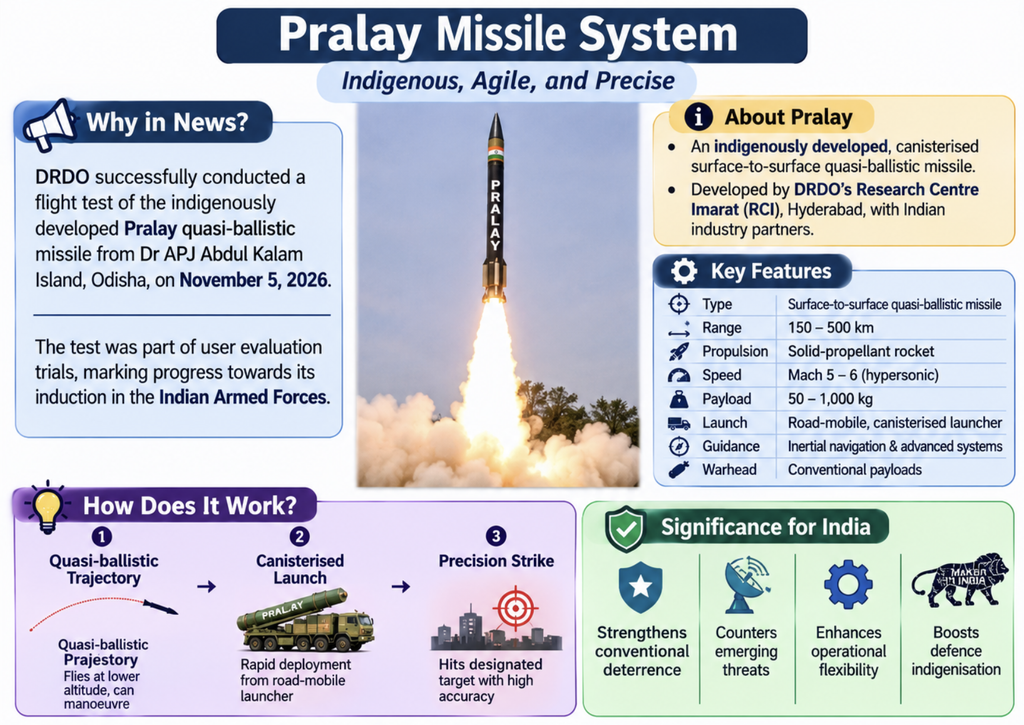
The Defence Research and Development Organisation (DRDO) successfully conducted a flight test of the indigenously developed Pralay quasi-ballistic missile from Dr APJ Abdul Kalam Island, Odisha, on November 5, 2026.

  • The test was conducted as part of user evaluation trials, with all stipulated objectives reportedly achieved. The successful trial marks progress towards the induction of the missile system into the Indian Armed Forces.
UPSC Relevance: GS-3 Science and Technology: Defence Technology 

Prelims: Pralay Missile System, Quasi-ballistic missiles 

About Pralay Missile System:

  • Pralay is an indigenously developed, canisterised, surface-to-surface quasi-ballistic missile designed primarily for conventional tactical and battlefield operations.
  • It has been developed by DRDO’s Research Centre Imarat (RCI), Hyderabad, in collaboration with other DRDO laboratories and Indian defence industries.

Key Features of Pralay Missile System:

FeatureDetails
TypeSurface-to-surface quasi-ballistic missile
Range150-500 km
PropulsionSolid-propellant rocket propulsion
SpeedHypersonic terminal speed, approximately Mach 5-6
Payload capacityApproximately 50-1000 kg
Launch systemRoad-mobile, canisterised launcher
GuidanceInertial navigation and advanced guidance systems
WarheadConventional payload configurations
Quasi-ballistic trajectory:Unlike conventional ballistic missiles, which generally follow a predictable parabolic trajectory, quasi-ballistic missiles fly at relatively lower altitudes and can maneuver during flight. They can alter their trajectory during the mid-course and terminal phases, making their flight path less predictable. This manoeuvrability complicates interception by conventional missile-defence systems.

Canisterised launch system:The missile is stored and transported in a sealed canister, facilitating mobility, rapid deployment, storage and launch readiness. Its road-mobile launcher allows deployment from different locations, improving operational flexibility.
image 7

Significance for India’s Defence Capabilities:

  • Strengthening Conventional Deterrence: Provides the Armed Forces with a precision-strike capability against high-value military targets, including command centres, airfields, radar installations and logistics infrastructure. Offers a conventional strike option below the nuclear threshold, expanding India’s range of military responses during a conflict.
  • Countering Emerging Security Threats: Its manoeuvrability and relatively unpredictable flight path can complicate interception by adversary air-defence and missile-defence systems. Its 150-500 km range provides tactical strike capability against targets in the immediate operational theatre.
  • Enhancing Operational Flexibility: Canisterisation and road mobility facilitate transportation, concealment, deployment and launch readiness. The ability to carry different conventional payload configurations allows it to address different battlefield requirements.
  • Defence Indigenisation: Reflects the growing role of DRDO and Indian defence industries in developing advanced missile technologies.

Pralay represents an important addition to India’s indigenous conventional missile capabilities. Its eventual induction can strengthen India’s precision-strike capability and conventional deterrence.

Practice Prelims MCQ: 

Q. Consider the following statements regarding the ‘Pralay’ Missile System:

1. It is a surface-to-surface ballistic missile capable of carrying both conventional and strategic nuclear warheads.

2. It follows a quasi-ballistic trajectory that allows mid-course and terminal phase manoeuvrability within the atmosphere.

3. The canisterised configuration of the missile ensures all-weather operational readiness, rapid deployment, and reduced maintenance overheads.

Which of the statements given above are correct?

(a) 1 and 2 only

(b) 2 and 3 only

(c) 1 and 3 only

(d) 1, 2 and 3

Answer: (b) 2 and 3 only

Explanation: Pralay is strictly designed for conventional tactical and battlefield operations (carrying payloads ranging from 50 kg to 1,000 kg). It is not intended for strategic nuclear warheads.

How do Tokamaks work to make Nuclear Fusion possible?

Open article →Download PDF

Why in News?

Tokamaks have gained attention as global research programmes explore nuclear fusion as a potential source of abundant, low-carbon energy. The International Thermonuclear Experimental Reactor (ITER), the world’s largest international fusion research project, uses the tokamak design.

UPSC Relevance: GS-3 Science and Technology: Nuclear Technology 

Prelims: Tokamak, Nuclear Fusion 
Mains: Nuclear fusion: Potential, technological challenges, India’s progress in fusion research

What is Nuclear Fusion?

  • Nuclear fusion is a process in which two light atomic nuclei combine to form a heavier nucleus, releasing enormous amounts of energy.
  • The most extensively studied fusion reaction involves two hydrogen isotopes, deuterium and tritium, which combine to produce helium, a neutron and energy.

                                               2H + 3H ———> 4He + n + 17.6MeV

  • Fusion powers the Sun and other stars through nuclear reactions. 

Why is Fusion difficult to achieve on Earth?

  • Positively charged nuclei repel each other due to electrostatic forces (Coulomb repulsion).
  • Extremely high temperatures, typically around 100-150 million°C for deuterium-tritium fusion, are required to overcome this repulsion and enable nuclei to fuse at useful rates.
  • At such temperatures, matter exists as plasma, a highly energetic state in which electrons separate from atomic nuclei. 
  • No conventional material can directly contain such hot plasma without being damaged or cooling it.

This creates the central challenge of fusion research: how to confine extremely hot plasma long enough for sufficient fusion reactions to occur.

What is a Tokamak?

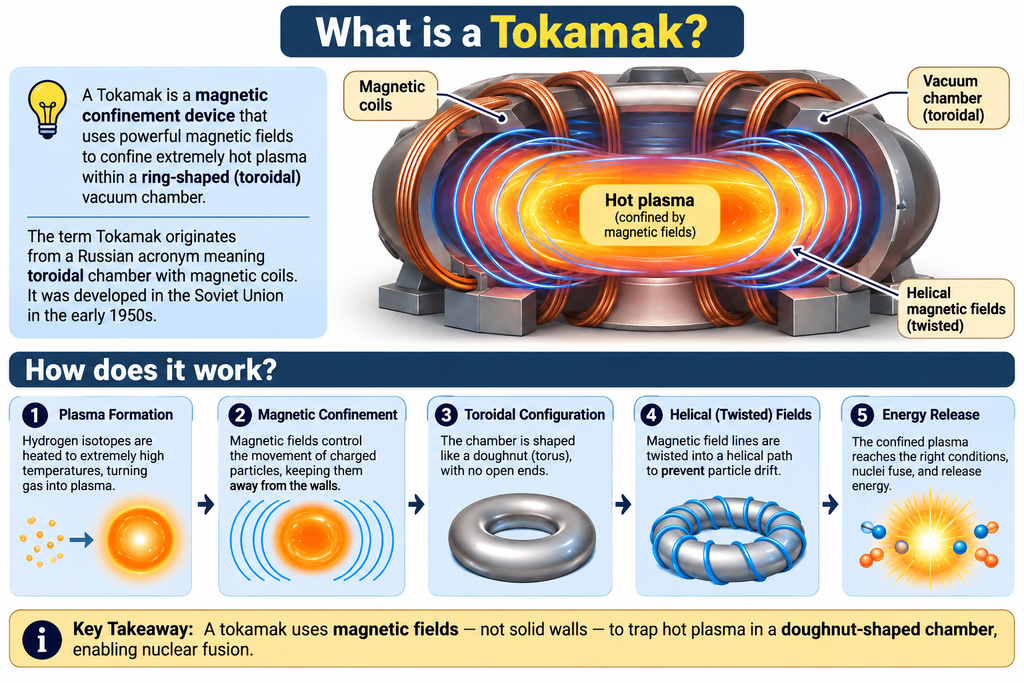
  • A Tokamak is a magnetic confinement device that uses powerful magnetic fields to confine extremely hot plasma within a ring-shaped (toroidal) vacuum chamber.
  • The term Tokamak originates from a Russian acronym meaning toroidal chamber with magnetic coils. It was developed in the Soviet Union during the early 1950s, primarily associated with physicists Igor Tamm and Andrei Sakharov.

How does it work?

  • Plasma formation: Hydrogen isotopes are introduced into a vacuum chamber and heated to extremely high temperatures, converting the gas into plasma.
  • Magnetic confinement: Since plasma consists of electrically charged particles, magnetic fields can control their movement and keep them away from the chamber walls.
  • Toroidal configuration: The chamber is shaped like a doughnut (torus). This continuous geometry eliminates “open ends,” preventing the charged particles from escaping.
  • Helical (twisted) Magnetic fields: Straight magnetic fields cause plasma particles to drift outwards. To stabilise them, the Tokamak twists the magnetic lines into a helical path. 
  • Energy release: The combined helical field confines the high-density plasma. Under suitable temperature, density and confinement-time conditions, nuclei collide and fuse, releasing energy.

Note: A tokamak does not physically contain plasma using solid walls. It uses magnetic fields to confine the charged particles without direct contact with the chamber.

How is Energy Generated and Converted into Electricity?

  • Energy release: In deuterium-tritium fusion, approximately 17.6 MeV of energy is released per reaction.
    • About 80% of the energy is carried by high-energy neutrons.
    • The remaining 20% is carried by helium nuclei (alpha particles), which help maintain plasma temperature through further collisions.
  • Heat generation: The high-energy neutrons escape the magnetic confinement and strike into the breeding blanket (typically containing lithium) lining the interior walls of the vacuum vessel, transferring their energy as heat.
  • Electricity generation: In a future commercial fusion power plant, a coolant such as water or helium would carry this heat to a steam-generation system, which would drive turbines to produce electricity.
image 8

Why has Commercial Nuclear Fusion not yet become Possible?

Despite scientific progress, several challenges remain:

  • Plasma instability: Extremely hot plasma can develop turbulence and instabilities, causing energy loss or sudden disruptions.
  • Long-duration confinement: Maintaining stable plasma at the required temperature, density and confinement time for sustained operation remains difficult.
  • Material limitations: High-energy neutrons can damage reactor walls and structural materials, reducing their operational life.
  • Tritium availability: Tritium is scarce and radioactive. Commercial reactors will need efficient lithium-based breeding systems to generate sufficient fuel.
  • Energy efficiency: Producing more fusion energy than the energy supplied to heat and confine plasma is not the same as generating net electricity. Magnets, cooling systems and other auxiliary equipment also consume substantial power.
  • High costs: Advanced superconducting magnets, specialised materials, complex engineering and long experimental timelines make fusion research capital-intensive.

Major Global Developments in Fusion Research:

(i) International Thermonuclear Experimental Reactor (ITER)

  • ITER is one of the world’s largest international scientific collaborations, located at Cadarache, France.
  • It involves seven members: China, the European Union, India, Japan, South Korea, Russia and the United States, representing 35 countries.
  • It aims to demonstrate the scientific and technological feasibility of magnetic-confinement fusion.

(ii) China’s EAST (Experimental Advanced Superconducting Tokamak)

  • China’s EAST, popularly called the Artificial Sun, sustained high-confinement plasma operation for 1,066 seconds (approximately 17.8 minutes) in 2025 at temperatures of around 100 million °C.
  • In 2026, researchers reported progress in overcoming the conventional empirical plasma-density limit, an important development for achieving higher-performance fusion conditions.

India’s Progress in Tokamak and Fusion Research

India has developed indigenous expertise in plasma physics and magnetic-confinement technologies through the Institute for Plasma Research (IPR), Gandhinagar, under the Department of Atomic Energy.

Major Indian initiatives:

  • ADITYA / ADITYA-U: India’s first indigenously developed tokamak, ADITYA, began operations in 1989. It was subsequently upgraded to ADITYA-U to study advanced plasma configurations and control techniques.
  • SST-1 (Steady-State Superconducting Tokamak-1): India’s first superconducting tokamak, designed to study long-duration plasma confinement using superconducting magnetic coils.
  • PRAGYA: Bengaluru-based Pranos Fusion unveiled PRAGYA in 2026 as India’s first privately developed compact tokamak. It is an experimental testbed for plasma control and magnetic confinement, not a commercial fusion power reactor.

Alternatives to Tokamak-Based Fusion

Fusion research follows two broad approaches:

ApproachHow it worksExample
Magnetic confinementUses magnetic fields to confine hot plasma.Tokamak, Stellarator
Inertial confinementUses powerful lasers or particle beams to compress a tiny fuel pellet, triggering fusion before it expands.National Ignition Facility (NIF), USA

Potential of Nuclear Fusion:

  • Abundant fuel: Deuterium can be extracted from seawater, while tritium can potentially be bred using lithium.
  • Low-carbon energy: Fusion does not produce direct carbon emissions during operation.
  • Energy security: Successful commercialisation could diversify the global energy mix and reduce dependence on fossil fuels.
  • Lower long-lived radioactive waste: Fusion generally produces less long-lived radioactive waste than conventional fission reactors, although neutron-activated reactor materials still require management.
  • Operational safety: Fusion does not involve a self-sustaining chain reaction. If confinement conditions are disrupted, the reaction stops.

India’s participation in ITER, domestic tokamak research and emerging private-sector initiatives can help build the technological capabilities required for the future fusion-energy ecosystem.

NVS-03: Strengthening India’s NavIC Navigation System

Open article →Download PDF

Why in News?

ISRO has confirmed that NVS-03, launched aboard GSLV-F18 on 30 October 2026, is healthy after completing orbit-raising manoeuvres. The manoeuvres placed the satellite in a near-circular, inclined geosynchronous orbit.

However, in-orbit testing of its navigation payload remains necessary before operational readiness can be established.

UPSC Relevance: GS-3 Science and Technology: Space Technology 

Prelims & Mains: Indigenous Satellite Navigation Technology; NaVIC 

About NVS-03: 

  • Third next-generation satellite: Part of the NVS series intended to maintain and strengthen services provided by the earlier Indian Regional Navigation Satellite System (IRNSS).
  • Launch vehicle: GSLV-F18 placed it in a Geosynchronous Transfer Orbit (GTO) from Sriharikota.
  • Navigation signals: Carries L1, L5 and S-band signals. L1 supports wider compatibility with civilian navigation receivers.
  • Atomic clocks: Carries an indigenous atomic clock alongside procured clocks, strengthening domestic capability in precision navigation.
  • NVS-03 has been designed for an operational life of around 12 years.
image 9

What is NavIC?

Navigation with Indian Constellation (NavIC) is India’s independent regional satellite navigation system, formerly called IRNSS.

  • Coverage: India and approximately 1,500 km beyond its boundary.
  • Services: Standard Positioning Service (SPS) for civilian users and Restricted Service (RS) for authorised strategic users.
  • Original constellation design: Seven satellites (three geostationary and four inclined geosynchronous) supported by ground stations. 
  • Applications: Land, air and marine navigation; location-based services; surveying; and precise timing and synchronisation. 

How does Satellite Navigation Work?

Navigation satellites broadcast their position and precise transmission time. A receiver uses signal travel times to estimate its distance from multiple satellites and calculate its location.

  • Why atomic clocks matter: Even tiny timing errors translate into positioning errors.
  • Why multiple satellites are needed: Normally, signals from at least four satellites allow a receiver to determine three-dimensional position and correct its clock error.

Why Is NVS-03 Significant?

  • Strategic autonomy: Strengthens India’s ability to provide navigation and timing services independently of foreign systems.
  • Service continuity: Supports replenishment and modernisation of the NavIC constellation.
  • Civilian adoption: L1 signals can facilitate integration into compatible smartphones, vehicles and other receivers; actual use also requires supporting hardware and software.
  • Critical infrastructure: Reliable timing supports telecommunications, power networks and other synchronised digital systems.
  • Technological self-reliance: Indigenous atomic clocks reduce dependence on imported precision components.

NVS-03 advances India’s navigation capability, but its practical value will depend on successful payload testing, sustained constellation maintenance and widespread receiver adoption.

Prelims Practice MCQ:

Q. With reference to NavIC, consider the following statements:

  1. It is a regional satellite navigation system.
  2. Every geosynchronous satellite is also geostationary.
  3. NVS-03 carries L1 signals alongside L5 and S-band signals.

Which of the statements given above are correct?

(a) 1 and 2 only
(b) 1 and 3 only
(c) 2 and 3 only
(d) 1, 2 and 3

Answer: (b) A geostationary satellite must additionally have a circular, equatorial orbit.

Mains Practice Question

Q. An indigenous satellite navigation system strengthens India’s strategic autonomy and civilian infrastructure. Discuss.