Opens in a new tab
Join Anantam IAS Channel on Telegram

Daily Digest · Thursday

20 August 2026 Current Affairs for UPSC

15 current affairs published on Thursday, 20 August 2026

20 August 2026 Current Affairs for UPSC — every Why-in-News article AnantamIAS published on Thursday, 20 August 2026, broken down with Why in News?, the exact GS paper it feeds, sub-topic mapping, MCQ-ready facts and a UPSC-style practice question. 15 articles in total, covering Polity, Economy, Environment, S&T, IR, Geography, History, Society and Internal Security — the same Why-in-News + GS-paper-mapping + practice-question format the Compass uses across every daily digest on the site.

Daily current affairs for UPSC is where new material enters your prep stream. Read this 20 August 2026 digest end-to-end in 25–35 minutes, attempt the practice question at the foot of each article (it's MCQ for some, 10/15-marker for others), then bookmark the entries that fall inside your active revision window. Everything stays cross-linked: tap any subject pill to jump to that subject's hub, or use the table of contents above to skip straight to a specific story.

Use this page three ways. Read sequentially for a one-sitting scan of everything that mattered on 20 August 2026. Download the 20 August 2026 PDF below for offline study or print revision. Or use the August 2026 Current Affairs compilation to see this day in the month's full context. For the previous day's reading, see 19 August 2026 Current Affairs; the next day's is 21 August 2026 Current Affairs.

Why we publish daily current affairs separately from the monthly compilation: daily is learning, monthly is revision. Use the daily page to add fresh material to your notes the day it breaks; come back to the August 2026 compilation 60 days before Prelims when the noise has settled and only the lasting takeaway is worth re-reading.

Supreme Court Reviews Polygamy and Personal Law

Open article →Download PDF

Why in News?

The Supreme Court sought the Union government’s response to a petition challenging polygamy and asked it to consider suitable legislative measures applicable irrespective of religion.

  • The petition asks the Court to examine the constitutional status of polygamy, including its relationship with equality, non-discrimination and dignity.
  • It seeks application of Section 82 BNS to plural marriages presently treated as valid under Muslim personal law.
  • The Court has sought a response; it has not delivered a judgment, abolished polygamy or finally criminalised the practice.
  • Its legislative suggestion asks the Union to consider suitable steps; it is not itself a completed statutory change.
  • The dispute tests how a facially general criminal provision operates when the validity of marriage depends on different personal laws.
  • It also raises the institutional question of whether reform should come through constitutional adjudication, legislation or a calibrated combination of both.

UPSC Relevance

Prelims Relevance

  • Section 82 of the Bharatiya Nyaya Sanhita, 2023
  • Articles 14, 15, 21 and 25 of the Constitution
  • Personal law and validity of marriage
  • Article 25 limitations and social reform
  • Judicial review and legislative competence

Mains Relevance

GS Paper 2

  • Balancing equality, dignity and religious freedom in personal-law reform
  • Limits of judicial review when criminal liability turns on marriage validity

GS Paper 1

  • Gender justice, family institutions and the social consequences of unequal marital rights

Essay

  • Constitutional reform is strongest when individual dignity, religious liberty and institutional competence are addressed together.
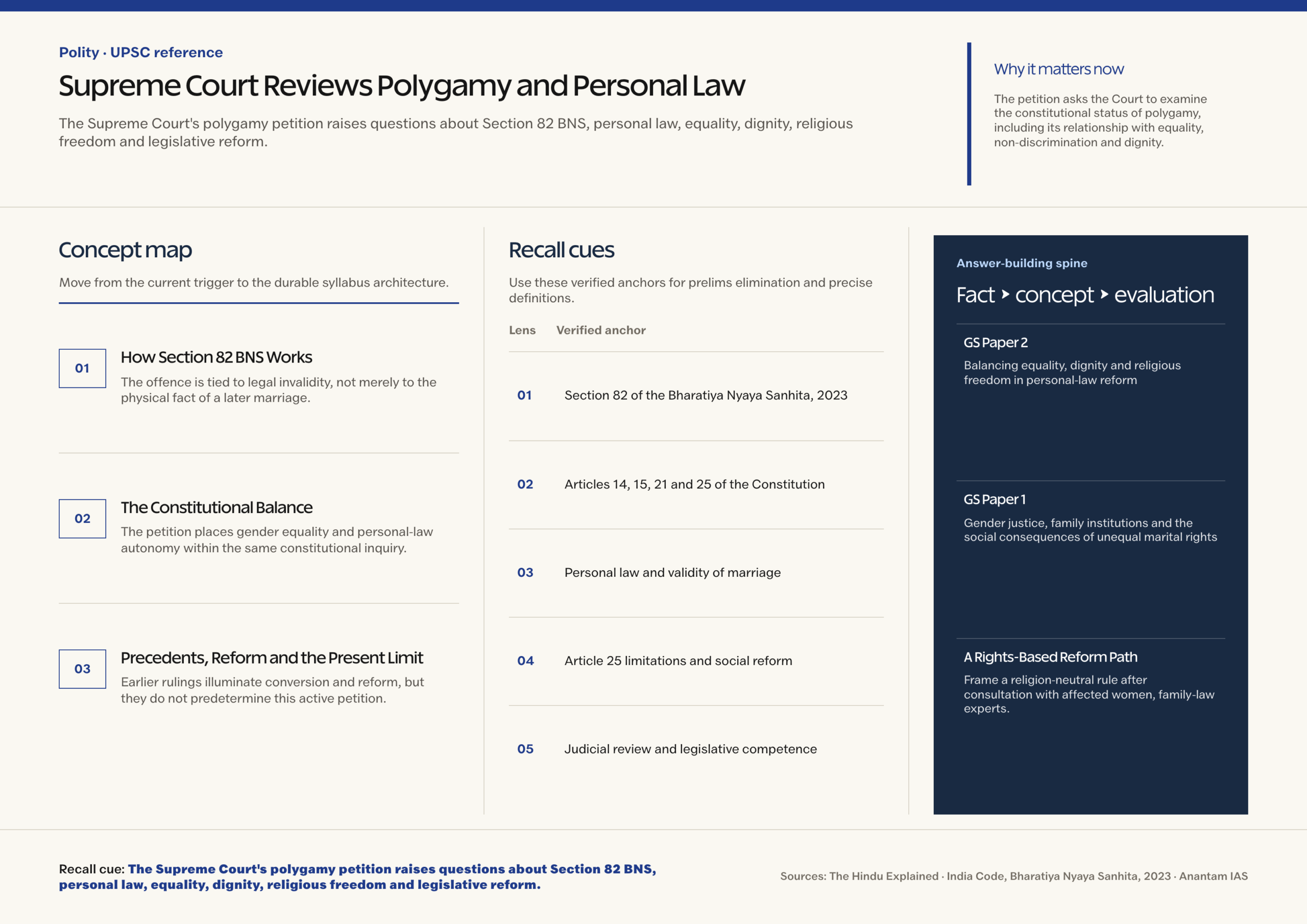
Mindmap explaining Supreme Court Reviews Polygamy and Personal Law for UPSC revision
Revision mindmap: Supreme Court Reviews Polygamy and Personal Law. Open the full-size image for details.

Background and Context

How Section 82 BNS Works

The offence is tied to legal invalidity, not merely to the physical fact of a later marriage.

  • Section 82 applies when a person with a living spouse marries again and the later marriage is void because the earlier spouse remains alive. This causal link is the core statutory trigger.
  • Sub-section (1) allows imprisonment up to seven years and a fine; concealment of the earlier marriage under sub-section (2) can attract up to ten years.
  • The section also recognises limited exceptions, including a court-declared void marriage and a spouse continuously absent and unheard of for seven years, subject to disclosure.
  • Its wording makes the applicable matrimonial law crucial: criminal liability arises only when that law treats the later marriage as void for subsistence of the first.
  • Calling Section 82 a blanket statutory exemption for one religion is imprecise; the differential operation follows from how personal law validates marriage.

The Constitutional Balance

The petition places gender equality and personal-law autonomy within the same constitutional inquiry.

  • Article 14 supports scrutiny of unequal legal consequences and requires any classification to rest on an intelligible basis connected to a legitimate objective. The inquiry examines both classification and legal effect.
  • Article 15 bars State discrimination on grounds including religion and sex, strengthening the challenge to State-backed rules that produce gendered marital inequality.
  • Article 21 protects life and personal liberty, supplying dignity, autonomy and decisional-privacy arguments for individuals affected by unequal family arrangements.
  • Article 25 protects freedom of conscience and religious practice, but expressly subjects that freedom to public order, morality, health and the other Fundamental Rights.
  • The Court must still decide threshold questions, including whether the impugned personal-law rule is reviewable as State action and how far religious protection extends.

Precedents, Reform and the Present Limit

Earlier rulings illuminate conversion and reform, but they do not predetermine this active petition.

  • In Sarla Mudgal, the Court held that a Hindu marriage is not dissolved merely because one spouse converts to Islam before contracting another marriage. The first marriage continued under its governing statute.
  • That ruling prevented conversion from becoming a device to evade the monogamy rule governing the subsisting Hindu marriage; it did not create one uniform marriage code.
  • The present petition directly contests the broader differential treatment associated with polygamy and asks for a religion-neutral criminal and constitutional framework.
  • A court can test laws and grant constitutional relief, while Parliament can design definitions, transitions, safeguards, remedies and enforcement through a generally applicable statute.
  • For exam answers, distinguish the pending proceeding, the Court’s request for a Union response and its suggestion to consider legislation from a final binding holding.

Way Forward

A Rights-Based Reform Path

Any reform should protect affected spouses without creating uncertainty about marital status, children or existing legal rights.

  • Frame a religion-neutral rule after consultation with affected women, family-law experts, religious communities and state governments.
  • Specify prospective operation, maintenance, inheritance, custody and property consequences so penal reform does not erase civil remedies.
  • Use proportionate enforcement and accessible legal aid, while protecting complainants from economic retaliation or abandonment.
  • Keep judicial review focused on constitutional injury and leave detailed transitional design to accountable legislation where institutional capacity is stronger.

Conclusion

  • The dispute is not simply religion versus reform; it concerns how marriage validity, criminal liability and equal citizenship interact within one constitutional order.
  • A strong answer should separate the pending case from settled law, apply Articles 14, 15, 21 and 25, and explain why carefully designed legislation may complement judicial review.

UPSC Practice Questions

Prelims MCQ 1

With reference to Section 82 of the Bharatiya Nyaya Sanhita, 2023, consider the following statements:

  1. It applies only when the subsequent marriage is void because it occurred during the lifetime of an existing spouse.
  2. Concealment of the former marriage from the person in the subsequent marriage can attract a higher maximum punishment.
  3. It contains no exception for a former spouse who has been continuously absent and unheard of for seven years.

How many of the above statements are correct?

(a) Only one (b) Only two (c) All three (d) None

Answer: (b) Only two

Explanation:

Statements 1 and 2 are correct. Section 82 includes a qualified exception for continuous seven-year absence when the former spouse has not been heard of and disclosure is made.

Prelims MCQ 2

Which constitutional provision expressly makes freedom of religion subject to public order, morality, health and the other Fundamental Rights?

(a) Article 14 (b) Article 15 (c) Article 21 (d) Article 25

Answer: (d) Article 25

Explanation:

Article 25 protects freedom of conscience and religious profession, practice and propagation, subject to public order, morality, health and the other provisions of Part III.

UPSC Mains Questions

  1. The constitutional review of polygamy requires more than a choice between equality and religious freedom. Discuss with reference to Articles 14, 15, 21 and 25.
  2. Why does the operation of Section 82 of the Bharatiya Nyaya Sanhita depend on the personal law governing marriage validity? Explain the case for legislative clarity.

Sources: The Hindu Explained and India Code, Bharatiya Nyaya Sanhita, 2023.

Frequently Asked Questions

Has the Supreme Court abolished polygamy?

No. The Court has sought the Union government’s response in an active petition and suggested consideration of suitable legislation. No final judgment abolishing or criminalising polygamy has been delivered.

What does Section 82 BNS punish?

It punishes marrying again while a spouse is living when the later marriage is void for that reason. Concealing the earlier marriage can attract a higher maximum sentence.

Does Section 82 expressly exempt Muslim personal law?

No express religion-based exemption appears in its text. Its operation depends on whether the applicable matrimonial law makes the subsequent marriage void while the first marriage subsists.

Which Fundamental Rights are central to the challenge?

Articles 14 and 15 support equality and non-discrimination claims, Article 21 supports dignity and autonomy, and Article 25 protects religious freedom subject to constitutional limits.

Why might legislation still be required?

Legislation can create a general rule while addressing prospective application, marital status, maintenance, inheritance, custody, remedies and enforcement, which a case-specific judicial order may not comprehensively design.
CAQM Cleaner Light Goods Vehicle Registration Shift in Delhi-NCR

Open article →Download PDF

Why in News?

On 18 August, CAQM approved Direction No. 102 to phase restrictions on new registrations of specified N1 and N2 light goods vehicles across Delhi-NCR.

  • The direction targets new registration; it is not an immediate ban on existing goods vehicles already operating in the region.
  • For N1 LGVs, restrictions on diesel, petrol and CNG registrations begin in Delhi on 1 January 2027 and selected high-density NCR districts on 1 July 2027.
  • In the remaining NCR districts, the N1 restriction starts on 1 January 2028 but covers diesel and petrol, not CNG, according to the PIB release.
  • Restrictions for the heavier N2 category follow the same regional sequence from January 2028 to January 2029.
  • The measure uses the vehicle-registration system to change the future fleet mix gradually, instead of ordering the existing fleet off the road at once.
  • It tests how a regional statutory body can coordinate clean-mobility rules across Delhi and several NCR states with different registration authorities.
  • The policy is distinct from CAQM’s July discussion on drone monitoring of stubble-burning hotspots; this direction addresses vehicular particulate emissions.

UPSC Relevance

Prelims Relevance

  • CAQM is the Commission for Air Quality Management in the National Capital Region and Adjoining Areas.
  • Category N1 covers goods vehicles with gross vehicle weight not exceeding 3.5 tonnes.
  • Category N2 covers goods vehicles above 3.5 tonnes and not exceeding 12 tonnes.
  • Direction No. 102 concerns phased new registrations, not blanket deregistration or scrappage of existing vehicles.
  • The high-vehicle-density districts named in the release are Gurugram, Faridabad, Sonipat, Ghaziabad and Gautam Buddha Nagar.

Mains Relevance

GS Paper 3

  • Link transport emissions, fleet composition and urban particulate pollution.
  • Assess phased registration controls as a clean-mobility instrument alongside emission norms and public transport.

GS Paper 2

  • Examine regional environmental governance across multiple state and local registration systems.
  • Discuss how clear categories, lead time and monitoring affect regulatory compliance.

Essay

  • Environmental transitions work best when regulation changes incentives predictably while protecting mobility and livelihoods during the shift.
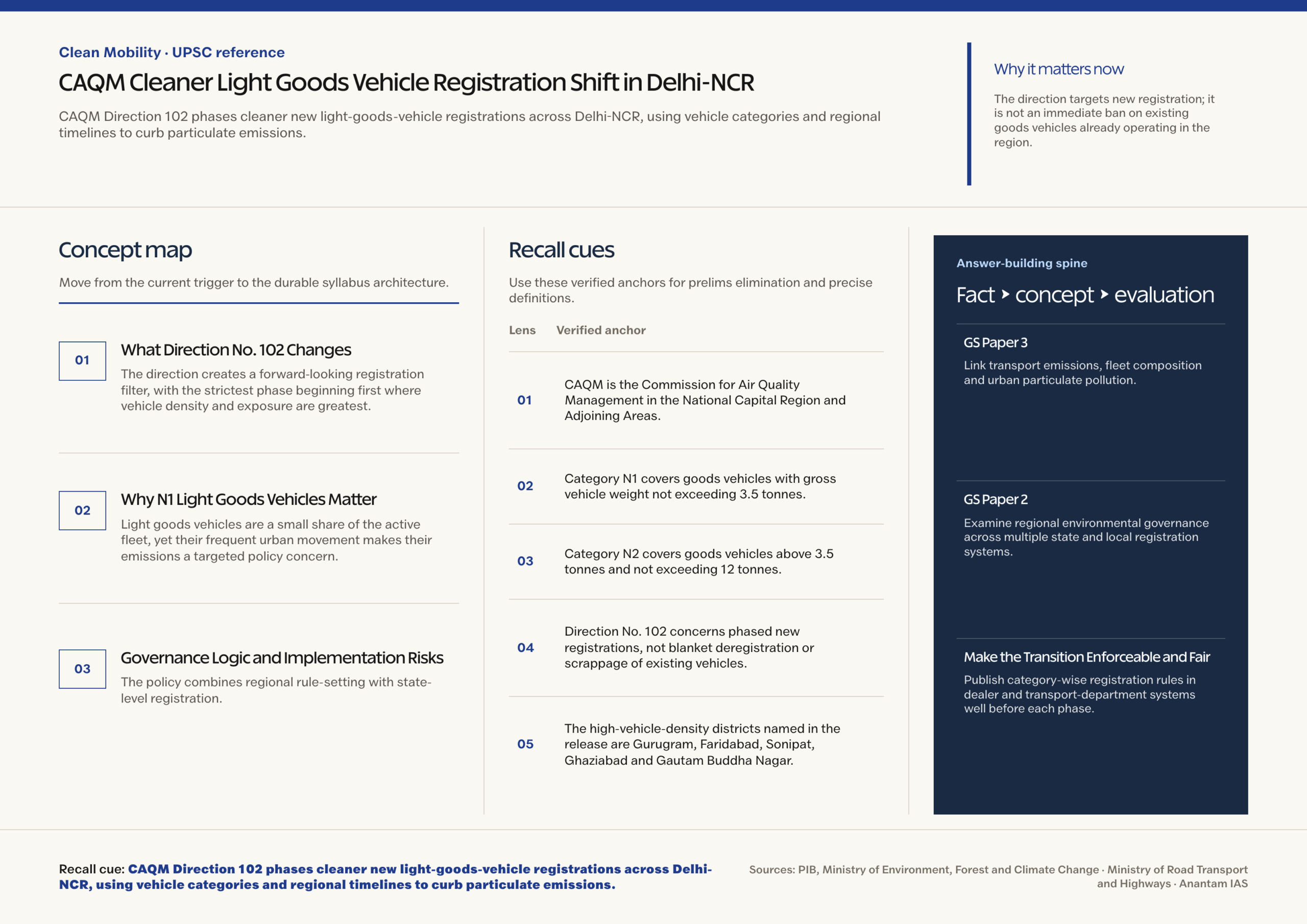
Mindmap explaining CAQM Cleaner Light Goods Vehicle Registration Shift in Delhi-NCR for UPSC revision
Revision mindmap: CAQM Cleaner Light Goods Vehicle Registration Shift in Delhi-NCR. Open the full-size image for details.

Background and Context

What Direction No. 102 Changes

The direction creates a forward-looking registration filter, with the strictest phase beginning first where vehicle density and exposure are greatest.

  • In Delhi, new diesel, petrol and CNG N1 registrations face restriction from 1 January 2027, giving buyers, dealers and freight operators advance notice.
  • The same N1 fuel set is restricted from 1 July 2027 in Gurugram, Faridabad, Sonipat, Ghaziabad and Gautam Buddha Nagar, the listed high-density districts.
  • Other NCR districts enter on 1 January 2028, but their first N1 phase covers diesel and petrol; the official release does not include CNG there.
  • N2 registration restrictions start later: Delhi in January 2028, the five high-density districts in July 2028, and the remaining NCR in January 2029.
  • The staggered sequence recognises differences in vehicle markets and charging or clean-fuel readiness while keeping one regional direction for the future fleet.

Why N1 Light Goods Vehicles Matter

Light goods vehicles are a small share of the active fleet, yet their frequent urban movement makes their emissions a targeted policy concern.

  • PIB reports that LGVs form about 1.2% of active vehicles but contribute approximately 3.3% of particulate emissions from the active fleet.
  • N1 is a technical classification, not a synonym for every small commercial vehicle: it covers goods vehicles with gross vehicle weight up to 3.5 tonnes.
  • N2 covers goods vehicles above 3.5 tonnes and up to 12 tonnes, explaining why its transition begins after the lighter N1 segment.
  • A registration restriction works at the entry point of the fleet: each affected new purchase must move toward an allowed cleaner mode rather than forcing one-day fleet replacement.
  • Existing vehicles are not automatically cancelled by this direction, so near-term gains depend on fleet turnover, enforcement, replacement-vehicle performance and parallel controls on other urban emission sources.

Governance Logic and Implementation Risks

The policy combines regional rule-setting with state-level registration, creating both a coordination advantage and an enforcement challenge across NCR boundaries.

  • CAQM supplies a common air-shed approach because pollution crosses administrative borders, while transport departments and registering authorities implement vehicle-entry rules within their jurisdictions.
  • A phased calendar can reduce disruption for last-mile freight operators, but delayed availability of affordable compliant vehicles could raise delivery costs for small businesses.
  • Different treatment of CNG outside the high-density districts requires precise software rules and dealer guidance; a simplified blanket-ban message would misstate the direction.
  • Registration databases and permit records should distinguish N1 and N2 accurately, record propulsion type, and prevent circumvention through registration in a neighbouring district followed by regular NCR operation.
  • The central exam trap is the distinction between new-fleet regulation and existing-fleet retirement: Direction 102 directly governs the former, not the latter.

Way Forward

Make the Transition Enforceable and Fair

  • Publish category-wise registration rules in dealer and transport-department systems well before each phase, including the distinct CNG treatment in remaining NCR districts.
  • Expand dependable charging and clean-fuel infrastructure along freight routes, markets and logistics hubs so compliance does not merely shift costs to small operators.
  • Use interoperable registration and permit data across NCR to detect avoidance without creating duplicate paperwork for legitimate inter-state goods movement.
  • Review fleet emissions and replacement affordability periodically, while changing timelines only through transparent, evidence-based orders rather than informal exemptions.

Conclusion

  • Direction No. 102 is a phased clean-fleet rule: it changes which new N1 and N2 goods vehicles may enter the Delhi-NCR fleet at specified times.
  • In an answer, connect air-shed governance with differentiated timelines, registration enforcement and transition support, while stating clearly that the direction does not immediately ban existing LGVs.

UPSC Practice Questions

Prelims MCQ 1

With reference to CAQM Direction No. 102, consider the following statements:

  1. It introduces phased restrictions on new registration of specified N1 and N2 light goods vehicles in Delhi-NCR.
  2. It immediately prohibits every existing diesel light goods vehicle from operating anywhere in NCR.
  3. Category N1 covers goods vehicles with gross vehicle weight not exceeding 3.5 tonnes.

How many of the above statements are correct?

(a) Only one (b) Only two (c) All three (d) None

Answer: (b) Only two

Explanation:

Statements 1 and 3 are correct. The direction regulates phased new registrations; the official release does not announce an immediate operating ban on every existing diesel LGV.

Prelims MCQ 2

Which one of the following correctly describes Category N2 under the motor-vehicle classification?

(a) Goods vehicles not exceeding 3.5 tonnes (b) Passenger vehicles with more than eight seats (c) Goods vehicles above 3.5 tonnes and not exceeding 12 tonnes (d) Goods vehicles exceeding 12 tonnes only

Answer: (c) Goods vehicles above 3.5 tonnes and not exceeding 12 tonnes

Explanation:

Category N2 covers goods vehicles with gross vehicle weight above 3.5 tonnes and not exceeding 12 tonnes; N1 is the category up to 3.5 tonnes.

UPSC Mains Questions

  1. Explain how phased restrictions on new light-goods-vehicle registrations can support air-quality management while limiting disruption to urban freight and small businesses.
  2. CAQM illustrates both the need and the difficulty of air-shed governance in a multi-state metropolitan region. Discuss with reference to clean-mobility regulation.

Sources: PIB, Ministry of Environment, Forest and Climate Change and Ministry of Road Transport and Highways.

Frequently Asked Questions

What did CAQM Direction No. 102 approve?

It approved phased restrictions on new registrations of specified N1 and N2 light goods vehicles across Delhi, high-density NCR districts and the remaining NCR.

Does Direction No. 102 ban existing light goods vehicles immediately?

No. The PIB release describes restrictions on new registration. It does not announce immediate cancellation of registrations or a blanket operating ban on the existing LGV fleet.

What is an N1 goods vehicle?

N1 is a motor vehicle used to carry goods with gross vehicle weight not exceeding 3.5 tonnes. The category is defined by vehicle use and weight.

Why has CAQM used different implementation dates?

The sequence starts with Delhi, then listed high-density districts, and later the remaining NCR, allowing a region-wide transition while accounting for differing market and infrastructure readiness.

How is this different from CAQM’s drone-based stubble monitoring?

Drone monitoring concerns detection of crop-residue-burning hotspots. Direction No. 102 instead changes the entry of specified new goods vehicles into the Delhi-NCR fleet.

Andhra Pradesh Transplant Bill: Swap Donation and Anti-Trafficking Safeguards

Open article →Download PDF

Why in News?

The Andhra Pradesh Legislative Assembly passed the A.P. Transplantation of Human Organs (Amendment) Bill, 2026 on 19 August, seeking to align the State framework with central changes made in 2011.

  • The Bill’s passage is a legislative stage; it does not by itself prove gubernatorial assent, Gazette publication or commencement.
  • The proposed alignment covers human tissues, an expanded near-relative category, swap donation and revised brain-stem-death certification.
  • It also carries safeguards for minors, foreign-national cases, persons covered by the Act’s mental-capacity restriction and suspected commercial dealing.
  • The central 2011 amendment took effect in 2014; Andhra Pradesh has continued under its separate 1995 State Act.
  • Transplant law must widen legitimate donation without turning medical scarcity into a market for vulnerable bodies.
  • Swap donation solves biological incompatibility, but compatibility cannot replace consent, relationship verification or regulatory approval.
  • For exam answers, separate what the Bill proposes from what the central law already provides and what is legally in force in Andhra Pradesh.

UPSC Relevance

Prelims Relevance

  • The central law is the Transplantation of Human Organs and Tissues Act, 1994, amended in 2011.
  • A near relative includes spouse, specified immediate family, grandparents and grandchildren.
  • Swap donation uses cross-compatible donors from two biologically incompatible near-relative donor-recipient pairs.
  • Swap transplantation requires prior approval of the Authorisation Committee.
  • Brain-stem death means permanent and irreversible cessation of all brain-stem functions, certified by the prescribed medical board.
  • A living non-near-relative donation also requires Authorisation Committee scrutiny to exclude commercial dealing.

Mains Relevance

GS Paper 2

  • How cooperative legal alignment can expand ethical access to transplantation while preserving State-level implementation responsibility.
  • Why Authorisation Committees, registered hospitals and independent death certification are essential safeguards against trafficking and conflicts of interest.

GS Paper 4

  • Balancing autonomy, family solidarity, medical urgency and protection of vulnerable donors in conditions of severe scarcity.

Essay

  • Scarcity tests whether institutions can expand access without weakening consent.
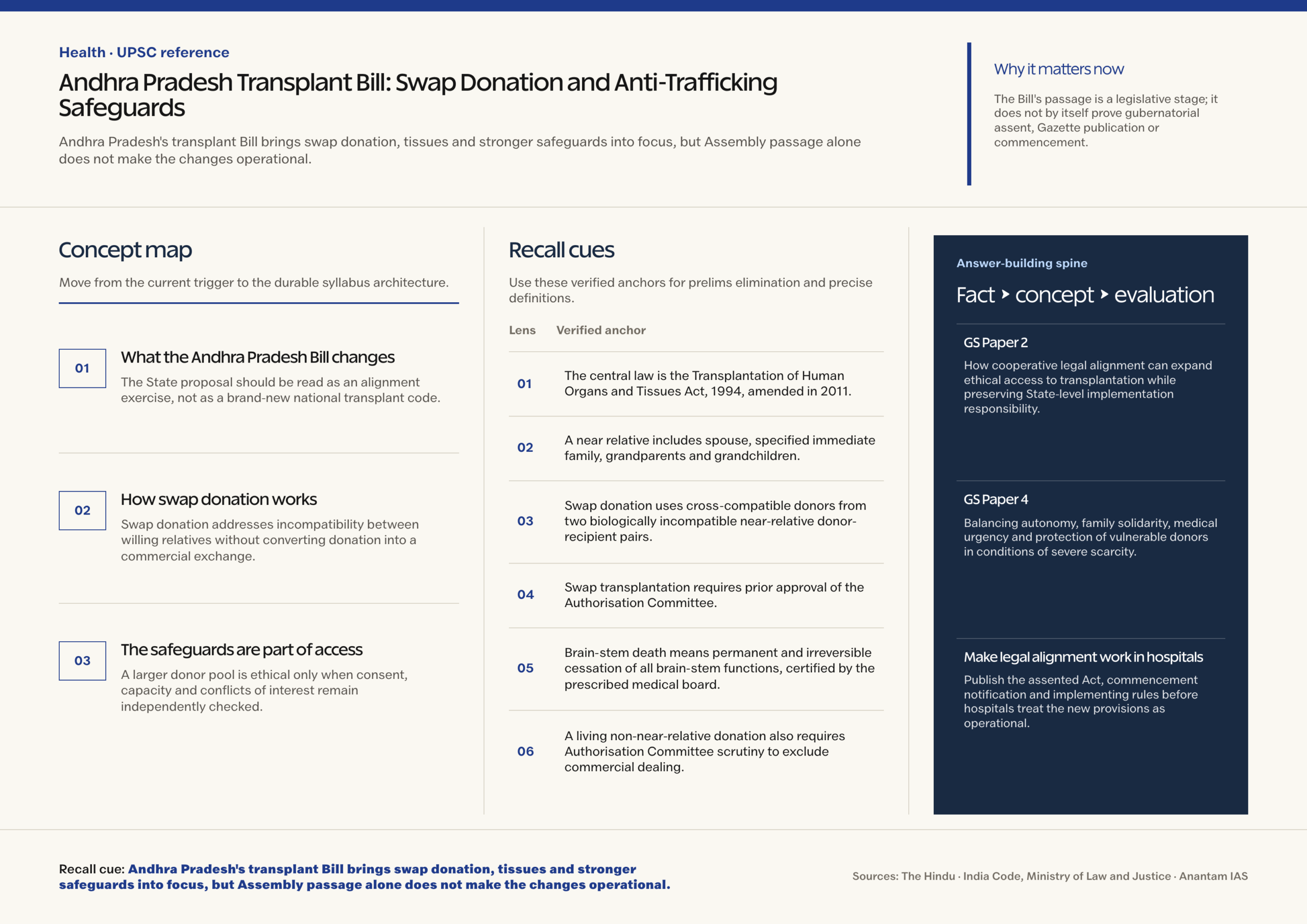
Mindmap explaining Andhra Pradesh Transplant Bill: Swap Donation and Anti-Trafficking Safeguards for UPSC revision
Revision mindmap: Andhra Pradesh Transplant Bill: Swap Donation and Anti-Trafficking Safeguards. Open the full-size image for details.

Background and Context

What the Andhra Pradesh Bill changes

The State proposal should be read as an alignment exercise, not as a brand-new national transplant code.

  • Andhra Pradesh regulates transplantation through its 1995 State Act, while the central statute was substantially amended in 2011 and its new provisions commenced in 2014 nationally.
  • The central amendment broadened the framework from organs alone to organs and tissues, bringing corneas, skin, heart valves and regulated tissue banks within the legal architecture.
  • It added grandparents and grandchildren to the near-relative definition, enlarging the lawful family donor pool without removing scrutiny for unrelated living donations.
  • The Assembly Bill seeks to carry these mechanisms into the State framework after a long legal gap between the separate State and central regimes governing hospitals.
  • Until assent and the applicable commencement step are officially confirmed, describe the measure as a passed Bill, not an operational amendment binding hospitals and committees in Andhra Pradesh.

How swap donation works

Swap donation addresses incompatibility between willing relatives without converting donation into a commercial exchange.

  • Pair A has a willing near-relative donor who is biologically incompatible with Recipient A; Pair B faces the same problem despite a valid family donation offer.
  • If Donor A matches Recipient B and Donor B matches Recipient A, the donors may make a cross-donation based on reciprocal biological compatibility rather than payment.
  • Both donors and recipients enter one agreement covering the linked donations; payment is neither the basis nor a lawful consideration for the exchange.
  • Section 9(3A) of the central THOTA framework requires prior Authorisation Committee approval even after doctors establish both cross-matches and all four participants agree.
  • The 2014 Rules keep swap donation within near-relative pairs, making documentary relationship verification and review of the complete linked arrangement part of the safeguard.

The safeguards are part of access

A larger donor pool is ethical only when consent, capacity and conflicts of interest remain independently checked.

  • Living donation by a non-near relative requires the Committee to examine affection, relationship documents, financial disparity, donor motivation and possible involvement of middlemen or touts.
  • Foreign-national cases need prior approval; an Indian donor cannot donate to a foreign recipient unless they are near relatives, closing a route for disguised cross-border commercial transplantation.
  • The central Act bars living removal from a person within its defined ‘mentally challenged person’ category; minor donation is exceptional, medically justified and approval-bound under the Rules.
  • Brain-stem death means permanent, irreversible cessation of all brain-stem functions and requires prescribed medical-board certification; it is neither ordinary coma nor a transplant team’s informal declaration.
  • When a neurologist or neurosurgeon is unavailable, approved independent specialists may substitute, but they must not belong to the recipient’s transplant team, limiting conflict of interest.

Way Forward

Make legal alignment work in hospitals

  • Publish the assented Act, commencement notification and implementing rules before hospitals treat the new provisions as operational.
  • Standardise Authorisation Committee review, conflict checks and written reasons across transplant centres.
  • Train independent certifying doctors and transplant coordinators without weakening the separation from recipient care teams.
  • Audit relationship documents, financial red flags and outcomes while protecting donor and recipient medical privacy.

Conclusion

  • The Bill’s strongest idea is not simply a larger donor pool. It is a regulated path for converting biological incompatibility into two ethical, compatible donations without treating scarcity as permission for commerce.
  • In a Mains answer, pair access reforms with safeguards: verified relationships, informed consent, independent death certification, registered institutions, reasoned committee approval and a categorical ban on organ commerce.

UPSC Practice Questions

Prelims MCQ 1

With reference to swap donation under India’s organ-transplant framework, consider the following statements:

  1. Each donor is a near relative of the recipient for whom the donor originally volunteered.
  2. The two donors are biologically compatible with the other pair’s recipient.
  3. Once biological compatibility is established, prior Authorisation Committee approval is unnecessary.

How many of the above statements are correct?

(a) Only one (b) Only two (c) All three (d) None

Answer: (b) Only two

Explanation:

Statements 1 and 2 describe the statutory swap mechanism. Statement 3 is incorrect because Section 9(3A) requires prior Authorisation Committee approval.

Prelims MCQ 2

Which one of the following best describes brain-stem-death certification under the central transplant law?

(a) A declaration made solely by the surgeon who will perform the transplant (b) A presumed death after a fixed period in intensive care (c) Certification by a prescribed medical board, with approved independent substitutes when specified neurological specialists are unavailable (d) A decision made by the Authorisation Committee after matching recipients

Answer: (c) Certification by a prescribed medical board, with approved independent substitutes when specified neurological specialists are unavailable

Explanation:

The Act requires prescribed board certification. Substitutes are permitted under conditions when a neurologist or neurosurgeon is unavailable, and conflict safeguards apply.

UPSC Mains Questions

  1. Swap donation can widen access to transplantation without legalising a market in organs. Explain the mechanism and the safeguards required. (150 words)
  2. A transplant law must treat independent certification and donor scrutiny as access safeguards, not procedural delays. Discuss. (250 words)

Sources: The Hindu and India Code, Ministry of Law and Justice.

Frequently Asked Questions

Has the Andhra Pradesh transplant amendment become operational?

The Assembly passed the Bill on 19 August 2026. Passage alone does not establish gubernatorial assent, Gazette publication or commencement; those steps require separate official confirmation.

What is swap donation?

Two incompatible near-relative donor-recipient pairs exchange donors when each donor matches the other recipient. The arrangement requires a single agreement and prior Authorisation Committee approval.

Who is a near relative under the central transplant law?

The statutory definition covers spouse, son, daughter, father, mother, brother, sister, grandfather, grandmother, grandson and granddaughter. The 2011 amendment added grandparents and grandchildren to the original family list.

Why is brain-stem-death certification important?

It establishes death through a prescribed medical board before deceased-donor retrieval. Independent membership and substitute-specialist rules reduce delay while separating certification from the recipient’s transplant team.

How does the law deter organ trafficking?

It prohibits commercial dealing, scrutinises non-relative and foreign-national cases, regulates hospitals and tissue banks, restricts vulnerable living donors, and penalises false documents used to disguise paid donation.

Maharashtra Makes Snakebite a Notifiable Disease

Open article →Download PDF

Why in News?

Maharashtra made suspected, probable and confirmed snakebite cases and related deaths mandatorily reportable to health authorities under a new State notification.

  • The duty covers government and private hospitals, medical colleges and medical practitioners, not only public facilities treating severe envenoming.
  • Each covered case must reach the concerned District Health Officer or District Surgeon through the prescribed reporting system.
  • State, district and municipal Snakebite Nodal Officers will coordinate reporting, monitoring and the use of data for local action.
  • The notification supports antivenom placement, referral planning and prevention; anti-snake venom is an antivenom treatment, not a vaccine.
  • Mandatory reporting converts scattered clinical encounters into a surveillance dataset that can reveal where, when and under what circumstances severe bites occur.
  • For governance answers, connect notification with a complete response chain: timely reporting, reliable analysis, stocked facilities, rapid referral, trained staff and community prevention.
  • The durable development is the State-wide surveillance duty, distinct from the earlier Gadchiroli school incident that prompted administrative action.

UPSC Relevance

Prelims Relevance

  • Meaning of a notifiable disease or condition
  • Suspected, probable and confirmed case reporting
  • Integrated Disease Surveillance Programme
  • Snakebite envenoming and antivenom
  • State and district nodal-officer functions
  • National Action Plan for Prevention and Control of Snakebite Envenoming

Mains Relevance

GS Paper 2

  • Public-health surveillance, Centre-State coordination and accountability across public and private providers
  • Last-mile emergency care, referral systems and health equity in rural and tribal areas

GS Paper 3

  • One Health prevention and data-led management of human-wildlife risk

Essay

  • Public data becomes valuable only when institutions convert it into timely care for vulnerable citizens.
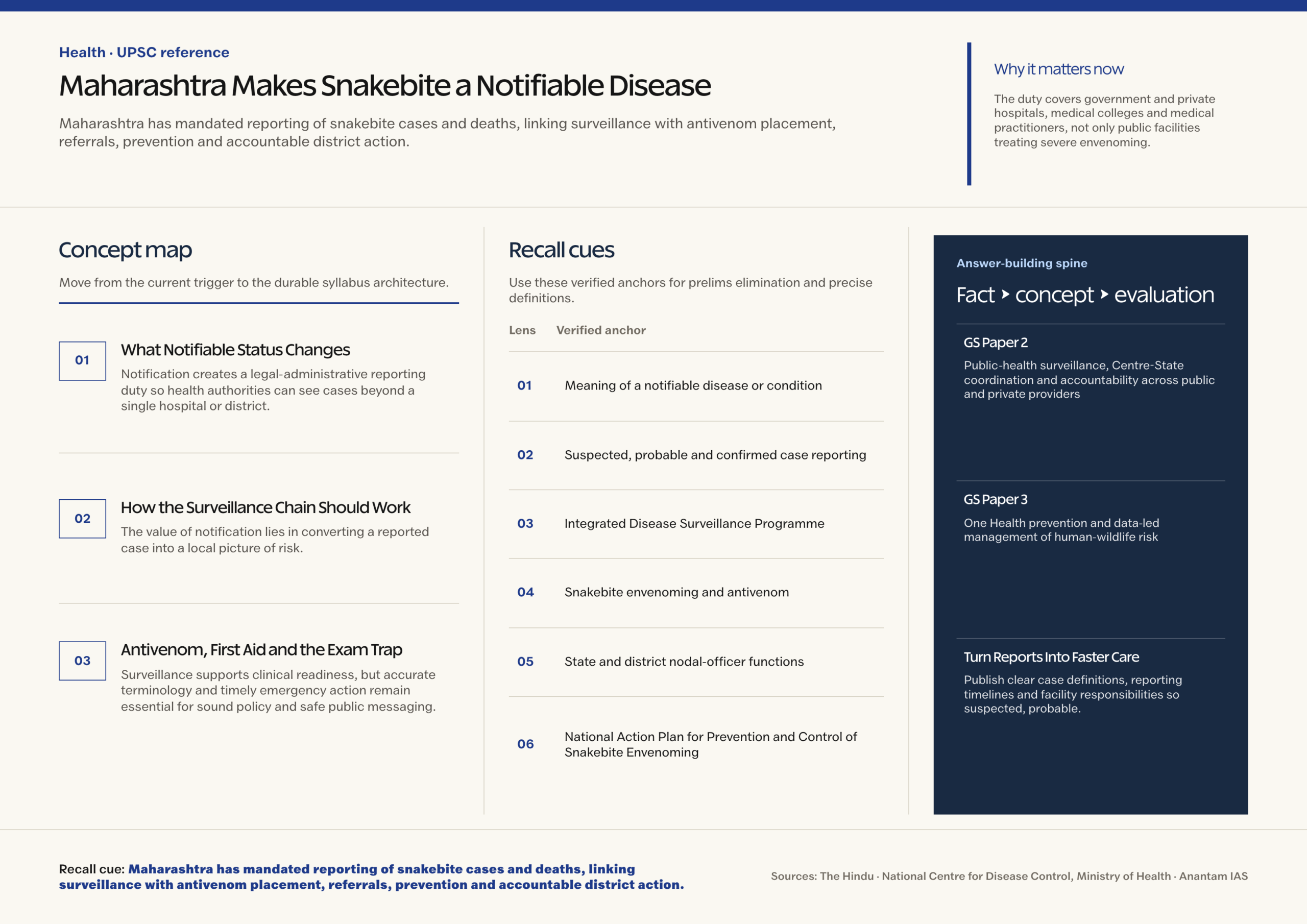
Mindmap explaining Maharashtra Makes Snakebite a Notifiable Disease for UPSC revision
Revision mindmap: Maharashtra Makes Snakebite a Notifiable Disease. Open the full-size image for details.

Background and Context

What Notifiable Status Changes

Notification creates a legal-administrative reporting duty so health authorities can see cases beyond a single hospital or district.

  • A notifiable condition must be reported to designated public authorities in the form and time prescribed by the competent government; reporting is not left to voluntary publication.
  • Maharashtra’s duty covers every suspected, probable or confirmed snakebite under observation or treatment, plus deaths attributed to snakebite.
  • The broad case spectrum matters because waiting for laboratory certainty or a fatal outcome would hide early demand, delayed referrals and clinically managed cases from surveillance.
  • Government and private hospitals, medical colleges and individual practitioners form one reporting network, reducing the blind spots created when surveillance relies only on public-facility records.
  • Notification does not itself prevent a bite or guarantee treatment; it supplies a compulsory information layer on which prevention, readiness and accountability can be built.

How the Surveillance Chain Should Work

The value of notification lies in converting a reported case into a local picture of risk, treatment demand and referral performance.

  • Institutions report to the concerned District Health Officer or District Surgeon, while designated officers at State, district and municipal levels act as Snakebite Nodal Officers.
  • Records can capture place and date of bite, symptoms of envenoming, treatment, antivenom use, referral, outcome and circumstances associated with the event.
  • Aggregation by location and season can identify high-incidence areas, allowing authorities to place antivenom and trained teams nearer to predictable demand rather than distribute stocks uniformly.
  • Referral data can show where patients lose time between first contact and definitive care, guiding ambulance links, facility protocols and escalation pathways for airway, bleeding or kidney complications.
  • The national snakebite programme similarly prioritises stronger surveillance, emergency care, treatment access, facility mapping, professional training and community outreach.

Antivenom, First Aid and the Exam Trap

Surveillance supports clinical readiness, but accurate terminology and timely emergency action remain essential for sound policy and safe public messaging.

  • Snakebite describes the exposure, while envenoming occurs when injected venom produces toxic effects; not every bite produces the same clinical syndrome or needs identical management.
  • Anti-snake venom is an antivenom containing antibodies that neutralise relevant venom effects. It treats indicated envenoming after exposure; it is not a preventive vaccine.
  • The World Health Organization identifies high-quality antivenom as the specific treatment that can prevent or reverse most venomous effects when appropriately administered.
  • A bitten person should be kept still, immobilised and transported promptly for medical care; tight tourniquets, wound cutting, suction and traditional remedies can cause harm or waste critical time.
  • Stock counts alone are an incomplete readiness measure. Safe outcomes also require trained diagnosis, management of reactions, airway and bleeding support, transport and a functional referral destination.

Way Forward

Turn Reports Into Faster Care

  • Publish clear case definitions, reporting timelines and facility responsibilities so suspected, probable, confirmed and fatal cases are recorded consistently across sectors.
  • Use district dashboards to connect incidence and referral delays with antivenom stocks, trained staff, ambulance routes and facilities capable of respiratory and renal support.
  • Audit missing fields, late reports and outcomes instead of treating submission volume as proof that the surveillance system is working.
  • Pair risk-season alerts with practical prevention and correct first-aid guidance for farmers, forest-edge communities, schools and other locally exposed groups.

Conclusion

  • Making snakebite notifiable is a governance intervention: it links compulsory reporting with a State-to-district chain for risk mapping, antivenom readiness, referrals and prevention.
  • In a Mains answer, distinguish data collection from health outcomes and explain the conversion pathway: complete reports, local analysis, stocked and trained facilities, rapid transport, appropriate antivenom and outcome audit.

UPSC Practice Questions

Prelims MCQ 1

With reference to Maharashtra’s snakebite notification, consider the following statements:

  1. Only laboratory-confirmed snakebite cases are required to be reported.
  2. The reporting duty covers government and private health-care providers.
  3. Anti-snake venom is an antivenom treatment rather than a preventive vaccine.

How many of the above statements are correct?

(a) Only one (b) Only two (c) All three (d) None

Answer: (b) Only two

Explanation:

Statements 2 and 3 are correct. The notification covers suspected, probable and confirmed cases, as well as snakebite deaths; it is not restricted to laboratory-confirmed cases.

Prelims MCQ 2

What is the most direct public-health purpose of making snakebite a notifiable condition?

(a) Replacing clinical diagnosis with a central database (b) Vaccinating every resident of a high-incidence district (c) Creating systematic surveillance for treatment, referral and prevention planning (d) Transferring all treatment from private hospitals to district hospitals

Answer: (c) Creating systematic surveillance for treatment, referral and prevention planning

Explanation:

Mandatory case reporting produces a fuller risk and service-use picture. Authorities can use it to plan antivenom availability, referrals, prevention and monitoring; it neither replaces diagnosis nor creates a vaccine programme.

UPSC Mains Questions

  1. Making a health condition notifiable improves visibility but does not automatically improve outcomes. Discuss with reference to snakebite surveillance and emergency-care readiness.
  2. Explain how district-level snakebite data can be converted into an equitable public-health response for rural and tribal communities.

Sources: The Hindu and National Centre for Disease Control, Ministry of Health and Family Welfare.

Frequently Asked Questions

What does making snakebite notifiable mean?

It means designated health providers must report covered snakebite cases and deaths to public-health authorities under the prescribed system, enabling systematic surveillance rather than voluntary or fragmented reporting.

Which snakebite cases must be reported in Maharashtra?

The notification covers suspected, probable and confirmed snakebite cases under observation or treatment, along with snakebite deaths, across government and private providers, medical colleges and practitioners.

Is anti-snake venom a vaccine?

No. Anti-snake venom is an antivenom treatment containing antibodies used after a bite when clinically indicated to neutralise venom effects. It is not preventive vaccination against future snakebites.

How can surveillance reduce snakebite deaths?

Reliable local data can reveal risk locations, seasons, treatment demand and referral delays, helping authorities position antivenom, train facilities, improve transport and target practical prevention measures.

Who are the nodal officers under the Maharashtra system?

The system designates a State-level hospital director, district surgeons and district health officers, plus municipal medical health officers, to coordinate snakebite reporting, monitoring and response.

Delhi Airport Cargo Transshipment Reform

Open article →Download PDF

Why in News?

On 19 August 2026, the Ministry of Civil Aviation scaled up Delhi airport’s secure domestic-to-international cargo transshipment model after a route-specific proof of concept.

  • The Chennai-Delhi-Frankfurt proof of concept reported a fall in average end-to-end transit time from 60 hours to 20 hours.
  • The result belongs to this particular route and trial; the PIB release does not establish an audited national average for cargo transit.
  • The expanded network added four domestic origins: Bengaluru, Ahmedabad, Mumbai and Hyderabad, and two international destinations: London and Copenhagen.
  • Repeat screening may be omitted only for secured transshipment cargo handled through the approved process and subject to prescribed safeguards.
  • Air cargo hubs depend on fast, predictable transfers between arriving feeder flights and departing long-haul services; unnecessary terminal steps can weaken the connection.
  • The reform tests whether India can combine logistics efficiency with aviation security while building hub-and-spoke cargo connectivity.

UPSC Relevance

Prelims Relevance

  • Transshipment means transferring cargo from one flight or transport leg to another at an intermediate hub for onward movement.
  • The present scale-up concerns domestic-to-international cargo transfers through Delhi’s Indira Gandhi International Airport.
  • The security framework uses dedicated Transfer Cargo Security Hold Areas for eligible secured cargo.
  • The Bureau of Civil Aviation Security issued the revised permission through Addendum-II to AVSEC Circular No. 6/2024.
  • The no-re-screening provision is a conditional process reform, not a general exemption for all cargo moving through an airport.

Mains Relevance

GS Paper 3

  • Airport infrastructure, multimodal logistics and the role of hub-and-spoke connectivity in reducing cargo transit friction.
  • Balancing time and cost gains with secure custody, terminal design and reliable onward flight connections.

GS Paper 2

  • Regulatory coordination among the Ministry of Civil Aviation, BCAS, CISF, Customs, airports and airlines.
  • Evidence-based scaling of a pilot without presenting route-specific results as system-wide performance.

Essay

  • Good infrastructure reform removes duplication without weakening the safeguards that make speed trustworthy.
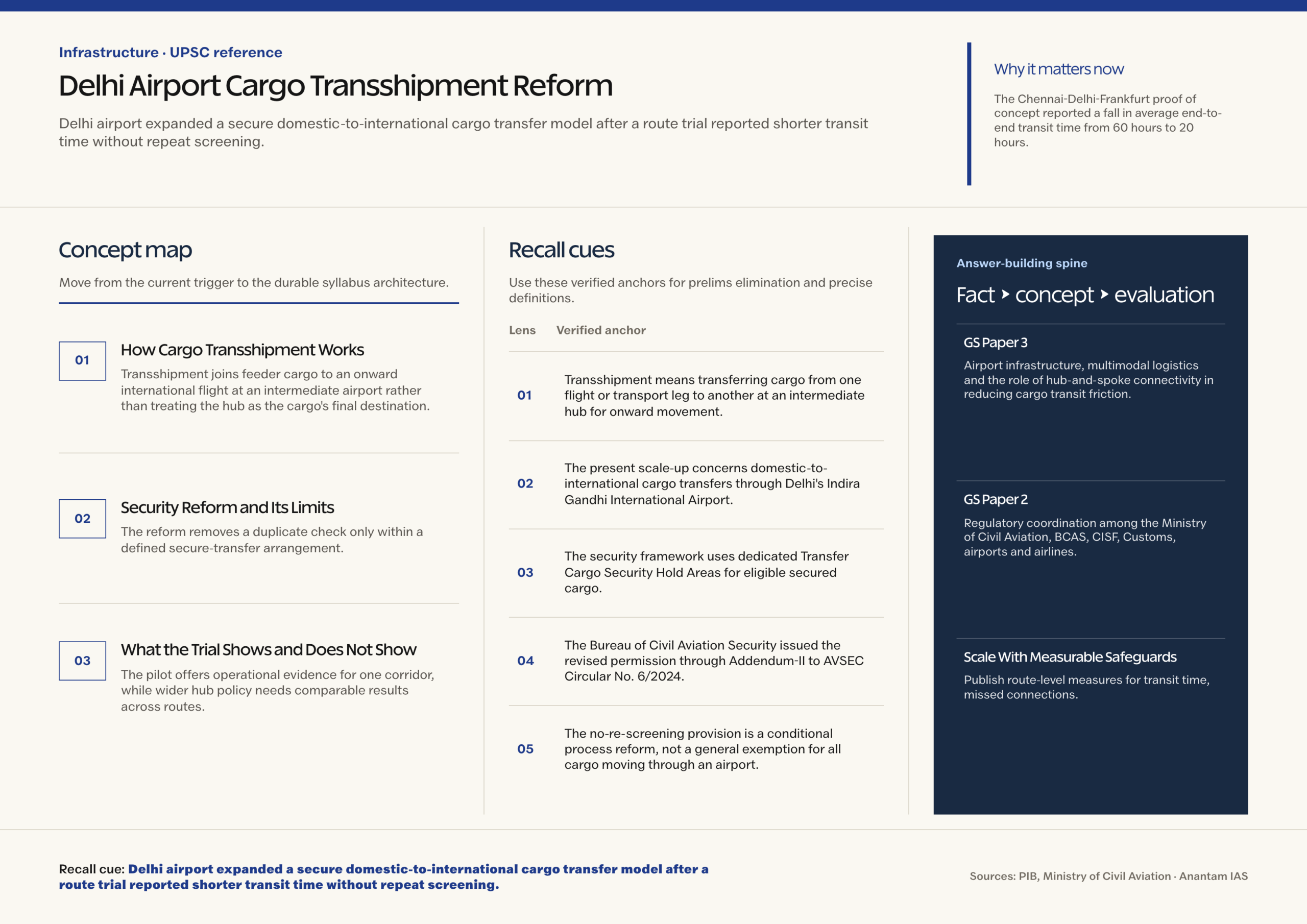
Mindmap explaining Delhi Airport Cargo Transshipment Reform for UPSC revision
Revision mindmap: Delhi Airport Cargo Transshipment Reform. Open the full-size image for details.

Background and Context

How Cargo Transshipment Works

Transshipment joins feeder cargo to an onward international flight at an intermediate airport rather than treating the hub as the cargo’s final destination.

  • A shipment arriving from a domestic origin enters the hub’s transfer chain, is sorted for its onward service and moves toward the designated international departure.
  • The hub combines cargo from several origins, helping an airline support long-haul connectivity even when each origin alone cannot fill a direct international service.
  • A useful transfer depends on synchronized schedules, adequate handling capacity and a protected path between flights; a missed connection can erase the expected time advantage.
  • For shippers, the practical gain is not merely a shorter headline time but greater predictability for inventory, cold-chain planning and delivery commitments.
  • For airports and airlines, successful consolidation can improve network use, but it also concentrates operational risk at the hub and requires disciplined terminal coordination.

Security Reform and Its Limits

The reform removes a duplicate check only within a defined secure-transfer arrangement; it does not dilute the requirement that cargo remain protected.

  • BCAS permitted eligible secured cargo to move through dedicated Transfer Cargo Security Hold Areas without repeat screening, subject to the safeguards prescribed in its framework.
  • The permission was notified through Addendum-II to AVSEC Circular No. 6/2024 on 21 July 2025, before the proof of concept began.
  • Security rests on maintaining an unbroken protected process: cargo eligibility, controlled access, custody records and handling discipline must prevent interference between the first screening and onward loading.
  • If cargo leaves the approved secure chain or no longer meets its conditions, the logic for skipping repeat screening no longer applies; process integrity is the boundary.
  • The participating agencies include BCAS, CISF, Customs, the airport operator and the airline, making inter-agency coordination part of the security design rather than an administrative afterthought.

What the Trial Shows and Does Not Show

The pilot offers operational evidence for one corridor, while wider hub policy needs comparable results across routes, cargo types and disruption conditions.

  • The proof of concept began on 20 June 2026 on the Chennai-Delhi-Frankfurt sector, with Air India operating the route end to end through Delhi’s transfer facility.
  • PIB reported the route’s average end-to-end transit time declining from 60 to 20 hours; this is a reported trial outcome, not a universal airport benchmark.
  • Adding domestic feeder cities and international destinations tests whether the process works across a broader network, where schedules, volumes and handling conditions may differ from the first corridor.
  • The reform concerns secure transfer and connectivity. It does not change the cargo’s origin, authorize false declarations or create a route for avoiding applicable customs controls.
  • India’s hub ambition will be credible only if faster transfers remain reliable during peaks and disruptions while security exceptions stay limited to cargo that satisfies the approved conditions.

Way Forward

Scale With Measurable Safeguards

  • Publish route-level measures for transit time, missed connections, handling exceptions and security incidents so that scale-up decisions rest on comparable evidence.
  • Use interoperable custody records and clearly assigned hand-offs among airlines, terminal operators and security agencies to protect the secure chain.
  • Expand only after stress-testing the process during congestion, schedule disruption and mixed cargo flows, when shortcuts and custody gaps are most likely to appear.
  • Keep customs compliance, cargo-origin documentation and security screening rules distinct in guidance so efficiency reform cannot be misread as an origin or duty exemption.

Conclusion

  • Delhi’s reform shows how process redesign can remove duplicate handling while retaining a security boundary around eligible cargo, improving the conditions for a functional air-cargo hub.
  • In an answer, treat the 60-to-20-hour result as route-specific evidence and evaluate wider success through reliability, security integrity, customs compliance and network connectivity.

UPSC Practice Questions

Prelims MCQ 1

With reference to the Delhi airport cargo transshipment reform, consider the following statements:

  1. It presently concerns domestic-to-international cargo transfers through Delhi airport.
  2. It permits all cargo to bypass screening regardless of its custody status.
  3. Eligible secured cargo uses dedicated Transfer Cargo Security Hold Areas under prescribed safeguards.

How many of the above statements are correct?

(a) Only one (b) Only two (c) All three (d) None

Answer: (b) Only two

Explanation:

Statements 1 and 3 are correct. The no-re-screening treatment is conditional on eligible secured cargo remaining within the approved protected process; it is not a blanket waiver.

Prelims MCQ 2

What is the main logistics purpose of air-cargo transshipment at a hub airport?

(a) To change the declared country of origin of goods (b) To exempt transferred goods from every customs control (c) To connect feeder cargo to an onward flight through an intermediate airport (d) To replace aviation-security screening with airline self-certification

Answer: (c) To connect feeder cargo to an onward flight through an intermediate airport

Explanation:

Transshipment connects transport legs at an intermediate hub. It does not alter origin, remove all customs controls or replace the approved aviation-security process.

UPSC Mains Questions

  1. Explain how secure cargo transshipment can strengthen airport hub connectivity. What institutional safeguards are needed when duplicate screening is removed?
  2. A successful pilot is evidence for scaling, not proof of universal performance. Discuss with reference to India’s air-cargo transshipment reform.

Source: PIB, Ministry of Civil Aviation.

Frequently Asked Questions

What is air-cargo transshipment?

It is the transfer of cargo from one flight or transport leg to another at an intermediate airport, allowing the shipment to continue toward its final destination.

Did Delhi airport remove screening for all cargo?

No. Repeat screening may be omitted only for eligible secured transshipment cargo moving through dedicated security-hold areas under the prescribed protected process and its security safeguards.

What does the 60-to-20-hour figure represent?

It is the average end-to-end transit-time result reported by PIB for the Chennai-Delhi-Frankfurt proof of concept. The release does not present it as an audited national average.

Which institution issued the revised security permission?

The Bureau of Civil Aviation Security issued it through Addendum-II to AVSEC Circular No. 6/2024. The permission applies subject to the prescribed security safeguards.

Does transshipment change the origin of cargo?

No. It changes the transfer route between transport legs; it does not lawfully alter origin declarations. Applicable customs controls and documentation requirements continue to govern the cargo.

RK-251 Shows How Tumour-Activated Cancer Drugs Work

Open article →Download PDF

Why in News?

The Ministry of Science and Technology reported on 19 August 2026 that Indian researchers developed RK-251, a tumour-activated drug candidate studied in breast-cancer cells and zebrafish embryos.

  • RK-251 is designed as a reactive-oxygen-species-activated candidate rather than a medicine that remains equally active throughout the body.
  • Higher ROS conditions trigger RK-251 to release NBDHEX, the anticancer payload examined by the researchers.
  • The reported evidence covers aggressive triple-negative breast-cancer cells and behavioural observations in zebrafish embryos.
  • The work is preclinical; it has not established safety, efficacy, dosage or benefit in human patients.
  • The study illustrates how a prodrug can use a biological condition near diseased cells as an activation switch.
  • It also shows why promising laboratory selectivity must be separated from claims about clinical treatment or replacing chemotherapy.

UPSC Relevance

Prelims Relevance

  • Meaning of a prodrug and stimulus-responsive drug activation
  • Role of reactive oxygen species in cellular signalling and oxidative stress
  • Difference between in vitro cell studies, animal-model work and human clinical trials
  • Basic features of triple-negative breast cancer
  • Research role of zebrafish embryos in early biomedical studies

Mains Relevance

GS Paper 3

  • Potential of stimulus-responsive prodrugs in precision medicine
  • Scientific and regulatory steps between preclinical findings and patient use

GS Paper 2

  • Public-health importance of communicating biomedical evidence without overstating readiness

Essay

  • Scientific progress depends as much on disciplined evidence as on inventive laboratory design.
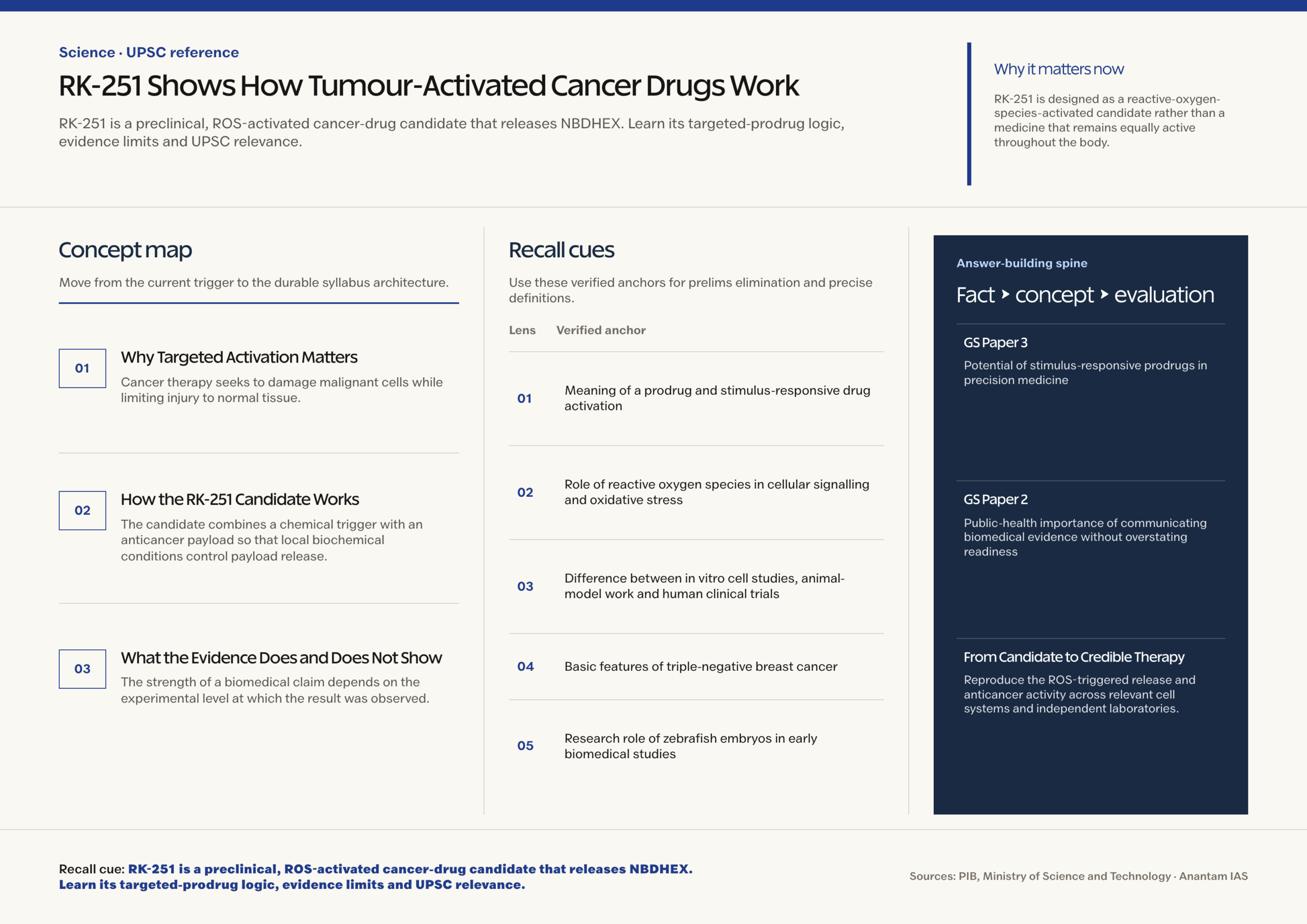
Mindmap explaining RK-251 Shows How Tumour-Activated Cancer Drugs Work for UPSC revision
Revision mindmap: RK-251 Shows How Tumour-Activated Cancer Drugs Work. Open the full-size image for details.

Background and Context

Why Targeted Activation Matters

Cancer therapy seeks to damage malignant cells while limiting injury to normal tissue, but biological differences are rarely absolute.

  • Conventional anticancer drugs may affect both tumour and healthy cells because many targets involved in growth or division are not confined to cancer.
  • A targeted prodrug addresses this problem by circulating in a less active form and releasing its active payload under a selected biological condition, adding a chemical control step before action.
  • The activation condition must differ enough between target and non-target environments to create a useful therapeutic window without assuming perfect selectivity.
  • RK-251 uses elevated reactive oxygen species as its proposed trigger, linking drug activation to a biochemical feature observed in many cancer cells.
  • This design is a research strategy, not proof that every tumour has the same ROS level or that normal tissues never experience oxidative stress.

How the RK-251 Candidate Works

The candidate combines a chemical trigger with an anticancer payload so that local biochemical conditions control payload release.

  • Reactive oxygen species are oxygen-containing molecules formed during metabolism; excessive production or weak antioxidant control can create oxidative stress.
  • When exposed to higher ROS conditions, RK-251 undergoes activation and releases NBDHEX, rather than relying only on passive accumulation near a tumour.
  • The PIB account says NBDHEX blocks proteins that cancer cells may use for survival and treatment resistance, supplying the candidate’s intended anticancer action.
  • The trigger-payload arrangement makes RK-251 a useful example of stimulus-responsive drug delivery, where chemistry links a measurable condition to local drug action rather than assuming the payload can distinguish cells alone.
  • Aspirants should distinguish the mechanism hypothesis from a clinical outcome: showing activation and cell-level activity does not establish patient benefit.

What the Evidence Does and Does Not Show

The strength of a biomedical claim depends on the experimental level at which the result was observed.

  • Researchers reported activity against aggressive triple-negative breast-cancer cells; such cell work helps test mechanism and selectivity under controlled laboratory conditions before more complex whole-organism questions are addressed in subsequent research stages.
  • Triple-negative disease lacks the commonly tested oestrogen, progesterone and HER2 targets, which makes new treatment approaches scientifically important but not automatically effective.
  • In zebrafish embryos, researchers observed desired fluorescence in the presence of ROS and no obvious toxicity signs under the reported study conditions.
  • An embryo observation cannot establish human safety, long-term toxicity, pharmacokinetics, dosage, tumour response or survival benefit; each requires further staged investigation.
  • No human trial, regulatory approval or established clinical efficacy was reported, so RK-251 cannot presently be described as a replacement for chemotherapy.

Way Forward

From Candidate to Credible Therapy

  • Reproduce the ROS-triggered release and anticancer activity across relevant cell systems and independent laboratories.
  • Study absorption, distribution, metabolism, excretion and toxicity in suitable preclinical models before proposing human exposure.
  • Determine whether tumour ROS variability permits reliable activation without harmful release in inflamed or oxidatively stressed normal tissues.
  • Advance to regulated clinical trials only after adequate preclinical evidence supports a justified starting dose and monitoring plan.

Conclusion

  • RK-251 demonstrates a promising design principle: use a tumour-associated chemical condition to activate a drug candidate and release its payload closer to intended cells.
  • In a Mains answer, pair this precision-medicine promise with the evidence ladder: cell work and zebrafish observations precede, but cannot substitute for, human trials.
  • The correct conclusion is cautious: RK-251 merits further validation, while present evidence supports neither clinical safety claims nor replacement of chemotherapy.

UPSC Practice Questions

Prelims MCQ 1

With reference to RK-251, consider the following statements:

  1. It is designed for activation under elevated reactive-oxygen-species conditions.
  2. Its activation releases the anticancer compound NBDHEX.
  3. Its safety and efficacy have been established through human clinical trials.

How many of the above statements are correct?

(a) Only one (b) Only two (c) All three (d) None

Answer: (b) Only two

Explanation:

Statements 1 and 2 describe the reported mechanism. Statement 3 is incorrect because the evidence is preclinical and includes breast-cancer cell work and zebrafish embryos, not human trials.

Prelims MCQ 2

Which one of the following best describes a stimulus-responsive prodrug?

(a) A drug that remains equally active in every tissue (b) A vaccine that creates antibodies against a chemical trigger (c) A candidate designed to release an active payload under a selected biological condition (d) A medicine approved without preclinical testing

Answer: (c) A candidate designed to release an active payload under a selected biological condition

Explanation:

A stimulus-responsive prodrug links activation or payload release to a condition such as a chemical feature in the target environment.

UPSC Mains Questions

  1. Explain how stimulus-responsive prodrugs could improve the selectivity of cancer treatment. What scientific limitations must be resolved before clinical use?
  2. Preclinical promise should not be confused with therapeutic readiness. Discuss with reference to the development of RK-251.

Source: PIB, Ministry of Science and Technology.

Frequently Asked Questions

What is RK-251?

RK-251 is a preclinical cancer-drug candidate designed to activate under higher reactive-oxygen-species conditions and release the anticancer compound NBDHEX.

How is RK-251 intended to become active?

Its chemical design responds to elevated reactive oxygen species, triggering release of NBDHEX. This stimulus-responsive mechanism aims to concentrate activity under selected cellular conditions.

What evidence has been reported for RK-251?

Researchers reported activity in triple-negative breast-cancer cell work and observations in zebrafish embryos. These are preclinical findings, not evidence of benefit in patients.

Can RK-251 currently replace chemotherapy?

No. It has no reported human trial evidence or regulatory approval. More preclinical validation and regulated clinical testing are required before any treatment comparison is justified.

NH-22 Hybrid Annuity Project and the India-Nepal Feeder Corridor

Open article →Download PDF

Why in News?

On 19 August 2026, the CCEA approved four-laning of the Muzaffarpur-Sitamarhi-Sonbarsa section of NH-22 in Bihar under the Hybrid Annuity Mode.

  • The approved project covers an 82.578 km section and carries a stated capital cost of Rs 3,590.73 crore.
  • The corridor would connect Sonbarsa near the India-Nepal border with Muzaffarpur and NH-27, the East-West Corridor.
  • PIB presents faster passenger and freight movement, safer travel and stronger supply-chain links as intended benefits, not completed outcomes.
  • The approval provides for four-laning under HAM; implementation still requires construction, monitoring and performance against the concession contract.
  • The project turns PPP risk allocation into a concrete case: payment certainty can attract private execution without transferring traffic demand risk.
  • Its strategic value comes from feeder connectivity between a border-facing corridor, NH-27, rail nodes, production centres and freight networks.
  • A road approval alone does not complete cross-border logistics; border facilities, customs processes and connecting links must also function.

UPSC Relevance

Prelims Relevance

  • Hybrid Annuity Mode combines government construction support with private financing and later annuity payments.
  • Under standard HAM design, the authority bears traffic or toll-revenue risk; the private partner is not paid from toll collections.
  • The concessionaire retains construction and maintenance performance risk, subject to the particular concession agreement.
  • NH-27 forms part of the East-West Corridor and provides the wider trunk-road connection from Muzaffarpur.
  • Sonbarsa is the border-facing end of the approved NH-22 section, while Bhithamore Land Port is a nearby cross-border logistics node.

Mains Relevance

GS Paper 3

  • Public-private partnership design and risk allocation in national-highway construction
  • Feeder corridors, multimodal logistics and the integration of border regions with freight networks

GS Paper 2

  • Connectivity as an enabling layer of India-Nepal economic relations
  • Need for coordination between road infrastructure, land-port administration and customs processes

Essay

  • Infrastructure creates value when contracts, institutions and connecting systems work together, not merely when a project receives approval.
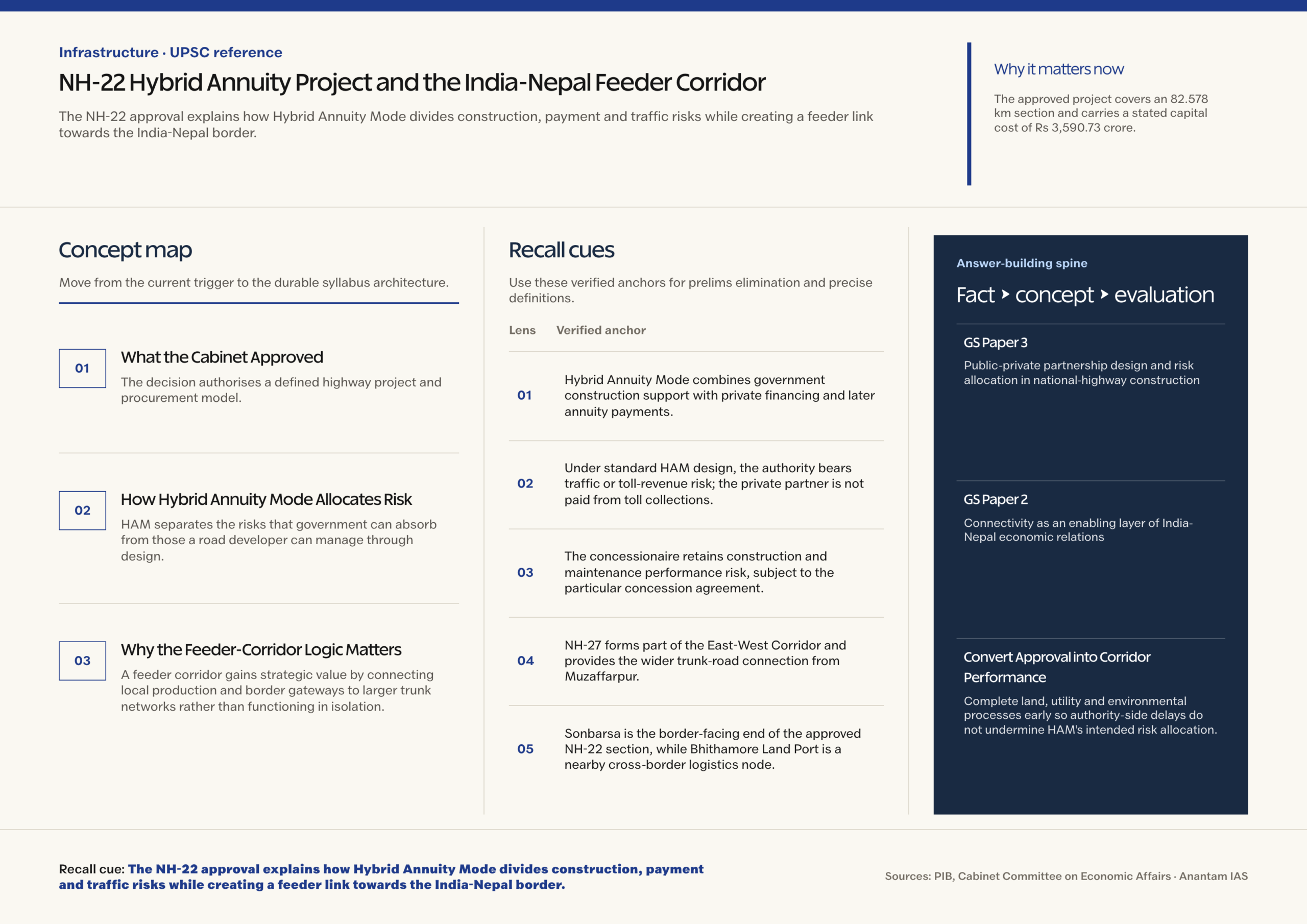
Mindmap explaining NH-22 Hybrid Annuity Project and the India-Nepal Feeder Corridor for UPSC revision
Revision mindmap: NH-22 Hybrid Annuity Project and the India-Nepal Feeder Corridor. Open the full-size image for details.

Background and Context

What the Cabinet Approved

The decision authorises a defined highway project and procurement model; it does not certify construction or operational gains.

  • The CCEA approval covers upgrading the Muzaffarpur-Sitamarhi-Sonbarsa section of NH-22 in Bihar to four lanes under HAM, specifying a PPP pathway rather than a budget-only announcement.
  • The approved section runs for 82.578 km, ending at Sonbarsa near the India-Nepal border and linking westward to Muzaffarpur, which fixes the physical scope on the Indian side.
  • At Muzaffarpur, the section meets NH-27, allowing border-facing movement to enter the wider East-West Corridor and national freight network for longer-distance freight and passenger distribution.
  • The design includes grade-separated and bridge infrastructure intended to protect through movement from local crossings and physical bottlenecks while retaining access through dedicated structures.
  • Expected reductions in congestion, travel time and vehicle costs remain projected benefits until works are delivered and operating performance is measured against a baseline after opening.

How Hybrid Annuity Mode Allocates Risk

HAM separates the risks that government can absorb from those a road developer can manage through design, construction and maintenance.

  • During construction, the road authority normally pays 40% of project cost in linked instalments, reducing the developer’s upfront financing burden and the quantum of commercial debt required.
  • The private concessionaire finances the remaining 60%, which the authority repays through scheduled annuities after operation begins rather than through a one-time completion payment.
  • Because repayment is authority-backed rather than toll-dependent, traffic demand risk stays substantially with the public side, shielding project cash flows from uncertain user volumes.
  • The concessionaire bears construction risk: delays, design execution, cost control and compliance affect milestone payments; poor execution is not automatically shifted back to the authority.
  • It also carries maintenance and availability risk; annuity and operation payments can depend on meeting specified road-condition and performance standards throughout the concession’s operating phase.

Why the Feeder-Corridor Logic Matters

A feeder corridor gains strategic value by connecting local production and border gateways to larger trunk networks rather than functioning in isolation.

  • The NH-22 section would channel movement between the Sonbarsa border belt, Sitamarhi, Muzaffarpur, the NH-27 trunk corridor and onward domestic markets.
  • Connections with railway stations, industrial areas and food-processing nodes can support first-mile and last-mile movement, but value depends on dependable interchanges and access roads.
  • The nearby Bhithamore Land Port adds a cross-border logistics dimension, but the approved road neither creates customs facilities nor guarantees faster border clearance.
  • The corridor can improve access to a border gateway only if connecting roads, terminals and procedures avoid shifting delays from highways to checkpoints or freight terminals.
  • For answers, distinguish domestic connectivity infrastructure from bilateral trade arrangements: a highway facilitates movement, while border agencies govern clearance, preventing an approval from being overstated as a foreign-policy outcome.

Way Forward

Convert Approval into Corridor Performance

  • Complete land, utility and environmental processes early so authority-side delays do not undermine HAM’s intended risk allocation.
  • Link annuity and maintenance payments to transparent availability, safety and pavement-quality indicators, with independent engineering checks.
  • Coordinate highway operations with land-port, customs and rail authorities so the feeder link reduces end-to-end logistics time.
  • Track actual travel reliability, crashes and freight movement against a pre-construction baseline instead of treating expenditure or road length as success.

Conclusion

  • The NH-22 decision is best understood as an approved HAM corridor project: it combines public payment support with private construction and maintenance obligations.
  • In a Mains answer, connect contract design to corridor outcomes and explain that cross-border benefits depend on roads, gateways and procedures working as one system.

UPSC Practice Questions

Prelims MCQ 1

With reference to the Hybrid Annuity Mode used for national-highway projects, consider the following statements:

  1. The road authority normally provides part of the project cost during construction.
  2. The private concessionaire’s repayment depends primarily on toll revenue collected from users.
  3. The concessionaire remains responsible for construction and contracted maintenance performance.

How many of the above statements are correct?

(a) Only one (b) Only two (c) All three (d) None

Answer: (b) Only two

Explanation:

Statements 1 and 3 are correct. Under HAM, authority-backed annuity payments reduce dependence on toll revenue, so traffic demand risk does not primarily sit with the concessionaire.

Prelims MCQ 2

What is the most accurate description of the approved Muzaffarpur-Sitamarhi-Sonbarsa NH-22 project’s cross-border role?

(a) It is a bilateral treaty corridor administered jointly by India and Nepal. (b) It replaces customs and land-port procedures at the international border. (c) It is a domestic feeder link connecting a border-facing area with wider highway and logistics networks. (d) It transfers traffic-revenue risk entirely to the private developer.

Answer: (c) It is a domestic feeder link connecting a border-facing area with wider highway and logistics networks.

Explanation:

The approved section is an Indian national-highway project. It can facilitate access towards border gateways, but it neither constitutes a bilateral treaty nor replaces customs administration.

UPSC Mains Questions

  1. Explain how the Hybrid Annuity Mode allocates construction, financing, maintenance and traffic risks in national-highway projects. Why does this allocation matter for project delivery?
  2. The value of a border feeder corridor depends on the network and institutions around it. Discuss with reference to the approved NH-22 Muzaffarpur-Sitamarhi-Sonbarsa project.

Source: PIB, Cabinet Committee on Economic Affairs.

Frequently Asked Questions

What did the Cabinet approve for NH-22?

The CCEA approved four-laning of the 82.578 km Muzaffarpur-Sitamarhi-Sonbarsa section in Bihar under Hybrid Annuity Mode. The decision is an approval, not completion of construction.

What is the Hybrid Annuity Mode?

HAM is a road PPP structure combining government construction-stage support with private financing, followed by authority-paid annuities and performance-linked operation and maintenance obligations during the operating period.

Who bears traffic risk under HAM?

Traffic or toll-revenue risk substantially remains with the road authority because the concessionaire receives authority-backed payments rather than relying mainly on toll collections during the operating period.

Why is NH-22 relevant to India-Nepal connectivity?

The section links the Sonbarsa border-facing area with Muzaffarpur and NH-27, feeding local and potential cross-border passenger and freight movement into a larger highway and logistics network.

Does the highway project itself operate the international border?

No. The national highway can improve access towards border gateways, but customs clearance, land-port operations and bilateral trade rules remain separate institutional functions at the international boundary.

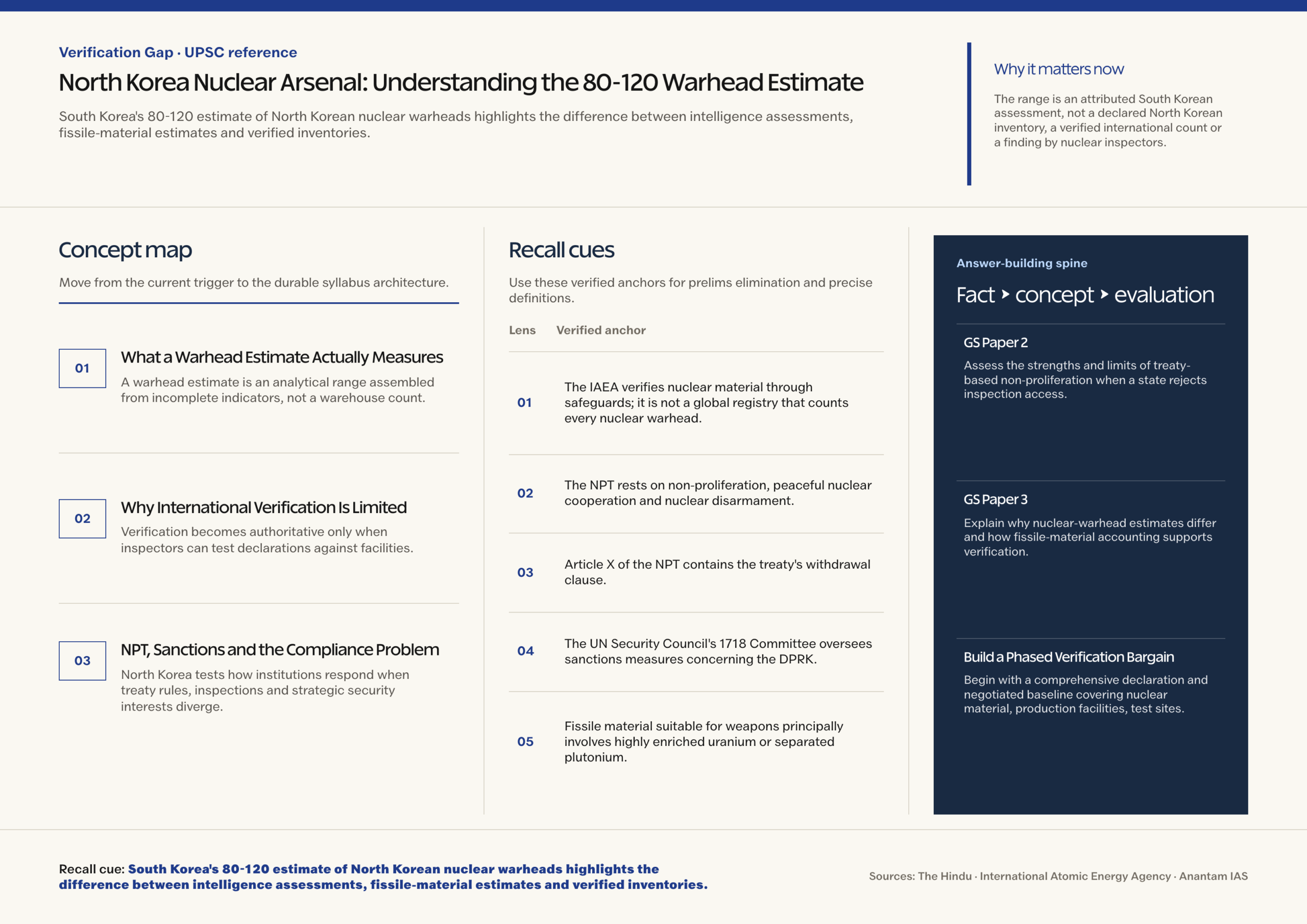
North Korea Nuclear Arsenal: Understanding the 80-120 Warhead Estimate

Open article →Download PDF

Why in News?

South Korea’s defence minister told lawmakers that North Korea was generally estimated to possess 80-120 nuclear warheads, while stressing that the exact figure was difficult to determine.

  • The range is an attributed South Korean assessment, not a declared North Korean inventory, a verified international count or a finding by nuclear inspectors.
  • The breadth of the range signals intelligence uncertainty about fissile-material stocks, weapon designs, assembly rates and how many devices are operationally deployable.
  • The IAEA does not publish a warhead count for North Korea; its mandate centres on nuclear-material safeguards and verification under applicable agreements.
  • The estimate matters because arsenal size influences deterrence calculations, missile-defence planning, crisis stability and the scope of any future disarmament bargain.
  • A larger presumed arsenal can support multiple missions, including retaliation and battlefield coercion, but an estimated stockpile does not by itself reveal readiness or reliability.
  • Verification is unusually weak because inspectors lack access, while public assessments must combine remote observation, production indicators, tests and intelligence with substantial analytic assumptions.
  • For India, the issue connects Asian security, nuclear non-proliferation, missile technology, sanctions enforcement and the risks created by opaque command-and-control systems.

UPSC Relevance

Prelims Relevance

  • The IAEA verifies nuclear material through safeguards; it is not a global registry that counts every nuclear warhead.
  • The NPT rests on non-proliferation, peaceful nuclear cooperation and nuclear disarmament.
  • Article X of the NPT contains the treaty’s withdrawal clause.
  • The UN Security Council’s 1718 Committee oversees sanctions measures concerning the DPRK.
  • Fissile material suitable for weapons principally involves highly enriched uranium or separated plutonium.

Mains Relevance

GS Paper 2

  • Assess the strengths and limits of treaty-based non-proliferation when a state rejects inspection access.
  • Examine how sanctions, diplomacy and security guarantees interact in negotiations over the Korean Peninsula.

GS Paper 3

  • Explain why nuclear-warhead estimates differ and how fissile-material accounting supports verification.
  • Analyse the relationship between arsenal opacity, deterrence, missile defence and crisis instability.

Essay

  • Security built on secrecy may strengthen deterrence while simultaneously increasing mistrust and miscalculation.
Mindmap explaining North Korea Nuclear Arsenal: Understanding the 80-120 Warhead Estimate for UPSC revision
Revision mindmap: North Korea Nuclear Arsenal: Understanding the 80-120 Warhead Estimate. Open the full-size image for details.

Background and Context

What a Warhead Estimate Actually Measures

A warhead estimate is an analytical range assembled from incomplete indicators, not a warehouse count.

  • Analysts first estimate fissile-material production: separated plutonium from reactors and reprocessing, and highly enriched uranium from centrifuge enrichment facilities.
  • They then apply assumptions about material used per device, production losses, test consumption, weapon-design efficiency and material retained outside assembled weapons.
  • A device may be assembled yet not miniaturised or integrated with a tested delivery system; stockpile size and deployable capability are different questions.
  • Remote imagery can reveal construction, reactor operation indicators or support activity, but it cannot show each hidden component, assembly status or maintenance condition.
  • Human intelligence, intercepted signals and test evidence can narrow estimates, but each source has coverage gaps and deception risks; a range is more honest than false precision.

Why International Verification Is Limited

Verification becomes authoritative only when inspectors can test declarations against facilities, records and nuclear material.

  • The IAEA reports that it has been unable to conduct all necessary safeguards activities in the DPRK since 1994.
  • IAEA inspectors have not been present in the country since April 2009, leaving the Agency dependent on satellite imagery and other available information.
  • Without access, inspectors cannot independently confirm facility configurations, operational status, undeclared sites, production records or the correctness and completeness of nuclear-material declarations.
  • Safeguards use material accountancy, seals, surveillance, inspections and environmental sampling to detect diversion or undeclared activity; these tools require cooperation and access.
  • The IAEA can maintain readiness and report observed indicators, but it cannot convert remote monitoring into a verified warhead inventory.

NPT, Sanctions and the Compliance Problem

North Korea tests how institutions respond when treaty rules, inspections and strategic security interests diverge.

  • The Nuclear Non-Proliferation Treaty exchanges non-acquisition commitments and safeguards for peaceful cooperation, alongside a broader obligation to pursue disarmament negotiations.
  • Its Article X permits withdrawal after notice when extraordinary events jeopardise supreme national interests; North Korea announced withdrawal, while aspects of that process remain legally debated.
  • The UN Security Council’s 1718 regime combines prohibitions, asset freezes and oversight to constrain nuclear and missile-related procurement and financing.
  • Sanctions can raise costs and slow access to technology, but they do not themselves establish a verified baseline, dismantle facilities or resolve the security motives behind proliferation.
  • A durable settlement must reconcile denuclearisation goals with sequencing, reciprocal steps, regional deterrence concerns and credible verification of declared and undeclared activities.

Way Forward

Build a Phased Verification Bargain

  • Begin with a comprehensive declaration and negotiated baseline covering nuclear material, production facilities, test sites, assembled devices and relevant delivery-system interfaces.
  • Sequence access, monitoring and disablement with reciprocal sanctions relief, while using predefined snapback provisions for verified non-compliance.
  • Combine on-site inspections, environmental sampling, seals and remote monitoring with satellite analysis to test declarations and detect undeclared activity.
  • Maintain crisis hotlines, notification arrangements and military risk-reduction measures so deterrence failures do not derail slower arms-control negotiations.

Conclusion

  • The 80-120 figure should be used as an uncertain assessment range, never as a verified inventory or an IAEA count.
  • A strong answer should separate estimated material and devices from deployable capability, then connect the verification gap to safeguards access, diplomacy and regional stability.
  • The central policy challenge is not merely counting weapons; it is creating conditions under which declarations can be independently tested and irreversible steps credibly demonstrated.

UPSC Practice Questions

Prelims MCQ 1

With reference to nuclear safeguards and the Nuclear Non-Proliferation Treaty, consider the following statements:

  1. IAEA safeguards are designed to verify nuclear-material declarations and detect diversion.
  2. Article X of the NPT contains a withdrawal provision.
  3. The IAEA maintains a verified public count of every state’s assembled nuclear warheads.

How many of the above statements are correct?

(a) Only one (b) Only two (c) All three (d) None

Answer: (b) Only two

Explanation:

Statements 1 and 2 are correct. Safeguards verify nuclear material under agreements, while the IAEA does not maintain a verified global inventory of assembled warheads.

Prelims MCQ 2

Which institution oversees the sanctions measures established by UN Security Council resolution 1718 concerning the Democratic People’s Republic of Korea?

(a) UN Security Council 1718 Committee (b) Nuclear Suppliers Group Secretariat (c) IAEA Board of Governors alone (d) UN Peacebuilding Commission

Answer: (a) UN Security Council 1718 Committee

Explanation:

The Security Council’s 1718 Committee oversees the relevant sanctions measures. The IAEA has a distinct safeguards and verification role.

UPSC Mains Questions

  1. Why do estimates of a state’s nuclear arsenal differ? Explain how fissile-material accounting and inspection access affect confidence in such estimates. (150 words)
  2. Evaluate the limits of sanctions and treaty mechanisms in addressing North Korea’s nuclear programme. Suggest elements of a credible phased verification arrangement. (250 words)

Sources: The Hindu and International Atomic Energy Agency.

Frequently Asked Questions

Does North Korea definitely possess 80-120 nuclear warheads?

No. The range is an attributed South Korean estimate based on incomplete intelligence. It is not a North Korean declaration, an inspected inventory or an IAEA count.

Why is North Korea’s exact warhead count difficult to determine?

Uncertainty surrounds fissile-material production, hidden facilities, material used per design, assembly rates, test consumption, weapon-design efficiency, operational readiness and the absence of sustained on-site inspections.

What does the IAEA verify in North Korea?

The IAEA’s mandate concerns nuclear-material safeguards and verification. Without inspector access, it monitors available information and maintains readiness, but cannot certify a complete operational warhead inventory.

What is the significance of Article X of the NPT?

Article X permits a party to withdraw after notice when extraordinary events jeopardise its supreme interests. North Korea announced withdrawal, though legal questions about the process persist.

Can sanctions alone eliminate a nuclear programme?

Sanctions can restrict finance, trade and sensitive technology, but dismantlement requires political agreement, a declared baseline, inspector access, technical verification, credible reciprocal sequencing and enforceable compliance mechanisms.

Transmission Constraints Threaten India’s Renewable Energy Expansion

Open article →Download PDF

Context:

India’s renewable-energy transition is progressing rapidly, but transmission and grid integration capacity is emerging as a critical bottleneck. 

UPSC Relevance: GS-3 Economy: Energy Infrastructure; GS-3 Environment: Renewable Energy

Prelims: India’s Renewable Energy Capacity
Mains: Issues facing India’s Renewable Energy Expansion 
image 11

India’s Renewable Energy Capacity: 

  • India aims to achieve 500 GW of installed non-fossil-fuel capacity by 2030 and has already surpassed the 50% non-fossil share of installed electricity capacity. 
  • As of mid 2026, India had 288.6 GW of renewable energy capacity, comprising about:
    • 162.2 GW solar
    • 57.4 GW wind
    • 57.2 GW hydro
    • 11.8 GW bio-power
  • ICRA expects renewables, including large hydro, to contribute over 35% of electricity generation by 2029-30, compared with 22% in 2024-25.

What is the problem?

Renewable-energy curtailment occurs when renewable generators (particularly solar projects) are asked to reduce or stop generation despite the availability of renewable resources, mainly because of:

  • inadequate transmission/evacuation capacity
  • localised oversupply during peak solar hours
  • grid-frequency and voltage constraints
  • insufficient storage and flexible generation; and
  • demand being lower than available generation.

Although renewable projects generally enjoy must-run status, curtailment may be undertaken to maintain grid security. 

ICRA found that around 37% of capacity at curtailment-affected substations in northern, western and southern India operated under Temporary General Network Access (T-GNA) and faced 30-50% curtailment during daytime. Peak curtailment reached about 8617 MW in western India and 5573 MW in northern India.

Why is transmission becoming a bottleneck?

  • Geographical mismatch: Solar and wind resources are concentrated in Rajasthan, Gujarat, Ladakh and southern coastal States, while major demand centres are located in Maharashtra, Gujarat, Uttar Pradesh, Tamil Nadu, Karnataka, etc. 
  • Generation-transmission mismatch: Renewable projects can be commissioned faster than transmission corridors.
  • Intra-State constraints: State-level evacuation networks may lag behind large renewable additions.
  • Land and right-of-way issues: Transmission projects face land acquisition, forest clearances and local opposition.
  • Intermittency: Solar and wind require storage and flexible generation to balance fluctuations.
  • Commercial constraints: Around 40-45 GW of awarded renewable capacity reportedly lacked signed Power Purchase Agreements (PPAs), as of April 2026, reflecting demand, tariff and execution uncertainties.
  • Slowing project awards: Bids for new renewable energy projects have slowed sharply. After 40.6 GW was awarded in 2024-25, awards fell to 14.7 GW in 2025-26. 

Beyond transmission, India also faces delays in land acquisition and weak finances of distribution companies (DISCOMs). 

Wider Implications: 

  • Transmission constraints can result in:
    • loss of clean electricity
    • lower revenues for renewable developers
    • higher financing risks
    • slower private investment 

Simply installing renewable capacity does not guarantee its availability to consumers. The challenge is therefore shifting from “adding renewable megawatts” to “integrating renewable electricity into the grid.”

Way Forward: 

  • Synchronise generation and transmission planning so that evacuation infrastructure is ready before projects are commissioned.
  • Accelerate Green Energy Corridors and high-capacity inter-State transmission, including High-Voltage Direct Current (HVDC) corridors.
  • Expand Battery Energy Storage Systems (BESS) and pumped-storage hydropower. The National Electricity Plan envisages about 47.2 GW of BESS and 22.4 GW of pumped storage by 2031-32.
  • Promote wind-solar hybrids, Firm and Dispatchable Renewable Energy (FDRE) and Round-the-Clock (RTC) renewable power.
  • Strengthen intra-State transmission networks and DISCOM finances.
  • Improve forecasting, demand response and time-of-day pricing to shift consumption towards periods of high renewable generation.
  • Establish transparent curtailment rules and appropriate compensation mechanisms where curtailment results from avoidable transmission constraints.

India’s renewable transition requires a generation + transmission + storage + distribution approach. 

The government has planned transmission systems capable of integrating over 500 GW of non-fossil capacity by 2030, but timely execution of these networks will determine whether India can convert its rapidly growing renewable capacity into reliable, affordable and dispatchable clean power.

Census 2027: Disability rights groups flag gaps in disability categories

Open article →Download PDF

Context:

Disability-rights organisations have questioned the proposed nine-category framework for recording disability in Census 2027. They argue that it may not adequately capture the 21 specified disabilities recognised under the Rights of Persons with Disabilities (RPwD) Act, 2016.

However, the framework is not yet final: the government has clarified that questions for the Population Enumeration phase, during which disability data are collected, are yet to be officially notified. 

image 12
UPSC Relevance: GS-2 Social Justice: Vulnerable Sections 

Prelims: Rights of Persons with Disabilities (RPwD) Act, 2016
Mains: Challenges facing Persons with Disabilities. 

What is being proposed?

The nine categories reportedly proposed by the government are:

  • Seeing
  • Hearing
  • Speech
  • Mobility
  • Intellectual disability
  • Mental illness
  • Acid-attack-related disability
  • Chronic neurological disease; and
  • Blood disorder.

Six largely continue the 2011 framework, with the outdated expression “mental retardation” replaced by intellectual disability. Acid-attack-related disability, chronic neurological disease and blood disorder are new additions.

What are the concerns?

  • The Rights of Persons with Disabilities (RPwD) Act, 2016 recognises disabilities such as autism spectrum disorder, specific learning disabilities, cerebral palsy, dwarfism, muscular dystrophy, multiple sclerosis, Parkinson’s disease, leprosy-cured persons and multiple disabilities. 

Disability Rights groups argue that:

  • Conditions such as autism, learning disabilities and dwarfism are not separately visible in the proposed categories.
  • Broad categories such as “mobility” or “chronic neurological disease” may conceal major differences in support requirements.
  • The absence of clear “multiple disabilities” and “other disability” options may produce exclusion or forced classification.
  • Proxy responses by household members, social stigma and insufficient enumerator training may particularly undercount psychosocial, intellectual and learning disabilities.
  • Data would not be fully comparable with the legal framework used for disability certificates, reservations and welfare programmes.

Why does accurate enumeration matter?

The 2011 Census recorded 2.68 crore persons with disabilities, i.e., 2.21% of India’s population. However, narrow definitions and condition-based questions can underestimate functional limitations. 

Reliable disaggregated data are essential for:

  • Planning accessible schools, healthcare, transport and housing;
  • Implementing the 4% reservation for persons with benchmark disabilities in government employment;
  • Allocating assistive devices, social-security benefits and rehabilitation services;
  • Identifying gender, caste, tribal and rural-urban inequalities within the disabled population;
  • Disaster-management and district-level accessibility planning; and
  • Monitoring the Sustainable Development Goals’ principle of leave no one behind.

Article 31 of the UN Convention on the Rights of Persons with Disabilities, ratified by India, requires States to collect appropriate and disaggregated disability data for policymaking. 

Way Forward: 

  • Map every RPwD Act disability transparently to the Census categories and publish detailed sub-codes.
  • Retain options for multiple and other disabilities.
  • Combine condition-based categories with functional questions covering seeing, hearing, mobility, cognition, communication, self-care and independent living.
  • Permit multiple responses instead of forcing a person into one category.
  • Prepare accessible questionnaires in Indian Sign Language, Braille, audio and easy-to-read formats.
  • Train enumerators in respectful, non-stigmatising identification and consult organisations led by persons with disabilities.
  • Link Census data methodologically (not through automatic personal-data sharing) with the Unique Disability ID system and specialised surveys.

Disability enumeration is not merely a statistical exercise. If a disability remains invisible in official data, the people affected may also remain invisible in budgeting and public policy. Census 2027 should therefore reconcile administrative simplicity with the diversity recognised by the RPwD Act. 

Also Read: https://anantamias.com/current-affairs/sc-expands-definition-of-acid-attack-victim-in-disabilities-act/ 

UPSC Mains PYQ 2022 

Q. The Rights of Persons with Disabilities Act, 2016 remains only a legal document without intense sensitisation of government functionaries and citizens regarding disability. Comment. 

UPSC Mains PYQ 2017 

Q. Does the Rights of Persons with Disabilities Act, 2016 ensure effective mechanisms for empowerment and inclusion of the intended beneficiaries in society? Discuss. 

China recovers first stage of a rocket on land: Rocket Reusability

Open article →Download PDF

Context:

Recently, China has demonstrated a major step towards reusable orbital launch vehicles by successfully recovering the first stage of LandSpace’s Zhuque-3 Y2 rocket on land after an orbital mission. The methane-liquid oxygen rocket performed a controlled vertical landing about 390 km downrange from the launch site.

The development highlights the growing global shift from expendable rockets towards reusable space transportation systems and the increasing role of China’s private space sector.

image 14
UPSC Relevance: GS-3 Science and Technology; Space Technology 

Prelims & Mains: Rocket Reusability (Concept, Advantages & Challenges); Major attempts towards Rocket Reusability. 

What is Rocket Reusability?

Most orbital rockets consist of multiple stages:

  • The first stage provides the major thrust required to overcome gravity and atmospheric resistance/drag before separating from the upper stage. After fuel exhaustion, it separates from the upper stage, which continues towards orbit.
  • In conventional expendable rockets, the first stage falls into the ocean or a designated impact zone. 
  • A reusable launch vehicle instead attempts to:
    • Launch → Stage separation → Controlled descent → Recovery → Inspection/refurbishment → Reflight

Importantly, successful recovery does not by itself establish operational reusability. The recovered stage must undergo refurbishment and demonstrate reliable subsequent flights.

Types of Reusability: 

  • Partial reusability: Only some components, generally the first stage/boosters, are recovered. SpaceX’s Falcon 9 follows this model.
  • Full reusability: Both the first stage and upper spacecraft/stage are designed for repeated recovery and flight. SpaceX’s Starship is pursuing this model, although achieving rapid, routine full reusability remains technically challenging.
image 13

Why is Reusability Important?

  • Lower recurring costs: Expensive engines and structural components can be used multiple times.
  • Higher launch cadence: Reduces dependence on manufacturing an entirely new rocket for every mission.
  • Responsive space access: Enables faster replacement or deployment of satellites.
  • Commercialisation: Lower launch costs can expand satellite constellations, space-based services and other commercial applications.
  • Strategic capability: Frequent and responsive launches can strengthen capabilities in communications, Earth observation and national security.
  • Deep-space potential: Reusable heavy-lift systems could reduce the cost of sustained lunar and eventually Martian operations.

However, reusability is not synonymous with cheap launches. Economic gains depend on high flight frequency, low refurbishment costs and reliable turnaround.

Why Methane-Based Rockets?

Zhuque-3 uses LOX-methane propulsion, an increasingly important technology for next-generation reusable rockets.

Methane is attractive because it offers:

  • relatively clean combustion, reducing engine-soot-related refurbishment challenges;
  • good performance for reusable systems; and
  • potential relevance to future Mars missions, since methane can theoretically be produced from Martian resources.

Associated Challenges: 

  • Recovery systems require additional fuel, landing hardware and guidance systems, potentially reducing payload capacity.
  • Repeated flights impose thermal, structural and engine stresses.
  • Inspection and refurbishment can offset some of the economic benefits.
  • High utilisation is necessary to achieve significant cost reductions.
  • Requires sophisticated tracking, telemetry, landing and ground infrastructure.
  • Frequent launches raise concerns regarding atmospheric emissions, noise and sonic booms.
  • Full reusability is considerably more difficult than first-stage recovery because the upper stage must survive orbital velocity and atmospheric re-entry.

India’s Reusable-Launch Programme: 

India is developing reusable-launch technologies through ISRO and the emerging private space sector.

  • RLV Technology Demonstrator (Pushpak):  ISRO’s winged vehicle has tested hypersonic re-entry and autonomous runway landing. Three landing experiments (LEX-01, LEX-02 and LEX-03) were successfully completed by 2024. ISRO is now working towards an Orbital Re-entry Experiment, in which Pushpak would return from orbit and land on a runway. 
  • Next Generation Launch Vehicle (NGLV): Approved in 2024, NGLV is envisaged as a heavier launch system (carrying up to 30 tonnes to Low-Earth Orbit, using relatively cleaner LOX-methane propulsion) with a reusable first stage. It is intended to support India’s growing commercial launch requirements, the Bharatiya Antariksh Station and future deep-space ambitions.
  • Vertical landing technology: ISRO is also developing technologies for vertical take-off and vertical landing (VTVL), which could eventually enable booster recovery.

India’s space reforms are enabling private companies to participate in launch-vehicle development, potentially accelerating innovation in reusable systems.

Rocket reusability represents a shift from a “disposable rocket” model to a “space transportation” model. The real breakthrough in reusable launch vehicles is not merely bringing a rocket back to Earth, but making its recovery, refurbishment and rapid reflight sufficiently reliable and economical to transform space launch.

Due Diligence in Surrogate Advertising

Open article →Download PDF

Why in News?

The Maharashtra Food and Drug Administration has issued show-cause notices to actors Shah Rukh Khan, Ajay Devgn and Tiger Shroff over advertisements for Vimal Elaichi. The FDA suspects that the advertisements indirectly promote tobacco or pan-masala products by retaining the same brand name, visual identity and celebrity appeal.

The actors have reportedly been asked to withdraw promotional content and explain the due diligence undertaken before accepting the endorsements. These are allegations under investigation, not findings of guilt. 

UPSC Relevance: GS-2 Polity and Governance: Government policies and interventions for development in various sectors. 

Prelims: Legal Framework against Surrogate Advertising

What is Surrogate Advertising? 

Surrogate advertising is the indirect promotion of a prohibited or restricted product, commonly tobacco or alcohol, through an ostensibly lawful product carrying the same:

  • Brand name or logo
  • Packaging and colour scheme
  • Slogan, music or visual imagery; and
  • Celebrity ambassador.

For example, advertisements for cardamom, mouth fresheners, soda or packaged water may be designed primarily to preserve consumer recall of a tobacco or liquor brand.

However, every brand extension is not automatically surrogate advertising. The legal question is whether the advertised product has an independent commercial existence or is merely a vehicle for promoting the prohibited product. 

Applicable Legal Framework: 

  • Cigarettes and Other Tobacco Products Act (COTPA), 2003: Section 5 prohibits advertisements that directly or indirectly promote cigarettes or other tobacco products. 
  • Food Safety and Standards Act, 2006: Section 24 prohibits misleading food advertisements and unfair trade practices.
  • Consumer Protection Act, 2019: Empowers the Central Consumer Protection Authority (CCPA) to act against misleading advertisements.
  • CCPA Guidelines, 2022: Expressly prohibit surrogate advertising and impose responsibilities on manufacturers, advertising agencies and endorsers.
  • Cable Television Networks Rules: Require advertisements carried on television to conform to the prescribed advertising code.

The involvement of the CCPA, FSSAI, health authorities, State FDAs and the Information and Broadcasting Ministry has nevertheless created a fragmented and overlapping enforcement regime.

Liability of Celebrity Endorsers: 

Under Section 21 of the Consumer Protection Act, the CCPA may impose a penalty of up to:

  • ₹10 lakh for the first contravention; and
  • ₹50 lakh for subsequent contraventions.

An endorser may also be prohibited from making endorsements for up to one year, extending to three years for a repeat violation. However, no penalty should be imposed if the endorser proves that adequate due diligence was undertaken to verify the claims. 

Due diligence should ordinarily include:

  • Verifying the product’s legal and regulatory approvals
  • Seeking documentary or scientific evidence for health and performance claims
  • Examining whether the brand is associated with a prohibited product
  • Ensuring that the endorsement reflects a genuine and reasonably current opinion
  • Checking disclaimers and material omissions; and
  • Retaining a contractual right to withdraw misleading promotional material.

Celebrity endorsers cannot treat themselves as mere performers because their reputation creates trust and materially influences consumer choices. 

What did the Delhi High Court hold? 

In DGHS v. Som Pan Products Pvt. Ltd. (2024), the Delhi High Court upheld interim protection granted to companies advertising tobacco-free pan masala and cardamom products.

The judgment established two important principles:

  • Mere use or registration of a brand also associated with tobacco does not conclusively prove surrogate advertising.
  • Conversely, the existence of a technically lawful product does not automatically make every advertisement lawful. 

The judgment does not grant blanket immunity to brand-extension advertising.

Public-Health and Constitutional dimensions: 

Surrogate advertisements also normalise harmful products among children and young consumers. The issue involves balancing: 

  • Commercial speech and the freedom to conduct lawful business under Articles 19(1)(a) and 19(1)(g) 
  • Consumer autonomy and the right to informed choice
  • The right to health under Article 21; and
  • The State’s duty to improve public health under Article 47.

Any restriction must therefore satisfy legality, necessity and proportionality.

Way Forward: 

  • Develop a uniform statutory test distinguishing genuine brand extensions from surrogate products. 
  • Create a coordinated enforcement mechanism involving CCPA, FSSAI, State FDAs and tobacco-control authorities.

Public-health enforcement will remain credible only when supported by evidence and procedural fairness. Effective regulation must close the surrogate-advertising loophole without treating every lawful brand extension as presumptively illegal. 

Water for Vizag Data Centres not at the Cost of City’s needs: Data Centres and Water Security 

Open article →Download PDF

Why in News?

The Andhra Pradesh state government has stated that water required for the proposed 6.5-GW data-centre ecosystem in Visakhapatnam will be supplied from the industrial allocation of the Polavaram project through dedicated pipelines, without affecting drinking-water and irrigation requirements.

The development assumes significance as Google has begun constructing a $15-billion, gigawatt-scale AI hub in Visakhapatnam. 

UPSC Relevance: GS-3 Economy: Digital Infrastructure 

Mains: Data Centre Industry in India: Opportunities & Challenges 

Data Centres:

  • Data centres are specialised facilities that store, process, and manage digital information, forming the backbone of cloud computing, artificial intelligence (AI), fintech, e-commerce, and digital governance. 
  •  Driven by AI adoption, cloud expansion, and data localisation requirements, India’s data centre industry is growing steadily. Total data centre capacity in the country has increased from about 375 MW in 2020 to around 1500 MW by 2025.

Why do Data Centres require water?

  • Data centres generate enormous heat while operating servers continuously. Water is commonly used in cooling towers, where evaporation removes this heat. Additional (indirect) water is consumed in producing the electricity that powers the centres.

The State estimates that the proposed facilities will require around 3 thousand million cubic feet (TMC) annually (approximately 85 billion litres a year or 233 million litres per day). Actual consumption will depend on climatic conditions, computing intensity and the cooling technology adopted.

Economic Significance: 

A data-centre cluster can:

  • strengthen India’s cloud-computing and artificial-intelligence capacity;
  • support data localisation and digital sovereignty;
  • attract investments in chips, cooling equipment, transformers and power electronics;
  • leverage Visakhapatnam’s submarine-cable and port connectivity; and
  • create an ecosystem encompassing logistics, construction and maintenance services.

Associated Constraints: 

  • Water scarcity: Conventional data centres require massive amounts of water for cooling. Sourcing this water in water-stressed urban regions creates severe environmental challenges. Industrial allocation may compete with domestic consumption and irrigation during drought years. 
  • Power-grid stress: Data centres require continuous, high-quality electricity. Spatial concentration of several gigawatt-scale facilities can strain local generation, transmission infrastructure and distribution utilities. 
  • Land and capital intensity: Data centres require large, secure and contiguous land parcels situated close to reliable electricity, fibre networks and cable-landing stations. This can considerably raise investment requirements and requires steep capital expenditure.
  • Fragmented regulation: India’s national Data Centre Policy, released in draft form in 2020, coexists with different State policies and approval systems. Investors may consequently face varying rules concerning land use, electricity tariffs, environmental clearances and fiscal incentives. 
  • Fibre connectivity and RoW: Optical-fibre deployment may face delays involving municipal, railway, highway and other land-owning authorities. The Telecommunications (Right of Way) Rules, 2024 seek to standardise and digitise permissions, but effective implementation by different authorities remains crucial.  

Way Forward: 

  • Use treated municipal wastewater rather than freshwater for cooling.
  • Mandate disclosure of Water Usage Effectiveness and Power Usage Effectiveness.
  • Promote closed-loop, direct-to-chip liquid immersion and climate-appropriate air-cooling technologies.
  • Introduce seasonal water limits and drought-contingency provisions, with drinking water receiving priority.
  • Conduct cumulative water, energy and environmental assessments for the entire cluster.
  • Require additional renewable-energy capacity, storage and grid upgrades alongside data-centre expansion.
  • Ensure transparent disclosure of industrial water allocations and independent monitoring.

Visakhapatnam can emerge as a major AI and digital-infrastructure hub, but dedicated pipelines alone cannot resolve the underlying sustainability challenge. 

Development must be based on transparent water allocation, ecological-flow protection, grid augmentation and resource-efficient technology to ensure that digital growth does not compromise the water and energy security of local communities. 

SC calls on students to educate elders in Waste Management

Open article →Download PDF

Why in News?

The Supreme Court has directed school and higher-education authorities to integrate theoretical as well as practical solid-waste-management education into the curriculum. It observed that children can become effective agents of behavioural change by encouraging parents and communities to reduce and segregate household waste.

The directions were issued in Bhopal Municipal Corporation v. Dr Subhash C. Pandey, where the Court is monitoring nationwide implementation of the Solid Waste Management Rules, 2026.

image 15
UPSC Relevance: GS-3 Environment & Biodiversity: Pollution, Conservation; GS-2 Governance; GS-4 Ethics 

Prelims: Solid Waste Management Rules 2026
Mains: Waste Management: Challenges, Constitutional & governance dimensions, Govt policies. 

What did the Court observe?

The Court rejected the assumption that waste management is solely the responsibility of sanitation workers. A small workforce cannot manage the increasingly complex waste generated by nearly 1.4 billion people without cooperation from households and institutions.

The Court directed:

  • Immediate inclusion of practical waste-management lessons in schools and colleges
  • Training teachers as trainers
  • Engagement by District Collectors with households and educational institutions; and
  • Participation of students in educating family and community members about responsible waste behaviour.

It had earlier constituted a monitoring committee comprising five Union Secretaries and the Member-Secretary of the Central Pollution Control Board to oversee implementation of the 2026 Rules.

Solid Waste Management Rules, 2026:

Notified under the Environment (Protection) Act, 1986, the Rules superseded the 2016 framework and became effective on April 1, 2026. They mandate segregation at source into four streams:

  • Wet waste: Kitchen and biodegradable waste;
  • Dry waste: Paper, plastic, metal, glass and other recyclables;
  • Sanitary waste: Diapers, sanitary products and similar waste; and
  • Special-care waste: Medicines, bulbs, paint containers and mercury thermometers.

The Rules incorporate the circular-economy and polluter-pays principles, online monitoring, environmental compensation and Extended Bulk Waste Generator Responsibility.

Read more: Solid Waste Management Rules, 2026 https://anantamias.com/current-affairs/a-decentralised-solution-for-waste-crisis/ 

Constitutional and governance dimensions: 

  • Article 21: The right to life includes the right to a clean and healthy environment.
  • Article 48A: Directs the State to protect and improve the environment.
  • Article 51A(g): Makes environmental protection a fundamental duty of every citizen.
  • Article 21A: Environmental education can form part of meaningful and socially relevant education.
  • Twelfth Schedule: Public health, sanitation and solid-waste management are functions of Urban Local Bodies.

The judgment therefore reframes waste management from a narrow municipal service into a form of participatory environmental governance.

Why involve students?

  • Behavioural habits such as segregation, reuse and responsible consumption are easier to build at an early age.
  • Children can transfer environmental knowledge from classrooms to households.
  • School waste audits, composting and recycling projects connect theory with practice.
  • Eco-clubs, NCC, NSS and community campaigns can strengthen civic responsibility.
  • Education reduces reliance on punishment by encouraging voluntary compliance.

This approach aligns with Mission LiFE, which seeks to transform individual lifestyle choices into collective environmental action.

Concerns and Limitations:

Education cannot substitute for functional public infrastructure. Asking children to promote segregation will have limited impact if municipal bodies subsequently mix waste during collection.

  • Children must not be made to handle sanitary, biomedical or hazardous waste.
  • Student participation should not become unpaid sanitation labour.
  • Sanitation workers and informal waste pickers require protective equipment, fair wages, mechanisation and social security.
  • Urban Local Bodies need adequate finance, trained personnel, Material Recovery Facilities and scientific processing capacity.
  • Producers must remain responsible for plastic, electronic and packaging waste.

Way Forward: 

  • Introduce age-appropriate modules on the waste hierarchy: refuse, reduce, reuse, repair, recycle and recover.
  • Establish zero-waste campuses with separate bins, composting and verified recycling.
  • Conduct household and school waste audits rather than symbolic cleanliness drives.
  • Ensure segregated door-to-door collection and traceability up to final processing.
  • Formalise and integrate waste pickers into municipal systems.
  • Link behavioural education with enforcement of user charges, Extended Producer Responsibility and the polluter-pays principle.

The Supreme Court’s intervention recognises that cleanliness cannot be outsourced to sanitation workers. Students can act as powerful catalysts of change, but lasting success requires responsible citizens, accountable producers and capable local governments to work together across the entire waste chain. 

Why is the Supreme Court examining Polygamy again?

Open article →Download PDF

Context:

On July 31, 2026, the Supreme Court issued notice to the Union government on a petition seeking to declare polygamy among Muslims unconstitutional. The Bench, headed by Chief Justice Surya Kant, tagged the petition with similar pending cases. Importantly, the Court has not yet prohibited polygamy or ruled on its constitutionality. 

The issue has returned because the Court’s 2017 Shayara Bano judgment invalidated instant triple talaq but expressly left polygamy and nikah halala for separate consideration.

UPSC Relevance: GS-2 Polity and Governance

Prelims: Articles 14, 15, 21, 25 and 44;
Mains: Fundamental rights versus religious freedom; gender justice and reform of personal laws; judicial review of religious practices 

What is the present legal position?

  • Section 2 of the Muslim Personal Law (Shariat) Application Act, 1937 provides that, notwithstanding contrary custom or usage, matters including marriage, dissolution of marriage and maintenance, where the parties are Muslims, are to be decided according to Muslim Personal Law (Shariat).
    • The 1937 Act does not itself expressly “legalise” or create a statutory right to polygamy. The Act primarily gives Muslim personal law precedence over contrary customs and usages.
    • Under the Muslim personal law applicable in India, a Muslim man may traditionally have up to four wives, while a woman cannot have multiple husbands.
  • Section 82 of the Bharatiya Nyaya Sanhita, 2023 punishes remarriage during the lifetime of a spouse with imprisonment of up to seven years, but only where the subsequent marriage is legally void.
    • Section 82 does not expressly exempt Muslims; rather, it ordinarily does not apply where Muslim Personal Law treats the subsequent marriage as valid. This creates the legal asymmetry being challenged.

What are the petitioners seeking?

Women’s-rights activists have sought:

  • Declaration of polygamy as unconstitutional and void for all citizens;
  • Invalidating Section 2 of the 1937 Act insofar as it recognises polygamy;
  • Uniform application of Section 82 of the BNS, irrespective of religion;
  • Compulsory registration of Muslim marriages and divorces;
  • Priority rights for the first wife and children over the matrimonial home, maintenance and financial support; and
  • Codification of Muslim Personal Law in conformity with constitutional gender equality.

The petition principally invokes:

  • Article 14: Equality before law
  • Article 15: Prohibition of sex- and religion-based discrimination
  • Article 21: Dignity, autonomy and security of women
  • Article 25: Religious freedom, subject to public order, morality, health and social reform; and
  • Article 44: State’s endeavour to secure a Uniform Civil Code

Key Facts:

  • Marriage and divorce fall under Entry 5 of the Concurrent List, enabling both Parliament and State legislatures to enact reforms. 
  • Uttarakhand’s Uniform Civil Code, operational since January 2025, already prohibits polygamy across covered communities. Polygamy, Nikah Halala and Iddat are banned.

What has the Supreme Court ruled previously?

  • Sarla Mudgal v. Union of India (1995): A Hindu husband cannot evade monogamy by converting to Islam and remarrying without dissolving his first marriage. The second marriage is void and constitutes bigamy.
  • Lily Thomas v. Union of India (2000): Reaffirmed that a conversion undertaken merely to contract another marriage does not dissolve the subsisting Hindu marriage.
  • Javed v. State of Haryana (2003): Held that polygamy is not an essential religious practice and may be regulated by the State.
  • Seema v. Ashwani Kumar (2006): Directed compulsory registration of marriages of all citizens, irrespective of religion, to prevent bigamy, child marriage and denial of women’s rights. 
  • Khursheed Ahmad Khan v. State of U.P. (2015): Upheld disciplinary action against a Muslim government servant for contracting a second marriage without permission, reiterating that polygamy is not integral to Islam. 
  • Shayara Bano v. Union of India (2017): Invalidated instant triple talaq but did not decide the validity of polygamy.

Significance: 

  • Constitutionally, the decisive question is whether a practice that is religiously permitted, but not an essential religious practice, can override women’s rights to equality and dignity. 
  • The case concerns the broader balance between religious autonomy, gender justice and constitutional supremacy. 

Any reform should combine uniform monogamy with compulsory marriage registration, effective maintenance, inheritance and residential safeguards, while avoiding the communalisation of what is fundamentally a women’s-rights issue.