UPSC CSE 2026 Essay Paper Discussion

Daily Digest · Thursday

16 July 2026 Current Affairs for UPSC

9 current affairs published on Thursday, 16 July 2026

16 July 2026 Current Affairs for UPSC — every Why-in-News article AnantamIAS published on Thursday, 16 July 2026, broken down with Why in News?, the exact GS paper it feeds, sub-topic mapping, MCQ-ready facts and a UPSC-style practice question. 9 articles in total, covering Polity, Economy, Environment, S&T, IR, Geography, History, Society and Internal Security — the same Why-in-News + GS-paper-mapping + practice-question format the Compass uses across every daily digest on the site.

Daily current affairs for UPSC is where new material enters your prep stream. Read this 16 July 2026 digest end-to-end in 25–35 minutes, attempt the practice question at the foot of each article (it's MCQ for some, 10/15-marker for others), then bookmark the entries that fall inside your active revision window. Everything stays cross-linked: tap any subject pill to jump to that subject's hub, or use the table of contents above to skip straight to a specific story.

Use this page three ways. Read sequentially for a one-sitting scan of everything that mattered on 16 July 2026. Download the 16 July 2026 PDF below for offline study or print revision. Or use the July 2026 Current Affairs compilation to see this day in the month's full context. For the previous day's reading, see 15 July 2026 Current Affairs; the next day's is 17 July 2026 Current Affairs.

Why we publish daily current affairs separately from the monthly compilation: daily is learning, monthly is revision. Use the daily page to add fresh material to your notes the day it breaks; come back to the July 2026 compilation 60 days before Prelims when the noise has settled and only the lasting takeaway is worth re-reading.

Odisha-Jharkhand Rail Multitracking: Freight Capacity and Green Logistics

Open article →Download PDF

Why in News?

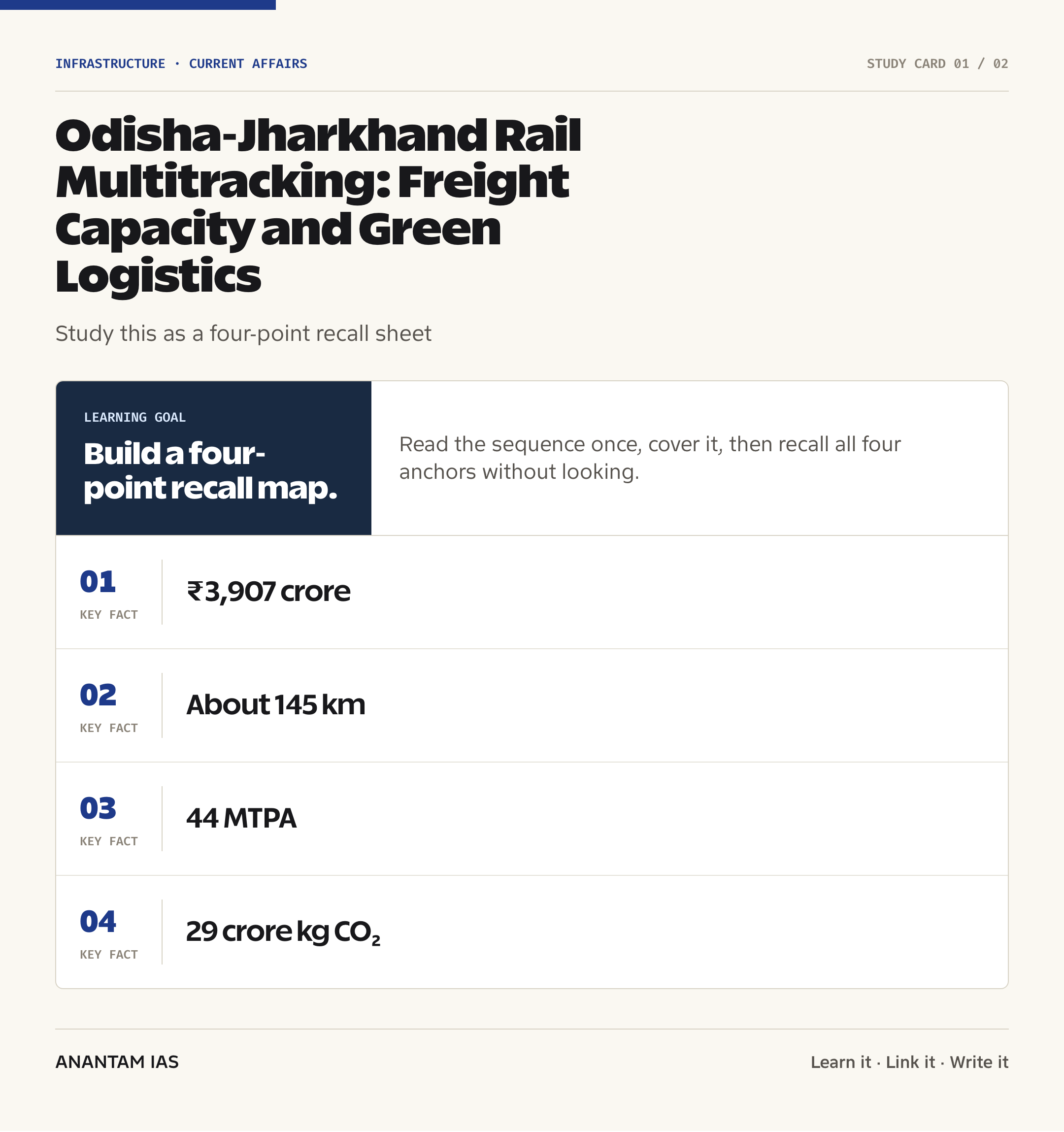
On 15 July 2026, the Cabinet Committee on Economic Affairs approved two Ministry of Railways multitracking projects: doubling of the Paradeep-Haridaspur section and construction of a fourth line between Rajkharsawan and Dangoaposi. The PIB release places both projects within an integrated freight, connectivity and regional-development framework.

The approval carries a combined estimated cost of approximately ₹3,907 crore, is targeted for completion up to 2030-31, and is expected to add about 145 km to the Indian Railways network. These are aggregate package figures: the release does not provide separate project-wise lengths or costs, so no line-wise split should be inferred from the total.

  • The package covers four districts across Odisha and Jharkhand and is expected to improve connectivity for about 1,526 villages with a population of roughly 14 lakh.
  • PIB estimates additional freight traffic of 44 MTPA, where MTPA means million tonnes per annum; this is an expected traffic magnitude from capacity augmentation, not a guaranteed engineering ceiling or actual traffic already carried.
  • The routes carry bulk commodities such as coal and iron ore, along with dolomite, limestone and gypsum, making the approval relevant to mineral supply chains and port-linked logistics.
  • The official appraisal associates the package with a reduction in oil import of 6 crore litres and lower CO₂ emissions of 29 crore kg, equivalent in the release to planting one crore trees.
  • PIB does not specify a time period for the oil and CO₂ totals in this release; they should be read as project-appraisal estimates, not automatically labelled as annual savings.

The development matters in the context of:

  • India’s bulk freight challenge is not only about laying track; it is about removing line-capacity bottlenecks between mines, industrial users, junctions and ports.
  • A congested rail section can push time-sensitive or diverted freight towards roads, so modal balance depends on reliable rail paths, terminals and last-mile links.
  • The approval links PM Gati Shakti integrated planning with logistics efficiency, but realised gains will depend on coordinated execution beyond the track itself.
  • Green logistics requires both lower-emission transport and safeguards against the local ecological and social costs of construction and expanded mineral movement.
Odisha-Jharkhand Rail Multitracking: Freight Capacity and Green Logistics — quick facts

UPSC Relevance

Prelims Relevance

  • The Cabinet Committee on Economic Affairs is a Cabinet committee that considers major economic and infrastructure proposals; the approved projects belong to the Ministry of Railways.
  • The Paradeep-Haridaspur proposal is a doubling project, while Rajkharsawan-Dangoaposi is a fourth-line project.
  • Multitracking means adding one or more parallel tracks to an existing railway corridor to increase train paths and reduce conflicts between movements.
  • MTPA expands to million tonnes per annum and is commonly used to express the scale of bulk commodity traffic or industrial capacity.
  • The two-project package covers Odisha and Jharkhand, about 145 km of network addition and four districts.
  • The official completion horizon is up to 2030-31, while the combined estimated cost is approximately ₹3,907 crore.
  • The release identifies coal, iron ore, dolomite, limestone and gypsum among the commodities moved on these essential routes.
  • The projects were planned under the PM Gati Shakti National Master Plan, which stresses integrated planning, multimodal connectivity and stakeholder consultation.
  • A functional mineral freight corridor is a route serving mineral flows; it should not be confused automatically with a separately notified Dedicated Freight Corridor.

Mains Relevance

GS Paper 3

  • Infrastructure: railway capacity augmentation, congestion removal, operational efficiency, service reliability and multimodal planning under PM Gati Shakti.
  • Indian economy: mineral supply chains, port connectivity, logistics costs, industrial competitiveness and the crowding-in effect of dependable trunk infrastructure.
  • Environment: rail-road modal choice, energy efficiency, oil-import dependence, emissions appraisal and the need to account for construction-stage impacts.

GS Paper 2

  • Cooperative governance: coordination among the Union government, two state governments, Indian Railways, ports, industry and district administrations.
  • Inclusive development: village connectivity, access to services, local employment and fair management of land, forests and community concerns.

Essay

  • Infrastructure is a system, not a collection of isolated assets: track, terminals, ports, roads, power and institutions must work together.
  • The quality of development is measured not only by freight moved, but also by who gains, who bears the cost and what emissions are avoided.
  • A lower-carbon economy needs practical choices in ordinary systems such as freight transport, not climate policy in a separate silo.

Background and Context

The Approval at a Glance

The decision combines two different capacity interventions into one CCEA approval package.

  • Paradeep-Haridaspur doubling adds a second track to the existing section, creating more scope for simultaneous movement and reducing dependence on crossings at selected stations.
  • The Rajkharsawan-Dangoaposi fourth line adds another parallel track to an already multitracked corridor, aimed at easing a heavier concentration of train movements.
  • The two projects together have an estimated cost of about ₹3,907 crore and a completion horizon up to 2030-31.
  • Their combined network addition is about 145 km; PIB does not publish a separate length, cost or freight figure for each project in this release.
  • This aggregate presentation matters for interpretation: ₹3,907 crore cannot be assigned between the two routes, and 44 MTPA cannot be allocated route-wise, without another official project document.
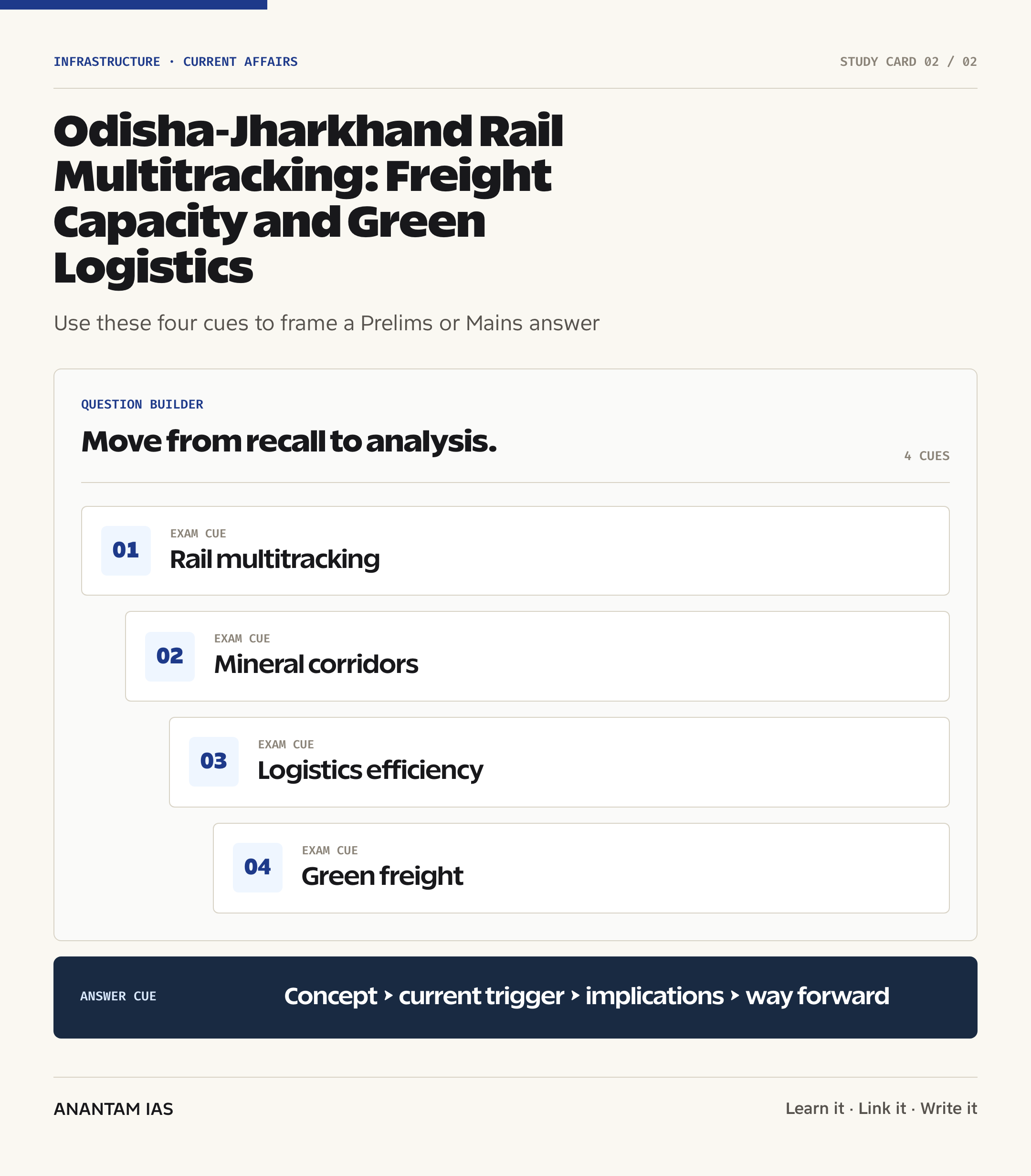
Odisha-Jharkhand Rail Multitracking: Freight Capacity and Green Logistics — exam lens

How Multitracking Expands Railway Capacity

Rail capacity depends on how many safe train paths a section can offer within a timetable, not merely on its map length.

  • On a single line, trains moving in opposite directions may need to wait at crossing stations; a second line can reduce these conflicts and improve average movement.
  • On a busy multitrack corridor, a fourth line can create additional paths, permit better separation of trains with different speeds or stopping patterns, and provide operating flexibility during maintenance.
  • Fewer conflicting movements can improve service reliability, wagon turnaround and the ability to schedule passenger and freight trains without one category repeatedly displacing the other.
  • Track addition alone is not sufficient. Real capacity also depends on signalling, junctions and yards, bridges, traction power, loading terminals, rolling stock and disciplined timetabling.
  • The release’s 44 MTPA figure describes expected additional freight traffic from the capacity works; it is not the physical weight of track, the present traffic level or an automatic outcome on the completion date.

Why These Are Mineral Freight Routes

A mineral freight corridor links extraction and processing regions with industrial consumers, storage points and ports through a high-volume transport chain.

  • PIB identifies coal, iron ore, dolomite, limestone and gypsum as commodities for which these routes are essential.
  • These materials are bulky, heavy and required in large volumes by sectors such as steel, power and cement, so reliable mass transport affects inventory planning and production continuity.
  • The Paradeep side gives the package a clear port-connectivity dimension, while the Odisha-Jharkhand geography connects the approval with an important mineral and industrial region.
  • The phrase mineral freight corridor describes the economic function of the routes. It does not by itself mean that either section is part of a statutory or branded Dedicated Freight Corridor.
  • The release treats the two lines as one package and does not assign individual commodities or tonnage to either one; route-specific claims should await detailed railway project reports.

Rail, Road and the Logistics-Cost Channel

Rail and road perform different parts of a freight chain, so the policy issue is efficient modal allocation rather than a simplistic contest between them.

  • Rail is suited to moving large, regular bulk loads over trunk routes because one train can consolidate many wagon-loads into a single scheduled movement.
  • Road transport retains an advantage in door-to-door flexibility, dispersed origins and destinations, shorter hauls and first- or last-mile collection.
  • A congested rail line raises waiting, uncertainty and wagon-cycle time. Added paths can lower these reliability costs, even when the published approval does not quantify a rupee reduction in national logistics cost.
  • Rail cannot deliver the expected gain if minerals queue at loading points, trains face junction delays or port evacuation is constrained. End-to-end logistics must connect track capacity with terminals and handling systems.
  • PM Gati Shakti is relevant because integrated planning can sequence railway, port, road, industrial and utility works around the same freight geography.
  • A shift from road to rail is possible only when rail service is dependable and commercially workable; the approval itself does not state how much road freight will shift.

Reading the Green-Logistics Claims Carefully

The environmental case rests on rail’s energy-efficient bulk movement and reduced petroleum dependence, but appraisal estimates need precise labels.

  • PIB describes railways as an environment-friendly and energy-efficient transport mode and links the projects with climate goals and lower logistics cost.
  • Its appraisal estimates a reduction in oil import of 6 crore litres and lower CO₂ emissions of 29 crore kg for the project package.
  • The release equates the CO₂ reduction with planting one crore trees. This is a communication equivalence, not a substitute for actual afforestation or an independently verified carbon credit.
  • No time horizon or calculation method is given for the oil and emissions totals in the release. Calling them annual figures would add a claim that the cited source does not make.
  • The mechanism is credible in direction: efficient rail movement and electric traction can reduce direct diesel use relative to moving comparable bulk freight by many road vehicles. The realised benefit depends on traffic actually shifted, train loading, electricity source and operations.
  • A complete environmental assessment must also examine construction emissions, land and forest impacts, noise, dust, water, wildlife movement and the induced effects of expanded mineral extraction.

Regional Development and Connectivity

Freight infrastructure can create wider regional gains when local connectivity and public services improve alongside industrial throughput.

  • The package is expected to enhance connectivity for about 1,526 villages with a combined population of approximately 14 lakh across four districts.
  • PIB also identifies Lalitgiri Buddhist Complex, Shree Baladevjew Temple and Meghahatuburu Hills among tourist destinations likely to gain from improved rail connectivity.
  • Better rail operations can support labour mobility, market access and the movement of inputs and finished goods, but a freight-heavy line does not automatically guarantee suitable passenger frequency or affordable local access.
  • Construction and associated services may create employment and self-employment, while durable gains require local skills, transparent procurement and links with regional enterprises.
  • Benefits should be assessed district-wise because aggregate village and population figures can conceal uneven access, displacement burdens or gaps in last-mile connectivity.

Implementation Risks and Public Accountability

The value of an approval depends on timely delivery, safe operation and transparent measurement after commissioning.

  • The 2030-31 horizon requires coordinated land availability, clearances, utility shifting, bridge and yard work, procurement and construction without prolonged traffic disruption.
  • Because the projects cross two states and four districts, intergovernmental coordination must align railway engineering with district administration, environmental conditions and local infrastructure.
  • Cost monitoring should separate the approved estimate from later expenditure, escalation and scope changes. The phrase approximately ₹3,907 crore is not a final audited outlay.
  • Performance reporting should track section capacity, average detention, freight carried, reliability, safety and passenger effects instead of treating kilometres laid as the only output.
  • Environmental claims should be checked after commissioning against actual traffic and energy data, with the assumptions behind oil and CO₂ estimates disclosed.
  • Consultation should cover affected communities, workers and local bodies so national logistics gains do not externalise social and ecological costs onto the corridor districts.
  • A transparent monitoring dashboard can distinguish inputs, outputs and outcomes: expenditure and land availability are inputs; commissioned track and upgraded yards are outputs; lower detention, reliable train paths and freight actually carried are outcomes. This distinction prevents physical completion from being presented as proof that every economic benefit has already materialised.
  • Independent safety and environmental audits should continue during construction and early operation. A corridor carrying more heavy freight needs attention to level crossings, track maintenance and emergency readiness, while district authorities need usable information on noise, dust, drainage and community complaints. Public disclosure can help correct problems before they become recurring operational or social costs.

Way Forward

Complete the Whole Capacity Chain

  • Synchronise new tracks with signalling, yards, junction remodelling, traction power and terminal capacity so bottlenecks do not simply move to the next node.
  • Coordinate mine sidings, industrial terminals and Paradeep-linked port logistics through PM Gati Shakti planning.
  • Protect passenger paths and maintenance windows through transparent, safety-led timetable design.

Measure Outcomes, Not Only Construction

  • Publish baseline and post-project indicators for train detention, line use, freight volume, wagon turnaround and service reliability.
  • Report the 44 MTPA estimate against actual incremental traffic without presenting projections as delivered outcomes.
  • Disclose project-wise physical progress, expenditure and revised milestones because the approval release supplies only package-level totals.

Make Green Freight Verifiable

  • State the baseline, appraisal period and modal-shift assumptions behind oil and CO₂ estimates in detailed project monitoring.
  • Track traction energy, train loading and displaced road movement after commissioning to test the claimed emissions advantage.
  • Apply mitigation for forests, drainage, dust, noise and wildlife movement, and treat the tree equivalence as an explanatory device rather than compliance.

Share Regional Benefits Fairly

  • Connect corridor investment with last-mile roads, stations and local services for the villages identified in the project area.
  • Use local skilling and procurement where feasible, while enforcing fair compensation, rehabilitation and worker safety.
  • Create accessible district-level grievance and consultation channels throughout construction and early operation.

Conclusion

The Odisha-Jharkhand package shows why rail multitracking is economic infrastructure, not merely an engineering upgrade. By adding paths on mineral and port-linked routes, it can improve freight reliability, support industry and create room for a better rail-road balance.

Its green and developmental case should still be tested through evidence. The decisive questions are whether the projects deliver the expected 44 MTPA, reduce oil use and emissions under disclosed assumptions, protect local communities and ecosystems, and convert national logistics efficiency into broad regional benefit.

UPSC Practice Questions

Prelims MCQ 1

With reference to the CCEA-approved Odisha-Jharkhand rail multitracking package, consider the following statements:

  1. It includes doubling of the Paradeep-Haridaspur section.
  2. It includes a fourth line between Rajkharsawan and Dangoaposi.
  3. The PIB approval release provides separate cost estimates for each project.

How many of the above statements are correct?

(a) Only one (b) Only two (c) All three (d) None

Answer: (b) Only two

Explanation:

Statements 1 and 2 are correct. The release gives a combined approximate cost of ₹3,907 crore and does not break that amount down project-wise.

Prelims MCQ 2

In the official appraisal of the two rail projects, what does 44 MTPA represent?

(a) The combined length of the new tracks (b) The expected additional freight traffic from capacity augmentation (c) The estimated reduction in carbon dioxide emissions (d) The annual petroleum import bill of Indian Railways

Answer: (b) The expected additional freight traffic from capacity augmentation

Explanation:

PIB describes 44 MTPA as the magnitude of additional freight traffic expected from the capacity augmentation works. It is not route length, emissions reduction or an import bill.

UPSC Mains Questions

  1. Railway multitracking can lower logistics friction only when the entire freight chain is upgraded. Discuss with reference to track capacity, terminals, ports, signalling, last-mile links and institutional coordination in mineral-producing regions.
  2. Examine the economic and environmental case for shifting suitable bulk freight from road to rail. What indicators should be used to verify claims concerning freight capacity, oil savings and lower carbon emissions?
  3. Infrastructure-led regional development can produce national gains while concentrating local costs. Suggest a framework for ensuring that mineral freight corridors improve village connectivity, employment and industrial competitiveness without weakening social and ecological safeguards.

Source: PIB, Cabinet Committee on Economic Affairs.

Frequently Asked Questions

What did the CCEA approve?

It approved two Ministry of Railways projects: Paradeep-Haridaspur doubling and a fourth line from Rajkharsawan to Dangoaposi. Together, they are intended to relieve congestion, add train paths and improve freight and passenger movement across parts of Odisha and Jharkhand.

What are the official cost and length?

PIB gives a combined estimated cost of approximately ₹3,907 crore and says the two projects will add about 145 km to the railway network. The release does not provide separate project-wise lengths or costs, so splitting these totals would be unsupported.

What does multitracking mean?

Multitracking means adding parallel tracks to an existing rail corridor. Doubling adds a second line; a fourth-line project adds another line to a corridor that already has multiple tracks. More tracks can reduce train conflicts, create additional paths and improve maintenance flexibility and reliability.

Why are these mineral freight corridors?

The routes serve flows of coal, iron ore, dolomite, limestone and gypsum, connecting mineral and industrial areas with users and port-linked logistics. Here, mineral freight corridor describes an economic function; it does not automatically identify a route as part of a separately notified Dedicated Freight Corridor.

Does 44 MTPA mean guaranteed capacity?

No. PIB calls 44 MTPA the magnitude of additional freight traffic expected from the capacity augmentation works. Actual traffic will depend on commissioning, demand, terminals, rolling stock, train paths and operations. It should not be treated as freight already carried or a guaranteed route-wise result.

How strong is the green claim?

PIB estimates reduced oil import of 6 crore litres and lower CO₂ emissions of 29 crore kg, with a one-crore-tree equivalence. The release does not state the appraisal period or methodology, so verification needs disclosed assumptions and post-commissioning traffic and energy data.


Kewra Fossil in Assam: A 24-Million-Year Record of Tropical Forests

Open article →Download PDF

Why in News?

The kewra fossil in Assam has extended the Indian record of the screw-pine family, Pandanaceae, to about 24 million years ago. Four well-preserved fossil leaves came from the Tikak Parbat Formation of the Makum Coalfield in Assam.

A PIB release dated 15 July 2026 highlighted the study by Harshita Bhatia and Gaurav Srivastava of the Birbal Sahni Institute of Palaeosciences, an autonomous institute of the Department of Science and Technology. Their research was published in the journal Geobios.

  • The researchers recovered four fossil leaves from the Tikak Parbat Formation of the Makum Coalfield, Assam.
  • The late Oligocene leaves were assigned to Pandanites trinervis, a fossil-leaf taxon with diagnostic affinity to Pandanaceae.
  • Key characters included an M-shaped transverse section, parallel veins, transverse veins and well-developed marginal prickles.
  • The study combined morphological and microscopic analysis with comparisons against herbarium material, botanical databases and fossil records.
  • The Assam record helps connect older 85-66 million-year-old records from Europe and North America with younger tropical records in Asia and Australia.

The development matters in the context of:

  • The discovery strengthens the study of India’s palaeobiodiversity and complements the wider story of biodiversity in India.
  • It presents India as a possible climatic refuge where ancient tropical lineages persisted while cooling removed them from higher latitudes.
  • It links plant evolution, continental-scale biogeography and long-term responses to climate change.
  • It shows why fossil-rich sedimentary formations are scientific archives, not merely sources of extractive resources.
Pandanus odorifer fragrant screw-pine with long spiny leaves
Modern Pandanus odorifer, the fragrant screw-pine associated with kewra. Photo: Wibowo Djatmiko (Wie146), CC BY-SA 3.0 (Wikimedia Commons)
Kewra Fossil in Assam: A 24-Million-Year Record of Tropical Forests — quick facts

UPSC Relevance

Prelims Relevance

  • Palaeobotany studies fossil plants and uses them to reconstruct past vegetation, environments, climates and plant evolution.
  • The fossil locality is the Makum Coalfield in Assam; the leaves occur in the Tikak Parbat Formation.
  • The fossils are about 24 million years old and belong to the late Oligocene.
  • The fossil leaves were attributed to Pandanites trinervis, not directly identified as the living species Pandanus odorifer.
  • Pandanaceae, commonly called the screw-pine family, is an early-diverging monocot lineage with a mainly tropical and subtropical distribution today.
  • Diagnostic features include a long linear lamina, parallel secondary veins, transverse veins, an M-shaped cross-section and marginal prickles.
  • Older pandanaceous fossil records from Europe and North America date to roughly 85-66 million years ago.
  • Global cooling after about 34 million years ago coincided with the retreat of these plants from many northern regions toward the tropics.
  • The Birbal Sahni Institute of Palaeosciences is an autonomous institute under the Department of Science and Technology.

Mains Relevance

GS Paper 3

  • Science and technology: fossil identification through comparative morphology, microscopy, herbarium evidence and multidisciplinary palaeoscience.
  • Environment: climate refugia, persistence of tropical lineages and the value of deep-time evidence for anticipating ecosystem responses.

GS Paper 1

  • Physical geography: geological time, the late Oligocene environment and the spatial redistribution of vegetation under long-term climate change.
  • Biogeography: India as a bridge and refuge within the wider palaeotropical distribution of Pandanaceae.

Essay

  • A species lineage may survive not by remaining everywhere, but by finding a climatic refuge.
  • The deep past is a laboratory for understanding the relationship between climate and biodiversity.

Background and Context

What the Researchers Actually Identified

The popular label ‘kewra fossil’ is useful, but the scientific identification needs a precise qualification.

  • The authors assigned the leaves to Pandanites trinervis, a fossil-leaf taxon showing a diagnostic combination of Pandanaceae characters.
  • The fossils closely resemble modern screw-pine leaves, including those associated with kewra, but they were not identified as the exact living species Pandanus odorifer.
  • A form taxon allows palaeobotanists to classify an isolated fossil organ when the complete parent plant is unavailable.
  • The result supports a pandanaceous presence in South Asia during the Paleogene; it does not prove that every modern use or ecological trait existed then.
Kewra Fossil in Assam: A 24-Million-Year Record of Tropical Forests — exam lens

Fossil Locality and Geological Setting

The rock layer and its age give the fossil its evolutionary meaning.

  • All four leaves were recovered from the Tikak Parbat Formation in the Makum Coalfield of Assam.
  • The formation preserves late Oligocene plant remains, placing the new leaves at about 24 million years ago.
  • The late Oligocene belongs to the Paleogene and records a world undergoing major climatic and vegetational reorganisation.
  • A fossil locality is valuable because the specimen, surrounding sediment and associated flora together reveal age, habitat and regional environmental history.

How Leaf Anatomy Established the Family Affinity

Identification rested on a combination of characters rather than one superficial resemblance.

  • The leaves have an elongated, linear or sword-shaped lamina, comparable in general form to modern Pandanaceae leaves.
  • Their transverse profile preserves a distinctive M-shaped section with a central midvein, a strong diagnostic clue.
  • Uniformly developed parallel secondary veins are crossed by finer veins running obliquely or nearly perpendicular to them.
  • Well-developed marginal prickles complete the character set used to distinguish the fossils from superficially similar monocot leaves.
  • Researchers checked these features against herbarium specimens, botanical databases and earlier fossils from other regions.

Pandanaceae, Pandanus and Kewra

The living comparison links a culturally familiar plant with a much older botanical lineage.

  • Pandanaceae is the screw-pine family, an early-diverging lineage of monocot flowering plants.
  • Its best-known genus, Pandanus, is now concentrated in tropical and subtropical regions rather than across the Northern Hemisphere.
  • Modern kewra is associated with the fragrant screw-pine, whose male flowers yield an aromatic essence used in sweets, traditional practices and perfumery.
  • The cultural familiarity of kewra should not obscure the larger scientific result: the fossil records persistence of the family lineage in India.

India as a Tropical Climate Refuge

A refuge is a region where a lineage survives conditions that cause its decline elsewhere.

  • Pandanaceous ancestors had a broader northern distribution, with fossil evidence from Europe and North America dating to about 85-66 million years ago.
  • As global climates cooled after about 34 million years ago, these plants disappeared from many regions and became increasingly confined to warmer zones.
  • The Assam leaves show that South Asia retained the lineage during this contraction, filling a temporal and geographic gap in its fossil record.
  • The finding supports India’s role as a palaeotropical refuge, a concept relevant to current discussions of India’s biodiversity hotspots.

How the Assam Record Bridges the Fossil Gap

A fossil becomes biogeographically important when it links separated records across both time and space.

  • The oldest comparison set cited by the study comes from Europe and North America, where pandanaceous fossils occur in rocks roughly 85-66 million years old.
  • The Makum Coalfield leaves place the family in South Asia during the late Oligocene, long after those older northern occurrences but before many younger tropical records.
  • Younger evidence from tropical Asia and Australia shows the family within regions closer to its present mainly tropical and subtropical range.
  • Taken together, the sequence supports persistence across the palaeotropics while cooling progressively reduced the lineage’s former Northern Hemisphere range.
  • This bridge is temporal because it fills part of a long interval, and geographic because it inserts India between Laurasian and later tropical occurrences.
  • The pattern supports regional survival of the family lineage; it doesn’t demonstrate uninterrupted occupation of one locality or survival of one unchanged species.
  • Such intermediate records help palaeobotanists distinguish between a genuine absence, limited sampling and an incomplete fossil record.

Scientific Significance and Necessary Caution

Deep-time evidence is powerful when its claims are matched to what the fossil preserves.

  • The record bridges older Laurasian occurrences and younger records from tropical Asia and Australia, improving the family’s biogeographic timeline.
  • It demonstrates how plant macrofossils can test ideas about migration, regional survival and vegetation change inferred from living distributions.
  • Past cooling unfolded over geological timescales, so the fossil is an analogue, not a simple forecast of the pace or effects of present warming.
  • Four leaves establish an important occurrence, but broader conclusions need more specimens, precise stratigraphic control and independent palaeoclimate evidence.
  • The study’s strength lies in combining geology, palaeobotany and palaeoclimate rather than treating leaf shape alone as conclusive.

Way Forward

Protect Fossil Context

  • Document fossil-bearing horizons in the Makum Coalfield before specimens are removed, because stratigraphic context carries evidence that a loose fossil cannot preserve.
  • Develop coordinated salvage, cataloguing and repository protocols among geological agencies, BSIP, universities and local authorities.
  • Use high-resolution photography and three-dimensional records to create accessible digital archives without risking fragile originals.

Strengthen Chronology and Palaeoclimate Evidence

  • Pair plant morphology with sedimentology, palynology and geochronology wherever suitable material is available.
  • Record uncertainty clearly so that headline ages, stratigraphic ranges and taxonomic affinities aren’t presented as more exact than the evidence permits.
  • Compare multiple fossil groups from the same formation to reconstruct a fuller late Oligocene ecosystem.

Build Comparative Collections

  • Expand digitised herbarium and fossil databases with standardised images of venation, prickles and transverse anatomy.
  • Support collaboration across South and Southeast Asia, where younger tropical records can test proposed migration and persistence pathways.
  • Train researchers in both botanical taxonomy and Earth science so fossils are interpreted within biological and geological limits.

Connect Deep Time with Conservation

  • Identify modern climate refugia using palaeo-records alongside present species distributions, habitat connectivity and future climate projections.
  • Protect ecological gradients that allow plants to shift ranges, rather than relying only on isolated protected patches.
  • Use fossil evidence to improve public understanding of why preserving evolutionary lineages matters beyond counting present-day species.

Conclusion

The kewra fossil in Assam is important because it places Pandanaceae in the Indian subcontinent about 24 million years ago. Its carefully preserved anatomy turns four leaves into evidence for a wider story of tropical plant persistence.

The strongest lesson is methodological as well as ecological. Fossils, rock context and living comparisons together reveal how lineages responded to past cooling. That deep-time perspective can sharpen conservation planning, provided scientists keep the distinction between a useful analogue and a direct prediction.

UPSC Practice Questions

Prelims MCQ 1

With reference to the kewra fossil discovery in Assam, consider the following statements:

  1. The fossil leaves were recovered from the Tikak Parbat Formation of the Makum Coalfield.
  2. The leaves were assigned to Pandanites trinervis and show affinity with Pandanaceae.
  3. The fossils date to the Late Cretaceous.

How many of the above statements are correct?

(a) Only one (b) Only two (c) All three (d) None

Answer: (b) Only two

Explanation:

Statements 1 and 2 are correct. The Makum Coalfield leaves are about 24 million years old and belong to the late Oligocene, not the Late Cretaceous.

Prelims MCQ 2

Which one of the following combinations most strongly supported the fossil leaves’ affinity with Pandanaceae?

(a) Reticulate venation, smooth margins and a heart-shaped lamina (b) Lobed margins, palmate venation and a hollow petiole (c) M-shaped transverse section, parallel veins and marginal prickles (d) Needle leaves, resin canals and naked seeds

Answer: (c) M-shaped transverse section, parallel veins and marginal prickles

Explanation:

The diagnostic combination included an M-shaped transverse section with midvein, uniformly developed parallel veins, transverse veins and well-developed marginal prickles.

UPSC Mains Questions

  1. The Assam Pandanaceae fossil is evidence not only of plant antiquity but also of India’s role as a climatic refuge. Explain how palaeobotanical records help reconstruct biogeography, vegetation change and the long-term response of tropical lineages to global climate transitions. (250 words)
  2. Fossil interpretation requires both biological comparison and geological context. Using the Makum Coalfield discovery as an example, discuss how morphology, microscopy, stratigraphy, herbarium collections and palaeoclimate evidence combine to produce a defensible account of plant evolution and biogeography in South Asia. (250 words)
  3. Deep-time climate analogues can inform conservation but cannot serve as simple forecasts of present warming. Examine this statement and suggest how palaeoecological evidence can be integrated with modern species data, connectivity planning, protected-area management and regional climate projections. (250 words)

Source: PIB, Ministry of Science and Technology.

Frequently Asked Questions

What was discovered in Assam?

Researchers found four well-preserved fossil leaves in the Tikak Parbat Formation of the Makum Coalfield, Assam. Their venation, transverse anatomy and marginal prickles support assignment to Pandanites trinervis, a fossil-leaf taxon with affinity to the ancient monocot screw-pine family, Pandanaceae.

How old are the fossil leaves?

The leaves are about 24 million years old and come from the late Oligocene Tikak Parbat Formation. The study treats this as a Paleogene record of Pandanaceae in South Asia, filling part of the gap between older northern fossils and younger tropical occurrences.

Is the fossil exactly modern kewra?

No. The fossils resemble leaves of modern kewra-related Pandanus, but scientists assigned them to Pandanites trinervis. The defensible claim is family-level pandanaceous affinity and long persistence in India, not proof that the exact living species Pandanus odorifer grew at the site.

Which features identified the fossil?

The leaves preserve an elongated linear lamina, an M-shaped transverse section with a midvein, uniformly parallel secondary veins, oblique-to-perpendicular transverse veins and well-developed marginal prickles. Researchers compared this combined character set with living herbarium specimens, botanical databases and earlier fossils.

Why is India called a refuge?

Older Pandanaceae relatives once occurred more widely across the Northern Hemisphere. As climates cooled after about 34 million years ago, the lineage vanished from many regions. The Assam record shows its survival in South Asia, supporting the idea that tropical India provided suitable refuge conditions.

Why does the fossil matter today?

It shows how fossil plants can reveal past range shifts, survival zones and responses to climatic change. Such evidence helps scientists frame hypotheses about modern climate refugia and habitat connectivity. It doesn’t directly predict present warming, whose speed and human pressures differ from ancient transitions.

Pakistan-Occupied Kashmir Protests: Economic Grievances and Political Rights

Open article →Download PDF

Why in News?

The Pakistan-occupied Kashmir protests intensified in June-July 2026 as a movement rooted in electricity tariffs, subsidised wheat and inflation broadened into demands concerning political representation, governance and civil liberties.

The immediate escalation followed the ban on the Joint Awami Action Committee, arrests around its planned mobilisation, and a dispute over 12 legislative seats reserved for refugees settled in Pakistan. The Hindu described the unrest as among the largest in the region in recent years; Associated Press reporting documented strikes, road blockades, clashes and competing allegations by protesters and authorities.

  • Akashvani News reported that the mobilisation entered its 36th consecutive day on 15 July 2026, with a large gathering at Rawalakot.
  • The protesters’ 38-point charter combines price relief with changes in representation, public services, taxation, policing and official accountability.
  • A regional court ruling held that the 12 refugee seats could not be abolished without a constitutional amendment, sharpening an already active representation dispute.
  • Associated Press reported a July operation to clear roads blocked for nearly a month; authorities and protest organisers gave conflicting accounts of responsibility for violence.
  • The Ministry of External Affairs linked the unrest to the denial of rights and governance failures in areas under Pakistan’s illegal and forcible occupation.

The development matters in the context of:

  • The issue sits at the intersection of neighbourhood stability, popular legitimacy, resource distribution and India-Pakistan relations.
  • Economic demands can become constitutional claims when people connect prices and services to who controls budgets, elections and public institutions.
  • For India, humanitarian concerns must be analysed alongside its consistent position on the entire territories of Jammu and Kashmir and Ladakh.
Pakistan-Occupied Kashmir Protests: Economic Grievances and Political Rights — quick facts

UPSC Relevance

Prelims Relevance

  • Joint Awami Action Committee: a civil-society coalition associated with traders, lawyers, transporters, students and local groups; it is not an organ of the Government of India.
  • The disputed local legislature has 53 members: 33 territorial seats, 12 seats for refugees settled in Pakistan, and eight other reserved or special-category seats, according to its official assembly website.
  • Do not confuse those 12 refugee seats with the seats kept vacant in India’s Jammu and Kashmir Legislative Assembly for areas under Pakistani occupation.
  • Section 14(4) of the Jammu and Kashmir Reorganisation Act, 2019 provides that 24 seats remain vacant until the area under Pakistan’s occupation ceases to be so occupied and its people elect representatives.
  • Article 1 of the Constitution describes India as a Union of States; the First Schedule specifies the territories of States and Union Territories.
  • The 1994 Parliament Resolution unanimously stated India’s position that the territory under Pakistan’s occupation is part of India and called for its vacation.
  • The Line of Control is a military control line and does not amount to an internationally recognised boundary.
  • ICCPR Article 21 protects peaceful assembly, while Article 25 concerns participation in public affairs and genuine periodic elections.

Mains Relevance

GS Paper 2

  • India-Pakistan relations, territorial claims, the Simla Agreement and India’s constitutional position on Jammu and Kashmir.
  • Representation, accountable institutions, civil liberties and the relationship between economic rights and political legitimacy.
  • International human-rights standards governing peaceful assembly, proportional restrictions and public participation.

GS Paper 3

  • How electricity pricing, food security, inflation, fiscal transfers and weak service delivery can become drivers of regional instability.
  • The neighbourhood-security effects of prolonged blockades, communication restrictions, contested policing and institutional distrust.

Essay

  • The price of bread and electricity can become a test of the legitimacy of the state.
  • Representation without accountability may preserve institutions while weakening consent.
  • Durable peace needs both territorial security and justice in everyday governance.

Background and Context

What triggered the present escalation?

The present crisis is a fresh escalation of an older movement, not a single-issue reaction.

  • The movement’s durable base lies in demands for cheaper electricity, subsidised wheat, lower taxes and relief from inflation and unscheduled power cuts.
  • The immediate political trigger was the regional government’s ban on the JAAC under anti-terror provisions, followed by arrests ahead of a planned June mobilisation.
  • The dispute sharpened after the regional Supreme Court treated the 12 refugee seats as constitutionally protected and said their removal required a constitutional amendment.
  • On 14 July, Associated Press reported that police began clearing blocked entry and exit roads. It also recorded official allegations against armed protesters and complaints by residents about shortages, showing why individual claims need careful attribution.
  • The analytical distinction is vital: verified developments include the ban, court ruling, strike, blockades and confrontations; precise cumulative crowd, arrest, casualty and injury totals remain contested across reports.
Pakistan-Occupied Kashmir Protests: Economic Grievances and Political Rights — exam lens

From household prices to governance claims

Economic grievances acquire political force when people see unequal rules behind high prices and poor services.

  • Residents question why a hydropower-producing region should face high electricity bills, fuel-adjustment charges and unreliable supply.
  • Food-price demands focus on affordable wheat and flour, market oversight and protection from shortages or profiteering.
  • The charter links household stress to the cost of political and bureaucratic privileges, making fiscal fairness a governance question.
  • Demands concerning health, education, roads and employment show that price relief alone can’t substitute for capable public services.
  • This is a classic political-economy chain: concentrated control over resources and budgets can produce weak accountability, unequal distribution and recurring protest.
  • The dispute is now about both immediate relief and transparent governance.

The representation dispute

The seat controversy asks whether a legislature can fairly represent both territorial residents and communities displaced outside the territory.

  • The official local assembly describes a 53-member House with 33 seats from the territory and 12 seats for refugees settled in Pakistan, alongside seats reserved for women and specified groups.
  • Protesters argue that the 12 externally elected seats dilute the political voice of people who live under the administration and receive its services.
  • Supporters of the arrangement present the seats as representation for people displaced from Jammu and Kashmir by the conflict.
  • The court ruling did not settle the political debate; it located the legal route for change in a constitutional amendment rather than an ordinary executive decision.
  • The issue illustrates the difference between descriptive representation, territorial accountability and equal weight in electoral decision-making.

Rights framework for protests and policing

Peaceful protest is a democratic safety valve, while violence by any actor remains subject to law and independent scrutiny.

  • ICCPR Article 21 recognises peaceful assembly; restrictions must be lawful, necessary and proportionate for a listed legitimate purpose.
  • The UN Human Rights Committee’s General Comment No. 37 says authorities should facilitate peaceful assemblies and shouldn’t treat isolated violence as proof that an entire gathering is non-peaceful.
  • Article 25 links participation to the ability to take part in public affairs through freely chosen representatives and genuine periodic elections.
  • Blanket bans, prolonged communication shutdowns and mass arrests can deepen distrust when they lack individualised reasons, time limits and effective review.
  • Independent investigation is essential where accounts conflict about firing, deaths, injuries or armed participation; news footage and partisan claims aren’t substitutes for verified evidence.

India's constitutional and diplomatic position

India treats the territory as part of India under illegal Pakistani occupation, not as a settled part of Pakistan.

  • The Constitution of India, read with the First Schedule and the Jammu and Kashmir Reorganisation Act, provides the domestic constitutional frame for Jammu and Kashmir and Ladakh.
  • The Ministry of External Affairs has reiterated the 1994 Parliament Resolution: the entire Union Territories of Jammu and Kashmir and Ladakh have been, are and shall be an integral part of India.
  • The Jammu and Kashmir Reorganisation Act, 2019 expressly recognises areas under Pakistan’s occupation for representation purposes and keeps 24 Assembly seats vacant.
  • India’s official description is Pakistan-occupied Jammu and Kashmir or areas under Pakistan’s illegal and forcible occupation; terminology should not imply acceptance of Pakistani sovereignty.
  • India has also framed the reported crackdown as an issue of rights denial and administrative oppression, while urging international attention to alleged abuses.
  • For deeper context, read the earlier PoK protests explainer without treating its historical figures as automatically current.

Bilateral and strategic significance

Local unrest matters beyond the immediate protest because Kashmir remains central to India-Pakistan relations.

  • The Simla Agreement provides the durable bilateral frame: differences are to be settled by peaceful means through bilateral negotiations or mutually agreed methods.
  • The Agreement requires respect for the Line of Control without prejudice to either side’s recognised position; the LoC doesn’t convert into a legal international boundary by itself.
  • Prolonged unrest can affect cross-LoC security calculations, military alertness, displacement risks and the wider information environment.
  • China adds a strategic layer because Pakistan illegally ceded territory to China under the 1963 boundary agreement and the China-Pakistan Economic Corridor traverses territory claimed by India.
  • India should distinguish support for rights and accountability from speculation about protesters’ final political preferences; the reported charter contains diverse economic, institutional and autonomy-related demands.
  • A calibrated reading fits the broader India-Pakistan relations framework of territorial integrity, deterrence, diplomacy and people-centred stability.

Way Forward

Immediate de-escalation

  • Protect peaceful assembly, keep hospitals and essential routes open, and create a monitored pause in coercive action by both authorities and organisers.
  • Release verifiable information on arrests, casualties and internet restrictions, with prompt access to lawyers, families and medical care.
  • Commission an independent investigation into each reported death or serious injury instead of relying on collective blame.

Credible political negotiation

  • Publish the status of all 38 demands, the legal basis for accepted items and a time-bound implementation ledger.
  • Address the 12-seat question through open constitutional consultation involving territorial residents, refugee communities, legal experts and civil society.
  • Use neutral facilitation, recorded minutes and enforceable review dates so dialogue produces measurable outcomes.

Economic and institutional reform

  • Disclose electricity generation, procurement, subsidy and tariff calculations so residents can test the claim of unfair resource pricing.
  • Target wheat and energy relief transparently while protecting budgets for health, education, local roads and employment.
  • Strengthen audit, grievance redress, election administration and legislative scrutiny rather than treating subsidies as a substitute for reform.

India's calibrated response

  • Maintain India’s constitutional position, document rights concerns from corroborated sources and avoid amplifying unverified casualty or crowd figures.
  • Keep diplomatic messaging focused on illegal occupation, accountable governance and the protection of civilians.
  • Combine strategic vigilance with factual restraint; neighbourhood instability is best assessed through law, institutions and verified evidence.

Conclusion

The protests show how electricity bills, wheat prices and inflation can become a wider challenge to representation and political legitimacy when people distrust the institutions controlling resources and elections.

For India, the sound framework combines its settled constitutional position on Jammu and Kashmir with attention to human rights, evidence and regional stability. Sound analysis avoids sensationalism and single-slogan reduction.

UPSC Practice Questions

Prelims MCQ 1

With reference to the Jammu and Kashmir Reorganisation Act, 2019, consider the following statements:

  1. It provides for a Legislative Assembly for the Union Territory of Jammu and Kashmir.
  2. It keeps 24 Assembly seats vacant for the area under Pakistan’s occupation until that occupation ceases and representatives are elected.
  3. These 24 seats are identical to the 12 refugee seats disputed in the legislature administered from Muzaffarabad.

How many of the above statements are correct?

(a) Only one (b) Only two (c) All three (d) None

Answer: (b) Only two

Explanation:

Statements 1 and 2 are correct under Section 14. Statement 3 is incorrect: the 24 vacant seats in Indian law and the 12 refugee seats in the Pakistan-administered legislature arise from different legal and political arrangements.

Prelims MCQ 2

Which provision of the International Covenant on Civil and Political Rights specifically recognises the right of peaceful assembly?

(a) Article 19 (b) Article 21 (c) Article 25 (d) Article 27

Answer: (b) Article 21

Explanation:

Article 21 recognises peaceful assembly. Article 19 protects expression, while Article 25 addresses participation in public affairs, voting and access to public service.

UPSC Mains Questions

  1. Economic grievances often become political-rights movements when public institutions lack legitimacy. Examine this proposition with reference to the 2026 protests in Pakistan-occupied Jammu and Kashmir, focusing on electricity pricing, public services, representation and accountability. (250 words)
  2. Explain India’s constitutional and diplomatic position on Pakistan-occupied Jammu and Kashmir. How should India balance territorial integrity, human-rights concerns, factual restraint and neighbourhood stability in responding to the current unrest? (250 words)
  3. The design of representative institutions can either reduce or deepen conflict in contested regions. Discuss with reference to territorial representation, displaced communities, electoral equality and the dispute over refugee seats in Pakistan-occupied Jammu and Kashmir. (250 words)

Sources: Akashvani News, Ministry of External Affairs and The Hindu.

Frequently Asked Questions

What triggered the 2026 PoK protests?

The deeper grievances concern electricity prices, wheat, inflation, taxes and services. The present escalation followed the ban on the Joint Awami Action Committee, arrests ahead of its mobilisation, and a regional court ruling that 12 refugee seats were constitutionally protected and could be removed only through amendment.

What is the Joint Awami Action Committee?

The Joint Awami Action Committee is a civil-society coalition associated with traders, transporters, lawyers, students and local groups. It has coordinated demands on electricity, wheat, privileges, services and representation. Regional authorities banned it in June 2026, while its supporters continued strikes, sit-ins and blockades.

Why are 12 refugee seats disputed?

The seats represent Jammu and Kashmir refugees settled in Pakistan. Protesters argue that externally elected members dilute the voice of territorial residents; supporters cite representation of displaced communities. The regional court said abolition would require a constitutional amendment, turning an electoral disagreement into a constitutional reform question.

What is India’s position on PoJK?

India maintains that the entire Union Territories of Jammu and Kashmir and Ladakh are integral parts of India and that Pakistan is in illegal and forcible occupation of Indian territory. This position is reflected in the 1994 Parliament Resolution and the Jammu and Kashmir Reorganisation Act, 2019.

Which rights apply to peaceful protests?

ICCPR Article 21 protects peaceful assembly, subject only to lawful, necessary and proportionate restrictions. Article 19 protects expression, and Article 25 concerns participation in public affairs. Authorities must distinguish peaceful participants from individual offenders, while organisers should prevent violence and protect essential access.

Why do these protests matter for India?

They affect a territory claimed by India, expose governance and rights issues under Pakistan’s occupation, and may influence India-Pakistan security calculations. They also test India’s ability to combine a firm constitutional position with corroborated human-rights advocacy, diplomatic restraint and careful monitoring of neighbourhood instability.

Delhi Right to Services Bill: Accountability for Delayed Public Services

Open article →Download PDF

Why in News?

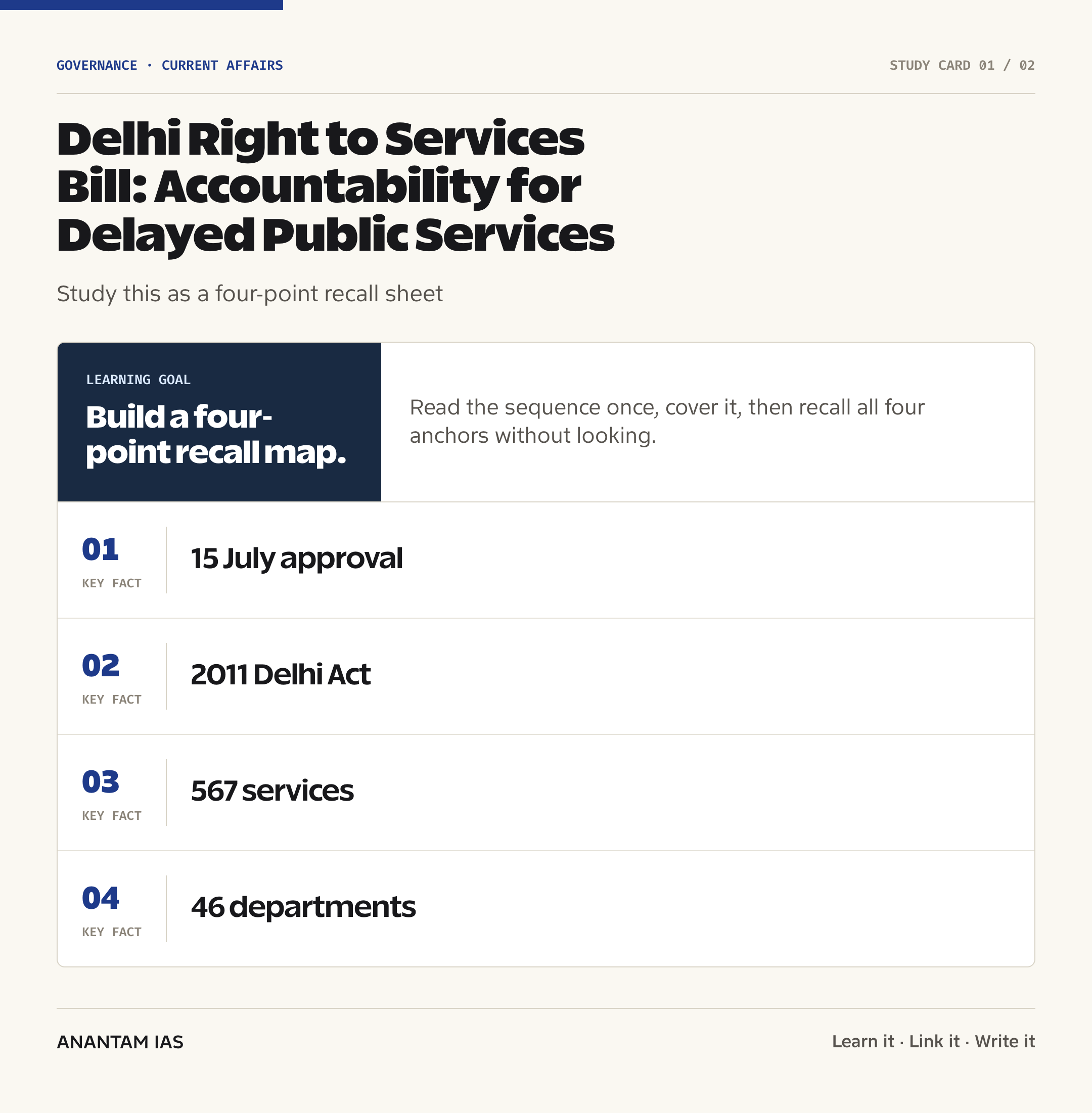
The Delhi Cabinet approved the proposed Delhi (Right of Citizen to Time Bound and Ease of Delivery of Services) Bill, 2026 on 15 July 2026. The Hindu reported that the proposal seeks to make officials personally accountable for unjustified delay in notified public services.

This is a Cabinet-approved Bill, not an enacted law. Cabinet approval authorises the government to take a legislative proposal forward, but the proposed duties, penalties and remedies can’t operate merely because the Cabinet cleared the draft. The applicable legislative and assent process must first be completed.

  • The reported design links time-bound service delivery with responsibility for delay instead of treating every missed deadline as an anonymous departmental failure.
  • The proposal reportedly covers notified public services, meaning the final legal obligation would depend on the services, time limits and authorities formally specified under the enacted framework.
  • The Hindu reported a proposed financial penalty on the responsible official for unjustified delay, but the exact liability must be read from the Bill when its authoritative text becomes public and from the law if enacted.
  • Delhi already has the Delhi (Right of Citizen to Time Bound Delivery of Services) Act, 2011. The 2026 proposal should be studied as a reported effort to replace or update that framework, not as Delhi’s first move toward time-bound services.
  • The debate joins four governance ideas: citizen rights, administrative capacity, individual accountability and procedural fairness. A sound law has to make these ideas work together.

The development matters in the context of:

  • For GS Paper 2, the proposal connects transparency, accountability, e-governance, citizen charters and institutional mechanisms for grievance redress.
  • For administrative reform, the hard question is whether delay arose from individual neglect or from missing staff, inter-departmental dependence, poor records or a defective digital workflow.
  • For citizens, a service guarantee matters when the system identifies the responsible authority and offers a usable remedy after default.
Delhi Right to Services Bill: Accountability for Delayed Public Services — quick facts

UPSC Relevance

Prelims Relevance

  • A Bill is a legislative proposal; it becomes an Act only after passage and the constitutionally required assent and notification steps.
  • The Delhi Act of 2011 is an existing enacted framework for time-bound delivery of notified citizen services in the National Capital Territory.
  • Delhi’s official e-SLA monitoring system tracks applications, processing stages, responsible officers and compliance with prescribed service timelines.
  • A Citizen’s Charter publicly states service standards and grievance channels, but a charter by itself doesn’t automatically create a statutory penalty or an enforceable legal remedy.
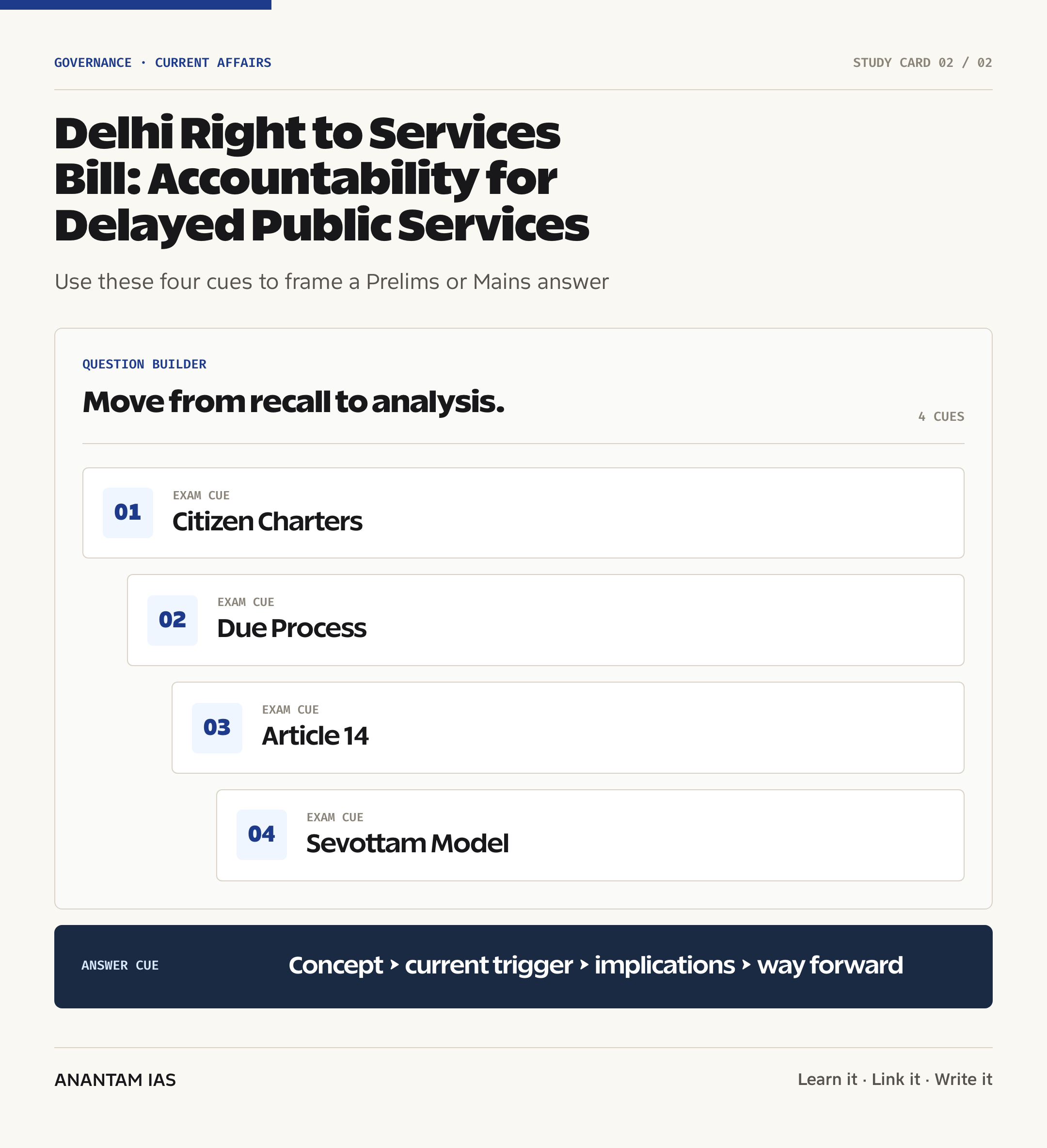
  • The Sevottam framework of the Department of Administrative Reforms and Public Grievances combines Citizen’s Charter implementation, public grievance redress and service-delivery capability.
  • Article 14 guards against arbitrary state action. It supports fair, non-discriminatory administration, but it shouldn’t be read as a standalone guarantee that every public service must be delivered within one uniform deadline.
  • The Right to Information Act, 2005 gives access to information within its statutory framework; it isn’t a substitute for completing the underlying certificate, licence, benefit or approval.
  • The rule of audi alteram partem, or hear the other side, requires a fair opportunity to answer an allegation before an adverse penalty is imposed.

Mains Relevance

GS Paper 2

  • Government policies and interventions: converting service standards into enforceable obligations while retaining room for genuine exceptions.
  • Transparency and accountability: using named responsibility, digital audit trails, escalation and reasoned decisions to reduce administrative delay.
  • Citizen charters and e-governance: moving from promises on a website to measurable delivery, accessible appeals and public performance data.

GS Paper 4

  • Probity in governance: fixing responsibility without using penalties as a substitute for leadership, staffing and process reform.
  • Civil-service values: balancing responsiveness to citizens with fairness, reasoned discretion and protection against arbitrary punishment.

Essay

  • Accountability without capacity can produce fear and defensive administration; capacity without accountability can normalise delay.
  • A citizen-centric state is judged not only by the policies it announces but by whether an ordinary applicant receives a predictable, reasoned and timely decision.

Background and Context

What the Cabinet decision does and does not do

The first exam-safe distinction is between a political-executive approval and a binding statute.

  • The Delhi Cabinet has approved a proposal, according to The Hindu. This settles the government’s intention to pursue the measure, not the final wording that the legislature may consider.
  • A Cabinet note or approved draft doesn’t itself impose a recoverable fine, create an appeal or amend the 2011 Act. Those effects require valid legislation and commencement.
  • The proposal must pass through the applicable Delhi Legislative Assembly process and the constitutional route governing Bills of the National Capital Territory.
  • If the introduced text, amendments and enacted text differ, the enacted text controls. News reports help explain the trigger, but they can’t substitute for the Gazette.
  • The safest current formulation is that the Bill seeks to strengthen personal accountability for unjustified delay. Any clause-level claim remains provisional until an authoritative Bill is available.
Delhi Right to Services Bill: Accountability for Delayed Public Services — exam lens

Delhi's existing 2011 right-to-service framework

Delhi already operates a statutory and digital architecture for time-bound citizen services.

  • The Delhi (Right of Citizen to Time Bound Delivery of Services) Act, 2011 was brought into force from 15 September 2011 through official notification.
  • Its operating design depends on notified services, prescribed time limits, competent officers and appellate authorities. This makes the Schedule and later notifications as important as the parent Act for day-to-day delivery.
  • The official e-SLA Delhi platform monitors applications at different processing stages and allows a citizen to view status, the responsible officer and whether the service-level timeline has been invoked.
  • The official e-SLA dashboard states that 567 services across 46 departments are integrated. It also reports more than 36 lakh applications in the monitored system.
  • These figures show that Delhi’s challenge isn’t simply absence of a framework. The policy question is whether enforcement, coverage, data quality and responsibility are strong enough to change the citizen’s experience.
  • If the 2026 Bill replaces the 2011 Act, transition provisions will matter for pending applications, existing notifications, designated officers and appeals. No transition detail should be assumed before the text is published.

Citizen's Charter and statutory right to service

A charter tells citizens what an office promises; a right-to-service law adds legal machinery behind that promise.

  • A Citizen’s Charter normally identifies services, eligibility, documents, expected timelines, contact points and the route for complaints.
  • A charter improves transparency and predictability, but its standards may remain administrative commitments unless a statute, rule or binding order supplies enforceability.
  • A right-to-service statute can designate accountable officers, create appeals, authorise compensation or penalties and require reasons for delay or rejection.
  • This distinction often trips aspirants: a charter and a law can use the same service timeline, but only the legal source decides whether breach produces a statutory remedy.
  • The strongest design connects the two. The charter explains the service, while the statute and rules make responsibility, escalation and review operational.

Sevottam as the durable reform framework

Sevottam treats service quality as a system, not as a penalty imposed after the system has already failed.

  • The Department of Administrative Reforms and Public Grievances developed Sevottam as a framework for excellence in public-service delivery.
  • Its first component is Citizen’s Charter implementation: identify the client group, specify services and standards, communicate them and review performance.
  • Its second component is public grievance redress: give citizens an accessible channel, acknowledge complaints, set disposal norms and analyse recurring causes.
  • Its third component is service-delivery capability: align staff, infrastructure, processes, records and training with the promised standard.
  • The framework explains why a fine alone can’t repair a broken workflow. If five offices must act in sequence, the system needs process ownership and traceable hand-offs, not a convenient last officer to blame.
  • The Second Administrative Reforms Commission, in its citizen-centric administration work, also stressed measurable standards, grievance mechanisms and periodic review as parts of responsive governance.

Personal accountability and natural justice

Personal liability can sharpen responsibility, but fairness depends on proving who controlled the delay and why it occurred.

  • A workable scheme must distinguish unjustified inaction from delay caused by missing documents, court orders, technical failure, disaster, another department or a legally required verification.
  • The decision-maker should rely on a digital audit trail showing receipt, transfer, query, response and disposal. Without this trail, personal liability can rest on guesswork.
  • Before imposing an adverse consequence, the official needs notice and an opportunity to respond. This is the practical meaning of audi alteram partem.
  • A penalty order should record reasons, evidence and the basis for attribution. A review or appeal guards against factual error and inconsistent treatment.
  • Accountability should follow actual control. A frontline officer shouldn’t bear the entire burden for a policy-level vacancy, server outage or upstream approval beyond that officer’s authority.

Delhi's special constitutional and administrative setting

Delhi’s service-delivery law operates within a Union Territory structure that differs from an ordinary State.

  • Article 239AA creates a Legislative Assembly and Council of Ministers for the National Capital Territory while excluding public order, police and land from the Assembly’s ordinary legislative domain.
  • The Government of National Capital Territory of Delhi Act, 1991 and later parliamentary amendments shape the institutional route through which Delhi’s elected government, Lieutenant Governor and administration function.
  • This constitutional setting doesn’t erase citizen-service duties, but it can complicate ownership and coordination where a service crosses Delhi departments, local bodies or Union-controlled institutions.
  • A good notification must identify the correct service provider and accountable authority. Citizens shouldn’t have to decode institutional boundaries before seeking a certificate, benefit or permission.

Likely gains and design risks

The proposal can improve responsiveness only if the incentives reward correct and timely decisions, not hurried disposal.

  • Clear deadlines and named officers can reduce administrative opacity, repeated visits, rent-seeking opportunities and the citizen’s dependence on informal follow-up.
  • Automatic escalation and application tracking can reveal bottleneck stages, helping managers fix recurring process failures instead of handling each complaint as an isolated event.
  • But a narrow disposal target can produce premature rejection, superficial scrutiny or requests for unnecessary documents simply to stop the clock.
  • Officials may adopt defensive administration if penalties are unpredictable, evidence is weak or exceptions aren’t defined with care. That can slow complex cases rather than speed them up.
  • The best metric isn’t files closed. It is correct service delivered within time, with low reversal rates, clear reasons and an effective remedy when the state defaults.

Way Forward

Publish the legal design clearly

  • Place the authoritative Bill, statement of objects and rules in the public domain and explain how the proposal relates to the 2011 Act.
  • Notify each service, timeline, required documents, responsible officer and appellate route in language citizens can understand.

Build evidence-based accountability

  • Create a tamper-evident application audit trail with timestamps for every transfer, query, response and decision.
  • Attribute delay to the officer or unit that had legal control of the next action, while recording justified exclusions and inter-departmental dependencies.

Protect fairness and service quality

  • Require notice, hearing, reasoned orders and review before personal financial liability is final.
  • Track rejections, appeals, reversals and citizen satisfaction alongside timeliness so speed doesn’t reward poor decisions.

Fix the system behind repeated delays

  • Use Sevottam-style process reviews to address vacancies, unclear forms, duplicate verification, weak interoperability and inaccessible grievance channels.
  • Publish periodic department-wise performance data and corrective action while protecting personal data and preventing public naming before liability is determined.

Conclusion

The Delhi proposal puts a useful governance question back at the centre: when a citizen meets every requirement, who answers for an avoidable administrative delay? A legal deadline can make that responsibility visible, but Cabinet approval alone hasn’t created the new right or penalty.

The durable answer combines Citizen’s Charters, Sevottam, digital audit trails, natural justice and administrative capacity. Personal accountability should close the last mile of service delivery, while process reform prevents the same delay from recurring.

UPSC Practice Questions

Prelims MCQ 1

With reference to the Delhi right-to-services framework, consider the following statements:

  1. Approval of a Bill by the Cabinet makes its proposed penalties immediately enforceable.
  2. Delhi already has the Delhi (Right of Citizen to Time Bound Delivery of Services) Act, 2011.
  3. A Citizen’s Charter, by itself, always creates a statutory right to compensation for delay.

How many of the above statements are correct?

(a) Only one (b) Only two (c) All three (d) None

Answer: (a) Only one

Explanation:

Only Statement 2 is correct. Cabinet approval doesn’t enact a Bill, and a Citizen’s Charter doesn’t automatically create a statutory penalty or compensation remedy.

Prelims MCQ 2

Which one of the following best describes the three core components of the Sevottam framework?

(a) Legislative drafting, judicial review and social audit (b) Citizen’s Charter implementation, grievance redress and service-delivery capability (c) Fiscal devolution, district planning and outcome budgeting (d) Information disclosure, vigilance inquiry and departmental prosecution

Answer: (b) Citizen's Charter implementation, grievance redress and service-delivery capability

Explanation:

Sevottam, developed by DARPG, integrates published service standards, effective grievance handling and the organisational capacity needed to meet those standards.

UPSC Mains Questions

  1. A statutory deadline can strengthen citizen rights, but penalties alone may encourage defensive administration. In the context of the proposed Delhi right-to-services Bill, critically examine how personal accountability can be combined with natural justice, process reform and adequate administrative capacity. (15 marks, 250 words)
  2. Distinguish a Citizen’s Charter from an enforceable right-to-service law. Discuss how the Sevottam framework, digital audit trails, reasoned decisions and accessible appeals can convert public-service promises into measurable and equitable outcomes. (15 marks, 250 words)

Sources: Government of NCT of Delhi, Department of Information Technology and The Hindu.

Frequently Asked Questions

Is the 2026 Delhi proposal already a law?

No. The Delhi Cabinet approved a Bill proposal on 15 July 2026, as The Hindu reported. It must complete the applicable legislative and assent process before becoming law. Until then, no new penalty or remedy can be treated as enforceable solely on the strength of Cabinet approval.

What does personal accountability mean here?

It means identifying the official who controlled the delayed action and attaching a consequence to unjustified default. Fair attribution requires timestamps, defined duties, notice, a chance to explain and a reasoned order. It shouldn’t make one officer liable for a server failure, vacancy or approval controlled elsewhere.

How is a citizen charter different?

A Citizen’s Charter publishes services, standards, timelines and grievance contacts. It improves transparency, but it may remain an administrative promise. A right-to-service statute can add designated officers, appeals, compensation or penalties, making compliance legally reviewable within the limits set by the enacted law.

What is the Sevottam framework?

Sevottam is DARPG’s public-service excellence framework. It combines Citizen’s Charter implementation, grievance redress and service-delivery capability. The third part matters because offices need trained staff, workable processes, records and infrastructure to meet the standards they publish. Penalties can’t substitute for those foundations.

Why does due process matter?

A personal penalty is an adverse administrative consequence. Natural justice requires notice, access to the basis of the allegation, an opportunity to explain and a reasoned decision by a competent authority. Review or appeal also helps correct mistaken attribution and keeps similar cases from receiving inconsistent treatment.

What should UPSC aspirants remember?

Remember three distinctions: Cabinet approval isn’t enactment; a Citizen’s Charter isn’t automatically a statutory remedy; and individual accountability works only with institutional capacity. Link the topic to GS2 themes of transparency, accountability, e-governance, citizen charters, grievance redress and Delhi’s Article 239AA framework.

AI Sexual Deepfakes: Platform Accountability and Consent in the Generative-AI Era

Open article →Download PDF

Why in News?

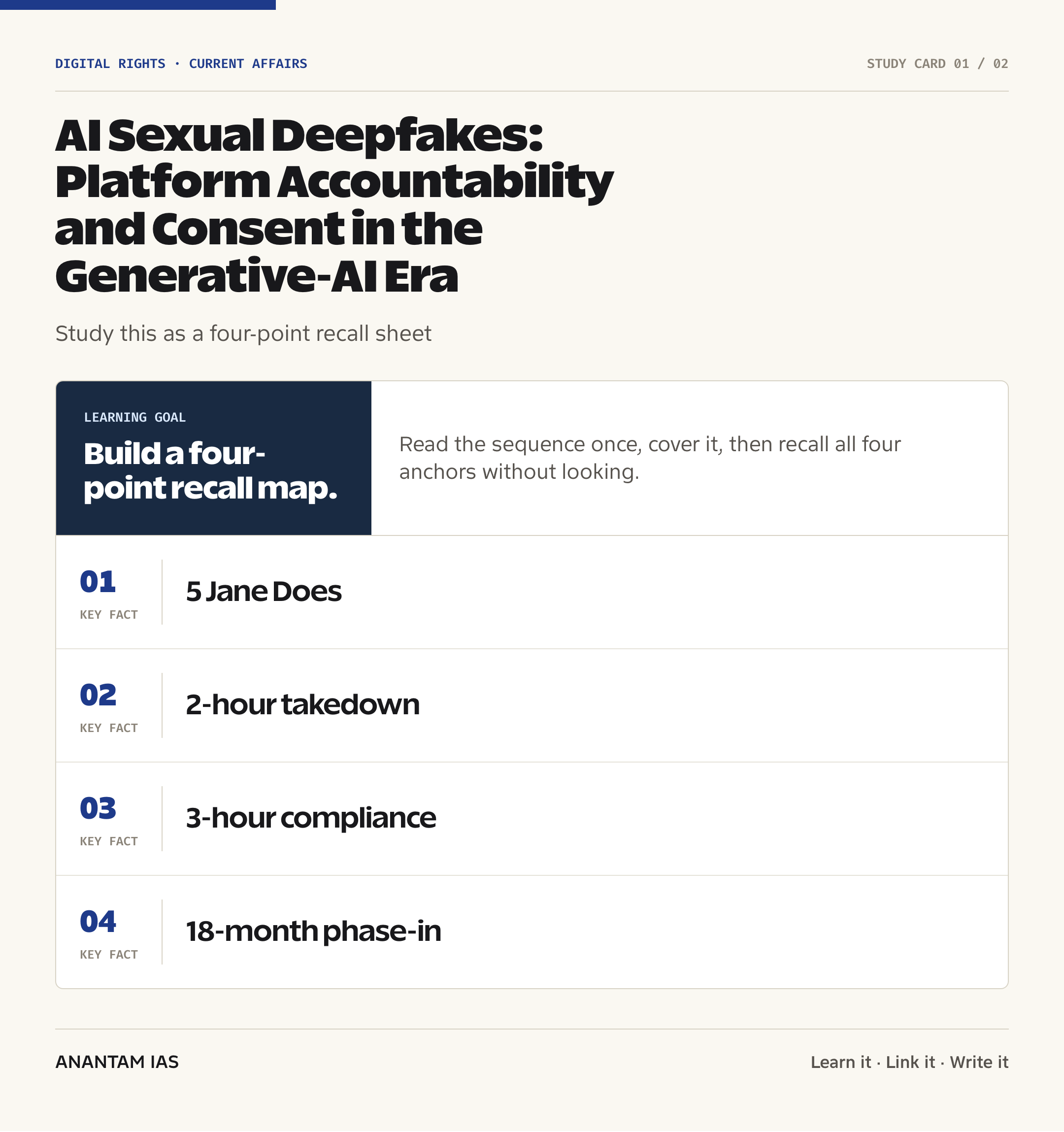
The Hindu and NPR reported that an amended proposed class action in the United States now has five pseudonymous plaintiffs, all identified as Jane Does, alleging that generative-AI tools were used to create sexually explicit synthetic images from photographs taken when they were minors. The amended complaint names xAI and Stability AI as defendants.

The case is pending, and its allegations are not judicial findings. It still raises a durable governance question: when a service can both generate and disseminate abusive synthetic content, should responsibility stop with the user, or also extend to model safeguards, platform design, reporting, evidence preservation and rapid victim redress?

  • The amended complaint was filed in the Northern District of California and added two plaintiffs to the three teenagers who had sued earlier.
  • The plaintiffs allege that ordinary family or school photographs were converted into child sexual abuse material through AI systems without their knowledge or consent.
  • One new plaintiff alleges that a photograph taken when she was about 11 years old was used to produce roughly 7,000 abusive images and videos; this number is an allegation in the complaint, not a court-verified finding.
  • The suit seeks monetary relief and stronger technical guardrails; it also alleges negligence, defective design and failures connected with reporting suspected abuse.
  • The Indian relevance lies in the distinction between a passive host and a platform whose own generative model, editing interface or publishing workflow materially helps create the disputed output.

The development matters in the context of:

  • Sexual deepfakes turn identity and bodily privacy into editable inputs even when no genuine intimate photograph ever existed.
  • The harm is persistent: deletion from one service does not remove downloaded copies, mirrors, private groups or model-derived variants.
  • Women and children face disproportionate targeting, linking the issue to gender justice, child protection and equal participation in digital public spaces.
  • India’s response now combines the IT Act, 2000, the amended IT Rules, 2021, sectoral criminal laws, constitutional privacy and the phased DPDP Act, 2023.
AI Sexual Deepfakes: Platform Accountability and Consent in the Generative-AI Era — quick facts

UPSC Relevance

Prelims Relevance

  • A deepfake is synthetic or altered audio-visual content that realistically depicts a person saying or doing something that did not occur.
  • The 2026 IT Rules use the wider term synthetically generated information, or SGI, for realistic algorithmically created or altered audio, visual or audio-visual information.
  • Routine good-faith editing, compression, accessibility work and translation that do not materially misrepresent content are excluded from the SGI definition.
  • Rule 3(3) requires covered intermediaries to deploy reasonable technical measures against unlawful SGI, including non-consensual intimate imagery and content invasive of bodily privacy.
  • Under Rule 3(2)(b), a complaint about nudity, a sexual act, impersonation or an artificially morphed image must trigger reasonable and practicable removal measures within two hours.
  • Section 79 of the IT Act offers conditional safe harbour for third-party information; due diligence and the intermediary’s role in initiating, selecting or modifying information matter.
  • Section 66E penalises intentional or knowing capture, publication or transmission of an image of a person’s private area without consent in privacy-violating circumstances.
  • The substantive consent, lawful-processing and data-principal provisions of the DPDP Act follow an 18-month commencement schedule from 13 November 2025 and were not yet operative on 16 July 2026.

Mains Relevance

GS Paper 2

  • Governance: conditional safe harbour, statutory due diligence, transparent grievance systems and accountability for cross-border digital services.
  • Social justice: gendered technology-facilitated abuse, child protection, dignity, accessible remedies and the chilling effect on women’s online participation.

GS Paper 3

  • Science and technology: generative-model risk, provenance, watermarking, content credentials, age-sensitive safeguards and safety testing before deployment.
  • Cyber security: rapid spread, evidence preservation, attribution, coordinated incident response and the limits of detection-only approaches.

Essay

  • Innovation without consent can convert human identity into an extractive digital resource.
  • The freedom to create synthetic media must be reconciled with dignity, autonomy and equal citizenship.
  • Trust in AI depends less on model novelty than on who bears the cost when predictable safeguards fail.

Background and Context

What Makes Sexual Deepfakes a Distinct Harm

A sexual deepfake is not harmless fiction merely because the depicted event never occurred.

  • It uses an identifiable person’s face, voice or likeness to fabricate nudity or sexual conduct, creating a false association that audiences may treat as authentic.
  • Consent to take or share an ordinary photograph is not consent to sexual alteration, model training, publication or onward circulation.
  • The injury combines privacy loss, reputational damage, sexual humiliation, harassment and loss of control over one’s social identity.
  • Labelling can help users identify lawful synthetic media, but a label cannot legitimise non-consensual intimate imagery that should not have been generated at all.
AI Sexual Deepfakes: Platform Accountability and Consent in the Generative-AI Era — exam lens

Constitutional Foundation: Privacy, Dignity and Autonomy

India’s constitutional framework treats privacy as part of liberty and human dignity, not simply secrecy.

  • In Justice K.S. Puttaswamy (Retd.) v. Union of India (2017), a nine-judge Supreme Court bench recognised privacy as a fundamental right protected by Article 21 and other freedoms in Part III.
  • The judgment connects privacy with bodily integrity, decisional autonomy, control over personal information and the freedom to shape one’s identity.
  • Article 19(1)(a) protects expression, but Article 19(2) permits lawful restrictions linked to decency, morality and defamation; creativity is not a blanket licence for sexual impersonation.
  • Fundamental rights primarily discipline the State, yet they guide legislation, proportionality review and judicial development of remedies involving private digital power.

The IT Act: Offences, Safe Harbour and Gaps

The Information Technology Act offers several routes, but no single legacy provision was designed around modern generative models.

  • Section 66E addresses non-consensual images of a private area; applying its capture-based wording to a wholly synthetic body may require careful factual and judicial interpretation.
  • Sections 67 and 67A address obscene and sexually explicit electronic material, while Section 67B directly addresses sexually explicit material involving children, including digital creation and related conduct.
  • Section 79 makes safe harbour conditional on a limited intermediary role, statutory due diligence and timely action after legally recognised knowledge of unlawful material.
  • When the service’s own model creates, modifies or publicly posts the output, the claim that it merely hosted third-party information becomes a fact-sensitive legal question.

India's 2026 SGI Due-Diligence Framework

The February 2026 amendments to the IT Rules move platform duties upstream from takedown alone to prevention, provenance and verification.

  • Rule 3(3) covers intermediaries enabling the creation, alteration, publication or dissemination of SGI and requires reasonable technical measures to stop unlawful categories.
  • The prohibited list expressly includes child sexual exploitative and abuse material, non-consensual intimate imagery, sexually explicit content and material invasive of bodily privacy.
  • Permissible SGI must carry a prominent, continuing label and, where technically feasible, permanent metadata or provenance with a unique identifier; platforms must not enable its removal.
  • A significant social media intermediary must seek an uploader’s SGI declaration, technically verify it before publication and label confirmed SGI; knowingly permitting or ignoring unlawful SGI can amount to failed due diligence.

Consent and the Phased DPDP Framework

Data protection adds a consent-and-purpose lens, but it should not be overstated as an immediate or complete deepfake remedy.

  • An identifiable face photograph and a synthetic image linked to a person can constitute digital personal data because they concern an identifiable individual.
  • The DPDP Act, 2023 is built around lawful processing, notice, purpose and consent that is free, specific, informed, unconditional and unambiguous, subject to statutory legitimate uses.
  • The Gazette notification of 13 November 2025 phased commencement: institutional provisions began first, while the core processing, consent, fiduciary-duty and data-principal provisions were scheduled after 18 months.
  • The Act excludes personal data made publicly available by the Data Principal from its application, and erasure cannot retrieve every downloaded copy; a dedicated NCII remedy remains important.

A Layered Test for Platform Accountability

Responsibility should track control, knowledge, foreseeability and the platform’s contribution to the harmful output.

  • At the model layer, examine training-data governance, red-team testing, prompt and image filters, child-safety controls and resistance to repeated bypass attempts.
  • At the product layer, examine whether features reward virality, offer sexualised modes, enable one-click editing of real people or publish generated outputs by default.
  • At the hosting layer, assess complaint access, the two-hour victim route, hashing and re-upload controls, preservation of evidence and cooperation with lawful investigations.
  • At the remedy layer, require accessible appeals, confidentiality, trauma-informed handling and protection against retaliatory doxxing or regeneration of more abusive images.

Way Forward

Build Consent and Safety into Generation

  • Block sexual alteration of an identifiable person unless a trustworthy, revocable consent signal is verified; never permit such generation involving a child.
  • Use adversarial testing, rate limits and repeat-offender controls, with heightened review for tools that accept face photographs as inputs.
  • Measure safety by prevented harms and complaint outcomes, not only by aggregate model accuracy.

Create a Victim-Centred Response

  • Offer a simple, multilingual and confidential two-hour complaint channel that accepts reports from victims or authorised representatives.
  • Remove matched copies and foreseeable re-uploads while preserving a secure evidentiary record for lawful investigation.
  • Provide status updates, escalation to the Grievance Appellate Committee and links to cybercrime and child-protection authorities.

Make Provenance Interoperable

  • Adopt durable content credentials, cryptographic provenance and identifiers that survive ordinary compression and cross-platform sharing.
  • Treat detection scores as probabilistic signals, not conclusive proof; human review and contestable decisions remain necessary.
  • Publish audited transparency data on generation blocks, victim complaints, response times and repeat uploads without exposing victims.

Close Legal and Institutional Gaps

  • Clarify a technology-neutral offence and civil remedy for creating or sharing non-consensual intimate imagery, including synthetic material.
  • Separate liability for the perpetrator from duties of the model provider and host, with proportionate standards based on control and foreseeable risk.
  • Strengthen cross-border cooperation, police capacity, forensic preservation and privacy-protective court procedures for pseudonymous victims.

Conclusion

AI sexual deepfakes show why consent must govern uses of identity, not just collection of a photograph. The deepest harm is the forced attachment of fabricated sexual conduct to a real person’s body, name and social life.

India’s 2026 SGI rules create a stronger operational baseline through prevention, rapid removal, labels and platform verification. Effective accountability still needs precise offences, fair safe-harbour boundaries, evidence-preserving enforcement and remedies designed around dignity rather than mere content deletion.

UPSC Practice Questions

Prelims MCQ 1

With reference to India’s framework for synthetically generated information, consider the following statements:

  1. The amended IT Rules define SGI with reference to realistic audio, visual or audio-visual information created or altered using a computer resource.
  2. A complaint concerning nudity, sexual conduct, impersonation or an artificially morphed image must be acted upon within two hours under Rule 3(2)(b).
  3. Every form of synthetically generated information is prohibited from publication in India.

How many of the above statements are correct?

(a) Only one (b) Only two (c) All three (d) None

Answer: (b) Only two

Explanation:

Statements 1 and 2 are correct. Permissible SGI is not banned; it is subject to prominent labelling and provenance duties. Unlawful categories, including non-consensual intimate imagery and child sexual exploitative material, must be prevented.

Prelims MCQ 2

Which one of the following best describes Section 79 safe harbour under the Information Technology Act, 2000?

(a) Absolute immunity for every output created or hosted by a digital service (b) Conditional protection for third-party information when the intermediary has a limited role and observes due diligence (c) A constitutional right of social media companies to disregard removal orders (d) A rule applicable only to government-owned digital platforms

Answer: (b) Conditional protection for third-party information when the intermediary has a limited role and observes due diligence

Explanation:

Section 79 is conditional. The intermediary’s functional role, compliance with due diligence and response to legally recognised knowledge matter; active creation or modification by a platform can complicate the third-party-information claim.

UPSC Mains Questions

  1. Non-consensual sexual deepfakes are simultaneously a privacy violation, a gender-justice concern and a platform-governance failure. Examine how India’s constitutional principles, Information Technology Act and 2026 SGI rules can be combined into a victim-centred accountability framework. (250 words)
  2. Conditional safe harbour was designed for intermediaries handling third-party information. Discuss the challenges of applying this principle when a platform’s own generative model creates, modifies and disseminates harmful synthetic content. Suggest a control-and-risk-based test for liability. (250 words)
  3. Technical labels can disclose that media is synthetic, but they cannot supply consent or cure abusive generation. Evaluate the relative roles of prevention-by-design, provenance, rapid takedown, criminal law and data protection in addressing AI-enabled intimate-image abuse. (250 words)

Sources: MeitY, Information Technology Rules updated in 2026 and The Hindu Explained, NPR and Associated Press.

Frequently Asked Questions

What is a sexual deepfake?

A sexual deepfake is realistic synthetic or altered media that falsely depicts an identifiable person nude or engaged in sexual conduct. It may use the person’s face, voice or ordinary photograph. The depicted event need not have occurred for the fabrication to violate dignity, privacy and consent.

Does photo consent permit synthetic sexualisation?

No. Consent is purpose-specific. Agreeing to be photographed, posting an ordinary picture or sharing it with someone does not itself authorise sexual alteration, AI generation or public distribution. Indian privacy doctrine protects autonomy and bodily integrity, while applicable statutes may create separate criminal and platform duties.

What do India’s 2026 IT Rules require?

Covered intermediaries must use reasonable technical measures against unlawful SGI, including non-consensual intimate imagery and child sexual exploitative material. Permissible SGI needs prominent labelling and provenance. Victim complaints about nudity, sexual acts, impersonation or artificially morphed images require reasonable removal measures within two hours.

Does Section 79 automatically protect AI platforms?

No. Section 79 protects qualifying intermediaries for third-party information only when statutory conditions and due diligence are met. If a platform’s model creates or materially modifies the disputed output, or the service ignores duties after lawful knowledge, the availability of safe harbour becomes fact-sensitive rather than automatic.

Can the DPDP Act address deepfake abuse?

It can add a personal-data, purpose and consent lens when identifiable photographs or outputs are processed. But core DPDP processing duties were still awaiting phased commencement in July 2026, publicly available data may fall outside scope, and erasure cannot recover every copied file. It is not a complete NCII remedy.

What should a victim do first?

Preserve URLs, timestamps and non-graphic proof without repeatedly downloading or forwarding abusive files. Use the platform’s victim grievance channel, report the material through India’s cybercrime mechanisms, and contact police or child-protection authorities where a minor is involved. Seek trusted legal and psychosocial support while limiting further exposure.

PLFS June Bulletin: Reading India’s Monthly Labour-Market Signals

Open article →Download PDF

Why in News?

The National Statistics Office under MoSPI released the Periodic Labour Force Survey Monthly Bulletin for June 2026 on 15 July 2026. It is the fifteenth bulletin in the monthly series and reports all-India labour-market indicators for persons aged 15 years and above under the Current Weekly Status approach.

PIB and the official bulletin reported that the overall LFPR was 54.4%, the WPR was 51.4%, and the unemployment rate was 5.5%. All three headline rates were at the same level as in May 2026, while the rural and urban components moved in different directions.

  • The urban LFPR rose from 49.8% in May to 50.1% in June 2026.
  • The urban WPR increased from 46.6% to 46.8% over the same month-on-month comparison.
  • The rural unemployment rate eased from 5.1% to 5.0%, while the urban rate moved from 6.4% to 6.6%.
  • The overall female LFPR stood at 32.7%, close to 32.8% in May and above 32.0% in June 2025.
  • The monthly estimates used information from 3,72,852 persons, including 2,12,390 rural and 1,60,462 urban respondents.

The development matters in the context of:

  • The bulletin offers a high-frequency snapshot for policy monitoring, but a single month can’t establish a structural trend or explain causation.
  • The three indicators use different denominators: LFPR and WPR relate to population, while the unemployment rate relates only to the labour force.
  • The headline rates measure participation and employment status, not the full quality of work, including earnings, security, adequate hours, or social protection.
PLFS June Bulletin: Reading India's Monthly Labour-Market Signals — quick facts

UPSC Relevance

Prelims Relevance

  • The Periodic Labour Force Survey is conducted by the National Statistics Office under MoSPI.
  • The labour force includes persons who are working and those who are seeking or available for work.
  • LFPR is the percentage of persons in the labour force among the population.
  • WPR is the percentage of employed persons among the population.
  • The unemployment rate is the percentage of unemployed persons among the labour force, not among the total population.
  • Current Weekly Status determines activity status with reference to the last seven days preceding the survey date.
  • The June bulletin reports all-India estimates for rural areas, urban areas, and both combined for persons aged 15 years and above.
  • The PLFS methodology was modified from January 2025 to support monthly and quarterly labour-market estimates for the country.

Mains Relevance

GS Paper 3

  • Use LFPR, WPR, and unemployment rate together when assessing employment, inclusive growth, and the transmission of economic growth into work opportunities.
  • Examine the rural-urban divergence, high-frequency data needs, labour-market resilience, and the limits of headline employment rates.
  • Connect the data to policies on skills, labour-intensive growth, MSMEs, social security, and rural non-farm employment.

GS Paper 2

  • Assess how women’s labour-force participation, care responsibilities, mobility, safety, and access to decent work shape substantive equality.
  • Discuss the role of credible official statistics in evidence-based welfare design, federal planning, and accountable governance.

Essay

  • Growth and work: an economy must be judged not only by output but also by who can enter, remain in, and benefit from productive employment.
  • What gets measured shapes policy: frequent statistics improve responsiveness, while careful interpretation guards against mistaking noise for progress.

Background and Context

What PLFS Measures

The Periodic Labour Force Survey is India’s principal official household survey for measuring participation in economic activity and employment-unemployment conditions.

  • The survey is conducted by the National Statistics Office, which functions under the Ministry of Statistics and Programme Implementation.
  • MoSPI states that PLFS began in 2017; its design created a regular evidence base beyond the older, less frequent employment-unemployment survey rounds.
  • From January 2025, the survey methodology was modified to support higher-frequency monthly and quarterly estimates with rural and urban coverage.
  • The June 2026 bulletin is the fifteenth monthly bulletin, following releases from April 2025 through May 2026.
  • Monthly results focus on three connected indicators: LFPR, WPR, and the unemployment rate for persons aged 15 years and above.
  • The bulletin is an all-India estimate; it shouldn’t be read as a state ranking, a district labour report, or an administrative count of jobs created.
PLFS June Bulletin: Reading India's Monthly Labour-Market Signals — exam lens

How to Read the Three Indicators

The indicators answer different questions, so reading any one of them alone can produce a misleading labour-market story.

  • LFPR asks what share of the population is in the labour force, meaning employed or unemployed but seeking or available for work.
  • WPR asks what share of the population is employed. Its denominator is the population, like LFPR, but its numerator includes only employed persons.
  • The unemployment rate asks what share of the labour force is unemployed. People outside the labour force don’t enter this denominator.
  • In rounded terms, the June rates mean that for every 100 persons aged 15 years and above, about 54 were in the labour force and about 51 were employed.
  • A falling unemployment rate isn’t automatically good news if discouraged workers stop seeking work and LFPR also falls; WPR helps test whether employment actually expanded.
  • A rising LFPR can temporarily accompany a higher unemployment rate when more people begin seeking work before sufficient jobs are available. The indicators must be interpreted as a joint dashboard.

June 2026 Headline Signals

The June bulletin describes broad month-on-month stability at the national level with modest changes beneath the aggregate.

  • The overall LFPR remained 54.4% in May and June 2026; it was 54.2% in June 2025, a year-on-year increase of 0.2 percentage points.
  • The overall WPR remained 51.4% month on month; it was 51.2% in June 2025, also a year-on-year increase of 0.2 percentage points.
  • The overall unemployment rate remained 5.5% month on month and was close to the 5.6% recorded in June 2025.
  • The male WPR increased from 72.5% in May to 72.9% in June 2026 and was broadly stable against 72.8% in June 2025.
  • These are sample-survey estimates, not exact counts. Small decimal movements should be assessed across time and alongside the survey design before drawing strong conclusions.
  • The unchanged national rates don’t mean every segment was static; changes in rural and urban components can offset one another in the combined estimate.

Rural and Urban Divergence

The sectoral split shows why the stable national average shouldn’t be treated as a uniform experience across India’s labour market.

  • The rural LFPR was 56.6% in both May and June, while the urban LFPR rose from 49.8% to 50.1%.
  • On a year-on-year basis, rural LFPR increased by 0.5 percentage points, while urban LFPR was 0.3 percentage points lower than in June 2025.
  • The rural WPR stayed at 53.8% month on month; the urban WPR edged up from 46.6% to 46.8%.
  • The rural unemployment rate eased from 5.1% to 5.0%, while the urban rate increased from 6.4% to 6.6% between May and June.
  • The urban unemployment rate was still lower year on year, falling from 7.1% in June 2025 to 6.6% in June 2026.
  • The bulletin also notes that rural male unemployment declined after rising continuously from February 2026, without assigning a causal explanation to that movement.
  • Agricultural cycles, construction, services demand, migration, and entry into or exit from job search can influence short-run sectoral rates; the bulletin alone can’t identify the dominant cause.

Gender Lens on Participation

Female participation remained nearly stable over the month but continued to show a large rural-urban difference.

  • The overall female LFPR was 32.7% in June 2026, compared with 32.8% in May and 32.0% in June 2025.
  • The rural female LFPR was 36.6%, close to 36.7% in May and 1.4 percentage points above 35.2% in June 2025.
  • The urban female LFPR held at 24.8% month on month but was below the 25.2% recorded in June 2025.
  • The rural-urban comparison shouldn’t be converted directly into a claim about job quality; participation may include work with different levels of pay, hours, productivity, and security.
  • Women’s employment outcomes are shaped by the availability of care services, safe transport, workplace conditions, skills, local job options, and social norms.
  • Policy analysis should pair participation with WPR, earnings, employment status, and time-use evidence so that an increase in work is also assessed for dignity and economic agency.

Current Weekly Status and Data Limits

The Current Weekly Status approach improves sensitivity to recent labour-market conditions but requires careful interpretation.

  • CWS determines a person’s activity status from activities pursued during the last seven days preceding the survey date.
  • A short reference period can capture recent entry into work, unemployment, or movement out of the labour force more quickly than a long usual-status reference period.
  • The June monthly estimates are based on 3,72,852 surveyed persons: 2,12,390 in rural areas and 1,60,462 in urban areas.
  • A survey estimate is weighted to represent the wider population; the sample size isn’t the number of workers, unemployed persons, or jobs in India.
  • Month-on-month movement may contain seasonal effects and sampling variation. A sequence of observations carries more analytical weight than one isolated change.
  • Headline LFPR, WPR, and unemployment rates don’t by themselves measure wages, informality, social security, productivity, multiple jobholding, or involuntary short hours.
  • Administrative datasets such as payroll enrolment can complement PLFS, but they cover different populations and shouldn’t be treated as interchangeable measures of total employment.

Policy Meaning of the Monthly Dashboard

Monthly PLFS data is most useful as an early-warning dashboard that guides questions for deeper quarterly and annual analysis.

  • A sustained rise in WPR alongside a stable or rising LFPR would offer stronger evidence of employment absorption than a fall in unemployment alone.
  • Persistent urban unemployment can direct attention to job-rich manufacturing, construction, services, apprenticeship pathways, and the school-to-work transition.
  • Rural policy should look beyond short-run absorption toward productive non-farm employment, agro-processing, rural enterprises, and more reliable earnings across seasons.
  • The female participation gap calls for coordinated action on childcare, mobility, safety, flexible work with protections, anti-discrimination, and access to market-relevant skills.
  • Employment policy needs both demand and supply measures: enterprise growth and public investment must create work, while skills and placement systems must connect people to that demand.
  • Good statistical communication should distinguish month-on-month movement, year-on-year movement, and structural change, and should state the relevant denominator every time.

Way Forward

Build a fuller labour-market dashboard

  • Read monthly PLFS with quarterly and annual estimates, sectoral output, enterprise surveys, wages, and carefully defined payroll indicators.
  • Present participation, employment, unemployment, earnings, hours, and employment status together so that job quantity isn’t mistaken for job quality.
  • Communicate sampling uncertainty and seasonal context clearly, especially when policy debate turns on changes of only a few tenths of a percentage point.

Expand productive and inclusive work

  • Prioritise labour-intensive sectors, MSME productivity, construction, tourism, logistics, care services, and green jobs where India can create employment at scale.
  • Strengthen rural value chains, agro-processing, digital market access, and local enterprises to expand non-farm employment and reduce distress-driven work transitions.
  • Link skilling and apprenticeships to verified local demand, employer participation, placement tracking, and portable credentials rather than measuring only training enrolment.

Remove barriers to women's employment

  • Expand affordable childcare and eldercare, safe public transport, workplace facilities, and enforcement of equal-opportunity and safety norms.
  • Track women’s retention, earnings, hours, occupation, and access to social security, not only their entry into the labour force.
  • Design city and district employment strategies around local care burdens, commuting time, skill profiles, and employer demand while keeping decent work central.

Conclusion

The June 2026 PLFS presents a stable national headline: LFPR, WPR, and unemployment were unchanged from May. But the rural-urban split adds the real analytical value, with marginal urban participation and employment gains, a slight easing of rural unemployment, and a small rise in urban unemployment.

For policy, the right lesson is disciplined interpretation. LFPR, WPR, and unemployment must be read together, across several months, and alongside evidence on earnings, hours, informality, and social protection. High-frequency data should sharpen diagnosis and response without turning decimal movement into unsupported claims about the whole economy.

UPSC Practice Questions

Prelims MCQ 1

With reference to PLFS labour-market indicators, consider the following statements:

  1. Labour Force Participation Rate is the share of persons in the labour force in the population.
  2. Worker Population Ratio is the share of employed persons in the population.
  3. Unemployment Rate is the share of unemployed persons in the labour force.

How many of the above statements are correct?

(a) Only one (b) Only two (c) All three (d) None

Answer: (c) All three

Explanation:

All three statements use the official definitions. The key distinction is the denominator: LFPR and WPR use population, while the unemployment rate uses the labour force.

Prelims MCQ 2

Which one of the following best describes the June 2026 PLFS movement compared with May 2026?

(a) Overall LFPR fell while overall WPR increased (b) Overall LFPR, WPR and UR were unchanged; urban LFPR and WPR rose marginally, while rural UR eased (c) Rural UR rose while urban UR fell (d) Female LFPR increased sharply in both rural and urban areas

Answer: (b) Overall LFPR, WPR and UR were unchanged; urban LFPR and WPR rose marginally, while rural UR eased

Explanation:

The official bulletin reported 54.4% LFPR, 51.4% WPR, and 5.5% UR at the same month-on-month levels. Urban LFPR and WPR edged up, while rural UR moved from 5.1% to 5.0%.

UPSC Mains Questions

  1. Explain how LFPR, WPR, and unemployment rate differ in concept and denominator. Using the June 2026 PLFS signals, show why these indicators must be read together rather than used separately to judge India’s employment situation. (15 marks, 250 words)
  2. The June 2026 PLFS shows stable national aggregates but divergent rural, urban, and female participation signals. Discuss what this reveals about the limits of headline labour statistics and suggest a policy framework for productive, inclusive, and decent employment. (15 marks, 250 words)

Sources: PIB, Ministry of Statistics and Programme Implementation and MoSPI, PLFS Monthly Bulletin for June 2026.

Frequently Asked Questions

What did the June 2026 PLFS show?

The overall LFPR was 54.4%, the WPR was 51.4%, and the unemployment rate was 5.5% for persons aged 15 years and above. Each matched its May 2026 level. Beneath that stability, urban LFPR and WPR rose slightly, rural unemployment eased, and urban unemployment increased from 6.4% to 6.6%.

Who releases the PLFS bulletin?

The National Statistics Office, which is part of the Ministry of Statistics and Programme Implementation, conducts PLFS and releases its findings. PIB disseminated the June 2026 press release, while the official MoSPI bulletin provides the definitions, headline estimates, comparison charts, and survey coverage used in these notes.

What does Current Weekly Status mean?

Current Weekly Status determines a person’s activity status using the activities pursued during the last seven days preceding the survey date. This short reference period makes the measure responsive to recent labour-market changes, but one monthly observation may also reflect seasonality and sampling variation, so a longer run of data is more informative.

How are LFPR and WPR different?

LFPR is the share of the population that is employed or unemployed but seeking or available for work. WPR counts only employed persons as a share of the population. Comparing them helps show whether higher participation is being absorbed into employment or is appearing as additional unemployment.

Can stable unemployment hide labour-market change?

Yes. The unemployment rate uses the labour force as its denominator, which can change when people enter or leave job search. A stable rate can coexist with changing participation or employment. Analysts should check LFPR and WPR, rural-urban and gender splits, and several months of data before describing the labour market as unchanged.

Does monthly PLFS measure job quality fully?

No. The headline monthly rates describe participation, employment, and unemployment, but they don’t by themselves establish adequate earnings, secure contracts, social protection, productivity, or sufficient hours. A credible assessment of decent work needs the richer PLFS tables and complementary evidence on wages, employment status, enterprises, and payroll coverage.

NIPU-2026: New Investment Framework for Urea Self-Reliance

Open article →Download PDF

Why in News?

NIPU-2026 received approval from the Cabinet Committee on Economic Affairs on 15 July 2026. The Department of Fertilizers designed the policy to attract investment in new gas-based urea plants and narrow the gap between domestic production and demand.

PIB confirmed that the framework changes the treatment of project costs, return on equity and foreign-exchange exposure compared with NIP-2012. Indian Express also reported the approval and linked it to the country’s continuing need for imported urea.

  • The policy covers investment in new gas-based urea manufacturing units in India.
  • It separates fixed costs from variable costs to make cost recognition more transparent.
  • The permitted return-on-equity band has a 12% floor and a 16% ceiling.
  • A plant’s fixed cost will be converted into Indian rupees after four years at the prevailing exchange rate.
  • PIB estimates a saving of more than ₹250 crore per plant under NIPU-2026 compared with NIP-2012.
  • India currently has 33 operational urea units with reassessed or installed capacity of 269.42 LMT.

The development matters in the context of:

  • During April-January 2025-26, official data recorded 251.26 LMT domestic production, 89.30 LMT of imports and 352.61 LMT of urea sales.
  • Gas-based urea links fertilizer security with natural-gas availability, price volatility and the rupee’s exchange rate.
  • Urea is sold at a notified price, so investment policy also carries a fertilizer-subsidy and public-finance dimension.
  • More domestic capacity can reduce import exposure, but balanced nutrient use and efficient application still matter for soil health.
NIPU-2026: New Investment Framework for Urea Self-Reliance — quick facts

UPSC Relevance

Prelims Relevance

  • NIPU-2026 stands for the National Investment Policy for Urea-2026 for Atmanirbhar Bharat.
  • The policy was approved by the Cabinet Committee on Economic Affairs on a proposal from the Department of Fertilizers.
  • Its immediate coverage is new gas-based urea units, not every fertilizer product or every existing plant.
  • Under NIP-2012, six urea units came up: four through joint ventures of nominated PSUs and two through private companies.
  • The investment window under NIP-2012 expired in October 2019; NIPU-2026 creates a fresh framework.
  • New Urea Policy 2015 concerned existing gas-based units, while NIPU-2026 is an investment framework for new capacity.
  • Urea has a statutorily notified maximum retail price; the Nutrient Based Subsidy regime mainly covers phosphatic and potassic fertilizers.
  • Fertilizers are regulated under the Essential Commodities Act, 1955 and the Fertilizer (Control) Order, 1985.
  • One lakh metric tonne, written as LMT, equals 100,000 metric tonnes; don’t confuse capacity with actual annual output.

Mains Relevance

GS Paper 3

  • Agricultural inputs and food security: reliable urea supply supports crop production, but excessive nitrogen use can weaken balanced fertilization.
  • Industrial policy: cost separation, a bounded return and currency-risk rules seek to make large fertilizer projects investible.
  • External-sector resilience: domestic capacity can reduce exposure to international urea prices, freight disruptions and foreign-exchange outgo.
  • Energy security: a gas-based capacity strategy remains sensitive to domestic gas allocation and imported LNG prices.

GS Paper 2

  • Government policy design: NIPU-2026 shows how the state shares commercial, currency and regulatory risks with investors.
  • Implementation accountability: transparent cost benchmarks and plant-level monitoring are needed when policy returns interact with subsidy payments.
  • Centre-state coordination: the Union manages supply and subsidy, while states oversee last-mile distribution and enforcement.

Essay

  • Self-reliance works best as resilience with competitive domestic capacity, not as isolation from all trade.
  • Food security depends on the quiet infrastructure behind farming: energy, fertilizer, logistics, fiscal support and healthy soils.

Background and Context

What NIPU-2026 changes

The new framework changes how a gas-based urea project can recover costs and earn a return.

  • Fixed and variable costs will be separated. Fixed costs broadly relate to the plant and financing, while variable costs move with production and inputs.
  • This separation makes capital-cost recovery visible instead of blending it with a volatile gas bill. Regulators can then compare project cost and operating efficiency on different tracks.
  • The 12–16% RoE band gives investors a minimum viability signal while limiting an open-ended return claim.
  • Return on equity means return on shareholder funds, not a guaranteed margin on every rupee spent. Detailed rules must define eligible equity and link payment to commissioning and performance.
  • After four years, the recognised fixed cost converts to INR at the prevailing exchange rate, reducing prolonged currency uncertainty.
  • PIB places the estimated saving above ₹250 crore per plant versus NIP-2012, but the short release doesn’t publish the calculation assumptions.
NIPU-2026: New Investment Framework for Urea Self-Reliance — exam lens

From NIP-2012 to a fresh investment window

NIP-2012 is the direct policy predecessor, while NUP-2015 addressed a different operational problem.

  • The Department of Fertilizers framed NIP-2012 for revamp, expansion, revival, brownfield and greenfield urea projects.
  • It led to six new units: four joint-venture units of nominated PSUs and two units established by private companies.
  • The earlier investment period ended in October 2019, even though proposals for new units continued to reach the department.
  • Don’t merge it with New Urea Policy 2015, which aimed to raise production from existing gas-based units beyond reassessed capacity.

Why the import gap persists

Installed capacity has grown, but urea demand still exceeds indigenous supply in many periods.

  • The NIPU release counts 33 operating units with reassessed or installed capacity of 269.42 LMT.
  • A March 2026 PIB reply put April-January 2025-26 output at 251.26 LMT, below 258.48 LMT in the same period a year earlier.
  • Urea imports rose from 48.70 LMT to 89.30 LMT across those two comparable ten-month periods, showing the immediate supply gap.
  • Those production, import and sales figures cover a period, while capacity is an annual rating. Stock changes and timing mean the three numbers shouldn’t be subtracted as if they form a closed equation.
  • Capacity isn’t the same as production. Gas supply, maintenance and plant efficiency decide how much nameplate capacity reaches farms.

How gas and currency risks enter plant economics

A gas-based urea plant is also an energy-security asset, because natural gas is a key feedstock and fuel.

  • Gas prices affect variable production cost, so domestic gas allocation and imported LNG conditions can change plant viability.
  • Imported equipment or foreign borrowing can expose project costs to rupee depreciation during construction and stabilisation.
  • The four-year INR conversion places a clearer boundary around foreign-exchange risk, but detailed guidelines must explain interim treatment and exceptional shocks.
  • India’s wider natural-gas allocation framework shapes whether new fertilizer capacity receives reliable feedstock.

The subsidy and farmer-price architecture

Investment viability sits alongside a controlled farmer price, so the public exchequer bridges much of the cost gap.

  • PIB stated in March 2026 that the notified MRP is ₹242 for a 45 kg bag of neem-coated urea, excluding coating charges and applicable taxes.
  • The government pays the difference between delivered farm-gate cost and the manufacturer’s or importer’s net market realisation as subsidy.
  • This arrangement protects farmer affordability, but rising gas, freight or currency costs can move to the subsidy bill rather than the retail price. Investment design and fiscal design can’t be assessed separately.
  • The Nutrient Based Subsidy policy mainly governs P&K fertilizers; NIPU-2026 doesn’t shift urea into that pricing regime.
  • Digital tools such as the integrated e-Bill system can shorten claims while preserving an auditable subsidy trail.
  • Cheap urea can invite diversion. The urea-diversion problem shows why production policy needs retail and industrial-use enforcement.

Expected gains and unresolved risks

NIPU-2026 can improve investment certainty, but new capacity alone won’t settle every part of fertilizer security.

  • Domestic output can reduce import-price and shipping exposure, especially during geopolitical or freight disruptions.
  • A transparent return band can lower regulatory uncertainty and make competing project proposals easier to compare.
  • Gas-based self-reliance may replace urea imports with greater natural-gas import dependence unless feedstock sourcing is diversified.
  • New plants also carry an execution risk: approval isn’t output. Land, finance, equipment, gas linkage, construction and commissioning must all arrive before import substitution appears in trade data.
  • More low-priced nitrogen can intensify nutrient imbalance; capacity policy must sit beside soil testing and balanced fertilizer use.
  • Long-run decarbonisation will require efficiency gains and credible green urea pathways, not only conventional capacity additions.

Way Forward

Publish bankable and auditable rules

  • Define eligible fixed and variable costs, commissioning milestones and RoE calculations before project bids are locked.
  • Disclose the method behind the ₹250 crore saving estimate so Parliament, investors and auditors can test the comparison.
  • Use independent technical review for capital-cost escalation, efficiency benchmarks and plant availability.

Manage gas and currency exposure

  • Combine long-term gas contracts, diversified suppliers and limited spot procurement to avoid a single-source shock.
  • Make the four-year INR conversion rule symmetrical and predictable for both depreciation and appreciation.
  • Reward lower energy consumption per tonne rather than compensating inefficient input use indefinitely.

Protect the fiscal and farm outcomes

  • Track actual output and import substitution, not just approved capacity or construction expenditure.
  • Link subsidy settlement with verified point-of-sale data and risk-based audits of diversion-prone districts and industries.
  • Publish plant-wise performance on production, gas use and subsidy without disclosing commercially sensitive contracts.

Pair capacity with nutrient sustainability

  • Expand soil testing and balanced fertilization so additional supply doesn’t become additional overuse.
  • Set tighter water, energy and emissions benchmarks for every new unit receiving policy support.
  • Create a transition path from conventional gas to low-carbon ammonia as technology and costs mature.

Conclusion

NIPU-2026 makes a serious project-finance correction: it separates costs, bounds investor returns and marks a clearer point for converting fixed costs into rupees. Those rules can turn policy intent into investible capacity.

But urea self-reliance should be judged by reliable output, lower import exposure, prudent subsidy costs and healthier nutrient use. Gas security, transparent claims and environmental efficiency will decide whether new plants deliver that wider result.

UPSC Practice Questions

Prelims MCQ 1

With reference to NIPU-2026, consider the following statements:

  1. It seeks investment in new gas-based urea units.
  2. It provides a 12% floor and 16% ceiling for return on equity.
  3. It converts variable cost into foreign currency after four years.

How many of the above statements are correct?

(a) Only one (b) Only two (c) All three (d) None

Answer: (b) Only two

Explanation:

Statements 1 and 2 are correct. The policy converts recognised fixed cost into INR after four years at prevailing exchange rates; it doesn’t convert variable cost into foreign currency.

Prelims MCQ 2

Which option best distinguishes NIPU-2026 from the earlier urea-policy framework?

(a) It replaces the notified urea MRP with free market pricing (b) It applies only to the 25 existing units covered by NUP-2015 (c) It separates fixed and variable costs and adds a bounded RoE with a four-year INR conversion (d) It brings urea under the Nutrient Based Subsidy regime

Answer: (c) It separates fixed and variable costs and adds a bounded RoE with a four-year INR conversion

Explanation:

NIPU-2026 is an investment framework for new gas-based units. It doesn’t abolish the notified urea price, replace NUP-2015 for existing units or move urea into the P&K subsidy regime.

UPSC Mains Questions

  1. NIPU-2026 seeks to reduce urea import dependence through new gas-based capacity while changing project-return and currency-risk rules. Examine how its design may improve investment viability, and assess the fiscal, energy-security and environmental risks that could limit durable self-reliance. (250 words)
  2. India’s fertilizer-security challenge isn’t only a shortage of capacity. Discuss how investment incentives, gas sourcing, subsidy governance, balanced nutrient use and low-carbon ammonia must work together to secure farm inputs without worsening fiscal or ecological stress. (250 words)

Sources: PIB, Ministry of Chemicals and Fertilizers and Indian Express.

Frequently Asked Questions

What is NIPU-2026?

NIPU-2026 is the National Investment Policy for Urea-2026 for Atmanirbhar Bharat. It creates an investment framework for new gas-based urea plants, separates fixed and variable costs, provides a 12–16% return-on-equity band and sets a four-year rule for converting recognised fixed cost into Indian rupees.

Who approved NIPU-2026?

The Cabinet Committee on Economic Affairs approved NIPU-2026 on 15 July 2026. The proposal came from the Department of Fertilizers under the Ministry of Chemicals and Fertilizers. PIB issued the official announcement, while Indian Express reported the approval the next morning.

How does the RoE band work?

The policy sets a return-on-equity floor of 12% and a ceiling of 16%. The band signals a viable return to investors while limiting open-ended compensation. The PIB release doesn’t provide the full computation method, so detailed guidelines must clarify eligible equity, performance conditions and review rules.

How is foreign-exchange risk treated?

After four years, a plant’s recognised fixed cost converts into INR using the prevailing exchange rate. This gives the project a defined currency-reset point instead of leaving fixed cost exposed indefinitely. It doesn’t remove gas-price risk or every currency risk connected with imported fuel, equipment or debt.

Why does India still import urea?

Domestic production doesn’t fully meet urea demand. PIB reported 251.26 LMT of domestic output, 89.30 LMT of imports and 352.61 LMT of sales during April-January 2025-26. Plant outages, gas availability, efficiency and seasonal farm demand can keep actual output below what installed capacity suggests.

Does NIPU-2026 change farmers’ urea price?

No such change appears in the approval release. Urea MRP remains part of the separate subsidy and price-control architecture; PIB stated ₹242 per 45 kg bag, excluding coating charges and applicable taxes, in March 2026. NIPU-2026 focuses on investment and plant economics, not retail price deregulation.

Mobile Phone Manufacturing Scheme: From Assembly to Domestic Value Addition

Open article →Download PDF

Why in News?

The Union Cabinet approved the Mobile Phone Manufacturing Scheme (MPMS) on 15 July 2026 with a budgetary outlay of ₹62,500 crore.

PIB said the five-year programme will reward eligible mobile-phone sales, deeper domestic sourcing, and Indian design and R&D. The policy shift matters because India has already built large assembly and export volumes; the next test is how much component value, intellectual property, and skilled work stays in the country.

  • The scheme will run for five financial years, from FY 2026-27 to FY 2030-31.
  • The basic incentive ranges from 2.25% to 5% of eligible sales at differentiated rates.
  • Domestic sourcing of key components and sub-assemblies can earn an additional incentive of up to 1.5%.
  • Building Indian brands through product design and R&D can earn an additional 3% on eligible sales.
  • The official projection is about ₹39 lakh crore in cumulative mobile-phone production and around 60,000 direct jobs during the tenure.

The development matters in the context of:

  • The earlier PLI for Large Scale Electronics Manufacturing ended on 31 March 2026 after helping India scale mobile-phone production and exports.
  • India is the world’s second-largest mobile-phone manufacturer by volume, and 99.2% of phones used domestically are made in India, according to PIB.
  • The policy question has moved from whether phones can be assembled in India to whether India can retain more value through components, industrial design, patents, tooling, and brands.
Mobile Phone Manufacturing Scheme: From Assembly to Domestic Value Addition — quick facts

UPSC Relevance

Prelims Relevance

  • MPMS is administered by the Ministry of Electronics and Information Technology (MeitY).
  • Its tenure is FY 2026-27 to FY 2030-31, not an open-ended subsidy period.
  • Its budgetary outlay is ₹62,500 crore.
  • Its basic support is 2.25% to 5% on eligible sales of mobile phones manufactured in India.
  • The domestic-sourcing add-on is up to 1.5% for key components and sub-assemblies.
  • The Indian-brand add-on is 3% for product design and R&D.
  • Domestic value addition means the share of a product’s value created inside India; it isn’t the same as final assembly inside India.
  • The predecessor PLI-LSEM was notified in 2020, supported mobile phones and specified electronic components, and ended on 31 March 2026.

Mains Relevance

GS Paper 3

  • Indian Economy: changes in industrial policy and their effects on industrial growth, employment, exports, and global value-chain participation.
  • Science and Technology: indigenisation of technology, R&D, patents, component ecosystems, and technology sovereignty.

GS Paper 2

  • Government policies and interventions: scheme design, fiscal accountability, implementation capacity, Centre-State coordination, and outcome monitoring.
  • Governance: balancing performance-linked support with competition, MSME access, trade obligations, labour standards, and environmental responsibility.

Essay

  • Technological sovereignty is built by owning knowledge and production capabilities, not only by producing large volumes.
  • The movement from assembly to value addition shows how industrial policy can connect jobs, exports, resilience, and innovation.

Background and Context

How the incentive design works

MPMS uses three linked incentive layers to push scale, local sourcing, and Indian product ownership at the same time.

  • The 2.25%-5% basic incentive rewards eligible sales from mobile phones made in India. It is performance-linked support, so production and sales must occur before a claim can qualify.
  • The additional 1.5% sourcing incentive is the bridge from assembly to component depth. A domestically assembled phone can still carry imported displays, camera modules, printed circuit boards, cells, tooling, or other high-value inputs.
  • The additional 3% design and R&D incentive targets Indian brands. Design ownership matters because product architecture, software integration, patents, and brand margins can retain value even when manufacturing spreads across countries.
  • The ₹62,500 crore outlay is a public-expenditure ceiling for the scheme, while ₹39 lakh crore is the projected cumulative production value. The two figures measure different things and shouldn’t be compared as if both were government spending.
  • The Cabinet release doesn’t specify applicant thresholds, annual ceilings, claim verification, rate slabs, or the exact rules for combining add-ons. Operational guidelines will have to settle those details before scheme performance can be judged.
Mobile Phone Manufacturing Scheme: From Assembly to Domestic Value Addition — exam lens

What changed after PLI-LSEM

The predecessor scheme proved that incentives could build scale; MPMS now tries to attach that scale to deeper capabilities.

  • The Production Linked Incentive model pays firms after measurable output rather than giving an unconditional upfront grant. The electronics PLI offered 4%-6% on incremental sales over a base year.
  • PLI-LSEM, notified in 2020, covered mobile phones and specified electronic components. PIB records that its tenure ended on 31 March 2026.
  • A separate MeitY release dated 15 July 2026 reported more than ₹20,600 crore in cumulative investment, over ₹11.62 lakh crore in production, and over ₹6.53 lakh crore in exports under PLI-LSEM by its close.
  • Those outcomes established assembly scale and export credibility. But scale alone doesn’t prove that India owns the components, production machinery, product designs, standards, or brands that capture the largest margins.
  • MPMS adds explicit rewards for domestic sourcing and design and R&D. That makes capability deepening a stated objective, not a hoped-for side effect of higher output.

Assembly is not the same as domestic value addition

This distinction is the core concept: the place where final assembly occurs doesn’t reveal where the product’s economic value was created.

  • Domestic value addition (DVA) is the value generated in India through local materials, components, labour, design, engineering, software, logistics, testing, and profits, after imported inputs are accounted for.
  • A phone may legally qualify as manufactured in India after substantial local assembly, yet imported components, foreign intellectual property, and overseas brand ownership can still capture much of its sale value.
  • PIB said 99.2% of phones used in India are manufactured domestically. But a Lok Sabha reply released by MeitY in April 2026 placed overall electronics DVA at an industry-estimated 18%-20%. The second figure covers electronics, not mobile phones alone.
  • The gap doesn’t cancel India’s manufacturing achievement. It shows the next policy frontier: move local firms from the lower-value assembly stage into components, product engineering, testing equipment, industrial tooling, and intellectual property.
  • The global value-chain lens helps here. Countries gain more when their firms occupy several stages of production and knowledge creation, not one final stage.

Expected outcomes and their limits

The headline targets are large, but each one needs the right denominator and a clear measurement method.

  • The projected ₹39 lakh crore is cumulative production across five years, not annual production and not a guaranteed outcome.
  • The expected 60,000 direct jobs count should be read alongside job quality: wages, formal contracts, training, safety, career progression, and women’s continued participation in electronics factories.
  • PIB says electronics manufacturing has grown seven times and exports eleven times since FY 2014-15. It also identifies smartphones as India’s largest exported product category in 2025.
  • Higher exports can support foreign-exchange earnings and India’s position in global value chains. Net gains will be stronger when imported component content falls and Indian firms earn design, patent, and brand income.
  • Supply-chain resilience doesn’t mean making every input domestically. It means avoiding single-point dependence through reliable domestic capacity, diversified imports, inventories for critical parts, and trusted production partners.

How MPMS fits the wider electronics ecosystem

A mobile-phone incentive can’t deepen the value chain by itself; it has to work with component, semiconductor, infrastructure, and skills policies.

  • The Electronics Component Manufacturing Scheme targets sub-assemblies, bare components, supply-chain inputs, and capital equipment. Its outlay was raised to ₹40,000 crore in the Union Budget 2026-27.
  • The India Semiconductor Mission addresses fabrication, packaging, chip design, materials, equipment, and workforce capability. Phone manufacturing creates demand that can help such upstream investments reach scale.
  • Electronics Manufacturing Clusters, testing laboratories, logistics networks, reliable power, industrial water, and customs efficiency reduce the non-incentive costs that decide whether suppliers remain competitive after subsidies end.
  • Domestic suppliers need certification, quality control, working capital, and long purchase commitments from anchor firms. Without supplier development, a sourcing bonus could raise costs without creating globally competitive capacity.
  • States shape the final outcome through land, labour administration, power, training institutes, and cluster services, while MeitY sets national scheme rules and monitors claims.

Risks and the scorecard that matters

The scheme succeeds only if public incentives create capabilities that survive after the five-year support window closes.

  • Additionality asks whether a subsidy caused production or R&D that wouldn’t otherwise occur. Paying for output a firm had already planned creates fiscal cost without an equal policy gain.
  • A few large assemblers can meet export targets while domestic MSMEs remain outside vendor networks. The scorecard should track Indian suppliers, component-wise DVA, and domestic procurement, not only company sales.
  • Patent counts can be gamed through low-value filings. Better measures include granted patents, standard-essential contributions, Indian-owned product designs, R&D payroll, prototypes commercialised, and licensing income.
  • The final rules should protect competition, prevent duplicate claims across schemes, and align local-sourcing support with India’s trade obligations. Transparent audits can reduce both overpayment and policy uncertainty.
  • Rapid output also raises material and waste costs. Compliance with the E-Waste (Management) Rules, 2022, repairability, recovery of critical materials, clean power, and safe recycling should sit inside the manufacturing scorecard.

Way Forward

Measure value addition precisely

  • Publish a component-wise DVA methodology that separates assembly labour from local components, design, tooling, and intellectual property.
  • Release annual dashboards for incentives claimed, audited eligible sales, exports, Indian procurement, jobs, R&D spending, and patents, while protecting genuine commercial secrets.
  • Use independent technical and financial audits to verify additionality and prevent the same investment or sale from receiving overlapping support.

Build competitive supplier networks

  • Coordinate MPMS and ECMS approvals so phone assemblers create predictable demand for domestic component projects.
  • Help MSMEs meet global quality, traceability, cybersecurity, and delivery standards through shared testing facilities, vendor-development programmes, and patient working capital.
  • Use time-bound incentives alongside logistics, power, customs, and cluster reforms so suppliers can compete without permanent fiscal support.

Turn R&D support into Indian ownership

  • Tie the Indian-brand add-on to verified product engineering, Indian R&D teams, commercially useful patents, and products that reach domestic or export markets.
  • Connect firms with IITs, IIITs, design institutes, and semiconductor programmes for radio design, power management, security, materials, software, and industrial design.
  • Track design revenue and licensing income, not patent applications alone, because usable intellectual property is the capability the incentive seeks to build.

Make jobs resilient and production circular

  • Link skill programmes to technician, tooling, automation, quality-control, chip-design, and product-engineering roles rather than counting only assembly-line hiring.
  • Audit formal employment, wages, safety, apprenticeships, retention, and women’s advancement so the 60,000-job target reflects job quality as well as quantity.
  • Enforce extended producer responsibility, design for repair, safe recycling, water efficiency, and clean-energy procurement as production expands.

Conclusion

MPMS marks a deliberate shift in India’s electronics policy. Output and exports remain important, but the scheme now rewards the harder capabilities behind lasting competitiveness: domestic components, resilient suppliers, Indian design, R&D, patents, and brands.

The final judgment should rest on how much value Indian firms and workers retain after incentives end. If component-wise DVA, productive R&D, supplier depth, and skilled employment rise with sales, India will have moved from being a major assembly location to becoming a broader electronics manufacturing and innovation base.

UPSC Practice Questions

Prelims MCQ 1

With reference to the Mobile Phone Manufacturing Scheme (MPMS), consider the following statements:

  1. It will operate from FY 2026-27 to FY 2030-31.
  2. It offers differentiated basic incentives ranging from 2.25% to 5% on eligible sales.
  3. It offers an additional domestic-sourcing incentive of up to 3%.

How many of the above statements are correct?

(a) Only one (b) Only two (c) All three (d) None

Answer: (b) Only two

Explanation:

Statements 1 and 2 are correct. The domestic-sourcing add-on is up to 1.5%; the separate 3% add-on supports design and R&D for building Indian brands.

Prelims MCQ 2

Which feature most directly distinguishes MPMS support for building Indian brands from a pure assembly incentive?

(a) A tariff exemption on all imported mobile-phone components (b) A 3% additional incentive on eligible sales for product design and R&D (c) Automatic patent grants for every approved manufacturer (d) A mandatory government equity stake in each beneficiary

Answer: (b) A 3% additional incentive on eligible sales for product design and R&D

Explanation:

The 3% design and R&D add-on seeks Indian product and brand ownership. The Cabinet release announces none of the other three measures.

UPSC Mains Questions

  1. India’s success in mobile-phone assembly has not automatically produced deep domestic value addition. Explain this distinction and critically examine whether the Mobile Phone Manufacturing Scheme’s sales, sourcing, and R&D incentives can move Indian firms into higher-value stages of global electronics value chains. (15 marks, 250 words)
  2. Performance-linked industrial policy can accelerate scale but may also create fiscal costs, concentration, and subsidy dependence. Discuss the safeguards and outcome metrics needed to ensure that the Mobile Phone Manufacturing Scheme creates additional production, competitive suppliers, useful intellectual property, and durable employment. (15 marks, 250 words)
  3. Mobile-phone manufacturing sits at the intersection of trade policy, technology sovereignty, employment, and supply-chain security. Analyse how MPMS should coordinate with component manufacturing, semiconductor, skill-development, logistics, and circular-economy policies to build a resilient electronics ecosystem in India. (15 marks, 250 words)

Source: PIB, Ministry of Electronics and IT.

Frequently Asked Questions

What is the Mobile Phone Manufacturing Scheme?

The Mobile Phone Manufacturing Scheme (MPMS) is a five-year MeitY incentive programme for phones made in India. It supports eligible sales at differentiated rates and adds incentives for domestic component sourcing and Indian design and R&D. The Cabinet approved it with a ₹62,500 crore budgetary outlay.

How long will MPMS operate?

MPMS will run for five financial years, from FY 2026-27 through FY 2030-31. A fixed sunset matters because the policy goal is to build firms and suppliers that remain competitive after support ends, not to make mobile-phone production permanently dependent on incentives.

What incentives does MPMS provide?

The basic incentive ranges from 2.25% to 5% on eligible sales. An additional incentive of up to 1.5% is linked to domestic sourcing of key components and sub-assemblies. Building Indian brands through product design and R&D can receive another 3% on eligible sales.

Why is domestic value addition important?

Final assembly shows where a phone was put together, but domestic value addition measures how much value India creates through components, labour, engineering, software, tooling, design, intellectual property, and profits. Higher DVA can deepen supplier networks, retain income, reduce vulnerable import dependence, and create more skilled work.

How is MPMS different from PLI-LSEM?

PLI-LSEM began in 2020 and focused on scaling mobile phones and specified electronic components through incentives on incremental sales. Its tenure ended on 31 March 2026. MPMS continues performance-linked support but explicitly adds rewards for domestic sourcing and design and R&D for Indian brands.

How should MPMS success be measured?

Sales and exports are only the first layer. A credible scorecard should track component-wise DVA, Indian suppliers, audited additional production, R&D payroll, commercially useful patents, design and licensing income, formal skilled jobs, MSME participation, incentive cost per outcome, and compliance with e-waste and labour rules.

Semicon 2.0: India Expands Long-Term Support for the Chip Ecosystem

Open article →Download PDF

Why in News?

On 15 July 2026, the Union Cabinet approved Semicon 2.0 for India’s semiconductor design and manufacturing ecosystem. PIB confirmed a total budget outlay of ₹1,27,500 crore for sustained, long-term policy support.

The new phase builds on Semicon India Programme 1.0 and organizes support around six pillars: design, machines and materials, additional fabrication facilities, advanced packaging, research and development, and talent. Its central shift is from attracting isolated plants to building a complete chip ecosystem.

  • The Cabinet approval covers both semiconductor design and manufacturing, rather than treating fabrication as the only policy objective.
  • The first domestic semiconductor fab supported by the existing programme is scheduled for commissioning in 2028.
  • Semicon 2.0 will encourage silicon fabs, compound-semiconductor fabs, discrete-component fabs and display fabs.
  • The programme will deepen ATMP/OSAT capabilities and seek more advanced packaging technologies in India.
  • It will support domestic production and research in equipment, materials, specialty chemicals and gases needed for chip manufacturing.

The development matters in the context of:

  • The policy belongs to a wider debate on techno-nationalism: governments seek secure access to critical technologies while remaining connected to global research, equipment and markets.
  • India’s challenge is not merely to assemble imported dies. It is to raise domestic value addition across design intellectual property, wafer fabrication, packaging, materials, equipment, testing and skilled services.
Semicon 2.0: India Expands Long-Term Support for the Chip Ecosystem — quick facts

UPSC Relevance

Prelims Relevance

  • A semiconductor is a material whose electrical conductivity can be controlled; this property allows transistors to switch and process information.
  • A fab performs front-end wafer fabrication, while ATMP/OSAT facilities assemble, test, mark and package fabricated dies.
  • EDA tools, or Electronic Design Automation tools, are software used to design, simulate and verify integrated circuits before fabrication.
  • A process node expressed in nanometres describes a manufacturing generation and feature scale; it isn’t the physical size of the complete chip.
  • Compound semiconductors use more than one chemical element; silicon carbide and gallium nitride are useful for selected power, radio-frequency and optoelectronic applications.
  • The India Semiconductor Mission is the nodal institutional mechanism for implementing India’s semiconductor and display schemes.
  • Semicon 2.0 has six pillars, including design, equipment and materials, fabs, packaging, R&D and talent development.

Mains Relevance

GS Paper 3

  • Assess Semicon 2.0 as an industrial-policy intervention linking science and technology, manufacturing, infrastructure, start-ups and strategic autonomy.
  • Examine how design IP, fabrication, packaging, materials and equipment together determine domestic value addition and supply-chain resilience.
  • Analyze the case for public support in a sector marked by high capital cost, long gestation, rapid technological change and strong global concentration.
  • Balance semiconductor expansion with reliable utilities, resource efficiency, skilled employment and transparent evaluation of public expenditure.

GS Paper 2

  • Study the role of Centre-State coordination in land, power, water, logistics, skilling and investment facilitation for semiconductor clusters.
  • Evaluate how international technology partnerships can support capability building without creating a new form of strategic dependence.

Essay

  • Strategic autonomy in technology means building the capacity to choose and withstand shocks, not pursuing complete isolation from global networks.

Background and Context

How the semiconductor value chain works

A chip reaches an end user through several specialized stages, and weakness at any stage can limit the value captured within India.

  • At the design stage, engineers translate product requirements into circuit architecture, logic, layouts and reusable intellectual-property cores. EDA tools help simulate and verify the design before an expensive manufacturing run.
  • A wafer fab creates microscopic circuit patterns on silicon or another semiconductor substrate through repeated deposition, lithography, etching, implantation and cleaning steps. It is the capital-intensive front end of chip production.
  • After fabrication, wafers are cut into dies. ATMP means Assembly, Testing, Marking and Packaging; OSAT describes outsourced providers that perform comparable back-end services for chip companies.
  • Packaging isn’t a cosmetic shell. Advanced packaging connects dies, manages heat and power, protects devices and can integrate multiple chiplets or functions into one system-level package.
  • The ecosystem also depends on ultra-pure materials, specialty gases, chemicals, precision equipment, clean rooms and reliable logistics. Localizing these inputs can reduce disruption risk and create opportunities beyond a few large fabs.
  • The nanometre node is a technology-generation label. Mature nodes such as those in the 28-110 nm range remain relevant for many automobiles, industrial controls, power devices, connectivity products and consumer applications.
Semicon 2.0: India Expands Long-Term Support for the Chip Ecosystem — exam lens

Institutional foundation under Semicon 1.0

Semicon 2.0 extends a mission architecture created after pandemic-era shortages exposed the concentration of global chip supply.

  • The Union Cabinet approved the original Semicon India Programme in December 2021 with an outlay of ₹76,000 crore for semiconductor and display manufacturing and design.
  • The India Semiconductor Mission was established as the nodal agency for strategy and implementation. Official material places it within Digital India Corporation with administrative and financial autonomy.
  • The policy basket covered silicon and display fabs, compound semiconductors and sensors, ATMP/OSAT facilities, and the Design Linked Incentive route for domestic chip design.
  • Existing modified schemes have offered eligible fabs fiscal support linked to 50% of project cost. The exact allocation and operating guidelines for the expanded Semicon 2.0 outlay must be read from its notified rules, not assumed from the earlier scheme.
  • This institutional frame connects with India’s emerging technology ecosystem, where semiconductor capability supports digital infrastructure, artificial intelligence, telecom, space and advanced manufacturing.

The six pillars of Semicon 2.0

The Cabinet has framed the next phase as a full-ecosystem programme rather than a fab-only subsidy package.

  • Design: support will deepen indigenous chip and system design, reusable intellectual property and strategic as well as commercial products, building on start-ups already using industry-standard design infrastructure.
  • Machines and materials: incentives will reach firms producing or researching semiconductor equipment, materials, chemicals and gases, with spillovers expected for India’s precision-manufacturing base.
  • More fabs: India will seek silicon, compound-semiconductor, discrete-component and display fabs. The first fab under the existing pipeline is scheduled to be commissioned in 2028.
  • Advanced packaging: the programme will further strengthen ATMP/OSAT and attract more sophisticated technologies, an important step because packaging increasingly shapes chip performance, cost and system integration.
  • Research and development: work that began around the 28-110 nm range will be extended toward more advanced nodes and technologies through collaboration with leading research centres in India and abroad.
  • Talent development: training will move beyond chip design into clean-room operations, fab construction and other production skills, with industry involvement intended to make college training more job-relevant.

What the first phase has delivered

The Cabinet’s case for long-term support rests on an initial pipeline that now spans fabrication, packaging and design.

  • PIB recorded 12 approved manufacturing units with cumulative proposed investment of more than ₹1.64 lakh crore under the earlier phase.
  • The mix comprises one silicon fab, one silicon-carbide fab, an integrated gallium-nitride Micro LED display fab and nine packaging units serving multiple downstream sectors.
  • Three facilities associated with Micron, Kaynes and CG Semi had begun commercial production when the Cabinet release was issued. This marks movement from approvals and construction toward operating output.
  • On design, 24 projects from start-ups and MSMEs had been approved for financial support, while 105 start-ups or MSMEs had access to industry-standard EDA tools.
  • Supported design applications include satellite communications, drones, surveillance, Internet of Things devices, LED drivers, AI systems, telecom equipment and smart meters, showing demand across civilian and strategic markets.
  • PIB also reported 315 universities using current EDA tools for complex chip-design training and about 68,000 students trained, creating a base that Semicon 2.0 intends to deepen.

Why a complete ecosystem matters

A domestic fab can still remain highly exposed if its tools, inputs, intellectual property, maintenance and customers depend on concentrated foreign sources.

  • Supply-chain resilience comes from alternative suppliers, inventories, trusted logistics and some domestic capability across critical stages; it doesn’t require every input to be produced entirely within one country.
  • Strategic autonomy improves when India can design priority chips, assure selected production and packaging capacity, and recover faster from geopolitical restrictions, disasters or transport disruptions.
  • Domestic design IP can raise value capture because reusable cores, architectures and system knowledge often shape product differentiation even when manufacturing is contracted to a foundry.
  • Equipment, chemicals and packaging widen the supplier base for MSMEs and precision manufacturers. They also create capabilities that can serve electronics, medical devices, energy systems and advanced industrial production.
  • The goal should be trusted interdependence: deeper domestic capacity combined with diversified partnerships for technology, equipment, research, finance and access to global markets.

Key implementation risks

Large public outlays can create durable capability only when project selection, infrastructure and accountability move together.

  • Semiconductor projects have high capital costs and long gestation. Delays in construction, tool installation, customer qualification or demand can weaken commercial viability even after an approval is announced.
  • Fabs need dependable high-quality power, water, waste treatment, logistics and clean-room services. State incentives can’t compensate for unreliable industrial infrastructure over the full operating life of a plant.
  • Rapid technology cycles create an obsolescence risk. Policy appraisal should test the target market, process maturity, upgrade path and committed customers instead of treating a smaller node as automatically superior.
  • Access to leading tools, equipment and know-how remains globally distributed. India must manage export controls, licensing restrictions and supplier concentration through diversification and credible international partnerships.
  • Public support needs milestone-based disbursement, disclosure and independent evaluation. Metrics should track commissioned capacity, yields, domestic value addition, patents, skilled jobs and commercial sales, not approvals alone.

Way Forward

Sequence support around credible markets

  • Prioritize projects with clear technology partners, customer commitments, financing and upgrade plans; match the type of fab or packaging capacity to realistic domestic and export demand.
  • Use milestone-based incentives tied to construction, tool installation, qualification, production, yield improvement and sales rather than treating approval as the final outcome.

Build shared industrial public goods

  • Develop cluster-level power, water recycling, effluent treatment, logistics, testing and emergency services that lower operating risk for anchor firms and smaller suppliers.
  • Expand shared access to EDA tools, multi-project wafer runs, prototyping, metrology and certification so start-ups and universities can cross the gap between a design and a manufacturable product.

Connect design, manufacturing and skills

  • Create procurement and commercialization pathways for Indian-designed chips in suitable telecom, mobility, energy, space and public-infrastructure applications, subject to rigorous quality and security testing.
  • Build apprenticeship routes with operating plants and equipment firms for process, maintenance, packaging and clean-room skills, while keeping advanced research linked to universities and national laboratories.

Protect resilience and public value

  • Diversify global partnerships for tools, materials, technology and research; avoid replacing dependence on one concentrated supplier network with dependence on another.
  • Publish a periodic outcome dashboard covering projects commissioned, production, yields, domestic sourcing, patents, commercialized designs, skilled jobs, resource use and public support disbursed.

Conclusion

Semicon 2.0 recognizes that chip capability is an ecosystem outcome. Design talent alone can’t assure supply, and a fab alone can’t create autonomy without materials, equipment, packaging, research, customers and skilled operations around it.

The ₹1,27,500 crore commitment can strengthen India’s technological choices if it converts public support into operating capacity, indigenous knowledge and competitive suppliers. The decisive measures will be commissioning, reliable production, domestic value addition and resilience, not the number of announcements.

UPSC Practice Questions

Prelims MCQ 1

With reference to Semicon 2.0, consider the following statements:

  1. Its six pillars include chip design, machines and materials, fabrication, advanced packaging, research and development, and talent development.
  2. ATMP and OSAT refer primarily to front-end circuit fabrication on semiconductor wafers.
  3. The Cabinet release states that the first fab in the existing programme pipeline is scheduled for commissioning in 2028.

How many of the above statements are correct?

(a) Only one (b) Only two (c) All three (d) None

Answer: (b) Only two

Explanation:

Statements 1 and 3 are correct. ATMP/OSAT are back-end assembly, testing, marking and packaging functions; wafer fabrication is the front-end process, so statement 2 is incorrect.

Prelims MCQ 2

Which one of the following best distinguishes a semiconductor fab from an OSAT facility?

(a) A fab designs only software, while an OSAT produces silicon wafers (b) A fab fabricates circuits on wafers, while an OSAT assembles, tests and packages dies (c) A fab manufactures display glass only, while an OSAT produces specialty gases (d) A fab regulates chip imports, while an OSAT licenses design intellectual property

Answer: (b) A fab fabricates circuits on wafers, while an OSAT assembles, tests and packages dies

Explanation:

A fab performs front-end wafer processing. An OSAT is an outsourced provider of back-end assembly and test services, often including packaging and final qualification.

UPSC Mains Questions

  1. Semicon 2.0 marks a shift from attracting individual plants to building a complete semiconductor ecosystem. Discuss how its six-pillar approach can improve domestic value addition and supply-chain resilience. What implementation conditions will determine whether the public outlay creates durable capability?
  2. Semiconductor fabrication involves high capital cost, long gestation and rapid technological change. Examine the case for mission-oriented industrial policy in this sector. Suggest safeguards that can reconcile strategic objectives with fiscal accountability, commercial viability and environmental responsibility.
  3. Technological self-reliance doesn’t mean isolation from global value chains. In the context of India Semiconductor Mission, evaluate how India can combine indigenous design, manufacturing and skills with diversified international partnerships while limiting new forms of strategic dependence.

Sources: PIB, Cabinet and PIB, Ministry of Electronics and Information Technology.

Frequently Asked Questions

What is Semicon 2.0?

Semicon 2.0 is the next phase of India’s semiconductor policy, approved by the Union Cabinet on 15 July 2026 with a ₹1,27,500 crore outlay. It seeks to build a complete ecosystem covering design, equipment and materials, fabrication, advanced packaging, research and talent rather than support manufacturing plants in isolation.

What are its six pillars?

The six pillars are chip design; semiconductor machines and materials; more silicon, compound, discrete and display fabs; stronger ATMP/OSAT and advanced packaging; research and development for advanced technologies; and talent development spanning design, clean rooms, fab construction and production-oriented skills.

How does it differ from Semicon 1.0?

Semicon 1.0 created the institutional and incentive base and produced an initial pipeline of fabs, packaging units and design projects. Semicon 2.0 builds on that base with a larger long-term commitment and sharper emphasis on the full value chain, especially equipment, materials, advanced packaging, R&D and deeper workforce capability.

What do ATMP and OSAT mean?

ATMP stands for Assembly, Testing, Marking and Packaging. OSAT means Outsourced Semiconductor Assembly and Test, referring to specialist firms that provide back-end services for chip companies. These stages turn fabricated dies into protected, connected and tested products that can be installed in electronic systems.

Why are mature process nodes still useful?

A mature process node can offer proven reliability, adequate performance and lower development risk for many products. Automobiles, industrial controls, power management, connectivity devices and consumer electronics don’t always need the smallest node. Policy should match node choice to application, customers, cost and a credible upgrade path.

Why does semiconductor resilience matter?

Chips support critical infrastructure, defence, telecom, transport, energy and digital services. A disruption in fabrication, materials, equipment or packaging can spread across many industries. Resilience means building selected domestic capabilities, diversifying trusted suppliers and partnerships, and preserving the ability to maintain essential systems during external shocks.