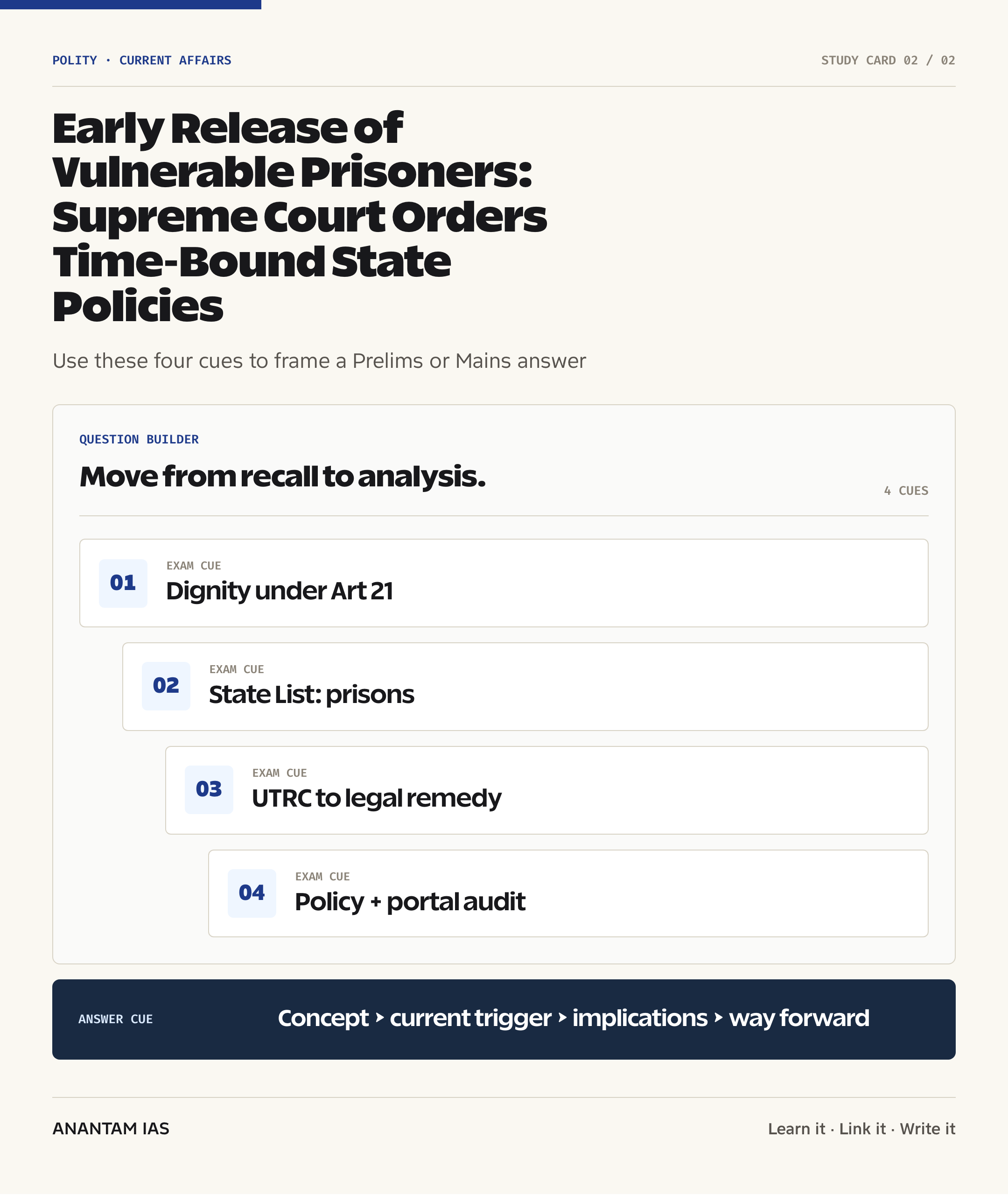
UPSC CSE 2026 Essay Paper Discussion

Daily Digest · Friday

17 July 2026 Current Affairs for UPSC

14 current affairs published on Friday, 17 July 2026

17 July 2026 Current Affairs for UPSC — every Why-in-News article AnantamIAS published on Friday, 17 July 2026, broken down with Why in News?, the exact GS paper it feeds, sub-topic mapping, MCQ-ready facts and a UPSC-style practice question. 14 articles in total, covering Polity, Economy, Environment, S&T, IR, Geography, History, Society and Internal Security — the same Why-in-News + GS-paper-mapping + practice-question format the Compass uses across every daily digest on the site.

Daily current affairs for UPSC is where new material enters your prep stream. Read this 17 July 2026 digest end-to-end in 25–35 minutes, attempt the practice question at the foot of each article (it's MCQ for some, 10/15-marker for others), then bookmark the entries that fall inside your active revision window. Everything stays cross-linked: tap any subject pill to jump to that subject's hub, or use the table of contents above to skip straight to a specific story.

Use this page three ways. Read sequentially for a one-sitting scan of everything that mattered on 17 July 2026. Download the 17 July 2026 PDF below for offline study or print revision. Or use the July 2026 Current Affairs compilation to see this day in the month's full context. For the previous day's reading, see 16 July 2026 Current Affairs; the next day's is 18 July 2026 Current Affairs.

Why we publish daily current affairs separately from the monthly compilation: daily is learning, monthly is revision. Use the daily page to add fresh material to your notes the day it breaks; come back to the July 2026 compilation 60 days before Prelims when the noise has settled and only the lasting takeaway is worth re-reading.

Lestes paloti: New Damselfly Species from the Western Ghats

Open article →Download PDF

Why in News?

The International Journal of Odonatology formally described Lestes paloti, a new spreadwing damselfly species from the western slopes of Kerala’s Western Ghats, on 15 July 2026.

The description distinguishes the species from the similar Lestes nodalis and Lestes garoensis, and it reassigns earlier southern Indian records of L. nodalis to the newly named species.

  • Publication: The peer-reviewed paper appears in Volume 29 of the International Journal of Odonatology, pages 159-168, with a DOI and a ZooBank publication record.
  • Authors: Vinayan Padmanabhan Nair, Maya George, Abraham Samuel, and Kalesh Sadasivan prepared the formal description.
  • Name: The species honours Muhamed Jafer Palot of the Zoological Survey of India for work on Indian odonatology, taxonomy, and Western Ghats fauna.
  • Historical gap: The Hindu reported it as the first new Indian Lestes species described since L. garoensis in 1987 and the first from the Western Ghats since L. malabaricus in 1929.
  • Known range: The paper records the species in six Kerala districts: Kannur, Kozhikode, Wayanad, Malappuram, Palakkad, and Ernakulam.

The development matters in the context of:

  • Taxonomic correction: A new name can change old distribution maps when specimens previously assigned to another species are re-examined.
  • Under-surveyed habitats: Laterite hillocks, homestead scrub, and backyards can hold biodiversity that stream-centred surveys may miss.
  • Evidence discipline: A formal species description establishes a taxon; it doesn’t automatically establish population size, threat category, or a complete geographic range.
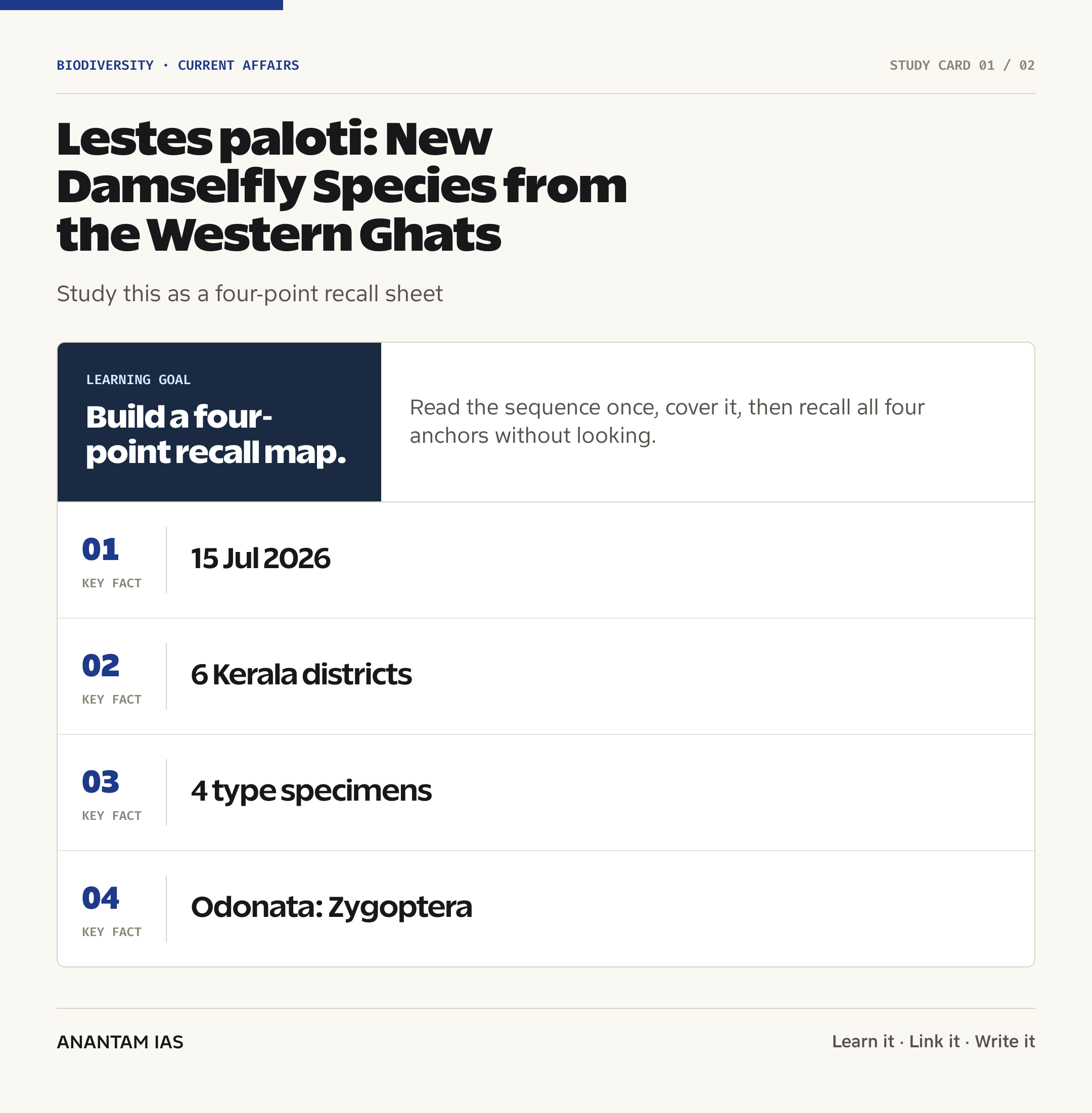
Lestes paloti: New Damselfly Species from the Western Ghats — quick facts

UPSC Relevance

Prelims Relevance

  • Order Odonata includes dragonflies and damselflies.
  • Suborder Zygoptera contains damselflies; Lestes paloti belongs to the family Lestidae.
  • Lestes species are commonly called spreadwings because adults often hold their wings partly open while resting.
  • Holotype means the single name-bearing specimen designated in the original description; paratypes are additional cited specimens in the type series.
  • Diagnostic characters for L. paloti include the male anal appendages and secondary genitalia, not colour alone.
  • Laterite hillocks and scrub around homesteads form part of the recorded adult habitat, often away from open water.
  • Seasonal colour variation runs broadly from brown in the dry season to blue in the wet season among mature individuals recorded by the study.
  • Western Ghats is both a global biodiversity hotspot and a UNESCO World Heritage property, but the two designations use different criteria.

Mains Relevance

GS Paper 3

  • Biodiversity documentation: Explain why taxonomy, type collections, and habitat surveys are basic infrastructure for conservation policy.
  • Habitat governance: Assess how small lateritic and semi-natural habitats can be overlooked by a protected-area-only approach.
  • Evidence-based conservation: Separate a species description from the population and threat data needed for management decisions.

GS Paper 1

  • Physical geography: Connect the Western Ghats’ relief, monsoon climate, and habitat diversity with high endemism.
  • Regional variation: Use the Palakkad Gap and north-south distribution records to discuss biogeographic barriers cautiously.

Essay

  • What remains unnamed remains poorly governed: Scientific classification shapes what institutions can count, monitor, and protect.
  • Conservation beyond charismatic species: Small insects and small habitats can reveal large gaps in ecological knowledge.

Background and Context

Discovery, Description, and a Scientific Name

A field sighting becomes a formally described species only after evidence is compared, documented, published, and tied to reference material.

  • Collection preceded publication: The designated specimens were collected at Taliparamba in Kannur district during 2019 and 2020; the species wasn’t first found in July 2026.
  • Formal description: The paper published on 15 July 2026 assigns the binomial Lestes paloti, describes diagnostic morphology, and provides habitat, distribution, and variation notes.
  • Holotype: A male collected on 3 April 2020 at about 50 metres above sea level is the name-bearing specimen and is deposited at the Zoological Survey of India centre in Kozhikode.
  • Paratypes: The paper lists one additional male and two females; these specimens help document variation without replacing the holotype’s nomenclatural role.
  • Traceability: The paper provides accession numbers, a DOI, and a ZooBank LSID, allowing later researchers to connect the name with its evidence.
  • Exam use: In an answer, write the sequence as survey, comparison, type designation, peer-reviewed description, and later ecological assessment.
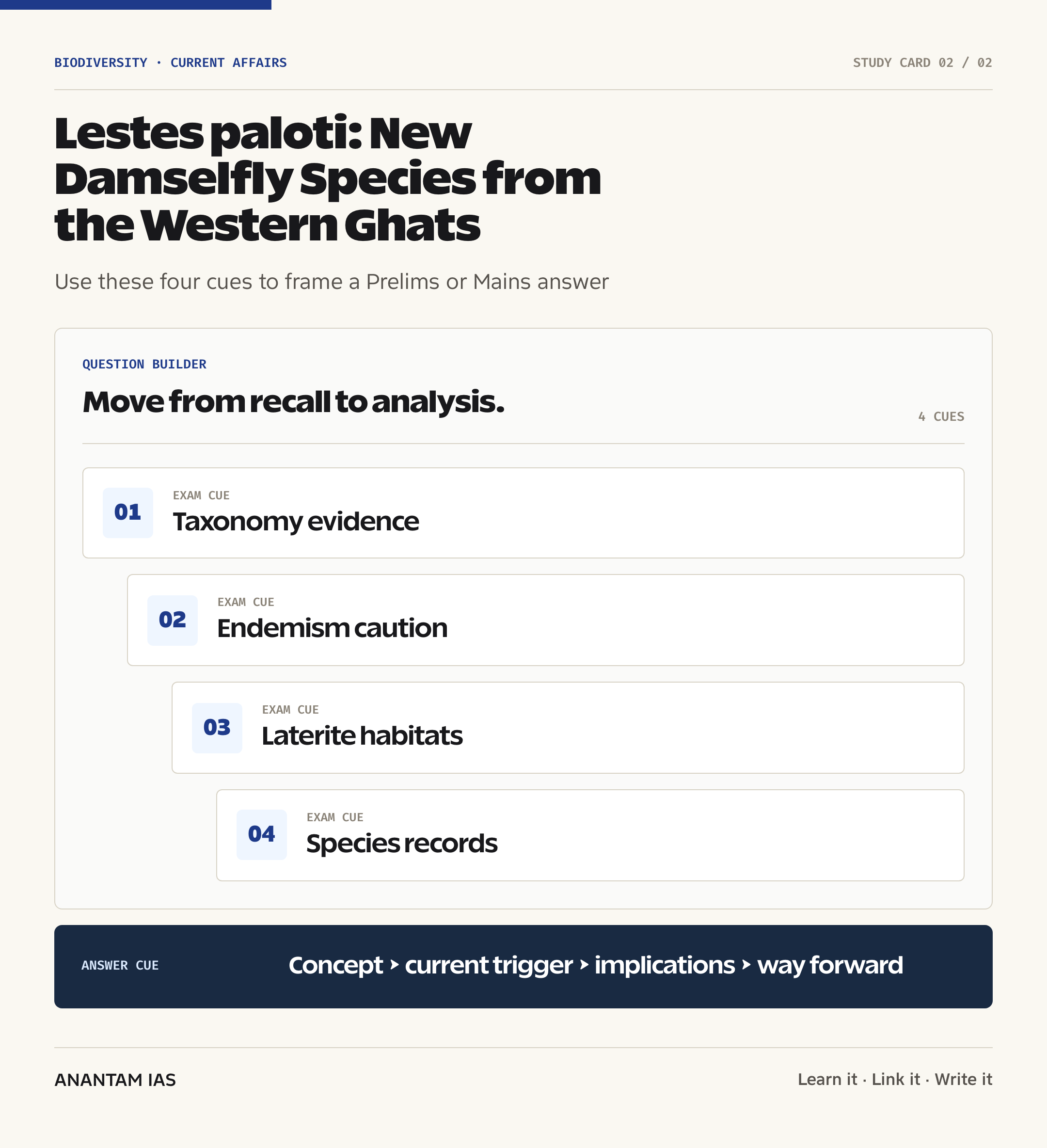
Lestes paloti: New Damselfly Species from the Western Ghats — exam lens

Where the Species Fits in Odonata

Its classification links a current discovery to standard concepts in insect taxonomy and freshwater ecology.

  • Taxonomic hierarchy: Animalia, Arthropoda, Insecta, Odonata, Zygoptera, Lestidae, Lestes, and Lestes paloti is the relevant sequence from broad group to species.
  • Odonata: The order has two familiar suborders: Zygoptera for damselflies and Anisoptera for dragonflies.
  • Spreadwings: Members of Lestidae often rest with wings partly spread, so the usual shortcut that all damselflies close their wings over the abdomen has an important exception.
  • Life cycle: Odonates have aquatic immature stages and terrestrial, aerial adults; an adult found away from visible water doesn’t by itself reveal the breeding site.
  • Genus context: The paper cites 82 Lestes species worldwide and proposes practical species-groups for Western Ghats identification, not a new phylogenetic classification.
  • Study link: Revise the broader concepts through the published notes on biodiversity and conservation.

How Lestes paloti Was Distinguished

The decisive evidence is comparative morphology, especially structures that are more stable and diagnostic than seasonal body colour.

  • Closest look-alikes: The species superficially resembles L. nodalis and L. garoensis, both associated mainly with northeastern India in the comparison.
  • Male cerci: The inner inflation of each cercus ends in a sharply pointed feature and its medial margin has a distinct preapical notch; the configuration differs from L. nodalis.
  • Secondary genitalia: The male genital ligula has broad, rounded, laterally expanded apical lobes with a deep median cleft and a hook-like lateral profile, helping separate it from L. garoensis.
  • Multiple characters: The authors compared anal appendages, secondary genitalia, body morphology, measurements, and published illustrations instead of naming the species from colour alone.
  • Voucher-based work: Microscopy, dissection, measurements, field photographs, and deposited specimens make the diagnosis open to later scrutiny.
  • Evidence limit: The authors didn’t directly examine type or topotypic specimens of L. nodalis and L. garoensis; those comparisons used published descriptions, illustrations, and photographs.

Distribution, Habitat, and Seasonal Appearance

The current record is wider within Kerala than the type locality, but it remains a documented range rather than a final boundary.

  • Six districts: Records come from Kannur, Kozhikode, Wayanad, Malappuram, Palakkad, and Ernakulam on the western side of the Western Ghats.
  • Recorded season: The paper reports observations from February to December, which shows a long adult recording window but doesn’t prove equal abundance in every month.
  • Microhabitat: Adults were concealed in scrub vegetation around homesteads, backyards, and laterite hillocks, often away from immediate water bodies.
  • Dry-season form: Mature adults observed from February to May were predominantly brown, while wet-season adults developed blue on the eyes, thorax, and parts of the abdomen.
  • Ontogenetic variation: Newly emerged individuals were pale, and an aged male with green coloration was also recorded; age and season can complicate field identification.
  • Survey implication: Searches should combine water-associated sampling with lateritic and semi-natural scrub, while separately investigating larval habitat and breeding ecology.

Western Ghats Endemism and Evidence Limits

A species known only from a hotspot can be biogeographically important without supporting claims that the available data can’t yet answer.

  • Known distribution: The primary description records L. paloti only in Kerala and uses endemic as a keyword, but future surveys can refine the mapped range.
  • Hotspot context: The Western Ghats biodiversity hotspot combines high endemism with extensive habitat transformation.
  • World Heritage context: UNESCO recognition applies to selected component sites with outstanding universal value; it doesn’t cover every place where the damselfly has been recorded.
  • Habitat mosaic: The species’ presence around laterite hillocks and settled landscapes shows why biodiversity inventories must look beyond forests, rivers, and formally protected areas.
  • No population estimate: Six-district occurrence doesn’t provide abundance, population trend, area of occupancy, or the condition of each local population.
  • No threat label: The description doesn’t assign an IUCN Red List category, so calling the species endangered, rare, or secure would exceed the evidence.

Why Correct Identification Changes Biodiversity Data

Taxonomic revision can add one species while simultaneously correcting the recorded range of another.

  • Earlier records: Southern Indian specimens had been reported as Lestes nodalis, partly through reliance on older identification accounts.
  • Re-examination: The new study treats those southern records as L. paloti, narrowing the supported Indian distribution of L. nodalis and creating a clearer record for the new species.
  • Checklist effect: The Hindu reported that Kerala’s odonate list rose to 192 species in 87 genera and 14 families, including 81 Western Ghats endemics; such lists remain dated scientific snapshots.
  • Policy effect: Misidentification can distort range maps, apparent endemism, site priorities, environmental baselines, and trend comparisons.
  • Comparable lesson: The new Western Ghats moth genus offers another example of taxonomy revealing overlooked diversity.
  • Answer-building cue: Use a three-part chain: accurate taxonomy improves inventories; inventories improve monitoring; monitoring supports defensible conservation choices.

What the Finding Can and Cannot Support

A strong UPSC answer should distinguish verified conclusions from sensible questions for the next research stage.

  • Supported: L. paloti is a formally described species, diagnosable from close relatives through specified male structures and documented from six Kerala districts.
  • Supported: Earlier southern Indian records attributed to L. nodalis were reinterpreted using the new diagnosis.
  • Not yet supported: The publication doesn’t establish the species’ total population, precise breeding waters, trend, climate sensitivity, or legal protection needs.
  • Conservation inference: Lateritic scrub deserves survey attention, but one species description alone can’t rank every laterite site for protection.
  • Governance lesson: Taxonomic institutions, museums, local natural-history groups, and long-term field observers create evidence that large remote-sensing datasets can’t replace.
  • Mains structure: Start with the discovery, explain the evidence, connect it to hotspot governance, state the data gaps, and close with targeted research and habitat safeguards.

Way Forward

Complete the ecological baseline

  • Map occurrence systematically across laterite plateaus and adjoining districts using repeatable survey protocols.
  • Identify breeding habitat by studying larvae, exuviae, seasonality, dispersal, and links between adult scrub sites and water.
  • Estimate population parameters before proposing a threat category or site-specific management prescription.

Protect evidence and improve identification

  • Digitize voucher data and high-resolution diagnostic images while retaining physical type material in accessible institutional collections.
  • Train field teams to separate colour variation from structural characters and to document both sexes across seasons.
  • Recheck legacy collections labelled L. nodalis from southern India so databases and distribution maps reflect the revised taxonomy.

Include overlooked habitats

  • Inventory laterite hillocks before land-use conversion and record microhabitat, hydrology, vegetation, and associated species.
  • Work with residents because several records came from homesteads and backyards where low-cost habitat stewardship may aid monitoring.
  • Avoid blanket conclusions by prioritizing sites through multi-species evidence, ecological function, and documented pressures.

Build an assessment pathway

  • Publish range and trend data in forms usable by state biodiversity boards, researchers, and independent assessors.
  • Assess threats transparently against IUCN criteria only after adequate evidence on range, population, habitat, and decline.
  • Link taxonomy with planning so environmental baselines acknowledge newly described and newly corrected species records.

Conclusion

Lestes paloti is important not only because it adds a name to a checklist. Its description shows how close morphological work can correct an old distribution record and reveal biodiversity in ordinary-looking lateritic scrub.

For UPSC answers, the balanced takeaway is clear: taxonomy is conservation infrastructure, but a new species description isn’t a substitute for population ecology or threat assessment. Protect the evidence, fill the data gaps, and let management follow verified findings.

UPSC Practice Questions

Prelims MCQ 1

With reference to Lestes paloti, consider the following statements:

  1. It belongs to the suborder Zygoptera within the order Odonata.
  2. Its diagnosis relies partly on the structure of male anal appendages and secondary genitalia.
  3. The primary description assigns it an Endangered status under the IUCN Red List.

How many of the above statements are correct?

(a) Only one (b) Only two (c) All three (d) None

Answer: (b) Only two

Explanation:

Statements 1 and 2 are correct. Lestes paloti is a lestid damselfly under Zygoptera, and male morphology is central to its diagnosis. The description doesn’t assign an IUCN category, so Statement 3 is incorrect.

Prelims MCQ 2

Which one of the following best describes the documented adult habitat of Lestes paloti?

(a) Alpine meadows above the tree line (b) Mangrove mudflats exposed at low tide (c) Scrub on laterite hillocks and around homesteads, often away from open water (d) Permanent snow-fed lakes of the Greater Himalaya

Answer: (c) Scrub on laterite hillocks and around homesteads, often away from open water

Explanation:

The paper records adults concealed in scrub vegetation on laterite hillocks and around homesteads or backyards. This adult occurrence doesn’t settle where the aquatic immature stages develop.

UPSC Mains Questions

  1. The formal description of Lestes paloti shows that taxonomy is infrastructure for biodiversity governance. Discuss how type specimens, corrected distribution records, and surveys of overlooked habitats can improve conservation decisions in the Western Ghats while acknowledging the limits of current evidence.
  2. A newly described species can reveal both biological richness and gaps in scientific knowledge. Using Lestes paloti as an example, explain how you would move from taxonomic discovery to credible ecological assessment and proportionate habitat management.

Sources: International Journal of Odonatology and The Hindu.

Frequently Asked Questions

What is Lestes paloti?

Lestes paloti is a formally described spreadwing damselfly in the family Lestidae and suborder Zygoptera. The 2026 paper documents it from six districts of Kerala on the western side of the Western Ghats and distinguishes it from similar Lestes species through comparative morphology.

When was the species discovered?

The name was formally published on 15 July 2026, but the type specimens were collected at Taliparamba in 2019 and 2020. This distinction matters: field collection, recognition as potentially different, comparative study, and formal description can occur years apart.

How is it identified?

The diagnosis gives greatest weight to male anal appendages and secondary genitalia. The inner inflation of the cercus has a sharply pointed feature and a distinct preapical notch, while the genital ligula differs from that of L. garoensis. Seasonal colour alone isn’t reliable.

Where has Lestes paloti been recorded?

The paper records it from Kannur, Kozhikode, Wayanad, Malappuram, Palakkad, and Ernakulam districts. Adults were found in scrub on laterite hillocks and around homesteads, often away from immediate water bodies. That is the documented range, not proof that it occurs nowhere else.

Is Lestes paloti endangered?

The primary description doesn’t assign an IUCN Red List category. It also doesn’t provide a population estimate or trend. A defensible threat assessment would need data on distribution, area of occupancy, abundance, habitat condition, pressures, and change over time.

Why did earlier records change?

Southern Indian specimens had been identified as Lestes nodalis because of superficial similarity and older identification accounts. The new study compared diagnostic structures and concluded that those records represent L. paloti. This changes the supported distribution data for both names.
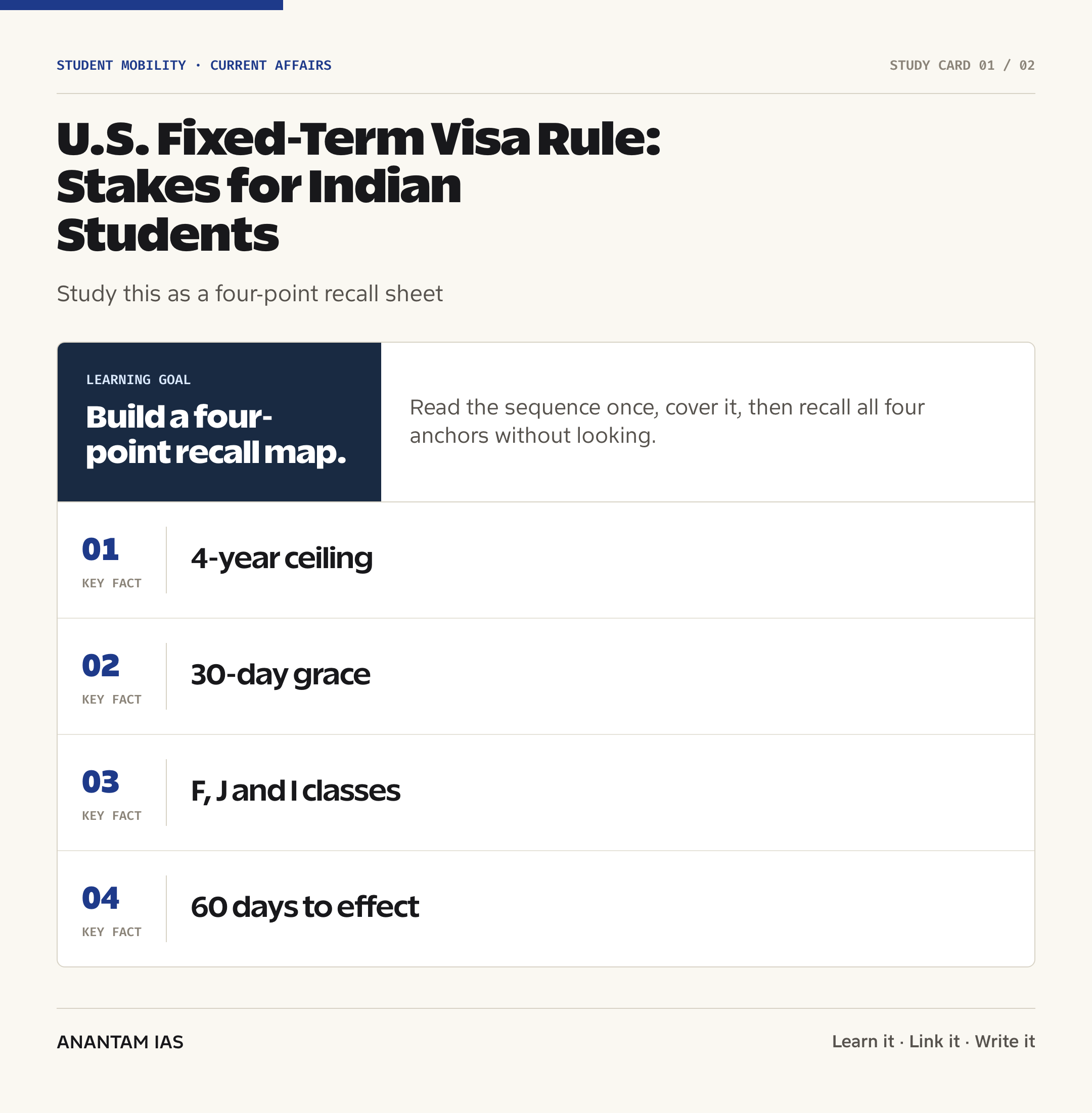
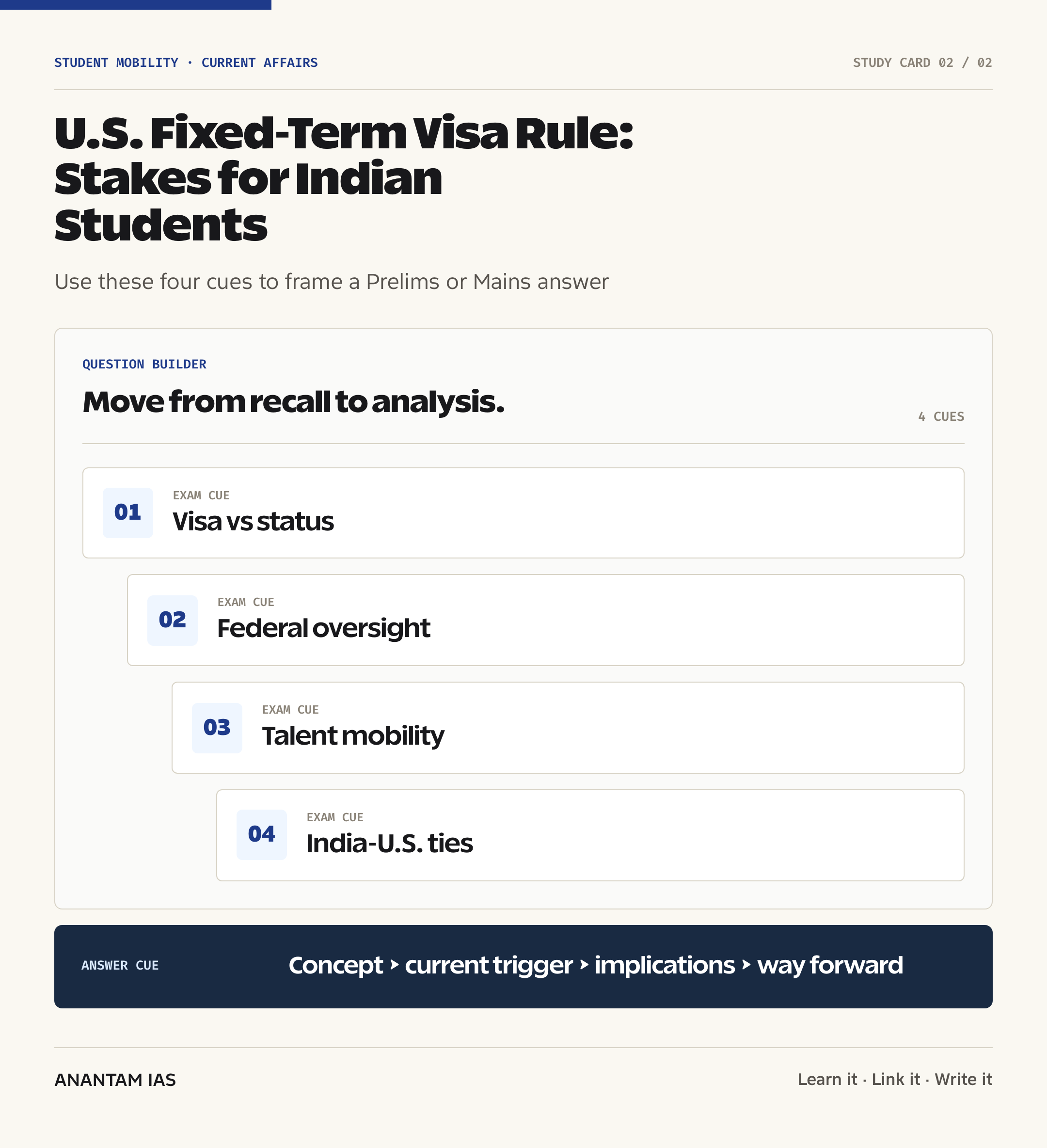
U.S. Fixed-Term Visa Rule: Stakes for Indian Students

Open article →Download PDF

Why in News?

On 16 July 2026, the U.S. Department of Homeland Security announced a final rule replacing open-ended duration-of-status admission with fixed admission periods for the F, J and I nonimmigrant categories. The Hindu and The Indian Express reported the move as a major change for foreign students, exchange visitors and journalists.

The announcement isn’t the rule’s effective date. DHS said the final text would be published in the Federal Register in the following days and would take effect 60 days after that publication. Until the effective date, the existing duration-of-status framework continues to govern eligible F, J and I holders.

  • F and J ceiling: Admission would cover the specific programme length, subject to a maximum of four years.
  • Extension route: A student or exchange visitor needing more time would have to seek an Extension of Stay from USCIS and undergo federal review.
  • Grace period: DHS said the post-completion departure period for F-1 students would fall from 60 days to 30 days.
  • Transition: Existing holders admitted for duration of status would move into the date-certain system, with DHS announcing a maximum four-year transition cap from the effective date.
  • Separate media category: I classification covers representatives of foreign information media and shouldn’t be confused with F academic students or J exchange visitors.

The development matters in the context of:

  • Large Indian exposure: ICE recorded 422,335 active SEVIS records linked to India in calendar year 2024, more than for any other country.
  • Administrative change: A programme update certified through SEVIS won’t by itself substitute for a federal extension when the new admission date is reached.
  • Mobility decision: Students weighing long doctoral programmes, transfers or post-study training will have to account for extension timing, cost and uncertainty.
  • Bilateral stake: Education links support India-U.S. research, skills, innovation and people-to-people relations, so compliance policy can have wider strategic effects.
U.S. Fixed-Term Visa Rule: Stakes for Indian Students — quick facts

UPSC Relevance

Prelims Relevance

  • F-1 is the main nonimmigrant classification for academic study at an approved U.S. institution; F-2 covers eligible dependants.
  • J-1 covers approved exchange-visitor programmes; J-2 covers eligible dependants.
  • I classification is for qualifying representatives of foreign information media and their eligible dependants, not for international students.
  • M-1 applies to vocational or other recognized non-academic study and already operates with a date-certain admission framework.
  • Duration of Status, recorded as D/S on Form I-94, permits an eligible person to remain while pursuing the authorized activity and maintaining the conditions of status.
  • A visa permits its holder to travel to a U.S. port of entry and seek admission; it doesn’t by itself determine the period of lawful stay inside the country.
  • Form I-94 is the arrival and departure record that shows the class of admission and either an admitted-until date or D/S.
  • Form I-20 is issued for F and M students by a SEVP-certified school, while Form DS-2019 supports a J exchange programme.
  • SEVP is managed by U.S. Immigration and Customs Enforcement, while SEVIS is the information system used to monitor participating schools, programmes and nonimmigrants.
  • USCIS adjudicates an in-country Extension of Stay; CBP decides admission at a port of entry; the State Department issues visas abroad.

Mains Relevance

GS Paper 2

  • International relations: Education and research mobility as a pillar of India-U.S. people-to-people ties.
  • Indian diaspora: Regulatory uncertainty, consular communication and welfare support for a large student community.
  • Governance comparison: The trade-off between immigration oversight and predictable, proportionate administration.
  • Social justice: Unequal effects of fees, processing delays and legal complexity on students with fewer financial buffers.

GS Paper 3

  • Human capital: Effects on advanced training, research networks and the movement of science and technology talent.
  • Innovation ecosystem: Links between graduate education, practical training, skilled employment and knowledge circulation.
  • Domestic opportunity: The case for stronger Indian research careers and institutions when overseas mobility becomes less predictable.

Essay

  • Mobility and sovereignty: States can regulate entry, but durable knowledge partnerships depend on transparent and predictable rules.
  • Brain drain to brain circulation: International education can create shared skills and networks rather than a simple one-way loss of talent.

Background and Context

From Proposal to Final Rule

The correct timeline separates an earlier rulemaking proposal from the final agency action announced in July 2026.

  • Agenda stage: The Spring 2025 Unified Agenda listed RIN 1653-AA95 at the proposed-rule stage and described replacing D/S with date-limited admission.
  • Notice stage: DHS published a Notice of Proposed Rulemaking on 28 August 2025 and invited public comment; a proposal and its regulatory agenda entry didn’t themselves change the governing rules.
  • Final action: On 16 July 2026, DHS announced that it had issued a final rule after the notice-and-comment process.
  • Publication step: At the time of the announcement, the final text had not yet appeared in the Federal Register. DHS said publication would follow within days.
  • Effective step: DHS placed implementation 60 days after Federal Register publication, so the precise effective date depends on the publication date.
  • Exam caution: Write that the rule has been finalized and announced, but don’t write that fixed terms already govern every holder before the stated effective date.
U.S. Fixed-Term Visa Rule: Stakes for Indian Students — exam lens

Visa Validity, Admission and Status Are Different

Many accounts call the measure a visa-duration cap, but the legal change chiefly concerns the period of admission recorded after entry.

  • Visa validity: A State Department visa foil allows a person to travel to a port of entry during its validity and request admission in the stated classification.
  • No guaranteed entry: Possessing a valid visa doesn’t compel CBP to admit the traveller; the port-of-entry decision remains a DHS function.
  • Authorized stay: Form I-94 records how long the person may remain after admission, either through a specific date or, under the current eligible framework, as D/S.
  • Expired visa inside the U.S.: Visa expiration doesn’t automatically end an F-1 student’s status if the student remains inside the country and continues to meet the status conditions.
  • Travel consequence: A student who leaves the United States may need a valid visa for readmission even when an academic record or employment authorization continues.
  • Fixed-term consequence: Under date-certain admission, the I-94 deadline becomes central; staying longer would require a timely extension, change of status or another lawful authorization.

How the Current Duration-of-Status Model Works

The current model links lawful presence to the continued performance of an authorized academic, exchange or media activity rather than only to a calendar deadline.

  • D/S notation: An eligible F, J or I holder may receive D/S instead of a fixed admitted-until date on Form I-94.
  • F-1 conditions: The student must pursue the authorized course, follow full-course and employment rules, maintain a valid SEVIS record and comply with transfer or practical-training requirements.
  • Institutional role: A Designated School Official updates Form I-20 and SEVIS when the programme, school or practical-training record changes.
  • J oversight: A designated programme sponsor and a Responsible Officer manage the exchange record through Form DS-2019 and SEVIS.
  • Current F grace period: A compliant F-1 student generally has 60 days after programme completion or authorized post-completion practical training to depart, transfer or change status.
  • Policy concern: DHS argues that D/S gives federal officers fewer scheduled opportunities to reassess continuing eligibility.
  • Counterpoint: Universities and exchange sponsors argue that SEVIS already supplies continuing oversight and that a separate extension layer can duplicate administration.

What the Final Rule Changes

The new design shifts eligible categories from an activity-linked stay to a programme-linked but date-certain admission.

  • Maximum period: DHS said F students and J exchange visitors would be admitted for the length of their programme, with a ceiling of four years.
  • Not an automatic four years: A shorter programme can produce a shorter admission period; four years is a maximum, not a guaranteed minimum.
  • Extension of Stay: A person needing more time would apply directly to USCIS, allowing biometric, background and fraud screening.
  • Academic changes: DHS also announced restrictions on changes to programmes, fields or educational levels, making the eventual Federal Register text important for exact conditions.
  • Departure window: The F-1 post-completion grace period would be 30 days rather than 60 days.
  • Existing holders: DHS said people already admitted under D/S would transition automatically and face a maximum four-year authorized period measured from the rule’s effective date.
  • I category: Foreign media representatives are also covered, but their press-freedom and assignment-continuity issues are distinct from student education policy.
  • M category: The change doesn’t convert M vocational students from D/S because M admission was already date-certain.

Why Indian Students Have a Large Stake

India’s exposure is both numerical and strategic because it is the largest source of students in major U.S. datasets.

  • SEVIS measure: ICE’s calendar-year 2024 country table listed 422,335 active SEVIS records for India, ahead of China.
  • Counting caution: SEVIS reports records rather than a perfect headcount because one person can have more than one active record during a year.
  • Higher-education measure: Open Doors separately counted 363,019 students from India at U.S. higher-education institutions in academic year 2024-25; its population and time period differ from SEVIS.
  • Long programmes: Doctoral research, combined degrees and delayed laboratory work can extend beyond four years, creating a likely extension requirement.
  • Practical training: Students must track how an admission deadline interacts with curricular practical training, optional practical training and any STEM extension.
  • Career transition: F-1 status and H-1B specialty-occupation status are different legal pathways; completing a U.S. course doesn’t automatically confer a work visa.
  • Distributional effect: Filing fees, biometrics, legal advice and processing uncertainty weigh more heavily on students with limited financial support.
  • Choice effect: Prospective students may compare the United States with countries offering clearer programme-length and post-study pathways.

Oversight Rationale and Governance Concerns

A balanced assessment tests the rule against security, proportionality, capacity and due process rather than accepting either side’s label.

  • DHS case: Date-certain admissions create periodic federal checks and a clearer point at which a person must depart or obtain additional authorization.
  • Fraud control: Direct extension adjudication can test whether the person remains engaged in a genuine course, exchange or media assignment.
  • Existing system: SEVIS already requires schools and sponsors to report enrolment, programme and status information to the government.
  • Duplicate burden: Universities warn that adding USCIS adjudication to SEVIS reporting can increase paperwork for students, institutions and federal officers.
  • Backlog risk: If extension processing is slow, a compliant student may face uncertainty over study, travel and employment even after filing on time.
  • Predictability test: Clear transition rules, advance reminders, online status tracking and consistent adjudication are central to procedural fairness.
  • Evidence test: Government should publish overstay, fraud, extension and processing data by category so the administrative burden can be compared with measurable gains.

India-U.S. Relations and Answer-Building Guidance

For GS2, the rule is best framed as a people-to-people and human-capital issue within a wider strategic partnership.

  • Beyond migration: Indian students contribute to university research, laboratories, entrepreneurship and professional networks linking both economies.
  • Knowledge circulation: Alumni can return with skills, build cross-border firms or sustain joint research, so the outcome isn’t limited to permanent brain drain.
  • Indian response: Diplomatic engagement can seek clear implementation guidance without claiming a right to override another state’s immigration law.
  • Consular role: Indian missions can issue verified advisories, coordinate student support and flag systemic problems through official channels.
  • Domestic lever: Stronger laboratories, faculty careers and the PM Research Chair pathway for attracting research talent can widen credible options at home.
  • Answer structure: Define D/S and date-certain admission, clarify visa versus status, state the final-rule timeline, quantify India’s exposure, weigh oversight against burden, and close with bilateral communication and domestic capacity.
  • Balanced conclusion: The best policy objective is neither unrestricted stay nor unpredictable control, but lawful mobility backed by proportionate oversight and reliable administration.

Way Forward

Clarify Implementation

  • DHS should publish a plain-language transition table for current students, programme completion, transfers, practical training, pending extensions and international travel.
  • USCIS should offer early filing windows, electronic reminders, case tracking and clear protection for timely filers while an extension remains pending.

Make Oversight Proportionate

  • Use risk-based review and interoperable SEVIS-USCIS records so students don’t repeatedly submit information already held by the government.
  • Publish processing times, approval rates, requests for evidence and overstay outcomes by category to test whether the rule meets its stated purpose.

Support Indian Students

  • Indian missions, universities and student associations should circulate official guidance on the I-94 deadline, extension filing and travel consequences.
  • Students should maintain complete I-20, SEVIS, employment and address records and seek qualified advice for individual cases rather than relying on social-media claims.

Strengthen Talent Partnerships

  • India and the United States should protect joint research, credit recognition and institutional exchanges within each country’s lawful immigration framework.
  • India should deepen funded doctoral positions, research infrastructure and industry-academia careers so overseas uncertainty doesn’t become a human-capital shock.

Conclusion

The fixed-term admission rule is a structural change in immigration administration, not simply a shorter visa sticker. It moves F, J and I holders from an activity-linked D/S framework toward a calendar deadline backed by federal extension review.

For India, the answer lies in precise student guidance, transparent U.S. implementation, sustained education diplomacy and stronger opportunities at home. A credible assessment should defend lawful oversight while asking whether the rule is proportionate, predictable and capable of preserving legitimate study and research.

UPSC Practice Questions

Prelims MCQ 1

With reference to U.S. nonimmigrant admission, consider the following statements:

  1. The expiration date on a visa foil always determines the last lawful day of stay inside the United States.
  2. Form I-94 records the class and authorized period of admission.
  3. The I classification applies to qualifying representatives of foreign information media.

How many of the above statements are correct?

(a) Only one (b) Only two (c) All three (d) None

Answer: (b) Only two

Explanation:

Statements 2 and 3 are correct. Visa validity concerns travel to a port of entry; the authorized stay after admission is shown through an I-94 date or, under the current eligible framework, D/S.

Prelims MCQ 2

Which statement best describes the U.S. fixed-term rule announced in July 2026?

(a) It immediately converted every F, J and I holder to a four-year visa on 16 July. (b) It abolished F-1 status and replaced it with H-1B status. (c) It established date-certain admission, with extensions adjudicated by USCIS when more time is needed. (d) It applied only to M-1 vocational students and left F, J and I unchanged.

Answer: (c) It established date-certain admission, with extensions adjudicated by USCIS when more time is needed.

Explanation:

DHS announced a final rule for F, J and I categories. The rule is to take effect 60 days after Federal Register publication; the four-year period is a maximum for F and J admission, not a new visa automatically granted to everyone.

UPSC Mains Questions

  1. The U.S. move from duration-of-status admission to fixed terms for students is an immigration-control measure with consequences for education diplomacy and human-capital mobility. Examine its likely effects on Indian students and India-U.S. relations.
  2. Visa validity, admission and lawful status are related but distinct concepts. Explain these distinctions and assess whether date-certain admission can improve oversight without creating disproportionate uncertainty for genuine international students.
  3. International education should be understood as knowledge circulation rather than only brain drain. Discuss in the context of changing destination-country rules and India’s need to build stronger domestic research careers.

Sources: U.S. Department of Homeland Security and The Hindu and The Indian Express.

Frequently Asked Questions

Is the fixed-term rule already effective?

No. DHS announced the final rule on 16 July 2026 but said the text would be published in the Federal Register in the following days. The agency set effectiveness 60 days after that publication. Until the effective date, eligible F, J and I holders remain governed by the existing framework.

Does a four-year visa equal four years of stay?

No. Visa validity concerns travel to a U.S. port of entry. Authorized stay is recorded on Form I-94 after admission. Under the new design, an F or J admission would match the programme length up to a four-year ceiling, so a shorter programme can produce a shorter authorized period.

What does Duration of Status mean?

Duration of Status, shown as D/S on Form I-94, permits an eligible person to remain while continuing the authorized study, exchange or media activity and following all status conditions. It isn’t permission to remain without limits or to ignore enrolment, employment, reporting or programme requirements.

Who is covered by F, J and I?

F classification mainly covers academic students, J covers approved exchange visitors, and I covers qualifying representatives of foreign information media. They serve different purposes even though the announced rule moves all three away from D/S. M vocational students are a separate category with date-certain admission.

Why does this matter especially to India?

India supplied 422,335 active SEVIS records in calendar year 2024, the highest country total in ICE’s table. Long doctoral courses, programme changes and practical training can make deadline and extension rules consequential. Students may face added filing costs, documentation needs and uncertainty while planning education and careers.

What should an affected student do?

Track the Form I-94 and SEVIS record, retain every I-20 or DS-2019, follow school reporting rules and read the final Federal Register text when published. Individual cases can differ, so students should use official DHS, USCIS, CBP and university guidance and seek qualified legal advice when necessary.

Codex Spice Standards: India’s Role in Global Food Rule-Making

Open article →Download PDF

Why in News?

The 49th Session of the Codex Alimentarius Commission, held in Geneva from July 6 to 10, 2026, adopted international commodity standards for large cardamom, coriander and vanilla. PIB announced the decision on July 16 and described it as a milestone in India’s participation in global food standard-setting.

All three texts had been finalised by the India-hosted Codex Committee on Spices and Culinary Herbs at its eighth session in Guwahati in October 2025. Their adoption creates common quality references for trade, but it does not automatically rewrite the food laws of India or any importing country.

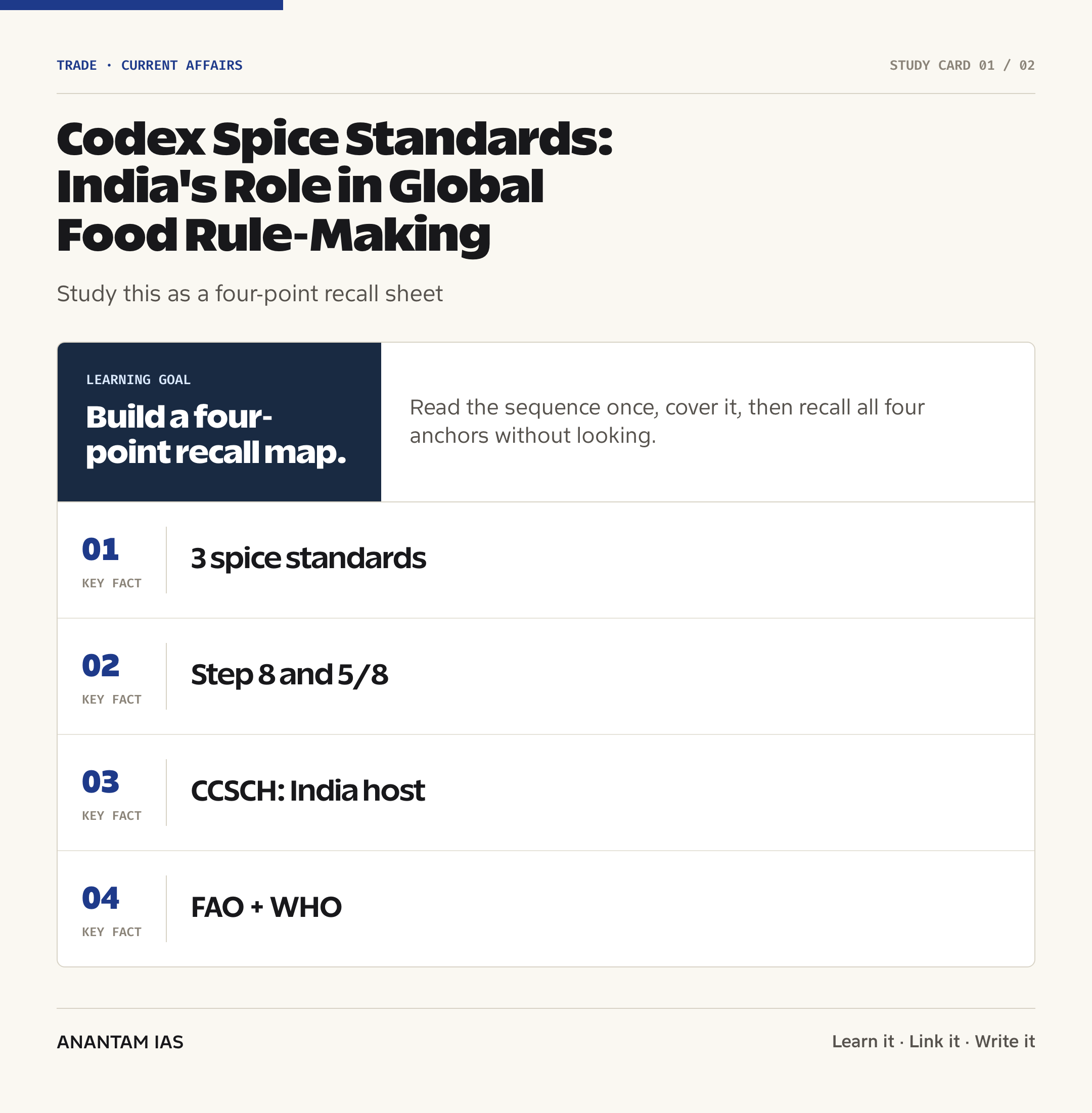
  • Vanilla completed the normal procedure and was adopted at Step 8 under Codex job number N03-2021.
  • Large cardamom and coriander were adopted at Step 5/8 under job numbers N03-2024 and N02-2024, respectively.
  • Step 5/8 is a final adoption route in which the Commission accepts a committee recommendation to omit Steps 6 and 7; it is not a provisional standard.
  • Relevant provisions had been examined by the Codex committees on methods and sampling, food additives and food labelling before Commission adoption.
  • The Commission also accepted India as Co-Chair of an electronic working group on risk analysis for new food products, with the European Union as Chair.

The development matters in the context of:

  • The development shows how technical diplomacy can influence the product definitions, quality parameters, sampling methods and labelling expectations used across markets.
  • A common standard can reduce avoidable variation between buyer specifications, but exporters still have to meet the binding domestic rules of the destination market.
  • The strongest Mains framing connects three levels: consumer health, fair food trade and India’s capacity to convert international standards into farm-level quality gains.
Codex Spice Standards: India's Role in Global Food Rule-Making — quick facts

UPSC Relevance

Prelims Relevance

  • The Codex Alimentarius Commission was established jointly by the Food and Agriculture Organization and the World Health Organization in 1963.
  • Its two core purposes are protecting consumer health and ensuring fair practices in the food trade.
  • The Commission is the decision-making body for the Joint FAO/WHO Food Standards Programme; Codex committees prepare specialised texts for its consideration.
  • Codex texts include standards, guidelines and codes of practice covering food hygiene, additives, contaminants, pesticide and veterinary-drug residues, labelling, sampling, analysis and inspection.
  • The CCSCH is an active commodity committee hosted by India. It develops worldwide standards for spices and culinary herbs in dried or dehydrated form, including whole, ground, cracked or crushed products.
  • India’s Spices Board, under the Ministry of Commerce and Industry, serves as the CCSCH Secretariat.
  • A normal Codex standard follows an eight-step process. Step 8 is final adoption; Step 5/8 allows the Commission to omit the second comment round at Steps 6 and 7 on a committee recommendation.
  • Codex standards are recommendations for voluntary application. They do not substitute for national legislation or become binding domestic law merely because the Commission adopts them.
  • Codex food-safety standards are recognised reference points under the WTO Agreement on the Application of Sanitary and Phytosanitary Measures.
  • The three standards adopted at CAC49 cover large cardamom, coriander and vanilla; they should not be confused with one combined standard for every spice.

Mains Relevance

GS Paper 2

  • India’s role in multilateral rule-making through an FAO-WHO institution and an India-hosted commodity committee.
  • Technical standards as an instrument of economic diplomacy, coalition-building and representation of producer-country concerns.
  • Relationship between voluntary international norms, national regulatory sovereignty and the rules-based trading order.

GS Paper 3

  • Food-safety and quality infrastructure across farms, processing, laboratories, certification and export inspection.
  • Standards as a means to reduce information gaps, improve market access and protect farmers from inconsistent buyer requirements.
  • Limits of harmonisation where small producers face compliance costs, weak traceability or inadequate testing facilities.

Essay

  • Rules written in technical rooms can shape livelihoods far beyond those rooms.
  • Standards build trust only when producers have the capacity to meet them.
  • Global harmonisation works best when it protects both consumers and diversity in production.

Background and Context

Codex Alimentarius: institution, mandate and texts

Codex is a global food-standard system, not a supranational food regulator.

  • The Codex Alimentarius Commission is responsible for the Joint FAO/WHO Food Standards Programme and meets as a membership-based intergovernmental body.
  • Its mandate combines two goals: food must be safe and wholesome for consumers, and food trade must follow fair practices rather than deceptive or arbitrary requirements.
  • Codex relies on scientific advice from FAO-WHO expert bodies and on negotiation among members. This combination separates risk assessment, which evaluates evidence, from risk management choices made by governments and Codex bodies.
  • A Codex standard usually gives requirements for a food or class of foods. Guidelines explain recommended approaches, while codes of practice set good practices for production, handling or control.
  • The collection covers principal foods and cross-cutting subjects such as hygiene, residues, contaminants, additives, labelling, sampling and import-export inspection. See the published note on India’s food-safety governance for the domestic regulatory context.
Codex Spice Standards: India's Role in Global Food Rule-Making — exam lens

CCSCH: why India hosts the spice committee

CCSCH turns producer, trader, regulator and consumer concerns into worldwide commodity standards for spices and culinary herbs.

  • The committee’s formal terms cover spices and culinary herbs in dried or dehydrated form, whether whole, ground, cracked or crushed.
  • India is the host country, and the Spices Board acts as Secretariat. Hosting includes administrative leadership and continuity; adoption authority still rests with the full Commission.
  • Electronic working groups let members develop text between sessions. They compare national practices, scientific information, trade descriptions and technical parameters before a draft reaches the committee plenary.
  • At CCSCH8 in Guwahati, held from October 13 to 17, 2025, members finalised the vanilla text and recommended final adoption of the large-cardamom and coriander texts.
  • Other specialist committees then reviewed clauses within their mandates. CCMAS addressed analysis and sampling, CCFA addressed additives, and CCFL addressed labelling before CAC49 took the final decision.

How the three standards reached adoption

The three products reached the same legal status through different points in the Codex elaboration procedure.

  • Vanilla was submitted as job N03-2021 at Step 8. That means it had completed the normal rounds of drafting, member comments, committee revision and final review before Commission adoption.
  • Large cardamom, job N03-2024, and coriander, job N02-2024, were submitted at Step 5 with a recommendation to omit Steps 6 and 7. CAC49 adopted both at Step 5/8 as final texts.
  • Step 5/8 should not be confused with the separate accelerated five-step procedure. In a Step 5/8 case, the subsidiary committee recommends omitting the second circulation and revision round after judging the text ready for final adoption.
  • The three texts moved from commodity drafting to specialist endorsement and then to CAC49. This chain protects coherence: a commodity committee should not create additive, labelling or analytical provisions that conflict with Codex-wide rules.
  • Once adopted by the Commission, a standard enters the Codex Alimentarius. National authorities and market actors can then refer to the final text, while later revision remains possible when science or trade conditions change.

What the standards do for each spice

The standards harmonise product identity and quality expectations without making every batch or origin identical.

  • The large-cardamom standard is especially relevant to the North-Eastern Himalayan region, where the crop is indigenous. A shared reference can make product forms, quality classes and analytical results more comparable across buyers.
  • The coriander standard covers the spice in the form of dried seeds. India’s scale as a producer and exporter makes predictable quality terminology important for contracts, inspection and dispute avoidance.
  • The vanilla standard creates an accepted quality framework for international trade. PIB noted that India imports a substantial share of its vanilla requirement, so the standard matters to import consistency and consumer confidence as well as any future domestic production.
  • The additive provisions allow relevant anticaking agents in ground or powdered forms in line with the Codex General Standard for Food Additives; the precise product standard, not a news summary, governs the applicable condition.
  • Common standards can reduce transaction costs caused by incompatible descriptions. They do not guarantee a sale, a premium price or automatic acceptance of a consignment that fails the importing country’s legal or contractual requirements.

Voluntary standard, domestic law and private contract

The exam-critical distinction is between an international recommendation and a rule that a court or regulator can enforce.

  • Codex standards are voluntary recommendations for members. The FAO-WHO Codex framework expressly says they are not a substitute for national legislation.
  • A standard becomes binding inside a country only when its legislature or regulator incorporates relevant requirements into domestic law, or when an existing law independently imposes equivalent requirements.
  • In India, binding food requirements arise under the Food Safety and Standards Act, 2006 and regulations, orders or directions made through the domestic system. CAC49 adoption alone does not amend those instruments.
  • A buyer may also place Codex-aligned specifications in a private contract. Those terms can bind the contracting parties even when the Codex text itself remains voluntary.
  • Exporters must check three layers: the Indian rules governing production and export, the destination country’s mandatory import rules, and the buyer’s contractual specification. Calling Codex either wholly non-binding or directly enforceable everywhere misses this layered effect.

Why voluntary Codex texts affect international trade

Codex gains practical force from regulatory adoption, buyer expectations and its benchmark role in the WTO system.

  • The WTO SPS Agreement recognises Codex standards, guidelines and recommendations as international references for food-safety measures.
  • A member may maintain a food-safety measure more stringent than the Codex baseline, but it may need scientific justification and a defensible risk basis if the measure restricts trade.
  • Quality descriptions and labelling can also interact with the WTO Technical Barriers to Trade Agreement, depending on the measure. SPS and TBT disciplines are related but not interchangeable.
  • Alignment can reduce avoidable testing duplication and make an exporter’s evidence easier for an importer to assess. But equivalence, inspection, certification and border control still depend on competent authorities and the applicable trade arrangement.
  • For the wider trade setting, connect this topic to the published notes on the World Trade Organization and non-tariff barriers.

India's gains, limits and answer-building framework

International adoption is a diplomatic gain only if domestic producers can turn the benchmark into reliable quality and better market access.

  • Representation gain: India can bring tropical producer conditions, product forms and smallholder realities into a process that might otherwise reflect large importing markets more heavily.
  • Trade gain: agreed terminology and methods can lower uncertainty, support fair comparison and strengthen India’s case against arbitrary or disguised barriers.
  • Consumer gain: better identity, hygiene, contaminant, additive and labelling controls can strengthen confidence in both imports and exports.
  • Capacity limit: small growers and processors may struggle with drying, storage, traceability, laboratory testing and certification costs even when the standard is sound.
  • Build a Mains answer in four moves: define Codex and CCSCH; cite the three standards and their adoption status; distinguish voluntary norms from domestic law while linking SPS effects; end with farm-level capacity, laboratories, traceability and inclusive participation.
  • The economic objective is not standard-setting for its own sake. It is to connect credible rules with competitive agricultural exports and more predictable returns without shifting disproportionate compliance costs onto small producers.

Way Forward

Translate standards into producer guidance

  • Publish crop-specific manuals in producer languages that convert the Codex text into practical steps for harvesting, drying, grading, storage and traceability.
  • Use the Spices Board, State departments, cooperatives and farmer-producer organisations to reach small growers rather than relying only on exporter-level circulars.

Strengthen quality infrastructure

  • Expand affordable access to accredited laboratories, validated methods, reference materials and proficiency testing near production clusters.
  • Make certification and test results interoperable where possible so a producer is not forced to pay repeatedly for the same parameter.

Align domestic rules transparently

  • Compare each final Codex provision with Indian regulations and publish a gap assessment before any domestic change.
  • Use public consultation and transition periods when alignment would impose new costs, while retaining stricter measures where Indian risk evidence supports them.

Use standards diplomacy strategically

  • Maintain scientific and trade teams across CCSCH, CAC and relevant WTO forums so India’s position remains consistent from drafting to dispute prevention.
  • Use India’s co-chair role on risk analysis for new food products to support transparent evidence rules and meaningful participation by developing countries.

Measure outcomes, not attendance

  • Track rejection rates, testing time, compliance cost, smallholder participation and price realisation after standards enter use.
  • Treat a lower border-rejection rate and wider producer access as stronger evidence of success than the number of meetings hosted.

Conclusion

CAC49’s adoption of the large-cardamom, coriander and vanilla standards shows India moving from rule-taker to active rule-shaper in a specialised area of global governance. Hosting CCSCH and supplying its Secretariat gives India institutional influence, while final authority remains multilateral.

The balanced assessment is that Codex standards are voluntary but consequential. They guide domestic rules, contracts and WTO scrutiny without automatically becoming Indian law. India’s next task is to pair standards diplomacy with laboratories, traceability, producer support and transparent domestic alignment so that common rules improve both consumer trust and farm-export competitiveness.

UPSC Practice Questions

Prelims MCQ 1

With reference to the Codex spice standards adopted at CAC49, consider the following statements:

  1. The vanilla standard was adopted at Step 8 of the Codex procedure.
  2. The large-cardamom and coriander standards were finally adopted at Step 5/8.
  3. Step 5/8 means that the standards remain provisional until each member incorporates them into domestic law.

How many of the above statements are correct?

(a) Only one (b) Only two (c) All three (d) None

Answer: (b) Only two

Explanation:

Statements 1 and 2 are correct. Statement 3 is incorrect: Step 5/8 is final Codex adoption after omission of Steps 6 and 7 on a committee recommendation. National incorporation is a separate question because Codex texts are voluntary recommendations.

Prelims MCQ 2

Which one of the following best describes the legal and trade effect of a Codex food standard?

(a) It automatically overrides the food law of every Codex member. (b) It is voluntary internationally but may guide national law and serve as a WTO food-safety benchmark. (c) It binds only FAO employees and has no relevance to international trade. (d) It becomes enforceable only after approval by the United Nations Security Council.

Answer: (b) It is voluntary internationally but may guide national law and serve as a WTO food-safety benchmark.

Explanation:

Codex standards are recommendations and do not replace national legislation. Their practical influence comes from domestic adoption, contracts and recognition as international food-safety references under the WTO SPS framework.

UPSC Mains Questions

  1. Codex standards are voluntary in form but consequential in global food trade. Discuss this statement by distinguishing international standards from domestic law and examining the role of the WTO SPS framework, private contracts and national regulatory capacity. (250 words)
  2. India’s hosting of the Codex Committee on Spices and Culinary Herbs illustrates the growing importance of standards diplomacy. Assess the benefits and limits of such institutional leadership for consumer protection, small producers and agricultural export competitiveness. (250 words)
  3. The value of a global food standard depends on the domestic capacity to implement it. Suggest a framework linking producer guidance, traceability, laboratories, certification, regulatory alignment and outcome measurement for India’s spice sector. (150 words)

Sources: PIB, Ministry of Commerce and Industry and FAO-WHO Codex Alimentarius Commission.

Frequently Asked Questions

What is the Codex Alimentarius Commission?

The Codex Alimentarius Commission is the intergovernmental body responsible for the Joint FAO/WHO Food Standards Programme. It adopts food standards, guidelines and codes of practice designed to protect consumer health and ensure fair practices in food trade. Its committees prepare specialised texts, while the Commission takes final adoption decisions.

Which spice standards did CAC49 adopt?

CAC49 adopted standards for large cardamom, coriander and vanilla. Vanilla reached final adoption at Step 8. Large cardamom and coriander were adopted at Step 5/8, which allowed the Commission to omit Steps 6 and 7 on the committee’s recommendation and adopt the texts as final standards.

What is India’s role in CCSCH?

India hosts the Codex Committee on Spices and Culinary Herbs, and the Spices Board serves as its Secretariat. The committee develops worldwide standards for dried and dehydrated spices and culinary herbs. Hosting provides institutional leadership and continuity, but all members participate and the Codex Commission retains final adoption authority.

Are Codex standards legally binding in India?

No, Commission adoption alone does not make a Codex standard binding Indian law. Codex texts are recommendations for voluntary application. Binding Indian requirements arise through the Food Safety and Standards Act, regulations and other domestic instruments. A buyer may separately make Codex-aligned specifications binding through a private contract.

How can Codex affect WTO disputes?

The WTO SPS Agreement recognises Codex food-safety standards as international reference points. A country can adopt a stricter food-safety measure, but it may need a sound scientific and risk basis if that measure restricts trade. Codex can help evaluate whether a measure protects health or acts as an unjustified barrier.

How can spice farmers benefit?

Common quality descriptions and test methods can reduce uncertainty, support fair comparison and improve access to buyers. Benefits are not automatic. Farmers and small processors need practical guidance, suitable drying and storage, traceability, affordable laboratory access and proportionate certification so compliance costs do not absorb the gains.

Gaganyaan Crew Module: Three Safety Systems Clear Qualification Tests

Open article →Download PDF

Why in News?

The Indian Space Research Organisation announced on July 12 that it had completed three major qualification tests for systems associated with the Gaganyaan Crew Module. The tests covered post-splashdown uprighting, an umbilical disconnect and the structural load generated when the apex cover separates.

Each trial addressed a different phase or interface in the return-and-recovery chain. The results support the qualification evidence for those specific designs, but they don’t by themselves certify the complete mission, establish crewed-flight readiness or announce a launch date.

  • Crew Module Up-righting System: A stored cold-gas system inflated the primary flotation unit across the required gas-bottle pressure range.
  • CM-SM Connect Disconnect System: The CSU-2 umbilical separated cleanly from a simulated Crew Module while its panel and interfaces remained structurally stable.
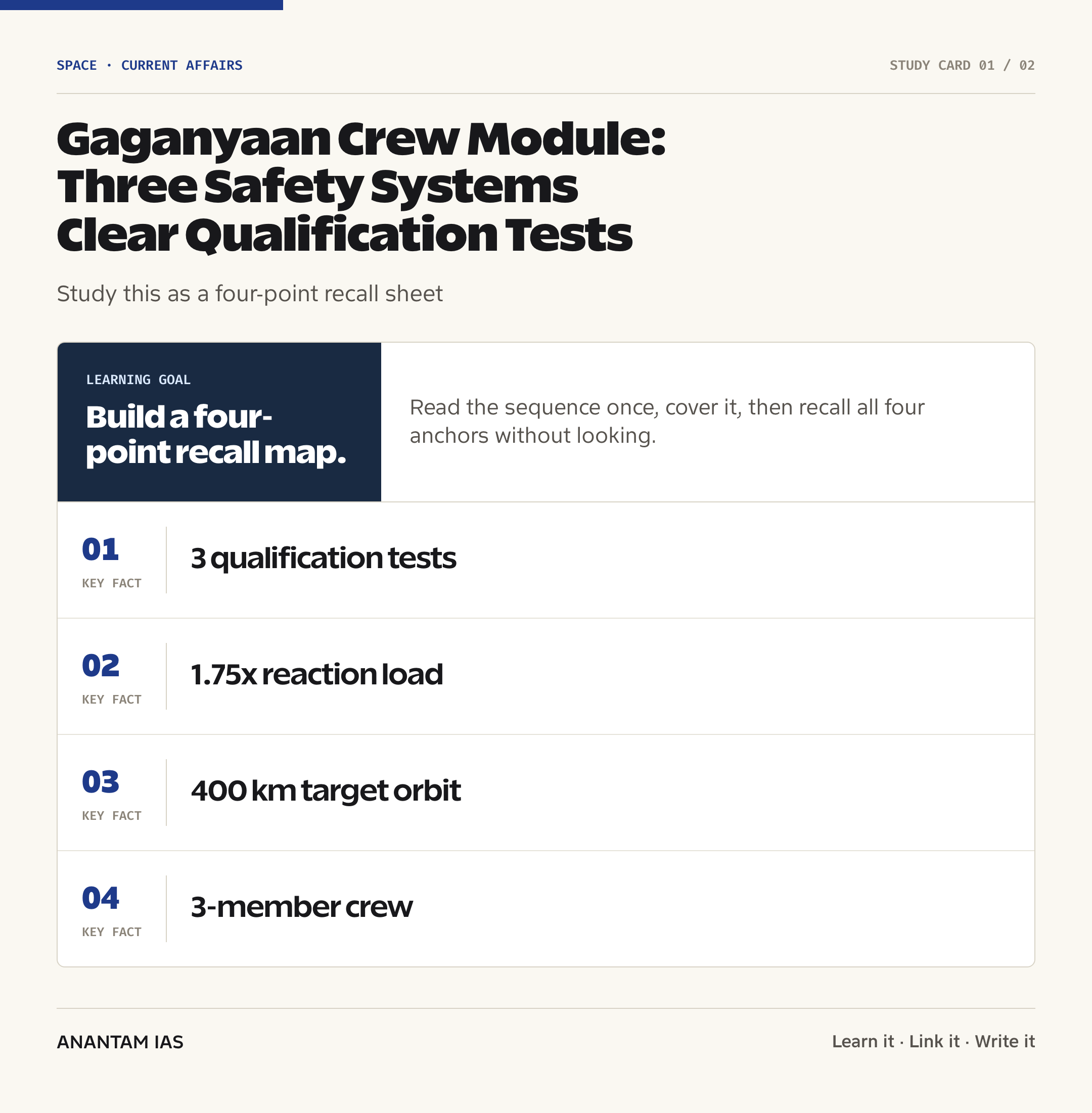
  • Apex-cover load test: A test rig applied about 1.75 times the estimated reaction loads at identified points on a simulated Crew Module.
  • Qualification scope: ISRO reported compliance with the functional, performance, structural-integrity and design-margin objectives defined for these tests.

The development matters in the context of:

  • Human spaceflight demands evidence that safety-critical systems work across expected operating ranges, not only at one nominal condition.
  • Return safety depends on a sequence of independent events: module separation, stable re-entry configuration, parachute exposure and deployment, splashdown and post-landing stability.
  • Qualification testing verifies a design against specified loads and conditions; later integrated and uncrewed demonstrations are still needed to establish system-level confidence.
Gaganyaan Crew Module: Three Safety Systems Clear Qualification Tests — quick facts

UPSC Relevance

Prelims Relevance

  • Gaganyaan is India’s programme to demonstrate indigenous human-spaceflight capability.
  • The Orbital Module consists of the Crew Module and Service Module.
  • The Crew Module provides the habitable volume and is designed to protect the crew through re-entry, descent and splashdown.
  • The Service Module is an unpressurised support unit containing propulsion, power, thermal and avionics systems.
  • CS-CDS carries electrical communication and hydro-pneumatic connections between the Crew Module and Service Module.
  • CSU-1 and CSU-2 are the two umbilical elements on the Service Module and Crew Module sides respectively.
  • The apex cover protects parachutes and associated subsystems before it is jettisoned at a predetermined altitude.
  • The Crew Module Up-righting System uses stored cold gas to deploy flotation hardware after sea splashdown.
  • Qualification tests assess whether a design meets specified performance and structural requirements; they aren’t the same as a complete mission test.

Mains Relevance

GS Paper 3

  • Indigenous capability: Explain how crew recovery, separation mechanisms, human-rated structures and life-support interfaces expand India’s high-reliability engineering base.
  • Technology validation: Examine why subsystem qualification, integrated testing and uncrewed precursor missions form separate layers of a human-spaceflight safety case.
  • Spillovers: Link high-assurance sensors, materials, pyrotechnics, valves and fault-tolerant avionics to wider industrial and disaster-response applications.

GS Paper 2

  • Public accountability: Discuss how transparent milestone reporting can distinguish verified subsystem progress from broad mission-readiness claims.
  • Institutional coordination: Assess the role of ISRO centres, research institutions, industry and academia in building a nationally distributed human-spaceflight ecosystem.

Essay

  • Reliability is accumulated: Complex public technology succeeds through repeated evidence, disciplined interfaces and learning from tests.
  • Ambition and restraint: Scientific confidence grows when institutions state both what a result proves and what remains unproven.

Background and Context

Gaganyaan's Mission Architecture

Gaganyaan combines a human-rated launch vehicle, an orbital spacecraft and a layered escape-and-recovery system.

  • Declared demonstration: ISRO describes a three-member crew reaching a target orbit of about 400 km, remaining for roughly three days and returning to Indian sea waters.
  • Human Rated LVM3: The launch vehicle is a reconfigured LVM3 whose systems must meet higher reliability and safety requirements for carrying people.
  • Orbital Module: The spacecraft comprises the pressurised Crew Module and the unpressurised Service Module, linked during orbital operations.
  • Crew Module: Its double-wall design combines a pressurised metallic inner structure with an external structure and thermal-protection system for re-entry.
  • Service Module: It supplies support functions in orbit through propulsion, power, thermal-control and avionics subsystems.
  • Safety layers: A Crew Escape System addresses launch or ascent emergencies, while separation, parachute and flotation systems protect the return phase.
Gaganyaan Crew Module: Three Safety Systems Clear Qualification Tests — exam lens

Test 1: Uprighting After Splashdown

The first qualification test examined whether the recovered capsule can achieve the required upright attitude in the sea.

  • Safety need: A stable upright Crew Module supports safe crew conditions, communication and recovery operations after splashdown.
  • Operating principle: The Crew Module Up-righting System stores cold gas at high pressure and releases it through control valves to inflate flotation hardware.
  • System-level setup: ISRO assembled all elements of the uprighting system needed for the primary inflation-module trial.
  • Functional result: The primary flotation deployed as intended when stored gas flowed from the bottle through the commanded valves.
  • Range evidence: Inflation-time requirements were demonstrated across the complete operating range of gas-bottle pressures specified for the test.
  • Exam distinction: This was a float-inflation qualification test; it wasn’t a full sea-recovery rehearsal involving the entire spacecraft and recovery fleet.

Test 2: Crew-Service Module Umbilical Separation

The second test verified a clean disconnect at a safety-critical electrical and fluid interface between the two modules.

  • Umbilical role: The Crew Module-Service Module Connect Disconnect System, or CS-CDS, carries electrical communication and hydro-pneumatic connections.
  • Life-support interface: Fluid communication associated with the Environment Control and Life Support System passes through this link while the modules remain connected.
  • Two-part design: The system includes CSU-1 and CSU-2, located on the Service Module and Crew Module sides.
  • Separation sequence: The Service Module separates from the Crew Module at CSU-1; CSU-2 on the Crew Module side must disconnect before Crew Module re-entry.
  • Test article: ISRO separated CSU-2 from a simulated Crew Module rather than conducting an orbital-module flight test.
  • Measured outcome: The trial showed clean separation, structural stability of the Crew Module panel and interfaces, integrated functionality and the required design margins.
  • Failure significance: An incomplete disconnect or damaging impulse could threaten re-entry configuration, local structure or connected subsystems.

Test 3: Apex-Cover Separation Loads

The third test checked whether the Crew Module structure can withstand the reaction loads created when the parachute cover is jettisoned.

  • Apex-cover function: The cover shields parachutes and associated subsystems during earlier mission phases.
  • Timed event: At a predetermined altitude, pyrotechnically actuated thrusters separate the cover before sequential parachute deployment.
  • Qualification rig: An instrumented setup combined a simulated Crew Module with the associated systems needed to reproduce separation loads.
  • Load margin: The rig applied about 1.75 times the estimated reaction loads at identified structural locations.
  • Evidence collected: Measured strains and deformations remained within the criteria used to confirm design margin and structural integrity.
  • Scope boundary: The result qualifies the structure for the specified apex-cover load case; it doesn’t replace parachute deployment, aerodynamic or end-to-end descent tests.

How Qualification Fits the Safety Case

Human-rating is built from component, subsystem, integrated and mission-level evidence rather than a single pass-fail event.

  • Verification: Engineers check that a design conforms to stated specifications through analysis, inspection, demonstration and test.
  • Qualification: Representative hardware is exposed to defined environmental or load conditions to show that the design has adequate performance and margin.
  • Acceptance: Flight hardware is checked against workmanship and performance criteria before use; acceptance isn’t a substitute for design qualification.
  • Integration risk: A subsystem that passes alone may still interact unexpectedly with power, avionics, structures, software or the mission timeline.
  • Redundancy and tolerance: Human-rated systems combine conservative margins, fault detection, backups and safe-state behaviour to reduce single-point vulnerability.
  • Precursor logic: ISRO’s programme includes air-drop, abort and test-vehicle demonstrations plus uncrewed missions before a crewed flight.
  • Related learning: The second integrated air-drop test examined the parachute-led descent and recovery chain at a broader integrated level.

Strategic and Institutional Significance

The tests matter beyond one mission because they deepen India’s capacity for high-reliability systems engineering.

  • Human Space Flight Centre: HSFC leads programme coordination across ISRO centres, laboratories, academia and industry.
  • Critical technologies: The programme brings together human factors, life support, thermal protection, precision separation, recovery, crew training and certification.
  • Interface discipline: The umbilical test shows why seemingly small connectors can become mission-critical when electrical, fluid and structural requirements converge.
  • Domestic ecosystem: Qualification campaigns create demanding standards for materials, valves, sensors, test rigs, pyrotechnics and quality assurance.
  • Launch-vehicle linkage: The CE20 flight-acceptance process offers a related example of evidence needed before a critical propulsion system enters a mission stack.
  • Life-support linkage: The Gaganyaan life-support system explains the environmental-control functions whose interfaces must remain dependable while the modules are connected.
  • Communication standard: Public updates should identify the hardware tested, boundary conditions, measured result and remaining integration steps.

Way Forward

Complete the Evidence Chain

  • Repeat qualification where configuration changes affect loads, interfaces or operating ranges, and close every test anomaly through documented root-cause review.
  • Correlate physical results with structural, fluid and dynamics models so later simulations reflect measured behaviour.

Test Interfaces in Sequence

  • Exercise the separation, parachute and flotation events in increasingly integrated conditions, including credible off-nominal cases.
  • Verify that pyrotechnic shocks, disconnected lines and residual hardware don’t create new risks for re-entry or parachute deployment.

Protect Crew and Recovery Operations

  • Demonstrate reliable post-splashdown attitude, communication, environmental control and crew egress across representative sea states.
  • Coordinate spacecraft trials with naval recovery teams, medical support and mission-control procedures.

Report Milestones Precisely

  • Publish test objectives, configuration and verified outcomes without converting a subsystem success into a whole-mission claim.
  • Keep schedules subordinate to safety evidence and announce crewed-flight readiness only after integrated and uncrewed milestones support it.

Conclusion

The three tests strengthen three distinct links in Gaganyaan’s return-safety chain: upright flotation after splashdown, a clean Crew Module-side umbilical disconnect and structural survival of apex-cover separation loads.

Their real value lies in disciplined qualification evidence. India’s human-spaceflight capability will rest on how these verified subsystems perform together through integrated demonstrations, uncrewed missions and operational recovery rehearsals.

UPSC Practice Questions

Prelims MCQ 1

With reference to the Gaganyaan Crew Module systems, consider the following statements:

  1. The Crew Module Up-righting System uses stored cold gas to inflate flotation hardware.
  2. CSU-2 is the Crew Module-side umbilical that must separate before re-entry.
  3. The apex cover remains attached during parachute deployment to protect the parachutes.

How many of the above statements are correct?

(a) Only one (b) Only two (c) All three (d) None

Answer: (b) Only two

Explanation:

Statements 1 and 2 are correct. The apex cover protects the parachute package earlier, but it must separate at a predetermined altitude before the parachutes deploy in sequence.

Prelims MCQ 2

What was the purpose of the recent apex-cover separation-load qualification test?

(a) To certify the crew’s ability to leave the capsule at sea (b) To measure the Service Module’s orbital propulsion performance (c) To verify Crew Module structural integrity under cover-separation reaction loads (d) To demonstrate an end-to-end uncrewed orbital mission

Answer: (c) To verify Crew Module structural integrity under cover-separation reaction loads

Explanation:

An instrumented rig applied about 1.75 times the estimated reaction loads to a simulated Crew Module. Measured strains and deformations supported the specified structural margin.

UPSC Mains Questions

  1. Human-spaceflight safety is an evidence chain rather than the outcome of one successful test. Explain this statement using Gaganyaan’s module separation, parachute protection and post-splashdown uprighting systems. What further integrated evidence is needed?
  2. Gaganyaan is as much a systems-engineering and institutional-coordination programme as a space mission. Discuss its technological spillovers, interface risks and the importance of precise public communication about qualification milestones.

Sources: Indian Space Research Organisation and The Hindu.

Frequently Asked Questions

What did ISRO test?

ISRO reported three qualification tests: primary-float inflation for the Crew Module Up-righting System, CSU-2 umbilical separation from a simulated Crew Module, and Crew Module structural response to apex-cover separation loads. Each trial examined a specific safety-critical function or load case.

Why must the module upright?

The capsule can adopt an unfavourable attitude after sea splashdown. Stored cold gas inflates flotation hardware to help place it in the required upright position, supporting crew safety, communication, environmental conditions and access for recovery teams.

What does the CS-CDS do?

The Crew Module-Service Module Connect Disconnect System provides electrical communication and hydro-pneumatic connections between the two modules. Its Crew Module-side element, CSU-2, must disconnect cleanly before re-entry without damaging the panel, interfaces or nearby systems.

Why is the apex cover separated?

The apex cover shields the parachutes and related subsystems during earlier flight phases. It is jettisoned at a predetermined altitude by pyrotechnically actuated thrusters so the parachutes can deploy in sequence and slow the Crew Module for splashdown.

What does 1.75 times mean?

ISRO applied about 1.75 times the estimated reaction loads from apex-cover separation at identified points on a simulated Crew Module. The measured strain and deformation were used to check structural integrity and design margin for that specified event.

Is Gaganyaan now mission-ready?

No such conclusion follows from these tests alone. They add qualification evidence for three specific systems or load cases. Integrated trials, precursor demonstrations, uncrewed missions, flight-hardware acceptance and operational recovery preparation remain separate parts of the human-spaceflight safety case.

ICMR i-DRONE Study: Faster TB Diagnosis and Lower Patient Costs in Telangana

Open article →Download PDF

Why in News?

The ICMR i-DRONE study has supplied programme-level evidence on transporting tuberculosis sputum samples from remote health facilities to diagnostic laboratories. On 16 July 2026, PIB reported findings from Yadadri-Bhuvanagiri district in Telangana, where ICMR worked with AIIMS Bibinagar and the District TB Office under the National TB Elimination Programme.

The underlying quasi-experimental study compared a 206-participant pre-drone phase with a 634-participant drone phase. The study-defined median diagnostic turnaround time fell from 15 days to 5 days, while mean patient out-of-pocket expenditure fell from about ₹9,451 to ₹90.9. These are results from one district and two non-equivalent study phases, not proof that the same effects will occur nationwide.

  • Study population: The analysis covered 840 people, split between 206 participants in the conventional phase and 634 in the drone-enabled phase.
  • Time comparison: Median turnaround time changed from 15 days, with an interquartile range of 10–20 days, to 5 days, with an interquartile range of 2–9 days.
  • Patient-cost comparison: Mean out-of-pocket expenditure per participant changed from ₹9,451 to ₹90.9; the corresponding medians were ₹2,735 and zero.
  • Delivery design: Four TB Units formed the diagnostic hubs, while 11 Primary Health Centres and 60 sub-centres acted as spokes.
  • Evidence boundary: A pre-post operational study can show a strong association and practical feasibility, but it can’t by itself establish nationwide causal effectiveness.

The development matters in the context of:

  • Last-mile barrier: Molecular tests help only when a viable sputum specimen reaches a capable laboratory and the result returns in time.
  • Financial protection: Moving the sample instead of the patient can reduce travel, food and wage-loss costs borne by rural households.
  • Health-system design: Drones are one transport layer within a hub-and-spoke laboratory network, not a substitute for PHCs, laboratories or trained workers.
  • Technology governance: Wider use depends on biosafety, airspace permissions, weather resilience, cost-effectiveness and integration with NTEP reporting.
ICMR i-DRONE Study: Faster TB Diagnosis and Lower Patient Costs in Telangana — quick facts

UPSC Relevance

Prelims Relevance

  • i-DRONE expands to Drone Response and Outreach in North East; ICMR first launched the model for vaccine and medical-supply delivery in hard-to-reach areas.
  • The Indian Council of Medical Research is an autonomous body under the Department of Health Research, Ministry of Health and Family Welfare.
  • Tuberculosis is an infectious disease caused by Mycobacterium tuberculosis and most often affects the lungs.
  • Presumptive pulmonary TB can require sputum collection followed by bacteriological testing; a drone transports the specimen but doesn’t perform the diagnosis.
  • CBNAAT and Truenat are molecular testing platforms used within India’s TB diagnostic network.
  • In a hub-and-spoke model, peripheral collection sites feed samples to a smaller number of laboratories with diagnostic capacity.
  • Out-of-pocket expenditure in this study combined direct medical, direct non-medical and indirect costs such as wage loss.
  • The study used triple-layer packaging for sputum specimens and obtained ethics, district-administration, police and aviation permissions.
  • Civil drone operations in India are governed by the Drone Rules, 2021, with the Directorate General of Civil Aviation as the sector regulator.
  • Median and interquartile range are useful for skewed time and expenditure data because extreme values can pull the mean.

Mains Relevance

GS Paper 2

  • Public health: Access to early TB diagnosis, primary-care linkages and the operational capacity of the National TB Elimination Programme.
  • Social justice: Geographic inequity, catastrophic health spending and wage loss among remote and low-income households.
  • Governance: Centre-state-district coordination, public-health innovation, data systems and accountable scale-up.

GS Paper 3

  • Science and technology: Civil-drone applications, hub-and-spoke logistics and technology adaptation for rural service delivery.
  • Infrastructure: Connecting peripheral facilities to diagnostic laboratories across poor roads and difficult terrain.
  • Regulation and safety: Airspace approval, biological-sample packaging, trained operators, weather limits and contingency planning.

Essay

  • Move the service, not the vulnerable person: Public systems become more inclusive when delivery design absorbs distance and transaction costs.
  • Innovation needs institutions: A drone has public value only when laboratories, frontline workers, protocols and accountability work around it.

Background and Context

What the Study Actually Compared

The strongest way to read the evidence is as a district-level pre-post comparison, not as a randomized national trial.

  • Study design: Researchers used a quasi-experimental mixed-methods approach under ICMR’s i-DRONE initiative in rural Yadadri-Bhuvanagiri.
  • Conventional phase: From February to December 2023, patients generally travelled 10–30 km by road to TB Units with CBNAAT or Truenat facilities.
  • Drone phase: During the intervention period, presumptive TB patients submitted sputum at a nearby PHC or sub-centre and drones carried the packaged samples to a designated TB Unit.
  • Different denominators: The conventional phase included 206 participants, while the drone phase included 634; every time or cost figure must be read against these unequal groups.
  • Primary outcomes: The analysis examined turnaround time, patient and diagnostic delays, result-reporting time and patient out-of-pocket expenditure.
  • Statistical method: Because the distributions weren’t normal, the study compared phases with the Mann-Whitney U test and reported means, medians and interquartile ranges.
  • Supporting evidence: A separate qualitative study used 28 in-depth interviews and 12 focus-group discussions with 101 health-system stakeholders to examine feasibility and acceptability.
ICMR i-DRONE Study: Faster TB Diagnosis and Lower Patient Costs in Telangana — exam lens

How the Hub-and-Spoke Network Worked

The intervention shortened the patient’s journey by connecting nearby collection points to centralized molecular-testing capacity.

  • Spokes: Eleven PHCs and 60 sub-centres received sputum specimens from people living in or near remote villages.
  • Hubs: Four TB Units with CBNAAT or Truenat facilities performed the diagnostic testing.
  • Command centre: AIIMS Bibinagar coordinated routes, flight operations and links between the peripheral facilities and laboratories.
  • Patient pathway: The person travelled only to the closest participating facility instead of making the longer trip to a diagnostic TB Unit.
  • Sample pathway: Health workers collected, labelled and placed specimens in triple-layer packaging before scheduled transport.
  • Flight planning: Pre-programmed routes accounted for terrain, population density and no-fly zones; a licensed pilot monitored operations.
  • Technology role: The drone replaced a portion of surface transport. Collection quality, laboratory capacity, result communication and treatment linkage remained health-system tasks.

Reading the Turnaround-Time Results

The time result is substantial, but the definition, distribution and study setting matter as much as the headline.

  • Median comparison: Study-defined turnaround time fell from 15 days in the conventional group to 5 days in the drone group.
  • Spread of observations: The interquartile range narrowed from 10–20 days to 2–9 days, suggesting that the typical experience also became less delayed.
  • Mean comparison: Mean turnaround time fell from 16.6 days to 6.96 days, with a reported P value below 0.001.
  • Reporting pattern: Next-day results rose from 1.5% of 206 conventional-phase participants to 76.3% of 634 drone-phase participants.
  • Long reporting delays: Results taking more than two days fell from 92.2% in the conventional phase to 16.3% in the drone phase.
  • What changed directly: Samples reached laboratories through a planned logistics network without requiring the patient to make the full journey.
  • What remains unproven: The study didn’t establish whether the model improves long-term treatment initiation, adherence, cure rates or transmission at population scale.

Reading the Cost Results Without Overclaiming

The reported rupee values measure patient out-of-pocket expenditure, not the government’s total drone-service cost.

  • Mean OOPE: Average expenditure per participant fell from ₹9,451 in the conventional phase to ₹90.9 in the drone phase.
  • Median OOPE: The median fell from ₹2,735 to zero, meaning at least half of the drone-phase participants reported no measured out-of-pocket cost.
  • Cost basket: OOPE covered direct medical spending, direct non-medical costs such as travel and food, and indirect costs such as wage loss for the patient or attendant.
  • Mechanism: Nearby collection reduced long-distance travel and time away from work, while the public network handled specimen transport.
  • Mean versus median: The much higher mean in the conventional phase shows that some participants faced very large expenses; both statistics are needed to describe the distribution.
  • Missing denominator: The study didn’t present the full public cost per flight, per sample, per positive diagnosis or per disability-adjusted life year averted.
  • Policy implication: A patient-cost reduction supports equity, but procurement decisions still need a separate health-system cost-effectiveness and budget-impact assessment.

Why Sample Transport Matters for TB Elimination

A molecular-testing network is only as useful as its ability to move good-quality specimens and timely results across the last mile.

  • Diagnostic cascade: A person with symptoms must reach care, provide an adequate specimen, receive a bacteriological result and enter appropriate treatment.
  • Transport bottleneck: Long distance, weak roads, infrequent public transport and wage loss can interrupt the cascade before a laboratory sees the sample.
  • Public-health cost: Delayed diagnosis prolongs illness and can extend the period during which infectious pulmonary TB spreads in the community.
  • Equity gain: Sending the sample to the laboratory can be more inclusive than requiring a sick person and attendant to cross the district.
  • NTEP fit: The model strengthens laboratory linkage inside the existing programme rather than creating a separate diagnostic system.
  • Core revision: Review the TB-Free India strategy and the wider tuberculosis care cascade before using this case study in a Mains answer.
  • Replicability test: Scale should be targeted where avoidable road delay, sufficient sample volume and reliable laboratory capacity make aerial logistics valuable.

Operational, Biosafety and Regulatory Safeguards

Routine deployment needs a safe chain of custody from sputum collection to the laboratory bench.

  • Biosafety: Trained staff must use correct containers, triple-layer packaging, disinfection procedures, manifests and documented handover.
  • Specimen integrity: Operations must protect samples from leakage, extreme conditions, delay and misidentification while meeting NTEP laboratory requirements.
  • Aviation approval: Routes, altitude, airspace and operator requirements must comply with the Drone Rules, 2021 and applicable DGCA permissions.
  • Weather resilience: Rain, high winds, signal loss or battery limits can ground a flight, so every route needs a road-based fallback.
  • Payload limits: The qualitative study recorded concerns about limited capacity and the need for extra sorties when sample volume exceeded a flight’s practical load.
  • Human interface: ASHAs, ANMs, laboratory staff and district authorities built trust, prepared specimens and aligned flight schedules with routine work.
  • Privacy: Flight visibility or poorly designed collection practices can expose a stigmatized health condition; facility-based collection and discreet scheduling matter.
  • Comparable institution-building: The ICMR high-altitude medicine centre at Keylong offers another example of adapting health research to difficult geography.

Limits, Scale-Up Tests and Answer-Building Guidance

A balanced answer should pair the promising operational association with the tests required before routine expansion.

  • No concurrent control: The before-and-after phases occurred at different times, so other programme changes may have contributed to the observed differences.
  • Unequal groups: The groups differed in size and participant characteristics; the researchers noted demographic imbalance and possible confounding.
  • Selection issue: Sites were purposively chosen for TB burden, remoteness and weak diagnostic access, which improves relevance to hard areas but limits generalization.
  • Recall bias: Patient spending was self-reported, making some measurement error possible, especially for indirect costs.
  • One-district evidence: Telangana’s terrain, staffing, TB Units, routes and weather can’t stand in for every Indian district.
  • Scale-up metrics: Compare road and drone options on cost per viable sample delivered, cancellation rate, time saved, laboratory throughput and treatment-linkage outcomes.
  • Digital integration: Track the specimen and result without creating a parallel data silo; the Ayushman Bharat Digital Mission shows the wider need for interoperable health information systems.
  • Answer structure: Start with the access problem, explain the network, cite the 840-participant result, separate patient OOPE from system cost, discuss limitations, and close with targeted evidence-led scale-up.

Way Forward

Target the Right Routes

  • Use distance, road time, weather, sample volume and laboratory readiness to identify corridors where drones offer a clear gain over scheduled surface transport.
  • Retain reliable road-based contingency plans for rain, wind, maintenance, signal failure and restricted airspace.

Measure Full Costs and Outcomes

  • Publish the public cost per sortie, per viable sample and per completed diagnosis, including staff, maintenance, batteries, training and regulatory compliance.
  • Track treatment initiation, adherence and patient outcomes instead of stopping assessment at sample delivery or result reporting.

Standardize Safety and Quality

  • Adopt audited SOPs for collection, triple-layer packaging, temperature and shock control, chain of custody, spill response and laboratory receipt.
  • Use route-risk assessments, trained operators, maintenance records and incident reporting under the applicable aviation framework.

Integrate People and Data

  • Train and compensate frontline workers and laboratory teams for the additional scheduling, packaging, documentation and community-communication work.
  • Link specimen identifiers, flight manifests, laboratory results and patient follow-up within NTEP systems while applying privacy safeguards.

Build Stronger Evidence

  • Test the model across tribal, hilly, flood-prone and island settings using concurrent comparison groups where feasible.
  • Set transparent expansion thresholds and subject contracts to independent evaluation so a promising pilot doesn’t become technology-led procurement without proof.

Conclusion

The ICMR i-DRONE study shows how a logistics redesign can move the burden of distance away from a person with possible TB. In one Telangana district, the drone-enabled phase was associated with a shorter diagnostic pathway and far lower patient spending because nearby facilities collected sputum and the network moved it to the laboratory.

The result supports careful expansion, not automatic national replication. India should scale route by route, protect biosafety and privacy, measure public-system costs, maintain surface-transport backups and test whether faster specimen movement leads to faster treatment and better outcomes.

UPSC Practice Questions

Prelims MCQ 1

With reference to ICMR’s i-DRONE TB study, consider the following statements:

  1. i-DRONE originally expands to Drone Response and Outreach in North East.
  2. The TB study was a randomized concurrent-control trial conducted across all Indian states.
  3. Primary Health Centres and sub-centres acted as spokes linked to TB Units with molecular-testing capacity.

How many of the above statements are correct?

(a) Only one (b) Only two (c) All three (d) None

Answer: (b) Only two

Explanation:

Statements 1 and 3 are correct. The study was a quasi-experimental pre-post programme study in Yadadri-Bhuvanagiri district, Telangana, not a randomized nationwide trial.

Prelims MCQ 2

Which interpretation of the study’s ₹9,451-to-₹90.9 comparison is most accurate?

(a) It is the total government cost of all conventional and drone operations. (b) It compares mean patient out-of-pocket expenditure across the two study phases. (c) It proves the drone service costs ₹90.9 for every sample nationwide. (d) It compares the market prices of the two drone models used.

Answer: (b) It compares mean patient out-of-pocket expenditure across the two study phases.

Explanation:

The figures are mean OOPE per participant, covering direct medical, direct non-medical and indirect costs. They aren’t a measure of the health system’s drone operating cost.

UPSC Mains Questions

  1. Drone-enabled sputum transport can reduce a geographic barrier to tuberculosis diagnosis, but it can’t replace primary care, laboratories or programme capacity. Discuss the i-DRONE model as a case of technology embedded in a public-health system.
  2. Assess the evidentiary value and limitations of the Telangana i-DRONE study. In your answer, distinguish patient out-of-pocket expenditure from health-system cost and suggest metrics for an accountable scale-up.
  3. Last-mile health innovation must be judged by equity, safety and outcomes rather than technological novelty. Examine with reference to the use of civil drones for transporting biological specimens in remote India.

Sources: PIB, Ministry of Health and Family Welfare and The International Journal of Tuberculosis and Lung Disease Open.

Frequently Asked Questions

What is ICMR i-DRONE?

i-DRONE expands to Drone Response and Outreach in North East. ICMR began it as a drone-based model for moving vaccines and medical supplies to hard-to-reach areas. The programme has since explored applications such as blood products, medicines, diagnostic specimens and TB sputum transport.

Where was the TB study conducted?

The programme-based study took place in Yadadri-Bhuvanagiri district of Telangana. AIIMS Bibinagar coordinated a network involving the District TB Office, four TB Units, 11 Primary Health Centres and 60 sub-centres under the National TB Elimination Programme. These facilities served remote and underserved villages.

What did the turnaround result show?

Among 206 conventional-phase and 634 drone-phase participants, the study-defined median turnaround time fell from 15 days to 5 days. The interquartile range narrowed from 10–20 days to 2–9 days. This is a district-level pre-post association, not a nationwide causal estimate.

Did drones reduce the government’s costs?

The published comparison doesn’t answer that question. It found mean patient out-of-pocket expenditure falling from ₹9,451 to ₹90.9, with the median falling from ₹2,735 to zero. A government decision also needs operating, staffing, maintenance, regulatory and opportunity costs per sample and diagnosis.

Why can’t the findings be generalized nationally?

The research compared two unequal groups at different times in one purposively selected district and had no concurrent control group. Participant characteristics also differed, and spending was self-reported. Other regions may have different terrain, weather, laboratory capacity, sample volumes, road networks and aviation constraints.

What safeguards are needed for TB sample flights?

A safe service needs trained collection staff, correct containers, triple-layer packaging, an auditable chain of custody, specimen tracking, licensed operators, approved routes and privacy protection. It also needs weather thresholds, maintenance and incident protocols, plus a dependable surface-transport fallback when a drone can’t fly.

PARIVARTAN Scheme: Replacing Old Trucks and Buses in the NCR

Open article →Download PDF

Why in News?

The Ministry of Housing and Urban Affairs approved the operational guidelines for the PARIVARTAN Scheme on 16 July 2026. The programme is now ready to replace older, highly polluting trucks and buses operating in the National Capital Region with eligible BS-VI-compliant or electric vehicles.

PIB confirmed that the Ministry of Road Transport and Highways will be the implementing ministry and that funding will flow through the National Capital Region Planning Board. The guidelines convert the Union Cabinet’s 3 June approval into an incentive and digital-delivery framework that requires coordination across Delhi, Haryana, Rajasthan and Uttar Pradesh.

  • The scheme carries a total outlay of ₹9,585 crore, including ₹5,041 crore in Central support.
  • The four participating jurisdictions have notified a 10-year motor vehicle tax concession and registration-fee waiver for eligible new vehicles.
  • Eleven original equipment manufacturers, representing more than 95% of the commercial-vehicle market, have agreed to extend the scheme discount.
  • Benefits will be delivered through a platform connected to VAHAN, V-Scrap, DigiELV and PFMS.

The development matters in the context of:

  • This is a fleet-renewal intervention, not a blanket subsidy for every commercial vehicle in the four participating states.
  • Its policy logic combines a polluter-retirement condition with finance, tax and manufacturer incentives for a cleaner replacement.
  • Its success must be judged by verified vehicle retirement and emission reduction, not only by registrations or subsidy disbursal.
PARIVARTAN Scheme: Replacing Old Trucks and Buses in the NCR — quick facts

UPSC Relevance

Prelims Relevance

  • PARIVARTAN expands to Programme for Accelerated Renewal and Incentivization of Vehicle Assets for Reducing Transport Air Pollution and Network Emissions.
  • Eligible old vehicles are trucks and buses registered in the Delhi-NCR region that meet BS-IV or earlier emission norms.
  • BS-III or older vehicles must be scrapped at a Registered Vehicle Scrapping Facility; an eligible BS-IV vehicle may instead be sold outside NCR in a non-NCAP city or town.
  • The replacement must be registered within the NCR and comply with BS-VI or stricter norms, or be electric.
  • In Delhi, replacement light goods vehicles must be electric; replacement buses must be BS-VI CNG or electric.
  • Government vehicles are excluded from the beneficiary pool.
  • The scheme has a two-year enrolment window, while Central benefits continue for five years from registration of the replacement.
  • The NCRPB is the funding channel, while MoRTH leads implementation and District Collectors or District Magistrates implement and monitor locally.

Mains Relevance

GS Paper 2

  • Use the scheme to explain cooperative federalism in a functional region that crosses state borders.
  • Assess whether an integrated portal, defined institutional roles and district monitoring can improve last-mile scheme delivery.

GS Paper 3

  • Connect old commercial vehicles with urban air pollution, environmental health and clean-technology transition.
  • Evaluate scrappage incentives against risks such as pollution displacement, weak charging networks and debt stress for small fleet owners.

Essay

  • Clean air policy works best when regulation, finance and technology move together.
  • A just green transition must make compliance affordable without weakening environmental outcomes.
  • Administrative borders cannot contain regional environmental problems.

Background and Context

Who and What the Scheme Covers

Eligibility turns on the old vehicle’s type, registration location, emission standard and replacement pathway.

  • The beneficiary must own a truck or bus registered in the Delhi-NCR area and compliant with BS-IV or an earlier standard.
  • The geographic reference is the notified National Capital Region, which includes NCT Delhi and notified NCR areas in Haryana, Rajasthan and Uttar Pradesh; it does not automatically cover every district in those states.
  • The regional design complements the planning logic discussed in the NCR Regional Plan 2041: transport and pollution flows cross administrative borders.
  • The Cabinet release estimated coverage of about 2.07 lakh vehicle owners, comprising around 1.91 lakh truck owners and 16,329 bus owners.
  • Government vehicles do not qualify. The programme is aimed at privately or commercially held legacy vehicles rather than routine public-fleet replacement.
  • Owners must complete the approved retirement or exit route for the old vehicle and then purchase and register the qualifying replacement within the NCR.
PARIVARTAN Scheme: Replacing Old Trucks and Buses in the NCR — exam lens

Retirement Rules and Replacement Technologies

PARIVARTAN links each subsidy to removal or relocation of an older polluting asset and acquisition of a cleaner vehicle.

  • A BS-III or older truck or bus must go to an authorised Registered Vehicle Scrapping Facility; continued operation or resale is not the approved exit route.
  • A BS-IV vehicle may be scrapped or sold outside the NCR, but sale is restricted to a city or town that is not covered by the National Clean Air Programme.
  • The standard replacement is a vehicle compliant with BS-VI or stricter emission norms, or an electric vehicle. Bharat Stage norms set progressively tighter limits on pollutants from vehicle exhaust.
  • Delhi applies a narrower technology condition: a replacement light goods vehicle must be electric, while a bus must be BS-VI CNG or electric.
  • An electric replacement can reduce tailpipe emissions, but its full value depends on charging availability, route suitability and electricity supply. The related PM E-DRIVE experience shows why vehicle support and enabling infrastructure must develop together.
  • A Certificate of Deposit in the scrappage system records vehicle deposit at an authorised facility. PARIVARTAN includes a lump-sum benefit linked to eligible CoD trading, which can connect vehicle retirement with a replacement buyer.

How the Incentive Package Is Structured

The scheme distributes the transition cost across the Centre, participating states, lenders and vehicle manufacturers.

  • The Centre provides a 5% interest subvention on eligible vehicle loans for five years, lowering the financing cost faced by an owner replacing an old asset.
  • Eligible diesel and CNG replacements receive monthly fuel vouchers; the Cabinet release placed the maximum at ₹4,800 per month, depending on vehicle category.
  • Electric replacements receive one-time financial assistance rather than a recurring fuel voucher, reflecting the different operating-cost structure.
  • Participating states waive registration fees and can provide up to 100% motor vehicle tax concession for a new replacement and 50% for an eligible used replacement for ten years.
  • The scheme also provides for waiver of eligible pending liabilities attached to participating old vehicles, reducing a barrier to formal scrappage.
  • Participating manufacturers must offer at least an 8% discount on the ex-showroom price of an eligible vehicle. Eleven OEMs covering over 95% of the commercial market had signed agreements by 16 July.
  • The two-year enrolment period creates a limited entry window, but Central benefits continue for five years from the new vehicle’s registration.
  • For analysis, separate upfront relief such as discount and fee waiver from recurring relief such as loan subvention and fuel vouchers; each changes owner behaviour through a different channel.

Institutional and Digital Delivery Chain

Implementation is deliberately shared because finance, registration, fuel support and scrappage sit with different actors.

  • MoHUA approved the guidelines and anchors the scheme through NCRPB, the statutory regional-planning institution under the ministry.
  • MoRTH is the implementing ministry. The Cabinet approval also assigns an implementation role to the Ministry of Petroleum and Natural Gas for the fuel-linked component.
  • The participating governments of Delhi, Haryana, Rajasthan and Uttar Pradesh issue tax and fee notifications, operate vehicle-registration systems and coordinate district execution in their NCR areas.
  • An Empowered Committee chaired by the Cabinet Secretary monitors the scheme at the Centre; its membership brings together NITI Aayog, concerned Union ministries, state chief secretaries and NCRPB.
  • District Collectors and District Magistrates are the local implementing and monitoring authorities, making district capacity central to beneficiary verification and grievance resolution.
  • The digital platform connects VAHAN for vehicle records, V-Scrap and DigiELV for end-of-life vehicle workflows, and PFMS for public payments.
  • Interfaces with lenders, OEMs and fuel-voucher systems should allow real-time eligibility checks, automated subvention claims and a traceable benefit trail.
  • Interoperability can reduce duplicate or false claims, but the administration still needs data-quality checks, consent safeguards and an appeal process when records across systems do not match.

Why Heavy-Vehicle Renewal Matters for Air Quality

The policy targets a small fleet segment because its pollution burden is disproportionately high.

  • PIB cited the 2018 ARAI-TERI source-apportionment study: transport contributes about 14% of PM2.5, 40% of carbon monoxide and 63% of nitrogen oxides in Delhi-NCR.
  • Within transport, trucks and buses account for about 36% of PM2.5 emissions despite forming only 3% of the total fleet.
  • The official estimate says one pre-BS heavy-duty vehicle can emit as much as 14 BS-VI-compliant vehicles, while a BS-IV vehicle emits about 2.7 times as much as a BS-VI counterpart.
  • This makes targeted fleet renewal a potential high-impact intervention, especially when heavy vehicles cover long distances and operate for many hours.
  • The scheme sits beside regulatory tools administered by the Commission for Air Quality Management, but incentives and restrictions serve different purposes.
  • A credible impact assessment must compare baseline and post-replacement emissions, vehicle kilometres travelled and actual retirement records, rather than treating every subsidy claim as an equal air-quality gain.

Governance Risks and Policy Trade-offs

The scheme can accelerate compliance, but several design and implementation risks need close monitoring.

  • Allowing a BS-IV vehicle to be sold outside NCR can create pollution displacement; the non-NCAP restriction reduces the immediate regulatory overlap but does not remove the vehicle’s emissions.
  • Small truck and bus owners may still face a large upfront capital gap even after discounts and interest support, while a new loan can increase business risk.
  • An 8% OEM discount is valuable only if the reference price is transparent and manufacturers do not offset it through accessories, finance charges or reduced dealer discounts.
  • Electric adoption can stall without suitable depot charging, grid connections, maintenance skills and route planning, especially for high-use freight fleets.
  • RVSF capacity and distance matter. A weak scrappage network can raise transaction costs, encourage informal dismantling or delay issue of a usable Certificate of Deposit.
  • Digital integration can exclude owners when legacy registration, tax or identity records are incomplete. A human-assisted correction channel is needed alongside automation.
  • The scheme’s stated 2.07 lakh pool is not the same as guaranteed replacement. Track applications, approved cases, completed scrappage, new registrations and measured emissions as separate outcomes.

Answer-Building Framework for UPSC

A strong answer should move from the regional pollution problem to design, delivery risks and measurable outcomes.

  • Open with the core problem: a small share of old trucks and buses creates a disproportionate share of transport particulate emissions in the NCR.
  • Explain the policy chain as retire old vehicle → finance cleaner replacement → register within NCR → verify digitally.
  • Organise the body under four headings: eligibility and technology, incentive sharing, cooperative-federal institutions, and environmental additionality.
  • Add a balanced criticism: affordability for small operators, pollution relocation, charging gaps, digital exclusion and the need to audit OEM pricing.
  • End with an outcome test: verified scrappage, lower fleet-average emissions and better air quality, supported by transparent district-wise data.

Way Forward

Protect Environmental Additionality

  • Track the final status of every retired or transferred BS-IV vehicle and publish aggregate destination data.
  • Link payments to verified scrappage or permitted transfer, replacement registration and continued compliance.

Make the Transition Affordable

  • Provide assisted application desks and standard loan disclosures for small fleet owners.
  • Audit ex-showroom reference prices so the OEM discount remains an additional, visible benefit.

Build the Supporting Ecosystem

  • Expand RVSF access, depot charging, grid connections and trained maintenance networks across the NCR.
  • Coordinate freight routes, charging plans and vehicle availability before pushing electric-only conditions.

Measure Results, Not Only Spending

  • Publish district-wise dashboards for applications, scrappage, replacements, grievance disposal and fiscal support.
  • Commission independent evaluation of PM2.5 and NOx reduction, fleet activity and distributional effects.

Conclusion

PARIVARTAN treats clean mobility as a coordinated replacement problem rather than a single purchase subsidy. Its combination of retirement rules, financing relief, manufacturer discounts and regional delivery gives the policy a credible implementation chain.

The decisive test is whether the programme permanently removes high-emitting vehicles without shifting the burden elsewhere or excluding small operators. Transparent records, accessible grievance handling and measured air-quality outcomes should define success.

UPSC Practice Questions

Prelims MCQ 1

With reference to the PARIVARTAN Scheme, consider the following statements:

  1. BS-III or older eligible trucks and buses must be scrapped at a Registered Vehicle Scrapping Facility.
  2. An eligible BS-IV vehicle may be sold outside NCR only in a non-NCAP city or town.
  3. Government trucks and buses are included in the beneficiary pool.

How many of the above statements are correct?

(a) Only one (b) Only two (c) All three (d) None

Answer: (b) Only two

Explanation:

Statements 1 and 2 are correct. Government vehicles are excluded. The replacement must be registered within NCR and comply with BS-VI or stricter norms, or be electric.

Prelims MCQ 2

Which institution serves as the funding channel for the PARIVARTAN Scheme?

(a) Commission for Air Quality Management (b) National Capital Region Planning Board (c) National Highways Authority of India (d) Central Pollution Control Board

Answer: (b) National Capital Region Planning Board

Explanation:

The scheme is funded through the NCRPB under MoHUA, while MoRTH leads implementation. The participating states, district administrations, lenders and OEMs handle defined delivery functions.

UPSC Mains Questions

  1. PARIVARTAN uses scrappage conditions, fiscal incentives and digital verification to modernise commercial fleets in Delhi-NCR. Examine how this design can reduce transport emissions while addressing affordability, pollution displacement and implementation risks for small truck and bus owners.
  2. Air pollution in the National Capital Region is a regional governance problem rather than a Delhi-only problem. Discuss the cooperative-federal architecture of the PARIVARTAN Scheme and suggest accountability mechanisms for converting vehicle replacement expenditure into measurable air-quality gains.

Sources: PIB, Ministry of Housing and Urban Affairs and PIB, Union Cabinet.

Frequently Asked Questions

What is the PARIVARTAN Scheme?

PARIVARTAN is a two-year enrolment programme for replacing eligible BS-IV or older trucks and buses registered in the Delhi-NCR region. It combines scrappage or approved transfer conditions with loan support, tax and fee concessions, manufacturer discounts, fuel vouchers or EV assistance, and digital verification.

Which old vehicles qualify?

The scheme covers eligible trucks and buses registered in the notified NCR area that comply with BS-IV or an earlier emission norm. Government vehicles are excluded. The owner must follow the prescribed retirement or transfer route and register a qualifying cleaner replacement within NCR.

Must every old vehicle be scrapped?

No. A BS-III or older eligible vehicle must be scrapped at an authorised RVSF. A BS-IV vehicle may be scrapped or sold outside NCR in a city or town not covered by the National Clean Air Programme. The second route can shift emissions, so destination tracking matters.

What replacement vehicles are allowed?

The general rule allows a BS-VI or stricter emission-compliant vehicle, or an electric vehicle. Delhi has tighter conditions: a replacement light goods vehicle must be electric, while a replacement bus must be BS-VI CNG or electric. The vehicle must be registered within NCR.

What financial benefits are available?

The package includes 5% interest subvention on eligible loans for five years, manufacturer discount of at least 8%, registration-fee waiver and motor vehicle tax relief. Eligible diesel and CNG vehicles receive monthly fuel vouchers, while electric replacements can receive one-time assistance.

Who implements and monitors the scheme?

MoRTH leads implementation, with funding routed through NCRPB under MoHUA and fuel-linked support involving MoPNG. Participating NCR governments issue tax and registration measures, District Collectors or District Magistrates manage local delivery, and a Cabinet Secretary-led Empowered Committee monitors the programme.

Draft CAFE-III Norms: Passenger-Vehicle Efficiency for 2027-32

Open article →Download PDF

Why in News?

The Draft CAFE-III norms, formally described as CAFE 2027, were circulated by the Ministry of Power on 16 July 2026 for public and stakeholder consultation. PIB confirmed that the proposed standards would cover M1 passenger vehicles manufactured or imported for sale in India from 2027-28 to 2031-32.

The Bureau of Energy Efficiency draft notification proposes manufacturer-specific, sales-weighted fleet targets rather than one identical fuel-consumption ceiling for every model. It combines progressively tighter annual standards with technology adjustments, renewable-fuel factors, super credits, a credit-debit passbook and penalties under the Energy Conservation Act, 2001.

  • Consultation deadline: The Ministry invited objections and suggestions up to 6 August 2026.
  • Proposed start: The standards are intended to take effect on 1 April 2027 and operate through 31 March 2032.
  • Coverage: They apply to M1 vehicles manufactured or imported for domestic sale, subject to the final notification.
  • Core test: A manufacturer’s sales-weighted actual fleet consumption must be lower than or equal to its mass-based annual standard.
  • Status: These are draft norms open to consultation, not a final legal obligation yet.

The development matters in the context of:

  • Energy security: Better fleet efficiency can reduce petroleum use and exposure to imported crude oil.
  • Climate policy: The framework links tailpipe carbon dioxide, alternative fuels and electrified powertrains within one compliance method.
  • Industrial transition: Five annual steps give automobile manufacturers a product-planning signal while making compliance progressively stricter.
  • Regulatory design: Flexibilities can lower transition costs, but weak or excessive credits may dilute real-world fuel savings.
Draft CAFE-III Norms: Passenger-Vehicle Efficiency for 2027-32 — quick facts

UPSC Relevance

Prelims Relevance

  • CAFE stands for Corporate Average Fuel Economy; it regulates a manufacturer’s fleet average, not only an individual model.
  • M1 category covers passenger vehicles with not more than eight seats in addition to the driver’s seat.
  • The proposed cycle runs from 2027-28 to 2031-32 and is called CAFE 2027 in the draft.
  • The draft draws authority from Sections 14 and 18 of the Energy Conservation Act, 2001.
  • The Bureau of Energy Efficiency is a statutory body established under the Energy Conservation Act, 2001.
  • MIDC means Modified Indian Driving Cycle; WLTP means Worldwide Harmonized Light Vehicles Test Procedure.
  • Fuel consumption is expressed as petrol-equivalent litres per 100 km; a lower value indicates better efficiency.
  • Carbon Neutrality Factors are proposed for specified renewable-fuel pathways before compliance assessment.
  • Super credits use volume derogation factors that give eligible cleaner vehicle types extra weight in the fleet calculation.
  • A small-volume manufacturer with fewer than 1,000 eligible vehicles in a reporting period is proposed to be exempt from the specific target.

Mains Relevance

GS Paper 3

  • Environment: Transport decarbonization, fuel efficiency and the relationship between tailpipe regulation and lifecycle emissions.
  • Energy security: Lower petroleum consumption, reduced import dependence and exposure to global oil-price shocks.
  • Science and technology: Hybrid and electric powertrains, regenerative braking, efficient accessories and test-cycle reform.
  • Industrial policy: Technology-neutral standards, innovation incentives and compliance costs for automobile manufacturers.

GS Paper 2

  • Governance: Consultation, delegated legislation, inter-ministerial coordination and credible monitoring.
  • Regulatory capacity: Roles of the Ministry of Power, BEE, MoRTH, type-approval agencies and the designated compliance agency.

Essay

  • Efficiency and sufficiency: Cleaner technology matters, but total travel demand and vehicle size also shape environmental outcomes.
  • Rules that reward outcomes: Performance standards can encourage innovation when measurement and enforcement remain credible.

Background and Context

What CAFE Regulates and Which Vehicles It Covers

Corporate Average Fuel Economy is a fleet-performance rule designed to improve the average efficiency of vehicles sold by each manufacturer.

  • Corporate average: Compliance is assessed across a manufacturer’s eligible domestic-sales fleet, so efficient models can balance less efficient ones within the prescribed calculation.
  • Not a per-model ban: A particular model may consume more than the fleet target, but the sales-weighted average for the manufacturer’s full eligible fleet must meet its standard.
  • M1 scope: Under the Central Motor Vehicles Rules, M1 means a passenger vehicle with no more than eight seats in addition to the driver’s seat.
  • Domestic market: The draft covers eligible vehicles manufactured or imported for sale in India and includes variants for which the relevant duty has been paid.
  • Manufacturer definition: Both manufacturers and importers whose vehicles require type approval can fall within the framework.
  • Longer policy arc: BEE records CAFE Stage I from 2017-18 and Stage II from 2022-23; the proposed CAFE-III cycle would follow them from 2027-28.
Draft CAFE-III Norms: Passenger-Vehicle Efficiency for 2027-32 — exam lens

Legal and Institutional Architecture

The proposal divides standard-setting, testing, administration and enforcement across energy and transport institutions.

  • Statutory basis: The Central Government issued the draft using clauses (a), (b) and (c) of Section 14 read with Section 18 of the Energy Conservation Act, 2001.
  • Ministry of Power: It proposes the energy-consumption standards in consultation with the Bureau of Energy Efficiency.
  • BEE: The statutory efficiency body would administer the compliance-credit mechanism and maintain the regulatory framework with the designated agency.
  • MoRTH: The Ministry of Road Transport and Highways would enforce testing, calculation, reporting, production conformity and technology-adjustment methods under the Central Motor Vehicles Rules.
  • Type-approval agencies: Notified testing bodies verify model-level fuel-use and carbon-dioxide values under standardized laboratory procedures.
  • Public consultation: The 21-day objection-and-suggestion window is part of pre-publication rule-making; the final standard may differ from the draft.
  • Related foundation: See how BEE uses standards and labeling to shape energy demand across other sectors.

Fleet-Average Logic: Target Versus Actual Performance

The compliance test compares a manufacturer-specific target with its sales-weighted actual petrol-equivalent fuel consumption.

  • Target formula: The annual standard is calculated as a × (W – b) + c, where W is the sales-weighted average unladen mass of the manufacturer’s eligible vehicles.
  • Mass adjustment: The formula recognizes differences in fleet weight, but annual constants tighten the standard over time so efficiency pressure continues.
  • Actual average: Each model’s petrol-equivalent fuel use is weighted by its eligible volume, with applicable carbon-neutrality, technology and super-credit adjustments.
  • Common unit: Petrol, diesel, LPG, CNG and electricity are converted into petrol-equivalent litres per 100 km so diverse powertrains can enter one fleet calculation.
  • Direction of compliance: Lower consumption is better; the actual annual average must be less than or equal to the applicable annual standard.
  • Credit or debit: Better-than-target performance creates a credit, while consumption above the target creates a debit recorded in the manufacturer’s passbook.
  • Exam method: In an answer, write the chain as model data → sales weighting → fleet average → target comparison → credit, debit or penalty.

Five Annual Steps and the Test-Cycle Transition

CAFE-III proposes year-by-year tightening while collecting parallel data for a later move from MIDC to WLTP.

  • Five-year horizon: Separate formula constants are prescribed for each fiscal year from 2027-28 through 2031-32 instead of one unchanged target for the entire cycle.
  • Progressive tightening: The multiplier a falls from 0.00158 in 2027-28 to 0.00131 in 2031-32, while c falls from 3.9960 to 3.3273 litres per 100 km.
  • MIDC basis: The draft’s target and initial performance calculations continue to use the Modified Indian Driving Cycle.
  • Dual reporting: For models sold from 1 April 2026, manufacturers are proposed to report carbon-dioxide performance measured on both MIDC and the notified WLTP.
  • WLTP purpose: The newer test procedure uses a more varied standardized driving profile intended to better represent real-world operation than the older cycle.
  • Unfinished transition: The Ministry of Power would separately notify the MIDC-to-WLTP conversion factor after BEE receives the required data.
  • Regulatory caution: Until that conversion is notified, the draft should not be described as a complete immediate switch to WLTP.

Technology, Fuel and Powertrain Adjustments

The proposal uses several adjustments to reward fuel-saving equipment, renewable fuels and cleaner propulsion choices.

  • Technology derogation: Certified fuel-saving technologies may receive a 1 g CO2/km benefit each, subject to an overall cap of 9 g CO2/km on MIDC.
  • Eligible examples: The indicative list includes start-stop systems, tire-pressure monitoring, regenerative braking, efficient transmissions, LED lighting, advanced glazing, electric pumps and efficient air-conditioning.
  • Carbon Neutrality Factor: The draft proposes specified discounts to declared tailpipe carbon dioxide for E20 or higher petrol blends, flex-fuel ethanol pathways, CNG with biomethane and notified diesel biofuel blends.
  • Illustrative factors: It proposes 8% for E20-or-higher petrol vehicles, 22.3% for flex-fuel ethanol and strong-hybrid flex-fuel vehicles, and at least 5% for CNG subject to notified CBG blending.
  • Super credits: Battery electric and range-extended electric vehicles receive a proposed volume factor of 3.0; plug-in hybrids receive 2.5, strong hybrids 1.6 and flex-fuel ethanol vehicles 1.1.
  • Policy purpose: These adjustments can speed technology adoption, but the accounting benefit must stay aligned with verifiable energy and emissions gains.
  • Study links: Compare the treatment of electric vehicles and India’s support ecosystem with the E20 ethanol-blending debate.

Passbooks, Pooling, Buyout and Penalty

CAFE-III combines annual measurement with block-period settlement and several proposed routes for resolving a compliance shortfall.

  • Annual assessment: Credits and debits are calculated each year and entered in a passbook maintained for each manufacturer or importer.
  • Compliance blocks: The first block covers three years from 2027-28; the second covers two years from 2030-31. Unused credits lapse at the end of the relevant block.
  • Pooling: Manufacturers may exchange or trade credits with one another on mutually agreed terms and report the result to the designated agency.
  • BEE buyout: The draft allows debit settlement by buying credits from BEE, with proposed prices rising from ₹2,500 per g CO2/km for FY 2028 to ₹4,500 for FY 2032.
  • Trading window: Exchange or buyout is proposed within 30 days, up to 30 September of each assessment year, followed by a final passbook before 31 October.
  • Penalty stage: Compliance is measured annually, but the draft proposes penalties at the end of a block after credit settlement, under Sections 26 to 28 of the Energy Conservation Act.
  • Fund flow: Penalties and buyout receipts would enter the Central Energy Conservation Fund, with 90% proposed for states and 10% retained by the Centre.
  • Small-volume exemption: A manufacturer with fewer than 1,000 eligible vehicles in a reporting year would be exempt from the specific fleet target.

Significance, Risks and Answer-Building Guidance

A strong UPSC assessment should connect energy security and innovation with the integrity of measurement and the risk of accounting dilution.

  • Energy-security gain: Lower fleet fuel use can reduce oil demand, the import bill and vulnerability to international supply and price shocks.
  • Climate co-benefit: More efficient vehicles can reduce carbon dioxide per kilometre, supporting the wider net-zero transition when electricity and fuel pathways also decarbonize.
  • Technology signal: Annual tightening can steer product planning toward lighter design, efficient engines, hybrids, electric vehicles and lower-loss accessories.
  • Consumer benefit: Better fuel economy can lower running costs, though vehicle purchase price, rebound in travel and real-world driving conditions affect net savings.
  • Credit-integrity risk: Super credits and deemed technology benefits may make regulatory compliance easier without an equal fall in actual fleet energy use if calibration is too generous.
  • Test-gap risk: Laboratory performance can differ from on-road consumption, making WLTP transition, production conformity and public reporting important.
  • Equity issue: Mass-based standards should avoid locking in a shift toward ever-heavier vehicles while still accounting for safety, utility and market diversity.
  • Answer structure: Define fleet-average regulation, explain the calculation and institutions, weigh benefits against flexibilities, and end with test integrity plus transparent annual disclosure.

Way Forward

Finalize a Transparent Metric

  • Publish the final annual coefficients, conversion factors and worked examples in a machine-readable format so manufacturers and the public can reproduce calculations.
  • Notify the MIDC-to-WLTP conversion method before the transition affects compliance and disclose the supporting evidence.

Protect Environmental Integrity

  • Review super-credit, carbon-neutrality and technology benefits against measured fleet outcomes and reduce any factor that over-rewards accounting rather than fuel savings.
  • Separate tailpipe accounting from lifecycle analysis so policy claims don’t confuse vehicle emissions with upstream fuel and electricity emissions.

Strengthen Monitoring

  • Require reliable model-wise sales, mass, fuel-use and carbon-dioxide data, with independent verification and production-conformity checks.
  • Publish manufacturer-level targets, actual averages, credits, debits, trades and penalties through a concise annual compliance dashboard.

Align the Wider Transport Strategy

  • Coordinate CAFE with vehicle-emission standards, fuel quality, EV charging, public transport and scrappage policy instead of treating efficiency as a stand-alone solution.
  • Track real-world fuel use and rebound effects while supporting affordable, safe and efficient mobility rather than only higher vehicle sales.

Use Consultation Well

  • Publish a response-to-comments document explaining which stakeholder proposals were accepted, modified or rejected and why.
  • Give manufacturers regulatory certainty without weakening the year-on-year efficiency trajectory needed for energy security and climate goals.

Conclusion

The Draft CAFE-III norms shift the focus from a single headline mileage number to a structured five-year fleet-compliance system. Their strongest feature is outcome-oriented regulation: each manufacturer’s sales mix, vehicle mass, fuel pathway and technology choices feed into an annual average that becomes a credit or debit.

The final rule will be credible only if test cycles, conversion factors and flexibilities reflect actual fuel savings. Transparent data, periodic recalibration and firm end-of-block enforcement can turn CAFE-III into an energy-security and industrial-innovation instrument rather than an accounting exercise.

UPSC Practice Questions

Prelims MCQ 1

With reference to the proposed CAFE-III norms, consider the following statements:

  1. They apply to the corporate average of a manufacturer’s eligible M1 vehicle fleet rather than imposing one identical limit on every model.
  2. The manufacturer-specific target is linked to the sales-weighted average unladen mass of its eligible vehicles.
  3. The draft proposes an immediate and complete replacement of MIDC by WLTP from the first compliance year.

How many of the above statements are correct?

(a) Only one (b) Only two (c) All three (d) None

Answer: (b) Only two

Explanation:

Statements 1 and 2 are correct. CAFE is a fleet-average rule, and the annual standard uses weighted average unladen mass. Statement 3 is incorrect: the draft retains MIDC for the initial calculation, requires parallel MIDC and WLTP reporting, and leaves the conversion factor for separate notification.

Prelims MCQ 2

Which one of the following institutions is proposed to enforce vehicle testing, calculation methods and conformity of production under CAFE-III?

(a) Ministry of Road Transport and Highways (b) Central Electricity Regulatory Commission (c) Petroleum and Natural Gas Regulatory Board (d) National Highways Authority of India

Answer: (a) Ministry of Road Transport and Highways

Explanation:

The draft assigns MoRTH responsibility for testing and calculation methodologies, reporting, conformity of production and related adjustment methods under the Central Motor Vehicles Rules. BEE’s role centers on energy-efficiency administration and the credit mechanism.

UPSC Mains Questions

  1. CAFE-III is best understood as a fleet-governance framework, not a mileage limit for each car. Explain its manufacturer-specific calculation, institutional architecture and credit-debit system. Assess how this design can improve energy security without allowing compliance flexibilities to displace real fuel savings.
  2. India’s passenger-vehicle efficiency policy must balance industrial transition, consumer mobility and climate integrity. Evaluate the proposed CAFE-III treatment of test cycles, alternative fuels, hybrids, electric vehicles and fuel-saving technologies. Suggest safeguards for transparent, verifiable and technology-neutral implementation.

Sources: PIB, Ministry of Power and Bureau of Energy Efficiency draft notification.

Frequently Asked Questions

What are CAFE-III norms?

CAFE-III is India’s proposed third phase of Corporate Average Fuel Economy regulation for M1 passenger vehicles. It measures each manufacturer’s sales-weighted fleet average in petrol-equivalent fuel consumption and compares it with a manufacturer-specific annual target. The July 2026 text is a draft for consultation, not the final enforceable standard.

When would CAFE-III apply?

The draft proposes application from 1 April 2027 through 31 March 2032, covering fiscal years 2027-28 to 2031-32. It sets different formula constants for each year. Public comments were invited before the final notification, so operative dates and detailed provisions should be checked against the final rule once issued.

Does every car get the same target?

No. The standard is calculated for each manufacturer’s fleet using its sales-weighted average unladen mass. Actual performance is also sales weighted across eligible models and converted into petrol-equivalent consumption. A less efficient model can remain in the fleet if the manufacturer’s overall adjusted average still meets its annual standard.

How are electric and hybrid vehicles treated?

The draft proposes volume derogation factors, often called super credits, for battery electric, range-extended, plug-in hybrid, strong-hybrid and flex-fuel vehicles. It also provides technology and renewable-fuel adjustments. These can encourage cleaner technologies, but regulators must compare the accounting benefits with actual fleet energy and emissions outcomes.

What happens if a manufacturer misses its target?

A shortfall becomes a debit in the manufacturer’s compliance passbook. The draft permits carry-forward within a block, voluntary pooling or credit exchange with other manufacturers, and purchase of credits from BEE during a defined window. Any unresolved non-compliance can attract an end-of-block penalty under the Energy Conservation Act.

What is the MIDC-WLTP issue?

MIDC is India’s older standardized driving cycle, while WLTP uses a broader speed-and-load profile intended to better represent real driving. The draft retains MIDC for the initial standard but requires dual reporting for relevant models. A separate government notification would establish the conversion factor for the transition to WLTP.

El Niño Raises Import Risks for Oils, Pulses and Cotton

Open article →Download PDF

Why in News?

A strengthening El Niño, below-normal July rainfall outlook and delayed kharif sowing have raised the risk that India may need larger imports of vegetable oils, pulses and raw cotton in 2026-27. This is a forward-looking risk, not a realised import record for the current financial year.

The Indian Express reported that India had already imported record quantities of vegetable oils and raw cotton in 2025-26, while pulse imports were near an earlier peak. IMD and NOAA now expect El Niño to strengthen, but both seasonal rainfall and crop output remain uncertain because ocean conditions don’t determine local weather or yields on their own.

  • IMD’s 30 June outlook said July 2026 all-India rainfall was most likely to be below normal, or less than 94% of the Long Period Average.
  • Weak El Niño conditions were present over the equatorial Pacific, and IMD models indicated likely strengthening during the southwest monsoon season.
  • NOAA’s 9 July advisory assigned an 81% chance of a very strong El Niño during October-December and a 97% chance of persistence into early spring 2027.
  • Kharif acreage as of 10 July was reported to be about 16% below the year-earlier pace, with larger lags in pulses and oilseeds.
  • Record-import risk concerns vegetable oils, pulses and cotton; it should not be extended automatically to well-stocked cereals such as rice and wheat.

The development matters in the context of:

  • Weather risk becomes trade risk when lower output reduces market arrivals and imports fill the domestic gap.
  • Rainfed pulses, oilseeds, millets and cotton are especially exposed to rainfall timing and distribution.
  • Import dependence links food inflation and the current account to global prices and the exchange rate.
  • Sowing data are an early signal; final imports depend on rainfall, yields, stocks, prices and policy.
El Niño Raises Import Risks for Oils, Pulses and Cotton — quick facts

UPSC Relevance

Prelims Relevance

  • El Niño is the warm phase of ENSO, involving sustained warming in the central and eastern equatorial Pacific with coupled atmospheric changes.
  • ENSO can alter the Walker circulation and shift tropical rainfall, but it doesn’t produce the same impact in every region or every event.
  • Indian Ocean Dipole conditions were neutral in IMD’s July outlook and were forecast to remain neutral during the monsoon season.
  • Long Period Average is the climatological benchmark against which IMD classifies seasonal or monthly rainfall.
  • Kharif crops are generally sown with the southwest monsoon and include paddy, tur, urad, soybean, groundnut, millets and cotton.
  • Vegetable oil imports mainly supplement domestic oilseed output and expose India to palm, soybean and sunflower oil markets.
  • Price Support Scheme covers pulses, oilseeds and copra through physical procurement at MSP by designated agencies.

Mains Relevance

GS Paper 3

  • Agriculture and food security: transmission of rainfall shocks into acreage, yields, market arrivals, prices and import demand.
  • Indian economy: effects of agricultural imports on inflation, the trade balance, the current account and household welfare.
  • Climate resilience: irrigation, seed systems, agro-advisories, crop insurance and diversification for rainfed regions.

GS Paper 1

  • Physical geography: ENSO, Walker circulation, Indian Ocean Dipole and the spatial variability of the southwest monsoon.
  • Human geography: links between climatic variability, cropping patterns, rural livelihoods and regional vulnerability.

Essay

  • Self-reliance and interdependence: food security needs domestic resilience as well as dependable international trade.
  • Uncertainty in public policy: forecasts should trigger preparation without being converted into deterministic claims.

Background and Context

What El Niño means, and what it does not

El Niño changes the odds of weather outcomes; it isn’t a one-variable explanation for India’s monsoon or harvest.

  • Ocean signal: El Niño is associated with warmer-than-average sea-surface temperatures in the central and eastern equatorial Pacific.
  • Atmospheric coupling: pressure, winds, convection and the Walker circulation also change, making ENSO an ocean-atmosphere phenomenon.
  • Indian association: El Niño often tilts the monsoon toward weaker rainfall, but the relationship is statistical rather than automatic.
  • Competing influences: the Indian Ocean Dipole, Madden-Julian Oscillation and synoptic systems can amplify or offset the signal.
  • A useful conceptual companion is El Niño’s monsoon transmission channels, which explains why a Pacific anomaly can become an Indian economic risk.
El Niño Raises Import Risks for Oils, Pulses and Cotton — exam lens

What the latest forecasts actually say

The official outlooks support heightened preparedness, while leaving room for changes in rainfall distribution and crop outcomes.

  • IMD assessed weak El Niño conditions over the equatorial Pacific at the end of June and expected them to strengthen during the southwest monsoon season.
  • July rainfall was forecast to be below normal nationally, defined in the outlook as less than 94% of the monthly Long Period Average.
  • Neutral IOD was observed and forecast to persist, so the outlook didn’t assume a strong positive Indian Ocean Dipole would counter the Pacific signal.
  • NOAA placed the chance of a very strong event during October-December at 81% and persistence into early spring 2027 at 97%.
  • Probability isn’t destiny: NOAA cautioned that even the strongest events don’t create the typical impact everywhere.

The early monsoon and sowing signals

Rainfall and planting data show current stress, but neither is the same as a final production estimate.

  • Rainfall: June was reported 38% below normal and the cumulative gap was still 24% as of 16 July despite an early-July recovery.
  • Total kharif sowing as of 10 July was about 16% below the year-earlier pace; planting can still catch up where rainfall and soil moisture improve within crop windows.
  • Crop gaps: pulses were reported 23.3% lower, oilseeds 21% lower and cotton 15.3% lower than the year-earlier sowing pace.
  • Interpretation: acreage is one production component; yield also depends on rainfall timing, heat, pests, irrigation and crop management.

The import base before the 2026-27 shock

India entered the current season with a large agricultural import bill, so a domestic shortfall would operate on an already high base.

  • Import volumes: the Indian Express estimated 16.4 million tonnes of vegetable oils, 1.1 million tonnes of raw cotton and nearly 6 million tonnes of pulses in 2025-26.
  • Commerce data: official quick estimates place 2025-26 import values at $19.49 billion for vegetable oil, $1.89 billion for raw cotton and waste, and $3.57 billion for pulses.
  • Current-year claim: a fresh record in 2026-27 remains a projection dependent on harvests, stocks, demand, world supply and policy.
  • Structural message: persistent dependence also reflects low oilseed yields, demand growth, crop incentives and textile-sector needs.

How a weather shock becomes an import shock

The exam-ready causal chain runs through physical production, markets, prices, policy and external trade.

  • Rainfall to output: delayed or poorly distributed rain can reduce acreage or yields and lower market arrivals.
  • Supply to prices: tighter availability raises prices unless private stocks, public buffers or imports bridge the gap.
  • Prices to trade: import volumes respond to domestic-global price gaps, the exchange rate, freight and policy.
  • Trade to macroeconomy: a larger bill can widen current-account pressure while food inflation reduces purchasing power.
  • Answer cue: climate signal → rainfall and heat → acreage and yield → supply and prices → trade and current account → resilience policy.
  • The inflation leg should be connected with the recent note on food-led CPI pressure, without assuming every global price increase passes through fully.

Why the three commodities face different risks

Vegetable oils, pulses and cotton share weather exposure but differ in end-use, policy support and global-market transmission.

  • Vegetable oils connect oilseed output to household cooking-oil prices; palm, soybean and sunflower oils also face biofuel-linked global demand and currency risk.
  • Pulses are central to affordable protein and food inflation; tur, urad and other rainfed crops are sensitive to sowing windows and dry spells.
  • Cotton is a commercial fibre; imports reflect output, quality, mill demand and exports, while dry conditions can alter pink bollworm risk.
  • Rabi spillover: a strong El Niño may raise the risk of a short or warm winter, but effects on wheat, mustard, gram and lentil remain conditional on temperature and soil moisture.
  • Policy distinction: pulses and oilseeds receive MSP-linked procurement, while cotton policy also weighs textile-industry needs.
  • See the published explainers on the Price Support Scheme and 2026-27 kharif MSPs.

Cushions that can prevent a crisis

High import risk doesn’t mean India lacks buffers, trade options or scope for a late-season recovery.

  • Public stocks of rice and wheat were reported above buffer norms, while pulse stocks could be released to cool prices.
  • Global supply was comfortable for several crops, and diversified harvest calendars can reduce concentration risk.
  • Rainfall recovery before the end of crop-specific sowing windows can narrow acreage gaps; later rains can still support crop development.
  • Limits of buffers: stock releases manage short-term availability, while repeated weather shocks require productivity, water and risk-management reform.

Way Forward

Use forecasts as operational triggers

  • District contingency plans should identify alternate crops, short-duration varieties and last viable sowing dates before rainfall gaps become irreversible.
  • Agromet advisories should reach farmers in local languages with crop-stage guidance on sowing, irrigation, pests and re-sowing.
  • Forecast updates must clearly separate observed rainfall, probabilistic outlooks and scenario-based crop estimates.

Build rainfed-crop productivity

  • Oilseed and pulse research should focus on higher yield, heat tolerance, pest resistance and region-specific seed systems.
  • Micro-irrigation and water harvesting can protect critical crop stages even where full irrigation coverage is impractical.
  • Extension services should pair resilient varieties with soil-moisture conservation and integrated pest management.

Align price and procurement policy

  • MSP signals need credible procurement access for pulses and oilseeds so farmers aren’t asked to bear diversification risk alone.
  • NAFED and NCCF procurement should be timely, decentralised and accessible to small farmers through transparent registration.
  • Buffer operations should use clear release rules that stabilise prices without crowding out normal market arrivals.

Use trade policy predictably

  • Import windows should be opened early enough to prevent panic buying but calibrated against the domestic harvest calendar.
  • Supplier diversification and sanitary approvals can reduce concentration risk in pulses and edible oils.
  • Tariff changes should balance consumer prices, processing needs and farmer returns rather than react to each weekly price movement.

Protect incomes and the macroeconomy

  • Crop insurance should settle weather-linked losses quickly and use transparent yield or weather data.
  • Inflation management should combine supply measures with targeted support instead of relying only on interest rates against a food-supply shock.
  • Import-risk monitoring should track volumes, values, exchange rates, freight and global stocks separately to avoid treating them as one indicator.

Conclusion

The strongest conclusion available on 17 July is a risk assessment: El Niño is strengthening, rainfall and sowing are lagging, and India already has a high import base in vegetable oils, pulses and cotton. A new record in 2026-27 is plausible, but it isn’t yet an observed outcome.

The policy test is to act before uncertainty resolves into scarcity. Better forecasts, resilient rainfed agriculture, credible procurement, smart buffers and predictable trade can break the chain from a Pacific climate shock to domestic inflation and external-account stress.

UPSC Practice Questions

Prelims MCQ 1

With reference to El Niño and the Indian monsoon, consider the following statements:

  1. El Niño involves warming in the central and eastern equatorial Pacific with coupled atmospheric changes.
  2. A very strong El Niño invariably produces deficient rainfall in every part of India.
  3. The Indian Ocean Dipole and intraseasonal systems can modify the monsoon outcome during an El Niño year.

How many of the above statements are correct?

(a) Only one (b) Only two (c) All three (d) None

Answer: (b) Only two

Explanation:

Statements 1 and 3 are correct. ENSO is a coupled Pacific ocean-atmosphere phenomenon, while the IOD and intraseasonal systems can modify India’s rainfall. Statement 2 is wrong because El Niño changes probabilities; it doesn’t guarantee the same rainfall outcome everywhere.

Prelims MCQ 2

Which one of the following best describes the first direct link in the chain from a weak monsoon to higher agricultural imports?

(a) An automatic rise in the policy repo rate (b) A decline in acreage or yield that reduces domestic market supply (c) An immediate appreciation of the rupee (d) A compulsory ban on agricultural exports

Answer: (b) A decline in acreage or yield that reduces domestic market supply

Explanation:

Rainfall stress can first reduce planted area or crop yield. Lower domestic supply may then raise prices and create an import gap, depending on stocks, demand, global prices, the exchange rate and government policy.

UPSC Mains Questions

  1. A climate forecast becomes an economic issue through agriculture, prices and trade. Trace the transmission of a strengthening El Niño into India’s vegetable-oil, pulse and cotton import dependence, while explaining why the outcome must be expressed probabilistically.
  2. India’s food security requires both domestic self-reliance and access to global markets. Evaluate how procurement, buffer stocks, crop diversification and predictable import policy can protect consumers without weakening farmer incentives.
  3. Rainfed agriculture is the critical bridge between monsoon variability and rural vulnerability. Suggest a district-level resilience strategy covering climate services, seeds, water, insurance, market support and crop-specific contingency planning.

Sources: India Meteorological Department and The Indian Express Explained.

Frequently Asked Questions

Is a record import bill certain in 2026-27?

No. Vegetable-oil, pulse and cotton imports may rise if acreage or yields fall, but the final volumes depend on rainfall recovery, output, stocks, demand, global prices, freight, the exchange rate and trade policy. The current claim is a risk projection, not a realised record.

How does El Niño affect India’s monsoon?

El Niño changes tropical Pacific winds and convection and often tilts India’s monsoon toward weaker rainfall. The relationship isn’t one-to-one. The Indian Ocean Dipole, Madden-Julian Oscillation, monsoon depressions and regional weather systems can strengthen, weaken or redistribute the impact nationally.

Why are pulses and oilseeds especially exposed?

Large shares of pulses and oilseeds are grown in rainfed regions, so sowing and yields depend on timely, well-distributed rainfall. Their domestic demand is also large, which means a production gap can move quickly into higher prices, stock releases or imports.

Why is cotton included with food commodities?

Cotton isn’t food, but it is a major rain-sensitive commercial crop and an input for the textile industry. A domestic shortfall can raise raw-cotton imports, affect mill costs and exports, and create a policy trade-off between farmer prices and industrial competitiveness.

Can buffer stocks remove the import risk?

Buffers can moderate a short-term supply shock by releasing cereals or pulses into the market. They can’t fully offset repeated oilseed, pulse or cotton shortfalls, and stock operations have limits of quantity, quality, storage and timing. Long-term resilience needs higher productivity and better water management.

What should a UPSC answer emphasise?

Start with the ENSO forecast and its uncertainty. Trace the chain from rainfall and temperature to acreage, yield, supply, prices, imports and the current account. End with a balanced package: climate services, rainfed productivity, procurement, buffers, crop insurance and predictable trade policy.

Vikram-I: India’s First Private Orbital Rocket Readies for Launch

Open article →Download PDF

Why in News?

Skyroot Aerospace is scheduled to attempt the maiden flight of Vikram-I at 11:30 a.m. IST on 18 July 2026 from the Satish Dhawan Space Centre, Sriharikota. The Indian Express reported the company-announced plan on 17 July. At the time of this note, the mission is an upcoming test flight, not a completed launch.

Named Mission Aagaman, the flight would be India’s first attempt to place payloads in orbit using a launch vehicle developed entirely by a private Indian company. Skyroot describes the maiden mission as a developmental flight meant to generate data for improving the rocket and building a reliable launch cadence.

  • The planned liftoff is at 11:30 a.m. IST on 18 July from Sriharikota
  • Mission Aagaman is the maiden orbital test of the indigenously developed Vikram-I
  • The flight targets an orbit of about 450 km at a 60-degree inclination
  • Technology payloads include missions associated with Grahaa Space, Cosmoserve, DCubed and Skyroot’s own SCOPE
  • Skyroot said the required airspace and maritime notices had been issued for the launch window

The development matters in the context of:

  • The launch tests whether India’s post-2020 reforms can move private firms from suborbital demonstration to an independent orbital launch service
  • A credible small-launch service could give Indian satellite builders more control over launch schedule, orbit and mission design
  • Because this is a developmental flight, public evaluation should cover flight data, safety oversight and corrective learning
Vikram-I: India's First Private Orbital Rocket Readies for Launch — quick facts

UPSC Relevance

Prelims Relevance

  • Vikram-I: privately developed, orbital-class small-satellite launch vehicle built by Skyroot Aerospace
  • Mission Aagaman: name of Vikram-I’s planned maiden orbital test flight
  • Low Earth Orbit (LEO): generally the region up to about 2,000 km above Earth
  • Sun-synchronous orbit (SSO): a near-polar orbit that crosses a location at roughly the same local solar time
  • Orbital versus suborbital flight: an orbital vehicle must acquire enough horizontal velocity to keep falling around Earth
  • Satish Dhawan Space Centre: India’s principal spaceport at Sriharikota, Andhra Pradesh
  • IN-SPACe: autonomous, single-window nodal agency under the Department of Space for private space activity
  • Indian Space Policy 2023: framework that allocates roles among ISRO, IN-SPACe, NSIL and non-government entities
  • Vikram-S: Skyroot’s suborbital demonstration vehicle launched in November 2022 under Mission Prarambh

Mains Relevance

GS Paper 3

  • Indigenisation of launch-vehicle technology and the emergence of a private Indian space industry
  • Commercial potential and technical limits of dedicated small-satellite launch services
  • Innovation policy, public research infrastructure and the scaling of deep-tech startups

GS Paper 2

  • Regulatory design under the Indian Space Policy 2023 and the authorisation role of IN-SPACe
  • Balancing commercial participation with public safety, security and international responsibility

Essay

  • Public institutions as platforms for private innovation
  • Why technological self-reliance needs both experimentation and accountability

Background and Context

Mission Aagaman and the planned flight

The first Vikram-I mission is a developmental test whose stated purpose is to learn in flight.

  • Skyroot has scheduled the attempt for 18 July at 11:30 a.m. IST from the Satish Dhawan Space Centre; weather, range safety or technical conditions can still affect a launch window
  • The Indian Express reported that the mission will target a roughly 450 km orbit with an inclination of 60 degrees
  • The payload set includes technology demonstrations linked to Grahaa Space, space-debris company Cosmoserve, space-component maker DCubed and Skyroot’s SCOPE satellite
  • Its exam-relevant purpose is validating launch-vehicle systems and payload deployment
  • Skyroot has called it the rocket’s first real flight-environment test; telemetry will be used to understand stage performance, guidance, separation and orbital injection
  • A launch attempt becomes an orbital success only when the vehicle completes the required sequence and deploys its payloads into the planned orbit; a liftoff alone doesn’t establish orbital capability
Vikram-I: India's First Private Orbital Rocket Readies for Launch — exam lens

What Vikram-I is designed to do

Vikram-I targets the growing market for small satellites that need dedicated or rideshare access to orbit.

  • Skyroot lists a payload capacity of up to 350 kg to Low Earth Orbit and up to 260 kg to Sun-synchronous orbit
  • Low Earth Orbit supports earth observation, communications, scientific experiments and technology demonstrations because it offers lower latency and lower launch energy than high orbits
  • Sun-synchronous orbit is useful for earth observation because repeated passes occur under similar sunlight conditions, making images easier to compare over time
  • A dedicated launch gives one customer greater control over timing and destination; a rideshare launch spreads cost across several payloads but offers less mission flexibility
  • Skyroot advertises custom orbital deployment, a useful feature for small-satellite operators that would otherwise wait for spare capacity on a larger rocket
  • The vehicle is named for Vikram Sarabhai, whose institution-building shaped India’s civilian space programme

Launcher architecture and tested systems

The vehicle combines composite structures, solid propulsion and a liquid upper-stage engine.

  • Skyroot describes Vikram-I as an all-carbon-composite launch vehicle with solid-fuel booster stages and a 3D-printed liquid engine
  • ISRO recorded the first static firing of the Kalam-1200 first-stage motor at Sriharikota on 8 August 2025
  • The ISRO test record describes Kalam-1200 as an 11 m-long, 1.7 m-diameter monolithic composite motor containing about 30 tonnes of propellant
  • A static test fires a stage while it remains fixed to a test stand, allowing engineers to measure thrust, pressure, vibration and structural behaviour before flight
  • ISRO also supported a 2023 test of the Raman-II liquid engine, intended for Vikram-I’s fourth stage and manufactured using additive techniques
  • Flight must prove integrated performance across propulsion, guidance, separation and payload release

From Vikram-S to an orbital vehicle

Skyroot’s 2022 suborbital flight was a useful precursor, but orbital flight is a much harder engineering threshold.

  • Under Mission Prarambh, Skyroot launched Vikram-S from Sriharikota on 18 November 2022
  • The ISRO mission record says Vikram-S reached about 89.5 km in 155 seconds and carried three payloads
  • Vikram-S followed a suborbital trajectory: it entered space but didn’t gain the sustained horizontal velocity needed to remain around Earth
  • Vikram-I must accelerate, navigate and stage accurately enough to achieve orbital velocity and inject payloads at the intended altitude and inclination
  • The change from a short demonstration to an orbital mission adds demanding requirements in propulsion duration, guidance precision, thermal loads, separation events and range safety
  • Mission Aagaman should be assessed as the next step in an engineering sequence, not as a routine repetition of Mission Prarambh

India's private-space governance architecture

Private launch is enabled by a public framework that separates research, regulation and commercial functions.

  • The 2020 space-sector reforms opened end-to-end space activity to non-government entities, including the building of satellites and launch vehicles
  • The Indian Space Policy 2023 seeks a stable framework and wider private participation across the space-economy value chain
  • IN-SPACe promotes, enables, authorises and supervises private space activity and mediates access to facilities controlled by the Department of Space and ISRO
  • ISRO retains its central role in advanced research, technology development, national missions and the provision of technical facilities and expertise
  • NewSpace India Limited (NSIL) is the Department of Space public-sector enterprise focused on commercialising mature space capabilities and undertaking demand-driven missions
  • Skyroot remains responsible for its own vehicle and mission execution; using public test infrastructure doesn’t turn Vikram-I into an ISRO rocket

Why the small-launch segment matters

Smaller satellites have created demand for launches that are frequent, responsive and tailored to specific orbits.

  • Miniaturised electronics let small satellites perform earth observation, Internet-of-Things connectivity, scientific research and in-orbit demonstrations at lower spacecraft cost
  • Large rockets offer low unit cost on rideshare missions, but a small payload may have to accept the primary customer’s schedule and destination orbit
  • A dedicated small launcher can reduce waiting time and deliver a payload closer to its required altitude, inclination and local crossing time
  • Commercial viability still depends on launch cadence, meaning how often a provider can safely and reliably fly, not only on a successful first launch
  • An Indian launcher can connect domestic upstream manufacturing with downstream space services
  • Vikram-I will coexist with other routes, including SSLV technology, larger ISRO vehicles and global rideshare providers; these options serve different payload and schedule needs

Strategic and economic significance

A domestic private launcher matters because launch access is both a commercial service and strategic infrastructure.

  • Successful orbital capability would widen India’s pool of organisations able to design and operate launch vehicles, reducing concentration in one public provider
  • A private firm can test new production methods, supply arrangements and customer models while ISRO focuses more resources on frontier research and national missions
  • Domestic launch services can help retain spending by Indian satellite startups and attract foreign small-satellite customers, supporting high-skill manufacturing and exports
  • The programme deepens experience in composites, propulsion, avionics and systems engineering
  • The recent CE20 flight-acceptance test shows the wider principle: repeatable launch capability depends on component qualification, test discipline and supply-chain quality
  • Strategic value doesn’t remove commercial discipline; customers will still compare price, reliability, insurance, schedule certainty and orbital accuracy

How to judge a maiden orbital test

A first flight should be evaluated through evidence rather than a binary headline.

  • Range safety comes first: the vehicle must remain within its approved corridor, and termination systems must protect people and property if it deviates
  • Stage performance is judged through burn duration, thrust, attitude control and clean separation under real aerodynamic and vibration loads
  • Orbital insertion requires the correct combination of altitude, velocity and inclination; merely crossing the conventional edge of space is insufficient
  • Payload deployment tests whether satellites separate safely and begin operations without collision or damage
  • Telemetry completeness can make even a partial flight useful by locating the cause of an anomaly and guiding a verified redesign
  • Long-term credibility will come from transparent learning, corrective action and repeated safe flights, not from calling one launch a complete commercial ecosystem

Way Forward

Learn from flight data

  • Publish a clear post-flight account of mission objectives, achieved milestones and anomalies without overstating a partial result
  • Convert telemetry into stage-by-stage corrective action and independently verify critical redesigns before the next attempt

Build reliable launch cadence

  • Standardise production and qualification so successive rockets have consistent materials, propulsion and avionics performance
  • Develop supplier redundancy and quality-control systems for space-grade components that can support repeated missions

Strengthen public oversight

  • Give IN-SPACe adequate technical capacity for timely authorisation, safety review and post-flight oversight as launch activity grows
  • Clarify insurance, liability, debris mitigation and accident-investigation expectations so innovation operates inside predictable rules

Create a sustainable market

  • Use transparent procurement and competitive missions to give capable Indian launch firms early demand without insulating them from performance standards
  • Coordinate spectrum, tracking and space-situational-awareness services so more launches don’t create avoidable orbital risk

Conclusion

Vikram-I’s planned flight is important because it tests a new institutional claim: an Indian private company can progress from a suborbital demonstrator to an orbital launch system while public institutions provide regulation, facilities and technical support. The result must be described precisely after the flight, since a launch attempt, a partial test and successful orbital deployment are different outcomes.

For UPSC answers, connect Mission Aagaman to three layers: indigenous technology, Indian Space Policy 2023 and the economics of small-satellite launch services. A balanced evaluation should pair opportunity in jobs, exports and strategic capacity with the need for safety, reliability, liability rules and responsible use of orbit.

UPSC Practice Questions

Prelims MCQ 1

With reference to Skyroot Aerospace’s launch vehicles, consider the following statements:

  1. Vikram-S completed a suborbital demonstration flight in 2022.
  2. Vikram-I is designed to place small satellites in orbit.
  3. IN-SPACe manufactures the propulsion stages used by Vikram-I.

How many of the above statements are correct?

(a) Only one (b) Only two (c) All three (d) None

Answer: (b) Only two

Explanation:

Statements 1 and 2 are correct. Vikram-S made a suborbital flight under Mission Prarambh, while Vikram-I is an orbital-class small-satellite launcher. Statement 3 is wrong: IN-SPACe authorises and enables private space activity; Skyroot develops the vehicle.

Prelims MCQ 2

Which one of the following best distinguishes an orbital flight from a suborbital flight?

(a) An orbital flight must carry a human crew (b) An orbital flight gains enough horizontal velocity to keep falling around Earth (c) A suborbital flight cannot cross the conventional boundary of space (d) A suborbital flight must use only solid propellant

Answer: (b) An orbital flight gains enough horizontal velocity to keep falling around Earth

Explanation:

Reaching a high altitude doesn’t by itself create an orbit. A vehicle must acquire sufficient horizontal velocity so that its continuing fall follows Earth’s curvature. Suborbital vehicles can cross the boundary of space and may use different propulsion types.

UPSC Mains Questions

  1. Mission Aagaman is a test not only of a private rocket but also of India’s post-2020 space-sector reforms. Examine how Vikram-I could strengthen indigenous capacity, and identify the regulatory and commercial conditions needed for a reliable private launch industry. (250 words)
  2. Distinguish between suborbital and orbital launch capability. Using Vikram-S and Vikram-I as examples, discuss why propulsion integration, guidance, range safety and launch cadence are critical to commercial small-satellite services. (150 words)

Sources: Indian Express, citing Skyroot Aerospace and ISRO.

Frequently Asked Questions

What is Vikram-I?

Vikram-I is an orbital-class small-satellite launch vehicle developed by Hyderabad-based Skyroot Aerospace. The company lists capacity of up to 350 kg to Low Earth Orbit and up to 260 kg to Sun-synchronous orbit. It uses carbon-composite structures, solid propulsion stages and a liquid upper-stage engine.

When is Mission Aagaman scheduled?

Skyroot scheduled the maiden Vikram-I attempt for 11:30 a.m. IST on 18 July 2026 from the Satish Dhawan Space Centre at Sriharikota. The timing was still prospective when this note was prepared on 17 July, so the mission shouldn’t be described as completed before a verified post-flight result.

Why is the launch historically important?

If the mission reaches its planned orbit, it would be the first orbital launch by a privately developed Indian rocket. Vikram-S flew in 2022, but that was a suborbital demonstration.

What is the difference from Vikram-S?

Vikram-S was a suborbital technology demonstrator that reached about 89.5 km during Mission Prarambh in November 2022. Vikram-I is a multi-stage orbital vehicle designed to accelerate payloads to sustained orbital velocity and deploy them at a specified altitude and inclination.

What role does IN-SPACe play?

IN-SPACe is the autonomous single-window nodal agency under the Department of Space that promotes, enables, authorises and supervises private space activity. It also facilitates access to government space infrastructure. It doesn’t manufacture Vikram-I; Skyroot owns the vehicle’s development and mission execution.

What counts as success on a test flight?

The full objective is safe flight, correct stage and fairing separation, accurate orbital insertion and successful payload deployment. A partial flight can still produce valuable telemetry, but it should be reported as partial. Commercial credibility requires corrective learning followed by repeated, safe and reliable missions.

BIMSTEC Security Cooperation: Joint Action on Terror and Maritime Crime

Open article →Download PDF

Why in News?

The fifth BIMSTEC National Security Chiefs’ Meeting was held in New Delhi on 16 July 2026, hosted by National Security Adviser Ajit Doval. Akashvani News reported that the seven member states reviewed cooperation against terrorism, transnational organised crime, cyber threats and maritime security challenges.

The meeting adopted guidelines for the maritime component of humanitarian assistance and disaster relief and endorsed guiding principles for maritime law-enforcement interactions at sea. The Ministry of External Affairs’ public account, reported by The Indian Express, says the principles are reference points for predictability and safety; it doesn’t describe them as a treaty or create a regional enforcement authority.

  • Participants: National Security Advisers or heads of delegation from Bangladesh, Bhutan, India, Myanmar, Nepal, Sri Lanka and Thailand.
  • First outcome: Maritime HADR guidelines meant to support faster, better-coordinated relief operations in the region.
  • Second outcome: Guiding principles for the conduct of maritime law-enforcement agencies during encounters at sea.
  • Wider agenda: Terrorism, organised crime, cyber security, maritime and energy security, connectivity, disaster management and emerging threats.
  • Scale cited: Ajit Doval described BIMSTEC as representing about 1.7 billion people and a combined GDP close to US$5 trillion.

The development matters in the context of:

  • Bay of Bengal threats cross borders: Trafficking, illicit finance, cyber incidents, maritime crime and disasters cannot be managed by one national agency acting alone.
  • Regionalism needs operating rules: Safe encounters at sea, common contact points and compatible HADR procedures can convert political declarations into usable cooperation.
  • Outcome language matters: Adoption or endorsement at a meeting is an institutional commitment, but legal force, compliance and domestic implementation depend on the instrument and national procedures.
BIMSTEC Security Cooperation: Joint Action on Terror and Maritime Crime — quick facts

UPSC Relevance

Prelims Relevance

  • BIMSTEC stands for the Bay of Bengal Initiative for Multi-Sectoral Technical and Economic Cooperation.
  • Its seven members are Bangladesh, Bhutan, India, Myanmar, Nepal, Sri Lanka and Thailand.
  • BIMSTEC began through the Bangkok Declaration of 6 June 1997 as BIST-EC.
  • The grouping’s permanent Secretariat is in Dhaka.
  • India is the lead country for the Security sector, which covers Counter-Terrorism and Transnational Crime, Energy and Disaster Management.
  • The BIMSTEC Charter was signed at Colombo on 30 March 2022 and gives the organisation legal personality.
  • Under Article 18 of the BIMSTEC Charter, BIMSTEC decisions are based on consensus.
  • HADR means Humanitarian Assistance and Disaster Relief.
  • The National Security Chiefs’ mechanism grew from the 2016 Goa Retreat call for coordination and information sharing.
  • The 2009 BIMSTEC Convention on terrorism, transnational organised crime and illicit drug trafficking entered into force on 16 March 2021.

Mains Relevance

GS Paper 2

  • Regional groupings: BIMSTEC as a bridge between South Asia and Southeast Asia and as a practical Bay of Bengal institution.
  • India’s foreign policy: Convergence of Neighbourhood First, Act East and the Indo-Pacific outlook.
  • Institutional effectiveness: Difference between declarations, guidelines, conventions and operational implementation.

GS Paper 3

  • Internal security: Cross-border terrorism, organised crime, trafficking, terror finance and cyber-enabled criminal networks.
  • Maritime security: Safe law-enforcement interactions, information exchange and rule-based conduct in a shared maritime space.
  • Disaster management: Regional HADR coordination, interoperability and time-sensitive response.

Essay

  • Shared geography requires shared capacity: The Bay of Bengal links prosperity, vulnerability and security.
  • Institutions earn relevance through implementation: Rules, exercises and trusted channels matter more than summit language alone.

Background and Context

BIMSTEC: Membership, Origin and Institutional Design

BIMSTEC is a seven-member intergovernmental organisation built around the Bay of Bengal rather than a single continental identity.

  • Origin: Bangladesh, India, Sri Lanka and Thailand signed the Bangkok Declaration on 6 June 1997, creating BIST-EC.
  • Expansion: Myanmar joined in December 1997; Bhutan and Nepal joined in 2004, giving the grouping its present seven-member form.
  • Geographic bridge: Bangladesh, Bhutan, India, Nepal and Sri Lanka connect the South Asian side, while Myanmar and Thailand connect Southeast Asia.
  • Institutionalisation: A permanent Secretariat opened in Dhaka in 2014, and the 2022 Charter supplied a legal and institutional framework.
  • Decision rule: Article 18 of the Charter requires consensus, which protects sovereign equality but can slow collective action.
  • Exam connection: Review BIMSTEC’s evolution, Charter and India’s role before comparing it with SAARC, ASEAN or IORA.
BIMSTEC Security Cooperation: Joint Action on Terror and Maritime Crime — exam lens

How the BIMSTEC Security Track Works

Security cooperation operates through political direction, specialised groups and national agencies rather than a supranational police or military command.

  • Lead-country arrangement: India leads the Security sector after BIMSTEC rationalised its cooperation structure into seven broad sectors in 2021.
  • Three sub-sectors: The official BIMSTEC structure places Counter-Terrorism and Transnational Crime, Energy and Disaster Management under Security.
  • Chiefs’ mechanism: The 2016 Goa Retreat called for annual meetings of national security chiefs focused on information and intelligence sharing.
  • Specialist mechanisms: The chiefs initiated expert groups on maritime security, cyber security and space security, along with security-dialogue forums.
  • CTTC architecture: A Joint Working Group oversees sub-groups on intelligence sharing, legal and law-enforcement issues, narcotics, money laundering and terror finance, radicalisation, and human trafficking.
  • National execution: Cooperation still depends on coast guards, police, customs, intelligence bodies, disaster agencies, prosecutors and other competent national authorities.

What the Fifth Security Chiefs' Meeting Produced

The New Delhi meeting produced two specific maritime outcomes and a wider political commitment to practical security cooperation.

  • Maritime HADR guidelines were adopted: Their stated purpose is to help member states undertake relief operations across the region more quickly.
  • Law-enforcement principles were endorsed: These are intended to guide agency conduct during interactions at sea and improve predictability and safety.
  • Threat review: Delegations discussed counterterrorism, organised crime, cyber, maritime and energy security, connectivity, disaster management and emerging risks.
  • Institutional review: BIMSTEC Secretary General Indra Mani Pandey briefed members on the status of cooperation across the security sector.
  • Capacity emphasis: The participants called for more collaboration, knowledge sharing, resilience and institutional capability as BIMSTEC approaches its thirtieth anniversary in 2027.
  • No overclaim: The public summary doesn’t announce a joint force, common criminal jurisdiction, automatic intelligence access or a compliance mechanism.

Why Maritime HADR and Encounter Rules Matter

A shared maritime space needs both emergency cooperation and predictable agency behaviour during routine or tense encounters.

  • HADR defined: Humanitarian Assistance and Disaster Relief covers support to save lives, reduce suffering and restore essential services after emergencies.
  • Regional exposure: Cyclones, storm surges, floods, earthquakes and maritime accidents can overwhelm local capacity and require rapid cross-border support.
  • Interoperability: Common procedures can clarify requests, points of contact, communications, logistics, search-and-rescue support and the handover of assistance.
  • Maritime law enforcement: Depending on national law, coast guards, marine police, customs and fisheries authorities may encounter one another while policing shared or adjacent waters.
  • Risk reduction: Agreed conduct can lower misunderstanding, unsafe manoeuvring and escalation when agencies communicate or operate close to each other.
  • Legal backdrop: Regional principles should complement the law of the sea and national jurisdiction; they cannot override treaty rights or domestic law.
  • Missing detail: The released account doesn’t publish the full text, command arrangements, communications protocol, exercises, funding or review timeline, so implementation remains the real test.

Counterterrorism and Transnational Crime: From Pledges to Cases

Criminal networks exploit differences in law, capability and information systems, making case-level cooperation more demanding than a political statement.

  • Interlinked threats: Terror finance, narcotics, arms smuggling, human trafficking, document fraud, cybercrime and money laundering can share routes, intermediaries and digital infrastructure.
  • Existing legal base: The 2009 BIMSTEC Convention on terrorism, transnational organised crime and illicit drug trafficking entered into force in March 2021 after ratification by all members.
  • Practical needs: Investigators need timely focal points, admissible evidence, financial intelligence, suspect and vessel identification, and coordinated action within national law.
  • Trust problem: Intelligence is sensitive, and members differ in threat perception, legal systems, technical capability and domestic politics.
  • Rights safeguard: Counterterrorism coordination must retain legality, necessity, proportionality, due process and protection against arbitrary action.
  • Performance measure: Useful indicators include response time to requests, joint training completed, actionable alerts exchanged, HADR drills held and cases supported, not only meetings convened.

Why BIMSTEC Security Cooperation Matters for India

For India, BIMSTEC joins continental neighbourhood concerns with the maritime and Southeast Asian dimensions of national security.

  • Neighbourhood First: Bangladesh, Bhutan, Nepal, Myanmar and Sri Lanka are central to India’s immediate diplomatic and security environment.
  • Act East: Myanmar and Thailand give BIMSTEC a direct link to Southeast Asia, complementing India-ASEAN engagement.
  • Bay of Bengal: Secure sea lanes, resilient ports, disaster readiness and lawful maritime activity support trade, energy flows and coastal livelihoods.
  • Northeast security: Stable border management and cooperation against trafficking and armed networks are tied to India’s engagement with Myanmar.
  • Regional public goods: India can contribute training, hydrographic and disaster expertise, digital systems and capacity support without turning cooperation into dominance.
  • Strategic value: BIMSTEC offers a functional platform when wider South Asian regionalism is constrained, but it should be assessed on its own delivery rather than only as a substitute for SAARC.

Limits and Answer-Building Guidance

A balanced UPSC answer should recognise the meeting’s concrete advances while separating declared intent from proven capability.

  • Start with the outcome: Cite the maritime HADR guidelines and law-enforcement conduct principles as the two specific results.
  • Explain the logic: Show how shared waters connect non-traditional security, disaster risk, organised crime and economic resilience.
  • Add the architecture: Mention India’s lead role, the security chiefs, expert groups, JWG-CTTC and the consensus rule.
  • State the gap: Publicly available reporting doesn’t show binding enforcement, a permanent operational command, dedicated finance or measurable timelines.
  • Avoid false binaries: BIMSTEC can complement ASEAN, IORA, SAARC mechanisms and bilateral cooperation; its Charter explicitly treats cooperation as complementary.
  • End with delivery: Recommend protocols, exercises, lawful information sharing, capacity support and a public implementation scorecard.

Way Forward

Publish Operational Protocols

  • Release non-sensitive versions of the HADR guidelines and maritime conduct principles, including scope, responsible agencies and review arrangements.
  • Create a maintained directory of 24/7 national contact points for maritime incidents, disaster requests and transnational crime alerts.

Test Interoperability

  • Run regular tabletop and field HADR exercises with after-action reviews, not ceremonial demonstrations.
  • Develop compatible incident formats, radio procedures and logistics checklists while respecting each state’s command structure.

Make Information Sharing Lawful and Useful

  • Set clear thresholds for exchanging vessel, financial, cyber and criminal intelligence, with purpose limits, security controls and auditable access.
  • Strengthen prosecutor-to-prosecutor and agency-to-agency channels so shared information can support admissible evidence and lawful investigation.

Close Capacity Gaps

  • Offer joint training in digital forensics, maritime domain awareness, terror finance, search and rescue and disaster logistics.
  • Use needs-based support and shared standards so smaller members can participate without dependence on a single provider.

Measure Delivery

  • Adopt a concise annual security-cooperation scorecard covering exercises, response times, trained personnel and implemented decisions.
  • Place rights, sovereignty, data protection and domestic law safeguards inside every operational mechanism to sustain trust.

Conclusion

The fifth BIMSTEC security chiefs’ meeting moved beyond a general declaration by producing two usable maritime coordination frameworks. Safer agency encounters and quicker HADR cooperation can become regional public goods if members translate agreed principles into protocols, training and reliable contact channels.

The stronger assessment is still implementation-focused: guidelines are not the same as a treaty, a joint force or proven operational capacity. BIMSTEC’s security credibility will rest on measurable cooperation that respects sovereignty, law and rights while addressing threats that no member can contain alone.

UPSC Practice Questions

Prelims MCQ 1

With reference to BIMSTEC, consider the following statements:

  1. It has seven member states linking South Asia and Southeast Asia.
  2. India is the lead country for BIMSTEC’s Security sector.
  3. Decisions under the BIMSTEC Charter are taken by qualified majority.

How many of the above statements are correct?

(a) Only one (b) Only two (c) All three (d) None

Answer: (b) Only two

Explanation:

Statements 1 and 2 are correct. BIMSTEC has seven members, and India leads its Security sector. Statement 3 is incorrect because Article 18 of the BIMSTEC Charter provides for decisions by consensus.

Prelims MCQ 2

Which one of the following best describes the two specific maritime outcomes of the fifth BIMSTEC National Security Chiefs’ Meeting?

(a) HADR guidelines and guiding principles for maritime law-enforcement interactions (b) A common navy and a binding regional criminal court (c) A fisheries free-trade agreement and a shared currency (d) A collective-defence treaty and a permanent military headquarters

Answer: (a) HADR guidelines and guiding principles for maritime law-enforcement interactions

Explanation:

The meeting adopted guidelines for the maritime component of humanitarian assistance and disaster relief and endorsed principles intended to improve predictability and safety when maritime law-enforcement agencies interact at sea.

UPSC Mains Questions

  1. BIMSTEC’s security relevance will be judged less by declarations and more by operational cooperation. Discuss this statement with reference to the 2026 maritime HADR guidelines, law-enforcement conduct principles and the institutional constraints on collective action in the Bay of Bengal region.
  2. Transnational crime, cyber threats and maritime disasters blur the boundary between internal security and foreign policy. Examine how India can use BIMSTEC to build regional public goods while protecting sovereignty, due process and trust among states with unequal capabilities.

Sources: Akashvani News, Prasar Bharati and The Indian Express.

Frequently Asked Questions

What did the BIMSTEC security chiefs decide?

They adopted guidelines for the maritime part of humanitarian assistance and disaster relief and endorsed guiding principles for maritime law-enforcement agencies interacting at sea. They also reviewed cooperation against terrorism, organised crime, cyber, maritime and energy-security threats. The public summary doesn’t create a joint force or regional police authority.

Are the maritime principles legally binding?

The released account calls them guiding principles and reference points for safety and predictability. It doesn’t describe them as a treaty or specify sanctions and enforcement. Their practical weight will depend on the approved text, national acceptance, agency procedures, training and repeated use during real operations and exercises.

Which countries are BIMSTEC members?

The seven members are Bangladesh, Bhutan, India, Myanmar, Nepal, Sri Lanka and Thailand. This membership links South Asia with Southeast Asia around the Bay of Bengal. BIMSTEC began in 1997 with four countries; Myanmar joined later that year, while Bhutan and Nepal joined in 2004.

Who leads BIMSTEC security cooperation?

India is the lead country for BIMSTEC’s Security sector. Its three official sub-sectors are Counter-Terrorism and Transnational Crime, Energy, and Disaster Management. Work is distributed across national security chiefs, a joint working group, specialised sub-groups and expert mechanisms, while implementation remains with competent national agencies.

Why is maritime HADR important here?

Bay of Bengal states face cyclones, storm surges, floods, earthquakes and maritime accidents that can demand rapid assistance across borders. Shared HADR procedures can clarify requests, contact points, logistics, communications and agency roles. Exercises and after-action reviews are needed to prove that written guidance works under time pressure.

How should a Mains answer evaluate this meeting?

Open with the two concrete outcomes, connect them to shared Bay of Bengal threats, and explain BIMSTEC’s security architecture and India’s lead role. Then note the gaps: no publicly stated enforcement body, dedicated funding, command chain or measurable timetable. End with protocols, exercises, lawful information sharing, capacity support and monitoring.

National Honour Amendment Bill: Proposed Penalty for Disrupting Vande Mataram

Open article →Download PDF

Why in News?

The Union government placed the Prevention of Insults to National Honour (Amendment) Bill, 2026 in the Monsoon Session agenda. Parliament passed it in July, and the President’s office records assent on 6 August 2026; it is now the Prevention of Insults to National Honour (Amendment) Act, 2026.

The enacted amendment extends Section 3 of the 1971 Act to the National Song. It makes intentionally preventing the singing of Vande Mataram, or causing disturbance to an assembly engaged in its singing, punishable with imprisonment up to three years, fine, or both. The official PIB explainer sets out the provision.

  • The measure moved from proposal to law: the Bill was passed by both Houses in July 2026 and received presidential assent on 6 August 2026.
  • It amends the Prevention of Insults to National Honour Act, 1971, which protects the National Flag, the Constitution and the National Anthem through specified offences.
  • The reported change concerns Vande Mataram, commonly described as India’s National Song, rather than Jana Gana Mana, the National Anthem.
  • The enacted rule turns the earlier policy question into an implementation question: how will authorities apply the intentional prevention and disturbance thresholds while respecting constitutional safeguards?
  • The January 2026 Union advisory on National Song protocol remains a separate administrative measure; the August 2026 Act is the later penal amendment.

The development matters in the context of:

  • The issue tests how a democracy can protect national symbols without converting respectful disagreement or non-participation into a criminal offence.
  • For an exam answer, separate three layers: the 1971 Act, the January 2026 advisory, and the enacted 2026 amendment.
  • The decisive policy question is not whether Vande Mataram deserves respect, but whether a penal rule is clear, proportionate and rights-compatible.
National Honour Amendment Bill: Proposed Penalty for Disrupting Vande Mataram — quick facts

UPSC Relevance

Prelims Relevance

  • The Prevention of Insults to National Honour Act, 1971 is a parliamentary law extending to the whole of India.
  • Section 2 deals with insults to the Indian National Flag and the Constitution of India in public or within public view.
  • Section 3 punishes intentional prevention of the singing of the Indian National Anthem or disturbance to an assembly engaged in such singing.
  • Existing Sections 2 and 3 allow imprisonment up to three years, or fine, or both.
  • Section 3A prescribes at least one year of imprisonment for a second or subsequent conviction under Section 2 or Section 3.
  • Article 51A(a) asks citizens to respect the Constitution, its ideals and institutions, the National Flag and the National Anthem; it does not expressly name the National Song.
  • Article 19(1)(a) guarantees freedom of speech and expression, subject to the grounds for reasonable restrictions in Article 19(2).
  • A Bill becomes law after passage by both Houses in the same form and presidential assent. For this measure, the President’s office records assent on 6 August 2026.

Mains Relevance

GS Paper 2

  • Legislative design at the intersection of fundamental rights, fundamental duties and protection of national symbols.
  • Need for a narrow definition of the prohibited act, a clear mens rea requirement and proportionate punishment.
  • Parliamentary scrutiny of a criminal-law amendment whose complete text and safeguards were not public at the agenda stage.

GS Paper 1

  • Historical place of Vande Mataram in the freedom struggle and the Constituent Assembly’s statement of January 24, 1950.
  • Difference between cultural recognition, executive protocol and enforceable statutory protection.

GS Paper 4

  • Balancing constitutional patriotism, respect for shared symbols, liberty of conscience and restraint in the use of criminal law.

Essay

  • Patriotism is strongest when civic respect and constitutional liberty reinforce each other.
  • A shared national symbol can unite citizens only when the law distinguishes deliberate disruption from difference of conscience.

Background and Context

What Has Been Proposed and What Has Not

The first analytical task is to state the proposal at its correct legislative stage.

  • The Lok Sabha Secretariat’s tentative agenda listed the Amendment Bill among five new measures for the Monsoon Session scheduled from July 20 to August 13, 2026.
  • The reported object is to punish an intentional insult to Vande Mataram or a disruption during its singing.
  • The Bill was only listed as of July 17. It had not yet been introduced, debated, referred to a committee, passed or assented to.
  • The complete clause-by-clause text was not public in the cited agenda reports. Claims about the exact sentence, arrest powers, bail classification or exceptions would be premature.
  • The tentative agenda can change. The title and stated purpose indicate legislative intent, but the introduced Bill and any later amendments will supply the enforceable wording.
  • This distinction mirrors a wider UPSC rule: always separate a proposal, a Bill, an Act and a commenced provision.
  • The session also includes pending legislation such as the FCRA Amendment Bill, 2026, showing why each measure’s stage must be tracked separately.
National Honour Amendment Bill: Proposed Penalty for Disrupting Vande Mataram — exam lens

Architecture of the Existing 1971 Act

The parent law protects specified national symbols through narrowly described statutory offences.

  • Parliament enacted the Prevention of Insults to National Honour Act, 1971 as Act No. 69 of 1971; it came into force on December 23, 1971.
  • Section 2 criminalises public burning, mutilation, defacement, destruction, trampling, disrespect or contempt directed at the Indian National Flag or the Constitution of India.
  • Section 2 carries imprisonment up to three years, or fine, or both. Its explanations specify forms of flag disrespect and define a public place.
  • Explanation 1 to Section 2 expressly protects lawful criticism aimed at amending the Constitution or altering the Flag. This is an important internal safeguard for democratic dissent.
  • Section 3 targets a different act: intentionally preventing the singing of the Indian National Anthem or disturbing an assembly engaged in such singing.
  • Section 3 also allows imprisonment up to three years, or fine, or both. This is the current statutory model closest to the reported Vande Mataram proposal.
  • Section 3A, inserted in 2003, requires imprisonment of at least one year for a second or subsequent conviction under Section 2 or Section 3.
  • The current India Code text does not place Vande Mataram within Sections 2, 3 or 3A. Any extension of criminal liability needs an enacted amendment.

National Anthem, National Song and Constitutional Text

Cultural status and express constitutional wording are related but legally distinct.

  • On January 24, 1950, Constituent Assembly President Rajendra Prasad declared Jana Gana Mana the National Anthem and said Vande Mataram, which played a historic role in the freedom struggle, should be honoured equally and have equal status.
  • The Constitution itself does not contain a separate article declaring a National Song. In April 2026, the Karnataka High Court recorded that the National Song was not then covered by a statutory framework.
  • Article 51A(a) expressly mentions respect for the Constitution, its ideals and institutions, the National Flag and the National Anthem. It does not expressly mention Vande Mataram.
  • Fundamental duties guide civic conduct and may inform interpretation, but a penal consequence must rest on valid law with clear ingredients.
  • The Union government’s 2017 parliamentary reply said Vande Mataram should receive due respect because of its freedom-struggle role and the Constituent Assembly President’s statement.
  • The historical and legal baseline is covered in Vande Mataram’s protocol and legal-status explainer.
  • For Prelims, remember the clean distinction: Jana Gana Mana is the National Anthem; Vande Mataram is recognised as the National Song in official practice and historical statements.

The 2026 Advisory and the Proposed Shift

The proposed Bill matters because it could move the subject from advisory protocol to statutory enforcement.

  • The Ministry of Home Affairs issued Orders relating to the National Song in January 2026, setting out occasions and protocol for singing or playing Vande Mataram.
  • The Supreme Court declined a premature challenge on March 25, 2026 after observing that the advisory created no mandatory legal burden, penalty or sanction.
  • On April 9, 2026, the Karnataka High Court likewise noted that the order used the word ‘may’, performance was not mandatory, and the National Song lacked a statutory framework at that time.
  • A later Act could create enforceable duties, but only within the precise conduct Parliament criminalises. A protocol and a penal offence are not interchangeable.
  • If the Bill targets only intentional disruption, its scope may resemble Section 3’s conduct-based model. If it separately criminalises ‘insult’, Parliament must define that term with care.
  • The introduced text should clarify whether respectful non-participation, academic criticism, artistic discussion or accidental interruption remains outside the offence.
  • Answer-building cue: use a three-step timeline, advisory to Bill to possible Act, and attach the legal effect of each stage.

Fundamental Rights and Judicial Principles

Any penal extension will be tested against free expression, conscience, equality and fair criminal-law standards.

  • Article 19(1)(a) protects speech and expression, including some forms of silence and non-participation. Restrictions must fit Article 19(2), have a legitimate aim and remain reasonable.
  • Protection of public order and prevention of intentional disruption can support regulation, but the offence must maintain a close connection with the permitted Article 19(2) ground invoked.
  • In Bijoe Emmanuel v. State of Kerala (1986), the Supreme Court protected students who stood respectfully but did not sing the National Anthem because of a sincere religious belief.
  • Bijoe Emmanuel concerned the National Anthem, not Vande Mataram. Its durable principle is that respectful non-singing is different from intentionally preventing or disturbing others’ singing.
  • Article 25 protects freedom of conscience and religion, subject to public order, morality, health and other fundamental-right provisions.
  • Article 14 requires a non-arbitrary rule. Undefined terms such as ‘insult’ can invite selective enforcement unless objective ingredients and exceptions narrow discretion.
  • Article 21 supports fair, just and non-arbitrary criminal procedure. Notice of prohibited conduct is especially important when imprisonment is possible.
  • The Court’s insistence on narrow, context-sensitive speech restrictions can also be compared with the 2026 hate-speech ruling.

Legislative Design Questions Parliament Must Resolve

The quality of the amendment will depend on its definitions, safeguards and fit with the parent Act.

  • Protected act: Parliament should specify whether the offence concerns only a formal rendition under notified protocol or any public, private or recorded performance.
  • Mens rea: ‘Intentional’ should require proof of a deliberate purpose to insult or disrupt, not mere presence, silence, mistake, disability or inability to participate.
  • Meaning of disruption: the law should distinguish material interference with an assembly from peaceful expression before or after the rendition.
  • Meaning of insult: a closed or tightly bounded definition is preferable to a subjective test based only on offence felt by an observer.
  • Safeguards: the Bill should state exceptions for bona fide scholarship, reporting, criticism and conduct protected by constitutional rights.
  • Penalty: sentence design should be proportionate to harm and culpability. The current Act’s three-year ceiling must not be assumed to be the proposed punishment until the Bill is published.
  • Procedure: Parliament should examine who may lodge a complaint, whether prior sanction is needed, and how police discretion can be checked.
  • Evidence: proof of intention, context and actual interference should matter more than a clipped recording or a bare allegation.

How to Evaluate the Bill After Introduction

A disciplined UPSC analysis should move from text to process, rights and implementation.

  • First, compare the introduced clause with existing Sections 2, 3 and 3A and mark every added definition, offence and penalty.
  • Second, identify the stated constitutional objective and test whether the restriction falls within Article 19(2) rather than relying on an abstract appeal to national honour.
  • Third, check whether respectful non-participation is expressly separated from insult or obstruction.
  • Fourth, examine whether the Bill is sent to a Department-related Standing Committee or another parliamentary committee for stakeholder evidence.
  • Fifth, track amendments in both Houses. An ordinary Bill must be passed in the same form before it can receive assent under Article 111.
  • Sixth, verify commencement and any rules or executive orders. Even after assent, the final Act and its commencement clause remain the authoritative sources.
  • A balanced conclusion should support protection from deliberate disruption while rejecting vague, symbolic over-criminalisation.

Way Forward

Publish the Text Before Rushed Debate

  • Place the full Bill, statement of objects and reasons, offence ingredients and proposed sentence in the public domain with adequate time for scrutiny.
  • Explain how the proposal interacts with the January 2026 advisory and the current Sections 2, 3 and 3A.

Use a Narrow Conduct-Based Offence

  • Target deliberate, material prevention or disruption of a formal rendition rather than beliefs, silence or peaceful non-participation.
  • Define insult, disruption, assembly and intent in objective terms.

Build Rights Safeguards Into the Clause

  • Protect bona fide criticism, scholarship, journalism, disability-related conduct and conscientious non-singing that does not disturb others.
  • Consider prior sanction or a screened complaint mechanism to reduce vexatious prosecution.

Prefer Civic Education Alongside Law

  • Teach the freedom-struggle history and meaning of Vande Mataram rather than treating criminal punishment as the main source of respect.
  • Use clear protocol, accessibility and public awareness to prevent accidental breaches.

Conclusion

The proposed amendment seeks to close a real statutory gap between the legal protection given to the National Anthem and the official respect accorded to Vande Mataram. But on July 17, 2026, it remained a listed Bill whose full text and punishment were not public.

Parliament can protect a shared national symbol without criminalising conscience. The sound route is a narrow offence against intentional, material disruption, backed by precise definitions, proportionate sanctions and explicit protection for respectful non-participation.

UPSC Practice Questions

Prelims MCQ 1

With reference to the Prevention of Insults to National Honour Act, 1971, consider the following statements:

  1. Section 2 concerns insults to the Indian National Flag and the Constitution of India.
  2. Section 3 concerns intentional prevention of National Anthem singing or disturbance to an assembly engaged in it.
  3. The current Act expressly criminalises refusal to sing Vande Mataram.

How many of the above statements are correct?

(a) Only one (b) Only two (c) All three (d) None

Answer: (b) Only two

Explanation:

Statements 1 and 2 reflect Sections 2 and 3. Statement 3 is incorrect: the current India Code text does not expressly cover Vande Mataram; the 2026 measure was only a proposed amendment as of July 17.

Prelims MCQ 2

Which one of the following is expressly mentioned in Article 51A(a) of the Constitution?

(a) National Song (b) National Emblem (c) National Anthem (d) National Calendar

Answer: (c) National Anthem

Explanation:

Article 51A(a) refers to respect for the Constitution, its ideals and institutions, the National Flag and the National Anthem. It does not expressly mention the National Song.

UPSC Mains Questions

  1. The proposed extension of penal protection to Vande Mataram sits at the intersection of fundamental rights, fundamental duties and constitutional patriotism. Discuss the safeguards Parliament should include to distinguish intentional disruption from respectful non-participation.
  2. A tentative legislative agenda, an introduced Bill, an enacted Act and a commenced provision have different legal effects. Explain these stages with reference to the Prevention of Insults to National Honour (Amendment) Bill, 2026.
  3. Criminal law can protect common civic symbols, but vague offences may enable selective enforcement. Examine the statement in the context of the proposed National Honour amendment.

Sources: The Hindu, citing the Lok Sabha Secretariat legislative agenda and India Code, Ministry of Law and Justice.

Frequently Asked Questions

Has the 2026 amendment become law?

No. As of July 17, 2026, the measure was listed in the Union government’s tentative Monsoon Session agenda. It had not been introduced, passed by both Houses or assented to by the President. The existing Prevention of Insults to National Honour Act, 1971 remained the governing statute.

What does the existing 1971 Act protect?

Section 2 protects the Indian National Flag and Constitution against specified public acts of insult or contempt. Section 3 punishes intentional prevention of National Anthem singing or disturbance to an assembly engaged in it. Section 3A sets a minimum sentence for repeat convictions under those sections.

What punishment does the proposed Bill prescribe?

The proposed punishment was not officially disclosed in the cited legislative agenda reports, and the full Bill text was not public on July 17. The current Act permits up to three years for Sections 2 and 3, but that existing ceiling should not be presented as the new proposal’s sentence.

Is singing Vande Mataram currently mandatory?

The January 2026 Union protocol was described by the Supreme Court and Karnataka High Court as advisory, using ‘may’ and imposing no legal penalty for non-participation. The reported Bill could change the statutory position for specified intentional insult or disruption only if Parliament enacts clear provisions.

Which rights are relevant to the proposal?

Article 19(1)(a) protects speech and expression, Article 25 protects conscience and religion, Article 14 guards against arbitrariness, and Article 21 supports fair legal procedure. Article 51A(a) supplies the civic-duty context but expressly names the National Anthem, not the National Song.

What is the key answer-writing distinction?

Separate deliberate obstruction from respectful non-participation. Bijoe Emmanuel protected students who stood respectfully without singing the National Anthem, while Section 3 targets intentional prevention or disturbance. A strong answer asks whether the new Bill preserves that line through clear intent, conduct and safeguard clauses.

Viksit Bharat Shiksha Adhishthan Bill: Regulator Versus Autonomy

Open article →Download PDF

Why in News?

The Hindu reported on July 17, 2026 that a draft report circulated to the Joint Committee on the Viksit Bharat Shiksha Adhishthan Bill, 2025 warned that extensive powers in a single central regulator could enable bureaucratic or ideological overreach and weaken the institutional autonomy available under the present framework.

The reported document is a committee draft, while the official parliamentary text remains Bill No. 194 of 2025, introduced in the Lok Sabha on December 15, 2025. At the time of the report, the committee was to consider and adopt its draft; the Bill had not become an Act and none of its proposed institutions or penalties was yet in force.

  • The proposal would replace the UGC, AICTE and NCTE with an apex Commission and three specialised Councils for regulation, accreditation and academic standards.
  • The draft committee report reportedly said the graded penalty system must operate only for proven violations and must not permit arbitrary punishment by the Regulatory Council.
  • For predictable vacancies, the panel reportedly sought a process beginning at least six months in advance and completion within 90 days after a vacancy arises.
  • The panel reportedly accepted presidential appointment of Council presidents and full-time members on a Search-cum-Selection Committee recommendation, but suggested direct Central Government appointment of certain other members to reduce delay.
  • The 31-member Joint Committee, chaired by Dr. D. Purandeswari, brings the institutional-design question into focus: can unified regulation reduce duplication without making the regulator dependent on the executive?

The development matters in the context of:

  • The dispute is not simply one regulator versus three; it concerns who appoints the regulator, who hears appeals, who controls delegated rules and how institutional autonomy is protected.
  • The Bill links autonomy to accreditation and compliance, but several safeguards are left to later rules or regulations. That makes the design of delegated legislation central to the final balance.
  • Higher education also has a federal dimension: national coordination of standards lies with the Union, while States retain important powers over universities under the constitutional distribution of legislative subjects.
Viksit Bharat Shiksha Adhishthan Bill: Regulator Versus Autonomy — quick facts

UPSC Relevance

Prelims Relevance

  • Bill No. 194 of 2025 was introduced in the Lok Sabha on December 15, 2025 and referred for examination by a Joint Committee of both Houses; a Bill under committee review is not enacted law.
  • Entry 66 of the Union List covers coordination and determination of standards in higher education, research, and scientific and technical institutions.
  • Entry 25 of the Concurrent List covers education, including technical and medical education and universities, subject to relevant Union List entries; Entry 32 of the State List covers incorporation, regulation and winding up of universities, subject to Entries 63–66 of the Union List.
  • The proposed apex body is the Viksit Bharat Shiksha Adhishthan, with a Regulatory Council, Accreditation Council and Standards Council.
  • The Bill would repeal the UGC Act, 1956, AICTE Act, 1987 and NCTE Act, 1993, subject to repeal-and-savings and transitional provisions.
  • Its coverage includes universities, specified Institutions of National Importance, technical and teacher-education institutions, architecture education, and recognised open, distance, online and digital education; several professional programmes, including medical and legal education, are excluded.
  • Under section 33 as introduced, repeated contraventions can trigger minimum penalties of ₹10 lakh, ₹30 lakh and ₹75 lakh; an unauthorised university or HEI can face a minimum ₹2 crore penalty and closure.
  • Under section 37, an appeal against an order of the Commission or a Council lies to the Central Government, whose decision is proposed to be binding.
  • The Bill’s Financial Memorandum keeps grants to centrally funded HEIs outside the Commission and Councils, with disbursal through mechanisms devised by the Ministry of Education.

Mains Relevance

GS Paper 2

  • Institutional design of regulatory bodies: balancing regulatory coherence with independence, expertise, transparency and review.
  • Constitutional division of responsibility for higher education under Union List Entry 66, Concurrent List Entry 25 and State List Entry 32.
  • Governance issues in appointments, executive directions, appeals, supersession and delegated legislation.
  • Social-justice implications of accreditation-led autonomy, student protection, access, public accountability and uneven institutional capacity.
  • Parliamentary committees as mechanisms for pre-legislative scrutiny and evidence-based correction of a government Bill.

Essay

  • Autonomy is not freedom from accountability; it is accountability protected from arbitrary control.
  • Good regulation should make power legible, reviewable and proportionate.
  • Uniform standards and institutional diversity need not be opposing goals.

Background and Context

The proposed architecture: one apex body, three Councils

The Bill tries to separate specialised functions while placing them under a common strategic roof.

  • The Commission would provide strategic direction, coordinate the Councils and develop road maps for multidisciplinary institutions, research, internationalisation and Bharatiya knowledge systems.
  • The Regulatory Council would act as the common regulator, enforce minimum standards, require public disclosures, address grievances and facilitate graded autonomy.
  • The Accreditation Council would create an outcome-based institutional accreditation framework, supervise accrediting institutions and publish accreditation information.
  • The Standards Council would frame learning outcomes, qualification levels, credit-transfer norms and minimum academic standards while leaving room for institutional innovation in curriculum, pedagogy and assessment.
  • The Ministry of Education presents this separation as a way to replace multiple approvals with faceless, technology-driven and disclosure-based regulation. The panel’s reported concern asks whether functional separation inside one architecture is enough when core powers and executive links remain concentrated.
Viksit Bharat Shiksha Adhishthan Bill: Regulator Versus Autonomy — exam lens

Autonomy: promise in the objective, uncertainty in the mechanism

The Bill repeatedly promises self-governing institutions, but the legal route to that autonomy is conditional and partly deferred.

  • Academic autonomy concerns courses, curriculum, pedagogy, admissions, examinations and research; administrative autonomy covers appointments and internal governance; financial autonomy covers spending, fees and resource mobilisation.
  • Section 11 asks the Regulatory Council to move HEIs towards full accreditation and autonomy in a graded and time-bound manner, linking freedom to verified performance and disclosure.
  • Section 12 would require even an existing or newly accredited university to obtain prior Regulatory Council approval before establishing constituent colleges, off-campuses or multiple campuses.
  • Section 49 gives the proposed Act overriding effect. It says autonomy and independence already accorded to Institutions of National Importance and Institutions of Eminence will be protected, but the manner of protection is left to regulations requiring prior Central Government approval.
  • This is the central tension: the statute declares autonomy as a goal, while important boundaries of that autonomy depend on future regulations. A durable answer should distinguish autonomy promised in policy from autonomy enforceable in law.
  • For the wider reform context, see the published note on National Education Policy 2020.

Regulator independence: appointments, directions and appeals

A regulator’s credibility depends not only on its expertise but also on the legal distance between rule-maker, regulated institution and political executive.

  • The proposed Commission would have a Chairperson and up to 12 members; each Council would be led by a President and have up to 14 members, drawing from academia, domain experts, State HEIs, Institutions of National Importance and government nominees.
  • The Chairperson is proposed to be appointed by the President of India on the Central Government’s recommendation. Council presidents and full-time members would be chosen on the recommendation of a Search-cum-Selection Committee containing two Centre-nominated experts and the Higher Education Secretary.
  • Under section 45, each body would be bound by written Central Government directions on questions of policy; if the Government and regulator disagree about whether a matter is policy, the Government’s view would be final.
  • Section 37 sends appeals from Commission or Council orders to the Central Government, rather than to an independent appellate tribunal. This combines policy direction and appellate review in the same executive.
  • Section 47 permits supersession of the Commission or a Council, with prior presidential approval and a show-cause opportunity, for up to six months, extendable by another period of up to six months.
  • The panel’s reported vacancy timelines address delay, but speed alone cannot establish independence. The design must also secure transparent criteria, plural selection, fixed tenure, disclosed conflicts and reasoned removal.

Penalty ladder: deterrence needs due process

The penalty architecture seeks to move from correction to stronger sanctions when violations repeat or persist.

  • For an initial contravention, section 33 first provides a written notice and time to rectify; failure to rectify can attract a minimum ₹10 lakh penalty.
  • A further contravention can attract a minimum ₹30 lakh penalty or recommendations affecting responsible personnel, grants or the institution’s academic and administrative autonomy.
  • A continuing or persistent contravention can attract a minimum ₹75 lakh penalty, with possible recommendations concerning degree-granting power, affiliation or closure.
  • Establishing a university or HEI without required government approval can attract a minimum ₹2 crore penalty and immediate closure. The Bill also directs the regulator to protect enrolled students from monetary repercussions of a penalty.
  • The reported draft committee view connects punishment to proven violations and habitual or repeated non-compliance. It also supports responsibility for specific promoters, leaders or trustees instead of allowing an institutional shell to hide individual wrongdoing.
  • Due process still requires precise definitions, access to evidence, a meaningful hearing, proportional reasons and independent review. A graded scale becomes fair only when the decision process is as clear as the amount.

Federalism: national standards, State-created universities

Higher education sits across overlapping constitutional fields, so regulatory unification must be designed as cooperative federalism.

  • The Union’s strongest constitutional basis is Entry 66 of the Union List, which supports national coordination and determination of higher-education standards.
  • Education is also in Entry 25 of the Concurrent List, while States legislate on the incorporation, regulation and winding up of universities under Entry 32 of the State List, subject to the Union’s standards-related entries.
  • The proposed Commission includes two academicians from State HEIs. The Regulatory and Standards Councils each include a State or Union Territory nominee on rotation, with a proposed one-year term.
  • Rotational participation gives States a voice but not continuous representation for every State. A central rule that affects State universities can still create implementation conflict if consultation is episodic.
  • The stronger federal model would preserve uniform minimum standards while allowing States and institutions room above that floor. The answer is neither fragmented regulation nor command-style uniformity, but shared standard-setting with recorded consultation.

NEP 2020 and the missing funding vertical

The Bill draws from NEP 2020 but does not reproduce its regulatory model in full.

  • NEP 2020 envisaged a Higher Education Commission of India with four independent verticals: regulation, accreditation, funding and academic standard-setting.
  • The Bill creates three Councils for regulation, accreditation and standards. It does not create a higher-education funding Council inside the Commission.
  • Its Financial Memorandum states that grants to centrally funded HEIs will remain outside the proposed bodies and be disbursed through mechanisms devised by the Ministry of Education.
  • Separating funding from day-to-day regulation can reduce conflict of interest. But locating funding with the Ministry also makes transparent grant criteria, predictable allocations and protection from policy leverage important.
  • The existing regulatory debate is illustrated by the published note on UGC Equity Regulations 2026, where rule-making, statutory authority and judicial review intersect.

Delegated legislation: where the final balance may be set

Many operational choices are left to rules made by the Government or regulations made by the proposed bodies.

  • Rules would shape appointments, adjudication, appeals, institutional closure and multiple procedural details; regulations would shape accreditation, autonomy, public disclosure and academic standards.
  • Delegation is necessary in a technical sector because standards change faster than primary legislation. The risk appears when a rule fills a core policy gap that Parliament should settle itself.
  • Autonomy of major institutions, criteria for proportional penalties, consultation with States and the independence of appellate review are strong candidates for statutory safeguards, not open-ended executive choice.
  • Rules and regulations must be laid before Parliament, but effective scrutiny also needs explanatory memoranda, stakeholder comments, impact assessment and a clear response to the Joint Committee’s final recommendations.
  • For a Mains answer, test every delegated power through four questions: Who makes it? What limits it? Who reviews it? What remedy exists?

Way Forward

Put autonomy safeguards in the Act

  • Define a minimum statutory domain of academic, administrative and financial autonomy, especially for Institutions of National Importance and high-performing accredited HEIs.
  • Allow restrictions only through published criteria, a reasoned order, proportionality and a time-bound review, instead of leaving the entire protection to later regulations.

Build an independent review chain

  • Create an independent appellate tribunal, or at minimum a review panel institutionally separate from the Ministry unit issuing policy directions.
  • Require publication of enforcement orders, evidence relied upon, hearing records and reasons, while protecting personal data and legitimate academic confidentiality.

Make appointments timely and plural

  • Adopt the reported six-month vacancy planning and 90-day completion benchmarks, backed by a public vacancy calendar.
  • Broaden search bodies beyond executive nominees, disclose selection criteria and conflicts, and preserve fixed tenure with removal only through defined grounds and fair inquiry.

Turn federal consultation into a rule

  • Create a standing Centre-State higher-education forum and require consultation before standards or regulations materially affecting State universities are finalised.
  • Publish State submissions and the regulator’s response so consultation becomes an accountable process, not a ceremonial invitation.

Use proportionate, student-safe enforcement

  • Distinguish fraud, quality failure, disclosure error and procedural delay; the same penalty ladder should not treat unlike violations alike.
  • Prioritise correction plans and student continuity, reserve closure for grave or persistent breaches, and ring-fence fees, records, credits and degree pathways when an institution is sanctioned.

Conclusion

The Viksit Bharat Shiksha Adhishthan Bill seeks a simpler regulatory architecture, clearer functional roles and disclosure-led accountability. The Joint Committee’s reported draft concern identifies the decisive test: consolidation should remove duplication without converting regulation into executive command.

A sound final law would combine national standards with institutional diversity, strong enforcement with due process, and timely appointments with genuine independence. In a Mains answer, the balanced position is clear: unified regulation can be useful, but concentrated power needs statutory safeguards, federal consultation and independent review.

UPSC Practice Questions

Prelims MCQ 1

With reference to the Viksit Bharat Shiksha Adhishthan Bill, 2025 as introduced, consider the following statements:

  1. It proposes separate Councils for regulation, accreditation and academic standards under an apex Commission.
  2. It proposes a fourth Council for disbursing grants to centrally funded higher educational institutions.
  3. Professional programmes regulated under medical and legal education laws are outside its application.

How many of the above statements are correct?

(a) Only one (b) Only two (c) All three (d) None

Answer: (b) Only two

Explanation:

Statements 1 and 3 are correct. Statement 2 is incorrect: the Bill creates three Councils, while its Financial Memorandum keeps grants to centrally funded HEIs outside them and assigns disbursal to mechanisms devised by the Ministry of Education.

Prelims MCQ 2

Which option best states the constitutional setting for higher-education regulation in India?

(a) Education is in the Concurrent List, while Union List Entry 66 covers coordination and determination of higher-education standards. (b) Universities are exclusively a Union subject, leaving States no legislative role. (c) Higher-education standards fall exclusively under State List Entry 32. (d) The Constitution assigns all professional education only to local governments.

Answer: (a) Education is in the Concurrent List, while Union List Entry 66 covers coordination and determination of higher-education standards.

Explanation:

Entry 25 of the Concurrent List covers education subject to specified Union entries. Union List Entry 66 covers coordination and determination of standards, while State List Entry 32 retains a role over universities subject to Entries 63–66.

UPSC Mains Questions

  1. The Viksit Bharat Shiksha Adhishthan Bill seeks regulatory coherence, but its institutional design raises questions about autonomy and executive control. Examine the proposed structure through appointments, policy directions, appellate review and delegated legislation, and suggest safeguards. (250 words)
  2. National coordination of higher-education standards must coexist with the States’ role in universities. Analyse the federal implications of a unified higher-education regulator and propose a cooperative mechanism for standard-setting, implementation and dispute resolution. (250 words)
  3. A graded penalty architecture can strengthen accountability only when it is proportionate and procedurally fair. Discuss this statement with reference to higher-education regulation, institutional responsibility, student protection and independent review. (150 words)

Sources: Lok Sabha, Parliament of India and The Hindu.

Frequently Asked Questions

What is the VBSA Bill?

The Viksit Bharat Shiksha Adhishthan Bill, 2025 proposes an apex higher-education Commission with separate Regulatory, Accreditation and Standards Councils. It would replace the UGC, AICTE and NCTE framework for institutions within its scope. As of the reported committee draft on July 17, 2026, it remained a Bill and was not an enacted law.

Why did the parliamentary panel raise concern?

The Hindu reported that the panel’s circulated draft feared extensive power in one central regulator could permit bureaucratic or ideological overreach and affect institutional autonomy. The concern also covers how penalties are imposed, how members are appointed and whether executive influence is balanced by clear legal limits and independent review.

Which bodies would the Bill replace?

The Bill would repeal the University Grants Commission Act, 1956, the All India Council for Technical Education Act, 1987 and the National Council for Teacher Education Act, 1993. Their relevant regulatory functions would move into the proposed Commission and its three Councils, subject to transition and savings provisions.

Does the Bill cover medical education?

No, professional programmes regulated by the National Medical Commission are excluded from the Bill’s application. Legal, veterinary, pharmacy, dental, nursing, Indian systems of medicine, homoeopathy, rehabilitation and allied-health programmes governed by the listed statutory bodies are also excluded, while technical, teacher and architecture education fall within the proposed framework.

How does the penalty system work?

Section 33 proposes escalating minimum penalties of ₹10 lakh, ₹30 lakh and ₹75 lakh as contraventions remain unrectified, repeat or persist. Stronger consequences can affect personnel, grants, autonomy, degree powers, affiliation or closure. An unauthorised university or HEI can face a minimum ₹2 crore penalty and closure, with student interests to be protected.

Where is the regulator-autonomy conflict?

The Bill promises graded autonomy and independent specialised functions, but the Central Government retains important roles in appointments, policy directions, approvals, appeals and possible supersession. Some protections, including the manner of safeguarding autonomy for Institutions of National Importance, are left to later regulations requiring prior Central Government approval.

Kudankulam Data-Leak Allegation: Cybersecurity at Nuclear Installations

Open article →Download PDF

Why in News?

World Leaks, a ransomware-linked extortion group, allegedly placed files connected with the Kudankulam Nuclear Power Plant on the dark web. The Indian Express reported on July 17 that the purported KKNPP subset contained 18,997 files totalling 14.3 GB, but said it could not independently authenticate the documents.

Reliance Infrastructure acknowledged a partial breach of its data on a third-party-hosted server. NPCIL said the material reported as compromised concerned conventional Balance of Plant common services for Units 3 and 4, not nuclear safety or nuclear security systems. That statement limits what can responsibly be inferred: a contractor-side information breach is serious, but it is not proof that reactor-control or safety systems were penetrated.

  • May 29: Yotta said it detected and stopped suspicious activity on a Reliance Infrastructure server.
  • June 11: the purported files reportedly began appearing on World Leaks.
  • July 15: NPCIL clarified its position after widespread media reporting.
  • Reported contents: correspondence, inspections, progress reports, vendor material and drawings linked mainly to Units 3 and 4.
  • Open questions: authenticity, intrusion route, credential exposure and the full scope of exfiltration.

The development matters in the context of:

  • A weak contractor or hosted service can expose information about critical information infrastructure beyond its own network.
  • India must combine nuclear secrecy with credible disclosure that limits speculation without revealing exploitable detail.
  • The exam-critical distinction is between enterprise IT holding project data and operational technology controlling physical processes.
  • Cyber risk spans the operator–contractor–cloud provider chain, not only the plant boundary.
Kudankulam Nuclear Power Plant Units 1 and 2 in Tamil Nadu
Kudankulam Nuclear Power Plant Units 1 and 2 in Tirunelveli district, Tamil Nadu. Photo: Reetesh Chaurasia, CC BY-SA 4.0 (Wikimedia Commons)
Kudankulam Data-Leak Allegation: Cybersecurity at Nuclear Installations — quick facts

UPSC Relevance

Prelims Relevance

  • KKNPP is in Tirunelveli district, Tamil Nadu, and was developed with Russian technical collaboration.
  • It has six VVER pressurised-water reactor units of 1,000 MW each; Units 1 and 2 operate.
  • NPCIL, under the Department of Atomic Energy, operates India’s commercial nuclear power reactors.
  • Balance of Plant covers supporting facilities outside the nuclear island; its information can still be sensitive.
  • Critical Information Infrastructure is defined by the debilitating impact its loss may have on national security, the economy, public health or safety.
  • Section 70 permits qualifying computer resources to be notified as protected systems.
  • Section 70A underpins NCIIPC’s CII-protection role within NTRO.
  • Section 70B provides for CERT-In’s national cyber-incident-response role.
  • CISAG and TAFICS are DAE specialist groups for information security and I&C security.

Mains Relevance

GS Paper 3

  • Internal security: CII protection, ransomware and the national-security value of technical information.
  • Science and technology: enterprise IT, operational technology and safety-related instrumentation and control.
  • Infrastructure resilience: defence in depth, segmentation, secure backups and recovery exercises.
  • Supply-chain security: contractor access, cloud hosting, vendor assurance and least privilege.

GS Paper 2

  • Governance: accountability and calibrated disclosure for essential infrastructure.
  • Coordination: roles of NPCIL, DAE, AERB, CERT-In, NCIIPC and private partners.
  • Regulatory capacity: enforceable contracts, audits and escalation duties.

Essay

  • Security and trust: secrecy can protect a system, but unexplained silence weakens confidence.
  • Interdependence: resilience depends on every organisation that designs, builds, maintains or hosts information.

Background and Context

What Is Alleged, Acknowledged and Still Unverified

A careful answer must separate the reported cache, the contractor’s admission and the plant operator’s technical clarification.

  • The Indian Express said its search of the alleged cache found 18,997 KKNPP-related files occupying 14.3 GB, nested within a much larger purported Reliance Group dataset.
  • Reliance Infrastructure acknowledged a partial breach of data held on a server hosted by Yotta, while Yotta said suspicious activity detected on May 29 was terminated and suspected ransomware execution was prevented.
  • NPCIL’s position is that the reported information concerns conventional common services, not nuclear safety or security systems; no public evidence establishes an operational compromise.
  • Document authenticity remains a live issue: stamps, signatures, familiar folder names or plausible drawings cannot independently prove that every file is genuine, current or complete.
  • Forensic findings should establish the intrusion path, affected identities, data-access logs, persistence, exfiltration volume and whether any material was altered as well as copied.
Kudankulam Data-Leak Allegation: Cybersecurity at Nuclear Installations — exam lens

Balance of Plant Is Not the Nuclear Island

The location and function of a system determine its safety significance; an alarming file name is not a substitute for that classification.

  • NPCIL awarded Reliance Infrastructure a 2018 EPC contract for conventional Balance of Plant common services associated with Units 3 and 4.
  • Balance of Plant is a broad engineering term for supporting facilities needed by a generating station but outside the reactor’s nuclear island and core safety systems.
  • Reported files included site layouts, vendor records, inspection material, project correspondence and engineering drawings. Such information may be commercially or security sensitive even when it does not control a reactor.
  • Information exposure can support reconnaissance, targeted phishing, impersonation, supplier mapping or physical-security planning, so ‘non-nuclear’ does not mean ‘no consequence.’
  • Operational compromise requires separate evidence of access to, manipulation of or loss of availability in systems that monitor or control the physical process.

Enterprise IT, Operational Technology and Nuclear I&C

UPSC answers gain precision by treating the three digital layers according to the functions they perform.

  • Enterprise IT supports email, finance, procurement, document management, design collaboration and administrative work; the alleged contractor-server breach sits primarily in this information domain.
  • Operational technology monitors or controls equipment and physical processes, often with strict availability, timing and safety requirements that differ from office IT.
  • Instrumentation and control systems connect sensors, logic and actuators used for monitoring, process control, protection and engineered safety functions inside a nuclear facility.
  • Segmentation and isolation reduce pathways, but controls must also cover removable media, maintenance laptops, vendors, credentials and insiders; an air gap is only one defence layer.
  • Analytical rule: compromise of one IT layer may increase risk to another, yet it does not by itself demonstrate that the second layer was breached.

Why Contractors and Hosted Services Expand the Attack Surface

A nuclear project distributes information across organisations long before a reactor enters operation.

  • EPC contractors exchange specifications, drawings, inspection records, schedules and vendor data with the operator and original equipment manufacturers throughout construction.
  • Third-party hosting creates shared responsibility for accounts, access, infrastructure security and evidence preservation.
  • Supplier information can help an attacker craft convincing messages, imitate trusted parties or focus on smaller vendors with weaker security controls.
  • Least privilege requires each contractor, employee and service account to receive only the data and access needed for a defined task and period.
  • IAEA guidance applies a graded, defence-in-depth approach and expects operators to impose verifiable computer-security requirements on vendors, contractors and suppliers.

India's Legal and Institutional Cybersecurity Architecture

Several institutions have connected but distinct mandates; treating them as interchangeable hides accountability gaps.

  • The Information Technology Act, 2000 defines CII by consequence; Section 70 enables notification of protected systems, while Section 70A underpins NCIIPC.
  • CERT-In, under Section 70B, leads national cyber-incident response and may seek information or issue directions to service providers, data centres, body corporates and government organisations.
  • The CERT-In Directions of 2022 require specified cyber incidents to be reported within six hours of detection or notification and prescribe measures including system-clock synchronisation and log retention.
  • DAE’s CISAG and TAFICS frame and review cybersecurity and instrumentation-control security within the nuclear establishment, while NPCIL remains responsible for secure operation of its assets and projects.
  • AERB regulates nuclear and radiation safety and publishes requirements for computer-based systems important to safety; its safety oversight should not be confused with CERT-In’s incident-response role.

The 2019 Kudankulam Malware Precedent

The earlier incident illustrates both the value of network separation and the cost of delayed or incomplete public communication.

  • In 2019, malware was detected on a computer connected to KKNPP’s administrative network after CERT-In alerted NPCIL.
  • The official Department of Atomic Energy response said the plant’s control and instrumentation system was isolated from the administrative network and was not affected.
  • Official responses cited network hardening, removable-media restrictions and regular audits; a later DAE parliamentary reply described CISAG and TAFICS oversight.
  • The two events differ: the 2019 case involved malware on an administrative computer at the plant, while the present allegation centres on contractor data hosted by a third party.
  • The shared lesson is that segmentation must be paired with evidence-led disclosure, rapid scoping and controls extending beyond the operator’s own network.

Transparency Without Publishing a Road Map for Attackers

Critical-infrastructure disclosure must provide assurance and accountability without exposing exploitable operational detail.

  • Disclosure must be calibrated: too little encourages rumour, while too much can reveal networks, controls, suppliers or investigative methods.
  • Minimum credible disclosure should state what category of system was affected, whether essential services continued, what data classes are involved, which authority is investigating and what containment is complete.
  • Provisional language should be explicit: facts may be updated as forensics progress, while unverified attacker claims should remain labelled as claims.
  • Chain of custody matters because a dark-web archive may mix authentic, altered, duplicated and unrelated files; investigators need hashes, logs, timestamps and provenance.
  • Public accountability should follow each party’s control over data, identities, infrastructure and reporting.

Way Forward

Complete a Joint, Evidence-Led Investigation

  • CERT-In, NPCIL, Reliance and Yotta should preserve evidence, correlate timelines and identify every affected account, host and repository.
  • Independent validation should classify documents by authenticity, age, sensitivity and any connection to protected systems.
  • Credential rotation should cover users, vendors, service accounts, remote-access tools and cryptographic secrets.

Apply Defence in Depth Across IT and OT

  • Network architecture should enforce zones, mediated data flows, deny-by-default access and boundary monitoring.
  • Sensitive engineering data needs classification, encryption, rights management, download controls and expiry rules.
  • Recovery exercises should test clean restoration, manual fallbacks and coordinated decisions.

Make Supply-Chain Security Contractual

  • EPC and cloud contracts should specify controls, escalation support, evidence preservation, subcontractor duties and audit rights.
  • Vendor assurance should combine risk-tiering, secure design exchange, exercises, credential reviews and timely access closure.
  • Data-residency choices should follow sensitivity and threat assessment, alongside strong identity and retention controls.

Create a Calibrated Disclosure Protocol

  • Named lead agencies should issue timely statements and distinguish verified facts from attacker claims.
  • Safety assurance should explain system category and impact without exposing layouts or vulnerabilities.
  • Protected oversight can examine compliance, vendor accountability and remediation when public detail must remain limited.

Measure Resilience, Not Paper Compliance

  • Boards should track detection, containment, reporting, recovery, privileged access, restoration tests and high-risk vendor findings.
  • Cross-domain exercises should test legal and technical hand-offs among operators, contractors, providers, regulators and cyber agencies.
  • Lessons learned should improve procurement, plant design, training and incident playbooks across the nuclear programme.

Conclusion

The Kudankulam allegation should neither be minimised as ordinary contractor paperwork nor inflated into an unproven reactor-system breach. The defensible conclusion is narrower: reported project information may have escaped from a contractor environment, while NPCIL says nuclear safety and security systems were not involved.

India’s strongest response is verified facts, layered defence and enforceable supply-chain accountability. Credible disclosure can protect both security and trust when it identifies the affected digital layer, explains operational impact and shows that remediation extends across every organisation holding sensitive infrastructure data.

UPSC Practice Questions

Prelims MCQ 1

With reference to India’s critical-information-infrastructure framework, consider the following statements:

  1. Section 70A of the Information Technology Act designates CERT-In as the national agency for cyber-incident response.
  2. Section 70B of the Information Technology Act provides the statutory basis for CERT-In’s national cyber-response role.
  3. Critical Information Infrastructure is defined by the debilitating impact that its incapacitation or destruction may have on national security, the economy, public health or safety.

How many of the above statements are correct?

(a) Only one (b) Only two (c) All three (d) None

Answer: (b) Only two

Explanation:

Statements 2 and 3 are correct. Section 70A concerns the national nodal agency for CII protection, performed by NCIIPC; Section 70B provides for CERT-In’s incident-response functions.

Prelims MCQ 2

Which one of the following is the most accurate inference from a breach of a nuclear-project contractor’s document server?

(a) The reactor protection system must also have been compromised (b) All exposed project documents are automatically part of the nuclear island (c) The breach may create reconnaissance and supply-chain risk, but operational-system compromise requires separate evidence (d) Network isolation removes the need for vendor-security controls

Answer: (c) The breach may create reconnaissance and supply-chain risk, but operational-system compromise requires separate evidence

Explanation:

Enterprise IT and operational I&C perform different functions. Exposure of contractor data can increase risk, but it does not prove access to systems controlling the plant.

UPSC Mains Questions

  1. A cyber incident in a contractor’s enterprise network can threaten critical infrastructure without directly compromising operational technology. Explain this distinction in the Kudankulam context, and assess the reconnaissance, credential and supply-chain risks that may persist even when nuclear safety systems remain isolated. (150 words)
  2. Examine India’s institutional architecture for cybersecurity at nuclear installations, with reference to NPCIL, AERB, DAE’s specialist groups, CERT-In and NCIIPC. Suggest mechanisms for assigning and regularly testing enforceable responsibility across operators, EPC contractors, original-equipment manufacturers and cloud or data-centre providers. (250 words)
  3. Critical-infrastructure incident disclosure must protect both national security and public trust. Discuss how a calibrated protocol can report system category, operational impact, investigation status and remediation during an active inquiry while withholding details that would assist hostile reconnaissance. (150 words)

Sources: The Hindu Editorial and The Indian Express Explained.

Frequently Asked Questions

Was Kudankulam’s reactor-control system hacked?

No public evidence establishes that conclusion. NPCIL says the reported material concerned conventional Balance of Plant services, not nuclear safety or security systems. Investigators still need to authenticate the purported files, determine the contractor-side breach’s scope and check for exposed credentials.

What does Balance of Plant mean?

Balance of Plant covers supporting facilities outside the nuclear island and core safety systems. These may be conventional, but their drawings, supplier records and project information can still aid reconnaissance, impersonation or targeted supply-chain attacks. Conventional doesn’t mean public or harmless.

How are IT and operational technology different?

Enterprise IT handles documents, email and business processes. Operational technology monitors or controls physical equipment, while nuclear I&C includes monitoring, protection and safety functions. A breach in one layer can raise risk for another without proving both were compromised. This distinction must guide impact claims.

What do CERT-In and NCIIPC do?

CERT-In, under Section 70B, coordinates national cyber-incident response, alerts and advisories. NCIIPC, under Section 70A and within NTRO, is the nodal agency for CII protection. Their mandates complement the responsibilities of DAE, AERB and NPCIL, because no single body owns every layer.

Why can contractor data still be risky?

Contractor repositories may reveal engineering context, suppliers, schedules and trusted correspondence. Attackers can use these for phishing, vendor impersonation, physical reconnaissance or follow-on intrusion attempts. The risk remains even when the files cannot operate a reactor or bypass a safety system.

What should a credible public update disclose?

A credible update should identify the affected system category, operational impact, data classes, investigating authority and containment status. It should label attacker claims as unverified until forensics confirms them, protect exploitable detail and state when the next review is due.

Early Release of Vulnerable Prisoners: Supreme Court Orders Time-Bound State Policies

Open article →Download PDF

Why in News?

In National Legal Services Authority v. Union of India, the Supreme Court directed every State and Union Territory to formulate and notify, within three months, a comprehensive policy for the early or premature release of prisoners of advanced age and/or those who are terminally ill.

The judgment, delivered on July 16, 2026 by Justices Vikram Nath and Sandeep Mehta, treats humane, time-bound consideration as part of Article 21. It does not order automatic release; it creates a review architecture combining medical certification, legal-services coordination, reasoned decisions and digital accountability.

  • Each policy must state clear eligibility criteria, a uniform working definition of terminal illness and an accessible, time-bound procedure.
  • States and Union Territories must consult their State Legal Services Authorities so eligible prisoners can be identified and assisted rather than left to navigate the process alone.
  • Independent Medical Boards must assess terminal illness or advanced medical vulnerability and periodically review identified cases.
  • Under Trial Review Committees must periodically examine vulnerable prisoners and recommend suitable action such as bail, parole, remission or release.
  • The entire application chain must be integrated with the National e-Prisons Portal, while protecting confidential medical and personal data.
  • The Union, States and Union Territories must file compliance affidavits within six months; the Court will review them on January 19, 2027.

The development matters in the context of:

  • The case connects prison reform with the constitutional rule that lawful custody cannot become cruel, degrading or medically neglectful confinement.
  • It addresses an implementation gap: a 2010 Union advisory had already urged humane treatment and release mechanisms for terminally ill prisoners, but practice remained uneven.
  • A uniform process matters in the context of prison overcrowding, ageing inmates, unequal State remission policies and limited capacity for specialised or end-of-life care.
Early Release of Vulnerable Prisoners: Supreme Court Orders Time-Bound State Policies — quick facts

UPSC Relevance

Prelims Relevance

  • Prisons and persons detained in them fall under Entry 4 of the State List in the Seventh Schedule.
  • Article 21 protects life, dignity, health and humane treatment even after a person has been lawfully incarcerated.
  • Article 14 requires non-arbitrary eligibility rules and consistent decision-making for similarly placed prisoners.
  • Articles 32 and 142 formed the constitutional basis for the Supreme Court’s binding remedial directions in this case.
  • Article 39A supports equal justice and free legal aid; NALSA is constituted under the Legal Services Authorities Act, 1987.
  • Articles 72 and 161 confer clemency powers on the President and Governors, respectively; these powers are distinct from statutory remission.
  • Remission reduces the sentence to be served without wiping out the conviction, while commutation substitutes a lighter form of punishment.
  • UTRCs are review and recommendation bodies; the competent court or executive authority still takes the legally required decision.
  • The e-Prisons Portal is a national digital prison-management system supported by the National Informatics Centre.
  • The judgment permits use of the UNODC Handbook on Prisoners with Special Needs to frame a workable definition of terminal illness.

Mains Relevance

GS Paper 2

  • Fundamental rights of prisoners: dignity, healthcare, proportionality and protection from cruel or degrading treatment under Article 21.
  • Federal governance: State control over prisons combined with judicially supervised minimum standards and Union-supported digital infrastructure.
  • Access to justice: the role of NALSA, SLSAs and DLSAs in identifying vulnerable prisoners and converting rights into usable remedies.

GS Paper 4

  • Public ethics: compassion and human dignity must coexist with legality, public safety, accountability and the legitimate interests of victims.
  • Administrative ethics: reasoned orders, transparent timelines and reviewable discretion reduce neglect without replacing case-specific judgment.

Essay

  • Human dignity is tested most clearly where the State exercises maximum control over people with minimum power.
  • A humane justice system measures punishment by proportionality and purpose, not by suffering detached from reform or public safety.

Background and Context

The Constitutional Status of a Prisoner

A prison sentence restricts liberty, but it does not place the prisoner outside the Constitution.

  • The Court located the issue in Article 21: custody must remain fair, humane and compatible with dignity, including access to necessary medical and palliative care.
  • Article 14 guards against arbitrary exclusions, unexplained delay and inconsistent treatment of prisoners facing comparable age or medical vulnerability.
  • The judgment draws on Sunil Batra and the wider prisoner-rights jurisprudence that rejects cruel, inhuman or degrading treatment behind prison walls.
  • The Court used Articles 32 and 142 to enforce fundamental rights while leaving States room to frame policy suited to their legal and administrative settings.
  • Its key restraint is equally important: compassionate consideration is mandatory, but release itself remains a reasoned, case-specific legal decision.
Early Release of Vulnerable Prisoners: Supreme Court Orders Time-Bound State Policies — exam lens

Federalism and the Legal-Services Chain

The order builds a national minimum process without erasing the States’ primary responsibility for prison administration.

  • Entry 4 of the State List places prisons, reformatories and persons detained in them within the legislative and administrative domain of States.
  • NALSA brought the petition under Article 32 after a nationwide campaign revealed a systemic gap in identifying and assisting vulnerable prisoners.
  • Each State policy must be prepared with the relevant SLSA, linking prison records, medical assessment, legal aid and executive decision-making.
  • At the district level, the DLSA may move an appropriate application when release is not recommended and no suitable application has already been filed.
  • This chain turns Article 39A from a broad promise of equal justice into proactive help for people who may be too ill, old or isolated to seek a remedy.

What the Three-Month Policy Must Contain

The judgment supplies minimum safeguards so that compassionate release does not depend on ad hoc mercy or administrative luck.

  • The policy must define advanced age, terminal illness, eligibility, documentary requirements, the competent authorities and the route for examination and disposal.
  • For terminal illness, States may adapt the UNODC test centred on a degenerating medical condition for which there is no reasonable prospect of avoiding death.
  • Independent Medical Boards at divisional and State levels must provide objective certification; the Court’s Schedule A also illustrates screening by prison doctors and district-board assessment.
  • Every application must follow an accessible and time-bound procedure, because delay can consume the final months or years during which relief could have practical meaning.
  • A refusal or approval must contain recorded reasons and remain open to judicial review, keeping compassionate discretion within the rule of law.

How Schedule A Organises Case Review

The annexed model separates medical identification from the final legal decision and assigns a role at each stage.

  • For a terminally ill prisoner, the Prison Medical Officer conducts initial screening before the case enters the UTRC and medical-board process.
  • The District Medical Board determines whether the prisoner meets the terminal-illness test and may issue the necessary certificate.
  • Recommended cases go to the State Government for consideration; a DLSA can pursue the suitable court or administrative remedy if release is not recommended.
  • For an old-aged prisoner, the UTRC reviews the case and, through the Prison Superintendent, forwards a recommendation for a case-by-case State decision.
  • States may adopt or adapt Schedule A, but they must preserve the core principles of dignity, proportionality and humane treatment.

Bail, Parole, Furlough and Remission Are Different

The judgment uses several remedies because the correct route depends on whether the person is an undertrial or a convict.

  • Bail releases a person from custody subject to conditions while a criminal proceeding or appeal continues; it does not decide guilt by itself.
  • For eligible undertrials, Section 479 of the BNSS provides a detention-duration safeguard, subject to its statutory conditions and exclusions.
  • Parole and furlough are forms of temporary release governed mainly by State prison rules; neither automatically cancels the sentence.
  • Remission shortens the unexpired sentence without nullifying the conviction, while commutation changes the punishment to a legally permitted lighter form.
  • Constitutional clemency under Articles 72 and 161 is distinct from statutory powers and remains subject to limited judicial review for illegality, mala fides or arbitrariness.

Why an e-Prisons Workflow Matters

Digital integration is meant to expose delay and responsibility, not merely convert a paper file into an online file.

  • Every application must receive a unique tracking number, creating an auditable path from filing to the final reasoned decision.
  • The portal must record medical evaluations, prison reports, Medical Board and UTRC recommendations, the competent authority’s decision and reasons.
  • Automated alerts must monitor prescribed timelines, while periodic compliance reports support oversight by States, SLSAs and other competent authorities.
  • The Union’s Law and Justice Ministry, Home Ministry and NIC must provide software, infrastructure, maintenance, training and capacity-building support.
  • Because the records contain sensitive diagnoses and identifiers, privacy and confidentiality must be designed into access controls, data sharing and reporting.

Evidence of the Implementation Gap

The Court moved from isolated hardship cases to a systemic remedy because official data showed scale and uneven follow-through.

  • NALSA’s special campaign ran from December 10, 2024 to March 10, 2025 through national, State and district units that visited prisons and checked records.
  • It identified 5,393 vulnerable prisoners: 1,886 undertrials and 3,507 convicts falling within the elderly and/or terminally ill groups.
  • The judgment cited NCRB’s Prison Statistics India 2022: 27,690 of 133,415 convicts, or about 20.8%, were aged 50 years or above.
  • The petition also placed the issue within India’s roughly 131% prison occupancy as of December 31, 2022, where overcrowding compounds healthcare and caregiving deficits.
  • A 2010 Union advisory already sought medical boards, specialised care and release pathways, but continuing gaps showed why deadlines, reasons and monitoring were needed.
  • The reform complements, rather than replaces, the wider challenge of prison overcrowding by undertrials.

The Balance: Humanity Without Automaticity

Compassionate release is strongest when it is both humane and institutionally credible.

  • Advanced age or serious illness should trigger priority review, not a blanket presumption that every applicant presents no public-safety concern.
  • Authorities may examine the nature of the offence, conduct, medical evidence, risk, sentence law and the conditions governing the available remedy.
  • Any conditions must be proportionate and workable; an infirm person should not receive reporting or travel conditions that defeat access to treatment.
  • Victim interests and public confidence are protected through reasoned decisions, legal criteria and review, not through indefinite administrative inaction.
  • Release planning must connect the person to community healthcare, social welfare and family support, so custody is not replaced by medical abandonment.

Way Forward

Use Precise, Inclusive Eligibility Rules

  • States should define advanced age and medical vulnerability with room for functional incapacity, disability and rapid deterioration rather than relying on age alone.
  • Policies should identify exclusions and risk factors narrowly, require individual assessment and explain how competing considerations will be weighed.

Fix Responsibility and Timelines

  • Each stage should name a responsible officer, deadline and escalation route, with deemed alerts reaching the Prison Superintendent, SLSA and reviewing authority.
  • Medical Boards need scheduled sittings, specialist access and a fast reconsideration process when the prisoner’s health condition changes.

Make Digital Oversight Rights-Safe

  • The e-Prisons design should use role-based access, minimal data collection, secure audit logs and anonymised public reporting.
  • A prisoner or authorised legal-aid representative should receive the tracking status and reasoned order in an accessible language and format.

Plan Care Beyond the Prison Gate

  • Before release, authorities should confirm treatment continuity, palliative-care access, identity documents, transport, housing and a willing care network.
  • District administrations should coordinate health, welfare and legal services so a person is not denied relief merely because the family lacks financial capacity.

Audit Outcomes, Not Just Portals

  • Compliance reports should disclose applications, decisions, processing time, reasons for rejection and post-release support, disaggregated without exposing personal medical data.
  • High Courts and legal-services institutions can use this evidence to detect State-wise disparities, recurring delay and policies that work only on paper.

Conclusion

The Supreme Court’s intervention reframes compassionate release as a problem of constitutional governance, not occasional charity. The State may punish according to law, but it cannot let age, terminal illness and administrative delay convert a sentence into avoidable suffering.

The real test will be whether medical evidence, legal aid, digital tracking and community care produce timely, reasoned outcomes. A credible policy must protect dignity without abandoning public safety, and it must make every authority’s decision visible and reviewable.

UPSC Practice Questions

Prelims MCQ 1

With reference to the Supreme Court’s 2026 directions on vulnerable prisoners, consider the following statements:

  1. States and Union Territories must notify a policy within three months in consultation with their State Legal Services Authorities.
  2. Every prisoner aged 70 years or above must be released automatically without a case-specific decision.
  3. Applications must be integrated with e-Prisons and assigned unique tracking numbers.

How many of the above statements are correct?

(a) Only one (b) Only two (c) All three (d) None

Answer: (b) Only two

Explanation:

Statements 1 and 3 are correct. The Court mandated a policy-and-tracking framework, but it did not create automatic release at a fixed age; eligibility and the final remedy require a reasoned, case-specific process.

Prelims MCQ 2

Which one of the following best describes remission of a sentence?

(a) Provisional release before conviction that permanently ends the trial (b) Reduction of the unexpired sentence after conviction without erasing the conviction (c) Judicial substitution of every prison sentence with bail (d) Temporary release that automatically extinguishes the remaining sentence

Answer: (b) Reduction of the unexpired sentence after conviction without erasing the conviction

Explanation:

Remission affects the period of punishment to be undergone, not the underlying conviction. Bail concerns custody during proceedings, while parole or furlough is ordinarily temporary release under applicable rules.

UPSC Mains Questions

  1. The right to life does not stop at the prison gate. Examine how the Supreme Court’s policy directions for elderly and terminally ill prisoners translate Article 21 into medical review, legal aid, reasoned decisions and continuity of care within a federal prison system.
  2. Prisons are a State subject, yet constitutional rights require minimum national safeguards. Discuss the federal balance reflected in the Court’s use of State policies, SLSAs, e-Prisons and Union technical support for compassionate-release applications, and assess the strengths and limits of this model.
  3. A humane release policy must avoid both mechanical detention and automatic release. Suggest a framework that balances dignity, medical vulnerability, public safety, victim interests, privacy and post-release care through transparent and reviewable administration for elderly and terminally ill prisoners in India.

Sources: Supreme Court of India (2026 INSC 713) and The Hindu.

Frequently Asked Questions

Did the Court order automatic release?

No. The Supreme Court ordered States and Union Territories to create a comprehensive, time-bound policy and review eligible cases. Medical vulnerability or advanced age triggers structured consideration, not guaranteed release. The competent court or executive authority must apply the governing law, record reasons and remain open to judicial review.

Who falls within the judgment’s scope?

The directions cover prisoners of advanced age and/or those who are terminally ill. The NALSA campaign used 70 years and above as an elderly-prisoner marker, but each notified policy must clearly state eligibility. The UTRC review also extends to prisoners with conditions causing serious physical incapacitation.

How is terminal illness to be defined?

States may adapt the UNODC Handbook approach: a medical condition with no reasonable prospect that degeneration leading to death can be avoided. The policy must provide a clear, uniform definition, and an independent Medical Board must objectively assess and certify the prisoner’s condition rather than rely on an unsupported claim.

What role does a UTRC perform?

An Under Trial Review Committee periodically identifies and reviews vulnerable prisoners and recommends the legally appropriate route, including bail, parole, remission or release. It does not overturn a conviction or grant every remedy itself. Its value lies in proactive review, inter-agency coordination and preventing eligible people from disappearing inside administrative files.

What will e-Prisons track?

The e-Prisons Portal must register each application, assign a unique number and record medical evaluation, prison reports, committee recommendations, the final decision and its reasons. Automated alerts should flag delay, while compliance reports support oversight. Access controls must protect confidential medical and personal information.

How do bail, parole and remission differ?

Bail concerns release from custody subject to conditions during a proceeding or appeal. Parole and furlough are generally temporary-release mechanisms under State rules. Remission reduces the remaining sentence without cancelling the conviction. The suitable remedy depends on whether the person is an undertrial or convict and on the applicable law.