Opens in a new tab
Join Anantam IAS Channel on Telegram

Daily Digest · Monday

29 June 2026 Current Affairs for UPSC

7 current affairs published on Monday, 29 June 2026

29 June 2026 Current Affairs for UPSC — every Why-in-News article AnantamIAS published on Monday, 29 June 2026, broken down with Why in News?, the exact GS paper it feeds, sub-topic mapping, MCQ-ready facts and a UPSC-style practice question. 7 articles in total, covering Polity, Economy, Environment, S&T, IR, Geography, History, Society and Internal Security — the same Why-in-News + GS-paper-mapping + practice-question format the Compass uses across every daily digest on the site.

Daily current affairs for UPSC is where new material enters your prep stream. Read this 29 June 2026 digest end-to-end in 25–35 minutes, attempt the practice question at the foot of each article (it's MCQ for some, 10/15-marker for others), then bookmark the entries that fall inside your active revision window. Everything stays cross-linked: tap any subject pill to jump to that subject's hub, or use the table of contents above to skip straight to a specific story.

Use this page three ways. Read sequentially for a one-sitting scan of everything that mattered on 29 June 2026. Download the 29 June 2026 PDF below for offline study or print revision. Or use the June 2026 Current Affairs compilation to see this day in the month's full context. For the previous day's reading, see 28 June 2026 Current Affairs; the next day's is 30 June 2026 Current Affairs.

Why we publish daily current affairs separately from the monthly compilation: daily is learning, monthly is revision. Use the daily page to add fresh material to your notes the day it breaks; come back to the June 2026 compilation 60 days before Prelims when the noise has settled and only the lasting takeaway is worth re-reading.

Samagra Shishu Bal Swasthya: Child Health and Anaemia-Free India

Open article →Download PDF

Why in News?

PIB said Union Health Minister J.P. Nadda would launch the Samagra Shishu Bal Swasthya Programme at the 16th Conference of the Central Council of Health and Family Welfare. The announcement makes child health a live governance issue, not just a static welfare topic.

PIB also said the minister would release operational guidelines for the Anaemia Mukt Bharat campaign at the same meeting. For UPSC, the news connects early childhood health, nutrition security, cooperative federalism and last-mile service delivery.

  • The launch is anchored in the Central Council of Health and Family Welfare, a Centre-State forum for public-health priorities.
  • Samagra Shishu Bal Swasthya signals an integrated approach to child health rather than isolated disease-specific work.
  • Anaemia Mukt Bharat remains important because anaemia affects learning, productivity, maternal health and child survival.
  • The policy angle is not only medical treatment; it includes screening, nutrition, behaviour change and state capacity.
  • The issue sits at the junction of GS2 health governance, social justice, women and child development, and human capital.

The development matters in the context of:

  • Child health is a lifecycle issue: poor nutrition and untreated illness in early years can affect schooling, cognition and future productivity.
  • Anaemia is both a medical and social problem because it reflects diet diversity, sanitation, infection burden, adolescent health and maternal care.
  • Federal coordination matters because health is primarily a State subject, while national missions, guidelines and funding support come from the Union.
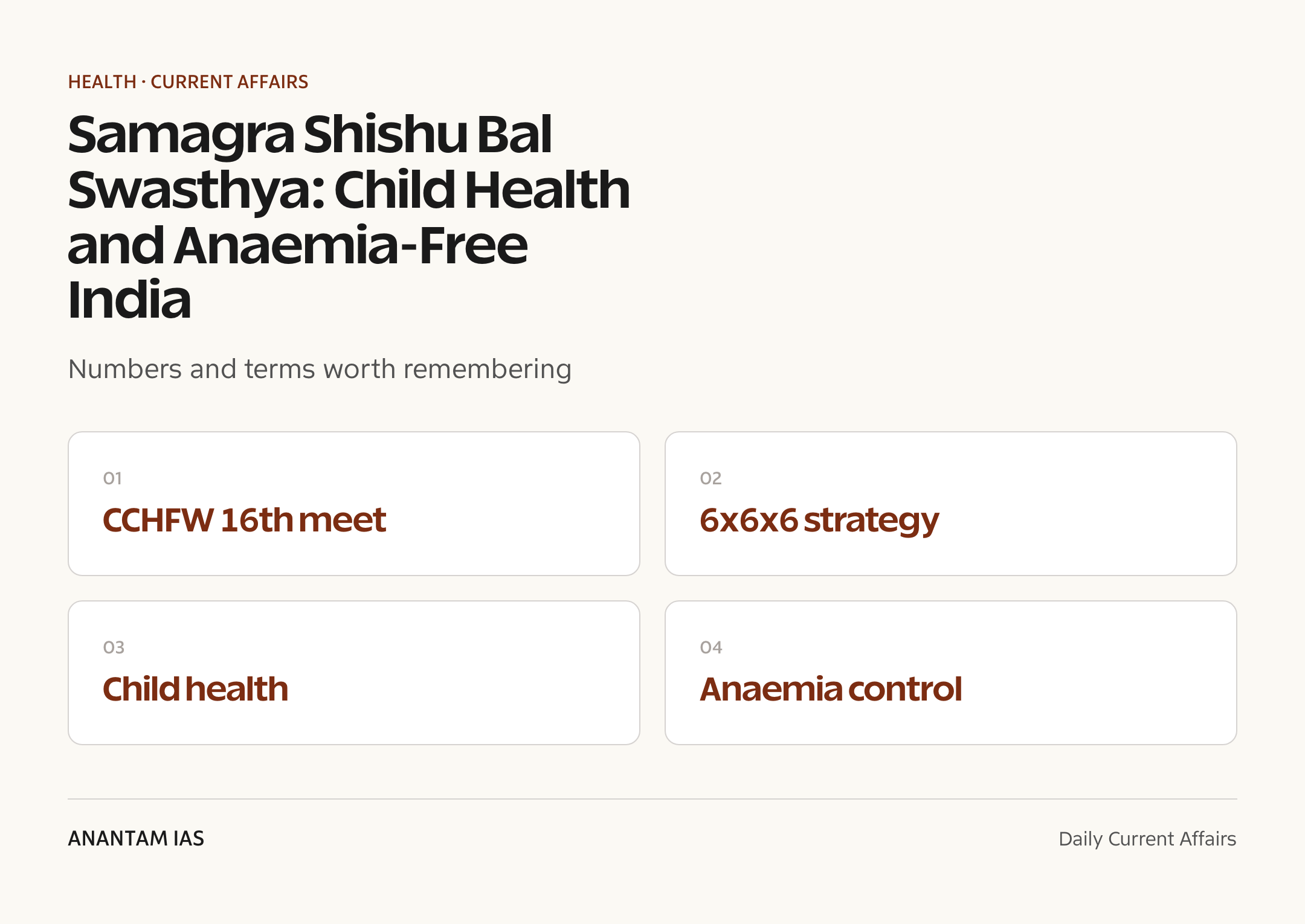
Samagra Shishu Bal Swasthya: Child Health and Anaemia-Free India — quick facts

UPSC Relevance

Prelims Relevance

  • Central Council of Health and Family Welfare (CCHFW): a high-level platform where the Union Health Ministry and States discuss health policy priorities.
  • Anaemia Mukt Bharat: a national strategy under the broader nutrition and health mission architecture to reduce anaemia across age and gender groups.
  • 6x6x6 strategy: six target beneficiary groups, six interventions and six institutional mechanisms used to structure anaemia-control work.
  • NFHS-5 (2019-21): recorded high anaemia prevalence among children, women and adolescents, making anaemia a persistent public-health concern.
  • POSHAN Abhiyaan: India’s flagship nutrition mission; anaemia control links with nutrition, counselling, supplementation and convergence.
  • Iron and folic acid (IFA): a core intervention for anaemia prevention and treatment, especially for children, adolescents and pregnant women.
  • Deworming: important because worm infestation can worsen anaemia by affecting nutrient absorption and blood loss.
  • Rashtriya Bal Swasthya Karyakram (RBSK): screens children for defects at birth, diseases, deficiencies and developmental delays.
  • Health and Wellness Centres: primary-care platforms that can support screening, counselling, follow-up and referral.
  • Social determinants of health: food security, sanitation, gender norms, school health and poverty shape child-health outcomes.

Mains Relevance

GS Paper 2

  • Analyse child health as a governance challenge involving nutrition, primary care, school systems, women and child development, and Centre-State coordination.
  • Assess why anaemia persists despite national programmes, and suggest reforms in data, diet diversity, supplementation, counselling and local accountability.

GS Paper 3

  • Link child health and anaemia reduction with human capital, demographic dividend and long-term productivity.

Essay

  • A nation’s future is built in the first years of a child’s life.
  • Public health is the foundation of human capital.

Background and Context

Why Child Health Needs an Integrated Frame

Child health cannot be solved through a single clinic visit or a single nutrition scheme.

  • Early childhood is a sensitive window for growth, brain development, immunity and school readiness.
  • A child may face overlapping risks: low birth weight, poor feeding, repeated infections, anaemia, stunting and delayed development.
  • A fragmented system can miss children who need follow-up, especially when services sit across health, ICDS, schools and local bodies.
  • An integrated child-health program can combine screening, referral, immunisation, nutrition counselling and family-level tracking.
  • The word Samagra is important for exam framing because it suggests convergence across services, not one isolated intervention.
  • Frontline workers become the hinge of the programme: ASHAs, ANMs and Anganwadi workers must identify risk, counsel families and make sure referral advice does not stop at paper records.
  • A strong child-health design should connect the home, the Anganwadi centre, the school and the primary health facility so that growth, nutrition and illness are reviewed together.
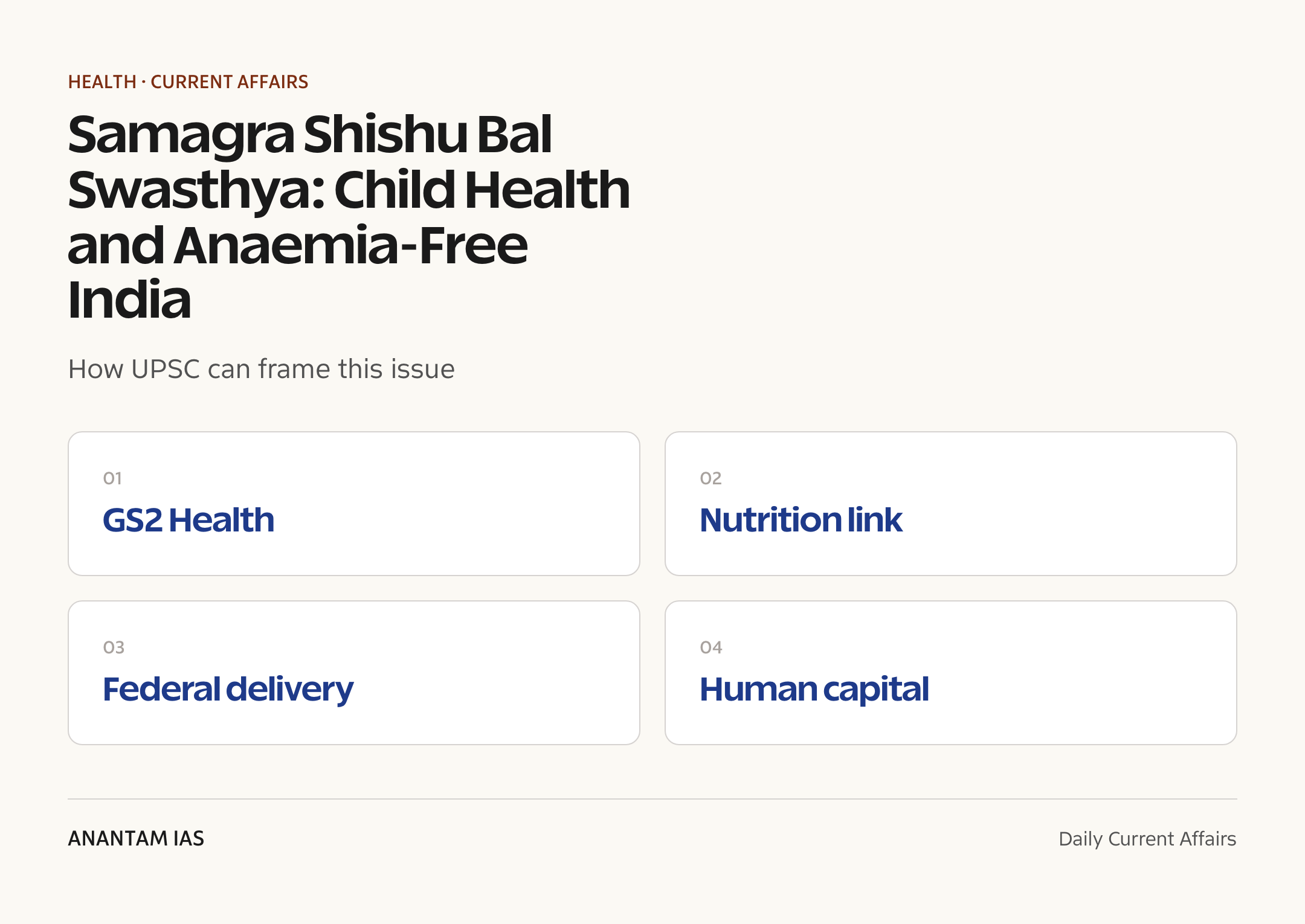
Samagra Shishu Bal Swasthya: Child Health and Anaemia-Free India — exam lens

Anaemia as a Public-Health Problem

Anaemia is common, measurable and deeply linked with social conditions.

  • Anaemia means a lower-than-normal level of haemoglobin or red blood cells, reducing the body’s capacity to carry oxygen.
  • Common drivers include iron deficiency, folate or vitamin B12 deficiency, malaria, worm infestation, repeated infection and poor diet diversity.
  • Among children, anaemia can affect attention, learning, physical growth and immunity.
  • Among adolescent girls and women, anaemia raises risks during pregnancy, delivery and postpartum recovery.
  • The problem needs both medical care and social action: supplementation alone works poorly if food insecurity, sanitation and counselling gaps remain.
  • Diet diversity is a key constraint because many children consume enough calories but not enough iron-rich foods, protein, fruits and vegetables.
  • Repeated infections, unsafe water and poor sanitation can reduce nutrient absorption, so anaemia control also links with WASH and preventive health.

Anaemia Mukt Bharat and the 6x6x6 Design

Anaemia Mukt Bharat gives anaemia-control work a structured national template.

  • The Anaemia Mukt Bharat approach is known for its 6x6x6 strategy.
  • The six target groups include children, adolescents, women of reproductive age, pregnant women and lactating mothers.
  • The six interventions include IFA supplementation, deworming, behaviour-change communication, testing and treatment, delayed cord clamping, and fortification-related measures.
  • The six institutional mechanisms include coordination, supply-chain management, monitoring, digital tools, capacity building and accountability.
  • For Prelims, the key is to remember the target-group-intervention-mechanism structure; for Mains, the key is why implementation remains difficult.
  • The strategy also shows why programme design must be age-specific: infants, school children, adolescent girls and pregnant women need different doses, counselling and follow-up cycles.
  • A useful Mains answer can compare supply-side work (tablets, testing, staff, logistics) with demand-side work (trust, adherence, food habits, household awareness).

Role of the Central Council of Health and Family Welfare

The CCHFW setting gives the announcement a federal governance angle.

  • Health is mainly a State subject, but national programmes depend on Union guidelines, financing support and common monitoring frameworks.
  • A conference of the CCHFW helps align States on priorities such as child health, anaemia control, primary care and digital health.
  • Operational guidelines matter because district officials need clarity on target groups, reporting formats, referral pathways and review indicators.
  • Centre-State platforms can reduce duplication between ministries, especially where health, education, ICDS and sanitation intersect.
  • The federal challenge is to keep national standards while allowing local adaptation for tribal areas, urban slums, aspirational districts and high-burden blocks.
  • States differ sharply in disease burden, food habits, health staffing and supply chains, so a single guideline needs flexible district-level execution.
  • The CCHFW route is useful because it can turn a national launch into reviewable commitments by States, rather than leaving the programme as a central announcement.

Implementation Gaps

India’s child-health challenge is often less about intent and more about execution.

  • Screening gaps: children may be identified once but not tracked until treatment or referral closure.
  • Supply gaps: IFA tablets, testing kits and deworming medicines must be available at the right level of care.
  • Behaviour gaps: families need counselling on diet diversity, breastfeeding, complementary feeding and adherence to supplements.
  • Data gaps: dashboards can report activity but still miss quality, follow-up and household-level outcomes.
  • Equity gaps: high-burden communities, migrants, tribal families and urban poor children need stronger outreach.
  • Referral gaps: screening has limited value if a child with severe anaemia, developmental delay or chronic illness cannot reach a higher facility.
  • Trust gaps: families may stop IFA because of side effects, misconceptions or lack of visible short-term benefit, so counselling must be repeated and local.

Why This Matters for Human Capital

Child health is not a soft welfare subject; it is economic infrastructure.

  • Healthy children attend school more regularly, learn better and enter adulthood with stronger physical and cognitive capacity.
  • Reducing anaemia can improve energy, concentration and productivity across the lifecycle.
  • Better child health reduces household out-of-pocket expenditure and lowers pressure on secondary and tertiary care.
  • The demographic dividend depends on quality of population, not just population size.
  • For answer writing, this topic lets students connect health, nutrition, education, gender and economy in one frame.
  • It also helps students avoid a common mistake: treating health as only hospital infrastructure when the biggest gains often come from prevention, nutrition and primary care.
  • A child-health programme that works well can reduce learning poverty, improve women’s health over the long term and make welfare spending more productive.

Way Forward

Make Tracking Outcome-Oriented

  • Track not only children screened, but also treatment completion, referral closure and improvement in haemoglobin or nutrition indicators.
  • Use digital dashboards for district review, while keeping field verification and community feedback in place.

Strengthen Convergence

  • Link health workers, Anganwadi centres, schools, Panchayats and local nutrition committees for follow-up.
  • Align child-health work with POSHAN Abhiyaan, school health services and adolescent-health interventions.

Fix the Last Mile

  • Ensure uninterrupted supply of IFA, deworming tablets, testing kits and counselling material.
  • Train frontline workers to explain side effects, dosage and diet changes in simple local language.

Target High-Burden Areas

  • Prioritise aspirational districts, tribal blocks, urban slums and migrant-heavy settlements.
  • Use local food systems, fortified staples where suitable, and culturally acceptable diet counselling.

Conclusion

The Samagra Shishu Bal Swasthya launch and the Anaemia Mukt Bharat guidelines should be read together: India is trying to move from episodic child-health services to a more integrated lifecycle approach. The real test will be whether screening, nutrition, treatment and follow-up meet the same child at the right time.

For UPSC, the issue is a strong GS2 case because it joins health policy with social justice and cooperative federalism. A good answer should not stop at programme names; it should explain why anaemia persists, why child health shapes human capital, and why district-level execution decides the outcome.

UPSC Practice Questions

Prelims MCQ 1

With reference to Anaemia Mukt Bharat, consider the following statements:

  1. It is structured around six target beneficiary groups, six interventions and six institutional mechanisms.
  2. Iron and folic acid supplementation is one of its core interventions.
  3. It deals only with pregnant women and excludes children and adolescents.

How many of the above statements are correct?

(a) Only one (b) Only two (c) All three (d) None

Answer: (b) Only two

Explanation:

Statements 1 and 2 are correct. Statement 3 is wrong because Anaemia Mukt Bharat covers multiple beneficiary groups, including children and adolescents.

Prelims MCQ 2

The Central Council of Health and Family Welfare is best understood as:

(a) A constitutional court for health disputes (b) A Centre-State forum for discussing health and family welfare policy (c) A private hospital accreditation body (d) A WHO regional office for South Asia

Answer: (b) A Centre-State forum for discussing health and family welfare policy

Explanation:

The CCHFW is a policy-coordination forum involving the Union Health Ministry and States. It is important for cooperative federalism in public health.

UPSC Mains Questions

  1. Child health is a lifecycle governance challenge rather than a narrow medical issue. Discuss with reference to nutrition, primary care, data systems and Centre-State coordination. (GS2)
  2. Why does anaemia persist in India despite national programmes? Suggest reforms in supplementation, diet diversity, behavioural counselling, monitoring and local accountability. (GS2)
  3. Healthy children are the foundation of India’s demographic dividend. Examine the statement in the context of public health and human capital. (GS3)

Sources: PIB, Ministry of Health and Family Welfare and PIB, Ministry of Health and Family Welfare.

Frequently Asked Questions

What is Samagra Shishu Bal Swasthya?

It is a child-health initiative announced by the Union Health Ministry. The available PIB note frames it as a comprehensive child-health programme. The details to watch are screening, referral, nutrition links, follow-up and how States implement it.

Why is anaemia important for UPSC?

Anaemia affects child growth, learning, maternal health and productivity. It is also a governance issue because it depends on diet, supplementation, deworming, sanitation, counselling and reliable public-health delivery.

What is the 6x6x6 strategy?

It is the design frame of Anaemia Mukt Bharat: six target beneficiary groups, six interventions and six institutional mechanisms. It helps students remember both the coverage and the implementation architecture.

What is the CCHFW?

The Central Council of Health and Family Welfare is a Centre-State platform for discussing national health priorities. It matters because health programmes need common guidelines, State ownership and district-level execution.

How is child health linked to human capital?

Poor child health can reduce school attendance, learning, immunity and future productivity. Strong early health and nutrition improve the demographic dividend by improving the quality of the workforce, not just its size.

What should a Mains answer include?

A good answer should cover nutrition, screening, primary health care, frontline workers, data systems, equity gaps and Centre-State coordination. It should also mention that anaemia is shaped by social determinants, not only by tablets.
Medical Devices Rules: Licensing Reform for India’s Health-Tech Sector

Open article →Download PDF

Why in News?

PIB said the Ministry of Health and Family Welfare has proposed draft amendments to the Medical Devices Rules, 2017 to simplify and speed up the licensing process for medical devices.

The reform seeks to reduce statutory timelines while keeping compliance with quality, safety and performance standards at the centre of the regulatory process.

  • The draft rules were notified through the Gazette of India after consultation with the Drugs Technical Advisory Board.
  • The proposal comes under the legal framework of the Drugs and Cosmetics Act, 1940 and the Medical Devices Rules, 2017.
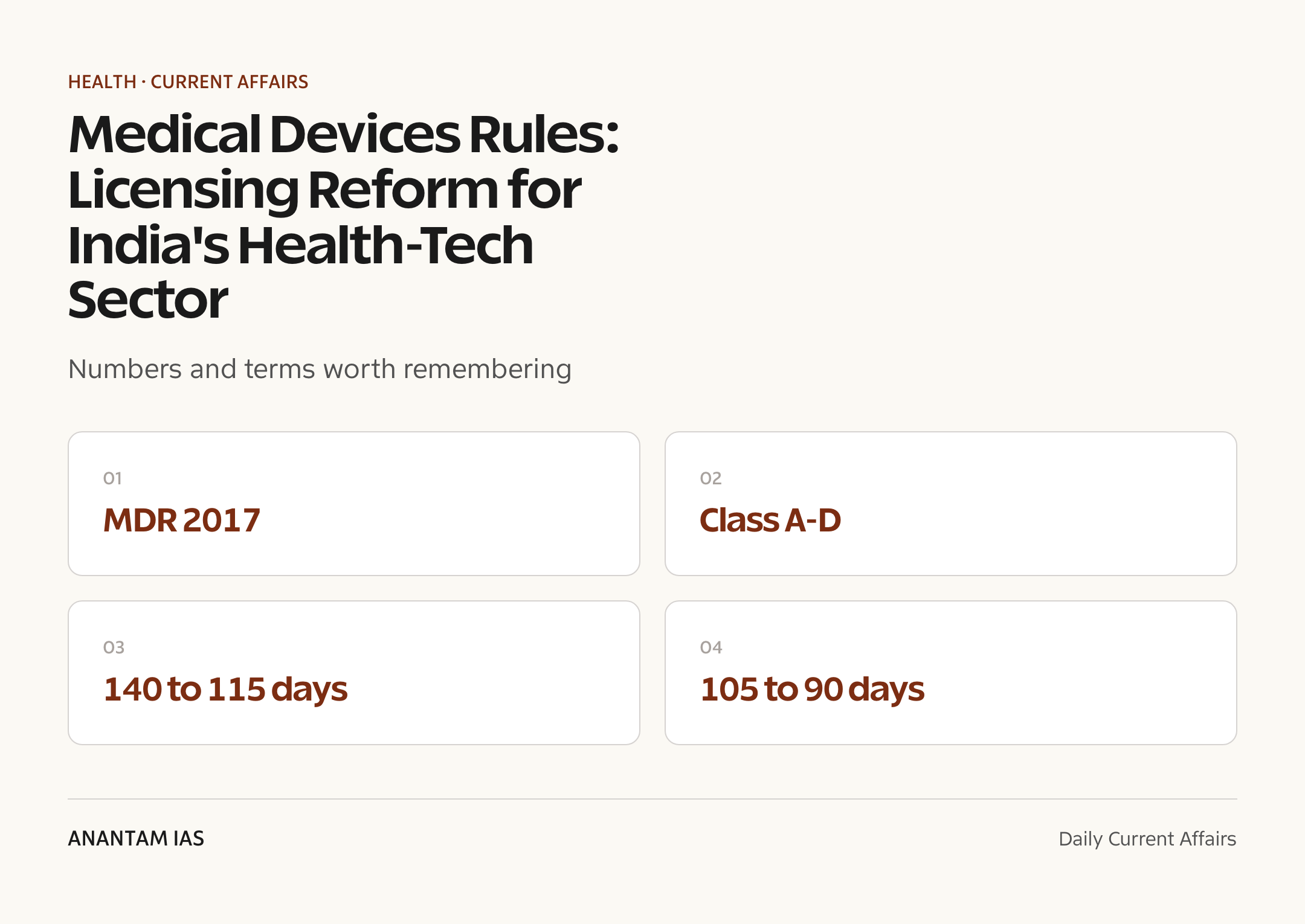
  • PIB highlighted that Class B licensing time is proposed to fall from 140 days to 115 days.
  • For Class C and Class D devices, the licensing time is proposed to fall from 105 days to 90 days.
  • The draft also sets clearer stage-wise timelines for application scrutiny, notified-body audit, compliance verification and issue of licence.
  • Stakeholders can send objections or suggestions within the specified 30-day consultation window.

The development matters in the context of:

  • Medical devices sit at the intersection of public health, industrial policy, import regulation and patient safety.
  • The reform matters because a licensing delay affects domestic manufacturers, hospitals, importers, start-ups and patients waiting for reliable devices.
  • The governance test is whether India can cut delay without weakening risk-based oversight or post-market accountability.
Medical Devices Rules: Licensing Reform for India's Health-Tech Sector — quick facts

UPSC Relevance

Prelims Relevance

  • Medical Devices Rules, 2017 regulate medical devices under the Drugs and Cosmetics Act framework.
  • CDSCO is the national regulatory authority for drugs, cosmetics and medical devices under the Health Ministry.
  • Class A, B, C and D are risk classes; Class A is low risk and Class D is high risk.
  • Class B examples cited by PIB include blood pressure monitors, hypodermic needles and pulse oximeters.
  • Class C and D examples cited by PIB include cardiac stents, hip implants, knee implants and other orthopaedic implants.
  • Notified Bodies are used for audits in the regulatory architecture, especially for lower-risk manufacturing-site checks.
  • Quality Management System requirements under the Fifth Schedule are central to manufacturing-site compliance.
  • SUGAM is the online portal used for many medical-device regulatory applications.

Mains Relevance

GS Paper 2

  • Health governance: balancing patient safety, timely access and accountable regulation.
  • Regulatory reform: reducing procedural delay while preserving statutory checks and transparency.
  • Centre-State coordination: licensing roles involve central and state regulators under a common legal framework.

GS Paper 3

  • Science and technology: medical devices are part of India’s health-tech and diagnostics ecosystem.
  • Manufacturing policy: predictable approvals can support domestic firms, MSMEs and innovation-led production.
  • Economic regulation: faster market entry must be matched with quality assurance and surveillance.

Essay

  • Regulation and innovation: good rules should protect citizens while allowing useful technologies to reach them.
  • Health security: a country needs dependable devices, skilled regulators and responsible manufacturers.
  • Trust in institutions: speed matters, but public trust depends on credible checks.

Background and Context

What the draft amendments propose

The draft is not a deregulation move; it is a timeline-rationalisation proposal within the existing statutory framework.

  • PIB says the objective is to simplify and speed up medical-device licensing while ensuring full compliance with quality, safety and performance standards.
  • For Class B devices, the headline licensing timeline is proposed to reduce from 140 days to 115 days.
  • For Class C and Class D devices, the headline licensing timeline is proposed to reduce from 105 days to 90 days.
  • The draft notification also clarifies timelines for scrutiny, notified-body audit, compliance verification and final licensing steps.
  • The central message is administrative predictability: applicants know the expected sequence, regulators keep the checks, and patients may get quicker access to quality devices.
Medical Devices Rules: Licensing Reform for India's Health-Tech Sector — exam lens

Medical Devices Rules, 2017: basic architecture

India regulates medical devices through a drug-law framework, but the 2017 Rules created a separate device-focused regulatory route.

  • The Medical Devices Rules, 2017 were framed under the Drugs and Cosmetics Act, 1940 to cover medical devices and in-vitro diagnostics.
  • A medical device can include an instrument, apparatus, appliance, implant, material, software or accessory used for diagnosis, prevention, monitoring, treatment or support of anatomy or physiology.
  • The Rules classify devices by risk into Class A, Class B, Class C and Class D.
  • Class A is low risk, Class B is low-moderate risk, Class C is moderate-high risk, and Class D is high risk.
  • This architecture matters because a thermometer, a pulse oximeter, an implant and a cardiac stent do not carry the same level of patient risk.

Who regulates the sector

The system combines central regulation, state licensing work and third-party audit capacity.

  • CDSCO, under the Directorate General of Health Services, is India’s central drug and medical-device regulator.
  • The Central Licensing Authority handles key permissions such as import licences, Class C and D manufacturing licences, clinical investigation permissions and new-device approvals.
  • State Licensing Authorities play an important role in domestic manufacturing licences for lower-risk device categories.
  • Notified Bodies, registered under the Rules, audit manufacturing sites and help verify quality-system compliance.
  • This divided structure needs clear timelines because manufacturers often interact with more than one regulatory actor before market entry.

Why licensing matters

Licensing is the gate between a product claim and real use on patients.

  • A licence confirms that a device has passed required checks for quality, safety and performance before it enters the market.
  • For patients, licensing reduces the risk of unsafe implants, inaccurate diagnostics, poor sterilisation or devices with weak manufacturing controls.
  • For hospitals, it gives a baseline of regulatory trust while procuring devices used in diagnosis, surgery, intensive care and routine care.
  • For manufacturers, predictable licensing reduces uncertainty around launch timelines, investments, supply-chain planning and market access.
  • For regulators, the challenge is to avoid both extremes: slow approvals that block useful technology and weak approvals that allow unsafe products.

Ease of doing business angle

The draft tries to convert regulatory efficiency into industrial competitiveness without dropping the safety bar.

  • Medical devices are a high-value sector for Make in India, import substitution, hospital supply chains and health-tech start-ups.
  • Shorter timelines can help domestic firms plan production cycles and product launches with less regulatory uncertainty.
  • Clearer stage-wise timelines reduce discretion because applicants can track whether the file is at scrutiny, audit, compliance verification or licence issue.
  • The reform also helps importers and hospitals because delayed approvals can affect availability of critical devices and replacement parts.
  • The key test is capacity: faster timelines work only when regulators, notified bodies and inspection teams have enough skilled staff and digital systems.

Patient safety and accountability

Speed is useful only if the regulator keeps the device-safety chain intact.

  • The draft keeps the language of compliance with quality, safety and performance standards, which is important for exam analysis.
  • Quality checks must cover design controls, manufacturing-site hygiene, sterilisation where relevant, traceability, labelling and risk management.
  • Licensing is only the first stage; India also needs stronger post-market surveillance, adverse-event reporting and recall systems.
  • The Materiovigilance Programme of India is relevant here because device failures can harm patients even after approval.
  • For a related health-regulation theme, see medical equipment notified as drugs.

Why this is a governance topic

The issue is not just technical; it is a live example of rule design in a welfare state.

  • A good regulator must be predictable, technically competent and independent enough to resist both industry pressure and bureaucratic delay.
  • Medical-device governance affects access to diagnostics, surgery, chronic-care monitoring, emergency care and assistive technologies.
  • The topic connects with wider debates on biosimilars, digital health, device software and clinical validation.
  • Emerging tools such as digital twins will make device regulation more complex because software, data and hardware increasingly overlap.
  • For Mains, the best answer frame is not pro-industry versus pro-safety; it is risk-based regulation with transparent timelines and strong surveillance.

Way Forward

Build capacity before compressing timelines

  • Increase trained reviewers, inspectors and device-domain experts in CDSCO, State Licensing Authorities and notified-body ecosystems.
  • Publish service-level dashboards for each licensing stage so delay can be tracked without weakening scrutiny.

Strengthen risk-based oversight

  • Keep deeper review for Class C and Class D devices where failure can cause serious patient harm.
  • Use checklists and standard operating procedures for Class A and B devices so lower-risk approvals become faster and more consistent.

Improve post-market safety

  • Link licence data with adverse-event reporting, field safety corrective action, recall alerts and hospital procurement systems.
  • Make manufacturers responsible for traceability, complaint handling and timely reporting of device failures.

Make consultation meaningful

  • Use the 30-day comment window to collect feedback from manufacturers, doctors, hospitals, patient groups, notified bodies and state regulators.
  • Publish a response matrix after finalisation so stakeholders can see which concerns were accepted, rejected or deferred.

Conclusion

The proposed amendment to the Medical Devices Rules, 2017 is a useful case study in health-sector regulatory reform: timelines are being shortened, but the language of quality, safety and performance remains central.

For exam answers, avoid treating this as a routine ease-of-business update. The real issue is how India can build a risk-based medical-device regime that supports manufacturing, protects patients and keeps regulation predictable.

UPSC Practice Questions

Prelims MCQ 1

With reference to medical-device regulation in India, consider the following statements:

  1. Medical devices are regulated under the Drugs and Cosmetics Act, 1940 and the Medical Devices Rules, 2017.
  2. Class D devices are treated as the lowest-risk category under the Medical Devices Rules, 2017.
  3. The draft licensing reform proposes to reduce the Class B licensing timeline from 140 days to 115 days.

How many of the above statements are correct?

(a) Only one (b) Only two (c) All three (d) None

Answer: (b) Only two

Explanation:

Statements 1 and 3 are correct. Class D is the highest-risk category, while Class A is the low-risk category.

Prelims MCQ 2

Which of the following is India’s central regulatory authority for drugs, cosmetics and medical devices under the Health Ministry?

(a) Central Drugs Standard Control Organisation (b) National Accreditation Board for Hospitals (c) Indian Council of Medical Research (d) National Health Authority

Answer: (a) Central Drugs Standard Control Organisation

Explanation:

CDSCO, under the Directorate General of Health Services, is the central regulatory authority for drugs, cosmetics and medical devices.

UPSC Mains Questions

  1. The proposed amendments to the Medical Devices Rules, 2017 seek faster licensing without diluting quality, safety and performance standards. Discuss how India can balance ease of doing business with patient safety in a risk-based medical-device regime.
  2. Medical-device regulation is both a health-governance issue and an industrial-policy issue. Examine this statement with reference to CDSCO, risk classification, notified-body audits and domestic manufacturing.
  3. Predictable timelines improve regulatory efficiency, but weak scrutiny can damage public trust. Suggest institutional measures to make medical-device licensing faster, transparent and accountable.

Sources: PIB, Ministry of Health and Family Welfare and Gazette of India draft notification.

Frequently Asked Questions

What are Medical Devices Rules, 2017?

The Medical Devices Rules, 2017 are India’s device-focused rules under the Drugs and Cosmetics Act framework. They regulate manufacturing, import, testing, clinical investigation, licensing, quality systems and risk classification for medical devices and in-vitro diagnostics.

What did the Health Ministry propose?

The Health Ministry proposed draft amendments to simplify licensing and reduce timelines. PIB says Class B licensing may fall from 140 days to 115 days, while Class C and D licensing may fall from 105 days to 90 days.

What is risk-based classification?

Risk-based classification groups devices by possible patient harm. Class A is low risk, Class B is low-moderate risk, Class C is moderate-high risk and Class D is high risk. Higher-risk devices need stricter scrutiny.

Why are notified bodies important?

Notified Bodies audit manufacturing sites and help verify quality-system compliance under the Rules. They add technical capacity to the licensing process, but their credibility depends on accreditation, conflict-of-interest control and regulatory supervision.

Does faster licensing mean weaker safety?

Not by itself. The draft keeps the requirement of compliance with quality, safety and performance standards. The concern is implementation: faster timelines need trained reviewers, reliable audits, digital tracking and strong post-market surveillance.

Why does this topic matter?

This topic links health governance, regulatory reform, ease of doing business, domestic manufacturing, patient safety and science-tech policy. It shows how a welfare state can make approvals predictable while keeping strong safeguards.

Tiger Translocation: Sariska and India’s Active Conservation Model

Open article →Download PDF

Why in News?

PIB said Union Environment Minister Bhupender Yadav inaugurated a national workshop on tiger translocation and reintroduction at Alwar, Rajasthan, marking 18 years of tiger reintroduction in Sariska Tiger Reserve.

The release framed Sariska as a global example of scientific recovery after local extinction: the reserve, tiger-less around 2005, now shelters 56 tigers and is being used to discuss active management for future conservation.

  • The workshop was organised by the National Tiger Conservation Authority, the Ministry of Environment, Forest and Climate Change, and the Rajasthan Government.
  • Participants included field directors, chief wildlife wardens, and wildlife experts from tiger-bearing regions.
  • PIB called Sariska the world’s first successful scientific tiger translocation programme in an area where tigers had become locally extinct.
  • The minister said India’s tiger reserves increased from 46 to 58 in the last decade.
  • Three publications were released: a framework for active tiger management, a booklet on tiger reintroduction and population recovery, and the Project Cheetah annual progress report.

The development matters in the context of:

  • Tiger translocation matters because many Indian tiger landscapes have strong source populations in some reserves and weak or empty sink habitats elsewhere.
  • Reintroduction is not just moving an animal; it needs prey recovery, habitat security, genetic planning, veterinary screening, conflict management, and long-term monitoring.
  • Sariska and Panna show that scientific movement of animals can rebuild lost populations when local communities and field staff support the programme.
  • Satkosia is the cautionary example in the PIB note: weak community support can block even a technically sound conservation design.
Dry forest habitat inside Sariska Tiger Reserve in Rajasthan
Sariska Tiger Reserve in Rajasthan, linked to India's tiger reintroduction story. Photo: Shivalir, CC BY-SA 4.0 (Wikimedia Commons)
Tiger Translocation: Sariska and India's Active Conservation Model — quick facts

UPSC Relevance

Prelims Relevance

  • Sariska Tiger Reserve is in Rajasthan’s Alwar region and lies in the Aravalli landscape.
  • Tiger translocation means shifting wild tigers from one landscape to another for recovery, supplementation, or genetic rescue under official approval.
  • Reintroduction means restoring a species to an area from which it has become locally extinct.
  • NTCA functions under the Ministry of Environment, Forest and Climate Change and anchors tiger conservation with states.
  • Project Tiger, launched in 1973, uses the core-buffer approach; revise the foundation through Project Tiger.
  • Wildlife Protection Act, 1972 provides the legal base for protected areas, tiger reserves, and species protection.
  • All India Tiger Estimation is a quadrennial exercise coordinated by NTCA, states, and scientific institutions.
  • Source population means a habitat producing surplus animals; sink habitat needs immigration or management support to sustain numbers.
  • Project Cheetah uses a different species and landscape, but the exam hook is similar: reintroduction, monitoring, prey base, and local consent.

Mains Relevance

GS Paper 3

  • Conservation of biodiversity, protected-area management, and landscape-level recovery.
  • Science-led wildlife management, including translocation, genetic safeguards, prey recovery, and monitoring.

GS Paper 2

  • Centre-state coordination through NTCA, state forest departments, and local administration.
  • Community participation, tribal and local livelihood concerns, and fair benefit-sharing around conservation landscapes.

Essay

  • Conservation succeeds when science, state capacity, and community trust move together.
  • A tiger reserve is not only a species space; it is also a forest, water, livelihood, and governance system.

Background and Context

What tiger translocation means

Tiger translocation is an active conservation tool, not a routine rescue or display exercise.

  • Translocation involves capturing, transporting, releasing, and monitoring wild animals under a planned conservation objective.
  • Reintroduction is a narrower case: it restores a species to a habitat where it has disappeared, as happened in Sariska after local extinction.
  • Supplementation adds animals to a weak existing population, often to improve numbers, sex ratio, or genetic diversity.
  • Genetic rescue may be needed when a small isolated population faces inbreeding, low reproductive success, or poor long-term viability.
  • Soft release may use acclimatisation enclosures and close monitoring; hard release allows quicker entry into the wild landscape.
  • Radio-collars, camera traps, pugmark confirmation, prey tracking, and veterinary follow-up convert a release into a monitored conservation project.
  • For basics on the species, taxonomy, and conservation story, revise Tiger (Panthera tigris).
Tiger Translocation: Sariska and India's Active Conservation Model — exam lens

Why Sariska became the case study

Sariska is exam-relevant because it moved from failure to recovery under a visible conservation experiment.

  • Sariska Tiger Reserve had lost its local tiger population around 2005, making it a test case for whether a reserve can be rebuilt after local extinction.
  • PIB said the Sariska programme is the world’s first successful scientific tiger translocation in a landscape where the species had disappeared locally.
  • The reserve now has 56 tigers, according to the minister’s statement at the workshop.
  • The recovery matters because it shows that tiger conservation is not limited to guarding strongholds such as Ranthambore, Corbett, or Kanha.
  • Aravalli ecology adds a geography angle: dry deciduous forests, rocky hills, water stress, tourism pressure, and village interface all affect carrying capacity.
  • For nearby static geography, use Ranthambore National Park as a comparison point in Rajasthan’s tiger landscape.

India's active tiger management model

The workshop points to a shift from passive protection to planned, science-led population management.

  • Active management means the state intervenes where natural recovery alone is unlikely because of local extinction, isolation, low prey base, or human pressure.
  • Source-sink planning identifies reserves that can safely donate dispersing animals and reserves that need rebuilding or demographic support.
  • Carrying capacity is central: a reserve cannot hold more tigers than its prey, territory, water, and human-pressure profile can sustain.
  • Habitat corridors decide whether a reintroduced population can exchange genes naturally or stays trapped as an isolated island.
  • Prey base recovery must precede release; without sambar, chital, nilgai, wild pig, and other prey, relocated tigers move toward livestock.
  • Veterinary protocols reduce disease risks when animals are moved across landscapes.
  • M-STrIPES, camera traps, field patrols, and independent scientific review keep translocation from becoming a one-time headline.

Legal and institutional framework

Tiger recovery sits inside a legal structure, not an informal conservation experiment.

  • Wildlife Protection Act, 1972 is the parent law for protected areas, species protection, and wildlife crime control in India.
  • Tiger reserves operate with core and buffer zones, where core areas are kept as critical tiger habitat and buffers manage coexistence pressures.
  • NTCA provides technical oversight, approval, advisories, monitoring frameworks, and funding support under Project Tiger.
  • State forest departments handle local field implementation: habitat works, patrolling, relocation logistics, community dialogue, and conflict response.
  • Wildlife Institute of India and other scientific bodies can support capture protocols, health checks, radio-telemetry, and post-release monitoring.
  • The institutional base can be revised through NTCA.

Community support as the deciding factor

The PIB note makes a clear governance point: local consent is not decorative, it can decide success or failure.

  • Sariska and Panna are cited as successful because conservation agencies worked with local communities and field institutions.
  • Satkosia Tiger Reserve in Odisha is cited as a difficult case where weak community support limited success.
  • Human-wildlife conflict rises when tigers move through villages, prey on livestock, or generate fear around forests and grazing routes.
  • Compensation systems must be fast, transparent, and trusted; delay can turn a conservation project into a political conflict.
  • Eco-development should connect tourism revenue, local jobs, grassland management, fuelwood alternatives, and village-level conservation incentives.
  • Relocation, where needed from core areas, must follow consent, lawful compensation, livelihood support, and long-term rehabilitation.
  • This is a good case to connect with human-wildlife conflict.

Prelims data and wider significance

The news also carries compact factual data that can appear in objective questions.

  • PIB said India’s tiger reserves rose from 46 to 58 in the last decade.
  • PIB said India met the Saint Petersburg Declaration target of doubling wild tiger numbers by 2022 ahead of the global deadline.
  • Official tiger estimation data place India’s 2022 tiger estimate at an average of 3,682, with a range of 3,167 to 3,925.
  • India is home to more than 70% of the world’s wild tigers, making its conservation choices globally significant.
  • Panna and Sariska show recovery after local extinction; Satkosia reminds aspirants that social acceptance is part of ecology.
  • The minister also released a Project Cheetah annual progress report, linking tiger recovery with India’s wider reintroduction debates.

Way Forward

Make translocation evidence-led

  • Approve tiger movement only after habitat suitability, prey base, water availability, disease risk, genetic compatibility, and conflict risk are independently assessed.
  • Use source-sink mapping so donor reserves are not weakened and recipient landscapes are not overloaded beyond carrying capacity.
  • Publish non-sensitive monitoring summaries so the public can track survival, dispersal, conflict incidents, breeding, and prey trends.

Protect the landscape, not only the release site

  • Secure wildlife corridors through land-use planning, mitigation structures on roads and railways, and voluntary community cooperation.
  • Invest in prey recovery, grassland management, water-point planning, invasive-species control, and anti-poaching patrols before adding tigers.
  • Integrate reserve management with district administration, tourism rules, disaster response, and local development schemes.

Put communities at the center

  • Build fast livestock compensation, early warning, insurance, and trained rapid-response teams around translocation landscapes.
  • Share conservation gains through local guides, eco-tourism jobs, skill training, fuelwood alternatives, and village-level infrastructure.
  • Treat consent and trust as core conservation infrastructure, not as a public-relations add-on.

Conclusion

Sariska shows that a reserve can recover from local extinction when science, field discipline, political backing, and community support work together.

The larger lesson is practical: tiger translocation is useful only when habitat, prey, genes, people, and monitoring are planned as one system.

For UPSC, the case is not just about tigers. It is about how India manages biodiversity recovery in a crowded federal landscape where conservation, livelihoods, tourism, and state capacity meet.

UPSC Practice Questions

Prelims MCQ 1

With reference to tiger reintroduction and translocation in India, consider the following statements:

  1. Sariska Tiger Reserve is cited by PIB as a successful scientific tiger translocation case after local extinction.
  2. The National Tiger Conservation Authority functions under the Ministry of Environment, Forest and Climate Change.
  3. Satkosia Tiger Reserve was cited in the PIB release as a case where weak community support affected translocation success.

How many of the above statements are correct?

(a) Only one (b) Only two (c) All three (d) None

Answer: (c) All three

Explanation:

All three statements are correct. PIB cited Sariska’s recovery, referred to NTCA’s role under MoEFCC, and contrasted Sariska/Panna with the Satkosia difficulty linked to weaker community support.

Prelims MCQ 2

Which of the following best describes reintroduction in wildlife conservation?

(a) Moving rescued captive animals to a zoo for breeding (b) Restoring a species to a habitat where it had become locally extinct (c) Counting wildlife with camera traps in a protected area (d) Expanding tourism infrastructure around a tiger reserve

Answer: (b) Restoring a species to a habitat where it had become locally extinct

Explanation:

Reintroduction is the planned return of a species to part of its former range after local disappearance. Sariska is relevant because tigers were restored after local extinction.

UPSC Mains Questions

  1. Tiger translocation can help recover locally extinct populations, but it can also deepen conflict if habitat and community concerns are ignored. Discuss with reference to Sariska, Panna and Satkosia.
  2. Explain the role of the National Tiger Conservation Authority in India’s tiger conservation model. How does active management differ from conventional protected-area protection?
  3. Biodiversity conservation in India is now a question of landscape governance, not only species protection. Examine using the example of tiger reintroduction.

Sources: PIB, Ministry of Environment, Forest and Climate Change and PIB, All India Tiger Estimation 2022.

Frequently Asked Questions

What is tiger translocation?

Tiger translocation is the planned movement of wild tigers from one habitat to another for conservation. It may support reintroduction, supplementation, or genetic rescue. It needs official approval, veterinary screening, habitat assessment, prey-base review, release planning, and long-term monitoring.

Why is Sariska important?

Sariska is important because tigers had become locally extinct there around 2005, and the reserve was later rebuilt through scientific reintroduction. PIB says Sariska now has 56 tigers and stands as a global example of successful tiger recovery after local extinction.

Who manages tiger conservation in India?

Tiger conservation is coordinated by the National Tiger Conservation Authority under the Ministry of Environment, Forest and Climate Change, with state forest departments implementing field work. Scientific institutions, local administrations, and communities also matter because tiger landscapes cross administrative and social boundaries.

Why did Satkosia face difficulty?

PIB cited Satkosia as a case where community support was weaker than in Sariska and Panna. The lesson is that a technically sound translocation plan can still struggle if local people fear conflict, distrust compensation, or see few benefits from conservation.

How is reintroduction different from supplementation?

Reintroduction restores a species to an area where it had disappeared locally. Supplementation adds individuals to an existing weak population. Both require habitat suitability, prey availability, genetic planning, disease checks, and monitoring, but the starting ecological condition is different.

Why does this matter for UPSC?

The topic connects GS3 environment with governance and ethics. It covers Project Tiger, NTCA, Wildlife Protection Act, protected-area management, human-wildlife conflict, community participation, science-led policy, and the limits of conservation when local trust is weak.

Rural Internal Audit Portal: AI for Accountable Rural Development

Open article →Download PDF

Why in News?

PIB said Union Rural Development Minister Shivraj Singh Chouhan launched the AI-enabled Rural Internal Audit Portal during the Rashtriya Gramin Vikas Sammelan at Pusa Campus, New Delhi.

The portal is a first-of-its-kind unified digital platform for end-to-end management of internal audits, covering both risk-based audits and compliance audits across Rural Development programmes.

  • The launch was reported by PIB on June 28, 2026, a day before the June 29 ministerial session of the two-day rural development conference.
  • The portal was conceived by the Office of the Chief Controller of Accounts, Ministry of Rural Development, and developed with the National Informatics Centre.
  • PIB says a pilot began in Chandauli district, Uttar Pradesh, on April 1, 2025, and all core modules became operational from October 2025.
  • The platform brings audit planning, audit execution, report generation, Action Taken Reports, para settlement, monitoring and analytics into one digital ecosystem.
  • The Ministry is progressively integrating AI-enabled functionalities for intelligent audit planning, high-risk entity identification, predictive analytics and pattern recognition.

The development matters in the context of:

  • This matters in the context of public finance accountability, because rural schemes involve large transfers, local implementation and many audit units.
  • It is not only an AI story; it is a case of digital public management where audit evidence, compliance status and decision dashboards are meant to reduce opacity.
  • It also helps compare social audit, CAG audit and internal audit as different accountability layers.
Rural Internal Audit Portal: AI for Accountable Rural Development — quick facts

UPSC Relevance

Prelims Relevance

  • Rural Internal Audit Portal: AI-enabled audit management platform of the Ministry of Rural Development.
  • Risk-based audit: audit prioritization based on likelihood and impact of implementation risks.
  • Compliance audit: checking whether rules, approvals, expenditure norms and reporting requirements are followed.
  • Office of Chief Controller of Accounts: the accounting and internal audit authority that conceived the portal for the Ministry.
  • National Informatics Centre: the government technology body that helped develop the platform.
  • Action Taken Report: the response filed by an auditee on audit observations and corrective action.
  • Para settlement: closure of audit paragraphs after compliance is examined and accepted.
  • Map View Module: geospatial view that can show audit coverage, team deployment, para settlement status and audit units never audited.

Mains Relevance

GS Paper 2

  • Good governance through transparency, accountability, institutional memory and faster compliance monitoring.
  • Centre-State and district-level coordination in rural development schemes, especially where programme divisions, State governments and field users must work on the same system.
  • Ethical use of AI in governance: explainability, human oversight, grievance channels and protection against algorithmic bias.

GS Paper 3

  • Public financial management, expenditure tracking and better identification of systemic risks in welfare and infrastructure spending.
  • Science and technology in governance, including predictive analytics, dashboards, API integrations and cybersecurity.

GS Paper 4

  • Probity in public life, audit trails, administrative responsibility and the ethics of data-driven decision-making.
  • Balancing efficiency with fairness when automated systems rank audit units or flag high-risk entities.

Essay

  • Technology improves governance only when institutions, incentives and accountability improve with it.
  • The future of the welfare state is auditability, not only delivery.
  • Data can reveal leakages, but trust still depends on fair process.

Background and Context

What The Portal Changes

The portal shifts internal audit from scattered files and delayed correspondence to a single digital audit management system.

  • PIB describes the older process as fragmented, paper-intensive and largely manual, with dispersed records, manual correspondence and delayed reporting.
  • The new system creates a centralized repository of audit units, audit observations, Action Taken Reports and audit records.
  • It integrates audit planning, engagement approvals, audit memoranda, observations, report preparation, approvals, record management and archival.
  • For administrators, the value is not just digitization; it is a shift from post-facto file checking to live oversight of audit progress and compliance status.
  • For UPSC answers, frame it as a state-capacity tool: better records, faster feedback loops, stronger compliance follow-up and more usable evidence for decision-makers.
Rural Internal Audit Portal: AI for Accountable Rural Development — exam lens

Institutional Design

The portal sits at the intersection of financial control, technology architecture and rural development programme management.

  • The platform was conceived by the Office of the Chief Controller of Accounts, Ministry of Rural Development, giving it a public-finance accountability base.
  • The National Informatics Centre supported development and hosting, which places the system within the Government of India’s digital governance infrastructure.
  • PIB says the portal has separate Development, User Acceptance Testing and Production environments, which supports controlled deployment of updates.
  • The role-based governance model gives dedicated access to auditors, auditees, approving authorities, programme divisions, State governments, district-level users and certified internal auditors.
  • This matters because rural programmes are implemented across levels; audit workflows fail when every level maintains its own record without a common compliance trail.

Audit Lifecycle And Compliance

The strongest exam point is the portal’s coverage of the full audit lifecycle, not only data display.

  • Audit planning can be digitized so units, teams and priorities are assigned through a trackable workflow.
  • Audit observations can be recorded in a standard format, reducing variation across districts, schemes and audit teams.
  • Auditees can file Action Taken Reports with supporting documents through the portal, making compliance claims easier to examine.
  • Auditors can review replies, communicate objections and complete para settlement when corrective action is accepted.
  • Digital processing creates an audit trail: who raised the issue, who replied, what evidence was filed, when a para was settled and which observations recur.

Dashboards, Map View And Risk-Based Audit

The portal uses dashboards and geospatial views to move audit from random coverage to risk-informed coverage.

  • Interactive dashboards show audit coverage, pending observations, ATR compliance, financial irregularities, audit performance and implementation trends.
  • The Map View Module provides geospatial visualization of audit activities across India, including team deployment and compliance response status.
  • PIB specifically says the module identifies audit units never audited, which can guide targeted interventions and better resource deployment.
  • Risk-based audit means limited audit capacity is directed first toward units with higher exposure, weaker compliance, repeated observations or unusual implementation patterns.
  • This connects naturally with the Panchayat Development Index logic: local data is useful only when it guides action and accountability.

AI And Algorithmic Governance

The AI layer should be read as decision support for audit planning, not as a substitute for administrative judgment.

  • PIB says AI-enabled functions are expected to support intelligent audit planning, high-risk entity identification, predictive analytics, pattern recognition and evidence-based decision-making.
  • Potential gains include quicker detection of recurring observations, unusual expenditure patterns, delayed compliance and weak audit coverage.
  • But AI in audit can create risks if the model’s variables, training data or scoring logic are opaque to officials and auditees.
  • A high-risk flag should trigger human review, reasoned audit planning and documentation, not automatic stigma for a district or programme unit.
  • For Mains, link it with algorithmic governance and bias: accuracy, explainability, contestability and proportionality matter.

Security And Data Governance

An audit platform is only as strong as its security, access control and data-quality practices.

  • PIB lists role-based access control, centralized monitoring, secure API-based integrations, automated exception handling and complete audit logging as security features.
  • The portal also includes periodic security assessments, daily backups and disaster recovery protocols for continuity of critical audit data.
  • Data quality is a governance issue: inaccurate audit-unit records, duplicate observations or weak document tagging can weaken the same dashboards meant to improve oversight.
  • Access must be need-based because audit records may include financial irregularities, scheme weaknesses, field-level correspondence and compliance evidence.
  • Good design needs retention rules, access logs, cyber incident response and periodic third-party review so the portal does not become a new single point of failure.

Wider Public Finance Significance

The Rural Internal Audit Portal can become a model for civil ministries because internal audit is a core public financial management function.

  • PIB says the Controller General of Accounts issued an Office Memorandum dated December 9, 2025, giving in-principle approval to implement the Internal Audit Module across civil ministries and departments.
  • The memorandum recognized the portal’s coverage of audit planning, engagement approvals, audit memoranda, real-time observation management, para-wise financial tracking and digital ATR processing.
  • This widens the topic beyond one ministry: it becomes a public financial management reform for the Union government.
  • If scaled carefully, the model can help ministries identify repeated compliance failures before they become major expenditure leakages.
  • The key caution is capacity: smaller offices need training, stable connectivity, clear help desks and time-bound escalation, or the digital workflow can become another compliance burden.

Way Forward

Make AI Explainable And Auditable

  • Publish internal guidance on what factors shape risk scoring, who can override a score and how such overrides are recorded.
  • Keep human approval mandatory for audit prioritization decisions that affect field units, districts or programme divisions.
  • Test the model for bias against smaller, remote or low-capacity units that may look risky because data reporting is weak.

Strengthen Field Capacity

  • Train auditors, auditees and district users on ATR filing, evidence uploads, para settlement and dashboard interpretation.
  • Create help desks and standard operating procedures for States, districts and certified internal auditors.
  • Use simple multilingual workflows so the portal works for field administration, not only central dashboards.

Link Audit With Corrective Action

  • Convert recurring audit observations into scheme-level reform notes for programme divisions.
  • Track whether audit findings lead to rule changes, training, recovery, process simplification or stronger local supervision.
  • Integrate internal audit insights with social audit and performance review without mixing their distinct roles.

Protect Data And Trust

  • Run periodic security audits, access reviews and disaster recovery drills for the portal.
  • Log every major workflow action so responsibility is clear and retrospective manipulation becomes difficult.
  • Give auditees a clear channel to correct records, upload missing evidence and contest wrongly tagged observations.

Conclusion

The Rural Internal Audit Portal is important because it makes audit a continuous management function, not only a compliance ritual after expenditure has already occurred.

Its success will depend on whether dashboards, AI flags and digital ATRs lead to better decisions in rural programmes. Technology can make weak signals visible, but accountable officials must still act on them.

For UPSC, use this case as a balanced example of digital governance: it can improve transparency and public financial management, but only with explainable algorithms, trained field users and strong data protection.

UPSC Practice Questions

Prelims MCQ 1

With reference to the Rural Internal Audit Portal, consider the following statements:

  1. It was conceived by the Office of the Chief Controller of Accounts, Ministry of Rural Development.
  2. It covers both risk-based audits and compliance audits.
  3. It replaces the Comptroller and Auditor General of India for rural development schemes.

How many of the above statements are correct?

(a) Only one (b) Only two (c) All three (d) None

Answer: (b) Only two

Explanation:

Statements 1 and 2 are correct as per the PIB release. Statement 3 is incorrect because internal audit does not replace the constitutional audit role of the CAG.

Prelims MCQ 2

Which one of the following best describes the Map View Module mentioned in relation to the Rural Internal Audit Portal?

(a) A satellite imagery tool for mapping rural roads (b) A geospatial visualization tool for audit coverage and compliance status (c) A land records platform for digitizing village property cards (d) A beneficiary mapping tool for Direct Benefit Transfer payments

Answer: (b) A geospatial visualization tool for audit coverage and compliance status

Explanation:

PIB says the Map View Module visualizes audit coverage, audit team deployment, para settlement status and compliance responses, and can identify audit units never audited.

UPSC Mains Questions

  1. The Rural Internal Audit Portal shows how digital systems can strengthen accountability in welfare spending. Discuss its potential for rural development governance, along with the safeguards needed for explainable and fair AI-based audit prioritization.
  2. Differentiate between internal audit, social audit and CAG audit in India’s accountability framework. How can digital audit platforms improve public financial management without weakening local participation and human oversight?
  3. Data-driven governance can improve last-mile delivery only when it is matched by institutional capacity. Examine this statement with reference to the AI-enabled Rural Internal Audit Portal.

Sources: PIB, Ministry of Rural Development and PIB, Ministry of Rural Development.

Frequently Asked Questions

What is the Rural Internal Audit Portal?

The Rural Internal Audit Portal is an AI-enabled digital platform of the Ministry of Rural Development for managing internal audits. It covers audit planning, execution, observations, reports, Action Taken Reports, para settlement, monitoring and analytics in one system.

Who developed the portal?

PIB says the portal was conceived by the Office of the Chief Controller of Accounts, Ministry of Rural Development, and developed in collaboration with the National Informatics Centre. The design places financial accountability and government technology support in the same workflow.

Why is it important for UPSC?

It is a strong GS2 example of digital governance, transparency and accountability. It also connects with GS3 public financial management and science-tech in governance because the portal uses dashboards, predictive analytics and AI-assisted risk identification.

How is internal audit different from social audit?

Internal audit is an administrative and financial control mechanism used inside government to check compliance, risks and corrective action. Social audit is community-facing and checks implementation through public participation, beneficiary verification and local accountability.

What risks does AI create in audit?

AI can help identify high-risk units and recurring patterns, but it can also create opaque scoring, bias and over-reliance on automated flags. Human review, explainable criteria, audit trails and grievance channels are needed.

What is the way forward?

The portal should be backed by field training, strong cybersecurity, clear risk-scoring rules and regular review of AI outputs. Audit findings should feed scheme reforms, not remain limited to dashboards or pending compliance lists.

PM Family Care Tracker: Birth-Linked Delivery of Welfare Benefits

Open article →Download PDF

Why in News?

PIB said Union Home and Cooperation Minister Amit Shah launched the PM Family Care Tracker pilot project in Gandhinagar, Gujarat, and administered polio drops to children.

The pilot seeks to connect birth-death data with a unique child ID so welfare benefits can reach eligible children automatically and on time through an integrated monitoring system.

  • The launch was held in Gandhinagar with the Gujarat Chief Minister and the Union Home Secretary present.
  • PIB said children were given polio drops and nutrition kits at the event.
  • The tracker is framed as a response to three delivery gaps: beneficiary identification, government outreach and timely scheme delivery.
  • The system will link a child-level database with birth and death records and create a number or ID for each child.
  • The release connects the tracker with DBT-based transparent welfare delivery and monitoring of health-related initiatives.

The development matters in the context of:

  • This matters in the context of lifecycle welfare, where the state shifts from application-based delivery to birth-linked eligibility tracking.
  • It is a case study in digital public infrastructure, because registry quality, interoperability and consent shape the delivery outcome.
  • It also raises classic GS2 concerns: exclusion errors, data protection, federal coordination and grievance redress.
PM Family Care Tracker: Birth-Linked Delivery of Welfare Benefits — quick facts

UPSC Relevance

Prelims Relevance

  • PM Family Care Tracker: a pilot launched in Gandhinagar to track child-linked welfare delivery.
  • Birth-death data: the basic civil-registration layer used to identify eligible children and lifecycle events.
  • Unique child ID: the proposed identifier for linking children with welfare entitlements; the release does not call it Aadhaar.
  • Direct Benefit Transfer: the transfer architecture used for transparent and targeted welfare payments.
  • Integrated monitoring system: the delivery layer meant to track whether benefits reach the needy.
  • Polio immunization: relevant to child health, vaccination outreach and last-mile public health delivery.
  • Nutrition kits: linked with child nutrition, maternal-child health and convergence of welfare schemes.
  • Gandhinagar: the pilot location in Gujarat.

Mains Relevance

GS Paper 2

  • Governance reform through beneficiary databases, DBT and last-mile delivery.
  • Welfare design for children, especially health, nutrition and early-life interventions.
  • Accountability concerns around privacy, exclusion and grievance redress in digital welfare.

GS Paper 2

  • Centre-State coordination because birth-death registration, health services and welfare delivery involve multiple levels of government.
  • Social justice angle: reaching children and families who often miss benefits because of weak documentation or outreach.

GS Paper 3

  • Use of digital public infrastructure for public-service delivery, audit trails and real-time monitoring.
  • Cybersecurity and data-governance risks when sensitive child data is linked across databases.

Essay

  • Digital state capacity: when technology improves welfare delivery and when it can deepen exclusion.
  • The first years of life as the foundation of human capital.
  • Trust, transparency and privacy in welfare governance.

Background and Context

What The Tracker Tries To Solve

The pilot is built around a simple governance question: how can a child receive benefits without the family repeatedly proving eligibility?

  • Beneficiary identification is the first problem: welfare schemes often fail when the state does not know who is eligible, where they live or which life event has triggered entitlement.
  • Government outreach is the second problem: families may not know which scheme applies, which document is needed or which office to approach.
  • Timely delivery is the third problem: child-health and nutrition benefits lose value when they reach late, especially in infancy and early childhood.
  • The tracker tries to shift delivery from a reactive application model to a proactive lifecycle model where the state acts when a birth or other record appears.
  • For UPSC, the core concept is not the software name alone; it is the move toward event-triggered welfare delivery.
  • A child-linked tracker can also reduce fragmentation, because one household may interact separately with civil registration, immunization, anganwadi services, nutrition support and cash-transfer systems.
  • The administrative promise is single-view follow-up: officials can see whether a child has been identified, whether a benefit is due and whether delivery is pending.
PM Family Care Tracker: Birth-Linked Delivery of Welfare Benefits — exam lens

Birth-Death Data As A Welfare Layer

Civil registration becomes more powerful when it is treated as a service-delivery trigger, not only as a record-keeping function.

  • Birth registration can help identify a newborn, the household and the first set of health, nutrition and social-protection entitlements.
  • Death registration can help update records, prevent duplicate delivery and identify families that may need social support after the loss of a caregiver.
  • India’s civil registration framework is linked with the Registration of Births and Deaths Act, 1969, making the quality of local registration crucial for any child-linked tracker.
  • Weak registration can create exclusion errors: children without timely birth registration may remain outside automated delivery loops.
  • Clean registries also need deduplication, error correction and an easy process for families to update names, addresses and guardian details.
  • The biggest governance gain comes when civil registration is combined with field verification, because frontline workers can confirm whether the child and family actually received services.
  • For Prelims, remember the distinction: registration data identifies a life event, while welfare systems decide eligibility and delivery.

DBT 2.0 And Last-Mile Delivery

The release frames the tracker within the wider DBT logic of targeted, transparent and monitorable welfare.

  • Direct Benefit Transfer reduces leakages by moving benefits or subsidies closer to identified beneficiaries through verified channels.
  • The tracker adds a child-lifecycle lens: birth, immunization, nutrition and health interventions can be tracked against a child’s record.
  • This is an extension of the governance logic behind direct benefit transfers: fewer middle layers, clearer beneficiary lists and better audit trails.
  • But DBT works best when identity, banking access, mobile connectivity and local support systems are reliable.
  • If a family lacks documents, faces migration, or has errors in records, an automated system can miss exactly the child it is meant to protect.
  • The next-generation challenge is assisted delivery: using data to find the beneficiary, but using human support to complete documentation, resolve mismatch and close the service gap.
  • A good answer should balance the gains from leakage reduction with the risk that efficiency metrics can hide families who never entered the database.

Child Health And Nutrition Convergence

The launch connected the tracker with polio drops and nutrition kits, making it relevant to child health governance.

  • Polio drops point to immunization outreach, micro-planning and local health-worker networks.
  • Nutrition kits connect the tracker with early-childhood nutrition, maternal-child health and the fight against wasting, stunting and anemia.
  • For a child, welfare is not one scheme; it is a bundle of health, nutrition, sanitation, childcare and household-support interventions.
  • The tracker can be studied with child malnutrition and stunting, because early identification matters more than delayed compensation.
  • It also links with early childhood care and education, where the first six years shape learning, nutrition and cognitive development.
  • The delivery challenge is convergence: health departments, civil registrars, anganwadi systems and local governments must read from compatible data.
  • The public-health angle is continuity of care: a child should not disappear from follow-up after one vaccine dose, one nutrition kit or one household visit.
  • The social-justice angle is early correction: a timely intervention in infancy can prevent deeper deprivation later in schooling, health and learning outcomes.

How To Use It In Mains Answers

This topic is best used as an example of digital governance that needs both technology and rights-based safeguards.

  • Under governance, use it to show how databases, DBT and local delivery systems can reduce leakages and delays.
  • Under social justice, use it to discuss children as a vulnerable group whose entitlements must be delivered without making poor families navigate complex paperwork.
  • Under health, connect it with immunization, nutrition, early childhood development and preventive care.
  • Under ethics, frame the dilemma as efficiency versus dignity: faster delivery is valuable, but not at the cost of consent, privacy or easy correction.
  • Under federalism, note that central platforms need state and local implementation capacity, because the last mile is handled by field institutions.
  • A balanced conclusion should say that digital welfare is a tool, not a substitute for frontline staff, social audits and accessible grievance systems.

Digital Governance Risks

A child-linked welfare tracker can improve delivery, but it also concentrates sensitive data and decision power.

  • Privacy risk is high because child data, family data, health status and welfare eligibility can become part of the same service-delivery system.
  • Purpose limitation matters: data collected for welfare delivery should not be freely reused for unrelated surveillance or profiling.
  • Consent and guardian rights become important because children cannot meaningfully consent to long-term data trails.
  • Algorithmic exclusion can occur if the system flags a family as ineligible because of stale or mismatched records.
  • Grievance redress must be offline-friendly: a parent should be able to correct records at a local office, health center or anganwadi, not only through an app.
  • Cybersecurity is part of welfare capacity because a breach of child-level data can cause lasting harm.
  • Children’s data needs a higher standard of care because a record created at birth can follow the person for decades.
  • Public dashboards should publish aggregate performance, not personally identifiable child or household information.

Federal And Administrative Scaling

A pilot can prove the concept, but scaling it needs legal clarity, common standards and local administrative capacity.

  • The pilot is in Gandhinagar; UPSC answers should avoid treating it as a nationwide operational scheme unless officially expanded.
  • State and local bodies handle much of the practical work: birth registration, health outreach, anganwadi services and local welfare lists.
  • A national or wider state rollout would need interoperability standards, role-based access and clear accountability for data correction.
  • Field workers need usable tools and training; otherwise a digital tracker can become one more reporting burden.
  • The best test of the model is not the dashboard but whether high-risk children receive services earlier, with fewer missed cases.
  • A phased rollout should publish lessons from the pilot: data quality, error rates, benefit delays, grievance load and staff workload.
  • Scale should follow evidence. If the pilot reduces missed children and service delays without increasing exclusion, it becomes a stronger model for lifecycle welfare.

Way Forward

Build Rights-Based Data Governance

  • Adopt data minimization: collect only what is needed for child welfare delivery and monitoring.
  • Define purpose limitation, retention rules and audit trails before scaling beyond the pilot.
  • Create child-sensitive safeguards for access, correction, deletion where legally possible and guardian grievance redress.

Protect Against Exclusion

  • Keep offline enrollment and correction channels available through local health centers, anganwadis and civil-registration offices.
  • Use social workers and ASHA/anganwadi networks to identify children who are missing from the database.
  • Measure success by reduced missed benefits, not by the number of profiles created.

Make Convergence Practical

  • Link only the necessary datasets across health, nutrition and civil registration with clear departmental responsibility.
  • Train frontline staff to use the tracker for service follow-up, not only for upward reporting.
  • Run periodic public audits on delivery timelines, grievance resolution and correction rates.

Conclusion

The PM Family Care Tracker pilot is important because it treats a child’s birth record as the beginning of a welfare pathway. If implemented well, it can reduce missed benefits in health, nutrition and social protection.

The caution is equally clear. A welfare tracker for children must be built around trust, privacy, human support and local correction mechanisms. Digital delivery is useful only when the weakest household can still claim its rights.

UPSC Practice Questions

Prelims MCQ 1

With reference to the PM Family Care Tracker pilot, consider the following statements:

  1. It was launched in Gandhinagar, Gujarat.
  2. It seeks to link birth-death data with a unique child ID.
  3. PIB described it as a system for replacing all child-health schemes with one cash transfer.

How many of the above statements are correct?

(a) Only one (b) Only two (c) All three (d) None

Answer: (b) Only two

Explanation:

Statements 1 and 2 are correct. PIB said the tracker was launched in Gandhinagar and will link birth-death data with a unique child ID. It did not say that all child-health schemes will be replaced by one cash transfer.

Prelims MCQ 2

Which of the following is the best governance rationale for linking birth registration with welfare delivery?

(a) It removes the need for data protection safeguards (b) It allows benefits to be triggered by lifecycle events (c) It makes local governments irrelevant in service delivery (d) It automatically proves household income without verification

Answer: (b) It allows benefits to be triggered by lifecycle events

Explanation:

Birth registration can act as an early trigger for child-linked health, nutrition and welfare entitlements. It does not remove privacy duties, local implementation or verification needs.

UPSC Mains Questions

  1. The PM Family Care Tracker pilot shows how birth-linked databases can support lifecycle welfare. Discuss its potential for improving child health and nutrition delivery, and examine the risks of exclusion, privacy loss and weak grievance redress.
  2. Digital governance can make welfare delivery more proactive, but it can also make errors harder for citizens to correct. Analyze this statement with reference to DBT, civil registration and child-welfare delivery.
  3. For child-focused welfare, convergence across health, nutrition, civil registration and local government is more important than creating one more dashboard. Comment.

Source: PIB, Ministry of Home Affairs.

Frequently Asked Questions

What is PM Family Care Tracker?

PM Family Care Tracker is a pilot launched in Gandhinagar to connect child-linked welfare delivery with birth-death data and a unique child ID. PIB frames it as an integrated monitoring system for identifying beneficiaries, improving outreach and delivering scheme benefits on time.

Where was the pilot launched?

The pilot was launched in Gandhinagar, Gujarat. PIB said Union Home and Cooperation Minister Amit Shah launched it and administered polio drops to children during the event, where nutrition kits were also distributed.

Why is birth-death data important?

Birth-death data helps the state identify lifecycle events. A registered birth can trigger child health, nutrition and welfare follow-up, while updated records can reduce duplication and missed delivery. The model depends on accurate, timely and inclusive civil registration.

How is it linked to DBT?

The release connects the tracker with DBT-style transparent welfare delivery. The idea is to identify eligible beneficiaries more accurately, reduce delays and monitor whether benefits reach the intended child or family through the delivery chain.

What are the main risks?

The main risks are exclusion of children with missing or incorrect records, privacy loss from linking sensitive child and family data, weak cybersecurity and poor grievance redress. Automated welfare systems still need human support and offline correction channels.

Why is it relevant for UPSC?

It fits GS2 themes such as governance, welfare schemes, social justice, health delivery, DBT and federal implementation. It also raises GS3 questions on digital public infrastructure, data security and the use of technology in public-service delivery.

Integrated Battle Groups: Army’s First Mountain Strike Reform

Open article →Download PDF

Why in News?

Indian Express reported that the Indian Army is set to establish and operationalize its first Integrated Battle Groups by next month, with the first formations carved out of the Panagarh-based XVII Corps, the mountain strike corps facing China.

The report matters because IBGs turn a long-discussed restructuring idea into a live operational reform: smaller, self-contained, combined-arms formations that can move faster in mountain terrain than a full corps-level mobilization.

  • Reported timeline: the plan has reportedly moved from September to July 1, 2026 for the first operationalization step.
  • Formation base: the first IBGs are to be carved from XVII Mountain Strike Corps, including the 59 Division and 23 Division.
  • Planned structure: four IBGs and one fire support group are reported under XVII Corps.
  • Command level: each IBG or fire support group is expected to be commanded by a Major General rank officer.
  • Combat mix: each IBG may have over 5,000 troops across 12-13 units, including infantry, artillery, engineers, EME, supply and medical elements.

The development matters in the context of:

  • This matters in the context of India-China border management, where terrain, weather and logistics make speed as important as numbers.
  • It links with defence modernisation, because the Army is moving from large, slower formations to modular groups built for fast combined-arms action.
  • It also connects to theatre commands, since IBGs can later be placed under specific integrated commands if India’s jointness reforms mature.
Integrated Battle Groups: Army's First Mountain Strike Reform — quick facts

UPSC Relevance

Prelims Relevance

  • Integrated Battle Group: a self-contained combined-arms formation meant for faster deployment and operational flexibility.
  • XVII Corps: Panagarh-based mountain strike corps associated with India’s eastern and China-facing posture.
  • Mountain Strike Corps: a formation designed for offensive and defensive operations in difficult high-altitude terrain.
  • Combined arms: coordinated use of infantry, artillery, engineers, logistics, communication, air defence and support services.
  • Fire support group: a grouping that can hold artillery and other firepower assets directly under corps-level control.
  • EME: Corps of Electronics and Mechanical Engineers, responsible for maintenance and technical support of equipment.
  • Exercise HimVijay: one of the exercises in which the IBG concept was reportedly tried in the eastern theatre.
  • Rudra brigades and Bhairav battalions: other restructuring ideas mentioned with the wider Army reform package.

Mains Relevance

GS Paper 3

  • Internal security and border management: IBGs show how military organization adapts to terrain-specific threats along contested borders.
  • Defence modernisation: the reform tests whether India can combine manpower, firepower, logistics and technology in ready-to-move formations.
  • Science and technology in security: future IBGs will need drones, secure communications, surveillance, air defence and precision fires.

GS Paper 2

  • Governance of defence reforms: IBGs sit beside theatreisation, CDS-led jointness and civil-military coordination.
  • India-China relations: the reform reflects operational learning from a more active Himalayan security environment.

Essay

  • Security reforms are not only about more weapons; they are about faster institutions.
  • Mountains reward preparation, logistics and command clarity more than headline troop strength.

Background and Context

What an Integrated Battle Group Means

An IBG is best understood as a ready, modular, combined-arms formation rather than a normal administrative grouping.

  • Integrated: the formation brings fighting arms and support services together before a crisis, instead of assembling them after mobilization begins.
  • Battle group: it is designed around a mission, terrain and threat profile, not around a rigid one-size-fits-all template.
  • Combined-arms logic: infantry can hold ground, artillery can provide fire support, engineers can clear obstacles, logistics can sustain movement and medical units can support casualties.
  • Self-contained design: the reported plan gives each IBG enough support elements to operate with less dependence on a full division or corps structure.
  • Mission tailoring: an IBG can be shaped for a particular sector, terrain and task, which is different from treating every formation as identical across plains, deserts and mountains.
  • Pre-crisis integration: the value lies in training together before a crisis, because units that meet for the first time during mobilization lose time in coordination.
  • Exam point: the core idea is speed with cohesion, not just downsizing the Army.
Integrated Battle Groups: Army's First Mountain Strike Reform — exam lens

Why XVII Corps Is Central

The first reported IBGs coming from XVII Corps makes the reform especially important for mountain warfare.

  • XVII Corps is based at Panagarh and is widely described as India’s mountain strike corps facing the China sector.
  • Mountain terrain compresses movement, slows reinforcement and makes road, bridge, airlift and supply lines decisive.
  • Full corps mobilization can take longer because a corps may have very large troop strength, multiple divisions and heavy support echelons.
  • IBGs are meant to reduce this lag by placing the fighting and enabling units under a smaller, ready command structure.
  • Forward sustainment becomes central in the Himalayas because weather windows, road capacity and altitude sickness can affect combat power as much as enemy action.
  • Border infrastructure and force design have to move together; a modular formation is useful only if it can reach, hold and be supplied in its assigned sector.
  • Strategic signal: India is trying to create formations that can respond quickly without waiting for the entire corps to move.

Reported Structure of the First IBGs

The reported plan is specific enough to make the topic useful for Prelims and Mains answers.

  • Four IBGs and one fire support group are reported under the XVII Mountain Strike Corps plan.
  • Major General command is expected for each IBG and the fire support group, which places them above a normal brigade in command weight.
  • Troop strength is reported at over 5,000 troops per IBG, with about 12-13 units in each formation.
  • Support elements include artillery regiments, Combat Engineers, the Corps of Electronics and Mechanical Engineers, Army Service Corps and field hospital support.
  • Chief Operations Officer: the report says a Brigadier-rank officer may hold this role inside each IBG, adding a dedicated operational coordination layer.
  • Division source: the first IBGs are expected from the 59 Division and 23 Division, showing that the reform reorganizes existing formations rather than creating a force from scratch.
  • Fire support group is likely to remain under corps headquarters and may include newer artillery-related groupings such as Divyastra batteries.

How IBGs Differ From Larger Formations

The reform is about reducing the gap between a brigade’s agility and a corps’ depth.

  • Brigade: usually smaller and more agile, but it may depend on higher formations for several support functions.
  • Division: larger and more capable, but not always as quick to move as a compact mission-tailored group.
  • Corps: powerful but heavy; Indian Express noted that a corps can have up to a lakh troops and takes longer to deploy.
  • IBG: sits between these layers by combining combat, firepower, engineering, logistics and medical support under a ready command.
  • Modularity: one IBG need not mirror another exactly; the mix can vary by terrain, threat, roads, air support and firepower needs.
  • Accountability: a named battle group can make training, readiness and equipment gaps easier to track than a loose ad hoc grouping.
  • Answer hook: IBGs are not a replacement for the Army’s hierarchy; they are a faster operational package inside it.

Doctrinal Shift Behind the Reform

IBGs point to a broader change in how the Army thinks about readiness and deterrence.

  • Mobilization time is now a capability in itself, especially where short-warning crises can unfold along a contested border.
  • Capacity-based planning in the report means building formations that are useful across scenarios, rather than designing them only around one named adversary.
  • Offensive and defensive roles both matter: an IBG may blunt an adversary’s attack or carry out limited offensive tasks if ordered.
  • HimVijay and IX Corps trials show that the idea has moved through exercises before the first formal operationalization.
  • Deterrence value: if an adversary knows India can move credible combat power quickly, the cost of a limited provocation rises.
  • Crisis stability: faster formations can help avoid panic mobilization, but they also need political control and clear escalation rules.
  • Institutional memory: the IBG idea was linked to one of the restructuring studies initiated under then Army Chief General Bipin Rawat.

Link With Theatreisation and Jointness

IBGs will matter more if they fit into India’s wider command reform instead of staying as isolated Army units.

  • Theatreisation seeks to place land, air and naval assets under integrated theatre commands for specific geographic or functional areas.
  • The reform connects naturally with India’s debate on theaterisation of the military, because IBGs could become ready land packages for a theatre commander.
  • Chief of Defence Staff reforms are relevant because joint command needs common planning, not separate service-level silos.
  • For background, see the Anantam IAS explainer on the Chief of Defence Staff and why jointness is difficult in practice.
  • Common communications will be essential because a theatre commander cannot use IBGs effectively if Army, Air Force and intelligence systems do not talk to each other.
  • Resource allocation also matters: IBGs need assured artillery, aviation, surveillance and logistics support without weakening other sectors.
  • Air-land coordination will be crucial in mountains because fire support, surveillance, casualty evacuation and logistics often need air assets.

Technology and New Battlefield Units

The IBG story should be read with other reported Army reforms, not as a stand-alone naming exercise.

  • Bhairav battalions, Rudra brigades, Divyastra batteries and Shaktibaan units indicate a wider attempt to create specialized, modular formations.
  • Drones and loitering systems can help IBGs with surveillance, target acquisition and terrain awareness, especially when visibility and roads are limited.
  • Secure communications matter because a smaller, faster formation becomes vulnerable if command links fail during dispersed mountain operations.
  • Precision fires and air defence will decide whether IBGs can survive against a technologically advanced adversary.
  • Counter-drone defence must travel with the formation because small units can be exposed to surveillance and strikes in narrow valleys.
  • Electronic warfare can disrupt navigation, radios and drones, so IBG training has to include degraded-network operations.
  • The reform also links with defence innovation ecosystems such as iDEX, where startups can support sensors, autonomy, communications and logistics tools.

Limits and Risks to Watch

The reform’s success will depend less on the label and more on training, sustainment and command clarity.

  • Logistics risk: a fast formation can still stall if fuel, ammunition, spares, bridges, roads and evacuation channels are weak.
  • Command overlap: IBGs must have clear reporting lines with division, corps and future theatre command structures.
  • Fire support balance: centralizing artillery under a fire support group can improve coordination, but the IBGs must still get timely fires.
  • Human-resource challenge: officers and units need repeated training to operate inside mixed combat-service formations.
  • Civil-military lesson: Parliament and the executive must track whether restructuring improves readiness without creating avoidable duplication.
  • Budget pressure: a new structure needs compatible radios, vehicles, drones, spares and training time; without funding, it becomes a paper reform.
  • Escalation control: faster offensive options need political direction, because tactical speed should not outrun strategic judgement.
  • For a wider future-war lens, see Anantam IAS notes on Indian defence vision 2047.

Way Forward

Make the Command Chain Unambiguous

  • IBG authority should be clearly defined across peace, mobilization and combat stages.
  • Division and corps roles must be redesigned so that IBGs do not become another layer in an already heavy hierarchy.
  • Theatre command planning should treat IBGs as ready force packages with known tasks, assets and logistics profiles.

Harden Mountain Logistics

  • Roads, bridges and airlift should be planned with IBG movement tables, not only broad corps-level movement plans.
  • Ammunition, fuel and winter stores need pre-positioning where terrain and weather can cut last-mile access.
  • Field hospitals and evacuation chains must be rehearsed because medical support is part of the reported IBG structure.

Train for Combined-Arms Cohesion

  • Infantry, artillery, engineers and logistics need repeated joint drills before a crisis, because integration cannot be improvised.
  • Mountain exercises should test deployment time, communication reliability, casualty evacuation and fire-support responsiveness.
  • After-action reviews should feed back into force design, equipment lists and command procedures.

Add Technology Without Overloading the Formation

  • Drones, sensors and secure radios can raise situational awareness, but they must be rugged enough for high altitude.
  • Electronic warfare resilience should be built into IBG communications from the start.
  • Procurement reform should prioritize interoperable systems rather than scattered platform purchases.

Conclusion

Integrated Battle Groups are important because they change the Army reform debate from size to readiness. For UPSC, the main point is simple: in mountain warfare, a smaller formation with the right combat, logistics and fire support mix may be more useful than a larger formation that reaches late.

The reported XVII Corps rollout should be watched as a test case, not treated as a finished reform. Its success will depend on command clarity, logistics, jointness, technology integration and repeated field validation.

A strong Mains answer should balance the promise of rapid deployment with the hard constraints of mountain logistics, civil-military oversight and integration with future theatre commands.

UPSC Practice Questions

Prelims MCQ 1

With reference to Integrated Battle Groups, consider the following statements:

  1. They are designed as self-contained combined-arms formations for faster deployment.
  2. The reported first IBGs are to be carved out of the Panagarh-based XVII Corps.
  3. They may include infantry, artillery, engineers, EME, supply and medical support elements.

How many of the above statements are correct?

(a) Only one (b) Only two (c) All three (d) None

Answer: (c) All three

Explanation:

All three statements are correct. The reported IBG model combines combat and support elements, with the first formations linked to XVII Mountain Strike Corps.

Prelims MCQ 2

Which one of the following best explains the significance of Integrated Battle Groups in mountainous areas?

(a) They replace all corps-level formations with police-style border units (b) They reduce mobilization delay by grouping combat and support elements under a ready command (c) They are meant only for ceremonial deployment in peacetime (d) They remove the need for artillery and logistics in high-altitude operations

Answer: (b) They reduce mobilization delay by grouping combat and support elements under a ready command

Explanation:

IBGs are meant to improve speed and cohesion in difficult terrain. They do not replace all corps structures, and they still need artillery, logistics and medical support.

UPSC Mains Questions

  1. Integrated Battle Groups represent a shift from mass mobilization to modular readiness in India’s defence planning. Discuss their significance for border management and the challenges of operationalizing them in mountainous terrain.
  2. The success of Army restructuring depends as much on logistics and command clarity as on combat power. Examine this statement with reference to Integrated Battle Groups and theatreisation.
  3. How can technology, jointness and civil-military oversight improve the effectiveness of India’s new military formations without creating duplication in the command structure?

Source: Indian Express.

Frequently Asked Questions

What is an Integrated Battle Group?

An Integrated Battle Group is a self-contained combined-arms formation that brings together infantry, artillery, engineers, logistics, technical support and medical elements for faster deployment. Its purpose is to reduce mobilization delay and improve battlefield cohesion, especially in terrain where moving a full corps can take longer.

Why is XVII Corps important?

XVII Corps is the Panagarh-based mountain strike corps associated with India’s China-facing posture. The reported first IBGs being carved out of this corps makes the reform relevant to high-altitude operations, where speed, terrain familiarity, logistics and fire support decide how quickly forces can respond.

How many IBGs are planned first?

Indian Express reported an existing plan for four Integrated Battle Groups and one fire support group under XVII Mountain Strike Corps. Each IBG is expected to have over 5,000 troops across 12-13 units and be commanded at Major General level.

How are IBGs different from brigades?

A normal brigade is agile but may depend on higher formations for several support functions. An IBG is meant to be more self-contained, with combat arms and support services grouped before a crisis. That makes it more independent than a standard brigade, but lighter than a full corps.

Why do IBGs matter for UPSC?

IBGs connect GS3 defence, internal security, border management, science and technology, and GS2 governance reforms. They help explain how India is trying to modernize force structure, reduce mobilization time, improve combined-arms coordination and prepare for future theatre commands.

What risks can affect IBG success?

The main risks are weak mountain logistics, unclear command lines, insufficient joint training, delays in fire support, communications disruption and duplication with future theatre commands. A new name will not improve readiness unless the formation is repeatedly exercised, supplied and integrated with wider defence reform.

U.S.-Iran Doha Talks: Hormuz De-escalation and India’s Energy Security

Open article →Download PDF

Why in News?

The Hindu reported that the United States and Iran had agreed to stop strikes against each other, with talks expected in Doha, Qatar, on June 30, 2026.

A related report said Iran’s top diplomat warned ships against bypassing Iran’s preferred route through the Strait of Hormuz, keeping the crisis tied to energy security, maritime rights and India’s West Asia diplomacy.

  • Doha talks are expected to focus on disputes around the Strait of Hormuz after a reported stand-down between Washington and Tehran.
  • Iran warned commercial vessels not to shift away from its preferred Hormuz route, saying such movement could raise tensions.
  • The Strait of Hormuz is located between Iran and Oman and connects the Persian Gulf with the Gulf of Oman and the Arabian Sea.
  • The U.S. Energy Information Administration says oil flows through Hormuz averaged about 20 million barrels per day in 2024, close to one-fifth of global petroleum liquids consumption.
  • For India, the issue links energy imports, Gulf shipping lanes, Indian citizens in West Asia, inflation risks and strategic autonomy.

The development matters in the context of:

  • Energy chokepoints convert a regional security event into a global price and supply shock because rerouting options are limited.
  • India’s West Asia policy must balance ties with the U.S., Iran, Israel, Gulf monarchies and Qatar without being pulled into bloc politics.
  • Maritime security matters because shipping advisories, naval deployments and insurance costs can affect trade even without a formal closure.
  • Crisis diplomacy through Doha shows how small and middle powers can provide communication channels during escalation.
U.S.-Iran Doha Talks: Hormuz De-escalation and India's Energy Security — quick facts

UPSC Relevance

Prelims Relevance

  • Strait of Hormuz: narrow maritime chokepoint between Iran and Oman.
  • Connected waters: Persian Gulf on one side, Gulf of Oman and Arabian Sea on the other.
  • Doha: capital of Qatar and a frequent venue for West Asia mediation.
  • Chokepoint: a narrow route whose disruption can delay trade and raise costs.
  • EIA estimate: about 20 million barrels per day of oil moved through Hormuz in 2024.
  • LNG angle: around one-fifth of global liquefied natural gas trade also crossed Hormuz in 2024, mainly from Qatar.
  • Transit passage: a key law-of-the-sea idea for international straits used for navigation.
  • India angle: crude oil, LNG, shipping insurance, diaspora safety and inflation transmission.

Mains Relevance

GS Paper 2

  • International relations: India’s balancing of the U.S., Iran, Israel, Qatar and Gulf partners during West Asia crises.
  • Diplomacy: role of mediation venues such as Doha in reducing escalation without a full political settlement.
  • Strategic autonomy: avoiding automatic alignment while protecting energy, diaspora and trade interests.

GS Paper 3

  • Energy security: vulnerability of crude oil, LNG and fertilizer-linked supply chains to maritime disruption.
  • Internal security: evacuation planning, maritime domain awareness and protection of Indian citizens in the Gulf.
  • Indian economy: impact of oil-price spikes on inflation, current account deficit and fiscal management.

Essay

  • Geography can turn into strategy when narrow seas decide the cost of energy.
  • Strategic autonomy is tested most sharply during crises, not during routine diplomacy.
  • Energy security is also a question of ports, pipelines, insurance and people.

Background and Context

What the reported stand-down means

The immediate issue is not a final U.S.-Iran settlement, but a pause that creates space for talks.

  • The Hindu, citing Reuters, reported that a senior U.S. official said the United States and Iran had agreed to stop strikes against each other.
  • Doha talks scheduled for June 30, 2026 are expected to discuss disputes linked to the Strait of Hormuz.
  • The stand-down should be read as de-escalation, not normalization; the military, nuclear, sanctions and regional proxy issues remain unresolved.
  • For exam purposes, this is a case of crisis management where communication channels matter even when adversaries lack trust.
  • It also follows the earlier escalation covered in the current-affairs note on U.S. strikes, Iran and Hormuz closure risks.
U.S.-Iran Doha Talks: Hormuz De-escalation and India's Energy Security — exam lens

Why the Strait of Hormuz is a strategic chokepoint

Hormuz is small in geography but large in strategic impact.

  • The Strait of Hormuz sits between Iran and Oman and links the Persian Gulf to the Gulf of Oman and Arabian Sea.
  • It is the exit route for a large share of petroleum and LNG exports from Gulf producers, so any disruption can affect Asian importers quickly.
  • The EIA’s June 2025 analysis says 20 million barrels per day of oil flowed through Hormuz in 2024, about one-fifth of global petroleum liquids consumption.
  • The same official analysis notes that around one-fifth of global LNG trade crossed the strait in 2024, primarily from Qatar.
  • Most cargo cannot be shifted immediately because alternate pipelines and ports have limited spare capacity.
  • For a geography-first explainer, use Strait of Hormuz geopolitics as the base internal reference.

Iran's shipping-route warning

The route warning matters because it shows how maritime behavior can become political signaling.

  • The Hindu’s AFP report said Iran warned ships not to bypass the route it preferred through the Strait of Hormuz.
  • The report said some vessels had been traveling on the opposite side of the waterway near the Omani coast, reflecting risk management by shipping operators.
  • Shipping firms may respond to crisis signals through route changes, delays, higher insurance, extra security advisories and port-level caution.
  • Even when the strait remains physically open, uncertainty can raise freight and insurance costs.
  • This is why a UPSC answer should separate closure risk from disruption risk; the second can start before the first occurs.

India's energy and economic exposure

India’s exposure is not only about crude volumes; it includes LNG, shipping costs, inflation and currency pressure.

  • India is among the major Asian destinations for crude oil moving through Hormuz, along with China, Japan and South Korea.
  • A price spike in Brent crude can feed into retail fuel, transport, fertilizer, electricity and imported inflation with a time lag.
  • Higher energy-import bills can widen the current account deficit and add pressure on the rupee.
  • LNG supplies matter because Qatar is a key LNG exporter and Hormuz is part of that route.
  • Strategic petroleum reserves, diversified suppliers, refinery flexibility and long-term gas contracts reduce risk but can’t remove geography.
  • India’s diplomatic balancing is explained further in India-Iran and West Asia autonomy.

Diplomacy: Qatar, mediation and strategic autonomy

Doha’s role highlights the value of trusted diplomatic venues in a polarized region.

  • Qatar has often served as a communication channel in difficult West Asia files because it keeps working ties with multiple sides.
  • For India, the correct posture is not passive neutrality; it is active risk reduction through contacts with all major stakeholders.
  • New Delhi’s interests include energy security, protection of Indian citizens, trade continuity, counter-terror concerns and long-term connectivity with West Asia.
  • A balanced answer should avoid treating Iran only through the U.S. lens or the Gulf only through the oil lens.
  • The phrase strategic autonomy should be backed by practical instruments: evacuation plans, rupee payment options, naval readiness, diversified imports and quiet diplomacy.

Maritime law and security concepts

The dispute is also a law-of-the-sea and maritime-security issue.

  • International straits used for navigation raise questions of transit passage, innocent passage, coastal-state security and freedom of navigation.
  • The Strait of Hormuz has Iranian waters on one side and Omani waters on the other, so ship routing can be legally and politically sensitive.
  • Naval signaling must avoid miscalculation because crowded shipping lanes leave little room for error.
  • For India, the response toolkit includes maritime domain awareness, coordination with friendly navies, advisories to shipping and consular preparedness.
  • The UPSC hook is to connect geography, law, economics and foreign policy in one answer.

How to frame the issue in answers

A strong answer should avoid alarmism and show layered thinking.

  • Start with the immediate news: reported U.S.-Iran stand-down, Doha talks and Iran’s warning to ships.
  • Move to geography: Hormuz as the key route from the Persian Gulf to the Arabian Sea.
  • Add the economic layer: oil, LNG, inflation, rupee pressure and insurance costs.
  • Add the diplomatic layer: Qatar’s mediation and India’s need to speak to all sides.
  • Close with resilience: diversification, reserves, naval readiness, diaspora protection and a rules-based maritime order.

Way Forward

Keep diplomatic channels active

  • India should maintain quiet communication with the U.S., Iran, Qatar, Oman, Saudi Arabia, the UAE and Israel.
  • Public messaging should support de-escalation, freedom of navigation and respect for international law without making India a party to the confrontation.
  • Embassies in the Gulf should keep updated contingency plans for Indian citizens, shipping crews and workers.

Build energy resilience

  • Use supplier diversification, strategic petroleum reserves and flexible refinery sourcing to reduce single-route exposure.
  • Track crude, LNG, fertilizer feedstock and shipping-insurance costs together, since energy shocks move across sectors.
  • Coordinate early with oil marketing companies, ports and shipping firms instead of waiting for a physical closure.

Strengthen maritime preparedness

  • Expand maritime domain awareness with information sharing, satellite inputs and shipping advisories.
  • Use naval presence for reassurance and protection of Indian interests, while avoiding steps that look escalatory.
  • Prepare for rerouting, convoy guidance and emergency communication with Indian-flagged and Indian-crewed vessels.

Use the crisis as a policy test

  • Treat Hormuz as a stress test for India’s energy transition, not only as a short-term import problem.
  • Improve demand-side efficiency, domestic storage, gas-market planning and port-level emergency protocols.
  • In foreign policy, keep strategic autonomy measurable through outcomes: stable supplies, citizen safety, lower panic and credible partnerships.

Conclusion

The reported U.S.-Iran stand-down and planned Doha talks are positive signals, but they do not remove the structural risk around the Strait of Hormuz. For India, the strait is a geography lesson, an energy-security problem and a diplomacy test at the same time.

The best UPSC framing is to move from event to concept: chokepoint geography, crisis diplomacy, maritime law, inflation risk and strategic autonomy. A good answer should neither exaggerate an imminent closure nor ignore the economic cost of even a fragile disruption.

UPSC Practice Questions

Prelims MCQ 1

With reference to the Strait of Hormuz, consider the following statements:

  1. It connects the Persian Gulf with the Gulf of Oman and the Arabian Sea.
  2. It lies between Iran and Oman.
  3. In 2024, all global seaborne oil trade passed through this strait.

How many of the above statements are correct?

(a) Only one (b) Only two (c) All three (d) None

Answer: (b) Only two

Explanation:

Statements 1 and 2 are correct. Statement 3 is incorrect because Hormuz is a major chokepoint, but not all global seaborne oil trade passes through it.

Prelims MCQ 2

Which of the following best explains why a disruption in the Strait of Hormuz matters for India?

(a) It is India’s only route for exports to Europe. (b) It can affect crude oil, LNG, shipping insurance and inflation. (c) It controls all traffic between the Indian Ocean and Pacific Ocean. (d) It is governed only by the domestic law of Qatar.

Answer: (b) It can affect crude oil, LNG, shipping insurance and inflation.

Explanation:

India’s exposure comes from energy imports, shipping costs, Gulf trade and wider price transmission. Hormuz is not India’s only export route, and it is not an Indo-Pacific-only passage.

UPSC Mains Questions

  1. The Strait of Hormuz crisis shows how geography can shape India’s foreign policy choices. Discuss with reference to energy security, diaspora safety, maritime law and India’s strategic autonomy in West Asia.
  2. Crisis diplomacy in West Asia often depends on trusted mediators and informal channels. Examine the significance of Doha talks in reducing escalation between adversarial states, and assess the lessons for India’s diplomatic posture.
  3. Energy security is not limited to finding suppliers; it also includes routes, insurance, storage and domestic resilience. Analyze this statement in the context of India’s exposure to maritime chokepoints.

Sources: The Hindu (Reuters) and The Hindu (AFP).

Frequently Asked Questions

What happened in Doha talks?

The Hindu reported that the United States and Iran had agreed to stop strikes and were expected to meet in Doha on June 30, 2026. The talks are important because they shift the issue from open escalation toward crisis diplomacy, though they do not settle the wider U.S.-Iran dispute.

Why is Hormuz important?

The Strait of Hormuz connects the Persian Gulf with the Gulf of Oman and the Arabian Sea. It carries a large share of oil and LNG trade from Gulf producers. Any disruption can affect global prices, shipping insurance, energy imports and inflation in major Asian economies including India.

Why did Iran warn ships?

Iran warned ships not to bypass its preferred route through the strait, saying such movement could raise tensions. The warning matters because shipping behavior can become strategic signaling during crises. Even route shifts near the Omani coast can affect insurance, naval monitoring and market confidence.

How does this affect India?

India’s exposure includes crude oil imports, LNG supplies, Gulf trade, shipping crews, workers in West Asia and domestic inflation. A Hormuz disruption can raise import bills and pressure the rupee. It also tests India’s ability to speak to all sides without abandoning strategic autonomy.

Is Hormuz closed now?

The available reports do not say the Strait of Hormuz is closed. The key point is disruption risk, not confirmed closure. Shipping warnings, rerouting, insurance costs and military signaling can still create economic pressure even when vessels continue to pass through the waterway.

What should India do?

India should keep diplomatic channels open, coordinate with Gulf partners, prepare consular plans, monitor shipping risks and strengthen energy resilience. Strategic petroleum reserves, diversified suppliers, maritime domain awareness and calibrated naval readiness are practical tools for managing a Hormuz-linked crisis.