Opens in a new tab
Join Anantam IAS Channel on Telegram

Daily Digest · Friday

3 July 2026 Current Affairs for UPSC

13 current affairs published on Friday, 3 July 2026

3 July 2026 Current Affairs for UPSC — every Why-in-News article AnantamIAS published on Friday, 3 July 2026, broken down with Why in News?, the exact GS paper it feeds, sub-topic mapping, MCQ-ready facts and a UPSC-style practice question. 13 articles in total, covering Polity, Economy, Environment, S&T, IR, Geography, History, Society and Internal Security — the same Why-in-News + GS-paper-mapping + practice-question format the Compass uses across every daily digest on the site.

Daily current affairs for UPSC is where new material enters your prep stream. Read this 3 July 2026 digest end-to-end in 25–35 minutes, attempt the practice question at the foot of each article (it's MCQ for some, 10/15-marker for others), then bookmark the entries that fall inside your active revision window. Everything stays cross-linked: tap any subject pill to jump to that subject's hub, or use the table of contents above to skip straight to a specific story.

Use this page three ways. Read sequentially for a one-sitting scan of everything that mattered on 3 July 2026. Download the 3 July 2026 PDF below for offline study or print revision. Or use the July 2026 Current Affairs compilation to see this day in the month's full context. For the previous day's reading, see 2 July 2026 Current Affairs; the next day's is 4 July 2026 Current Affairs.

Why we publish daily current affairs separately from the monthly compilation: daily is learning, monthly is revision. Use the daily page to add fresh material to your notes the day it breaks; come back to the July 2026 compilation 60 days before Prelims when the noise has settled and only the lasting takeaway is worth re-reading.

Radio Galaxy Discovery: Indian team finds rare ‘bow and arrow’ galaxy

Open article →Download PDF

Why in News?

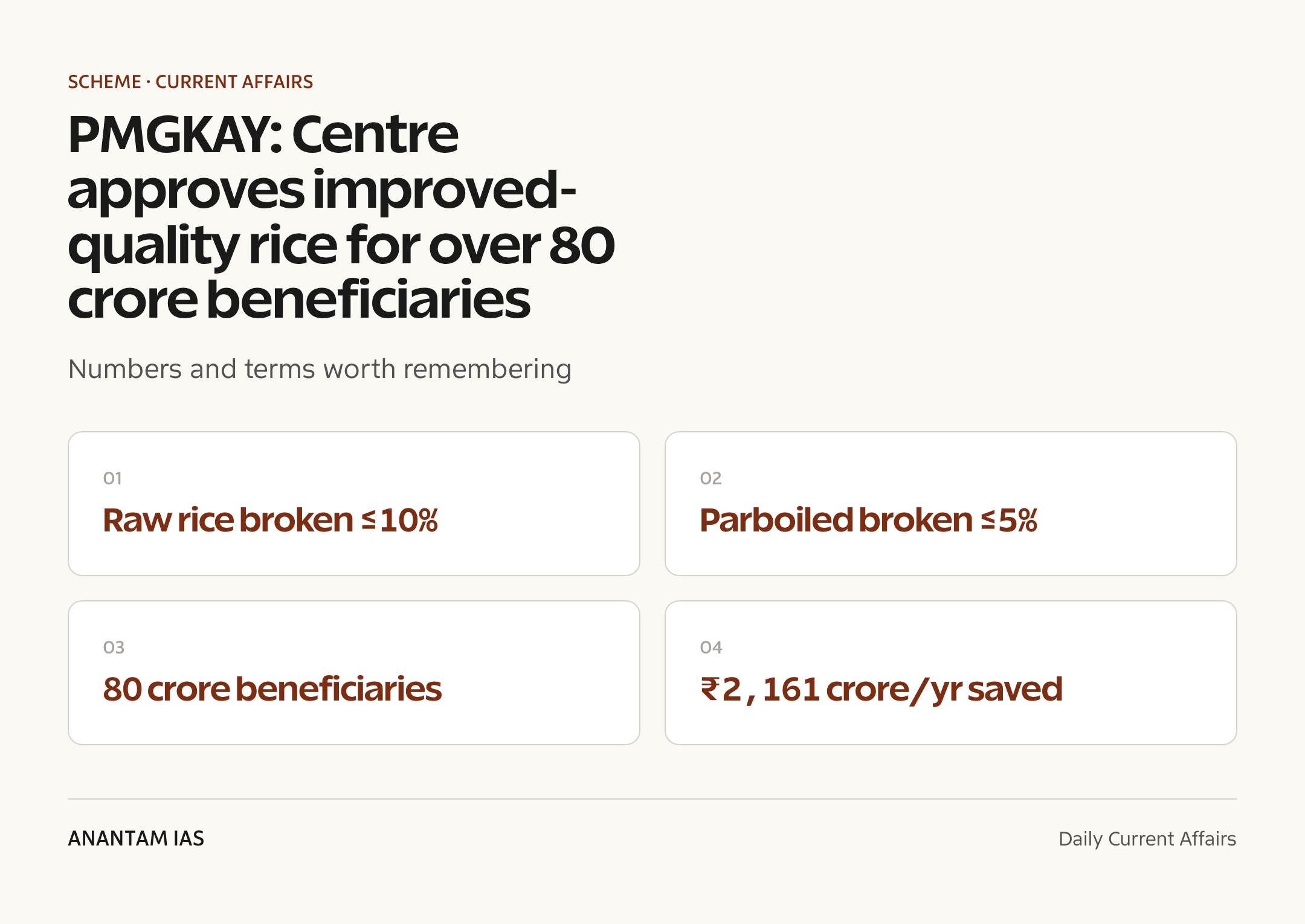
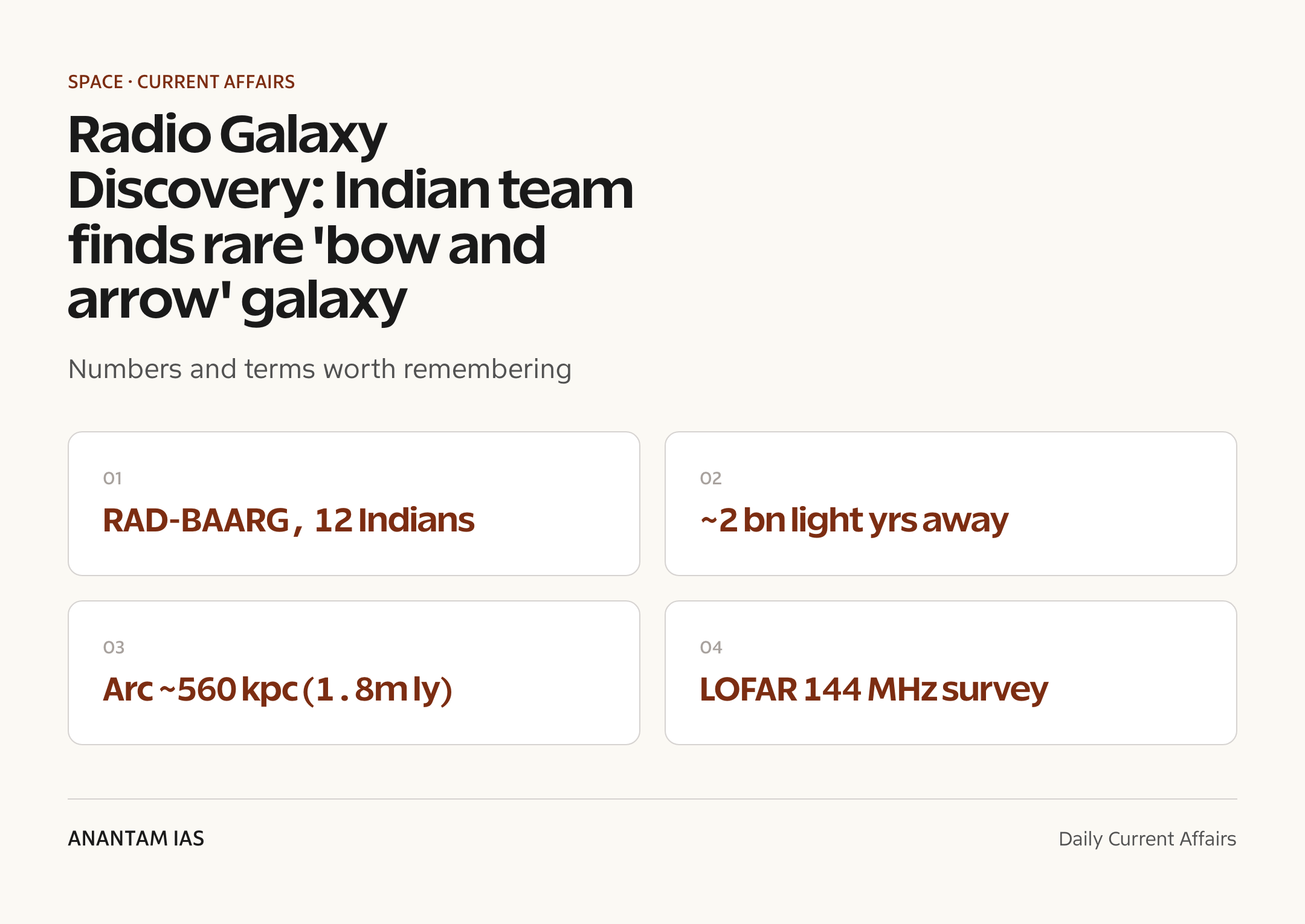
The Hindu reported that a team of 12 Indian researchers working across three countries has discovered a rare, bow-and-arrow-shaped radio galaxy located about 2 billion light years from Earth. The arc-like system spans roughly 1.8 million light years — around 18 times the width of the Milky Way’s visible disc.

The object has been named RAD-BAARG — RAD for the RAD@home Astronomy Collaboratory, India’s first citizen-science research platform in astronomy, and BAARG for Bow And Arrow Radio Galaxy. The researchers say it may be one of the clearest known radio signatures of a giant bow shock produced by a galaxy falling supersonically into a cluster environment.

  • The discovery paper was published in the Monthly Notices of the Royal Astronomical Society (MNRAS) on June 22, 2026.
  • The source was spotted in ultra-sensitive 144 MHz images from the LOFAR Two-metre Sky Survey, one of the deepest low-frequency radio surveys ever made.
  • The lead author is Ananda Hota of the University of Mumbai, founder-director of the 13-year-old RAD@home collaboratory based at Kharghar, Navi Mumbai.
  • A giant arc-like radio feature extends over nearly 560 kiloparsecs (about 1.8 million light years) on the galaxy’s western side — the ‘bow’ of the system.
  • The find follows the same team’s 2025 identification of the farthest and most powerful Odd Radio Circle known at that time.

The development matters in the context of:

  • The discovery is a showcase of Indian radio astronomy capability and of a low-cost citizen-science research model that lets university students make frontier discoveries from home.
  • It lands just as India ramps up its role in the Square Kilometre Array Observatory (SKAO), the next-generation global radio telescope, making radio-galaxy science a durable exam theme.
  • Bow shocks around infalling galaxies were long predicted by simulations but almost never observed directly — RAD-BAARG offers an unusually detailed radio view of the phenomenon.
Radio Galaxy Discovery: Indian team finds rare 'bow and arrow' galaxy — quick facts

UPSC Relevance

Prelims Relevance

  • RAD-BAARG — Bow And Arrow Radio Galaxy; rare, asymmetric radio galaxy ~2 billion light years away; total arc structure ~560 kpc (~1.8 million light years).
  • Radio galaxy — an active galaxy, powered by a supermassive black hole at its core, that emits enormous energy as radio waves; read the basics of black holes alongside.
  • RAD@home Astronomy Collaboratory — India’s first citizen-science research platform in astronomy (founded 2013); based at Kharghar, Navi Mumbai; founder-director Ananda Hota.
  • LOFAR (Low Frequency Array) — Europe’s low-frequency radio telescope network centred in the Netherlands; its Two-metre Sky Survey (144 MHz) produced the discovery images.
  • Bow shock — a shock front formed when an object moves through a medium faster than the local speed of sound, like the shock wave ahead of a supersonic aircraft.
  • Intra-cluster medium (ICM) — the hot, diffuse plasma filling the space between galaxies in a cluster; the infalling host galaxy compresses this gas to create the bow shock.
  • Odd Radio Circles (ORCs) — mysterious ring-shaped radio structures; the RAD@home team reported the farthest, most powerful ORC then known in 2025.
  • GMRT / uGMRT — Giant Metrewave Radio Telescope at Khodad near Pune; 30 fully steerable 45-m dishes; operated by NCRA-TIFR; India’s flagship radio astronomy facility.
  • SKAO — Square Kilometre Array Observatory, an intergovernmental radio telescope being built in South Africa (mid-frequency) and Australia (low-frequency); India is a member.
  • Kiloparsec (kpc) — 1,000 parsecs, about 3,260 light years; a standard unit for galaxy-scale distances.

Mains Relevance

GS Paper 3

  • Achievements of Indians in science and technology — a home-grown citizen-science collaboratory producing discoveries in a leading international journal.
  • Awareness in the field of space — radio astronomy, AGN jets, and how survey telescopes like LOFAR and the upcoming SKA change discovery science.
  • Role of AI and machine learning in mining enormous radio-survey data volumes for unusual sources — a model the RAD-BAARG team explicitly recommends.

GS Paper 2

  • International S&T collaborations — India’s membership of big-science projects such as the SKAO, LIGO-India’s global network, and the Thirty Meter Telescope as instruments of science diplomacy.

Essay

  • Citizen science and the democratisation of research — discovery is no longer the monopoly of large institutions.
  • Big questions, shared telescopes: why frontier science is increasingly a global, collaborative enterprise.

Background and Context

What is a radio galaxy?

Radio galaxies are among the largest single structures in the universe, and their engine sits at the centre of the host galaxy.

  • An active galaxy hosts an active galactic nucleus (AGN) — a compact central region far more luminous than the combined starlight of the galaxy.
  • The engine is a supermassive black hole, millions to billions of solar masses, feeding on surrounding gas through an accretion disc.
  • Part of the infalling matter is flung out as twin jets of relativistic magnetised plasma that punch out of the galaxy into intergalactic space.
  • Electrons spiralling in magnetic fields within these jets emit synchrotron radiation, which is brightest at radio wavelengths — this is why such systems are called radio galaxies.
  • Standard radio galaxies show a fairly symmetric double-lobed shape; astronomers classify them by lobe brightness patterns (the Fanaroff–Riley classes).
  • Peculiar or ‘nonconformist’ morphologies — X-shaped and winged sources, ORCs, and now a bow-and-arrow shape — record how jets interact with their large-scale environment.

Radio Galaxy Discovery: Indian team finds rare 'bow and arrow' galaxy — exam lens

RAD-BAARG: what exactly was found

The MNRAS paper describes a highly unusual, asymmetric structure unlike standard radio galaxies.

  • The paper is titled “RAD@home discovery of a bow-and-arrow radio galaxy tracing a ~560 kpc bow-shock structure in a multi-halo environment”, published on June 22, 2026.
  • On the western side, a narrow jet feeds a sector-shaped emission region and a giant arc-like feature stretching nearly 560 kpc (~1.8 million light years) — the ‘bow’.
  • On the opposite side, the jet develops a distorted S-shaped morphology followed by a faint offset tail extending to almost 600 kpc.
  • The host galaxy sits in a dynamically complex, multi-halo environment with cluster-scale systems at similar distances.
  • The morphology is consistent with radio jets interacting with large-scale gas gradients, bulk gas motions, and shock-related compression tied to the galaxy’s infall.
  • The discovery used the LOFAR Two-metre Sky Survey at 144 MHz; the radio image was combined with optical imaging from the BASS survey to place the structure on the sky.
  • The 12 authors — all associated with RAD@home — work at institutions across three countries, including the University of Mumbai, SRM University (Sikkim), Midnapore City College, Amity University, and centres in Poland and Abu Dhabi.

The physics: a galaxy falling faster than sound

The bow-and-arrow shape is read as the radio-lit imprint of a giant shock front around an infalling galaxy.

  • Galaxy clusters are filled with hot, thin plasma — the intra-cluster medium — which has its own local speed of sound.
  • A galaxy pulled in by the cluster’s gravity (an infall) can move through this gas supersonically, compressing the gas ahead of it into a large-scale shock front.
  • Team member Shubhrangshu Ghosh told The Hindu the effect is similar to the shock wave ahead of a supersonic aircraft.
  • Such shocked gas is extraordinarily diffuse and faint, so bow shocks were predicted by simulations for decades but proved very hard to detect directly.
  • In RAD-BAARG, the radio-emitting plasma from the jets appears to illuminate the otherwise invisible shock structure, making it visible in low-frequency images.
  • Lead author Ananda Hota said the structure is unlike any radio galaxy he had seen in 25 years of research — a candidate textbook example of jet–environment interaction.

RAD@home: India's citizen-science collaboratory

The discovery is as much a story about how Indian science is organised as about the object itself.

  • RAD@home, founded in 2013, is India’s first citizen-science research collaboratory in astronomy, based at Kharghar, Navi Mumbai.
  • It trains university students and enthusiasts to inspect real survey images and conduct extragalactic research from home — no telescope ownership needed.
  • Founder-director Ananda Hota of the University of Mumbai leads the network; every co-author of the RAD-BAARG paper is associated with it.
  • The same collaboratory earlier reported the farthest and most powerful Odd Radio Circle known at the time (2025), showing repeatable discovery capacity.
  • The model mirrors global efforts like Galaxy Zoo: human pattern-recognition at scale complements automated pipelines in finding rare, odd-shaped sources.
  • It’s a low-cost route to research participation that widens the base of trained astronomers — relevant to debates on scientific temper and research access in India.

India's radio astronomy backbone

India runs one of the world’s premier low-frequency radio facilities and has joined the next-generation global array.

  • The Giant Metrewave Radio Telescope (GMRT) at Khodad near Pune — 30 fully steerable 45-metre dishes spread over ~25 km — is run by the National Centre for Radio Astrophysics (NCRA-TIFR).
  • Its upgrade, the uGMRT, widened frequency coverage and sensitivity, keeping it among the most sought-after metre-wavelength telescopes globally.
  • The Ooty Radio Telescope (532 m long cylindrical antenna, Tamil Nadu) is another long-standing Indian radio facility.
  • India is a member of the Square Kilometre Array Observatory (SKAO) — an intergovernmental project building the world’s largest radio telescope across sites in South Africa and Australia — with NCRA-TIFR leading Indian participation and India contributing key observatory software.
  • The RAD-BAARG team said next-generation facilities like the SKA will deepen understanding of how radio galaxies evolve within the large-scale cosmic environment.
  • LOFAR itself, the discovery instrument, is a Europe-wide low-frequency array centred in the Netherlands — a reminder that survey data is shared globally and mined by whoever looks smartly.

The wider Indian astronomy portfolio

For prelims, place this discovery within India’s growing multi-wavelength and multi-messenger astronomy footprint.

  • AstroSat (2015) — India’s first dedicated multi-wavelength space observatory, covering ultraviolet to X-ray bands.
  • XPoSat (2024) — India’s X-ray polarimetry satellite studying black holes, neutron stars and AGN; see the full XPoSat explainer.
  • Aditya-L1 (2023) — solar observatory at the Sun–Earth L1 point; solar physics complements galactic astronomy.
  • LIGO-India — approved gravitational-wave detector at Hingoli, Maharashtra; covered in our note on gravitational waves and LIGO-India.
  • Thirty Meter Telescope (TMT) — India is a partner in this next-generation optical telescope project.
  • MACE at Hanle, Ladakh — among the world’s highest-altitude gamma-ray Cherenkov telescopes; Devasthal 3.6-m (ARIES) is India’s largest optical telescope.

Way Forward

Preparing for the SKA era

  • Scale up Indian participation in SKAO science working groups so Indian teams lead early key-science projects, not just contribute software.
  • Invest in big-data infrastructure — regional data centres, high-performance computing and archives — since SKA-scale surveys will dwarf LOFAR data volumes.
  • Keep the uGMRT scientifically competitive as a complementary metre-wave facility and a training ground for the SKA generation.

Institutionalising citizen science

  • Extend the RAD@home model to other data-rich fields — biodiversity, seismology, air quality — with university credit for verified research contributions.
  • Pair trained human classifiers with AI/ML pipelines, as the discovery team recommends, to sift unusual sources from upcoming radio sky surveys.
  • Fund small, distributed research collaboratories under national science programmes so discovery capacity spreads beyond metropolitan institutes.

Conclusion

RAD-BAARG is a striking object in its own right — a 1.8-million-light-year arc that may be the clearest radio portrait yet of a galaxy’s supersonic plunge into a cluster. But its deeper significance for India is methodological: open survey data, a citizen-science collaboratory, and careful follow-through produced a discovery published in a leading journal without a single new telescope being built.

As India moves into the SKAO era with the uGMRT, LIGO-India and a widening space-observatory fleet, the pipeline of trained eyes and algorithms that projects like RAD@home create will decide how much of the coming data deluge turns into Indian-led science.

UPSC Practice Questions

Prelims MCQ 1

With reference to the recently discovered ‘bow and arrow’ radio galaxy RAD-BAARG, consider the following statements:

  1. It was discovered using low-frequency images from the LOFAR Two-metre Sky Survey.
  2. Its bow-shaped arc is attributed to a bow shock formed as the host galaxy falls supersonically into a cluster environment.
  3. It was discovered by the Giant Metrewave Radio Telescope (GMRT) near Pune.

How many of the above statements are correct?

(a) Only one (b) Only two (c) All three (d) None

Answer: (b) Only two

Explanation:

Statements 1 and 2 are correct: RAD-BAARG was found in 144 MHz LOFAR Two-metre Sky Survey images, and its ~560 kpc arc is read as a bow shock from supersonic infall into a cluster. Statement 3 is wrong — the discovery instrument was LOFAR, the European low-frequency array, not the GMRT.

Prelims MCQ 2

Which of the following best describes the Square Kilometre Array Observatory (SKAO)?

(a) A space-based X-ray telescope operated by NASA and ESA (b) An intergovernmental radio telescope project with sites in South Africa and Australia, of which India is a member (c) An optical telescope being built in Hawaii with Indian participation (d) A gravitational-wave detector planned in Maharashtra

Answer: (b) An intergovernmental radio telescope project with sites in South Africa and Australia, of which India is a member

Explanation:

The SKAO is building the world’s largest radio telescope — mid-frequency dishes in South Africa’s Karoo and low-frequency antennas in Western Australia. India is a member, with NCRA-TIFR (Pune) leading participation. Option (c) describes the Thirty Meter Telescope; option (d) describes LIGO-India.

UPSC Mains Questions

  1. Citizen-science platforms are emerging as low-cost engines of frontier research in India. Using the RAD@home collaboratory’s astronomical discoveries as a case study, examine the potential and limits of citizen science in India’s research ecosystem. (250 words)
  2. India’s participation in mega-science projects such as the Square Kilometre Array Observatory, LIGO-India and the Thirty Meter Telescope serves both scientific and diplomatic goals. Discuss. (250 words)
  3. Radio astronomy has repeatedly revealed structures invisible to optical telescopes. Explain how radio galaxies form, and discuss India’s strengths and gaps in radio astronomy as it enters the SKA era. (250 words)

Source: The Hindu.

Frequently Asked Questions

What is RAD-BAARG?

RAD-BAARG (Bow And Arrow Radio Galaxy) is a rare, asymmetric radio galaxy discovered by 12 Indian researchers of the RAD@home collaboratory. Located about 2 billion light years away, its arc-like structure spans roughly 560 kiloparsecs — about 1.8 million light years — and traces a giant bow shock.

Which telescope discovered the bow-and-arrow galaxy?

It was found in ultra-sensitive 144 MHz images from the LOFAR Two-metre Sky Survey, one of the deepest low-frequency radio surveys ever conducted. LOFAR (Low Frequency Array) is a Europe-wide radio telescope network centred in the Netherlands, whose survey data is open to researchers globally.

What is RAD@home?

RAD@home Astronomy Collaboratory, founded in 2013 and based at Kharghar, Navi Mumbai, is India’s first citizen-science research platform in astronomy. Founded by Ananda Hota of the University of Mumbai, it trains university students to analyse real survey images and make extragalactic discoveries from home.

What causes the bow-and-arrow shape?

The host galaxy appears to be falling supersonically into a nearby cluster of galaxies. Like the shock wave ahead of a supersonic aircraft, this compresses the hot intra-cluster gas into a giant bow shock, and the galaxy’s radio jets light up this otherwise invisible structure.

What is a radio galaxy?

A radio galaxy is an active galaxy powered by a supermassive black hole at its core. The black hole launches enormous jets of relativistic magnetised plasma whose electrons emit synchrotron radiation, making these systems extremely bright at radio wavelengths and often larger than the visible galaxy itself.

Why does this matter for India?

It showcases Indian radio astronomy capability and a low-cost citizen-science model of research. It also strengthens India’s positioning for the Square Kilometre Array era — India is an SKAO member, runs the uGMRT near Pune, and is building LIGO-India and other frontier facilities.
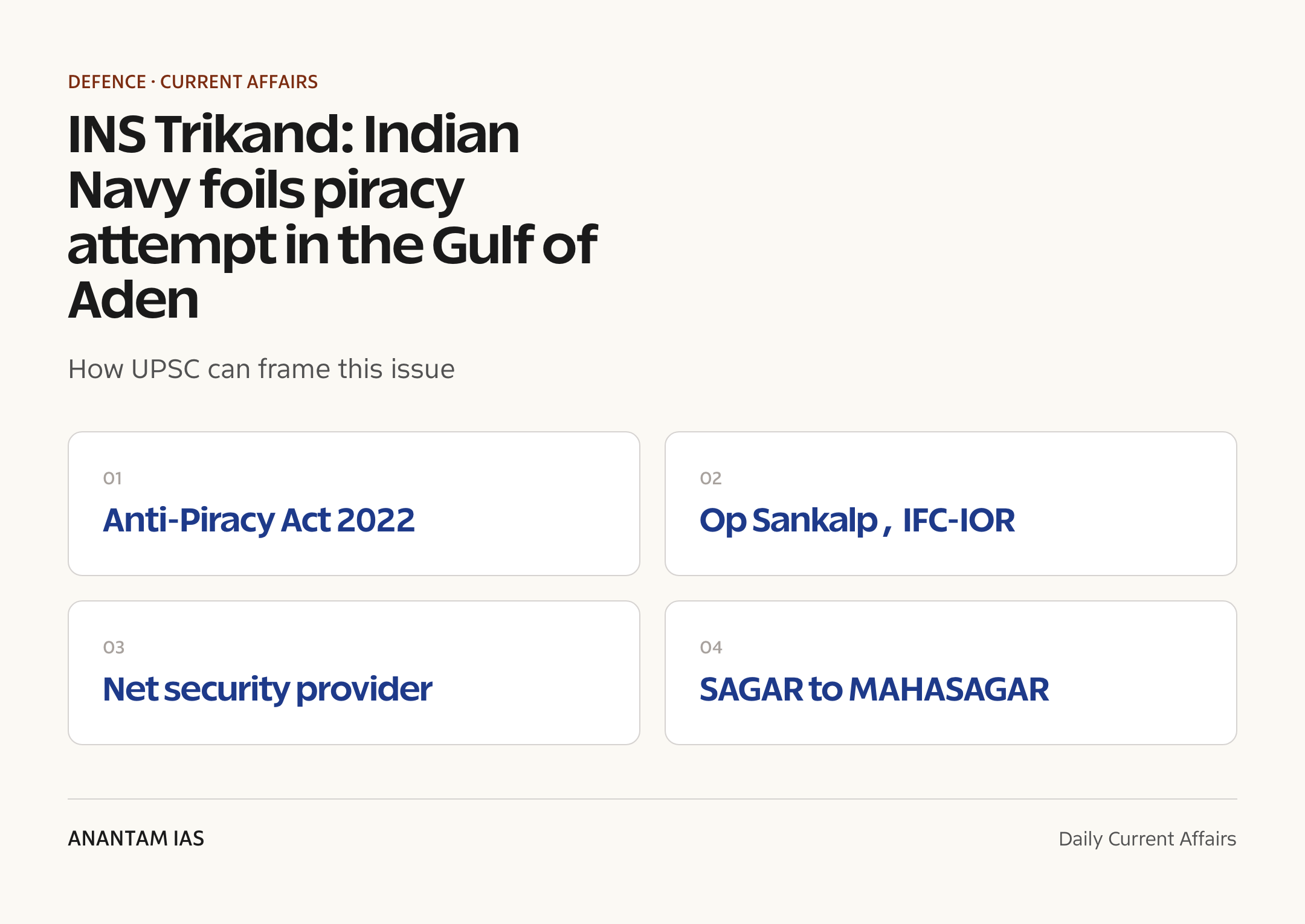
INS Trikand: Indian Navy foils piracy attempt in the Gulf of Aden

Open article →Download PDF

Why in News?

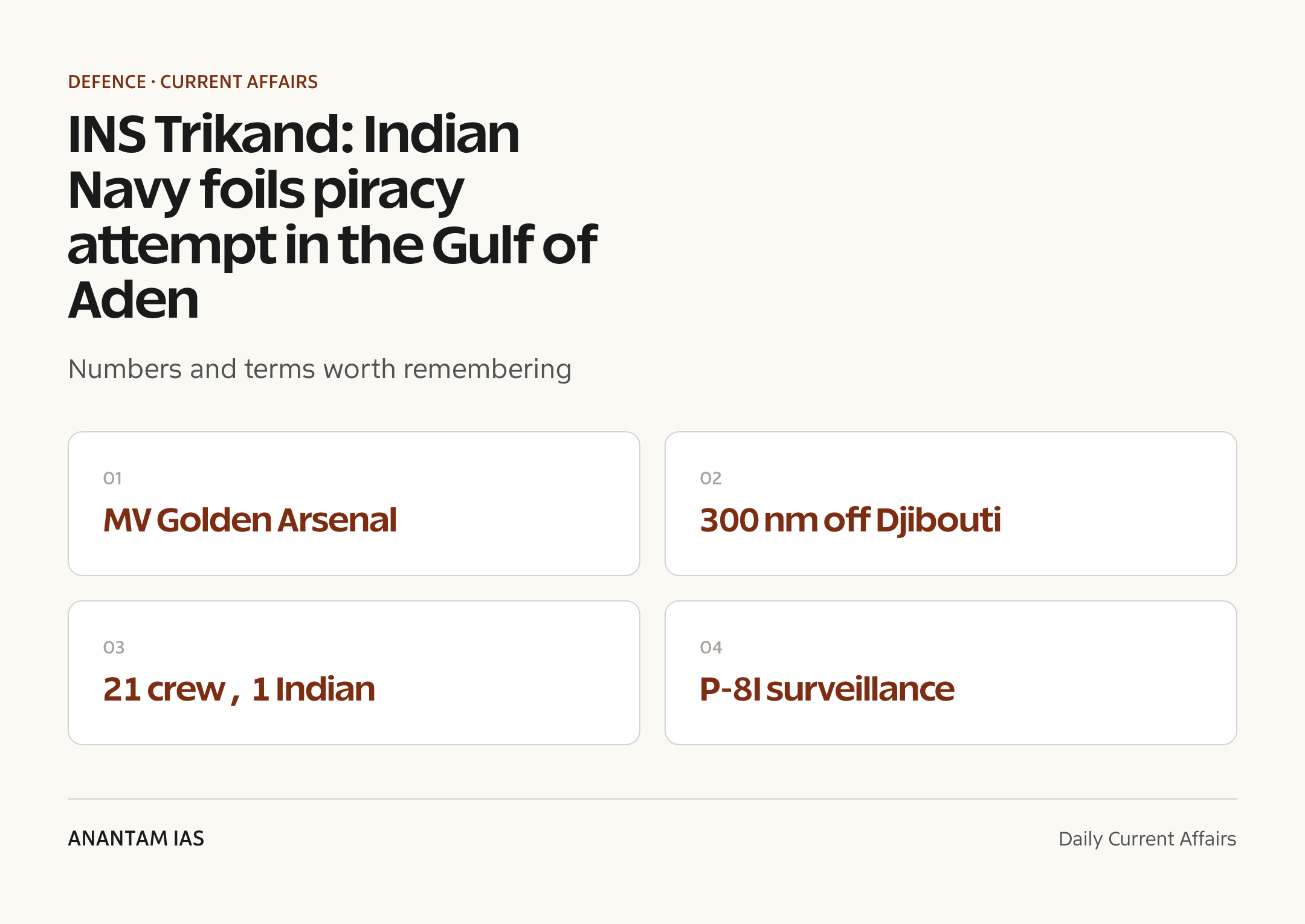
INS Trikand, a mission-deployed stealth frigate of the Indian Navy operating in the Gulf of Aden, responded to a piracy attempt on MV Golden Arsenal, a St. Vincent and the Grenadines-flagged bulk carrier, on 1 July 2026. PIB confirmed that the merchant vessel, transiting from Aden in Yemen, reported the attack roughly 300 nautical miles east-northeast of Djibouti.

The vessel’s 21 crew members, including one Indian national, took shelter in the ship’s citadel — a fortified safe room designed to protect sailors during a pirate boarding — and were reported safe. A boarding team from INS Trikand sanitised the vessel on 2 July, and a P-8I maritime patrol aircraft provided aerial surveillance. MV Golden Arsenal has since resumed her voyage.

  • Piracy attempt on MV Golden Arsenal occurred on 1 July 2026, about 300 nautical miles east-northeast of Djibouti.
  • The incident was reported in coordination with the Information Fusion Centre – Indian Ocean Region (IFC-IOR), leading to INS Trikand’s tasking.
  • The ship carried 21 crew members, including one Indian national; the bridge superstructure was damaged but no injuries were reported.
  • On 2 July 2026, an Indian Navy boarding team searched and sanitised the vessel; no suspicious personnel were found onboard.
  • A P-8I long-range maritime patrol aircraft undertook aerial reconnaissance to support the response.

The development matters in the context of:

  • The response showcases India’s mission-based deployments — warships stationed round-the-clock at Indian Ocean chokepoints as first responders.
  • It reinforces India’s role as the net security provider in the Indian Ocean Region, protecting seafarers irrespective of nationality.
  • The Gulf of Aden–Red Sea corridor has faced renewed shipping threats since late 2023, making naval presence a core element of economic security.
INS Trikand: Indian Navy foils piracy attempt in the Gulf of Aden — quick facts

UPSC Relevance

Prelims Relevance

  • INS Trikand (F51) — a Talwar-class (Project 1135.6) stealth frigate, commissioned in 2013; armed with BrahMos cruise missiles.
  • MV Golden Arsenal — St. Vincent and the Grenadines-flagged bulk carrier attacked ~300 nm east-northeast of Djibouti.
  • Citadel — a fortified compartment where merchant crews shelter during pirate attacks.
  • IFC-IOR — Information Fusion Centre for the Indian Ocean Region, set up at Gurugram in December 2018.
  • Maritime Anti-Piracy Act, 2022 — India’s first dedicated anti-piracy law; applies on the high seas beyond India’s Exclusive Economic Zone (EEZ).
  • Operation Sankalp — Indian Navy’s Gulf-region maritime security operation, launched in June 2019.
  • P-8I Poseidon — long-range maritime patrol and anti-submarine warfare aircraft of the Indian Navy.
  • Bab-el-Mandeb — the chokepoint linking the Gulf of Aden with the Red Sea and the Suez route.
  • SAGAR (2015) and MAHASAGAR (2025) — India’s maritime doctrines for security and growth in the Indian Ocean and beyond.

Mains Relevance

GS Paper 3

  • Security of sea lanes of communication (SLOCs) as an extension of internal and economic security; role of mission-based deployments and maritime domain awareness.
  • Legal-institutional response to piracy: the Maritime Anti-Piracy Act, 2022, IFC-IOR, and Navy-DG Shipping coordination.
  • Linkages between organised crime at sea (piracy, smuggling) and instability in the Horn of Africa.

GS Paper 2

  • India as a net security provider and first responder in the Indian Ocean Region — soft-power and diplomatic dividends of protecting foreign-flagged shipping.
  • India’s maritime multilateralism: SAGAR to MAHASAGAR, cooperation with littoral states and international navies in the Gulf of Aden.

Essay

  • The sea unites what the land divides — oceans as arteries of prosperity and arenas of insecurity.
  • A nation’s power is measured not by what it conquers but by what it protects.

Background and Context

What Happened: The Incident at Sea

PIB’s account of the operation shows a textbook anti-piracy response — detection, interception, boarding, and sanitisation.

  • On 1 July 2026, MV Golden Arsenal, transiting from Aden, Yemen, reported an attempted pirate attack about 300 nautical miles east-northeast of Djibouti.
  • The report flowed through the IFC-IOR, after which INS Trikand, already mission-deployed in the Gulf of Aden, was directed to intercept.
  • The vessel’s bridge superstructure and adjoining compartments were damaged; all 21 crew, including one Indian national, sheltered safely in the citadel.
  • On 2 July, a boarding team from INS Trikand embarked the ship and found no suspicious personnel onboard after a thorough search.
  • A P-8I maritime patrol aircraft flew surveillance sorties, enhancing maritime domain awareness over the area.
  • With the threat neutralised, MV Golden Arsenal resumed her voyage — the Navy stressed its commitment to seafarers irrespective of nationality.
INS Trikand: Indian Navy foils piracy attempt in the Gulf of Aden — exam lens

INS Trikand and the Talwar-Class Frigates

The platform behind the operation is a frontline guided-missile frigate that regularly features in prelims questions.

  • INS Trikand (F51) is a Talwar-class stealth frigate (Russian Project 1135.6, a Krivak III derivative), commissioned into the Indian Navy in 2013.
  • It was built at the Yantar Shipyard, Kaliningrad (Russia), as the third ship of the follow-on batch (INS Teg, INS Tarkash, INS Trikand).
  • The class carries the BrahMos supersonic cruise missile, surface-to-air missiles, torpedoes and a multi-role helicopter, with radar-signature-reducing stealth features.
  • Follow-on ships INS Tushil (2024) and INS Tamal (2025) extended the lineage; INS Tamal is expected to be India’s last imported warship as shipbuilding shifts to Indian yards.
  • Frigates like Trikand are the workhorses of mission-based deployments — versatile enough for escort, boarding and surveillance duties in distant waters.

India's Anti-Piracy Record: Escorts to Operation Sankalp

The Gulf of Aden response rests on a decade and a half of institutionalised anti-piracy experience.

  • The Indian Navy has maintained continuous anti-piracy escort patrols in the Gulf of Aden since October 2008, escorting thousands of merchant ships of all flags.
  • Operation Sankalp, launched in June 2019 after tanker attacks in the Gulf of Oman, keeps Indian warships on station near the Strait of Hormuz.
  • After the Red Sea crisis erupted in late 2023 — drone and missile attacks plus resurgent Somali piracy — the Navy surged multiple task groups across the Arabian Sea and Gulf of Aden.
  • Landmark actions include the March 2024 recapture of MV Ruen by INS Kolkata, with 35 pirates brought to Mumbai for trial, and the January 2024 MV Lila Norfolk rescue after a citadel drill similar to Golden Arsenal’s.
  • Mission-based deployments, adopted in 2017, station ships permanently at key chokepoints, cutting response time from days to hours — the reason Trikand could intercept swiftly.

Maritime Anti-Piracy Act, 2022: The Legal Backbone

Interdiction at sea is only half the job; prosecution needs a dedicated domestic law, which India acquired in 2022.

  • The Maritime Anti-Piracy Act, 2022 is India’s first standalone law on piracy, giving effect to the piracy provisions of the UN Convention on the Law of the Sea (UNCLOS), 1982.
  • It applies to offences committed on the high seas beyond India’s EEZ — that is, beyond 200 nautical miles — closing a jurisdictional gap that earlier forced prosecutors to stretch the Indian Penal Code.
  • Piracy is punishable with imprisonment up to life; where the act of piracy causes or attempts to cause death, the punishment can extend to death or life imprisonment.
  • The Act permits arrest and prosecution of pirates apprehended by the Indian Navy and Coast Guard anywhere on the high seas, with trials before designated Sessions Courts.
  • The MV Ruen pirates became the first major batch prosecuted under the new law, signalling that India can complete the full arrest-to-trial chain.

IFC-IOR and Maritime Domain Awareness

The Golden Arsenal tasking began with an information-sharing hub, not a warship — a reminder that data is the first line of maritime defence.

  • The Information Fusion Centre – Indian Ocean Region (IFC-IOR) was established in December 2018 at Gurugram, co-located with the Navy’s Information Management and Analysis Centre (IMAC).
  • It tracks white shipping (commercial vessel traffic) across the Indian Ocean using data-sharing agreements and hosts International Liaison Officers from partner countries.
  • In this incident, the piracy report was coordinated through IFC-IOR, which enabled the Navy to direct the nearest mission-deployed asset — a working demonstration of maritime domain awareness (MDA).
  • MDA is reinforced by the P-8I fleet, coastal radar chains and satellite surveillance, knitting sensors and ships into one operational picture.

Why the Gulf of Aden Matters: Chokepoints and Trade

Geography explains why a piracy attempt 300 nautical miles from Djibouti is a concern for New Delhi.

  • The Gulf of Aden connects the Arabian Sea to the Red Sea through the Bab-el-Mandeb strait, feeding the Suez Canal route that carries roughly 12 per cent of global trade.
  • It is bounded by Yemen to the north and Somalia and Djibouti on the Horn of Africa — where state fragility and poverty incubate piracy networks.
  • A large share of India’s crude oil imports and Europe-bound exports transits this corridor; disruption raises freight, insurance and energy costs.
  • Thousands of Indian seafarers crew the world’s merchant fleet at any time, giving India a direct human stake in these waters.
  • Multiple navies operate here — including the multinational Combined Task Force 151 — but India deploys independently, preserving strategic autonomy while sharing information.

Net Security Provider: From SAGAR to MAHASAGAR

Protecting a foreign-flagged ship with one Indian aboard is strategy, not charity — it operationalises India’s maritime doctrine.

  • SAGAR (Security and Growth for All in the Region), articulated in 2015 at Mauritius, framed India as a partner for capacity-building and security across the Indian Ocean.
  • In March 2025, this was elevated to MAHASAGAR (Mutual and Holistic Advancement for Security and Growth Across Regions), widening the canvas to the broader Global South.
  • The net security provider concept means India supplies more security than it consumes — escorts for ships of all flags, disaster relief, hydrography and training for littoral navies.
  • Each successful rescue builds India’s credibility amid expanding Chinese naval presence in the Indian Ocean, including its base at Djibouti.
  • For revision, pair this note with the daily digests on current affairs and the compiled monthly current affairs PDFs.

Way Forward

Deepen maritime domain awareness

  • Expand IFC-IOR partnerships, white-shipping agreements and liaison-officer postings so threats are flagged early.
  • Invest in satellite tracking, unmanned vessels and long-range drones for persistent surveillance over piracy-prone waters.

Sustain presence and platforms

  • Maintain mission-based deployments at chokepoints while accelerating indigenous frigate and destroyer construction.
  • Institutionalise escort corridors and convoy schedules with the shipping industry during high-threat periods.

Attack the roots, not just the skiffs

  • Support capacity-building in Horn of Africa littorals — coast guards, courts, coastal livelihoods — since piracy revives wherever governance recedes.
  • Prosecute apprehended pirates consistently under the Maritime Anti-Piracy Act, 2022 to build deterrence beyond tactical interdiction.

Conclusion

The INS Trikand operation is a compact case study in how India’s maritime security architecture works: an information hub (IFC-IOR) detects, a mission-deployed frigate intercepts, air power (P-8I) surveils, and the Maritime Anti-Piracy Act, 2022 stands ready to prosecute — each layer the product of a decade of deliberate investment.

For the examination, anchor this news to the durable concepts — mission-based deployments, net security provider, SAGAR/MAHASAGAR, Gulf of Aden chokepoints — rather than the incident’s particulars. The particulars change every few months; the architecture endures.

UPSC Practice Questions

Prelims MCQ 1

With reference to the Indian Navy’s recent anti-piracy operation involving MV Golden Arsenal, consider the following statements:

  1. INS Trikand, which responded to the incident, is a Talwar-class stealth frigate.
  2. The piracy incident was reported in coordination with the Information Fusion Centre – Indian Ocean Region (IFC-IOR).
  3. MV Golden Arsenal is an Indian-flagged oil tanker.

How many of the above statements are correct?

(a) Only one (b) Only two (c) All three (d) None

Answer: (b) Only two

Explanation:

Statements 1 and 2 are correct: INS Trikand is a Talwar-class (Project 1135.6) frigate, and the attack report was coordinated through IFC-IOR, Gurugram. Statement 3 is incorrect — MV Golden Arsenal is a St. Vincent and the Grenadines-flagged bulk carrier, not an Indian-flagged tanker.

Prelims MCQ 2

The Maritime Anti-Piracy Act, 2022 applies to acts of piracy committed in which of the following maritime zones?

(a) Only within India’s territorial waters (b) Only within India’s Exclusive Economic Zone (c) On the high seas beyond India’s Exclusive Economic Zone (d) Only within 24 nautical miles of the Indian coast

Answer: (c) On the high seas beyond India's Exclusive Economic Zone

Explanation:

The Act gives effect to UNCLOS piracy provisions and applies to the high seas beyond India’s EEZ (beyond 200 nautical miles), enabling Indian courts to try pirates apprehended by the Navy or Coast Guard in international waters.

UPSC Mains Questions

  1. India describes itself as the ‘net security provider’ in the Indian Ocean Region. With reference to the Indian Navy’s anti-piracy operations in the Gulf of Aden, examine how this role advances India’s strategic and economic interests. (250 words)
  2. Maritime domain awareness, forward deployment and domestic legislation form the three pillars of India’s response to piracy. Analyse each pillar, citing IFC-IOR, mission-based deployments and the Maritime Anti-Piracy Act, 2022. (250 words)

Source: PIB, Indian Navy.

Frequently Asked Questions

What happened to MV Golden Arsenal?

MV Golden Arsenal, a St. Vincent and the Grenadines-flagged bulk carrier, reported an attempted pirate attack on 1 July 2026 about 300 nautical miles east-northeast of Djibouti. Its 21 crew, including one Indian national, sheltered safely in the citadel. INS Trikand intercepted, boarded and sanitised the vessel, which then resumed her voyage.

What class of warship is INS Trikand?

INS Trikand (F51) is a Talwar-class stealth frigate of the Indian Navy, built under Russia’s Project 1135.6 at the Yantar Shipyard, Kaliningrad, and commissioned in 2013. The class carries BrahMos supersonic cruise missiles, air-defence missiles, torpedoes and a multi-role helicopter, with stealth shaping to reduce radar signature.

What is a ship’s citadel?

A citadel is a fortified safe room inside a merchant ship, stocked with communications, water and supplies, where the crew locks itself in during a pirate boarding. It denies attackers hostages, buys time for naval forces to respond, and is a core recommendation of the shipping industry’s Best Management Practices.

What is the IFC-IOR?

The Information Fusion Centre – Indian Ocean Region, established at Gurugram in December 2018, is the Indian Navy’s hub for tracking commercial shipping and maritime threats across the Indian Ocean. It hosts International Liaison Officers from partner countries and coordinated the reporting that led to INS Trikand’s tasking in this incident.

What does the Maritime Anti-Piracy Act, 2022 do?

It is India’s first dedicated anti-piracy law, implementing UNCLOS provisions. It applies to piracy on the high seas beyond India’s EEZ, prescribes punishment up to life imprisonment — and death or life imprisonment where piracy causes death — and lets designated Sessions Courts try pirates apprehended by the Navy or Coast Guard.

Why does India patrol the Gulf of Aden?

The Gulf of Aden feeds the Bab-el-Mandeb strait and the Suez route, which carries a large share of India’s trade and energy imports. Indian escort patrols have run there since 2008 to protect merchant shipping and seafarers of all nationalities, reinforcing India’s role as the region’s net security provider.

IBC vs PMLA: NCLAT rules insolvency does not shield firms from ED action

Open article →Download PDF

Why in News?

The National Company Law Appellate Tribunal (NCLAT) has held that insolvency proceedings cannot be used to shield assets allegedly linked to money laundering. The principal bench, ruling in the liquidation of Siddhi Vinayak Logistics Ltd, dismissed the liquidator’s plea to recover funds and assets seized by the Enforcement Directorate (ED), as reported in the Indian Express Explained section.

The tribunal observed that the Insolvency and Bankruptcy Code (IBC) was never intended to become a “holy ganges” that could wash away a corporate debtor’s “sin of criminality” under the Prevention of Money Laundering Act (PMLA). It held that the two statutes operate in distinct spheres — the IBC deals with legitimately acquired assets, while the PMLA tracks proceeds of crime.

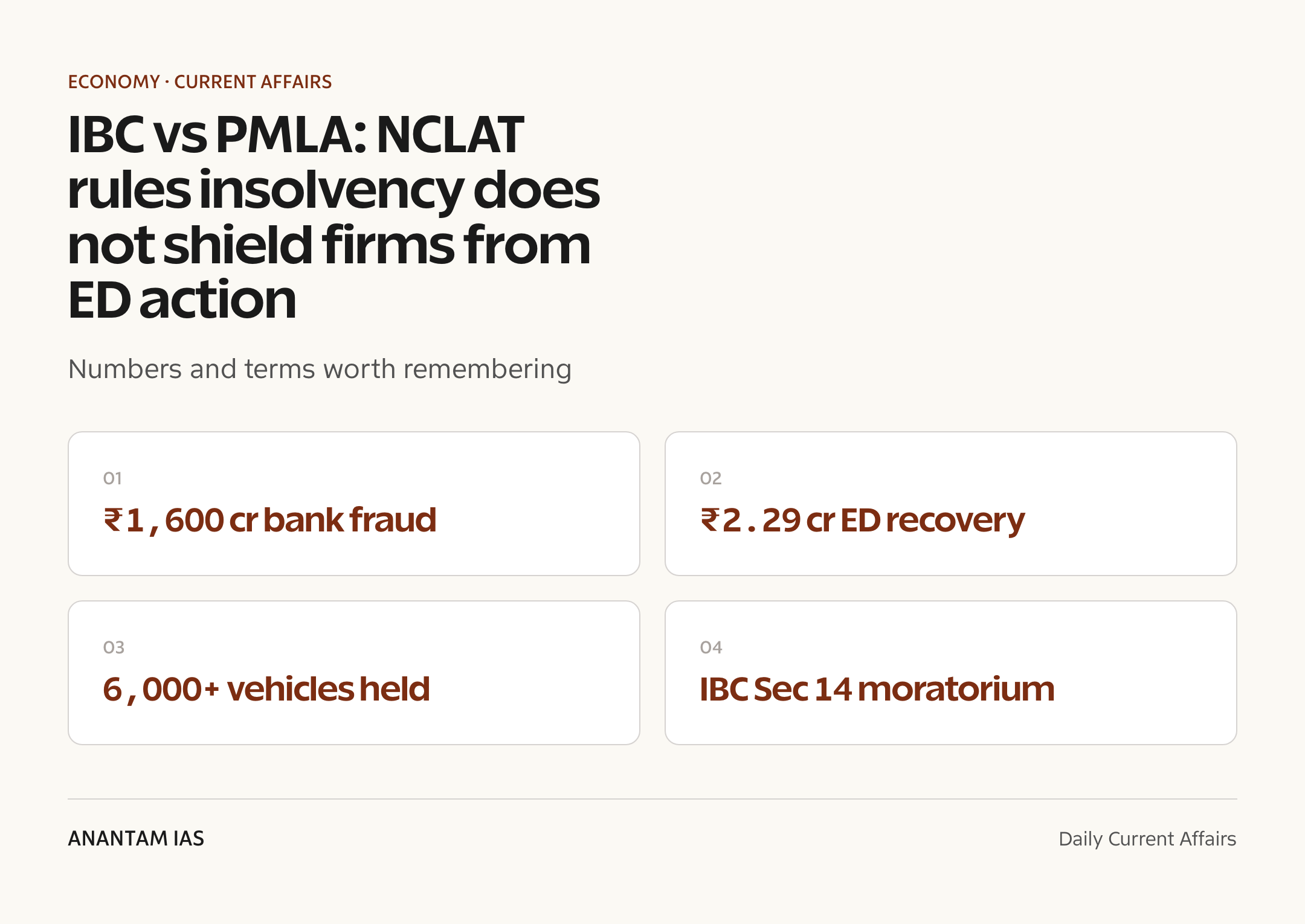
  • The company faced ED investigation over FIRs alleging bank fraud and loan diversion exceeding ₹1,600 crore.
  • The ED attached assets BEFORE the Corporate Insolvency Resolution Process (CIRP) began in September 2017, and later withdrew ₹2.29 crore from a company account during the moratorium.
  • In 2019 the ED attached over 6,000 vehicles of the logistics firm; the company eventually went into liquidation.
  • The liquidator argued the withdrawal violated the Section 14 IBC moratorium; the NCLAT disagreed.
  • The bench framed the dispute as “IBC vs PMLA” — a clash of statutes, not parties — and ruled that ED attachments of alleged proceeds of crime survive the moratorium.

The development matters in the context of:

  • The friction between the IBC moratorium and PMLA attachment powers is a recurring fault line in India’s insolvency ecosystem — it decides how much creditors recover in fraud-hit cases.
  • It also clarifies jurisdictional boundaries — the NCLT/NCLAT cannot review ED attachment orders, which must be contested only before PMLA authorities.
IBC vs PMLA: NCLAT rules insolvency does not shield firms from ED action — quick facts

UPSC Relevance

Prelims Relevance

  • IBC, 2016 — adjudicating authority is the NCLT; appeals lie to the NCLAT, then the Supreme Court.
  • Section 14, IBC — moratorium barring suits and proceedings against the corporate debtor once CIRP begins.
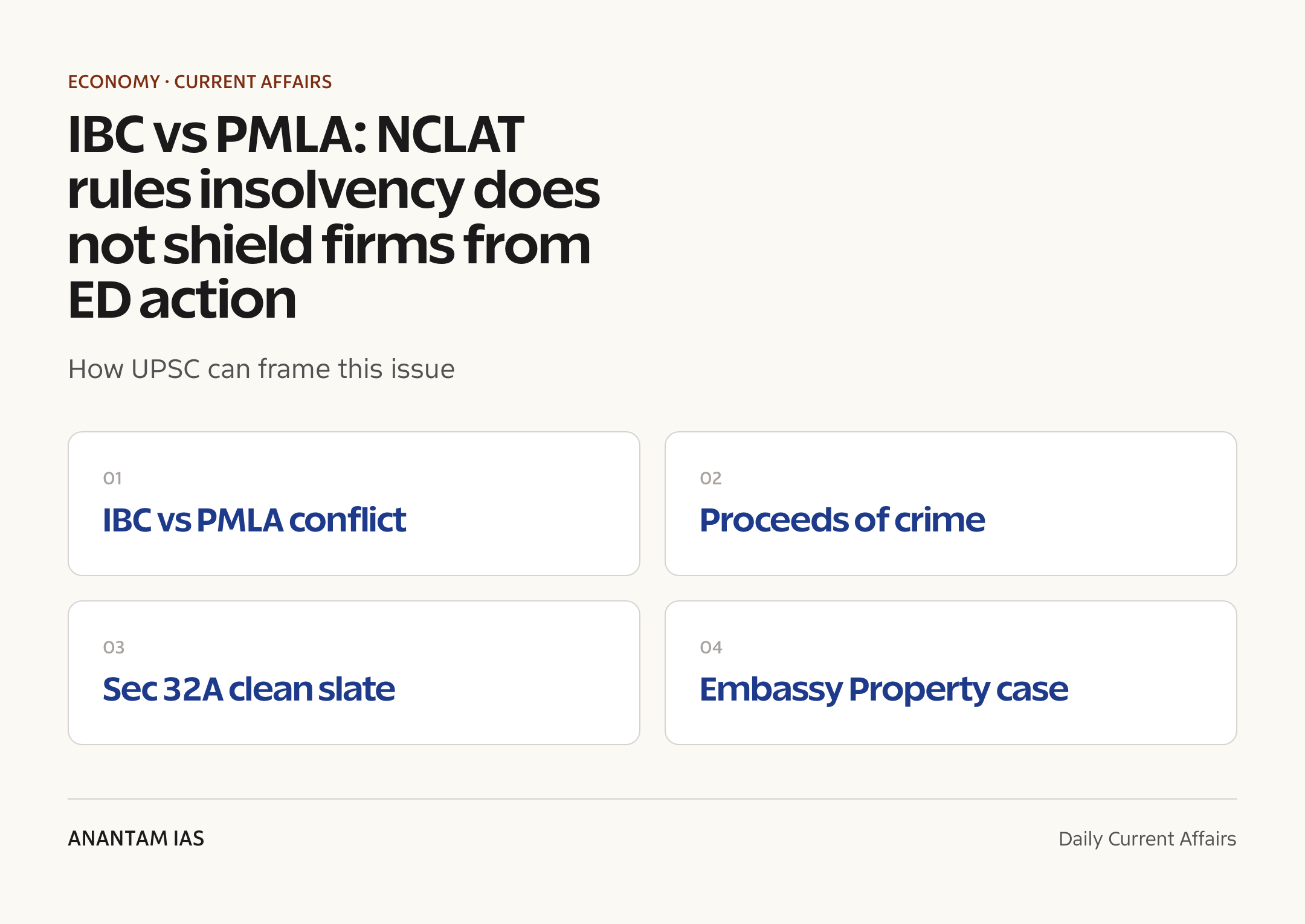
  • Section 32A, IBC (2020) — “clean slate”: prior-offence liability ceases once a resolution plan is approved for new, unconnected management.
  • PMLA, 2002 — enforced by the ED (Department of Revenue, Ministry of Finance); provisional attachment of proceeds of crime is confirmed by an Adjudicating Authority.
  • Section 41, PMLA — bars civil courts from matters the PMLA authorities are empowered to decide.
  • Proceeds of crime — property derived, directly or indirectly, from a scheduled offence.
  • P. Mohanraj v. Shah Brothers Ispat (2021) — coercive recovery during the moratorium is impermissible.
  • Embassy Property Developments case (2019) — NCLT’s jurisdiction is confined to the IBC’s own working; it cannot review other statutory authorities.
  • Manish Kumar v. Union of India (2021) — upheld the constitutional validity of Section 32A.
  • IBBI — regulator for insolvency professionals and processes under the IBC.

Mains Relevance

GS Paper 3

  • IBC’s creditor-recovery objective vs the state’s interest in confiscating proceeds of crime — “compromisable” recovery against “uncompromisable” national interest.
  • Impact of parallel ED attachments on resolution timelines, haircuts and the bankability of fraud-hit debtors.

GS Paper 2

  • Tribunals and jurisdictional discipline: NCLT/NCLAT’s statutory limits (Embassy Property doctrine) and the Section 41 PMLA bar.
  • Harmonising two special statutes — legislative silence on the IBC-PMLA interface and the case for clarification by Parliament.

Essay

  • Rule of law vs economic efficiency — should the pursuit of ill-gotten wealth yield to speedy commercial resolution?
  • Institutions as gatekeepers: how credible enforcement against economic crime underpins trust in markets.

Background and Context

The Siddhi Vinayak Logistics case: facts in brief

The dispute arose from a Surat-based logistics company that faced money-laundering attachment before and during its insolvency.

  • Siddhi Vinayak Logistics Ltd came under ED investigation over FIRs alleging bank fraud and diversion of loan funds exceeding ₹1,600 crore.
  • The ED provisionally attached its assets and told customers not to release payments — all before insolvency began.
  • The company entered CIRP in September 2017, triggering the Section 14 moratorium.
  • During the moratorium, the ED confirmed the attachment and withdrew ₹2.29 crore from a company bank account; in 2019 it attached over 6,000 vehicles.
  • The Appellate Tribunal under PMLA set aside the original 2017 attachment; a challenge to that order is pending in the Bombay High Court.
  • Resolution failed and the company went into liquidation; the liquidator argued the ED’s withdrawal “constituted unlawful depletion of the insolvency estate”.
IBC vs PMLA: NCLAT rules insolvency does not shield firms from ED action — exam lens

IBC 2016 and the Section 14 moratorium

The Insolvency and Bankruptcy Code is India’s consolidated law for time-bound resolution of corporate distress.

  • The IBC, 2016 replaced a fragmented regime (SICA, BIFR, Companies Act winding-up) with a single creditor-driven process overseen by the NCLT and regulated by the IBBI; CIRP is time-bound at 180 days, with a 330-day outer limit including litigation.
  • Section 14(1)(a) imposes a moratorium once CIRP begins: it bars the institution or continuation of suits or proceedings against the corporate debtor, including execution of any judgment or order.
  • Its purpose is collective resolution: freezing the debtor’s position so creditors are dealt with together, not through a race of individual recoveries.
  • In P. Mohanraj v. Shah Brothers Ispat (2021), the Supreme Court held coercive recovery actions during the moratorium impermissible — the liquidator’s central authority.
  • Section 32A (2020 amendment, upheld in Manish Kumar v. Union of India, 2021) gives the debtor a clean slate: prior-offence liability ceases once a resolution plan is approved for new, unconnected management.

PMLA 2002 and the ED's attachment powers

The Prevention of Money Laundering Act arms the state to track, attach and eventually confiscate ill-gotten wealth.

  • The PMLA, 2002 (in force from 2005) criminalises laundering of proceeds of crime — property derived directly or indirectly from a scheduled offence.
  • The Enforcement Directorate, under the Department of Revenue, Ministry of Finance, investigates and enforces the Act.
  • Under Section 5, the ED may provisionally attach suspected proceeds of crime; an Adjudicating Authority confirms it, an Appellate Tribunal hears appeals, and confirmed cases move towards confiscation.
  • Section 41 bars civil courts from matters the Director, Adjudicating Authority or Appellate Tribunal is empowered to decide — the ED’s shield against NCLT/NCLAT scrutiny here.
  • The ED contended its proceedings concerned proceeds of crime under a separate statute altogether, beyond the jurisdiction of the insolvency tribunals.
  • In Vijay Madanlal Choudhary v. Union of India (2022), the Supreme Court broadly upheld the ED’s attachment, arrest and search powers under the PMLA.

What the NCLAT actually held

The principal bench framed the case as a clash of statutes and drew a bright line between legitimate assets and criminal wealth.

  • The bench said the dispute “is not appellant vs the Enforcement Directorate but IBC vs PMLA, when both the legislations are in action”.
  • It distinguished legitimately acquired assets — which the IBC pools and sells to repay creditors — from assets sourced “by and out of a crime”, where the PMLA prevails.
  • Parliament “did not legislate IBC with an intent to create… a mechanism for legitimising ill-gotten wealth“; PMLA attachment is a framework for “tracking and hunting” such assets towards confiscation.
  • It read Section 14 narrowly: the moratorium covers only proceedings that add to the company’s civil debt; penal actions of a public-law nature are untouched, even if they shrink the creditors’ pool.
  • Creditor recovery is “compromisable” — every creditor accepts haircuts in insolvency — whereas “national interest at all times remains uncompromisable”.
  • On Section 32A, the bench declined to engage: the clean-slate immunity operates only on a successful resolution, and this company had gone into liquidation.
  • On jurisdiction, relying on Embassy Property Developments v. State of Karnataka, it held ED attachments must be contested before PMLA authorities alone.

Why the IBC-PMLA friction persists

Neither statute expressly resolves what happens when a money-laundering attachment collides with an insolvency estate.

  • Both laws carry non-obstante (overriding) clauses — Section 238 IBC and Section 71 PMLA — each claiming primacy, with no express rule for their mutual conflict.
  • Benches and courts have pulled in different directions: some rulings prioritised the resolution objective and estate integrity, others protected ED attachments as a distinct public-law track.
  • Section 32A settled one scenario — a successful plan wipes prior offence liability — but is silent on liquidation, pre-CIRP attachments and interim depletion of the estate: the exact gaps this case exposed.
  • For lenders the stakes are concrete: attached assets are carved out of the estate, deepening haircuts in fraud-driven insolvencies.
  • For enforcement, letting the moratorium freeze attachments would let promoters route tainted assets through insolvency and emerge laundered — the “holy ganges” risk the NCLAT flagged.
  • The ruling strengthens the ED’s hand but leaves the boundary to case-by-case litigation until Parliament clarifies the interface.

Significance for the insolvency ecosystem

The decision recalibrates expectations for creditors, resolution professionals and bidders in fraud-tainted insolvencies.

  • Resolution professionals and liquidators cannot count attached assets as part of the estate; PMLA overhangs must be disclosed upfront.
  • Resolution applicants get a clearer incentive: the Section 32A clean slate rewards a successful resolution plan, while liquidation offers no immunity.
  • Financial creditors — mostly public-sector banks in large fraud accounts — face deeper haircuts where the ED has attached core assets.
  • The judgment reinforces tribunal discipline and reduces forum shopping between the NCLT and PMLA authorities.
  • Track related developments on the Anantam IAS current affairs digests, and read the primary statutes on the IBBI website and the Enforcement Directorate portal.

Way Forward

Statutory clarity

  • Parliament should codify the IBC-PMLA interface — the fate of pre-CIRP attachments, treatment during liquidation, and time-bound PMLA adjudication for companies in insolvency.
  • Extend a calibrated Section 32A logic to liquidation sales to bona fide third-party buyers, so clean assets find buyers without legitimising crime.

Institutional coordination

  • A formal ED-IBBI-RBI protocol for fraud-hit debtors — shared asset registries and early disclosure of attachments to resolution professionals.
  • Strengthen PMLA Adjudicating Authority capacity so attachment appeals don’t outlast the insolvency process itself.

A definitive Supreme Court ruling on the IBC-PMLA overlap would settle the field faster than piecemeal tribunal orders.

Conclusion

The NCLAT ruling draws a principled line: the IBC exists to resolve honest business failure, not to launder the proceeds of dishonest enterprise. By reading the Section 14 moratorium as a shield for civil liabilities — not against penal action targeting proceeds of crime — the tribunal kept both statutes in their own spheres.

But the decision also exposes the cost of legislative silence. Creditors bear deeper haircuts, and the boundary between legitimate and tainted assets will be fought case by case. A statutory fix to the IBC-PMLA interface is the durable answer.

UPSC Practice Questions

Prelims MCQ 1

With reference to the Insolvency and Bankruptcy Code (IBC), 2016, consider the following statements:

  1. Section 14 of the IBC imposes a moratorium barring the institution or continuation of suits and proceedings against the corporate debtor once the insolvency resolution process begins.
  2. Section 32A of the IBC extinguishes the corporate debtor’s liability for prior offences only after a resolution plan is successfully approved, and does not apply where the company goes into liquidation.
  3. Appeals against orders of the National Company Law Tribunal (NCLT) in insolvency matters lie directly to the Supreme Court.

How many of the above statements are correct?

(a) Only one (b) Only two (c) All three (d) None

Answer: (b) Only two

Explanation:

Statements 1 and 2 are correct — Section 14 freezes suits against the corporate debtor, and the Section 32A clean slate operates only on a successful resolution, not in liquidation. Statement 3 is incorrect: appeals from the NCLT lie to the NCLAT, and only then to the Supreme Court.

Prelims MCQ 2

Under the Prevention of Money Laundering Act (PMLA), 2002, a provisional attachment of property suspected to be proceeds of crime is confirmed by which of the following?

(a) The Special Court trying the scheduled offence (b) The Adjudicating Authority constituted under the PMLA (c) The National Company Law Tribunal (d) The jurisdictional High Court

Answer: (b) The Adjudicating Authority constituted under the PMLA

Explanation:

The ED provisionally attaches suspected proceeds of crime under Section 5 of the PMLA; the attachment must be confirmed by the Adjudicating Authority, with appeals lying to the Appellate Tribunal. Section 41 bars civil courts — and, per the NCLAT, insolvency tribunals — from interfering with this chain.

UPSC Mains Questions

  1. The IBC and the PMLA pursue distinct public objectives that can collide in fraud-hit insolvencies. In the light of recent NCLAT jurisprudence, examine the conflict between the IBC moratorium and ED attachment powers, and suggest a statutory resolution.
  2. “Creditor recovery is compromisable, but national interest is not.” Critically analyse this framing of the balance between speedy resolution of stressed assets and enforcement against economic offences in India.
  3. Discuss how jurisdictional discipline among specialised tribunals — as reflected in the Embassy Property doctrine — affects the efficiency and credibility of India’s insolvency framework.

Source: Indian Express Explained.

Frequently Asked Questions

What did the NCLAT rule on IBC vs PMLA?

The NCLAT held that the insolvency process cannot shield assets allegedly linked to money laundering. ED attachments of proceeds of crime under the PMLA survive the IBC moratorium, because the two laws operate in distinct spheres — the IBC pools legitimate assets for creditors, while the PMLA targets criminal wealth for confiscation.

What is the Section 14 moratorium under the IBC?

Once the corporate insolvency resolution process begins, Section 14 bars the institution or continuation of suits and proceedings against the corporate debtor. Its purpose is collective resolution — freezing the debtor’s position so all creditors are dealt with together. The NCLAT read it narrowly, covering only proceedings that add to the company’s civil debt.

What are proceeds of crime under the PMLA?

Proceeds of crime means property derived or obtained, directly or indirectly, from criminal activity relating to a scheduled offence under the PMLA, 2002. The Enforcement Directorate can provisionally attach such property; an Adjudicating Authority confirms the attachment, and confirmed cases move towards confiscation to the Central Government.

What is Section 32A of the IBC?

Section 32A, inserted in 2020 and upheld in Manish Kumar v. Union of India (2021), gives a corporate debtor a clean slate: its liability for offences committed before insolvency ceases once a resolution plan is approved for new, unconnected management. The NCLAT clarified it does not apply where the company goes into liquidation.

Why could the NCLAT not review the ED’s attachment?

Relying on Embassy Property Developments v. State of Karnataka, the tribunal held that the NCLT’s jurisdiction extends only as far as the IBC’s own working requires. Section 41 of the PMLA separately bars civil courts from matters the PMLA authorities are empowered to decide, so ED attachments must be contested before PMLA forums alone.

What was the Siddhi Vinayak Logistics case about?

The logistics company faced ED investigation over alleged bank fraud and diversion of loans exceeding ₹1,600 crore. The ED attached its assets before insolvency began in September 2017, later withdrew ₹2.29 crore from its account, and attached over 6,000 vehicles in 2019. The liquidator’s plea to recover these was dismissed by the NCLAT.

IRDAI Reform: A statutory body to curb dark patterns in insurance

Open article →Download PDF

Why in News?

The Insurance Regulatory and Development Authority of India (IRDAI) has partnered with the Institute of Public Auditors of India (IPAI) to independently study and monitor dark patterns — manipulative digital design practices — across the insurance industry over a period of nine months. The Indian Express reported the move on July 2, 2026, after IRDAI Chairman Ajay Seth announced it at an industry event in Mumbai.

The trigger was telling: when IRDAI directed insurers in April 2026 to self-assess their platforms against the dark-pattern guidelines and report back, almost every insurer claimed it had none. The regulator has now moved from self-certification to independent third-party monitoring, and will follow up with a consultation paper on insurance distribution reforms in July, targeting mis-selling and the commission-based distribution model.

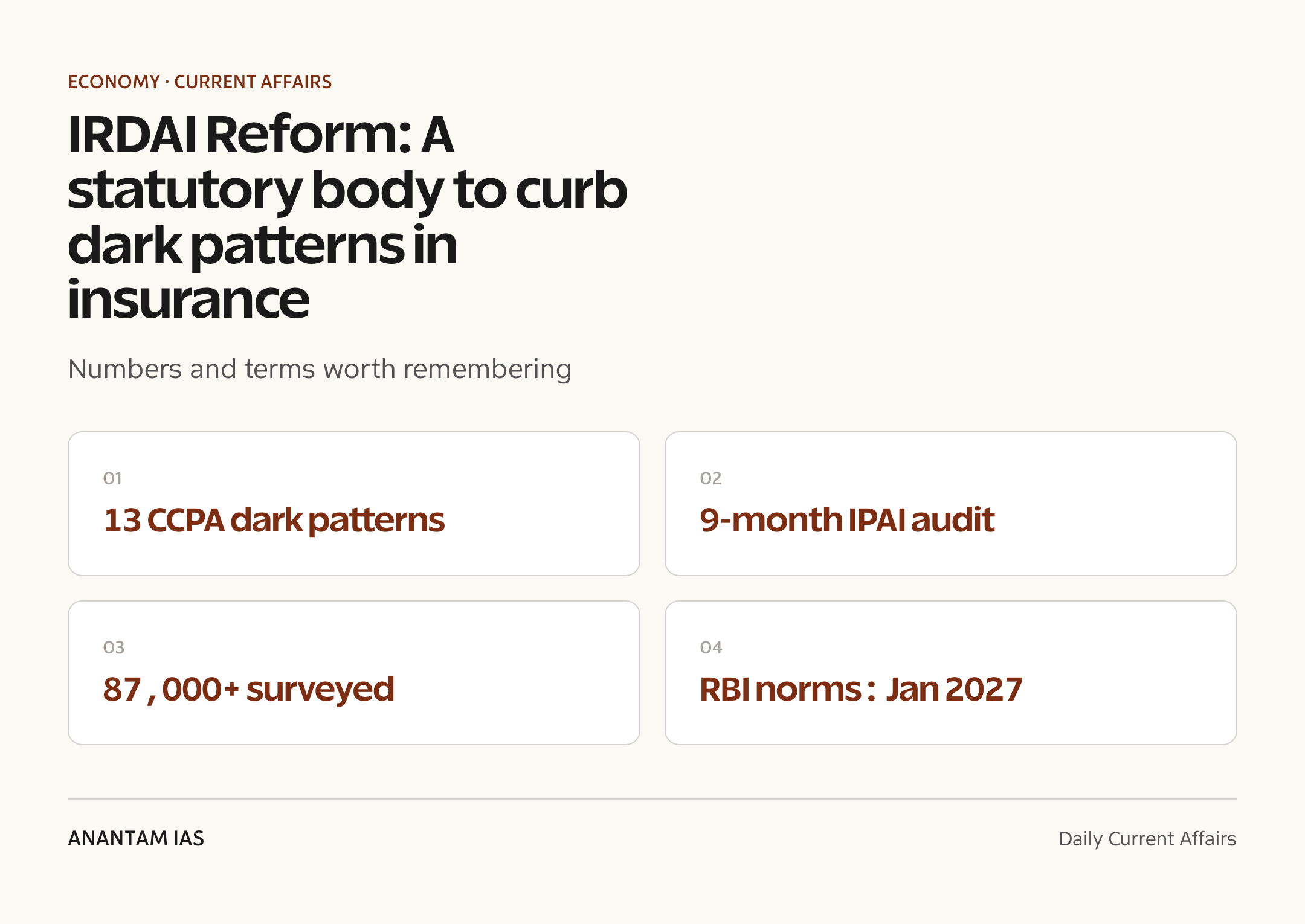
  • IPAI, a body of public-audit professionals drawn from the CAG fraternity, will track over nine months which insurers use dark patterns and which don’t.
  • The April 2026 directive had asked insurers to align with the CCPA’s dark-pattern guidelines, run a self-assessment and submit action plans — the near-universal denial prompted the external audit.
  • A LocalCircles survey of over 87,000 respondents across 341 districts found about 80% faced hidden charges, difficulty in cancelling policies or forced data sharing on insurance platforms.
  • Around 90% of surveyed users reported being pushed through unsolicited calls and messages to buy or renew policies.
  • IRDAI’s July consultation paper is expected to propose steps to curb mis-selling across distribution channels, improve transparency and rework commission structures.
  • The move follows the RBI’s framework curbing mis-selling and dark patterns by banks, which takes effect from January 1, 2027.

The development matters in the context of:

  • This sits at the junction of financial regulation and consumer protection — a behavioural-economics problem (manipulation by design) being answered with institutional machinery (audit, disclosure, distribution reform).
  • Trust is the binding constraint on financial inclusion in insurance: India’s insurance penetration was about 3.7% of GDP in FY24, and manipulative selling repels precisely the hesitant first-time buyer.
  • It also illustrates regulatory convergence: the CCPA, RBI and IRDAI are now acting on the same harm — dark patterns — within their respective jurisdictions.
IRDAI Reform: A statutory body to curb dark patterns in insurance — quick facts

UPSC Relevance

Prelims Relevance

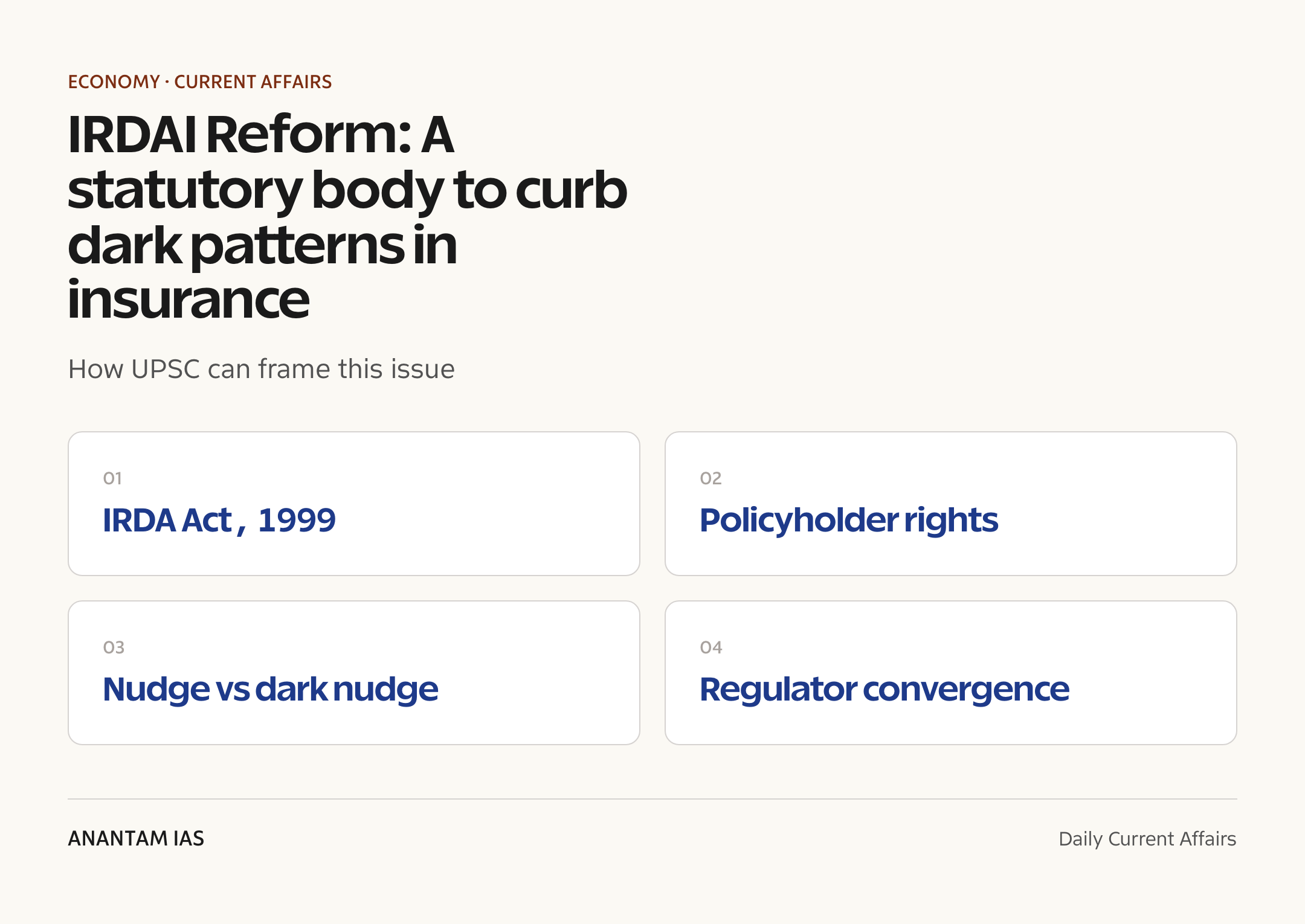
  • IRDAI — statutory body under the IRDA Act, 1999; headquartered in Hyderabad; set up on the recommendations of the Malhotra Committee (1994).
  • Dark patterns — deceptive user-interface designs that manipulate users into choices they didn’t intend; regulated in India by the CCPA guidelines, 2023.
  • CCPA — Central Consumer Protection Authority, established under the Consumer Protection Act, 2019; its 2023 guidelines specify 13 dark patterns.
  • Examples of the 13 specified patterns: false urgency, basket sneaking, confirm shaming, subscription trap, drip pricing, bait and switch, nagging, interface interference, forced action, disguised advertisement, trick wording, SaaS billing, rogue malware.
  • Institute of Public Auditors of India (IPAI) — professional body of public auditors (est. 1996) engaged by IRDAI for the nine-month dark-patterns study.
  • RBI framework on mis-selling by banks — bans compulsory bundling and dark patterns, mandates explicit consent and refunds; effective January 1, 2027.
  • Digital Personal Data Protection (DPDP) Act, 2023 — consent-based data processing; relevant to forced data-sharing patterns.
  • Bima Trinity — Bima Sugam (digital marketplace), Bima Vistaar (composite cover), Bima Vaahak (women-led distribution); part of IRDAI’s Insurance for All by 2047 vision.
  • India’s insurance penetration: about 3.7% of GDP in FY24 (IRDAI Annual Report).

Mains Relevance

GS Paper 3

  • Financial-sector regulation: mis-selling as a market failure; incentive misalignment in commission-based distribution.
  • Financial inclusion: why consumer trust is infrastructure — low insurance penetration despite digital distribution.
  • Digital economy: platform design, behavioural manipulation and the limits of caveat emptor online.

GS Paper 2

  • Statutory and regulatory bodies: IRDAI’s mandate under the IRDA Act, 1999; independent audit as a governance instrument.
  • Regulatory coordination: CCPA–RBI–IRDAI acting on the same consumer harm — case for harmonised norms.
  • Government policies for vulnerable sections: protecting the first-time financial consumer.

GS Paper 4

  • Ethics of persuasion in business: the line between a legitimate nudge and a manipulative dark pattern; corporate governance and probity.

Essay

  • Trust is the true currency of a financial system — regulation can protect it, only conduct can earn it.
  • Technology amplifies both choice and manipulation: the case for designing markets around the consumer.
  • Financial inclusion without financial protection is a promise half kept.

Background and Context

What Are Dark Patterns?

Dark patterns are design tricks built into websites and apps that steer users into decisions they wouldn’t otherwise make.

  • The term covers deceptive user-interface and user-experience practices that pressurise, mislead or trap users — into sharing data, paying more, or staying subscribed.
  • India’s legal definition comes from the Guidelines for Prevention and Regulation of Dark Patterns, 2023, notified by the Central Consumer Protection Authority (CCPA) under the Consumer Protection Act, 2019.
  • The guidelines specify 13 dark patterns: false urgency, basket sneaking, confirm shaming, forced action, subscription trap, interface interference, bait and switch, drip pricing, disguised advertisement, nagging, trick question/trick wording, SaaS billing and rogue malware.
  • In insurance, the typical forms are: forcing users to hand over personal data before showing quotes, making policy cancellation deliberately hard, hiding charges deep in the purchase flow, and relentless spam calls pushing products.
  • Behavioural economists distinguish a nudge (choice-preserving help toward a better decision) from sludge or dark nudges (friction and framing engineered against the user’s interest) — dark patterns are the latter, at industrial scale.
IRDAI Reform: A statutory body to curb dark patterns in insurance — exam lens

IRDAI: The Regulator Behind the Move

The exam-relevant anchor here is the institution itself — a statutory financial regulator with an explicit policyholder-protection mandate.

  • IRDAI is a statutory body constituted under the Insurance Regulatory and Development Authority Act, 1999, and became operational in April 2000.
  • It was created on the recommendations of the Malhotra Committee (1994) on insurance-sector reforms; headquarters: Hyderabad.
  • Composition: a chairperson, up to five whole-time members and four part-time members, all appointed by the Government of India.
  • Its mandate under the Act: protect policyholders’ interests, and regulate, promote and ensure the orderly growth of the insurance and reinsurance business.
  • Its current agenda is framed by the Insurance for All by 2047 vision and the Bima Trinity — Bima Sugam, Bima Vistaar and Bima Vaahak.
  • The current chairman, Ajay Seth, has framed the dark-patterns drive as a trust problem: financial inclusion must be “more understandable, more trusted, and more actionable”.

The New Monitoring Mechanism

IRDAI’s response escalated in three steps once self-regulation visibly failed.

  • Step 1 — April 2026 directive: insurers were told to align with the CCPA’s dark-pattern guidelines, run a self-assessment of their digital platforms and submit their observations and action plans.
  • Step 2 — the denial problem: almost all insurers reported they had no dark patterns. As Chairman Seth put it, that response is exactly why the regulator went external.
  • Step 3 — independent audit: IRDAI has engaged the Institute of Public Auditors of India (IPAI) — a professional body of public-audit experts drawn from the CAG-led audit fraternity, set up in 1996 — to study and monitor the industry for nine months and establish who uses dark patterns and who doesn’t.
  • A consultation paper on insurance distribution is due in July 2026 — expected to cover curbs on mis-selling across channels, better transparency, and changes to the commission-based distribution model.
  • Seth also flagged a specific practice for scrutiny: insurers demanding extensive personal information before revealing product, price or performance details — which kills product discovery for hesitant buyers.

Mis-Selling: How Big Is the Problem?

Dark patterns are the digital face of a much older disease in Indian insurance — mis-selling.

  • Mis-selling means selling a financial product through unfair, deceptive or unsuitable means — wrong product for the buyer’s profile, incomplete or misleading information, or sales without informed consent.
  • Agents, brokers and bancassurance channels have long been accused of pushing complex products — endowment and ULIP-style policies in particular — onto customers who wanted simple protection or savings.
  • A LocalCircles survey covering over 87,000 respondents across 341 districts found roughly 80% had faced hidden charges, cancellation hurdles or forced data sharing on insurance platforms.
  • About 90% said they were repeatedly pushed through unsolicited calls and messages to buy or continue policies.
  • The study covered India’s biggest digital insurance marketplaces — Policybazaar, Acko and Tata AIG among them — showing the problem is industry-wide, not confined to fringe players.
  • The macro cost: mistrust suppresses demand in a market where insurance penetration is already only about 3.7% of GDP (FY24) — far below the world average.

The Wider Regulatory Architecture

IRDAI isn’t acting alone — three regulators now target the same behavioural harm from different statutory bases.

  • CCPA (Consumer Protection Act, 2019): its 2023 guidelines make deploying any of the 13 specified dark patterns an unfair trade practice, applicable to all platforms, advertisers and sellers in India.
  • RBI: a comprehensive framework curbing mis-selling by banks takes effect from January 1, 2027 — it bans compulsory bundling of third-party products, requires explicit customer consent and suitability assessment, mandates refunds plus compensation where mis-selling is established, and expressly prohibits dark patterns. Details are on the RBI website.
  • Seth acknowledged the RBI’s guidelines and noted the overlap: banks selling insurance are IRDAI licensees too — “now it is our turn to bring in suitable guidelines for them”.
  • IRDAI’s own toolkit: the Protection of Policyholders’ Interests regulations (consolidated in 2024), the Bima Bharosa grievance portal, and the Insurance Ombudsman system for policyholder disputes.
  • DPDP Act, 2023: forced data sharing — the most common insurance dark pattern — also collides with the Act’s requirement of free, specific and informed consent for processing personal data.

Significance and the Sceptic's View

The reform matters beyond insurance — it tests whether Indian regulators can police design, not just disclosure.

  • Trust as infrastructure: for first-time buyers “already on the fence”, one manipulative funnel can mean permanent exit from formal insurance — undermining Insurance for All by 2047.
  • From disclosure to design: classic regulation polices what firms say; dark-pattern regulation polices how choice architecture is built. That’s a conceptual shift in Indian financial regulation.
  • Industry impact: an analyst quoted by the Indian Express expects only a short-term sales hit for insurers — largely inconsequential — while tighter norms build durable consumer trust.
  • Sceptic’s concerns: the self-assessment episode shows self-regulation failed; enforcement capacity for continuous UI/UX audits is untested; and three regulators acting separately risks overlapping jurisdiction and inconsistent standards.
  • Compliance burden: smaller insurtech distributors may struggle with parallel CCPA, RBI and IRDAI norms — a harmonised code would cut duplication.
  • This is a live case study for the governance theme of regulatory bodies adapting to the digital economy.

Way Forward

Codify and enforce

  • Convert the IPAI study’s findings into binding conduct regulations with graded penalties, rather than advisory circulars.
  • Publish audit outcomes — a public scorecard of platforms — so reputational pressure reinforces enforcement.
  • Harmonise definitions and penalties across CCPA, RBI and IRDAI so a single dark pattern doesn’t face three inconsistent rulebooks.

Fix the incentive engine

  • Use the July consultation to rework commission structures — trail-based and persistency-linked pay over upfront commissions that reward one-time pushy sales.
  • Mandate suitability assessment and meaningful free-look windows for complex products, mirroring the RBI’s refund-plus-compensation standard.
  • Let consumers see product, price and performance before KYC — quote-first journeys as the default, with Bima Sugam enabling neutral comparison.

Alongside supply-side fixes, invest in financial literacy so consumers recognise manipulation — an informed buyer is the cheapest regulator of all.

Conclusion

IRDAI’s dark-patterns audit is a small mechanism with a large signal: when an industry certifies itself clean against the evidence of 87,000 consumers, the regulator’s answer is independent verification. Pairing the IPAI study with distribution reform attacks both the symptom (manipulative interfaces) and the cause (commissions that reward mis-selling).

For aspirants, the topic bundles three durable syllabus threads — a statutory regulator exercising its policyholder-protection mandate, consumer protection law extending into digital design, and the economics of trust and financial inclusion. Watch the July consultation paper and the RBI framework’s January 2027 rollout for the next developments.

UPSC Practice Questions

Prelims MCQ 1

With reference to the Insurance Regulatory and Development Authority of India (IRDAI), consider the following statements:

  1. It is a statutory body established under an Act of Parliament.
  2. It was set up on the recommendations of the Malhotra Committee.
  3. It is headquartered in Mumbai.

How many of the above statements are correct?

(a) Only one (b) Only two (c) All three (d) None

Answer: (b) Only two

Explanation:

IRDAI is a statutory body under the IRDA Act, 1999 (statement 1 correct), created on the recommendations of the Malhotra Committee, 1994 (statement 2 correct). It is headquartered in Hyderabad, not Mumbai (statement 3 incorrect).

Prelims MCQ 2

The ‘Guidelines for Prevention and Regulation of Dark Patterns, 2023’, which specify 13 manipulative design practices such as false urgency, drip pricing and subscription trap, were issued by:

(a) The Reserve Bank of India (b) The Insurance Regulatory and Development Authority of India (c) The Central Consumer Protection Authority (d) The Ministry of Electronics and Information Technology

Answer: (c) The Central Consumer Protection Authority

Explanation:

The CCPA, established under the Consumer Protection Act, 2019, notified the dark-patterns guidelines in 2023, specifying 13 patterns and treating their use as an unfair trade practice. IRDAI and RBI have since applied the concept within their own sectors.

UPSC Mains Questions

  1. Dark patterns sit at the intersection of consumer protection, data protection and financial regulation. In the light of recent measures by the CCPA, RBI and IRDAI, examine why manipulative digital design demands regulatory coordination rather than isolated sectoral action.
  2. Mis-selling of insurance undermines both policyholder welfare and India’s goal of ‘Insurance for All by 2047’. Analyse the structural causes of mis-selling in India and evaluate whether reforming the commission-based distribution model can address them.
  3. Self-regulation is the first casualty of misaligned incentives. Discuss with reference to IRDAI’s decision to commission an independent nine-month audit of dark patterns after insurers’ self-assessments denied their existence.

Sources: IRDAI and Indian Express Explained.

Frequently Asked Questions

What are dark patterns in insurance?

Dark patterns are manipulative website and app design tricks that push users into unintended choices — forcing personal data before showing quotes, hiding charges, making cancellation difficult, or bombarding users with calls. India’s CCPA guidelines, 2023 specify 13 such patterns and treat their use as an unfair trade practice.

What has IRDAI announced on dark patterns?

IRDAI has partnered with the Institute of Public Auditors of India (IPAI) to independently study and monitor dark patterns across insurers for nine months. It follows an April 2026 directive asking insurers to self-assess, to which nearly all claimed they had no dark patterns.

What is the Institute of Public Auditors of India?

IPAI is a professional body of public-audit experts, set up in 1996 and drawn largely from the CAG-led audit community. IRDAI has engaged it as an independent third party to establish which insurers use dark patterns, replacing reliance on the industry’s own self-certification.

Is IRDAI a statutory body?

Yes. IRDAI was constituted under the Insurance Regulatory and Development Authority Act, 1999, on the Malhotra Committee’s recommendations, and became operational in 2000. Headquartered in Hyderabad, it regulates the insurance sector and is legally mandated to protect policyholders’ interests.

What are the CCPA’s 13 dark patterns?

The CCPA’s 2023 guidelines list false urgency, basket sneaking, confirm shaming, forced action, subscription trap, interface interference, bait and switch, drip pricing, disguised advertisement, nagging, trick question or wording, SaaS billing, and rogue malware. They apply to all platforms, advertisers and sellers in India.

How is the RBI tackling mis-selling by banks?

The RBI’s framework, effective January 1, 2027, bans compulsory bundling of third-party products, requires explicit customer consent and suitability checks, prohibits dark patterns, and mandates full refunds plus compensation where mis-selling is established. Banks selling insurance also remain IRDAI licensees.

Ayurveda Global: NITI Aayog’s strategic roadmap report

Open article →Download PDF

Why in News?

On 2 July 2026, NITI Aayog released a report titled “Strategic Roadmap for Making Ayurveda Global” in New Delhi. PIB confirmed that the report presents a comprehensive assessment of Ayurveda’s global footprint and lays out a phased roadmap for taking the system worldwide.

The report was launched by Dr Ashok Kumar Lahiri, Vice Chairman of NITI Aayog, in the presence of NITI Aayog Member Prof (Dr) M. Srinivas and Vaidya Rajesh Kotecha, Secretary, Ministry of Ayush, alongside officials from the Ministry of External Affairs, research bodies and industry associations.

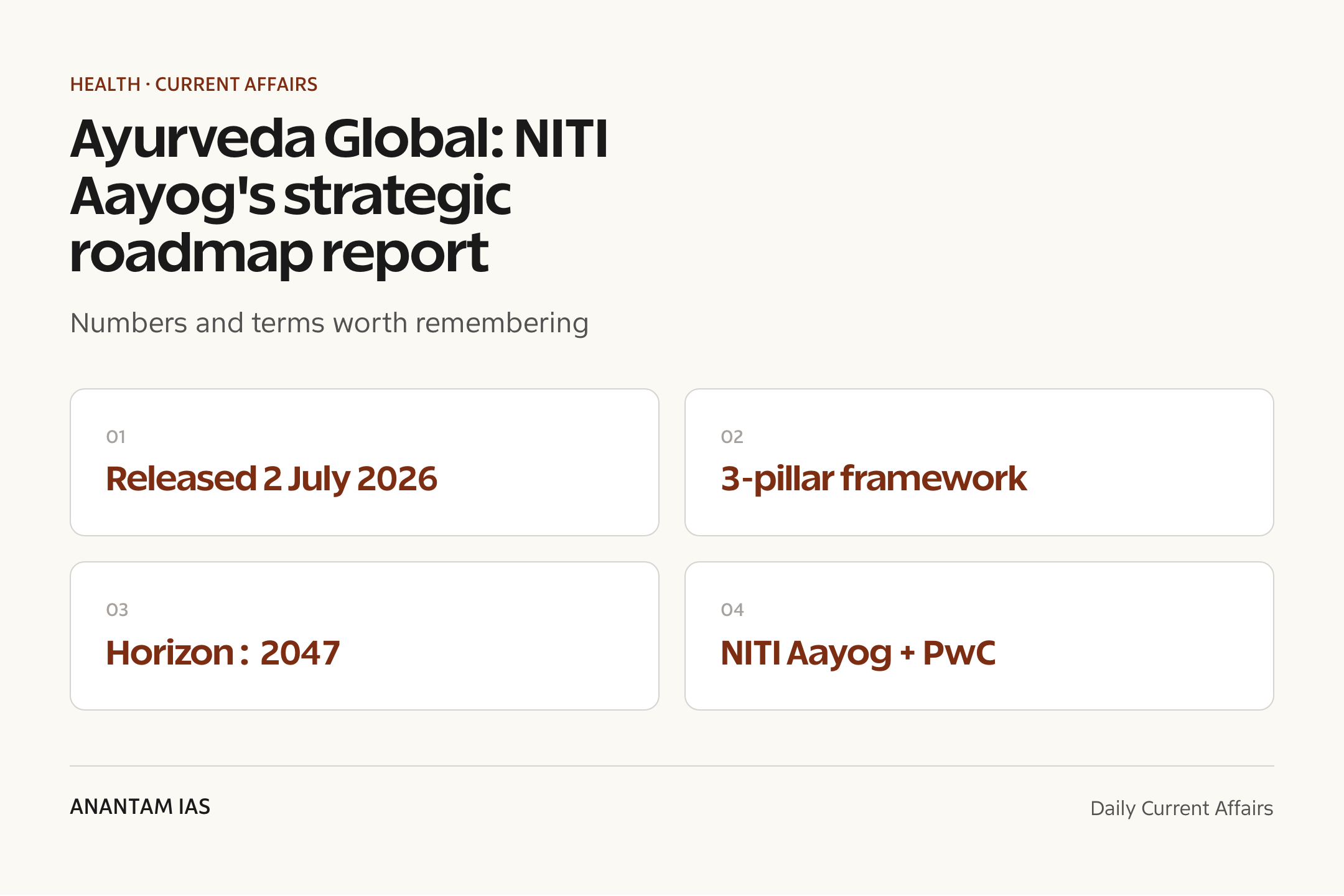
  • The study was prepared by the Health Division of NITI Aayog in collaboration with PricewaterhouseCoopers (PwC), drawing on stakeholder consultations and international benchmarking.
  • It adopts a three-pillar framework — Availability, Acceptability and Propagation — covering practice, exports, research, education, regulation, insurance and brand positioning.
  • The roadmap proposes a phased strategy up to 2047, aligned with the Viksit Bharat@2047 vision.
  • The Vice Chairman called for a whole-of-government approach for coordinated, time-bound implementation.
  • The report anchors itself in India’s commitment to the “One Earth, One Health” vision articulated during India’s G20 presidency era.

The development matters in the context of:

  • The release matters because traditional medicine sits at the junction of GS2 health governance and India’s soft-power toolkit — a NITI Aayog roadmap signals apex-level policy ownership beyond the Ministry of Ayush.
  • It lands amid a supportive global moment: the WHO Traditional Medicine Strategy 2025–2034 and the WHO Global Traditional Medicine Centre at Jamnagar have put evidence-based traditional systems on the multilateral agenda.
Ayurveda Global: NITI Aayog's strategic roadmap report — quick facts

UPSC Relevance

Prelims Relevance

  • Strategic Roadmap for Making Ayurveda Global — released by NITI Aayog on 2 July 2026, prepared with PwC.
  • Three pillars of the report: Availability, Acceptability, Propagation; phased strategy up to 2047.
  • Ministry of AYUSH — full ministry since November 2014 (upgraded from the Department of AYUSH); AYUSH covers Ayurveda, Yoga & Naturopathy, Unani, Siddha, Sowa-Rigpa and Homoeopathy.
  • WHO Global Traditional Medicine Centre (GTMC) — the WHO’s first global centre for traditional medicine, at Jamnagar, Gujarat (agreement 2022), India-supported.
  • National AYUSH Mission (NAM) — centrally sponsored scheme (2014) for AYUSH services, education and drug quality in states.
  • ICD-11 Traditional Medicine Module 2 — WHO’s disease-classification update coding Ayurveda, Siddha and Unani morbidity, enabling global data and insurance billing.
  • National Commission for Indian System of Medicine (NCISM) Act, 2020 — regulator for Ayurveda education and practice, replacing the Central Council of Indian Medicine.
  • Pharmacopoeia Commission for Indian Medicine and Homoeopathy (PCIM&H), Ghaziabad — sets quality standards for ASU&H drugs.
  • Ayush visa (introduced 2023) — special visa category for foreigners seeking treatment under Indian systems of medicine.
  • Global Traditional Medicine Summit, Gandhinagar (August 2023) — co-hosted by WHO and India; outcome: the Gujarat Declaration.

Mains Relevance

GS Paper 2

  • Health governance: mainstreaming traditional medicine into public health — issues of evidence, regulation and quality standards.
  • Government policies and interventions: role of NITI Aayog as a think tank shaping sectoral roadmaps and whole-of-government coordination.
  • International relations: medical diplomacy and India’s engagement with the WHO on traditional medicine as an instrument of soft power.

GS Paper 3

  • Economy: AYUSH sector exports, manufacturing, herbal supply chains and employment potential.
  • Science and technology: the research-validation gap — clinical trials, pharmacovigilance and standardisation of traditional formulations.

Essay

  • Tradition and modernity in Indian healthcare — can ancient knowledge systems pass modern scientific tests?
  • Soft power in the 21st century: yoga, Ayurveda and the export of Indian civilisational goods.

Background and Context

What the report actually says

PIB’s release sets out the architecture of the roadmap, which organises the globalisation task into three mutually reinforcing pillars.

  • Availability — building a globalised practice and workforce, expanding global exports and manufacturing, deepening international research and development, and standardising Ayurveda education worldwide.
  • Acceptability — ensuring compliance with foreign regulations and guidelines, forging academic and industrial collaborations, securing insurance coverage for Ayurveda treatments, and adapting offerings to local cultures.
  • Propagation — strategic brand positioning, global visibility campaigns, medical value travel, and presence in global standard-setting bodies.
  • The strategy is phased up to 2047, deliberately synchronised with the Viksit Bharat@2047 national vision.
  • NITI Aayog frames the goal as more than commerce: Member Prof M. Srinivas stressed the aim of giving people worldwide additional evidence-based options for better health outcomes.
  • The full report is hosted on the NITI Aayog website, and the study’s method combined stakeholder consultations with international benchmarking.
Ayurveda Global: NITI Aayog's strategic roadmap report — exam lens

The institutional architecture behind Ayurveda

The roadmap builds on a two-decade institutionalisation of traditional medicine within the Union government.

  • The Ministry of AYUSH became a full ministry in November 2014, upgraded from a department, giving Ayurveda, Yoga and Naturopathy, Unani, Siddha, Sowa-Rigpa and Homoeopathy a dedicated administrative home.
  • The National AYUSH Mission (2014), a centrally sponsored scheme, funds AYUSH dispensaries, co-located facilities in primary health centres, drug quality infrastructure and educational institutions in states.
  • Education and practice are regulated under the NCISM Act, 2020, which replaced the old Central Council of Indian Medicine with a National Commission modelled on the NMC for modern medicine.
  • Research flows through the Central Council for Research in Ayurvedic Sciences (CCRAS), while apex institutions such as the All India Institute of Ayurveda, New Delhi, and the Institute of Teaching and Research in Ayurveda (ITRA), Jamnagar — an Institution of National Importance — anchor tertiary care and academics.
  • Drug standards are set by the Pharmacopoeia Commission for Indian Medicine and Homoeopathy (PCIM&H); Ayurvedic, Siddha and Unani drugs are licensed under the Drugs and Cosmetics Act, 1940, with GMP norms under its Schedule T.
  • An AYUSH Export Promotion Council was set up with the Commerce Ministry to push AYUSH products and services abroad. For the parent institution’s role, see the explainer on NITI Aayog’s structure and functions.

Ayurveda's global footprint so far

The roadmap does not start from zero — India has spent a decade wiring traditional medicine into the multilateral system.

  • The WHO Global Traditional Medicine Centre at Jamnagar, Gujarat — the WHO’s first and only global outposted centre for traditional medicine — was agreed in 2022 with Indian financial support, focusing on evidence, data, sustainability and innovation.
  • The first WHO Global Traditional Medicine Summit was co-hosted by India at Gandhinagar in August 2023, producing the Gujarat Declaration on evidence-based traditional medicine.
  • The WHO Traditional Medicine Strategy 2025–2034, adopted by the World Health Assembly, gives member states a fresh mandate to integrate validated traditional systems into national health policies.
  • The WHO’s ICD-11 Traditional Medicine Module 2 now codes disorders as described in Ayurveda, Siddha and Unani, a technical step that enables global morbidity data, research comparability and insurance claims.
  • India has signed a series of bilateral MoUs on traditional medicine and supports AYUSH academic chairs at foreign universities; the Ayush visa (2023) channels inbound patients for treatment.
  • PIB noted the Ministry of External Affairs’ role: Acquino Vimal, Additional Secretary, highlighted how international engagements and partnerships have advanced the globalisation agenda.

The evidence and standards problem

The hardest barrier to globalisation is not marketing but proof — Ayurveda must clear the scientific and regulatory thresholds that foreign systems demand.

  • Most importing jurisdictions classify Ayurvedic products as food supplements, not medicines, because few formulations have cleared randomised controlled trials to modern regulatory standards.
  • Episodes of heavy-metal contamination in some exported herbo-mineral (rasashastra) products have triggered import alerts abroad, making pharmacovigilance and batch-level quality assurance a credibility issue.
  • Standardisation is intrinsically hard: classical formulations vary by raw-material source, season and preparation method, complicating pharmacopoeial standards and stability testing.
  • Practitioner mobility is limited because most countries do not recognise BAMS degrees; the report’s push for standardised global education and WHO benchmark-aligned training targets exactly this gap.
  • Insurance coverage — a pillar-two priority — depends on coded diagnoses and costed protocols, which is why the ICD-11 TM2 module and treatment-standardisation work matter commercially, not just academically.
  • The sector also needs stronger sustainable sourcing of medicinal plants, since export scale-up without cultivation planning risks depleting wild herb stocks.

Economy and soft power: why the government cares

The Vice Chairman’s launch remarks framed globalisation of Ayurveda as an economic and civilisational project simultaneously.

  • PIB quoted Dr Ashok Kumar Lahiri saying the effort can unlock substantial economic value, create employment, strengthen exports and reinforce India’s cultural and knowledge-based soft power.
  • The AYUSH industry spans classical medicines, nutraceuticals, cosmetics and wellness services, feeding a fast-growing global wellness economy; exports run through both products and medical value travel.
  • Ayurveda complements Yoga — already globalised via the International Day of Yoga — as a twin instrument of India’s cultural diplomacy.
  • A credible traditional-medicine offer also supports domestic goals of universal health coverage by widening the primary-care and preventive toolkit; see the note on universal health coverage in India.
  • For NITI Aayog, the report extends its established role of producing sectoral strategy documents, reviewed in 10 years of NITI Aayog.
  • Secretary Vaidya Rajesh Kotecha said the recommendations would complement the Ministry of Ayush’s decade of groundwork and add momentum to global recognition.

Criticisms and caveats to note

A balanced Mains answer should acknowledge the friction points around state-backed promotion of traditional medicine.

  • Public-health scholars caution against promoting systems ahead of evidence generation; the report’s own emphasis on international R&D implicitly concedes the validation deficit.
  • There are recurring turf tensions over integrative medicine — including debates on cross-system practice rights — which regulators must settle without diluting patient safety.
  • Global branding can collide with intellectual property concerns; India’s Traditional Knowledge Digital Library (TKDL) exists precisely to block wrongful patenting of classical formulations abroad.
  • Export ambitions must not outpace domestic quality enforcement, since a single adverse event abroad damages the collective brand more than years of promotion can build.
  • Coordination risk is real: the roadmap spans the Ayush, Commerce, External Affairs, Education and Health ministries — precisely why NITI Aayog urges a whole-of-government approach.

Way Forward

Build the evidence base first

  • Scale up multi-centre clinical trials and real-world evidence studies through CCRAS and partnerships with foreign universities, prioritising a shortlist of high-potential formulations.
  • Institutionalise pharmacovigilance for ASU drugs with public adverse-event reporting, and enforce GMP uniformly across export and domestic batches.

Fix standards, education and recognition

  • Align pharmacopoeial monographs with international norms and pursue mutual recognition agreements so Ayurvedic products can be registered as therapeutics, not just supplements.
  • Roll out WHO benchmark-aligned curricula and international bridge courses so Ayurveda practitioners can qualify to practise in foreign jurisdictions.

Sequence the market push

  • Use the Ayush Export Promotion Council and missions abroad to target receptive markets first, pairing product exports with medical value travel under the Ayush visa.
  • Secure insurance codification of standardised treatment protocols using ICD-11 TM2, and protect classical knowledge through TKDL while building a positive global brand.

Conclusion

The Strategic Roadmap for Making Ayurveda Global marks a shift in ambition — from promoting Ayurveda as heritage to engineering its acceptance as a regulated, evidence-based system of healthcare in foreign markets. By assigning the task a three-pillar structure and a 2047 horizon, NITI Aayog has converted a cultural aspiration into an implementable policy programme.

Its success will turn on the least glamorous parts of the plan: clinical validation, quality enforcement and regulatory diplomacy. If those foundations hold, Ayurveda can become to Indian soft power what evidence-based integration is to global health — a case where civilisational knowledge and modern science reinforce, rather than contradict, each other.

UPSC Practice Questions

Prelims MCQ 1

With reference to the report “Strategic Roadmap for Making Ayurveda Global” (2026), consider the following statements:

  1. The report was released by NITI Aayog.
  2. It adopts a three-pillar framework of Availability, Acceptability and Propagation.
  3. It proposes a phased strategy extending up to the year 2035.

How many of the above statements are correct?

(a) Only one (b) Only two (c) All three (d) None

Answer: (b) Only two

Explanation:

Statements 1 and 2 are correct: NITI Aayog’s Health Division, with PwC, prepared the report around the Availability–Acceptability–Propagation framework. Statement 3 is wrong — the phased strategy extends up to 2047, aligned with Viksit Bharat@2047.

Prelims MCQ 2

The WHO Global Traditional Medicine Centre, the World Health Organization’s first global centre dedicated to traditional medicine, is located at:

(a) Gandhinagar, Gujarat (b) New Delhi (c) Jamnagar, Gujarat (d) Pune, Maharashtra

Answer: (c) Jamnagar, Gujarat

Explanation:

The WHO Global Traditional Medicine Centre is being established at Jamnagar, Gujarat, with Indian support under a 2022 agreement. Gandhinagar hosted the first WHO Global Traditional Medicine Summit in August 2023.

UPSC Mains Questions

  1. NITI Aayog’s Strategic Roadmap for Making Ayurveda Global frames traditional medicine as both a public-health asset and an instrument of soft power. Examine the principal barriers to the global acceptance of Ayurveda and evaluate how the roadmap’s three-pillar framework addresses them.
  2. “The globalisation of a traditional medicine system depends less on promotion and more on proof.” Discuss with reference to evidence generation, pharmacopoeial standards and regulatory recognition challenges facing Ayurveda’s international expansion.
  3. Discuss the role of NITI Aayog as a policy think tank in driving whole-of-government sectoral strategies, using the 2026 Ayurveda globalisation roadmap as a case study.

Source: PIB, NITI Aayog.

Frequently Asked Questions

What is the Strategic Roadmap for Making Ayurveda Global?

It is a report released by NITI Aayog on 2 July 2026, prepared by its Health Division with PwC. It assesses Ayurveda’s global footprint and lays out a phased strategy, extending up to 2047, for making Ayurveda a globally accepted system of healthcare.

What are the three pillars of the report?

Availability (global practice, workforce, exports, manufacturing, R&D and standardised education), Acceptability (regulatory compliance, international collaborations, insurance coverage and cultural adaptation) and Propagation (brand positioning, global visibility, medical value travel and presence in global bodies).

Why is the roadmap linked to 2047?

The phased strategy is deliberately aligned with the Viksit Bharat@2047 vision, the national goal of becoming a developed country by the centenary of independence. Ayurveda’s globalisation is framed as part of that economic and soft-power ambition.

Where is the WHO Global Traditional Medicine Centre located?

At Jamnagar, Gujarat. It is the WHO’s first global centre dedicated to traditional medicine, established with Indian support under a 2022 agreement, and focuses on evidence, data, sustainability and innovation in traditional systems.

What is ICD-11 Traditional Medicine Module 2?

It is a module of the WHO’s International Classification of Diseases (ICD-11) that codes disorders as described in Ayurveda, Siddha and Unani. Coding enables global morbidity data collection, research comparability and insurance billing for traditional medicine treatments.

Which body regulates Ayurveda education in India?

The National Commission for Indian System of Medicine, created by the NCISM Act, 2020, regulates Ayurveda, Unani, Siddha and Sowa-Rigpa education and practice. It replaced the earlier Central Council of Indian Medicine, mirroring the NMC reform in modern medicine.

Citizenship Proof: If a passport is not proof, then what is?

Open article →Download PDF

Why in News?

A senior Ministry of External Affairs (MEA) official clarified on June 24, 2026 that the Indian passport is a “travel document”, not a “citizenship document” — it attests to nationality abroad but cannot, by itself, establish citizenship. The Hindu reported that the clarification came amid the Special Intensive Revision (SIR) of electoral rolls underway in 16 states.

Days later, on June 30, 2026, the Gauhati High Court upheld a Foreigners’ Tribunal order declaring Aminul Hoque, a 38-year-old daily-wage labourer from Assam, a foreigner — even though he produced 15 documents, including a 1951 NRC copy, voter identity cards, a PAN and a 1973 land deed. The two developments revive a foundational polity question: what legally proves Indian citizenship?

  • The MEA official said the passport, issued under the Passports Act, 1967, exists for travel; the Passport Manual places it “in the same category as any other evidence” of citizenship status.
  • The bench upheld the opinion of Foreigners’ Tribunal No. 4, Kamrup (Metropolitan), which had declared Mr. Hoque a foreigner on February 28, 2019.
  • The court held the 15 documents failed the burden cast by Section 9 of the Foreigners Act, 1946 — the suspected person must prove they are not a foreigner.
  • The 1951 NRC extract was rejected as a printout lacking a Section 65B, Evidence Act certificate; the land deed fell over unexplained inheritance gaps.
  • Oral testimony — his father identified him in court — was held insufficient without “admissible and relevant” documentary evidence.

The development matters in the context of:

  • India issues no single conclusive citizenship document: Aadhaar, voter ID, PAN and even passports serve other statutory purposes.
  • With the SIR in 16 states and NRC-linked litigation in Assam, the evidentiary standard for citizenship is a live governance and rights question, hitting the poorest hardest.
  • The story bundles Articles 5–11, the Citizenship Act, 1955, Section 6A, Foreigners’ Tribunals and burden of proof into one case study.
Citizenship Proof: If a passport is not proof, then what is? — quick facts

UPSC Relevance

Prelims Relevance

  • Articles 5–11 (Part II) — citizenship at commencement; Article 11 empowers Parliament to regulate citizenship by law.
  • Citizenship Act, 1955 — five modes: birth (Sec 3), descent (Sec 4), registration (Sec 5), naturalisation (Sec 6), incorporation of territory (Sec 7).
  • Birth cut-offs: before July 1, 1987 — citizen by birth; after December 3, 2004 — one parent a citizen, the other not an illegal migrant.
  • Section 6A — special Assam regime from the Assam Accord, 1985; upheld 4:1 by a Constitution Bench in October 2024.
  • Section 9, Foreigners Act, 1946 — reverse burden of proof on the individual; carried into the Immigration and Foreigners Act, 2025.
  • Foreigners’ Tribunals — quasi-judicial bodies under the Foreigners (Tribunals) Order, 1964; function mainly in Assam.
  • Section 9, Aadhaar Act, 2016 — Aadhaar is not proof of citizenship or domicile.
  • Sarbananda Sonowal v. Union of India (2005) — struck down the IMDT Act, 1983; linked illegal migration to “external aggression” under Article 355.
  • Assam cut-off — March 24, 1971 (midnight); the final Assam NRC (August 31, 2019) excluded about 19.06 lakh of 3.3 crore applicants.

Mains Relevance

GS Paper 2

  • Citizenship as a constitutional-statutory scheme: Articles 5–11, the Citizenship Act, 1955 and executive documentation.
  • The reverse burden of proof versus due process and Article 21 — how evidentiary rules shape substantive rights.
  • Electoral integrity versus inclusion: the SIR, the ECI’s Article 324 mandate, and the documentation burden on poor and migrant citizens.
  • Working of quasi-judicial bodies: Foreigners’ Tribunals and judicial review by High Courts.

GS Paper 1

  • Post-independence consolidation: the Assam Movement (1979–85), the Assam Accord and its citizenship legacy.
  • Migration from East Pakistan/Bangladesh and its demographic-political consequences in the Northeast.

Essay

  • Paper trails and personhood: when belonging to a nation must be proved on paper.
  • The weakest carry the heaviest burden: evidentiary justice and India’s documentation state.

Background and Context

The Trigger: An MEA Clarification and a Failed Citizenship Test

Two developments within a week crystallised the gap between the documents Indians hold and the citizenship they are presumed to have.

  • On June 24, 2026, a senior MEA official said the passport “attests to your nationality” abroad but “is not a document of your citizenship” — the Passport Manual itself calls it evidence “in the same category as any other”.
  • On June 30, 2026, the Gauhati High Court dismissed Aminul Hoque’s writ petition: his 15 documents — a 1951 NRC copy naming his father and grandparents, voter IDs, a PAN and a 1973 land deed — did not discharge his Section 9 burden.
  • The NRC printout lacked a Section 65B certificate (Evidence Act, 1872); the land deed raised unanswered inheritance questions; the tribunal had committed no “patent error”.
  • The ruling shows the exacting standard: each document must be admissible, relevant and consistent — volume alone proves nothing.
Citizenship Proof: If a passport is not proof, then what is? — exam lens

Constitutional Framework: Articles 5 to 11

The Constitution settled only who was a citizen on January 26, 1950, and handed everything after that to Parliament.

  • Article 5 — citizenship at commencement via domicile plus birth, parentage or five years’ residence; Articles 6–8 — migrants from and to Pakistan (with a July 19, 1948 dividing line) and persons of Indian origin abroad.
  • Article 9 — voluntarily acquiring foreign citizenship ends Indian citizenship; India permits no dual citizenship.
  • Article 10 guarantees continuance subject to law; Article 11 gives Parliament full power over acquisition and termination — the basis of the Citizenship Act, 1955.
  • Because the Constitution is silent on documents, proof of citizenship is a statutory-evidentiary question — the root of today’s confusion.

Citizenship Act, 1955: Five Modes and the Shrinking Birthright

The Act, administered by the Ministry of Home Affairs, recognises five modes of acquisition — and Parliament has steadily tightened the birth route.

  • Section 3 (birth): born before July 1, 1987 — citizen regardless of parentage; 1987 to December 3, 2004 — one parent a citizen; after 2004 — one parent a citizen, the other not an illegal migrant.
  • Section 4 (descent) — birth abroad to an Indian parent; Section 5 (registration) and Section 6 (naturalisation) — persons of Indian origin, spouses, long-term residents; Section 7 — incorporation of territory (Sikkim, Goa).
  • Only citizens by registration or naturalisation get a citizenship certificate; citizens by birth or descent — the vast majority — hold no citizenship document at all.
  • The Citizenship (Amendment) Act, 2019 fast-tracked six non-Muslim minorities from three neighbouring countries who entered by December 31, 2014. The Act’s text sits on the official India Code portal.

Why Everyday Documents Do Not Prove Citizenship

Each familiar identity document was created for a different statutory purpose, and each disclaims what people assume it proves.

  • Passport — issued under the Passports Act, 1967 for travel; issuance presumes citizenship, but courts and the MEA treat it as evidence of nationality, not conclusive proof.
  • Aadhaar — Section 9, Aadhaar Act, 2016 states an Aadhaar number is not proof of citizenship or domicile; it is residence-linked identity only.
  • Voter ID (EPIC) — proves enrolment as an elector after a summary inquiry under the Representation of the People Act, 1950; it presumes citizenship without adjudicating it.
  • PAN and ration cards — tax and welfare instruments; PAN is issued to foreigners too.
  • Birth certificate — proves place and date of birth; after the 2004 cut-off it must be paired with proof of the parents’ status.
  • Net effect: citizenship rests on a chain of evidence — birth records, parents’ legacy documents, admissibility formalities — hardest to assemble for the poor, landless and displaced.

Assam's Special Regime: Section 6A, the Accord and the NRC

Assam runs on a different citizenship clock, negotiated to end a six-year agitation against migration from the newly created Bangladesh.

  • The Assam Accord (1985) fixed March 24, 1971 (midnight) as the cut-off: pre-1966 entrants are citizens; 1966–71 entrants got citizenship after a 10-year voting suspension; later entrants face detection and expulsion.
  • Parliament codified this as Section 6A of the Citizenship Act; a five-judge Constitution Bench upheld it 4:1 in October 2024.
  • The National Register of Citizens (1951) was updated for Assam under Supreme Court supervision; the final list of August 31, 2019 excluded about 19.06 lakh of 3.3 crore applicants and remains un-notified.
  • Foreigners’ Tribunals — quasi-judicial bodies under the 1964 Order — give “opinions” on foreigner status, reviewable only by the High Court.
  • The Hindu reported that in 2025 the Assam government began invoking the Immigrants (Expulsion from Assam) Act, 1950 to “push back” suspected foreigners without full tribunal proceedings.

Burden of Proof: Section 9, Sonowal and the Evidence Act

The decisive legal feature of citizenship litigation is that the State need not prove you are a foreigner — you must prove you are not.

  • Section 9, Foreigners Act, 1946: once the question is raised, the onus of proving one is not a foreigner lies on that person — a reversal of the normal rule.
  • In Sarbananda Sonowal v. Union of India (2005), the Supreme Court struck down the IMDT Act, 1983 (which put the burden on the State), holding unchecked migration amounted to “external aggression” under Article 355.
  • The Immigration and Foreigners Act, 2025, which replaced the 1946 law, retains the individual’s burden; Mr. Hoque’s case proceeded under the 1946 Act.
  • Admissibility formalities do heavy work: electronic printouts need a Section 65B certificate, copies must be duly certified, and names and dates must match across decades-old records.
  • In the Bihar SIR litigation, the Supreme Court directed the Election Commission of India to accept Aadhaar as an identity document while reiterating it is not proof of citizenship (see eci.gov.in).
  • The combined effect: 15 documents can fail where one properly certified legacy document might succeed.

Way Forward

Clarify the evidentiary standard

  • Specify a graded, illustrative list of documents and the weight each carries in citizenship inquiries, so tribunals apply uniform standards.
  • Relax hyper-technical objections (spelling variants, minor age mismatches) where the overall chain of evidence is coherent.

Fix the documentation deficit

  • Push universal birth registration and digitised legacy records with easy access to Section 65B-compliant certified copies.
  • Provide legal aid under Article 39A for persons before Foreigners’ Tribunals — most, like the Assam labourer, contest complex proceedings alone.

Institutional safeguards

  • Standardise the composition, tenure and training of Foreigners’ Tribunal members, with reasoned, published opinions to enable High Court review.
  • In roll-revision exercises like the SIR, keep inclusion the default: deletion should follow individualised notice and inquiry, since the ECI verifies electors, not citizenship.

Conclusion

India’s citizenship architecture rests on a paradox: the Constitution and the Citizenship Act, 1955 define who is a citizen, but the State issues no universal document that proves it. Proof collapses into a chain of old records that the poorest citizens are least able to produce and authenticate.

The MEA’s clarification and the Gauhati High Court ruling are the system working as designed, with a reverse burden of proof settled since Sarbananda Sonowal (2005). Whether that design serves justice amid NRC-style verification and the SIR is now the central question for lawmakers and courts. Track how it evolves in our daily current affairs digests.

UPSC Practice Questions

Prelims MCQ 1

With reference to proof of Indian citizenship, consider the following statements:

  1. The Indian passport is legally a travel document and is not conclusive proof of citizenship.
  2. The Aadhaar Act, 2016 expressly provides that an Aadhaar number is not proof of citizenship.
  3. Under the Foreigners Act, 1946, the burden of proving that a person is not a foreigner lies on the State.

How many of the above statements are correct?

(a) Only one (b) Only two (c) All three (d) None

Answer: (b) Only two

Explanation:

Statements 1 and 2 are correct: the passport is a travel document (Passports Act, 1967), and Section 9 of the Aadhaar Act, 2016 says Aadhaar is not proof of citizenship. Statement 3 is wrong — Section 9, Foreigners Act, 1946 places the burden on the individual.

Prelims MCQ 2

The cut-off date of March 24, 1971 (midnight), recently in the news in the context of citizenship in Assam, is prescribed by:

(a) The Citizenship (Amendment) Act, 2019 (b) Section 6A of the Citizenship Act, 1955, giving effect to the Assam Accord (c) Article 6 of the Constitution of India (d) The National Register of Citizens, 1951

Answer: (b) Section 6A of the Citizenship Act, 1955, giving effect to the Assam Accord

Explanation:

Section 6A, inserted in 1985 to implement the Assam Accord, fixes March 24, 1971 (midnight) as the citizenship cut-off for Assam; a Constitution Bench upheld it 4:1 in October 2024. The CAA 2019 cut-off is December 31, 2014.

UPSC Mains Questions

  1. “A passport attests to nationality but does not prove citizenship.” In the light of recent executive and judicial clarifications, examine the constitutional and statutory framework for determining Indian citizenship and the difficulties it creates for ordinary citizens. (250 words)
  2. The reverse burden of proof under Indian foreigners law places the heaviest evidentiary load on the poorest residents. Critically analyse with reference to Section 9 of the Foreigners Act, 1946, the Sarbananda Sonowal judgment and the working of Foreigners’ Tribunals in Assam. (250 words)
  3. India has no single, conclusive document of citizenship. Discuss the administrative and rights-related consequences of this gap, and suggest reforms to make verification exercises like the NRC and the Special Intensive Revision of electoral rolls both accurate and inclusive. (250 words)

Sources: The Hindu Explained and The Hindu.

Frequently Asked Questions

Is an Indian passport proof of citizenship?

No. The MEA clarified in June 2026 that the passport, issued under the Passports Act, 1967, is a travel document. It attests to the holder’s nationality while travelling abroad, but the government’s Passport Manual treats it as just one piece of evidence, not conclusive proof of citizenship.

Which documents legally prove Indian citizenship?

There is no single conclusive document. Citizens by registration or naturalisation get a citizenship certificate; citizens by birth or descent must build a chain of evidence — birth records, parents’ legacy documents, old electoral rolls or NRC extracts — each admissible under evidence law and consistent across records.

Is Aadhaar or a voter ID proof of citizenship?

No. Section 9 of the Aadhaar Act, 2016 expressly says Aadhaar is not proof of citizenship or domicile. A voter ID shows enrolment as an elector after a summary inquiry; it presumes citizenship but does not adjudicate or conclusively prove it.

What is Section 9 of the Foreigners Act?

It reverses the normal burden of proof: once a person’s citizenship is questioned, the onus of proving they are not a foreigner lies on that person, not the State. The Supreme Court reinforced this in Sarbananda Sonowal (2005), and the Immigration and Foreigners Act, 2025 retains the rule.

Why did the Gauhati High Court reject 15 documents?

On June 30, 2026 the court held Aminul Hoque’s documents were inadmissible or inconsistent — his 1951 NRC copy was a printout without the Section 65B Evidence Act certificate, and the 1973 land deed raised unexplained inheritance gaps — so he failed to discharge his burden under the Foreigners Act.

What is Section 6A of the Citizenship Act?

Section 6A, added in 1985 to implement the Assam Accord, creates a special citizenship regime for Assam with a March 24, 1971 cut-off. Entrants before 1966 are citizens; 1966–71 entrants got citizenship after a ten-year voting suspension. A Constitution Bench upheld it 4:1 in October 2024.

PMGKAY: Centre approves improved-quality rice for over 80 crore beneficiaries

Open article →Download PDF

Why in News?

The Cabinet Committee on Economic Affairs (CCEA) has approved a reform to improve the quality of rice supplied under the Pradhan Mantri Garib Kalyan Anna Yojana (PMGKAY) and Other Welfare Schemes. PIB confirmed the decision through the Ministry of Consumer Affairs, Food and Public Distribution on 2 July 2026.

For the first time in nearly three decades, the government has revised the quality specifications of rice moving through the Public Distribution System (PDS). Over 80 crore beneficiaries will receive rice with substantially lower broken-grain content — with no change in their existing entitlements.

  • Raw rice under PMGKAY will now contain up to 10% broken grains, replacing the earlier ceiling of 25%.
  • Parboiled rice will contain up to 5% broken grains, down from the earlier ceiling of 16%.
  • Procurement of improved-quality rice starts immediately; the rollout covers all procuring states by Kharif Marketing Season (KMS) 2027–28 in a phased manner.
  • The reform is expected to generate annual savings of about ₹2,161 crore through reduced logistics, storage and packaging costs.
  • Rice bags will carry QR-code tagging for end-to-end traceability across the PDS supply chain.
  • The change was validated through pilots in Haryana, Andhra Pradesh, Punjab, Odisha, Telangana and Chhattisgarh.

The development matters in the context of:

  • This shifts the food-security debate from quantity (universal free grain) to quality — grain integrity, appearance and consumer acceptability inside the world’s largest food distribution programme.
  • It complements ongoing PDS modernisation — One Nation One Ration Card, ePoS authentication and rice fortification — that together target both leakages and nutrition.
  • Broken rice separated at milling will be put to productive industrial use and auctioned from millers’ premises, easing the food subsidy burden.
PMGKAY: Centre approves improved-quality rice for over 80 crore beneficiaries — quick facts

UPSC Relevance

Prelims Relevance

  • PMGKAY — launched March 2020 as pandemic relief (extra 5 kg free foodgrain per person per month); merged with free NFSA distribution from 1 January 2023; extended for 5 years from 1 January 2024.
  • New rice specs — broken grains capped at 10% in raw rice (earlier 25%) and 5% in parboiled rice (earlier 16%); first revision in nearly 30 years.
  • NFSA 2013 — legal entitlement covering up to 75% rural and 50% urban population; 5 kg per person per month for priority households, 35 kg per household for Antyodaya Anna Yojana (AAY) families.
  • CCEA — the Cabinet committee that clears major economic decisions, chaired by the Prime Minister.
  • KMS 2027–28 — the outer deadline for all procuring states to switch to improved-quality rice.
  • ₹2,161 crore — estimated annual cost rationalisation from logistics, storage and packaging.
  • QR-code tagging of rice bags — end-to-end traceability tool for the PDS supply chain.
  • HDPE bags — broken rice will be stored in HDPE bags, cutting jute bag requirements.
  • Pilot states — Haryana, Andhra Pradesh, Punjab, Odisha, Telangana, Chhattisgarh.

Mains Relevance

GS Paper 2

  • Welfare schemes for vulnerable sections — design upgrade of PMGKAY from coverage to quality of service delivery.
  • Governance and transparency — QR-code traceability, ePoS and ONORC as e-governance tools against PDS leakages.
  • Issues relating to poverty and hunger — dignity of beneficiaries as a policy objective, not just calorie delivery.

GS Paper 3

  • Food security and PDS reform — buffer stocking, procurement economics, FCI operations and the food subsidy bill.
  • Value addition — productive industrial use of separated broken rice and its revenue potential.

Essay

  • Welfare with dignity: from feeding the poor to serving them well.
  • Food security in India: the journey from scarcity to quality.

Background and Context

What exactly has changed in the rice specifications

The reform rewrites the quality benchmark that governs every kilogram of PDS rice.

  • PDS rice is procured against uniform specifications; the permissible broken-grain content has stood at 25% for raw rice and 16% for parboiled rice for nearly three decades.
  • The approved policy caps broken grains at 10% in raw rice and 5% in parboiled rice — beneficiaries get rice with better grain integrity, appearance and cooking quality.
  • Entitlements stay untouched: the same quantity of grain, free of cost, but of visibly better quality.
  • Procurement of the improved-quality rice begins immediately; distribution follows in phases so states can transition smoothly.
  • All procuring states must conform by KMS 2027–28, giving millers and state agencies two full seasons to adjust milling and sortex operations.
  • PIB noted that pilots in six states — Haryana, Andhra Pradesh, Punjab, Odisha, Telangana and Chhattisgarh — have already demonstrated that improved-quality rice can be produced at scale.
PMGKAY: Centre approves improved-quality rice for over 80 crore beneficiaries — exam lens

PMGKAY: from pandemic relief to the world's largest food scheme

PMGKAY has evolved through three distinct phases since 2020.

  • March 2020 — launched as part of the Pradhan Mantri Garib Kalyan Package during the COVID-19 lockdown, giving an additional 5 kg free foodgrain per person per month over and above NFSA entitlements.
  • The scheme ran in successive phases through December 2022, cushioning households through the pandemic’s economic shock.
  • 1 January 2023 — the government made NFSA foodgrains entirely free and subsumed that distribution under PMGKAY, ending the ₹1–₹3 per kg issue prices.
  • 1 January 2024 — PMGKAY was extended for five years at an estimated outlay of about ₹11.80 lakh crore, locking in free grain until end-2028.
  • It reaches over 80 crore beneficiaries — roughly two-thirds of India’s population — making it the largest food distribution programme in the world.
  • The quality upgrade is the first structural improvement to what beneficiaries receive, after years of expanding how many receive it and at what price.

NFSA 2013: the legal backbone of the entitlement

PMGKAY operates on the beneficiary architecture created by the National Food Security Act.

  • The National Food Security Act (NFSA), 2013 converted food security from a welfare measure into a legal entitlement, covering up to 75% of the rural and 50% of the urban population.
  • Priority households get 5 kg per person per month; Antyodaya Anna Yojana (AAY) households — the poorest of the poor — get 35 kg per household per month.
  • The Act also mandates maternity benefits, nutritional support to children, and a two-tier grievance redressal machinery with district grievance officers and state food commissions.
  • Identification of beneficiaries rests with states; grain allocation, procurement and inter-state movement rest with the Centre through the Food Corporation of India (FCI).
  • A quality floor for the grain itself was the missing piece in this rights framework — the new specifications begin to close that gap. A fuller primer is in our note on the Public Distribution System: issues and reforms.

Why grain quality matters: nutrition, acceptability, dignity

Broken rice is not just a cosmetic problem — it shapes whether entitlements translate into nutrition.

  • High broken content lowers cooking quality and consumer acceptability; households sometimes sell or divert poor-quality PDS grain, defeating the scheme’s purpose.
  • Better grain integrity improves uptake — beneficiaries actually consume what they lift, strengthening the nutrition outcomes the scheme is meant to deliver.
  • The reform runs parallel to rice fortification: fortified rice kernels blended with iron, folic acid and vitamin B12 are supplied across welfare schemes to fight anaemia — explained in our guide to food fortification in India.
  • PIB framed the decision as moving from food security to food security with improved quality — receiving good rice “with dignity” is itself the stated policy goal.
  • Quality PDS grain also supports the fight against child malnutrition and stunting, where dietary quality matters as much as quantity.

The fiscal and operational arithmetic

Counter-intuitively, supplying better rice is expected to save money, not cost more.

  • Broken rice separated during milling will be auctioned directly from millers’ premises — it never enters the FCI logistics chain, cutting transport, storage and handling costs.
  • Broken rice will be stored in HDPE bags, reducing the requirement of costlier jute bags.
  • Together these changes are projected to save about ₹2,161 crore annually in logistics, storage and packaging.
  • Sale proceeds of broken rice add non-tax revenue, further trimming the food subsidy burden — the fiscal context is covered in our note on the food subsidy bill: constraints and strategies.
  • The separated broken rice goes to productive industrial uses — feed, ethanol and food processing — so no grain is wasted while superior edible rice reaches beneficiaries.
  • Procurement itself continues at MSP through the custom-milling chain, so farmers’ price assurance is unaffected by the quality change downstream.

The transparency stack: QR codes on top of ONORC and ePoS

The quality reform arrives with a traceability layer that extends a decade of PDS digitisation.

  • QR-code tagging of rice bags will enable end-to-end traceability from miller to fair price shop, strengthening accountability and inventory management and plugging leakage points.
  • It builds on ePoS devices at fair price shops, which authenticate beneficiaries through Aadhaar before grain is issued.
  • One Nation One Ration Card (ONORC) lets migrant workers draw entitlements anywhere in India — full national portability was achieved in 2022.
  • End-to-end computerisation of supply chains, digitised ration cards and online allocation have already reduced the diversion that the Shanta Kumar Committee (2015) flagged as the PDS’s central weakness.
  • Traceable, better-quality, fortified grain moving through an authenticated network is the emerging design of a reformed PDS — quality, nutrition and integrity addressed in one architecture.

Way Forward

Execution levers for a smooth transition

  • Upgrade milling and sortex capacity in procuring states well before KMS 2027–28, with clear incentives for millers to meet the tighter specifications.
  • Publish transparent auction protocols for broken rice at millers’ premises to prevent cartelisation and ensure fair price discovery.
  • Run beneficiary-level quality audits at fair price shops so the improved specification is verified at the last mile, not just at depots.
  • Use the QR-code data to build a public traceability dashboard, letting states benchmark leakage and delivery performance.

Deepening the quality agenda

  • Extend the quality-first approach to wheat and coarse grains, including millets, supplied through welfare schemes.
  • Pair better rice with sustained fortification coverage and nutrition education so quality gains convert into measurable health outcomes.
  • Periodically review specifications through a standing technical committee rather than waiting decades between revisions.

Conclusion

The CCEA’s decision marks a quiet but significant maturing of India’s food security policy. Having achieved near-universal free coverage through PMGKAY, the state is now competing on quality — capping broken grains at 10% and 5%, tagging bags with QR codes, and monetising the by-product to save about ₹2,161 crore a year.

For the exam, the takeaway is the design logic: a welfare reform that simultaneously improves the beneficiary’s plate, the system’s transparency and the exchequer’s arithmetic. It shows how service quality is becoming the next frontier of welfare governance after coverage and affordability.

UPSC Practice Questions

Prelims MCQ 1

With reference to the improved-quality rice reform approved under PMGKAY in 2026, consider the following statements:

  1. Raw rice supplied under PMGKAY will contain up to 10% broken grains, replacing the earlier ceiling of 25%.
  2. Parboiled rice will contain up to 16% broken grains under the revised specifications.
  3. This is the first revision of PDS rice quality specifications in nearly three decades.

How many of the above statements are correct?

(a) Only one (b) Only two (c) All three (d) None

Answer: (b) Only two

Explanation:

Statements 1 and 3 are correct. Statement 2 is wrong — parboiled rice will contain up to 5% broken grains; 16% was the earlier ceiling being replaced.

Prelims MCQ 2

With reference to the Pradhan Mantri Garib Kalyan Anna Yojana (PMGKAY), which of the following statements is correct?

(a) It supplies foodgrains to NFSA beneficiaries at subsidised issue prices of ₹1–₹3 per kg. (b) Since 1 January 2023, foodgrains under the NFSA are supplied free of cost through PMGKAY. (c) It covers only Antyodaya Anna Yojana households. (d) It is implemented by the Ministry of Agriculture and Farmers Welfare.

Answer: (b) Since 1 January 2023, foodgrains under the NFSA are supplied free of cost through PMGKAY.

Explanation:

NFSA grains were made free and merged into PMGKAY from 1 January 2023; the scheme was extended for five years from 1 January 2024. It covers both priority and AAY households and is run by the Ministry of Consumer Affairs, Food and Public Distribution.

UPSC Mains Questions

  1. The recent decision to supply improved-quality rice under PMGKAY signals a shift from coverage-centric to quality-centric welfare delivery. Examine the significance of this shift for food and nutrition security in India. (250 words)
  2. Technology-driven reforms — ePoS authentication, One Nation One Ration Card and QR-code traceability — are transforming the Public Distribution System. Critically evaluate their effectiveness in plugging leakages and improving beneficiary experience. (250 words)
  3. India’s food subsidy regime must balance fiscal prudence with the legal entitlements of the National Food Security Act, 2013. Discuss how by-product monetisation and logistics rationalisation can reconcile the two. (150 words)

Source: PIB, Ministry of Consumer Affairs, Food & Public Distribution.

Frequently Asked Questions

What has the CCEA approved for PMGKAY rice?

The Cabinet Committee on Economic Affairs approved supply of improved-quality rice under PMGKAY and Other Welfare Schemes. Broken-grain content is capped at 10% in raw rice (earlier 25%) and 5% in parboiled rice (earlier 16%) — the first revision of PDS rice quality specifications in nearly three decades.

When will beneficiaries get the improved-quality rice?

Procurement of improved-quality rice begins immediately, and distribution will be phased in. All procuring states must conform to the new specifications by Kharif Marketing Season (KMS) 2027–28, allowing millers and state agencies a smooth transition without disrupting supplies.

What is the Pradhan Mantri Garib Kalyan Anna Yojana?

PMGKAY began in March 2020 as pandemic relief giving 5 kg extra free foodgrain per person monthly. From 1 January 2023 it absorbed free NFSA distribution, and from 1 January 2024 it was extended five years at about ₹11.80 lakh crore, serving over 80 crore beneficiaries.

How does the reform save the government money?

Broken rice separated at milling will be auctioned directly from millers’ premises, skipping FCI transport and storage, and stored in cheaper HDPE bags instead of jute. This rationalises logistics, storage and packaging costs by about ₹2,161 crore annually, while broken-rice sales add revenue.

What is QR-code tagging of rice bags?

Each rice bag will carry a QR code enabling end-to-end traceability across the PDS supply chain — from miller to depot to fair price shop. It strengthens transparency, accountability and inventory management, and plugs points where grain could earlier leak out of the system.

Do beneficiaries lose any entitlement under the new policy?

No. Entitlements under the NFSA remain unchanged — 5 kg per person per month for priority households and 35 kg per household for Antyodaya families, free of cost. Only the quality of the rice improves, with lower broken-grain content and better cooking quality.

AI Governance: Preliminary report of the Independent International Scientific Panel on AI

Open article →Download PDF

Why in News?

The Independent International Scientific Panel on Artificial Intelligence — the first global scientific body on AI, created under the United Nations — released its Preliminary Report on 1 July 2026. The report is the first global, independent scientific assessment of the opportunities, risks and impacts of AI, and its findings will be tabled before governments at the inaugural Global Dialogue on AI Governance in Geneva on 6–7 July 2026.

The panel’s central warning is stark: current safeguards can’t keep pace with the growth of AI capabilities. Co-chair Yoshua Bengio said “AI capabilities are outpacing both scientific understanding and governments’ ability to adapt” — and that science can’t guarantee ever-more-capable AI won’t cause catastrophic harm. The Hindu, in its editorial ‘A hold on AI’, read the report as a caution against treating AI purely as a geostrategic asset while its potential for broad damage goes unaddressed.

  • Report released on 1 July 2026 by a panel of 40 experts drawn from all five UN regions, serving in their personal capacity.
  • Panel is co-chaired by Yoshua Bengio (Turing Award-winning AI pioneer) and Maria Ressa (2021 Nobel Peace Prize laureate).
  • The body was established by UN General Assembly resolution A/RES/79/325 (26 August 2025), a follow-through on the Global Digital Compact of September 2024.
  • The report finds the US (~75%) and China (~15%) together control roughly 90% of the computing power behind leading AI supercomputers.
  • 118 countries, mostly in the Global South, aren’t part of major AI governance discussions — a core equity finding.
  • Findings feed directly into the first Global Dialogue on AI Governance, Geneva, 6–7 July 2026.

The development matters in the context of:

  • This is widely described as the ‘IPCC for AI’ moment — an independent scientific panel assessing AI risk for governments, the way the IPCC does for climate change.
  • It matters for the durable GS3 theme of regulating emerging technologies: evidence-based, multilateral assessment as the first step toward global rules.
  • For India — which runs the IndiaAI Mission and champions Global South voice in AI — the report’s equity findings strengthen its long-standing negotiating position.
AI Governance: Preliminary report of the Independent International Scientific Panel on AI — quick facts

UPSC Relevance

Prelims Relevance

  • Independent International Scientific Panel on AI — first global scientific body on AI; 40 experts from all 5 UN regions, serving in personal capacity; produces annual policy-relevant but non-prescriptive assessments.
  • Created by UNGA resolution A/RES/79/325 (26 August 2025), which also set up the Global Dialogue on AI Governance.
  • Both mechanisms flow from the Global Digital Compact, adopted at the UN Summit of the Future (September 2024) as part of the Pact for the Future.
  • Co-chairs: Yoshua Bengio and Maria Ressa.
  • First Global Dialogue on AI Governance: Geneva, 6–7 July 2026.
  • Compute concentration: US ~75% + China ~15% ≈ 90% of leading AI supercomputing power; 118 countries outside major AI governance forums.
  • EU AI Act — world’s first comprehensive, risk-based AI law; entered into force August 2024.
  • IndiaAI Mission — approved March 2024 with a ₹10,371.92 crore outlay; includes an AI Safety Institute under MeitY.
  • Earlier UN step: consensus UNGA resolution of March 2024 on safe, secure and trustworthy AI for sustainable development, co-sponsored by India.

Mains Relevance

GS Paper 3

  • Regulating emerging technologies: why AI governance is a collective-action problem — capabilities move faster than evidence, and evidence arrives after the window to act closes.
  • Science-policy interface: the ‘IPCC for AI’ model — independent assessment first, binding rules later — and its strengths and limits.
  • Compute concentration as a strategic-technology dependency; implications for India’s semiconductor, data-centre and sovereign-compute push under the IndiaAI Mission.

GS Paper 2

  • Global governance architecture: Global Digital Compact → scientific panel + Global Dialogue as new UN machinery; comparison with IPCC/UNFCCC layering.
  • India’s advocacy for the Global South in digital governance — 118 excluded countries validates New Delhi’s inclusion agenda (GPAI leadership, AI summit diplomacy).

Essay

  • Technology travels faster than wisdom: governing what we don’t yet fully understand.
  • The window is closing: precaution versus innovation in the age of intelligent machines.
  • A digital divide is becoming an intelligence divide — equity in the AI century.

Background and Context

From Global Digital Compact to a scientific panel

The panel is the product of a deliberate, step-by-step construction of UN machinery for AI over three years.

  • March 2024: the UN General Assembly adopted by consensus its first AI resolution, on safe, secure and trustworthy AI for sustainable development — co-sponsored by India and over 120 countries.
  • September 2024: the Global Digital Compact, adopted at the Summit of the Future, committed member states to two new mechanisms — an independent scientific panel on AI and a global dialogue on AI governance.
  • 26 August 2025: UNGA resolution A/RES/79/325 operationalised both, fixing the panel’s terms of reference and the dialogue’s modalities.
  • The panel has 40 members selected from all five UN regional groups across disciplines — computer science, law, economics, human rights — serving in their personal capacity, independent of any government or company.
  • Its mandate is to issue an annual policy-relevant but non-prescriptive scientific assessment — it informs governments; it doesn’t write rules.
  • Co-chairs Yoshua Bengio and Maria Ressa embody the design: one built modern AI systems, the other documented technology’s harms to democracy.
AI Governance: Preliminary report of the Independent International Scientific Panel on AI — exam lens

What the preliminary report finds: capability and opportunity

The report is not a doom document — it catalogues genuine, measurable benefits across seven domains, from science and health to education and agriculture.

  • AI systems have predicted the structures of over 200 million proteins, compressing years of laboratory work and accelerating drug discovery.
  • Diagnostic AI enables earlier disease detection — the report cites breast cancer screening as a proven use case.
  • AI-driven early-warning systems for food insecurity help humanitarian agencies act before famines take hold.
  • Assistive AI expands accessibility for persons with disabilities — speech, vision and mobility support at near-zero marginal cost.
  • Its seven assessment domains: AI science and trajectories; societal applications; economic implications; security and environment; human rights, information and democracy; individual flourishing, autonomy and child safety; and governance and reliability.

The risk ledger: what the panel is worried about

The core finding is an evidence trap: policymakers need scientific proof to regulate, but by the time proof is conclusive, it may be too late to act.

  • Co-chair Yoshua Bengio: science currently can’t guarantee that increasingly capable AI won’t cause catastrophic harm.
  • Documented present-day harms: AI-generated child sexual abuse material and non-consensual deepfakes spreading online.
  • Disinformation at industrial scale — synthetic media convincing enough to corrode trust in elections and institutions.
  • AI-enabled cybercrime: automated attacks, fraud and social-engineering at scale.
  • Emerging psychological harms — chatbots implicated in mental-health crises and reinforcement of suicidal ideation.
  • A frontier-safety concern: as systems become more autonomous, human ability to monitor and correct them declines.
  • Environmental cost: energy-hungry data centres add materially to greenhouse-gas emissions — an AI-climate linkage examiners like.

Compute concentration and the Global South divide

The report’s most quotable numbers describe who owns the infrastructure of intelligence — and who is locked out of the room.

  • The United States hosts about 75% and China about 15% of the computing power behind leading AI supercomputers — roughly 90% between two states.
  • 118 countries, overwhelmingly in the Global South, aren’t engaged in the major AI governance discussions shaping the rules they’ll live under.
  • The Global South is disproportionately exposed to AI misuse because it has the least capacity to detect and mitigate harms.
  • More than 40 AI governance frameworks already exist worldwide — but they’re fragmented, voluntary and inconsistent, which is precisely the gap a UN-level process is meant to close.
  • The equity finding converts AI from a purely technological question into a development and justice question — the report’s sharpest break from a race-to-the-frontier framing.

The comparative governance landscape

The panel lands in a crowded but uneven field of national and plurilateral AI rulemaking.

  • The EU AI Act — in force since August 2024 — is the first comprehensive, legally binding AI law, using a risk-based classification (unacceptable, high, limited, minimal risk).
  • The US relies on sectoral regulators plus executive action; China licenses generative-AI services and mandates content labelling — three incompatible templates.
  • Summit diplomacy built momentum: the Bletchley Declaration (November 2023, 28 countries + EU, India a signatory), the Seoul summit (2024), and the Paris AI Action Summit (February 2025), which India co-chaired.
  • A network of national AI Safety Institutes (UK, US, Japan, India and others) now tests frontier models — the technical counterpart to the UN’s assessment layer.
  • The Global Partnership on Artificial Intelligence (GPAI) — where India was lead chair in 2024 — pioneered the multistakeholder approach; the UN panel’s value addition is universality, since every member state receives the same evidence base.

Where India stands

India enters this debate with an operating mission at home and a bridge-builder identity abroad.

  • The IndiaAI Mission (approved March 2024, ₹10,371.92 crore over five years) spans seven pillars — compute capacity, foundation models, datasets, application development, FutureSkills, startup financing and safe and trusted AI. Details at the official IndiaAI portal.
  • MeitY has set up an AI Safety Institute under the mission’s safe-and-trusted pillar to evaluate models and build indigenous safety tooling.
  • India hosted the AI Impact Summit in New Delhi in February 2026 — the first leaders-level AI summit held in the Global South, centring inclusion and development.
  • India consistently argues that AI governance must reflect Global South realities — the report’s 118-countries finding is, in effect, empirical support for that position.
  • India’s approach is pro-innovation regulation: no omnibus AI law yet; it relies on the DPDP Act 2023, IT rules and sectoral advisories while capability is built.
  • Track India’s evolving tech-policy positions through the daily current affairs digests and the monthly current affairs compilations.

Way Forward

For the multilateral process

  • Convert the panel’s evidence into minimum global baselines — incident reporting, pre-deployment testing of frontier models, and watermarking of synthetic media — through the Global Dialogue.
  • Guarantee Global South participation: funded seats at the table, compute-access windows, and capacity-building so the 118 excluded countries become rule-shapers, not rule-takers.
  • Protect the panel’s independence — its credibility, like the IPCC’s, depends on scientists writing conclusions governments can’t edit.

For India

  • Operationalise the AI Safety Institute quickly and plug it into the international safety-institute network so Indian evaluations shape global benchmarks.
  • Reduce compute dependency through the IndiaAI compute pillar and the semiconductor mission — the report’s 90% concentration figure is a strategic-autonomy warning.
  • Codify a graded domestic framework — high-risk-use obligations, deepfake and provenance rules — so India negotiates in Geneva from the strength of a working model.

Conclusion

The preliminary report’s contribution is not any single number but a method: get the world’s scientists to agree on what AI can do, before asking the world’s governments to agree on what it may do. That IPCC-style sequencing turned climate change from contested science into negotiated treaty — the bet is that it can do the same for artificial intelligence, faster.

For India, the report validates both halves of its strategy — build capability at home, demand inclusion abroad. The test now moves to Geneva: whether the first Global Dialogue on AI Governance converts a shared evidence base into even minimal shared rules, while the window the panel describes is still open.

UPSC Practice Questions

Prelims MCQ 1

With reference to the Independent International Scientific Panel on Artificial Intelligence, consider the following statements:

  1. It was established through a UN General Assembly resolution that followed from the Global Digital Compact.
  2. Its members serve in their personal capacity, independent of governments and companies.
  3. It is a treaty body empowered to enforce binding AI regulations on member states.

How many of the above statements are correct?

(a) Only one (b) Only two (c) All three (d) None

Answer: (b) Only two

Explanation:

Statements 1 and 2 are correct: UNGA resolution A/RES/79/325 (August 2025) created the panel as a follow-through on the Global Digital Compact, and its 40 experts serve in personal capacity. Statement 3 is wrong — the panel’s assessments are policy-relevant but non-prescriptive; it has no enforcement power.

Prelims MCQ 2

The first Global Dialogue on AI Governance, where the preliminary report of the UN’s scientific panel on AI is being presented to member states, is convening in which city?

(a) New York (b) Geneva (c) Nairobi (d) New Delhi

Answer: (b) Geneva

Explanation:

The inaugural Global Dialogue on AI Governance meets in Geneva on 6–7 July 2026. Like the panel, it was created by UNGA resolution A/RES/79/325 in fulfilment of the Global Digital Compact.

UPSC Mains Questions

  1. The preliminary report of the Independent International Scientific Panel on AI warns that AI capabilities are outpacing both scientific understanding and governments’ ability to respond. Examine the challenges of governing frontier technologies under such uncertainty, and evaluate the ‘IPCC model’ as a response. (250 words)
  2. About 90% of the computing power behind leading AI systems is concentrated in two countries, while 118 countries remain outside major AI governance discussions. Discuss the implications of this twin concentration for the Global South, and outline how India’s AI strategy addresses it. (250 words)
  3. Fragmented national AI regulations cannot manage a borderless technology. In light of the EU AI Act, national AI safety institutes and the new UN machinery on AI, critically examine the prospects of a coherent global AI governance regime. (250 words)

Sources: United Nations, Independent International Scientific Panel on AI and The Hindu Editorial.

Frequently Asked Questions

What is the Independent International Scientific Panel on AI?

It is the first global scientific body on artificial intelligence, created under UN General Assembly resolution A/RES/79/325 (August 2025). Forty experts from all five UN regions, serving in personal capacity, produce annual independent, policy-relevant but non-prescriptive assessments of AI’s opportunities, risks and impacts for governments.

Why is it called the ‘IPCC for AI’?

Like the Intergovernmental Panel on Climate Change, it separates science from politics: independent experts assess the evidence, and governments then negotiate responses. The panel informs the Global Dialogue on AI Governance the way IPCC assessments inform climate negotiations, without itself writing binding rules.

What did the preliminary report say?

Released on 1 July 2026, it found AI capabilities are outpacing scientific understanding and government responses. It documented benefits (protein prediction, disease detection, famine early warning) alongside risks — deepfakes, disinformation, cybercrime, autonomy loss — and flagged extreme compute concentration and Global South exclusion.

Who chairs the panel?

It is co-chaired by Yoshua Bengio, the Turing Award-winning deep-learning pioneer, and Maria Ressa, the 2021 Nobel Peace Prize-winning journalist — pairing a builder of AI systems with a chronicler of technology’s harms to democracy.

What is the Global Digital Compact?

Adopted at the UN Summit of the Future in September 2024, it is the first comprehensive global framework for digital cooperation. Among its commitments were two new AI mechanisms — the Independent International Scientific Panel on AI and the Global Dialogue on AI Governance — operationalised in August 2025.

Where does India fit into global AI governance?

India runs the ₹10,371.92 crore IndiaAI Mission with an AI Safety Institute, co-chaired the 2025 Paris AI Action Summit, led GPAI in 2024, and hosted the 2026 AI Impact Summit in New Delhi. It consistently pushes for Global South inclusion — a position the report’s findings support.

Manipur Violence: Kuki village torched in Noney district

Open article →Download PDF

Why in News?

The Hindu reported that an armed group attacked and torched Leikot Kuki village in Manipur’s Noney district at around 5 a.m. on July 2, 2026. The Kuki Inpi — the apex body of the Kuki tribes — for Jiribam, Tamenglong and Noney districts alleged that suspected members of the National Socialist Council of Nagalim (NSCN) carried out the pre-dawn attack, reducing the village to ashes.

The attack follows similar violence on July 1 in Kamjong district, along the India-Myanmar border, where armed Naga groups allegedly torched Phaimol Kuki village and Kuki extremists reportedly destroyed Huimin Thana and Kherongram villages in retaliation. Noney lies more than 200 km west of the border — a sign the Kuki-Naga conflict zone is expanding across Manipur’s hill districts.

  • Leikot village was attacked at around 5 a.m. on Thursday, July 2, 2026; the Kuki Inpi called it an “unprovoked” pre-dawn assault that reduced the village to ashes.
  • Village volunteers armed with licensed single-barrel firearms were overwhelmed by attackers reportedly using automatic rifles and mortar shells.
  • The site is over 200 km west of the India-Myanmar border, showing the violence is no longer confined to the border belt of Ukhrul and Kamjong.
  • On July 1, in border-adjacent Kamjong district, Phaimol Kuki village was allegedly torched by armed Naga groups, and Huimin Thana and Kherongram villages were reportedly destroyed in a retaliatory attack.
  • The Kuki Inpi demanded immediate government intervention and an impartial investigation; the NSCN did not react, while some Naga civil society organisations counter-claimed that the Noney incident may have been staged.

The development matters in the context of:

  • The clashes mark a distinct Kuki-Naga axis of violence, separate from the Meitei-Kuki conflict that has convulsed Manipur since May 2023 — a state already stretched thin on security resources.
  • Manipur was placed under President’s Rule under Article 356 in February 2025, making the Union government directly answerable for law and order in the new flashpoints.
  • The spread of ethnic militia violence to interior districts tests India’s frameworks for ceasefire monitoring, Suspension of Operations (SoO) discipline, and border-area management along the Myanmar frontier.
Manipur Violence: Kuki village torched in Noney district
Map: Spread of the conflict zone in Manipur — Ukhrul and Kamjong near the Myanmar border, westward to Kangpokpi and Noney (official India basemap, Datameet/Survey of India derivative)
Manipur Violence: Kuki village torched in Noney district — quick facts

UPSC Relevance

Prelims Relevance

  • NSCN (Isak-Muivah): Naga insurgent group formed after splits in the Naga movement; signed a ceasefire with the Government of India in 1997 and the Framework Agreement in 2015.
  • Kuki Inpi: the apex customary body of the Kuki tribes, organised at state and district levels in Manipur.
  • Suspension of Operations (SoO), 2008: tripartite agreement (Centre-Manipur-Kuki armed groups under the KNO and UPF umbrellas); cadres confined to designated camps with weapons in locked storage.
  • Article 356: President’s Rule imposed in Manipur in February 2025; Article 355 places a duty on the Union to protect states against internal disturbance.
  • Article 371C: special provision for Manipur (27th Amendment Act, 1971) creating a Hill Areas Committee of the Legislative Assembly.
  • Free Movement Regime (FMR): allowed visa-free movement up to 16 km either side of the India-Myanmar border; its discontinuation was announced in February 2024 alongside plans to fence the 1,643-km border.
  • Districts in news: Noney (carved out of Tamenglong, 2016), Kamjong (carved out of Ukhrul, 2016), plus Ukhrul and Kangpokpi.
  • Assam Rifles: guards the India-Myanmar border and functions under the operational control of the Army; AFSPA, 1958 applies to notified disturbed areas of Manipur.

Mains Relevance

GS Paper 3

  • Internal security: expansion of ethnic militia violence to new districts as a failure of area domination, intelligence and buffer-zone strategy.
  • Security challenges in border areas: Myanmar instability, cross-border movement of arms and cadres, FMR withdrawal and fencing debate.
  • Effectiveness of ceasefire and SoO frameworks when signatory groups are accused of fresh violence.

GS Paper 1

  • Society: ethnic identity, tribal land and territorial anxieties, and the hill-valley divide as structural drivers of recurring conflict in the Northeast.

GS Paper 2

  • Article 355/356 and Centre-state responsibility for law and order during President’s Rule; role of customary apex bodies in governance and negotiation.

Essay

  • Peace is not the absence of war but the presence of justice — the unfinished peace processes of the Northeast.
  • Borders within borders: how identity conflicts fragment states from inside.

Background and Context

Manipur's Layered Ethnic Fault Lines

Manipur’s geography concentrates political power in a small valley and grievance in the surrounding hills, producing more than one axis of conflict.

  • The Imphal valley is roughly a tenth of the state’s area but holds the majority Meitei population; the surrounding hills, about 90% of the territory, are home to Naga and Kuki-Zo tribes with constitutionally protected land rights.
  • The Meitei-Kuki conflict that erupted on May 3, 2023 — triggered by disputes over Scheduled Tribe status, land and poppy-eradication drives — killed more than 250 people and displaced tens of thousands into relief camps.
  • The Kuki-Naga axis is older: the clashes of 1992-97, driven by competing claims over land and village ownership in the hill districts, killed several hundred people and destroyed hundreds of villages.
  • Overlapping homeland claims persist: the Naga movement has sought integration of Naga-inhabited areas of Manipur, while Kuki-Zo groups demand a separate administration carved from the same hill belt.
  • Each community maintains armed groups, village volunteer forces and strong apex civil bodies — the Kuki Inpi, the United Naga Council, and Meitei organisations — which act as parallel centres of authority.
Manipur Violence: Kuki village torched in Noney district — exam lens

The Noney and Kamjong Attacks: What Happened

Within 48 hours, the Kuki-Naga confrontation jumped from the Myanmar border belt deep into western Manipur.

  • July 1, 2026: armed Naga groups allegedly torched Phaimol Kuki village in Kamjong district near the India-Myanmar border; Kuki extremists reportedly destroyed Huimin Thana and Kherongram villages in retaliation, according to The Hindu.
  • July 2, 2026, about 5 a.m.: an armed group attacked Leikot Kuki village in Noney district, more than 200 km west of the border, burning it down.
  • The Kuki Inpi of Jiribam, Tamenglong and Noney districts blamed suspected members of the NSCN, describing defenders with licensed single-barrel guns facing automatic rifles and mortar shells.
  • The conflict zone has now widened from Ukhrul to adjoining Kamjong and Kangpokpi, and onward to Noney — four hill districts drawn in.
  • Competing narratives are already hardening: the Kuki Inpi demanded an impartial probe and better security cover, while some Naga civil society organisations alleged the Noney incident may have been staged; the NSCN itself made no statement.

The Armed-Group Landscape: Ceasefires and SoO

Both sides of this conflict include groups that are formally inside peace frameworks with the Government of India.

  • The NSCN (Isak-Muivah), among the oldest insurgent organisations in the Northeast, has observed a ceasefire with New Delhi since August 1997 and signed the Framework Agreement in August 2015; final settlement remains stuck over demands such as a separate flag and constitution.
  • The ceasefire’s ground rules formally apply within Nagaland, which has long complicated enforcement against NSCN activity in the Naga-inhabited hill districts of Manipur.
  • Kuki-Zo armed groups under the Kuki National Organisation (KNO) and United People’s Front (UPF) umbrellas signed the tripartite Suspension of Operations agreement in August 2008: cadres must stay in designated camps and keep weapons in locked storage.
  • Compliance has been contested for years — the Manipur government withdrew from the SoO with two groups in March 2023, alleging ground-rule violations, and renewal of the wider agreement has been repeatedly debated since the 2023 violence.
  • When villages burn while ceasefires formally hold, the credibility of the entire ceasefire-monitoring architecture — joint monitoring groups, designated camps, weapon audits — comes under question.

Constitutional and Governance Framework

The legal machinery for handling Manipur’s breakdown spans emergency provisions, special provisions and policing statutes.

  • Article 355 obliges the Union to protect every state against external aggression and internal disturbance; it is the constitutional basis for central intervention short of President’s Rule.
  • Article 356 was invoked in February 2025 after the Chief Minister’s resignation, placing Manipur under President’s Rule with the Assembly in suspended animation — so responsibility for the Noney-Kamjong security lapses rests squarely with the Union government.
  • Article 371C (inserted by the 27th Amendment Act, 1971) mandates a Hill Areas Committee of Manipur MLAs to safeguard hill interests; hill groups argue it is far weaker than the Sixth Schedule autonomy enjoyed in Assam, Meghalaya, Tripura and Mizoram.
  • The Armed Forces (Special Powers) Act, 1958 operates in notified disturbed areas of Manipur, and central forces — Army, Assam Rifles, CRPF — man buffer zones between communities.
  • The Ministry of Home Affairs (mha.gov.in) coordinates the peace talks, SoO oversight and deployment decisions that now determine whether the new front stabilises.

The Border Dimension: FMR, Fencing and Myanmar

The first round of the current Kuki-Naga clashes began in districts hugging an unstable international border.

  • India and Myanmar share a 1,643-km border, of which about 398 km runs along Manipur — hilly, porous and historically governed by kinship ties that straddle the boundary.
  • The Free Movement Regime, which allowed border residents visa-free movement up to 16 km on either side, was ordered discontinued in February 2024; the government simultaneously announced fencing of the entire border, and a stricter pass-based system now regulates crossings.
  • Instability in Myanmar since the 2021 military coup has pushed refugees, arms and displaced cadres across the frontier, feeding both weapons availability and demographic anxieties inside Manipur.
  • Kamjong’s torched villages sit directly on this frontier — border-area vulnerability and thin deployment make remote villages easy targets and hard crime scenes.
  • The Noney attack shows the limits of a border-centric lens: once armed groups are mobilised, violence travels along ethnic geography, not administrative distance from the boundary.

Why This Escalation Matters for Internal Security

A second ethnic front in an already-broken state is a compounding, not additive, security problem.

  • Security forces calibrated to hold Meitei-Kuki buffer zones in the valley-foothill interface now face a separate Kuki-Naga front across four hill districts, stretching deployment and intelligence grids.
  • Asymmetry of arms — mortar shells and automatic rifles against licensed single-barrel guns — points to leakage from militant arsenals or cross-border supply, despite camps and ceasefires.
  • Every unpunished village burning strengthens the case within each community for armed self-defence volunteers, deepening the militarisation of civil society.
  • Mutual accusations — attack versus staged incident — show how quickly an information vacuum fills with competing propaganda when investigations lack credibility.
  • Displacement from newly hit villages adds to Manipur’s existing internally displaced population, compounding relief-camp burdens and long-term land disputes.

Way Forward

Immediate Security and Investigative Response

  • Rapid, visible deployment of neutral central forces in Noney, Tamenglong and Jiribam, with pickets at vulnerable minority villages identified jointly with district administrations.
  • A time-bound, credibly independent investigation into the Leikot, Phaimol, Huimin Thana and Kherongram attacks — with findings published — to arrest the spiral of rumour and retaliation.
  • Weapons audits of SoO camps and ceasefire-bound groups, with named consequences for ground-rule violations.

Rebuilding the Peace Architecture

  • Convene the apex bodies — Kuki Inpi, United Naga Council and church and civil networks — in district-level peace committees before positions harden, reviving the mediation practices that ended the 1990s Kuki-Naga clashes.
  • Insulate the Naga peace process and the SoO review from each other publicly, so a settlement with one community isn’t read as territorial loss by another.
  • Under President’s Rule, pair security action with an explicit political roadmap — hill-area development, functioning Article 371C institutions, and clarity on how competing homeland demands will be addressed.

Border and Long-Term Measures

  • Complete smart fencing and surveillance on the most trafficked stretches of the Manipur-Myanmar border while ensuring the pass system doesn’t criminalise legitimate kinship movement.
  • Choke arms leakage through coordinated Assam Rifles-police interdiction and prosecution of gunrunners rather than only cadre-level seizures.
  • Fund resettlement and compensation for burnt villages quickly — unresolved displacement is the raw material of the next round of conflict.

Conclusion

The burning of Leikot village is a warning that Manipur’s crisis is mutating, not settling. A state that has spent three years managing one ethnic fault line now confronts a second, older one — between communities both of which have armed groups formally inside ceasefire and SoO frameworks with the Indian state.

For the Union government, directly responsible under President’s Rule, the test is twofold: stop the geographic spread with impartial policing, and give every community a credible, non-violent route for its political claims. The durable lesson for internal-security management is that ceasefires without enforcement, and special provisions without substance, only park conflicts — they don’t resolve them.

Revise related themes from our daily current affairs archive to connect this with earlier developments in Manipur and the Naga peace process.

UPSC Practice Questions

Prelims MCQ 1

With reference to peace frameworks and border arrangements in India’s Northeast, consider the following statements:

  1. The National Socialist Council of Nagalim (Isak-Muivah) has observed a ceasefire with the Government of India since 1997.
  2. The Suspension of Operations (SoO) agreement in Manipur is a tripartite arrangement covering Kuki armed groups.
  3. The Free Movement Regime allowed residents to travel visa-free up to 50 km on either side of the India-Myanmar border.

How many of the above statements are correct?

(a) Only one (b) Only two (c) All three (d) None

Answer: (b) Only two

Explanation:

Statements 1 and 2 are correct: the NSCN-IM ceasefire dates to August 1997, and the SoO (2008) is a tripartite pact among the Centre, the Manipur government and Kuki groups under the KNO and UPF umbrellas. Statement 3 is incorrect — the FMR permitted movement up to 16 km, not 50 km, on either side of the border.

Prelims MCQ 2

Noney district of Manipur, recently in the news for ethnic violence, was carved out of which of the following districts?

(a) Ukhrul (b) Churachandpur (c) Tamenglong (d) Senapati

Answer: (c) Tamenglong

Explanation:

Noney was created in 2016 by bifurcating Tamenglong district in western Manipur. Kamjong, the other district in the news, was carved out of Ukhrul the same year.

UPSC Mains Questions

  1. The expansion of ethnic violence to new districts of Manipur exposes the limits of ceasefire and Suspension of Operations frameworks in the Northeast. Critically examine, and suggest measures to make such frameworks instruments of durable peace rather than managed stalemate.
  2. Border-area vulnerability and internal ethnic fault lines reinforce each other in India’s Northeast. Discuss with reference to the India-Myanmar border, the withdrawal of the Free Movement Regime, and the recent violence in Manipur’s hill districts.
  3. During President’s Rule, the Union government bears direct responsibility for internal security in a state. In the context of Manipur, examine the constitutional tools available under Articles 355, 356 and 371C, and evaluate their effectiveness in managing ethnic conflict.

Source: The Hindu.

Frequently Asked Questions

What happened in Manipur’s Noney district?

An armed group attacked and torched Leikot Kuki village in Noney district at about 5 a.m. on July 2, 2026. The Kuki Inpi alleged that suspected NSCN members carried out the pre-dawn attack, overwhelming village volunteers who had only licensed single-barrel firearms against automatic rifles and mortar shells.

How is this different from the Meitei-Kuki conflict?

The Meitei-Kuki conflict, ongoing since May 2023, pits the valley-based Meitei community against Kuki-Zo tribes. The Noney and Kamjong attacks fall on a separate Kuki-Naga axis — a rivalry over land and village ownership in the hill districts that previously exploded in the 1992-97 clashes.

Who are the NSCN (Isak-Muivah)?

The National Socialist Council of Nagalim (Isak-Muivah) is one of the oldest insurgent groups in the Northeast, seeking a unified Naga homeland. It has observed a ceasefire with the Government of India since 1997 and signed the Framework Agreement in 2015, though a final settlement remains unresolved.

What is the Suspension of Operations agreement?

The SoO is a tripartite agreement signed in 2008 among the Centre, the Manipur government and Kuki armed groups under the KNO and UPF umbrellas. Cadres must remain in designated camps with weapons in locked storage. Alleged violations and renewal disputes have dogged the pact since the 2023 violence.

Why was Manipur placed under President’s Rule?

President’s Rule was imposed under Article 356 in February 2025, after the Chief Minister resigned amid the prolonged ethnic crisis that began in May 2023. The Assembly was kept in suspended animation, making the Union government directly responsible for law and order in the state.

What was the Free Movement Regime?

The FMR allowed residents on both sides of the India-Myanmar border to travel up to 16 km into each other’s territory without a visa, respecting cross-border kinship ties. Citing security concerns after the Manipur violence, the government announced its discontinuation in February 2024 alongside plans to fence the 1,643-km border.

GST Collections: Why the buoyancy is an unwelcome surge

Open article →Download PDF

Why in News?

India’s gross GST collections for June 2026 rose 13.9% year-on-year to about ₹1.95 lakh crore, among the strongest monthly prints since the tax was introduced. On the face of it, this looks like a robust revenue performance as GST completes nine years of operation.

A Hindu editorial titled ‘Unwelcome surge’ has unpacked the composition of this growth: IGST on imports surged 34.6% over June 2025, while domestic GST collections grew a modest 6.5%. The editorial argues the buoyancy is being underwritten by imported inflation and a depreciating rupee rather than stronger domestic value addition — a distinction with direct relevance to how aspirants should read headline tax data.

  • Gross GST collections in June 2026: about ₹1.95 lakh crore, up 13.9% year-on-year.
  • Import IGST grew 34.6% YoY in June, accelerating from 17.2% growth in May.
  • Domestic GST collections grew only 6.5% — the domestic engine is far weaker than the headline suggests.
  • June collections reflect May’s economic activity, when crude and petroleum imports rose 54% and gold imports 34% by value.
  • The government had raised the gold import duty from 6% to 15% on May 13, adding to the import-tax kitty.
  • The rupee depreciated by almost 6% against the US dollar since late February, mechanically inflating the import tax base.

The development matters in the context of:

  • The episode is a textbook illustration of tax buoyancy that flatters to deceive — revenue growing faster than underlying output because prices, duties and the exchange rate inflated the tax base.
  • It matters for the Union Budget arithmetic: revenue projections built on import-price-driven collections are fragile if commodity prices or the rupee reverse.
  • For GS3 answers, it supplies ready data to distinguish healthy buoyancy (consumption- and formalisation-led) from unhealthy buoyancy (inflation- and duty-led).
GST Collections: Why the buoyancy is an unwelcome surge — quick facts

UPSC Relevance

Prelims Relevance

  • GST — destination-based, multi-stage consumption tax introduced on 1 July 2017 via the 101st Constitutional Amendment Act, 2016.
  • Components: CGST (Centre), SGST/UTGST (States/UTs), IGST on inter-state supplies and imports, plus compensation cess on select goods.
  • IGST on imports is levied under the Customs framework alongside basic customs duty — a weaker rupee or costlier imports directly raises this collection.
  • GST Council — constitutional body under Article 279A; Union Finance Minister chairs it; states hold two-thirds of the vote weight.
  • Tax buoyancy — percentage change in tax revenue relative to percentage change in nominal GDP, including the effect of rate/base changes; buoyancy above 1 means taxes outpace GDP.
  • Tax elasticity — the same responsiveness measured with the tax structure held constant (no rate changes); buoyancy is the observed, elasticity the structural measure.
  • Imported inflation — domestic price rise transmitted through costlier imports, driven by global prices, freight or currency depreciation.
  • Eight core industries — coal, crude oil, natural gas, refinery products, fertilizers, steel, cement, electricity; about 40% weight in the IIP; grew ~2.8% in Q1 FY27.
  • GST taxpayer base expanded from about 66 lakh in 2017 to over 1.65 crore today.

Mains Relevance

GS Paper 3

  • Mobilisation of resources: why the composition of tax revenue matters as much as its level — import-IGST-led growth vs domestic-consumption-led growth.
  • Growth diagnostics: reading GST data alongside the core sector (2.8% in Q1 FY27) and the manufacturing PMI (54.2) to assess real momentum.
  • External sector: how currency depreciation and global commodity/gold prices transmit into domestic indirect tax collections.
  • Nine years of GST: base expansion and formalisation versus unresolved input tax credit, litigation and rate-structure issues.

GS Paper 2

  • Fiscal federalism: revenue-sharing and compensation concerns of states within the GST Council framework.
  • Cooperative federalism in tax administration — the Council under Article 279A as India’s most active intergovernmental body.

Essay

  • Headline numbers conceal more than they reveal — the ethics of reading data honestly in public policy.
  • Nine years of GST: one nation, one tax as a work in progress in a federal polity.

Background and Context

GST architecture in brief: the machine behind the monthly number

The monthly collection figure aggregates four distinct streams, and knowing them is essential to reading the data.

  • GST is a destination-based consumption tax that replaced a web of central and state indirect levies from 1 July 2017, enabled by the 101st Constitutional Amendment Act, 2016.
  • The gross figure combines CGST (accrues to the Centre), SGST/UTGST (accrues to states and UTs), IGST (on inter-state supplies and on imports, later apportioned between Centre and states) and the compensation cess.
  • IGST on imports is collected at the customs stage on the value of imported goods. Its size moves with import volumes, global prices, customs duty rates and the exchange rate — none of which reflects domestic production.
  • The GST Council, set up under Article 279A, decides rates, exemptions and rules; the Union commands one-third of the voting weight and states two-thirds, with decisions needing a three-fourths majority. See the detailed note on the GST Council’s composition and voting.
  • GST sits on the indirect side of India’s tax system; the direct vs indirect taxes distinction matters here because indirect collections respond to prices, not just incomes.
GST Collections: Why the buoyancy is an unwelcome surge — exam lens

What the June 2026 data actually show

The Hindu’s editorial decomposition of the June print reveals a two-speed picture.

  • Gross collections: about ₹1.95 lakh crore, up 13.9% year-on-year — a record-strength headline.
  • Import IGST: up 34.6% over June 2025, sharply accelerating from 17.2% growth recorded in May.
  • Domestic GST (CGST + SGST + domestic IGST): up only 6.5% — barely ahead of nominal GDP growth, suggesting no broad-based surge in domestic value addition.
  • Timing matters: GST collected in June reflects May’s transactions. May’s merchandise import data show crude and petroleum products up 54% by value and gold up 34% year-on-year.
  • Non-oil imports rose 14.5% in May at elevated global prices, further widening the import tax base.

Tax buoyancy: the concept UPSC actually tests

Buoyancy is the bridge between tax data and the real economy — and the June numbers show why the bridge can mislead.

  • Tax buoyancy = percentage change in tax revenue ÷ percentage change in nominal GDP. A buoyancy above 1 means revenue grows faster than the economy.
  • Buoyancy captures everything — real growth, inflation, better compliance, and discretionary changes like rate or duty hikes. Tax elasticity strips out the discretionary changes and measures only the structural response.
  • Healthy buoyancy comes from rising consumption, formalisation and compliance — it signals a stronger economy and is durable.
  • Unhealthy buoyancy comes from inflation, currency depreciation or duty hikes inflating the tax base in value terms — it can coexist with a slowing real economy and reverses when prices normalise.
  • June 2026 is a live case of the second kind: the gold import duty hike (6% to 15% on May 13), a 60% surge in gold prices between May 2025 and May 2026, and a ~6% rupee depreciation since late February all mechanically pumped up import IGST.

Imported inflation: how prices abroad become taxes at home

Three channels turned global price pressure into record GST collections.

  • Commodity prices: costlier crude, petroleum products and gold raise the customs value of imports, and IGST is levied on that value — higher world prices mean higher collections with zero extra domestic activity.
  • Currency depreciation: with the rupee down almost 6% against the dollar, every imported unit costs more in rupees, expanding the tax base again. A spike in freight charges compounded this.
  • Duty policy: the hike in gold import duty from 6% to 15%, intended to curb gold imports, raised per-unit tax incidence. The government’s earlier move is covered in the note on the gold and silver import duty hike.
  • The gold surge itself signals stress, not strength — a near-60% price rise and heavy buying suggest hedging during uncertain times rather than productive investment demand.
  • Imported inflation eventually shows up in the CPI too, squeezing households even as it flatters the exchequer; the transmission is explained in the note on the Consumer Price Index.

The domestic economy: what the other dials say

Read against real-activity indicators, the domestic picture is subdued rather than surging.

  • The eight core industries expanded only about 2.8% in Q1 FY27, against roughly 6% in the same quarter last year.
  • Weakness was concentrated in crude oil, natural gas, refinery products, fertilizers and electricity — the energy-and-inputs backbone of industry.
  • The HSBC Manufacturing PMI reading of 54.2 shows factories still expanding, but at the second-lowest pace in 13 months — steady, not accelerating.
  • Domestic GST growth of 6.5% is consistent with this moderate-activity picture, not with a 13.9% revenue boom.
  • Together the dials say: the economy is growing modestly while the import bill — inflated by prices, duty and the currency — is doing the heavy lifting in the tax data.

Nine years of GST: real gains, unfinished agenda

The anniversary context gives the balanced-assessment material a GS3 answer needs.

  • Taxpayer base: from about 66 lakh registrants in 2017 to over 1.65 crore today — evidence of formalisation and improved compliance.
  • Process gains: e-invoicing, e-way bills and faster refunds have reduced cascading and logistics friction, strengthening India’s indirect tax architecture.
  • Unresolved: input tax credit disputes and blocked credits, mounting litigation, and questions of federal balance in revenue sharing after the end of guaranteed compensation.
  • The rate structure remains multi-slab, and petroleum products, electricity and real estate stay largely outside GST — limiting the ‘one nation, one tax’ promise.
  • The June episode adds a new caution: even the celebrated revenue buoyancy needs decomposition before it is claimed as a reform dividend.

Way Forward

Decompose before declaring victory

  • Official monthly releases should routinely publish the domestic vs import split, volume vs price effects, and state-wise trends so buoyancy claims can be independently assessed.
  • Budget revenue projections should discount price-and-duty-driven collections and anchor estimates to domestic-base growth, keeping fiscal arithmetic honest.

Rebuild the domestic engine

  • Reviving core sector momentum — energy, fertilizers, electricity — and private capex is the durable route to healthy GST buoyancy.
  • Rationalising the rate structure, settling input tax credit disputes and cutting litigation would raise compliance-led collections rather than price-led ones.

Manage the external channel

  • Stabilising the rupee’s real value and diversifying energy sourcing reduce the pass-through of imported inflation into both prices and fragile revenue.
  • Gold-demand management needs instruments beyond duty hikes — deepening financial savings alternatives addresses the hedging motive that drove May’s surge.

Conclusion

The June 2026 GST print is a reminder that a tax on value rises whenever value rises — whether because Indians produced more, or because the world charged India more. With import IGST growing at 34.6% and domestic collections at 6.5%, the record collection owes more to imported inflation, a weaker rupee and a gold-duty hike than to domestic dynamism.

For the exam, the takeaway is analytical, not cynical: GST remains a structural achievement, and its base expansion from 66 lakh to over 1.65 crore taxpayers is real. But tax buoyancy must always be decomposed — by source, by price-versus-volume, by policy change — before it is read as a sign of economic health. The composition of revenue is the story; the headline is only its cover.

UPSC Practice Questions

Prelims MCQ 1

With reference to India’s GST collections in June 2026, consider the following statements:

  1. Gross GST collections rose about 13.9% year-on-year to roughly ₹1.95 lakh crore.
  2. IGST on imports grew several times faster than domestic GST collections.
  3. GST collections reported for a month reflect economic activity of that same month.

How many of the above statements are correct?

(a) Only one (b) Only two (c) All three (d) None

Answer: (b) Only two

Explanation:

Statements 1 and 2 are correct: collections rose 13.9% to about ₹1.95 lakh crore, with import IGST up 34.6% against 6.5% domestic growth. Statement 3 is wrong — a month’s collections reflect the previous month’s transactions (June collections capture May activity).

Prelims MCQ 2

Which of the following best describes ‘tax buoyancy’?

(a) The ratio of total tax revenue to GDP in a financial year (b) The percentage change in tax revenue in response to a percentage change in nominal GDP, including the effect of rate and base changes (c) The responsiveness of tax revenue to GDP growth with the tax structure held constant (d) The share of indirect taxes in gross tax revenue

Answer: (b) The percentage change in tax revenue in response to a percentage change in nominal GDP, including the effect of rate and base changes

Explanation:

Buoyancy is the observed responsiveness of revenue to nominal GDP and includes discretionary changes (rate hikes, new levies). Option (c) describes tax elasticity, which holds the tax structure constant. Option (a) is the tax-to-GDP ratio.

UPSC Mains Questions

  1. Record tax collections do not always signal a healthy economy. With reference to the composition of recent GST revenues, distinguish between buoyancy driven by domestic value addition and buoyancy driven by imported inflation and currency depreciation. (250 words)
  2. Nine years after its rollout, GST has widened the tax base and formalised the economy, yet input tax credit disputes, litigation and federal revenue-sharing concerns persist. Critically evaluate GST as a reform in progress. (250 words)
  3. How do global commodity prices, import duties and exchange-rate movements transmit into India’s indirect tax collections? Suggest measures to make revenue analysis and budget projections more robust to such distortions. (150 words)

Source: The Hindu Editorial.

Frequently Asked Questions

Why did GST collections surge in June 2026?

Gross collections rose 13.9% to about ₹1.95 lakh crore, but the surge came mainly from IGST on imports, which jumped 34.6%. Costlier crude and gold, a gold import duty hike from 6% to 15%, and a rupee depreciation of nearly 6% inflated the import tax base. Domestic GST grew only 6.5%.

What is tax buoyancy?

Tax buoyancy measures the percentage change in tax revenue for a given percentage change in nominal GDP. It includes the effects of rate changes, duty hikes and compliance gains. Buoyancy above 1 means revenue is growing faster than the economy. Tax elasticity is the same measure with the tax structure held constant.

What is imported inflation?

Imported inflation is a rise in domestic prices transmitted from abroad — through higher global commodity prices, costlier freight, or a depreciating currency that makes every imported unit more expensive in rupees. It raises the value of imports and, with it, taxes levied on that value, such as IGST at customs.

What is IGST and who collects it?

Integrated GST (IGST) is levied on inter-state supplies of goods and services and on imports into India. It is collected by the Centre and later apportioned between the Centre and the destination state. On imports it is charged at the customs stage on the import value, alongside basic customs duty.

Why is import-driven GST growth considered unhealthy?

Because it reflects higher prices, duties and a weaker currency rather than more domestic production or consumption. Such revenue can coexist with a slowing real economy — core industries grew just 2.8% in Q1 FY27 — and it reverses when commodity prices or the exchange rate normalise, making budget projections fragile.

How much has the GST taxpayer base grown?

The registered taxpayer base has expanded from about 66 lakh at GST’s launch in July 2017 to over 1.65 crore now. This reflects formalisation, e-invoicing and better compliance, and is counted among GST’s genuine structural achievements even as litigation and input tax credit issues persist.

New EPF Scheme 2026: What changes for provident fund subscribers

Open article →Download PDF

Why in News?

The Centre has notified the Employees’ Provident Funds Scheme, 2026, replacing the Employees’ Provident Funds Scheme, 1952 — the rulebook that has governed India’s largest retirement fund for over seven decades. The Ministry of Labour and Employment’s move is part of implementing the Code on Social Security, 2020, and the new scheme came into effect from June 29, 2026 with its publication in the Gazette, as The Indian Express reported.

The consolidated scheme folds in the withdrawal reforms the EPFO approved in October 2025 — three simplified withdrawal categories and a 25% minimum balance — while keeping the contribution rate unchanged at 12%. It also introduces, for the first time, the concept of a principal employer who carries ultimate responsibility for the provident fund dues of contract workers.

  • EPF Scheme, 2026 notified under the Code on Social Security, 2020; effective from June 29, 2026.
  • It supersedes the EPF Scheme, 1952; the Employees’ Pension Scheme, 2026 and EDLI Scheme, 2026 were notified alongside.
  • Withdrawal categories streamlined from 13 to 3 — essential needs, housing needs and special circumstances — with a 25% minimum balance requirement.
  • Contribution rate stays at 12% of wages each from employer and employee (10% for certain notified establishments).
  • Employers must deposit both contributions plus administrative charges within 15 days of the close of every month.
  • For contract workers, the principal employer carries ultimate responsibility for contributions even when a contractor makes the payment.

The development matters in the context of:

  • The notification operationalises the social-security pillar of the four labour codes, which PIB confirmed were brought into force from November 21, 2025, rationalising 29 central labour laws.
  • The EPF corpus is the default retirement vehicle for India’s organised workforce — news reports put active subscribers at nearly 8 crore — so any change to contribution and withdrawal rules has economy-wide savings implications.
  • The scheme is a live test case of how the Code on Social Security, 2020 translates statute into subordinate legislation — a recurring GS2/GS3 theme.
New EPF Scheme 2026: What changes for provident fund subscribers — quick facts

UPSC Relevance

Prelims Relevance

  • EPF Scheme, 2026 — notified under the Code on Social Security, 2020; effective June 29, 2026; replaces the EPF Scheme, 1952.
  • Three withdrawal categories — essential needs (illness, education, marriage), housing needs, special circumstances; earlier there were 13.
  • 25% minimum balance — mandatory floor that must stay in the fund; the withdrawable ‘100% of eligible balance’ means up to 75% of total funds.
  • Contribution rate — 12% of wages each from employer and employee; 10% for certain notified establishments; mandatory only up to the statutory wage ceiling of ₹15,000 per month.
  • Principal employer — introduced in the EPF scheme for the first time; ultimately responsible for contract workers’ PF contributions.
  • EPFO — statutory body under the Ministry of Labour and Employment; administered by the tripartite Central Board of Trustees (CBT).
  • Four labour codes — Code on Wages 2019, Industrial Relations Code 2020, Code on Social Security 2020, OSH Code 2020; effective November 21, 2025.
  • International workers — mandatory EPF coverage continues; withdrawal generally only on retirement after 58 years, except under Social Security Agreements (SSAs).
  • Vishwas Scheme — EPFO’s 2025 amnesty-style rationalisation of penal damages on delayed PF remittances under Section 14B.

Mains Relevance

GS Paper 3

  • Social security architecture and household savings: how simplified withdrawals and voluntary contributions above the wage ceiling reshape retirement savings behaviour and take-home pay.
  • Labour reforms and formalisation: the EPF Scheme, 2026 as subordinate legislation under the Code on Social Security, 2020 — continuity, codification of CBT decisions, and ease of compliance.
  • Inclusion of contract labour: the principal-employer liability as a tool against PF evasion in outsourced employment.

GS Paper 2

  • Governance and welfare delivery: consolidating 70-year-old subordinate rules into a single scheme; balancing liquidity for members against the pension adequacy objective.
  • Statutory bodies: role of the EPFO and the tripartite Central Board of Trustees in social-security policymaking.

Essay

  • Social security is the bridge between economic growth and economic dignity.
  • Reforms succeed when they simplify the citizen’s interface with the State.

Background and Context

From the 1952 Scheme to the Code on Social Security

The new scheme is the subordinate-legislation leg of India’s biggest labour-law consolidation in decades.

  • The Employees’ Provident Funds and Miscellaneous Provisions Act, 1952 and the schemes under it (EPF 1952, EPS 1995, EDLI 1976) governed provident fund, pension and insurance for organised-sector workers for over 70 years.
  • Parliament subsumed the 1952 Act into the Code on Social Security, 2020 — one of the four labour codes that replaced 29 central labour laws.
  • PIB confirmed the four codes took effect from November 21, 2025; the EPF Scheme, 2026 is the machinery that makes the Code’s provident-fund chapter operational.
  • Alongside it, the government notified the Employees’ Pension Scheme, 2026 and the Employees’ Deposit Linked Insurance Scheme, 2026, completing the trio of EPFO-run schemes.
  • The 2026 scheme largely codifies continuity: it absorbs decisions already taken by the EPFO’s Central Board of Trustees, rather than inventing new rules from scratch.
New EPF Scheme 2026: What changes for provident fund subscribers — exam lens

Simplified Withdrawals: Three Categories, One Minimum Balance

The scheme writes into law the withdrawal overhaul the EPFO board cleared in October 2025.

  • In October 2025, the EPFO’s 238th CBT meeting collapsed 13 partial-withdrawal categories into 3: essential needs (illness, education, marriage), housing needs, and special circumstances.
  • A 25% minimum balance of aggregate contributions must always remain in the fund — it keeps earning interest and protects the retirement corpus.
  • Illness (self or family): withdraw up to 100% of the eligible member balance after 12 months of membership. Since 25% is locked, that effectively means up to 75% of total funds.
  • Education (self or family): allowed after 12 months of membership; capped at 10 withdrawals over the membership.
  • Marriage (self or family): up to 100% of eligible balance; capped at 5 withdrawals.
  • Housing: purchase of a house or flat, a construction site, construction, home-loan repayment, or renovation — limited to 75% of total funds after 12 months, with a 5-withdrawal cap.
  • The full 100% of the corpus can be withdrawn only after remaining unemployed for one year — a tightening aimed at preserving retirement savings.

Contributions: What Stays Mandatory, What Turns Voluntary

Rates don’t change; the scheme instead spells out the voluntary layer above the wage ceiling.

  • The contribution rate stays at 12% of wages each from employer and employee, with 10% for certain establishments notified by the central government.
  • Mandatory contributions apply only up to the statutory wage ceiling of ₹15,000 per month — so the compulsory employee contribution is capped at ₹1,800 a month regardless of actual salary.
  • The scheme now explicitly states that employees may voluntarily contribute on wages above the ceiling, or at a rate higher than 12%; employers may make matching contributions but aren’t obliged to.
  • Both sides can later reduce or discontinue voluntary contributions — flexibility that, as EY India’s Puneet Gupta noted in The Indian Express, lets workers restructure savings and raise take-home pay.
  • An official quoted by the paper stressed that nothing new has been made mandatory — the provision codifies existing practice on voluntary contributions.
  • The employer pays additional administrative charges on wages on which voluntary contributions are made.

Contract Workers and the Principal Employer

The most novel provision fixes PF accountability in outsourced employment chains.

  • The concept of a principal employer enters the EPF scheme for the first time, in line with the labour codes.
  • For workers employed directly or through an unregistered contractor, the employer must pay both the employer’s and the employee’s contribution, plus administrative charges, within 15 days of the close of each month.
  • Where a registered contractor remits the PF, the ultimate responsibility for the contributions still rests with the principal employer.
  • This targets a chronic evasion gap: contract and outsourced workers — a growing share of organised employment — often fell through the cracks when contractors defaulted.
  • It complements the Code’s wider push to extend cover to gig, platform and informal workers, who historically sat outside the EPF net.

International Workers and Continuity Provisions

Cross-border employees stay inside the fund, on the same restrictive exit terms.

  • Mandatory EPF coverage of international workers in covered establishments is retained.
  • Existing international workers who were members under the EPF Scheme, 1952 automatically continue as members under the 2026 scheme.
  • Their withdrawals are generally allowed only on retirement after 58 years of age — except where a bilateral Social Security Agreement (SSA) permits earlier repatriation of contributions.
  • SSAs matter for Indian professionals abroad too: they prevent double social-security contributions and totalise service periods across countries.

EPFO: The Institution Behind the Fund

The scheme is administered by one of the world’s largest social-security organisations.

  • The Employees’ Provident Fund Organisation (EPFO) functions under the Ministry of Labour and Employment and administers the EPF, pension and insurance schemes.
  • Policy is set by the tripartite Central Board of Trustees (CBT) — government, employer and employee representatives — chaired by the Union Labour Minister.
  • News reports place EPFO’s active subscriber base at nearly 8 crore, making the fund a systemic pool of household savings channelled into government securities and, partly, equity ETFs.
  • Recent EPFO reforms sit alongside the scheme: the Vishwas Scheme rationalising penal damages on delayed remittances, digital life certificates for pensioners, and faster auto-settlement of claims.
  • The EPF’s assured, tax-favoured return keeps it central to India’s retirement debate — contrast it with the NPS-linked questions in the OPS vs NPS vs UPS discussion.

Significance and the Watch-Points

Codification brings clarity, but the fine print carries trade-offs worth flagging.

  • Ease of compliance: one consolidated scheme replaces seven decades of accreted amendments — simpler for employers, clearer for members.
  • Liquidity vs adequacy: easier partial withdrawals help households handle illness or education shocks, but every rupee withdrawn early compounds into a smaller retirement corpus; the 25% floor is the counterweight.
  • Formalisation dividend: principal-employer liability should push PF coverage deeper into contract-heavy sectors like construction, security and facility management.
  • Voluntary-contribution clarity could nudge higher earners to treat EPF as a top-up savings vehicle — or, conversely, let employers restructure pay to trim PF outgo to the ₹15,000 ceiling.
  • Implementation risk: state rules under the labour codes are still being aligned, and the wage definition under the codes (basic pay at least 50% of total remuneration) will decide the real contribution base.

Way Forward

Protect the retirement corpus

  • Pair liberal withdrawals with default nudges — auto-restoration plans and clear projections of the retirement cost of each early withdrawal.
  • Review the ₹15,000 wage ceiling, unchanged since 2014, so mandatory cover keeps pace with wage growth.

Make principal-employer liability work

  • Build a real-time contractor-compliance dashboard so principal employers can verify remittances before releasing contractor payments.
  • Extend awareness drives to contract workers on checking UAN-linked passbooks, so evasion is caught by the worker, not just the inspector.

Deepen coverage

  • Use the Code on Social Security’s enabling provisions to fold gig and platform workers into contributory social security with aggregator-funded contributions.
  • Speed up Social Security Agreements with major destination countries so Indian workers abroad don’t pay twice.

Conclusion

The EPF Scheme, 2026 is less a revolution than a consolidation — it retires a 1952 rulebook, absorbs the withdrawal reforms already approved by the EPFO board, and gives statutory shape to practices like voluntary contributions above the wage ceiling. For nearly 8 crore subscribers, the day-to-day experience changes most visibly at the point of withdrawal: three clean categories, a 25% locked floor, and clearer caps.

The provision to watch is principal-employer liability. If enforced well, it could close the oldest leak in India’s social-security pipe — the contract worker whose PF nobody owned. That, more than any rate or ceiling, will decide whether the new scheme widens the safety net or merely tidies its rulebook.

UPSC Practice Questions

Prelims MCQ 1

With reference to the Employees’ Provident Funds Scheme, 2026, consider the following statements:

  1. It has been notified under the Code on Social Security, 2020 and replaces the Employees’ Provident Funds Scheme, 1952.
  2. It reduces the mandatory provident fund contribution rate from 12% to 10% of wages for all establishments.
  3. It consolidates partial-withdrawal grounds into three categories, subject to a minimum balance of 25% of total contributions.

How many of the above statements are correct?

(a) Only one (b) Only two (c) All three (d) None

Answer: (b) Only two

Explanation:

Statements 1 and 3 are correct. Statement 2 is wrong — the contribution rate is unchanged at 12% (10% applies only to certain establishments notified by the central government, as before).

Prelims MCQ 2

Under the EPF Scheme, 2026, when the provident fund contribution of a contract worker is remitted by a registered contractor, the ultimate responsibility for the contribution rests with:

(a) The contractor alone (b) The principal employer (c) The EPFO regional office (d) The worker, through voluntary deposits

Answer: (b) The principal employer

Explanation:

The 2026 scheme introduces the labour-code concept of the principal employer into EPF rules for the first time: even where the contractor pays, ultimate liability for contract workers’ contributions stays with the principal employer.

UPSC Mains Questions

  1. The Employees’ Provident Funds Scheme, 2026 consolidates rather than transforms India’s provident fund architecture. Examine the key changes it introduces and evaluate how far they balance members’ liquidity needs against the goal of retirement-income adequacy.
  2. The introduction of principal-employer liability in the EPF Scheme, 2026 addresses a structural gap in social-security coverage of contract workers. Discuss its significance and the implementation challenges in contract-labour-intensive sectors.
  3. Subordinate legislation determines whether labour codes deliver on their promise. With reference to the schemes notified under the Code on Social Security, 2020, analyse the challenges of translating consolidated labour statutes into effective social-security delivery.

Sources: Ministry of Labour and Employment (Akashvani News) and Indian Express Explained.

Frequently Asked Questions

What is the EPF Scheme, 2026?

It is the new consolidated provident fund scheme notified by the Ministry of Labour and Employment under the Code on Social Security, 2020. Effective June 29, 2026, it replaces the Employees’ Provident Funds Scheme, 1952 and was notified alongside new pension (EPS 2026) and insurance (EDLI 2026) schemes.

Has the EPF contribution rate changed?

No. The rate stays at 12% of wages each from employer and employee, with 10% for certain notified establishments. Mandatory contributions apply only up to the ₹15,000 monthly wage ceiling; contributions above the ceiling or above 12% are voluntary, with optional employer matching.

What are the new withdrawal categories?

Thirteen partial-withdrawal grounds have been merged into three: essential needs (illness, education, marriage), housing needs, and special circumstances. Members must always keep a minimum balance of 25% of total contributions in the fund, so the withdrawable ‘eligible balance’ is effectively up to 75%.

When can the full PF corpus be withdrawn?

The complete 100% of the corpus can be withdrawn after remaining unemployed for one year, or on retirement. Partial withdrawals for illness, education, marriage and housing are allowed after 12 months of membership, subject to category-wise caps of 5 or 10 withdrawals.

What is the principal employer provision?

For the first time, the EPF scheme makes the principal employer ultimately responsible for contract workers’ provident fund contributions, even when a contractor remits them. Contributions and administrative charges must be deposited within 15 days of the close of each month.

How does the scheme treat international workers?

Mandatory EPF coverage of international workers continues, and 1952-scheme members carry over automatically. They can generally withdraw only on retirement after age 58, unless a bilateral Social Security Agreement between India and their home country allows earlier withdrawal.

Drugs Rules, 1945 Amendment: Uniform regulation for cell and gene therapies

Open article →Download PDF

Why in News?

The Central Government has amended the Drugs Rules, 1945 to bring advanced cell and gene therapy products under a single, uniform regulatory regime. The Ministry of Health and Family Welfare notified the change through a Gazette Notification, confirmed by PIB.

The amendment places cell or stem cell derived products, gene therapeutic products and xenografts under the Centrally License Approving Authority (CLAA) framework, meaning joint Centre-State licensing oversight rather than uneven, state-by-state approval.

It expands a list that already held vaccines, large volume parenterals and r-DNA medicines, extending the same high-scrutiny gate to the newest classes of frontier therapy.

  • Amendment issued under the Drugs and Cosmetics Act, 1940 and the Drugs Rules, 1945.
  • Three new categories added to CLAA: cell/stem cell derived products, gene therapeutics, xenografts.
  • Named examples include CAR-T cell therapy for blood cancers and gene editing products for genetic disorders.
  • Existing CLAA list already covered vaccines, large volume parenterals (IV solutions above 100 ml) and r-DNA based medicines.
  • PIB called these highly complex, specialised and rapidly evolving areas that need enhanced scrutiny for patient safety.
  • Detailed rules published via Gazette Notification on egazette.gov.in for public reference.

The development matters in the context of:

  • India lacked a uniform national standard for licensing these fast-evolving therapies, risking inconsistent state-level approvals.
  • The move signals regulatory readiness for advanced therapy medicinal products (ATMPs) as domestic biotech scales up.
  • It matters for affordable access: India’s first indigenous CAR-T therapy is positioned at a fraction of Western prices.
  • It links directly to India’s ambition, under the BioE3 policy, to become a global hub for high-value biomanufacturing.
Drugs Rules, 1945 Amendment: Uniform regulation for cell and gene therapies — quick facts

UPSC Relevance

Prelims Relevance

  • Drugs and Cosmetics Act, 1940 and Drugs Rules, 1945 as the parent legislation.
  • Centrally License Approving Authority (CLAA) — joint Centre-State licensing mechanism.
  • CDSCO (Central Drugs Standard Control Organisation) and the DCGI as central regulator.
  • New Drugs and Clinical Trials Rules, 2019 — the clinical-trial and new-drug approval regime.
  • CAR-T cell therapy — Chimeric Antigen Receptor T-cell therapy for leukemias and lymphomas.
  • NexCAR19 — India’s first indigenous CAR-T therapy (ImmunoACT, IIT Bombay-Tata Memorial Centre).
  • Xenografts — animal tissue-derived products such as heart valves.
  • r-DNA (recombinant DNA) based medicines and large volume parenterals.
  • Difference between gene replacement and gene editing therapeutics.
  • BioE3 policy (Biotechnology for Economy, Environment and Employment).
  • State Licensing Authorities vs Central Licensing Authority roles under the Act.

Mains Relevance

GS Paper 3

  • Regulation of emerging biotechnologies and the balance between innovation and patient safety.
  • Developments in science and technology and their applications in healthcare and life sciences.
  • Indigenisation of technology and building an affordable domestic biopharma base.

GS Paper 2

  • Government policies and interventions in the health sector, and issues in centre-state regulatory coordination.
  • Issues relating to development and management of the health sector and access to affordable care.

Essay

  • Science must serve the many, not the few: regulating frontier medicine for equity.
  • Innovation and oversight: the state as an enabler of safe technology adoption.

Background and Context

The regulatory architecture behind the news

The amendment works within India’s long-standing drug law, not a new statute.

  • The Drugs and Cosmetics Act, 1940 and Drugs Rules, 1945 govern import, manufacture, distribution and sale of drugs in India.
  • Most routine drug licensing is done by State Licensing Authorities, but critical, high-risk categories fall under joint Centre-State control.
  • That joint mechanism is the Centrally License Approving Authority (CLAA) scheme, coordinated through the CDSCO under the Drugs Controller General of India (DCGI).
  • Before this change, CLAA covered vaccines, large volume parenterals (IV fluids above 100 ml) and r-DNA based medicines.
  • The amendment expands, rather than replaces, this list — the parent Act and the state role stay intact.
Drugs Rules, 1945 Amendment: Uniform regulation for cell and gene therapies — exam lens

What cell and gene therapy actually means

These are living or biologically active products, a class apart from ordinary chemical drugs.

  • Cell and gene therapies treat disease by adding, editing, replacing or delivering living cells and genetic material, rather than a small-molecule pill.
  • CAR-T therapy (Chimeric Antigen Receptor T-cell) re-engineers a patient’s own T-cells to recognise and kill cancer cells, used against leukemias and lymphomas.
  • Gene replacement inserts a healthy copy of a faulty gene; gene editing (tools such as CRISPR) rewrites the DNA sequence itself to correct inherited disorders.
  • Xenografts are animal tissue-derived products — for example heart valves — transplanted into humans, with use in cardiology and orthopedics.
  • Many are one-time, personalised, living-drug treatments, which makes their manufacture, storage and quality control far harder than for standard medicines.
  • Unlike a mass-produced tablet, a CAR-T dose is often made patient by patient, so quality assurance must cover each individual batch.

What the amendment actually adds

Three advanced product classes now need central-plus-state clearance.

  • Cell or stem cell derived products — including stem cell-based regenerative treatments and CAR-T cell therapies.
  • Gene therapeutic products — covering both gene replacement and gene editing products.
  • Xenografts — animal tissue-derived products such as heart valves transplanted into humans.
  • All three are folded into the existing CLAA list, so a single uniform standard applies nationwide.
  • Licensing now needs the sign-off of both Central and State Licensing Authorities, raising the bar of scrutiny before a product reaches patients.

India's regulatory ecosystem for biologics

The amendment plugs into an existing web of guidelines and bodies.

  • The CDSCO, headed by the DCGI, is the apex central drug regulator for approvals, imports and standards.
  • The New Drugs and Clinical Trials Rules, 2019 govern how new drugs — including biologics — are trialled and approved in India.
  • The National Guidelines for Stem Cell Research (2017), issued jointly by ICMR and DBT, set ethics norms and bar unproven stem-cell ‘treatments’.
  • The National Guidelines for Gene Therapy Product Development and Clinical Trials (2019) from CDSCO, ICMR and DBT frame research on gene therapies.
  • Guidelines alone are advisory; folding these products into CLAA makes compliance a condition of the manufacturing licence itself.
  • This amendment gives those guidelines a firmer statutory licensing anchor under the Drugs Rules, closing the gap between guidance and enforceable law.

Why these therapies need extra scrutiny

They are complex, living or biologically active products with real clinical risk.

  • CAR-T therapy can trigger severe immune reactions such as cytokine release syndrome, needing specialised centres to manage.
  • Gene therapies alter or replace genes and carry long-term, sometimes irreversible, safety questions that surface only over years.
  • Xenografts raise risks of immune rejection and cross-species infection, needing tight sourcing and processing norms.
  • Unproven stem-cell clinics have long marketed dubious cures in India, making a hard licensing gate important for public safety.
  • Poor manufacturing controls in a living-cell product can seed contamination or wrongly engineered cells, harm that no recall can undo once infused.
  • PIB noted these are highly complex, specialised and rapidly evolving areas that demand enhanced oversight for patient safety.

Why uniform regulation matters

The core gain is one national standard instead of many.

  • Joint oversight by Central and State Licensing Authorities replaces uneven, state-by-state treatment.
  • It removes the risk of a therapy being approved to different standards in different states — a real danger given fragmented past practice.
  • It raises regulatory rigour for emerging technologies while keeping a predictable, single pathway for manufacturers.
  • A common standard makes Indian approvals easier to benchmark against global regulators and to trust for export.
  • PIB framed the step as aligning India with global best practices in advanced-therapy regulation.

The affordability and self-reliance angle

Regulation also shapes access, not just safety.

  • India’s first indigenous CAR-T, NexCAR19, was developed by ImmunoACT, incubated at IIT Bombay with Tata Memorial Centre, and cleared by CDSCO in October 2023.
  • It is priced at roughly one-tenth of imported CAR-T therapies — about ₹30-42 lakh against imported options that can run into crores abroad.
  • A clear central pathway supports domestic manufacturing and quicker, safer adoption of new treatments made in India.
  • It fits the broader push for self-reliance in high-value biopharma and life sciences, and the BioE3 policy‘s aim of a biomanufacturing-led economy.
  • Local production also shortens the wait for patients, since imported living-cell products face cold-chain and logistics delays that can be fatal in aggressive cancers.
  • The government cast the move as safeguarding public health while promoting innovation.

How the world regulates advanced therapies

Major regulators already run dedicated pathways for these products.

  • The US FDA uses the RMAT (Regenerative Medicine Advanced Therapy) designation to fast-track cell and gene therapies with early evidence of benefit.
  • The European Medicines Agency (EMA) regulates them as ATMPs (Advanced Therapy Medicinal Products) through a specialist committee.
  • These frameworks pair expedited review with long-term follow-up and registries to catch delayed side-effects.
  • India’s move brings it closer to this global template of specialised, central oversight for frontier medicine.
  • Both regulators also demand rigorous manufacturing and comparability data for each product, a benchmark India’s assessors will now have to apply.
  • The gap ahead is not the rulebook but assessor capacity and post-market surveillance to match these systems.

Where challenges remain

A rulebook is only as good as the capacity to enforce it.

  • Regulators need trained assessors and lab capacity to evaluate living-cell and gene-editing products.
  • Ethical guardrails on germline vs somatic gene editing and informed consent remain a live policy question.
  • Costs, cold-chain logistics and hospital infrastructure limit real-world access even after approval.
  • A single national licence must not become a bottleneck that slows down affordable domestic innovation.
  • Many state drug regulators still lack staff skilled in biologics, so the joint-oversight model works only if the Centre carries most of the technical load.
  • Coordination between CDSCO, state authorities and research bodies like ICMR and DBT will decide implementation quality.

Way Forward

Build regulatory capacity

  • Strengthen CDSCO assessor teams and specialised labs for cell and gene product evaluation.
  • Issue clear technical guidelines and standard operating protocols for each new category, so approvals are fast and predictable.

Protect access and ethics

  • Support indigenous affordable therapies like NexCAR19 so uniform rules do not become a cost barrier.
  • Set transparent ethical norms for gene editing, sourcing of xenografts and informed consent, aligned with ICMR-DBT guidelines.

Track outcomes

  • Build pharmacovigilance and long-term patient registries for these one-time, high-cost interventions.
  • Link domestic capacity to the BioE3 policy so regulation and manufacturing scale together.

Pair the tighter licensing regime with insurance and public-financing options, so uniform national standards translate into real access for patients rather than a paper safeguard.

Conclusion

The amendment to the Drugs Rules, 1945 is a quiet but consequential upgrade. It treats cell, gene and xenograft therapies as the high-risk frontier medicine they are, and gives them a single national standard through the CLAA framework.

By anchoring earlier ICMR-DBT guidelines in enforceable licensing, and by aligning with the FDA and EMA template, India signals it is ready to host the next generation of therapeutics safely.

Done well, it can make India both safer and more self-reliant in advanced therapeutics. The real test now shifts from notification to enforcement capacity, affordability and ethics.

UPSC Practice Questions

Prelims MCQ 1

With reference to the recent amendment to the Drugs Rules, 1945, consider the following statements:

  1. It brings cell or stem cell derived products under the Centrally License Approving Authority framework.
  2. It removes vaccines from central licensing oversight.
  3. Xenografts are now included within the same framework.

How many of the above statements are correct?

(a) Only one (b) Only two (c) All three (d) None

Answer: (b) Only two

Explanation:

Statements 1 and 3 are correct. Statement 2 is wrong — vaccines were already under CLAA and continue to be; the amendment adds new categories rather than removing any.

Prelims MCQ 2

The Centrally License Approving Authority (CLAA) mechanism is best described as:

(a) A purely state-level drug licensing body (b) A joint Centre-State licensing framework for specified critical products (c) A private accreditation agency for hospitals (d) A World Health Organization certification scheme

Answer: (b) A joint Centre-State licensing framework for specified critical products

Explanation:

Under the Drugs and Cosmetics Act, CLAA provides joint oversight by Central and State Licensing Authorities for high-risk categories like vaccines, r-DNA medicines and now cell, gene and xenograft products.

UPSC Mains Questions

  1. The regulation of cell and gene therapies tests a government’s ability to balance patient safety with rapid innovation. In this light, examine the significance of bringing these therapies under India’s uniform licensing framework. (250 words)
  2. Advanced therapies such as CAR-T offer transformative outcomes but raise concerns of cost, ethics and access. Discuss how India can regulate frontier medicine without deepening health inequity. (250 words)
  3. ‘Statutory licensing gives teeth to scientific guidelines.’ Analyse this statement with reference to India’s evolving framework for advanced therapy medicinal products. (150 words)

Source: PIB, Ministry of Health and Family Welfare.

Frequently Asked Questions

What did the government amend?

The Central Government amended the Drugs Rules, 1945 under the Drugs and Cosmetics Act. The change brings cell or stem cell derived products, gene therapeutic products and xenografts under the Centrally License Approving Authority (CLAA) framework, ensuring uniform, joint Centre-State regulation of these advanced therapies across the country.

What is the CLAA framework?

The Centrally License Approving Authority framework is a joint regulatory mechanism under the Drugs and Cosmetics Act. For specified high-risk products, licensing is overseen jointly by Central and State Licensing Authorities rather than states alone. It already covered vaccines, large volume parenterals and recombinant DNA based medicines before this amendment expanded it.

What is CAR-T cell therapy?

CAR-T (Chimeric Antigen Receptor T-cell) therapy re-engineers a patient’s own immune T-cells to recognise and attack cancer cells. It is used mainly against blood cancers such as leukemias and lymphomas. Because it is a complex living-cell product, it now requires the enhanced central-plus-state licensing oversight added by the amendment.

What is NexCAR19?

NexCAR19 is India’s first indigenous CAR-T cell therapy, developed by ImmunoACT, a company incubated at IIT Bombay with Tata Memorial Centre, and approved by CDSCO in October 2023. Priced at roughly one-tenth of imported CAR-T therapies, it is central to India’s push for affordable, home-grown advanced cancer treatment.

What are xenografts?

Xenografts are products derived from animal tissue that can be transplanted into humans, such as heart valves used in cardiology and orthopedic applications. They carry risks of immune rejection and cross-species infection, which is why the amendment brings them under stricter uniform regulation through the CLAA framework.

How does this affect affordability?

A clear central licensing pathway supports domestic manufacturing of advanced therapies, including India’s indigenous CAR-T capacity priced far below imported options costing crores. By enabling safe local production under uniform rules, and linking to the BioE3 policy, the framework can help improve access, though costs and infrastructure remain real challenges.

India-Japan 16th Annual Summit: Joint statements on AI, energy and Indo-Pacific

Open article →Download PDF

Why in News?

Prime Minister of Japan Takaichi Sanae paid her first official visit to India from 1-3 July 2026 for the 16th India-Japan Annual Summit with Prime Minister Narendra Modi in New Delhi. PIB released the summit joint statement — ‘Advancing a Partnership of Strategic Convergence and Trust for Shared Growth, Prosperity and Resilience’ — along with a list of 16 outcome documents on 2 July 2026.

The headline deliverables are the India-Japan Joint Declaration on Economic Security, a first-of-its-kind Joint Statement on Cooperation in Artificial Intelligence that elevates the two countries to strategic AI research and development partners, and a Joint Statement on Energy Resilience covering strategic petroleum stockpiling. Both sides will celebrate 2027, the 75th anniversary of diplomatic relations, as the India-Japan Year of Shared Horizons.

  • 16 outcomes announced: 1 joint declaration, 2 joint statements, 6 Memoranda of Cooperation, 5 MoUs, 1 exchange of letters and a 75th-anniversary plan.
  • The AI pact builds on the Japan-India AI Cooperation Initiative (JAI) and the first India-Japan AI Strategic Dialogue of April 2026.
  • The energy statement was signed between India’s Ministry of Petroleum and Natural Gas (MoPNG) and Japan’s Ministry of Economy, Trade and Industry (METI).
  • PM Takaichi affirmed Japan’s support for India’s membership of the International Energy Agency (IEA).
  • The fourth 2+2 Ministerial Meeting will be held in Tokyo by end-2026; progress on the 10 trillion yen investment target was reviewed.

The development matters in the context of:

  • Japan is one of only a handful of countries with which India holds leader-level Annual Summits, a mechanism running since 2006.
  • The visit came amid supply-chain weaponisation, West Asia instability around the Strait of Hormuz, and intensifying technology competition — making economic security the new axis of the partnership.
  • For GS2, the summit is a ready case study of how a ‘Special Strategic and Global Partnership’ operationalises Indo-Pacific convergence — track it alongside the daily current affairs digests.
Hyderabad House in New Delhi, the venue for India's bilateral summit meetings
Hyderabad House, New Delhi — India's venue for leader-level summit talks Photo: Prime Minister's Office, Government of India, GODL-India (Wikimedia Commons)
India-Japan 16th Annual Summit: Joint statements on AI, energy and Indo-Pacific — quick facts

UPSC Relevance

Prelims Relevance

  • 16th India-Japan Annual Summit — New Delhi, 1-3 July 2026; PM Takaichi Sanae’s first official visit to India.
  • Special Strategic and Global Partnership — the label of India-Japan ties since 2014.
  • Joint Declaration on Economic Security — semiconductors, critical minerals, ICT/AI, clean energy, pharmaceuticals.
  • Joint Statement on AI Cooperation — strategic R&D partnership across the AI technology stack; anchored in the Hiroshima AI Process.
  • Joint Statement on Energy Resilience — MoPNG-METI pact on strategic stockpiling of crude oil and petroleum products.
  • UNICORN (Unified Complex Radio Antenna) — stealth naval antenna; agreement in principle reached.
  • CBG Initiative — Cooperative Biogas for Growth: 1,000 biogas and organic fertilizer plants via dairy cooperatives.
  • India-Japan Year of Shared Horizons — 2027, 75 years of diplomatic relations (established 1952).

Mains Relevance

GS Paper 2

  • India-Japan ties as a template of issue-based strategic convergence — defence, economic security, technology and people-to-people pillars.
  • Indo-Pacific architecture: Japan’s updated FOIP aligned with India’s IPOI and MAHASAGAR; Quad, ASEAN centrality, and a proposed India-Japan-Philippines trilateral dialogue.
  • G4 push for UNSC reform; mutual support for permanent seats and non-permanent terms in 2028-29 and 2033-34.
  • Counter-terrorism convergence: condemnation of cross-border terrorism from Pakistan, the Pahalgam attack and UN-listed groups like LeT and JeM.

GS Paper 3

  • Economic security as doctrine — de-risking semiconductor, critical mineral and pharma supply chains against economic coercion.
  • Energy security levers: strategic petroleum reserves, Strait of Hormuz sea-lanes, clean ammonia and biogas cooperation.
  • AI and frontier tech: sovereign LLM development, compute infrastructure and AI-talent mobility as technology diplomacy.

Essay

  • Middle powers and minilateralism: how like-minded partnerships, not blocs, are rebuilding the world order.
  • Technology is the new territory: AI, chips and supply chains as the currency of 21st-century diplomacy.

Background and Context

How India-Japan ties became a Special Strategic and Global Partnership

The relationship has climbed a deliberate ladder of upgrades over seven decades, and the 2026 summit builds directly on that scaffolding.

  • Diplomatic relations were established in 1952 through a separate India-Japan peace treaty — 2027 marks the 75th anniversary.
  • The Global Partnership (2000) became a Strategic and Global Partnership in 2006, when the Annual Summit mechanism was institutionalised; 2014 brought the elevation to the Special Strategic and Global Partnership.
  • The Comprehensive Economic Partnership Agreement (CEPA), in force since 2011, remains the trade backbone; both PMs agreed to accelerate its review to make it ‘more forward-looking’.
  • The 15th Annual Summit (August 2025) produced the Joint Declaration on Security Cooperation, the Economic Security Initiative and the 10 trillion yen investment target — all reviewed and extended now.
  • The 2+2 Ministerial dialogue, running since 2019, holds its fourth round in Tokyo by end-2026.
India-Japan 16th Annual Summit: Joint statements on AI, energy and Indo-Pacific — exam lens

What the 16th Summit delivered: the 16 outcomes

PIB’s List of Outcomes groups the deliverables into strategic declarations, ministry-level pacts and institution-to-institution agreements.

  • Joint Declaration on Economic Security — project-based collaboration in semiconductors, critical minerals, ICT including AI, clean energy and pharmaceuticals, tracked via Fact Sheet 2.0.
  • Joint Statement on AI Cooperation — a roadmap across the AI technology stack; Joint Statement on Energy Resilience — stockpiling and maritime energy transport.
  • Six MoCs: the CBG biogas initiative, batteries, pharmaceuticals and medical devices (APIs and Key Starting Materials), geology and mineral exploration, IndiaAI Mission-METI (GENIAC), and the NGMP.
  • Research MoUs: C-CAMP-RIKEN and NCBS-TIFR-RIKEN (life sciences and neuroscience), IIT Bombay-BharatGen-NII Japan (LLMs for scientific reasoning), SarvamAI-Preferred Networks (full AI stack).
  • Digital and financial plumbing: NIXI-JPNIC MoU on IPv6 and internet governance; an IFSCA-JFSA exchange of letters on FinTech and RegTech supervision.

The AI pact: a first-of-its-kind strategic R&D partnership

The AI joint statement treats AI as an ‘era-defining general-purpose technology’ and organises cooperation into three priority areas.

  • Priority I — governance, safety and cybersecurity: coordination in the G20, OECD, GPAI and UN; commitment to the Hiroshima AI Process; AI model evaluation via the Trusted AI Commons platform from the India AI Impact Summit.
  • Priority II — infrastructure, models and talent: data centres, GPU compute and semiconductors; the FOIP Digital Corridor Initiative; multilingual, open-source models for native languages.
  • A concrete talent goal: inviting 500 highly skilled AI professionals from India to Japan by 2030, set at the Foreign Ministers’ Strategic Dialogue in January 2026.
  • Priority III — AI for All: capacity building for the Global South under the New Delhi Declaration; Japan announced it will host the next AI Summit.
  • The IndiaAI Mission pairs with Japan’s GENIAC initiative through B2B matchmaking and shared computing resources; child safety in AI and AI-enabled cybersecurity for critical infrastructure get explicit mention.

Energy resilience and economic security: de-risking in a coercive world

Both economies import heavily and sit exposed to chokepoints, so the summit paired energy security with a broader economic security doctrine.

  • The two PMs voiced ‘grave concerns’ over economic coercion, arbitrary export restrictions and price manipulation in critical minerals — language aimed at supply-chain weaponisation without naming any country.
  • The energy statement institutionalises cooperation on strategic petroleum reserves — best practices and technical collaboration on the stockpiling ecosystem — plus joint investments in maritime energy transport.
  • Both sides stressed free navigation through the Strait of Hormuz; regional platforms cited include Japan’s POWERR Asia and the Quad Initiative on Indo-Pacific Energy Security.
  • Japan backed India’s membership of the International Energy Agency — significant since India is currently only an IEA Association country.
  • Clean energy workstreams: the clean ammonia project in Odisha, green hydrogen, solar PV, and the CBG goal of 1,000 biogas plants riding on dairy cooperatives; batteries and pharma MoCs extend the de-risking logic.

Defence and Indo-Pacific security convergence

Security cooperation moved from dialogue to hardware and interoperability, framed by a shared reading of the region.

  • PM Modi welcomed Japan’s review of its Three Principles on Transfer of Defence Equipment and Technology — a loosening of post-war export restraints.
  • Agreement in principle on the UNICORN stealth naval antenna — among Japan’s first major defence-technology transfers to India, under ‘Make in India’.
  • Navies conducted JAIMEX 25; Japan joined the International Fleet Review 2026 at Visakhapatnam; cooperation extends to satellite-based maritime domain awareness and naval MRO.
  • Serious concern over the East and South China Seas; disputes to be settled per UNCLOS; Quad cooperation reaffirmed, with an inaugural India-Japan-Philippines trilateral dialogue in preparation.
  • Strongest condemnation of cross-border terrorism from Pakistan, the Pahalgam attack of 22 April 2025 and the Delhi blast of 10 November 2025.

Economy, investment and mobility: from yen target to bullet trains

The economic agenda ties Japanese capital and technology to India’s Viksit Bharat goal and its manufacturing ambitions.

  • Progress reviewed on the 10 trillion yen private-investment target set at the 15th Summit; the India-Japan Industrial Competitiveness Partnership fast-track eases investor entry.
  • On the Mumbai-Ahmedabad High Speed Rail, Japan noted India’s target of commercial operations on priority sections in 2027 and the plan to introduce the next-generation E10 Shinkansen.
  • Future corridors will be explored toward India’s vision of a 7,000 km national high-speed rail network, with Japanese companies invited in.
  • The NGMP MoC drives private-sector cooperation across rail, automotive, aviation, shipbuilding, ports and logistics — a ‘Make in India for the World’ export play.
  • People-to-people: two-way visitors crossed 540,000 in 2025; Japanese-language education grows via the Nihongo Partners programme.

Regional and global issues: North East, Africa, UNSC reform

The joint statement reads as a map of where Indian and Japanese regional strategies interlock beyond the bilateral.

  • Japan’s FOIP and India’s Act East Policy converge on the North Eastern Region — connectivity, semiconductors and biofuels — with value chains linking the NER to the Bay of Bengal and BIMSTEC.
  • Africa cooperation is being structured by synthesising India’s IAFS mechanism and Japan’s TICAD process.
  • As G4 members, both back urgent UNSC expansion, each other’s permanent candidature and non-permanent terms in 2028-29 and 2033-34.
  • Japan supports India hosting the 4th UN World Conference on Disaster Risk Reduction in 2030 under the Sendai Framework.
  • Science ties deepen via the ISRO-JAXA LUPEX lunar polar mission and a DST-Cabinet Office Letter of Intent on quantum technologies.

Way Forward

Convert frameworks into projects

  • Fix timelines and financing for the flagship pacts — UNICORN, the Odisha clean ammonia plant and the first NGMP projects — so the 17th Summit reviews delivery, not intent.
  • Use the CEPA review to address India’s persistent trade deficit with Japan and the low uptake of CEPA benefits by Indian exporters.

Build the AI corridor with safeguards

  • Hold the AI Strategic Dialogue annually and track the 500-professionals mobility goal with transparent visa and credential pathways.
  • Pair compute and LLM cooperation with interoperable AI safety standards so the partnership shapes, rather than follows, global AI governance.

Deepen the Indo-Pacific web

  • Move early on the India-Japan-Philippines trilateral and the next Quad Leaders’ Summit to lock in regional momentum.
  • Scale North East connectivity under the Act East Forum as the land bridge to BIMSTEC and Southeast Asia.

Conclusion

The 16th Annual Summit shows the India-Japan relationship maturing from a values-based friendship into an interests-based operating system — one that now spans stealth antennas, petroleum stockpiles, foundation models and bullet trains. The economic security and AI documents mark the first time New Delhi has co-written technology-governance roadmaps of this depth with any partner.

For aspirants, the summit is a compact case study in how India practises strategic autonomy through layered partnerships — bilateral summitry, minilaterals like the Quad, and G4-led multilateral reform — all pointing toward a free, open and rules-based Indo-Pacific. Revise it with the monthly current affairs compilations before Prelims and Mains.

UPSC Practice Questions

Prelims MCQ 1

With reference to the 16th India-Japan Annual Summit (2026), consider the following statements:

  1. The two countries adopted a first-of-its-kind Joint Statement on Artificial Intelligence, elevating the relationship to a strategic research and development partnership in AI.
  2. The Joint Statement on Energy Resilience covers cooperation in strategic stockpiling of crude oil and petroleum products.
  3. Japan announced its support for India’s full membership of the Organisation for Economic Co-operation and Development (OECD).

How many of the above statements are correct?

(a) Only one (b) Only two (c) All three (d) None

Answer: (b) Only two

Explanation:

Statements 1 and 2 are correct per the PIB outcome documents. Statement 3 is wrong: PM Takaichi affirmed support for India’s membership of the International Energy Agency (IEA), not the OECD.

Prelims MCQ 2

The ‘UNICORN’ project, recently seen in the news in the context of India-Japan cooperation, relates to:

(a) A joint lunar polar exploration mission (b) A unified complex radio antenna for naval warships (c) A cross-border digital payments corridor (d) A high-speed rail signalling system

Answer: (b) A unified complex radio antenna for naval warships

Explanation:

UNICORN (Unified Complex Radio Antenna) is a Japanese stealth naval-mast technology. The 16th Summit recorded agreement in principle on the remaining technical details — set to be among Japan’s first major defence-technology transfers to India. The lunar mission is LUPEX (ISRO-JAXA).

UPSC Mains Questions

  1. “India and Japan are natural and indispensable partners in the Indo-Pacific.” In light of the outcomes of the 16th India-Japan Annual Summit, examine how the Special Strategic and Global Partnership has moved from declaratory convergence to concrete cooperation. (250 words)
  2. Economic security has emerged as the organising principle of India-Japan relations. Discuss how the 2026 summit outcomes on semiconductors, critical minerals, energy resilience and artificial intelligence address India’s supply-chain vulnerabilities. (250 words)
  3. Technology partnerships are becoming instruments of foreign policy. With reference to the India-Japan Joint Statement on AI cooperation, analyse the opportunities and risks of aligning India’s AI ecosystem with a strategic partner. (150 words)

Sources: PIB, Prime Minister's Office (List of Outcomes) and PIB, Prime Minister's Office (Joint Statement).

Frequently Asked Questions

What is the 16th India-Japan Annual Summit?

It is the leader-level summit held in New Delhi from 1-3 July 2026 between PM Narendra Modi and Japan’s PM Takaichi Sanae — her first official visit to India. It produced 16 outcome documents, including joint statements on economic security, artificial intelligence and energy resilience.

What is the India-Japan Special Strategic and Global Partnership?

It is the formal designation of India-Japan relations since 2014, built on the Global Partnership of 2000 and the Strategic and Global Partnership of 2006. It rests on three pillars reaffirmed in 2026: defence and security, economic partnership including economic security and technology, and people-to-people exchanges.

What does the India-Japan AI joint statement provide?

It elevates the two countries to strategic R&D partners in AI, with cooperation across governance and safety, compute infrastructure and model development, and ‘AI for All’ capacity building. It includes a goal of inviting 500 highly skilled Indian AI professionals to Japan by 2030.

What is the Joint Statement on Energy Resilience?

Signed between India’s Ministry of Petroleum and Natural Gas and Japan’s METI, it strengthens cooperation in strategic stockpiling and reserve mechanisms for crude oil and petroleum products, and promotes joint investments across the maritime energy transport value chain. Japan also backed India’s IEA membership.

What is the UNICORN project between India and Japan?

UNICORN, or Unified Complex Radio Antenna, is a Japanese stealth mast that integrates a warship’s communication antennas into a single structure. At the 2026 summit both sides reached agreement in principle on remaining technical details, paving the way for a rare Japanese defence-technology transfer to India.

Why is 2027 significant for India-Japan ties?

2027 marks the 75th anniversary of the establishment of diplomatic relations between India and Japan in 1952. The two Prime Ministers decided to celebrate it as the India-Japan Year of Shared Horizons, with year-long commemorative programmes across both countries.